1
Evaluating the Effect of Course-specific Library Instruction on Student Success
Principal Investigator: Andrew Asher, PhD
Assessment Librarian, IUB Libraries Adjunct Faculty in Anthropology Year/Semester Awarded:
2016/Spring
Number of undergraduate students in this study: 7238 in instructional groups, 41,949 total
Number of graduate students in this study:
0
Executive Summary
This study evaluates the impact of course specific library instruction on undergraduate students’ course grade outcomes in 2014-2015. Grade distributions and mean grade outcomes were compared between courses that did and did not participate in library instruction and analyzed for the overall student population, students grouped by expected achievement level, and students enrolled in specific courses. In general, findings demonstrated statistically significant positive differences in grade outcomes for students receiving instruction, but with very small effect sizes, indicating little overall effect of library instruction. Regression models further indicated that observed differences in grade outcomes were principally associated with student preparation rather than library instruction. However, significant positive impacts with relatively high effect sizes were observed for students at the lower end of the expected achievement spectrum, suggesting the importance of library instruction for these students.
Narrative Initial Findings
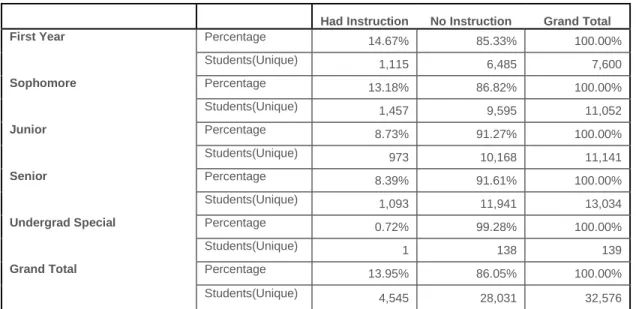
This study enabled the IUB Libraries to model the reach and impact of their in-course instructional programs for the first time. The dataset analyzed contained all course-specific library instruction conducted in the Fall 2014, Spring 2015, Summer 2015, and Fall 2015 semesters, for a total of 224 instructional interventions with 7238 undergraduate students (17% of total enrollment). During AY14-15,1 IUB Libraries’ course instruction sessions reached 14% (4545) of undergraduate
students (Table 1) and 1.3% (138) of undergraduate courses offered. Several academic departments showed particularly high rates of participation in library instruction during this time period, including Business (61 courses, 13.5% of students), Apparel Merchandising and Interior Design (9 courses, 42% of
1 This count is limited to the 2014-2015 academic year in order to avoid double counting students as they move between academic levels (e.g. from first-year to sophomore).
2 students), Biology & Biotechnology (5 courses, 8% of students), Chemistry (2 courses, 11% of students), Human Biology (1 course, 20% of students), and Nursing (1 course, 29% of students).
Had Instruction No Instruction Grand Total
First Year Percentage 14.67% 85.33% 100.00%
Students(Unique) 1,115 6,485 7,600 Sophomore Percentage 13.18% 86.82% 100.00% Students(Unique) 1,457 9,595 11,052 Junior Percentage 8.73% 91.27% 100.00% Students(Unique) 973 10,168 11,141 Senior Percentage 8.39% 91.61% 100.00% Students(Unique) 1,093 11,941 13,034
Undergrad Special Percentage 0.72% 99.28% 100.00%
Students(Unique) 1 138 139
Grand Total Percentage 13.95% 86.05% 100.00%
Students(Unique) 4,545 28,031 32,576
Course-level grades were used to evaluate the impact of library instruction on the student population in general, students grouped by achievement level, and students enrolled in specific courses receiving instruction.
Because course grades do not reflect a normal distribution and tend to skew toward the high end of the 4.0 grading scale for both courses that received library instruction and courses that did not (Fig. 1), a non-parametric Mann-Whitney test was used to evaluate the null hypothesis that the course grade distribution was the same for students in both groups. The result of this test was to reject the null hypothesis (p < .001, at 95% significance). However, the association was very weak (Cramer’s V = .029), suggesting minimal real-world difference between the distributions.
3 A paired samples t-test was then conducted to compare the observed difference in the means of course grades students received in courses that incorporated library instruction (3.317) and those that did not (3.207). The t-test confirmed the difference between the groups, but the effect size was again fairly small (t = -10.454, p < .001, Cohen’s D = .125).
When measured in terms of expected achievement, students in courses receiving library instruction appeared to perform slightly better than expected when comparing their mean in-course GPAs (3.313) to their mean GPAOs (3.269), but with an extremely small effect size ( t = -5.258, p < .001, Cohens D =.063). Increased numbers of library instruction sessions did not increase this effect.
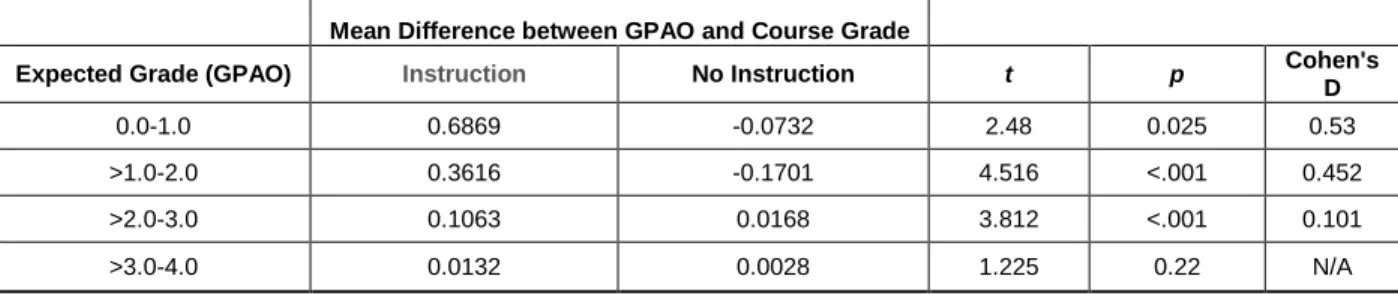
Library instruction initially appeared to have a greater effect on the grades of students at the lower end of the expected performance scale. Students receiving instruction who had expected grades of less than 1.0 and between 1.0 and 2.0 achieved grades an average of 0.69 and 0.36 grade points higher than their GPAO, compared to 0.11 and 0.04 for students with expected grades between 2.0 and 3.0 and between 3.0 and 4.0. A one-way ANOVA comparing these means was significant (F = 22.16, p <.001), but the effect size (eta squared = .01) ultimately indicated very little impact.
A paired samples t-test was conducted on the mean differences between a student’s course grade and their GPAO to evaluate if students in each expected performance band performed better or worse than expected in courses that received library instruction. As shown in table 2, students in 3 of the 4
expected achievement levels performed significantly better in courses that received library instruction. Notably, students in the lower achievement bands appeared to obtain greater benefit in courses that received instruction, and the effect size of the difference in means increases substantially for the two lower achievement bands. This is one of the most interesting findings of this study, and supports the importance of library instruction for students who are performing poorly in their coursework.
4
Mean Difference between GPAO and Course Grade
Expected Grade (GPAO) Instruction No Instruction t p Cohen's
D
0.0-1.0 0.6869 -0.0732 2.48 0.025 0.53
>1.0-2.0 0.3616 -0.1701 4.516 <.001 0.452
>2.0-3.0 0.1063 0.0168 3.812 <.001 0.101
>3.0-4.0 0.0132 0.0028 1.225 0.22 N/A
Tests were next conducted to evaluate the effect of library instruction on course outcomes.
Of the 224 courses that included library instruction, 51 had parallel courses (i.e. courses that had the same course number) that were taught during the same semester but did not receive library instruction. These course pairs were used as a natural experiment to further compare students’ grade outcomes. 19 (37%) of these courses showed significantly different grade distributions between the courses that received library instruction and those that did not using a non-parametric Mann-Whitney test (at p <.05). The Mann-Whitney test was confirmed using a Pearson’s chi-squared test, which showed a significant difference for 13 course pairs (at p <.05). Of these, 8 courses receiving library instruction showed a positive shift in the mean GPA for the course (Table 3). A Cramer’s V statistic was calculated to evaluate the strength of the association for these courses, which ranged from moderate to strong association (.222 to .657). Notably, all but one of these courses are at the 100 or 200 level, suggesting library instruction may be most effective early in a curricular sequence.
Mean GPA
Course Term Instruction Instruction No Mann-Whitney Squared Chi Cramers V
AMID-R404 Fall 2014 3.325 3.152 Y Y 0.441 BIOL-L211 Fall 2015 2.909 2.566 Y Y 0.359 BUS-C104 Fall 2015 3.536 3.264 Y Y 0.255 BUS-C106 Fall 2015 3.756 3.564 Y Y 0.222 BUS-D271 Fall 2015 3.751 3.437 Y Y 0.267 BUS-W212 Spring 2015 3.662 3.340 Y Y 0.439 FOLK-F253 Fall 2015 3.700 3.405 Y Y 0.657 SPEA-E162 Fall 2015 3.548 3.096 Y Y 0.288
These tests were also conducted to compare the grade distributions of students with course instructors who had taught both courses with library instructional interventions and without interventions. Of the 27 instructors in the dataset who met these criteria, only 3 showed a positive shift in grade distributions and significant results for Mann-Whitney and chi-square tests (p<.05). The Cramer’s V statistic for these distributions ranged from moderate to strong association (.315 to .505). Four instructors in this test
Table 2: Differences between obtained grade and expected grade (as measured by GPAO) by expected achievement level.
Table 3: Courses with significant differences between sections receiving and not receiving library instruction. All tests significant at p <.05.
5 group taught courses that had significant results in the parallel courses test. Of these, only 2 had
significant results in both groups, suggesting that the observed impacts of library instruction may instead be an effect of the instructor grading practices.
A stepwise linear regression was conducted the on the eight parallel courses and three instructors that exhibited positive significant effects of library instruction using students’ GPAO, total accumulated credits, and library instruction as predictor variables, and course grade as the dependent variable. While library instruction contributed positively and significantly (p <.05) to the regression model in 5 of the 8 parallel courses and for all three of the instructors, its contribution was small (ranging between explaining between <1% and 10% of the model), especially when compared to GPAO (explaining between 12% and 44% of the model). Total accumulated credits did not significantly contribute to any of the models.
Based on these analyses, it appears that library instruction has little measurable effect on students’ in-course grade outcomes. Nevertheless, these data also suggest that this instruction may have significant impact on specific groups of students and courses. In particular, the finding that library instruction has a greater impact on students in the lower ranges of expected performance indicates that it may be appropriate for the IUB Libraries to focus more instruction efforts on reaching these students.
Reflections about the LAF Process
This study represents the first quantitative exploration of the impacts of IUB Libraries’ instructional programs. Because the Libraries are in this exploratory stage of their learning analytics efforts, it is perhaps not surprising that this study yielded primarily negative results. Nevertheless, this study provided a very useful starting point from which to continue the Libraries’ learning analytics investigations, and revealed several methodological issues that can be addressed in future studies. Given the large number of courses that participate in library instruction, the dataset required to compare students who received instruction and those that did not essentially amounted to IUB’s entire enrollment during the semesters analyzed. This volume of data made the process of disaggregating students and courses for comparison difficult and more time consuming than expected, and resulted in the study not including an evaluation of student retention as was initially proposed.
Due to the complexity of factors that comprise a final course grade, the outcomes of this study also suggest that in-course and other GPA measures are not the most appropriate for assessing the impact of library instruction. For this reason, it is not surprising that a single (or even multiple) library instruction intervention were shown to have a limited effect on grade outcomes. Measures that evaluate student learning objectives at the level of assignments and other artifacts of student work would be more appropriate for evaluating these impacts.
A second problem with the data model used in this study is a lack of specificity or differentiation in the library instruction variable. This study treats all library instruction as the same, but in practice there is a fairly wide range of instructional interventions and intensities. Future studies should consider
developing a rating system that allows more fine-grained evaluation of different types or approaches to instructional interventions.
6
Changes Undertaken, Connections to the Field, and Disseminating the Findings
Due to the lack of significant results in this study, it is not appropriate to recommend curricular changes at this time. The Libraries will continue to track instruction on an ongoing basis in order to expand this dataset, and these analyses will be updated as additional data becomes available. A multi-year dataset will also enable a more rigorous evaluation of the potential effect of library instruction over time and at different points in a student’s course of study. I also hope to add retention variables to this data since I was not able to evaluate these outcomes as planned.
In addition to expanding this initial dataset, I plan to conduct a second study in 2017 that evaluates the impact of the Libraries information literacy instruction on student learning outcomes using assignment-level artifacts produced by students in research-oriented courses.
The results of this study will be shared with instructional librarians and with IUB Libraries’
administration, and will also be used in outreach to faculty members while planning library course instruction and setting instructional goals.
The full dataset and SPSS syntax files of this analysis will be made available for reuse.