Kyung-Wook Hwang
Submitted in partial fulfillment of the requirements for the degree
of Doctor of Philosophy
in the Graduate School of Arts and Sciences
COLUMBIA UNIVERSITY
Kyung-Wook Hwang All Rights Reserved
Design of Scalable On-Demand Video Streaming
Systems Leveraging Video Viewing Patterns
Kyung-Wook Hwang
The explosive growth in on-demand access of video across all forms of delivery (Internet, traditional cable, IPTV, wireless) has renewed the interest in scalable delivery methods. Approaches using Content Delivery Networks (CDNs), Peer-to-Peer (P2P) approaches, and their combinations have been proposed as viable options to ease the load on servers and network links. However, there has been little focus on how to take advantage of user viewing patterns to understand their impact on existing mechanisms and to design new solutions that improve the streaming service quality.
In this dissertation, we leverage on the observation that users watch only a small portion of videos to understand the limits of existing designs and to optimize two scalable approaches — the content placement and P2P Video-on-Demand (VoD) streaming. Then, we present our novel scalable system called Joint-Family which enables adaptive bitrate streaming (ABR) in P2P VoD, supporting user viewing patterns.
We first provide evidence of such user viewing behavior from data collected from a na-tionally deployed VoD service. In contrast to using a simplistic popularity-based placement and traditionally proposed caching strategies (such as CDNs), we use a Mixed Integer Pro-gramming formulation to model the placement problem and employ an innovative approach that scales well. We have performed detailed simulations using actual traces of user viewing sessions (including stream control operations such as pause, fast-forward, and rewind). Our results show that the use of segment-based placement strategy yields substantial savings in both disk storage requirements at origin servers/VHOs as well as network bandwidth use. For example, compared to a simple caching scheme using full videos, our MIP-based placement using segments can achieve up to 71% reduction in peak link bandwidth usage.
abandonment can result in increased interruptions and wasted resources. As a result, we reconsider the set of policies to use in the presence of abandonment. Our goal is to balance the conflicting needs of delivering videos without interruptions while minimizing wastage. We find that an First chunk selection policy in conjunction with the Earliest-Deadline peer selection policy allows us to achieve high download rates. We take advantage of abandonment by converting peers to “partial seeds”; this increases capacity. We minimize wastage by using a playback lookahead window. We use analysis and simulation experiments using real-world traces to show the effectiveness of our approach.
Finally, we propose Joint-Family, a protocol that combines P2P and adaptive bitrate (ABR) streaming for VoD. While P2P for VoD and ABR have been proposed previously, they have not been studied together because they attempt to tackle problems with seemingly orthogonal goals. We motivate our approach through analysis that overcomes a misconcep-tion resulting from prior analytical work, and show that the popularity of a P2P swarm and seed staying time has a significant bearing on the achievable per-receiver download rate. Specifically, our analysis shows that popularity affects swarm efficiency when seeds stay “long enough”. We also show that ABR in a P2P setting helps viewers achieve higher playback rates and/or fewer interruptions.
We develop the Joint-Family protocol based on the observations from our analysis. Peers in Joint-Family simultaneously participate in multiple swarms to exchange chunks of different bitrates. We adopt chunk, bitrate, and peer selection policies that minimize occurrence of interruptions while delivering high quality video and improving the efficiency of the system. Using traces from a large-scale commercial VoD service, we compare Joint-Family with existing approaches for P2P VoD and show that viewers in Joint-Joint-Family enjoy higher playback rates with minimal interruption, irrespective of video popularity.
1 Introduction 1
1.1 Leveraging Video Viewing Patterns for Scalable Streaming Systems . . . 2
1.1.1 Optimal Video Segment Placement . . . 2
1.1.2 User Abandonment and its Impact on P2P VoD . . . 5
1.2 Enabling Adaptive Bitrate Streaming in P2P VoD . . . 7
1.3 Overview of the Dissertation . . . 9
2 Related Work 11 2.1 User Behavior in Online Video Watching . . . 11
2.2 Content Placement . . . 12
2.3 Abandonment and its Impact on P2P VoD . . . 14
2.4 Adaptive Streaming in Multi-swarm P2P VoD . . . 15
I Leveraging Video Viewing Patterns for Scalable Streaming Systems 17 3 User Behavior in Online Video Viewing 19 3.1 Description of Data Set . . . 19
3.1.1 Trace Data . . . 19
3.1.2 Limitations of our data . . . 20
3.2 Motivation for Placing Video Segments . . . 22
3.2.1 Most Requests Are Concentrated on Popular Videos . . . 23
3.2.2 Most Users Watch Fraction of a Video . . . 23
3.2.3 Correlation between NLV and Video Properties . . . 24
4.1.1 Problem Formulation . . . 28
4.1.2 Managing the Scale of the MIP . . . 31
4.2 Experimental Evaluation . . . 32
4.2.1 Experiment Setup . . . 32
4.2.2 Working Set Size . . . 34
4.2.3 Maximum and Aggregate Link Bandwidth . . . 35
4.2.4 Number of Replicas . . . 37
4.2.5 Hops Traversed . . . 39
4.2.6 Disk and Bandwidth Tradeoff . . . 39
4.2.7 Effect of Segment Size . . . 40
4.2.8 Cache Dynamics . . . 41
5 User Abandonment and its Impact on P2P VoD 43 5.1 Abandonment and P2P VoD . . . 43
5.1.1 Abandonment in Trace Data . . . 43
5.1.2 Chunk Selection Policy . . . 44
5.1.3 Peer Selection Policy . . . 45
5.1.4 Handling Free Riding . . . 46
5.1.5 Using “Partial” Seeds . . . 47
5.1.6 Reducing Wastage by Limiting Playback Lookahead . . . 48
5.2 Abandonment Analysis . . . 48
5.2.1 Swarm Population . . . 50
5.2.2 Useful Download Rates . . . 52
5.3 Experimental Evaluation . . . 54
5.3.1 Data Set . . . 54
5.3.2 Experiment Setup and Assumptions . . . 55
5.3.3 Impact of Abandonment . . . 58
5.3.4 Utilizing Partial Seeds . . . 64
5.3.5 Minimizing Wastage . . . 65
6 JOINT-FAMILY: Adaptive Streaming in Multi-swarm P2P VoD 70
6.1 Analysis of P2P Systems for VoD and Adaptive Streaming . . . 70
6.1.1 Assumptions . . . 70
6.1.2 Popularity, Download Rate, and Seed Staying Time . . . 71
6.1.3 Caching to Increase Staying Time and Download Rate . . . 75
6.1.4 Adaptive Bitrate Analysis . . . 78
6.2 JOINT-FAMILY Design . . . 80
6.2.1 Overview . . . 81
6.2.2 Protocol Mechanisms for Multi-Swarm P2P . . . 82
6.2.3 Chunk Selection and Rate Adaptation . . . 84
6.2.4 Earliest-Deadline (ED) Peer Selection . . . 86
6.3 Performance Evaluation . . . 86
6.3.1 Experiment Setup . . . 86
6.3.2 Joint-Family vs. Server-based ABR . . . 88
6.3.3 Joint-Family vs. State-of-the-art P2P . . . 88
6.3.4 Performance Improvement with ABR . . . 92
6.3.5 Effect of Multiple Swarms . . . 94
6.3.6 Impact of Chunk and Peer Selection Policies . . . 95
6.3.7 Effect of Heterogeneous Peers . . . 96
III Conclusions and Future Work 98 7 Conclusions 99 7.1 Future Work . . . 101
IV Bibliography 104
Bibliography 105
3.1 Cumulative distribution of the NLVs with different session resumption
thresh-olds Tr. . . 20
3.2 Typical signature of a video with free preview. . . 21
3.3 Fraction of viewer requests for all videos in the library (Zipf distribution). Rank 100% corresponds to the least popular video. . . 22
3.4 Cumulative distribution of requests to video of different sizes. The plot also shows the cumulative distribution of requests with different lengths viewed. 23 3.5 Scatterplot of averaged NLV for each video of different lengths. One point represents a single video. . . 24
3.6 Cumulative distribution of NLV for different classes of video lengths. . . 24
3.7 Scatterplot of NLV for videos of decreasing popularity. (Rank 100% corre-sponds to the least popular video.) . . . 25
3.8 Scatterplot of video length for videos of decreasing popularity. . . 25
3.9 Cumulative distribution of the NLVs for free and priced videos. . . 26
4.1 Fraction of working set size to the entire library size at each VHO. . . 35
4.2 Link bandwidth utilized across all links, computed every 5 minutes (the or-dering of the curves is the same as in the legend). . . 36
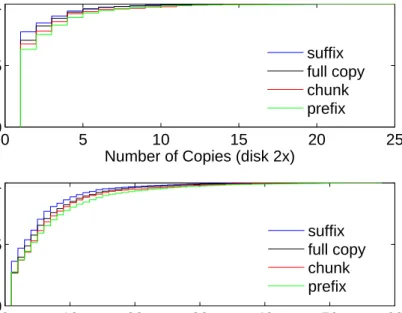
4.3 Cumulative distribution of the number of replicas created by the MIP based approach when the available disk is 2x and 6x library sizes. . . 37
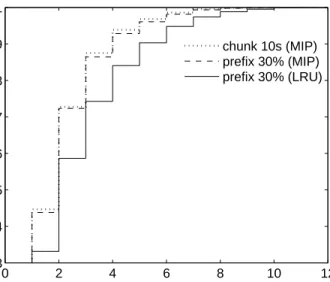
4.4 Cumulative distribution of the number of hops traversed when transferring content (segments) remotely. . . 38
5.1 Cumulative distribution of normalized length viewed of all requests in trace
data . . . 44
5.2 Useful download rate of EF vs β (µ1= 0.01) . . . 53
5.3 CDF of viewed length for 8 videos . . . 55
5.4 Number of concurrent sessions for a random video in the real trace. . . 55
5.5 Comparing NITs of different combination of chunk- and peer- selection poli-cies when user abandonment exists and when it does not (with 95% confidence interval). . . 57
5.6 Average NITs of each peer group divided based on viewed length. The initial seed capacity is 3Mbps. . . 58
5.7 Cumulative distribution of NITs when user abandonment exists and when it does not, respectively. . . 59
5.8 The fraction of demand (in terms of bytes) satisfied by the initial seed over time. . . 60
5.9 Number of concurrent downloads of a peer over time. The solid curve ends at 1610 seconds. . . 61
5.10 NITs of 1000 peers sorted in their arriving order . . . 62
5.11 Average NITs of each peer group divided based on viewed length. The syn-thetic trace used. . . 63
5.12 Seed staying time from trace . . . 64
5.13 NITs of three different schemes in presence of abandonment as a function of partial seed staying time. . . 64
5.14 Average NITs of each peer group divided based on viewed length (µ1=µ2). ED+EF used. Real trace used. . . 65
5.15 Average NITs of each peer group divided based on viewed length (µ1=µ2). ED+EF used. Synthetic trace. . . 65
5.16 CDFs of leecher download rate (µ1 =µ2). 1/µ2 = 0 indicates partial seeds leave immediately after abandoning. . . 66
6.1 Download rate as a function of λwith 1/γ= 3600 secs. (X axis in log scale) 75 6.2 Download rate as a function of seed staying time 1/γ. (Y axis in log scale) 75 6.3 Caching multiple videos: each download rate is divided by the download rate
when c= 1. (1/γ= 3600 secs) . . . 77
6.4 Download/playback rate vs. arrival rate with different chunk bitrates . . . . 78
6.5 Validation of ABR analysis using simulation . . . 80
6.6 A peer in Joint-Family participates in multiple swarms. . . 81
6.7 Flow chart for bitrate adaptation . . . 85
6.8 Comparison between Joint-Family and the state-of-the-art P2P system (group 1: the set of most popular videos). . . 90
6.9 Effect of seed staying time (1/γ) for JF, c= 5 . . . 91
6.10 Rate adaptation with ABR . . . 92
6.11 Rate adaptation when the link bandwidth available at a sample peer changes over time . . . 93
6.12 Aggregate upload bandwidth for Joint-Family and BT VoD . . . 94
6.13 Video popularity and the effect of cache size (c) . . . 94
6.14 Interruption time with different chunk- and peer-selection policies . . . 96
6.15 CDF of interruption time for each interruption . . . 96
6.16 Playback rate of Joint-Family for heterogeneous peers . . . 97
4.1 Input parameters and decision variables used in the MIP . . . 29
4.2 Total bytes transferred from remote locations for different prefix sizes (in TB) 40 4.3 Total served bytes for different segment sizes (in TB) . . . 41
4.4 Cache dynamics for the different schemes over the last 7 days (in TB). . . . 41
5.1 Parameters and Definition for Analysis . . . 49
5.2 Simulation parameters and their default values. . . 56
6.1 Parameters and Definition . . . 71
6.2 Simulation parameters . . . 87
6.3 Playback rates and interruption time with server-based ABR scheme and Joint-Family . . . 89
6.4 Interruptions count with ED and TFT . . . 96
I would like to express my sincere gratitude to my advisors Vishal Misra and Dan Rubenstein who led me throughout the process of doing research, provided encouragement and support, and were so wonderful in helping me through difficult problems. I was truly fortunate to pursue the doctoral program under their guidance. I am deeply grateful to Dr. K. K. Ramakrishnan for his priceless advices and guide throughout many projects. I deeply thank my research collaborators, Vijay Gopalakrishnan, Rittwik Jana, and Seungjoon Lee for their valuable discussions and insightful feedback. I dedicate this thesis to my wife Joohyun whose love and understanding made me finish this thesis, and my parents who have always supported me in everything.
Chapter 1
Introduction
Video-on-Demand (VoD) has grown rapidly as the leading source of Internet traffic. Recent estimates [san, 2013] show that it accounts for about 62.0% of peak aggregate traffic (up from 29.5% in 2009) in North America. This increasing demand put significant pressure on content delivery systems requiring more costs of sustainable infrastructure such as disk storage and network bandwidth, in order to satisfy as many end users as possible. There has been renewed interest in scalable approaches for delivering videos. However, there has been little focus on how to take advantage of user viewing patterns to understand their impact on existing mechanisms and to derive new solutions that improve the streaming service quality.
In this dissertation, we leverage on the observation that users watch only a small portion of videos (we call this behavior abandonment) to understand the limits of existing designs and to optimize two scalable approaches — the content placement and Peer-to-Peer (P2P) VoD streaming. Then, we present our novel scalable system called Joint-Family which enables Adaptive Bitrate streaming (ABR) in P2P VoD, supporting user viewing patterns. In the first part of the dissertation, we characterize user viewing behaviors using data collected from a real-world commercial VoD service. We provide proof that users watch only a small portion of videos (not just for short clips, but even with full-length movies). Based on this information, we explore how to take advantage of user viewing patterns to place content in provider networks to reduce their storage and network utilization. We use a optimization.
Moreover, we contend that the policies used in existing P2P VoD systems are not opti-mized because they have not taken user viewing patterns and viewers abandon prematurely. We show that the chunk selection and the peer selection policies are interdependent. They need to be addressed holistically and improved upon.
In the second part of the dissertation, we propose Joint-Family, a P2P streaming video delivery system that has peers participating in multiple swarms simultaneously, uses Earliest-First as the chunk selection policy, and Earliest-Deadline as the peer selection pol-icy. We show analytically why our policies are suited for P2P VoD. Joint-Family with its seamless multiswarm approach enables P2P systems to support adaptive bitrate videos by leveraging resources across multiple swarms.
1.1
Leveraging Video Viewing Patterns for Scalable
Stream-ing Systems
1.1.1 Optimal Video Segment Placement
To keep up with the explosively increasing demand on streaming videos, content providers have adopted a range of approaches including Content Distribution Networks (e.g., Aka-mai, Limelight), Peer-to-Peer based delivery (e.g., PPLive, PPStream, Zattoo) or hybrid combinations of the two (e.g., LiveSky [Yin et al., 2009b]). Cable and Internet television (IPTV) providers use networks similar to content distribution networks for distributing and delivering on-demand content.
Despite the differences in the actual delivery mechanism, there is one common factor: Most of these approaches focus on content delivery and ignore storage. Instead they assume that a full copy of the content is stored in multiple, if not all, locations. These include the origin servers in case of content distribution networks (CDNs) or Video Hub Offices (VHOs) in the case of cable and IPTV providers.
Intelligent storage, however, can significantly reduce cost and improve delivery efficiency. It has been known for a while that content popularity is significantly skewed [Guo et al., 2007a; Yu et al., 2006; Yinet al., 2009a]; as a result not every video needs to have an equal number of copies. More importantly, there is increasing evidence that users do not watch
entire videos [Yu et al., 2006; Yin et al., 2009a; Liet al., 2011]. Whether it is short clips, or full movies, users stop watching the video prematurely. Such behavior is consistent with a well established finding in psychology that people often make judgments about a subject without evaluating all aspects of the subject [Banaji and Hardin, 1996]. Further, with the ability to skip or replay portions of the video, users tend to skip portions of the video they watch [Gopalakrishnan et al., 2011]. This, we argue, is crucial evidence against storing full videos in multiple locations.
Storage is cheap, so why bother? Despite the falling prices of storage, we believe that it is worthwhile to consider storing portions of the video in most locations. First, although the cost of consumer storage has fallen significantly, enterprise grade storage, as needed by a high performance and highly available streaming solution is many orders more expensive. Specifically, while it is possible to purchase a 2TB hard disk around 100 USD today, the cost of carrier grade storage servers with the same disk capacity can be higher by two orders of magnitude (e.g., 30K USD) [sun, 2010]. Most of the cost comes from the strict redundancy requirements and the sustained streaming rate needed for video delivery. Second, to cater to growing demand and to gain competitive advantage, providers have been growing their library catalogues at a rapid rate [com, 2010]. Third, transferring this ever increasing number of videos to all the locations and storing them there, especially when not all of the data will be viewed, is not just inefficient but also strains the distribution system. Finally, storing portions of the video opens up opportunities toscale the library significantly for the same amount of disk space.
In this dissertation, we seek to leverage users’ viewing patterns to design a more efficient video placement strategy. Ideally, we want to identify small portions for each video that can satisfy a large number of requests. By replicating those portions in multiple places, we can maximize the number of requests that are satisfied locally with minimum disk usage.
Various studies have looked at the problem of content placement. For example, many approaches [Borst et al., 2010; Baevet al., 2008; Valancius et al., 2009] use optimization-based techniques to guide placement. These, however, resort to heuristics to solve the problem or ignore important constraints such as link bandwidth. As a result, simple caches [Yinet al., 2009b; Allenet al., 2007] and cache replacement policies [Allenet al., 2007;
Wu and Li, 2009] have been used within the CDN, cable network, or at the clients. Caching, however, can only be successful if the available cache is large enough to store the “working set”. This working set is the set of unique videos requested over a time window. As we show in Section 3.2, the working set size at a location can be as large as 50% of the entire library. In this setting, smaller caches result in significant churn, rendering the cache ineffective.
Our design and analysis of Joint-Family makes the following essential contributions to the field of streamed VoD:
• We first analyze video access data from a nationally deployed VoD service and confirm that many requests indeed consume small fractions of videos (Section 3.2). We provide a detailed analysis of how viewers watch videos and describe how their usage changes across different parameters such as video size and popularity. Based on this finding, a natural approach is to break a video into multiple segments, which become units of storing and fetching content in our system. In this we study the advantages gained by two approaches: (a) splitting a video into a prefix and a suffix, and (b) splitting the video into fine-grained segments (e.g., chunks as in P2P systems).
• Instead of heuristics [Borst et al., 2010; Baev et al., 2008; Valancius et al., 2009] or caching [Allen et al., 2007; Wu and Li, 2009], we use a mixed integer program (MIP) formulation, whose solution guides how to place each segment across different locations (Section 4.1). The MIP formulation takes a projected demand for each segment, a disk constraint at each location, and a bandwidth constraint for each link, and computes a solution that minimizes the overall network utilization. While the formulation and the solution technique draw from our previous work [Applegate et al., 2010], the problem of placing segments adds new challenges. For example, with chunks, the scale of the problem grows so large that even the approach in our earlier work [Applegateet al., 2010] is not able to solve the MIP quickly. As a result, we try to cluster different chunks into groups and place these groups.
• We use detailed simulation experiments and compare our optimal placement approach against alternate schemes (Section 4.2). Our results show that, there is tremendous benefit to storing just portions of a video. For example, chunk-based MIP placement
can achieve 71% reduction in peak link bandwidth usage over LRU caching with full-length videos and 52% reduction over MIP placement of full-full-length videos. Even simply utilizing prefixes in the MIP-based placement results in up to 62% reduction in peak link bandwidth usage.
1.1.2 User Abandonment and its Impact on P2P VoD
Peer-to-peer (P2P) systems have become part of the mainstream content distribution envi-ronment, improving the viewing experience by utilizing the upload capacity of the download-ing nodes, thereby increasdownload-ing overall upload capacity. Even traditional Content Distribution Network (CDN) providers such as Akamai [Maggs, 2012] are choosing to experiment with and deploy P2P-based delivery of video content.
and is being considered for commercial deployment VoD services [Maggs, 2012]. Much of this progress can be attributed to previous research identifying the set of policies that enable robust and scalable P2P delivery systems. In this dissertation, we consider the problem of viewers abandoning videos part way through the viewing of the video. While mostly overlooked so far, we show that abandonment (also called viewer engagement in other work [Dobrianet al., 2011]) is a critical factor to consider since it directly affects the impact of various policies used for P2P VoD.
The two most important policies that determine P2P performance are the chunk- and peer-selection policies. File sharing systems have traditionally used a combination of Tit-for-Tat (TFT) as the peer selection and Rarest-first (RF) as the chunk selection as this combination offers the best tradeoff in terms of performance and fairness. Unfortunately, this combination does not work as well with streaming video, be it live or on-demand, since a video is generally consumed sequentially. Instead, an Earliest-First (EF) policy is a more natural chunk selection policy for video streaming. EF, however, is incompatible with TFT as peers in different points of playback have very little content of mutual interest to exchange with each other. As a result, there has been a lot of work to identify hybrid chunk selections strategies (e.g., EF+RF) [Zhou et al., 2007; Fan et al., 2010; Borghol et al., 2010; Carlsson and Eager, 2007; Vlavianoset al., 2006; Shah and Paris, 2007] that find a compromise between the need of streaming to get sequential data and TFT’s need for
diversity.
While the design of EF+RF implicitly assumes that viewers watch entire videos, recent studies [Yin et al., 2009a; Li et al., 2011] show that viewers of both short clips and full-length movies often watch only a small portion of a video and abandon the video part way through. Such abandonment may be attributed to how users find movies of interest (e.g., surfing for interesting content) or the possibility that a viewer loses interest in the content. Such viewer abandonment of videos has significant implications on the design of P2P policies. For example, peers using EF+RF may end up downloading rare chunks that they do not actually watch later due to abandonment. In this case, it would be more beneficial to use that upload capacity to deliver chunks that peer immediately need, to improve video playback experience and reduce unnecessary bandwidth consumption.
In this dissertation, we reconsider the set of chunk and peer selection policies to use in real-world P2P VoD systems with viewer abandonment (Section 5.1). We show that EF is a more appropriate chunk selection strategy in the presence of abandonment. Instead of using TFT, we introduce Earliest-Deadline (ED) as the peer selection strategy. In ED, a node picks peers with the earliest deadline among chunks when deciding which request to serve. Choosing ED not only gives us substantial performance improvement (as seen in our experiment results), but also allows us to break the inter-dependence between chunk- and peer selection that TFT introduces. While EF itself reduces wasted download compared to EF+RF, we introduce the notion of a playback lookahead window (PLA) to further limit the download rate, as is used in HTTP streaming [Akhshabi et al., 2011; Raoet al., 2011]. The window is sized such that when it is full, the user will not encounter interruptions. At the same time, users do not request any more data than needed to avoid “wasting” bandwidth in case they abandon the video.
Note that while the properties of churn and abandonment are similar in philosophy, there are still subtle differences. In particular, with abandonment, users do not necessarily leave the system. Instead they may stay connected and watch a different video after a short period of time, or even stay idle in the system. Instead of treating abandonment as a departure, we take advantage of the peer’s staying connected by getting it to continue to participate in the swarm as a “partial seed” until the user watches the next video. We
define a partial seed as a peer that does not have the entire video, but is not actively watching (and downloading) the video. These partial seeds continue to serve requests for the chunks they have downloaded already, and thus contribute to increasing the overall system capacity. We show using an analytical model accounting for abandonment and partial seeds (in Section 5.2) that the partial seed staying time significantly influences the swarm’s performance. We evaluate our design using detailed simulations based on traces of user requests collected from a nationally deployed VoD service (Section 5.3).
In this dissertation, we make the following important contributions:
• Through trace-driven simulations, we show that existing P2P VoD systems do not perform well in presence of abandonment. They experience more interruptions com-pared to when users watch videos entirely. More importantly, we show that viewers that watch more of the video experience severe interruptions.
• In contrast to previous findings, our results show that with abandonment, a hybrid policy of EF+RF performsworse and results in longer interruption periods than EF. With EF, using ED instead of TFT brings significant performance enhancements.
• We develop a detailed analytical model that accounts for abandonment and partial seeds and show that “useful” download rate of EF effectively improves as partial seeds stay longer.
• We show that the combination of ED, EF, and partial seeds can significantly improve overall video playback performance, while PLA further reduces wasted bandwidth consumption.
1.2
Enabling Adaptive Bitrate Streaming in P2P VoD
The ever-increasing demand placed by streamed video traffic across both wired and wireless networks has been managed by two seemingly complementary approaches: adaptive bitrate (ABR) [ss, 2010; ado, 2010], and P2P delivery [joo, ; uus, ]. ABR encodes a video at multiple bitrates, and maximizes the video bitrate within the available bandwidth, giving a higher fidelity video when possible, and dropping to lower quality rather than forcing an
interruption of playback. P2P-based systems are a popular alternative to deliver on-demand videos as explained in the previous subsection. Intuitively, these two orthogonal approaches are not well-suited to work together, because viewers watching the video at differing rates are presumably unable to exchange video parts with one another. Hence, it appears that enabling ABR interferes with the ability for peers to share video parts with one another.
In this dissertation, we show that, contrary to current intuition, ABR and P2P can effectively be combined in a way that achieves the best of both worlds: P2P techniques im-prove upload capacity, and ABR enables the highest quality viewing at that capacity. Using a combination of analysis and simulations, we demonstrate the performance improvements offered by our novel design, which we call Joint-Family, and compare it to existing P2P video-on-demand (VoD) systems.
Our design and analysis of Joint-Family makes the following essential contributions to the field of streamed VoD:
• We identify a misleading generalization of the conclusion of previous fluid modeling efforts [Qiu and Srikant, 2004] that popularity of a stream does not have bearing on its effective download capacity. We also identify the conditions that contradict the conclusion of these models. We show that with ”sufficiently long” staying times,
content popularity in fact affects swarm efficiency, yielding that more popular swarms have higher download rates than less popular swarms (Section 6.1.2).
• We analyze the effectiveness of caching previously watched videos and sharing them as a mechanism to extend seed staying time (Section 6.1.3). With caching we can also transfer underutilized capacity from one swarm to another and thereby improve global performance.
• We show how ABR, when combined with P2P, enables a swarm to efficiently adapt to the best encoding rate, withouta prioriknowledge of the video’s popularity. (Section 6.1.4) We use our Markov model to show that ABR allows P2P swarms to migrate to the highest sustainable rate for that swarm: highly popular content will induce large swarms and have a high sustainable download capacity, whereas less popular content will have smaller swarms and a lower sustainable download capacity.
• Based on our analytical observations, we design a novel protocol called Joint-Family to deliver high-quality videos with minimal interruptions in a P2P system, using multi-swarm participation and ABR (Section 6.2).
A peer in Joint-Family caches and shares multiple ABR videos using storage space at the end system, and increases capacity of swarms (especially for unpopular videos) by sup-plementing it with (unused) peer capacity. Hence, the peer participates in multiple swarms concurrently, and shares different parts of the ABR video at multiple bitrates. To support this, we identify the right combination of chunk selection, peer selection, and bitrate adap-tation policies that minimize interruptions. Our design makes Joint-Family immediately suitable for existing VoD infrastructures in which the provider owns the distribution in-frastructure (e.g., CDNs [Maggs, 2012], IPTV [UVe, ]). We also describe how the protocol can be applied in a decentralized setting by utilizing mechanisms that encourage sharing of content [Piateket al., 2010]. We conduct extensive performance evaluations of Joint-Family using traces from a nationally deployed VoD service (in Section 6.3), and show that ABR with P2P is indeed feasible. Compared to a generalized implementation of the state-of-the-art in P2P VoD, our instantiation of Joint-Family delivers high quality VoD streaming, even for unpopular videos, with minimal interruptions.
1.3
Overview of the Dissertation
This dissertation consists of two main parts. In Part I (Chapters 3, 4, and 5), we present user viewing patterns and our new approaches to video placement and P2P VoD that account for viewing patterns. Section 3.1 describes the real-world data set used in our study. We then analyze the data and present how videos are watched in Section 3.2. Section 4.1 presents the mixed integer program (MIP) that we use to determine the optimal content placement, and in Section 4.2 we evaluate the performance of our segment-based video placement through experiments. In Section 5.1, we re-evaluate key policies and design decisions for P2P VoD by taking viewer abandonment into account. We then analyze in Section 5.2 how abandonment affects the performance in P2P VoD. Section 5.3 evaluates our P2P VoD design that supports abandonment.
Part II (Chapter 6) presents our novel scalable system Joint-Family. Section 6.1 analyti-cally shows how video popularity, the staying time of peers, and caching help increase system capacity. Also we analyze how adaptive bitrate can further improve the playback quality. Section 6.2 describes Joint-Family protocols, and Section 6.3 evaluates the performance of Joint-Family and compares it to state-of-the-art P2P approaches.
Chapter 2
Related Work
We discuss previous works on the design and analysis of video streaming systems and protocols. We first describe previous study related to user behavior or patterns in online video viewing (Section 2.1) since we seek to leverage users’ viewing patterns to design more efficient video-on-demand (VoD) systems. We then present previous works on video caching and optimal video placement (Section 2.2) before we introduce our optimal video segment placement strategy in Chapter 4. We then review existing P2P VoD systems focusing on their main policies and design selections (Section 2.3), and we show in Chapter 5 that those existing schemes for P2P VoD do not perform well when users abandon a video part-way. Finally, we present the recent use of adaptive bitrate (ABR) video streaming which have been frequently adopted in practice (Section 2.4), and we show in Chapter 6 that Joint-Family’s multi-swarm solution is a perfect match for the needs of ABR video distribution in P2P environment.
2.1
User Behavior in Online Video Watching
With more and more deployments of cable, IPTV, and P2P-based VoD systems cropping up, there has been a large amount of data to study different aspects of how users watch the videos. Yu et al. [Yu et al., 2006] study the user behavior in PowerLive, a VoD system deployed in China. Huang et al. [Huanget al., 2008] study different aspects the PPLive [ppl, ] P2P VoD system. Yin et al [Yinet al., 2009a] study user behavior using the data collected
from VoD access to the 2008 Beijing Olympics. Gopalakrishnan et al. [Gopalakrishnan et al., 2010] study how users use the DVD-like operations (e.g., skip, fast-forward, rewind) in a large-scale VoD system. Especially, Yin et al. [Yin et al., 2009a] and Li et al.[Li et al., 2011] present a measurement study on viewer abandonment in a large scale landline-based and mobile-based IPTV services provider, respectively. They both demonstrate that users often watch only a small portion of a video. In Chapter 3 we provide concrete evidence to viewer abandonment by measuring how often users abandon videos and how much of a video they watch, and we also study how user behavior correlates to different aspects such as video length and popularity.
Aalto et al. [Aalto et al., 2011] analyze viewer abandonment in P2P VoD with limited simulation scenarios for model verification. Our work in Section 5.2 analyzes the contribu-tion of ”partial seeds” and performs practical evaluacontribu-tion with real traces to measure impact of abandonment in the real world.
2.2
Content Placement
Work related to our optimal video segment placement (Chapter 4) can be divided into two broad categories: work on full video and prefix caching, and work on optimal content placement. We describe each of these areas here.
Utilizing Video Prefixes Despite the lack of concrete evidence, the notion of taking advantage of prefixes is not new. Previous studies typically have focused oncachingprefixes of videos, either for fast startup, or to reduce cache space. Sen et al. [Sen et al., 1999] and Zhang et al. [Zhang et al., 2000] propose caching an initial prefix of video to provide fast start-up, deal with jitter, and reduce server load. Park et al. [Park et al., 2001] propose a caching scheme that stores a portion of the entire video, where the amount of video cached is determined by its popularity. Wang et al. [Wanget al., 2002] attempt to minimize aggregate network bandwidth by analytically determining the optimal proxy prefix cache. Wu et al. [Wuet al., 2001] propose partitioning videos into exponentially increasing segments and caching these segments. They also propose cache admission and replacement strategies that determine which segments to cache and which ones to replace. More recently, Huang
et al. [Huang et al., 2007] and Allen et al. [Allen et al., 2007] study the use of P2P nodes for caching videos. The goal of both approaches is to reduce server load by using peers to serve the content. All these approaches rely on servers when content delivery from caches or peers is not possible. In contrast, our focus is on placing content among the backend servers and to take advantage of client viewing patterns among these backend servers.
Optimal Placement Approach Content placement and replication has, in general, been a topic of extensive research. Qiu et al. [Qiuet al., 2001] consider the problem of positioning web server replicas to minimize the overall cost. Other work [Barbir et al., 2003; Alzoubi
et al., 2008] focuses on how to direct user requests to the “best” among replicated servers (also known as request routing). Most existing work focuses on minimizing latency given constraints (e.g., server capacity), but do not consider network link capacity constraint. There have also been several efforts to address the problem of content placement using analytical framework. Valancius et al. [Valanciuset al., 2009] propose an LP-based heuristic to identify which videos and how many replicas to be placed at customer home gateways. Borst et al. [Borst et al., 2010] focus on minimizing link bandwidth utilization assuming a tree structure with limited depth. Both proposals focus on a network structure that connects consumers to the server. In contrast, we consider placing content in the backbone networks with diverse disk and link bandwidth constraints. Baev et al. [Baev et al., 2008] consider the data placement problem where the objective is to minimize the cost without taking bandwidth into account. They prove that their problem is NP-hard via a reduction to the uncapacitated facility location problem. Since the data placement problem is a special case, our problem is also NP-hard. Baev et al. also show that when object length is not the same, even deciding feasibility is NP-hard, and no approximation algorithm is possible unless P=NP. Our problem is strictly more complex, since we also consider link constraints. We also find provably-good solutions (e.g., within 1% of optimal) on instances arising from real-world large-scale systems dealing with diverse objects. Zhou and Xu [Zhou and Xu, 2002] consider the problem of minimizing the load imbalance among servers subject to disk space and server network bandwidth constraints. Their work only considers the egress link capacity from servers.
2.3
Abandonment and its Impact on P2P VoD
Our results in Chapter 5 show that viewer abandonment has a significant effect on the performance of existing P2P VoD streaming systems and that existing schemes for P2P VoD should be reconsidered to cope with more realistic demands. In this section, we study some of the key policies and design decisions for previous P2P VoD works.
Chunk Selection: To adapt BitTorrent for streaming systems (either live or VoD), a combination of the rarest first (RF) chunk selection policy and sequential chunk download (EF) has been exploited [Zhouet al., 2007; Hwanget al., 2008; Borgholet al., 2010; Carlsson and Eager, 2007; Vlavianos et al., 2006; Shah and Paris, 2007; Fan et al., 2010]. The specific details of the proposed schemes vary from simple probabilistic hybrid models to using sophisticated network coding techniques. Previous literature claims that achieving balance between system utilization (by RF) and on-line playback (by EF) can substantially improve playback quality. However, we show in Chapter 5 that with viewers’ abandonment, such a hybrid policy greatly degrades the playback performance. We further show that using EF only achieves better playback performance.
Peer Selection: BitTorrent’s TFT is effective for file sharing with its inherent incentive mechanism to encourage a peer’s contribution. However, several prior works [Huguenin et al., 2010; Zhanget al., 2011; Wenet al., 2011; D’Acuntoet al., 2010; Shah and Paris, 2007; Yang et al., 2010; Mol et al., 2008; Guo et al., 2007b] show that TFT is not suitable for streaming applications. This is primarily because chunk selection using RF is not suitable for streaming, and TFT without RF makes it difficult for new peers to contribute to older peers, thus preventing them from fully helping each other. Various peer selection approaches have been proposed for streaming. Shah et al. [Shah and Paris, 2007] modify TFT’s optimistic unchoke, D’Acunto et al. [D’Acunto et al., 2010] make peers act more altruistically, and Wen et al. [Wen et al., 2011] group peers with similar playback points to help each other. To satisfy a viewer’s uninterrupted playback experience, in Section 5.1.3 we replace TFT with the Earliest-Deadline (ED) policy, which ensures that each chunk is delivered to the viewer prior to its deadline.
Limiting Rate to Avoid Wastage: Popular VoD services such as YouTube (using Pro-gressive Download) and Netflix (using Adaptive Bit Rate) have adopted approaches that
limit the amount of video bytes delivered beyond the current playback point so as to limit wastage on network bandwidth and also reduce the load on the network for VoD stream-ing. However, most of these approaches have been applied for server-based environments such as HTTP streaming [Rao et al., 2011], progressive download [Ghobadi et al., 2012; Alcock and Nelson, 2011], and adaptive bitrate streaming [Akhshabiet al., 2011]. A similar capability is desired for P2P VoD streaming. We show in Section 5.3.3 that our approach of having a limited ’look-ahead’ window can also reduce wastage caused by abandonment in P2P systems, while not hurting the viewer’s playback experience.
2.4
Adaptive Streaming in Multi-swarm P2P VoD
In terms of swarm participation, a peer viewing a video typically participates in the swarm only for as long as it is viewing that content. With abandonment, the work done in down-loading the data is wasted if the peer does not view that portion or share it with others. A natural mechanism to improve system capacity and efficiency in such scenarios is to allow a peer to stay and also be in multiple swarms. Also, an important practical considera-tion is that most VoD providers (e.g., Netflix, Hulu) move users between higher and lower quality video chunks based on observed user download rate using Adaptive Bitrate (ABR) streaming.
In this section, we describe related work on multi-swarm P2P and adaptive streaming and show in Chapter 6 that our Joint-Family’s multi-swarm protocol is eminently suitable for the distribution of ABR video.
Multiple Swarms in P2P: While most of the work has improved the performance in a single swarm, little effort has been put on multiple swarms to utilize idle upload/download bandwidth of peers by means of added capacity obtained between swarms. Wu et al. [Wuet al., 2009] and Wang et al. [Wanget al., 2010a] investigate the peer’s bandwidth allocation to contribute across multiple swarms in live streaming but not in VoD. Zhou et al. [Zhouet al., 2011] model inter-swarm data exchange in VoD, however, their implementation requires centralized schemes for estimating the demand and supply for each content piece. Wang et al. [Wanget al., 2010b] focus on adjusting the peer’s inter-swarm contribution based on the
demand, which corresponds to one of the many aspects considered in our work.
Adaptive Streaming: Adaptive bitrate (ABR) streaming has been gaining popularity as a way to enable users to experience the highest quality of videos. ABR dynamically adapts to the user’s network and playback condition. There are several flavors of ABR im-plementations (e.g., MPEG-DASH, Adobe Dynamic Streaming, Microsoft Smooth Stream-ing, Apple HTTP StreamStream-ing, Netflix [Stockhammer, 2011; ado, 2010; ss, 2010; app, 2011; Akhshabi et al., 2011]). While ABR has been used for HTTP server based streaming, the use of P2P systems for ABR are not yet common. Roverso et al. [Roverso et al., 2012] implement ABR in P2P systems for live media only. To the best of our knowledge, we are the first to investigate ABR for P2P VoD.
Scalable video coding (SVC) [Schwarzet al., 2007] is yet another approach that enables end-systems to adapt network conditions. The SVC streams consist of a base layer and mul-tiple enhancement layers where each enhancement layer improves the video quality. SVC can also be supported in P2P systems for VoD. [Castro et al., 2003; Petrocco et al., 2011; R¨uckert et al., 2012; Eberhard et al., 2012] take a multiple description or layered coding approach which causes interdependency of layers per chunk distribution in P2P and which is not directly applicable to ABR or our P2P work. Also, SVC has not been widely imple-mented due to the complexity of decoding on the end-systems, and the additional bandwidth requirements compared to ABR. ABR deployment has far outpaced other alternatives.
Part I
Leveraging Video Viewing Patterns
for Scalable Streaming Systems
Chapter 3
User Behavior in Online Video
Viewing
3.1
Description of Data Set
We first describe the data set used in our study. We then analyze the data and present how videos are watched in the next section.
3.1.1 Trace Data
We obtained trace data collected for 16 days in January of 2010 from a nationally deployed video-on-demand service. This trace includes over 13 million requests for both free and paid videos belonging to various classes including music videos and trailers, TV shows, and full length movies. A record in this anonymized trace data includes information such as the requested video ID (typically a hash of the content), its length, its price, the time of request, and the video server serving request (i.e., the Video Hub Office (VHO)). It also contains information about the set of DVD-like operations that the user performed while watching the video in a given session (i.e., timestamps when the user started watching the video and when they stopped watching it).
Note that a session duration may be longer than the video length because the user may have re-wound or paused the video. Further, the actual amount of video watched is quite
0 0.2 0.4 0.6 0.8 1 0 0.2 0.4 0.6 0.8 1
Normalized Length Viewed
Probability
0 (no resumption) 5 minutes 1 hour 4 hours
Figure 3.1: Cumulative distribution of the NLVs with different session resumption thresh-olds Tr.
different from the session duration or even the video length. To get an accurate estimate of how much of the video was actually watched, we included the time spent in fast-forward, rewind, pause, SKIP, and REPLAY. For example, suppose that a user spends the first 4 minutes fast-forwarding the video at 2x speed and then watches another minute before stopping the session. While the session length is 5 minutes, the amount of video consumed is 9 minutes. We measure the actual length of the video watched as a fraction of the video length and call it theNormalized Length Viewed (NLV). In the above example, if the length of the video is 30 minutes, then NLV is 9/30=0.3.
3.1.2 Limitations of our data
Our data has certain limitations. Here we describe relevant limitations and how we address them.
3.1.2.1 Session Resumption
The VoD service allows users to watch a video partially and continue at a later time. However, our data did not clearly identify if a particular session by a user was a new one or
0 500 1000 1500 2000 2500 3000 3500 0 50 100 150 200 250
Length Viewed (secs)
Number of Sessions
Figure 3.2: Typical signature of a video with free preview.
the resumption of a previous session. To overcome this, if a user requests the same video in two consecutive sessions that are less than Tr apart in time, then we assume that the
later session resumes from where the previous session left off. Otherwise, we treat the later session as a new session watching from the beginning.
In Figure 3.1, we compare the NLVs when we take into account the session resumption with different thresholdsTr. Tr= 0 indicates that no session is resumed. First, we see that
the NLVs under the session resumption are longer than those without resumption regardless of Tr. Next, we see that when we increase the threshold, we see that the change in NLVs
decreases (e.g., Tr =1hr and Tr =4hr are almost identical). In the rest of the chapter, we
useTr= 4 since the number of consecutive sessions beyond this threshold was negligible in
our trace data. Note that using this value is conservative and overestimates the access to latter part of videos.
3.1.2.2 Free Previews
The VoD service provides free short previews for some of the paid content. Users get to watch these previews before they decide if they want to pay for the full video. Unfortunately, our trace data does not have information that allows us to distinguish which videos have previews and for how long. Since these preview sessions are short, not identifying access to
10−2 10−1 100 101 102 10−5 10−4 10−3 10−2 10−1 100 101 Video Rank (%) Requests (%)
Figure 3.3: Fraction of viewer requests for all videos in the library (Zipf distribution). Rank 100% corresponds to the least popular video.
these previews can significantly skew our results.
To overcome this, we analyzed our data and observed that most paid videos with pre-views had a typical signature with a large proportion of the requests watching less than 5 minutes as shown in Figure 3.2. We use this signature to identify videos with free preview and exclude all sessions for these videos whose length is shorter than 5 minutes. Again, we believe this is a conservative threshold (most of the preview sessions are 1 ∼ 3 minutes) and underestimates the access to earlier part of videos.
3.2
Motivation for Placing Video Segments
By analyzing our data described in the previous section, we provide the motivation for placing segments (Chapter 4) rather than full videos. We study how much of a video users watch, and then investigate how this correlates to video properties such as video length and popularity.
0 2000 4000 6000 8000 10000 0 0.2 0.4 0.6 0.8 1 Length (secs) Probability length viewed requests
Figure 3.4: Cumulative distribution of requests to video of different sizes. The plot also shows the cumulative distribution of requests with different lengths viewed.
3.2.1 Most Requests Are Concentrated on Popular Videos
In Figure 3.3, we plot how many requests each video has during the 16 day period. The figure shows that most of viewer requests are concentrated on the limited number of very popular videos. The top 10% popular videos of the entire library have more than 75% of the entire requests. This viewing pattern strongly motivates our optimal video placement in Chapter 4, rather than replicating the entire content library at every VHO.
3.2.2 Most Users Watch Fraction of a Video
We first study the relation between the length of requested videos and the NLV for these viewing sessions. In Figure 3.4, we show the video length and the viewed length for all requests and plot the cumulative distribution. We observe that 43% of the requests are to videos that are 2000 secs (e.g., a 30 minute TV show) or less. By contrast, the amount of video watched by users is much shorter. Specifically, about 73% of the cases watched 2000 seconds or less of the requested video. This result indicates that most users do not watch videos fully.
1000 2000 3000 4000 5000 6000 7000 8000 9000 10000 0 0.1 0.2 0.3 0.4 0.5 0.6 0.7 0.8 0.9 1
Video Length (secs)
Normalized Length Viewed (on average)
Figure 3.5: Scatterplot of averaged NLV for each video of different lengths. One point represents a single video.
0 0.2 0.4 0.6 0.8 1 0 0.1 0.2 0.3 0.4 0.5 0.6 0.7 0.8 0.9 1
Normalized Length Viewed
Probability
video length 0~1000(secs) 1001~2000
2001~4000 4001~10000
Figure 3.6: Cumulative distribution of NLV for different classes of video lengths.
3.2.3 Correlation between NLV and Video Properties
3.2.3.1 Longer videos tend to have smaller NLVs
Having established that viewers watch only a portion of the video, we examine the corre-lation between the length of a video and the normalized length viewed. In Figure 3.5, we show a scatter plot of the average NLVs for all requests to each video of different lengths. We also see some interesting trends here. First, we see that shorter videos tend to have larger NLVs. We also see four clusters of video lengths. This is not surprising because of the nature of the content in the video library: music videos and trailers, episodes of shows, documentaries, and movies.
In Figure 3.6, we plot the cumulative distributions of the four clusters of video lengths as identified in the previous figure. We clearly see that longer videos tends to have smaller NLV values. For the cluster of videos of the greatest length, around 55% of the requests stopped before reaching 40% of the video length. By contrast, for the group of shortest videos, only less than 20% of the requests stopped before viewing 40% of the video.
0 20 40 60 80 100 0 0.1 0.2 0.3 0.4 0.5 0.6 0.7 0.8 0.9 1 Video Rank (%)
Normalized Length Viewed (on average)
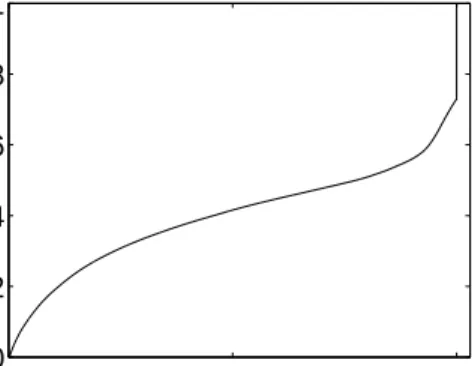
Figure 3.7: Scatterplot of NLV for videos of decreasing popularity. (Rank 100% cor-responds to the least popular video.)
0 20 40 60 80 100 0 1000 2000 3000 4000 5000 6000 7000 8000 9000 10000 Video Rank(%)
Video Length (secs)
Figure 3.8: Scatterplot of video length for videos of decreasing popularity.
3.2.3.2 Weak correlation between popularity and NLV
We now study the relationship between the popularity of a video and how much of it is viewed. Conventional wisdom says that popular videos tend to be viewed fully. This belief also forms the basis for some of the prefix caching approaches [Park et al., 2001]. For each video, we calculate the average NLV across all requests to the video and plot the result in Figure 3.7. Surprisingly, the figure shows that there is little to no correlation between the popularity of a video and how much of it is actually viewed.
We further investigate if there is any bias in popularity towards videos of a certain size. Figure 3.8 shows the relation between the length of videos and their popularity. As in Figure 3.5 we see four clusters of videos based on length. Also, within a given cluster, there are some indications of bias in popularity. For example, it seems that short videos are denser in the unpopular zone, while the density is higher for longer videos in the popular zone. However, there appears no strong bias in popularity across these clusters. Although not shown here, we also examined a subset of videos (e.g., longer than 4000 seconds), but did not observe any strong correlation between popularity and NLV.
This result indicates that just taking the popularity of a video and deciding how to store it may lead to an inefficient placement decision. We contend that there are benefits to be
0 0.2 0.4 0.6 0.8 1 0 0.2 0.4 0.6 0.8 1
Normalized Length Viewed
Probability
paid sessions free sessions
Figure 3.9: Cumulative distribution of the NLVs for free and priced videos.
gained by looking to store videos at a finer granularity.
3.2.3.3 Paid videos have longer NLV than free ones
We separately explore sessions for free and paid videos since it is generally assumed that viewers are more likely to watch longer when they pay for viewing. Figure 3.9 confirms that this assumption is indeed true, showing that paid sessions are significantly longer than free sessions. For example, about 45% of the requests for free videos stopped watching before 40% of the video while only 25% for paid videos stopped at that point.
3.2.3.4 Small difference between weekdays and weekends
We investigated the NLVs of each day’s sessions from Monday to Sunday, and we observe that the NLV is the largest on a Saturday and the smallest on a Monday. However, the difference is modest. Specifically, in our results, about 51% of viewers on Monday watched 50% or less of the video, while 47% on Saturday watched the same amount.
3.2.3.5 NLV depending on genres
We also investigated the difference in NLV depending on the genres (e.g., kids, action) of videos and found that most genres show a similar NLV distribution (the result not displayed here). For example, in the case of paid videos, the majority of genres follow a curve similar
to the one shown in Figure 3.9, although a few genres slightly deviate from the curve (e.g., adult genre with shorter viewing sessions even for paid videos).
Chapter 4
Optimal Video Segment Placement
4.1
MIP Formulation
In this section we present the mixed integer program (MIP) that we use to determine the optimal content placement. While we have presented this formulation in our earlier work [Applegate et al., 2010], we describe it here for completeness. We also discuss new aspects of the problem when we consider placing portions of a video.
4.1.1 Problem Formulation
Given a request pattern for each video at each VHO over a time period, our goal is to find a video placement that minimizes the total network consumption while satisfying all user requests within the link bandwidth and disk capacity constraints. We first describe our input parameters and decision variables. Let V denote the set of VHO locations, L the set of directed links between these locations, W the set of videos in our video library, and M the set of distinct segments (e.g., chunks, or prefix and suffix) of video.1 The set of time slices at which we enforce the link bandwidth constraints is T. We take the learning from [Applegate et al., 2010] to identify the time slices to be 1-hour windows during the peak busy period on weekend days. Each VHO i has disk capacity Di, and the size of
1
Parameters Meaning V set of VHOs (vertices)
L set of directed links W set of videos
M set of distinct segments of all videos inW T set of time slices
Di disk capacity at i∈V (in GB) reserved for fixed storage
sm size of video segmentm∈M (in GB)
Pij set of links on path used by i∈V to serve requests at j∈V
Bl capacity of linkl∈L(in Mbps)
rm bitrate of video segment m∈M (in Mbps)
amj aggregate # of requests for video segmentm∈M at VHOj ∈V fjm(t) # of requests for segmentm∈M at VHO j∈V
that are active at timet∈T
cij cost of transferring one GB from i∈V toj∈V
Decision
variables Meaning
yim binary variable indicating whether to store segmentm∈M at VHO i∈V
xmij fraction of requests for segment m∈M atj ∈V served byi∈V Table 4.1: Input parameters and decision variables used in the MIP
m∈M issm. Instead of just having a few distinct video sizes (e.g., 4 in [Applegateet al., 2010]), we allow a video to be of arbitrary size. For each pair of VHOs i, j∈V, we assume that there is a fixed directed pathPij fromitoj. Serving a request locally requires no links,
so Pii = ∅. The capacity of link l ∈ L is Bl, while the bit rate of video segment m ∈ M
is rm (both in Mbps). For each segment m∈M, VHOj ∈V receives amj requests during the entire modeling period. Using the detailed DVD-like stream control traces (not just the distinct video requests by the user), we identify the exact length of the video that the user views, and thereby derive the counts for each portion of the video segment requested. At
any given time slice t∈T, the number of concurrent streams is fjm(t). We denote the cost of serving one GB of video from itoj bycij. This cost for a remote service is proportional
to the number of hops between iand j (i.e.,|Pij|).
Our MIP model has two types of decision variables. For each i∈V and eachm ∈M, yim indicates whether we store m ati. yim is a binary variable, because given m, ialways stores it in its entirety or not (i.e., yes, if yim = 1; no, if yim = 0). When a request for m arrives at VHOj, it is served locally if the video is stored atj; otherwise, it must be fetched from some other VHO storing m. If there are multiple such VHOs, the variable xmij tells what fraction of requests should be served from VHOi. Table 4.1 summarizes the symbols used and their meaning. The top section lists the input parameters, which our MIP treats as fixed.
Our MIP formulation is:
min ∑ m∈M ∑ i,j∈V smamj cijxmij (4.1) s.t. ∑ i∈V xmij = 1, ∀m∈M, j∈V (4.2) xmij ≤ymi , ∀i, j∈V, m∈M (4.3) ∑ m∈M smyim≤Di, ∀i∈V (4.4) ∑ m∈M ∑ i,j∈V: l∈Pij rmfjm(t)xmij ≤Bl, ∀l∈L, t∈T (4.5) xmij ≥0, ∀i, j∈V, m∈M (4.6) ymi ∈ {0,1}, ∀i∈V, m∈M (4.7)
The objective expressed by (4.1) is to minimize the overall cost of byte transfer while serving all the requests for the entire period (Constraint (4.2)) without violating the disk capacity and link bandwidth capacity constraints (Constraints (4.4) and (4.5)). Con-straint (4.3) captures the fact that location ican servemonly when it has a local copy.2
2
Constraints (4.2) and (4.3) combine to ensure that everym∈M is available in the system. That is, they imply∑i∈Vym
4.1.2 Managing the Scale of the MIP
It is hard to find an optimal solution (due to NP-hardness) to the above MIP. We have presented a practical approach in our earlier work [Applegate et al., 2010] that allows us to solve the MIP quickly. However, despite the advances presented in that work, the scale of the problem grows significantly when we attempt to place chunks. For instance, when an average video size is an hour, breaking each video into 10-second chunks increases the number of variables in the MIP formulation by a factor of 360. However, to take advantage of operations like ‘skip’ or ‘replay’ and eliminate the delivery of some chunks, we need to use small chunks.
To make the problem size tractable even with small chunks, we cluster chunks into groups. We then solve the MIP instance based on these groups and place the groups as dictated by the output of the MIP. As a result, all the chunks within a cluster are placed together. One approach we attempted is to retain the difference in popularity by clustering chunks of the same access frequency. This approach, however, has an important drawback in that it results in unbalanced cluster sizes — some clusters being very big (e.g., clusters with chunks having very few accesses) and some other clusters being very small. For example, with our data, we noticed that the size of the largest cluster was∼130000 times that of the smallest cluster. The size of these large clusters makes it very hard to place them in any VHO, thereby defeating the very purpose of MIP-based placement.
We break this using a simple heuristic. We first sort all chunks based on the number of accesses during the training period in decreasing order. Then, we cluster groups of n chunks, so that the first cluster has the n most popular chunks, and the second cluster has the next n popular chunks, and so on. The downside of this approach is that it is an approximation and can potentially result in more copies of certain chunks than needed (because of the additive effect of the demand of each chunk). However, by limiting the size of a cluster to a small number, we can minimize this effect, while we still can solve the MIP quickly.
4.2
Experimental Evaluation
We evaluate the performance of chunk and prefix-based placement through simulation ex-periments using data from a nationally deployed VoD service. We make the following high level observations from our results:
• Both chunk- and prefix-based placement significantly reduce the amount of data trans-ferred.
• We get most of our reduction from user abandoning videos.
• Despite the availability of stream control operations like skip, most of today’s viewing is predominantly sequential.
In the rest of this section, we describe our experiment setup and provide details on each of these results.
4.2.1 Experiment Setup
We use a custom event-driven simulator that implements the network between the VHOs and performs trace-driven simulations. We assume that each VHO has a certain amount of disk, which is partitioned into two parts. One part stores the videos assigned to the VHO (i.e., not eligible for replacement), and the other part is used as a dynamic cache (i.e., LRU). To protect proprietary information, we use normalized disk sizes relative to the space needed to store the entire video library. For instance, when the total disk space across all VHOs is 2x the space needed to store the library, each VHO has disk space equaling ∼3% (2/59) of the total library space. This 3% includes the fixed portion of the disk as well as the dynamic cache. We use a small cache of 5% of the space at each VHO with our MIP-based placement schemes to accommodate for errors in demand estimation and to handle flash crowds.
Upon a user request, if the video segment is available locally (either in the pre-assigned portion or dynamic cache portion), the VHO simply handles the transfer locally without consuming network bandwidth. If the video segment is not available locally, the VHO fetches the segment from a remote VHO that stores this segment in its cache. We assume
the existence of a directory that keeps track of what is stored in each VHO. With a dynamic cache, the set of video segments stored at a VHO constantly changes over time. For this, we assume a perfect directory that always finds the closest VHO with a local copy. Note that this is the best case scenario for those dynamic cache strategies (i.e., LRU). For our MIP-based strategy, the MIP solution guides from which VHO to fetch the video (i.e., x variables in the formulation in Section 4.1).
We use a network modeled from a deployed IPTV network for our experiments. This network has 59 nodes (i.e., VHOs) with 70+ bi-directional links of equal bandwidth con-necting the different VHOs. We vary the bandwidth to understand the trade-offs between disk capacity and bandwidth. In a given experiment, we assume that all the VHOs have the same disk size. However, we vary the disk size value in different experiments to understand the performance tradeoff between disk and link bandwidth capacity. We set the streaming rate of all videos to 2 Mbps (Thus, one second of video needs about 256 KB of disk).
We use the data trace described in Section 3.2 to simulate video requests by users. The trace data has information about the stream control operations like skip, fast-forward, replay, etc. that are performed by users. In our experiments, we translate these stream control operations to accesses to specific segments of the video: In the case of chunk, it is the specific chunk requested, while with prefixes it is either the prefix or the suffix. When a user performs a skip, we treat the corresponding portion of the video as not accessed. However, we consider that all the segments are accessed during a fast-forward operation because the video is played out during the fast-forward operation albeit at a faster rate. Note that if a request from a user results in transferring data from a remote location, we
do not stop the transfer prematurely even if the user does so. This allows us to cache the entire video segment and serve it locally when it is requested again.
Stream control operations like skip typically move the user about 30 seconds into the stream. To take advantage of these operations and not deliver chunks that are skipped, we need to make use of small chunks. However, as mentioned in Section 4.1, using small chunks significantly increases the time to solve the MIP instance. We addressed this by clustering a number of chunks. In our experiments, we use 10-second chunks and a cluster size of 100; we observed that this size gave us a good balance between the time taken to