c
TRANSACTIONAL PROGRAMMABILITY AND PERFORMANCE
BY
LEE W. BAUGH
B.S. University of Texas at Dallas, 1997 M.S. University of Texas at Dallas, 2000
DISSERTATION
Submitted in partial fulfillment of the requirements for the degree of Doctor of Philosophy in Computer Science
in the Graduate College of the
University of Illinois at Urbana-Champaign, 2008
Urbana, Illinois
Doctoral Committee:
Assistant Professor Craig Zilles, Chair Professor Sarita V. Adve
Associate Professor Steven S. Lumetta Ravi Rajwar, Intel Corporation
Abstract
Transactional memory is a promising technique for multithreaded synchronization and con-currency which has attracted much interest in recent years. Compared to locks, transactions can offer increased concurrency, composability, and deadlock freedom; yet their speculative nature introduces problems not seen in lock-based code, and these have limited the adoption of transactions as a serious alternative to locks. Specifically, it is not clear how transactions can contain side-effecting actions like I/O, nor how they can scale to arbitrary footprints and durations while retaining acceptable performance and a consistent and desirable pro-gramming semantic.
I believe that addressing problems like these is of first importance to programmers consid-ering using transactions. In this work, I seek to extend the programmability of transactions by exploring and addressing these problems. I begin by exploring the domain of hardware support for software transactional memory. I first show how a general-purpose user-mode memory protection system can be used to provide strong isolation to software transactional memory systems with little hardware and minimal performance overhead. Then I show how to augment this strongly atomic software transactional memory system with a ‘best-effort’ hardware transactional memory system to yield a hybrid transactional memory system, the UFO Hybrid, in which high-performance hardware transactions can run concurrently with large, long, nested, or side-effecting software transactions. Compared to previous hybrid transactional memory proposals, my system offers a strongly atomic programming model for both its hardware and its software transactions, low-overhead conflict detection between its hardware and software transactions, and high HTM performance even in the presence
of potentially-conflicting software transactions. I show through experimental analysis that the UFO Hybrid performs at least as well as competing hybrid transactional memory sys-tems, and significantly outperforms them when some transactions are forced to fail over to software.
I also provide an analysis of I/O in lock-based critical sections in large multithreaded workloads, with observations on how this I/O could be performed in transactional code. In this analysis, I find that no one of the previously proposed techniques is by itself sufficient for handling side-effects without sacrificing performance. However, I conclude that the majority of transactional I/O is likely to be compensatable, and that causing transactions performing I/O to ‘go nonspeculative’ can be a reasonable choice for uncompensated I/O, provided that it does not delay non-side effecting transactions.
Acknowledgements
When, in 2002, I took my Qualifying exam, Dr. Josep Torrellas asked me afterwards, “How did it go?” I replied that I was unsure, adding “You guys are so smart!” “No, no, Lee,” he replied, “We’re just more experienced. In five years, you’ll be there too.” It’s taken six years, and I am quite reluctant to rate myself equal to the exceptional members of my qual committee, but his comment was nonetheless accurate. The Ph.D is a transforming experience, converting those promising students who stick with it into capable, diligent, and resourceful researchers, and no one has been more instrumental to my transformation than my advisor, Craig Zilles. His virtues as a researcher exceed, I fear, my ability to match, but his example – in identifying the essential promise of an idea, in isolating and presenting the correct data to support one’s findings, in crafting a paper or presentation to answer more questions than it raises, and in working hard to get good results – has given me something to strive for, both during my Ph.D work as well as in the work which will come after.
I would like to express my appreciation to my committee for their help along the way. Steve Lumetta has generously shared his time to test my work and discuss its direction; Ravi Rajwar’s difficult questions have helped me produce a stronger dissertation and his support was essential for the work presented in Chapter 3. However, if each year of a Ph.D rests on the years previous to it, then I owe my completion of this degree to Josep Torrellas, who went out of his way to ensure that I felt welcome in the department and that I had the early support I needed.
Computer architecture at UIUC is fortunate to have a thriving community of bright, enthusiastic graduate students, both in CS and ECE. The open atmosphere encourages
communication, and everyone participating benefits from the reading group, practice talks, and other productive communications. Two research groups in particular could always be relied upon to support me in my own explorations and preparations: the i-acoma group, whose members are always available for proofreading, criticism, technical discussions, and moral support; and my own advisor’s MSSP group. Of course I enjoyed years of mutual support with the first generation of MSSP students: Pierre Salverda, Naveen Neelakantam, Nicholas Riley, and myself, but the group is now growing, and in good directions. Craig’s guidance has built a strong and diverse group, and one with quite high-minded research principles.
I would also like to acknowledge the support of the CS department, and its staff: partic-ularly Barb Cicone, who was on my side early on; Mary Beth Kelley, who is on my side at the end, and Sheila Clark, who solved so many problems for me during my years with Craig. Finally, I must acknowledge the profound impact of the support of my friends and family. While there are too many to show here, I’d like to particularly acknowledge, for the direct support they lent this dissertation at various times of my graduate student career, my friends Brian Greskamp, Pierre Salverda, James Tuck, Derek Gottlieb, and Jeff Cook. Michelle Urberg has been a tremendous support in the difficult last months of this Ph.D. But the greatest share of credit must go to my parents, James and Deborah Baugh. Their unstinting support ofme– without requiring I follow any particular path – has allowed me to reach this point on my own terms and without resentment. Together, they are uniquely supportive: insightful and enthusiastic in turn; and there is no question that without their powerful presence this document, and my Ph.D, would not exist.
Table of Contents
List of Tables . . . ix List of Figures . . . x Preface . . . 1 Chapter 1 Introduction . . . 15 1.1 Limitation of Scope . . . 171.1.1 Shared Memory Parallel Programming . . . 17
1.1.2 Transactional Memory . . . 18
1.1.3 Transactional Memory and Memory Consistency . . . 18
1.1.4 Transactional Workloads . . . 19
1.2 Transactional Memory Background . . . 19
1.2.1 Transactional Memory Design Space . . . 20
1.3 Summary of the Dissertation . . . 24
Chapter 2 The UFO Hybrid . . . 28
2.1 Introduction . . . 29
2.2 Motivation . . . 31
2.2.1 High Performance . . . 31
2.2.2 A Clean and Complete Programming Model . . . 31
2.2.3 The Role of Hardware . . . 37
2.3 Hardware Primitives . . . 38
2.3.1 BTM: a “Best-effort” Hardware TM . . . 38
2.3.2 UFO: User-mode Fine-grained Hardware Memory Protection . . . 40
2.4 System Organization . . . 43
2.4.1 USTM: Building a Strongly-Atomic STM . . . 43
2.4.2 Making USTM Strongly Atomic . . . 47
2.4.3 Bringing It Together: The UFO Hybrid . . . 48
2.4.4 Contention Management in a Hybrid TM . . . 52
2.5 Performance Analysis . . . 54
2.5.1 Experimental Method . . . 55
2.5.2 Results . . . 58
2.5.3 Speculative Footprint . . . 62
2.5.5 Sensitivity Analysis . . . 67
2.5.6 Using HTM to Support an STM System . . . 68
2.6 Concluding Remarks . . . 71
2.6.1 Hardware TM Policies . . . 73
2.6.2 Advanced Transactional Semantics . . . 75
Chapter 3 I/O in Critical Sections . . . 77
3.1 Introduction . . . 78
3.2 Types of Actions . . . 79
3.3 Proposals for Handling Side-Effects in Transactions . . . 80
3.4 Side-Effects in Critical Sections . . . 83
3.4.1 Experimental Method . . . 85
3.5 IO Results . . . 87
3.5.1 Syscall Sites . . . 87
3.5.2 Syscall Protection – The Advantage of Compensation Code . . . 88
3.5.3 Syscall Context . . . 91
3.5.4 The Applicability of Deferral . . . 92
3.5.5 The Overhead of “Going Nonspeculative” . . . 93
3.6 Concluding Remarks . . . 95
Chapter 4 Conclusion . . . 96
References . . . 99
List of Tables
1.1 Some Transactional Memory Proposals and Their Salient Properties 27
2.1 The BTM ISA Extension . . . 39
2.2 UFO ISA Extensions . . . 40
2.3 The USTM API . . . 44
2.4 Simulation parameters . . . 56
List of Figures
1 A Race Condition in a Two-threaded Application. . . 6
2 Atomic Regions . . . 7
3 Lock-based Critical Sections . . . 8
4 Deadlock . . . 9
5 Privatization . . . 11
2.1 Using Fine-grained Memory Protection to Achieve a Strongly-atomic, Efficient Hybrid Transactional Memory System . . . 29
2.2 A Transactional Containment Violation in an Eager-Versioning Trans-actional Memory System . . . 32
2.3 A Transactional Non-Interference Violation . . . 33
2.4 Privatization Leading to Inconsistency in an Early-Versioning Trans-actional Memory System Lacking Strong Atomicity . . . 34
2.5 A Lost Non-Transactional Write In a Word-Granularity, Eager-Versioning Transactional Memory System Lacking Strong Atomicity 35 2.6 The Memory Hierarchy with UFO Support . . . 42
2.7 The USTM Shared Ownership Table (otable) . . . 45
2.8 Code Example of a USTM Write Barrier . . . 46
2.9 A USTM Write Barrier with Strong Isolation via UFO . . . 48
2.10 A UFO Fault Handler . . . 49
2.11 Hybrid TM code. . . 50
2.12 The BTM Abort Handler . . . 52
2.13 STAMP Performance of Several TM Schemes. . . 57
2.14 Hardware Abort Reasons . . . 57
2.15 A Problematic Transaction in labyrinth . . . 61
2.16 Range of Speculative Cache Footprints . . . 62
2.17 Victim Caches Can Avert Set Overflows . . . 64
2.18 Software Failover Limit . . . 65
2.19 Failover Limit Detail for PhTM as the Amount of Work Done in Each Transaction Is Varied . . . 66
2.20 Sensitivity Analysis . . . 67
2.21 Code Example of a USTM Write Barrier using BTM for Atomic otable Updates . . . 70
2.22 Abort Rates of BTM Transactions in USTM Execution . . . 72
3.1 A Syscalling-TCS Overlapping with TCSs . . . 86
3.2 Distribution of Syscalls across Syscalling-TCSs . . . 88
3.3 Distribution of Syscalling-TCS Durations (in µsec) . . . 90
3.4 Distribution of First Syscalls across Critical Sections . . . 91
3.5 Degree of Overlap of Toplevel Syscalling Critical Sections (syscalling-TCSs) and Toplevel Critical Sections ((syscalling-TCSs) . . . 93
Preface
Parallel programming – the technique of dividing a computational task into separate units which may be simultaneously executed using independent hardware resources – has long been an important method for improving program performance. Until recently, parallel programming has been largely constrained to applications in scientific and enterprise com-puting. In these domains, the value of solving a computational problem quickly offsets not only the cost of greater hardware resources, but also of the labor-intensive process of effi-ciently adapting the problem to the available resources. This adaptation, an expert process requiring detailed knowledge of both the computational problem and the capabilities and limitations of the hardware, seeks not only to improve the code’s performance on a single CPU, but also to partition the code into multiple independent threads which could be ex-ecuted simultaneously on different processing units. Consumer computing, however, rarely received such parallelization efforts: the economic incentives were much less, the underlying hardware systems too numerous and varied, and in any case very few consumers had access to multiprocessor systems.
Computing has enjoyed a long trend of single-threaded performance improvement. The increasing transistor count promised by Moore’s law supported more advanced superscalar designs, increasing issue width and pipeline depth, and the scaling-down of individual devices permitted increasing clock rates. Recently, however, a number of factors have contributed to the slowing of this trend, including
• The ‘ILP Wall’: Programs tend only to expose a limited amount of instruction-level parallelism. Accordingly, increasing processor issue width meets with diminishing
returns at the price of greatly increased hardware complexity.
• The ‘Memory Wall’: Memory system performance has not scaled at the same rate as computational performance, so the cost of memory operations relative to the cost of other operations has increased. Accordingly, single-threaded performance is increas-ingly memory-bound.
• Power and Heat: Both the increasing clock rate and the decreasing size of tran-sistors have greatly increased the power density of modern CPUs, to the degree that heat management has become a limiting factor in CPU designs. Drastic increases in frequency (without complex cooling systems) are unlikely.
These factors, combined, appear to spell the end of the steady and significant single-threaded performance improvement which consumers (and application developers) have come to ex-pect. Indeed, processor manufacturers have largely abandoned grand attempts to improve single-core performance, instead offering more cores per chip – so-called multicore architec-tures – and focusing on shared memory system designs.
These new multicore architectures do not pose a significant problem to developers of scientific and enterprise applications – already used to parallel programming, they need simply to learn how best to take advantage of the new processors. There is, however, a large contingent of developers with little or no experience in parallel programming. Multicore architectures require such developers, grown used to a steady increase in single-threaded performance, to look towards parallelism in order to continue to obtain the performance improvement (or increase in features) that their applications have enjoyed. We find ourselves, then, at a point when parallel programming – particularly shared-memory parallelism – is becoming a very important technique to a much wider variety of software developers.
Shared-memory parallel programming
There are a number of ways to extract parallelism from an algorithm.[46] The best or most natural choice depends on a combination of factors: available libraries, languages, or hard-ware; the expected value of parallelization; or programmer ability; but most of all it depends on the algorithm itself. Different applications may be more or less suited to parallelization, and different parallelization approaches are more or less suited to different synchronization mechanisms. Some tasks can be trivially and effectively parallelized – in ray tracing, for example, each ray can be computed independently of all other rays. Some tasks can be par-allelized, but only with difficulty, or with limited concurrency returns. Other tasks are very difficult to parallelize, either because the problem simply does not expose any parallelism, or because it is very difficult to rule out the possibility of contention on shared data.
In the taxonomy of parallel programming techniques, the broadest division is between message-passing techniques and shared-memory techniques. Message-passingassumes a pri-vate memory space for each thread, processor, or node; communication between threads is performed by explicitly sending and receiving messages. This approach is generally used in large, distributed-memory systems. Since I am exploring parallel programming for multicore architectures, I will focus on shared-memory synchronization. In shared-memory synchro-nization, threads share a common region of memory, and the programmer must ensure that mutual exclusion on shared variables is enforced. Broadly speaking, there are two ways to ensure mutual exclusion: by phasicmeans such as barriers, or by mutexes like locks.
Phasic synchronization guarantees that shared data is not exposed to race conditions by dividing parallel work into phases. For example, parallelizations which decompose algorithms in a pipelined or systolic fashion might ensure that in any given phase (or pipeline stage), any given shared variable is only accessed by one thread, and are handed off between threads only at phase boundaries. Barrierspermit programmers to define these phases by specifying synchronization points in their code. A given barrier is initialized to support N threads;
it will then block the first N − 1 threads to wait on it. When the Nth thread arrives
at the barrier, the waiting threads are all set free and the barrier is reset. In addition to implementing hand-off points in systolic or pipelined algorithms, barriers are useful for coordinating phases in Single Program Multiple Data (SPMD) parallelism. If an algorithm is suited to these kinds of decomposition, no other synchronization may be necessary, if data shared between threads may be proven never to be shared concurrently during a phase.
As a shared-memory synchronization mechanism, barriers have much to commend them. Under barrier-based synchronization, it is very easy for programmers to reason about what can occur concurrently. For many algorithms, pipelining is a relatively simple parallelization, compared to other kinds of parallel decompositions. Also, and importantly, implementing barriers in hardware efficiently is a well-understood problem, so that barriers can be a low-overhead synchronization option.
However, not all algorithms are well-suited to shared-memory parallelization using bar-riers alone. Mutexes offer a more generic approach to synchronization by allowing program-mers to designate regions of code (called critical sections) which can only be executed by one thread at a time. There are several flavors of mutex, including:
• Semaphores, which control access to shared resources. A semaphore is loweredwhen mutual exclusion on the resource it protects is desired, and raised when the work on the resource is done. A thread attempting to lower a semaphore which is already held is blocked until the semaphore is raised again. Semaphores apply naturally to process waiting, shared resource protection, and producer-consumer relationships, and so are commonly used in operating systems
• Monitors, a language-level synchronization construct which provide a form of implicit synchronization by associating shared data with a set of functions permitted to act on the data. Functions belonging to the same monitor execute under mutual exclusion1, 1Monitor functions may wait; multiple monitor functions may be in flight, but only if at most one of them is not waiting.
and the monitor data may not be shared save through the monitor functions. Monitors are particularly well suited to synchronizing operations to shared objects.
• Locks, which, like semaphores, permit users to define regions of mutual exclusion. A thread acquires a lock when it wishes to perform some action on shared state or resources, and releases the lock when it is done. An attempt to acquire a lock which is already held either blocks until the lock is available or fails, depending on the kind of lock used. Because of their generality (barriers, semaphores, and monitors are frequently implemented using locks) and the widespread support in ISAs for lock ac-quires and releases, locks are perhaps the most common synchronization mechanism in shared-memory applications.
Mutex-based parallel programming is a notoriously difficult endeavor. Parallel programs are subject to new classes of bugs not present in single-threaded programs, such as deadlock and race conditions. Moreover, even a correct parallel program, if poorly parallelized, may not yield any performance improvements over single-threaded execution. Partitioning a program into parallel threads effectively and correctly is a difficult enough task, but the way parallelism is expressed – and in particular, the way accesses to data shared between parallel threads are handled – itself introduces a number of challenges and pitfalls to parallel programmers.
What mutex programmers want
Race freedom
Parallelizing a program for a shared-memory architecture involves two tasks: partitioning the program into threads, and then protecting operations on resources (if any) shared between two or more of these threads. An example of the need for this protection is shown in Figure 1.
x
←
counter
x
←
counter
x = x + 1
x = x + 1
counter
←
x
counter
←
x
Thread 1
Thread 2
x
is local,
counter
is shared,
counter = 0
counter == 1
time
Figure 1: A Race Condition in a Two-threaded Application.
counterhas been incremented twice, but due to unfortunate interleaving of the threads, at
the end of the sample it contains 1 rather than 2.
In this figure, an unfortunate interleaving of operations from the two threads has re-sulted in an invalid state: counter has been incremented twice, but appears to have been incremented only once. Such race conditions result from the two threads running concur-rently; without some way of grouping the read, modify, and write operations performed by each thread, the programmer cannot achieve race freedom.
Atomic Regions
Central to this grouping are the concepts of atomicity and isolation.2 Briefly, a group of
operations are performed atomically if they are either all performed, or none of them is performed. A group of operations is performed in isolation if no other thread views any intermediate state in the group – that is, from the perspective of other threads, it either
2This terminology is borrowed from the transactional database literature, as in Gray and Reuter [25], and will be used (and described in greater detail) throughout this dissertation.
Thread 1
Thread 2
x
is local,
counter
is shared,
counter = 0
counter == 2
time
x
←
counter
x
←
counter
x = x + 1
x = x + 1
counter
←
x
counter
←
x
atomic {
}
atomic {
}
Figure 2: Atomic Regions
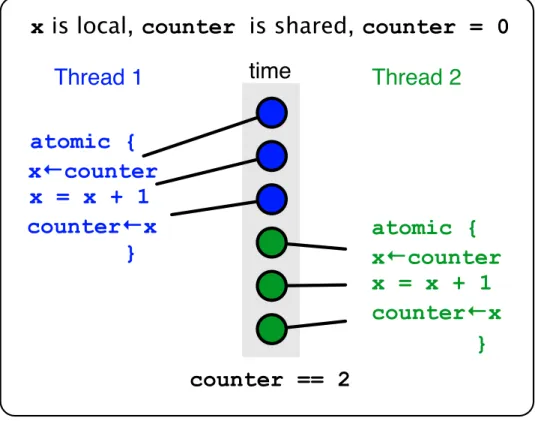
Atomic regions such as these avoid the race condition seen in Figure 1.
appears that none of the operations in the group was performed, or all of them were. Taken together, atomicity and isolation permit programmers to safely perform groups of operations on data shared between threads.
A parallel programming paradigm for shared memory must support, explicitly or implic-itly, some form of atomic regions (or critical sections). In Figure 3, the read, modify, and write operations have been grouped together in atomic regions which are executed atomi-cally and in isolation. Regardless of thread interleaving, the final value (and any intermediate values) of counter is correct.
Concurrency Expression
While correct, the atomic regions in Figure 3 may be too restrictive. While the isolation property is satisfied by interleaving all atomic regions, this approach may unnecessarily
Thread 1
time
Thread 2
(work)
(work)
acquire(lock1)
release(lock1)
acquire(lock2)
release(lock2)
Figure 3: Lock-based Critical Sections
Such critical sections can execute concurrently, as long as they are guarded by different locks.
serialize atomic regions which do not share any state, resulting in a loss of performance. Accordingly, parallel programming techniques for shared memory permit programmers to express, implicitly or explicitly, concurrency in their atomic regions.
Locks, for example, permit programmers to express concurrency by guarding different resources or regions of shared memory by different locks. Since a thread must hold the rele-vant lock before it can execute any of a given critical section, and only one thread may hold a given lock at a time, atomicity and isolation are guaranteed for a well-formed program3; however, two critical sections guarded by different locks are free to execute concurrently, as shown in Figure 3. However, it is the responsibility of the programmer to ensure that every access to a given shared resource is guarded by the same lock; otherwise isolation and atomicity are not guaranteed.
3That is, a program for which each lock protects a unique region of shared memory, and each region of shared memory is protected by one lock.
Deadlock Avoidance
Thread 1
time
Thread 2
(work)
(work)
acquire(lock1)
release(lock2)
acquire(lock2)
release(lock1)
acquire(lock2)
acquire(lock1)
release(lock2)
release(lock1)
Figure 4: DeadlockDeadlock results from a circular chain of dependences among threads, and results in no forward progress.
Critical sections may be nested; when a programmer wishes to atomically access shared resources guarded by more than one lock, all relevant locks may be acquired, the atomic accesses performed, then all the locks may be released. However, if critical sections can execute concurrently, this raises the danger of deadlock, the situation in which a series of threads form a circular chain of dependences upon locks. Figure 4 shows an example of this situation. In this figure, Thread 1 has acquired lock1 and is waiting on lock2; meanwhile, Thread 2 has acquired lock2 and is waiting on lock1. lock1 will not be released until Thread 1 has completed, which is causally dependent on its acquisition of lock2; a similar situation prevents Thread 2’s releasing lock2. Neither thread may make forward progress.
Deadlock is a significant source of bugs in parallel programs. To avoid it requires intimate knowledge of the locking behavior of the whole program, to ensure a consistent partial ordering of lock acquires. The cost of such bugs, or of the design effort to avoid them, makes concurrent programming techniques which avoid or limit deadlock desirable.
Forward Progress and Starvation
Programmers could, with considerable effort, seek to avoid deadlock by releasing all con-tended locks if some time has elapsed without successfully acquiring a needed lock. In addition to its complexity, however, this approach risks livelock: a phenomenon in which, while work is being done – here, the acquire and release of locks, whole-program forward progress is not being made.
If, on the other hand, a deadlock detection and recovery system only releases the locks held by one of the deadlocking threads, livelock can be avoided – but at the risk ofstarvation, or lack of forward progress on one thread. While such starvation does not affect correctness – eventually, other threads will exhaust their work and release the resources the starving thread needs – it can affect performance by limiting the work done by the starving thread, and thus reducing the parallelism of the application.
A good shared-memory concurrent programming method should help programmers avoid livelock and starvation.
Atomic Region Composition
Modular programming, and the separation of concerns, encourages programmers to use mod-ules or libraries as ‘black boxes’, about which little is known except for what the module requires for input and produces as output. However, this technique – widely considered cru-cial for effective software engineering – directly contravenes the requirement that program-mers of lock-based code maintain a whole-program awareness of lock acquires and releases in order to avoid deadlock. In Figure 4, Thread 1’s acquire to lock2 could be in a library call, as could Thread 2’s acquire to lock1; in this case, code which at the context of the outer critical section appears deadlock-free may still deadlock.
Deadlock through composition is not the only pitfall of this approach. For concurrency schemes which allow atomic regions to execute speculatively, composing code with
side-effects into an atomic region can cause problems. As composition is fundamental to modular programming, concurrent programming techniques which promote it are desirable.
Privatization
Thread 1 time Thread 2
list_t *obj = head;
list_t *obj = head;
head = head->next; head = head->next perform_actions(obj); atomic { } atomic { } perform_actions(obj); Figure 5: Privatization
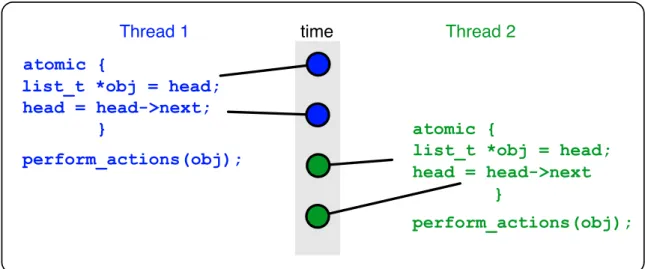
Privatization ‘unshares’ a shared variable so that it can be worked on privately, without need for atomicity or isolation.
Protecting shared data in atomic regions incurs overhead through the ‘opportunity cost’ of limited concurrency. For this reason, a high-performance concurrent programming tech-nique should provide a way to privatize shared data – to remove it from sharing, and from the need to protect access to it in an atomic region.
Figure 5 gives an example of privatization; in it, both threads 1 and 2 atomically remove an element from a shared linked list, but then perform work on the element privately, without needing to operate on it atomically or in isolation.
Transactional Memory
Historically, the dominant form of synchronization for application-level (as opposed to system-level) parallel programming has been locks. This is in part due to their generality – more
sophisticated synchronization mechanisms may be efficiently built from locks – and in part to the ubiquity of support for lock acquires and releases among many diverse architectures. However, lock-based parallel programming is extremely challenging due to its risks of dead-lock and livedead-lock, and the difficulty of abstracting dead-lock-based critical sections to enable easy composition.
The source of these difficulties stems from the requirement to associate a specific lock, or set of specific locks, with every critical section. Transactional memory, in contrast, permits programmers to specify transactions, or atomic regions unassociated with a specific lock resource. To permit concurrent execution of several transactions, transactions execute speculatively: transactional memory systems observe memory accesses within transactions, and should a conflict between two concurrent transactions arise, one of them is aborted.
Transactional memory has many advantages over lock-based synchronization, which have made it the target of a considerable amount of research scrutiny in recent years. Transac-tional programmers can avoid race conditions by simply marking atomic regions as such. The degree to which transactions may execute concurrently is in theory limited only by the contention they experience. While deadlock is still possible under transactions4, it is
extremely unlikely to arise in most transactional codes. Accordingly, transactions offer a more modular approach to composing atomic regions than do locks. These benefits, taken together, seem to indicate that system- and language-level support for transactional memory may see the technique employed in a new generation of parallelized applications.
These advantages have spurred considerable research interest into transactional memory in recent years, but current TM proposals still fall short of programmer expectations – at the time of this writing, no major multithreaded applications using transactional memory have been demonstrated. I believe that transactional memory’s acceptance is hindered by two factors: its performance, and its programmability. Specifically,
4Deadlock in transactional code is trivially demonstrable by observing that transactions may be used to implement locks.
• Several proposals supporting transactional memory in hardware exist; however, with-out considerable evidence that programmers consider transactional memory valuable, processor firms are very unlikely to spend design effort and chip resources supporting it. Moreover, it is not yet clear that the correct transactional semantics have been es-tablished; this threatens to obsolete hardware transactional memories which attempt to provide a complete transactional solution.
• Transactional memory systems implemented (as a library or a language construct) in software can be easily deployed, and may be easily changed to adapt to developing trans-actional semantics. However, due to the overhead of transactional conflict detection and transactional data version control, these software systems tend to suffer from poor performance. Moreover, many such software transactional memory systems are prone to subtle race conditions created by a lack of strong atomicity. These race conditions can, for example, affect programmers’ ability to privatize data. Strongly atomic STMs have been proposed, but their strong atomicity comes at significant overhead.
• Hybrid transactional memory systems combining limited hardware support for transac-tions with a software transactional memory system have been proposed. Such systems attempt to achieve good performance by executing most transactions in hardware, but to permit arbitrary transactions and flexible semantics by allowing transactions unable to complete in hardware to ‘fail over’ to software. These hybrid systems, however, tend to perform poorly whenever any transaction is running in software, and they are generally prone to the same lack of strong atomicity as STMs.
• The concurrency benefits of transactional memory stem from the speculative nature of transactions. Transactions, however, only extend isolation and atomicity to accesses to shared memory within them; side effects such as I/O are neither performed in iso-lation, nor are they undone in the case of a transactional abort. This has an effect upon transactional composability; if a programmer unwittingly composes a module
which performs side-effects within a transaction, the program’s consistency may be-come compromised.
Research Goals
I believe that before it sees acceptance by parallel programmers, transactional memory will need to address the aforementioned problems with transactional programmability and performance. This dissertation aims to do this in two ways:
• First, addressing the performance, programmability, and hardware complexity short-comings of previous transactional memory proposals, I propose a new hybrid transac-tional memory system which couples a strongly-atomic software transactransac-tional memory system with best-effort hardware support for transactional memory. Uniquely, this hybrid system, called the UFO Hybrid, can run hardware transactions at full speed even while potentially-conflicting software transactions are in flight. Furthermore, the strong atomicity of both the hardware and software components of the UFO Hybrid permit a consistent, sensible programming model to its users. Through performance analysis of my implementation of the UFO Hybrid, I explore the space of policies for hardware conflict resolution, software conflict resolution, and software failover policy. • Second, addressing the programmability challenges posed by side-effects in
transac-tions, I offer an analysis of side effects in critical sections and their ramifications on transactional memory. Through profiling the (lock-based) critical sections in large, multithreaded applications, I show that programmers do use I/O in critical sections, and not merely to provide mutual exclusion on external resources like files. I then an-alyze the kinds of I/O used in critical sections and the kinds of critical sections which perform I/O, and these data to reason about the applicability and performance of the proposed techniques for handling side-effects in transactions.
Chapter 1
Introduction
As with other synchronization schemes, transactional memory has both a semantic com-ponent which concerns the behavior programmers can expect from transactions, and an implementation component which concerns the mechanisms, hardware or software, by which transactional support is provided. A good transactional memory system design must address both of these components, as a poor choice of transactional semantics will compromise the ease and clarity of transactional programming on the system, and a poor implementation may compromise not only the performance of the system, but even its ability to support reasonable transactional semantics. Programmers are unlikely to use a transactional mem-ory system whose behavior is unintuitive or difficult to reason about, or a system whose performance is poor.
In this dissertation, I will be exploring transactional memory from both a semantic and an implementation perspective, addressing both transactional programmability and perfor-mance. The key questions motivating this dissertation include:
• What simple and flexible hardware and software mechanisms can provide strong atom-icity (Section 1.2.1) to a software or hybrid transactional memory system without re-quiring nontransactional code to be instrumented?
• What simple hardware can be used to accelerate the performance of a software or hybrid transactional memory system?
• Will support for side-effects such as I/O in transactions be required? If so, what kind of support?
Addressing these questions, the key contributions of this dissertation include:
• I show that hardware memory protection may be used to make a strongly atomic soft-ware transactional memory which does not require instrumentation or recompilation of nontransactional code. (Section 2.4.1)
• I show that such a strongly atomic software transactional memory system may be paired with a best-effort hardware transactional memory system to produce a high-performance hybrid transactional memory system, the UFO hybrid, which permits hardware transactions to run uninstrumented, at full speed, even while potentially-conflicting software transactions are in flight. (Section 2.4.3)
• Using the STAMP benchmarks [48, 49], I compare the UFO Hybrid against previous hybrid transactional memory schemes, and show that it offers superior performance when software transactions are in flight. (Section 2.5.2)
• Using the STAMP benchmarks to measure performance, I consider a number of varia-tions of this hybrid’s hardware conflict resolution policy, its software conflict resolution policy, and its software failoverpolicy, determining which design decisions have a sig-nificant performance or forward progress impact. (Section 2.5.5)
• I give an analysis of I/O in lock-based critical sections in two large, modern, multi-threaded workloads, characterizing the I/O that occurs in critical sections by kind, frequency, and distribution within the critical section, as well as characterizing the critical sections which contain I/O. Using this information, I gauge the feasibility and likely efficacy of the proposed techniques for handling I/O and side-effects within transactions. (Chapter 3)
In this Introduction, I first define the scope with which this dissertation is concerned (Section 1.1). Then, in Section 1.2, I review the historical context, key concepts, and related
works of this dissertation. Finally, in Section 1.3, I summarize this dissertation, emphasizing my findings and results.
1.1
Limitation of Scope
The field of parallel programming is enormously varied. The exigencies of distributed system design have spawned a number of parallel programming paradigms, supporting architectures with varying interprocessor or interprocess communication costs, with varying arrangements of memory, or supporting different synchronization primitives. Different problems may be parallelized in different ways rendering them more or less suitable to different parallel archi-tectures. Many scientific workloads, like protein folding, can benefit from computing power far in excess of the ability of a single shared-memory computer to provide – Stanford’s Fold-ing@Home [38], for example, can claim the world’s most powerful computing cluster, at any time consisting of tens or hundreds of thousands of PC clients working in parallel; while the cost of interprocess communication in this case is enormously high, such communication is quite rare because the work can be effectively partitioned into numerous large, independent tasks. Parallel programming for distributed-memory machines, or the architecture of those machines, is not germane to transactional memory, and so does not fall under the purview of this dissertation.
1.1.1
Shared Memory Parallel Programming
Other problems are not so easily parallelized, or they don’t offer as much to be gained from so much parallelism. For such problems – much more in the scope of most programmers than highly-parallel high performance computing code – the shared memory paradigm is a natural fit. A number of mechanisms exist for synchronization and concurrency in a shared-memory system, including not only transactional memory but also semaphores, locks, monitors, and barriers, each lending itself to different hardware configurations and different parallelizations.
Moreover, a barrier parallelization of a given code may be fundamentally different than a lock parallelization of the same code, and both may differ entirely from a transactional parallelization of the code. My interest in this dissertation is not to compare different ways of extracting parallelism from an application, but to explore transactional memory. For this reason, I do not quantitatively compare transactional memory to any other synchronization paradigm.
1.1.2
Transactional Memory
Transactional memory is not itself a monolithic technique. Section 1.2.1 describes a number of design parameters which characterize any given transactional memory system. Though I will examine some of them, like the transactionalconflict resolution policy, I do not purpose to provide an exhaustive analysis of each of the design choices (some of which has been done by prior work, e.g.Bobbaet al.[12]), but instead to fix a congenial set of design parameters (in this case, dictated by hardware) and use it as a platform for study and improvement.
1.1.3
Transactional Memory and Memory Consistency
Transactional memory’s interaction with various memory consistency models is not yet com-pletely clear. As software TMs generally depend upon mutexes to access and update their ownership structures, their interaction with memory consistency generally devolves to their constituent mutexes’ interaction with memory consistency, which is typically well under-stood. However, just as mutexes must take into account the underlying hardware’s memory consistency model, so must hardware transactional memory. The aim of this dissertation is not to explore the interaction of HTM and memory consistency models or to formalize the consistency requirements of particular HTM implementations. Accordingly, throughout this dissertation, except where otherwise noted, I assume a sequential consistency model.
1.1.4
Transactional Workloads
The lack of availability of diverse suitable transactional workloads is a significant lacuna in the field. The problem merits, and will no doubt receive, much research attention: but not, however, in this dissertation. The Stanford STAMP benchmark suite [48, 49], including a number of transactional small applications and execution kernels, has been made available for public use. In this dissertation, I neither examine techniques for parallelizing applications using transactional memory nor do I characterize such applications themselves; instead I use the STAMP benchmarks, with modifications to support hybrid execution, to compare transactional memory implementations.
1.2
Transactional Memory Background
Transactional memory developed from several historical trends. Databases have long sup-ported transactions to perform work atomically [25], and a mechanism in the IBM 801 ex-tended hardware support for database transactions using perhaps the first hardware transac-tional memory [15]. The ACI properties of transactransac-tional memory – Atomicity, Consistency, Isolation – are derived from database transaction literature, as are the terms for trans-actional actions which I use in Section 3.2. Eswaran et al. [22] introduced the concepts of two-phased locking and well-formed transactions, which modern transactional memory systems still employ.
Some very early work on the semantics of atomicity was done by Lomet [40], who de-veloped an atomic programming paradigm which, though it did not support concurrency with dynamic conflict detection or resolution, did explore a number of concepts related to atomic semantics, including composition, transactional waiting, explicit aborting, and strong atomicity.
Early research on modern transactional memory, including the papers which coined the termstransactional memory[33] andsoftware transactional memory[67], was largely in
pur-suit of non-blocking shared data structures – that is, shared data structures which could be operated on atomically, but which, unlike locks, could not be tied up indefinitely by threads which then get swapped out. To this end, early transactional memory systems were presented as multi-word load linked/store conditionalor compare-and-swap operations.
With the recent dominance of multicore processors, it is clear that the path to increas-ing application performance involves increasincreas-ing parallelization. In response, transactional memory has emerged as a compelling alternative to traditional locks. When transactions are considered as a general-purpose synchronization and concurrency primitive, however, transactional memory systems have very different constraints and responsibilities than ap-ply when transactions are used only in support of a single application class like databases, or only for operations on some kinds of data structure. In Table 1.1, a number of representa-tive transactional memory proposals, and their properties, are shown. Section 1.2.1 explains these properties, and attempts to flesh out the design space of contemporary transactional memory systems.
1.2.1
Transactional Memory Design Space
The primary division I make among transactional memory systems is between hardware and software. Transactional memory can be implemented as an architectural feature, as in hardware transactional memory systems (HTMs), or as a software library or language feature, as insoftware transactional memory systems (STMs). HTMs, in which speculative versioning and conflict detection are performed in hardware, can offer excellent performance – with low contention, hardware transactions incur almost no overhead over equivalent sequential code. However, bounded HTMs, which typically augment the cache to store transactional metadata, can only support transactions of limited size before their transactional storage overflows, or of limited duration before a context switch aborts them. Meanwhile,unbounded HTMs generally demand significant hardware complexity – on the order of, or in excess of, that required for virtual memory.
STMs are naturally unbounded1, as they employ dynamic memory-resident data
struc-tures to store transactional state and ownership information. Software transactional memory systems are also more easily extended than HTMs to provide advanced transactional seman-tics likenesting,open nesting[54] orpaused regions[77],retryandorElse[31],compensation code, or other semantics under active research. However, the lack of hardware support in STMs means that they incur significant overhead over HTMs on startup, transactional ac-cesses, or commit. All STM proposals have one crucial advantage over most HTMs, though: they are available for use, and testing, immediately.
A third class of transactional memory system, hybrid transactional memory systems, typically combine a bounded HTM with an unbounded STM. This are thought to permit near-hardware performance for smaller transactions while still supporting arbitrarily-sized transactions and demanding less hardware complexity than unbounded HTMs.
Transactional memory systems are also categorized by granularity, versioning, conflict detection, conflict resolution policy, nesting, blocking, and atomicity.
Granularity: Every transactional memory system detects conflicts at some minimum granularity. As with cache coherence, finer granularity reduces false conflicts while coarser granularity can reduce overhead. HTMs, which typically piggyback off of the cache coherence system, often use cache-line granularity; STMs often operate on a per-word granularity. Some transactional memory systems operate at object granularity, extending transactional protection to an entire object at once.
Versioning: Transactional writes require two copies of the written location to be stored: the original value (to be used by other code while the transaction is executed, and if the transaction aborts) and the speculative value (to be used when the transaction commits). Where the speculative data is stored is the transactional memory system’s versioning policy. A lazy versioning transactional memory system stores its speculative state privately, and
1Software transactional memory systems are, like all other software, of course bounded by available virtual memory.
sometimes requires a serialized commit phase to update architected state – a fact that gives rise to several performance pathologies. By contrast,eager versioningtransactional memory systems eagerly store speculative data to memory, eliminating the need for a complex commit phase and optimizing the (hopefully common) commit case. Either technique can be affected by pathological cases, as shown in [12].
Conflict detection: Eagerly conflict detecting transactional memory systems detect and act on conflicts as soon as they occur, while lazy conflict detecting transactional memory systems defer either the detection of or the response to conflicts to some later time, often just before commit.
Conflict resolution policy: When transactions conflict, a number of behaviors are avail-able. A fixed policy, such asconflictor abortsoryounger aborts, is often employed by HTMs due to its simplicity, but may be prone to pathologies. [12] Unbounded HTMs and STMs, however, often employ an adaptive software policy. Such a policy may, for instance, choose to attempt to stall the conflicting transaction in the hopes that the conflictee will retire, and then after some timeout period abort the transaction deemed to have performed the least work.
Nesting: Most transactional memory systems support transaction nesting, if only by flattening – subsuming all child transactions into their top-level ancestor. This is trivial to support, requiring only a ’nesting depth’ counter to be maintained so that the system knows when the top-level transaction is closing. Some transactional memory systems support full nesting, which maintains child transactions separately from their ancestors, merging the two only when the child commits. Transactions which support full nesting may be able to support open nesting, a proposed technique for permitting transactional side-effects. Another flavor of nesting, open nesting, permits the state written by open-nested transactions to become architecturally visible upon their commit, even if their ancestor transactions have not yet committed.[53, 54] This approach permits programmers to avoidphysicalconflicts on shared state while still providing logical conflict detection.
Blocking: As mentioned earlier, transactional memory was originally studied as a tool supporting nonblocking data structures. Not all recent transactional memory system propos-als, however, are nonblocking. Typically HTMs are nonblocking: since hardware manages the state of all transactions, one transaction can cause another to be aborted and rolled back at-demand.2 However, some STMs may block: if an eager-versioning transaction has
write-acquired an address and then stalled, or a lazy-versioning transaction stalls during its commit phase, a later transaction desiring access to that address may have to wait for it to return. Ennals has recently argued that STMs shouldbe blocking to preserve performance [21], and current STM research appears to concur.
Atomicity: All transactional memory systems guarantee conflict detection between con-current transactions. However, not all transactional memory systems havestrong atomicity3,
meaning that they can detect conflicts between a transaction and nontransactional code (Sec-tion 2.2.2). HTMs, which listen to coherence traffic to detect conflicts, are generally strongly isolating. By contrast, most STMs, whose accesses to transactional data must be guarded by ownership lookups, are weakly isolating. The designations strong and weak atomicity were introduced by Blundell et al. [9] and further examined in the context of a high-level language’s memory model in Grossman et al. [26], and the semantics of strong and weak atomicity were formally provided by Moore et al. [51]. Generally, hardware transactional memory systems are strongly isolating, since they are not aware of whether conflicting ac-cesses originate from within a transaction or outside of one. Software transactional memory systems are on the other hand typically not strongly isolating, though a recent proposal provides strong atomicity by instrumenting nontransactional code. [68]
I find that while many of the proposals in Table 1.1 offer interesting insights and tech-niques, none of the proposals presents a system which hardware designers will want to support and concurrent programmers will want to use. Bounded HTMs like TM, LTM,
2Moreover, most bounded HTMs are not even capable of being stalled, as they abort on a context switch. 3Strong atomicity is also called strong isolation in the literature; the property itself is perhaps best described as both strong atomicityandstrong isolation
and Bulk place size or duration restrictions on transactions which would seem arbitrary in higher-level language code. STMs like STM, DSTM, HSTM, and TL2 incur considerable overhead for maintaining transactional state. Unbounded HTMs like UTM, TCC, VTM, LogTM, and PTM balance unbounded transaction size and duration with low performance overhead, but require unrealistic hardware complexity. While very few transactional memory proposals explicitly address supporting I/O, outlawing I/O and going nonspeculative upon I/O (described in Section 3.3) can apply to most transactional memory proposals. However, compensating for speculative I/O is likely to benefit from support for true (not flattening) nesting. Bounded and unbounded HTMs are generally strongly isolating (the benefits of which are described in Section 2.2.2), but most STMs and Hybrids (STM, DSTM, RSTM, McRT-STM, TL2, HyTM, and Intel Hybrid) are not strongly isolating; those which are (HSTM, SA-STM) depend on instrumenting all nontransactional code in which accesses to transactional data cannot be disproven, a technique which can introduce performance over-head in nontransactional code. Similarly, hybrid transactional memory systems like HyTM and Intel’s Hybrid support conflict detection between hardware and software transactions by instrumenting hardware transactions, increasing their performance overhead.
1.3
Summary of the Dissertation
This dissertation makes contributions in two broad categories, both pertaining to the theme of expanding transactional performance and programmability. In Chapter 2, I motivate, describe, and analyze a new hybrid TM system, the UFO Hybrid, which permits good per-formance, offers reasonable semantics, and requires only moderate hardware support (and that useful beyond this one application). In Section 2.2, I motivate the need for such a hy-brid system in three ways: I claim that an effective transactional memory system will have to offer minimal performance overhead on uncontested transactions; that a usable transac-tional memory system will need to present unsurprising semantics to the programmer; and
that a practical transactional memory system cannot demand considerable special-purpose hardware. On the second point, I elaborate at length, giving examples of surprising seman-tics and showing how most previous software and hybrid transactional memory systems can behave in unexpected – and undesirable – ways.
In Section 2.3, I describe the hardware primitives from which the UFO Hybrid is com-posed. I rely on two primitives: BTM, a best-effort bounded hardware transactional memory system which relies on transactional caches for versioning and cache coherence for conflict detection; and UFO, a fine-grained, user-mode hardware memory protection system. In Sec-tion 2.4 I describe how these primitives are assembled into the UFO Hybrid. I first show how memory protection like UFO can be used to make a strongly atomic software transactional memory system, then show how I compose such an STM with a hardware transactional memory system like BTM to obtain the UFO Hybrid.
The results I obtained from my simulations of the UFO Hybrid are presented in Sec-tion 2.5. There, I show the UFO Hybrid’s performance on transacSec-tional benchmarks as well as limit studies relative to its constituent STM, two prior hybrid TM proposals, and an unbounded variant of its constituent HTM. I also describe the performance impact of several design choices in the hybrid, including its hardware conflict resolution policy and its software failover policy. I find that the UFO Hybrid tends to offer HTM-like performance at low software failover rate, and tends to resemble STM performance only to the degree to which it uses the STM. I argue that these are ideal performance characteristics for a hybrid transactional memory system, permitting programmers to target transactional code for high performance while still gracefully supporting the occasional large transaction or advanced transactional technique.
Providing a suitable transactional memory system does not, however, guarantee easy de-velopment of transactional codes. Due to the speculative nature of transactional execution, many programming idioms in common, unremarkable use in lock-based code are deeply trou-blesome, or even downright impossible, in transactional code. Among the most significant
of these hazards is the problem of side-effects within transactions. In Chapter 3, I explore this problem by examining lock-based critical sections in large, parallel codes, and extrapo-lating the kinds and contexts of side-effects in these critical sections to previously proposed techniques to handle transactional side effects. In Sections 3.2 and 3.3, I give background to the problem by introducing terminology for side-effecting operations and surveying prior proposals for handling side-effects in transactions. After describing my experimental method in Section 3.4, I give results in Section 3.5, including data on which side effects were invoked within critical sections, where they were situated within their critical sections, and the kinds of critical sections in which they were found. I find that if transactions resemble the crit-ical sections used in the workloads I examined, they will certainly contain side-effecting operations; but that between a transaction-aware system library, the ability of side-effecting transactions to go nonspeculative, and the ability for programmers to specify compensation code, virtually all of these side-effecting operations can be handled, the vast majority of them without requiring the compliticy of the application developer.
T ra n s act ion a l On Stron g Memo r y S ystem Y ea r T yp e Gra n ula rit y V er s. Co nfl . Co nfl ict Nest Bl o c k A t o mic it y No t es TM [33] 19 93 HTM cac he line laz y eag er con flict or ab or ts no no y es L TM [4] 20 04 HTM cac he line laz y eag er con flict ee a b o rts fla t no y es UTM [4 ] 20 04 UHTM cac he line l/e eag er y o unge r ab orts fla t no y es 1 TC C [2 8] 20 04 UHTM cac he line laz y laz y com mit ter w ins fla t no y es VTM [6 0] 20 05 UHTM cac he line laz y eag er soft w are p oli cy fla t no y es Bul k [14] 20 06 HTM w ord laz y laz y de cided b y BDM y es no y es LogTM [52] 20 06 UHTM cac he line eag er eag er soft w are p oli cy y es no y es 2 PTM [16 ] 20 06 UHTM cac he line laz y eag er y o unge r ab orts fla t no y es T ok e nTM [1 1] 20 08 UHTM cac he line eag er eag er soft w are p oli cy fla t no y es ST M [67] 19 95 ST M w ord eag er eag er ’he lpin g’ no no no 3 DST M [32 ] 20 03 ST M ob jec t laz y eag er soft w are p oli cy fla t no no 4 HSTM [31] 20 05 ST M w ord laz y laz y com mit ter w ins no y es y es 5 ASTM [43] 20 05 ST M ob jec t laz y l/e soft w are p oli cy no y es no 10 TL2 [1 9] 20 06 ST M ob jec t laz y laz y com mit ter w ins fla t y es no 7 McR T -STM[6 3] 20 06 ST M w ord/ ob ject eag er l/e con flict or ab or ts y es y es no 11 RSTM [44] 20 06 ST M ob jec t laz y l/e soft w are p oli cy fla t y es no HyTM [18 ] 20 06 Hybrid TM w ord laz y eag er soft w are p oli cy fla t y es no 8 In tel Hy [36 ] 20 06 Hybrid TM ob jec t laz y eag er soft w are p oli cy fla t no no 9 HaST M [64 ] 20 06 HaST M w ord/ ob ject eag er laz y com mit ter w ins fla t y es no SA-S TM[68 ] 20 07 ST M w ord/ ob ject eag er l/e con flict or ab or ts y es y es y es 12 Sig TM [4 9] 20 07 Hybrid TM cac he line laz y eag er con flict ee a b o rts y es y es y es 6 1 UTM ha s laz y v ersio ning fo r da ta in cac he, and eag er v er sionin g for d ata in m emor y . 2 L o gTM re ceiv es ne sting supp or t in [53]. 3 Sha vit & T oui tou’s STM execute s tran sact ions nonsp ec ulat iv ely a fte r acqui ring o w nersh ip on the en tire data set. Whe n a threa d at temp ts to execu te a tra nsact ion but is st ymie d b y an execu ting, p o ssibly sw app ed -out, trans actio n holdi ng dat a it w ishe s to a cquire, it c an he lp the e x e cutin g transa ctio n b y atte mpt ing to run its transa ction , gu aran tee ing that no tr ansac tion is he ld u p ind efin itely b y ano ther , stal led transa ction . 4 DST M exhibi ted ob str u c tion fr ee d om , a w eak no n b lo cking p olicy . 5 Hask e ll ST M featu red stron g at omic it y b y forb iddi ng n on tran sacti onal co de fro m a ccess ing transa ctio nal data . It also in tro duce d re try , a m etho d for pro gram mers to exp licitl y a v o id so me blo ckin g sit uatio ns. 6 Sig TM, wh ile na med as a h ybrid transa ction al m emor y syste m, is p erh aps m ore ac curat ely a soft w are-a ssisted HTM. It do es no t blo ck on sta lled tra nsact ions, but can only su pp ort a lim ited n u m b e r of con curre n t tran sactio ns. An ob ject -gran ul arit y v a rian t is desc rib ed. 7 TL2 forb ids sh aring dat a b et w een transa ction al a nd n on-t ransac tion al co de . 8 HyTM’s b est-effort HTM is a limi ted LogT M, and inhe rits LogT M ’s prop ert ies. HyTM can eithe r fo rbid c oncu rren t exec ution of H W a nd SW tra nsact ions, or exec ute H W transa ctio ns in strum en ted to exam ine the STM’s OR EC TA BLE . 9 In tel’s h ybrid tran sacti onal extend s the DST M STM. 10 A S TM im pro v es on DS TM b y rem o vin g a lev el of indi rectio n wh en lo o k ing u p a transa ction ally-he ld o b ject. 11 M c R T-S TM ha s a b lo cking imp lem en tatio n, bu t ap p e ars n on blo ck in g via threa d sc hed uler mo dific atio ns an d de adlo ck dete ction . 12 SA-STM extend s McR T-STM to pro vide stron g at omic it y . T a ble 1 .1: Som e T ransacti onal Mem or y Pro p o sal s a nd T hei r Sal ien t P r op e rt ies
Chapter 2
The UFO Hybrid
A transactional memory system can be characterized by three orthogonal attributes: the programming interface that it provides, its performance, and its hardware requirements (dis-cussed in more detail in Section 2.2). The ideal transactional memory system would provide clean semantics and a complete programming model, introduce no overhead to transactions, and require no special-purpose hardware support. While such an ideal transactional memory system is likely unobtainable because of the tension between these attributes in the imple-mentation, I contend that existing proposals fall well short of the ideal in one or more of the attributes.
I believe that hybrid transactional memory systems represent the most compelling ap-proach to supporting transactional memory, but that existing proposals have significant weaknesses. A hybrid transactional memory system executes most transactions using a sim-ple HTM, but handles large, long-running, or otherwise uncommon transactions using a STM [18]. This approach promises the performance of an HTM in the common case and permits arbitrary transactions without the complex hardware required by unbounded HTMs. It also permits much of the system’s transactional semantics to be defined in software rather than hardware. However, existing hybrid transactional memory proposals suffer from two notable drawbacks: they are subject to the non-intuitive semantics resulting from not de-tecting conflicts between transactional and non-transactional code, and the performance of their common-case hardware transactions is sacrificed to ensure that hardware transactions do not violate the atomicity of software transactions. In this chapter, I propose a new hybrid transactional memory design that addresses these shortcomings of the previous work.
x: 5 y: 5 write protect rd/wr protect memory z: 3 atomic { *y = *x; ... } atomic { *x = *y; } *z = *y; a) b) c) d) w: 0 executed as a software transaction executed as a hardware transaction executed non-transactionally
Figure 2.1: Using Fine-grained Memory Protection to Achieve a Strongly-atomic, Efficient Hybrid Transactional Memory System
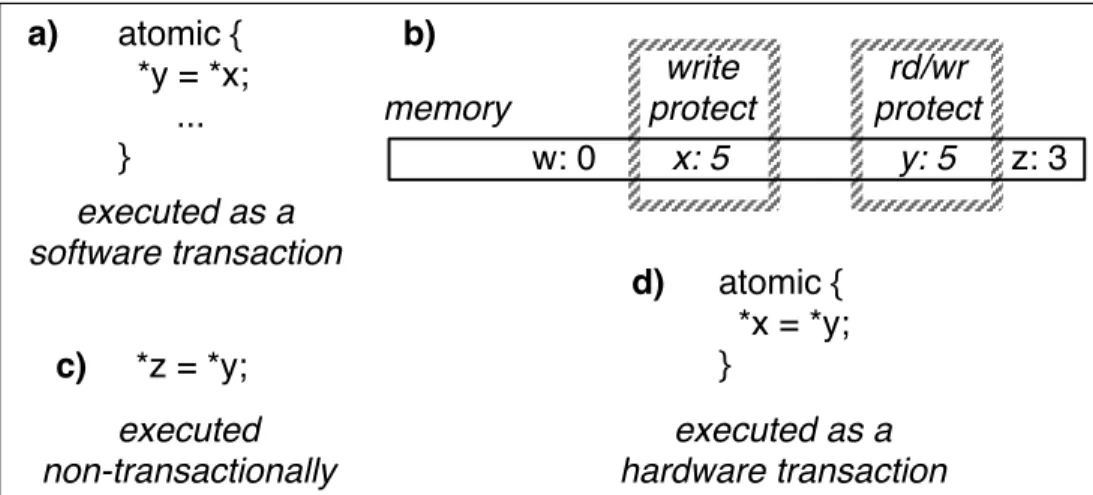
Software transactions (a) use hardware memory protection towrite protect values that they read and read/write protectvalues that they write, as shown in (b). Accesses to these values by non-transactional execution (c) will raise a protection violation, preventing the transaction’s atomicity from being violated. This same protection mechanism also prevents conflicting hardware transactions (d) from violating the atomicity of software transactions,
without the hardware transactions having to check STM metadata; they can execute without software overhead.
2.1
Introduction
In this proposal, the STM transactions protect the memory locations that they are reading and writing using a hardware fine-grained memory protection mechanism (e.g., Blizzard [65], Mondriaan Memory Protection [72], iWatcher [76]), as shown in Figure 2.1. This prevents accesses from non-transactional code from violating the atomicity of software transactions, because a hardware fault will be raised before a conflicting non-transactional read or write completes.1 In this way, I provide the STM withstrong atomicity [9], which, as I discuss in Section 2.2.2, is a property that provides clean transactional semantics in a straightforward way.
This technique, however, also permits hardware transactions to detect conflicts with concurrently-executing software transactions without slowing hardware transactions that do not conflict. When a hardware transaction attempts to perform an access that
conflicts with an in-flight software transaction, it receives a protection fault, permitting the hardware transaction to avoid the conflict by backing off or aborting. Since software trans-actions are required to protect their transactional data with hardware memory protection, hardware transactions can run at full speed because no software checks are required to detect conflicts with STM transactions. In this way, this proposal adopts apay-per-usephilosophy, where the costs of uncommon cases (such as overflowed transactions or I/O) only affect overall performance in proportion to their frequency.
My approach also follows the precept that hardware should provide primitives and not solutions[73]. This hybrid transactional memory system uses a minimum of special-purpose hardware, instead consisting of two hardware primitives — a best-effort hardware transac-tional memory (Section 2.3.1) and fine-grained memory protection (Section 2.3.2) — that have many compelling applications unrelated to transactional memory. This approach also avoids architecting in hardware the hybrid transactional memory’s semantics; instead, the STM is free to define (and evolve) its full feature set, of which the hardware transactional memory accelerates a (likely common) subset. This approach is particularly compelling as it is in the dark corners of transactional memory (e.g., system calls, I/O, waiting, open nesting) where the desired semantics have yet to be determined, but where programs are likely to spend only a fraction of their time.
This chapter makes the following contributions:
• I show how hardware memory protection enables low-overhead strong atomicity for STMs (Section 2.4.1).
• I demonstrate that this strong atomicity enables a hybrid transactional memory sys-tem with zero-overhead hardware transactions that can execute concurrently with potentially-conflicting software transactions (Section 2.4.3) and characterize the per-formance of this hybrid transactional memory (Section 2.5).
switch-ing transactions to software that achieve robust performance (Section 2.4.4).
2.2
Motivation
In this section, I discuss the three attributes of an ideal transactional memory system men-tioned above — high performance, a clean and complete programming model, and little dependence upon special-purpose hardware — and pitfalls encountered by prior transac-tional memory proposals.
2.2.1
High Performance
As the goal of multi-core programming is to increase program performance, many program-mers will ignore transactions if they significantly underperform locks, even if they offer a cleaner programming model. For example, there has been little adoption of software trans-actional memory because its significant single-thread overhead causes them to underperform lock-based code in any circumstance where lock contention is not the only bottleneck.
I strongly believe that, to achieve widespread use, uncontended transactions will need to incur little – if any – performance overhead relative to non-transactional execution. If transactions incur negligible single-thread overhead, programmers will be free to use them for concurrency control in almost any piece of code, without having to consider whether that code represents a scalability bottleneck.
2.2.2
A Clean and Complete Programming Model
To be accepted by programmers, transactional memory should expose a programming model that is no more complex than locks. This poses a problem for bounded HTM systems, for programmers should not have to reason about how their transactions fit into the cache geometry and the time quantum of all machines upon which they might run. Furthermore, the transactional memory system’s semantics should be intuitive — however, some proposed