G R A P H S , C O D E S ,
Q U A N T U M S T A T E S , A N D
B O O L E A N F U N C T I O N S
ISBN 978-82-308-05
7
3-
2
Bergen, Norway 2008
G R A P H S , C O D E S ,
Q U A N T U M S T A T E S , A N D
B O O L E A N F U N C T I O N S
Lars Eirik Danielsen
dissertation forthe degree of philosophiae doctor
the selmer center department of informatics
university of bergen norway
Abstract vii
Acknowledgements ix
Introduction to the Thesis 1
PAPER I:
On the Classification of All Self-Dual Additive Codes over GF(4)
of Length up to 12 25
PAPER II:
Graph-Based Classification of Self-Dual Additive Codes over
Finite Fields 51
PAPER III:
Edge Local Complementation and Equivalence of Binary Linear
Codes 77
PAPER IV:
Spectral Orbits and Peak-to-Average Power Ratio of Boolean Functions with Respect to the{I,H,N}n Transform 95
PAPER V:
Aperiodic Propagation Criteria for Boolean Functions 117 PAPER VI:
Interlace Polynomials: Classification, Unimodality, and
Connec-tions to Codes 159
PAPER VII:
We study objects that can be represented as graphs, error-correcting codes, quantum states, or Boolean functions. It is known that self-dual additive codes, which can also be interpreted as quantum states, can be represented as graphs, and that two codes are equivalent when the corresponding graphs are equivalent with respect to local complemen-tation (LC). We give classifications of such codes. Circulant graph codes are introduced, and it is shown that some of these codes have highly regular graph representations. We show that the orbit of a bipartite graph under edge local complementation (ELC) corresponds to the equivalence class of a binary linear code. We classify ELC orbits, give a new method for classifying binary linear codes, and show that the information sets and the minimum distance of a code can be derived from the corresponding ELC orbit. Self-dual additive codes over GF(4)
can also be interpreted as quadratic Boolean functions. In this context we define PARIHN, peak-to-average power ratio with respect to the {I,H,N}n transform, and prove that PARIHN equals the size of the
maximum independent set over the associated LC orbit of graphs. We define the aperiodic propagation criteria (APC) of a Boolean function, and show that it is related to the minimum distance of a self-dual additive code over GF(4), and to the degree of entanglement in the associated quantum state. We give a generalization to non-quadratic Boolean functions, and relate APC to known cryptographic criteria. Interlace polynomials encode many properties of the LC and ELC or-bits of a graph. We enumerate interlace polynomials and circle graphs, show that there exist non-unimodal interlace polynomials, and relate properties of interlace polynomials to properties of codes and quantum states. We define self-dual bent functions, and provide constructions and classifications.
The three years I have worked on this thesis have been both interesting and challenging. I wish to use this opportunity to thank all those whose advice and encouragement I have received. Firstly, I would like to express my gratitude to my supervisor, Matthew G. Parker, for his guidance, enthusiasm, and constant supply of ideas. Secondly, I thank my co-supervisor Tor Helleseth and all colleagues at the Selmer Center for providing an excellent work environment. Working in a group that has been described by the Research Council of Norway as “one of the gems on the Norwegian Scientific scene” has been truly inspiring. Finally, I give my thanks to Kristin and my family for their support.
1 M
O T I V A T I O NThis thesis is mainly a study of objects that can be represented as graphs, error-correcting codes, quantum states, or Boolean functions. These different ways of viewing what is fundamentally the same object give different insights to the properties of the object, and give rise to different constructions and generalizations.
Generating orbits of graphs under certain local operations give us efficient methods for classifying codes. We mainly consider codes that have applications in quantum computation, and which can also be represented as quantum graph states. Entangled graph states can be used, for instance, as a resource for measurement-based quantum com-putation. Graphs have a natural generalization to weighted graphs, which correspond to more general non-binary quantum states. Certain properties of a quantum graph state can be derived from the interlace polynomials of the associated graph.
A graph can also be represented as a quadratic Boolean function. There is a natural generalization to non-quadratic Boolean functions, which can still be interpreted as quantum states. Boolean functions have applications in cryptography, and it is interesting to observe that properties of Boolean functions that are relevant in cryptography are related to measures of entanglement in quantum states.
2 G
R A P H SAgraphis a pairG= (V,E)whereVis a set ofvertices, andE⊆V×V
is a set ofedges. A graph withnvertices can be represented by ann×n adjacency matrixΓ, whereΓi,j = 1 if{i,j} ∈ E, andΓi,j =0 otherwise. We will considersimple undirectedgraphs whose adjacency matrices
(a) (b) Fig. 1:Two Graph Representations of the Hexacode
are symmetric with all diagonal elements being 0. Theneighbourhood
of v ∈ V, denoted Nv ⊂ V, is the set of vertices connected tov by
an edge. The number of vertices adjacent to v is called thedegree of
v. The induced subgraphof G onW ⊆ V contains vertices W and all edges fromEwhose endpoints are both inW. ThecomplementofGis found by replacingEwithV×V−E, i.e., the edges inEare changed to non-edges, and the non-edges to edges.
As an example, consider the graph in Fig. 1a. We will usually consider graphs up toisomorphism, i.e., we ignore the labeling of the vertices. Choosing an arbitrary labeling of vertices, the adjacency matrix of this graph is Γ= 0 0 1 0 1 1 0 0 1 1 0 1 1 1 0 0 0 1 0 1 0 0 1 1 1 0 0 1 0 1 1 1 1 1 1 0 .
A graph operation that is central in this thesis islocal complementation
(LC) [1], which is defined as follows. Given a graphG= (V,E)and a vertexv∈V, LC onvtransformsGintoG∗v, where we have replaced the induced subgraph ofGonNvby its complement. As an example, we
will perform LC on vertex 1 of the graphG, shown in Fig. 2a. We see that the neighbourhood of 1 isN1={2, 3, 4}and that the induced subgraph
on the neighbourhood has edges{2, 3}and{2, 4}. The complement of this subgraph contains the single edge{3, 4}. The resulting LC image,
G∗1, is seen in Fig. 2b. As another example, consider the graph shown in Fig. 1b. An LC operation on any vertex of this graph produces the
2
1
3
4
(a)The Graph G
2
1
3
4
(b)The Graph G∗1
Fig. 2:Example of Local Complementation
the graph shown in Fig. 1a gives the same graph, up to isomorphism. LC operations on any of the other five vertices produces the graph shown in Fig. 1b.
Another operation that we use isedge local complementation(ELC) [2], sometimes called thepivotoperation, which can be defined in terms of LC. Given a graphG= (V,E)and an edge{u,v} ∈E, ELC on{u,v}
transformsGintoG(uv)=G∗u∗v∗u= G∗v∗u∗v. TheLC orbitof
a graphGis the set of all graphs that can be obtained by performing any sequence of LC operations onG. As an example, the two graphs shown in Fig. 1 make up a complete LC orbit, up to isomorphism. Similarly, theELC orbitofGcomprises all graphs that can be obtained by performing any sequence of ELC operations onG. LC and ELC were originally introduced in the context ofisotropic systems[2].
Associated with a graphG areinterlace polynomials q(G,x) [3] and
Q(G,x)[4]. The polynomialq(G), whose introduction was motivated by a problem related to DNA sequencing [5], encodes certain properties of the ELC orbit ofGand is defined as follows. If Gis a graph with
nvertices and no edges,q(G) = xn. For any other graphG= (V,E),
choose an arbitrary edge{u,v} ∈E, and letq(G) =q(G\u) +q(G(uv)\ u), whereG\uis the graphGwith vertexuand all edges incident onu
removed.Q(G)similarly encodes properties of the LC orbit ofGand is defined as follows. IfGis an edgeless graph withnvertices,Q(G) =xn.
For any other graphG= (V,E), choose an arbitrary edge{u,v} ∈E, and letQ(G) =Q(G\u) +Q(G(uv)\u) +Q(G∗u\u). Properties of
a graph that can be obtained from its interlace polynomials include the number of vertices, the number of connected components, and the number of perfect matchings. Most interesting for our purposes is that the degree ofQequals the size of the largestindependent setover all members of the LC orbit ofG, and that the value ofQ(G, 4)equals 2n
set is a set of vertices such that no pair are connected by an edge, and a graph is Eulerian if all vertices have even degree. As an example, both graphs in Fig. 1 have interlace polynomials q(G) = 12x+10x2 and
Q(G) =108x+45x2. The fact that deg(Q) =2 matches the observation
that none of the two graphs have an independent set of size greater than two. That Q(2G6,4) = 18 means that each graph has 18 Eulerian
subgraphs.
3 C
O D E SCoding theory [6] deals with techniques for detecting and correcting errors in information that has been affected by noise. A binary linear code,C, is a linear subspace of GF(2)nof dimensionk, where 0≤k≤n. C is called an[n,k]code, and the 2k elements ofC are calledcodewords.
Such a code can be utilized by mapping a block ofkinformation bits onto one of the 2kn-bit codewords. Upon receivingnbits, the receiver
can detect errors simply by observing that the bits do not form a valid codeword. He can then perform error-correction, typically by choosing the codeword that is closest to the received bits in terms ofHamming distance. The Hamming distance between two vectors is the number of coordinates where they have different values. For error-detection to be successful the number of bit positions in error must be at most
d−1, wheredis theminimum distanceof the code. For error-correction to succeed, the number of errors must be at mostjd−1
2 k
. The minimum distance of a code is the minimal Hamming distance between any two codewords. A linear code with minimum distancedis called an
[n,k,d]code, and can be defined by ak×n generator matrixwhose rows span the code. Two codes are considered to beequivalentif one can be obtained from the other by some permutation of the coordinates, or equivalently, a permutation of the columns of a generator matrix. A classical problem is to classify codes up to equivalence [7]. We define thedualof the codeC asC⊥ = {u ∈GF(2)n | u·c=0 for allc∈ C}. C is calledself-orthogonal ifC ⊆ C⊥, andself-dual[8] if C = C⊥. The classification of self-dual codes is also an active research topic [9].
Besides binary linear codes, in this thesis we study a more special class of codes known as self-dual additive codes over GF(4)[10, 11], which are of interest due to their connections to quantum codes [12]. We denote the finite field with four elements GF(4) = {0, 1,ω,ω2},
subgroup of GF(4)n with 2k codewords of length n and minimum
distanced. It can be defined by ak×ngenerator matrix. We consider codes that are self-dual with respect to theHermitian trace inner product,
u∗v=∑ni=1(uiv2i +u2ivi) (mod 2). A self-dual code must be an(n, 2n)
code. Two codes are equivalent if we can get from one to the other by a permutation of coordinates and permutations of the elements{1,ω,ω2}
in each coordinate.
As an example, consider the(6, 26, 4)code, also known as the
Hexa-code, generated by C= 1 0 0 1 ω ω ω 0 0 ω ω2 ω2 0 1 0 ω 1 ω 0 ω 0 ω2 ω ω2 0 0 1 ω ω 1 0 0 ω ω2 ω2 ω .
It is known that all self-dual additive codes over GF(4)can be repre-sented as graphs [2, 13–17]. More specifically, every code is equivalent to a code with generator matrixΓ+ωI, whereΓis the adjacency matrix of a graph, andIis an identity matrix. For example, the code generated by the matrixCgiven above is equivalent to the code generated by
C0 =Γ+ωI= ω 0 1 0 1 1 0 ω 1 1 0 1 1 1 ω 0 0 1 0 1 0 ω 1 1 1 0 0 1 ω 1 1 1 1 1 1 ω ,
whereΓis the adjacency matrix of the graph depicted in Fig. 1a. It is also known that if two codes are equivalent, their associated graphs will be related by some sequence of local complementations [2, 16, 17]. This means that the LC orbit of a graph corresponds to the equivalence class of a self-dual additive code over GF(4). For example, the two graphs shown in Fig. 1 represent the equivalence class of the Hexacode.
More generally, self-dual additive codes can be defined over the finite field GF(m2)[18, 19]. These codes can be represented as graphs
where the edges are weighted with elements from GF(m)[14, 15], and a generalization of the LC operation can be used to generate their equivalence classes [20].
4 Q
U A N T U MS
T A T E SA quantum computer [21] performs computations by using quantum mechanical systems. The laws of quantum mechanics predict effects, such assuperpositionandentanglement, which are very different from the physical reality we ordinarily observe. These effects makes it possible to solve certain problems much more efficiently on a quantum computer than on a classical computer. Shor’s algorithm for factoring integers in polynomial time is of particular interest, due to the importance of factoring in public-key cryptography. Quantum computation is an active field of research, although a scalable quantum computer has not yet been built.
Quantum information can be stored in quantum bits, also known asqubits. A qubit can be described by a vector|xi= (αβ)∈C2, where |α|2 is the probability of observing the value 0 when we measure
the qubit, and|β|2 is the probability of observing 1. If bothαand β
are non-zero, the qubit has both the value 0 and the value 1 at the same time, and we call this asuperposition. Once we have measured the qubit, however, the superposition collapses, and we are left with a classical state that is either 0 or 1 with certainty. A state ofnqubits is represented by a normalized complex vector with 2n elements. The
state is calledentangledif the measurement outcomes of the qubits are not independent. An example of an entangled state of two qubits is theEPR pair,√1
2(|00i+|11i), with vector representation(√12, 0, 0,√12)T.
Once we measure one of these two qubits, we know that the other qubit must have the same value.
Measurement of a quantum state collapses superpositions and de-stroys entanglement, but we can perform an operation that does not disturb the state. Such a transformation must be represented by a
unitarymatrix, i.e.,UU† = I, where † means conjugate transpose. A
transformation that acts independently on each qubit of a multi-qubit state is calledlocal unitary, and can be written as atensor product (or
Kronecker product) of 2×2 matrices. We define the tensor product as
A⊗B= A1,1B A1,2B · · · A1,2B A2,2B · · · ... ... ... .
quan-decohere, i.e., be destroyed by interaction with the environment. It is remarkable that quantum error correction is possible [22], since quan-tum information can not be copied or observed without destroying it, and since quantum errors are continuous. Assuming that errors act independently on each qubit, every possible error can be described as a local unitary transform. Any 2×2 unitary matrix can be written as a linear combination of thePauli matrices,
X= 0 1 1 0 , Z= 1 0 0 −1 , Y=iXZ= 0 −i i 0 , I= 1 0 0 1 . By using an error correction process that collapses any error operator to a tensor product of Pauli matrices, a quantum code only needs to consider the three possible errorsX,Z, andY. A class of quantum codes that exploit this fact are thestabilizer codes[23]. An[[n,k]]stabilizer code encodes kqubits usingn qubits, and is an Abelian group generated by a set of n−k commuting Pauli operators. An error is detected by measuring the eigenvalues of these operators. If a state is a valid codeword that has not been affected by error, we will observe the eigenvalue +1 for all operators. If there is a detectable error, some eigenvalues would be −1, due to the fact that Pauli matrices anti-commute. In this thesis, we consider [[n, 0]] codes. An [[n, 0]] code is generated by a set of n Pauli operators and represents a single quantum state known as astabilizer state. The minimum distance,d, of an[[n, 0,d]]code is the minimum weight of all error operators in the stabilizer, where the weight of an error operator is the number of tensor components that are different fromI. If the minimum distance is high, the stabilizer state is highly entangled.
As an example, consider the[[6, 0, 4]] stabilizer state, generated by the operators Z⊗I ⊗I ⊗Z⊗X⊗X X⊗I ⊗I ⊗X⊗Y⊗Y I ⊗Z⊗I ⊗X⊗Z⊗X I ⊗X⊗I ⊗Y⊗X⊗Y I ⊗I ⊗Z⊗X⊗X⊗Z I ⊗I ⊗X⊗Y⊗Y⊗X.
We can represent ann-fold tensor product of Pauli matrices as a vector in GF(4)n, by the mappings I 7→ 0, Z 7→ 1, X 7→ ω, andY 7→ ω2.
In this way, it is possible to represent stabilizer codes as codes over GF(4)[12]. That the stabilizer is Abelian and that all operators commute means that the code over GF(4)must be additive and self-orthogonal. Stabilizer states correspond to self-dual additive codes over GF(4). As an example, the[[6, 0, 4]]code given above corresponds to the self-dual additive (6, 26, 4) Hexacode. Since all self-dual additive codes over
GF(4) can be represented as graphs, this also holds for all stabilizer states. Thus the[[6, 0, 4]] code corresponds to the LC orbit shown in Fig. 1. A stabilizer state represented in graph form is called a graph state[24]. Graph states can be used as a resource for measurement-based quantum computation [25], where carefully chosen measurements on an entangled state are used to execute a quantum algorithm.
Instead of qubits, we could consider the more generalm-levelqudits, and the corresponding non-binary stabilizer codes [18, 19].
5 B
O O L E A NF
U N C T I O N SA Boolean function ofnvariables is a function f :Zn
2 →Z2. It can be
represented as a vector inZ2n
2 listing the values of f(x)for allx∈Zn2,
called atruth table. It can also be represented inalgebraic normal form, as a sum of monomials ofnvariables. Thedegreeof a Boolean function is the degree of the highest degree term in its algebraic normal form. A graph onnvertices can be represented as a quadratic Boolean function ofnvariables, by simply mapping the edge{u,v}to the monomialxuxv.
Furthermore, given a Boolean function f(x)ofnvariables, the vector
s= 2−n2(−1)f(x)can be interpreted as the state vector of a quantum
state ofnqubits. This is a convenient way of mapping a graph to its corresponding graph state, but is also valid for Boolean functions of degree higher than two.
Local unitary transforms of the vectorspreserve the entanglement of the associated quantum state. We are particularly interested in the set of transforms I= 1 0 0 1 , H= √1 2 1 1 1 −1 , N= √1 2 1 i 1 −i , wherei2=−1. These three matrices are called the identity, Hadamard,
and Negahadamard kernels, and are generators for the local Clifford group. The{I,H,N}n set of transforms is given by the 3n n-fold tensor
produce 3n spectra. A transform of s that, to within normalization,
contains only entries±1 is aflatspectrum and can be interpreted as 2−n
2(−1)f0(x), where f0is a Boolean function we consider to be
equiva-lent to f. It has been shown that the set of flat{I,H,N}n spectra of a
quadratic Boolean function corresponds to the LC orbit of the associated graph [26]. In fact, LC on a vertexvcorresponds to the application of
Nto the variable xv, and ELC on an edge {u,v} corresponds to the
application ofHto variablesxuand xv.
The{I,H,N}n transforms of a Boolean function can tell us
some-thing about the degree of entanglement in the corresponding quantum state [27]. We define PARIHN, the peak-to-average power ratio with
respect to{I,H,N}n, as
PARIHN(s) =2n max U∈{I,H,N}n
k∈Zn
2
|Sk|2, whereS=Us.
PARIHN will be a value between 1 and 2n, and states with a high
degree of entanglement will have a low value. More generally, we can define PARU with respect to the infinite set of all local unitary
transforms, on which PARIHNis only a lower bound. Since the values |Sk|2are the probabilities of observing each of 2nbasis states associated
withS, and a local unitary transformation corresponds to a change of measurement basis, PARUanswers the question: If we can use any local
measurement basis, what is the highest probability that can be achieved for any basis state? A more well-known measure of entanglement is the
Schmidt measure[24], which answers the question: For all local unitary transformsS=Us, what is the lowest number of non-zero coefficients inS? Bounds on the Schmidt measure can be obtained from PARU and
PARIHN[28]. It has also been shown [29] that PARUis equivalent to the geometric measure[30] of entanglement for a pure quantum state, and that PARIHN is an upper bound on the geometric measure. Another property related to entanglement is theClifford merit factor(CMF) [31],
CMF(s) = 6n
∑U∈{I,H,N}n
k∈Zn
2
|Sk|4−6n, whereS=Us.
It can be shown that CMF is invariant under any local unitary trans-form [31]. As an example, the graph shown in Fig. 1a corresponds to the Boolean function f(x) =x1x3+x1x5+x1x6+x2x3+x2x4+x2x6+
which are known to be the lowest values for any quadratic or cubic function of 6 variables [28].
Boolean functions have important applications in cryptography, for instance as components of S-boxes in block ciphers, and as filtering functions in stream ciphers. An interesting class of functions in this context are thebent[32] functions, due to their perfectnon-linearity. A Boolean function is called bent if itsWalsh-Hadamard transform, defined by the unitary matrix H⊗n, is flat. The Walsh-Hadamard transform
of a bent function f can be interpreted as the truth table of another Boolean function ˜f, called thedualof f. Note that the transform H⊗n
is one of the 3n {I,H,N}n transforms. There are many properties that
Boolean functions used in cryptography should satisfy. For instance, to be secure against differential cryptanalysis, the component Boolean functions of an S-box should satisfy thepropagation criteria(PC) and the
extended propagation criteria(EPC) [33], both derived from the periodic
autocorrelationspectrum of the function.
6 S
U M M A R Y O FP
A P E R SThe thesis consists of seven papers. A short overview of each paper follows.
6.1 PA P E RI
The first paper, entitled “On the classification of all self-dual additive codes over GF(4) of length up to 12,” is co-authored with Matthew G. Parker and was published in J. Combin. Theory Ser. A113(7), 1351– 1367, 2006. An earlier version of the paper was also presented at the Fourth International Workshop on Optimal Codes and Related Topics (OC 2005) in Pamporovo, Bulgaria.
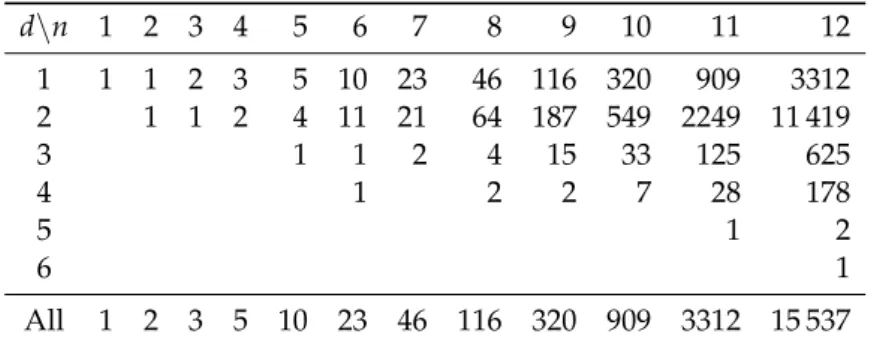
We give an introduction to self-dual additive codes over GF(4)and their graph representation. By recursively applying LC operations and checking for graph isomorphism, we can generate the entire LC orbit of a graph, which corresponds to the equivalence class of a self-dual additive code over GF(4). Self-dual additive codes over GF(4)of length up to 9 have previously been classified, but by running our graph-based algorithm on a parallel cluster computer, we are able to extend the classification to length 12, which is the main result of this paper. By exploiting the fact that codes of Type II correspond to anti-Eulerian
all extremal Type II codes of length 14. We also solve an open problem by finding that the smallest Type I and Type II codes with trivial automorphism group have lengths 9 and 12, respectively.
6.2 PA P E RII
The second paper is entitled “Graph-based classification of self-dual additive codes over finite fields,” and is a preprint of a paper that has been submitted for publication.
This is a generalization of the work in Paper I, in that we consider self-dual additive codes over GF(m2). It is known that these codes
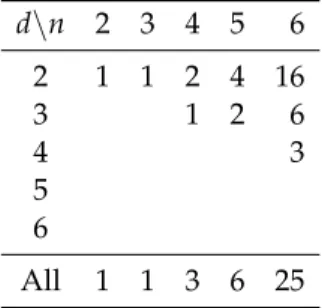
correspond to quantum stabilizer states over GF(m), that they can be represented as weighted graphs, and that a generalization of the LC operation generates the equivalence class of a code. By using a graph-based algorithm, similar to the one used in Paper I, all self-dual additive codes over GF(9), GF(16), and GF(25)up to lengths 8, 6, and 6, respectively, are classified. By using an extension technique, we are also able to classify all extremal self-dual additive codes over GF(9)of length 9 and 10. Assuming that the MDS conjecture holds, this means that all self-dual additive MDS codes over GF(9) are classified. We show that the known mass formula for self-dual additive codes over GF(4)is easily generalized to GF(m2), and use this to derive bounds
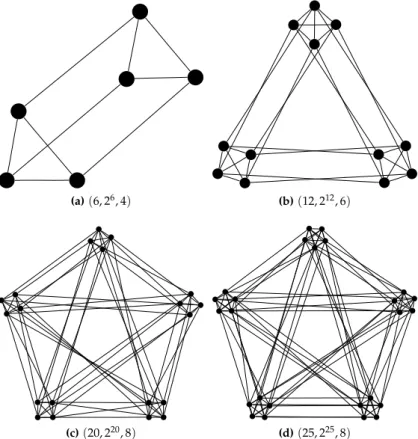
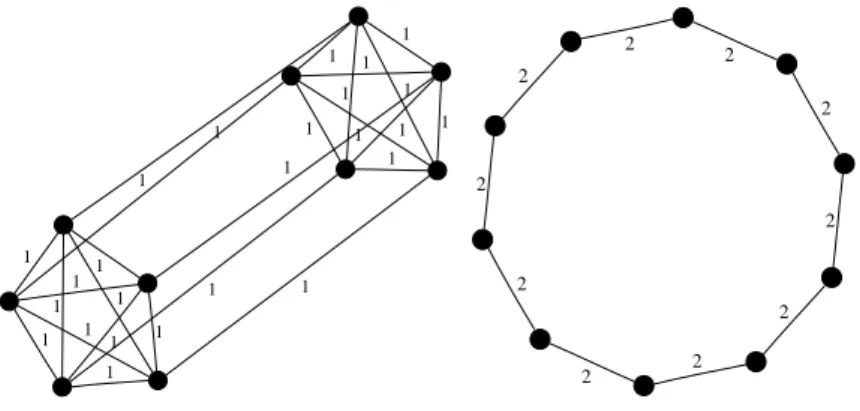
on the number of inequivalent codes. We also prove that the minimum distance of a code is equal to one plus the minimum vertex degree over all graphs in the associated generalized LC orbit. We introduce the concept of a circulant graph code, and perform a computer search which reveals this class to contain many strong codes. It is mentioned that some of the circulant graph codes correspond to highly regular graph structures, in particular the “nested clique” graphs. This concept is explored further in Papers IV and VI.
6.3 PA P E RIII
The third paper, entitled “Edge local complementation and equivalence of binary linear codes,” is co-authored with Matthew G. Parker. It has been accepted for publication inDes. Codes Cryptogr., after being presented at the International Workshop on Coding and Cryptography (WCC 2007) in Versailles, France.
Whereas Papers I and II studied self-dual additive codes, interesting for their applications in quantum error-correction, this paper deals
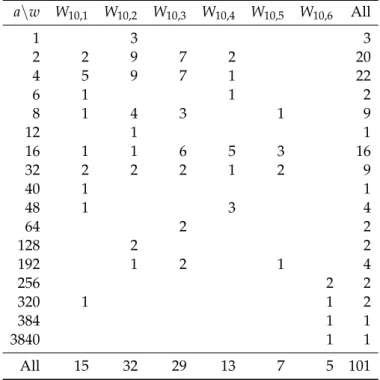
with classical binary linear codes. Like a self-dual additive code can be represented as a graph, it is common to represent a binary linear code as a bipartite graph. Our contribution is to prove that the equivalence class of the code can be generated by recursively applying edge local complementation (ELC) on the associated bipartite graph. Although the improvement of our graph-based approach over classical classification algorithms is not as great for binary linear codes as it was for self-dual additive codes, we claim that our algorithm has running time comparable to the best known algorithm. With our algorithm it is possible to classify all binary linear codes of length at least up to 15. The classification of all codes of length greater than 14 has been presented as an open problem. With a minor modification to the ELC operation, we obtain an algorithm for finding all information sets of a code. We also explain the relationship between the number of ELC orbits of bipartite graphs onnvertices and the number of inequivalent binary linear codes of lengthn. We prove that the minimum distance of a binary linear code is equal to one plus the minimum vertex degree over all graphs in the associated ELC orbit. We also classify the ELC orbits of all graphs on up to 12 vertices. Although not applicable to binary linear codes, the ELC orbits of non-bipartite graphs may be of interest in the context of quantum graph states. They are also useful in the study of interlace polynomials, as will be seen in Paper VI.
6.4 PA P E RIV
The fourth paper is entitled “Spectral orbits and peak-to-average power ratio of Boolean functions with respect to the{I,H,N}n transform,”
and is a joint work with Matthew G. Parker. It was presented at Se-quences and Their Applications (SETA 2004) in Seoul, South Korea, and published inLecture Notes in Comput. Sci.3486, 373–388, 2005.
The classification of all self-dual additive codes over GF(4)of length up to 12 was first reported in this paper, albeit in a much more con-densed version than in Paper I. It is also shown that certain self-dual additive codes over GF(4) with high minimum distance can be rep-resented by graphs with a highly regular “nested clique” structure. The connections between self-dual additive codes, graphs, quantum codes, and stabilizer states have already been elaborated on. In this paper the link to Boolean functions is made. We explain how a graph can be represented as a quadratic Boolean function, and that the LC
forms of the Boolean function. PARIHN is defined, and it is shown
that it is correlated with the minimum distance of the corresponding self-dual additive code, and with the degree of entanglement in the corresponding stabilizer state. We prove that PARIHN of a quadratic Boolean function is given by the size of the largest independent set over all graphs in the associated LC orbit, and give bounds on this value derived from Ramsey numbers and from computational results. The{I,H,N}ntransform and PARIHNremain well-defined for Boolean
functions with degree higher than two. These functions do not corre-spond to stabilizer states, but can still be interpreted as quantum states. Boolean functions of high degree and strong spectral properties are also of interest in cryptography. We propose a construction technique to generate non-quadratic Boolean functions with low PARIHN. The
study of Boolean functions related to quantum states and cryptography is continued in Paper V. The properties of the interlace polynomial of a graph are used to prove a theorem in this paper. Interlace polynomials are studied further, and some of the results in this paper are extended, in Paper VI.
6.5 PA P E RV
The fifth paper is a joint work with T. Aaron Gulliver and Matthew G. Parker. It is entitled “Aperiodic propagation criteria for Boolean functions,” and was published inInform. and Comput.204(5), 741–770, 2006.
Boolean functions used as components of S-boxes in block ciphers should satisfy the propagation criteria (PC) and the extended propa-gation criteria (EPC), which are both derived from the periodic auto-correlation spectrum of the function. In this paper, we introduce the aperiodic propagation criteria (APC), derived from the aperiodic au-tocorrelation spectrum of a Boolean function, and related to the first derivative of the function. We set up a cryptographic scenario where APC is relevant, and define the APC distance of a Boolean function to be the minimum number of plaintext bits that an attacker must both know and be able to modify in order to succeed with a differential attack. Surprisingly, the APC distance of a quadratic Boolean function is equal to the minimum distance of the corresponding self-dual ad-ditive code over GF(4). This means that Boolean functions with high APC distance also correspond to highly entangled graph states, and provides a link between quantum entanglement and cryptographic
criteria. The interpretation of Boolean functions as quantum states is also extended to non-quadratic functions, which can be represented as hypergraphs. Non-quadratic functions with high APC distance could be of interest in both cryptography and quantum error-correction. We give examples of cubic functions of 7 and 8 variables that have APC distance equal to the best quadratic functions of the same number of variables. Just as LC operations preserve the minimum distance of the associated self-dual additive code over GF(4), it is proved that the
{I,H,N}nset of transforms preserve the APC distance of any Boolean
function. It is explained how the {I,H,N}n transform can be used
to generate orbits of equivalent Boolean functions, a technique that was also used in Paper IV. The orbits of non-quadratic functions can be viewed as generalized LC orbits. Finally, we perform a differential analysis of a few state-of-the-art S-boxes with respect to both periodic and aperiodic autocorrelation. High aperiodic biases are found, but it might be difficult to exploit these biases in a practical attack.
6.6 PA P E RVI
The sixth paper, a preprint entitled “Interlace polynomials: Enumer-ation, unimodality, and connections to codes,” is co-authored with Matthew G. Parker.
In this paper, we study the properties of the interlace polynomials
q(G)andQ(G)associated with a graphG, and the connections to the self-dual additive code and quantum state thatGrepresents. It is known that the minimum distance of a self-dual additive code over GF(4)is equal to one plus the minimum vertex degree over all graphs in the associated LC orbit. This value can not be obtained from any interlace polynomial, but we show that other values that are correlated with the minimum distance are encoded in the interlace polynomialQ. In Paper IV, we proved that PARIHN of a quadratic Boolean function is
given by the size of the largest independent set over all graphs in the associated LC orbit. This value can also be obtained as the degree of
Q(G). It has also been shown that from the valueQ(G, 4), which gives us the number of induced Eulerian subgraphs of G, we can obtain the Clifford merit factor (CMF). Our computational results show that the interlace polynomialQof a graph that corresponds to a self-dual additive code over GF(4)with high minimum distance, will also have low degree and a low value ofQ(G, 4). In particular, we have not found
does not also correspond to a code with the highest known minimum distance.
Graphs that are not LC equivalent may still have the same interlace polynomial. It is interesting to know how many distinct interlace poly-nomials exist, and we give an enumeration of the interlace polypoly-nomials
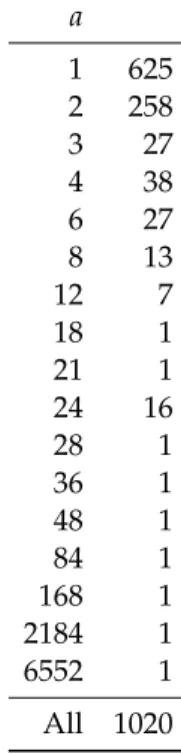
qandQof all graphs of order up to 12.
A graph is called a circle graph if its vertices can be represented as chords on a circle, such that every edge corresponds to a intersection of two chords. Previously, all circle graphs of order up to 9 have been enumerated. We give an enumeration of all circle graphs of order up to 12. When it comes to the application of graphs as self-dual additive codes over GF(4), we show that circle graphs, as well as bipartite graphs, are not well suited. We also revisit the “nested clique” graphs, and give some indications as to why these graphs are particularly good.
A sequence is unimodal if it is non-decreasing up to some coefficient, and the rest of the sequence is non-increasing. It has been conjectured that all interlace polynomialsqhave unimodal coefficient sequences. We show that there exist graphs of order 10 with interlace polynomials
qwhose coefficient sequences are non-unimodal, thereby disproving this conjecture. We also show that by various extension techniques, we can find graphs of any order greater than 10 with non-unimodal interlace polynomials. With these extension techniques, we can obtain all graphs of order 11 with non-unimodal interlace polynomials, and all but four graphs of order 12. We verify that for graphs of order up to 12, all interlace polynomialsQhave unimodal coefficients, and we conjecture that this holds for allQ.
6.7 PA P E RVII
The seventh and last paper is a joint work with Claude Carlet, Matthew G. Parker, and Patrick Solé. It is entitled “Self-dual bent functions,” and will be presented by Patrick Solé at the Fourth International Workshop on Boolean Functions: Cryptography and Applications (BFCA 2008) in Copenhagen, Denmark.
We introduce self-dual bent functions as the subset of bent functions where ˜f = f, where ˜f is the dual of f. We call a bent function anti-self-dual if ˜f is the complement of f. A spectral characterization in terms of the Rayleigh quotient ofH⊗n allows us to give a simple and efficient
search algorithm which makes it possible to classify all self-dual bent function of up to six variables and all quadratic self-dual bent functions
of 8 variables. We also derive primary and secondary constructions for self-dual bent functions, and describe the operations on Boolean functions that preserve self-duality. If the function is a quadratic form, ELC on the corresponding graph is one such operation. More generally,
{I,H}n transforms, the action of the orthogonal group, and a restricted
set of affine offsets preserve self-duality. We have classified self-dual bent functions with respect to the latter two of these symmetries.
There are several connections between the topic of this paper and the previous six papers. The transformH⊗n is one of the 3n{I,H,N}n
transforms studied in Papers IV and V. Finding Boolean functions that have good properties with respect to subsets of the {I,H,N}n
transforms may provide clues as to what functions are optimal with respect to the complete set of {I,H,N}n transforms. There is also
a relationship between self-dual bent functions and self-dual codes. We show that quadratic self-dual bent functions obtained from the Maiorana-MacFarland construction correspond to parity check matrices of self-dual binary codes.
7 O
P E NP
R O B L E M SThis thesis deals with a very diverse topic and presents many open problems and areas for further research. Some of the open problems are listed here.
• In Papers I, II, and III, we classify different types of codes. It would of course be of interest to improve the classification algorithms and extend these classifications.
• In Paper II, we give an algorithm for classifying binary linear codes. There are perhaps some special classes of binary linear codes where our algorithm is particularly effective.
• Analogous to the generalization from Paper I to Paper II, it should be possible to generalize the results in Paper III, i.e., devise an algorithm for classifying non-binary linear codes, by defining a generalized ELC operation for weighted graphs.
• We have only studied self-dual additive codes, corresponding to
[[n, 0,d]]stabilizer codes. It would be interesting to also consider self-orthogonal additive codes, or[[n,k,d]]stabilizer codes. These
operation similar to LC that generates the equivalence class of a code is not known.
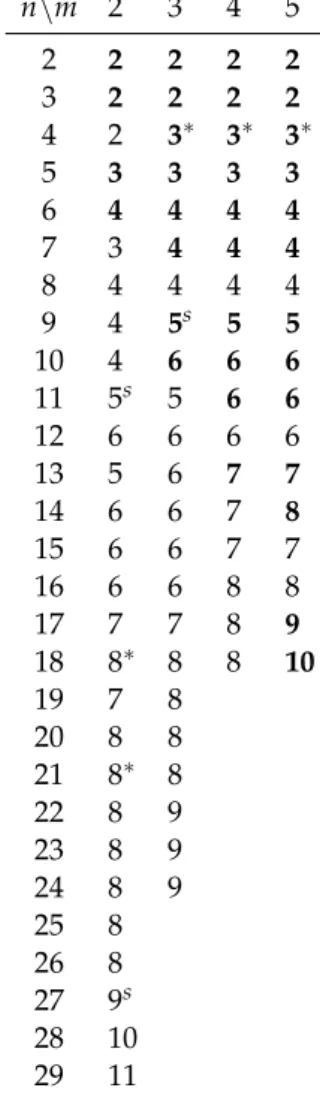
• For lengths between 23 and 27, the optimal minimum distance of a self-dual additive code over GF(4)is not known. In particular, the existence of a(24, 224, 10)code remains an open question.
• In Paper II, we generate generalized LC orbits of graphs where the edges are weighted with elements from GF(m), but a general-ization of LC to graphs with weights from an Abelian group that is not a finite field is not known.
• The “nested clique” graphs, studied in Papers II, IV, and VI, might lead to a more formal construction, yielding codes with a pre-dictable minimum distance. For self-dual additive codes over GF(4)with minimum distance greater than 8, we have not found any “nested clique” representations, nor any graph representa-tion where all vertices have minimal degree, i.e., one less than the minimum distance. Perhaps a more general regular graph structure than the “nested clique” is required for higher minimum distances.
• In Paper II we introduce circulant graph codes. For self-dual addi-tive codes over GF(4)of length up to 30, the best codes produced by the circulant graph construction have exactly the same mini-mum distance as codes obtained by the more general circulant code construction. It would be interesting to find conditions for when a circulant code is equivalent to a circulant graph code.
• In Papers IV and VI we give bounds on PARIHN and CMF from computational results. An open problem is to provide more formal bounds on these values.
• Is it possible to give a bound on the size of the largest independent set in the LC orbit of a Paley graph, or any other family of graphs?
• Finding a new construction technique for graphs or codes with good properties (PARIHN, CMF, or minimum distance) would be an important result.
• Construction techniques for non-quadratic Boolean functions with good properties (PARIHN, CMF, or APC distance) are also of interest. In particular, we would like to find a non-quadratic
function with better properties than the best quadratic function of the same number of variables.
• It is not obvious if and how a non-quadratic Boolean function can be employed as a quantum error-correcting code.
• It is known that bipartite graphs do not yield strong self-dual additive codes, and in Paper IV, we see that circle graphs are not good either. Is it possible to give bounds on the properties of a circle graph, and are there other classes of graphs that should be avoided?
• In Papers IV and VI, we calculate the PARIHNof graphs. It would
be interesting to also be able to calculate PARUwith respect to the infinite set of all unitary transforms. For LC orbits that contain bipartite graphs, this value is equal to PARIHN, but in general we
can only find lower bounds.
• Interlace polynomials are explored in Paper VI, and in Paper II we see that there is a generalized LC operation for weighted graphs. Does this mean that generalized interlace polynomials for weighted graphs can also be defined?
• The aperiodic propagation criteria (APC) is introduced in Paper V, but a practical application of aperiodic autocorrelation to the cryptanalysis of symmetric primitives has not yet been found.
• Another problem is to extend the classification of self-dual bent functions from Paper VII.
• We have seen that certain self-dual bent functions correspond to self-dual binary codes. Finding more connections to the theory of self-dual codes is a topic for further research.
R
E F E R E N C E S[1] de Fraysseix, H.: Local complementation and interlacement graphs.
Discrete Math.33(1), 29–35, 1981.
[2] Bouchet, A.: Graphic presentations of isotropic systems. J. Combin. Theory Ser. B45(1), 58–76, 1988.
[3] Arratia, R., Bollobás, B., Sorkin, G. B.: The interlace poly-nomial of a graph. J. Combin. Theory Ser. B 92(2), 199–233, 2004.
[4] Aigner, M.,van derHolst, H.: Interlace polynomials. Linear Algebra Appl.377, 11–30, 2004.
[5] Arratia, R., Bollobás, B., Coppersmith, D., Sorkin, G. B.: Euler circuits and DNA sequencing by hybridization.Discrete Appl. Math.104(1– 3), 63–96, 2000.
[6] MacWilliams, F. J., Sloane, N. J. A.:The Theory of Error-Correcting Codes. Elsevier, New York, 1978.
[7] Kaski, P., Östergård, P. R. J.:Classification Algorithms for Codes and Designs, vol. 15 ofAlgorithms and Computation in Mathematics. Springer, Berlin, 2006.
[8] Rains, E. M., Sloane, N. J. A.: Self-dual codes. In
Hand-book of Coding Theory, pp. 177–294. North-Holland, Amsterdam, 1998.
arXiv:math.CO/0208001.
[9] Huffman, W. C.: On the classification and enumeration of self-dual codes.Finite Fields Appl.11(3), 451–490, 2005.
[10] Höhn, G.: Self-dual codes over the Kleinian four group. Math. Ann.
327(2), 227–255, 2003. arXiv:math.CO/0005266.
[11] Gaborit, P., Huffman, W. C., Kim, J.-L., Pless, V.: On additive GF(4) codes. InCodes and Association Schemes, vol. 56 ofDIMACS Ser. Discrete Math. Theoret. Comput. Sci., pp. 135–149. Amer. Math. Soc., Providence, RI, 2001.
[12] Calderbank, A. R., Rains, E. M., Shor, P. M., Sloane, N. J. A.: Quantum error correction via codes over GF(4). IEEE Trans. Inform. Theory
44(4), 1369–1387, 1998. arXiv:quant-ph/9608006.
[13] Schlingemann, D.: Stabilizer codes can be realized as graph codes.
Quantum Inf. Comput.2(4), 307–323, 2002. arXiv:quant-ph/0111080.
[14] Schlingemann, D., Werner, R. F.: Quantum error-correcting codes associated with graphs.Phys. Rev. A65(1), 2002. arXiv:quant-ph/0012111. [15] Grassl, M., Klappenecker, A., Rötteler, M.: Graphs, quadratic
forms, and quantum codes. InProc. IEEE Int. Symp. Inform. Theory, p. 45. 2002. arXiv:quant-ph/0703112.
[16] Glynn, D. G., Gulliver, T. A., Maks, J. G., Gupta, M. K.: The geometry of additive quantum codes, 2004. Submitted to Springer. [17] Van denNest, M., Dehaene, J., DeMoor, B.: Graphical description
of the action of local Clifford transformations on graph states.Phys. Rev. A
[18] Rains, E. M.: Nonbinary quantum codes.IEEE Trans. Inform. Theory45(6), 1827–1832, 1999. arXiv:quant-ph/9703048.
[19] Ketkar, A., Klappenecker, A., Kumar, S., Sarvepalli, P. K.: Non-binary stabilizer codes over finite fields.IEEE Trans. Inform. Theory52(11), 4892–4914, 2006. arXiv:quant-ph/0508070.
[20] Bahramgiri, M., Beigi, S.: Graph states under the action of local Clif-ford group in non-binary case, 2006. Preprint. arXiv:quant-ph/0610267. [21] Nielsen, M. A., Chuang, I. L.:Quantum Computation and Quantum
Information. Cambridge University Press, Cambridge, 2000.
[22] Shor, P. W.: Scheme for reducing decoherence in quantum computer memory. Phys. Rev. A52(4), 1995.
[23] Gottesman, D.: Stabilizer Codes and Quantum Error Correction. Ph.D. thesis, Caltech, May 1997. arXiv:quant-ph/9705052.
[24] Hein, M., Eisert, J., Briegel, H. J.: Multi-party entanglement in graph states.Phys. Rev. A69(6), 2004. arXiv:quant-ph/0307130.
[25] Raussendorf, R., Browne, D. E., Briegel, H. J.: Measurement-based quantum computation on cluster states. Phys. Rev. A68(2), 2003. arXiv:quant-ph/0301052.
[26] Riera, C., Parker, M. G.: Generalised bent criteria for Boolean functions (I).IEEE Trans. Inform. Theory52(9), 4142–4159, 2006. arXiv:cs.IT/0502049. [27] Parker, M. G., Rijmen, V.: The quantum entanglement of binary and bipolar sequences. InSequences and Their Applications – SETA 2001, Dis-crete Math. Theor. Comput. Sci., pp. 296–309. Springer, London, 2002. arXiv:quant-ph/0107106.
[28] Danielsen, L. E.:On Self-Dual Quantum Codes, Graphs, and Boolean Func-tions. Master’s thesis, Dept. Informat., Univ. Bergen, Norway, Mar. 2005. arXiv:quant-ph/0503236.
[29] Riera, C., Parker, M. G.: One and two-variable interlace polynomi-als: A spectral interpretation. In Coding and Cryptography, vol. 3969
of Lecture Notes in Comput. Sci., pp. 397–411. Springer, Berlin, 2006.
arXiv:cs.IT/0504102.
[30] Wei, T.-C., Goldbart, P. M.: Geometric measure of entanglement and applications to bipartite and multipartite quantum states. Phys. Rev. A
68(4), 2003. arXiv:quant-ph/0307219.
[31] Parker, M. G.: Univariate and multivariate merit factors. InSequences and Their Applications – SETA 2004, vol. 3486 ofLecture Notes in Comput. Sci.,
[32] Rothaus, O. S.: On "bent" functions. J. Combin. Theory Ser. A20(3), 300–305, 1976.
[33] Preneel, B., VanLeekwijck, W., VanLinden, L., Govaerts, R., Vandewalle, J.: Propagation characteristics of Boolean functions. In
Advances in Cryptology – EUROCRYPT ’90, vol. 473 ofLecture Notes in
P A P E R I
O N T H E C L A S S I F I C A T I O N O F A L L
S E L F
-
D U A L A D D I T I V E C O D E S O V E R
G F
(4)
O F L E N G T H U P T O
12
S E L F
-
D U A L A D D I T I V E C O D E S O V E R
G F
(4)
O F L E N G T H U P T O
12
Lars Eirik Danielsen
∗Matthew G. Parker
∗We consider additive codes over GF(4)that are self-dual with respect to the Hermitian trace inner product. Such codes have a well-known interpretation as quantum codes and correspond to isotropic systems. It has also been shown that these codes can be represented as graphs, and that two codes are equivalent if and only if the corresponding graphs are equivalent with respect to local complementation and graph isomorphism. We use these facts to classify all codes of length up to 12, where previously only all codes of length up to 9 were known. We also classify all extremal Type II codes of length 14. Finally, we find that the smallest Type I and Type II codes with trivial automorphism group have lengths 9 and 12, respectively.
1 I
N T R O D U C T I O NAnadditivecode,C, over GF(4)oflength nis an additive subgroup of GF(4)n. C contains 2k codewords for some 0 ≤ k ≤ 2n, and can be
defined by a k×n generator matrix, with entries from GF(4), whose rows spanC additively.C is called an(n, 2k)code. We denote GF(4) = {0, 1,ω,ω2}, whereω2=ω+1.Conjugationofx∈GF(4)is defined by
x=x2. Thetrace map, Tr : GF(4)→GF(2), is defined by Tr(x) =x+x. ∗Department of Informatics, University of Bergen, PB 7803, N-5020 Bergen, Norway.
TheHermitian trace inner productof two vectors over GF(4)of lengthn, u= (u1,u2, . . . ,un)andv= (v1,v2, . . . ,vn), is given by u∗v=Tr(u·v) =
∑
n i=1 Tr(uivi) = n∑
i=1(ui v2 i +u2ivi) (mod 2). (1)Note thatu∗vis also the number (modulo 2) of places whereuandv
have different non-zero values. We define thedualof the codeC with respect to the Hermitian trace inner product, C⊥ = {u ∈ GF(4)n | u∗c = 0 for allc ∈ C}. C is self-orthogonal ifC ⊆ C⊥. It has been shown that self-orthogonal additive codes over GF(4) can be used to represent quantum error-correcting codes [1]. IfC = C⊥, then C is
self-dual and must be an (n, 2n) code. Self-dual additive codes over
GF(4)correspond to zero-dimensional quantum codes, which represent single quantum states. If the code has high minimum distance, the corresponding quantum state is highlyentangled.
TheHamming weightofu, denoted wt(u), is the number of nonzero components ofu. TheHamming distancebetweenuandvis wt(u−v). Theminimum distanceof the codeCis the minimal Hamming distance between any two distinct codewords ofC. SinceC is an additive code, the minimum distance is also given by the smallest nonzero weight of any codeword inC. A code with minimum distance dis called an
(n, 2k,d) code. The weight distribution of the code C is the sequence (A0,A1, . . . ,An), whereAiis the number of codewords of weighti. The weight enumeratorofC is the polynomial
W(x,y) =
∑
n i=0Aixn−iyi (2)
We distinguish between two types of self-dual additive codes over GF(4). A code is ofType IIif all codewords have even weight, otherwise it is ofType I. It can be shown that a Type II code must have even length. Bounds on the minimum distance of self-dual codes were given by Rains and Sloane [2, Theorem 33]. LetdIbe the minimum distance of a
Type I code of lengthn. ThendIis upper-bounded by
dI≤ 2n6 +1, ifn≡0(mod 6) 2n+3, ifn≡5(mod 6) (3)
There is a similar bound ondII, the minimum distance of a Type II code of lengthn, dII≤2 jn 6 k +2. (4)
A code that meets the appropriate bound is calledextremal. It can be shown that extremal Type II codes must have a unique weight enumer-ator. Rains and Sloane [2] also used a linear programming bound, and showed that extremal codes do not exist for all lengths. For instance, there is no self-dual (13, 213, 6) code. If a code has highest possible
minimum distance, even if it is not extremal, it is calledoptimal. An interesting open problem is whether there exists a Type II(24, 224, 10)
code.
Alinearcode,C, over GF(4) which is self-dual with respect to the
Hermitian inner product, i.e.,u·v=0 for allu,v∈ C, is also a self-dual
additivecode with respect to theHermitian trace inner product. However, most of the self-dual additive codes are not linear. Only Type II codes can be linear, since self-dual linear codes over GF(4) must contain codewords of even weight only. It follows that the set of Hermitian self-dual linear codes over GF(4)is a subset of the set of Type II self-dual additive codes over GF(4).
Example 1. The unique extremal (6, 26, 4) code, also known as the
Hexacode, has a generator matrix
1 0 0 1 ω ω ω 0 0 ω ω2 ω2 0 1 0 ω 1 ω 0 ω 0 ω2 ω ω2 0 0 1 ω ω 1 0 0 ω ω2 ω2 ω .
This code has weight enumeratorW(x,y) =x6+45x2y4+18y6. It is
therefore of Type II, and it can be verified that it is also a linear code. Two self-dual additive codes over GF(4),C andC0, areequivalentif and only if the codewords ofC can be mapped onto the codewords of C0 by a map that preserves self-duality. Such a map must consist of a permutation of coordinates (columns of the generator matrix), followed by multiplication of coordinates by nonzero elements from GF(4), followed by possible conjugation of coordinates. For a code of lengthn, there is a total of 6nn! such maps. The 6 possible
the 6 permutations of the elements{1,ω,ω }in the coordinate. A map that maps C to C is called anautomorphism ofC. All automorphisms ofC make up anautomorphism group, denoted Aut(C). The number of distinct codes equivalent toC is then given by 6nn!
|Aut(C)|. By summing the sizes of all equivalence classes, we find the total number of distinct codes of lengthn, denotedTn. It was shown by Höhn [3] thatTnis also
given by themass formula,
Tn = n
∏
i=1( 2i+1) =∑
tn j=1 6nn! |Aut(Cj)|, (5)where the sum is over all equivalence classes. Similarly, the total number of distinct Type II codes of lengthnis given by
TnII=n
∏
−1 i=0(2 i+1) = t II n∑
j=1 6nn! |Aut(Cj)|, (6)where the sum is over the equivalence classes of Type II codes. By assuming that|Aut(Cj)|=1 for all jin Eq. (5), we get a lower bound
ontn, the number of inequivalent codes of lengthn. tn≥ & ∏ni=1(2i+1) 6nn! ' (7) A similar bound ontIIn can be derived from Eq. (6).
We can use the computational algebra system Magma [4] to find the automorphism group of a code. Since, at this time, Magma has no explicit function for calculating the automorphism group of an additive code, we use the following method, described by Calderbank et al. [1]. We map the(n, 2k)additive codeC over GF(4)to the[3n,k]
binary linear code β(C) by applying the map 0 7→ 000, 1 7→ 011,
ω7→101,ω27→110 to each generator ofC. We then use Magma to find
Aut(β(C))∩Aut(β(GF(4)n)), which will be isomorphic to Aut(C).
If we are giventninequivalent codes of lengthn, i.e., one code from
each equivalence class, it is relatively easy to calculate the automor-phism group of each code, as described above, and verify that the mass formula defined by Eq. (5) gives the correct value. But to actually find a set oftn inequivalent codes, or just the value oftn, is a hard problem.
forn ≤7. Höhn also classified all Type II codes of length 8. Using a different terminology, the codes of lengthnwere implicitly classified by Hein, Eisert, and Briegel [5] forn≤7 and by Glynn et al. [6] forn≤9. Gaborit et al. [7, 8] have classified all extremal codes of length 8, 9, and 11, and all extremal Type II codes of length 12. Bachoc and Gaborit [9] classified all extremal Type II codes of length 10, and they also showed that there are at least 490 extremal Type II codes of length 14 and gave a partial result on the unicity of the extremal Type II code of length 18. A review of the current status of the classification of various types of self-dual codes was given by Huffman [10].
In this paper, we will give a complete classification of all codes of length up to 12, and all extremal Type II codes of length 14. But first, in Section 2, we introduceisotropic systemsand show that they correspond to self-dual additive codes over GF(4). It is known that isotropic sys-tems can be represented by graphs. In Section 3 we definegraph codes. Theorem 6 shows that every code can be represented by a graph. This gives us a much smaller set of objects to work with. In Section 4, we introducelocal complementation, and Theorem 12 states that two codes are equivalent if and only if the corresponding graphs are related via local complementations and graph isomorphism. This implies that clas-sifying codes up to equivalence is essentially the same as clasclas-sifying orbits of graphs under local complementation. We describe an algo-rithm for generating such graph orbits in Section 5. This algoalgo-rithm was used to classify all codes of length up to 12. We show that Type II codes correspond to a special class of graphs and use this fact to classify all extremal Type II codes of length 14. Finally, we determine that the smallest Type I and Type II codes with trivial automorphism group have lengths 9 and 12, respectively. In Section 6, we conclude and mention some other results.
2 I
S O T R O P I CS
Y S T E M SWe define a mappingφ: GF(4)→GF(2)2byφ(x) = (Tr(xω2), Tr(x)),
i.e., 0 7→ (0, 0), 1 7→ (1, 0),ω 7→ (0, 1) andω2 7→ (1, 1). The reverse
mapping φ−1 : GF(2)2 →GF(4) is given by φ−1(a,b) = a+ωb. Let u ∈ GF(2)2n be written as u = (a|b) = (a1,a2, . . . ,an,b1,b2, . . . ,bn).
We extend the mapping φ : GF(4)n → GF(2)2n by letting φ(v) = (a|b) where φ(vi) = (ai,bi). Likewise, we define φ−1 : GF(2)2n →
of(a|b),(a|b)∈GF(2) ash(a|b),(a|b)i=a·b +b·a. A subset
I ⊂GF(2)2nis calledtotally isotropicifhu,vi=0 for allu,v∈ I.
Definition 2. A totally isotropic linear subspace of GF(2)2nwith
dimen-sionndefines anisotropic system[11]. An isotropic system can therefore be defined by the row space of a full rankn×2nbinary matrix(A|B), where ABT+BAT=0.
Theorem 3. Every self-dual additive code overGF(4)can be uniquely
rep-resented as an isotropic system, and every isotropic system can be uniquely represented as a self-dual additive code overGF(4).
Proof. Let C ⊂ GF(4)n be a self-dual additive code. MapC to I ⊂
GF(2)2n by mapping each codewordu∈ C toφ(u) = (a|b)∈GF(2)2n. I must then be a linear subspace of GF(2)2n with dimensionn.(a|b), (a0|b0)∈ I are orthogonal with respect to the symplectic inner product if and only ifφ−1(a|b),φ−1(a0|b0)∈ Care orthogonal with respect to the Hermitian trace inner product, because
φ−1(a|b)∗φ−1(a0|b0) =Tr(φ−1(a|b)·φ−1(a0|b0))
=Tr((a+ωb)·(a0+ωb0))
= (a·a0)Tr(1) + (a·b0)Tr(ω) + (b·a0)Tr(ω) + (b·b0)Tr(1) =a·b0+b·a0.
SinceCis self-dual,u∗v=0 for allu,v∈ C, andI must therefore be totally isotropic. It follows thatI defines an isotropic system. Likewise, the reverse mapping from an isotropic system to a subset of GF(4)n
will always give a self-dual additive code over GF(4).
Example 4. The row-space of(A|B)defines an isotropic system, while
C=A+ωBis a generator matrix of the(6, 26, 4)Hexacode.
(A|B) = 1 0 0 1 0 0 0 0 0 0 1 1 0 0 0 0 1 1 1 0 0 1 1 1 0 1 0 0 1 0 0 0 0 1 0 1 0 0 0 1 0 1 0 1 0 1 1 1 0 0 1 0 0 1 0 0 0 1 1 0
C= 1 0 0 1 ω ω ω 0 0 ω ω2 ω2 0 1 0 ω 1 ω 0 ω 0 ω2 ω ω2 0 0 1 ω ω 1 0 0 ω ω2 ω2 ω
3 G
R A P HR
E P R E S E N T A T I O NAgraphis a pairG= (V,E)whereVis a set ofvertices, andE⊆V×V
is a set ofedges. A graph withnvertices can be represented by ann×n adjacency matrixΓ, whereΓi,j=1 if{i,j} ∈E, andΓi,j =0 otherwise. We will only considersimple undirectedgraphs whose adjacency matrices are symmetric with all diagonal elements being 0. Theneighbourhood
ofv ∈V, denotedNv⊂V, is the set of vertices connected tovby an
edge. The number of vertices adjacent tov,|Nv|, is called thedegree
ofv. Theinduced subgraphofGonW⊆Vcontains verticesW and all edges fromEwhose endpoints are both inW. ThecomplementofGis found by replacingEwithV×V−E, i.e., the edges in Eare changed to non-edges, and the non-edges to edges. Two graphsG= (V,E)and
G0= (V,E0)areisomorphicif and only if there exists a permutationπof
Vsuch that{u,v} ∈E ⇐⇒ {π(u),π(v)} ∈E0. Apathis a sequence of vertices, (v1,v2, . . . ,vi), such that{v1,v2},{v2,v3}, . . . ,{vi−1,vi} ∈ E.
A graph is connectedif there is a path from any vertex to any other vertex in the graph.
Definition 5. Agraph code is an additive code over GF(4)that has a
generator matrix of the formC=Γ+ωI, whereIis the identity matrix andΓis the adjacency matrix of a simple undirected graph.
A graph code is always self-dual, since its generator matrix has full rank over GF(2) and CCT only contains entries from GF(2) whose traces must be zero. This construction for self-dual additive codes over GF(4)has also been used by Tonchev [12].
Theorem 6. Every self-dual additive code overGF(4)is equivalent to a graph
code.
Proof. (This proof is due to Van den Nest, Dehaene, and De Moor [13, 14].) We recall that the generator matrix of a self-dual additive code over GF(4) corresponds to ann×2n binary matrix(A|B), such that
C=A+ωB. The row-space of(A|B), denotedI, defines an isotropic system. We must prove thatI is also generated by(Γ|I), whereIis the identity matrix andΓis the adjacency matrix of a simple undirected graph.
The rows of (A|B) can be replaced by any n independent vectors fromI. This basis change can be accomplished by(A0|B0) =M(A|B), where M is an n×n invertible binary matrix. If B is invertible, the solution is simple, sinceB−1(A|B) = (Γ|I). Note thatΓwill always be
a symmetric matrix, sinceΓIT+IΓT=0. If thei-th diagonal element of Γis 1, it can be set to 0 by conjugating columniofΓ+ωI.
In the case whereBhas rankk<n, we can perform a basis change to get (A0|B0) = A1 B1 A2 0 ,
where B1is a k×n matrix with full rank, and A1also has size k×n.
Since the row-space of(A0|B0)is totally isotropic, andB0contains an all-zero row, it must be true that A2B1T = 0. A2 must have full rank,
and the row space ofB1must be the orthogonal complement of the row
space of A2.
We assume thatB1= (B11|B12)whereB11is ak×kinvertible matrix.
We also write A2 = (A21|A22) where A22 has size (n−k)×(n−k).
Assume that there exists anx∈ GF(2)n−k such that A22xT=0. Then
the vectorv= (0, . . . , 0,x)of lengthnsatisfiesA2vT=0. Since the row
space ofB1is the orthogonal complement of the row space ofA2, we
can write v = yB1 for some y ∈ GF(2)k. We see thatyB11 = 0, and
sinceB11 has full rank, it must therefore be true thaty=0. This means
thatx=0, which proves that A22is an invertible matrix.
Interchanging column i of A0 and column i of B0 corresponds to multiplication by ω2 followed by conjugation of the i-th column of
A0+ωB0. We can therefore swap thei-th columns of A0 and B0 for
k<i≤nto get(A00|B00). SinceB
11andA22are invertible,B00must also
be an invertible matrix. We then findB00−1(A00|B00) = (Γ|I), and set all diagonal elements ofΓto 0.
(a) (b) Fig. 1:Two Graph Representations of the Hexacode
Theorem 6, we findC0 =Γ+ωI, which generates an equivalent graph code.Γis the adjacency matrix of the graph shown in Fig. 1b.
(A|B) = 1 0 0 1 0 0 0 0 0 0 1 1 0 0 0 0 1 1 1 0 0 1 1 1 0 1 0 0 1 0 0 0 0 1 0 1 0 0 0 1 0 1 0 1 0 1 1 1 0 0 1 0 0 1 0 0 0 1 1 0 0 0 0 1 1 0 0 0 1 1 1 1 (Γ|I) = 0 0 1 0 1 1 1 0 0 0 0 0 0 0 1 1 0 1 0 1 0 0 0 0 1 1 0 0 0 1 0 0 1 0 0 0 0 1 0 0 1 1 0 0 0 1 0 0 1 0 0 1 0 1 0 0 0 0 1 0 1 1 1 1 1 0 0 0 0 0 0 1 C0 = ω 0 1 0 1 1 0 ω 1 1 0 1 1 1 ω 0 0 1 0 1 0 ω 1 1 1 0 0 1 ω 1 1 1 1 1 1 ω
Theorem 6 was first proved by Bouchet [15] in the context of isotropic systems, and later by Schlingemann [16] in terms ofquantum stabilizer states. Proofs of Theorem 6 have also been given by Schlingemann and Werner [17], by Grassl, Klappenecker, and Rötteler [18], by Glynn et al. [6, 19], and by Van den Nest et al. [13, 14].