Pleas e note th at this is an aut hor-pr oduc ed PDF of an article a cce pted for publ icatio n foll owin g pe er revi ew. T he defin iti v e pu b lish e r-a uthentic ated ve rsion is av ail a b le on the pub lis her W eb site 1
Proceedings 6th International Conference molluscan Shellfish safety, Blenheim, NZ, March 2007
The Royal Society of New Zealand, Miscellaneous ser., 71, 289-297.
Archimer
http://archimer.ifremer.frIndustrial scale detoxification of phycotoxin-contaminated shellfish : myth or reality ?
Lassus Patrick1*, Gowland Dennis2, McKenzie Douglas3, Kelly Maeve4, Braaten Bjoern5, Marcaillou-Martin Claire1, Blanco Juan6
1 IFREMER (Institut Français de Recherche et d'Exploitation durable de la MER), rue de l'Ile d'Yeu, BP 21105, 44311 Nantes Cedex 3, France.
2 North Bay Shellfish Ltd, Horries Deerness, Orkney, Scotland. 3 Integrin Advanced Biosystems Ltd, Barcaldine Argyll, Scotland. 4 SAMS Dunstaffnage Marine Laboratory, Oban, Argyll, Scotland. 5 NIVA, PO Box 173, Kjelsaas, Brekkeveien 19, 0411 Oslo, Norway
6 CIMA, Pedras de Coron s/n apartado 13, 36620 Vilanova de Arousa (Pontevedra) Spain
*: Corresponding author : [email protected]
Abstract:
As early as 1999, the EUROHAB initiative reported an urgent need for research on phycotoxin accumulation, detoxification and biotransformation rates in exploited shellfish species. It also strongly recommended a second objective of developing commercial systems for the cleansing of shellfish once contaminated with toxin. As a result, EU Framework Programs and regional programs funded a series of R & D projects aiming to consolidate our understanding of contamination/detoxification pathways, together with the development of industrial scale detoxification processes and mechanisms. These studies attempted to accelerate the depuration process, for DSP in blue mussels, PSP in Pacific oysters and Manila clams, and ASP in King Scallops. Bulk culture protocols were undertaken for either toxic (Alexandrium, Pseudo-nitzschia) or non-toxic (Skeletonema, Isochrysis) algae to balance the often random nature of toxic episodes, and to fulfil industry requirements for detoxification. Technical improvements were derived from these studies. They included a practical protocol for washing ASP from the edible parts of contaminated scallops, and the manufacture of an algal paste that could be used as detoxification material instead of live cells. Difficulties were experienced with a decrease in Alexandrium or Pseudo-nitzschia toxicity when grown in bulk cultures, and the wide individual variations of shellfish toxin content compromised some experiments. However, supplying non-toxin containing food to these bivalves was confirmed as one of the most efficient means of speeding up detoxification, although the time needed to reach the regulatory level varied according to toxin type and shellfish species.
Introduction and background
Shellfish farming is the main form of marine aquaculture in the European Union, with production estimated at 1,200,000 tons in 1999 (Food and Agricultural Organization). Mussels, oysters, scallops and clams are the main species produced, and Spain, Italy, France and the Netherlands are the four principal EU member producer nations. Aquaculture production is continuing to expand throughout Europe, and is becoming a major economic resource in developing areas. As the shellfish farms are generally found in coastal bays and estuaries, they are widely exposed to any kind of variation in the local environment, and especially to the discharge of chemical contaminants, and the presence of pathogenic micro-organisms and toxic microalgae.
Toxic algae are considered to be a growing threat as they are blooming in areas where nitrogen and phosphorus outputs have globally increased over recent decades, like estuaries, bays and inland seas. According to maps produced by the International Council for the Exploration of the Sea (ICES) at least three different types of shellfish poisoning, namely, diarrhetic, amnesic, and paralytic syndroma (DSP, ASP, and PSP), have been observed in Europe so far. DSP and PSP outbreaks were widespread in almost all ICES countries during the period 1993-2002. ASP only appeared in five ICES member nations during the same period, but has recently been reported over a much wider geographical area. With the closure of increasing numbers of production centers, shellfish farmers soon began to clamour for early warning systems as well as post harvest treatments. As a result, and as early as 1999, the EUROHAB science initiative recommended further “research on phycotoxin accumulation as well as detoxification and biotransformation rates in exploited shellfish species’. In addition, priority was given to studies aiming to ‘develop commercial systems for cleansing shellfish contaminated with toxins’. Several programs were funded by the EU during the 2000-2007 period, like TALISMAN, SHELLFISH and BIOTOX (WP9) while similar R&D projects sprung up at national or regional levels, like DEMEVI in Galicia (Spain).
Various methods for accelerating the detoxification process have been tried in the past, particularly for PSP toxins. They include thermal and osmotic stress, electric shocks, decrease in pH, and chlorination (Shumway et al, 1995). None of these methods, however, has proved effective. Biotransformation of phycotoxins by enzymes is still under investigation, and ozonization of seawater has been giving contradictory results. More recently, the following parameters have been considered: shellfish body size (Iniesta and Blanco, 2002), body weight
(Moroño et al, 1998), dinoflagellate intrinsic toxicity (Bricelj et al, 1991), shellfish ability to achieve detoxification (Bricelj and Shumway, 1998), temperature (Madenwald, 1985; Bricelj et al, 1999), and STX binding specificity (Louzao et al, 1992). Regarding detoxification of processed seafood, different strategies have also been tried and these include evisceration, critical point extraction, cooking and commercial canning. Regarding this last aspect, some promising solutions seem to be under consideration, like evisceration (scallops, razor clams, gasteropods) as stipulated by EU directive 2002/226 but also canning and cooking (for PSP). As regards live shellfish, there is very little information readily available today, except on some of the effects of an increased food supply on detoxification of PSP-contaminated oysters. Further efforts are therefore needed to develop effective detoxification processes. It appears from the international literature that at least two strategies have been tried so far:
i) looking at the effects of external parameters (cell toxicity, emersion, temperature,
weight alteration, inorganic matter, available seston) on live shellfish considered as a ‘black box’;and
ii) ii) reaching a better understanding of physiological mechanisms assumed to modify
toxin uptake and further sequestration in tissues.
Finally, among the numerous research options being investigated in the field of contamination/decontamination processes in bivalves, the development of models seems to be a high priority. The question is to validate single or multi-compartment models already developed, and to check if they are really applicable today to mussels, oysters, scallops or any other economically important bivalve species. Models facilitate parameter comparison, can handle complex kinetics (several toxins, several tissues) and can make it possible to predict intensity and duration of toxic episodes, as well as anticipate the duration of the most critical stage-the detoxification of phycotoxin from contaminated shellfish (Blanco et al, 2005; Blanco, 2006).
The present status of studies undertaken over the last few years in the context of the EU research and development Programs will be addressed in this paper.
Material and methods
The following microalgae were mass cultured: Alexandrium minutum and Pseudo-nitzschia multiseries for experimental contamination trials (SHELLFISH and TALISMAN projects) and Isochrysis galbana (Tahiti strain), and Skeletonema costatum for detoxification trials.
Most of these strains were grown at 16 1 °C). Adult oysters (Crassostrea gigas Thunberg)
of commercial size were obtained from a breeding farm located on the French Atlantic coast with no history of toxic algal blooms. Biodeposits and seston samples were collected twice a day for further filtration and evaluation of total, organic and inorganic particulate matter fractions. Ammonia and nitrite levels were monitored daily. Clams were obtained from Seasalter, Whitstable and were allowed to acclimatise on arrival, in a similar manner to that employed for oysters. Three 100 L raceways and 30 L buffer tanks were used for either oysters or clams during ‘laboratory module’ experiments. Toxic or non-toxic algae were continuously fed into the buffer tanks using peristaltic pumps, and algal concentrations were kept constant and monitored frequently using a fluorometer coupled with a data-logger / computer system.
DSP detoxification experiments carried out in the context of the TALISMAN project were first performed in 2003 with toxic bottom living mussels from a farm in a central region of Norway (Trøndelag), and then in 2004 with toxic mussels cultivated on ropes from a farm in
Sognefjorden.Detoxification trials started after 4 to 10 days acclimatisation. Initial toxicities
at the farm were 1571 and 810 µg eq OA Kg-1 respectively in 2003 and 2004. Mussels were placed in perforated plastic bags and hung freely in 12 octagonal fibreglass tanks of 200 L capacity. In 2003 the tanks were assigned 4 different feeding levels: 7.5 % (high), 3 % (medium), 1.5 % (low) and 0 % (control) of dry body mass per day. At first, the algal diet consisted of live cultures of Isochrysis galbana, but later on this was substituted by ‘Instant algae’ (Reed Mariculture). In 2004 the Instant Shellfish diet (Isochrysis, Pavlova, Tetraselmis and Thalassiosira weissflogii) was continuously supplied to mussels through a digital peristaltic tube pump, with 3 feeding levels being applied: 7.5 %, 1 % and 0 %. Filtered deepwater from 60m depth, and with a salinity of 34-34.5 psu, was used at temperatures ranging from 8.7 to 12.8°C. All samples were analysed for OA, DTX1 and DTX2 toxins, as well as degradation products (acyl-esters).
In the BIOTOX project, naturally contaminated mussels were sorted and distributed into
several flat baskets stacked in two 800 L tanks supplied with 14-15°C ‘drill’ seawater with or without (control) S.costatum pure culture continuously injected. Discrete sampling of mussels
and biodeposits was carried out every day of the detoxification process to check DSP toxin accumulation in soft tissues.
PSP analysis on either shellfish or plankton extracts (Ravn et al, 1995) were performed by reverse phase ion-pairing high-performance liquid chromatography using a fluorescence detector (IP-HPLC-FLD), and following the method of Oshima (1995). For DSP analysis in mussels or plankton extracts the toxin detection and quantification were carried out with HPLC coupled with ion-trap mass spectrometry (Quilliam et al, 2001). Okadaic acid was quantified in both hydrolysed (total OA) and non hydrolysed (free OA) extracts. OA esters were indirectly quantified by the difference between total and free OA.
Regarding toxic level quantification in clams, samples were tested for PSP toxins using a Saxitoxin enzyme immunoassay method – Ridascreen Fast Saxitoxin, kit from R-Biopharm. Correlation between immuno assay and HPLC results was deemed to be an acceptable methodology.
In attempting ASP detoxification of scallops (Pecten maximus) in the TALISMAN project (SAMS) two approaches were taken:
i) examining the effect of varying pH and salinity combinations together with non toxic
algae feeding on domoic acid (DA) retention in live scallop tissues (200 scallops); and
ii) ii) examining the effect of washing the edible parts (gonad and adductor muscle)
post-shucking of these tissues, including some which were artificially contaminated by exposure to an homogenised ‘stomach contamination solution’ made from contaminated scallops digestive gland and mucus. DA analysis in scallop tissue was performed by HPLC-UV using the Quilliam method (Quilliam et al, 1995).
Results
PSP detoxification trials in Pacific oyster and Manilla clams.
It appeared that:
i) detoxification trends observed at either 12, 16 or 20°C in oysters displayed
detoxification times that were significantly higher (5.3 to 6.5 days) than the reference
increasing non toxic cell concentrations along with the detoxification time from1.9 to 2.4 days; and
ii) ii) from the results obtained with «temperature» or «cell concentration» trials on
oysters we concluded that temperatures as low as 12°C should be avoided, and
recommend maintaining suspended matter within the range 0.5-0.7 mg l-1 during the
detoxification process, since greater values might increase overall costs without significantly shortening detoxification times.
Regarding experimental results with clams, safe levels (i.e. <80 µg/100g STX eq.) could readily be obtained within 4 days of detoxification, and using live algae and increased concentration of non toxic feed algae, did not appear to significantly increase the rate of detoxification (>1.5mg/L TPM). Ammonia and nitrite levels were observed to have an effect on clam or oyster feeding rates.
Bacterial growth in raceways supplied with T.Isochrysis slurry led us to conclude that this food is unsuitable for the industrial pilot study, and another candidate species, S. costatum, in paste form, was selected. Both live S.costatum cells and concentrated pastes, however, decreased PSP toxicity levels in oysters to the same extent, i.e down to the regulatory level. Several attempts to use naturally-contaminated oysters or clams to validate the pre-pilot unit were unsuccessful, and consequently it rapidly became apparent that bulk culture of toxic algae for artificial contamination of either oysters or clams by controlled amounts was a prerequisite which could not be omitted. A trial was thus performed in 2005 to validate the pre-industrial pilot study (already validated as a ‘stocking system’ for 50-150 Kgs weight of oysters) with PSP artificially contaminated oyster (bulk cultures of A. minutum mixed with
live S. costatum, to avoid any feeding inhibition in oysters). Results revealed no change in
scope for growth, and no significant mortality through the 11 days experimental time. A 60% drop in toxin content was reached within 6 days of detoxification, but with animals far below the expected initial toxicity (50 instead of 200 to 300 µg eq STX 100g-1).
DSP detoxification trials in blue mussels
The objective of the BIOTOX Work Package 9 was to determine the influence of algal diet on the detoxification rate of mussels containing diarrhetic toxins (DTXs or AZAs), and then to investigate the detoxification of mussels contaminated with AZAs and DTX in commercial scale holding units. Two experiments were carried out in France in 2006, the first one with Mediterranean blue mussels (M.galloprovincialis) from Leucate lagoon, and the second one
with ‘bouchot’ blue mussels (M.edulis) from Vilaine Bay (Atlantic coast). Initial DSP toxin
levels in each 200 Kg sample were respectively 183 and 1100 µg Kg-1 whole body flesh, or
0.26 and 4 µg g-1 digestive glands. Mediterranean mussels contained OA and PTXs with
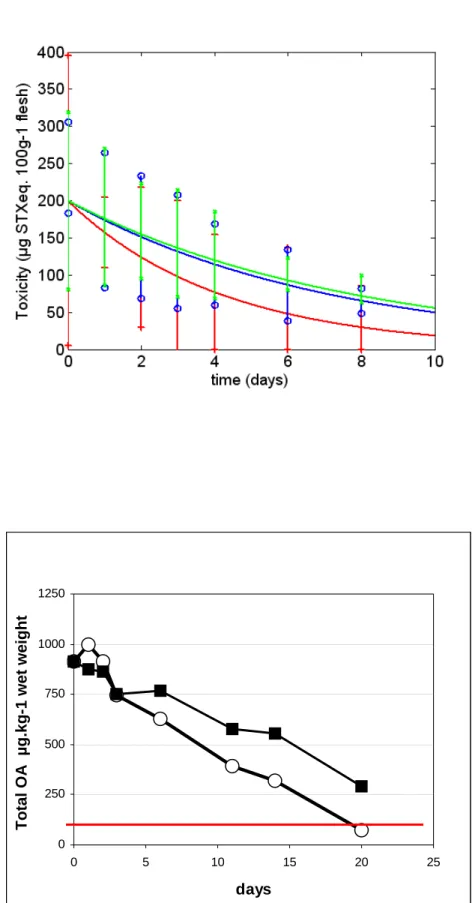
DTX3 not being detected. Overall initial toxicity did not much exceed the regulatory threshold, and a 92 % drop in OA concentration was observed within 10 days for fed mussels, whereas toxicity in starved mussels significantly increased after 4 days detoxification, most probably as a result of a strong decrease in the condition index. Pectenotoxins decreased the same way in either fed or unfed mussels and almost disappeared within 10 days. Mussels from the Atlantic coast (Southern Brittany) were processed according to the same procedure. OA concentrations differed between hydrolysed and non-hydrolysed extracts, and therefore all OA fractions were quantified. There was a 90 % drop in total OA of fed mussel versus only 52 % in unfed mussels. The ‘feed’ effect was detectable as early as day 10 of detoxification, and was significant after 3 weeks. Comparison of detoxification efficiency between each diet (or each tank) was 32 % for total OA but only 15 % for free OA which can be explained by a lack of significant change in the concentrations of esters for the unfed mussels. From a regulatory point of view, and taking into account the experimental conditions and the 160 µg Kg-1 safe level, 18 days’ detoxification with a continuous supply of non-toxic algae were needed to decrease DSP toxicity in mussels down to a level compatible with safe human consumption (Fig 2).
In the TALISMAN project in regard to mussels and DSP the detoxification experiments showed that feeding these bivalve molluscs seemed to significantly accelerate the depuration process. These findings were in contrast with the experiments carried out by Svensson (2003) where neither temperature nor food conditions had any effect on OA detoxification rates. According to the results of the trials performed in the BIOTOX project, detoxification rates varied with time. In 2003, after an initial period of 14 days where degradation products varied strongly, a period of fast depuration took place in all tanks that received feed. The detoxification half-life varied from 11 days at high ration, to 13 at medium ration, and 26 days at low ration. In 2004, the detoxification half-life for high ration was reduced to 7 days in the best period. Both experiments were terminated before DSP levels fell below accepted levels (160 µg toxin Kg-1 shellfish meat).
In relation to these findings it is worth noting the findings of the DEMEVI project on DSP-contaminated mussel detoxification pathways: even when major changes in toxin content of mussels were recorded, no relevant contribution to the toxin burden of any organ other than
the digestive gland was found at any stage of detoxification (Blanco et al). Finally, emersion had no effect on the DSP detoxification rate in M.galloprovincialis (Marino et al).
ASP detoxification trials in processed scallops
The research exhaustively demonstrated the difficulties in bulk culturing the ASP toxin producing strain of Pseudo-nitzschia that has been isolated on the West coast of Scotland. It also showed that the toxic strains lost their toxin producing ability over time in culture. Early indications from detoxification trials with scallops, in which a certain physical parameters (pH and salinity) were varied, confirmed that there is still a gap in our understanding of how DA is retained in scallop hepatopancreas tissue. A follow up study of pulse feeding with non-toxic strains confirmed this result, and indicated that, at present, there is little prospect of a feeding-based depuration method for live scallops. King scallops (Pecten maximus) fed toxic
diatoms Pseudo-nitzschia multiseries accumulated ASP toxins in the digestive gland and
kidneys, but there was no evidence of toxin transformation to different analogues, nor of any adverse effects on the health of the scallop.
Washing of the edible parts after shucking, however, gave an encouraging result. The main results showed that i) washing DA-contaminated scallop gonads in just tap water for 15 mins reduced mean toxin levels below the statutory safety level of 20µg DA g-1, and after 120 minutes the levels of DA in gonad tissue decreased below the minimum detectable limit (Fig 3) ii) in the artificially contaminated treatment (gonads that had been left in a homogenized digestive gland solution for 10 mins) the initial mean post contamination DA level exceeded 160 µg DA g-1 and the mean DA level after just 45 mins washing fell below 20 µg DA, iii) to validate these findings in a commercial context the impact of washing time on DA loss from gonad and adductor muscle was also examined: a 5 minute washing time for adductor muscle was more than adequate to render tissues safe. Generally speaking, the greatest period of DA elimination from both adductors and gonads occurred during the first 5 mins of the
washing trial, a period of negligible water uptake by the tissues.
It is worth comparing these findings with some published results obtained in the context of the DEMEVI project: hanging scallops in rafts increased the domoic acid detoxification rate for whole body, digestive gland (c.a 30 %) and edible tissues (c.a 15 %) according to Blanco et al, 2006. Interacting temperature-salinity variables seemed to be the main factors, whereas food did not seem to have a significant effect. However, the 13-19°C temperature range (in an
experiment where temperature was the only variable) had no effect on DA detoxification in any scallop tissues (Acosta 2006)
Conclusions
Very few attempts have been made to date to detoxify phycotoxin-contaminated shellfish on a semi-industrial scale (quantities of more than 100 kgs). There is overwhelming evidence to suggest that temperature has no effect on detoxification rates (PSP, DSP, ASP), although the temperature–salinity interaction needs more extensive investigation. Non-toxic algae fed to shellfish have a beneficial effect on PSP detoxification rates, especially for pacific oysters and Manilla clams. Mixed results have been obtained feeding non-toxic algae to shellfish contaminated with lipophilic toxins in that while a significant acceleration of detoxification was observed the time needed to decrease the toxin content of mussels down to the regulatory level does not, so far, meet with industry requirements. As a result, a better understanding of physiological mechanisms involved in toxin sequestration / elimination from live shellfish tissue is urgently needed. Regarding processed seafood, washing the edible parts of ASP contaminated scallops is a more effective method than trying to detoxify live animals using an algal diet.
Due to the randomness of toxic episodes, readily available bulk cultures of at least PSP and ASP producers should be maintained so they are readily available for the purpose of research. Keeping algal cell toxicity levels as stable as possible in mass cultures is a real challenge. Using and comparing cultures of live or concentrated «fodder» algae with a view to finding the most economically viable solutions, and developing future detoxification processes, is one way forward. Our conclusion is that industrialized detoxification is no longer a myth, but is
well on the way to becoming a reality.
Acknowledgements: this research was supported by European Commission, CRAFT and STREP programmes, for the TALISMAN, SHELLFISH and BIOTOX projects respectively, and by the Xunta de Galicia (Spain) for the DEMEVI project
References:
Acosta CP, Mariño C, Martin H, Blanco J, 2006. Lack of effect of temperature on the depuration of domoic acid from the King scallop, Pecten maximus. XIIth Int.Conf.Harmful Algae, Copenhagen, Denmark, September 2006. Abstract,
Blanco J, 2006. Modelling phycotoxins accumulation in bivalves: a review. Proceeds. 5th Int.Conf.Mollusc.Shellfish Safety, 258-269.
Blanco J, Moroño A, Fernandez ML, 2005. Toxic episodes in shellfish produced by lipohilic phycotoxins : an overview. Revista Galega de Recursos Mariños, Xunta de Galicia 2005, (Monog.) : 1, 1-70 pp
Bricelj VM, Cembella AD, Laby DE, 1999. Temperature effects on kinetics of PSP
detoxification in surfclam, Spisula solidissima. Proceeds. 6th Can.Workshop Harmful
mar.Algae, Can.Tech.Rep.Fish.Aquat.Sci., 2261, Martin JL and Haya K eds,. Abstract, 82-84 Bricelj VM, Lee JH, Cembella AD, 1991. Influence of dinoflagellate cell toxicity on uptake
and loss of paralytic shellfish toxins in the northern quahog Mercenaria mercenaria,
Mar.Ecol.Prog.Ser.,74, 33-46.
Bricelj V.M., Shumway S.E., 1998. Paralytic shellfish toxins in bivalve molluscs. Occurrence, transfer kinetics, and biotransformation. Rev. Fish. Sci., 6, 4, 315-383.
Graneli E, Codd GA, Dale B, Lipiatou E, Maestrini SY, Rosenthal H, 1999. Harmful algal blooms in European marine and brackish waters. Proceedings EUROHAB, 94 pp.
Iniesta R., Blanco J., 2002. Effect of body size on detoxification of PSP toxins in the mussel Mytilus galloprovincialis. Aquatic Ecosystem Health and Management Society conference, Abstract book of the conference.
Louzao M.C., Lopez-Corona P.P., Vieytes M.R., Botana L.M., 1992. Union de saxitoxina a receptores de fracciones celulares de hepatopancreas de mejillon Mytilus galloprovincialis Lmk. Cuad. Area Cienc. Mar. Semin. Estud. Galegos., 6, 65-72.
Madenwald N.D., 1985. Effect of water temperature on the loss of paralytic shellfish poison
from the butter clam Saxidomus giganteus. In: Toxic Dinoflagellates. D.M. Anderson, A.W.
White & D.G. Baden (eds.). New York, Elsevier North Holland, 479-484
Mariño C, Martin H, Acosta CP, Blanco J, 2006. Effect of emersion on diarrhetic shellfish toxins depuration from the blue mussel, Mytilus galloprovincialis. XIIth Int.Conf.Harmful Algae, Copenhagen, Denmark, September 2006. Abstract, 233
Moroño A., Luisa Fernández M., Franco J.M., Martínez A., Reyero M.I., Míguez A., Cacho E., Blanco J., 1998. PSP and DSP detoxification kinetics in mussel Mytilus galloprovincialis : effect of environmental parameters and body weight. In : Harmful Algae, Reguera et al eds., Xunta de Galicia and IOC of UNESCO Publish, 445-448.
Oshima Y, 1995. Chemical and enzymatic transformation of paralytic shellfish toxins in marine organisms; In: Harmful marine algal blooms, Lassus P, Arzul G, Erard E, Gentien P and Marcaillou C eds, Lavoisier Publish, 475-480.
Quilliam M.A., Hess, P. and Dell’Aversano, C., 2001. Recent developments in the analysis of phycotoxins by liquid chromatography-mass spectrometry. In: Dekoe, W.J., Sampson, R.A., van Egmond, H.P., Gilbert J., Sabino, M. (Eds.) Mycotoxins and Phycotoxins in Perspective at the Turn of the Millenium. De Koe, W.J., Wageningen, The Netherlands, pp. 383-391. Quilliam MA, Xie M, Hardstaff WR, 1995. Rapid extraction and clean up for liquid chromatographic determination of domoic acid in unsalted seafood. J. AOAC Int.78, 543-554 Ravn H, Anthoni V, Christopher C, Nielsen PH, Oshima Y, 1995. Standardized extraction method for paralytic shellfish toxins in phytoplankton. J.Appl.Phycol.,7, 589-594
Shumway S.E., van Egmond H., Hurt J.W., Bean L.L., 1995. Management of shellfish
resources. In: Manual on Harmful Marine Microalgae. G.M. Hallegraeff, M. Anderson &
A.D. Cembella (eds.). IOC Manuals and Guides, UNESCO, 33, 436-463
Svensson S, 2003. Depuration of okadaic acid (Diarrhetic shellfish toxin) in mussels, Mytilus edulis (Linnaeus), feeding on different quantities of non-toxic algae. Aquaculture 218, 277-291.
Diagram captions:
Fig 1: Detoxification trends of PSP-contaminated oysters at either 12, 16 or 20°C : due to wide individual variations no significant effect of temperature can be established. Safe levels are reached within 6 to 7 days with initial toxicities reported to 200 µg eq STX 100g-1
Fig 2: Detoxification trends of DSP-contaminated mussels at 16°C with (open circles) or without (plain black squares) added algal food (Skeletonema costatum) : even fed mussels need 20 days to reach regulatory levels
Fig 3: Mean and standard deviation of DA concentration (µg DA g-&) for artificially (3b) and non-artificially (3a) ASP contaminated scallop gonads washed for a period of 0 to 120 mins. Both the 20 µg DA g-1 regulatory level and the 4.6 µg DA g-1 action level are indicated.
Fig 1 0 250 500 750 1000 1250 0 5 10 15 20 25 days
Fig 2
Fig 3
F ig . 1 a . N o n a rtific ia lly c o n ta m in a te d g o n a d tis s u e
0 2 0 4 0 6 0 8 0 1 0 0 1 2 0 ug DA g -1 we t ti s s u e w e ig h t 0 1 0 2 0 3 0 F ig . 1 b . C o n ta m in a te d g o n a d tis s u e W a s h in g tim e in m in u te s 0 2 0 4 0 6 0 8 0 1 0 0 1 2 0 ug DA g -1 we t ti s s u e w e ig h t 0 5 0 1 0 0 1 5 0 2 0 0 4 .6 u g D A g-1 2 0 u g D A g-1 4 .6 u g D A g-1 2 0 u g D A g-1 3a 3b