
HAL Id: hal-02171870
https://hal.archives-ouvertes.fr/hal-02171870
Submitted on 3 Jul 2019
HAL
is a multi-disciplinary open access
archive for the deposit and dissemination of
sci-entific research documents, whether they are
pub-lished or not. The documents may come from
teaching and research institutions in France or
abroad, or from public or private research centers.
L’archive ouverte pluridisciplinaire
HAL
, est
destinée au dépôt et à la diffusion de documents
scientifiques de niveau recherche, publiés ou non,
émanant des établissements d’enseignement et de
recherche français ou étrangers, des laboratoires
publics ou privés.
SoDeep: a Sorting Deep net to learn ranking loss
surrogates
Martin Engilberge, Louis Chevallier, Patrick Pérez, Matthieu Cord
To cite this version:
Martin Engilberge, Louis Chevallier, Patrick Pérez, Matthieu Cord. SoDeep: a Sorting Deep net to
learn ranking loss surrogates. CVPR 2019 - 2019 IEEE/CVF Conference on Computer Vision and
Pattern Recognition, Jun 2019, Long Beach, United States. �hal-02171870�
SoDeep: a Sorting Deep net to learn ranking loss surrogates
Martin Engilberge
1,2, Louis Chevallier
2, Patrick P´erez
3, Matthieu Cord
1,31
Sorbonne Universit´e, Paris, France,
2Technicolor, Cesson S´evign´e, France,
3Valeo.ai, Paris, France
{martin.engilberge, matthieu.cord}@lip6.fr [email protected] [email protected]
Abstract
Several tasks in machine learning are evaluated us-ing non-differentiable metrics such as mean average pre-cision or Spearman correlation. However, their non-differentiability prevents from using them as objective func-tions in a learning framework. Surrogate and relaxation methods exist but tend to be specific to a given metric.
In the present work, we introduce a new method to learn approximations of such non-differentiable objective func-tions. Our approach is based on a deep architecture that approximates the sorting of arbitrary sets of scores. It is trained virtually for free using synthetic data. This sorting deep (SoDeep) net can then be combined in a plug-and-play manner with existing deep architectures. We demonstrate the interest of our approach in three different tasks that require ranking: Cross-modal text-image retrieval, multi-label image classification and visual memorability ranking. Our approach yields very competitive results on these three tasks, which validates the merit and the flexibility of SoDeep as a proxy for sorting operation in ranking-based losses.
1. Introduction
Deep learning approaches have gained enormous re-search interest for many Computer Vision tasks in the recent years. Deep convolutional networks are now commonly used to learn state-of-the-art models for visual recognition, including image classification [26,18, 35] and visual se-mantic embedding [25, 22, 37]. One of the strengths of these deep approaches is the ability to train them in an end-to-end manner removing the need for handcrafted features [29]. In such a paradigm, the network starts with the raw inputs, and handles feature extraction (low level and high-level features) and prediction internally. The main require-ment is to define a trainable scheme. For deep architec-tures, stochastic gradient descent with back-propagation is usually performed to minimize an objective function. This loss function depends on the target task but has to be at least differentiable.
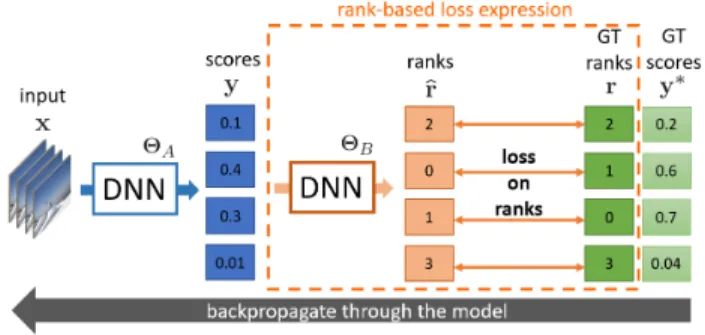
Figure 1: Overview of SoDeep, the proposed end-to-end trainable deep architecture to approximate non-differentiable ranking metrics. A pre-trained differen-tiable sorter (deep neural net [DNN] ΘB) is used to
con-vert into ranks the raw scores given by the model (DNN
ΘA) being trained to a collection of inputs. A loss is then
applied to the predicted rank and the error can be back-propagated through the differentiable sorter and used to up-date the weightsΘA.
Machine learning tasks are often evaluated and com-pared using metrics which differ from the objective func-tion used during training. The choice of an evaluafunc-tion met-ric is intimately related to the definition of the task at hand, even sometimes to the benchmark itself. For example, ac-curacy seems to be the natural choice to evaluate classifica-tion methods, whereas the choice of the objective funcclassifica-tion is also influenced by the mathematical properties that allow a proper optimization of the model. For classification, one would typically choose the cross entropy loss – a differen-tiable function – over the non-differendifferen-tiable accuracy. Ide-ally, the objective function used during training would be identical to the evaluation metric. However, standard evalu-ation metrics are often not suitable as training objectives for lack of differentiability to start with. This results in the use of surrogate loss functions that are better behaved (smooth, possibly convex). Unfortunately, coming up with good sur-rogate functions is not an easy task.
In this paper, we focus on the non-differentiability of the evaluation metrics used in ranking-based tasks such as re-call, mean average precision and Spearman correlation. De-parting from prior art on building surrogates losses for such tasks, we adopt a simple, yet effective, learning approach: Our main idea is to approximate the non-differentiable part of such ranking-based metrics by an all-purpose learnable deep neural network. In effect, this architecture is designed and trained to mimic sorting operations. We call it SoDeep. SoDeep can be added in a plug-and-play manner on top of any deep network trained for tasks whose final evaluation metric is rank-based, hence not differentiable. The resulting combined architecture is end-to-end learnable with a loss that relates closely to the final metric.
Our contributions are as follows:
• We propose a deep neural net that acts as a differentiable proxy for ranking, allowing one to rewrite different eval-uation metrics as functions of this sorter, hence making them differentiable and suitable as training loss.
• We explore two types of architectures for this trainable sorting function: convolutional and recurrent.
• We combine the proposed differentiable sorting module with standard deep CNNs, train them end-to-end on three challenging tasks, and demonstrate the merit of this novel approach through extensive evaluations of the resulting models.
The rest of the paper is organized as follows. We discuss in Section2the related works on direct and indirect optimiza-tion of ranking-based metrics, and posioptimiza-tion our work ac-cordingly. Section3is dedicated to the presentation of our approach. We show in particular how a “universal” sorting proxy suffices to tackle standard rank-based metrics, and present different architectures to this end. More details on the system and its training are reported in Section4, along with various experiments. We first establish new state-of-the-art performance on cross-modal retrieval, then we show the benefits of our learned loss function compared to stan-dard methods on memorability prediction and multi-label image classification.
2. Related works
Many data processing systems rely on sorting opera-tions at some stage of their pipeline. It is the case also in machine learning, where handling such non-differentiable, non-local operations can be a real challenge [32]. For ex-ample, retrieval systems require to rank a set of database items according to their relevance to a query. For sake of training, simple loss functions that are decomposable over each training sample have been proposed as for instance in [19] for the area under the ROC curve. Recently, some more complex non-decomposable losses (such as the Aver-age Precision (AP), Spearman coefficient, and normalized
discounted cumulative gain (nDCG) [3]) that present hard computational challenges have been proposed [31].
Mean average precision optimization Our work shares the high level goal of using ranking metrics as training ob-jective function with many works before us. Several works studied the problem of optimizing average precision with support vector machines [21,40] and other works extended these approaches to neural networks [1,31, 8]. To learn rank, the seminal work [21] relies on a structured hinge up-per bound to the loss. Further works reduce the computa-tional complexity [31] or rely on asymptotic methods [36]. The focus of these works is mainly on the relaxation of the mean average precision, while our focus is on learning a surrogate for the ranking operation itself such that it can be combined with multiple ranking metrics. In contrast to most ranking-based techniques, which have to face the high computational complexity of the loss augmented inference [21, 36,31], we propose a fast, generic, deep sorting ar-chitecture that can be used in gradient-based training for rank-based tasks.
Application of ranking based metrics Ranking is com-monly used in evaluation metrics. On retrieval tasks such as cross-modal retrieval [25,22,15, 12,30], recall is the standard evaluation. Image classification [11,9] and ob-ject recognition are evaluated with mean average precision in the multi-label case. Ordinal regression [5] is evaluated using Spearman correlation.
Existing surrogate functions Multiple surrogates for ranking exist. Using metric learning to do retrieval is one of them. This popular approach avoids the use of the rank-ing function altogether. Instead, pairwise [39], triplet-wise [38,4] and list-wise [13,2] losses are used to optimize dis-tances in a latent space. The cross-entropy loss is typically used for multi-label and multi-class classification tasks.
3. SoDeep approach
Rank-based metrics such as recall, Spearman correlation and mean average precision can be expressed as a function of the rank of the output scores. The computation of the rank being the only non-differentiable part of these metrics, we propose to learn a surrogate network that approximates directly this sorting operation.
3.1. Learning a sorting proxy
Lety∈Rdbe a vector ofdreal values andrkthe rank-ing function so thatrk(y) ∈ {1· · ·d}d is the vector
con-taining the rank for each variable iny,i.e. rk(y)i is the
rank ofyiamong theyj’s. We want to design a deep
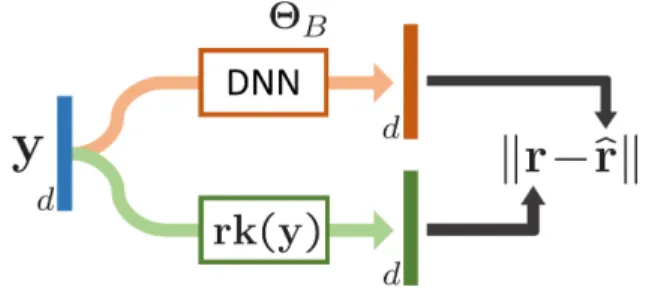
archi-tecturefΘBthat is able to mimic this sorting operator. The training procedure of this DNN is summarized in Fig. 2. The aim is to learn its parameters,ΘB, so that the output of
the network is as close as possible to the output of the exact sorting.
Before discussing possible architectures, let’s consider the training of this network, independent of its future use. We first generate a training set by randomly sampling N input vectors y(n) and we compute through exact sorting
the associated ground-truth rank vectorsr(n) =rk(y(n)).
We then classically learn the DNNfΘBby minimizing aL1
loss between the predicted ranking vectorˆr=fΘB(y)and the ground-truth rankrover the training set:
min ΘB N X n=1 rk(y (n))−fΘ B(y (n)) 1. (1)
We explore in the following different network architectures and we explain how the training data is generated.
Figure 2: Training a differentiable sorter. Given a score vectorywe learn the parametersΘB of a DNN such that
its outputˆrapproximates the true rank vectorrk(y). The model is trained using gradient descent and an L1 loss.
Once trained,fΘBcan be used as a differentiable surrogate of the ranking function.
3.1.1 Sorter architectures
We investigate two types of architectures for our differen-tiable sorterfΘB. One is a recurrent network and the other one a convolutional network, each capturing interesting as-pects of standard sorting algorithms:
• The recurrent architecture in Fig. 3a consists of a bi-directional LSTM [34] followed by a linear projection. The bi-directional recurrent network creates a connection between the output of the network and every input, which is critical for ranking computation. Knowledge about the whole sequence is needed to compute the true rank of any element.
• The convolutional architecture in Fig. 3b consists of 8 convolutional blocks, each of these blocks being a one-dimensional convolution followed by a batch normaliza-tion layer [20] and a ReLU activation function. The sizes of the convolutional filters are chosen such that the output
of the network contains as many channels as the length of the input sequence. Convolutions are used for their local property: indeed, sorting algorithms such as bubble sort [14] only rely on a sequence of local operations. The in-tuition is that a deep enough convolutional network, with its cascaded local operations, should be able to mimic re-cursive sorting algorithms and thus to provide an efficient approximation of ranks.
We will further discuss the interest of both types of SoDeep block architectures in the experiments.
3.1.2 Training data
SoDeep module can be easily (pre)trained with supervision on synthetic data. Indeed, while being non-differentiable, the ranking functionrkcan be computed with classic sort-ing algorithms. The trainsort-ing data consists of vectors of ran-domly generated scalars, associated with their ground-truth rank vectors. In our experiments, the numbers are sampled from different types of distributions:
• Uniform distribution over[−1,1];
• Normal distribution withµ= 0andσ= 1;
• Sequence of evenly spaced numbers in a uniformly drawn random sub-range of[−1,1];
• Random mixtures of the previous distributions.
While the differentiable sorter can be trained ahead of time on a variety of input distributions, as explained above, there might be a shift with the actual score distribution that the main networkfΘAwill output for the task at hand. This shift can reduce naturally during training, or an alignment can be explicitly enforced. For example, fΘA can be de-signed to output data in the interval used to learn the sorter, with the help of bounded functions such as cosine similarity.
3.2. Using SoDeep for training with rank-based loss
Rank-based metrics are used for evaluating and compar-ing learned models in a number of tasks. Recall is a stan-dard metric for image and information retrieval, mean Av-erage Prediction (mAP) for classification and recognition, and Spearman correlation for ordinal prediction. This type of rank-based metrics are non-differentiable because they require to transition from the continuous domain (score) to-ward the discrete domain (rank).
As presented in Fig1, we propose to insert a pre-trained SoDeep proxy block fΘB between the deep scoring func-tionfΘA and the chosen rank-based loss. We show in the following how mAP, Spearman correlation and recall can be expressed as functions of the rank and combined with SoDeep accordingly.
In the following we assume a training set of annotated pairs {(xi, yi∗)}Mi=1 for the task at hand. A group B of
(a)Architecture of LSTM sorter. (b)Architecture of CNN sorter.
Figure 3: SoDeep architecture.The sorter takes a vector of raw scorey ∈Rd as input and outputs a vectorˆr∈Rd. Two architectures are explored, one recurrent (a), the other one, convolutional (b). Both architectures present a last affine layer to get a final projection to a vectorˆrinRd. Note that even if it is not explicitly enforced,ˆrwill try to mimic as close as possible the vector of the ranks of theyvariables.
d training examples among them yields a prediction vec-tory(ΘA) = [fΘA(xi)]i∈Band an associated ground-truth score vectory∗= [y∗i]i∈B(Fig.1).
3.2.1 Spearman correlation
For two vectorsyandy0of sized, corresponding to two sets of dobservations, the Spearman correlation [7] is defined as:
rs= 1−
6krk(y)−rk(y0)k2 2
d(d2−1) . (2)
Maximizingw.r.t. parametersΘAthe sum of Spearman
correlations (2) between ground truth and predicted score vectors over N subsets of training examples amounts to solving the minimization problem:
min ΘA N X n=1 rk(y (n))−rk(y∗(n)) 2 2 , (3)
with the loss not being differentiable.
Using now our differentiable proxy instead of the rank function, we can define the new Spearman loss for a group B: LSP R(ΘA,B) = N X n=1 fΘB(y(ΘA) (n))−rk(y∗(n)) 2 2. (4) Training will typically minimize it over a large set of groups. Note that here the optimization is done overΘA,
knowing that SoDepp blockfΘB has been trained indepen-dently on specific synthetic training data. Optionally, the block can be fine-tuned along the way, hence minimizing w.r.t.ΘBas well.
3.2.2 Mean Average Precision (mAP)
Multilabel image classification is often evaluated using mAP, a metric from information retrieval. To define it, each of theCclasses is considered as a query over thedelements
of the datasets. For classc, denotingy∗c thed-dimensional ground-truth binary vector andyc the vector of scores for
this class, the average precision (AP) for the class is defined as [40] : AP(yc,yc∗) = 1 rel X j:y∗ c(j)=1 P rec(j), (5)
whererel =|j:y∗c(j) = 1|is the number of positive items for classcand precision for elementjis defined as:
P rec(j) = |{s∈S : y
∗
c(s) = 1}|
rk(yc)j , (6)
withSthe set of indices of the elements ofyclarger than
yc(j).
Minimizingrk(y)jfor alljfrom classc(i.e., those ver-ifyingyc∗(j) = 1) will be used as a surrogate of the maxi-mization of the AP over predictor’s parametersΘA.
The mAP is obtained by averaging AP over the C classes. Replacing the rank function by its differentiable proxy, the proposed mAP-based loss reads:
LmAP(ΘA,B) = C X c=1 hfΘB(yc),y∗ci. (7) 3.2.3 Recall atK
Recall at rankkis often used to evaluate retrieval tasks. In the following we assume a training set{xi}Mi=1for the task
at hand. A groupB of d training examples among them yields ad×dprediction matrixY(ΘA) = [fΘA(xi)]i∈B
representing the scores of all pairwise combinations of training examples in B. In other words, the i-th column of this matrix,Y[i] =fΘA(xi), provides the relevance of other vectors in the group w.r.t. to queryxi.
This matrix being given, recall atKis defined as:
R@K(Y) = 1 d d X i=1 ( 1, ifrk(Y[i])p< K 0, otherwise, (8)
withpthe index of the unique positive entry inY[i], a single relevant item being assumed for queryxi.
Once again, our sorter enables a differentiable imple-mentation of this measure. However, we could not obtain conclusive results yet, possibly due to the batch size lim-iting the range of the summation. We found, however, an alternative way to leverage our sorting network. It is based on the use of the “triplet loss”, a popular surrogate for re-call. We propose to apply this loss on ranks instead of sim-ilarity scores, making it only dependent on the ordering of the retrieved elements. The triplet loss on the rank can be expressed as follows:
loss(Y[i], p, c) = max
0, α+fΘB(Y[i])p−fΘB(Y[i])c , (9) where pis defined as above (the positive example in the triplet, given anchor queryxi) andcis the index of a
nega-tive (irrelevant) example for this query. The goal is to mini-mize the rank of the positive pair with scoreY[i]psuch that its rank is lower than the rank of the negative pair with score Y[i]cby a margin ofα.
The complete loss is then expressed over all the elements ofBin itshardnegative version as:
LREC(ΘA,B) = 1 d X i∈B max c6=p,c6=iloss(Y[i], p, c). (10)
In equations (2), (5) and (8), the metrics are expressed in function of the non-differentiable rank functionrk. Lever-aging our differentiable surrogate allows us to design a dif-ferentiable loss function for each of these metrics, respec-tively (4), (7) and (10).
4. Experiments
We present in this section several experiments to evaluate our approach. We first detail the way we train our differen-tiable sorter deep block using only synthetic data. We also present a comparison between the different models based on CNNs and on LSTM recurrent nets and with our baseline inspired from pairwise comparisons. We then evaluate the SoDeep combined with deep scoring functionsfΘB. The loss functions expressed in (4), (7) and (10) are applied to three different tasks: memorability prediction, cross-modal retrieval, and object recognition.
4.1. SoDeep Training and Analysis
4.1.1 Training
The proposed SoDeep models based on BI-LSTM and CNNs are trained on synthetic pairs of scores and ranks generated on the fly according to the distributions defined in Section3.1.2.
For convenience we call an epoch as going through 100 000 pairs. The training is done using the Adam optimizer
Sorter model L1 loss Handcrafted sorter 0.0350 CNN sorter 0.0120 LSTM sorter loss 0.0033
Table 1: Performance of the sorters on synthetic data. Ranking performance of the sorter on the synthetic dataset. Among the learned sorters the LSTM one is the most effi-cient.
[24] with a learning rate of0.001which is halved every 100 epochs. Mini-batches of size 512 are used. The model is trained until the loss values stop decreasing and are stable.
4.1.2 A handcrafted sorting baseline
We add to our trainable SoDeep blocks a baseline that does not require any training.
Inspired by the representation of the ranking problem as a matrix of pairwise ordering in [40], we build a handcrafted differentiable sorterfhusing pairwise comparisons.
Asigmoidfunction parametrized withλscalar is used as a binary comparison function between two scalarsaandb as:
σcomp(a, b) = 1
1 +e−λ(b−a). (11)
Indeed, if a and b are separated by a sufficient margin, σcomp(a, b)will be either0or1. The parameterλis used to control the precision of the comparator.
This function may be used to approximate the rela-tive rank of two components yi and yj in a vector y:
σcomp(yi,yj) will be close to 1 if yi is (significantly)
smaller thanyj, 0 otherwise. By summing up the result of
the comparison betweenyiand all the other elements of the
vectory, we form our ranking functionfh. More precisely,
the rankfh(y, i)for thei-est element ofyis expressed as follow:
fh(y, i) =
X
j:j6=i
σcomp(yi,yj). (12)
The overall precision of the handcrafted sorter can be controlled by the hyper parameterλ. The value of lambda is a trade off between the precision of the predicted rank and the efficiency when back-propagating through the sorter. Further experiments will useλ= 10.
4.1.3 Results
Table1contains the loss values of the two different trained sorters and the handcrafted one on a generated test set of 10 000 samples. The LSTM based sorter is the most efficient, outperforming the CNN and the handcrafted sorters.
The performance of the CNN sorter slightly below the LSTM-based one can be explained by local behaviour of the CNNs, requiring a more complex structure to be able to rank elements.
In Figure4we compare CNN sorters with respect to their number of layers. From these results, we choose to use 8 layers in our CNN sorter since the performance seems to saturate once this depth has been reached. A possible ex-planation of this saturation is that the relation between the depth of the network and the input dimension (d = 100
here) is logarithmic.
Figure 4: Performance of the CNN sorter with respect to the depth of the CNN. Value of the cost function during the training of multiple CNN sorters with a number of layers varying from 2 to 10. The model performances saturate for models with 8 layers or more.
4.1.4 Further analysis
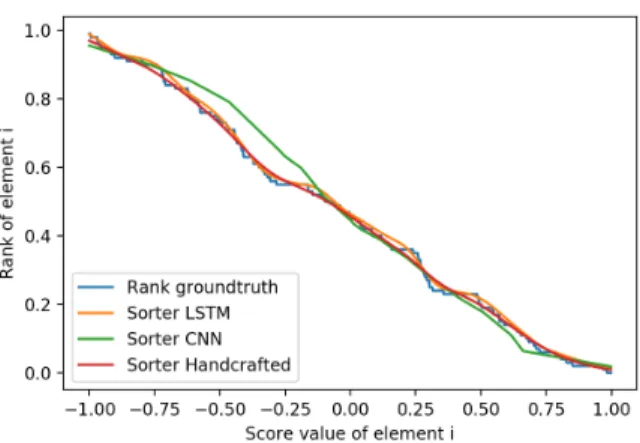
The ranking function being continuous is non-differentiable, the rank value is jumping from one discrete value to another. We design an experiment to visualize how the different types of sorter behave at these discontinuities. Starting from a uniformly sampled vectory0∈R100of raw
scores in the range [−1,1], we compute the ground truth rankrk(y0)1 and the predicted rankfΘB(y
0)
1 of the first
element y10 while varying this elementy01 from -1 to 1 in increments of 0.001. The plot of the predicted ranks can be found in Fig.5. The blue curve corresponds to the ground-truth rank where non-continuous steps are visible, whereas the curves for the learned sorters (orange and green) are a smooth approximation of the ground-truth curve.
In Fig. 6we compare our SoDeep against previous ap-proaches optimizing structured hinge upper bound to the mAP loss. We followed the protocol described in [36] for their synthetic data experiments. Our sorters using the loss
Figure 5: Sorter behaviour analysis. Given a synthetic vectory0 of raw scores in the range[−1,1]of size 100 we plot the rank of its first elementy01when the said value is
linearly interpolated between -1 and 1. The x-axis represent the valuey0
1, and the y-axis is it corresponding rank.
LmAP defined in (7) are compared to a re-implementation
of the Hinge-AP loss proposed in [21]. The results in Fig.6
show that our approach with the LSTM sorter (blue curve) gets mAP scores similar to [21] (purple curve) while being generic and less complex.
Figure 6: Synthetic experiment on mAP optimization. Comparison against the proposed sorter and the previous approaches.
From the learned sorters, the LSTM architecture is the one performing best on synthetic data (Tab. 1). In addition, its simple design and small number of hyper-parameters make it straightforward to train. The CNN architecture while not being as efficient, uses a smaller number of weights and is 1.7 time faster. Further experiments will use the LSTM sorter unless specified otherwise.
4.2. Differentiable Sorter based loss functions
Our method is benchmarked on three tasks. Each one of these tasks focuses on a different rank based loss function. Cross-modal retrieval will be used to test recall evaluation metrics, memorability prediction will be used for Spearman correlation and image classification will be used for mean average precision.
As explained in Section 3.1.2, a shift in distribution might appear when using sorter-based loss. To prevent this, a parallel loss can be used to help domain alignment. This loss can be used only to stabilize the initialization or kept for the whole training.
4.2.1 Spearman Correlation: Predicting Media Mem-orability
The media memorability prediction task [5] is used to test the differentiable sorter with respect to the Spearman cor-relation metrics. Examples of elements of the dataset can be found in Fig. 7. Given a 7 seconds video the task con-sists in predicting the short term memorability score. The memorability score reflects the probability of a video being remembered.
Figure 7: Media memorability dataset. Frames with low and high memorability scores coming from 4 different videos of the memorability dataset [5]. The memorability scores are overlayed on top of the images.
The task is originally on video memorability. However the model used here are pretrained on images, therefore 7 frames are extracted from each video and are associated with the memorability score of the source video. The train-ing is done on pairs of frame and memorability score. Dur-ing testDur-ing the predicted score of the 7 frames of a video are averaged to obtain the score per video. The dataset contains 8000 videos (56000 frames) for training and 2000 videos for testing. This training set is completed using LaMem dataset [23] adding 60 000 (image, memorability) pairs to the training data.
Single model Spear. cor. test
Baseline [6] 46.0
Image only [17] 48.8
R34 + MSE loss 44.2
R34 + SoDeep loss 46.6 Sem-Emb + MSE loss 48.6 Sem-Emb + SoDeep loss 49.4
Table 2: Media Memorability prediction results. Our proposed loss function and architecture outperform the state-of-the-art system [17] by 0.6 pt.
Architectures and training The regression model con-sists of a feature extractor combined with a two layers MLP [33] regressing features to a single memorability score. We use two pretrained nets to extract features: the Resnet-34 [18] and the semantic embedding model of [10] (as in the next section).
We use the lossLSP Rdefined in (4) to learn the
memo-rability model. The training is done in two steps. First, for 15 epochs only the MLP layers are trained while the weights of the feature extractor are kept frozen. Second, the whole model is finetuned. The Adam optimizer [24] is used with a learning rate of0.001which is halved every 3 epochs. To help with domain adaptation, our loss is combined with an L1 loss for the first epoch.
Results In Tab. 2, we compare the impact of the learned loss over two architectures. For both models we defined a baseline using a L2 loss. On both architectures the proposed loss function achieves higher Spearman correlation by 2.4 points on the Resnet model and 0.8 points on the semantic embedding model. These are state of the arts result on the task with an absolute gain of 0.6 pt. The model is almost on par (-0.3 pt) with an ensemble method proposed by [17] that is using additional textual data.
Sorter comparison The memorability prediction is also used to compare the different types of sorters presented so far. Fixing the model and the hyper parameters, 4 models are trained with 4 different types of loss. The losses based on the LSTM sorter, the CNN sorter and the handcrafted sorter obtained respectively a Spearman correlation of 49.4, 46.6, 45.7, and the L1 loss gives a correlation of 46.2. These results are consistent with the result on synthetic data, with the LSTM sorter performing the best, followed by the CNN and handcrafted ones.
4.2.2 Mean Average precision: Image classification
The VOC 2007 [11] object recognition challenge is used to evaluate our sorter on a task using the mean average preci-sion metric. We use an off-the-shelf model [9]. This model
caption retrieval image retrieval
model R@1 R@5 R@10 Med. r R@1 R@5 R@10 Med. r Emb. network [37] 54.9 84.0 92.2 - 43.3 76.4 87.5
-DSVE-Loc [10] 69.8 91.9 96.6 1 55.9 86.9 94.0 1
GXN (i2t+t2i) [16] 68.5 - 97.9 1 56.6 - 94.5 1
DSVE-Loc + SoDeep loss 71.5 92.8 97.1 1 56.2 87.0 94.3 1
Table 3: Cross-modal retrieval results onMS-COCO.Using the proposed rank based loss function outperforms the hard negative triplet margin loss, achieving state-of-the-art results on the caption retrieval task.
Loss mAP
VGG 16 [35] 89.3
WILDCAT [9] 95.0
WILDCAT* 93.2
WILDCAT* + SoDeep loss 94.0
Table 4: Object recognition results. Model marked by (*) are obtained with code available online: https:// github.com/durandtibo/wildcat.pytorch
is a fully convolutional network, combining a Resnet-101 [18] with advanced spatial aggregation mechanisms.
To evaluate the lossLmAP defined in (7) two versions
of the model are trained: A baseline using only multi-label soft margin loss, and another model trained using the multi-label soft margin loss combined withLmAP.
Rows 3 and 4 of Tab.4show the results obtained by the two previously described models. Both models are below the state-of-the-art, however the use of the rank loss is ben-eficial and improves the mAP by 0.8 pt compared to the model using only the soft margin loss.
4.2.3 Recall@K: Cross-modal Retrieval
The last benchmark used to evaluate the differentiable sorter is the cross-modal retrieval. Starting from images annotated with text, we train a model producing rich features for both image and text that live in the same embedding space. Sim-ilarity in the embedding space is then used to evaluate the quality of the model on the cross-modal retrieval task.
Our approach is evaluated on theMS-COCOdataset [28] using the rVal split proposed in [22]. The dataset contains 110k images for training, 5k for validation and 5k for test-ing. Each image is annotated with 5 captions.
Given a query image (resp. a caption), the aim is to retrieve the corresponding captions (resp. image). Since MS-COCO contains 5 captions per image, recall at r (“R@r”) for caption retrieval is computed based on whether at least one of the correct captions is among the firstr re-trieved ones. The task is performed 5 times on 1000-image subsets of the test set and the results are averaged.
We use an off-the-shelf model [10]. It is a two-paths multimodal embedding approach that leverages the latest neural network architecture. The visual pipeline is based on a Resnet-152 and is fully convolutional. The textual pipeline is trained from scratch and uses a Simple Recur-rent Unit (SRU) [27] to encode sentences. The model is trained using the lossLREC defined in (10) instead of the
triplet based loss.
Cross-modal retrieval results can be found in Tab.3. The model trained using the proposed loss function (DSVE-Loc + SoDeep loss) outperforms the similar architecture DSVE-Loc trained with the triplet margin based loss by (1.7%,0.9%,0.5%) on (R@1,R@5,R@10) in absolute for caption retrieval, and by (0.3%,0.1%,0.3%) for image re-trieval. It obtains state-of-the-art performance on caption retrieval and is very competitive on image retrieval being almost on par with the GXN [16] model, which has a much more complex architecture. It is important to note that the loss function proposed could be beneficial for any type of architecture.
5. Conclusion
We have presented SoDeep, a novel method that lever-ages the expressivity of recent architectures to learn differ-entiable surrogate functions. Based on a direct deep net-work modeling of the sorting operation, such a surrogate allows us to train, in an end-to-end manner, models on a diversity of tasks that are traditionally evaluated with rank-based metrics. Remarkably, this deep proxy to estimate the rank comes at virtually no cost since it is easily trained on purely synthetic data.
Our experiments show that the proposed approach achieves very good performance on cross-modal retrieval tasks as well as on media memorability prediction and multi-label image classification. These experiments demon-strate the potential and the versatility of SoDeep. This ap-proach allows the design of training losses that are closer than before to metrics of interest, which opens up a wide range of other applications in the future.
References
[1] Chris Burges, Tal Shaked, Erin Renshaw, Ari Lazier, Matt Deeds, Nicole Hamilton, and Greg Hullender. Learning to rank using gradient descent. InICML, 2005.2
[2] Zhe Cao, Tao Qin, Tie-Yan Liu, Ming-Feng Tsai, and Hang Li. Learning to rank: From pairwise approach to listwise approach. InICML, 2007.2
[3] Soumen Chakrabarti, Rajiv Khanna, Uma Sawant, and Chiru Bhattacharyya. Structured learning for non-smooth ranking losses. InACM SIGKDD, 2008.2
[4] Gal Chechik, Varun Sharma, Uri Shalit, and Samy Bengio. Large scale online learning of image similarity through rank-ing.J. Machine Learning Research, 11:1109–1135, 2010.2
[5] Romain Cohendet, Claire-H´el`ene Demarty, Ngoc Duong, Mats Sj¨oberg, Bogdan Ionescu, and Thanh-Toan Do. Me-diaeval 2018: Predicting media memorability task. arXiv preprint arXiv:1807.01052, 2018.2,7
[6] Romain Cohendet, Claire-H´el`ene Demarty, and Ngoc Q. K. Duong. Transfer learning for video memorability prediction. InMediaEval Workshop, 2018.7
[7] Yadolah Dodge. The concise encyclopedia of statistics. Springer Science & Business Media, 2008.4
[8] Abhimanyu Dubey, Nikhil Naik, Devi Parikh, Ramesh Raskar, and C´esar A Hidalgo. Deep learning the city: Quan-tifying urban perception at a global scale. InECCV, 2016.
2
[9] Thibaut Durand, Taylor Mordan, Nicolas Thome, and Matthieu Cord. Wildcat: Weakly supervised learning of deep convnets for image classification, pointwise localization and segmentation. InCVPR, 2017.2,7,8
[10] Martin Engilberge, Louis Chevallier, Patrick P´erez, and Matthieu Cord. Finding beans in burgers: Deep semantic-visual embedding with localization. InCVPR, 2018.7,8
[11] Mark Everingham and J Winn. The PASCAL visual object classes challenge 2007 development kit. Technical report, 2007.2,7
[12] Fartash Faghri, David Fleet, Jamie Ryan Kiros, and Sanja Fi-dler. VSE++: Improved visual-semantic embeddings. arXiv preprint arXiv:1707.05612, 2017.2
[13] Basura Fernando, Efstratios Gavves, Damien Muselet, and Tinne Tuytelaars. Learning to rank based on subsequences. InICCV, 2015.2
[14] Edward H Friend. Sorting on electronic computer systems. JACM, 1956.3
[15] Andrea Frome, Greg Corrado, Jon Shlens, Samy Bengio, Jeff Dean, and Tomas Mikolov. DeViSE: A deep visual-semantic embedding model. InNIPS, 2013.2
[16] Jiuxiang Gu, Jianfei Cai, Shafiq Joty, Li Niu, and Gang Wang. Look, imagine and match: Improving textual-visual cross-modal retrieval with generative models. In CVPR, 2018.8
[17] Rohit Gupta and Kush Motwani. Linear models for video memorability prediction using visual and semantic features. InMediaEval Workshop, 2018.7
[18] Kaiming He, Xiangyu Zhang, Shaoqing Ren, and Jian Sun. Deep residual learning for image recognition. In CVPR, 2016.1,7,8
[19] Alan Herschtal and Bhavani Raskutti. Optimising area under the roc curve using gradient descent. InICML, 2004.2
[20] Sergey Ioffe and Christian Szegedy. Batch normalization: Accelerating deep network training by reducing internal co-variate shift.arXiv preprint arXiv:1502.03167, 2015.3
[21] Thorsten Joachims. Optimizing search engines using click-through data. InACM SIGKDD, 2002.2,6
[22] Andrej Karpathy and Li Fei-Fei. Deep visual-semantic align-ments for generating image descriptions. InCVPR, 2015.1,
2,8
[23] Aditya Khosla, Akhil S. Raju, Antonio Torralba, and Aude Oliva. Understanding and predicting image memorability at a large scale. InICCV, 2015.7
[24] D Kinga and J Ba Adam. A method for stochastic optimiza-tion. InICLR, 2015.5,7
[25] Ryan Kiros, Ruslan Salakhutdinov, and Richard Zemel. Uni-fying visual-semantic embeddings with multimodal neural language models. arXiv preprint arXiv:1411.2539, 2014. 1,
2
[26] Alex Krizhevsky, Ilya Sutskever, and Geoffrey E Hinton. Imagenet classification with deep convolutional neural net-works. InNIPS, 2012.1
[27] Tao Lei and Yu Zhang. Training RNNs as fast as CNNs. arXiv preprint arXiv:1709.02755, 2017.8
[28] Tsung-Yi Lin, Michael Maire, Serge Belongie, James Hays, Pietro Perona, Deva Ramanan, Piotr Doll´ar, and C Lawrence Zitnick. Microsoft COCO: Common objects in context. In ECCV, 2014.8
[29] David Lowe. Object recognition from local scale-invariant features. InICCV, 1999.1
[30] Lin Ma, Zhengdong Lu, Lifeng Shang, and Hang Li. Mul-timodal convolutional neural networks for matching image and sentence. InICCV, 2015.2
[31] Pritish Mohapatra, Michal Rolinek, CV Jawahar, Vladimir Kolmogorov, and M Kumar. Efficient optimization for rank-based loss functions. InCVPR, 2018.2
[32] Mehryrar Mohri, Afshin Rostamizadeh, and Ameet Tal-walkar.Foundations of Machine Learning. MIT Press, 2012.
2
[33] Frank Rosenblatt. The perceptron: A probabilistic model for information storage and organization in the brain. Psycho-logical review, 1958.7
[34] Mike Schuster and Kuldip K Paliwal. Bidirectional recurrent neural networks.IEEE Trans. Signal Processing, 1997.3
[35] Karen Simonyan and Andrew Zisserman. Very deep convo-lutional networks for large-scale image recognition. arXiv preprint arXiv:1409.1556, 2014.1,8
[36] Yang Song, Alexander Schwing, and Raquel Urtasun. Train-ing deep neural networks via direct loss minimization. In ICML, 2016.2,6
[37] Liwei Wang, Yin Li, Jing Huang, and Svetlana Lazebnik. Learning two-branch neural networks for image-text match-ing tasks. IEEE Trans. Pattern Recognition and Machine Intell., 41(2):394–407, 2018.1,8
[38] Kilian Q Weinberger and Lawrence K Saul. Distance metric learning for large margin nearest neighbor classification. J. Machine Learning Research, 2009.2
[39] Eric P Xing, Michael I Jordan, Stuart J Russell, and An-drew Y Ng. Distance metric learning with application to clustering with side-information. InNIPS, 2003.2
[40] Yisong Yue, Thomas Finley, Filip Radlinski, and Thorsten Joachims. A support vector method for optimizing average precision. InACM SIGIR, 2007.2,4,5

![Table 2: Media Memorability prediction results. Our proposed loss function and architecture outperform the state-of-the-art system [17] by 0.6 pt.](https://thumb-us.123doks.com/thumbv2/123dok_us/10202118.2923196/8.918.89.429.555.750/table-memorability-prediction-results-proposed-function-architecture-outperform.webp)

