ACHIEVING NEW UPPER BOUNDS FOR THE HYPERGRAPH
DUALITY PROBLEM THROUGH LOGIC
∗GEORG GOTTLOB† ANDENRICO MALIZIA‡
Abstract. The hypergraph duality problemDualis defined as follows: given two simple hyper-graphs G and H, decide whetherH consists precisely of all minimal transversals of G (in which case we say that G is the dual of H or, equivalently, the transversal hypergraph of H). This problem is equivalent to deciding whether two given nonredundant monotone disjunctive normal forms/conjunctive normal forms are dual. It is known thatDual, the complementary problem to Dual, is in GC(log2n, PTIME), where GC(f(n),C) denotes the complexity class of all problems that after a nondeterministic guess ofO(f(n)) bits can be decided (checked) within complexity classC. It was conjectured thatDualis in GC(log2n, LOGSPACE). In this paper we prove this conjecture and actually place theDualproblem into the complexity class GC(log2n, TC0) which is a subclass of GC(log2n, LOGSPACE). We here refer to the logtime-uniform version of TC0, which corresponds to FO(COUNT), i.e., first order logic augmented by counting quantifiers. We achieve the latter bound in two steps. First, based on existing problem decomposition methods, we develop a new nondeter-ministic algorithm forDualthat requires one to guessO(log2n) bits. We then proceed by a logical analysis of this algorithm, allowing us to formulate its deterministic part in FO(COUNT). From this result, by the well-known inclusion TC0 ⊆LOGSPACE, it follows that
Dualalso belongs to DSPACE[log2n]. Finally, by exploiting the principles on which the proposed nondeterministic algo-rithm is based, we devise a deterministic algoalgo-rithm that, given two hypergraphsGandH, computes in quadratic logspace a transversal ofGmissing inH.
Key words. hypergraphs, hypergraph transversals, hypergraph duality, DNF duality, complex-ity, first order logic, logical analysis of algorithms, TC0, first order logic with counting quantifiers, algorithms, limited nondeterminism, graph theory
AMS subject classifications. 03B10, 03B70, 03B80, 03C80, 05C65, 05C85, 06E30, 68Q10, 68Q19, 68Q25, 68R10, 68W05, 68W40, 94C10
DOI. 10.1137/15M1027267
1. Introduction.
The hypergraph duality problem
Dual
is one of the most
mysterious and challenging decision problems of computer science, as its complexity
has been intensively investigated for almost 40 years without any indication that the
problem is tractable, nor any evidence whatsoever, why it should be intractable. Apart
from a few significant upper bounds, which we review below, and a large number of
restrictions that make the problem tractable, progress on pinpointing the complexity
of
Dual
has been rather slow. So far, the problem has been placed in relatively low
complexity nondeterministic classes within coNP. It is the aim of this paper to further
narrow it down by using logical methods.
The hypergraph duality problem.
A hypergraph
G
consists of a finite set
V
of vertices and a set
E
⊆
2
Vof (hyper)edges.
G
is
simple
(or
Sperner
) if none
∗Received by the editors June 22, 2015; accepted for publication (in revised form) November 27,2017; published electronically April 12, 2018. This paper is an extended version of a paper which appeared in the Proceedings of CSL-LICS, ACM, New York, 2014, 43 [27].
http://www.siam.org/journals/sicomp/47-2/M102726.html
Funding: The first author’s work was supported by the EPSRC Programme Grant EP/M025268/ “VADA: Value Added Data Systems – Principles and Architecture.” The second author’s work was mainly supported by the European Commission through the European Social Fund and by the Region of Calabria (Italy). Malizia received additional funding from the ERC grant 246858 (DIADEM) and the above mentioned EPSRC grant “VADA.”
†Department of Computer Science, University of Oxford, UK ([email protected]). ‡Department of Computer Science, University of Exeter, UK ([email protected]).
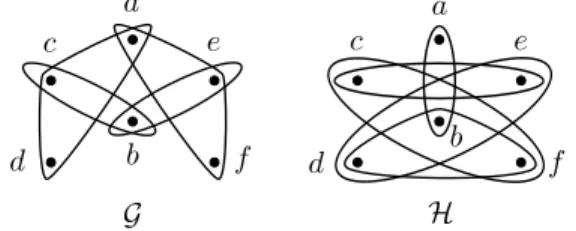
Fig. 1.HypergraphGand its transversal hypergraphH.
of its edges is contained in any other of its edges. A
transversal
or
hitting set
of a
hypergraph
G
=
h
V, E
i
is a subset of
V
that meets every edge in
E
. A transversal
of
G
is
minimal
, if none of its proper subsets is a transversal. The set of minimal
transversals of a hypergraph
G
=
h
V, E
i
is denoted by
tr
(G). Note that
tr
(G), which
is referred to as the
dual
1of
G
or also as the
transversal hypergraph
of
G, defines
itself as a hypergraph on the vertex set
V
. The decision problem
Dual
is now easily
defined as follows: given two simple hypergraphs
G
and
H
over vertex set
V
, decide
whether
H
=
tr
(G).
An example of a hypergraph and its dual is given in Figure 1. It is well known
that the duality problem has a nice symmetry property [2]: if
G
and
H
are simple
hypergraphs over vertex set
V
, then
H
=
tr
(G) if and only if
G
=
tr
(H), and in this
case
G
and
H
are said to be dual. The
Dual
problem is also tightly related to the
problem of actually
computing
tr
(G) for an input hypergraph
G. In fact, it is known
that the computation problem is feasible in total polynomial time, that is, in time
polynomial in
|G|
+
|
tr
(G)|, if and only if
Dual
is solvable in polynomial time [3].
These and several other properties of the duality problem are reviewed and discussed
in [15, 11, 31, 13], where many original references can also be found.
Applications of hypergraph duality.
The
Dual
problem and its
compu-tational variant have a tremendous number of applications. They range from data
mining [30, 45, 4, 5], functional dependency inference [43, 44, 26], and machine
learn-ing, in particular, learning monotone Boolean conjunctive normal forms (CNFs) and
disjunctive normal forms (DNFs) with membership queries [30, 46], to model-based
diagnosis [47, 29], computing a Horn approximation to a non-Horn theory [35, 23],
computing minimal abductive explanations to observations [14], and computational
biology, for example, discovering of metabolic networks and engineering of drugs
pre-venting the production of toxic metabolites in cells [40, 39]. Surveys of these and
other applications as well as further references can be found in [12, 11, 31, 41].
The simplest and foremost applications relevant to logic and hardware design
are DNF duality testing and its computational version, DNF dualization. A pair
of Boolean formulas
f
(
x
1, x
2, . . . , x
n) and
g
(
x
1, x
2, . . . , x
n) on propositional variables
x
1, x
2, . . . , x
nare dual if, for any Boolean assignment to variables
x
1, . . . , x
n,
f
(
x
1, x
2, . . . , x
n)
≡ ¬
g
(¬
x
1,
¬
x
2, . . . ,
¬
x
n)
.
A monotone DNF is
irredundant
if the set of variables in none of its disjuncts is covered
by the variable set of any other disjunct. The
duality testing problem
is the problem
1Note that sometimes in the literature the dual hypergraph ofGwas defined as the hypergraph derived fromGin which the roles of the vertices and the edges are “interchanged” (see, e.g., [2, 48]), and this is different from the transversal hypergraph. Nevertheless, lately in the literature the name “dual hypergraph” has been used with the meaning of “transversal hypergraph” (as in, e.g., [15, 37, 6, 25, 38, 16]).
of testing whether two irredundant monotone DNFs
f
and
g
are dual. It is well
known and easy to see that monotone DNF duality and
Dual
are actually the same
problem.
2Two hypergraphs
G
and
H
are dual if and only if their associated DNFs
G
∗and
H
∗are dual, where the DNF
F
∗associated with a hypergraph
F
=
h
V, E
i
is
W
e∈E
V
v∈e
v
, where, obviously, vertices
v
∈
V
are interpreted as propositional
variables. For example, the hypergraphs
G
and
H
of Figure 1 give rise to DNFs
G
∗= (
a
∧
c
∧
d
)
∨
(
a
∧
e
∧
f
)
∨
(
c
∧
b
)
∨
(
e
∧
b
)
,
and
H
∗= (
a
∧
b
)
∨
(
c
∧
e
)
∨
(
c
∧
b
∧
f
)
∨
(
e
∧
b
∧
d
)
∨
(
d
∧
b
∧
f
)
,
which are indeed mutually dual. The duality problem for irredundant monotone DNFs
corresponds, in turn, to
Dual
, and the problem instances
hF
,
Gi
and
hF
∗, G
∗i
can
be intertranslated by extremely low-level reductions, in particular, LOGTIME
reduc-tions, and even projection reductions. In many publicareduc-tions, the
Dual
problem is
thus right away introduced as the problem of duality checking for irredundant
mono-tone DNFs. An equivalent problem is the problem of checking whether a monomono-tone
CNF and a monotone DNF are logically equivalent.
Previous complexity bounds.
Dual
is easily seen to reside in coNP. In fact,
in order to show that a
Dual
instance is a “no-instance,” it suffices to show that
either some edge of one of the two hypergraphs is not a minimal transversal of the
other hypergraph (which is feasible in polynomial time), or to find (guess and check)
a missing transversal to one of the input hypergraphs. The complement
Dual
of
Dual
is therefore in NP. In their landmark paper, Fredman and Khachiyan [19]
have shown that
Dual
is in DTIME[
n
o(logn)], more precisely, that it is contained
in DTIME[
n
4χ(n)+O(1)], where
χ
(
n
) is defined by
χ
(
n
)
χ(n)=
n
. Note that
χ
(
n
)
∼
log
n/
log log
n
=
o
(log
n
).
Let GC(
f
(
n
),
C) denote the complexity class of all problems that after a
non-deterministic guess of
O
(
f
(
n
)) bits can be decided (checked) in complexity class
C.
Eiter, Gottlob, and Makino [13] and, independently, Kavvadias and Stavropoulos [36]
have shown that
Dual
is in GC(log
2n
, PTIME); note that this class is also known
as
β
2P; see [24].
Recently, the nondeterministic bound for
Dual
was further pushed down to
GC(log
2n
, [[LOGSPACE
pol]]
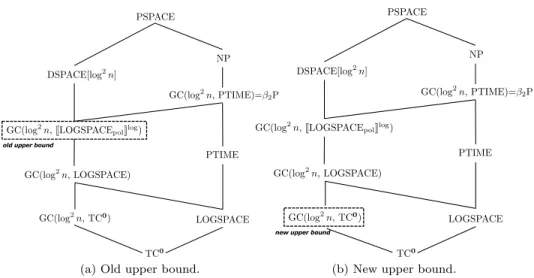
log) [25]; see Figure 2(a).
A precise definition of [[LOGSPACE
pol]]
logis given in [25]. We will not make use
of this class in the technical part of the present paper. Informally, [[LOGSPACE
pol]]
logcontains those problems
π
for which there exist a logspace-transducer
T
, a polynomial
p
, and a function
f
in
O
(log
n
), such that each
π
-instance
I
of size
n
=
|
I
|
can be
reduced by the
f
(
n
)-fold composition
T
f(n)of
T
to a decision problem in LOGSPACE,
where the size of all intermediate results
T
i(
I
) for 1
≤
i
≤
f
(
n
), is polynomially
bounded by
p
(
n
). For the relationship of GC(log
2n
, [[LOGSPACE
pol]]
log) to other
classes; see Figure 2(a). In [25], it was shown that GC(log
2n
, [[LOGSPACE
pol]]
log)
is not only a subclass of GC(log
2n
, PTIME), but also of
DSPACE[
log
2n
], i.e.,
of quadratic logspace. Therefore, as also proven in a new and more direct way in
the present paper,
Dual
is in
DSPACE[
log
2n
] (Corollary 4.9), and it is thus most
unlikely for
Dual
to be PTIME-hard, which answered a previously long-standing
2In fact, in the literature, the hypergraph transversal problem was tackled interchangeably from the perspective of monotone Boolean formula dualization or from the perspective of hypergraphs. Readers wanting to know more about the relationships between some of the different perspectives adopted in the literature to deal with the Dual problem are referred to the extended technical report [28] available online.
(a) Old upper bound. (b) New upper bound.
Fig. 2.Complexity bound improvement obtained in this paper.
question. Given that PTIME and
DSPACE[
log
2n
] are believed to be incomparable,
it is also rather unlikely that
Dual
is closely related to another interesting logical
problem of open complexity, namely, to validity checking for the modal
µ
-calculus or,
equivalently, to the winner determination problem for parity games [32, 34], as these
latter problems are PTIME-hard, but in NP
∩
coNP.
Main complexity problem tackled.
In [25] it was asked whether the upper
bound of GC(log
2n
, [[LOGSPACE
pol]]
log) could be pushed further downwards, and
the following conjecture was made.
Conjecture
(see [25]).
Dual
∈
GC(log
2n
, LOGSPACE).
It was unclear, however, how to prove this conjecture based on the algorithms
and methods used in [25]. There, a problem decomposition strategy by Boros and
Makino [6] was used, that decomposed an original
Dual
instance into a conjunction
of smaller instances according to a specific conjunctive self-reduction. Roughly, this
strategy constructs a decomposition tree of logarithmic depth for
Dual
, each of whose
nodes represents a subinstance of the original instance; more details on decomposition
trees are given in section 3. To prove that the original instance is a no-instance
(and thus a “yes-instance” of
Dual
), it is sufficient to guess, in that tree, a path
Π from the root to a single node
v
associated with a no-subinstance that can be
recognized as such in logarithmic space. Guessing the path to
v
can be easily done
using
O
(log
2n
) nondeterministic bits, but it is totally unclear how to actually
compute
the subinstance associated with node
v
in LOGSPACE. In fact, it seems that the only
way to compute the subinstance at node
v
is to compute—at least implicitly—all
intermediate
Dual
instances arising on the path from the root to the decomposition
node
v
. This seems to require a logarithmic composition of LOGSPACE transducers,
and thus a computation in the complexity class [[LOGSPACE
pol]]
log. It was therefore
totally unclear how [[LOGSPACE
pol]]
logcould be replaced by its subclass LOGSPACE,
and new methods were necessary to achieve this goal.
New results: Logic to the rescue.
To attack the problem, we studied various
alternative decomposition strategies for
Dual
, among them the strategy of Gaur [21],
which also influenced the method of Boros and Makino [6]. In the present paper, we
build on Gaur’s original strategy, as it appears to be the best starting point for
our purposes. However, Gaur’s method still does not directly lead to a
guess-and-check algorithm whose guess-and-checking procedure is in LOGSPACE, and thus new techniques
needed to be developed.
In a first step, by building creatively on Gaur’s deterministic decomposition
strat-egy [21], we develop a new nondeterministic guess-and-check algorithm
ND-NotDual
for
Dual
, that is specifically geared towards a computationally simple checking part.
In particular, the checking part of
ND-NotDual
avoids certain obstructive steps
that would require more memory than just plain LOGSPACE, such as the successive
minimization of hypergraphs in subinstances of the decomposition (as used by Boros
and Makino [6]) and the performance of counting operations between subsequent
de-composition steps so to determine sets of vertices to be included in a new transversal
(as used by Gaur [21]). Our new approach is thus influenced by Gaur’s, but differs
noticeably from it, as well as from the algorithm of Boros and Makino.
In a second step, we proceed with a careful logical analysis of the checking part of
ND-NotDual
. We transform all subtasks of
ND-NotDual
into logical formulas.
However, it turns out that first order logic (FO) is not sufficient, as an essential step
of the checking phase of
ND-NotDual
is to check for specific hypergraph vertices
v
whether
v
is contained in at least half of the hyperedges of some hypergraph. To
account for this, we need to resort to FO(COUNT), which augments FO with counting
quantifiers. Note that we could have used in a similar way FOM, i.e., FO augmented by
majority quantifiers, as FO(COUNT) and FOM have the same expressive power [33].
By putting all pieces together, we succeed in describing the entire checking phase by
a single fixed FO(COUNT) formula that has to be evaluated over the input
Dual
instance. Note that FO(COUNT) model checking is complete for logtime-uniform
TC
0.
In summary, by putting the guessing and checking parts together, we achieve as
the main theorem a complexity result that is actually better than the one conjectured.
Theorem. Dual
∈
GC(log
2n
, TC
0).
By the well-known inclusion TC
0⊆
LOGSPACE, we immediately obtain a
corol-lary that proves the above-mentioned conjecture.
Corollary
A.
Dual
∈
GC(log
2n
, LOGSPACE).
Moreover, by the inclusion GC(log
2n
, LOGSPACE)
⊆
DSPACE[log
2n
], and the
fact that DSPACE [log
2n
] is closed under complement, we can easily obtain as a
simple corollary the following.
Corollary
B.
Dual
∈
DSPACE[log
2n
].
To conclude, by an easy adaptation of our algorithm
ND-NotDual
we devise
a simple deterministic algorithm
ComputeNT
to compute a new (not necessarily
minimal) transversal in quadratic logspace.
Significance of the new results and directions for future research.
The
progress achieved in this paper is summarized in Figure 2, whose left part
(Fig-ure 2(a)) shows the previous state of knowledge about the complexity, while the right
part (Figure 2(b)) depicts the current state of knowledge we have achieved. We have
significantly narrowed down the “search space” for the precise complexity of
Dual
(or
Dual
). We believe that our new results are of value to anybody studying the
complexity of this interesting problem. In particular, the connection to logic opens
new avenues for such studies. First, our results show where to dig for tighter bounds.
It may be rewarding to study subclasses of GC(log
2n
, TC
0) and, in particular,
logi-cally defined subclasses
that replace TC
0by low-level prefix classes of FO(COUNT).
Classes of this type can be found in [7, 8, 18, 49, 50]. More details on this will be
given in the conclusive remarks in section 5. Second, the membership of
Dual
in
GC(log
2n
, TC
0) provides valuable information for those trying to prove hardness
re-sults for
Dual
, i.e., to reduce some presumably intractable problem
X
to
Dual
. Our
results restrict the search space to be explored to hunt for such a problem
X
.
More-over, given that LOGSPACE is not known to be in GC(log
2n
, TC
0), and given that it
is not generally believed that GC(log
2n
, TC
0) contains LOGSPACE-hard problems
(under logtime reductions), our results suggest that LOGSPACE-hard problems are
rather unlikely to reduce to
Dual
, and that it may thus be advisable to look for
a problem
X
that is not (known to be) LOGSPACE-hard, in order to find a lower
bound for
Dual
. Our new results are of a theoretical nature. This does not rule out
the possibility that they may be used for improving practical algorithms, but this has
yet to be investigated. Finally, we believe that the methods presented in this paper
are a compelling example of how logic and descriptive complexity theory can be used
together with suitable problem decomposition methods to achieve new complexity
results for a concrete decision problem.
Organization of the paper.
After some preliminaries in section 2, we discuss
problem decomposition strategies and introduce the concept of a decomposition tree
for
Dual
in section 3. Based on this, in section 4 we present the nondeterministic
algorithm
ND-NotDual
for
Dual
, prove it correct, and then analyze this algorithm
to derive our main complexity results. To conclude, by exploiting the method used
in the nondeterministic algorithm, we present a deterministic algorithm to actually
compute a new (not necessarily minimal) transversal in quadratic logspace.
2. Preliminaries.
In what follows, when we identify a hypergraph
G
with its
edge-set
E
by writing
G
=
E
, we mean
G
=
h
S
G∈E
G, E
i. By writing
G
∈ G
we
mean
G
∈
E
. Generally, we denote by
V
the set of vertices of a hypergraph and, if
not stated otherwise, pairs of hypergraphs
G
and
H, and the hypergraphs of a
Dual
instance
hG
,
Hi, are assumed to have the same set of vertices. The number of edges
of
G
is denoted by
|G|, and, given an instance
hG
,
Hi
of
Dual
,
m
is the total number
|G|
+
|H|
of edges of
G
and
H. By
kGk
we denote the size of the hypergraph
G, that
is, the space (in terms of the number of bits) required to represent
G. It is reasonable
to assume that a hypergraph
G
is represented through the adjacency lists of its edges
(i.e., each edge
G
of
G
is represented through the list of the vertices belonging to
G
).
It is easy to see that
|
V
| ≤ kGk
and
|G| ≤ kGk. We denote by
N
=
kGk
+
kHk
the
size of the input of the
Dual
problem.
We say that
G
is an
empty hypergraph
if
G
does not have any edge, and
G
is an
empty-edge hypergraph
if
G
contains only an empty edge (i.e., an edge without vertices
in it). Note that empty and empty-edge hypergraphs can actually contain vertices,
and thus there are various empty and empty-edge hypergraphs. For notational
con-venience, by
G
=
∅
we indicate that
G
is an empty hypergraph, while by
G
=
{
∅
}
we
indicate that
G
is an empty-edge hypergraph. However, with these notations we do
not mean that these hypergraphs do not have vertices. The notation
∅
∈ G
clearly
means that
G
contains an empty edge. Observe that, if
G
=
∅
, then any set of vertices
is a transversal of
G. For this reason, there is only one minimal transversal of
G
and
it is the empty set. On the other hand, if
∅
∈ G, then there is no transversal of
G
at
all. Hence, by definition, the dual of an empty hypergraph is an empty-edge
hyper-graph, and vice versa [11]. Two hypergraphs
G
and
H
over the same vertex set are
trivially dual
, if one of them is an empty hypergraph and the other is an empty-edge
hypergraph.
Given a hypergraph
G
and a set of vertices
T
, a vertex
v
∈
T
is
critical
in
T
(w.r.t.
G) if there is an edge
G
∈ G
such that
G
∩
T
=
{
v
}. We say that
G
witnesses
the criticality of
v
in
T
. Observe that, if
v
is a critical vertex in
T
,
v
may have various
witnesses of its criticality, that is, more than one edge of
G
can intersect
T
only on
v
.
A set of vertices
S
is an
independent set
of a hypergraph
G
if, for all
G
∈ G,
G
6⊆
S
. If
G
and
H
are two hypergraphs, a set of vertices
T
is a
new transversal
of
G
w.r.t.
3H
if
T
is a transversal of
G, and
T
is also an independent set of
H. Intuitively,
a new transversal
T
of
G
is a transversal of
G
missing in
H. More formally,
T
is a
new transversal of
G
w.r.t.
H
if, for any transversal
T
0⊆
T
of
G,
T
0∈ H. Note that
/
a new transversal is not necessarily a minimal transversal, however, it contains a new
minimal transversal.
In the following, we state the main properties about transversals to be used in
this paper. These properties are already known or easily follow from what is known
in the literature (see, e.g., [2, 19, 22, 6, 16, 11, 20]).
4Lemma
2.1.
Let
G
be a hypergraph, and let
T
⊆
V
be a transversal of
G
. Then,
T
is a minimal transversal of
G
if and only if every vertex
v
∈
T
is critical (and hence
there is an edge
G
v∈ G
witnessing so).
For a set of vertices
T
⊆
V
, let
T
denote
V
\
T
, i.e., the
complement
of
T
in
V
.
Lemma
2.2.
Let
G
and
H
be two hypergraphs. A set of vertices
T
⊆
V
is a new
transversal of
G
w.r.t.
H
if and only if
T
is a new transversal of
H
w.r.t.
G
.
We say that hypergraphs
G
and
H
satisfy the
intersection property
if all edges of
G
are transversals of
H
and, thus, vice versa, all edges of
H
are transversal of
G. Note
here that, for the intersection property to hold, the edges of one hypergraph are
not
required to be minimal transversal of the other.
Lemma
2.3.
Let
G
and
H
be two hypergraphs. Then,
G
and
H
are dual if and
only if
G
and
H
are simple, satisfy the intersection property, and there is no new
transversal of
G
w.r.t.
H
.
3. Decomposing the DUAL
problem.
3.1. Decomposition principles.
A way to recognize no-instances
hG
,
Hi
of
Dual
is to find a new transversal of
G
w.r.t.
H, i.e., a transversal of
G
that is also an
independent set of
H. In fact, many algorithms in the literature follow this approach
(see, e.g., [19, 13, 36, 16, 6, 21]). These algorithms try to build such a new transversal
by successively including vertices in and excluding vertices from a candidate for a
new transversal. To give an example, the classical algorithm “A” of Fredman and
Khachiyan [19] tries to include a vertex
v
in a candidate for a new transversal, and if
this does not result in a new transversal, then
v
is excluded. Moreover if the exclusion
of
v
does not lead to a new transversal, then no new transversal exists which is coherent
with the choices having been made before considering vertex
v
. (If
v
is the first vertex
considered, then there is no new transversal at all.)
We speak about
included
and
excluded
vertices because most of the algorithms
proposed in the literature implicitly or explicitly keep track of two sets: the set of
the vertices considered included in and the set of the vertices considered excluded
3We will often omit “w.r.t.H” when the hypergraphHwe are referring to is understood. 4All the missing proofs of this and other sections and appendices of this paper can be found in the extended technical report [28] available online.
from the attempted new transversal. Similarly, those algorithms working on Boolean
formulas keep track of the truth assignment: the variables to which
true
has been
assigned, those to which
false
has been assigned, and (obviously) those to which no
Boolean value has been assigned yet.
If
G
and
H
are two hypergraphs, an
assignment
σ
=
h
In
,
Ex
i
is a pair of subsets
of
V
such that
In
∩
Ex
=
∅
. Intuitively, set
In
contains the vertices considered
included in (or, inside) an attempted new transversal
T
⊇
In
of
G
w.r.t.
H, while set
Ex
contains the vertices considered excluded from (or, outside)
T
(i.e.,
T
∩
Ex
=
∅
).
We say that a vertex
v
∈
V
is free in (or of) an assignment
σ
=
h
In
,
Ex
i, if
v /
∈
In
and
v /
∈
Ex
. Note that the
empty assignment
σ
ε=
h
∅
,
∅
i
is a valid assignment. Given
assignments
σ
1=
h
In
1,
Ex
1i
and
σ
2=
h
In
2,
Ex
2i, if
In
1∩
Ex
2=
∅
and
Ex
1∩
In
2=
∅
,
we denote by
σ
1+
σ
2=
h
In
1∪
In
2,
Ex
1∪
Ex
2i
the extension of
σ
1with
σ
2. An
assignment
σ
2=
h
In
2,
Ex
2i
is said to be an
extension
of assignment
σ
1=
h
In
1,
Ex
1i,
denoted by
σ
1v
σ
2, whenever
In
1⊆
In
2and
Ex
1⊆
Ex
2. If
σ
1v
σ
2and
In
1⊂
In
2or
Ex
1⊂
Ex
2we say that
σ
2is a
proper extension
of
σ
1, denoted by
σ
1@
σ
2.
Given a set of vertices
S
⊆
V
, the associated assignment is
σ
S=
h
S, S
i. We
say that an assignment
σ
=
h
In
,
Ex
i
is
coherent
with a set of vertices
S
, and vice
versa, whenever
σ
v
σ
S. This is tantamount to
In
⊆
S
and
Ex
⊆
S
(or, equivalently,
Ex
∩
S
=
∅
). With a slight abuse of notation we denote that an assignment
σ
is
coherent with a set
S
by
σ
v
S
. Observe that, by Lemma 2.2, if
σ
=
h
In
,
Ex
i
is coherent with a new transversal
T
of
G
w.r.t.
H, then the
reversed assignment
σ
=
h
Ex
,
In
i
is coherent with the new transversal
T
of
H
w.r.t.
G. Intuitively, this
means that for an assignment
σ
=
h
In
,
Ex
i, set
In
is (a subset of) an attempted new
transversal of
G
w.r.t.
H, and, symmetrically, set
Ex
is (a subset of) an attempted
new transversal of
H
w.r.t.
G.
Most algorithms proposed in the literature essentially try different assignments
by successively extending in different ways the current assignment. Each extension
performed induces a “reduced” instance of
Dual
on which the algorithm is recursively
invoked. Intuitively, the size of the instance decreases for two reasons. Including
vertices in the new attempted transversal of
G
increases the number of edges of
G
met
by the new transversal under construction and, hence, there is no need to consider
these edges any longer. Symmetrically, excluding vertices from the new attempted
transversal of
G
increases the number of edges of
H
certainly not contained in the new
transversal under construction and, hence, again, there is no need to consider these
edges any longer.
Given a hypergraph
G
and a set
S
of vertices, as in [16, 6], we define hypergraphs
G
S=
h
S,
{
G
∈ G |
G
⊆
S
}i
and
G
S=
h
S,
min({
G
∩
S
|
G
∈ G})i, where min(H), for
any hypergraph
H, denotes the set of inclusion minimal edges of
H. Observe that
G
Sis always a simple hypergraph, and that if
G
is simple, then so is
G
S. If
∅
∈ G, then
min(G) =
{
∅
}.
Let
I
=
hG
,
Hi
be an instance of
Dual
. While constructing a new
transver-sal of
G, when the assignment
σ
=
h
In
,
Ex
i
is considered let us denote by
I
σ=
hG(
σ
)
,
H(
σ
)i
=
h(G
V\In)
V\(In∪Ex),
(H
V\Ex)
V\(In∪Ex)i
the reduced instance derived
from
I
and induced by
σ
. Observe that both
G(
σ
) and
H(
σ
) are simple by
defini-tion, because they undergo a minimization operadefini-tion, and that, if
G
and
H
have the
same vertex set, then
G(
σ
) and
H(
σ
) have the same vertex set. Intuitively, since we
are interested in finding new transversals of
G
w.r.t.
H, we can avoid analyzing and
further extending an assignment
σ
=
h
In
,
Ex
i
for which
In
is not an independent set
of
H
or
Ex
is not an independent set of
G. In fact, on the one hand, if
Ex
is not an
independent set of
G, then no set of vertices
T
coherent with
σ
can be a transversal
of
G
(because, by
σ
v
T
,
T
and
Ex
are disjoint). On the other hand, if
In
is not an
independent set of
H, then no set of vertices
T
coherent with
σ
can be an independent
set of
H
and, hence, a new transversal of
G
(because, by
σ
v
T
,
In
⊆
T
). To this
purpose, for an assignment
σ
=
h
In
,
Ex
i, if there is an edge
H
∈ H
with
H
⊆
In
or an
edge
G
∈ G
with
G
⊆
Ex
, we say that
In
and
Ex
are
covering
, respectively. We also
say that
σ
=
h
In
,
Ex
i
is a covering assignment if
In
or
Ex
are covering. For future
reference, let us highlight the just mentioned property in the following lemma.
Lemma
3.1.
Let
G
and
H
be two hypergraphs, and let
σ
=
h
In
,
Ex
i
be an
assign-ment.
(a)
If Ex is covering, then there is no set of vertices coherent with
σ
that is a
transversal of
G
.
(b)
If In is covering, then there is no set of vertices coherent with
σ
that is an
independent set of
H
.
Hence, if
σ
is covering, then there is no set of vertices coherent with
σ
that is a new
transversal of
G
w.r.t.
H
.
Decomposing an original instance of
Dual
into multiple subinstances has the
advantage of generating smaller subinstances for which it is computationally easier to
check their duality. In fact, many algorithms proposed in the literature decompose
the original instance into smaller subinstances for which the duality test is feasible
in PTIME or even in subclasses of it. The following property of
Dual
subinstances
is of key importance for the correctness of all the approaches tackling
Dual
through
decomposition techniques.
Lemma
3.2.
Two hypergraphs
G
and
H
are dual if and only if
G
and
H
are simple,
satisfy the intersection property, and, for all assignments
σ
,
G(
σ
)
and
H(
σ
)
are dual
(or, equivalently, there is no new transversal of
G(
σ
)
w.r.t.
H(
σ
)
).
Lemma 3.2 can be easily proven by exploiting Lemma 2.3 and the equivalence
between the hypergraph transversal problem and the duality problem of nonredundant
monotone Boolean CNF/DNF formulas, where (partial) assignments here considered
correspond to partial Boolean truth assignments. However, in Appendix A, we provide
a detailed proof of the previous lemma without resorting to the equivalence with
Boolean formulas and we also analyze other interesting properties of decompositions.
Although checking the duality of subinstances of an initial instance of
Dual
can
be computationally easier, it is evident that, in order to find a new transversal of
G, naively trying all the possible noncovering assignments would require exponential
time. Nevertheless, as already mentioned, there are deterministic algorithms solving
Dual
in quasi-polynomial time. To meet such a time bound, those algorithms do not
try all the possible combinations of assignments, but they consider specific assignment
extensions.
Common approaches—here referred to as extension types—to extend a currently
considered assignment
σ
=
h
In
,
Ex
i
to an assignment
σ
0are
(i) include a free vertex
v
into the new attempted transversal of
G
w.r.t.
H, i.e.,
σ
0=
σ
+
h{
v
}
,
∅
i;
(ii) include a free vertex
v
as a critical vertex into the new attempted
transver-sal of
G
w.r.t.
H
with an edge
G
∈ G(
σ
), such that
v
∈
G
, witnessing
v
’s
criticality, i.e.,
σ
0=
σ
+
h{
v
}
, G
\ {
v
}i;
(iii) exclude a free vertex
v
from the new attempted transversal of
G
w.r.t.
H
(or,
equivalently, include
v
into the new attempted transversal of
H
w.r.t.
G), i.e.,
σ
0=
σ
+
h
∅
,
{
v
}i;
(iv) include a free vertex
v
as a critical vertex into the new attempted transversal
of
H
w.r.t.
G
with an edge
H
∈ H(
σ
), such that
v
∈
H
, witnessing
v
’s
criticality, i.e.,
σ
0=
σ
+
h
H
\ {
v
}
,
{
v
}i.
Observe that the extension types listed above always generate consistent
assign-ments, i.e., assignments for which the sets of included and excluded vertices do
not overlap.
This is easy to see for extension types (i) and (iii).
For extension
type (ii), observe the following. Let
σ
=
h
In
,
Ex
i
be an assignment. Since
G
∈ G(
σ
),
G
⊆
V
\
(
In
∪
Ex
) by definition of
G(
σ
). Therefore,
G
∩
In
=
∅
and
G
∩
Ex
=
∅
.
Moreover, the sets of vertices
{
v
}
and (
G
\ {
v
}) clearly constitute a partition of
ver-tices in
G
, thus
h
In
∪ {
v
}
,
Ex
∪
(
G
\ {
v
})i
is a consistent assignment. Similarly, it can
be shown that extension type (iv) generates a consistent assignment.
The size reduction attained in the considered subinstances tightly depends on
the assignment extension performed and, in particular, on the frequencies with which
vertices belong to the edges of
G(
σ
) and
H(
σ
). We will analyze this in detail below.
3.2. Assignment trees and the definition of
T
(
G
,
H
).
Most algorithms
proposed in the literature adopt their own specific assignment extensions in specific
sequences. The assignments successively considered during the recursive execution of
the algorithms can be analyzed through a treelike structure. Intuitively, each node of
the tree can be associated with a tried assignment, and nodes of the tree are connected
when their assignments are one the direct extension of the other. We can call these
trees
assignment trees
.
Inspired by the algorithm proposed by Gaur [21],
5we will now describe the
con-struction of a general assignment tree
T
(G
,
H) that simultaneously represents all
possible decompositions of an input
Dual
instance
hG
,
Hi
according to (assignment
extensions directly derived from) extension types (ii) and (iii). This tree is of
super-polynomial size. However, it will be shown later that whenever
G
and
H
are not dual,
then there must be in this tree a node at depth
O
(log
N
) which can be recognized
with low computational effort as a witness of the nonduality of hypergraphs
G
and
H.
Intuitively, each node
p
of the tree
T
(G
,
H) is associated with an assignment
σ
p.
In particular, the root is labeled with the empty assignment. Node
p
of the tree has
a child
q
for each assignment
σ
qthat can be obtained from
σ
pthrough an elementary
extension of type (ii) or (iii). Edge (
p, q
) is then labeled by precisely this extension.
For our purposes, drawing upon the algorithm of Gaur, for each node
p
of the
tree whose assignment is
σ
p=
h
In
p,
Ex
pi
we do not (explicitly) consider subinstance
I
p=
hG(
σ
p)
,
H(
σ
p)i. We refer instead to the following sets:
•
Sep
G,H(
σ
p) =
{
G
∈ G |
G
∩
In
p=
∅
}, the set of all edges of
G
not met
by
(or, equivalently,
separated
from)
σ
p; and
•
Com
G,H(
σ
p) =
{
H
∈ H |
H
∩
Ex
p=
∅
}, the set of all edges of
H
compatible
with
σ
p.
We will often omit the subscript “G
,
H” of
Sep
G,H(
σ
p) and
Com
G,H(
σ
p) when
hyper-graphs
G
and
H
we are referring to are understood. The sets
Sep
(
σ
p) and
Com
(
σ
p)
are very similar to
G(
σ
p) and
H(
σ
p), respectively. However, roughly speaking, unlike
G(
σ
p) and
H(
σ
p), the edges in
Sep
(
σ
p) and
Com
(
σ
p) are neither “projected” over the
free vertices of
σ
p, nor minimized to obtain simple hypergraphs. In fact,
Sep
(
σ
p) and
5Readers can find in Appendix B adeterministic algorithm, based on that of Gaur [21] (see also [22]), deciding hypergraph duality. Note that the original algorithm proposed by Gaur aims instead at decidingself-duality of DNF Boolean formulas. It is from the algorithm reported in the appendix that we have taken ideas to devise our nondeterministic algorithm. Note that the exposition in Appendix B builds up on concepts, definitions, and lemmas discussed in subsections 3.2 and 3.3.Fig. 3.A subtree of the decomposition treeT(G,H).
Com
(
σ
p) are (more or less) equivalent to
G
V\Inpand to
H
V\Exp, respectively (and not
to (G
V\Inp)
V\(Inp∪Exp)
and to (H
V\Exp)
V\(Inp∪Exp)
, respectively). The difference lies
in the fact that
Sep
(
σ
p) and
Com
(
σ
p) are formally defined as sets of sets of vertices,
while
G
V\Inpand
H
V\Expare hypergraphs.
More formally, let
T
(G
,
H) =
h
N, A, r, σ, `
i
be a tree whose nodes
N
are labeled
by a function
σ
, and whose edges
A
are labeled by a function
`
. The root
r
∈
N
of
the tree is labeled with the empty assignment
σ
ε=
h
∅
,
∅
i. Each node
p
is labeled
with the assignment
σ
p=
h
In
p,
Ex
pi
(specified below). The leaves of
T
(G
,
H) are
all nodes
p
whose assignment
σ
pis covering or has no free vertex (remember that,
by Lemma 3.1, there is no benefit in considering (and further extending) covering
assignments). Each nonleaf node
p
of
T
(G
,
H) has precisely the following children:
•
Derived from extension type (iii): for each free vertex
v
of
σ
p,
p
has a child
q
such that
σ
q=
σ
p+
h
∅
,
{
v
}i, and the edge connecting
p
to
q
is labeled
−
v
.
•
Derived from extension type (ii): for each
G
∈
Sep
(
σ
p) and each vertex
v
∈
G
that is free in
σ
p,
p
has a child
q
such that
σ
q=
σ
p+
h{
v
}
, G
\ {
v
}i, and the
edge connecting
p
to
q
is labeled (
v, G
).
Observe that, by this definition of
T
(G
,
H), the edges leaving a node are all labeled
differently and, moreover, siblings are always differently labeled. Note, however, that
different (nonsibling) nodes may have the same label, and so may edges originating
from different nodes.
Also in this case, the extensions considered in tree
T
(G
,
H) generate consistent
assignments. This is obvious for the extension derived from extension type (iii) since
the vertex considered in the exclusion is free in the assignment. For the extension
derived from extension type (ii) observe the following. Let
σ
p=
h
In
p,
Ex
pi. The sets
of vertices
{
v
}
and (
G
\{
v
}) constitute a partition of vertices in
G
. Since
G
∈
Sep
(
σ
p),
G
∩
In
p=
∅
, and hence (
G
\ {
v
})
∩
In
p=
∅
. It could be the case that
G
∩
Ex
p6=
∅
,
however,
v /
∈
Ex
p, because
v
is free. Therefore,
h
In
p∪ {
v
}
,
Ex
p∪
(
G
\ {
v
})i
is a
consistent assignment.
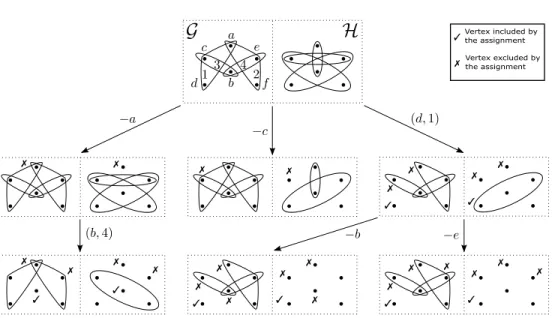
To give an example, consider Figure 3.
Hypergraph vertices are denoted by
letters, and hypergraph edges are denoted by numbers. In the tree illustrated, the root
coincides with the pair of hypergraphs of Figure 1, except that the transversal
{
d, b, f
}
of
G
is now missing in
H. The root is associated with the empty assignment
σ
εand,
correspondingly, the sets depicted with the root node are
Sep
(
σ
ε) and
Com
(
σ
ε). Each
of the other nodes
p
represents an assignment
σ
pwhose included vertices are indicated
by a checkmark (
3
) and whose excluded vertices by a cross (
7
). In addition, each
node
p
shows, on the left-hand side, the separated edges of
G
and, on the right-hand
side, the compatible edges of
H
in
σ
p, respectively. The leftmost edge leaving the
root is labeled with
−
a
which stands for the exclusion of vertex
a
. This reflects
the application of an extension type (iii). On the other hand, the rightmost edge
leaving the root is labeled with (
d,
1) which stands for the inclusion of vertex
d
as a
critical vertex, along with edge 1 of
G
witnessing
d
’s criticality in the attempted new
transversal under construction. This reflects the application of an extension type (ii).
In the given example, not all but only some nodes of the tree are depicted. Indeed,
observe that the bottom right node of the figure is not a leaf, because its assignment is
noncovering and still contains two free vertices that can be either included (as critical
vertices), or excluded.
On the other hand, the bottom central node of the figure is a leaf, because its
as-signment is covering (in particular, edge 3 of hypergraph
G
is covered by the excluded
vertices).
A path Π = (
`
1, `
2, . . . , `
k) in
T
(G
,
H) is a sequence of edge labels describing the
path from the root to a node following the edges labeled in turn
`
1,
`
2,. . . ,
`
k.
For example, in Figure 3, the path ((
d,
1)
,
−
e
) leads to the bottom right node of
the figure.
Since the edges leaving a node are assumed to be all differently labeled, a path
identifies unequivocally a node in the tree. Given a path Π, we denote by
N
(Π)
the end-node of Π. Note that the end-node of a path is not necessarily a leaf of the
decomposition tree.
The next lemma, which shows how to compute the assignment
σ
N(Π)of node
N
(Π), immediately follows from the definition of the concept of path. For notational
convenience we define
σ
(Π) =
σ
N(Π).
Lemma
3.3.
(1)
σ
N(Π)=
σ
(Π) =
*
[
(v,G)∈Π{
v
}
,
[
−v∈Π{
v
}
∪
[
(v,G)∈Π(
G
\ {
v
})
+
.
Let us now analyze what are the reductions in size achieved when specific
exten-sion types are performed. We denote by
ε
Sepv (σ)=
|{
G
∈
Sep
(
σ
)
|
v
∈
G
}|
|{
Sep
(
σ
)}|
and
ε
Com(σ) v=
|{
H
∈
Com
(
σ
)
|
v
∈
H
}|
|{
Com
(
σ
)}|
the ratio of the edges in
Sep
(
σ
) and
Com
(
σ
), respectively, containing vertex
v
.
Lemma
3.4.
Let
G
and
H
be two hypergraphs satisfying the intersection property,
and let
σ
be a noncovering assignment. If
v
is a free vertex of
σ
, then
|
Sep
(
σ
+
h{
v
}
,
∅
i)|
= (1
−
ε
Sepv (σ))
· |
Sep
(
σ
)|
and
|
Com
(
σ
+
h
∅
,
{
v
}i)|
= (1
−
ε
Comv (σ))
· |
Com
(
σ
)|
.
On the other hand, if
G
∈
Sep
(
σ
)
,
H
∈
Com
(
σ
)
, and
v
∈
G
and
w
∈
H
are free
vertices of
σ
, then
|
Com
(
σ
+
h{
v
}
, G
\ {
v
}i)| ≤
ε
Comv (σ)· |
Com
(
σ
)|
and
|
Sep
(
σ
+
h
H
\ {
w
}
,
{
w
}i)| ≤
ε
Sepw (σ)· |
Sep
(
σ
)|
.
Proof.
Given an assignment
σ
, if
v
is a free vertex in
σ
and
v
belongs to
ε
Sepv (σ)·
|
Sep
(
σ
)|
many edges of
Sep
(
σ
), then, for the assignment
σ
0=
σ
+
h{
v
}
,
∅
i
(extension
type (i)), it is easy to see that
|
Sep
(
σ
0)|
= (1
−
ε
vSep(σ))
· |
Sep
(
σ
)|. Similarly, when the
assignment
σ
0=
σ
+
h
∅
,
{
v
}i
is considered (extension type (iii)), it is easy to see that
|
Com
(
σ
0)|
= (1
−
ε
vCom(σ))
· |
Com
(
σ
)|.
Let us now consider extension type (ii), and let
σ
0=
σ
+
h{
v
}
, G
\ {
v
}i. We will
show that
|
Com
(
σ
0)| ≤
ε
vCom(σ)· |
Com
(
σ
)|. Let
K
{v}=
{
H
e
∈
Com
(
σ
)
|
H
e
∩
G
=
{
v
}}
be the set of edges in
Com
(
σ
) whose intersection with
G
is exactly vertex
v
, and let
K
[v]=
{
H
e
∈
Com
(
σ
)
|
H
e
∩
G
3
v
}
be the set of edges in
Com
(
σ
) whose intersection
with
G
contains vertex
v
. Clearly
K
{v}⊆
K
[v]and, hence,
|
K
{v}| ≤ |
K
[v]|. By
definition,
|
K
[v]|
=
ε
Com(σ)
v
· |
Com
(
σ
)|, therefore
|
K
{v}| ≤
ε
Comv (σ)· |
Com
(
σ
)|. Since
G
and
H
satisfy the intersection property,
Sep
(
σ
) contains edges of
G, and
Com
(
σ
)
contains edges of
H, all edges of
Com
(
σ
) intersect
G
. This, together with the fact
that all vertices
G
\ {
v
}
are excluded in
σ
0, implies that
Com
(
σ
0) =
K
{v}. Therefore,
|
Com
(
σ
0)| ≤
ε
Com(σ)v