High Availability for Database
Systems in Geographically
Distributed Cloud Computing
Environments
byHuangdong Meng
A thesis
presented to the University of Waterloo in fulfillment of the
thesis requirement for the degree of Master of Mathematics
in
Computer Science
I hereby declare that I am the sole author of this thesis. This is a true copy of the thesis, including any required final revisions, as accepted by my examiners.
Abstract
In recent years, cloud storage systems have become very popular due to their good scal-ability and high availscal-ability. However, these storage systems provide limited transactional capabilities, which makes developing applications that use these systems substantially more difficult than developing applications that use a traditional SQL-based relational database management systems (DBMS). There have been solutions that provide transactional SQL-based DBMS services on the cloud, including solutions that use cloud shared storage sys-tems to store the data. However, none of these solutions take advantage of the shared cloud storage architecture to provide DBMS high availability. These solutions typically deal with the failure of a DBMS server by restarting this server and going through crash recovery based on the transaction log, which can lead to long DBMS service downtimes that are not acceptable to users. It is possible to run traditional DBMS high availability solutions in cloud environments. These solutions are typically based on shipping the transaction log from a primary server to a backup server, and replaying the log at the backup server to keep it up to date with the primary. However, these solutions do not work well if the primary and backup are in different, geographically distributed data centers due to the high latency of log shipping. Furthermore, these solutions do not take advantage of the capabilities of the underlying shared storage system.
We present a new transparent high availability system for transactional SQL-based DBMS on a shared storage architecture, which we call CAC-DB (Continuous Access Cloud DataBase). Our system is especially designed for eventually consistent cloud storage sys-tems that run efficiently in multiple geographically distributed data centers. The database and transaction logs are stored in such a storage system, and therefore remain available af-ter a failure up to the failure of an entire data cenaf-ter (e.g., in a natural disasaf-ter). CAC-DB takes advantage of this shared storage to ensure that the DBMS service remains available and transactionally consistent in the face of failures up to the loss of one or more data centers. By taking advantage of shared storage, CAC-DB can run in a geographically distributed environment with minimal overhead as compared to traditional log shipping solutions.
In CAC-DB, an active (primary) and a standby (backup) DBMS run on different servers in different data centers. The standby catches up with the active’s memory state by replay-ing the shared log. When the active crashes, the standby can finish the failover process and reach peak througput very quickly. The DBMS service only experiences several seconds of downtime. While the basic idea of replaying the log is simple and not new, the shared storage environment poses many new challenges including the need for synchronization protocols, new buffer pool management mechanisms, approaches for guaranteeing strong
consistency without sacrificing performance and new shared storage based failure detection mechanism. This thesis solves these challenges and presents a system that achieves the following goal: if a data center fails, not only does the persistent image of the database on the storage tier survive, but also the DBMS service can resume almost uninterrupted and reach peak throughput in a very short time. At the same time, the throughput of the DBMS service in normal processing is not negatively affected. Our experiments with CAC-DB running on EC2 confirm that it can achieve the above goals.
Acknowledgements
At first, I would like to thank my supervisor Ashraf Aboulnaga for guiding and sup-porting me through my graduate studies at academic and career levels.
I would also like to thank Professor Kenneth Salem, Li Liu, and Rui Liu, my collabo-rators on this work, for continuously sharing their insights.
I would also like to thank Professor Kenneth Salem and Professor Lukasz Golab for being my thesis readers.
I would also like to thank my parents for their continuous support and love throughout my entire life.
A special thanks to my girlfriend, Yuke Yang, for her support, patience and great food that helped me through my Master program.
Finally, I would also like to thank the University of Waterloo for providing me a chance to begin my professional life in North America.
Table of Contents
List of Tables xi
List of Figures xiii
1 Introduction 1
2 Related Work 5
3 Background and System Overview 9
3.1 Overview of DAX . . . 9
3.2 ARIES Recovery Protocol . . . 11
3.2.1 The Transaction Log . . . 11
3.2.2 Checkpointing . . . 12
3.3 Overview of CAC-DB . . . 13
4 CAC-DB Log Replay 17 4.1 Synchronizing Log Replay Between Active and Standby . . . 17
4.2 Managing Non-shared Data . . . 18
4.3 Buffer Pool Management in the Standby . . . 19
4.4 Handling a Slow Standby . . . 23
4.4.1 Increasing IO Threads at the Standby . . . 25
4.4.3 Evicting Unsafe Pages at the Standby . . . 26
4.5 Guaranteeing Consistent Reads at the Standby . . . 28
4.5.1 Consistent Reads of Log Files . . . 29
4.5.2 Consistent Reads of Data Files . . . 30
5 CAC-DB Failover 35 5.1 Failover . . . 35
5.2 Reprotection . . . 36
6 Experimental Evaluation 39 6.1 Experimental Setup . . . 39
6.2 Behavior of CAC-DB During Failover . . . 40
6.2.1 Failover in One Zone . . . 42
6.2.2 Failover in Different Regions . . . 46
6.3 Reprotection After a Failure . . . 50
6.4 Comparison Between Local Disk and EBS . . . 51
6.5 Varying Buffer Pool Size . . . 53
6.6 Different Design Alternatives for Dealing with a Slow Standby . . . 57
7 Conclusion and Future Work 61 7.1 Conclusion . . . 61
7.2 Directions for Future Work . . . 61
7.2.1 CAC-DB with Other DBMSes and Storage Systems . . . 62
7.2.2 Eliminating the Need for Page Flushing After Failover . . . 62
APPENDICES 63
A Failure Detection in CAC-DB 65
References 69
List of Tables
6.1 Failover Time Comparison for One-Zone . . . 45 6.2 Failover Time Comparison for Different Regions . . . 49 6.3 Failover Time Comparison for Different Methods of Handling a Slow Standby 58
List of Figures
1.1 CAC-DB System Overview . . . 3
3.1 CAC-DB Architecture . . . 12
3.2 The Three Phases of Active and Standby in CAC-DB . . . 16
4.1 Safe Page Eviction . . . 21
4.2 Evicting Unsafe Pages at the Standby . . . 23
4.3 Incompletely Written Log Blocks . . . 29
6.1 Comparison Between DAX and CAC-DB In One Zone . . . 42
6.2 DAX and CAC-DB During Failover in One Zone . . . 43
6.3 Comparison Between MySQL Binlog Replication Solutions and CAC-DB-W in One Zone . . . 44
6.4 Comparison Between DAX and CAC-DB in Different Regions . . . 47
6.5 Comparison Between MySQL Binlog Replications and CAC-DB-W in Dif-ferent Regions . . . 48
6.6 Reprotection After a Failure . . . 50
6.7 Average and 95% Confidence Interval of Throughput on Local Disk and EBS 51 6.8 Bandwidth Comparison Between Local Disk and EBS . . . 52
6.9 Comparison Between DAX and CAC-DB-W With a 2GB Buffer Pool . . . 54
6.10 Comparison Between DAX and CAC-DB-W With a 10GB Buffer Pool . . 55
6.12 Detailed View of the Methods for Handling a Slow Standby . . . 57 6.13 Number of Pages in the Standby Buffer Pool . . . 59
Chapter 1
Introduction
Today there are numerous distributed storage systems that are designed for a cloud com-puting environment. These systems are scalable and highly-available, but provide only limited functionality. First, they have a simple data model where the data is stored as (key, value) pairs, and they only support simple operations, e.g., reading and writing values by key. They do not support full SQL, so they they are often called “NoSQL” systems. Second, they have very limited transactional capabilities. For example, Cassan-dra [22] and Google’s Bigtable [15] only provide atomic read and write access to a single row, while atomic multi-row queries and updates are not possible. Google’s Megastore [10] does support multi-row atomic access, but multi-row transactions are limited to pre-defined fine-grained database partitions. In contrast to cloud storage systems, relational database management systems (DBMS) provide a rich query language in the form of SQL, and strong ACID guarantees for transactions. This makes developing application that use relational DBMS much simpler than applications that use cloud storage systems. However, relational database systems are not as scalable and elastic as cloud storage systems.
It is possible to use a cloud storage system as the storage tier for a relational DBMS, which can in turn support the data management needs of hosted applications. We call this approach a shared-storage DBMS solution. There have been several shared-storage DBMS solutions, such as running a DBMS on Amazon’s S3 storage service [13], ElasTras [19] which uses HDFS [3] as the storage tier, and DAX [23] which uses a Dynamo-like multi-master system as the storage tier.
The shared storage DBMS architecture is a promising architecture for data management on the cloud. This architecture decouples storage scalability and availability (which become the responsibility of the storage system) from query and transaction processing (which
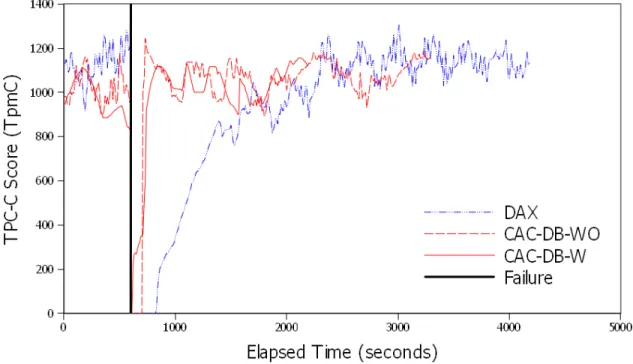
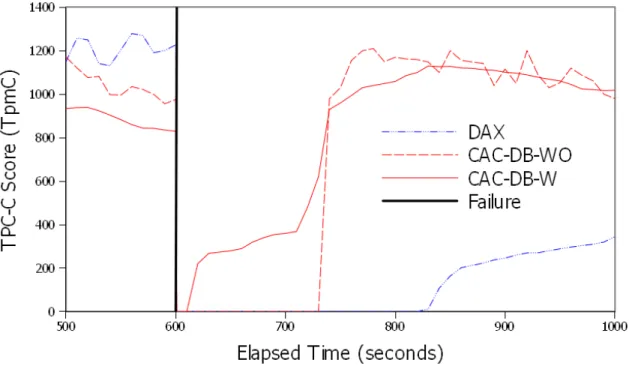
become the responsibility of the DBMS). However, all solutions that follow this architecture lack DBMS-level high availability (HA), that is, an always-on hosted DBMS. If a data center fails, the persistent image of the database in the cloud storage tier can survive in another data center through the high availability mechanism of the cloud storage system. However, the cloud storage high availability mechanism does not address DBMS high availability, and a new DBMS server must be launched in another data center and must go through the normal DBMS recovery process, typically based on replaying the transaction log. However, this is a slow process resulting in a significant outage of the DBMS service that may not be acceptable to users. For example, in DAX, the system experiences a downtime of about 270s when a DBMS server fails, and the time to reach peak throughput after a backup server comes online is around 1000s (Figure 10 in [23]). Therefore, it is desirable to provide DBMS-level high availability for shared storage DBMS architectures, and this is the focus of this thesis.
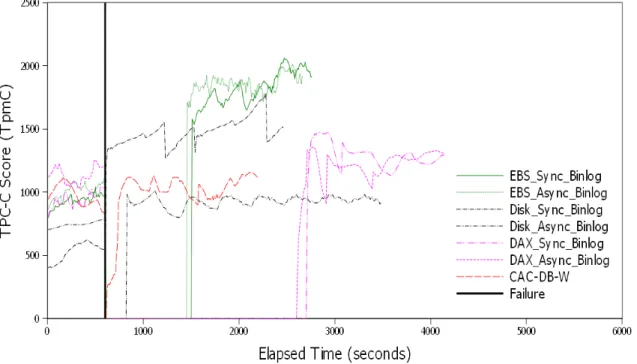
A common approach to providing DBMS high availability is to ship the database trans-action log over a network from a primary active DBMS to a backup standby DBMS running on a different server machine. For example, MySQL, which we use in this thesis, has a high availability solution based on Binlog (binary log) replication [5]. Binlog replication offers two modes of replication from the active to the standby DBMS: asynchronous and syn-chronous log shipping (asynchronous or synchronous to transaction commits). Committed transactions may be lost if asynchronous log shipping is used, while the throughput of the active DBMS will be reduced significantly if synchronous log shipping is used, especially in a multi-data-center deployment. Any log shipping solution would suffer from high message latency if the active and standby servers are in different, geographically distributed data centers. Besides, log shipping solutions do not take advantage of the availability of shared storage between the active and standby in a shared storage DBMS architecture.
In this thesis, we present a new transparent high availability solution for shared stor-age DBMS architecture, which we callCAC-DB (for Continuous Access Cloud DataBase). Our system is designed especially for eventually consistent cloud storage systems such as Dynamo [20] or Cassandra [22]. These cloud storage systems run effectively in multiple, geographically distributed data centers and can remain available in the face of failures up to a disaster that crashes a whole data center. Our solution is based on DAX, which provides a multi-tenant database service on top of an eventual consistency cloud storage system. DAX’s storage tier provides scalability, elasticity, and availability that is decoupled from the DBMS tenants. DAX works well across data centers and offers strong consistency guar-antees to the DBMS tenants without sacrificing performance, which makes it an excellent platform for implementing CAC-DB.
The basic idea of CAC-DB is to provide DBMS high availability by replaying the log 2
Figure 1.1: CAC-DB System Overview
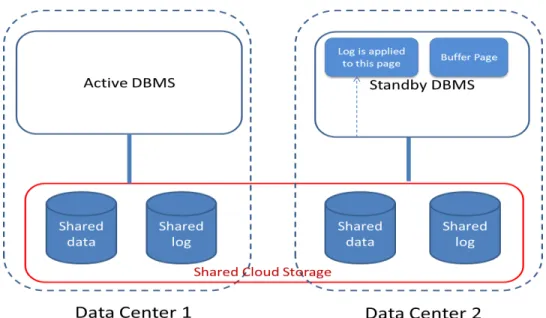
generated at an active DBMS on a different machine that is hosting a standby DBMS. This idea is not new [5], but the log in our solution is in the shared storage system instead of being shipped from the active to the standby. Figure 1.1 illustrates this architecture.
Having a log and database that are shared between active and standby provides many benefits, but also raises many technical challenges. The main benefit of the shared database and log in DAX is removing the latency of log shipping from the critical path of transaction execution at the active server. The log records still need to be propagated from the active to the standby, but the propagation is handled by DAX with minimal performance overhead for the active. Another benefit is that DAX ensures that the standby can always access a transactionally consistent version of the log that contains all log records of all committed transactions, so no committed transactions are lost in case of a failure. A third benefit is saving storage space, since the standby does not need to have its own copy of the database and log as would be the case in a typical log shipping solution.
The challenges raised by having a shared database and log relate to coordinating access to these shared files between the active and standby. First, in order to ensure that the database and log remain consistent, the shared data can only have one writer at any time. The standby in CAC-DB can read database and log pages, but it cannot write these pages. Therefore, the standby needs novel page eviction mechanisms, since it can no longer flush dirty pages. Second, it is important to guarantee that if the standby is slower
than the active and needs to catch up with it, the standby could do so without affecting the throughput of the active. Third, the standby needs a strong consistency guarantee without sacrificing performance during normal operation and during failover. In addition, synchronization protocols between the active and the standby and a lightweight failover detection mechanism based on shared storage are needed.
CAC-DB solves these challenges and achieves the following goals: (1) the overhead during normal operation is low, (2) data remains consistent and accessible after a failure up to the loss of one or more data centers (as in a natural disaster), and (3) the database service experiences minimal outage after a failure and reaches peak throughput fast. We show that CAC-DB has much better performance than a traditional log shipping approach, which is not surprising in a geographically distributed setting.
The difference between CAC-DB and a log shipping solution can be summarized as fol-lows. Compared to asynchronous log shipping, CAC-DB guarantees no committed trans-actions are lost. Compared to synchronous log shipping, CAC-DB imposes a much lower, almost negligible performance overhead on the active, especially in a multi-data-center de-ployment. This is because DAX, on which CAC-DB is based, tries to hide the latency of cross-data-center communication and remove it from the critical path of transaction com-mit. CAC-DB does not require the log to be shipped and does not require an additional local copy of the database at the standby, because the log and database are in shared storage that is accessible to both active and standby. It should be noted that since the persistent log and database are accessible to active and standby, the focus of CAC-DB is on efficiently maintaining the in-memory state of the standby so that it is consistent with the active. That way, if the active fails, the standby can take over managing the shared log and database, go through the log-based recovery process fast since most of the log has already been replayed, and reach peak throughput with minimal service interruption.
The remainder of the thesis is organized as follows. Chapter 2 provides a summary of related work. In Chapter 3, we provide some background about DAX and ARIES recovery, and present the architecture of CAC-DB. Chapter 4 describes CAC-DB during normal operation, discussing buffer pool management, the synchronization protocol between active and standby, and how to ensure that the standby does not regularly fall behind the active and does not slow it down. Chapter 5 discusses failure detection and failover. We present an empirical evaluation of a deployment of our system in Amazon’s Elastic Compute Cloud (EC2) in Chapter 6. Chapter 7 concludes the thesis.
Chapter 2
Related Work
There are different types of HA techniques which are used in database systems. Active-standby HA is one of the most important techniques, and it is implemented by many database systems [8, 16, 29, 25]. In active-standby HA based systems, log shipping is often used. Log shipping may be synchronous or asynchronous. With synchronous log shipping, committed transactions are not acknowledged to the client until the active and standby both have made the update durably. Systems based on synchronous log propagation are considered 2-safe systems [21, 28], which means that committed transactions are not lost due to the failure of a single server. However, HA based on synchronous log shipping may impose a large performance penalty on the throughput of the active server, since each transaction commit is delayed until the log records are propagated. In contrast, with asynchronous log shipping, transactions are acknowledged as soon as they are committed at the active. Systems based on asynchronous propagation are 1-safe systems, which incur much lower overhead at the active during normal operation. However, recently commit-ted transactions may be lost if the active fails. We have tescommit-ted and compared MySQL semi-synchronous and asynchronous Binlog replication, and we discuss their drawbacks in Chapter 6. RemusDB [25] is an active-standby HA system that implements DBMS high availability as a service provided by the virtual machine layer. It uses asynchronous check-pointing to propagate updates at the VM level from active to standby. RemusDB requires the DBMS to run in a virtual machine, and it does not address the issues of geographically distributed deployment; putting the active and standby in different data centers would result in high latency for commits at the primary.
In CAC-DB, which is itself an active-standby system, the active does not need to wait for the standby and therefore there is no additional throughput overhead on the active. In addition, CAC-DB is built on the DAX storage system [23], which guarantees that updates
are synchronized to different replicas in the storage tier in a way that is consistent with the semantics of DBMS-level ACID transactions. Therefore, CAC-DB is 2-safe and addresses the drawbacks of synchronous and asynchronous propagation. CAC-DB differs from other database active-standby systems in that it is designed for a shared-storage environment instead of a shared-nothing environment. In addition, a major advantage of CAC-DB is that CAC-DB can provide fast failover across multiple geographically distributed data centers, while other HA solutions require the active and standby to be in the same data center.
There are also several HA approaches for shared access environments, where two or more DBMS instances share a common network attached storage infrastructure, in which the database is stored. The network attached storage stores data redundantly, which makes the data reliable. If one DBMS server fails, other servers which can access to the same database can take over quickly. This technique is implemented by many database systems, such as Oracle RAC [30], and synchronized data nodes accessed through the NDB in MySQL Cluster [8]. CAC-DB differs from these techniques in that it is an active-standby system which is built on top of shared storage. In addition, shared access approaches are designed for single-data-center failover while CAC-DB works in a geographically distributed setting.
In this work, we assume a multi-tenant database service deployed on the DAX shared storage system. Other works have been proposed that deploy a database service on cloud shared storage. ElasTras [19] is an example of a system that is intended to host DBMS on a shared storage tier. However, unlike DAX [23], ElasTras assumes that the storage tier provides read and write operations with strong consistency while DAX assumes a storage tier with eventual consistency. Recent work by Najaran et al. [27] has looked at hosting relational database services on a storage tier based on Sinfonia [9]. However, their work can only provide tuple-level access while DAX provides a block-level interface. In principle, CAC-DB can be adapted to work with any system that uses shared storage, but of course the details of how to do this are highly non-trivial, and are an interesting area of future work for this thesis.
There are also several commercial services which are used as storage tiers for DBMS tenants. A typical example is Amazon EBS, which can provide strongly consistent read and write operations. However, EBS does not work across multiple data centers. EBS is used as the storage tier in our experiments for Binlog replication since the active and standby in this case maintain separate copies of the database in their respective data centers. Brantner et al. [13] consider hosting database systems on Amazon Simple Stor-age Service (S3). However, S3 only provides weak eventual consistency guarantees, which makes offering transactional guarantees more complex. In contrast, DAX can offer
actional guarantees to the hosted database systems while at the same time providing good performance.
For failure detection, systems typically implement automated or semi-automated mech-anisms using some kind ofheartbeat [6]. Such mechanisms require the active to send regular heartbeat messages to indicate that it is still alive. Failure of the active to send a heart-beat message within a prescribed interval is taken as an indication that it has failed. The active’s heartbeat messages may be directed to the standby system or to a third-party system. For example, a Bigtable [15] master system must maintain an active session with the Chubby lock service [14] to ensure that it remains as the master. To keep its session alive, the Bigtable master sends heartbeat messages to Chubby. Another example is the failure detection service in Boxwood [24], which requires that clients send regular heart-beat messages to a set of observers. CAC-DB relies on a heartheart-beat-based failure detection mechanism that uses DAX storage for reliable, indirect communication of the heartbeats.
Chapter 3
Background and System Overview
In this chapter, we describe the CAC-DB system architecture. Since CAC-DB is built on DAX, we first provide some background about DAX. We also present an overview of the ARIES recovery algorithm, which is used by many DBMS and which CAC-DB assumes will be used.
3.1
Overview of DAX
DAX [23] uses cloud storage to implement a reliable, distributed, shared-block storage service for hosted DBMS tenants. DAX implements a thin software layer called theDAX client library that runs on the DBMS tenant machine to intercept the interaction between the DBMS storage manager (InnoDB, in the case of MySQL) and the storage devices to read or write data. The DAX client library converts these interactions to interactions with the underlying cloud storage system (Cassandra, in the case of DAX). To the DBMS tenant, DAX behaves like a disk, but in terms of implementation it is a scalable, reliable, geographically distributed storage service.
The DAX service assumes that all DBMS data access is block-oriented. DAX stores all database blocks in a single Cassandra column family, that is, each row consists of a key and a single data column containing one data block. Each block accessed by a DBMS maps to a single row in this column family, with the block id as the key of the row. The DBMS storage manager remains responsible for data blocks caching, concurrency control, and transactional recovery.
The hosted DBMS in DAX expects that when it reads a data block, it will obtain the most recently written version of that block, but Cassandra only provides eventual consistency for data that is written. That is, the tenant can write one replica of a data block and then read another replica to which the write has not yet propagated, leading to a stale read. To solve this problem, DAX uses a technique calledoptimistic I/O for ensuring consistent reads for hosted database systems, while avoiding most of the performance penalty.
Cassandra provides multiple variants of the read and write operation that enable the application to control how many replicas need to be read or written before the return to the client. This allows the application to control the consistency vs. latency and consistency vs. durability tradeoff. One variant of read is Read(1), which returns the first response received to the client. This operation is cheap but may return stale data if the first replica to respond is stale. Cassandra also provides Read(QUORUM), which waits until a quorum of replicas responds and sends the most recent version from among the data items received from the quorum of replicas to the client. This operation is relatively expensive, especially if the replicas are distributed across geographically different data centers. Similarly, Cassandra provides Write(1) and Write(QUORUM). The client can choose cheap Read(1)/Write(1) operations, which are fast but not necessarily consistent or durable. The client can also choose expensive Read(QUORUM)/Write(QUORUM) operations, which are consistent and durable but may be slow. The goal of DAX is to use cheap reads and writes while getting the consistency and durability of expensive reads and writes. To enable the use of cheap Read(1) calls in DAX, each DBMS tenant maintains an in-memory version list that records the most recent version numbers of different blocks. These version numbers are also stored in the blocks in Cassandra. When a DBMS tenant reads a block that is on the version list, the tenant can determine if it received the most recent version of the block by comparing the version number read from storage to the version number on the version list. DAX optimistically uses Read(1) for blocks on the version list, and repeats the read if the returned version is stale. For blocks that are not on the version list, DAX uses Read(QUORUM).
For writes, DAX also uses cheap Write(1) operations. However, this reduces fault tolerance since the loss of the only replica containing an acknowledged write leads to loss of data. To address this problem, DAX implements a technique called client-controlled synchronization to complement optimistic I/O. In client controlled synchronization, DAX uses a new type of write operation, called Write(CSYNC). Like Write(1), Write(CSYNC) operations are acknowledged to the client as soon as one replica is updated. In addition, Write(CSYNC) records the key (i.e., the block id) in a per-client sync-pending list at the DAX server to which the client is connected. The key stays in the sync pending list until
the remaining replicas have asynchronously acknowledged the update.
DAX provides the client with an API call named CSync (similar to fsync) by which the client can tell DAX to ensure that all previously acknowledged writes must be syn-chronized. This approach is very natural for a DBMS because many DBMS are already designed to use explicit update synchronization points. For example, a DBMS that im-plements the write-ahead logging protocol will write the log page and then issue a write synchronization operation (e.g., fsync in Linux) to ensure the requirement of durability. When the DBMS needs to ensure that a write is durable (at leastk replicas updated), it issues an explicit CSync synchronization request. On a CSync, the DAX server to which the client is connected makes a snapshot of the client’s sync pending list and blocks until at leastk replica update acknowledgements have been received for each update on the list. The synchronization request is then acknowledged to the client. A DBMS would typically issue such an explicit synchronization request as part of commit processing. As part of processing such a request, DAX ensures that thek replicas are distributed among various data centers. Therefore, even if an entire data center fails, the database and log are avail-able in other data centers, and reflect the changes made by all committed transactions. A new DBMS instance can be launched in a different data center and can perform log-based database recovery and restore the availability of the database service.
3.2
ARIES Recovery Protocol
ARIES [26] is a recovery algorithm for DBMS. Recovery in ARIES consists of two stages: the redo stage and the undo stage. In the redo stage, the DBMS “repeats history”, starting from the latest checkpoint in the log, and restores the database state to what it was at the time of the crash. In the undo stage, the DBMS undoes all the actions of uncommit-ted transactions, so that only the actions of commituncommit-ted transactions are reflecuncommit-ted in the database.
3.2.1
The Transaction Log
The transaction log records the history of actions executed by the DBMS. The log, phys-ically, is a file of log records stored in stable storage. The log file is assumed to survive a crash and can be used to perform recovery. The most recent portion of the log is stored in alog buffer in main memory and is periodically forced (i.e., flushed) to stable storage, usually as part of commit processing. Log records are written to stable storage at the granularity of pages, just like data records.
Figure 3.1: CAC-DB Architecture
Every log record has an id called thelog sequence number (LSN), which is assigned in monotonically increasing order. In the implementation of InnoDB, LSN mod the size of the log file is the physical offset in the log file. Every page has a pageLSN, which is the LSN of the most recent log record that makes a change to this page. In the buffer pool of a DBMS, the pageLSN of a buffer page is the last change to make this page dirty. Based on our system design, the standby has its own interpretation of pageLSN, shown in the definition below:
Definition 1 pageLSN in the standby: In the buffer pool of the standby, the pageLSN of a buffer page is the last change in the log the standby has applied to this page.
3.2.2
Checkpointing
When the DBMS takes a checkpoint, it is as if the DBMS takes a snapshot of its state. The DBMS periodically takes checkpoints to reduce recovery time. Conceptually, taking a checkpoint means that all the updates before the latest checkpoint have been flushed to
stable storage. In InnoDB, a checkpoint is identified by its checkpointLSN. The log file records the checkpointLSN of the latest checkpoint in a known location. All the updates whose LSN is smaller than the latest checkpointLSN are guaranteed to be durable in the storage tier.
The checkpointing technique that InnoDB uses is called fuzzy checkpointing. It is in-expensive because it does not require the DBMS to write out pages at the checkpoint. Instead, a background thread is responsible for writing dirty pages to the durable storage periodically. At a checkpoint, InnoDB does not flush any dirty pages and only calculates its new checkpointLSN and records this value in the log. The new checkpointLSN is equal to the smallest oldest-lsn (the first LSN to make a page dirty) of all the dirty pages in the buffer pool.
3.3
Overview of CAC-DB
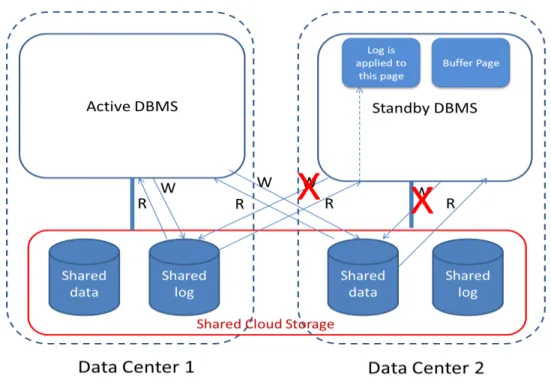
Figure 3.1 illustrates the architecture of CAC-DB, which is built on DAX. In CAC-DB, every database tenant has a primary server (active) and a backup server (standby) in different data centers. The database and the transaction log are stored in the cloud storage system. The active and standby servers both have (read and write) access to the shared database and log. DAX replicates the database and log in the two data centers with the active and standby, and hides most latencies related to propagating updates from the active data center to the standby data center, so access by the standby typically incurs no cross-data-center latency. It is important to note that even though both active and standby can read and write the database and log, CAC-DB is designed so that only the active writes (as well as reads) the database and log. The standby can read the database and log, but it never writes to either. The reason for this restriction is that we want every database block to have one writer in order to keep the database consistent without additional concurrency control protocols. This restriction means that the standby cannot flush dirty pages from its buffer pool, which requires changing the buffer eviction mechanism for the standby. We will return to this point in Chapter 4.
The active accepts users requests, executes queries and performs database updates in the shared storage. The standby does not accept user requests. Instead, the standby continuously reads the shared transaction log and replays log records to update its internal memory state (i.e., its buffer pool). This makes the contents of the standby buffer pool closely resemble the most recent state of the active buffer pool. Thus, the standby is “warm” and can take over quickly if the active fails.
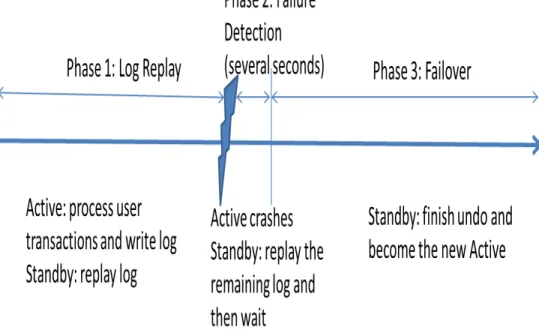
If the active fails, the database and log are available to the standby, and their state is consistent with all committed transactions at the active. This is because the storage tier in DAX provides transactionally consistent scalability and HA for the persistent image of the database and log, independent of any DBMS instance. When the standby detects that the active has failed, CAC-DB provides fast failover and atomic handover from active to standby. The standby can then become the new active. The whole operation of a standby server in CAC-DB can be divided into three phases:
1. Log Replay (phase 1): In the traditional log-based ARIES recovery algorithm [26], the recovery procedure is based on repeating history, that is, executing exactly the same actions that happened during normal processing before the failure. Repeating history includes redo of log records of both complete and incomplete transactions from the latest checkpoint in the transaction log. In ARIES, recovery, this redo stage is followed by a subsequent undo stage. In CAC-DB, the standby continuously replays the log that is produced by the active. The log replay procedure of CAC-DB is naturally similar to the redo stage of ARIES recovery, so we reuse the code for the redo stage of recovery in our standby log replay procedure. The standby can get the complete transaction log from shared storage. We provide a consistency guarantee for log writes in DAX, similar to optimistic IO, that guarantees (along with the ARIES protocol) that the standby never skips any log records. CAC-DB uses batch based log replay, in which a log file can be divided into many segments. The standby repeatedly reads one segment from storage into memory, replays the log records in this segment, and then reads the following segment.
2. Failure Detection (phase 2): For CAC-DB, we use a heartbeat-based failure detection mechanism that uses DAX storage for reliable, indirect communication of the heartbeats. We create a reliable counter in DAX for each active/standby pair to support failover. The standby’s failure to read the latest counter value for more than a fixed period is taken as an indication that the active has failed. The failure detection mechanism is presented in Appendix A.
3. Failover (phase 3): After detecting the failure of the active, the standby performs ARIES recovery. Since the standby is continuously replaying log records during normal operation, it usually finds that it has already finished the redo stage of ARIES. The standby performs the undo stage of ARIES recovery and becomes the new active. The undo stage of ARIES recovery can proceed while the standby is servicing user requests. That is, the standby actually becomes the active and then performs undo recovery. The new active (the old standby) reaches peak throughput quickly because
(1) it has a warm buffer pool, (2) it typically does not need to perform redo recovery, and (3) it serves user requests while performing undo recovery. The recovery is based on the ARIES algorithm [26] which guarantees atomic handover.
We illustrate the active and standby in the above three phases in a timeline diagram shown in Figure 3.2.
Although the basic idea of replaying the log is not new, the fact that CAC-DB is built on cloud shared storage and tries to take advantage of this storage creates many new challenges. First, during the standby’s normal log replay, the standby cannot write to the database, which means that it cannot flush dirty pages, which means that a new mechanism is needed to manage the standby’s buffer pool. Second, we have to deal with the case when the standby cannot catch up with the active, without placing any additional overhead on the active. Third, we need to provide a strong consistency guarantee for the standby because the underlying storage tier only supports eventually consistency. Finally, a novel failover detection mechanism based on shared storage is needed. We address these challenges through a series of novel techniques that we present in the next two chapters. Chapter 4 focuses on normal operation and Chapter 5 focuses on failover.
In the implementation of CAC-DB, we choose MySQL as the DBMS, with InnoDB as the storage engine, and DAX as the distributed storage service. For the DBMS tier, CAC-DB can be easily re-implemented in another DBMS, such as PostgreSQL. This would involve changes to the PostgreSQL code, along with the DAX client library for PostgreSQL. For the storage tier, we choose DAX because DAX offers strong consistency guarantees to the DBMS that works across data centers and without sacrificing performance. CAC-DB can use another storage system that provides strong consistency to the DBMS, but the solution would be limited by any limitations of the storage system. For example, if CAC-DB uses HBase as the storage tier, it could work well in a single data center, but not across data centers due to the limitation of HBase. HBase provides strong consistency for each operation in one data center, but this per-operation strong consistency would be expensive in a multi-data-center setting. Thus, HBase would be a good choice for the storage tier when CAC-DB is used to provide DBMS-level HA in one data center. On the other hand, DAX enables CAC-DB is to provide DBMS-level HA which can tolerate the crash of a whole data center (as in the case of a natural disaster).
Figure 3.2: The Three Phases of Active and Standby in CAC-DB
Chapter 4
CAC-DB Log Replay
This chapter describes the normal operation of CAC-DB. During normal operation (i.e., no failure) the standby replays the log that is written in shared storage by the active. This log replay phase of CAC-DB requires tackling challenges such as synchronizing the active and standby, managing the buffer pool at the standby, and ensuring the consistency of the data read by the standby. We discuss these challenges next.
4.1
Synchronizing Log Replay Between Active and
Standby
The basic architecture of DB is shown in Figure 3.1. The active and standby in CAC-DB access the log and database in a shared storage tier, so there is no need to transfer data between them over the network. The active writes log records to the shared transaction log and the standby reads these log records and replays them to update the in-memory state of its buffer pool.
For this log replay protocol, the standby needs to know when there are new log records to read. The active sends a trigger message to the standby over the network to trigger log replay. This message can be sent periodically (e.g., every second), or whenever the active commits a transaction. In our implementation of CAC-DB, the active sends trigger messages whenever the active commits a transaction, so that the standby can be triggered immediately when new log records come. The active sends trigger messages to the standby over a TCP socket.
The standby also needs to know thelog sequence number (LSN)of the latest checkpoint. The standby needs this message to (1) manage the buffer pool, and (2) to judge whether the standby has fallen too far behind the active and can therefore see an inconsistent view of the log. Specifically, this LSN is used to judge whether the latest LSN written by the active is going to catch up in the circular log file with latest LSN replayed by the standby. We will return to this point in detail later in this chapter. Therefore, whenever the active completes a checkpoint, it sends the LSN of that checkpoint to the standby over the network.
When the standby receives a trigger message, it reads the most recent log records in the log file and begins replaying them.
4.2
Managing Non-shared Data
The active and standby in CAC-DB reside on a shared storage tier, and the shared storage can have only one writer at any time in order to ensure consistency. During normal oper-ation, this writer is the active. In the next section, we present a buffer pool management technique that enables the standby to replay the log and manage its buffer pool without writing to the database. This approach takes care of database data, but a DBMS needs to write much more than database data. For example, a DBMS needs to write information related to its identity like server name or IP address. A DBMS also needs to write diag-nostic and error logs that assist an administrator in tuning and problem solving. As part of query processing, a server may write temporary intermediate data such as hash tables for hash joins. It is not possible for the standby to completely avoid writing this type of server-specific, private data.
Since the data written by the standby is server-specific, we do not need to store it as part of the shared data (shared database and shared log file) on shared storage. Thus, CAC-DB divides all data into two categories: shared data and non-shared data.
• Shared data: This data encompasses the database and the transaction log. It is shared between the active and standby and should be stored in the shared storage tier. The active is the only writer of the shared data and the standby can only read this data.
• Non-shared data: This is sever-specific data such as the examples given above. This data is specific to the primary or standby, so it is stored on local storage, or in shared storage but separate from the database and log.
We use MySQL as the DBMS in CAC-DB. In MySQL, there are several kinds of non-shared data and we present how CAC-DB manages this data. First, MySQL stores performance data in the performance schema database, and tables in this database are views or temporary tables that use no persistent on-disk storage. MySQL will recreate them when it restarts after a failure. Therefore, this kind of non-shared data does not need to survive a failure. Second, MySQL stores metadata in the information schema database, which is similar to the performance schema database. Third, MySQL creates internal temporary tables while processing queries. MySQL creates a temporary table initially as an in-memory table, then converts it to an on-disk table if it becomes too large. If a failure happens, MySQL will rerun the query and recreate the associated temporary data structures. Therefore, this kind of non-shared data does not need to survive a failure either, and it is stored on local storage. Fourth, MySQL writes error messages to the console or to an error log file. If the error messages are written to a file, and this error log needs to survive a failure, CAC-DB stores this data in shared storage as a separate column family.
The approach adopted for MySQL can be adopted for any other DBMS: ephemeral non-shared data (that does not need to survive a failure) can be stored in local storage, while non-shared data that needs to survive a failure can be stored in shared storage in a server-specific area separate from the shared database and log. In any DBMS that we want to use for CAC-DB, it should be easy to distinguish in the DBMS server code between writes to the database and log on the one hand (shared data), and writes to server-specific data on the other hand (non-shared data).
4.3
Buffer Pool Management in the Standby
A DBMS, whether it is the active or the standby, needs to flush dirty pages periodically when it evicts them from its buffer pool during normal operation. However, the CAC-DB design relies for consistency on the fact that only the active writes the database and log. The standby can read the database and log, but it never writes to shared data to avoid introducing inconsistency. This means that the standby cannot flush dirty pages, which requires changing the buffer eviction mechanism for the standby. The general idea of our solution is that we don’t evict pages from the end of buffer pool eviction list (e.g., the LRU list), if these pages may cause inconsistency (we illustrate this with an example below). Instead, we can only evict a buffer page when that page is safe in shared storage. A safe page can be evicted without being flushed, so the standby can avoid all writes to the database.
We present the details of our algorithm in the context of InnoDB, which we use for CAC-DB. Other DBMS will require different implementation details, but the idea of evicting only safe pages will still apply. In InnoDB, there are three lists of pages which are used in buffer pool management. The flush list is a list that consists of all the dirty pages in the buffer pool. A background thread flushes the dirty pages from the end of flush list periodically. The pages in the LRU list and the pages in the free list together contain all the pages in the buffer pool. The buffer pages that have not been used recently are evicted when space is needed to cache newer pages, and this is done using the LRU list. The evicted pages from the end of the LRU list include dirty pages and clean pages. If the evicted pages are dirty, they are flushed to storage. When the DBMS needs a free frame to load a page, it uses one from the free list.
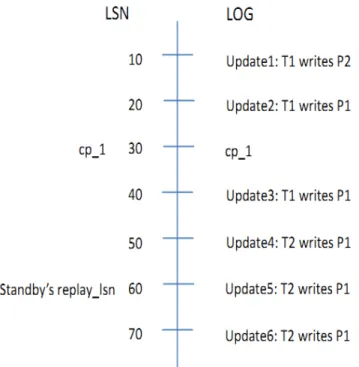
In order to prevent the standby from writing database pages to the shared storage tier, we have to suppress flushing buffer pages from the flush list and LRU list at the standby. The standby has to replay the shared log, which causes it to touch different database pages, so its buffer pool will eventually fill up and thus needs an eviction policy. We cannot simply evict pages from the end of the LRU list or the flush list, since that will cause inconsistency problems. For example, in Figure 4.1,cp1 represents the latest checkpointLSN received by the standby from the active, andreplay lsn represents the point to which the standby has replayed the shared log. At the end of this timeline, we are sure thatP2 withupdate1 and
P1 with update2 were flushed (by the active) to the storage tier because their updates are before cp1. However, the active cannot ensure that P1 with updates after cp1 is flushed to the storage tier. Therefore, if the standby evicts P1 after applying LSN = 60, when the standby applies the log record with LSN = 70, it will need to load P1 from the shared storage tier. However, because the active cannot ensure thatP1 with LSN = 60 is flushed to the storage tier, the standby may getP1 withLSN = 20, which misses update3,
update4, and update5. This causes inconsistency. On the other hand, P2 can be evicted by the standby since we are sure that the latest LSN applicable to this page is reflected in shared storage. That is,P2 is safe while P1 is unsafe.
In order to determine which pages can be evicted and which cannot, we first definesafe updates and safe pages.
Definition 2 Safe Updates: Safe updates are updates that happen before the latest check-point at the active. For example, update1 and update2 in Figure 4.1 are safe. Because updates before a checkpoint have been flushed to storage, these updates can be recovered by reading the page, so they are safe.
Definition 3 Safe Page: A page whose updates are all safe updates is a safe page. In
Figure 4.1, page P2’s updates are all before cp1, so P2 is a safe page. Since there are updates onP1 after cp1, P1 is not a safe page.
In CAC-DB, only the active can take a checkpoint and periodically send the check-pointLSN (cpLSN) to the standby. The standby compares the LSN of an update with the latest receivedcpLSN. If an update’s LSN is less than or equal to the latest received
cpLSN, this update is a safe update. If a page’s pageLSN (pLSN), which records the latest update applied to this page, is smaller than or equal to cpLSN, this page is a safe page.
In order to evict only safe pages, we design a new algorithm to manage the LRU list and free list of the standby. Upon receipt of a checkpoint LSN from the active, the standby scans the LRU list and checks the pageLSN of each page on the list to identify safe pages. The standby changes the state of all safe pages to a state that indicates that this page can be replaced, for example, by changing the dirty bit from dirty to clean and removing the page from the flush list. Updated safe pages can now be evicted from the buffer pool.
In our solution, not every receipt of a checkpoint LSN will cause the standby to update the LRU list. The standby updates the buffer pool lists only when there is not enough space in the free list to assign to newly read pages. The standby updates the LRU list and free list and does page evictions only when it needs to.
In our solution, the standby evicts the smallest number of pages possible. For example, if the standby has updated 10 safe pages in the LRU list and the free list needs 2 more pages, the standby will evict exactly 2 pages in order to maintain the utilization of the buffer pool at the standby.
There may be scenarios where the free list is not enough to accommodate new pages and all pages in the standby’s buffer pool are unsafe. In this case, the standby can either stop log replay until the next checkpoint arrives so that more pages can be identified as safe, or the standby can ask the active to take a new checkpoint immediately. In our implementation of CAC-DB, the standby asks the active to take a new checkpoint immediately when faced with this situation. The likelihood of this situation arising is related to the buffer pool size of the standby and the size of the log file. The larger the size of the log file, the less frequently checkpoints have to be taken, and the more frequently this situation arises. If the standby has a small buffer pool and the log file is large, this situation will happen relatively frequently. If the buffer pool of the standby is large and the log file is also reasonably small, this situation will not happen very often.
Figure 4.2: Evicting Unsafe Pages at the Standby
4.4
Handling a Slow Standby
The previous section provides a basic HA solution in shared storage environment. However, this basic solution works only under the assumption that the standby can always catch up with the active by replaying all the updates the active has recorded in the shared log. If the standby falls behind the active, in this section, we present techniques for handling this situation.
First, we start with a precise definition of the standby being “caught up” with the active. In modern DBMS, the transaction log is typically implemented as a number of files arranged as a circular file. This is done to keep the amount of space used by the log files bounded. For example, in InnoDB, there are two log files by default in each log group. When InnoDB starts, it writes log records in the first log file. When the first log file is filled, InnoDB begins writing in the second log file. When both log files are filled, InnoDB will return to the start of the first file and overwrite its old log content. InnoDB can overwrite old log content since all the log records before the latest checkpoint LSN are reflected in stable storage and hence will never be used, so they can be overwritten (the log replay
procedure in the redo stage of ARIES recovery starts from the latest checkpoint LSN). There is a mechanism to guarantee that new log records will not overwrite log records that have not been checkpointed.
The inconsistencies caused by the standby falling too far behind the active arise if the standby is so slow in applying log records that the active overwrites log content which the standby has not yet replayed. For example, in Figure 4.2, all the log files are filled and the active wraps around and writes log records from the start of the log file. In the figure, the active has written the log record with LSN = 110. At that time, the standby has replayed the log only up to the record withLSN = 40. If the active continues writing the shared log, the new log records will eventually overwrite log records that the standby has not replayed. If this happens, the standby cannot replay the shared log correctly, causing inconsistency.
It is likely that the standby will not be able to catch up with the active using the default DBMS setting, since the standby issues IO at a lower bandwidth than the active. The active serves multiple concurrent clients that generate several IO streams. In contrast, the standby replays the log sequentially, using only one IO stream. It is likely that the single IO stream of the standby will not be fast enough to keep up with the multiple IO streams of the active.
The specific manifestation of this problem in InnoDB is as follows. InnoDB uses the asynchronous IO (AIO) mechanism. In this mechanism, several AIO arrays are used to store AIO requests, and each AIO array is associated with a read/write IO thread. Since we use storage that is accessed over a network instead of local disk, there is a large variance in IO completion time, from single milliseconds to hundreds of milliseconds. The standby performs log replay in batch mode, , where a batch of log records is read and the database pages corresponding to these log records are then read into the buffer pool by IOs that are issued in one batch using the AIO arrays. The standby must finish processing one batch of log records completely before it can load another batch. For every batch, each AIO array has nearly the same number of AIO requests, but the completion time for processing all the AIO requests in different AIO arrays will vary due to variance in IO latency. The faster IO threads have to wait for the slower IO threads, so IO bandwidth is not effectively utilized and the completion time is determined by the slowest thread. The situation does not arise in the active because the different IO threads can work independently without impacting one another. Because of this difference, the IO processing speed in the standby is slower than that the active, causing the standby to fall behind the active.
We present three ways to address the problem in the next sections.
4.4.1
Increasing IO Threads at the Standby
Since the standby falls behind the active due to having less IO intensity, a simple solution is to increase the IO intensity of the standby. In InnoDB, this can be done by increasing the number of IO threads and corresponding AIO arrays. The default number of IO threads and AIO arrays in InnoDB is 4. In CAC-DB, we increase this number at the standby to 10. With this change, we find in our experiments that the standby can easily keep up with the active. Furthermore, the additional IO load generated by the standby does not interfere with the active, so the throughput of the active is the same as it was before. Because the standby does not fall behind the active, no inconsistency arises. In addition, when the standby detects the failure of the active, it always finds in our experiments that it has replayed all of the logs (i.e., the ARIES redo stage is over) and immediately begins ARIES undo almost no system downtime. Furthermore, there is no situation in which the standby must evict extra pages in the buffer pool (as required by the second solution which we describe in the next section), so the buffer pool remains warm and the standby can quickly reach peak throughput.
After failover, the standby decreases the number of read IO threads to the original number (4 by default). Specifically, when the standby finishes the redo stage of ARIES after failover, the AIO arrays are empty. Thus, we destroy these AIO arrays and the associated IO threads, and we re-create the original number of AIO arrays and associated IO threads. The reason we decrease the number of IO threads when the standby takes over as active is to ensure that the IO intensity of the new active is not too high. More IO threads means more IO capacity, and the DBMS is configured with a certain number of IO threads to achieve a certain IO capacity. We increase the number of IO threads at the standby to address the specific problem outlined above, but when the standby takes over as active, it needs to be restored to the configured IO capacity (i.e., the configured number of IO threads).
In our experiments, we have found this solution to be sufficient. We never encounter any case in which the standby is slower than the active. However, there remains a possibility that such a case may occur. If, for example, the standby is slow due to OS problems, hard-ware problems, or load placed on the machine by other processes. In this case, increasing the number of IO threads at the standby is not enough and we need an explicit synchro-nization mechanism between the active and standby. We present two possible approaches in the next two sections.
4.4.2
Active Waits for a Slow Standby
The most direct way to prevent the active from overwriting the log records that have not been replayed by the standby yet is to force the active to wait for the standby synchronously. Specifically, every time the standby loads one batch of log records, it will send the start LSN of this batch to the active. When the active wants to write new log records, it checks whether its latest LSN (LSNa), plus the length of the new log records (lnewrec), will pass
the start LSN received from the standby (LSNstartbatch). If Equation 4.1 is satisfied, the
active will block until it receives a new start LSN from the standby, at which time it will check the equation again:
LSNa+lnewrec≥LSNstartbatch (4.1)
Although this solution ensures proper synchronization between the active and standby, it will reduce the throughput of the active if the standby cannot keep up with it. Our experiments show that the throughput of the active with this additional synchronization can be less than 50% of its throughput without the synchronization. One of the primary objectives of this thesis is to avoid solutions that reduce the throughput of the active during normal operation, so we do not use this solution. Instead, we use the solution described next, which does not affect the active’s throughput.
4.4.3
Evicting Unsafe Pages at the Standby
Since we do not want the active to wait for the standby, we developed a solution where the synchronization between the active and standby relies on the standby reacting to the actions of the active without stopping them. In particular, instead of forcing the active to wait for the standby, the standby can skip some log records to catch up with the active. Specifically, upon receipt ofcpLSN from the active, the standby can comparecpLSN with its latest replayed LSN. There is an existing mechanism to guarantee that the latest LSN at the active will not catch up with cpLSN when the log wraps around the end of the file. Thus, if cpLSN is larger than the standby’s latest replayed LSN, the standby will know that it has fallen behind the active, and it can skip all log records up to cpLSN. For example, in Figure 4.2, the standby’s latest received checkpoint from the active iscp2. As cp2 is larger than the standby’s replay lsn, the standby will skip log records from the standby’s replay lsn to cp2. However, simply skipping log records without applying the updates they contain would cause the state of the database pages in the buffer pool to be inconsistent. In Figure 4.2, if the standby does not replay the log records between
the standby’s replay lsn and cp2 , update3, update4, and update5 to page P1 would be missed, whereas update6 may be applied. This would leave the copy of P1 in the buffer pool inconsistent (recall that the standby only updates pages in the buffer pool not in storage when replaying the log).
The solution to this problem is to simply evictP1 from the buffer pool of the standby, relying on the fact that a consistent copy of P1 is available in shared storage and can be read by the standby when needed.
Thus, the synchronization mechanism that we propose, and that we use in CAC-DB, is as follows: If the latest checkpoint at the active is later than the latest replayed LSN at the standby, the standby skips the log records until the latest checkpoint. Skipping log records means that some updates will be missed, making some pages unsafe. The standby evicts these unsafe pages from its buffer pool.
Definition 4 Unsafe Page: A page in the standby’s buffer pool that misses some updates due to the standby skipping some log records.
To implement this synchronization approach, at every checkpoint the active sends an ar-ray of pairs to the standby. Each pair represents an LSN and the page number to which the LSN applies. The LSNs represented in this array are the LSNs between the previous check-point LSN and the current checkcheck-point LSN, e.g.,{(P2,30),(P1,40),(P1,50),(P1,60),(P1,70)} in Figure 4.2. Note that the array is ordered by LSN. If the standby decides that log records must be skipped, it will do a binary search and find the (page-no, LSN) pairs with LSN larger than standby’s replay lsn, e.g.,{(P1,50),(P1,60),(P1,70)}in Figure 4.2. For each pair with larger LSN, the standby will check whether the page is in its buffer pool. If so, these pages are unsafe pages and the standby evicts them. For example, in Figure 4.2, assuming P1 is the in standby’s buffer pool, P1 will be deemed an unsafe page and will be evicted. The same page P1 on the storage tier reflectsupdate3,update4, and update5. When the standby needs P1 again later, it can read it from the storage tier with all the necessary updates. After the standby evicts all of the unsafe pages, it will continue to replay the log.
Although this solution avoids inconsistency and has no impact on the throughput of the active, it remains a concern that evicting pages from the buffer pool of the standby will reduce the degree of warmth of the standby’s buffer pool. As time passes, if the number of pages evicted is larger than the number of pages loaded, the standby’s buffer pool will become colder and colder. In the limit, we may find that the work that CAC-DB does to replay the log and keep the standby buffer pool warm is all lost due to unsafe page
evictions, and that failover in CAC-DB is as expensive as starting a new server after failure and performing ARIES recovery. Thus, this synchronization mechanism should be viewed as a way to ensure correctness if the standby temporarily falls behind the active. In the steady state, the standby should have sufficient IO capacity so that it rarely falls behind the active, if at all.
To summarize, in CAC-DB the primary mechanism for ensuring that the standby does not fall behind the active is to increase the IO capacity of the standby (Section 4.4.1). CAC-DB also implements the mechanism of skipping log records and evicting unsafe pages at the standby (Section 4.4.3). Forcing the active to wait for the standby when the standby falls behind (Section 4.4.2) is not considered a good solution since it affects the throughput of the active during normal operation.
4.5
Guaranteeing Consistent Reads at the Standby
This section focuses on techniques for guaranteeing strong consistency for the standby when it reads log and data pages, while avoiding some, or most of, the consistency penalty. The combination of optimistic IO and client-controlled synchronization in DAX guarantees that the active always sees consistent versions when it reads log and data pages that it has written (see Sections 3 and 4 in [23]). What we need to guarantee for CAC-DB is that when the standby reads log and data pages written by the active, the standby sees consistent versions.
As explained in Chapter 2, with optimistic IO the active maintains an in-memory version list to record the most recent version numbers of various blocks. The entries in the version list have the latest versions of the associated blocks. The DAX client library assigns the lastest version numbers to blocks when they are written by the active. However, because the standby cannot write to the shared storage, the entries in a version list maintained by the standby would remain unchanged and would not reflect the latest version of the associated blocks (recall that the latest versions are written by the active). Therefore, optimistic IO for the active cannot work for the standby, and a new technique is required for guaranteeing consistent reads at the standby. If the underlying cloud storage system provides strong consistency, this problem would cease to exist. However, one of the goals of DAX and CAC-DB is to avoid strong consistency, since it is too expensive for a system that is deployed across geographically distributed data centers.
In this section, we develop techniques for guaranteeing consistent reads at the standby without requiring the storage system to raise its consistency level all the way to strong
Figure 4.3: Incompletely Written Log Blocks
consistency. We divide data read by the standby into two types: log files and data files. The difference between log and data files is that log files are append-only while data files are not. Because of this difference, we have developed separate techniques to ensure consistent reads of log and data files.
4.5.1
Consistent Reads of Log Files
CAC-DB uses batch-based log replay, in which a log file can be divided into many segments. The standby repeatedly reads one segment from storage into memory, replays the log in this segment, and then reads the following segment.
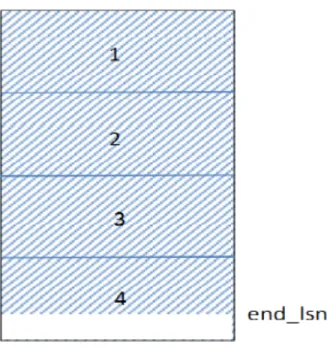
In the current implementation of InnoDB, if one segment of log files is not fully written (some blocks may be incomplete, e.g., the fourth block in Figure 4.3), the standby will record the end lsn which represents the standby’s replayed position in the log, as shown in Figure 4.3. When the standby reads the next segment, it will read from the last end lsn, and will replay from that position, not skipping any log records. As log files are append-only, if the standby can record the last replayed position with every read of a log segment,
and then replay from that position in the next read of a log segment, the standby will be guaranteed to replay the log in order and not skip any log records. This guarantees the correctness of log reads.
Based on the above, we have developed two solutions to guarantee the correctness of reads from the log file.
SOLUTION 1: The standby can use Read(1), which means that it can potentially get an old version when it reads a new log segment. The standby will replay from the last end lsn, which records the position to which the standby has replayed the last time, so it will be able to handle stale reads from the log since it would ignore log records that it has previously replayed. After replaying the current log segment, the standby will again record the end lsn, which is the starting position of log replay for the next log segment read.
Using Read(1) may be sufficient to guarantee correctness of log replay. However, it does not provide strong guarantees that log replay will make forward progress fast enough. If the standby keeps reading stale log segment because of the Read(1) operation, the standby may be much slower than the active and may fall behind. The problems of a slow standby discussed in Section 4.4 would then arise.
SOLUTION 2: A better solution is for the standby to use Read(QUORUM) to read the log file. Read(QUORUM) always obtains the most recent version of the log files, because log writes in DAX are synchronized with at least k replicas as part of commit processing. In this way, the standby can always make forward progress and keep up with the active. In the implementation of CAC-DB, we use this solution, and we have found it to be effective and inexpensive.
4.5.2
Consistent Reads of Data Files
Unlike append-only log files, data files experience multiple updates in different locations. Therefore, the standby cannot use Read(1) and expect consistent reads. To overcome this problem, we have developed a mechanism by which the standby can determine whether a Read(1) has returned most recent version of a block. To achieve this, the standby maintains an in-memorypageLSN list in its Dax client library. This is similar to theversion list used for optimistic IO in DAX [23]. In the pageLSN list, the standby records the latest pageLSN of each page (this pageLSN is not the true largest pageLSN as written by the active, but rather the largest pageLSN seen by the standby). The standby updates the pageLSN of a page in the pageLSN list when it applies a log record to that page during log replay. When a page is read using Read(1), the storage tier returns the first page replica that it is able to obtain, and this returned page contains a pageLSN. The client library at the