Clemson University Clemson University
TigerPrints
TigerPrints
All Dissertations Dissertations
December 2019
Probabilistic Framework for Behavior Characterization of Traffic
Probabilistic Framework for Behavior Characterization of Traffic
Participants Enabling Long Term Prediction
Participants Enabling Long Term Prediction
Jasprit Singh GillClemson University, [email protected]
Follow this and additional works at: https://tigerprints.clemson.edu/all_dissertations
Recommended Citation Recommended Citation
Gill, Jasprit Singh, "Probabilistic Framework for Behavior Characterization of Traffic Participants Enabling Long Term Prediction" (2019). All Dissertations. 2509.
https://tigerprints.clemson.edu/all_dissertations/2509
This Dissertation is brought to you for free and open access by the Dissertations at TigerPrints. It has been accepted for inclusion in All Dissertations by an authorized administrator of TigerPrints. For more information,
PROBABILISTIC FRAMEWORK FOR BEHAVIOR
CHARACTERIZATION OF TRAFFIC PARTICIPANTS
ENABLING LONG TERM PREDICTION
A Dissertation Presented to the Graduate School of
Clemson University
In Partial Fulfillment
of the Requirements for the Degree Doctor of Philosophy Automotive Engineering
by
JaspritSinghGill December 2019
Accepted by:
Dr. Pierluigi Pisu, Committee Chair Dr. Matthias J. Schmid, Co-Chair
Dr. Venkat N. Krovi Dr. Yunyi Jia
Abstract
This research aims at developing new methods that predict the behaviors of the hu-man driven traffic participants to enable safe operation of autonomous vehicles in complex traffic environments. Autonomous vehicles are expected to operate amongst human driven conventional vehicles in the traffic at least for the next few decades. For safe navigation they will need to infer the intents as well as the behaviors of the human traffic participants using extrinsically observable information, so that their trajectories can be predicted for a time horizon long enough to do a predictive risk analysis and gracefully avert any risky situation. This research approaches above challenge by recognizing that any maneuver per-formed by a human driver can be divided into four stages that depend on the surrounding context: intent determination, maneuver preparation, gap acceptance and maneuver execu-tion. It builds on the hypothesis that for a given driver, the behavior not only spans across these four maneuver stages, but across multiple maneuvers. As a result, identifying the driver behavior in any of these stages can help characterize the nature of all the subsequent maneuvers that the driver is likely to perform, thus resulting in a more accurate prediction for a longer time horizon. To enable this, a novel probabilistic framework is proposed that couples the different maneuver stages of the observed traffic participant together and as-sociates them to a driving style. To realize this framework two candidate Multiple Model Adaptive Estimation approaches were compared: Autonomous Multiple Model (AMM) and Interacting Multiple Model (IMM) filtering approach. The IMM approach proved superior
to the AMM approach and was eventually validated using a trajectory extracted from a real world dataset for efficacy. The proposed framework was then implemented by extending the validated IMM approach with contextual information of the observed traffic participant. The classification of the driving style of the traffic participant (behavior characterization) was then demonstrated for two use case scenarios. The proposed contextual IMM (CIMM) framework also showed improvements in the performance of the behavior classification of the traffic participants compared to the IMM for the identified use case scenarios. This out-come warrants further exploration of this framework for different traffic scenarios. Further, it contributes towards the ongoing endeavors for safe deployment of autonomous vehicles on public roads.
Acknowledgments
In this long journey to my doctoral degree, I am grateful to have found so many mentors, friends and families without whom my experience would not have been the same. A page is too less to merely name all the people who have influenced me in some way during this period. Nonetheless, this dissertation would not be complete without mentioning some people from the following groups.
Academic advisors: My sincerest gratitude goes to my advisor, Dr. Pierluigi Pisu,
for being patient enough to let me explore different areas of the technology and allowing me to pursue the one that piqued my interest. My appreciation to my co-advisor, Dr. Matthias Schmid, is beyond words. He mentored me through the crucial phases of my doctoral re-search and willingly flexed his schedule in the times I needed guidance. Our lengthy and invaluable brain storming sessions in front of a white board gave me a glimpse of the things we could have achieved had we met a couple of years earlier. I am thankful for my committee members: Dr. Venkat Krovi, for supporting me at different stages of my doctoral research as well as providing me unrestricted access to the state-of-the-art robotics equipment from his lab; and Dr. Yunyi Jia, for his ever wise, insightful suggestions for this work.
I am also grateful to my advisors during the initial phases of graduate studies: Dr. Joachim Taiber, for supporting me, allowing me to explore my entrepreneurial side and coaching me into visualizing the big picture in things; Dr. David Smith for providing me with critical guidance I required during my PhD qualifiers; and Dr. Todd Hubing for
guiding me in the formative years of my PhD as well as providing access to his priceless Clemson Vehicular Electronics Laboratory.
Funding agencies:Thanks are also owed to National Science Foundation (grant No.
CNS-1544910), for the financial support for this work, and Clemson University Libraries, for providing me access to a treasure of literature without which my journey would have been unimaginable.
Friends and family: I have cherished the philosophical as well as entrepreneurial
discussions with Prashant Salla over endless cups ofchaiand am indebted to him for jolting
me out in my crucial moments of doubt by reassuring my faith in my decisions. Simone Gelmini, Marco Rossi, Roberto Merco, Andrea Gil and Adhiti Raman, the numerous get-togethers, excursions and culinary adventures we took together sharing our ups and downs will never be forgotten. Ashwini Amin, who brought colors and cheerfulness into my oth-erwise grayscale schedule. Angelina and Celine, my travel companions, who helped me retain my sanity through this roller-coaster journey.
I was able to survive through my time away from my family only because I found mine in Greenville. I am grateful to the Griffith, the O’Donnell and the Patrick families who opened their doors to me for their festivities and the familial moments of celebrations. I truly admire the patience and flexibility with which Elena Gazzola has bridged the gaps for meeting my constraints during this period. Her tremendous love, support and sense of adventure have always amazed me with things I would not have known about myself otherwise.
Last but not the least, my deepest gratitude goes towards my parents, Gunwant Kaur Gill and Narendra Pal Singh Gill, as well as my brother, Harpreet Singh Gill, who have always stood by me emotionally and financially, in my moments of doubts, through my eccentric desires and kept encouraging me in achieving my goals. I am what I am because of them, and wouldn’t have reached this far without their support.
Table of Contents
Title Page . . . . i Abstract . . . . ii Dedication . . . . iv Acknowledgments . . . . v List of Tables . . . . ix List of Figures . . . . x 1 Introduction . . . . 1 1.1 Motivation . . . 2 1.2 Challenges . . . 41.3 Research Objectives & Scope . . . 6
1.4 Intellectual Merit / Research Contributions . . . 8
1.5 Broader impact . . . 9
1.6 Dissertation organization . . . 9
2 State Of The Art: Prediction In Complex Traffic Environment . . . 11
2.1 Risk Assessment Classification . . . 15
2.2 Prediction for long time horizon . . . 20
2.3 Research Gaps . . . 28
3 Preliminaries: Motion Models . . . 29
3.1 Motion models explored in this study . . . 29
4 System Architecture and Probabilistic Framework . . . 39
4.1 System architecture for highly autonomous driving . . . 40
4.2 Decision making in complex traffic environments . . . 43
4.3 Problem Formulation . . . 44
4.4 Probabilistic framework . . . 46
4.6 Conclusion . . . 55
5 Maneuver Identification and Prediction for Traffic Participants . . . 56
5.1 Maneuver identification model . . . 57
5.2 Vehicle dynamics model . . . 62
5.3 Tuning and evaluation of the behavior identification model . . . 62
5.4 Conclusion . . . 70
6 Behavior Identification in Prolonged Observations using AMM . . . 72
6.1 Motion model for lane change . . . 72
6.2 Smoothing the likelihood of the default behavior . . . 82
6.3 AMM with reinitialization logic . . . 83
6.4 Conclusion . . . 87
7 Behavior Identification using IMM . . . 88
7.1 Interacting Multiple Model alogrithm . . . 88
7.2 Maneuver identification using IMM . . . 94
7.3 IMM for prolonged observations . . . 98
7.4 IMM for behavior identification . . . 100
7.5 Validation of the maneuver identification model . . . 107
7.6 Conclusion . . . 110
8 Probabilistic Framework Implementation with IMM . . . 112
8.1 Probabilistic framework revisited . . . 113
8.2 Representing a traffic participant using IMM . . . 116
8.3 Simulation setup . . . 125
8.4 Conclusion . . . 137
9 Conclusions and Future Work . . . 139
9.1 Answering the Research Questions . . . 142
9.2 Recommendations for Further Research . . . 142
Appendices . . . 144
A Linearization and Discretization of Systems . . . 145
B List of Publications . . . 150
List of Tables
1.1 Automakers facing behavior related issues as per disengagement reports . . 4
2.1 Comparative review of works on driver behavior identification . . . 27
5.1 Results of varying the process and measurement noise for MMAE . . . 66
5.2 Results of varying the process and measurement noise when evaluating with vehicle model . . . 70
7.1 Detection times for IMM withΛ𝑡𝑟𝑎𝑛𝑠1 . . . 96
7.2 Detection times for IMM withΛ𝑡𝑟𝑎𝑛𝑠2 . . . 96
7.3 Detection times for AMM . . . 96
7.4 AMM and IMM approach comparison under prolonged observation . . . . 100
7.5 IMM based behavior identification performance for the two behaviors . . . 105
7.6 IMM based behavior identification on a trajectory from HighD dataset . . . 110
8.1 Detction times for the IMM and CIMM for the aggressive driver use case . 131 8.2 Detction times for the IMM and CIMM for the passive driver use case . . . 133
List of Figures
2.1 Risk assessment classification . . . 14
4.1 Autonomous vehicle system architecture . . . 41
4.2 Representation of the behavior set . . . 45
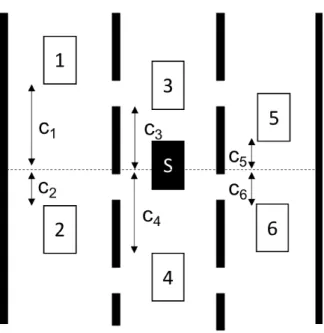
4.3 Traffic scenario as an example. Sis the subject vehicle being observed,1 -6are the relevant traffic participants for S, with𝑐1 -𝑐6 forming the spatio-temporal relations for the context . . . 47
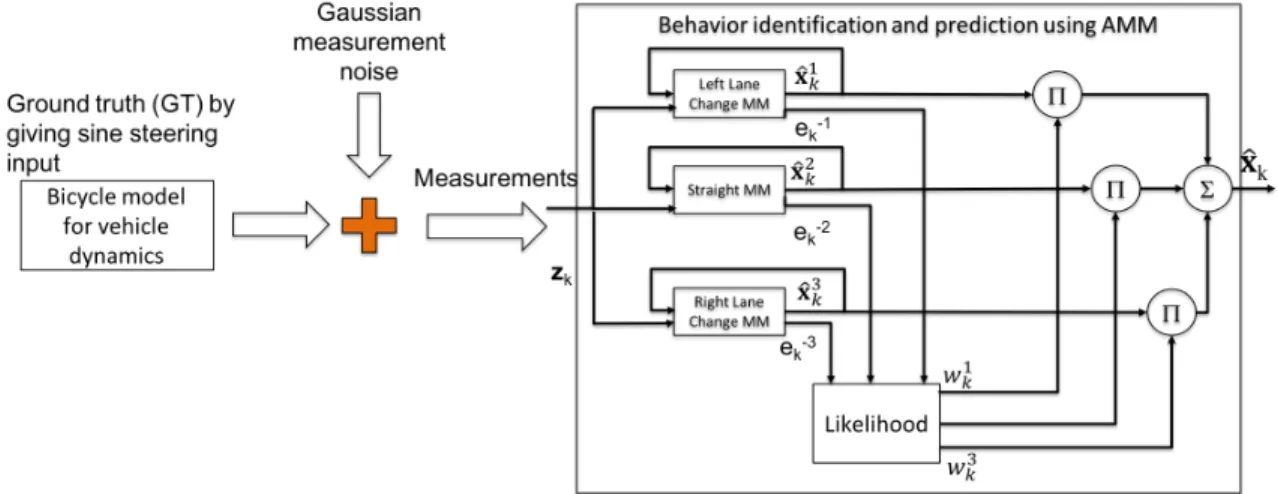
5.1 Autonomous Multiple Model filter block diagram . . . 59
5.2 Sinusoidal lane change parameters . . . 60
5.3 Right lane change weights for case 1 . . . 63
5.4 Straight maneuver weights for case 1 . . . 64
5.5 Right lane change weights for case 3 . . . 65
5.6 Evaluation of the maneuver identification model with a bicycle model . . . 66
5.7 Straight maneuver detection when Q=0.1 and R=0.0025 with vehicle model 68 5.8 Right lane change detection when Q=0.1 and R=0.0025 with vehicle model 69 6.1 Exemplary scenario for behavior identification . . . 73
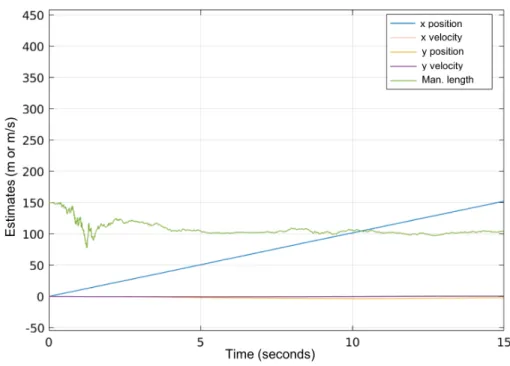
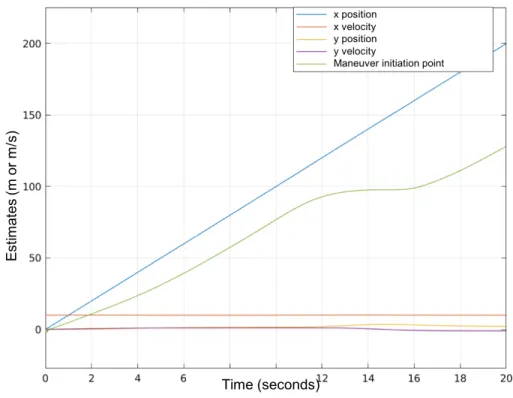
6.2 Evolution of estimated maneuver length (green) with𝑃0= 100 . . . 74
6.3 Evolution of estimated maneuver length (green) with𝑃0= 2500 . . . 75
6.4 Probabilistic weights for maneuvers with AMM estimating maneuver length𝐿 76 6.5 Evolution of estimated maneuver length for right lane change elemental filter 77 6.6 Evolution of estimated maneuver length for left lane change elemental filter 77 6.7 Evolution of estimated maneuver initiation point (green) . . . 79
6.8 Simulated ground truth for the left lane change scenario . . . 80
6.9 Maneuver likelihoods under no measurement noise for the lane change sce-nario . . . 80
6.10 Pre-normalized weights of the elemental filters for the scenario . . . 81
6.11 Block diagram for a cascaded moving average filter . . . 82
6.12 Filtering the likelihood of the straight behavior . . . 82
6.13 Tracking performance of the AMM with the reset logic . . . 84
6.14 AMM behavior weights with the reset logic . . . 85
6.15 Evolution of estimates showing the correction in𝑋𝑚𝑖𝑝due to reset pulses . . 86
7.2 IMM based maneuver identification estimates and probabilistic weights
un-der prolonged observations . . . 99
7.3 IMM based behavior identification estimates and probabilistic weights for short left lane change under prolonged observations . . . 102
7.4 IMM based behavior identification estimates and probabilistic weights for long left lane change under prolonged observations . . . 103
7.5 IMM based behavior identification with constant velocity motion model for straight behavior . . . 106
7.6 Visialization of highD dataset with vehicle 167 intrack 01trajectories . . . 107
7.7 IMM performance with highD dataset trajectory . . . 109
7.8 IMM performance with highD dataset trajectory against time . . . 110
8.1 Traffic scenario as an example. jis the subject vehicle being observed,1 -6are the relevant traffic participants for𝑗, with𝑐1-𝑐6forming the relations for the context . . . 113
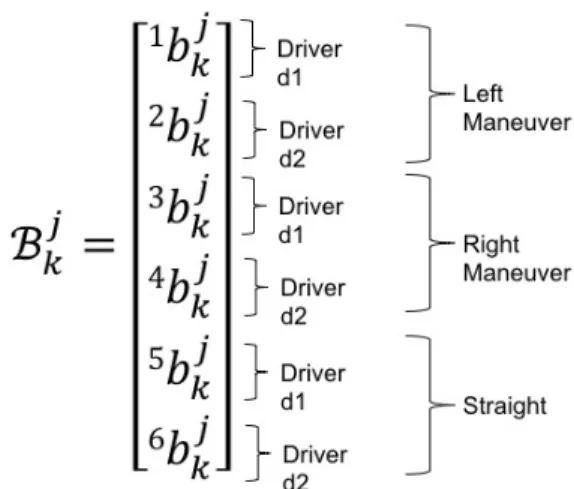
8.2 Hierarchical Dynamic Bayesian Network representing a traffic participant . 115 8.3 Behavior vector for a traffic participant j with two driver styles (d1 and d2) and with 5 behaviors, 2 for left and right lane change, and one for straight. . 115
8.4 Simulation scenario with Sub being the observed vehicle,O1 and O2are other traffic participants in the scene . . . 125
8.5 CIMM inferencing the𝑆𝑢𝑏vehicle for the aggressive driver use case . . . . 132
8.6 Behavior weights for the CIMM . . . 133
8.7 Behavior weights for the IMM inferencing the 𝑆𝑢𝑏vehicle for the aggres-sive driver use case . . . 134
8.8 CIMM inferencing the𝑆𝑢𝑏vehicle for the passive driver use case . . . 135
8.9 CIMM inferencing the𝑆𝑢𝑏vehicle for the passive driver use case . . . 136
Chapter 1
Introduction
Advances in the field of artificial intelligence, sensing and computing in the past 30 years have opened up a lot of opportunities for the applications for autonomous vehi-cles. Mobile robots, which are a category of autonomous vehicles, have found many uses in factories, military reconnaissance ground vehicles, warehouses and even consumer prod-ucts like robotic vacuum cleaners as well as lawn mowers [52]. Availability of excellent texts and tutorials for robotics [65, 23, 45] coupled with open source platforms like Robot Operating System (ROS)[55] have further propelled this revolution. Open communities for sharing software for autonomous vehicles have a number of reference implementations of the Simultaneous Localization and Mapping (SLAM), perception and navigation tech-niques made available over the past decade, some even transitioning into industrial grade off the shelf products [70, 6, 9, 2]. Due to operation in exclusive zones or in controlled con-ditions, the mobile industrial robots have progressed in the phase where they can function well towards their assigned goals but they need to be robust in performance [62, 21].
Another industry that is gearing up to adopt the benefits of the above developments is automotive industry. Due to a significant increase in the road fatalities in the past few decades, human safety has become one of the two key objectives of transportation, the other
being fuel efficiency. Autonomous vehicle technology is seen as promising for both. Major interest in it arose after Defense Advanced Research Projects Agency (DARPA) organized two DARPA Grand Challenges and the DARPA Urban Challenge (DUC) for autonomous vehicles from 2004-2007 [3, 4, 5, 7]. Although these competitions uncovered significant challenges that needed to be addressed for getting the autonomous vehicles on public roads, the public perception towards the robotic systems as a part of automobiles was shifted. Since 2010, when Google announced it has been developing and testing a fleet of vehicles for highly autonomous driving, various other auto makers have gradually started working towards it. In 2014, Society of Automotive Engineers (SAE) released an information re-port J3016 [58] in which it defines 6 different levels of autonomy, with level 2 as partially automated and level 3 and above as highly automated. There have been two school of ap-proaches for developing this technology. The newer players like Waymo (Google spinoff), Uber, Cruise automation (GM undertaking) have been working on fully automated driving (SAE Level 4+) whereas the traditional automakers have been working on incremental au-tomation approaches. Many automakers already have an SAE Level 2 systems in the market. Some like Tesla and Mercedes Benz are working towards SAE Level 3 autonomy in their vehicles. Various independent studies have determined that by 2030, a significant portion of the vehicles being sold will have some level of autonomy [8].
1.1
Motivation
Deployment of highly autonomous vehicles on the road has significant challenges however. Unlike mobile industrial robots, which have the liberty to operate in controlled environmental conditions and designated operating areas, autonomous vehicles will have to work under changing weather and light conditions, all the while sharing the roads with other manually driven vehicles. While the changing environmental conditions pose a
sig-nificant challenge in perception of the surroundings, sharing the roads with the other traffic participants pose challenges that span across perception and planning modules of the cars. Unlike industrial environments where the robots and the other human or non-human par-ticipants work towards a common overarching goal, the parpar-ticipants in the traffic have all independent goals. This requires the participants to interact with each other and often negotiate their intent or right of the way to successfully navigate through the traffic. MIT -Cornell collision [32] in the DUC, which occurred as a result of a failure to anticipate the intent of the other car, was one of the first instances where this challenge was uncovered. Now, almost a decade after the learnings from that incident in DUC, the obvious question that comes to ones mind is where does the technology stand?
A good way to answer this question is to go through the Disengagement Reports from the Autonomous Vehicle tests in the California Department of Motor Vehicles (CADMV) website [1]. The CADMV issues Autonomous Vehicle Testing Permits to the manufacturers developing and testing autonomous vehicles on the public roads and as per the regulations the permit holders are required to submit a disengagement report annually summarizing the cause of every disengagement during their tests. As of the date of writing of this publication, there are 62 permit holders with this program. A quick glance through their disengagement reports tells the challenges the autonomous vehicle developers are facing. The ego vehicle giving insufficient or incorrect yields, exhibiting unwanted behaviors during a maneuver, or other traffic participant driving recklessly make up a significant portion of reasons for the disengagements (Table 1.1). This justifies the need for further understanding the various interactions between the traffic participants.
Table 1.1: Automakers facing behavior related issues as per disengagement reports
Automaker Behavior related Total Percentage
GM Cruise 46 82 56% Zoox 6 8 75% Baidu 57 88 65% Honda 30 77 39% Nuro 20 41 49% Toyota 93 149 62% Waymo 50 112 45%
1.2
Challenges
For operation in real world traffic, an autonomous vehicle will need to predict the behaviors of other traffic participants so that it can analyze the risks involved well in ad-vance. Doing so enables graceful handling of the situations, also avoiding the ones that may lead to near term risks. Current Advanced Driver Assist Systems (ADAS) like colli-sion avoidance, adaptive cruise control, are designed to use simplistic physics based models to predict the motions of the traffic participants to analyze a possible dangerous situation, and take necessary evasive action. The interactions between the traffic participants are typi-cally ignored assuming they will maintain the states of their kinematic motions irrespective of what other participants in their vicinity do. However, this approach is effective only in the time horizon of 1-2 seconds i.e. a human response time [46]. For long horizon risk analysis however, the autonomous vehicle systems need to be able to predict possible maneuvers for every relevant traffic participant (other vehicle) to plan the feasible maneuvers for its own safe navigation. In a heterogeneous traffic, where both connected automated vehicles and conventional vehicles share the road, this has to be done by utilizing merely the extrinsic in-formation of the observed traffic participants and is a challenging problem. Understanding the manner in which a human driver executes a maneuver can aid in addressing this chal-lenge. Any maneuver performed by a traffic participant can be broken down into following
four stages:
i) Intent determination: The intent specifies what maneuver the driver wishes to
per-form eventually and is typically based upon the surrounding traffic participants as well as upon the traffic situation. The reason for the initiation of most maneuvers lies usually within a mandate arising from the route (exiting a freeway, turning at an approaching intersection, merging from a ramp, etc.) or is due to a traffic obstruction (such as a stopped vehicle, construction area, end of lane, etc.). Yet, there are some maneuvers such as lane change, where the intent could be at discretion and is usually attributed to a perceived benefit in the resulting driving conditions (e.g. increase in speed, clear look ahead, etc.).
ii) Maneuver preparation: After self-identifying an intent for performing a maneuver,
the driver progresses into the preparation stage in which the intent may be advertised using turn indicators or hand signals for instance. The driver may then accelerate, de-celerate or simply maintain the speed to work out a sufficient gap between the relevant traffic participants involved in the traffic scene.
iii) Gap acceptance: If the spatio-temporal gap between the relevant nearby traffic
par-ticipants is perceived as sufficiently safe, the driver progresses to the execution phase. If the gap is considered to be not safe, the driver falls back to the preparation phase. Although the gap acceptance is more of a decision point for transitioning from the ma-neuver preparation to the mama-neuver execution stage, it is a factor that is influenced by the driving style independently from maneuver preparation. For instance, a driver may prepare aggressively for a maneuver (e.g. by increasing the speed), but may undergo a change of mind based upon the eventual gap. This justifies to consider gap acceptance as an individual stage.
iv) Behavior execution:In this phase, the driver provides necessary steering, acceleration
or braking inputs to perform the desired maneuver.
The key challenge arises from the altering and driver-dependent consideration of decision factors when determining intent. Apart from the mission level goals, the factors influencing such decisions may also vary based on traffic, weather, and road conditions. Furthermore, the manner of preparing for the maneuver after determining the intent differs with every driver. Depending on the traffic situation, preparation may or may not be needed. Some drivers may increase the speed (e.g. to move ahead of a vehicle in the adjoining lane when changing lanes), others may decrease the speed in the same context. The tolerances for gap acceptance (to perform the desired maneuver) also range among drivers. Thereafter, the way in which the maneuver is executed might also deviate significantly. Some drivers may turn or change a lane in a quick short way, others may do it more gradually. To predict the evolution of a traffic situation effectively, estimation of the above characteristics of the traffic participant at any given instant is important. The small time window of observation for inferring these characteristics further amplifies difficulties.
1.3
Research Objectives & Scope
The goal of this research is to develop new methods that enable safe operation of autonomous vehicles in complex traffic environments while sharing the roads with human participants. Specifically, this work seeks to address the above mentioned challenges by in-corporating the driver type characterizing of a traffic participant. It rests on the hypothesis that for a given driver, the behavior not only spans across the four maneuver stages men-tioned in the previous section, but also across multiple maneuvers. Estimating the charac-teristics of one or more maneuver stages for a traffic participant aids in identifying the driver
type. In turn, this helps to predict the nature of subsequent maneuvers the driver is likely to perform, enabling trajectory prediction for a longer time horizon.
While the definition of human traffic participants includes pedestrians, bicyclists, motorcyclists as well as conventional vehicles, the scope of this work will be focused only on vehicle based traffic participants. Further, this work assumes that the data association for traffic participants in the environment is perfect, the information of object tracking is available and as a result the commonly chosen physical states of the vehicle as well as the other traffic participants are estimated well. It also assumes that the scenarios and situation classification is available.
Following research questions will be addressed as a part of this work:
(RQ1) How to predict the trajectories of the traffic participants for time horizons longer than the human response time (1-2 secs) using only their extrinsic information? (RQ2) How to model interactions between the traffic participants that follow different
driv-ing policies?
The first research question aims at investigating the system frameworks that enable modeling the human characteristics influencing their driving manners. The outcome of this research would help to improve risk analysis and planning capabilities of autonomous vehicles.
The second research question aims at investigating the methods that enable operation of autonomous vehicles under varying driving circumstances (for instance peak hour traffic vs non-peak), where the human driving styles may vary even in a given geographical region. The outcome of this research question will improve robustness of operation of autonomous vehicles towards different driving situations and hence accelerate their deployment.
These research questions are stemmed in the realization that the long journey to eventually solving the challenges that autonomous vehicles will face while sharing the road
with conventional vehicles will have to be in steps. Since the driver behavior can vary geo-graphically, and the factors that influence the driver behavior are numerous and not entirely understood, model based approaches may edge out at some point. Data driven approaches have proven to outperform model based approaches in many other areas involving human behaviors like speech and text recognition. However, driving is a high level task with a lot of hidden variables and influencing parameters. In order to even explore data driven ap-proaches, as a first step, methods for generating and automated labeling of large amount of real driver data are needed. The outcome of this research will open up new opportunities in automated labeling of driver data. Further, the research will not only help open new oppor-tunities for understanding human driving behaviors but will also accelerate the pace with which this challenge is addressed.
1.4
Intellectual Merit / Research Contributions
This research addresses the challenges of prediction in complex traffic environments by characterizing the driver behaviors of the relevant traffic participants in the scene. Doing so, helps in estimating the policies for their driving and hence gives a better prediction for their future trajectories. Following are the contributions of this research:
• A novel probabilistic framework for prediction was introduced that uses multiple driver policies to characterize the behavior of different traffic participants and model interactions between them [35].
• The proposed framework was implemented by extending an interacting multiple model (IMM) filter with the contextual information of the observed traffic participants. The approach for characterizing the driver behavior was demonstrated for two simulated use cases. The simulated results also show an improvement in the performance for
behavior classification compared to a traditional IMM.
• The work also compared two Multiple Model Adaptive Estimations (MMAE) ap-proaches for behavior classification, Autonomous Multiple Model (AMM) approach and IMM approach. The IMM approach was validated using a trajectory extracted from a real world dataset.
1.5
Broader impact
The proposed work impacts the transportation safety and efficiency by accelerating the deployment of autonomous vehicles. When running online in an autonomous vehicle, the approach enables operation in complex traffic scenarios by determining the "active driver policy" as well as driving behaviors of the traffic participant. These assist in providing a more accurate prediction for risk analysis.
When running offline or online on a road side unit (traffic light controller etc.), it can serve two benefits: it can enable automated labeling of the driver characteristics and maneuvers of the traffic participants in the collected data, which can be used for training the machine learning based driver models offline; and it can also characterize the predominant driver models used in that geographical area, depending on the lane and traffic conditions. This can be a valuable input for autonomous vehicle operation as well as microscopic traffic analysis.
1.6
Dissertation organization
This dissertation is organized as follows. Chapter 2 discusses the needs for the pre-diction in complex traffic environments and gives the state-of-the-art in prepre-diction identi-fying the research gaps available. Chapter 3 provides preliminaries on the motion models
considered for the work. Chapter 4 proposes the probabilistic framework for representing the traffic participant as a Dynamic Hierarchical Bayesian Network. Chapters 5, 6 and 7 ex-plore two approaches for MMAE: AMM and IMM and provide an in-depth comparison of the two for behavior identification of a traffic participant. Finally, chapter 8 implements the proposed probabilistic framework by extending the IMM approach and presents the results of evaluation for behavior identification as well as behavior characterization. The conclu-sion and future works are summarized in chapter 9.
Chapter 2
State Of The Art: Prediction In
Complex Traffic Environment
Deployment of highly autonomous vehicles on the road requires them to be able to plan their motion in complex environment(environments with multiple maneuvering partic-ipants). Planning problem in any environment can basically be considered as an optimiza-tion problem with following steps: (i) identifying the possible states (i.e. search space) that the vehicle can attain while staying within safety constraints; (ii) performing an optimized search through this search space using an objective function (cost function) that represents the identified constraints of the motion; and (iii) providing a reference to the motion execu-tion modules of the vehicle. Depending on the different factors considered while generating a search space, the different levels of planning are involved in navigation.
1. Path planning: A path is a collection of poses that a vehicle has followed in the past or might be following in a finite future [62]. For navigation through a ground envi-ronment, it usually consists of states like longitudinal position, lateral position and orientation in case of 2D navigation in a road environment but without any informa-tion of time. Path planning is determining the future path of the vehicle given its
present states, available map and mission level goals. States of the other participants of the traffic environment are usually not considered in this.
2. Trajectory planning: Trajectory is a collection of position, orientation, velocity and/or higher derivative states of a vehicle marked with time stamps. A path can be ex-tracted from a trajectory, but trajectory cannot be recreated from path due to lack of time information[62]. Trajectory planning determines the future trajectory of the ve-hicle given its present states, map, goal and the states of the other participants of the environment.
3. Behavior planning: It can be seen in the literature [36, 73, 47, 46] that the terms ma-neuver and behavior are often used interchangeably. However, it can be argued that they are separate. This work differentiates between the two as follows. A maneuver is a collection of motion sequences that a driver executes in order to achieve a local or a global level mission objective and is usually described by a symbolic label like "lane change", "lane merging", "left turn", "right turn", etc. On the other hand, the policies and the physical parameters that govern the kind of inputs that the driver gives to the vehicle for performing the maneuver constitute the behavior. In other words, different behaviors can result in the different manners in which the same maneuver can be real-ized. Behaviors for an identified maneuver can typically be described by trajectories since they involve specifying stopping times, velocities and possibly accelerations at different spatiotemporal points in the future. Hence, behavior planning is determin-ing the future trajectories of the vehicle given its present states, map, goals and the predicted behavior of the other traffic participants in the environment.
Navigation through a complex traffic environment requires planning to be performed at the behavior level. Given the current states of the environment and its participants,
anal-for such planners. Risk analysis can be decomposed into following 3 steps[46, 27, 47]: i) identify states of all the traffic participants
ii) predict their future states in a time stept+sin the future
iii) check the possibility of a risky event (e.g. collision) at each time step
To assess the risks in the correct domain space for effective planning, we need to understand the needs of real-world driving scenarios. Collisions with other entities (pedes-trian, bicyclists, other vehicles, stationary objects, etc.) are the primary risks that need to be avoided, but in the real world the drivers also avoid executing behaviors that may lead to a possible collision. Even if such behaviors don’t lead to collisions, they do disrupt the smooth flow of the traffic. Hence, risks include behaviors that may lead to a risky situation. Further, the risks can also include violating a road traffic rule or a road etiquette, or even inconvenient driving conditions that may cause an injury to the occupants or the vehicle functionality in the short or long term. Accurately identifying and predicting the trajecto-ries (behaviors) of all the relevant traffic participants becomes key to analyzing the risks and is a challenging problem.
This chapter seeks to approach the challenges of navigation through complex traffic environments by collectively looking at the needs of the operating domain as well as the state-of-the-art of the technology from a broader perspective to build the foundation for the right solution. It is organized as follows. Section 2.1 provides a fresh taxonomy of safety / risks that an autonomous vehicle needs to address while navigating through traffic. Section 2.2 focuses on the needs of prediction for a longer time horizon and then covers the state-of-the-art. The chapter concludes with identifying the research gaps.
2.1
Risk Assessment Classification
At the highest level, risk assessment can be classified as either near term (short hori-zon) or long horizon as illustrated in Fig. 2.1. Whenever the foreseen evaluation of the risk is within the temporal vicinity of human reaction time, it is considered as near term, other-wise it is interpreted as long horizon. This distinction has been chosen due to a key factor in determining the risk mitigation strategy (i.e. motion planning): it must be decided whether the traffic rules should be followed or not. For near term risk prevention, the dominating priority of the planners lies within risk avoidance irrespective of rule following. For long horizon risk prevention, however, the planners need to obey traffic rules. As a result, mit-igation strategies for both categories of risks necessitate different policy models. For both classes, identifying whether a traffic participant performs an expected or unexpected behav-ior (as per traffic rules), can further assist in identifying a risk situation. One of the recent works for the identification of such unexpected behaviors can be found in [47].
2.1.1
Short horizon risk assessment
For the short horizon risk assessment, existing literature ignores the interactions between the traffic participants. Physics based models (like constant velocity, constant ac-celeration, constant turning rate acac-celeration, constant curvature, etc. [48]) are utilized for predicting the trajectories under the assumption that the participants are moving indepen-dent of each other and hence will maintain their dynamic states. The argument that the interactions between the vehicles can be ignored holds true only for the time horizon of a human reaction time, which is about 1-2 seconds.
If an unexpected behavior is observed, i.e. another traffic participant is at fault (due to a rule breaking or a failure), the risk analysis needs to determine whether the collision is inevitable or avoidable. Here, metrics such as time-to-collision, time-to-react,
distance-to-collision, etc. can be utilized [46]. Example situations in this category include: a participant cutting across while the ego car drives straight; an on-coming vehicle crossing the divider and entering the ego vehicle’s lane. If the collision is inevitable, the risk analysis module must be able to provide an assessment of impact, such that a behavior minimizing damage, for instance, can be planned simultaneously as the system is preparing for a collision. Most of the emergency Advanced Driver Assistance Systems (ADAS) fall into this category. If the collision is avoidable, the risk analysis module needs to provide an assessment such that an evasive behavior (braking only, steering only, or a combination of braking and steer-ing) with least possible consequences can be planned. Whether the collision is avoidable or inevitable, planning for this situation is performed with low priority attributed to rule following and higher priority attributed to realizing a maneuver with least possible conse-quences.
Unexpected behavior can also be observed for the ego vehicle likely due to a failure in some vehicle module. In such situations, the fault diagnosis and fault mitigation routines need to take over as typical models may fail. This research area is out of scope of the presented work.
For the case in which all participants behave as per the traffic rules, the main objec-tive of the risk assessment module amounts to aiding short term rule adherence for the ego vehicle and analyzing trajectories that may lead to dangerous situations. Driver assistance systems such as lane keeping and adaptive cruise control fall under this category.
Most of the SAE Level 1 and 2 ADAS systems in the market address risks in this category. Lane merge assist systems that are on the horizon also address such risks, however a lane merge maneuver isn’t always a short term maneuver. Collision-based risk prediction has been an active topic for researchers for quite some time now with a large body of lit-erature available [17, 41, 69, 33, 53, 16, 64, 40, 19, 44, 13, 27, 31, 12, 68]. The popular approach in such cases is to assume no inputs from the driver, make assumptions about
con-stant velocity, acceleration, steering angle or steering rate, predict the trajectories of the traf-fic participants and then check for an event like time-to-collision, distance-to-collision[46], time to closest approach, etc. to determine possible conflicts. Some of the notable works that implement computationally effective methods to determine possible conflicts are dis-cussed here. Campos et. al. [27] provide the 3 step procedure for the threat assessment for collision avoidance at intersections. The three step procedure is: (i) use unscented transform to predict the trajectories using constant turn rate acceleration (CTRA) model; (ii) define some geometric areas (collision zones approximated as rectangles) on the vehicles for cal-culating the time-to-collision (TTC) and distance-to-collision (DTC) and then use bivariate normal distribution integral approximation (Drezner, 1978[29]) to find the probability of collision. (iii) employ reachability analysis for assessment of threat. This publication also gives the values of covariance parameters from experiments, which are typically challeng-ing to determine. Batz et al [16] use unscented transform for predictchalleng-ing trajectories. Here, covariance ellipses are utilized in calculating the area representing the position of the vehi-cles, adding uncertainty of orientation and then applying Minkowski’s sum operator to it for every vehicle. Then for every vehicle pair, the approach calculates the minimum distance in the short time in the future, if this distance falls below certain threshold it flags a dangerous situation. However, these methods are usable only for short term prediction as they ignore driver intent, which is the key uncertainty for long horizon risk assessment.
2.1.2
Long horizon risk assessment
This category addresses analyzed risks that are spatially or temporally distant enough to effectively take risk averse actions in order to gracefully handle the situation. As such, the assessment rather analyzes for possible near term risky situations than events, incor-porating the notion that risky events will be avoided implicitly if risky situations can be
avoided. Here, models assume the traffic participants to be either interaction-aware or non-interactive. For complete risk analysis, however, the first case needs to be considered. Ir-respective of whether an unexpected behavior has been observed or not, rule adherence in the planning must be ensured.
If an unexpected behavior on the part of another participant is observed, the risk assessment module analyzes different strategies to aid in planning a risk-averse maneuver gracefully handling the situation. The strategies can either be based on the possible ma-neuvers available to the ego vehicle or on the input space of the vehicle [26]. An example scenario would be when the ego vehicle comes across a vehicle blocking an intersection. The graceful behavior in such case would be either to brake to a complete halt or change lanes in order to drive around the slower vehicle.
If no unexpected behaviors are observed for other traffic participants, then, the risk assessment consists of safety and efficiency analysis for driving maneuvers such that poten-tial near-term risks can be avoided. Examples include a car parked on the shoulder: here, typical behavior of the vehicles driving in the adjoining lane is to either slow down or change lanes. Another example could be a multiple lane intersection with merge-ins as vehicles in an adjoining lane can change lanes to avoid any possible conflicts with merging vehicles.
For long term risks, necessary steps for risk assessment are:
1. Model and predict possible/expected behaviors of other traffic participants
2. Analyze the potential risk for every possible behavior of the ego vehicle against the predicted behaviors of other traffic participants
3. Identify the realized behavior as soon as the other traffic participant executes a ma-neuver
oc-curs
Clearly, the most challenging part in the above steps is predicting the behavior (and implicitly the trajectories) of the traffic participants accurately for a long time horizon. This is due to three kinds of uncertainties that need to be factored into the prediction [71]:
i) The uncertainty in the maneuver that may be executed, which depends on the situation and may vary with the driver for a given situation
ii) The uncertainty in the manner in which the maneuver is executed, which depends on the driver
iii) The uncertainty in the state estimates of the observed participant due to sensor noise. The prediction is also the most crucial step, since the risk analysis will be as effec-tive as the accuracy of the predicted behaviors. Studies addressing the challenges in this category are relatively recent. Lefevre et al. [47] presented a framework for reasoning for collision risk at a semantic level by differentiating expected behaviors of the drivers from the unexpected behaviors. Their approach rests on the assumption that participants that execute unexpected behaviors invoke dangerous situations. The framework was demonstrated by ap-plying to the road intersections with interactions. Among the most recent works, Damerow [26] presents a situation-based risk evaluation and behavior planning framework for highly automated driving. Analysis of risks is performed using prototypical predicted trajectories of the traffic participants and the result of the analysis is a proposed risk map that is basi-cally a search space for the behavior planner. The framework is demonstrated for parallel driving and intersection traffic scenes. Prototypical trajectories based approaches however implicitly assume the availability of the high definition digital maps for effective operation. Further, the framework is decoupled from the environment perception module and doesn’t reuse the information about uncertainty already available from it.
The focus of this work is to enable prediction for a longer time horizon and it also subsumes behavior identification. The next section covers the related work in prediction.
2.2
Prediction for long time horizon
Accurate prediction of trajectories for long time horizon requires the interactions between the traffic participants to be considered. In heterogeneous traffic, where both con-nected automated vehicles and conventional vehicles share the road, prediction has to rely entirely on observing the traffic participant extrinsically and is a challenging problem. Un-derstanding of the manner in which a human driver executes a maneuver can help in address-ing this challenge. Any maneuver performed by a traffic participant can be broken down into following stages [56], and can be collectively utilized to infer the driver behavior:
i) Intent determination: The intent specifies what maneuver the driver wishes to
per-form eventually, and is typically based on the surrounding traffic participants as well as the traffic situation. The cause for most of the maneuvers is usually either a mandate due to the route (exiting a free way, turning at an approaching intersection, merging in from the ramp, etc.) or due to a traffic obstruction (like a stopped vehicle, con-struction, end of lane, etc.). Yet, there are some maneuvers like lane change, where the intent could be at discretion and is usually attributed to a perceived benefit in the resulting driving conditions (e.g. increase in speed, clear look ahead, etc.).
ii) Maneuver preparation: After self-identifying an intent for performing a maneuver,
the driver progresses into the preparation stage where the intent may be advertised using turn indicators or hand signals for instance. She may then accelerate, decelerate or simply maintain the speed to work out a sufficient gap between the relevant traffic participants.
iii) Gap acceptance:When the spatiotemporal gap between the relevant nearby traffic
par-ticipants is perceived to be safe enough, the driver progresses to the execution phase. If the gap is not perceived to be safe, the driver falls back to the preparation phase. Al-though the gap acceptance is more of a decision point for transitioning from maneuver preparation to maneuver execution stages, it is a factor that is influenced by the driving style independently from maneuver preparation. For instance, a driver may prepare aggressively for a maneuver by increasing the speed, but may change the mind given the eventual gap. his justifies to consider it as an independent stage.
iv) Maneuver execution: In this phase, the driver gives the necessary steering,
accelera-tion or braking input to perform the desired maneuver, e.g. lane change.
As long as the traffic participant communicates the intent explicitly (using turn in-dicators for instance), the prediction can be straight forward. However, studies show that in many cases (55% [56]), the maneuvers are performed either without communicating the intent explicitly, or communicated after / just before the maneuver has been initiated. In such cases the intent must be inferred from the behavior of the participant. A popular way of inferring is by running a mathematical model, associated with every relevant traffic par-ticipant, that considers their surrounding information (also called as context [36]) and then estimates their maneuver intent. Such approaches can be divided into model based ap-proach and data driven apap-proaches. In the model based apap-proach, the mathematical model is a driver model that considers the context of the subject vehicle, i.e. its spatiotermporal relations with the surrounding traffic and estimates the driver intent. For the data driven approach, machine learning based approaches are used to train the mathematical model of-fline using data collected from different driving scenarios based on the identified parameters with the surrounding traffic. Finally, the trained model is used on-line to infer the intent of the observed vehicle. The challenge is that the factors that are considered in determining
the intent vary with every driver. The mission level goals like approaching a turn or an exit / ramp that the driver wants to take also influence such decisions. And even with a given driver, these factors may vary based on the circumstances like traffic conditions, weather conditions and road conditions.
Once a driver identifies an intent for performing a maneuver, the driver accelerates or decelerates to prepare for the maneuver. The driver maintains this stage until gap accep-tance, where the driver determines that the gap between the traffic participants is sufficient / safe enough to perform the maneuver. Finally, the driver proceeds to the execution of the maneuver. Depending on the traffic situations the the preparation may or may not be needed. However there can be a variation in the way different drivers prepare for a maneuver. Some may increase the speed to move ahead of a vehicle on the side for a lane change for instance, others may decrease the speed. Further the tolerances for gap acceptances also varies with the driver. Finally, the way in which the maneuver is executed also deviates. Some may take a quick short turn or lane change, others may perform it more gradually. preparation and execution stages are basically motions based on the decision on an accepted threshold of the gap. The maneuver execution can be represented as motion models for the maneuvers, with the variability expressed in the form of parameters.
The approach to model the driver intents using contextual information has been uti-lized in the microscopic traffic analysis for quite some time. Gipp’s car following [37] and Intelligent Driver Model (IDM) [67] are two of the most popular car following models. One of the recent additions to this is a Foresighted Driver Model (FDM) [30]. Likewise, for lane change intents, Gipp’s lane change [38] and Minimum Overall Braking Deceler-ations Induced by Lane changes (MOBIL) [42] are the popular ones. Toledo et al. were one of the first ones to propose an integrated lane change and car following model [66]. For a comprehensive review on the lane change models, the reader is referred to Rahman et al. [56]. Apart from the microscopic traffic analysis models, Dou et al. [28] presented
their approach for predicting lane changes at higway lane change drops using SVM, Artifi-cial Neural Network (ANN) and a combined classifier. Contextual information like relative speed, difference and distance with the nearby vehicles are given as inputs to these classi-fiers, and the output is a vote suggesting merge or not to merge. The approach is evaluated on the I80 and US 101 datasets in the publicly available NGSIM database. All the above models focus on intent determination as well as the gap acceptance aspects of the driver behavior.
Amongst the recent works, Rehder et al. [57] use logistic regressions to identify lane change intentions. The model was trained with data from humans driving on a simulator. Influences like traffic rules, road structure, individual driving style, environmental condi-tions as well as influence from co-drivers was considered to model the interaccondi-tions. Aoude et al. presented a machine learning base model for driver intents at intersections [14]. They used Support Vector Machines with Bayesian Filter (SVM-BF) and Hidden Markov Model (HMM) based models to classify the behaviors of the traffic participants as "compliant" or "violators". The model was evaluated with the real world data collected in Christians-burg, VA, through the US Department of Transportation Cooperative Intersection Collision Avoidance System for Violations (CICAS-V) initiative. Social Force Model (SFM) [39] is a popular approach for modeling interactions with the pedestrians. Recently, several studies have utilized SFM to model vehicle to vehicle interactions. One such study is by Yoon et al. [74], where SFM is utilized on a multilane highway to model the tendency of the drivers to keep safe distances from the object vehicles, to get to the maximum allowable speed on the route and to stay at the center of the lane. The works in this paragraph focus only on the intent determination stage of the driver behavior.
The works that identify driver behaviors based on the maneuver intent and maneu-ver execution are [26, 71, 72, 11, 15, 36, 10, 20, 47] . Damerow [26] utilizes the FDM to model the driver intent and trajectory matching with prototype trajectories to predict the
maneuver. Wissing et al. [71] use IDM and MOBIL for intent determination and Monte Carlo approach for execution. They demonstrate their approach for lane keeping, left and right lane change maneuvers. In another work by them [72], contextual information, such as relative distances and relative velocities between the observed vehicle and its nearby vehi-cles, is utilized along with the spatiotemporal information of the observed vehicle, such as lateral distance to lane center, lateral velocity, longitudinal velocity, as features for training an SVM model that classifies the maneuver and predicts the time to lane change. This in-formation is used to model the predicted trajectories as cubic splines with constant velocity assumption. Alin et al. [11] describe the use of attractor functions to determine the con-text of the system and predict the potential target locations for the traffic participants. They demonstrate this on a lane following as well as double lane scenarios and use grid-based Bayesian filters for modeling the maneuver execution. The approach was evaluated using TORCS simulator. Bahram [15] uses game theory for modeling intent and Naive Bayes for classifying the maneuver based on the longitudinal and lateral motion. The approach is demonstrated for lane keeping, left and right lane change maneuvers. An approach that stands out from above works in this paragraph is by Gindele et al. [36]. This work was the first comprehensive framework that integrates the interaction-aware driver intent determi-nation and maneuver execution stages together in a probabilistic filtering framework. The work represents the traffic scenario as a Dynamic Bayesian Network and neatly ties together the context, maneuver, predicted trajectories and the base states (continuous physical states) of the traffic participants. The approach is then demonstrated on a two lane highway sce-nario for an overtaking situation using particle filters. This framework is also adapted by a few other other works. Agamennoni et al. [10] adopted this framework and utilize feature functions to extract the high level information from low level contextual information. The inference in their implementation is deterministic and is implemented for mining safety on haul trucks. Brechtel et al. [20] adopted the same framework in their work for behavior
plan-ning for autonomous vehicles. Their framework is implemented with Partially Observable Markov Decision Process (POMDP) and is evaluated at runtime on a simulator for overtak-ing situation. Due to the intuitive design of the framework, our approach also extends the framework by Gindele et al. [36]. Further, just like Agamennoni et al. [10] we utilize our own feature functions. The details for this can be found in section 4.4.
The works that focus on maneuver execution phase of the driver behavior are [22, 51, 59, 50, 60, 73]. Carvalho et al. [22] use Interactive Multi Model based Kalman Filtering (IMM-KF) for modeling left lane change ,lane keeping and right lane change maneuvers. The longitudinal motion is modeled with constant acceleration and constant velocity mod-els, where as the IMM-KF is utilized for lateral motion. The implementation uses a bank of 9 elemental filters each running a second order motion model. Liu et al. [51] use cascaded HMM classifiers to identify the behaviors based on maneuver execution. In the first stage, an HMM for a traffic participant classifies the maneuver type as lane change left, right or lane keeping based on its base states. In the second stage two HMMs are modeled, one for an normal driver and the other for a dangerous driver. Given the maneuver, this state maps the base states of the participant to a symbolic driver behavior. In the final stage, the likelihood of the models is used to give the decisive classification. Schreier et al. [59] use Bayesian inference with multiple motion models to identify dangerous drivers. They demonstrate their work for lane following, lane changes, turns and for a few trash maneuvers. Among the most recent works, Li et al. [50] is Gaussian Mixture HMM (GMHMM) for maneu-ver based threat assessment in lane keeping, left and right lane change maneumaneu-vers. Their observation vector consists of lateral offset, lateral velocity and lateral acceleration. Con-stant acceleration model is used for lane keeping motions and sinusoidal half lane change with constant velocity for lane changes. Schulz et al. [60] use Autonomous Multiple Model (AMM) [49], also known as classical Multi Model Adaptive Estimation (MMAE) [25] fil-ters with Unscented Kalman Filfil-ters (UKF) for an infil-tersection scenario. The number of
modes in their model depends on a possible combination of route and maneuver intentions. They evaluated their model with 6 modes for upto 15 vehicles, and concluded that their ap-proach outperforms a particle filter with upto 50,000 particles. Further, the runtime of their cycle was 0.5 secs as against 7 secs for the particle filter. Xie et al. [73] utilize Interactive Multiple Model (IMM) to integrate maneuver based and physics model model for trajec-tory prediction. Constant Turn Rate Acceleration (CTRA) [48] model was utilized for the physics based mode and sinusoidal lane change was utilized for the maneuver based model. The model was evaluated on naturalistic data collected and was validated to be superior than the single model approaches.
To the best of my knowledge, the only available framework that models maneuver intent, gap acceptance and maneuver execution together is by Lefevre et al. [47]. Their framework extends the framework by Gindele et al. [36] for reasoning of collision risk at a semantic level by differentiating expected behaviors of the drivers from the unexpected be-haviors. The dangerous situations are identified by comparing what drivers intend to do with what they are expected to do according to the traffic rules. The authors propose a Markov State Space model (MSSM) based graphical representation where the previous intentions of the other vehicles in a multiple vehicle situation influences the expected behaviors of the vehicles. A hierarchical framework is presented in which the highest level corresponds to the expected and the intended maneuver performed, next level corresponds to the physical state of the vehicle and the lowest level the measurements. The framework is applied to road intersection scenario and uses a feature function for gap acceptance to decide on the necessity to stop. The risk estimation is performed using a bootstrap filter for approximate inference.
Table 2.1: Com par ativ e re vie w of w or ks on dr iv er beha vior identification Dr iv er Beha vior Study R emar k Beha viors Intent de ter mination Maneuv er pr epar ation Gap accep tance Maneuv er ex ecution Dr iv er update Gipp’ s1981 [37 ] IDM -Helbing 2000 [67 ] FDM -Egg er t2015 [30 ] R ule based Car follo wing ✓ ✓ MOBIL -Helbing 2007 [42 ] Gipp’ s1986 [38 ] R ule based Lane chang e ✓ ✓ Toledo 2007 [66 ] R ule based Integ rated lane chang e ✓ ✓ Dou 2016 [28 ] SVM, ANN Lane mer ge ✓ ✓ R ehder 2016 [57 ] Logis tic reg ression Lane chang e ✓ A oude 2011 [14 ] SVM-BF ,HMM Intersection ✓ SFM -Helbing 1995 [39 ] R ule based Intersections wit h pedes trians ✓ Y oon 2018 [74 ] SFM wit h NMPC Multi lane dr iving ✓ Damer ow 2018 [26 ] FDM, pr ot otype tra ject or ies Intersection, lane follo wing ✓ ✓ W issing 2018 [71 ] IDM, MOBIL wit h Monte Car lo Lane mer ge ✓ ✓ W issing 2018 [72 ] SVM, cubic splines Lane chang e ✓ ✓ Alin 2012 [11 ] A ttr act or functions, gr id-based BF Lane keeping & changing ✓ ✓ Bahr am 2017 [15 ] Game theor y, N aiv e Ba yes Lane keeping & changing ✓ ✓ Gindele 2010 [36 ] DBN ,par ticle filter Ov er taking ✓ ✓ A gamennoni 2012 [10 ] DBN ,f eatur e functions Intersection ✓ ✓ Br ec htel 2011 [20 ] POMDP Ov er taking ✓ ✓ Car valho 2014 [22 ] IMM-KF Lane keeping & changing ✓ Liu 2015 [51 ] Cascaded HMM Lane keeping & changing ✓ Sc hr eier 2016 [59 ] BF Lane keeping & changing ✓ Li 2018 [50 ] GMHMM Lane keeping & changing ✓ Sc hulz 2018 [60 ] AMM Intersection ✓ Xie 2018 [73 ] IMM Lane chang e ✓ Gill 2019 [ 34 ] AMM Lane keeping & changing ✓ Lef evr e 2015 [47 ] DBN ,f eatur e functions, boo ts trap filters Intersections ✓ ✓ ✓ Zhou 2018 [75 ] POMDP Intersection ✓ ✓ ✓ Gill 2019 (Pr oposed) [ 35 ] DBN Lane keeping & changing ✓ ✓ ✓ ✓ ?? ?? ?? ✓ ✓ ✓ ✓ ✓
2.3
Research Gaps
Table 2.1 summarizes the presented works mapping them against the stages of driver behaviors for a maneuver. To the best of my knowledge, following gaps exist in the litera-ture:
1. There are no probabilistic filtering frameworks that couple together the four stages of the driver maneuver discussed in the section above.
2. There are no filtering frameworks that characterize the driver style and update it on the fly based on the behavior identified from one of the maneuver stages to influence on the other stage. Driver behaviors have a correlation between the maneuver stages. Characterizing the driver early on helps predict their intents, and hence the trajecto-ries for long horizon more accurately. For instance, identifying the behavior of rash driver in the maneuver execution stage reveals additional information about the intent determination nature of the driver. Without associating these stages to a driving style and coupling them together, crucial correlation between these stages is lost.
3. None of the works utilize the maneuver preparation stage of the driver for character-izing the behavior. Utilcharacter-izing this information can not only help identify the intent of the driver, but also identify the driving style such as "cooperative", "opportunistic", "aggressive" even before the initiation of the maneuver.
Chapter 3
Preliminaries: Motion Models
3.1
Motion models explored in this study
Prediction and tracking share similar foundations when it comes to functioning but with some significant differences. As against tracking, where the propagation horizon is rel-atively short, is independent of the surroundings of the participants, and is typically utilized in missed measurements or occlusions, the propagation horizon for prediction is longer as it is utilized for planning. As a result, the error in prediction can differ by a large margin if the motion model is incorrect, leading to sub optimal planning. The key to prediction is identifying the right motion model that the target is believed to be following. The more accurately the model represents the target, the longer the horizon of accurate prediction.
Ground vehicle motions are typically represented as 2D motions in the longitudi-nal and lateral directions. The resulting motion models can be divided into symmetric and asymmetric. Symmetric motion models have the same propagation equations representing the longitudinal and lateral motions, whereas asymmetric ones have different propagation equations for longitudinal and lateral motions. The effectiveness of the motion model de-pends on the operation domain of the target. For an unstructured environment where the
motion can be expected in both lateral as well as longitudinal direction symmetric models work well. Constant acceleration (CA), constant velocity (CV) are examples of symmetric motion models. For a road traffic environment, which is structured in terms of rules and motions, and where larger motion is expected in the longitudinal direction than lateral, and that certain predefined distributions of movements are performed for a typical maneuver, asymmetric models are more effective. The continuous time state-space models for such mathematical models are given by:
̇
x(𝑡) =𝑓(x(𝑡),u(𝑡),w(𝑡), 𝑡),x(𝑡0) =𝑥0 (3.1) ̇
z(𝑡) =ℎ(x(𝑡),u(𝑡), 𝑡) +𝑣(𝑡) (3.2)
The linearized, discrete time equivalent of the above model are of the form:
x𝑘+1= 𝐹(x𝑘) +𝐵(u𝑘) (3.3)
z𝑘 = 𝐻(x𝑘) +𝐷(u𝑘) (3.4)
where F and H are the Jacobian matrices of the state and measurement equations respec-tively, if they are non-linear. Following are some of the motion models that were explored in this work. Many of these come from the field of tracking. For ground vehicles, the motions are typically considered in x-y plane.
3.1.1
Constant Velocity Motion Model
Constant Velocity (CV) motion model represents the linear motions of a vehicle and can be used to represent straight, free flow highway like driving conditions where the vehicle speeds are nearly constant over a period of time and the roads are nearly straight.
The state vector comprises of, ̇ x= [ 𝑥 𝑣𝑥 𝑦 𝑣𝑦 ]′ (3.5) and the state equations are given as:
̇𝑥=𝑣𝑥 (3.6) ̇ 𝑣𝑥= 0 (3.7) ̇𝑦=𝑣𝑦 (3.8) ̇ 𝑣𝑦 = 0 (3.9)
The discrete time counter part of the above equation with the noise is:
x𝑘+1 =𝐹𝑐𝑣⋅x𝑘+𝜁𝑘 (3.10)
where𝐹𝑐𝑣is the state transition matrix given by,
𝐹𝑐𝑣= ⎡ ⎢ ⎢ ⎢ ⎢ ⎢ ⎢ ⎢ ⎣ 1 𝑇𝑠 0 0 0 1 0 0 0 0 1 𝑇𝑠 0 0 0 1 ⎤ ⎥ ⎥ ⎥ ⎥ ⎥ ⎥ ⎥ ⎦ (3.11)
𝜁𝑐𝑣is the process noise with statistics as,
𝜁𝑘 ∼(0, 𝑄𝑘) (3.12)
𝑄𝑘 = ⎡ ⎢ ⎢ ⎢ ⎢ ⎢ ⎢ ⎢ ⎣ 𝜎𝑥 0 0 0 0 𝜎𝑣𝑥 0 0 0 0 𝜎𝑦 0 0 0 0 𝜎𝑣𝑦 ⎤ ⎥ ⎥ ⎥ ⎥ ⎥ ⎥ ⎥ ⎦ (3.13)
Remark. The noise in constant velocity is correlated due to acceleration, and is given as following based on the sample time:
𝜁 = ⎡ ⎢ ⎢ ⎢ ⎢ ⎢ ⎢ ⎢ ⎣ 𝑇𝑠2∕2 0 𝑇𝑠 0 0 𝑇2 𝑠∕2 0 𝑇𝑠 ⎤ ⎥ ⎥ ⎥ ⎥ ⎥ ⎥ ⎥ ⎦ ⋅ ⎡ ⎢ ⎢ ⎣ 𝜁𝑥 𝜁𝑦 ⎤ ⎥ ⎥ ⎦
and the covariance of the noise is given by:
𝑄= ⎡ ⎢ ⎢ ⎢ ⎢ ⎢ ⎢ ⎢ ⎣ 𝜎𝑥⋅𝑇𝑠4∕3 𝜎𝑥⋅𝑇𝑠3∕2 0 0 𝜎𝑥⋅𝑇𝑠3∕2 𝜎𝑥⋅𝑇𝑠2 0 0 0 0 𝜎𝑦⋅𝑇𝑠4∕3 𝜎𝑦⋅𝑇𝑠3∕2 0 0 𝜎𝑦⋅𝑇3 𝑠∕2 𝜎𝑦⋅𝑇𝑠2 ⎤ ⎥ ⎥ ⎥ ⎥ ⎥ ⎥ ⎥ ⎦ (3.14)
3.1.2
Constant Acceleration
Constant Acceleration (CA) motion model is good at representing accelerating as well as decelerating targets and is very effective in the nearly straight urban driving condi-tions where the vehicles undergo a lot of changes in speeds. It assumes a nearly constant acceleration. The state vector comprises ofẋ =
[
𝑥 𝑣𝑥 𝑎𝑥 𝑦 𝑣𝑦 𝑎𝑦 ]′