All Regis University Theses
Summer 2013
Mentor Training Program
Marlene M. Berens
Regis University
Follow this and additional works at:https://epublications.regis.edu/theses
Part of theMedicine and Health Sciences Commons
This Thesis - Open Access is brought to you for free and open access by ePublications at Regis University. It has been accepted for inclusion in All Regis University Theses by an authorized administrator of ePublications at Regis University. For more information, please [email protected].
Recommended Citation
Berens, Marlene M., "Mentor Training Program" (2013).All Regis University Theses. 194. https://epublications.regis.edu/theses/194
Loretto Heights School of Nursing
Doctor of Nursing Practice Capstone Project
Disclaimer
Use of the materials available in the Regis University Capstone Collection ("Collection”) is limited and restricted to those users who agree to comply with the following terms of use. Regis University reserves the right to deny access to the Collection to any person who violates these terms of use or who seeks to or does alter, avoid or supersede the functional conditions, restrictions and
limitations of the Collection.
The site may be used only for lawful purposes. The user is solely responsible for knowing and adhering to any and all applicable laws, rules, and regulations relating or pertaining to use of the Collection.
All content in this Collection is owned by and subject to the exclusive control of Regis University and the authors of the materials. It is available only for research purposes and may not be used in violation of copyright laws or for unlawful purposes. The materials may not be downloaded in whole or in part without permission of the copyright holder or as otherwise authorized in the "fair use” standards of the U.S. copyright laws and regulations.
i
Mentor Training Program Marlene M. Berens
Submitted in Partial Fulfillment of Doctorate of Nursing Practice Degree Regis University
A bstract
M entor Training Program
The retention of pre-licensure baccalaureate nursing students is one of the critical components in resolving the present healthcare crisis. Peer mentors play an important role in retention of students. The main objective of peer mentoring was to support a nursing student making the transition to a university setting and to nursing education. Gilmour, Kopeikin, and Douche (2007) described peer mentoring as a key strategy for support of nursing students. Mentoring is a complex process requiring development of purposeful relationships underpinned by knowledge and experience. This capstone project’s purpose was designed and implemented to determine if a mentor training program for pre-licensure baccalaureate nursing students would increase mentor self-efficacy and mentoring efficacy.
This capstone project was a quantitative, pre- and post-test study design. The mentor training program was held in a classroom at the selected Midwestern University in January 2013. A total of 26 participants self-enrolled in an eight hour mentor training program. This program provided a rich learning opportunity for the development of the qualities and skills required for mentoring roles. Participants answered 30 questions on a five point Likert scale regarding their beliefs concerning mentor self-efficacy and mentoring efficacy. The questions were the same for the pre- and post-test. Data analysis demonstrated a statistically significant positive difference in mentor self-efficacy and mentoring efficacy; p> 0.05 and p> 0.001 respectively. This data will be useful for change agents interested in the implementation and design of mentor training programs.
Keywords: DNP Capstone Project, mentor training program, self-efficacy, student retention.
Copyright @ 2013 Marlene Berens. All rights reserve. No part of this work may be reproduced, stored in a retrieval system, or transmitted in any form or by any means, electronic, mechanical, photocopying, recording or otherwise, without the author’s prior written permission.
Executive Summary Mentor Training Program
Problem
Overcoming the critical shortage of professional nurses is essential to the future success of the United States healthcare system. One of the proposed methods of increasing the number of professional nurses is to retain present pre-licensure baccalaureate nursing students. This capstone project was initiated in response to this critical situation. The population consists of pre-licensure baccalaureate nursing students self-enrolled in a mentor training program at the selected Midwestern University. An educational program to train peer mentors was implemented. Nursing administration and faculty at the Midwestern University supported this capstone project.
Purpose
The purpose of the capstone project is to determine if a mentor training program increases mentor self-efficacy and mentoring efficacy. A peer mentor program was implemented in the winter semester of 2012 and several mentors verbalized role confusion and lack of self confidence in their skills. Additionally, in August of 2012, the president of the selected Midwestern University challenged faculty to develop methods in which to increase student retention rates.
Goals
The short term goal of the capstone project at the selected Midwestern University was increased mentor self-efficacy and mentoring efficacy. The long term goal was retention of nursing students. Additional goals included increased mentor and mentee academic satisfaction, limitation of financial losses by the mentees, and improved leadership and communication skills by mentors.
Objectives
The objectives of the mentor training program included providing materials and strategic approaches to assist students in becoming effective mentors. The students demonstrated strategies of mentoring using a variety of learning styles and techniques to overcome numerous challenges in mentoring.
Plan
The Doctorate of Nursing Practice (DNP) Project Process Model was utilized as a guideline for this capstone project (Zaccagnini & White, 2011). The completed model included nine steps. In steps I and II it was recognized that peer mentors lack mentor self-efficacy, then a needs assessment was completed. In step III a mission statement, goals and objectives were developed for the mentor training program. For step IV, the Bandura theory of efficacy was chosen for a theoretical
underpinning. A timeline for completion and budget was identified in step V. Furthermore, a written and oral proposal was also completed. At step VI during the planning stage a Logic Model was developed. Step VII contains an Institutional Review Board (IRB) approval from both Regis University and the Midwestern University. Additionally, potential threats and barriers to the capstone project were identified and minimized. The final steps Step VIII and Step IX included analysis and reporting of the data.
Outcomes and Results
A total of 26 students completed an eight hour mentor training program. The population was a combination of sophomore, junior, and senior level pre-licensure baccalaureate nursing students. Mentor efficacy and mentoring efficacy were evaluated using pretest and posttest comparisons. Data analysis revealed significant positive differences in all 30 questions. The p values for both mentor self-efficacy and mentoring efficacy were less than 0.005 and 0.001 respectively. The p values were significantly smaller than alpha at 0.05. Following the mentor training program numerous pre licensure baccalaureate nursing students expressed appreciation of their experience.
Acknowledgements
I am very appreciative for the large support team who gathered around me during this season in my life to spur me on and see that this project would be completed. I am ever grateful to God, the Creator to whom I owe my very existence. I praise God the Almighty for providing me with this opportunity and granting me the capability to proceed successfully. God has been my source of strength and reassurance throughout this project. The prayers of my church family have been powerful. I thank you for your fervent and diligent prayers.
To my wonderful, supportive, and encouraging husband Steve; thanks for not just
believing in me, but knowing I could do this. I could never have accomplished this without your great boundless love for me. Thanks for holding me up when times were rough. Thanks for making me smile. I will always love you, till death do us part. I am extremely blessed with remarkable parents, (Albert and Lorraine), two wonderful children (Kevin and Karen), and three precious grandchildren (Isabella, Sophia, and Case). They were my encouragement and listening ears.
My gratitude extends to all of my professors in the DNP program at Regis University. Special appreciation is owed to Dr. Maria Gilbert (Capstone faculty), Dr. Christine Finn
(Capstone faculty) and Dr. Szutenbach (Capstone Chair) whose feedback, guidance, and patience were extremely beneficial. I am deeply indebted to Sandra for her support and enthusiasm as she served as my DNP clinical mentor. I would also like to thank Kathy from the research
department at the selected Midwestern University for her guidance regarding the statistical analyses of this capstone project. Finally, I would like to thank the entire DNP 2011 student cohort at Regis University who were my peers, colleagues, and friends.
Table of Contents I. Preliminary Pages... i A. Abstract...i B. Copyright P a g e ... ii C. Executive Summary...iii D. Acknowledgements...iv E. Table of Contents... v F. List of Tables...viii G. List of Figures... ix H. List of Appendices...x II. Introduction...1
III. Problem Recognition... 1
A. Problem Statement...1
B. Population/Intervention/ Compari son/Outcome...2
C. Project Significance...4
D. Elements Relevant to Purpose... 4
E. Theoretical Foundation... 6
a. Bandura’s Theory... 6
b. Lewin’s Change Theory...7
IV. Review of Evidence... 9
A. Background of Problem... 9
V. Project Plan... 15
A. Market/Risk Analysis... 15
B. SWOT Analysis...16
C. Driving Forces... 18
D. Resources and Sustainability...18
E. Risks...19 F. Stakeholders... 19 G. Project Team... 21 H. Strategy... 21 I. Budget... 22 J. Cost-Benefit Analysis... 22
K. Mission, Vision, Goals... 25
L. Mentor Training Program Obj ectives...26
VI. Evaluation of Project...27
A. Logic Model... 27
B. Outcome Question... 27
C. Study Design... 28
D. Population... 28
E. Informed Consent...28
F. Mentor Efficacy Scale... 29
G. Variables... 29
H. Timeframe... 30
J. Human Subject’s Protection...32
K. Instrumentation Reliability/Validity... 35
L. Data Collection Procedure...37
M. Data Presentation Procedure...38
VII. Proj ect Findings and Results... 38
A. Detailed Statistical Finding From Instrumentation... 38
B. Obj ective One... 38
a. Mentor Self-Efficacy...38
C. Objective Two... 41
a. Mentoring Efficacy...41
D. Results Discussed According to Evidence-based Question... 43
VIII. Strengths, Limitations, Recommendations, Implications for Change...44
A. Strengths... 44 B. Limitations... 44 C. Recommendations... 45 D. Practice Implications... 46 IX. Conclusion...46 X. References... 48
List of Tables
I. SWOT Analysis... 17
II. Actual Cost of Mentor Training Program... 23
III. Timeframe For Mentor Training Program...32
List of Figures
I. Traditional Mentoring Model... 5
II. Reciprocal Mentoring Model... 5
III. Emergent Mentoring Model... 6
IV. Lowest and Highest Pre- and Post-Test Scores Mentor Self-Efficacy...40
List of Appendices
A. Systematic Review of Literature...59
B. Proposed Budget... 108
C. Logic Model... 109
D. Mentor Efficacy Scale (MES) Tool... 110
E. Timeframe DNP Capstone Project... 113
F. Mentor Training Program... 114
G. Approval Lifelines... 200
H. CITI Certification... 201
I. NIH Certification... 202
J. Approval Department Chair... 203
K. Approval IR B ... 204
L. Regis University IRB Approval...205
M. Author Approval to Use MES Tool...206
N. Mentor Self-Efficacy Pre and Post-Test Scores... 207
O. Mentoring Efficacy Pre and Post-Test Scores...209
P. Paired Sample T-Test for Mentor Self-Efficacy...211
Q. Paired Sample T-Test for Mentoring Efficacy...212
R. Descriptive Analysis Mentor Self-Efficacy... 213
Mentor Training Program
It is crucial to increase the number of professional nurses globally; a shortage of professional nurses has been highlighted in the world news for several years. In the United States (U.S.) the deficit of nurses originated in 1954 (Fox & Abrahamson, 2009). The
insufficient number of nurses in the U.S. is multi-factorial and solutions are necessary. In 2010 the Institute of Medicine (IOM) reported issues of escalating care complexity that emphasized the need for increasing the percentage of nurses with baccalaureate degrees (IOM, 2010). One solution of the IOM initiative is to take actions to retain the students who are presently enrolled in baccalaureate programs (Clark & Allison-Jones, 2011). The retention of student nurses in a pre-licensure baccalaureate nursing program is a critical component of health care within the U.S. The increased retention of pre-licensure baccalaureate nursing students will bolster the number of Bachelors of Science in Nursing (BSN) degree prepared nurses who enter the workforce.
Problem Recognition Problem Statement
The purpose of this capstone project was to determine if a mentor training program for pre-licensure baccalaureate nursing students would increase both mentor self-efficacy and mentoring efficacy (also known as outcome expectancy). An individual’s belief in him or herself and the ability to perform as a mentor is called mentor self-efficacy (Riggs, 2000). Furthermore, Riggs defined mentoring efficacy as the extent of mentors’ beliefs in their mentoring efforts which create a measurable difference in a mentee. Student mentors at a Midwestern University frequently questioned their ability to complete the tasks necessary in the process of mentoring another individual.
The issue of support for mentors is essential to address. Thompson, Jeffries, and Topping (2012) found that a process to train and support mentors is critical for mentoring programs to be successful. This capstone project was in response to several key concerns. First, the president at the Midwestern University where the capstone project occurred challenged the faculty to find ways to improve student retention. Second, numerous students expressed a lack of self confidence in their ability to mentor. And third, concerns were verbalized regarding the definition of mentoring, the role of a mentor, and how to mentor. The challenge the selected Midwestern University faced was to find strategies that supported nursing students. Peer
mentoring has been a proven method to increase student retention and academic success. Mentor training is clearly supported as a critical component in the implementation of a successful peer mentor program (Athanases et al., 2008; Christiansen & Bell, 2010; Leidenfrost, Strassnig, Schabmann, Spiel, & Carbon, 2011).
Population/Intervention/Com parison/Outcom e (PICO)
Evidence-based research is needed to improve patient outcomes and meet changing health care obligations. Doctor of Nursing Practice (DNP) graduates are prepared with essential knowledge to be proficient in the process of identification and interpretation of an individual’s or organization’s needs. Kane and Radosevich (2011) recognized the need for the utilization of evidence-based research to provide appropriate management of challenging problems. It is imperative for DNPs to impact the outcomes of individuals or entire organizations using evidence-based research.
A DNP graduate acts as a change agent in the design and implementation of a mentor training program. Individuals and groups are impacted by the DNP’s role of change agent. Rylatt (2013) defined a change agent as an individual who is highly motivated to resolve a
difficult situation and is able to articulate a rationale for the change taking place that effect stakeholders. According to Furlong and Smith (2005) an advanced practice nurse initiates and implements changes in response to an individual or organizational needs. The mentor training program was initiated as a potential solution to the need of numerous students at the selected Midwestern University to understand the role of a mentor and to attempt to increase their mentor self-efficacy.
Finally, DNP graduates are able to analyze data using evidence-based research and incorporate findings into their nursing practice. Zaccagnini and White (2011) specified that prior to practicing evidence-based nursing it is essential to develop a question about the population, the intervention, a comparison, and outcome (PICO). The following PICO was developed for this capstone project.
• Population - Pre-licensure baccalaureate nursing students who self-enrolled in mentor training program at the selected Midwestern University.
• Intervention - Designed and implemented an educational program to train peer mentors. • Comparison - Since no prior mentor training program for pre-licensure baccalaureate
nursing students has been conducted, a comparison was completed using a pre-and post test format.
• Outcome - Increased both mentor self-efficacy and mentoring efficacy by pre-licensure baccalaureate nursing students.
Project Question - Does a mentor training program for pre-licensure baccalaureate nursing students who are enrolled in a mentor training program at the selected Midwestern University increase mentor self-efficacy and mentoring efficacy?
Project Significance
As a DNP graduate it is imperative that the provided interventions be effectively measured to evaluate the impact nursing has on client outcomes. Griffiths, Richardson, and Blackwell (2012) defined nurse-sensitive outcomes as the process of identifying outcomes for a client that are sensitive to nursing interventions. According to Kleinpell (2009) it is essential to have a clear sense of what is to be measured and why it is necessary to measure it. Effective mentors are individuals who are confident in their ability to mentor and expect positive outcomes from their mentoring. This capstone project’s proposed outcome was that pre-licensure
baccalaureate nursing students attending a mentor training program would increase mentor self efficacy and mentoring efficacy.
The identification of nurse-sensitive outcomes is vital in establishing the impact of nursing interventions on patient results. The American Nurses Association (ANA) (2012) identified that nurse sensitive outcomes have been hampered by lack of patient care that reflects the direct influence of nursing interventions. This capstone project directly addressed several nurse-sensitive outcome measures including both the student’s mentor self-efficacy and mentoring efficacy.
Elements Relevant to Purpose
The term mentor is often confusing. Terminology between the words coaching, tutoring, and mentoring are often blurred. No universal definition of mentoring exists, however the goal remains the same; to develop growth of individuals in specific areas (Wilson, Sanner, &
McAllister, 2010). Jones and Brown (2011) discussed three potential models and definitions of mentors; traditional, reciprocal, and emergent. The traditional model is outlined as individuals who possess advanced experience, knowledge, wisdom, skills, and influence which provides
support and promotes the growth of their mentees through interactive rapport (D’Abate & Eddy, 2008). The flow of information in the traditional model will go in one direction: downward (see Figure 1).
Figure 1
Traditional Mentoring Model
Mee ro
Source: Jones & Brown, 2011.
The second model is the reciprocal model, which is a collaborative model in which both the mentee and mentor benefit. Jones and Brown (2011) described the relationship between a mentor and his or her mentee as collaborative. In a reciprocal model, power is shared and concessions occur (see Figure 2). In addition, timeframes are flexible, decision-making is shared, and topics discussed are debated.
Figure 2
Reciprocal Mentoring Model
Source: Jones & Brown, 2011.
The most recent description of mentoring is the emergent model (Jones & Brown, 2011). In the emergent model the mentees are encouraged to use a multiplicity of mentors. The mentees
are expected to be in charge of their own learning. For this capstone project all three definitions and models were analyzed during the mentor training program.
Figure 3
Emergent Mentoring Model
Source: Jones & Brown, 2011.
Even though the term mentor is not universal, the academic literature is consistent with the characteristics necessary for a mentor to possess. Wilson et al. (2010) listed the crucial elements mentors must possess as trustworthy, available, knowledge, enthusiasm, and reliable. Relationships between mentors and mentees are enhanced when mentors possess these traits. Theoretical Foundation
B an d u ra’s Theory. The foundation of this capstone project was based on Bandura’s theory of efficacy. There are two outcome performance expectancies in the efficacy theory by Bandura (1997); self-efficacy and outcome expectancy. Self-efficacy allows individuals to decide whether they have the ability to perform the required tasks at the desired level of
competency. Additionally, Bandura defined outcome expectancy as an individual’s anticipation of a future occurrence based on prior life experiences. Bandura specified past successes and mastery of tasks contribute to efficacy expectancies which lead to the behavior of individuals.
Efficacy differs among individuals by their level of belief in their own abilities (Kim & Baylor, 2006). Individuals who possess both a high level of outcome expectancy and self-efficacy will be confident in their abilities to become an effective mentor. Additionally, Kim and Baylor’s research demonstrated that social interaction is a key component to increased efficacy and suggested integration of both personal reflection and role playing activities in educational programs. These strategic elements were integrated in the mentor training program developed for this capstone project used at a Midwestern University. Bandura’s theory of efficacy served as a strong foundation for the mentor training program.
Mentors should possess proficiency, comprehension, and beliefs in their own ability in order to manage challenging circumstances. Athanases et al. (2008) documented mentoring does not emerge naturally. The solution to this challenge is the development of mentor training programs. In addition, Garvis (2009) found certain mentors are prone to give up easily and will put less effort into tasks if they believed their efforts would fail. According to Swackhamer, Koellner, Basile, and Kimbrough (2009) the higher the level of self-efficacy a mentor possesses the greater is the benefit to their mentee. Swackhamer et al. indicated mentors who possessed high levels of mentoring efficacy worked longer with their mentees, recognized areas that needed improvement, and attempted different and new methods in order to maximize their mentee’s potential. Mentor and the mentee satisfaction levels increased resulting in an additional benefit to the mentee. A solid underpinning in the concepts of mentoring and a mentor training program based on Bandura’s theory provided the essential foundation for this capstone project.
Lewin’s Change Theory. As change leaders, DNP graduates participate in innovative approaches that introduce change concepts. Anticipation of potential difficulties when
organization is one of the most challenging and essential roles of a DNP graduate. Lewin’s change theory was the framework utilized to drive change associated with the implementation of the mentor training program. The three stages in Lewin’s change theory are unfreezing-change- refreezing. Individuals enrolled in the mentor training program were required to reject prior learning about mentoring terminology and performance and replace the mentoring concepts with new ideas. Application of the unfreezing stage of Lewin’s change theory includes motivation of participants to change their ideas and beliefs about mentoring outcomes and their ability to mentor by means of exposure to new ideas. A critical component in the unfreezing stage is the development of a shared vision. The shared vision guided, shaped, and motivated mentors to positively strive to contribute and make a difference in their mentee’s life.
The second step of the theory described by Lewin is entitled “change phase”. Stichler (2011) portrayed this step as saying “life will not be the same” (p. 9). During the change phase individuals develop new skills and competencies. Stichler furthermore believed the earlier new behaviors can be adopted the easier the transition will be. The mentor training program was designed to include all nursing students such as individuals who were presently classified according to their academic achievement as a sophomore, junior, or senior.
The final step in Lewin’s change theory is called “refreezing phase”. Carter (2008) defined the refreezing phase as creating equilibrium within a new environment. In this phase individuals adopt and integrate new practices and behaviors into their performances. Stichler (2011) acknowledged it as essential to reinforce and encourage new behaviors by recognition and rewarding individuals who successfully integrate the crucial changes. Positive
reinforcement that ensues following a favorable outcome that occurs or an appropriate action that transpires served as a foundation to strengthen an individual’s behavior.
Review of Evidence Background of Problem
Finding strategies to support students is vital to their retention in nursing programs. It is increasingly documented that nursing students often struggle with loneliness, anxiety, and uncertainty when first exposed to the complexity of health care environments (Christiansen & Bell, 2011). In addition, Christiansen and Bell suggested a vital component in the development and support of individuals was the availability of a peer relationship. The greatest gift
individuals can give to others is to share their skills, knowledge, and time (Duffy, 2004; Ward, Thomas, & Disch, 2012). Because of the potential benefits of this significant peer relationship, countless academic and business settings have implemented peer mentor programs.
The concept of mentoring is deeply entrenched in history. Nursing is rich with examples of leaders who had mentors including Florence Nightingale (Ketola, 2009). Mentoring has been undertaken by leaders desiring to help develop their followers, parents wishing to develop skills in their children, and elders carrying out their responsibilities to cultivate the succeeding
generation.
L iterature Review
A systematic review of literature (SRL) was completed in order to establish support for an evidence-based intervention (see Appendix A). Additionally, academic literature was used to identify a conceptual model, measurement tool, theoretical framework, project variables, and ethical considerations. This literature search of health and educational related databases was conducted including the following search engines: Cumulative Index to Nursing and Allied Health Literature (CINAHL), Education Resources Information Center (ERIC), and Google Scholar. The initial SRL was conducted using Houser and Omen’s (2011) recommendation to
first identify established criteria to be entered as search terms with the PICO serving as a
foundation. A combination of keywords were inserted; mentor education, undergraduate mentor program, measurement mentor training, evaluation mentor training, mentor program, mentor, mentor training, mentoring in adult education, attrition nursing students, retention students, baccalaureate nursing program, efficacy, self-efficacy, and Bandura. A total of 142 articles were reviewed. Thirty-four of these articles studied were appropriate for inclusion in the SRL; each article was evaluated and the content was analyzed for accuracy, validity, and reliability.
O’Donnell (2011) completed research using a qualitative case study approach in which the purpose was aimed at the development of a theoretical understanding of why nursing students voluntarily leave their programs of studies. Pre-licensure baccalaureate nursing students often encounter untenable situations especially during the first semester of nursing courses. O’Donnell described the situation as being a “reality shock” for students because of numerous additional challenges.
O’Donnell’s (2011) study population was obtained through purposeful sampling and consisted of 15 students who had voluntarily withdrawn from nursing classes. Interviews with each of the 15 students were conducted, recorded, and interpreted. The primary cause cited for leaving the nursing program was the incongruence of expectations between actual nursing courses and requirements listed during the nursing preadmission process. Wang (2012)
conducted a similar study in order to understand the socialization process and competing college and family responsibilities. Wang used an in-depth, semi-structured interview process with a population of 30 first-generation college students. First-generation college students are defined as individuals who are attending a college or university whose parents have had no college or post-secondary experiences. Wang’s findings emanated from a variety of situations including
problems with time management, necessity for decreasing extra-curricular activities, decreasing academic grades, family constraints, increased financial concerns, and lack of social integration. Reasons for leaving a nursing program are numerous and often unique to each individual student. Shelton (2012) suggested nursing programs consider the offer of greater flexibility through part time programs and academic support systems including a peer mentor program. Workable solutions are essential and need to be implemented to support and retain nursing students.
There are numerous benefits associated with the implementation of a peer mentoring program. According to Robinson and Niemer (2010) peer mentoring may be one solution to the decrease in student populations. Other solutions may include the need to loosen budget restraints and address the shrinking availability of clinical sites. Though not a solution to attrition
problems, it would be wise to also address the increasing graduate competency requirements. Robinson and Niemer (2010) conducted quantitative, a non-randomized, prospective cohort study with students who were considered “at risk” and enrolled in a baccalaureate nursing program. Through this study interventions were introduced to both increase retention rates at the university level and to increase positive academic outcomes. Peer mentor-tutors were chosen from nursing students who had achieved high academic success and expressed a desire to participate in the program. In addition, mentors were given an overview of program essentials, two mentoring textbooks, and handouts that contained instructions in fostering personal
interactions including the challenges of facing difficult relationships. Using course grades as an evaluation tool, the authors found that students in the intervention group who were assigned a peer mentor tutor scored significantly higher than the control group. Furthermore, Robinson and Niemer recognized the relationship between a mentor and mentee assisted mentees to manage their own learning. Development of personal skills and improvement in performance is directly
linked to an ability to manage one’s own learning. The study supported implementation of a peer mentor-tutor program and the development of a mentor training program.
Using a mixed method research design, Muldoon (2008) investigated the potential relationship between mentor professional development and effective mentoring practices in a university setting. Muldoon hypothesized in addition to the obvious benefits to the mentee, peer mentors would also benefit; a mutually beneficial relationship would serve as a foundation for successful mentoring. Thirty five mentors participated in the research. Data was collected via postal survey. Out of the potential 35 participants, 25 returned the survey. Mentors had formalized training in communication skills, interpersonal skills, and problem solving abilities prior to working with a mentee. Muldoon identified three key benefits of mentoring which were increases in communication skills, mentor self-efficacy, and leadership skills. Additional benefits included increased tolerance, patience, social abilities, empathy, and team building skills. Muldoon acknowledged mentoring was found to be a vital component to empowering oneself and others.
Despite the apparent benefits of mentoring there remain several challenges associated with peer mentoring programs. Studies evaluating peer mentor programs demonstrate mixed results as to whether the program was actually beneficial to mentors and mentees. Mentoring can be time consuming and other obligations can obstruct progress (Hall & Jauglietis, 2011). Decision making and actions by mentors can be either beneficial or have serious implications. These implications include decreased academic satisfaction, decreased social interactions, and increased attrition rates by universities (Terrion & Leonar, 2007).
Enscher and Murphy (2011) completed a qualitative research study in which the aim was to investigate the challenges in the role of mentor in a mentoring relationship. A web-based
survey was sent to 312 individuals who were involved in a mentoring relationship. Additional criteria included individuals 25 years and older and presently living in the U.S. Key findings from Enscher and Murphy revealed that the pairing of mentors and mentees should be a deliberate process based on gender, age, and personal interests. Holley and Caldwell’s (2011) research supported Enscher and Murphy’s findings, reiterating that a careful approach with both the selection of individuals to become mentors and in the mentor pairing procedures are critical for a successful program. Hovey and Craig (2011) suggested communication was the most critical component in a relationship and individuals must strive for shared understanding. The research of all these authors has consistently established the benefits of peer mentoring and the importance of the establishment of solid working relationships between a mentors and mentees.
When mentor training programs were studied across multiple disciplines, numerous approaches existed which served a variety of purposes and characteristics. Mentoring can be mandatory or voluntary, occur in groups or pairs, function between peers or hierarchically, transpire within single and multiple organizations, in person or over a distance (D’Abate & Eddy, 2008). Additionally, the academic literature indicated the quality and specifics of mentor training are significantly inconsistent among and across disciplines (Deutsch & Spencer, 2009). D ’Abate and Eddy (2008) suggested mentor training programs be planned and evaluated to ensure quality and that desired outcomes are achieved. Colvin and Ashman (2010) recognized the preparation is fundamental to a successful peer mentor program and mentor training is a vital component.
Numerous studies have explored methods of increasing self-efficacy and outcome expectancy in professional individuals (Christiansen & Bell, 2010; Holley & Caldwell, 2011; Riggs, 2000). However, research studies are limited regarding the process of increasing
mentoring efficacy and mentor self-efficacy in undergraduate students. If a mentor training program for undergraduate students was implemented, the evaluation of the training was based on the benefits to the mentee instead of the mentor and the effect of their training (Hunt & Ellison, 2010; Kafai et al., 2008). In this capstone project the pre-licensure baccalaureate nursing students determined the degree to which they held both mentor self-efficacy and mentoring efficacy. The hypothesis of the project was that a mentor training program would increase both mentor’s self-efficacy and mentoring efficacy.
Review of academic literature demonstrated strong evidence in favor of implementation in a mentor training program to support a peer mentor program (Athanases et al., 2008; Kafai et al.; 2008; Knowles & Parsons, 2009; Stanulis & Ames, 2009; Townsend et al., 2011; Wallen et al., 2010). The research studies by Townsend et al. and Stanulis and Ames recommended
incorporation of the following areas into a mentor training program: Communication techniques, definition of the mentor role, strategies to overcome challenges in mentoring, learning styles, and assessment techniques. All of Townsend et al. and Stanulis and Ames recommendations were integrated into the mentor training program at the Midwestern University. A mentor training program that is supported and strategically planned can be a substantial benefit for both the mentor and mentee.
Support of the mentor is imperative when designing a mentor training program. Skills associated with high academic achievement do not automatically translate into effective mentoring (Athanases et al., 2008). Although individuals who are selected to mentor are often among the students with the highest academic achievements, they still require formal
Rogan (2009) completed a quantitative, descriptive study that explored baccalaureate nursing student preceptor’s perceptions concerning their training for the responsibility. Rogan acknowledged 10 content areas mentors listed as essential educational areas to improve their abilities and outcomes in of their role. Two leading themes emerged from Rogan’s data analysis: preceptors desired to know more about what their responsibilities and roles were and the process of how to teach organizational skills including setting priorities. Rogan’s research also indicated that mentor training programs should include the following: Adult learning strategies, principles of adult education, communication techniques, and role clarification. In addition, critical
program elements include; resources for conflict resolution, an instrument to assess a mentee’s needs, and an evaluation tool. The mentor training program incorporated a variety of techniques that modeled engaging and collaborative interactions. Each session had a specific focus
designed to expand the mentor’s expertise.
Finally, positive nursing faculty perceptions of effective retention strategies are essential for ownership in the overall goals. Baker (2010) conducted a cross-sectional study of randomly sampled nursing programs to investigate 14 different types of retention strategies utilized in undergraduate nursing programs. Baker documented these strategies could potentially improve retention of nursing students. Two of the 14 strategies found to improve retention rates included the development of organized study groups and the initiation of a comprehensive peer mentoring program.
Project Plan M arket Analysis and Risk Analysis
In order for organizations and institutions to thrive they must contend with competitive forces. Organizations and institutions that use strategic planning can incrementally improve
chances of success during the execution of any program. Strategic planning is a process to develop a competitive advantage compared to an entity’s competitors. Academic literature regarding this type of planning proposes several critical environmental factors that impact political, economic, social, and technological environments (Strubhar, 2011). This capstone project affected both social and economic aspects at the Midwestern University. The application of strategic planning led to the decision to implement a mentor training program at the selected Midwestern University in order to enhance the retention and academic success of nursing students.
There are numerous strategic planning models that can be utilized. The choice of strategic plans depends on the purpose, organization, and past history of planning the
environment of change. The alignment model is often used by institutions in order to fine-tune and adjust strategies already in place. This method can be very effective when dealing with internal efficiency problems (Douglas, 2009). The process involves outlining the overall mission, evaluating the fit of programs presently in place, and the resources currently available as well as the need for any additional support. The existing problem is identified and then adjustments to the current programs are devised and incorporated into the strategic plan. Strengths, Weaknesses, O pportunities, and T hreat (SWOT) Analysis
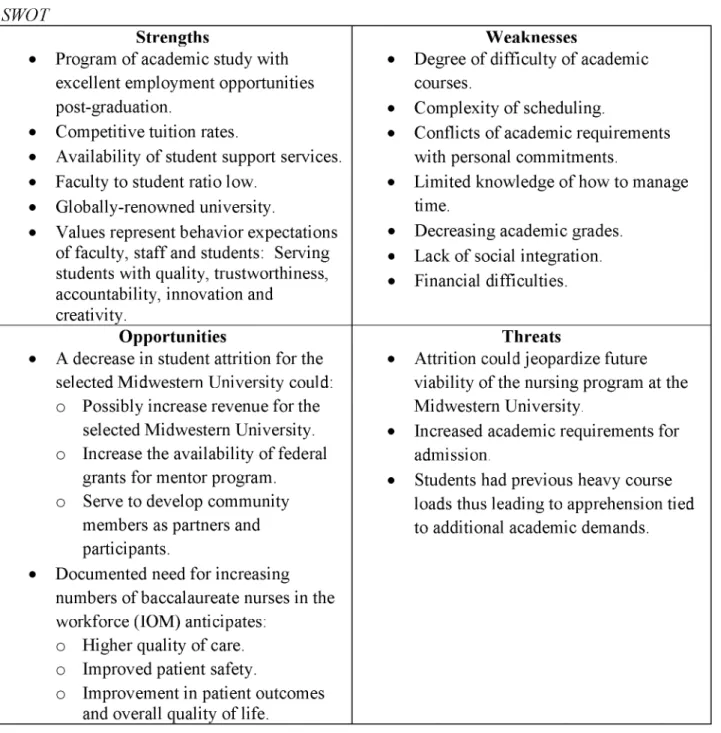
When employing the alignment model it is critical to conduct a SWOT analysis (Douglas, 2009). According to Briciu, Capu§neanu, and Topor (2012) a SWOT analysis is a framework aimed at formulating present and future plans. Fortenberry (2010) described a SWOT analysis as a systematic analysis that focused on internal strengths and weaknesses in addition to external opportunities and threats. Furthermore, a SWOT analysis assists in determining factors that may enhance accomplishment of organizations objectives and obstacles that are critical to overcome
or minimize in order to achieve the desired results (Institute of Certified Professional Managers, 2010). A SWOT analysis of the school of nursing at the selected Midwestern University in relation to student attrition is depicted in Table 1. Information provided by the SWOT analysis assisted in identifying factors that had potential to impact the results and provided the underlying support for this capstone project.
Table 1
SWOT
Strengths
• Program of academic study with excellent employment opportunities post-graduation.
• Competitive tuition rates.
• Availability of student support services. • Faculty to student ratio low.
• Globally-renowned university.
• Values represent behavior expectations of faculty, staff and students: Serving students with quality, trustworthiness, accountability, innovation and
creativity.
Weaknesses
• Degree of difficulty of academic courses.
• Complexity of scheduling.
• Conflicts of academic requirements with personal commitments.
• Limited knowledge of how to manage time.
• Decreasing academic grades. • Lack of social integration. • Financial difficulties. O pportunities
• A decrease in student attrition for the selected Midwestern University could: o Possibly increase revenue for the
selected Midwestern University. o Increase the availability of federal
grants for mentor program. o Serve to develop community
members as partners and participants.
• Documented need for increasing numbers of baccalaureate nurses in the workforce (IOM) anticipates:
o Higher quality of care. o Improved patient safety.
o Improvement in patient outcomes and overall quality of life.
Threats
• Attrition could jeopardize future viability of the nursing program at the Midwestern University.
• Increased academic requirements for admission.
• Students had previous heavy course loads thus leading to apprehension tied to additional academic demands.
Driving Forces
The driving force in this capstone project was the SWOT analysis. This analysis revealed a need to increase the rate of retention in the student population at the selected Midwestern University. The president of the selected Midwestern University challenged faculty members to develop programs to increase student retention. The challenge the university faced was to find strategies that support nursing students. The SWOT analysis further confirmed the validity of the IOM (2010) initiative that laid out the reasons why there is a critical need for increasing the number of baccalaureate prepared nursing students. Nursing program resources that facilitate the students’ choice to persevere are included in the mentor training program.
Resources and Sustainability
A complete assessment of the available resources and necessary support of the project was essential in the strategic planning process. According to Zaccagnini and White (2011) resources needed to launch a mentor training program could include financial support, personnel (faculty, staff, and students), materials for the project (program curriculum materials), a physical site(s) to conduct the training, and support for the statistical analysis. A comprehensive analysis was completed demonstrating the following resources and support essential for implementation of a successful mentor training program. The necessary components were the following:
• Students desiring to attend mentor training program. • Administrative and faculty support.
• Mentor training curriculum. • Binders.
• Pencils. • Dividers.
• Paper. • Classroom.
• Technical support.
• Statistical Package for Social Sciences (SPSS) software.
The funding for the mentor training program was partially provided by the selected Midwestern University. The Midwestern University agreed to fund the room charges, technical support, and instructor wages. Due to minimal anticipated expenses and probable long-term sustainability of this capstone project was deemed feasible.
Risks
Some risks are avoidable; however risk is present in any venture. Risk is defined by the Institute of Certified Professional Managers (2010) as the degree or amount of possible loss. The greatest risk from this capstone project was minimal psychological discomfort from answering 30 questions within a Likert scale format. There was an additional risk of discovery of the identification of participants, but the investigator implemented several strategies to minimize this risk. The participants met in a classroom setting and after all questions of concern were
answered, students signed an informed consent agreement. Participants were directed to create a unique four digit number so their pre- and post-test results could be kept anonymous. All
information was confidential and kept in a secured environment. Data analysis and evaluation of this capstone project were disseminated as an aggregate.
Stakeholders
Students who choose to attend the selected Midwestern University were the largest group of stakeholders for the success of the mentor training program. Financial benefits for remaining in an area of study where job openings are available after graduation is imperative. Mitchell
(2011) documented within the U.S. the average annual cost of tuition in 2011 at all universities was approximately $12,000.00. Peer mentor programs increase retention rates and a mentor training program is one of the cornerstones to academic success. The mentor training program was integrated as a requirement to become a mentor for fellow nursing students enrolled at the selected Midwestern University where this project was conducted.
The Midwestern University was a stakeholder as well. Improving student retention at the selected Midwestern University was one of the highest priorities set by the university president. The number of students who are enrolled in courses and their rates of retention are components of the university’s financial stability. The Midwestern University is increasingly concerned about the percentage of students who begin a program of study and who do not complete a degree. Jepsen, Patel, and Troske (2010) recognized numerous potential determinants that hamper the retention of students. They included financial difficulties, decreasing academic grades, and lack of social integration. The increasingly challenging financial environment at the selected Midwestern University drives the urgency of finding fiscally sound solutions for the student attrition problem.
The final stakeholders were all individuals residing within the U.S. The combination of increased longevity, the volume of people in the baby-boomer generation who are entering the >65 age group (the age group who generally require the greatest amount of healthcare), coupled with the number of nurses who will retire within the next 10 to 15 years will worsen the
shortage. A mentor training program has the potential to reduce the attrition of nursing students from their programs and ultimately increase the numbers of professional nurses within the U.S. healthcare system.
Project Team
The principal project team members required for this capstone project included the Dean of the College of Professional Health, Associate Dean of Nursing, Department Chair of Nursing, and the Associate Chair of Nursing, in addition to the DNP candidate. These positions already existed at the selected Midwestern University. In addition, keys to the implementation, design, analysis, and dissemination of the project were the DNP clinical mentor and the DNP Capstone Chair.
Strategy
A mentor training program was offered winter semester 2013 for all pre-licensure
baccalaureate nursing students attending the selected Midwestern University. According to the American Association of Colleges of Nursing (AACN, 2006) a capstone project should include a synthesis of all of the courses within the DNP program. The DNP curriculum at Regis
University incorporated all of the content within their courses that AACN listed as critical components in the development of a capstone project including the following:
• Advanced Nursing Practice (NR 704; NR706; NR715). • Organization and Management (NR712).
• Analytic Methodologies and Evaluation of Practice (NR702; NR707). • Utilization of Technology (NR703).
• Health Policy Development (NR 708). • Interdisciplinary Collaboration (NR711).
The mentor training program was designed using evidence-based research and founded on Bandura’s theory of efficacy. The mentor training program was implemented to improve mentor self-efficacy, mentoring efficacy, and student retention.
Budget
Preparing a proposed budget was a critical step in the planning stages of this capstone project. An accurate and detailed budget is necessary for projecting the long-term sustainability of a project (Zaccagnini & White, 2011). Expenses for the mentor training program included both fixed and variable costs. Fixed costs are expenses that are not dependent upon the level of essential materials and have a tendency to be time-related factors including salaries, rent, and utilities (Cleverly, Song, & Cleverly, 2011). In contrast, variable expenses are volume-related. Cleverly et al. established that the largest fixed cost center of a project is usually the salaries of staff members. Variable costs for this capstone project included the undetermined number of students who would attend the mentor training program affecting the costs of available materials. According to Zaccagnini and White (2011) costs include labor, equipment, project space,
consultant fees, supplies, traveling amenities, marketing, and information technology services. A comprehensive budget (see Appendix B) was proposed to the administrative staff at the selected Midwestern University and approval for the capstone project was obtained.
Cost-Benefit Analysis
The organization’s services can be assessed by analyzing its costs and benefits to both consumers and providers of the product. Zaccagnini and White (2011) specified that completing a cost-benefit analysis is considered a powerful tool to promote the capstone project to
stakeholders and obtain possible funds. Expenses related to the implementation of this capstone project by the DNP candidate were based on existing personnel, equipment, and facilities at the selected Midwestern University (see Table 2). The costs incurred for implementation of a mentor training program are considered minimal related to the potential benefit for the Midwestern University.
Table 2
Actual Cost o f Mentor Training Program
Resource Cost of Resources Total Budget Mentor training program
handout - includes folder, copy costs, and dividers.
$12.00 per student x 26 $312
Classroom facility. 8 hours = $600 Waived per Midwestern University
Instructor wages. 8 hours = $320 Not applicable; DNP candidate was instructor.
Technical support. 1 hour = $22 Waived per Midwestern University.
Statistics Software SPSS version 21
Software program - one time download.
$100
Statistician consults. 4 hours = $280 Waived per Midwestern University.
Total cost. $412
Source: Bureau of Labor Statistics, 2013; Midwestern University Data Book, 2012; Pay Scale, 2013; Statistical Package for Social Sciences, 2011.
The primary reason for implementation of a mentor training program at the selected Midwestern University was to increase student retention. Forecasting for the retention of students in a peer mentor program was completed using a sensitivity analysis method.
Forecasting is considered one of the key components of strategic planning. Sensitivity analysis is a behavioral approach that uses values for given variables to assess the impact on the
organization’s return (Gitman, 2007). The mentor training program is expected to improve retention of pre-licensure baccalaureate students.
Using the sensitivity analysis method Gitman (2007) recommended, four variables were considered for employing information originating from the selected Midwestern University. These variables consisted of revenue, retention rate, the present number of students enrolled, and the effect of retention after intervention. The first variable was for every student retained at the selected Midwestern University an additional $9,000 in revenue could be attained per year. The
second variable necessary to evaluate is the retention rate at the Midwestern University. According to the Midwestern University’s Data Book (2012) in 2010 the retention of pre licensed baccalaureate nursing students was 63.9%. The third variable essential to consider was the impact of the proposed mentor training program on retention. The anticipated outcome of implementing a comprehensive peer mentor program for undergraduate students was an increase in the retention rate by 3.65% (Wilson et al., 2012).
Townsend et al. (2011) and Wilson et al. (2012) found that an essential component to the peer mentor program was mentor training in order to obtain the increased rate in retention. The final consideration was the number of students who were enrolled in the undergraduate
baccalaureate nursing program. In 2010, according to the selected Midwestern University’s Data Book there were 222 students enrolled in the undergraduate nursing program and of the 222 students enrolled only two-thirds of the Midwestern University nursing students were projected to finish their studies. Without implementation of a comprehensive peer mentor program, only 63.9% would continue on to graduation resulting in just 142 students who would complete their degree. The goal of this project was that an additional 3.65% of students might possibly be retained with the application of a comprehensive peer mentor program. This would increase the retention rate of students to 67.55%. As a result, 150 students should be able to complete their degree. Completion rates are of great concern to the university. The retention of an additional eight students per year could yield $72,000 in revenue for the selected Midwestern University. With improvement in student retention resulting from the implementation of a peer mentoring program at the selected Midwestern University it is projected that revenue will be increased in five years to $360,000 and in ten years to $720,000. Based on the above data, a peer mentor program could produce a significant financial gain to the selected Midwestern University.
Mission, Vision, and Goals
The alignment model by Gitman (2007) identified the first steps in strategic planning as outlining the mission and vision of the organization. A mission statement according to Gitman is a statement about the purpose of the organization or program; the reason for existence. The mission statement for the School of Nursing at the selected Midwestern University and the selected Midwestern University were congruent; to prepare individuals and organizations to excel in a “knowledge-driven environment” (Student Support Services, 2012). The mission statement of the mentor training program lined up with and supported this mission by the application of thorough academic preparation. The mission of the mentor training program was to increase both mentor self-efficacy and mentoring efficacy of pre-licensure baccalaureate nursing students and result in higher rates of student retention.
A vision statement is a brief listing of the ideals and goals the stakeholders of the program strive to achieve in the future. According to Gitman (2007) the vision statement helps to motivate individuals toward a common goal while proving to stakeholders the program is heading towards the desired direction. The School of Nursing at the selected Midwestern University and the selected Midwestern University shared the same vision statement for their graduates; to exceed employer expectations, transform communities, and change individual lives by believing that every person can achieve his or her dream (Student Support Services, 2012). The vision of the mentor training program aligned and reinforced this vision; to build a
community of passionate individuals who are committed to mutual success and to be a resource which provides extra guidance and support to academic peers who are in need. Additionally the hope is as students feel supported their success rates would also improve. This holds the
prospect of improving the students’ outlook on their potential to succeed in their studies and will likely enable them to continue to degree completion.
The practice of setting goals is frequently accomplished in a wide variety of settings including both business and personal. Ordonez, Schweitzer, Galinsky, and Bazerman (2009) indicated in their research goal setting can robustly influence behavior and enhance performance. Muja and Appelbaum (2012) defined goals as a desired result individual or groups envision achieving. The short term goals of the mentor training program were to increase both mentor self-efficacy and mentoring efficacy. The long term goal of the mentor training program is to increase student retention.
M entor Training Program Objectives and Outcomes
Objectives should be specific enough so everyone involved knows exactly what behaviors are desired. Without specificity, individuals can have differing ideas about expectations. The objectives of the mentor training program were focused toward the context and practice setting of pre-licensure baccalaureate nursing students. In the nursing profession the acronym SMART (specific, measurable, attainable, realistic, and timely) is frequently used to guide the writing of objectives (Jung, 2007). The following objectives for the mentor training program were based on the SMART acronym. Students were expected to complete all program objectives by the end of the training session. The anticipated outcomes were increased mentor self-efficacy and mentoring efficacy to improve mentee retention. The following were the list of activities that each participant was expected to complete by the end of the mentor training program:
• Verbalize the meaning of the term “mentor”. • Demonstrate the qualities of a good mentor.
• Demonstrate effective communication techniques.
• Demonstrate techniques to overcome challenges in mentoring.
These skills served as a guideline in anticipation of achieving the mentor training program objectives and outcomes.
Evaluation Plan of Project Logic Model
The logic model for this capstone project was a visual model (see Appendix C) depicting dynamic components essential in the implementation and evaluation of the mentor training program for pre-licensure baccalaureate nursing students. According to Kane and Radosevich (2011) an outcomes project must clearly identify relationships including necessary resources and expected outcomes. The community needs assessment is the first step in building a conceptual model. The second step is to determine the population of concern, necessary intervention, a comparison group, and an expected outcome (PICO). The mentor training activities served as a guideline for mentors to utilize with their mentees; providing guidance in a controlled
environment. The third step was the formulation of an outcomes question. Lastly, it is essential to evaluate resources, activities, goals, and the potential impact of this capstone project. Review and analysis of the outcomes may shed light on issues that were not previously identified and may guide future program adjustments.
Outcomes Question
The outcomes question for this capstone project was whether a mentor training program for pre-licensure baccalaureate nursing students at the selected Midwestern University would increase both mentor self-efficacy and mentoring efficacy. Thorough preparation and planning is necessary for a successful mentor training program to be implemented. Athanases et al.
(2008) revealed mentoring does not occur naturally for an individual and suggested a variety of activities to be included in a mentor training program. Research has demonstrated that training for a specific skill plus self-efficacy positively correlates with performance (Bandura, 1997). A mentor training program enriches mentoring performance.
Study Design
Polit (2010) described a pre- and post-test design as a process used to measure potential changes following an intervention. This capstone project was a quantitative, pre- and post-test study design measuring the outcome of a mentor training program offered winter semester 2013 at the selected Midwestern University. Measurements for this capstone project were obtained prior to taking the mentor training program and at the end of the program.
Population
This capstone project was conducted with a single student population. All sophomore, junior, and senior level pre-licensure baccalaureate nursing students were eligible to self-enroll for the mentor training program held at the selected Midwestern University. It was estimated approximately 30 students would attend, however the classroom setting could accommodate an increased number for a total of 60 students. Students opted not to attend related to conflicts in scheduling of the mentor training program, work commitments, family situations, lack of interest, and other personal matters (Hansman, 2004). In this capstone project there were a total of 102 eligible individuals; 26 students participated in the mentor training program.
Inform ed Consent
Prior to participation in the mentor training program, this capstone project was fully explained and all questions posed by the participants were answered. During the recruitment phase of the mentor training program a copy of the informed consent document was given to all
sophomore, junior, and senior level pre-licensure baccalaureate nursing students two days prior to the project. The informed consent form documented both potential benefits and risks to the participants. On the day of the mentor training program the informed consent document was read to all potential participants prior to requesting their signature. The digital signature consisted of a unique four digit number which the participants established. The consent forms were kept in a locked file cabinet located within the nursing office. The office was locked when the room was unoccupied. Destruction of consent forms will occur within six months after completion of this capstone project.
M entor Efficacy Scale
The Mentor Efficacy Scale (MES) is a self-reported measurement tool based on
Bandura’s theory of efficacy (see Appendix D). Student mentors were instructed to respond to the 30 questions on a 5-point Likert scale. The scale assessed participant’s beliefs in their abilities to support mentees and their expected outcomes of mentoring. The MES was
administered to students prior to the beginning and at the end of their mentor training program. Riggs (2000) predicted a mentor who believes a mentee can be positively influenced by effective mentoring. Riggs also asserted that the mentor who believes in his or her mentoring abilities will invest more time and effort into the process of mentoring. The foundation of Bandura’s theory is that behaviors and actions can be learned by observation (Hunt & Ellison, 2010). Using
Bandura’s theory, activities were presented in the mentor training program as an attempt to increase mentor self-efficacy and mentoring efficacy.
Variables
When completing research or scholarly work, it is essential to analyze all factors that could influence an outcome. There are many variables to be accounted for in this mentor
training program including dependent, independent, and extraneous variables. Ensuring that certain research variables were controlled increased the reliability and validity of this project.
Dependent variables in this capstone project were an increase in mentor self-efficacy and mentoring efficacy. Polit (2010) defined a dependent variable as correlated together with the outcome of an intervention. Starting with the dependent variable the following outcome question was formulated; does a mentor training program for pre-licensure baccalaureate nursing students increase mentor self-efficacy and mentoring efficacy?
Independent variables must additionally be considered. An independent variable is considered a variable a researcher can manipulate (Polit, 2010). According to Bandura (1997) training in a specific area should increase the individual’s efficacy in performing the task. Training is a method to manipulate variables. In this capstone project the independent variables were specific aspects of training: Group activities, topics that were covered, eligible students, and number of hours of mentor training.
Finally, extraneous variables can affect outcomes. An extraneous variable according to Polit (2010) is any variable that may affect the dependent variable other than the independent variable. In the designing and implementation of this mentor training program extraneous variables included natural maturation, age, culture, income level, prior experience in mentoring, and present level of undergraduate education. Becoming aware and reporting extraneous variables may increase the accuracy of findings. However due to a small population and risk of identification of individuals, the extraneous variables were not accounted for in this project. Timeframe
This capstone project was a culmination of the knowledge gained in the DNP courses. This project demonstrated an analytical approach to practice issues in a format that supported the
synthesis, transfer and utilization of knowledge (Zaccagnini & White, 2011). The model utilized for this capstone project was the “Process Model for the DNP Project” (Zaccagnini & White, p. 498).” This model includes nine steps which begin with the identification of a problem and ends with the dissemination of information. The timeframe for this project is depicted in Appendix E. The model was first initiated during the orientation process held at Regis University in August 2011 when a problem was identified. The final dissemination of the project was August 2013 with the electronic publication of this capstone project.
Setting
Student schedules were reviewed previous to implementation by the DNP candidate to determine the weekday in which the least amount of conflicting schedules occurred. The mentor training program was scheduled to occur over one day in January 2013 and was completed with eight hours (see Table 3). The mentor training program (see Appendix F) was held in a
classroom at the selected Midwestern University. A series of six educational sections covering a variety of topics were included in the curriculum including defining the word “mentor”, listening techniques, introduction to different styles for learning, suggestions for how to fulfill your mentee’s needs, overcoming obstacles that may occur and practicing new skills. The mentor training program resources and activities included the following: Digital Video Discs (DVDs) with permission from the Lifeline organization (see Appendix G), role playing, discussions, video clips, self-reflections, and PowerPoint presentations. Individuals were eligible to participate in this capstone project only if all six sessions were attended and the pre-test was taken immediately prior to the mentor training program.
Table 3
Timeframe fo r Mentor Training Program
Time Name of Session Activities
8:00 - 8:30 Welcome and Introductions • Discussion 8:30 - 9:15 Instructions and Capstone Project • MES Pre-test 9:15 - 10:15 Session I - Defining the Word “Mentor” • Activity with
blindfolds • DVD • Reflection • Discussion 10:15-10:30 Break
11:30-12:30 Session II - Introduction to Learning Styles • Video clipping • Self-evaluation of learning style • PowerPoint • Discussion 12:30-1:30 Session III - Listening Techniques • Activity drawing
pictures with partners • PowerPoint • Role playing 1:30-2:15 Session IV - Becoming What Your
Mentee Needs • Video clipping “Confused Student” • DVD • Reflection • Discussion 2:15-2:30 Break
2:30-3:30 Session V - Overcoming Obstacles • DVD • Reflection • Discussion • Role Playing 3:30-4:15 Session VI - Putting it All Together • Discussion 4:15 - 5:00 Evaluations - Capstone Project • MES Post-test
H um an Subject’s Protection
An institute of higher learning is partly responsible for positive or negative student outcomes. A DNP who holds a faculty position is qualified to improve outcomes and has an