Introduction
Pruning plus brush disposal accounts for around a third of the labour used in citrus crops in Spain (exclu-ding harvesting) with 95 h ha-year–1(Juste et al.,2000) and thus it is quite interesting to mechanize this task in order to reduce crop costs. Brush removal with shredders has reduced the costs of brush disposal, but mechanical pruning is still not widely accepted among farmers; it is thus probable that more studies conducted under Spanish conditions are required.
Selective pruning by means of power-assisted tools, such as electrical or air shears and chainsaws, is not employed with citrus crops in Spain because of its high price, the difficulties involved in moving the cords and pipes through the canopy and because the work capa-city does not increase significantly, although in other countries, such as Italy, pneumatic systems are widely used in citrus pruning (Intrigliolo & Roccuzzo, 2011). Experiments in non-selective mechanical pruning began in the 50s in USA, showing that mechanical pruning followed up by hand pruning can reduce costs
Effect of mechanical pruning on the yield and quality
of ‘Fortune’ mandarins
1Bernardo Martin-Gorriz
1*, Ignacio Porras Castillo
2and Antonio Torregrosa
31Universidad Politécnica de Cartagena. Escuela Técnica Superior de Ingeniería Agronómica.
Paseo Alfonso XIII, 48. 30203 Cartagena (Murcia), Spain. 2Instituto Murciano de Investigación y Desarrollo
Agrario y Alimentario (IMIDA). c/ Mayor, s/n. 30150 La Alberca (Murcia), Spain. 3Universitat Politècnica
de València. Dpto Ingeniería Rural y Agroalimentaria. Camino de Vera, s/n. 46022 Valencia, Spain
Abstract
This work compares mechanical pruning followed up by hand pruning versus manual pruning in the case of ‘Fortune’ mandarins. Yield and fruit quality were measured over a three-year period. Two mechanical pruning intensities were tested, these intensities being measured as the width of the row middles left free after mechanical pruning. Although there were differences in biomass and diameter of the branches that were cut, no differences were observed between the two mechanical pruning intensities in terms of yield or fruit quality. In all pruning treatments, fruit size reached the highest category. The pruning treatments consisted in: (i) hand pruning every year, (ii) mechanical pruning followed up by hand pruning every year, and (iii) alternating the two previous methods over the years studied. On analysing the accumulated fruit production of the three years, it can be observed that there were no significant differences in yield when mechanical pruning was alternated with hand pruning over the years. When only mechanical pruning was used for the three years, however, a 22% reduction in yield was observed with respect to the treatment involving hand pruning alone. From the economic point of view, mechanical pruning shortened the time needed to complete the follow-up hand pruning by 13% with respect to just hand pruning, but this reduction in labour does not offset the cost of the mechanical equipment.
Additional key words:fruit quality; citrus; crop management; biomass.
* Corresponding author: [email protected] Received: 22-02-14. Accepted: 12-11-14.
This work has 2 supplementary figures that do not appear in the printed article but that accompany the paper online.
Abbreviations used: M (hand pruning); MI (maturity index); T (mechanical pruning); T1 (mechanical pruning 1.20 m free between rows); T2 (mechanical pruning 1.40 m free between rows); TA (titratable citric acid); TSS (total soluble solids).
1 A previous version of this manuscript was awarded the first prize for the best communication in the «VII Congreso Ibérico de Agroingeniería y de Ciencias Hortícolas» Madrid, August, 26-29, 2013. Oral session: SP9.
by 30-50% without affecting yield and fruit quality (Moore, 1958), but results are highly variable because they depend on several factors such as species, varie-ties, pruning time, tree size, tree age, and crew expe-rience among others (Smith, 1999; Nesbitt et al., 2008; Bordas et al., 2012).
In Spain, the first trials were carried out in the 70s-80s (Ortiz-Cañavate, 1979; Zaragoza & Alonso, 1980, 1981). Zaragoza & Alonso (1980, 1981) compared non-pruning, hand non-pruning, mechanical non-pruning, and mechanical pruning followed up by hand pruning. After one year of pruning, all the trees remained without pruning the following year, and the experiment was conducted over four years and on two orange varieties, ‘Washington Navel’ and ‘Salustiana’. They noticed that in the year of pruning, the yield in the pruned trees decreased with respect to the unpruned trees, but the following year, when all the trees remained unpruned, yields were similar in all the treatments. On average for the two biennia, the yield in all pruning treatments of ‘Washington Navel’ oranges was lower than in non-pruning treatments (14%). In ‘Salustiana’ oranges, however, there were no differences between unpruned or hand-pruned trees, but there was a reduction of 17% in the yield of those that were pruned mechanically with respect to the unpruned ones. There were no differences between trees pruned mechanically and those that were pruned first mechanically and then followed up by hand. Fruit size was inversely proportional to yield, but no appreciable differences were observed between pruning treatments in terms of the soluble solid content, acidity or maturity index. Since then, not many experiences on mechanical pruning have been published in Spain. The only example is that of Velazquez & Fernández (2010) who carried out an experiment with several pre-pruning hedging and topping cutting planes combined or not with hand-pruning, but the experiment comprised only one year of experiences and over a limited number of trees (5 trees/treatment). The main conclusions of the work were related to biomass waste and pruning costs, since conclusions regarding yield require longer period of experiences.
In other Mediterranean countries such as Italy or Tur-key pruning tests have reported similar results (Raciti et al.,1982; Spina et al.,1984; Giametta & Zimbalatti, 1992; Yildirim et al.,2010; Intrigliolo & Roccuzzo, 2011). It is a well-proven fact that yield decreases in the year in which mechanical pruning is performed, but if the effect of mechanical pruning is analysed over several years, this adverse effect disappears because
the tree compensates for the previous reduction in the non-pruning years, probably as a consequence of the accumulation of reserves and better lighting (Zaragoza & Alonso, 1980; Fallahi & Kilby, 1997; Kallsen, 2005; Rouse et al.,2006; Mendonça et al.,2008; Sauls, 2008; Yildirim et al.,2010).
Some authors, such as Kallsen (2005), compared se-veral types and intensities of mechanical pruning, such as topping at several heights and some hand-pruning intensities, with non-pruning. He noticed that, in all cases, the higher the pruning intensity was, the lower the yield was, regardless of the type of pruning used. In the same way, Joubert et al.(2000), working in South Africa, tested the effect of light and severe pre-pruning followed up by hand pre-pruning in ‘Valencia’ and ‘Navel’ oranges and ‘Star Ruby’ grapefruits. After three years’ experimentation, they were able to confirm that all the systems tested produced a higher yield than the unpruned control, with the best choice being hedging with an inclination of 10-20° combined with hand pruning once or twice a year. Pre-pruning in which a tilted plane is produced facilitates lighting of the bottom of the tree and also favours the concentra-tion of fruits in the lower part of the tree, which makes manual harvesting easier.
Spanish citrus farmers like to leave the trees with large skirts because this is a highly productive part of the tree. However, skirting tests performed with pre-pruners have shown that the overall production of the tree is not affected, while mechanical harvesting is fa-cilitated, problems with soil fungus are reduced and tree microclimate is affected (El-Zeftawi, 1976; Mora-les & Davies, 2000; Sauls, 2008).
Similar results were obtained by Santarosa et al. (2010), who tested pruning combined with thinning to regulate size and bearing in orange trees. According to Sauls (2008), bearing can be controlled with mecha-nical pruning, since using this technique after a year of low yield will potentially become the precursor of a highly productive year.
Another factor to be considered in mechanical pru-ning is the possibility of the transmission of pathogens, such as viruses or bacteria. In the case of hand pruning, disinfecting the tools can be a way to reduce the problem, but in mechanical pruning the task is more complicated (Rouse et al.,2006) because, although equipment can be sterilized after changing parcel, it is not so easy to do so while working along the rows or blocks of rows.
Mechanical pruning allows the management of tree dimensions, which makes other tasks like spraying and
harvesting easier (Boswell et al.,1977). Nowadays, me-chanical pruning, either alone or combined with hand pruning, is used by some Spanish farmers. It is, however, not a technique that is widely accepted by gro-wers, among other reasons due to a lack of experience. Pruning citrus trees must be a general canopy mana-gement strategy based on the understanding of specific pruning and regrowth management practices that must be combined with cost-effective methods adapted to each orchard period, growth, full production and old trees decline due to age and/or shading (Krajewski & Krajewski, 2011). Mechanical pruning can be integra-ted in this general strategy.
This work is focused on the intensity of mechanical pruning and its effect on yield, size and quality of citrus fruits, as well as the effects of different combinations of mechanical and hand pruning. The study was carried out over a three-year period on an orchard of ‘Fortune’ mandarins.
Material and methods
Trials were performed in an orchard of ‘Fortune’ (Citrus reticulata Blanco) mandarins grafted on ‘Cleo-patra’ (Citrus×reshni) mandarins, around 20 years old, planted within a frame with an in-row spacing of 4 m and 6 m between rows, and trees reached heights of 3.3 m. Trees were almost rectangular in shape, ma-king a continuous hedge in the direction of the row and allowing free row middles with a width of 0.9-1 m. The field, with a total area of 65 ha, was located in Carta-gena (Spain). For the pruning tests 10 rows with 49 trees per row and a row length of 196 m were used. Two rows were used for each treatment.
Mechanical pruning was performed with a pruner (Industrias David, Yecla, Murcia, Spain) consisting of a linear arm equipped with five shearing discs. Each disc was driven by a hydraulic motor. The pruner was hitched on the front of an orchard tractor (John Deere 2650F). The pruner was only able to cut one side of the hedge or half the topping on each pass. Two side-hedging and two side topping were carried out (4 passes per row) (shown in the Suppl. Fig. S1 [pdf online]). The topping cut was 2.50 m height on the outside of the trees and 2.80 m in the central zone of the trees so that the freshly cut branches fall to the center of the row. In the first two years of trials, two intensities of mechanical pruning were tested and measured as the middle row left free after pruning, T1 (1.2 m) and T2 (1.4 m); in the third year only one
pruning intensity was applied, T (1.3 m). In all the cases, mechanical pruning was followed up by hand pruning.
On the other hand, over the years, on the same rows, combinations of mechanical and manual pruning were arranged, as shown in the Suppl. Fig. S2 [pdf online]. Pruning was carried out on March 16th 2009, April 13th 2010 and April 6th 2011; harvesting was perfor-med on April 7th 2010, March 21st 2011 and February 23rd 2012. Pruning disposals were weighed and the diameters of the cut branches were measured before they were shredded on the ground. The following varia-bles were analysed:
— Yield per tree. The production of ten trees, ran-domly selected, per row was weighed.
— Fruit equatorial diameter. At harvest, 50 fruits per treatment were measured.
— Fruit quality. At harvest, 15 fruits from each treatment were taken to measure total soluble solid contents (TSS) and titratable acidity (TA). The matu-rity index (MI) was calculated as the TSS/TA ratio. The TSS of the juice was measured with a refractometer (at 20ºC) and TA was determined by titration with 0.1 N NaOH and phenolphthalein indicator (results are expressed as a percentage of citric acid in the juice).
— Productivity (P, in h ha–1) of hand and mechani-cal pruning. In the case of hand harvesting, the time ta-ken by a team of five workers was measured. Producti-vity of mechanical pruning was calculated according to: [1] where Aand Lare between-row width and row length (m); Nis the number of passes that the machine perfor-med per row; V is the tractor advance speed (km h–1) and Gis the time used in manoeuvres to change row (min).
— Pruned biomass characterization. Diameter (mm) of cut branches was measured at the cutting point and the vegetation removed was weighed. Ten trees were measured per treatment.
Statistical analyses were performed using a commer-cially available statistics package (Statgraphics Plus, version 5.1, STSC Inc., Rockville, MD, USA).
The cost of pruning was calculated as follows: — Hand pruning costs were based on a labour rate of 9€h–1, including taxes.
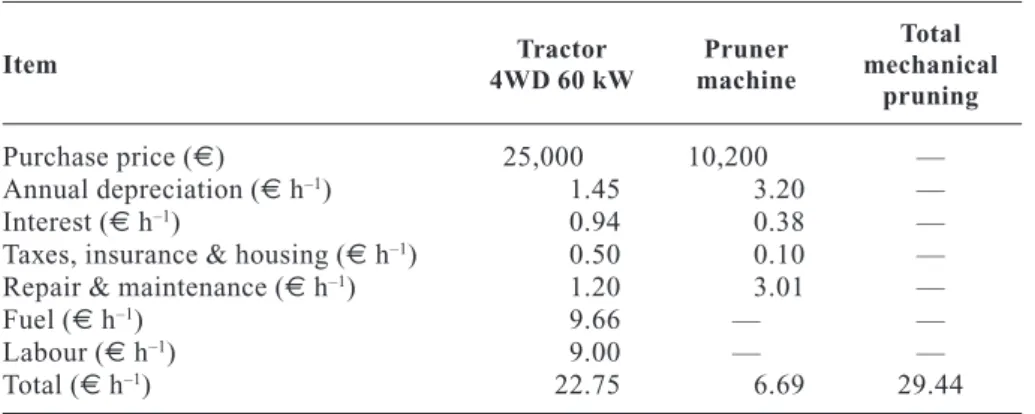
— Mechanical pruning costs were calculated follo-wing ASAE Standards (2006, 2011). The results are summarized in Table 1. The following variables were used: (a) the tractor has an estimated working life of 16
P A L N L V G = ⋅ ⋅ ⋅ ⋅ + ⎡ ⎣ ⎢ ⎤ ⎦ ⎥ 10000 1000 60
years or 16000 h; annual usage of 1000 h; interest rate 7%; salvage value 10% of purchase price; taxes, in-surance, and housing 2% of purchase price; cumulative repair and maintenance costs 80% of purchase price; (b) the pruner machine has an estimated working life of 6 years or 3000 h; annual usage of 500 h; interest rate 7%; salvage value 10% of purchase price; taxes, insurance and housing 1% of purchase price; cumulative repair and maintenance costs 90% of purchase price.
Results and discussion
Assessment of the intensity of mechanical
pruning (treatments T1 and T2)
Productivity and costs of pruning treatments are summarized in Table 2. Although the productivity of systems T1 and T2 were similar, in T2 tractor speed was slightly lower, probably because the cut was carried
out over a higher vegetation density and so 7% and 2% more time was necessary at T2 than at T1 in the years 2009 and 2010, respectively.
Follow-up hand pruning performed after mechanical pruning required 15% and 13% less time in 2009 and 2010, respectively, compared to the treatment consis-ting in hand pruning alone (M). The total time neces-sary to prune was lower in the treatment involving me-chanical pruning followed up by hand pruning than just hand pruning, with a reduction of 11% in 2009/2010 and 7% in 2010/2011. This decrease in time meant a cost reduction of 1-2% in 2009/2010, but in 2010/2011 the total cost of mechanical pruning treatments follo-wed up by hand pruning was 3-4% higher than manual pruning (M).
Table 3 shows the data concerning the mass of vege-tation cut and the width left free between rows after pruning for each pruning treatment. Both in 2009 and in 2010, with mechanical pruning there were no signi-ficant differences in biomass removed between treat-ments T1 and T2. In the second year of mechanical
Table 1.Cost of mechanical pruning (€h–1)
Tractor Pruner Total
Item mechanical 4WD 60 kW machine pruning Purchase price (€) 25,000,00 10,200,00 — Annual depreciation (€h–1) 1.45 3.20 — Interest (€h–1) 0.94 0.38 —
Taxes, insurance & housing (€h–1) 0.50 0.10 —
Repair & maintenance (€h–1) 1.20 3.01 —
Fuel (€h–1) 9.66 — —
Labour (€h–1) 9.00 — —
Total (€h–1) 22.75 6.69 29.44
Table 2. Productivity and costs of pruning systems
Season Treatment§ Velocity Working time (h ha
–1)
Cost (€ha
–1)
(km h–1)
Mechanical Hand§§ Total Mechanical Hand§§ Total
2009/2010 T1 1.78 a 3.83 a 83.40 a 87.23 a 113 a 751 a 864 a T2 1.66 a 4.12 a 83.40 a 87.52 a 121 a 751 a 872 a M — — 98.12 b 98.12 a — 883 b 883 a 2010/2011 T1 1.51 a 4.52 a 92.59 a 97.11 a 133 a 833 a 969 a T2 1.48 a 4.61 a 92.59 a 97.20 a 136 a 833 a 972 a M — 104.17 b 104.17 a — 938 b 938 a
§T1: mechanical pruning 1.20 m free between rows; T2: mechanical pruning 1.40 m free between rows; M: hand pruning. §§follow-up hand pruning. In each season, treatments with different letters had significant differences according to Fisher (LSD) at 95.0%.
pruning the differences in biomass removed between treatments T1 and T2 were very small, because in this second year pruning was performed on rows that had been pruned mechanically the year before. In 2010, mechanical pruning removed on average 2.73 kg tree–1 versus 11.01 kg tree–1in hand pruning. In both years, the f inal distance left free between rows was higher than the programmed distance.
In 2009 the average diameter at the cutting point of mechanically pruned branches was 5.44 ± 2.36 mm, with a minimum of 1.9 mm and a maximum of 15.2 mm; in 2010 it was 7.46 ± 2.04 mm, with the average diame-ter of branches cut at T2 being significantly higher than at T1. The diameter of branches cut in the hand pruning treatment was clearly higher (23.35 mm) than those cut mechanically.
Each season, the mechanically-pruned trees had lower yields than the hand-pruned ones. There were no significant differences in yield between the two inten-sities of mechanical pruning (T1 and T2) (Table 4). For this reason in the third season only one mechanical pruning intensity, free distance between rows, was used (T = 1.30 m).
Fruit diameter was inversely proportional to yield, which is in agreement with other authors (Agustí, 2003). A regression curve was calculated to relate equatorial diameter and tree yield (Fig. 1) where it can be noticed that diameter decreases when tree yield rises, but the determination coeff icient was not too high (R2= 0.57) due to the high dispersion of the data. In all cases diameters were higher than the minimum required by the citrus quality regulations (OJ, 1989), which specify a minimum diameter of 45 mm for this variety; moreover, the fruits were sorted as f irst category because they reached a diameter of more than 63 mm.
Table 3.Biomass cut and distance left free between rows after pruning
2009/2010
2010/2011
Treatment§ Biomass Distance Biomass Distance
removed between removed between
(kg tree–1) canopies (m) (kg tree–1) canopies (m)
T1 2.61 a 1.35 a 2.76 a 1.38 a
T2 4.82 a 1.51 a 2.69 a 1.47 a
M 12.02 b 1.05 a 11.01 b 0.93 a
§T1: mechanical pruning 1.20 m free between rows; T2: mechanical pruning 1.40 m free between rows; M: hand pruning. Treatments with different letters had significant differences according to Fisher (LSD) at 95.0%.
Table 4.Yield and diameter of fruits depending on pruning system
Yield Fruit
Season Treatment§ diameter
(kg tree–1) (mm) 2009/2010 T1 64.16 a 72.60 ba T2 68.83 a 70.23 aa M 87.92 b 71.83 ab 2010/2011 T1 50.48 a 77.02 aa T2 50.34 a 74.72 ab M 66.67 a 72.86 ba
Mean of two seasons T1 57.32 a 73.65 aa
T2 59.59 a 71.78 ba
M 77.30 b 72.26 ba
§T1: mechanical pruning 1.20 m free between rows; T2: me-chanical pruning 1.40 m free between rows; M: hand pruning. Treatments with different letters had signif icant differences according to Fisher (LSD) at 95.0%.
Figure 1.Relationship between equatorial diameter (mm) of mandarins and tree yield.
Analysis over three seasons
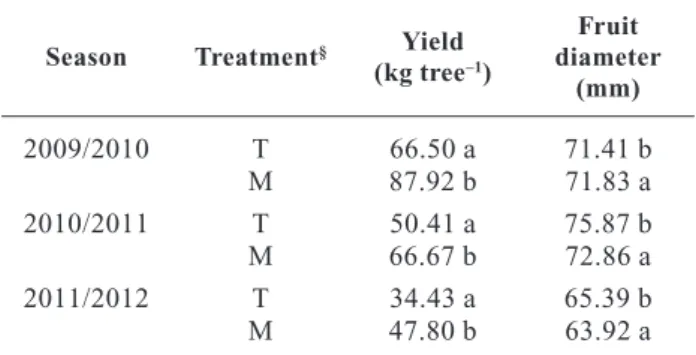
As there were no signif icant differences between the two mechanical pruning intensities (T1 and T2), in the following analysis mechanical pruning trials were considered a single treatment (T) when compared with hand pruning (M). Table 5 shows the results of yield and fruit diameter depending on the pruning system. In the three seasons, hand pruning (M) had a greater yield than mechanical pruning (T) when they were analysed individually year by year.
On the other hand, over the years, there was a pro-gressive reduction in the crop yield, as can be observed in the rows that only underwent hand pruning. In the second season, yield decreased by 24% with respect to the first season, and the third season yield decayed a further 30% with respect to the second. The third sea-son was atypical as yield and fruit diameter decreased. This reduction in diameter could be due to the
non-application of treatment to increase the fruit size, as was the case in the previous seasons.
Juice content was high and similar to that reported by El-Otmani et al.(1993) (Table 6). Acidity was also high, but with values considered normal for this variety (Bono et al.,1985). The MI, although not excessively high, was commercially acceptable. In this variety delaying harvesting will allow the MI to become higher, but will also increase the risk of peel pitting (García Lidón et al.,1998); flowering and fecundation will be affected and this will reduce the following year’s yield.
Effect of alternating pruning systems
over successive years
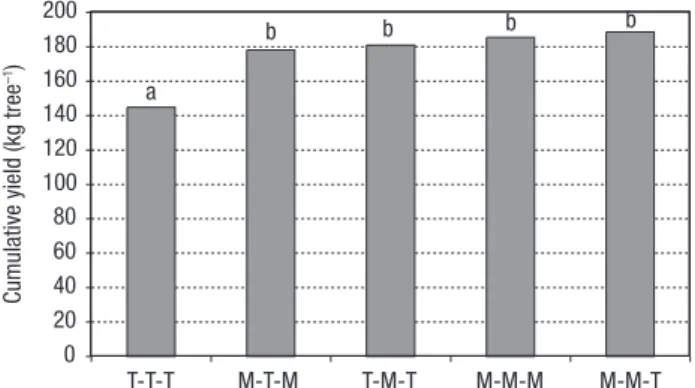
The effect of pruning on yield in isolated years can be modif ied by the regulatory effect of the tree. To avoid this problem the accumulated yield of three years was analysed (Fig. 2). Hence, when the accumulated yield of three years was studied (Fig. 2) no significant differences were found between treatments in which hand and mechanical pruning had been used: M-T-M (178.02 kg tree–1), T-M-T (180.83 kg tree–1), M-M-T (188.64 kg tree–1) and M-M-M (185.32 kg tree–1), even in the case in which mechanical pruning was perfor-med in two of the three years (T-M-T). On the other hand, the rows of trees with continuous mechanical thinning for the three years (T-T-T) had an accumulated yield of 144.73 kg tree–1, which represents a reduction of 22% with respect to the control (M-M-M). One pos-sible explanation for this negative effect of mechanical pruning is that mechanical pruning cuts a higher num-ber of young and external shoots than hand pruning,
Table 5.Yield and fruit diameter depending on pruning systems
Yield Fruit
Season Treatment§ diameter
(kg tree–1) (mm) 2009/2010 T 66.50 a 71.41 b M 87.92 b 71.83 a 2010/2011 T 50.41 a 75.87 b M 66.67 b 72.86 a 2011/2012 T 34.43 a 65.39 b M 47.80 b 63.92 a
§T: mechanical pruning; M: hand pruning. Treatments with different letters had significant differences according to Fisher (LSD) at 95.0%.
Table 6.Juice, juice density (D), total soluble solids (TSS), titratable citric acid (TA), and maturity index (MI) in juice from ‘Fortune’ mandarin grafted on ‘Carrizo’ citrange over three seasons
Season Treatment Juice (% ) D (g L–1) TSS (20ºC) TA (g L–1) MI
2009/2010 T1 53.05 a 1.0535 ba 13.6 a 14.34 aa 9.48 aa T2 55.07 a 1.0515 aa 14.1 a 13.46 ab 10.47 ba M 54.06 a 1.0520 ab 13.9 a 13.90 ba 9.98 ab 2010/2011 T1 55.31 a 1.0524 ba 13.5 a 12.97 aa 10.87 ba T2 54.09 a 1.0514 aa 13.7 a 13.76 ba 9.95 aa M 53.70 a 1.0519 ab 13.8 a 13.37 ab 10.41 ab 2011/2012 T 57.68 a 1.0542 aa 13.2 a 13.14 aa 10.04 aa M 57.79 a 1.0537 aa 13.5 a 14.32 aa 9.11 aa
Treatments with different letters had significant differences according to Fisher (LSD) at 95.0%.
and that shoots have more floral boots in late maturing varieties such as ‘Fortune’.
Economic assessment
Mechanical pruning reduced the amount of time needed for follow-up hand pruning by around 13%. Hand pruning required 101.1 h ha–1versus 88.0 h ha–1 for follow-up hand pruning (Table 2). Nonetheless, the total pruning cost of mechanical plus follow-up hand pruning did not diminish with respect to hand pruning (M-M-M, Table 7). For the combination of mechanical plus follow-up hand pruning to be more economical than hand pruning alone (supposing 29.44€h–1to be the cost of mechanical pruning and 9€h–1the cost of hand pruning) the following conditions will have to be satisf ied: (i) the time used in the follow-up must be reduced by more than 15% (2% more than at present), or (ii) the cost of hand pruning must increase by more than 7%, since a decrease in the cost of mechanical pruning is not realistic due to the continuous increase in fuel prices.
In conclusion, there were no differences between the two mechanical pruning intensities tested. Treat-ment with hand pruning yielded more fruit than treat-ments with mechanical pruning. When mechanical pruning was alternated with hand pruning over the years, no differences in yield were found. The type of pruning did not affect fruit quality. Fruit diameter was inversely proportional to tree yield, regardless of pruning type. The economic analysis showed that me-chanical pruning followed up by hand pruning did not reduce the costs with respect to hand pruning alone,
the only advantage of the mechanical system being a wider and more regular free middle between rows that facilitated the circulation of equipment.
Acknowledgments
To the ‘Consejería de Agricultura y Agua de la Re-gión de Murcia’ for financial support and to the produ-cer ‘Agrícola Cerezuela’ and specially its technician D. Fernando Ortuño for their collaboration.
References
Agustí M, 2003. Citricultura. Ed. Mundi-Prensa. Madrid. 416 pp.
ASAE, 2006. Standard EP496.3. Agricultural machinery management. Revised January 2011. Am Soc Agr Biol Eng, St. Joseph, MI (USA). 6 pp.
ASAE, 2011. Standard D497.7. Agricultural machinery ma-nagement data. Revised March 2011. Am Soc Agr Biol Eng, St. Joseph, MI (USA). 8 pp.
Bono R, Soler J, Fernández de Córdova L, 1985. Variedades de agrios cultivadas en España. Instituto Valenciana de Investigaciones Agrarias, Valencia. 70 pp.
Bordas M, Torrents J, Arenas FJ, Hervlejo A, 2012. High density plantation system of the Spanish citrus industry. Acta Hortic 965: 123-130.
Boswell SB, Ede LL, McCarty CD, 1977. Effect of training young lemon trees for limb-shaker mechanical harvest on yield and tree trunk growth. HortScience 12 (4): 352-353. El-Otmani M, Agustí M, Aznar M, Almela V, 1993. Impro-ving the size of `Fortune´ mandarin fruits by the auxin 2,4-DP. Sci Hort 55: 283-290.
El-Zeftawi BM, 1976. Response of ‘Navel’ orange trees to skirting. Sci Hortic 5 (1): 59-63.
Fallahi E, Kilby M, 1997. Rootstock and pruning influence on yield and fruit quality of ‘Lisbon’ lemon. Fruit Var J 51(4): 242-246.
Table 7.Cumulated cost of pruning for the three years depending on the system used
Treatment§ Cost by season (€ha
–1) Total cost 2009/2010 2010/2011 2011/2012 (€ha –1) T-T-T 868 968 918 2753 M-T-M 883 968 911 2761 T-M-T 868 938 918 2724 M-M-M 883 938 911 2732 M-M-T 883 938 918 2739
§T: mechanical pruning; M: hand pruning. Hourly pruning cost were: T: 29.44 €h–1, M: 9 €h–1.
Figure 2.Three years' accumulated yield depending on the combination of pruning systems. Treatments with different letters had significant differences according to Fisher (LSD) at 95.0%.
García Lidón A, Pérez Hernández F, Porras Castillo I, 1998. Citricultura murciana: Situación actual, innovaciones varietales y tendencias. Levante Agrícola 37(2): 118-128. Giametta G, Zimbalatti G, 1992. Three-years experiments of citrus fruit mechanical pruning. Proc Intl Soc Citricult 2: 693-696.
Intrigliolo F, Roccuzzo G, 2011. Modern trends of Citrus
pruning in Italy. Adv Hort Sci 25(3): 187-192.
Joubert FJ, Plessis MH, Stassen PJC, 2000. Pruning strate-gies to alleviate overcrowding in higher density citrus or-chards. J Appl Hort 2 (1): 1-5.
Juste F, Martín B, Fabado F, Moltó E, 2000. Estudio sobre la reducción de los costes de producción de cítricos me-diante la mecanización de las prácticas de cultivo. Comu-nidad Valenciana Agraria 12: 23-29.
Kallsen CE, 2005. Topping and manual pruning effects on the production of commercially valuable fruit in a midsea-son Navel Orange variety. HortTecnology 15 (2): 335-341. Krajewski AJ, Krajewski SA, 2011. Canopy management of sweet orange, grapefruit, lemon, lime and mandarin trees in the tropics: Principles, practices and commercial expe-riences. Acta Hortic 894: 65-76.
Mendonça V, Ramos JD, Neto SEA, Ruf ini JCM, 2008. Production of ‘Poncan’ tangerine tree after pruning recovery. Ciencia e Agrotecnologia 32 (1): 103-109. Moore PW, 1958. Mechanical pruning for citrus. California
Agriculture, Nov, 7-13.
Morales P, Davies FS, Littell RC, 2000. Pruning and skirting affect canopy microclimate, yields and fruit quality of ‘Orlando’ tangelo. HortScience 35(1): 30-35.
Nesbitt ML, Ebel RC, Dozier JWA, 2008. Production practices for Satsuma mandarins in the Southeastern United States. HortScience 43(2): 290-292.
OJ, 1989. Reglamento CEE nº 920/89 de la Comisión de 10 de abril de 1989 por el que se establecen normas de cali-dad para las zanahorias, los cítricos y las manzanas y peras
de mesa. EC Official Journal nº L 97, de 11 de abril de 1989.
Ortiz-Cañavate J, 1979. Mechanical pruning of citrus. Anales INIA: Tecn Agr 5: 155-167 [In Spanish].
Raciti G, Spina P, Scuderi A, Intrigliolo F, 1982. Tre anni di potatura meccanica degli agrumi in Italia. Frutticultura 44: 35-46.
Rouse B, Parsons L, Wheaton TA, 2006. Hedging, topping and skirting trees in the citrus canker era. Citrus Industry 12, 2 pp.
Santarosa E, Koller OC, Petry HB, Casamali B, 2010. Fre-quência e intensidade de poda em pomar jovem de laran-jeiras ‘Valência’ sob manejo orgânico. Ciência Rural 40 (10): 2081-2085.
Sauls JW, 2008. Citrus pruning. Texas citrus and subtropical fruits. Available in http://aggie-horticulture.tamu.edu/ci-trus/pruning/L2308.htm [14 Mar 2008].
Smith R, 1999. Shedding light on pruning orange trees. Tree source citrus nursery. Available in http://www.citrustree-source.com/SheddingLightOnPrunning.pdf [25 July 2014].
Spina P, Giuffrida A, Melita E, 1984. Comparative trials of citrus mechanical and aided pruning. Proc Intl Soc Citri-cult 1: 106-109.
Velázquez B, Fernández E, 2010. The influence of me-chanical pruning in cost reduction, production of fruit, and biomass waste in citrus orchards. Appl Eng Agric 26(4): 531-540.
Yildirim B, Yesiloglu T, Incesu M, Kamiloglu M, Ozguven F, Tuzcu O, Aka Y, 2010. The effects of mechanical pru-ning on fruit yield and quality in ‘Star Ruby’ grapefruit. J Food Agric Environ 8 (2): 834-838.
Zaragoza S, Alonso E, 1980. La poda mecanizada de los agrios en España. Invest Agrar: Prod Veg 12: 157-180. Zaragoza S, Alonso E, 1981. Citrus pruning in Spain. Proc