ISSN: 2089-9823, DOI: 10.11591/edulearn.v12i1.6912 ˆ 30
The Influence Process of Science Skill and Motivation Learning
with Creativity Learn
Yoga Budi Bhakti*, Irnin Agustina Dwi AstutiFaculty of Engineering and Mathematics of Nature Science, Indraprasta PGRI of University, Indonesia
Article Info ABSTRACT
Article history: Received Oct 01, 2017 Revised Dec 10, 2017 Accepted Jan 22, 2018
This research aims to understand the influence process of science skill and motivation learning with creativity learn. Data about the process of scince skill, motivation and creativity learn collected by test questioner instrument. Data analysis with regression analysis and correlation. Research shows that: There is the influence of skill process of science to the process of creativity learn with correlation coefficient r=0.634, there is the influence of motivation learn students to creativity learning with correlation coefficient
r=0.55, the process of science skills and motivation to study for students influence of creativity learn with correlation coefficient r=0.935. This study concluded that skill process of science and the motivation to study student could creative learning.
Keywords: Creativit Motivation Science
Copyright © 2018 Institute of Advanced Engineering and Science. All rights reserved. Corresponding Author:
Yoga Budi Bhakti,
Faculty of Engineering and Mathematics of Nature Science, Indraprasta PGRI of University,
Jl Nangka No 58C, Jagakarsa, Jakarta Selatan, Indonesia. Email: [email protected]
1. INTRODUCTION
Education is the activity and human effort to improve his personality to the path of fostering his private potentials which includes physical and spiritual. Education will lead mankind on a change in attitude and mannerisms as a result of his experiences. Formal education started from the level of kindergarten until the level of the highest namely college. The various levels of education has different purposes so that the subject matter, a method of teaching and others also would be different. However, at every level of education will not be in spite of growth in activity. Of the people of indonesia is currently facing the era of globalization and the era of information, where of progress in science, technology, and art is very fast. The indonesian nation is required to reach keunggulan menuju national levels of productivity. Hence, all the people i have to win competition, by the way of control various fields science and technology, dexterity and skill professional.
As one of the lessons given at the school basic, natural sciences (science is subjects that is very conducive to mastery science and technology for students in the future), in accordance with its function subjects natural science at school which is to give knowledge of the natural environment, develop skill, insight, and awareness technology in relation to the use of for everyday life. Science is a main element technology, it means technology are the application of concepts natural science will be practical and useful in the life of if the that can be increased to technology. Natural science (IPA) provides various learning experiences to understand the concept and related science process skills with the life of beings life. Science as a process is nothing else is a scientific method [1]-[3].
The role of natural science as a princip natural science constituent technology increasingly important especially globalization era inside information encourage formal education to do many efforts to improve the study results in the field of study this. But efforts have not been successful well. Empirical
evidence showed that study results students in field of study natural science in general is still low, this can be viewed from test scores natural science primary school. In which test scores natural science primary school still not satisfactory for example, the average score test natural science primary school national is 5.60. This means that subjects science at the level of primary school need to be management is more serious than all parties.
Science is the result of human activities in the form of organized knowledge, ideas and concepts about the universe, gained from experience through a series of scientific processes including the investigation, compilation and testing of ideas [4]. Thus it is very wrong if the teacher teaches the existing science in textbooks only, because what is in the text book is only one dimension of science that is "the dimension of the product" (the knowledge).
Aside from being a product, another very important dimension in science is the process dimension, because as an science process is gained through research using certain steps called the scientific method, it needs to be introduced as early as possible to students so they are expected to enjoy lessons science. Of course the elementary school students can not be taught a complete study, but should start to be introduced and developed scientific method gradually, with the hope that in the end will form a more complete process, and elementary students can conduct research simple. The development phases are adapted to a process called process skill (basic skills). Scientific process skills are performance skills that include aspects of cognitive skills (cognitive skills)-the intellectual skills that underpin the mastery of science-process skills-and sensorimotor skills (sensorimotor skills). Thus, measurement of the mastery of science process skills includes cognitive skills that can be measured using written tests. Measurements of creativity in terms of divergent thinking ability have been collected [5].
Basic science process skills about observing, measuring, inferring, predicting and communicating [6]. Basic skills of science is an education that not only prioritize the achievement of goals, but the learning process that is directed at the development of students' potential as a whole. Learning not only demands the mastery of facts, concepts and generalizations, but displays the message of moral value contained in that knowledge. The target approach is clear so that the cognitive, affective, and psychomotor fields are continuous and not partial. A relationship between kinesthetic, logical-mathematical, visual-spatial and naturalistic intelligences with the preferred science teaching. In addition there was a correlation between kinesthetic and visual-spatial intelligences with science process skills, implying that multiple intelligences are related to science learning [7].
The basic skills developed in the guidelines for the implementation of teaching and learning in elementary schools include: the ability to observe, understand, and gather facts. Science learning activities on students was still weak, teachers have a lot to play an active role, emphasizing the development of creative thinking. Integrated science process skills are already the application of science process skills used for problem solving [8]. Basic science process skills can be broken down into two, namely: (a) basic skills (basic skills) and (b) skills processing/processing (process skill). Integrated science process skills include investigative skills as advanced science process skills [9]. Share their skills in the process of science into two kinds, namely basic skills and integrated skills [10].
In fact, many schools lack the skills and creativity of students, consequently the learning process does not provide much learning experience for students to actualize learning outcomes in everyday life. The role of students is poorly trained in expressing, searching and using information, as a result of acceptance through lecture methods. In addition, students are less able to solve problems of cognitive content, without much actual problems. The teacher's habits act as an informant to develop a learning culture that receives, with the development of rote memorization. Students still strong position as learners who focus on the material presented by the teacher. The effort of the teacher to further activate the students already exists, but if not balanced with the media in accordance with the needs and development of students will return in the situation the students just accept.
The low creativity of science process skills is caused by, the first possibility is that teachers are less developed the skills of the science process. While the skill of the process of science is a requirement of multak that must be mastered learners. As a result, learners do not master the skills of the science process. The likelihood of both teachers has trained the skills of pro-science, but lacks the orientation of divergent patterns as the basis for creativity development. Perhaps because one of the dominant factors is the teacher's habit of taking measurements with multiple-choice forms that are clearly oriented towards the development of convergent thinking patterns [11]. Students who are having high process skills will be easy in conducting investigations in the method learning. All activities are inquiry involves the process skills that include basic process skills, measurement skills and calculation, planning skills experiments, and skills process and present data [12].
To improve student learning outcomes, many factors affect the learning that needs to be handled properly [13]. Suryabrata states that the students' learning outcomes are influenced by two factors: (1) factors
that come from outside the student's self, consisting of: a) non social factors and b) social factors, (2) factors Comes from within the student, consisting of: a) physiological factors and b) psychological factors. Non-social factors from outside students themselves can be a means and infrastructure used to support learning activities that include school buildings, laboratories, books sources, and so forth. While the social factor that is the human factor, whether human is present or not present directly, the dominant is the teacher and parents. The factors in the student are many kinds, among others: intelligence, creativity, language ability, interest in learning and others. Among these factors, motivation is a dominant factor in influencing the learning process, that motivation is the main factor driving someone to do something. So motivation is a factor that influences student involvement actively in learning. Motivation is a complex part of human psychology and behavior that influences how individuals choose to invest their time, how much energy they exert in any given task, how they think and feel about the task, and how long they persist at the task [14].
Correlation between scientific proficiency and scientific creativity, scientific proficiency as a capability to comprehend the core concept of science, to make hypothesis and do research, make experiments and collaborate with peers [15]. These skills are correlated to scientific creativity, as the creativity is the base for new development in science. Therefore, students need to learn about creativity, so that they can learn science better. The other definition about creativity is creativity in the context of science education refers, or should refer, to what the science teacher does (i.e., s/he stimulates and encourages creative thinking) and/or to the opportunities the students have, independently and/or as a result of what their teacher does, for creative thinking [16].
From the results of observation that in learning science, students are still not fully motivated. Student learning motivation needs to be raised again by exciting their curiosity, for example not only by reading repetitive and verbal but using the appropriate and interesting teaching aids while challenging questions to improve their thinking ability. Likewise, the process skill done by the student can be improved again by planning the learning activity of mature by the teacher. By implementing well-planned process skills means that students learn by doing the right activities, children are given the opportunity to do real activities such as observing, seeing with their own eyes, fingering with their own hands, trying to classify themselves, etc. (Learning by doing), so that children find their own knowledge so that what is obtained will be embedded in the heart and minds of children in a long time so it is not easily forgotten, this means the process skills can affect student learning creativity.
To obtain scientific truths related to process skills and student learning motivation as well as its effect on learning creativity, then it should be done in depth research on the above problems.
2. RESEARCH METHOD
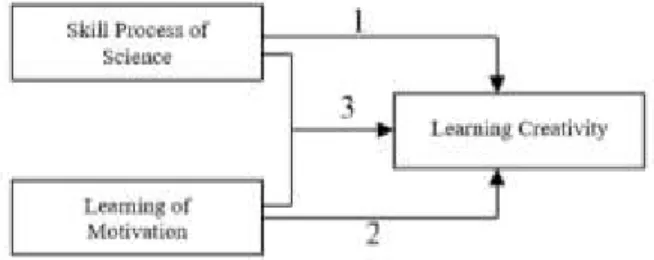
The method used in this research is survey method with correlation technique. This method provides a description of the variables to be studied and investigate the relationship between variables, among them is the relationship between the variables of science process skills and student learning motivation with learning creativity.
Figure 1. Design of research method
The target population in this study is the second grade of elementary school students in Pasar Minggu subdistrict, South Jakarta, while the population is second class students of elementary school in Pejaten Timur. The sample of this research is the second grader of elementary school with elementary school students in Pejaten Timur.
As mentioned above, this research is conducted in Pasar Minggu Subdistrict. The population target in this study were all students of the second grade of elementary school in Pasar Minggu subdistrict, consisting of 68 schools spread over 6 sub-districts, covering (1) Pejaten Barat Village, (2) Pejaten Timur
Village, (3) Kelurahan Pasar Minggu, (4) Kelurahan Jati Padang, (5) Rawa Bambu Village, and (6) Kalibata Village.
Sampling is done by the following steps: First, to determine the location of this research, it is done by simple random to determine one of six areas in Pasar Minggu Subdistrict. So elected village of East Pejaten (there are 18 schools). Second, in the same way selected 2 schools from 18 schools in East Pejaten. So, Pejaten timur 01 and 06 elementary schools are selected as a place of sampling.
Data on science process skills was obtained from the results science skill test of the class second. Scores obtained are conversions about the mastery of students in performing scince processes such as the ability to observe, classify and conclude. Data on student motivation is obtained through a questionnaire conducted in grade second elementary school students. This data score is indicated through indicators of liveliness, perseverance, effort to achieve success, and optimistic students in learning.
Data on student learning creativity was obtained from the respondents after filling out the creativity questionnaire. The low level of student learning creativity is determined by the high score of the obtained. The higher the score the students get, the more creative. Conversely the lower the score obtained, the lower the creativity of learning.
Technique of data collecting is done by technique of test and non test. This research is intended to reveal the relationship between Process Skills of science (X1) and Student Learning Motivation (X2) with Learning Creativity (Y). For that required three data collection tools. Process skill of science is using test instrument for data collection, while non test technique use instrument in the form of question to reveal data about student learning motivation and creativity learning.
3. RESULTS AND ANALYSIS
Based on data analysis using correlational technique, the results show that science process skill has positive and significant relationship with learning creativity. Level of relationship between learning motivation and learning creativity shown by correlation coefficient 0.634 and 0.445 very significant. The results of this study provide information that, for students to have maximum learning creativity should have good science process skills. This indicates that the better the science process skills that students have, the better the creativity of learning. The coefficient of determination obtained by 0.401 can be interpreted that 40.1% variance of learning creativity is supported by science process skill. The pattern of relationship between the two variables through the regression equation, which means that if the skill of the science process is increased one unit then the learning creativity will increase too. This result is in accordance with the research conducted by Smarabawa with the title of the influence of learning model of community technology science to understanding the concept of biology and creative thinking skill of students sma stated that students who learn using science approach model have better creative thinking skill [17].
The results of the second hypothesis testing showed that there is a positive relationship between students' learning motivation and learning creativity. This relationship is shown by the coefficient 0.55 is very significant. This is also reinforced by partial correlation coefficient is 0.456 significant influence science skill process students.
The results of this study provide information that, for students to have high learning creativity should have a high learning motivation as well. This shows that the higher the motivation of the students the higher the creativity of learning. The coefficient of determination obtained by 0.3025 can be interpreted that 30.25% variance of learning creativity supported by student learning motivation. The pattern of relationship between the two variables through the regression equation, which means that if the student's learning motivation is increased one unit then the learning creativity will increase by too.
Contribution of variable process skill of sciennce with creativity of learning equal to 40.1% and variable of student's learning motivation with creativity learn equal to 30.25%, this indicate that variable of science process skill and student motivation have contribution to credativity learn. Nevertheless it is possible there are many other factors that influence the creativity of learning. Science process skills are special skills WKDW VLPSOLI\ OHDUQLQJ VFLHQFH DFWLYDWH VWXGHQWV GHYHORS VWXGHQWV¶ VHQVH RI UHVSRQsibility in their own learning, increase the permanency of learning, as well as teach them the research [18].
Based on the results of the third hypothesis testing, it is concluded that the science process skills and student learning motivation together have a positive relationship with learning creativity. The closeness of the relationship is shown by double coefficient is 0.936 very significant, which pattern of relationship between science process skill and student's motivation variable with learning creativity variable expressed by regression equation.
Table 1. Table of Significance of Correlation Coefficient between Skill Process of Science and Student Motivation with Learning Creativity
Sample (n) Correlation Coefficient (ry,12) Fh Ft
0,05 0,01
40 0,936 145,33 3,253 5,233
That 87.6% variation of learning creativity is determined jointly by science process skills and student learning motivation. However, considering the contribution of each dependent variable, then there are other factors that also determine the creativity of learning.
Based on the results of data analysis as described, it was found that: There is influence of science process skill to science learning creativity. The conclusion shows that if the science process skill is increased, the creativity of learning will increase. The effect of science process skill on learning creativity of science is shown by correlation coefficient 0,634 and coefficient of determination 0,401. This shows that the science process skill significantly determines and contributes to the science learning creativity of 40.1%, so that if the science process skill is improved then the creativity of science learning will also increase. The relationship of these two variables is described in the linear regression equation. When done controlling student learning motivation variable, then obtained correlation coefficient equal to 0,445. This means that the variation of students 'learning creativity can be explained by the science process skill by controlling the students' motivation variable. teaching science through experiment orientation will provide students with opportunities to engage with science and in the practices of scientists [19]. Student will gain experience through science experiments. In addition, conducting science experiments will involve the movement of the whole body. This is the reason why science learning involves hands-on activities and practice [20].
There is influence of student's learning motivation to science learning creativity. This conclusion shows that the higher the students' learning motivation, the higher the learning creativity. The form of relationship between the two variables can be expressed by the regression equation. The influence of students' learning motivation on the learning creativity of science is shown by the correlation coefficient 0.55 with coefficient of determination 0.3025, this result show that student's learning motivation significantly determine and give contribution to creativity study of science equal to 30.25%. If done controlling to variable skill of science process then obtained correlation coefficient equal to 0.456. This means that the variation of learning creativity of science can be explained by student's learning motivation.
There is influence of science process skill and student learning motivation together to creativity of science learning. This conclusion shows that the better the science process skill and the higher the students' learning motivation, the better the learning creativity. The results showed that the correlation coefficient 0.936. Coefficient of determination 0.876. From the results of the proven analysis that the science process skills and student motivation to make a significant contribution of 87.6% of science learning creativity. However, considering the contribution of each dependent variable, then there are other factors that contribute to determining the learning creativity of science.
According to the research conducted by Bakar [14], there is a positive influence motivation to learn the competence of students earning SMK West Sumatra. This means that if the motivation to learn increased, the tendency of students to increase productive competence. The analysis showed the coefficient of determination of 0.115. This means that 11.5 % of variance explained by the variable productive competence motivation to learn. Motivation can be considered as the overall driving force in students that lead to learning activities [21]. Motivation is the impetus or stimulus given to a person in order to have the will to act. Motivation is very important in determining the activity of learning, because a motivated group will be more successful than those who do not have the motivation.
4. CONCLUSION
This study proved the relationship between science process skills, motivation and creative learning. Based on the conclusions as explained, the following suggestions can be put forward: For the Basic Education Office, it should continue to provide efforts in order to improve the professionalism of elementary teachers, for example in the form of training, workshops, seminars, and so on (especially in science lessons ) So that every teacher has skills in teaching science.
For primary school princnatural sciencels, it should: further improve their professional skills so as to improve the quality of science learning and provide more motivation to learn to the students in order to stimulate learning creativity (especially science lesson).
REFERENCES
[1] Brum & McKane. 1989. Study Guide Biology: Exploring Life. New York: John Wiley & Sons.
[2] Hibbard, K.M. t.t. Performance Assessment in The Science Classroom. New York: McGraw-Hill Companies. [3] Towle, A. 1989. Modern Biology. Austin: Holt, Rinehart and Winston.
[4] Mulyana, E. 2006. Kurikulum Tingkat Satuan Pendidikan. Bandung: PT Remaja.
[5] .LQG 3 0 .LQG 9 ³&UHDWLYLW\ LQ 6FLHQFH (GXFDWLRQ 3HUVSHFWLYHV DQG &KDOOHQJHV IRU 'HYHORSLQJ 6FKRRO 6FLHQFH´ 6WXGLHV LQ 6FLHQFH (GXFDWLRQ -37, (Online, diakses 28 Oktober 2007)
[6] Zeidan, Afif Hafez & Majdi Rashed Jayosi. 2015. Science Process Skills and Attitudes toward Science among Palestinian Secondary School Students. World Journal of Education Vol. 5, No. 1.
[7] Samsudin, Mohd Ali, Noor Hasyimah Haniza, Corrienna Abdul-Talib, Hayani Marlia Mhd Ibrahim. 2015. The Relationship between Multiple Intelligences with Preferred Science Teaching and Science Process Skills. Journal of Education and Learning. Vol. 9(1) pp. 53-59.
[8] Rezba, R.J., Sparague, C.S., Fiel, R.L., Funk, H.J., Okey, J.R., & Jaus, H.H. 1995. Learning and Assessing Science Process Skills (Edisi ke-3). Iowa: Kendall/Hunt Publishing Company.
[9] Bryce, T.G.K., McCall, J., MacGregor, J., Robertson, I.J. & Weston, R.A.J. 1990. Techniques for Assessing
3URFHVV 6NLOOV LQ 3UDFWLFDO 6FLHQFH 7HDFKHU¶V JXLGH 2[IRUG +HLQHPDQQ (GXFDWLRQDO %RRNV
[10] Djohar. 1989. Dimensi Pendidikan Sains Menyongsong Tahun 2000. Pidato Pengukuhan sebagai Guru Besar dalam Bidang Pen-didikan Sains pada FPMIPA IKIP YOGYAKARTA. Diucapkan pada Rapat Senat Terbuka IKIP YOGYAKARTA 11-03-1989.
[11] Subali, B. (2011). Pengukuran Kreativitas Keterampilan Proses Sains dalam Konteks Assessment for Learning. Jurnal Cakrawala Pendidikan, 1(1).
[12] Deta, U. A., & Widha, S. (2013). Pengaruh Metode Inkuiri Terbimbing dan Proyek, Kreativitas, Serta Keterampilan Proses Sains Terhadap Prestasi Belajar Siswa. Jurnal Pendidikan Fisika Indonesia, 9(1).
[13] Suryabrata, Sumadi. 1996. Psikologi Pendidikan. Jakarta: Raja Grasindo
[14] Bakar, Ramli. 2014. 7KH (IIHFW RI /HDUQLQJ 0RWLYDWLRQ RQ 6WXGHQW¶V 3URGXFWLYH &RPSHWHQFLHV LQ 9RFDWLRQDO +LJK
School, West Sumatra. International Journal of Asian Social Science, 2014, 4(6): 722-732.
[15] Diki. 2013. "Creativity for Learning Biology in Higher Education," LUX: A Journal of Transdisciplinary Writing and Research from Claremont Graduate University: Vol. 3: Iss. 1, Article 3.
[16] Hadzigeorgiou, Yannis, Persa Fokialis, and Mary Kabouropoulou. 2012. Thinking about Creativity in Science Education. Journal of Scientifict Research Publishing Vol.3, No.5, 603-611
[17] Smarabawa, I. G. B. N., Arnyana, I. B., & Setiawan, I. G. A. N. (2013). Pengaruh Model Pembelajaran Sains Teknologi Masyarakat Terhadap Pemahaman Konsep Biologi Dan Keterampilan Berpikir Kreatif Siswa SMA. Jurnal Pendidikan IPA, 3(1).
[18] .DUDPXVWDIDR÷OX 6HYLOD\ ,PSURYLQJ WKH 6FLHQFH 3URFHVV 6NLOOV $ELOLW\ RI 6FLHQFH 6WXGHQW 7HDFKHUV 8VLQJ ,
Diagrams. Eurasian J. Phys. Chem. Educ. 3(1):26-38.
[19] Kelly, G. J., Brown, C., & Crawford, T. 2000. Experiments, contingencies, and curriculum: Providing opportunities for learning through improvisation in science teaching. Science Education. 84(5): 624-657.
[20] Kamisah Osman, Zanaton Haji Iksan & Lilia Halim. 2007. Sikap terhadap sains dan sikap saintifik di kalangan pelajar sains. Jurnal Pendidikan. 32: 39-69.
[21] Sardiman, A.M., 2012. Interaksi dan motivasi belajar mengajar. Jakarta: Rajawali Pers.
BIOGRAPHIES OF AUTHORS
My name is Yoga Budi Bhakti. I live in Jatimulya, Bekasi, West -DYD ,¶P JUDGXDWHG EDFKHORU
degree from Physics Education at Jakarta State of University. Also master degree of Research
DQG (YDOXDWLRQ RI (GXFDWLRQ DW -DNDUWD 6WDWH RI 8QLYHUVLW\ ,¶P OHFWXUHU LQ ,QGUDSUDVWD 3*5, RI 8QLYHUVLW\ ,¶P WHDFKLQJ DERXW %DVHGof Physics, Statistic, and Evaluation.
0\ QDPH LV ,UQLQ $JXVWLQD 'ZL $VWXWL ,¶P IURP %HNDVL :HVW -DYD ,¶P OHFWXUHU LQ 8QLYHUVLW\
of Indraprasta PGRI since 2015 until now. My teaching skill in the field of learning media and physics education. My hobbies are writing journal and research in learninng media and physics
HGXFDWLRQ ,¶P JUDGXDWHG EDFKHORU GHJUHH IURP 3K\VLFV (GXFDWLRQ DW $KPDG 'DKODQ 8niversity, and master degree of Physics Education at Ahmad Dahlan University.