Systematic and Applied Microbiology 29 (2006) 59–68
Polyphasic characterization of the lactic acid bacteria in kefir
Isabelle Mainville, Normand Robert, Byong Lee, Edward R. Farnworth
Food Research and Development Centre, Agriculture and Agri-Food Canada, 3600, Boul. Casavant ouest, St.-Hyacinthe, Que., Canada J2S 8E3
Received 6 June 2005
Abstract
The lactic acid bacteria of kefir were isolated and characterized using phenotypical, biochemical, and genotypical methods. Polyphasic analyses of results permitted the identification of the microflora to the strain level. The genus
Lactobacilluswas represented by the speciesLb. kefir andLb. kefiranofaciens. Both subspecies of Lactococcus lactis
(lactisandcremoris) were isolated.Leuconostoc mesenteroides subsp.cremoriswas also found.
The kefir studied contained few species of lactic acid bacteria but showed a high number of different strains. We found that the polyphasic analysis approach increases the confidence in strain determination. It helped confirm strain groupings and it showed that it could have an impact on the phylogeny of the strains.
r2005 Elsevier GmbH. All rights reserved.
Keywords:Kefir; Lactic acid bacteria; LAB; Complex microflora; PCR; RFLP; 16S rRNA
Introduction
No clear definition of what is kefir exists presently. The FAO/WHO food standards defines kefir starter culture as being kefir grains,Lactobacillus kefiri, species of the genera Leuconostoc,Lactococcus, and Acetobac-ter. It also contains Kluyveromyces marxianus and
Saccharomyces unisporus, S. cerevisiae and S. exiguus
(www.codexalimentarius.net). This definition does not describe what the microflora of kefir grains contains. It also does not include Lactobacillus kefiranofaciens, L. kefirgranumandL. parakefirin the list ofLactobacillus
species to be present in a kefir starter.
Published reports used phenotypic traits and bio-chemical tests to identify the species present in kefir
[14,17,19,21,25]. Very few studies using molecular
techniques for the identification of lactic acid bacteria in specific kefir grains have been published[22,23].
In order to understand the fermentation of kefir, the composition of the final product, and later on be able to make claims about the probiotic properties of such a product, a clear understanding of the microflora has to be attained [6]. Identifying each strain of lactic acid bacteria present in kefir was the aim of this study.
Materials and methods
Bacterial strains
Kefir grains were obtained from the Moscow Dairy Institute (Moscow, Russia) and were maintained by daily transfers in pasteurized cows’ milk at 211C at the Liberty Company (Brossard, QC, Canada) that pro-duces kefir commercially. Type strains and reference
www.elsevier.de/syapm
0723-2020/$ - see front matterr2005 Elsevier GmbH. All rights reserved. doi:10.1016/j.syapm.2005.07.001
Corresponding author.
strains (Table 1) were obtained from the American Type Culture Collection (ATCC), USA and the BCCM/LMG Bacteria Collection Laboratory for Microbiology (LMG), Belgium.
Isolation and cultivation
Drained kefir grains (10 g) were recovered from a 20 h fermented mother culture using a sterilized strainer and homogenized with 90 g of sterile saline containing 0.9% NaCl and 0.1% bacto peptone (Difco Laboratories). Serial dilutions were performed and aliquots were plated on M17 agar (BDH) containing 0.5% glucose for the selective growth of lactococci; lactobacilli MRS broth (Difco) supplemented with 1.5% agar and adjusted to pH 5.4 with acetic acid, as well as LAW agar (ATCC) for the growth of lactobacilli. Leuconostocs were isolated using MRS medium containing 5 ml/L of 1% X-gal (5-bromo-4-chloro-3-indolyl-X-D-galactopyranoside) solution. MRS X-gal plates were incubated 7 days at 151C under anaerobiosis (5% CO2, 10% H2, and 85% N2). M17 plates were incubated aerobically at 301C for 2 days. MRS and LAW plates were incubated under anaerobiosis at 301C for 4 days. All colonies with different morphologies or at least 10% of the total number of colonies on the plates counted were transferred to an appropriate growth medium and characterized further.
Characterization of the kefir isolates
Isolates were identified by phenotypic criteria[2]. The identification system API 50CH (bioMe´rieux,
Marcy-l’Etoile, France) was used for assimilation tests of lactic acid bacteria. Produced lactic acid isomers were determined using the D-lactic acid/L-lactic acid UV-test (Boehringer Mannheim). Kefir isolates that gave differ-ent biochemical patterns were investigated further. They were characterized by RFLP and/or PCR–RFLP
[8,11,12]. Partial sequencing of variable regions of 16S rRNA genes was also performed.
Preparation of genomic DNA from lactobacilli,
leuconostocs and lactococci
Extraction of DNA was performed based on a bacterial genomic DNA extraction protocol [27] and modified as follows. A culture (10 ml) was centrifuged at 1430gfor 10 min. The pellet was resuspended in 1 ml TS buffer (Tris–HCl 25 mM, 12% sucrose, pH 8.0). The suspension was transferred into a 1.5 ml microcentrifuge tube and centrifuged (13,490g; 10 min; 251C). The pellet was washed twice in TS buffer and resuspended in 400ml TS together with 100mg mutanolysin (Sigma) (50ml of 2 mg/ml TS buffer solution) and 2 mg lysozyme (Sigma) (50ml of 40 mg/ml TS buffer solution). Tubes were incubated at 371C with gentle agitation. After 2 h standing, 100ml 10% SDS, 200ml 250 mM EDTA pH 8.0, and 1 mg proteinase K (50ml of a 20 mg/ml TS buffer solution) were added and incubation was carried on for another 2 h. The contents of each tube were separated into two tubes (500ml) and then 120ml 5 M NaCl and 100ml 10% CTAB (cetyltrimethyl-ammonium bromide)/0.7 M NaCl were added to each tube. Some strains producing large amounts of polysaccharides were treated with 100ml 2% PVP (polyvinyl pyrolidone)/10% CTAB/0.7 M NaCl to liberate the residual polysacchar-ides from the DNA-containing aqueous phase in later stages. Tubes were incubated for 20 min at 651C. DNA was purified with three (24:1) chloroform/isoamyl alcohol extractions (550ml). After centrifugating the tubes (14,300g; 10 min; 251C), the upper phase was transferred to a fresh tube. Portions (500ml) of cold isopropanol were added to precipitate the DNA over-night at 201C. Tubes were centrifuged (14,300g; 10 min; 251C) and the pellet was air-dried for 30 min. The DNA was finally resuspended in 100ml sterile water.
Preparation of plasmid DNA from
Lactobacillus
kefir
The protocol for plasmid DNA preparation was adapted from O’Sullivan and Klaenhammer [16] as follows. Cells were grown in 100 ml MRS broth at 301C under aerobic conditions. After log phase cells were centrifuged (1430g; 10 min; 201C). The pellet was washed twice with 20 ml TES buffer (50 mM Tris–HCl, pH 7.4; 50 mM EDTA, pH 8.0, 12% sucrose). The cells
Table 1. Bacterial strains used for this work
Species Strain
Lactobacillus acidophilus ATCC 4356T Lactobacillus helveticus ATCC 10797 Lactobacillus helveticus ATCC 12046 Lactobacillus helveticus ATCC 15009T
Lactobacillus kefir ATCC 35411T
Lactobacillus kefir ATCC 8007
Lactobacillus brevis ATCC 14869T
Lactobacillus brevis ATCC 13648
Lactobacillus kefirgranum LMG 15132T Lactobacillus parakefir LMG 15133T Lactobacillus kefiranofaciens ATCC 43761T Leuconostoc mesenteroidessubsp.
mesenteroides
ATCC 8293T Leuconostoc mesenteroidessubsp.cremoris LMG 14531 Leuconostoc mesenteroidessubsp.cremoris LMG 6909T Leuconostoc pseudomesenteroides ATCC 12291T Lactococcus lactissubsp.lactis LMG 6890T Lactococcus lactissubsp.lactis biovar
diacetylactis
LMG 7931 Lactococcus lactissubsp.cremoris LMG 6897T
were then resuspended in 10 ml TES containing 1 mg/ml lysozyme and incubated at 371C for 2 h. Mutanolysin (75mg/ml) was added and the incubation was allowed to continue until most of the cells appeared as protoplasts under the light microscope (2 h). After centrifugation (1430g; 10 min; 201C), the cells were washed with 20 ml TES, centrifuged and resuspended in 4 ml TE-RNase (10mM Tris–HCl, pH 8.0, 1 mM EDTA, pH 8.0, 0.5 mg/ ml boiled RNase A). The tubes were incubated at 371C for 15 min. Then, 8 ml of freshly prepared alkaline SDS (3% SDS, 0.2 N NaOH) was added and the tubes were incubated at room temperature for 7 min before 6 ml of ice-cold sodium acetate (3 M, pH 4.8) was added. Tubes were gently mixed and put on ice for 15 min. After centrifugation (1430g; 35 min; 41C), the supernatant was transferred into a new tube containing 13 ml isopropanol and kept at 201C overnight. The tubes were then centrifuged and the DNA pellet was air-dried for 15 min and resuspended in 1 ml sterile water containing RNase (Sigma) (0.1 mg/ml boiled RNase A).
RFLP analyses
Chromosomal DNA samples (3–5mg) from lactoba-cilli and lactococci were digested withHindIII orEcoRI (10 U/mg of DNA; New England Biolabs). Leuconostocs were digested with Eco0109I or BsoBI (10 U/mg of DNA; New England Biolabs). Agarose gel electrophor-esis was performed. The restriction fragments were transferred to a positively charged nylon membrane (Roche Diagnostics, Laval, QC, Canada). DIG-labelled probes were obtained by PCR. The total genomic DNA fromLb. brevisATCC 14869 (for lactobacilli),Lc. lactis
subsp.lactisLMG 6890 (for lactococci), and Leuconos-toc mesenteroides LMG 6909 (for leuconostocs) was isolated as previously described. Probes were prepared using a PCR DIG probe synthesis kit (Roche Diag-nostics, Laval, QC, Canada) according to the instruc-tions of the manufacturer. Primers used for probe design (located in the 16S rRNA) were synthesized at Bio S&T Inc. (Lachine, QC, Canada). Nucleotide sequences and
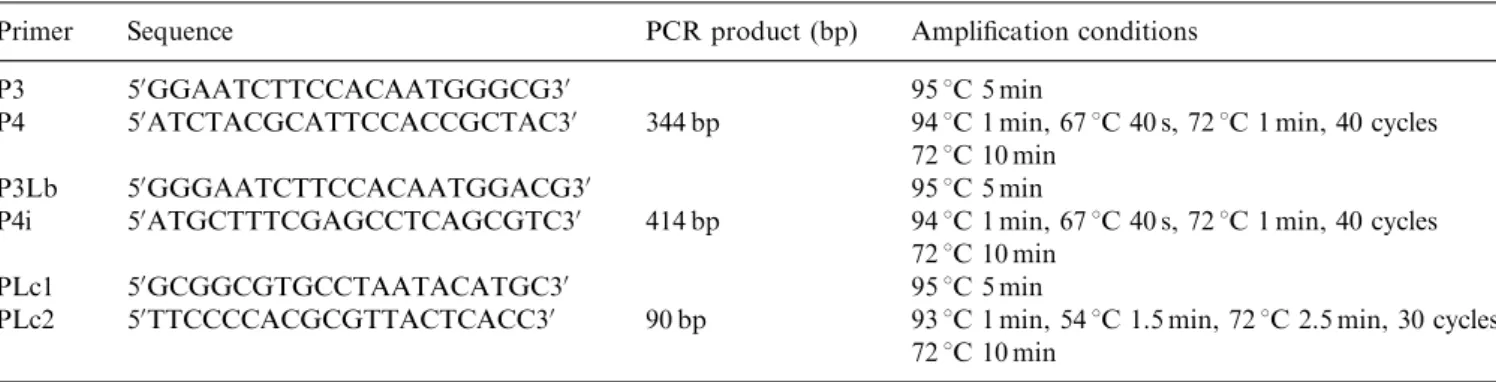
amplification conditions of the primers are presented in
Table 2.
PCR–RFLP of
Lactococcus lactis
subspecies
PCR amplification was performed using puRe Taq Ready-To-Go PCR beads (GE Healthcare, NJ, USA) according to the manufacturer’s instructions. The primers and amplification conditions used to produce the PCR fragments (PLc1 and PLc2) are shown inTable 2. Primer sequence were chosen based on work by Salama et al. [20] who showed that an area of the 16S rRNA can differentiate the two subspecies. The amplified fragments were digested with RsaI,HaeII orEarI restriction endonucleases (New England Biolabs, Mississauga, Ont., Canada) according to the supplier’s instructions. The fragments were run on a 2% NuSieve 3:1 agarose gel (Cambrex Bio Science Rockland Inc., Rockland, ME, USA) and stained with ethidium bromide (Sigma).
DNA Sequencing
A region of 16S rRNA located near the beginning of the gene [11]of isolates IM002, IM014, IM015, IM017, and IM082 were determined by sequencing the PCR-amplified 16S rRNA gene product (using primers P3Lb and P4i for Lactobacillusstrains and P3 and P4 for the
Leuconostoc strain) in both directions by Universite´ Laval sequencing services (Que., QC, Canada). Subse-quently, the partial 16S rDNA sequences were aligned and compared with sequences available from the Genbank database using Vector NTI Suite 9 software (Informax Inc., MD, USA).
Results
Morphology of the isolates
All lactic acid bacteria isolated from kefir were gram-positive and non-motile. Lactobacilli strains occurred
Table 2. Primers used for probe design, for PCR-RFKP and/or for sequencing analyses
Primer Sequence PCR product (bp) Amplification conditions
P3 50GGAATCTTCCACAATGGGCG30 951C 5 min
P4 50ATCTACGCATTCCACCGCTAC30 344 bp 941C 1 min, 671C 40 s, 721C 1 min, 40 cycles 721C 10 min
P3Lb 50GGGAATCTTCCACAATGGACG30 951C 5 min
P4i 50ATGCTTTCGAGCCTCAGCGTC30 414 bp 941C 1 min, 671C 40 s, 721C 1 min, 40 cycles 721C 10 min
PLc1 50GCGGCGTGCCTAATACATGC30 95
1C 5 min
PLc2 50TTCCCCACGCGTTACTCACC30 90 bp 931C 1 min, 541C 1.5 min, 721C 2.5 min, 30 cycles 721C 10 min
singly, in pairs, or occasionally in short chains. Strains which belong to theLb. kefirspecies formed short rods and did not seem to produce exopolysaccharides (EPS), while those of theLb. kefiranofaciensspecies were longer and produced EPS or some sort of extra-cellular structure. Our screening method did not allow the isolation of Lb. parakefirstrains. This species may not be represented or may exist in very low numbers in the kefir studied. Lactococci strains mostly appeared as pairs or short to long chains. Leuconostocstrains were also found in pairs or chains and produced a capsular material.
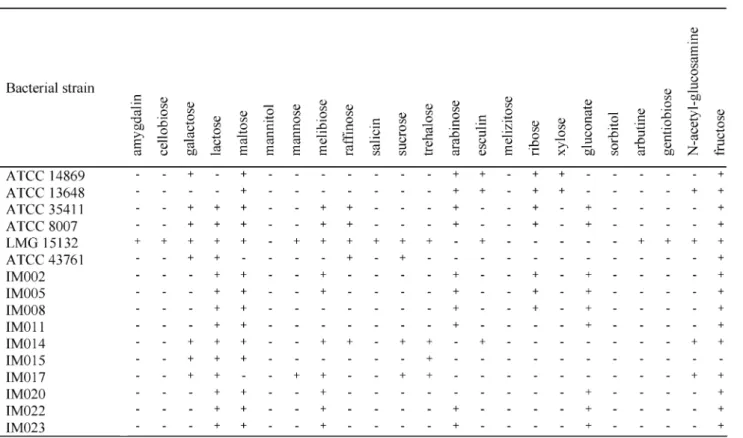
Biochemical and physiological characteristics
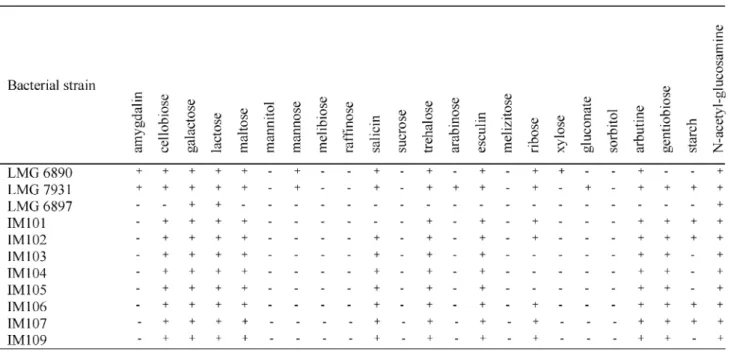
As shown inTable 3,Lactobacillussp. IM014, IM015, and IM017 fermented galactose and trehalose but not arabinose, contrary to the other isolates. Neither of these strains grew at 151C, nor produced gas from both glucose and gluconate. These strains did not produce ammonia from arginine, while the other isolates did. This homofermentative profile, along with the combina-tion of the other biochemical results suggest that strains IM014, IM015, and IM017 might belong to the Lb. kefiranofaciens species, while the other isolates showed similarity to theLb. kefirprofile. All isolated lactobacilli strains produced both isomers of lactic acid. Resultsobtained with the lactococci isolates are shown inTable 4.Lactococcussp. IM103. IM104, and IM105 failed to produce acid from ribose and starch compared to the others isolates. They also did not produce ammonia from arginine. All strains produced L-lactic acid. These results suggested that IM103, IM104, and IM105 belonged to thecremorissubsp., while the other isolates belonged to the lactis subspecies. The results for the leuconostocs are presented inTable 5. There seemed to be limited diversity within that genus in the kefir studied. Two isolates were studied further. Both kefir isolates could utilize glucose, galactose, and lactose. IM080 produced acid from N-acetyl glucosamine but the reaction was weak for IM082. Both strains were able to grow at 10 and 371C, and both strains produced D -lactic acid and gas from glucose. Strain IM082 was further investigated and was shown to produce diacetyl and small amounts of mannitol in milk. These results suggested that IM080 and IM082 might belong to the
cremoris subspecies ofLn. mesenteroides.
RFLP analysis and sequencing results of lactobacilli
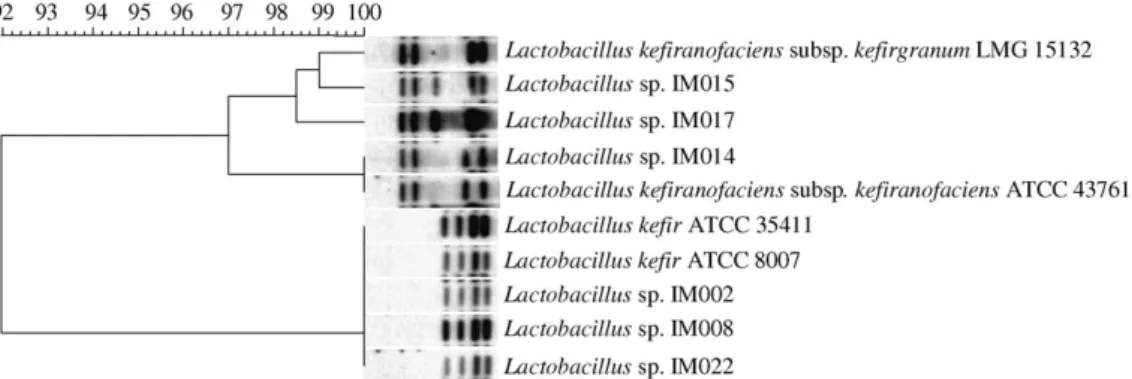
Results obtained from the Southern blot analysis of total genomic DNA from 10 lactobacilli digested withHindIII showed different banding patterns for the three different species (Fig. 1). IM014 had the same pattern as
Lb. kefiranofaciens ATCC 43761, and although it did not seem to produce polysaccharides in LAW broth, it tested positive for esculin hydrolysis, and it produced acid from trehalose. IM015 and IM017 showed unique patterns with 3 or 4 bands in common with Lb. kefiranofaciens subsp. kefirgranum and Lb. kefiranofa-ciens subsp. kefiranofaciens. Partial 16S sequencing results of ATCC 43761, LMG 15132, IM014, IM015, and IM017 (data not shown) revealed a 100% homology within these strains confirming that IM015 and IM017 did belong to eitherLb. kefiranofaciens subsp. kefirgra-numorLb. kefiranofacienssubsp.kefiranofaciens. Based
on the genotypic results, morphologic and phenotypic features, IM015 and IM017 were classed as Lb. kefiranofacienssubsp. kefirgranum.
Results also showed a homologous RFLP pattern between both reference strains of Lb. kefirand IM002, IM008, and IM022. Other restriction enzymes were also used (BclI,StyI andBamHI) to see if they could further differentiate the strains within that species, but without success (data not shown). A dendrogram corresponding to the consensus matrix from the numerical analysis of the fermentation patterns, based on the Jaccard coefficient, and the numerical analysis of the banding
Table 4. Comparison of the carbohydrate metabolism of the lactococci strains
patterns generated by HindIII restriction, is shown in
Fig. 2.
Plasmid profiles of
Lb. kefir
All strains with a banding pattern corresponding to the Lb. kefir species were tested for the presence of plasmid DNA in order to further differentiate the strains. Results are shown in Fig. 3. Reference strains did not show any plasmids while all strains isolated from kefir possessed one or more plasmids. Each isolated strain presented a different plasmid profile.
RFLP analysis of lactococci
Results obtained from the Southern blot analysis of total genomic DNA isolated from 11 strains of lactococci and one strain ofStreptococcusdigested with
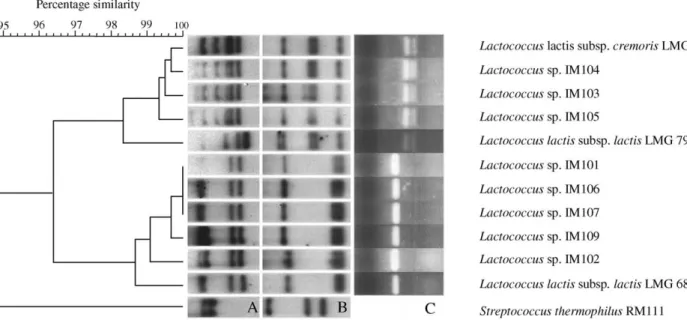
HindIII and EcoRI are shown in Fig. 4A and B. Dendrograms resulting from the numerical analysis of the banding patterns generated by the two endonu-cleases grouped IM103, IM104, and IM105 with L.
lactissubsp.cremorisLMG 6897. The level of similarity for LMG 7931 to LMG 6897 was higher than to LMG 6890.
PCR–RFLP of
Lactococcus lactis
subspecies
Digestion of the PCR fragments from the lactococci strains withEarI is shown inFig. 4C. The endonucleaseEarI cuts the PCR fragments from the cremoris
subspecies. Results indicated that IM103, IM104, and IM105 belong to that subspecies, while isolates IM101, IM102, IM106, IM107, and IM109 belong to thelactis
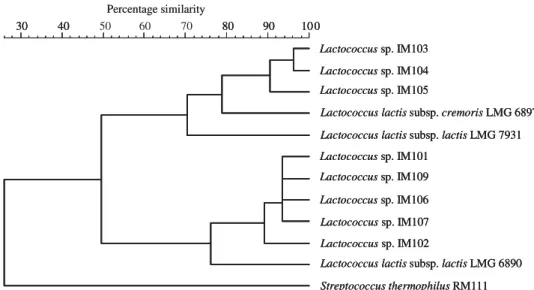
subspecies. Interestingly, L. lactis subsp. lactis LMG 7931 was cut by EarI. Endonucleases RsaI andHaeII, which cut the PCR fragments from thelactissubspecies confirmed the results obtained with EarI (results not shown). These results are in agreement with the genomic RFLP results. A dendrogram corresponding to the polyphasic consensus matrix from the numerical analy-sis of the fermentation patterns, based on the Jaccard coefficient, the numerical analysis of the RFLP banding
Fig. 1. Dendrogram and ribopatterns of lactobacilli strains.
Lactobacillus kefiranofacienssubsp.kefirgranumLMG 15132 10 90 80 70 60 50 40 30 Lactobacillussp. IM017 Lactobacillussp. IM014 Lactobacillussp. IM015 Lactobacillussp. IM002 Lactobacillussp. IM008 Lactobacillussp. IM022
Lactobacillus kefiranofacienssubsp.kefiranofaciensATCC 43761
Lactobacillus kefirATCC 35411
Lactobacillus kefirATCC 8007 Percentage similarity
Lactobacillus kefiranofacienssubsp.kefirgranumLMG 15132 10 90 80 70 60 50 40 30 40 50 70 80 90 100 30 Lactobacillussp. IM017 Lactobacillussp. IM014 Lactobacillussp. IM015 Lactobacillussp. IM002 Lactobacillussp. IM008 Lactobacillussp. IM022
Lactobacillus kefiranofacienssubsp.kefiranofaciensATCC 43761
Lactobacillus kefirATCC 35411
Lactobacillus kefirATCC 8007 Percentage similarity
patterns generated byHindIII andEcoRI restriction and the PCR–RFLP results, is shown inFig. 5.
RFLP analysis and sequencing results of the
Leuconostoc
strains
Results obtained from the Southern blot analysis of total genomic DNA isolated from 6 strains of Leuco-nostocdigested withEco0109I andBsoBI are expressed in a dendrogram (Fig. 6). Results from the numerical analysis of the banding patterns generated by the two endonucleases showed that the two isolates have an identical banding pattern to Ln. mesenteroides subsp.
cremoris LMG 6909. A dendrogram corresponding to the consensus matrix from the numerical analysis of the fermentation patterns, based on the Jaccard coefficient, the numerical analysis of the RFLP banding patterns generated byEco0109I andBsoBI restriction is shown in
Fig. 7. Both isolates show a high similarity to LMG 6909. Partial 16S sequencing results (data not shown) of IM082 showed homology to strains ofLn. mesenteroides
when compared to the Genbank database.
Discussion
Current literature on the identification of the micro-flora of kefir is difficult to interpret, particularly for the lactic acid bacteria. Many articles written on the subject use old methodology to characterize the microflora
[9,15,19]. Even more recent publications identify the strains isolated based uniquely on phenotypic traits
[1,21]. Garrote et al.[7]and Pintado et al.[18]included whole-cell protein profiles with their phenotypic results. Takizawa et al.[23]added to the cell protein determina-tion, GC% and DNA/DNA hybridization. RFLP,
Fig. 4. Polymorphic matrix of genotypic results for lactococci strains. (A) Ribopatterns of lactococci digested withHindIII. (B) Ribopatterns of lactococci digested withEcoRI. (C) Digestion withEarI of the PCR product of lactococci strains.
100 99 98 97 96 95 94
Lactobacillus kefirATCC 35411
Lactobacillus kefirATCC 8007
Lactobacillussp. IM002 Lactobacillussp. IM005 Lactobacillussp. IM011 Lactobacillussp. IM023 Lactobacillussp. IM022 Lactobacillussp. IM020 Lactobacillussp. IM008 Percentage similarity 10 99 98 97 96 95 94
Lactobacillus kefirATCC 35411
Lactobacillus kefirATCC 8007
Lactobacillussp. IM002 Lactobacillussp. IM005 Lactobacillussp. IM011 Lactobacillussp. IM023 Lactobacillussp. IM022 Lactobacillussp. IM020 Lactobacillussp. IM008 Percentage similarity
which is a very discriminating method, was never used, to our knowledge, to identify the LAB of kefir grains.
RFLP was shown to be a useful method to differentiate between the different species of lactobacilli present in kefir grains. However, strain variations within theLb. kefir species could not be demonstrated by the RFLP analysis. Morphologic differences (colony shape and size) were evident between strains ATCC 35411 and ATCC 8007 but our genotypic results, including plasmid
profiles, could not differentiate the two. This suggests that a very small difference in a genetic locus, not detectable by RFLP, or a low abundance plasmid, responsible for colony aspect, could not be detected. The strains isolated from kefir were differentiated by their plasmid profiles. RFLP results showed that there seems to be a single pattern for theLb. kefirspecies, suggesting low genome diversity. Plasmid profiles showed many different patterns, suggesting their importance in strain
10 0 90 80 70 40 30 Lactococcussp. IM103 Lactococcussp. IM104 Lactococcussp. IM105 Lactococcussp. IM106 Lactococcussp. IM107 Lactococcussp. IM101 Lactococcussp. IM109 Lactococcussp. IM102
Lactococcus lactissubsp. cremorisLMG 6897
Lactococcus lactissubsp. lactisLMG 7931
Lactococcus lactissubsp. lactisLMG 6890
Streptococcus thermophilusRM111 Percentage similarity 10 0 90 80 40 30 40 50 60 80 90 10 0 30 Lactococcussp. IM103 Lactococcussp. IM104 Lactococcussp. IM105 Lactococcussp. IM106 Lactococcussp. IM107 Lactococcussp. IM101 Lactococcussp. IM109 Lactococcussp. IM102
Lactococcus lactissubsp. cremorisLMG 6897
Lactococcus lactissubsp. lactisLMG 7931
Lactococcus lactissubsp. lactisLMG 6890
Streptococcus thermophilusRM111 Lactococcussp. IM103 Lactococcussp. IM104 Lactococcussp. IM105 Lactococcussp. IM106 Lactococcussp. IM107 Lactococcussp. IM101 Lactococcussp. IM109 Lactococcussp. IM102
Lactococcus lactissubsp. cremorisLMG 6897
Lactococcus lactissubsp. lactisLMG 7931
Lactococcus lactissubsp. lactisLMG 6890
Streptococcus thermophilusRM111 Percentage similarity
Fig. 5. Polyphasic matrix for lactococci strains.
100 99 98 97 96 95 94 Leuconostocsp. IM080 Leuconostocsp. IM082
Leuconostoc mesenteroidessubsp.cremorisLMG 6909
Leuconostoc mesenteroidessubsp.mesenteroidesATCC 8293
Leuconostoc mesenteroidessubsp.cremorisLMG 14531
Leuconostoc pseudomesenteroidesATCC 12291 Percentage similarity 0 99 98 97 96 95 94 95 96 97 98 99 0 94 Leuconostocsp. IM080 Leuconostocsp. IM082
Leuconostoc mesenteroidessubsp.cremorisLMG 6909
Leuconostoc mesenteroidessubsp.mesenteroidesATCC 8293
Leuconostoc mesenteroidessubsp.cremorisLMG 14531
Leuconostoc pseudomesenteroidesATCC 12291
Leuconostocsp. IM080
Leuconostocsp. IM082
Leuconostoc mesenteroidessubsp.cremorisLMG 6909
Leuconostoc mesenteroidessubsp.mesenteroidesATCC 8293
Leuconostoc mesenteroidessubsp.cremorisLMG 14531
Leuconostoc pseudomesenteroidesATCC 12291 Percentage similarity
Fig. 6. Dendrogram of RFLP results for leuconostocs.
70 50
Leuconostoc mesenteroidessubsp.cremorisLMG 14531
Leuconostoc mesenteroidessubsp.mesenteroidesATCC 8293
Leuconostocsp. IM080
Leuconostocsp. IM082
Leuconostoc mesenteroidessubsp.cremorisLMG 6909
Leuconostoc pseudomesenteroidesATCC 12291 Percentage similarity 100 90 80 60 40 30
Leuconostoc mesenteroidessubsp.cremorisLMG 14531
Leuconostoc mesenteroidessubsp.mesenteroidesATCC 8293
Leuconostocsp. IM080
Leuconostocsp. IM082
Leuconostoc mesenteroidessubsp.cremorisLMG 6909
Leuconostoc pseudomesenteroidesATCC 12291 Percentage similarity
diversity. The strains obtained from the ATCC may have lost their plasmids through frequent sub-culturing in a non-milk-based medium[3,4].
Strain variations within theLb. kefiranofaciensspecies were shown with the RFLP method usingHindIII as the restriction endonuclease, although 16S partial sequen-cing results were not able to differentiate between both subspecies. IM014 gave a RFLP profile identical to ATCC 43761 but due to its morphologic features, (mainly growth characteristics in broth and apparent lack of EPS production) it was classified within the
kefirgranum subspecies. It is possible that the main difference between Lb. kefiranofaciens subsp. kefirano-faciens and Lb. kefiranofaciens subsp. kefirgranum, which consist mainly of EPS production by the subspecieskefiranofaciens, might be caused by the loss of a plasmid coding for the slime-producing trait by the
kefirgranum subspecies [13,26]. RFLP profiles showed four different patterns for the Lb. kefiranofaciens
species. It was not possible to attribute one particular pattern to the kefiranofaciens or the kefirgranum
subspecies. Phenotypic attributes justifies that two subspecies should be present in the Lb. kefiranofaciens
species[24]. Genotypic results based on RFLP analysis did not create 2 distinct groups for the subspecies. Two strains with the same RFLP pattern were classed in different subspecies (ATCC 43761 and IM014) while strains with different patterns could also be classed in a same subspecies (LMG 15132, IM014, IM015, and IM017). Takizawa et al. [23] created subgroups within thekefirgranumandkefiranofacienssubspecies based on phenotypic and biochemical characteristics but they did not demonstrate genotypic differences. RFLP analysis suggested that there might be a wide variety of genotypically different strains within the Lb. kefirano-faciens species. These results also demonstrated that even though the genotypic identification is essential for the proper classification of a strain, phenotypic char-acteristics also are essential for the proper typing. The polyphasic approach proved to be a valuable tool for the typing of these strains.
Lactococci strains isolated from kefir formed four different genomic RFLP patterns with bothHindIII and
EcoRI showing that at least four different strains were isolated for the kefir grains. Strains from bothlactisand
cremoris subspecies were found. This was further demonstrated through the PCR–RFLP results. Geno-mic RFLP of lactococci enabled strain differentiation and the groups formed did coincide to the PCR–RFLP subspecies grouping indicating that the genomic RFLP might be used for subspecies differentiation as well. More strains should be tested to validate this observa-tion. It is worth noting that the 16S PCR fragment of
Lb. lactissubsp.lactisLMG 7931, a strain that produces diacetyl, was cut byEarI endonuclease, suggesting that this strain belongs to thecremorissubspecies. Genomic
RFLP groupings also clustered this strain closer to the
cremoris group. In the past, this strain was probably classified into the lactis subspecies based on its sugar utilization profile that more closely resembled that of a
lactissubspecies.
Leuconostocs were also isolated from the studied kefir grains. Because of their ability to grow at 151C and produceX-galactosidase, they were isolated using MRS-X-Gal since they were not able to grow selectively on other differential media tested. The detected hetero-geneity of the strains in the studied kefir grains may have been limited by the culturing method used. New screening methods could also be useful for this genus. Strains isolated were identified as Ln. mesenteroides
subsp. cremoris. Their limited sugar utilization profile probably makes them very dependant on other bacteria for their maintenance and growth in the grains.
When one studies more closely the list of organisms isolated from kefir grains from various parts of the globe, it becomes evident that the earlier lack of molecular tools for the proper identification of the species probably inflated the list of species found in kefir grains. For example, some claimed to have isolatedLb. acidophilus andLb. brevisfrom kefir [1,10,17]but these species of lactobacilli are so phenotypically and bio-chemically closely related to theLb. kefiranofaciensand
Lb. kefir species, respectively, that they may have been misidentified. More rigorous methods of characteriza-tion will demonstrate that kefir grains from different parts of the world are not as different as once thought. Takizawa et al. [23] studied different sources of kefir grains and isolated only three species of lactobacilli. Our study using a kefir grain from Russia contained two species of lactobacilli, the same species isolated by the Japanese team. Molecular biology and bioinformatics are technologies now at our disposal [5]. Polyphasic characterization combining phenotypic, biochemical, genotypic, and, ideally, sequencing results should become a requirement for the classification of strains.
Acknowledgement
This study was part of the Agriculture and Agri-Food Canada MII program and was partly financed by Les Produits de Marque Liberte´.
References
[1] L. Angulo, E. Lopez, C. Lema, Microflora present in kefir grains of the Galician region (North-West of Spain), J. Dairy Res. 60 (1993) 263–267.
[2] Bergey’s Manual of Determinative Bacteriology, eighth ed., In: J.G. Holt, N.R. Krieg, P.H.A. Sneath, S.T. Williams (Eds.), Williams & Wilkins, Baltimore, 1986.
[3] B. Cerning, C. Bouillanne, M.J. Desmazeaud, M. Land-on, Exopolysaccharide production by Streptococcus thermophilus, Biotechnol. Lett. 10 (1988) 255–260. [4] B. Cerning, C. Bouillanne, M. Landon, M.J.
Desma-zeaud, Isolation and characterization of exopolysacchar-ides from slime-forming mesophilic lactic acid bacteria, J. Dairy Sci. 75 (1992) 692–699.
[5] F. Desiere, B. German, H. Watzke, A. Pfeifer, S. Saguy, Bioinformatics and data knowledge: the new frontiers for nutrition and foods, Trends Food Sci. Technol. 12 (2002) 215–229.
[6] E.R. Farnworth, I. Mainville, Kefir: a fermented milk product, In: E.R. Farnworth (Ed.), Handbook of Fermented Functional Foods, CRC Press, Boca Raton, FL, 2003, pp. 77–112.
[7] G.L. Garrote, A.G. Abraham, G.L. de Antoni, Chemical and microbiological characterisation of kefir grains, J. Dairy Res. 68 (2001) 639–652.
[8] F. Grimont, P.A.D. Grimont, Ribosomal ribonucleic acid gene restriction patterns as potential taxonomic tools, Ann. Inst. Pasteur/Microbiol (Paris). 137B (1986) 165–175.
[9] T. Hirota, Microbiological studies on kefir grains, Rep. Res. Lab. SnowBrand Milk Prod. Co. 84 (1987) 67–129. [10] O. Kandler, P. Kunath, Lactobacillus kefir sp. nov., a component of the microflora of kefir, Syst. Appl. Microbiol. 4 (1983) 286–294.
[11] N. Klijn, A.H. Weerkamp, W.M. de Vos, Identification of the mesophilic lactic acid bacteria by using polymerase chain reaction-amplified variable regions of 16S rRNA and specific DNA probes, Appl. Environ. Microbiol. 57 (1991) 3390–3393.
[12] G. Kohler, W. Ludwig, K.H. Schleifer, Differentiation of lactococci by rRNA gene restriction analysis, FEMS Microbiol. Lett. 84 (1991) 307–312.
[13] M. Kojic, M. Vujcic, A. Banina, P. Cocconcelli, J. Cerning, L. Topisirovic, Analysis of exopolysaccharide production by Lactobacillus casei CG11, isolated from cheese, Appl. Environ. Microbiol. 58 (1992) 4086–4088. [14] F.V. Kosikowski, V.V. Mistry, Fermented milks, In: F.V.
Kosikowski (Ed.), Cheese and Fermented Milk Foods, Vol. 1, third ed., Westport, CT, 1997, pp. 61–64. [15] J.W.M. La Rivie`re, P. Kooiman, K. Schmidt, Kefiran, a
novel polysaccharide produced in the kefir grain by Lactobacillus brevis, Archiv fu¨r Mikrobiol 59 (1967) 269–278.
[16] D.J. O’Sullivan, T.D. Klaenhammer, Rapid mini-prep isolation of high-quality plasmid DNA fromLactococcus and Lactobacillus spp, Appl. Environ. Microbiol. 59 (1993) 2730–2733.
[17] G. Ottagalli, A. Galli, P. Resmini, G. Volonterio, Composizione microbiologica, chimica et ultrastructtura dei granuli di kefir, Ann. Microbiol. 23 (1973) 109–121. [18] M.E. Pintado, J.A. Lopes Da Silva, P.B. Fernandes, F.X.
Malcata, T.A. Hogg, Microbiological and rheological studies on Portuguese kefir grains, Int. J. Food Sci. Technol. 31 (1996) 15–26.
[19] J. Rosi, J. Rossi, I Microrganismi del kefir: I fermenti lattice, Sci. Tech. Lattiero-Casearia. 29 (1978) 291–305. [20] M. Salama, W. Sandine, S. Giovannoni, Development
and application of oligonucleotide probes for identifica-tion ofLactococcus lactissubsp.cremoris, App. Environ. Microbiol. 57 (1991) 1313–1318.
[21] E. Simova, D. Beshkova, A. Angelov, T. Hristozova, G. Frengova, Z. Spasov, Lactic acid bacteria and yeasts in kefir grains and kefir made from them, J. Ind. Microbiol. Biotechnol. 28 (2002) 1–6.
[22] S. Takizawa, S. Kojima, S. Tamura, S. Fujinaga, Y. Benno, T. Nakase,Lactobacillus kefirgranumsp. nov. and Lactobacillus parakefir sp. nov., two new species from kefir grains,, Int. J. Syst. Bacteriol. 44 (1994) 435–439. [23] S. Takizawa, S. Kojima, S. Tamura, S. Fujinaga, Y.
Benno, T. Nakase, The composition of theLactobacillus flora in kefir grains, Syst. Appl. Microbiol. 21 (1998) 121–127.
[24] M. Vancanneyt, J. Mengaud, I. Cleenwerck, K. Vanho-nacker, B. Hoste, P. Dawyndt, M.C. Degivry, D. Ringuet, D. Janssens, J. Swings, Reclassification ofLactobacillus kefirgranum Takizawa et al. 1994 as Lactobacillus kefiranofaciens subsp. kefirgranum subsp. nov. and emended description ofL. kefiranofaciensFujisawaet al. 1988, Int. J. Syst. Evol. Microbiol. 54 (2004) 551–556. [25] Y. Vayssier, Le ke´fir: analyse qualitative et quantitative,
Rev. Lait. Fr. 361 (1978) 73–75.
[26] M. Vescovo, G.L. Scolari, V. Bottazzi, Plasmid-encoded ropiness production in Lactobacillus casei ssp, Casei. Biotechnol. Lett. 11 (1989) 709–712.
[27] K. Wilson, Miniprep of bacterial genomic DNA, In: F.M. Ausubel, R. Brent, R.E. Kingston, D.D. Moore, J.G. Seidman, J.A. Smith, K. Struhl (Eds.), Current Protocols in Molecular Biology, Vol. 1, Wiley, New York, 1990 pp. 2.4.1–2.4.5.