Inhoudsopgave
Appendix A: References ...
Fout! Bladwijzer niet gedefinieerd.
Appendix B: Success factors Information Management System (IMS) ... 5
Appendix C: Success factors Quality Management Systems (QMS) ... 15
Appendix D: Survey ... 21
Appendix E: Answers survey ... 35
Appendix F: Interviews ... 55
Interview Rutger van der Noort ...
Fout! Bladwijzer niet gedefinieerd.
Interview Herman van der Noort ...
Fout! Bladwijzer niet gedefinieerd.
Interview Piet van Krimpen ...
Fout! Bladwijzer niet gedefinieerd.
Interview Marjolein van Beek ...
Fout! Bladwijzer niet gedefinieerd.
Appendix A: Success factors Information Management System (IMS)
Success factors for the implementation of an Information Management System (IMS) are derived from
literature about this subject. The IMS’s researched are:
Information systems
Web-based project management systems
Web-based construction information management systems
Product Data Interchange (PDI)
Enterprise Resource Planning (ERP)
A summary of the derived success factors can be found in Table 1.
Chung, Skibniewski, Lucas and Kwak
Chung, Skibniewski, Lucas and Kwak did research to the success factors of Enterprise Resource Planning (ERP,
see chapter
Fout! Verwijzingsbron niet gevonden.
) in the construction and engineering industry. These success
factors are summed up in Figure 1.
Figure 1: ERP success model (Chung et al., 2008)
The nine success factors are divided in two different categories; User related Variables and Project related
variables:
User related variables:
1.
Output
2.
Job relevance
3.
Image
4.
Result demonstrability
5.
Compatability
6.
System reliability
Project related variables:
1.
Internal support
2.
Function
3.
Consultant support
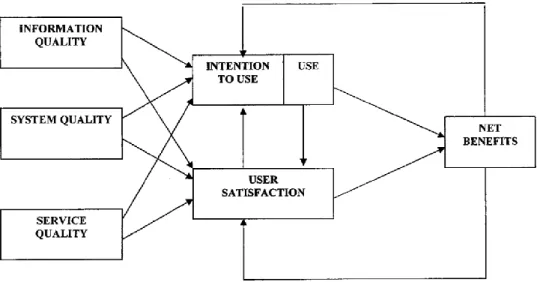
DeLone and McLean
DeLone and McLean published a paper including a model in 1992 to “bring some awareness and structure to
the Information Systems (IS) success in IS research. It was also meant to summarize previous research in a
model to provide guidance for future researchers. In 2003 a new paper was published by them with an
improved model, see Figure 2.
Figure 2: Updated DeLone & McLean information systems success model (DeLone, McLean, 2003)
The success factors of DeLone and McLean:
1.
Information quality
2.
System quality
3.
Service quality
4.
Intention to use / Use
5.
User satisfaction
6.
Net benefits
Kim, Garrity and Sanders
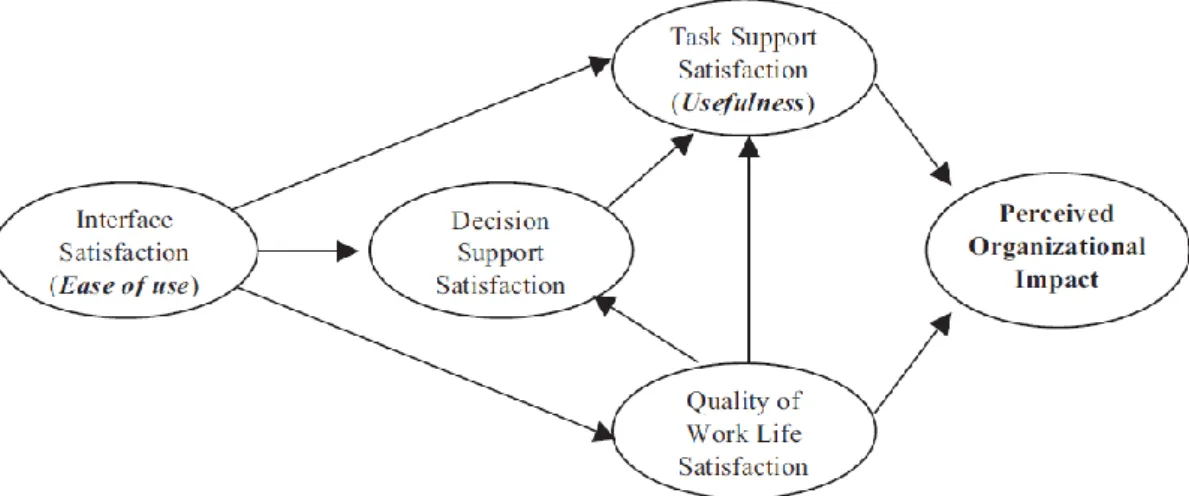
Kim, Garrity and Sanders (2003) researched success measures of information systems and created a ‘User
satisfaction-based information systems success model’ (SISSM), as can be seen in Figure 3.
Figure 3: User satisfaction-based information systems success model (Kim et al., 2003)
The SISSM is only for the user satisfaction on individual level, further success measurements are:
Individual level
o
User satisfaction
Task support satisfaction
Decision support satisfaction
Interface satisfaction
Quality of work life satisfaction
Business process level
o
Operational efficiency
Flexibility and scalability
Consistency
Productivity
Cycle time
o
Management effectiveness
Improvement in decision making
Improvement in span of control
Improvement in planning
Organization level
o
Financial performance
Return on investment
Return on sales
Cash flow
Profitability
o
Enhancement of products and services
Cost reduction
Quality
Responsiveness
Reliability
o
Market share growth
Market share gains
Sales growth
Nitithamyong and Skibniewski
Nitithamyong and Skibniewski (2010) defined sixteen ‘Success factors’ or requirements for the implementation
of Web-based Project Management Systems (WPMS). They made a differentiation between ‘Key’, ‘Important’,
and ‘basic’ success factors:
Key success factors:
Top management support
It is highly recommended that the client or personnel suggesting the use of WPMS must also utilise the system
as their primary method of communication. They must encourage the team to use the system, ensure its
effective use, and become actively involved in all major problems.
Presence of a champion
A champion is a strong leader within a project team who sturdily builds support for the change process by
actively promoting the project and providing information, material, resources, and political support. The
presence of a champion is important to every IT project because transformation occurs when a champion
strongly supports a project and possesses the skills and clout needed to overcome resistance that may arise
within the organization.
To ensure the success of WPMS usage, the project team should identify or assign a champion who can
encourage team members to use WPMS in the project as early as possible.
Adequacy of training
The extent of training given to users is generally recognized as influencing the productive use of an IT project
and has been found to have a great impact on implementation success. If people are willing to learn and use a
new system but do not have appropriate training support, their enthusiasm will disappear quickly.
Formal training and guidelines explaining the folder structure and document management practices used in the
project at hand are necessary. Self-learning or learning from peers is insufficient and sometimes impossible in
the dynamic setting of construction project organization.
Quality of the service provider’s support services
Team members should be able to easily contact the service provider. It is particularly important that all
problems are solved within a reasonable time frame to avoid or reduce any possibility of negative effects on
the project.
Responses to queries by the service provider must also be quick or doubt and frustration will arise among the
users.
The service provider’s staff should have adequate technical competency, including the ability to understand
specific technical problems and to provide solutions to such problems.
Ease of system use
Ease of use is a fundamental aspect of the technical quality of IT systems. This factor is one of the most
common barriers to WPMS adoption frequently reported in literature.
System reliability
How well a system performs its expected function is partly dependent on its reliability, including response time,
uptime, and availability. When users face technical difficulties in using WPMS, they will be quick to revert to
traditional channels of communication which will in turn reduce the usefulness of WPMS.
User involvement during implementation planning
Team members should be involved in the WPMS selection and implementation planning processes to assure
that they fully understand the concept and the role of WPMS, as well as how the system can assist them in
performing their jobs effectively
Alignment of WPMS objectives to project objectives
The WPMS implementation strategy should correspond with and support the project’s team strategy and
business needs. A formal presentation by the decision-makers and the service provider would help in resolving
any potential conflicts regarding the use of WPMS and in ensuring that the commonality of strategies exists.
Service provider’s knowledge in construction
Research both in IT and WPMS areas shows that a service provider must have a good understanding of an
end-user’s business tasks and problems to ensure the success of system implementation. By understanding various
processes and challenges of a construction project, the provider would offer an important bridge between
construction processes and IT solutions.
Availability and reliability of data connections and WPMS access
All team members should have direct access to the internet and WPMS from their work locations. High-speed
connections should also be used but particular attention must be paid for their reliability.
Flexibility of queries and reporting formats
The system’s ability to perform varied database queries and provide flexible reporting formats according to the
user’s needs helps in avoiding misinterpretation of project data that could potentially result in
miscommunication and disputes.
Data security
Security is the prime concern to construction practitioners when using collaboration tools. A fully developed
security system must be equipped with the system, allowing the team to decide what information is to be
available at each security level and assign appropriate security levels to individuals or groups.
Basic requirements
Adequacy of resources
An adequate fund for the use of WPMS should be allocated and agreed at the earliest time possible in the
project as this would facilitate user acceptance of the system.
Computer experience of team members
Computer experience and skills can enhance the potential of WPMS implementation success in a project
environment as several challenges may require creative IT and information management solutions.
Project duration
A project must be long enough to promote the use of WPMS as it is relatively difficult to get all team members
to buy into using WPMS in a short-schedule project. WPMS should be commenced at the earliest possible stage
of the project and should be fully tested before commissioning its actual use.
Saarinen
Saarinen (1996) developed a “multi-dimensional measurement instrument for the success of an IS investment.
Therefore the reliability and validity, for each of the four main constructs we have developed, are assessed
separately.” The measurement instrument is about User Information Satisfaction (UIS).
1.
Reliability
2.
Content validity
There is measured what is supposed to be measured
3.
Predictive validity
The measurement instrument distinguishes the successful cases from the unsuccessful ones, and
converges with other alternative measures of success
4.
Construct validity
The underlying structure of the developed construct is found also in reality
1.
Flexibility of queries and reporting formats
2.
Data security
Scott, Kwan, Cheong and Li
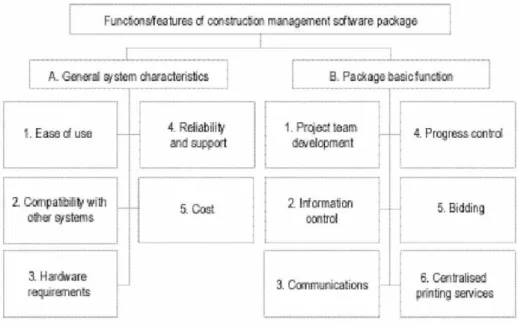
Scott, Kwan, Cheong and Li (2012) defined a checklist with features for the evaluation of Construction
Information Management Systems (CIMS). They separated the features in two categories; General system
characteristics and Package basic functions, see Figure 4.
Figure 4: Hierarchy of features and functions in web-based CIMS selection (Scott et al., 2012)
General system characteristics:
1.
Ease of use
2.
Compatibility with other systems
3.
Hardware requirements
4.
Reliability and support
5.
Cost
Package basic functions:
1.
Project team development
2.
Information control
3.
Communications
4.
Progress control
5.
Bidding
Teeuw, Liefting and Demkes
In the Dutch book ‘Product Data Interchange, Naar succesvolle invoering in de praktijk’ (towards successful
implementation in practice, 1994) Teeuw, Liefting and Demkes developed nine ‘critical factors for success‘
separated in two categories; Technical aspects of PDI and organizational aspects of PDI:
Technical aspects of PDI:
1.
Level of participation
2.
Exchange concept
3.
Level of product description
4.
Standardization
5.
Phase of implementation
Organisational aspects of PDI:
1.
Value chain
2.
Value system
3.
Profit margin
4.
Redesign
Chung et al.
User related variables
1.
Output
2.
Job relevance
3.
Image
4.
Result demonstrability
5.
Compatability
6.
System reliability
Project related variables
7.
Internal support
8.
Function
9.
Consultant support
Kim et al.
Individual level
User satisfaction
1.
Task support satisfaction
2.
Decision support satisfaction
3.
Interface satisfaction
4.
Quality of work life satisfaction
Business process level
Operational efficiency
5.
Flexibility and scalability
6.
Consistency
7.
Productivity
8.
Cycle time
Management effectiveness
9.
Improvement in decision making
10.
Improvement in span of control
11.
Improvement in planning
Organization level
Financial performance
12.
Return on investment
13.
Return on sales
14.
Cash flow
15.
Profitability
Enhancement of products and services
16.
Cost reduction
17.
Quality
18.
Responsiveness
19.
Reliability
Market share growth
1.
Market share gains
2.
Sales growth
3.
Revenue growth
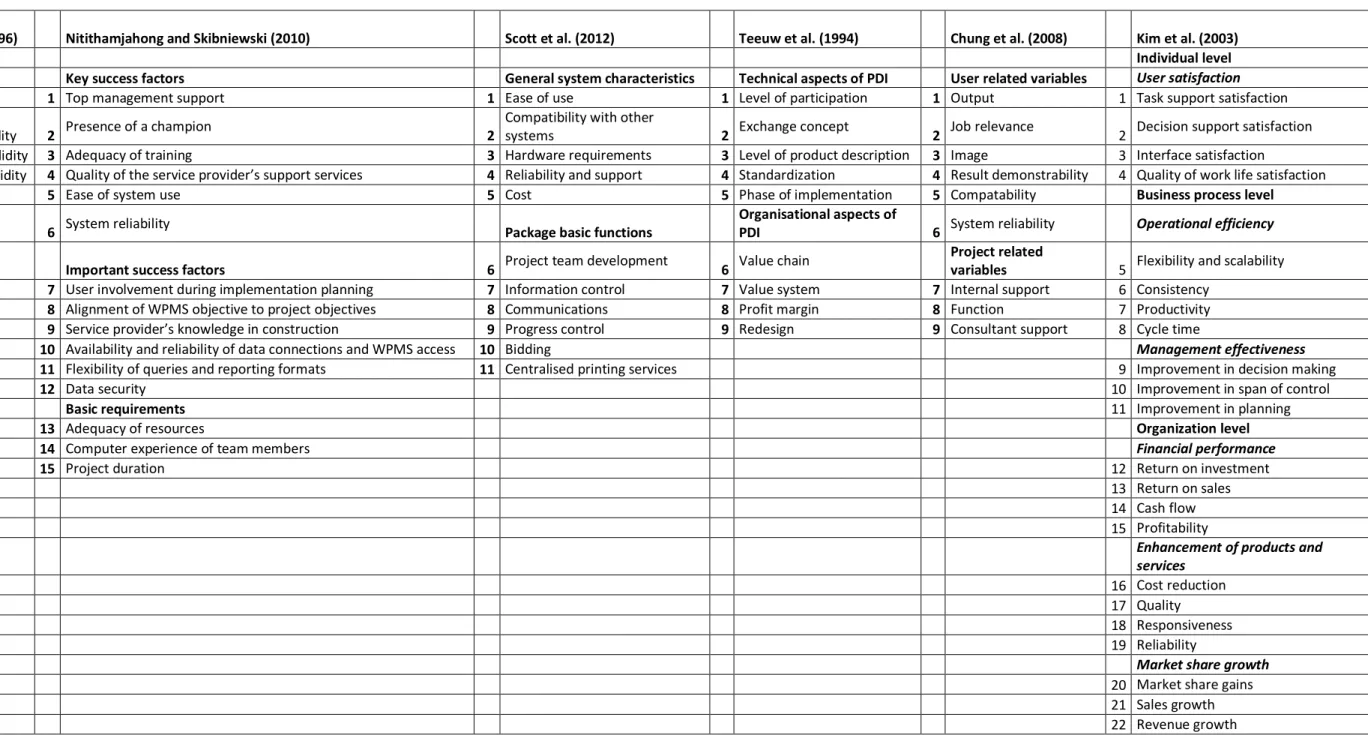
Table 1: Success factors for the implementation of an Information Management System
DeLone and McLean
(2003)
Saarinen (1996)
Nitithamjahong and Skibniewski (2010)
Scott et al. (2012)
Teeuw et al. (1994)
Chung et al. (2008)
Kim et al. (2003)
Individual level
Key success factors
General system characteristics
Technical aspects of PDI
User related variables
User satisfaction
1
Information quality
1
Reliability
1
Top management support
1
Ease of use
1
Level of participation
1
Output
1 Task support satisfaction
2
System quality
2
Content validity
2
Presence of a champion
2
Compatibility with other
systems
2
Exchange concept
2
Job relevance
2
Decision support satisfaction
3
Service quality
3
Predictive validity
3
Adequacy of training
3
Hardware requirements
3
Level of product description
3
Image
3 Interface satisfaction
4
Intention to use
4
Construct validity
4
Quality of the service provider’s support services
4
Reliability and support
4
Standardization
4
Result demonstrability
4 Quality of work life satisfaction
5
User satisfaction
5
Ease of system use
5
Cost
5
Phase of implementation
5
Compatability
Business process level
6
Net benefits
6
System reliability
Package basic functions
Organisational aspects of
PDI
6
System reliability
Operational efficiency
Important success factors
6
Project team development
6
Value chain
Project related
variables
5
Flexibility and scalability
7
User involvement during implementation planning
7
Information control
7
Value system
7
Internal support
6 Consistency
8
Alignment of WPMS objective to project objectives
8
Communications
8
Profit margin
8
Function
7 Productivity
9
Service provider’s knowledge in construction
9
Progress control
9
Redesign
9
Consultant support
8 Cycle time
10
Availability and reliability of data connections and WPMS access
10
Bidding
Management effectiveness
11
Flexibility of queries and reporting formats
11
Centralised printing services
9 Improvement in decision making
12
Data security
10 Improvement in span of control
Basic requirements
11 Improvement in planning
13
Adequacy of resources
Organization level
14
Computer experience of team members
Financial performance
15
Project duration
12 Return on investment
13 Return on sales
14 Cash flow
15 Profitability
Enhancement of products and
services
16 Cost reduction
17 Quality
18 Responsiveness
19 Reliability
Market share growth
20 Market share gains
21 Sales growth
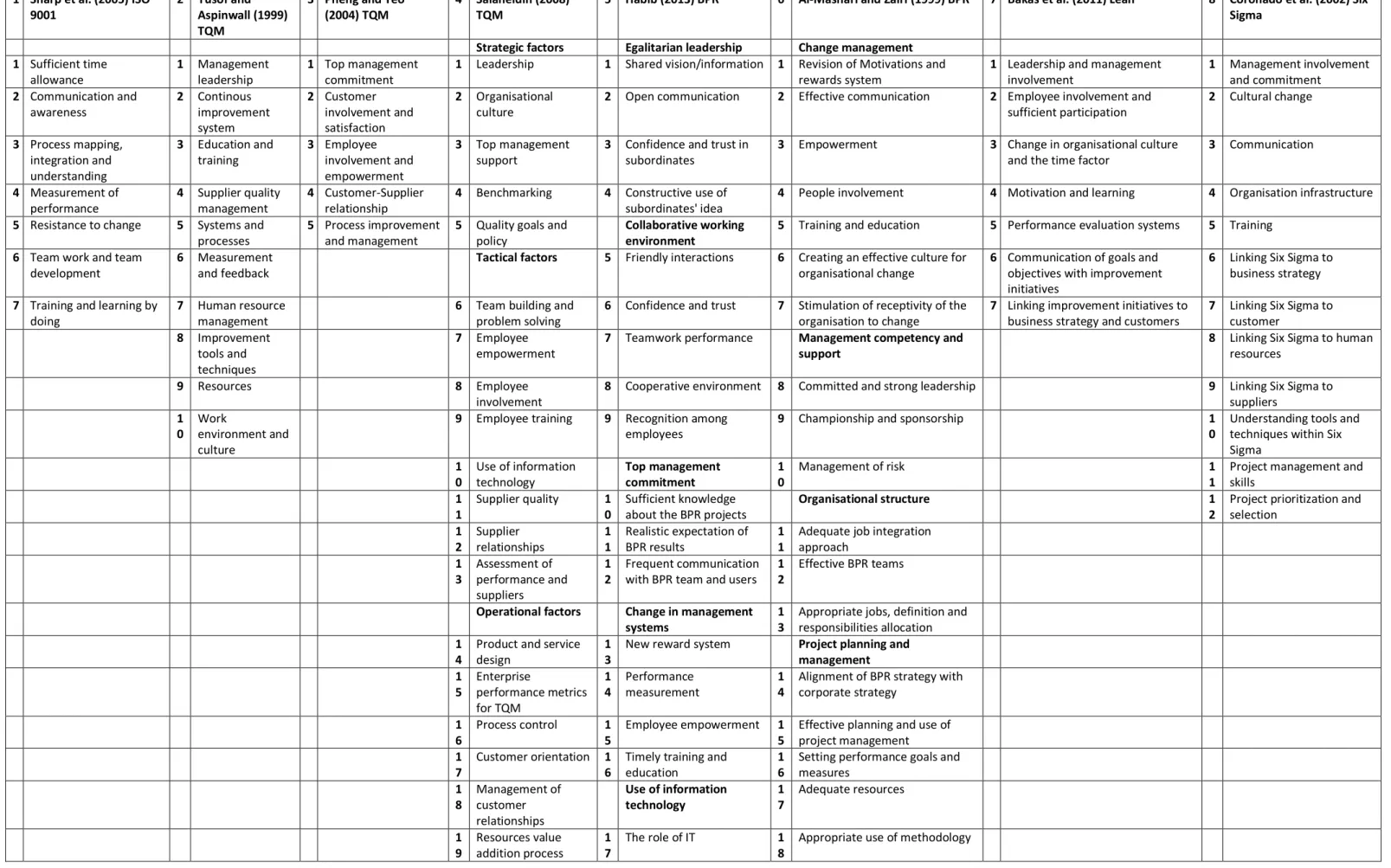
Appendix B: Success factors Quality Management Systems (QMS)
Success factors for the implementation of an Quality Management System (QMS) are derived from literature
about this subject. The QMS’s researched are:
ISO 9001
Total Quality Management (TQM)
Business Process Re-engineering (BPR)
Lean manufacturing
Six sigma
A summary of the derived success factors can be found in Table 2.
Sharp, Sharif, Al Haj, Kutucuoglu and Davies
1.
Sufficient time allowance
2.
Communication and awareness
3.
Process mapping, integration and understanding
4.
Measurement of performance
5.
Resistance to change
6.
Team work and team development
7.
Training and learning by doing
Yusof and Aspinwall
1.
Management leadership
2.
Continous improvement system
3.
Education and training
4.
Supplier quality management
5.
Systems and processes
6.
Measurement and feedback
7.
Human resource management
8.
Improvement tools and techniques
9.
Resources
10.
Work environment and culture
Pheng and Teo
1.
Top management commitment
2.
Customer involvement and satisfaction
3.
Employee involvement and empowerment
4.
Customer-Supplier relationship
5.
Process improvement and management
Salaheldin
Strategic factors
1.
Leadership
2.
Organisational culture
3.
Top management support
4.
Benchmarking
5.
Quality goals and policy
Tactical factors
6.
Team building and problem solving
7.
Employee empowerment
8.
Employee involvement
9.
Employee training
10.
Use of information technology
11.
Supplier quality
12.
Supplier relationships
13.
Assessment of performance and suppliers
Operational factors
14.
Product and service design
15.
Enterprise performance metrics for TQM
16.
Process control
17.
Customer orientation
18.
Management of customer relationships
19.
Resources value addition process
20.
Realistic TQM imp
Habib
Egalitarian leadership
1.
Shared vision/information
2.
Open communication
3.
Confidence and trust in subordinates
4.
Constructive use of subordinates' idea
Collaborative working environment
5.
Friendly interactions
6.
Confidence and trust
7.
Teamwork performance
8.
Cooperative environment
9.
Recognition among employees
Top management commitment
10.
Sufficient knowledge about the BPR projects
11.
Realistic expectation of BPR results
12.
Frequent communication with BPR team and users
Change in management systems
13.
New reward system
14.
Performance measurement
15.
Employee empowerment
16.
Timely training and education
Use of information technology
17.
The role of IT
18.
Use of up-to-date communication technology
19.
Adoption of IT
Al-Mashari and Zairi
1.
Revision of Motivations and rewards system
2.
Effective communication
3.
Empowerment
4.
People involvement
5.
Training and education
6.
Creating an effective culture for organisational change
7.
Stimulation of receptivity of the organisation to change
Management competency and support
8.
Committed and strong leadership
9.
Championship and sponsorship
10.
Management of risk
11.
Organisational structure
12.
Adequate job integration approach
13.
Effective BPR teams
14.
Appropriate jobs, definition and responsibilities allocation
Project planning and management
15.
Alignment of BPR strategy with corporate strategy
16.
Effective planning and use of project management
17.
Setting performance goals and measures
18.
Adequate resources
19.
Appropriate use of methodology
20.
External orientation and learning
21.
Effective use of consultants
22.
Building a BPR vision
23.
Effective process redesign
24.
Integrating BPR with other improvement approaches
25.
Adequate identification of BPR values
IT infrastructure
26.
Adequate alignment of IT infrastructure and BPR strategy
27.
Building an effective IT infrastructure
28.
Adequate IT investment and sourcing decisions
29.
Adequate measurement of IT infrastructure effectiveness on BPR
30.
Proper IS integration
31.
Effective Reengineering of Legacy IS
32.
Increasing IT function competency
33.
Effective use of software tools
Bakas, Govaert and Van Landeghem
1.
Leadership and management involvement
2.
Employee involvement and sufficient participation
3.
Change in organisational culture and the time factor
4.
Motivation and learning
5.
Performance evaluation systems
6.
Communication of goals and objectives with improvement initiatives
7.
Linking improvement initiatives to business strategy and customers
Coronado and Anthony
1.
Management involvement and commitment
2.
Cultural change
3.
Communication
4.
Organisation infrastructure
5.
Training
6.
Linking Six Sigma to business strategy
7.
Linking Six Sigma to customer
8.
Linking Six Sigma to human resources
9.
Linking Six Sigma to suppliers
10.
Understanding tools and techniques within Six Sigma
11.
Project management and skills
Table 2: Success factors for the implementation of a Quality Management System
1 Sharp et al. (2005) ISO
9001
2 Yusof and
Aspinwall (1999)
TQM
3 Pheng and Teo
(2004) TQM
4 Salaheldin (2008)
TQM
5 Habib (2013) BPR
6 Al-Mashari and Zairi (1999) BPR
7 Bakas et al. (2011) Lean
8 Coronado et al. (2002) Six
Sigma
Strategic factors
Egalitarian leadership
Change management
1
Sufficient time
allowance
1
Management
leadership
1
Top management
commitment
1
Leadership
1
Shared vision/information
1
Revision of Motivations and
rewards system
1
Leadership and management
involvement
1
Management involvement
and commitment
2
Communication and
awareness
2
Continous
improvement
system
2
Customer
involvement and
satisfaction
2
Organisational
culture
2
Open communication
2
Effective communication
2
Employee involvement and
sufficient participation
2
Cultural change
3
Process mapping,
integration and
understanding
3
Education and
training
3
Employee
involvement and
empowerment
3
Top management
support
3
Confidence and trust in
subordinates
3
Empowerment
3
Change in organisational culture
and the time factor
3
Communication
4
Measurement of
performance
4
Supplier quality
management
4
Customer-Supplier
relationship
4
Benchmarking
4
Constructive use of
subordinates' idea
4
People involvement
4
Motivation and learning
4
Organisation infrastructure
5
Resistance to change
5
Systems and
processes
5
Process improvement
and management
5
Quality goals and
policy
Collaborative working
environment
5
Training and education
5
Performance evaluation systems
5
Training
6
Team work and team
development
6
Measurement
and feedback
Tactical factors
5
Friendly interactions
6
Creating an effective culture for
organisational change
6
Communication of goals and
objectives with improvement
initiatives
6
Linking Six Sigma to
business strategy
7
Training and learning by
doing
7
Human resource
management
6
Team building and
problem solving
6
Confidence and trust
7
Stimulation of receptivity of the
organisation to change
7
Linking improvement initiatives to
business strategy and customers
7
Linking Six Sigma to
customer
8
Improvement
tools and
techniques
7
Employee
empowerment
7
Teamwork performance
Management competency and
support
8
Linking Six Sigma to human
resources
9
Resources
8
Employee
involvement
8
Cooperative environment
8
Committed and strong leadership
9
Linking Six Sigma to
suppliers
1
0
Work
environment and
culture
9
Employee training
9
Recognition among
employees
9
Championship and sponsorship
1
0
Understanding tools and
techniques within Six
Sigma
1
0
Use of information
technology
Top management
commitment
1
0
Management of risk
1
1
Project management and
skills
1
1
Supplier quality
1
0
Sufficient knowledge
about the BPR projects
Organisational structure
1
2
Project prioritization and
selection
1
2
Supplier
relationships
1
1
Realistic expectation of
BPR results
1
1
Adequate job integration
approach
1
3
Assessment of
performance and
suppliers
1
2
Frequent communication
with BPR team and users
1
2
Effective BPR teams
Operational factors
Change in management
systems
1
3
Appropriate jobs, definition and
responsibilities allocation
1
4
Product and service
design
1
3
New reward system
Project planning and
management
1
5
Enterprise
performance metrics
for TQM
1
4
Performance
measurement
1
4
Alignment of BPR strategy with
corporate strategy
1
6
Process control
1
5
Employee empowerment
1
5
Effective planning and use of
project management
1
7
Customer orientation
1
6
Timely training and
education
1
6
Setting performance goals and
measures
1
8
Management of
customer
relationships
Use of information
technology
1
7
Adequate resources
1
9
Resources value
addition process
1
7
The role of IT
1
8
2
0
Realistic TQM imp
1
8
Use of up-to-date
communication
technology
1
9
External orientation and learning
1
9
Adoption of IT
2
0
Effective use of consultants
2
1
Building a BPR vision
2
2
Effective process redesign
2
3
Integrating BPR with other
improvement approaches
2
4
Adequate identification of BPR
values
IT infrastructure
2
5
Adequate alignment of IT
infrastructure and BPR strategy
2
6
Building an effective IT
infrastructure
2
7
Adequate IT investment and
sourcing decisions
2
8
Adequate measurement of IT
infrastructure effectiveness on
BPR
2
9
Proper IS integration
3
0
Effective Reengineering of Legacy
IS
3
1
Increasing IT function
competency
3
2
2. Level of education
MBO
HBO
WO
3. Years of working experience
0-1 2-3 4-6 7-10 11-20 21-30 31-40
0,00%
10,00%
20,00%
30,00%
40,00%
50,00%
4. Company
Appendix D: Answers survey
Personal data
2. What is your highest level of education? 2. Wat is jouw hoogst genoten opleiding?
1. MBO 2 5,71%
2. HBO 23 65,71%
3. WO 10 28,57%
35 100,00%
3. How many years of work experience do you have? 3. Hoeveel jaar werkervaring heb jij?
1. 0-1 1 2,86% 2. 2-3 2 5,71% 3. 4-6 3 8,57% 4. 7-10 4 11,43% 5. 11-20 11 31,43% 6. 21-30 13 37,14% 7. 31-40 1 2,86% 35 100,00%
1. What is your age? 1. Wat is je leeftijd? 1. 20-25 3 8,57% 2. 26-30 5 14,29% 3. 31-35 4 11,43% 4. 36-40 5 14,29% 5. 41-45 7 20,00% 6. 46-50 8 22,86% 7. 51-55 2 5,71% 8. 56-60 1 2,86% 35 100,00%
4. At which company do you work? 4. Bij welk bedrijf werk jij?
1. Mobilis 17 48,57% 2. Van Gelder 4 11,43% 3. Geobest 2 5,71% 4. Strabag 2 5,71% 5. CFE 1 5,71% 6. Grontmij 1 2,86% 7. IV-infra 1 2,86% 8. Jeroen Koot 1 2,86% 9. Movares 1 2,86% 10. Nobleo 1 2,86% 11. Tauw 1 2,86% 12. Wiertsema 1 2,86% 13. Zublin 1 2,86% 36 100,00%
1.
Age
20-25 26-30 31-35 36-40 41-45 46-50 51-55 56-605. Years working experience at company
0-1 2-3 4-6 7-10 11-20 21-306. Department
Management board Execution Work preparation Acquisition Design HSE Quality SE Different0,00%
5,00%
10,00%
15,00%
20,00%
25,00%
30,00%
7. Projects with usage of IMT-MS
8. Leadership during projects
Yes
No
5. How many years do you work at this company? 5. Hoeveel jaar werk je al bij dit bedrijf?
1. 0-1 9 25,71% 2. 2-3 4 11,43% 3. 4-6 9 25,71% 4. 7-10 3 8,57% 5. 11-20 7 20,00% 6. 21-30 3 8,57% 35 100,00%
6. On which department of the company do you work? 6. Op welke afdeling werk jij?
1. Management board 1 2,86% 2. Execution 2 5,71% 3. Project preparation 6 17,14% 4. Acquisition 5 14,29% 5. Design 10 28,57% 6. HSE 3 8,57% 7. Quality 2 5,71% 8. SE 1 2,86% 9. Different 5 14,29% 35 100,00%
7. On which projects did you use IMT-MS? 7. Op welke projecten heb je IMT-MS gebruikt?
1. Centrale As Midden 12 26,09% 2. Parallelstructuur A12 9 19,57% 3. Haak om Leeuwarden 4 8,70% 4. A50 Ewijk-Valburg 3 6,52% 5. A4 Steenbergen 2 4,35% 6. Drachtsterweg 2 4,35% 7. Kustwerk Katwijk 2 4,35% 8. Radartoren Neeltje Jans 2 4,35% 9. Rotterdam CS/NSP 2 4,35% 10. Shtandart TT 2 4,35% 11. Stadsring Limburg 2 4,35% 12. Ecopassage Veluwe 1 2,17% 13. PB Nieuwegein 1 2,17% 14. Spoorzone Delft 1 2,17% 15. Station Lelystad 1 2,17% 46 100,00%
8. Do you have a leadership function during projects? 8. Geef je leiding in/aan projecten?
1. Yes 11 31,43%
2. No 24 68,57%
10. Underlying policy
Very unclear
Unclear
Clear
Very clear
Not applicaple
11. Goal
Very unclear
Unclear
Clear
Very clear
Not applicaple
12. Motivation from management board
No support Little support Sufficient support Ample support Not applicaple
13. Motivation from head of department
No support Little support Sufficient support Ample support Not applicaple
14. Motivation from direct supervisor
No support Little support Sufficient support Ample support Not applicaple
Development IMT-MS
SF1: Clear and open goals and policy
10. Is the underlying policy of IMT-MS clear?
10. Is het achterliggende beleid van IMT-MS duidelijk?
1. Very unclear 0 0,00% 2. Unclear 14 40,00% 3. Clear 18 51,43% 4. Very clear 1 2,86% 5. Not applicaple 2 5,71% 35 100,00%
SF1: Clear and open goals and policy
11. Is the goal of IMT-MS clear? 11. Is het doel van IMT-MS duidelijk?
1. Very unclear 0 0,00% 2. Unclear 7 20,00% 3. Clear 24 68,57% 4. Very clear 4 11,43% 5. Not applicaple 0 0,00% 35 100,00%
SF2: Top management support
12. Do you experience enough motivation/support from the management board to use IMT-MS?
12. Ervaar je voldoende motivatie/draagvlak vanuit de directie om IMT-MS te gebruiken? 1. No support 4 11,43% 2. Little support 14 40,00% 3. Sufficient support 8 22,86% 4. Ample support 3 8,57% 5. Not applicaple 6 17,14% 35 100,00%
SF2: Top management support
13. Do you experience enough motivation/support from the head of your department to use IMT-MS?
13. Ervaar je voldoende motivatie/draagvlak vanuit het hoofd van uw afdeling om IMT-MS te gebruiken?
1. No support 1 2,86% 2. Little support 10 28,57% 3. Sufficient support 8 22,86% 4. Ample support 8 22,86% 5. Not applicaple 8 22,86% 35 100,00%
SF2: Top management support
14. Do you experience enough motivation/support from your direct supervisor to use IMT-MS?
14. Ervaar je voldoende motivatie/draagvlak vanuit je directe leidinggevende om IMT-MS te gebruiken?
1. No support 2 5,71% 2. Little support 10 28,57% 3. Sufficient support 7 20,00% 4. Ample support 8 22,86% 5. Not applicaple 8 22,86% 35 100,00%
15. Motivation from colleagues
No support Little support Sufficient support Ample support Not applicaple17. Involvement implementation process
No involvement
Little involvement
Sufficient involvement Ample involvement
Not applicable
16. Involvement development process
No involvement Little involvement Sufficient involvement Ample involvement Not applicable
18. Provided training
No training provided Training provided; insufficient Training provided; sufficient Training provided; ample Not applicable SF2: Top management support15. Do you experience enough motivation/support from your colleagues to use IMT-MS?
15. Ervaar je voldoende motivatie/draagvlak vanuit je collega's om IMT-MS te gebruiken? 1. No support 3 8,57% 2. Little support 9 25,71% 3. Sufficient support 18 51,43% 4. Ample support 2 5,71% 5. Not applicaple 3 8,57% 35 100,00%
SF3a: User involvement development phase
16. Is the end user sufficiently involved during the development process of IMT-MS?
16. Is de gebruiker voldoende betrokken bij het ontwikkelingsproces van IMT-MS? 1. No involvement 7 20,00% 2. Little involvement 15 42,86% 3. Sufficient involvement 9 25,71% 4. Ample involvement 0 0,00% 5. Not applicable 4 11,43% 35 100,00%
SF3b: User involvement implementation phase
17. Is the end user sufficiently involved during the implementation process of IMT-MS?
17. Is de gebruiker voldoende betrokken bij het implementatieproces van IMT-MS? 1. No involvement 7 20,00% 2. Little involvement 18 51,43% 3. Sufficient involvement 6 17,14% 4. Ample involvement 0 0,00% 5. Not applicable 4 11,43% 35 100,00% SF5: Adequacy of training
18. Is the training/explanation that is provided sufficient to work well with IMT-MS?
18. Is de training/uitleg die aangeboden wordt voldoende om goed te werken met IMT-MS?
1. No training provided 13 37,14% 2. Training provided; insufficient 11 31,43% 3. Training provided; sufficient 8 22,86% 4. Training provided; ample 0 0,00% 5. Not applicable 3 8,57%
19. Computer experience team members
No experience Insufficient experience Sufficient experience Ample experience Not applicable20. Which questions/themes from this page do you think are the most important for succes of IMT-MS? (1 is most important, 10 least important)
20. Welke vragen/thema's van deze pagina vind je het belangrijkste voor het succes van IMT-MS? (1 is het belangrijkste, 10 het minst belangrijk)
1. 2. 3. 4. 5. 6. 7. 8. 9. 10. 1. 10. Underlying policy 6 5 5 3 3 5 5 4 5 1
2. 11. Goal 14 8 3 2 3 2 1 1 1 0
3.
12. Motivation from management
board 3 4 7 3 1 2 5 4 3 4
4.
13. Motivation from head of
department 1 4 3 10 4 4 1 1 3 3
5. 14. Motivation from direct supervisor 3 6 5 3 8 4 4 2 1 1 6. 15. Motivation from colleagues 2 4 4 6 3 2 4 4 4 1 7. 16. Involvement development process 0 2 3 2 3 6 4 4 3 8
8. 17. Involvement implementation process 2 0 1 1 6 3 6 5 6 2 9. 18. Provided training 4 1 2 2 3 7 1 9 4 1 10. 19. Computer experience 0 1 2 3 1 0 4 1 5 14 Score Ranking 1. 10. Underlying policy 22 3 2. 11. Goal 107 1 3.
12. Motivation from management
board 3 6
4.
13. Motivation from head of
department 18 4
5. 14. Motivation from direct supervisor 41 2 6. 15. Motivation from colleagues 10 5 7. 16. Involvement development process -54 9
8.
17. Involvement implementation
process -43 8
9. 18. Provided training -20 7 10. 19. Computer experience -84 10
SF6: Computer experience of team members
19. Is the computer experience of colleagues within your project team sufficient to work with IMT-MS?
19. Is de computerervaring van collega's binnen je projectteam voldoende om te werken met IMT-MS?
1. No experience 2 5,71% 2. Insufficient experience 4 11,43% 3. Sufficient experience 19 54,29% 4. Ample experience 7 20,00% 5. Not applicable 3 8,57% 35 100,00%
-100
-50
0
50
100
150
20. Importance questions themes page 'development IMT-MS'
21. Comment page ‘Development’ 21. Commentaar pagina 'Ontwikkeling'
"Creeer draagkracht voor het gebruik van SE en een goede documentcontrol binnen het projectteam als tools om he project mee te beheersen en ga niet meteen in op de techniek van de programma's. Maak een goede homepage in relatix waarin systeemverantwoordelijken de zaken zien die voor hun van belang zijn en niet meer dan dat. Regel een goede invulling van de documentcontrol en een heldere structuur." Het is belangrijk dat collega's het ervaren als een hulpmiddel en niet als weer een nieuwe last. Daarmee zal de wil ermee te werken substantieel toenemen."
22. Open and effective communication
No communication possible
Little open and effective communication Reasonable open and effective communication Very open and effective communication Not applicable
23. Exchange of information
No exchange possible
Deteriorates exchange
Exchange does not change
Improves exchange
Not applicable
24. Collaboration within project
No collaboration possible Deteriorates collaboration
Collaboration does not change
Improves collaboration
Not applicable
25. Clearness roles and permissions
Very unclear
Unclear
Clear
Very clear
Not applicable
Communication
SF7: Open and effective communication
22. Do IMT-MS and Chapoo lead to open and effective communication?
22. Leiden IMT-MS en Chapoo tot open en effectieve communicatie?
1. No communication possible 1 2,94% 2. Little open and effective communication 15 44,12% 3. Reasonable open and effective communication 13 38,24% 4. Very open and effective communication 3 8,82% 5. Not applicable 2 5,88%
34 100,00%
SF8: Exchange of data by team members
23. Do IMT-MS and Chapoo promote the exchange of information between project team members?
23. Bevorderen IMT-MS en Chapoo de uitwisseling van informatie tussen projectteam leden?
1. No exchange possible 1 2,94% 2. Deteriorates exchange 4 11,76% 3. Exchange does not change 14 41,18% 4. Improves exchange 12 35,29% 5. Not applicable 3 8,82%
34 100,00%
SF9: Improvement of collaboration
24. Does IMT-MS have effect on the collaboration within a project?
24. Heeft IMT-MS effect op de samenwerking binnen een project?
1. No collaboration possible 0 0,00% 2. Deteriorates collaboration 5 14,71% 3. Collaboration does not change 20 58,82% 4. Improves collaboration 5 14,71% 5. Not applicable 4 11,76%
34 100,00%
SF10: Assigning of responsibilities
25. Are the roles and permissions clearly assigned within IMT-MS?
25. Zijn de rollen en rechten binnen IMT-MS duidelijk toegewezen? 1. Very unclear 3 8,82% 2. Unclear 19 55,88% 3. Clear 10 29,41% 4. Very clear 1 2,94% 5. Not applicable 1 2,94% 34 100,00%
26. Support Building Process department
Largely insufficient Insufficient Sufficient Ample Not applicable27. Support Quality department
Largely insufficient Insufficient Sufficient Ample Not applicable
28. Affinity construction industry BP
department
Largely insufficient Insufficient Sufficient Ample Not applicable29. Affinity construction industry Quality
department
Largely insufficient Insufficient Sufficient Ample Not applicable SF11a: Quality of support service26. Is the support for IMT-MS from the building process department sufficient?
26. Is de ondersteuning van IMT-MS vanuit de afdeling Bouwproces voldoende? 1. Largely insufficient 1 2,94% 2. Insufficient 5 14,71% 3. Sufficient 20 58,82% 4. Ample 0 0,00% 5. Not applicable 8 23,53% 34 100,00%
SF11a: Quality of support service
27. Is the support for IMT-MS from the Quality department sufficient?
27. Is de ondersteuning van IMT-MS vanuit de afdeling Kwaliteit voldoende? 1. Largely insufficient 3 8,82% 2. Insufficient 6 17,65% 3. Sufficient 14 41,18% 4. Ample 2 5,88% 5. Not applicable 9 26,47% 34 100,00%
SF11b: Knowledge of support provider in construction
28. Has the Building Process department sufficient affinity with the construction industry to provide support for IMT-MS?
28. Heeft de afdeling Bouwproces voldoende affiniteit met de bouw om ondersteuning van IMT-MS te bieden?
1. Largely insufficient 1 2,94% 2. Insufficient 5 14,71% 3. Sufficient 17 50,00% 4. Ample 1 2,94% 5. Not applicable 10 29,41% 34 100,00%
SF11b: Knowledge of support provider in construction
29. Has the Quality department sufficient affinity with the construction industry to provide support for IMT-MS?
29. Heeft de afdeling Kwaliteit voldoende affiniteit met de bouw om ondersteuning van IMT-MS te bieden?
1. Largely insufficient 2 5,88% 2. Insufficient 6 17,65% 3. Sufficient 13 38,24% 4. Ample 1 2,94% 5. Not applicable 12 35,29% 34 100,00%
30. Which questions/themes from this page do you think are the most important for succes of IMT-MS? (1 is most important, 8 least important)
30. Welke vragen/thema's van deze pagina vind je het belangrijkste voor het succes van IMT-MS? (1 is het belangrijkste, 8 het minst belangrijk)
1. 2. 3. 4. 5. 6. 7. 8.
1. 22. Open and effective communication 12 8 9 3 2 2 2 3 2. 23. Exchange of information 11 10 7 3 1 1 0 0 3. 24. Collaboration within project 4 9 12 2 5 0 1 0 4. 25. Clearness roles and permissions 2 2 4 12 1 5 0 8 5. 26. Support Building Process department 3 1 0 7 15 2 4 0 6. 27. Support Quality department 0 3 0 2 7 10 8 2 7. 28. Affinity construction industry BP department 2 0 2 3 1 10 14 2 8. 29. Affinity construction industry Quality department 0 1 0 2 2 4 5 19
Score Ranking
1. 22. Open and effective communication 69 1 2. 23. Exchange of information 88 2 3. 24. Collaboration within project 61 3 4. 25. Clearness roles and permissions -9 4/5 5. 26. Support Building Process department -9 4/5 6. 27. Support Quality department -48 6 7. 28. Affinity construction industry BP department -56 7 8. 29. Affinity construction industry Quality department -96 8
0
31. Comment page 'Communication' 31. Commentaar pagina 'Communicatie'
"De ondersteuning vanuit bouwproces heeft een veel te hoog abstractiegehalte voor de meeste medewerkers. Zolang het beleid en het doel er achter onvoldoende duidelijk is gaat het implementatieproces moeizaam."
-100
-50
0
50
100
32. Influence duration of project
Yes
No
0
1
2
3
4
5
1-10
11-20 21-30 31-40 41-50 51-60
33. Minimum duration project (weeks)
34. Influence size of project
Yes
No
0
1
2
3
4
0-2
3-4
5-6
7-8
9-10
35. Minimum size project (million euro)
36. Support decision making
No support
Little support
Support
Much support
Possibilities
SF12: Project duration32. Does the duration of the project have influence on the usage of IMT-MS?
32. Heeft de tijdsduur van het project invloed op het gebruik van IMT-MS?
1. Yes 12 37,50%
2. No 20 62,50%
32 100,00%
SF12: Project duration
33. If yes, what is the minimum duration of a project, where IMT-MS is effective? (in weeks)
33. Zo ja, wat is dan de minimale tijdsduur van een project waarbij IMT-MS effectief is? (in weken)
1. 1-10 4 28,57% 2. 11-20 3 21,43% 3. 21-30 5 35,71% 4. 31-40 0 0,00% 5. 41-50 0 0,00% 6. 51-60 2 14,29% 14 100,00% SF12: Project duration
34. Does the size of the project have influence on the usage of IMT-MS? 34. Heeft de omvang van het project invloed op het gebruik van IMT-MS?
1. Yes 17 53,13%
2. No 15 46,88%
32 100,00%
SF12: Project duration
35. If yes, what is the minimum size of a project, where IMT-MS is effective? (in million euro)
35. Zo ja, wat is dan de minimale omvang van een project waarbij IMT-MS effectief is? (In miljoen euro)
1. 0-2 4 40,00% 2. 3-4 0 0,00% 3. 5-6 3 30,00% 4. 7-8 0 0,00% 5. 9-10 3 30,00% 10 100,00% SF19: Decision support 36. Does IMT-MS support the decision making during a project?
36. Ondersteunt IMT-MS de besluitvorming binnen een project? 1. No support 9 28,13% 2. Little support 6 18,75% 3. Support 10 31,25% 4. Much support 0 0,00% 5. Not applicable 7 21,88%
37. Storing of decision making
Largely insufficient Insufficient Sufficient Ample Not applicable38. Compatibility IMT-MS
Largely insufficient Insufficient Sufficient Ample Not applicable0,00%
20,00%
40,00%
60,00%
80,00%
100,00%
39. Possibilities
Largely insufficient
Insufficient
Sufficient
Ample
Not applicable
SF19: Decision support37. Are there sufficient possibilities to store the decision making in IMT-MS and Chapoo?
37. Is er voldoende mogelijkheid om besluitvorming vast te leggen in IMT-MS en Chapoo? 1. Largely insufficient 3 9,38% 2. Insufficient 10 31,25% 3. Sufficient 13 40,63% 4. Ample 1 3,13% 5. Not applicable 5 15,63% 32 100,00%
SF20: Compatibility with other systems
38. Is the compatibility of IMT-MS with other software/programmes sufficient?
38. Is de compatibiliteit van IMT-MS met andere software/programma's voldoende? 1. Largely insufficient 5 15,63% 2. Insufficient 9 28,13% 3. Sufficient 10 31,25% 4. Ample 2 6,25% 5. Not applicable 6 18,75% 32 100,00% SF21: System quality
SF22: Flexibility of queries and reporting formats
39. Do IMT-MS and Chapoo offer sufficient possibilities on these fields:
39. Bieden IMT-MS en Chapoo voldoende mogelijkheden op de volgende onderdelen:
Project management Technical management Surroundings management Project control Project support Reporting Queries 1. Largely insufficient 2 6,25% 2 6,25% 2 6,25% 2 6,25% 2 6,25% 2 6,25% 6 18,75% 2. Insufficient 4 12,50% 4 12,50% 4 12,50% 5 15,63% 6 18,75% 10 31,25% 6 18,75% 3. Sufficient 19 59,38% 20 62,50% 15 46,88% 17 53,13% 18 56,25% 14 43,75% 16 50,00% 4. Ample 1 3,13% 3 9,38% 2 6,25% 3 9,38% 2 6,25% 1 3,13% 2 6,25% 5. Not applicable 6 18,75% 3 9,38% 9 28,13% 5 15,63% 4 12,50% 5 15,63% 2 6,25%
0,00%
20,00%
40,00%
60,00%
80,00%
100,00%
41. Document management possibilities
Largely insufficient
Insufficient
Sufficient
Ample
Not applicable
SF21: System qualitySF22: Flexibility of queries and reporting formats
40. Are there modules/parts/processes missing in IMT-MS and Chapoo? If yes, which? 40. Zijn er modules/onderdelen/processen die u mist in IMT-MS en Chapoo? Zo ja, welke? "Risicomanagement en raakvlakmanagement"
"Handmatig beheren versienummers" "Zoeken in documenten naar tekst (inhoud)" "Vastleggen kansen/optimalisaties. Koppeling 3D"
"Open editing in Windows omgeving (zoals bijv. mogelijk is in Sharepoint)" "Overzicht en duidelijkheid in documenten"
SF23a: System possibilities: Document management
41. Do IMT-MS and Chapoo offer sufficient possibilities for document management on these fields:
41. Bieden IMT-MS en Chapoo voor het document management voldoende mogelijkheden op de volgende onderdelen:
Internal document distribution External document distribution Project correspondens e management Drafting/Testing internal documents Testing external documents Archiving/Sto ring Version control Who-reads-what list 1. Largely insufficient 2 6,25% 2 6,25% 2 6,25% 3 9,38% 2 6,25% 2 6,25% 5 15,63% 1 3,13% 2. Insufficient 4 12,50% 3 9,38% 6 18,75% 5 15,63% 6 18,75% 2 6,25% 5 15,63% 3 9,38% 3. Sufficient 16 50,00% 14 43,75% 14 43,75% 13 40,63% 13 40,63% 18 56,25% 11 34,38% 16 50,00% 4. Ample 4 12,50% 4 12,50% 2 6,25% 2 6,25% 1 3,13% 6 18,75% 5 15,63% 2 6,25% 5. Not applicable 6 18,75% 9 28,13% 8 25,00% 9 28,13% 10 31,25% 4 12,50% 6 18,75% 10 31,25%