Gaining from Training?:
Designing an Online Training Module for University of Hawai‘i-West O‘ahu
Peer-Tutors
Natalie Perez
University of Hawai‘i at Mānoa Honolulu, HI, USA [email protected]
https://sites.google.com/view/noeaututortraining/home
Abstract: The No‘eau Center, a learning center at the University of Hawai‘i-West O‘ahu (UHWO), provides supplemental support services to UHWO students through peer tutoring. In order to offer this service, the No‘eau Center hires UHWO undergraduate students and prepares them for tutoring through a rigorous training program. Following the guidelines of the International Tutor Training Program Certification (ITTPC) provided by the College Reading and Learning Association (CRLA), the center is qualified to provide Level 1 tutor training, which focuses on foundational tutoring elements for peer tutors. Having completed the requirements of Level 1 training, returning peer tutors have expressed a desire to broaden their tutoring abilities. In order to obtain Level-2 ITTPC certification from the CRLA, the No‘eau Center is required to provide training on ways to enhance the learning environment of a tutoring session. The purpose of this project was to create and evaluate an online tutor-training module to educate peer tutors on ways to structure and modify the learning environment of a tutoring session. The module was created using Google Sites, a free web development platform, as well as a combination of tools including: Google Docs, Google Forms, and YouTube. A constructivist design approached blended with anchored instruction were integrated into the design. This study involved a total of 11 participants ranging in ages from 18 to 26. All data collected from the project was analyzed and reported through the use of statistical and descriptive analysis. The results of the data suggest that after completing the online tutor training module, participants’ knowledge on tutoring strategies increased.
Introduction
Learning centers are spaces of daily contact as students, faculty, and administration alike move in and out of the center, making them one of the “busiest intersections” on campus (Kail, 2014). Not surprisingly, these types of centers play an essential role within an institution’s retention efforts. However, to ensure successful retention of students, peer-tutors need to be appropriately trained to meet the demands of a given student body. Relatedly, the No‘eau Center is an
educational learning center located at the University of Hawai‘i-West O‘ahu (UHWO hereafter). Founded in 2007, the No‘eau Center has been responsible for offering writing, math, science, and other subject tutoring services to students enrolled at the university. Key features of the center are to foster independent learning and assist in the retention efforts of the university. In order to achieve these goals, the staff at the center focuses a large amount of their work on training peer tutors, so that the tutors are knowledgeable in tutoring methods and strategies
needed to successfully interact and assist students. The center’s training curriculum follows the guidelines of the International Tutor Training Program Certification (ITTPC hereafter), provided by the College Reading and Learning Association (CRLA hereafter), a nationally-recognized certifying organization for tutoring centers. Currently, the center is qualified to provide Level-1 ITTPC tutor training, which educates peer-tutors on foundational tutoring strategies.
As a staff member and certified tutor trainer at the No‘eau Center, one of my responsibilities is to develop and conduct tutor training for new and returning tutors. The No‘eau Center often hires new tutors every semester and each new tutor requires training. In order to train new tutors and returning tutors, a three day bi-annual training is offered every spring and summer semester. The face-to-face training provides opportunities for team building for new and returning tutors, as well as foundational tutoring skills development, required by the Level-1 ITTPC accreditation. During the bi-annual training, tutors are responsible for interacting with their peers, problem solving, and familiarizing themselves with the content presented.
While the training offers skill building for new tutors, returning peer tutors have noted that the training units are becoming redundant, and they would like “to be more challenged.” Since tutors are requesting advanced training, it would be valuable to create a training that lines with Level-2 ITTPC accreditation, which is an advanced tutor training certification. Though lacking the ability to offer an additional bi-annual face-to-face training, due to time constraints, an online module would offer returning tutors access to training anytime and anywhere, meet the needs of returning tutors who want more advanced tutor training, and reduce time intensive training demands on staff members. Consequently, the creation of an online learning module is needed to ensure accessibility and present a higher level of training focused on increased familiarity of tutoring methods and knowledge of how to structure and modify a learning environment within a tutoring session. Hence, the purpose of this instructional design project is to create and evaluate how well an online tutor-training module can educate peer tutors at the No‘eau Center.
Literature Review Tutor Training Strategies
In reviewing research on characteristics of tutor training, it seems virtually no scholar is alike in their estimation of best practices for tutor training. Hobson (1998) finds that a tutor-training curriculum should match the experiences tutors might face while tutoring, while Leary et al. (2013) insists tutor training should be problem-based and focus on reflective analysis. Roscoe and Chi (2007) recommends tutor training should offer an integration of new and prior
knowledge to enable successful construction of knowledge. And, speaking to developing online tutor training, Breuch (2000) contests that training should be process-based and student-centered; though, Behrend and Thompson (2012) found it effective to create online training modules that consisted of web pages with text and graphic content followed by a practice test to assess module learning. Regarding face-to-face tutor training, some scholars feel tutor training should
incorporate mock tutoring sessions with feedback, so tutors can understand and implement feedback during their own tutoring sessions (Baroffio et al., 2007; Brufee, 1980). Other studies reinforce the use of video demonstrations during tutor training in order to effectively
researchers found using videos with problem-based tutoring scenarios enhanced peer-tutors self-efficacy in navigating challenging tutoring situations. Holland, Grant, and Donthamsetty (2017) take this concept further, indicating the usefulness of videos for tutor development, modeling, and self-observation. Evidently, scholars differ when considering the characteristics of effective tutor training; yet, there is a consensus among scholars that some type content expert should be responsible for developing a curriculum to guide peer tutors through a series of training sessions with an emphasis on best practices of tutoring (Hobson, 1998; Crisculuo, 1971; Baroffio et al., 2007; Brufee, 1980; Kail, 2003; Nakamura & Wilder, 2013).
Pedagogy and Online Learning Strategies
Research implies online instruction should encompass a student-focused blend of pedagogy and design to produce effective instruction. According to Gayton and McEwen (2007), designing effective e-learning needs purposeful planning and implementation to combine multiple instructional strategies and assessment to develop material that students can glean from. Comparably, Caplan and Graham (2008) insists that designing an effective online course
requires strategic planning and implementation as well as the utilization of pedagogy that fits the needs of instruction. In addressing design, Menchaca (2014), notes one strategy for student-centered e-learning is to break online instruction down into four parts: content, synchronous, asynchronous, and assessment; in doing so, instructors can develop instruction that is more concise while implementing a variety of instructional delivery methods for a diverse range of learners. Likewise, Beetham and Sharpe (2013) suggests virtual environments should be
designed in ways that engage learners—this can be from layouts to navigation. Relatedly, when designing instruction, there should be clear objectives and an introduction prior to content, so learners have a better understanding of what to expect (Gagne, Briggs & Wagner, 1992; Dick, Carey & Carey, 2014). Ultimately, literature suggests a varied approach to instructional design methods and clear-cut objectives are important components for designing online instruction. Best practices for e-learning specify a need for problem-based learning. Scholars argue that blending pedagogy and appropriate design are important because this method allows learners to obtain information, transfer it into memory, and move towards content application (Caplan & Graham, 2008; Anderson, 2008). In connection, Bransford et al. (1990) notes anchored
instruction is a learning theory that is grounded in applicable instruction. Anchored learning is a technology-based learning approach that stresses meaningful learning, problem solving, and uses context or stories to situate learning and the application of knowledge (“CTGV,” 1993;
Bransford et al., 1990). Analogously, effective instruction is student-centered. According to Westbrook et al. (2013), learner centered pedagogy is a learning theory that is extremely effective, largely because this theory relies on a learner’s prior understanding and new experiences to create new knowledge. Overall, anchored instruction and learner-centered practices offer an engaging and practical learning environment for online instruction—and as such, these pedagogies seem apropos for an online tutor training module.
Project Development Instructional Design Framework
Assessing the most suitable methods for online learning coupled with tutor training, this project used a student-centered, constructivist approach that enabled participants to be active learners, build their problem solving skills, and construct knowledge through content grounded in application (Bhattacharjee, 2015; Westbrook et al., 2013). Comparatively, since this project sought to provide applicable workplace training to peer tutors, anchored learning was selected as the leading pedagogy because it stresses meaningful learning, problem solving, and situated learning and implementation (Bransford et al., 1990). Because this project focused on advanced tutor training for returning peer tutors, the theory of scaffolding was a secondary pedagogy used, as it emphasizes building upon a learner’s prior knowledge (Jumaat & Tasir, 2014).
Terminal Objective and Module Structure
This project’s terminal objective was to instruct tutors to “use cognitive scaffolding to support learners’ academic growth by utilizing necessary tools to identify the needs of the student(s) and to modify practices to best meet those needs” (“CRLA,” 2015). Using the theory of scaffolding, the content-rich online training was divided into five units. The first unit was titled “Tutoring Foundations.” This unit contained a synthesis of best practices on scaffolding and tutoring (Dzubak & York, 2009; Thompson, 2009; Pirini, 2017; Nordolf, 2014; Mackiewicz &
Thompson, 2014). The second unit was titled “Assessing Learner Needs.” Using content from Noessel (2013) and Linares and Muñoz (2011) this unit covered methods for assessing learner needs. The third unit was titled “Questioning Strategies.” Strategies using the Socratic method of questioning were used to build this unit (Tofade, Elsner & Haines, 2013; Thompson &
Mackiewicz, 2014). The fourth unit was titled “Tutoring Methods.” Content for this unit was borrowed from a variety of scholars regarding tutoring methods (Ryan & Zimmerelli, 2010; Thomas, 2001; Boehm, 2009; Miller, 2011; Thompson 1994). The final unit was titled
“Structuring the Learning Experience.” This unit was a cumulative unit that integrated material from the previous units but followed Olinghouse’s (2008) suggestions on developing a student-centered personalized learning environment. Overall, the module was crafted to provide insight into student learning and a universal range of tutoring methods rather than subject specific content, so returning tutors from any major could utilize the module.
Because of its multilayered nature, the online module was designed to be untimed—allowing the participants to comfortably pace themselves throughout the training. Each unit was designed to take 45 minutes to 1 hour to complete. In total, the module took between 4-6 hours to complete. Google Sites was selected as the platform to house the online tutor training. This platform was chosen because of its engaging layout features, free account, and seamless embedding of Google Docs, Google Forms, and YouTube videos. After reviewing literature on tutor training and online learning, this study addressed four areas identified by researchers, which include the following: 1) engaging graphics, 2) clear objectives, 3) video demonstrations, and 4) instruction grounded in problem solving and application.
Engaging Design and Graphics
The site itself was designed to display simplistic icons for the participants to easily navigate through each page of the training. Likewise, different font sizes were used to delineate headings from the site’s body text. Diverse colors were also selected to ensure high contrast for
participants who might have been visually impaired. For a personalized and familiar touch, images of No‘eau staff members and peer tutors were placed within the site, with prior
permission of the models. Navigational buttons were created at the bottom of each page, so the participants could easily advance to the next section. And, a comprehensive menu, within the upper-right corner of the website, was used to offer an alternative way for participants to easily traverse through site, including accessing the pretest and posttest. Each page within the site contained brief and easy-to-follow directional material to help the participants understand what they were expected to do as they moved through the training.
The homepage included three large icons that allowed the participants to find the pretest, module content, and posttest (Beethham & Sharpe, 2013). This page also provided information on the pretest, module content, and posttest to familiarize the participants with the different sections in the site (Figure 1).
Figure 1. Screenshot of User Interface with Engaging Features.
Learning objectives were specified throughout the training (Gagne, Briggs & Wagner, 1992; Dick, Carey & Carey, 2014). Prior to the start of the first unit, the participants were guided to a page devoted to the overall goals of the training module. The module’s goals and expectations were explained through a YouTube video demonstration, which was created by the site designer. The page also contained a written explanation regarding ways the training could potentially assist the participants. In addition to this comprehensive page, the module’s units also contained unit objectives. These objectives were placed within the top of each unit page under the heading “Unit Introduction.” Additionally, each unit contained an overview and description of its
learning objectives, so the participants could easily find and distinguish the learning expectations for each respective unit (Figure 2).
Figure 2. Screenshot of Unit Introduction Containing Learning Objectives.
Video Demonstrations
YouTube videos were integrated within each unit to supplement audible content for the
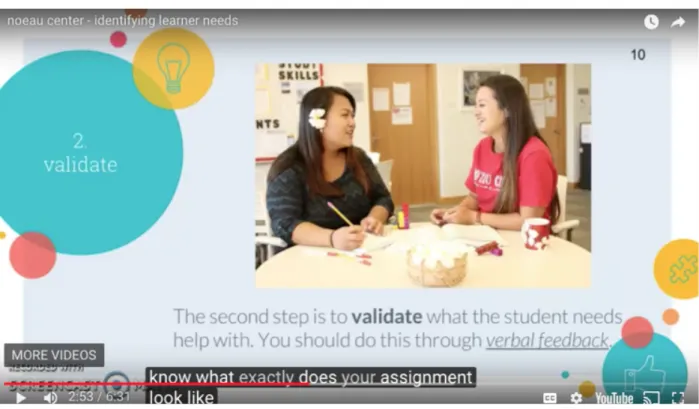
participants as well as provide video demonstrations of tutoring scenarios (Hobson, 1998; Bosse et al., 2010; Roidi, 2012; Holland, Grant & Donthamsetty, 2017). Based on best practices indicated by tutor training literature, each of the YouTube videos within the site were custom produced by the course designer and then uploaded to YouTube. To develop the video demonstrations, dynamic Google Slides presentations were formed, integrating animations, images, and other engaging visual features. Screencast-O-Matic was then used to record the presentation as well as the designer’s narrative voice-overs, which offered guidance and direction for the participants. Afterwards, the videos were saved and uploaded to YouTube. In addition to its ease of you, YouTube was also selected due to Google Sites’ easy-to-embed YouTube features (Figure 3). Moreover, YouTube’s subtitle capabilities were an important element needed to comply with ADA requirements, allowing participants, especially those who might have been be audibly impaired, to read the content within each video. Consistent with the site’s language, English was selected as the closed-caption language for the YouTube videos.
Instruction Grounded in Problem Solving and Application
Each unit addressed a practical tutoring method that the participants could utilize within a tutoring session to better assist students (Figure 4). Likewise, each unit had an “Activity” and “Quiz” that allowed the participants to apply their learning by critically thinking through a tutoring scenario or problem and explain how they would respond to each situation, especially in terms of the material they had learned from each unit (Gayton & McEwen, 2007; Caplan & Graham, 2008; Hobson, 1998; Leary et al., 2013; Breuch, 2000). The activities and quizzes were created using Google Docs and Google Forms (Figure 5).
Figure 4. Screenshot of Content Grounded in Application.
Assessment Measures
A pretest (Appendix 1), posttest (Appendix 2), and attitudinal survey (Appendix 7) were created using Google Forms (Dick, Carey & Carey, 2014). All collected data was stored within secured and password protected Google Spreadsheets. Quizzes (Appendix 3) and activities (Appendix 4) were placed within each unit to assess the participants’ knowledge integration (Behrend & Thompson, 2012). To complete each activity, participants were directed to create and share a Google Doc to the designer’s password-protected email account. A comprehensive rubric was also included within each assignment to guide participants through each of the assignment expectations (Andrade, 2008) (Appendix 4). Relatedly, automated grading was applied within the quizzes to provide immediate feedback to the participants.
Methods Research Question
The primary research question for this project is: How well does the online training module educate peer tutors at the No‘eau Center? A secondary question is: How effective is the delivery of instruction within the module units?
Participants
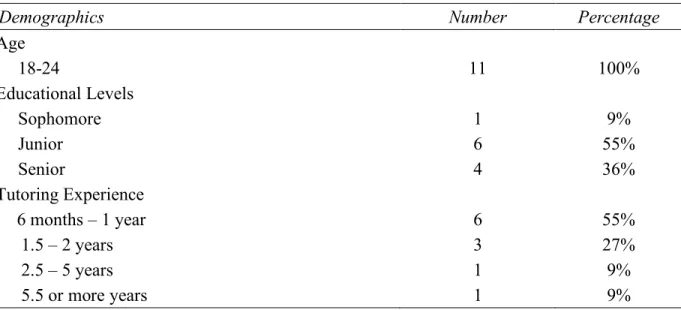
In total, 12 participants, 8 females and 4 males, agreed to participate in this study. Though, 1 participant did not complete the entire training because of prior commitments. The participants’ ages ranged between 18-26 years old. In this study, the participants were defined as returning peer-tutors, having tutored for at least six months or more. The participants ranged in educational levels: 1 participant was a sophomore, 6 participants were juniors, and 4 participants were
seniors. The participants also ranged in tutoring experience with 6 participants having 6 months-1 year of experience, 3 participants with months-1.5-2 years of experience, months-1 participant with 2.5-5 years
of experience, and 1 participant with over 5 years of experience (Table 1).
Table 1. Participants Demographics.
Demographics Number Percentage
Age 18-24 11 100% Educational Levels Sophomore 1 9% Junior 6 55% Senior 4 36% Tutoring Experience 6 months – 1 year 6 55% 1.5 – 2 years 3 27% 2.5 – 5 years 1 9% 5.5 or more years 1 9% Materials
All prospective participants were contacted via email (Appendix 5). Most participants agreed to complete the module using their personal computers. A total of 12 individuals were approached to participate; each agreed to participate in the training module as well as complete the pretest and posttest. Before starting the module, the participants were asked to agree to the terms of a research consent form (Appendix 6). After consenting, the participants were emailed the website training link and received a detailed explanation of the steps required to complete the online training on their computer device from a location of their choice.
Procedures
The participants were instructed to complete a pretest containing 16 multiple-choice questions. After finishing the pretest, participants were directed to complete the online module. Once done, the participants were asked to complete a posttest. The posttest consisted of 16 multiple-choice questions. Both the pretest and posttest contained similar questions. Responses to the pretest and posttest questions were required for every question. After the completion of the posttest, an attitudinal survey was emailed to the participants. It consisted of 32 Likert-type scaled questions and written responses and was administered to assess the participant’s perceptions of the online module, including the training’s strengths and weaknesses. The pretest and posttest scores were compared to measure how well the module educated peer tutors. The units themselves were structured with activities and quizzes to assess student learning and provide application of instructional material.
Of the 12 participants, 11 participants completed the entire training; only data from the 11 participants who completed the training was analyzed in this study. To measure how well the training module educated peer tutors, the results of the pretest and posttest were compared, following the completion of the entire training. Comparable questions were used in both tests, albeit the questions were slightly altered to prevent rote memorization. To measure the module’s effectiveness in delivering content, the responses of the attitudinal survey were assessed.
Focus 1. Educating Peer Tutors – Pretest and Posttest
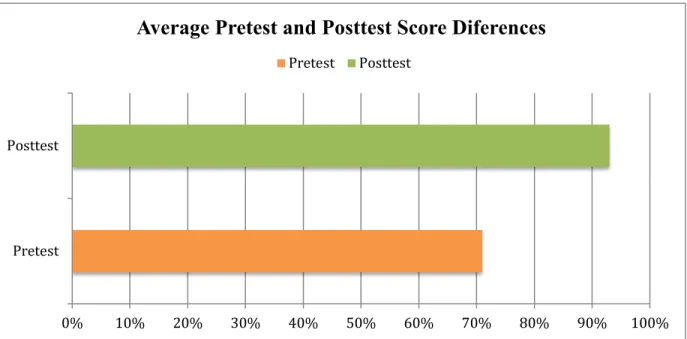
The major results of the pretest and posttest outcomes indicate that there was a pronounced effect on the participants’ test scores. In particular, the results, when comparing the pretest to posttest scores, show that the participants, on average, scored a 71% on the pretest whereas the average score on the posttest was 93%. Noticeably, the participants scored over 20% higher on their posttest as compared to their pretest scores (Figure 6).
Comparing the pretest and posttest scores also reveals the most challenging units for the
participants. Interestingly, the participants’ errors, based on the posttest, potentially signify that Unit 3 and Unit 4 were the most challenging units for students. While all participants had errors within each of the unit sections on the pretest, on the posttest, 18% of the participants struggled with questions pertaining to Unit 3 and 36% of the participants struggled with questions
regarding Unit 4.
Figure 6. Comparison of Average Pretest and Posttest Score Differences.
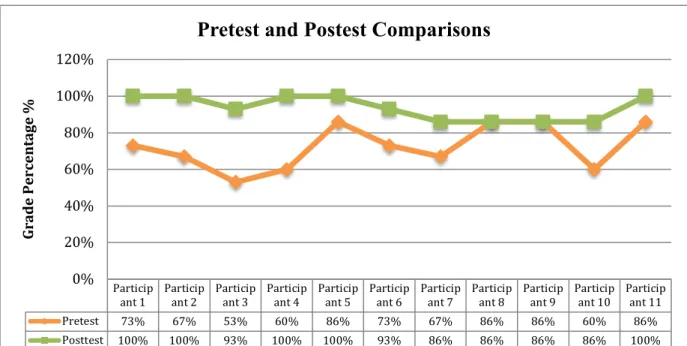
Undeniably through a comparison of scores, the participants overall showed improvement between their pretest and posttest scores (Figure 7). However, Participant 8 and Participant 9 scored an 86% for both their pretest and posttest. Interestingly, the participant with the greatest gain was Participant 3, whose score ranged from 53% on the pretest to 93% scored on the posttest. In all, the participants’ scores showed well-defined differences.
0% 10% 20% 30% 40% 50% 60% 70% 80% 90% 100%
Pretest Posttest
Average Pretest and Posttest Score Diferences
Pretest PosttestFigure 7. Comparison of Pretest and Posttest Scores.
In addition to descriptive statistics analyzed between the pretest and posttests, an independent-samples t-test was conducted to compare the online tutor training pretest and posttest scores (Table 2). There was a significant difference in scores for the pretest (M=10.5, SD=1.74) and posttest (M=14.20, SD=0.87); t(9)=4.96, p = 1.83. These results suggest that the online tutor training module had an effect on the participants’ knowledge. Specifically, these results imply that after completing the online tutor training module, participants’ knowledge on tutoring strategies increased.
Table 2. t-Test: Paired Two Sample for Means.
Posttest Pretest
Mean 14.20 10.5
Variance 0.84 2.72
Observations 10.00 10
Pearson Correlation -0.66
Hypothesized Mean Difference 0.00
df 9.00 t Stat 4.96 P(T<=t) one-tail 0.00 t Critical one-tail 1.83 P(T<=t) two-tail 0.00 t Critical two-tail 2.26 Particip ant 1 Particip ant 2 Particip ant 3 Particip ant 4 Particip ant 5 Particip ant 6 Particip ant 7 Particip ant 8 Particip ant 9 Particip ant 10 Particip ant 11 Pretest 73% 67% 53% 60% 86% 73% 67% 86% 86% 60% 86% Posttest 100% 100% 93% 100% 100% 93% 86% 86% 86% 86% 100% 0% 20% 40% 60% 80% 100% 120% Gr ade Per cen tag e %
Focus 2. Delivery of Instruction – Survey
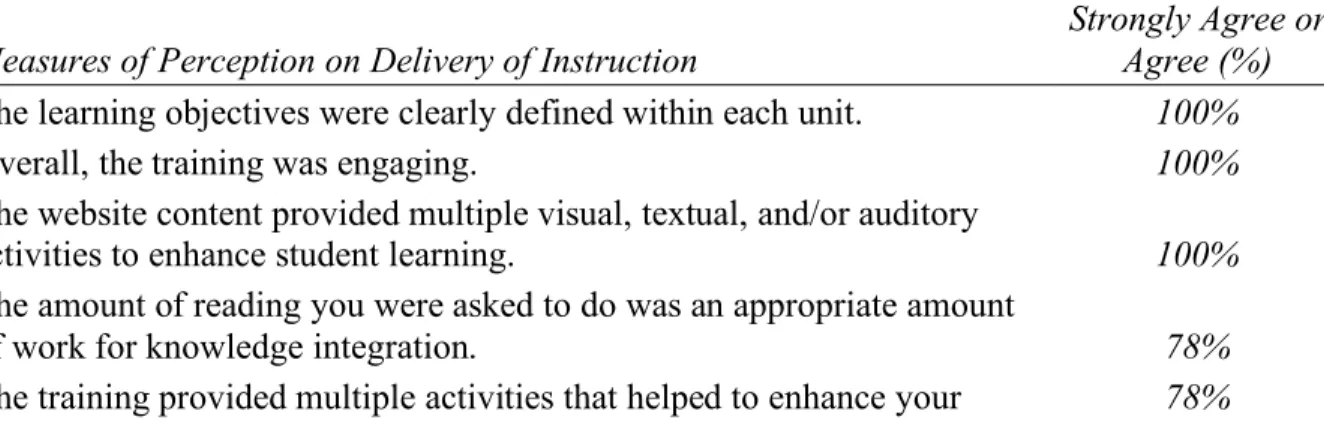
The attitudinal survey administered to the participants was crafted to assess the respondents perceptions of the website, instructional delivery, and the educational aspect of the online training (Table 3). Recalling specific aspects of the module’s design, 100% of the respondents agreed that the website’s layout, images, and content were engaging. One respondent noted that these elements “made completing the training a more enjoyable experience.” This finding is consistent with previous studies emphasizing engaging design (Beetham & Sharpe, 2013). In terms of the use of objectives, 100% of the respondents agreed that the module’s objectives were clearly defined. The importance of clear learning objectives is consistent with Gagne, Briggs, and Wagner (1992) and Dick, Carey, and Carey (2014) studies.
Based on multimedia, mostly video demonstrations, 100% of the respondents agreed that the blend of textual material and multimedia assisted them in comprehending the material.
Additionally, one participant stated, “I really enjoyed the videos provided within each unit. They were entertaining and made the content easier to understand.” Detailed attention to multimedia material, mainly video demonstrations, is a consistent finding in previous studies analyzing tutor training strategies and this method worked for the participants (Behrend & Thompson, 2012; Hobson, 1998; Bosse et al., 2010; Roidi, 2012; Holland, Grant & Donthamsetty, 2017). Instruction grounded in problem solving and application was an important element within the module. The survey data indicates that 100% of the respondents agreed that they felt confident in transferring the concepts and strategies they learned from the training into tutoring session in the future. When asked what the respondents felt was the greatest benefit of the module, the most frequent response was the following: learning or gaining knowledge on tutoring strategies (f=8). This finding is consistent with previous studies emphasizing anchored learning where instruction is grounded in application and problem solving (“CTGV,” 1993; Bransford et al., 1990; Hobson, 1998; Leary et al., 2013; Roscoe & Chi, 2007; Breuch, 2000). However, in considering the module’s application components, only 78% of the respondents felt the unit activities helped them to enhance their critical thinking and problem solving skills for tutoring.
Table 3. Summary of Results for Measures of Satisfaction from Attitudinal Survey.
Measures of Perception on Delivery of Instruction
Strongly Agree or Agree (%) The learning objectives were clearly defined within each unit. 100%
Overall, the training was engaging. 100%
The website content provided multiple visual, textual, and/or auditory
activities to enhance student learning. 100%
The amount of reading you were asked to do was an appropriate amount
of work for knowledge integration. 78%
critical thinking/problem solving skills for tutoring.
The training modules were developed in a way that helped you understand
the material. 100%
The training made good use of visuals to compliment written material. 100%
Measures of Perception on Educational Aspect of Training Strongly Agree or Agree (%) The online tutor training educated you on how to modify/customize a
learning environment. 100%
This training provided practical knowledge for tutoring. 100% The learning objectives, instructional material, and assessment
activities all aligned with each unit. 100%
The training had an appropriate amount of activities to assess your
readiness for applying material learned within a tutoring session. 78% There was a good blend of both text-based and multimedia materials to
assist in comprehending the content within each unit. 100% You feel confident that you are able to transfer the concept/strategies
learned in this training into tutoring sessions within the future. 100% As a result of this training, you are able to modify/customize a tutoring
session. 100%
Discussion Findings
This study focused on identifying how well an online training module educated peer tutors at the No‘eau Center as well as measuring how effective the participants felt the instruction was within the module. Based on the t-test scores, pretest and posttest comparisons, as well as the positive comments provided by the participants, data collected from this study suggests that an online module can work well in providing advanced tutor training. The data also shows that, based on the participant’s responses, the instructional design of the module was beneficial for knowledge integration. Clearly, peer-tutors can gain valuable education from online tutor training.
Data collected for this project also particularly revealed what worked and what did not work. More specifically, the results imply that it is important to develop online training that is
engaging—especially in terms of interesting content, simplistic graphics, and visually appealing materials. Comparatively, the participants emphasized the value in applicable instruction and problem solving (f=8), the usefulness of flexibility and accessibility of learning online (f=5), and the usefulness in video demonstrations (f=2). Additionally, the participants surprisingly enjoyed the mini-quizzes because they felt the quizzes were good personal assessment measures of how well they had retained information from the unit (Behrend & Thompson, 2012). Areas that need more work include limiting the amount of article readings (f=2) and providing opportunities to
practice the content learned within each unit through tutoring (f=5). While the amount of readings can be easily adjusted, there are several challenges with creating options for practicing tutoring for online training. It was noted that the video demonstrations were helpful and the activities reinforced material, but the participants felt they would have benefitted from practicing applying the content material directly after completing each unit, as suggested by Holland, Grant, and Donthamsetty (2017). Connectedly, one participant suggested practicing tutoring online. With resource limitations and challenges in building genuine face-to-face practice sessions, a mixed reality platform to practice tutoring would be ideal. In this way, tutors could immediately begin practicing applying the content learned within each unit into a virtual tutoring session. Congruently, while moving through the training at their own pace, it might be valuable for tutors to practice virtually applying tutoring content, as it would allow for a safe and easily accessible environment without placing any real students at risk by way of mixed-reality.
In terms of the assessment measures, there was one content related concern found regarding the posttest results. Within the pretest, 45% of participants answered the content question correctly. Within a similar question, only 64% of participants answered correctly. After examining the material within the module unit, one possibility that may have confused participants is a video in which participants were encouraged to use their best judgment in determining which tutoring method to utilize when assisting a student. However, previously on the page, an explanation of the various tutoring methods explicitly described which tutoring method to use when coming across students with certain needs. Hence, explicitly detailing methods, and then encouraging tutors to use their best judgment might have sent mixed messages to the participants.
Interestingly, the findings from this study compare exactly to previous findings in literature pertaining to design elements, pedagogy, and tutor training strategies. However, it also exposed differences, like the need for a virtual option for tutor practice. One reason why this difference might exist is because there is such a limited scope of literature focused on developing
instruction for online tutor training.
Limitations
One limitation of this research study was the constitution of the sample population. Participants were not randomly selected from a larger population to participate in this study. Additionally, the participants were employees under my supervision. This might have biased the sample.
However, the participants did come from a range of ability levels and years of tutoring experience. The sample also provided a heterogeneous group of participants, who reflect a greater diversity in ethnicity and social class. An additional limitation is it cannot be determined whether the change in pretest and posttest scores is because of the online module or time. And, there was no concurrent control group that studied the online module. Though, the average time it took for the participants to complete the training was a total of 4.3 days. Thus, time, while a factor, may or may not have impacted the participants’ abilities. Lastly, another limitation was the slight modification of questions on the pretest as compared to the posttest. Modifications of the questions were made strategically to prevent rote-memorization; however, these
modifications could have impacted the participants due to potentially different tone(s) or content of the modified questions. Although, the question modifications related to the same concepts as the pretest questions and special attention was given to ensure tone consistency.
Suggestions for Further Research
Educational researchers within the field of educational technology should consider conducting empirical research to determine if mixed-reality would work as a form of virtual tutoring
practice. And, more specifically, researchers should consider determining what traits are needed, among virtual students, for peer tutors to successfully perform tutoring methods.
Conclusion
Providing advanced tutor training is a valuable option in offering developmental opportunities for returning university tutors. And, by delivering a comprehensive online training module, peer tutors will be more prepared to enhance the experience of their students by the strengthening their knowledge of tutoring strategies. Creating an online training system can assist in fostering tutors’ knowledge of complex tutoring methods and confidence in utilizing tutoring strategies to structure and modify a learning environment, ideally lending to a better experience for students. In reflection, if learning centers choose to develop any form of online training, it is important that trainers use a learning management system that blends visual, audible, and text-based
elements with an appropriate pedagogy as well as defining clear objectives and activities that can assist tutors in enhancing their tutoring abilities. Additionally, based on my experiences, it has become clear that online tutor training should contain instruction that is applicable as well as contain video demonstrations to model tutoring scenarios. This project has also revealed the need for different outlets of tutoring practice—rather than requiring written or verbally recorded activities—tutors need an option to practice applying the content they learned from training. Though, I have found a drawback to offering tutor training online is challenges in developing opportunities for practicing through “mock” tutoring sessions.
Nonetheless, this study has also shed light on an area not entirely addressed by researchers, which is the need for virtual mock tutoring sessions to assist tutors as an option to complement
online training. Ultimately, with limited research in the realm of developing curriculum for
online tutor training, this study was significant for the field of research regarding ways to frame online instruction to train student tutors as well as identifying methods that work and do not work for online tutor training.
Overall, the findings of this study are vital to learning centers around the globe. As suggested by the participants, an online training module can give tutors the ability to further their knowledge of tutoring and provide an outlet for tutors to critically think about how they would apply advanced tutoring strategies into their own tutoring sessions. More importantly though, with the lack of research on how to create an effective online tutor training, this project has illustrated several methods that should be considered when developing online training for tutors. Likewise, in reflecting on the need for more research and resources concerning online tutor training, this project has been registered with Creative Commons, allowing other learning centers to model, copy, or even modify portions or all of the training to meet their specific needs. By continuing to research, develop, and share resources and best practices for online tutor training, learning center staff can gain valuable methods for conducting online tutor training as a means to better support their tutors and, ultimately, better assist their students.
References
Anderson, T. (2008). Teaching in an online learning context. Theory and practice of online learning. Retrieved from http://www.aupress.ca/books/120146/ebook/14_Anderson_ 2008-Theory_and_Practice_of_Online_Learning.pdf
Andrade, H. (2008). Self-assessment through rubrics. Educational leadership, 65(4), 60-63. Baroffio, A., Nendaz, M. R., Perrier, A., & Vu, N. V. (2007). Tutor training, evaluation criteria
and teaching environment influence students’ ratings of tutor feedback in problem-based learning. Advances in Health Sciences Education, 12(4), 427-439.
Beetham, H., & Sharpe, R. (Eds.). (2013). Rethinking pedagogy for a digital age: Designing for 21st century learning. UK: Routledge.
Behrend, T. S. & Thompson, L. F. (2012). Using animated agents in learner-controlled training: the effects of design control. Intentional Journal of Training and Development, 16(4). doi: 10.1111/j.1468-2419.2012.00413.x
Bhattacharjee, J. (2015). Constructivist Approach to Learning–An Effective Approach of Teaching Learning. International Research Journal of Interdisciplinary &
Multidisciplinary Studies, 1(4), 23-28.
Boehm, D. (2009). The Work and Art of Writing Center Tutor Training. Zeitschrift Schreiben. Bosse, H. M., Huwendiek, S., Skelin, S., Kirschfink, M., & Nikendei, C. (2010). Interactive film
scenes for tutor training in problem-based learning (PBL): dealing with difficult situations. BMC medical education, 10(1), 52.
Bransford, J. D., Sherwood, R. D., Hasselbring, T. S., Kinzer, C. K., & Williams, S. M. (1990). Anchored instruction: Why we need it and how technology can help. Cognition,
education, and multimedia: Exploring ideas in high technology, 115-141. Breuch, L. A. M. K. (2000). Developing sound tutor training for online writing
centers: Creating productive peer reviewers. Computers and Composition, 17(3), 245- 263.
Bruffee, K. (1980). Two Related Issues in Peer Tutoring: Program Structure and Tutor Training. College Composition and Communication, 31(1), 76-80. doi:10.2307/356637
Caplan, D., & Graham, R. (2004). The development of online courses. Theory and practice of online learning, 175.
Criscuolo, N. (1971). Training Tutors Effectively. The Reading Teacher, 25(2), 157-159. Retrieved from http://www.jstor.org/stable/20192926
CRLA: Standards, Outcomes, and Assessments. (2015). International Tutor Training Program Certification, Shawn O’Neil (eds). Retrieved from
https://www.crla.net/images/ITTPC/ITTPC_Standards_Outcomes_Assessments_Levels_ 2_and_3.pdf
CTGV. (1993). Anchored instruction and situated cognition revisited. Educational Technology, 33 (3), 52- 70.
Dick, W., Carey, L., & Carey, J. O. (2014). The systematic design of instruction, 8th edition Pearson.
Dzubak, C. M., & York, P. (2009). Why tutoring matters: The interaction of a peer tutor and a tutee during scaffolding. Synergy: The Journal of the Association for the Tutoring Profession, 2, 1-5.
Gagné, R. M., Briggs, L., & Wager, W. (1992). The events of instruction. Principles of Instructional Design. Fort Worth, TX: Harcourt Brace Jovanovich College Publishers.
Hobson, E. H. (1994). Writing Center Practice Often Counters Its Theory. So What? Intersections: Theory-Practice in the Writing Center. Ed. Joan A. Mullin and Ray Wallace. Urbana, IL: NCTE.
Holland, A., Grant, C., & Donthamsetty, R. (2017). Coaching tutors: an instrumental case study on testing an integrated framework for tutoring sessions. Journal of Contemporary Issues in Tutoring and Teaching, 1(1).
Jumaat, N. F., & Tasir, Z. (2014, April). Instructional scaffolding in online learning
environment: A meta-analysis. In Teaching and Learning in Computing and Engineering (LaTiCE), 2014 International Conference on (pp. 74-77). IEEE.
Kail, H. (2003). Separation, initiation, and return: tutor training manuals and writing center lore. Eds. Pemberton M. & Kinkead J. Center Will Hold (pp. 74-95). Logan, Utah:
University Press of Colorado. Retrieved from http://www.jstor.org/stable/j.ctt46nxnq.8 Leary, H., Walker, A., Shelton, B. E., & Fitt, M. H. (2013). Exploring the relationships between
tutor background, tutor training, and student learning: A problem-based learning meta- analysis. Interdisciplinary Journal of Problem-based Learning, 7(1), 6.
Linares, L. I. R., & Muñoz, S. M. (2011). Revisiting validation theory: Theoretical foundations, applications, and extensions. Enrollment Management Journal, 2(1), 12-33.
Mackiewicz, J., & Thompson, I. (2014). Instruction, cognitive scaffolding, and motivational scaffolding in writing center tutoring. Composition Studies, 42(1), 54.
Macrovector. (n.d.). “Round Education Icons.” Freepik. Retrieved from
https://www.freepik.com/free-vector/round-education-icons_1012548.htm
McAndrew, D. A., & Reigstad, T. J. (2001). Tutoring writing: A practical guide for conferences. UK: Heinemann.
Menchaca, M. (2014). Mi CASA Es Su Casa E-Learning: A Simplified Approach to Designing Online Learning. Manoa, HI: University of Hawaii at Manoa. Retrieved from
https://dcdc.coe.hawaii.edu/ltec/612/wp-content/uploads/2014/05/menchaca_casa.pdf the effects of design control. Intentional Journal of Training and Development, 16(4). Miller, G. (2011). Preparing for Emotional Sessions. The Writing Lab Newsletter. Retrieved
from https://wlnjournal.org/archives/v35/35.5-6.pdf
Nakamura, M., Wilder, S. (2013). “Peer Leaders’ Training – Workshop Style.” Conference Proceedings of the Peer-Led Team Learning International Society, May 17-19, 2012, New York City College of Technology of the City University of New York, ISSN 2329-2113.
Noessel, C. (2003). Free range learning support. Interaction Design Institute. Retrieved from http://www.interactionivrea. it/theses/2002-03/c. noessel/need. htm.
Nordlof, J. (2014). Vygotsky, scaffolding, and the role of theory in writing center work. The Writing Center Journal, 45-64.
Olinghouse, N. (2008). Designing lessons for diverse learners. Curriculum Instruction and Teacher Education. Michigan State: East Lansing.
Pirini, J. (2017). Peer Tutoring: A Training and Facilitation Guide. New Zealand Council for Educational Research. Wellington: New Zealand.
Rod, D. R. & Chi, M. T. H. (2007). Understanding Tutor Learning: Knowledge-
Building and Knowledge-Telling in Peer Tutors' Explanations and Questions. Review of Educational Research, 77(4), 534-574. Retrieved from
http://www.jstor.org/stable/4624910
Lifelong Learners. Synergy: The Online Journal for the Association for the Tutoring Profession, 7. Retrieved from https://www.myatp.org/wp-
content/uploads/2015/10/Synergy-Vol-8-Roidi.pdf
Ryan, L. & Zimmerelli, L. (2010). The Bedford guide for writing tutors. Boston, MA: Bedford/St. Martins.
Taylor, R. G. (2004). Tutoring Writing: A Practical Guide for Conferences. UK: Heinemann. Thompson, I. (2009). Scaffolding in the writing center: A microanalysis of an experienced
tutor’s verbal and nonverbal tutoring strategies. Written Communication, 26(4), 417-453. Thompson, I. & Mackiewicz, J. (2014). Questioning in writing center conferences. The Writing
Center Journal, 37-70.
Thompson, T. C. (1994). Personality preferences, tutoring styles, and implications for tutor training. The Writing Center Journal, 14(2), 136-149.
Tofade, T., Elsner, J., & Haines, S. T. (2013). Best practice strategies for effective use of questions as a teaching tool. American journal of pharmaceutical education, 77(7), 155. Westbrook, J., Durrani, N., Brown, R., Orr, D., Pryor, J., Boddy, J., & Salvi, F. (2013).
Pedagogy, curriculum, teaching practices and teacher education in developing countries. Education rigorous literature review. University of Sussex – Center for International Education: Department for International Development. Retrieved from
Appendices