Documentos de Trabajo
Fathers and children: alimony and contact after
marriage breakdown (Uruguay)
Marisa Bucheli y Wanda Cabella
Documento No. 28/09
Fathers and children: alimony and contact after marriage breakdown
(Uruguay)
Marisa Bucheli♦ Wanda Cabella♣
♦ Departamento de Economía, Facultad de Ciencias Sociales, Universidad de la República (dECON) ♣ Programa de Población, Facultad de Ciencias Sociales, Universidad de la República
RESUMEN
Entre 1985 y 2000, la tasa de divorcio en Uruguay se duplicó desde 15% a 30%, alcanzando el mayor valor de América del Sur. A pesar del creciente número de divorcios y separaciones, existe aún poca información sobre el contacto entre hijos y padres no copresidentes y sobre el pago de pago de pensiones alimenticias. Este documento estudia estos dos temas, utilizando datos de una encuesta que específicamente relevó información al respecto. Como tenemos información proporcionada por hombres y mujeres, analizamos las declaraciones de padres y madres y exploramos las fuentes de sus diferencias. Nuestras principales conclusiones son: 1) los pagos de pensiones y el contacto son mayores de acuerdo a la información de los padres que las madres; 2) la capacidad del pago del padre afecta el pago de pensión pero no el contacto; 3) padres y madres no concuerdan con el efecto que tiene una nueva pareja de la mujer; 4) una nueva pareja del padre disminuye la frecuencia de contacto pero no afecta el pago de pensiones.
ABSTRACT
From 1985 to 2000 the total divorce rate (TDR) in Uruguay doubled from 15% to 30%, the highest figure in South America. Despite the increasing number of divorces and separations, there is still little information concerning contact between non resident parents and children and payment of child support. This paper provides more information on these two points, using a survey that collected the appropriate data. Since we have data from both men and women, we analyse declarations of fathers and mothers and explore the sources of their differences. Our main conclusions are: 1) child support payment rates and contact with children after divorce are higher according to fathers than to mothers; 2) father’s capacity to pay is related to child support but not with contact; 3) fathers and mothers do not agree about the effect of repartnering of the mother; 4) fathers’ repartening diminishes contact but does not affect child support payment rates.
Palabras claves: pensiones alimenticias; régimen de visitas; divorcio; transferencias intergeneracionales
Keywords: child support; visitations; divorce; intergenerational transfers JEL: J12; J13
Introduction
Uruguay is considered an atypical country in the context of Latin America because of the characteristics of its population and the distinctive nature of its social development. The country processed the demographic transition at the end of the 19th century and the beginning of the 20th, more than half a century before most of the countries in the continent. By the mid 20th century Uruguay was already in the last phase of the transition: the total fertility rate was 2.8 children per woman and life expectancy at birth was 69 (Pellegrino, 2003; Chackiel & Scholnick, 1992).
Social policies have a long tradition in Uruguay compared to most Latin American countries. Since the end of the 19th century, primary education has been lay, free of charge and compulsory for girls as well as boys. At that time too the first social security programs were set up. In the 20th century, the coverage of social programs was expanded and they became more diverse, and today Uruguay ranks third in Latin America in terms of public social expenditure (CEPAL, 2008)
Uruguay also differs from the norm in that the process of secularization came early and was intense. The last stage in this process, which began in the 1880s, came in 1907 with the first divorce law (Caetano, G. & Geymonat, 1997). This initiative in the legal framework was expanded in 1913 and in 1977, and the country was the first in South America to have a divorce law.
Although the divorce law came early, the number of divorces increased only very slowly up to the 1970s. However, in that decade, and even more so in the 1980s, the divorce rate grew more rapidly in the context of far-reaching changes in the patterns of how relationships and families were structured. These trends will be examined in greater depth in the next section.
One of the consequences of the rise in divorce has been a corresponding increase in the number of children and adolescents who do not live with both their biological parents. In Uruguay, 89% of one-parent households with children under 21 years old are headed by a female.1 Therefore Uruguay is faced with the same kinds of problems as various other countries that have undergone changes in family patterns to a similar or greater extent in recent decades. One of these problems is that of children not receiving financial support
1 According to the 2007Household Survey, National Institute of Statistic, Uruguay.
from their fathers and/or losing contact with them, when the parents’ relationship breaks up. Although there has been scant research into this subject, it is estimated that around 60% of fathers do not make money transfers to their children after the parents’ relationship breaks up, and around 40% do not have contact with them (Bucheli 2003). One of the main limitations on these data is that they are based only on survey information provided by women who live in the country’s capital city and greater metropolitan area. In our study, we have been able to analyze the problem from the perspective of men as well as women, and our samples are representative of urban areas throughout the country.
The aim of this study is to compare the information supplied by the fathers and that from the mothers of children and adolescents under 21 years of age as regards the extent to which the fathers fulfill their obligations to pay child support, and the frequency with which they see their children after the couple’s relationship has broken up. We shall also analyze the variables that have an influence on the child support payment rate, and the frequency of contact between non resident fathers and their children, by estimating various probability models.
The study is organized as follows: after this introduction we give a brief outline of the observed changes in how families are structured and the legislation governing child support and parents’ access. In section 3 we describe the sources and the methods used. In section 4 we focus on a description of the results, and lastly, in section 5, we discuss our main findings.
1. The increase in divorce and the regulations governing child support
1.1.Changes in the family
In the mid 1970s, the number of divorces began to increase at a moderate rate, and in the 1980s there was an unprecedented acceleration in separations and divorce. This trend continued in the 1990s, and by the end of that decade the total divorce rate was around 30% (Cabella, 1998).2
This increase in divorce is just one of the changes that the family in Uruguay has been undergoing since the mid 1980s. The magnitude and the rapidity of this change echo
2 The latest available figure for this indicator is for 2002, the last year in which divorce data by duration of the marriage were published. In that year the value of the indicator was 36%.
very similar processes to those that took place previously in the Western industrialized countries, and are known as the second demographic transition. In fact, between 1987 and 2007 the marriage rate fell to half its former level and in the same period cohabiting unions increased by a factor of four in the 15 to 49 age bracket. The proportion of children born to cohabiting parents doubled between 1993 and 2007 (14% to 34%) while the proportion of children born to married couples has been reduced to its half in the same period. 3 Lastly, since the early years of the 21st century, total fertility rate has fallen below the replacement level (Cabella, 2009; Filgueira & Peri, 2004; Paredes, 2003; Filgueira & Kaztman, 2001; Filgueira, 1996).
A large body of international evidence shows that divorce has negative economic consequences, mainly for the women and children involved (Bartfeld 2000; Bartfeld & Meyer, 2003). In Uruguay, one aspect of particular importance is the economic vulnerability of the children and the increasing infant poverty (De Armas 2006; PNUD 2005). Although there are no measurements that evaluate the effect that changes in the family have had in terms of increased infant poverty, it is reasonable to suppose that family instability tends to exacerbate the disadvantages of poor families, and these are the families where most of the child and adolescent population are concentrated.
In spite of the fact that the divorce rate is high, there are few sources of information on which a study of its consequences for the various members of the family can be based. Information available about the custody of children and adolescents, the visits regime and the fulfillment of financial obligations is also very limited. In 2001, it was conducted a survey in Montevideo that gathered various data about the relations between children and their fathers after a divorce or relationship breakup.4 According to this survey (ESF 2001), some 58% of the fathers in couples that had separated did not make any economic contribution to the household where their ex-partner and children were living, and 32% lost contact with their children (Bucheli, 2003). The analysis showed that the lower the educational level of non resident fathers, the more precarious their insertion into the labor market, and the greater degree of conflict between the two members of the broken relationship, the lower the probability that the father would transfer money in child support for his children (Bucheli & Cabella 2005, Bucheli, 2003). On the other hand, the duration
3 According to the Vital Statistics of Health Ministry
4 The survey covered 1800 women resident in Montevideo (the country’s capital) and its greater metropolitan area. Bear in mind that around 50% of the population of the country live in this area. The total population country at census 2004 was around 3.301.000 persons.
of the relationship (whether legally married or unmarried but cohabiting) was positively related to the probability of a transfer after breakdown. Lastly, the study by Bucheli (2003) showed that the fathers who made the most financial transfers were also those who maintained the most contact with their children.
2.2 Legislation on child support and visits between children and non resident parents
In Uruguay, the child support scheme is governed exclusively by the judicial system. If couples were married, a condition for obtaining a divorce is that they must make an economic and child visit regime agreement and this must be legally confirmed by a judge. If the couples are not married and are unable to reach an extra-legal agreement, either of the ex-partners may have recourse to the court to solicit a child support order to oblige their former partner to fulfill transfer and visit regime requirements. In all cases, non-fulfillment of the conditions that have been set (whether by agreement or by court decision) constitutes grounds for legal action.
The law states that parents must maintain their children financially up to the age of 21, and it also lays down the legal measures that can be applied if child support payments are evaded. Evasion is a legal offence, and a parent who does not fulfill his or her transfer obligations may be liable to sanctions that involve prison and/or the confiscation of assets or goods. The main instrument used to enforce this law is the legal withholding of a portion of the parent’s income at source. Once the non resident parent’s income is determined, the judge can order part of it to be handed over to the guardian parent.
However, the law does not establish any fixed formula to determine the monetary amount of child support. Judges analyze each case on its own merits, and in practice they follow criteria established in jurisprudence that take account of the age of the minors, the number of children for whom child support should be paid, and whether there are any special needs involved (for example, disability). The child support payment for one child is usually set at 20% of the father’s confirmed income, and 5% is added for each additional child up to a ceiling of 35-40% of his total income (Varela de Motta, 1998).
The diffusion of data on evasion gave rise to a certain amount of public debate about the prevailing legislation governing child support. Parliament recently passed a
measure to set up a “register of child support debtors”. This law imposes restrictions on a series of financial transactions, and these are applied to people who figure on the child support debtors list.
While this new law was a step forward and gave greater visibility to an area that receives little attention on public policy agendas, it did not tackle the main problems involved in the legal enforcement of child support payments. According to our own survey of various actors in the legal system, there is a general consensus that the main problems with legal enforcement centre on the difficulty of determining what the father’s real income is and on making him fulfill his obligations. Both these problems are closely connected to the father’s work situation. If the father is not in the formal employment market or is self-employed, the legal system finds it very difficult to estimate his income, and besides, it cannot implement wage withholdings (Bucheli & Cabella, 2005). The actors in the legal system consider that the legal instruments available are adequate, but there is no denying that only in very few cases are the sanctions laid down in the law actually applied. For example, even though there is provision in the law for the father to be sent to prison, this almost never occurs in practice.
There is also a general consensus that the legal system has little power to enforce agreements about visits between non resident parents and their children. The right of children and adolescents to have contact with their parents is established in the Childhood and Adolescence Code and by Uruguay’s subscription to the international Convention on the Rights of the Child. However, the actors in the legal system acknowledge that agreements about visits are very difficult to enforce if the ex-partners are unwilling (Bucheli & Cabella, 2005).
There is also a consensus that the legal framework governing this area has not been adjusted to cater to changes in the family insofar as it does not take account of the fact that an increasing proportion of fathers participate more actively in rearing their children and demand a greater role when they cease to live with them. For example, even though very few fathers seek custody of their children, quite often the arrangements for visits do not come up to the father’s expectations. On this point the legal actors acknowledge that the law is very mother-centered and there is a general feeling that the legislation covering this aspect should be changed to take account of situations in which fathers demand more time with their children (Bucheli & Cabella, 2005).
2. Data and method
The Gender and Generations Survey (EGG, for its acronym in Spanish) was carried out in 2004 by an inter-institutional team funded by the United Nations Population Fund. It collects information of 6,500 persons aged 15 to 79 residing in urban areas of more than 5,000 inhabitants. Some 86% of the population of Uruguay live in these areas, so the EGG provides a good description of the situation of the country as a whole.
The sample was selected from the universe of households, and one member of the required age was randomly selected from the household. Different interview forms were used for individuals over 60 years of age and for those under 60. In this study we use information from the under-60 group (Benia et al. 2005).
In the questionnaire, the under-60s were asked about their personal characteristics and the characteristics of their household, and data was gathered about their marital history, whether they had children, and about any children under 21 years of age whether or not they still lived in the home. This yielded information provided by: a) women who after an conjugal union breakup continued to live with their children under 21 whose father was still alive; 5 and b) data about men who after a breakup had children under 21 who were living with their mother.
Hence, we build two samples. One is representative of the information supplied by women and the other of data provided by men. The former is a sample of 551 mothers (896 children) and the latter is one of 176 fathers (288 children). Note that the women and men supplying the information were not the mothers and fathers of the same children.
The EGG collects information about whether the father makes the required maintenance support payments and about how frequently he has contact with his children after the breakup. In both samples the questionnaire reveals whether, in the year before the interview, the father handed over money in the form of cash to cover the cost of supporting the child. In addition, also for both samples, it reveals how frequently the father and child saw each other in the year prior to the interview: more than once per week, once a week, every fortnight, once a month, less than once a month or never.
With these data we build up two variables. The variable YT takes the value 1 when
the father made some cash payment in the year prior to the interview, and 0 (zero)
5 By “conjugal unions” we mean both marriages and cohabiting unions.
otherwise. The variable YC takes the value 1 when the father and child saw each other at
least once a fortnight during the previous year, and 0 otherwise.
The probability of observing each of these two binary variables can in principle be described through two probability models: P (YT = 1) = xT´βT + εT and P (YC = 1) = xC´βC + εC
However, the results obtained by Bucheli (2003) suggest that the pair (YT,YC) is the
result of two joint non-independent decisions. Therefore we make an estimation that allows the residuals of the two decision models to be correlated. We specify for the vector (εiT, εiC) a bivariate normal distribution (0, 0, 1, 1, ρ). Thus we estimate the joint probability through a bivariate probit model:
P (YT = 1 , YC = 1| X) = Φ (xT´βT, xC´βC, ρ)
where Φ is the normal bivariate distribution function with parameters (0, 0, 1, 1, ρ) and X is a vector of common explanatory variables for the two decisions. In this model, the correlation coefficient is studied through a null hypothesis test on the correlation coefficient (Ho: ρ = 0). On rejecting this hypothesis, the estimation using the bivariate
probit model is more efficient than the results obtained from the two probit models separately.
Note that the variable YT takes equal values for the children of the same father and
mother ande YC has a high correlation between siblings. Therefore, for the estimation, we
work with an observation by nuclear family and we use the weight of the interviewee. We assign the value 1 to Yc when it takes at least this value for one of the children of the nucleus.
The vector X contains a group of variables for which there is data for both fathers and mothers. Two of them allow us to characterize the separated couple: whether they had been married, and the time that passed since their breakup. Also regardless of who provided the data, we have information about some characteristics of the father: his years of schooling and whether he is in a new relationship at the time of the interview. We also know whether the mother is in a new relationship. Lastly, we include variables that characterize the couple’s children: how many they are, their average age and the proportion that are male.
In addition, the vector X includes variables that characterize only the person interviewed. First, their situation as regards religion is captured by a variable that takes the value 1 when the interviewee attended religious services at least once per month, and 0 (zero) otherwise.
Second, we build up a deprivation index based on a list of goods and access to services. This information enabled us to construct a variable that takes the value 1 when the household is deprived of some condition, and 0 otherwise. The level of deprivation in the interviewee’s household is calculated as the weighted sum of these variables. The weighting we utilize reflects the effect that the higher the percentage of people who have a specific good, the greater the sense of deprivation among those that do not have it. The index is standardized in such a way that the value 0 is assigned when none of the conditions that affect the levels of deprivation are present (the individual has all the goods considered). At the other extreme, when all the conditions of deprivation are present (the individual lacks all the goods considered) the value 1 is assigned. The conditions we use to indicate deprivation are as follows: a suitable means for heating the home, unshared bathroom facilities, connection to sanitation, unshared kitchen facilities, television, automobile, freezer, international credit card and domestic service.
We also analyze the frequency of contact between father and child on the basis of the six alternative responses in the questionnaire, utilizing the children as the unit of analysis. Again, we work with the mothers’ and fathers’ responses separately.
We work with an ordinal variable V that takes six values ordered from the lowest frequency (when the father and child did not see each other in the year prior to the interview) to the greatest (when they saw each other more than once a week). Thus, we consider that the latent variable V originates from a latent variable V* that enables us to divide V into six ordinal categories. For each child i :
Vi = m if τ m -1 ≤ V* < τ m for m=1,…, 6
Using the ordered probit model in which the distribution function of the residuals is normal with a variance of 1, we estimate:
P (V=m | X) = Φ(τ m - X´βV) - Φ(τ m-1 - X´βV)
The vector of explanatory variables includes those mentioned above in our previous estimation.
Lastly, we analyze another question which captured the payment of child support. Specifically, the EGG asks mothers what proportion of the payment they received in the month before the interview. The degree to which the father fulfilled his financial obligation is classified as follows: the father did not pay child support, he paid less than half, half, more than half, or the whole amount. Based on the responses, we estimate an ordered probit model in which the dependent variable takes its lowest value when the father does not fulfill his obligation and the highest when he pays in full.
3. Results
3.1.Data description
In table 1 we present information about the frequency of transfers (YT) and contact
(YC) in the year before the interview.
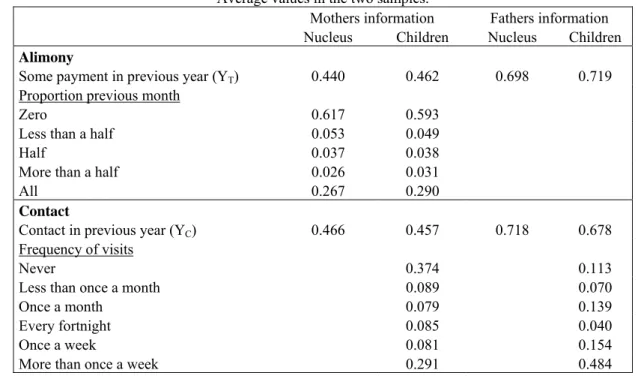
The information is markedly different depending on whether it was provided by the father or the mother. Some 70% of the fathers declared that they had made a money payment in the previous year, but only 44% of the women stated they have received a transfer in this period. Moreover, only 38% of the women acknowledged receiving a transfer in the month before the interview; this was made up of 11% who were paid part of the stipulated sum and the other 27% who were paid in full.
Similarly, the fathers claimed they had contact with their children more frequently than what was stated by the mothers. According to the men, some 72% of children saw their fathers at least once a fortnight and only 11% did not see them at all during the year, but according to the women’s responses these figures are 46% and 37% respectively.
Table 1. Payment of child support and frequency of contact. Average values in the two samples.
Mothers information Fathers information
Nucleus Children Nucleus Children
Alimony
Some payment in previous year (YT) 0.440 0.462 0.698 0.719 Proportion previous month
Zero 0.617 0.593
Less than a half 0.053 0.049
Half 0.037 0.038
More than a half 0.026 0.031
All 0.267 0.290
Contact
Contact in previous year (YC) 0.466 0.457 0.718 0.678 Frequency of visits
Never 0.374 0.113
Less than once a month 0.089 0.070
Once a month 0.079 0.139
Every fortnight 0.085 0.040
Once a week 0.081 0.154
More than once a week 0.291 0.484
Source: author’s preparation based on Gender and Generations Survey, Uruguay, 2004
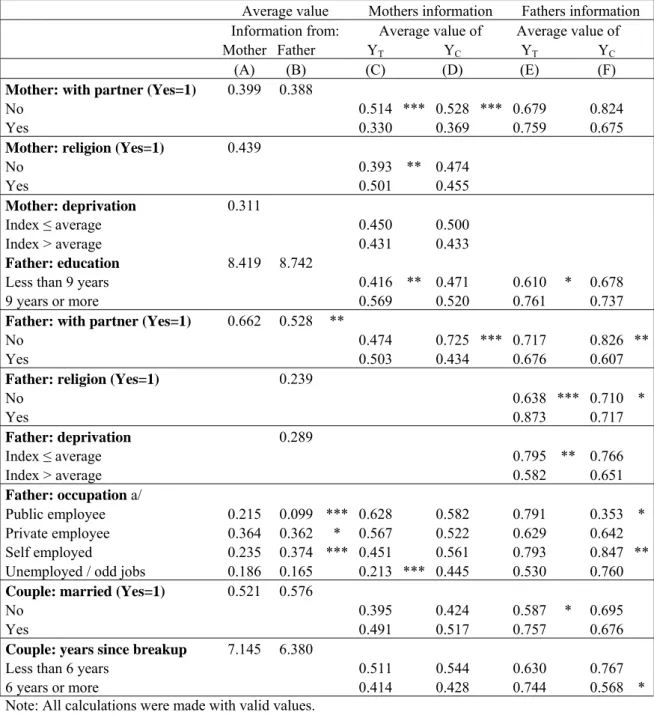
In principle one would not expect that the differences in the responses would stem from differences between the samples. In any case, it is worth analyzing the extent to which the composition of the samples differ in terms of variables that are potentially relevant in the explanation of YT and YC. Columns A and B of table 2 show the average
values of some variables, and if the variable is present in both samples the level of signification of the mean differences is indicated.
The samples differ in two characteristics. First, the mothers report a higher proportion of fathers in a relationship. Second, the distribution of the occupations of fathers (public employee, private employee, self-employed, unemployed6) differs between
the samples. The mothers declare that 21% of their ex-partners work in the public sector whereas only 10% of the fathers say they work in that sector. There is also a discrepancy between the two samples’ declarations as regards the father being self-employed (23% of the women state this was the case as against 37% of the men). This difference in the declarations suggests that not all the mothers know what their ex-partner’s real work
6 The unemployed frequently do occasional jobs of very short duration (odd jobs). Fathers who were in this kind of employment were included in the ‘unemployed’ category.
situation is. The estimation of frequency in the two samples is based on valid data, but there is a “don’t know” response. In the mothers sample 15% give this response and in the fathers sample 2% do so.
Table 2 also shows the average values of YT and YC for groups of distinct
characteristics, and the level of signification of the mean differences between the groups. The mothers and fathers agree that contact is less frequent when the father has a new partner. The responses of fathers and mothers also agree that child support is paid more frequently when the father has a higher educational level.
But women and men do not agree about some other characteristics. Only the mothers suggest that the behavior of the father is different when the mother is in a new relationship: they report that both child support payments and contact are less frequent if this is the case. On the other hand, only the fathers register differences in behavior that can be traced to the characteristics of the broken relationship: child support payment is more frequent when the couple had been married, and the less time that had passed since the breakup the more frequent visits are.
The last characteristic for which information is available for the two samples and that appears in table 2 is the father’s work situation. Note that the reference period for child support payments is the year before the interview but the labor question refers to the man’s situation at the time the interview took place. It could be argued that this limiting factor is moderated because we are dealing with labor categories that are relatively structural in the life of the person. We would even expect that the unemployed category, which would be of a more transitory nature, captures a phenomenon of vulnerability in the labor market.
The ordering of the categories of the average value of YT declared by the mothers is
what was to be expected. A father fulfills his obligations more when he is employed in the public sector. In this sector, the corresponding wage withholdings at source is unavoidable. This category is followed by employment in the private sector, and then self-employment. In these cases evasion is easier. Additionally, it is more difficult for the mother to know what her ex-partner’s income is, so she can misjudge the percentage the father has to pay. In spite of this ordering, the differences are not statistically significant at the usual levels. However, a significantly lower average value is obtained when the father is unemployed.
This general pattern is not found in the information from the fathers. On the contrary, what emerges is that the self-employed show a higher proportion of fathers who
saw their children in the last year. This outcome could be related to the fact that this kind of employment involves more flexible work timetables.
Lastly, there are characteristics that only characterize the interviewee. These were religion and the availability of assets in the home.
The fathers register a higher YT value when they are more committed to religion.
The more religious mothers also register higher YT values, which could be due to their
ex-partners being more religious (and therefore, in accordance with the result obtained from the sample of fathers, these men are more likely to pay child support). According the information from the fathers’ sample, a commitment to religion is also associated with a father having more frequent contact with his children.
Lastly, fathers in more deprived households obtain a lower YT value, and there are
no significant differences in YC. On the other hand, the average values of child support
payment and contact do not seem to be connected to the level of deprivation in the mother’s household.
Table 2. Characteristics of the two samples: average value of variables and average value of YT and YC for the groups.
Average value Mothers information Fathers information Information from: Average value of Average value of
Mother Father YT YC YT YC
(A) (B) (C) (D) (E) (F)
Mother: with partner (Yes=1) 0.399 0.388
No 0.514 *** 0.528 *** 0.679 0.824
Yes 0.330 0.369 0.759 0.675
Mother: religion (Yes=1) 0.439
No 0.393 ** 0.474 Yes 0.501 0.455 Mother: deprivation 0.311 Index ≤average 0.450 0.500 Index > average 0.431 0.433 Father: education 8.419 8.742
Less than 9 years 0.416 ** 0.471 0.610 * 0.678 9 years or more 0.569 0.520 0.761 0.737
Father: with partner (Yes=1) 0.662 0.528 **
No 0.474 0.725 *** 0.717 0.826 **
Yes 0.503 0.434 0.676 0.607
Father: religion (Yes=1) 0.239
No 0.638 *** 0.710 * Yes 0.873 0.717 Father: deprivation 0.289 Index ≤average 0.795 ** 0.766 Index > average 0.582 0.651 Father: occupation a/ Public employee 0.215 0.099 *** 0.628 0.582 0.791 0.353 * Private employee 0.364 0.362 * 0.567 0.522 0.629 0.642 Self employed 0.235 0.374 *** 0.451 0.561 0.793 0.847 ** Unemployed / odd jobs 0.186 0.165 0.213 *** 0.445 0.530 0.760
Couple: married (Yes=1) 0.521 0.576
No 0.395 0.424 0.587 * 0.695
Yes 0.491 0.517 0.757 0.676
Couple: years since breakup 7.145 6.380
Less than 6 years 0.511 0.544 0.630 0.767 6 years or more 0.414 0.428 0.744 0.568 * Note: All calculations were made with valid values.
a/ the test of measurements was made in relation to public employment.
Source: author’s preparation based on Gender and Generations Survey, Uruguay, 2004
3.2.Child support and contact: joint estimation
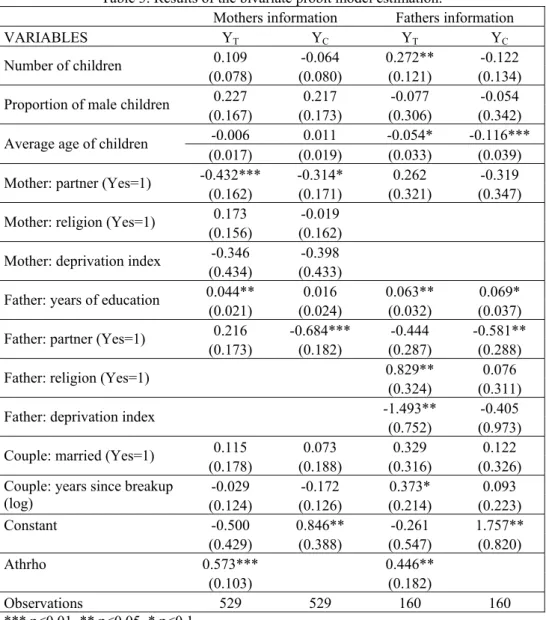
Table 3 shows the outcomes of the bivariate probit model estimation. For both samples the positive sign and the level of the statistical significance of the estimated correlation coefficient indicate that alimony and contact are the results of a complementary
decision. Moreover, unobserved characteristics that increase the likelihood of contact also contribute to increase the likelihood of the payment of child support.
According to the estimations performed with information of women, the characteristics of children do not affect the likelihood of contact neither the likelihood of child support. However, information of men indicates a negative effect of children age and, unexpectedly, a positive effect of the number of children on the likelihood of child support.
In line with our description in the previous section, the results from both samples indicate that when the father has a new partner contact is less frequent, but this situation does not affect the payment of child support. Both samples also indicate that the probability of child support payment increases with the father’s years of schooling. Furthermore, it emerges that, when information from fathers is used, the father’s education has a positive effect on the likelihood of contact.
The results again suggest different perceptions of the effect of the mother having a new partner. While this effect is null (in accordance with the usual levels of statistical significance) for the fathers, according to the information from the mothers there is less probability of child support and contact.
As regards the characteristics of the relationship, no effect of the legal status of the union (whether the couple were legally married or cohabiting but unmarried) emerges. According the information from the fathers, the time lapse since the breakup has a positive impact on payment of child support.
Lastly, the probability of child support payment is greater when the father has a religious commitment, and also greater the less deprived the household is.
Table 3. Results of the bivariate probit model estimation.
Mothers information Fathers information
VARIABLES YT YC YT YC
0.109 -0.064 0.272** -0.122 Number of children
(0.078) (0.080) (0.121) (0.134) 0.227 0.217 -0.077 -0.054 Proportion of male children
(0.167) (0.173) (0.306) (0.342) -0.006 0.011 -0.054* -0.116*** Average age of children
(0.017) (0.019) (0.033) (0.039) -0.432*** -0.314* 0.262 -0.319 Mother: partner (Yes=1)
(0.162) (0.171) (0.321) (0.347) 0.173 -0.019
Mother: religion (Yes=1)
(0.156) (0.162) -0.346 -0.398 Mother: deprivation index
(0.434) (0.433)
0.044** 0.016 0.063** 0.069* Father: years of education
(0.021) (0.024) (0.032) (0.037) 0.216 -0.684*** -0.444 -0.581** Father: partner (Yes=1)
(0.173) (0.182) (0.287) (0.288) 0.829** 0.076 Father: religion (Yes=1)
(0.324) (0.311) -1.493** -0.405 Father: deprivation index
(0.752) (0.973) 0.115 0.073 0.329 0.122 Couple: married (Yes=1)
(0.178) (0.188) (0.316) (0.326) -0.029 -0.172 0.373* 0.093 Couple: years since breakup
(log) (0.124) (0.126) (0.214) (0.223) Constant -0.500 0.846** -0.261 1.757** (0.429) (0.388) (0.547) (0.820) Athrho 0.573*** 0.446** (0.103) (0.182) Observations 529 529 160 160 *** p<0.01, ** p<0.05, * p<0.1
Source: author’s preparation based on Gender and Generations Survey, Uruguay, 2004
We are also interested in using the estimations to explore the nature of the differences between mothers’ and fathers’ information. Specifically, we are interested in comparing the mean predicted value obtained when we use the parameters and data-set of mothers’ information, with the mean predicted value when using the parameters of mother information and the data-set of fathers’ information. But to follow this procedure, we need to restrict the independent variables to those that are in both data-sets.
When we fit the bivariate probit with mothers’ information (except her religion and deprivation index) the mean predicted values of YT and YC are 0.44 and 0.46.7 When we use the same parameters but with the characteristics of fathers, the mean values of YT and YC are 0.53 and 0.59. These results suggest that the differences in reported contact and child support payment between fathers and mothers are not entirely explained by differences in the samples.
We also calculate the mean predicted values of YT and YC when we use the bivariate probit estimations obtained with fathers’ information: they are 0.69 and 0.69, respectively. If we make the prediction using the parameters of fathers and the characteristics of mothers we obtain a value of 0.67 for YT and 0.70 for YC. These results reinforce the conclusions below.
3.3. Maintenance: total payment, partial, or non-payment
As mentioned in section 3 above, in the EGG the mothers were asked what proportion of the set child support they had been paid in the month before the interviews, and there were five possible responses. With this information we estimated an ordered probit model with a dependent variable that took five values. Based on the results this yielded, we made a new estimation in which we put the categories of the dependent variable into three groups. The lowest value corresponds to when the father did not make any payment, and the highest is for when the father paid in full. Cases in which payment was partial were given the intermediate value.
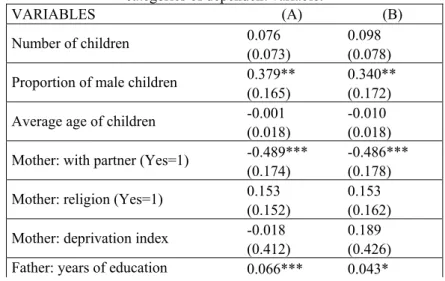
Table 4 shows the estimated coefficients for the two specifications. In both, one group of results confirms the same conclusions as those of the estimation in section 4.2. The fulfillment of financial obligation is greater when the mother does not have a new partner, and also when the father has a higher educational level. On the other hand, the mother’s religiosity, her level of deprivation and the characteristics of the parents’ relationship do not have an effect.
Once again, the number of couple’s children and their average age do not have any effect, but the results indicate that the higher the proportion of male children the greater the probability that the father will fulfill his obligations.
7 These values are quite close to those obtained for the full model and the average values of the observed data. We reach a similar conclusion when we fit the restricted model with fathers’ information.
Unlike the estimation in column A, in column B we also include explanatory variables as regards the father’ work situation. This reduces the impact of his educational level. We are aware that in this specification we have an endogeneity problem because the father might opt for an occupation that facilitates his evading his child support obligations. In any case, these results have some interesting aspects.
The fulfillment of financial obligations is less among the self-employed than among employed workers, and this is consistent with the fact that only the latter are liable to legally enforced wage withholdings. It may be that wage withholdings or the threat of legal enforcement function as a tool to promote fulfillment. However, there are two aspects that make this notion relative. First, if it is true that fathers frequently opt for self-employment in order to evade child support, the result obtained does not allow us to draw conclusions about the legal threat. Second, as the amount of the court ordered child support is set as a proportion of the father’s income, the precision of the information about the father’s income that the mother has affects her response. Remember that this information is less precise when the father is self-employed. If mothers overestimate their ex-partners’ income they will have the perception that the level of child support paid is below what was ordered.
Lastly, fathers who are unemployed show a lower level of obligation fulfillment. This is easily explained by their lack of income to be able to pay child support. It is possible that some fathers claim they do not have work to justify not fulfilling their obligations.
Table 4. Results of the estimation. Ordered probit model: three categories of dependent variable.
VARIABLES (A) (B)
0.076 0.098 Number of children
(0.073) (0.078) 0.379** 0.340** Proportion of male children
(0.165) (0.172) -0.001 -0.010 Average age of children
(0.018) (0.018) -0.489*** -0.486*** Mother: with partner (Yes=1)
(0.174) (0.178) 0.153 0.153 Mother: religion (Yes=1)
(0.152) (0.162) -0.018 0.189 Mother: deprivation index
(0.412) (0.426) Father: years of education 0.066*** 0.043*
(0.022) (0.024) 0.022 -0.141 Father: with partner (Yes=1)
(0.165) (0.173) -0.319
Father: private employee
(0.196) -0.427** Father: self-employed (0.216) -1.651*** Father: unemployed (0.241) 0.136 0.167 Couple: married (Yes=1)
(0.193) (0.204) -0.031 0.022 Couple: years since breakup (log)
(0.128) (0.133) Observations 503 503
*** p<0.01, ** p<0.05, * p<0.1
Source: author’s preparation based on Gender and Generations Survey, Uruguay, 2004
4.4. Contact between fathers and children: frequency of visits
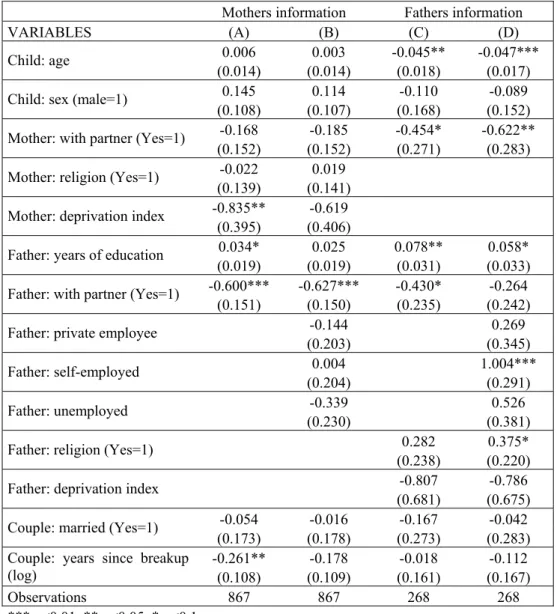
As mentioned in section 3 above, the EGG inquires into the frequency with which fathers and children saw each other in the year before the interview, and there were six possible responses: never, less than once per month, once a month, once a fortnight, once a week, and more than once a week. We use these responses as a basis for estimating an ordered probit model in which the observations correspond to the children. The results are shown in table 5. We fit two specifications for each sample: in one we do not include the father’s labor situation (columns A and C) and in the other we do include it (columns B and D).
The estimations in columns A and C show some of the patterns that have been mentioned above. The frequency of contact between fathers and children increases with the father’s educational level, and is less when the father has a new partner. The parameter for the mother having a new partner is negative, but this estimation is statistically significant only when the information from the fathers is used.
As the observations in this estimation are those for the children, we introduce two children’s characteristics: their age and their sex. The latter variable does not turn out to have a statistically significant effect. In the case of the fathers’ information, contacts decrease with age.
Lastly, the results from including the fathers’ labor situation indicate that, when the fathers’ information is used, self-employment is associated with more frequent contact.
Table 5. Estimation results. Ordered probit model: six categories of the dependent variable.
Mothers information Fathers information
VARIABLES (A) (B) (C) (D)
0.006 0.003 -0.045** -0.047*** Child: age
(0.014) (0.014) (0.018) (0.017) 0.145 0.114 -0.110 -0.089 Child: sex (male=1)
(0.108) (0.107) (0.168) (0.152) -0.168 -0.185 -0.454* -0.622** Mother: with partner (Yes=1)
(0.152) (0.152) (0.271) (0.283) -0.022 0.019
Mother: religion (Yes=1)
(0.139) (0.141) -0.835** -0.619 Mother: deprivation index
(0.395) (0.406)
0.034* 0.025 0.078** 0.058* Father: years of education
(0.019) (0.019) (0.031) (0.033) -0.600*** -0.627*** -0.430* -0.264 Father: with partner (Yes=1)
(0.151) (0.150) (0.235) (0.242) -0.144 0.269 Father: private employee
(0.203) (0.345) 0.004 1.004*** Father: self-employed (0.204) (0.291) -0.339 0.526 Father: unemployed (0.230) (0.381) 0.282 0.375*
Father: religion (Yes=1)
(0.238) (0.220)
-0.807 -0.786
Father: deprivation index
(0.681) (0.675) -0.054 -0.016 -0.167 -0.042 Couple: married (Yes=1)
(0.173) (0.178) (0.273) (0.283) -0.261** -0.178 -0.018 -0.112 Couple: years since breakup
(log) (0.108) (0.109) (0.161) (0.167)
Observations 867 867 268 268
*** p<0.01, ** p<0.05, * p<0.1
Source: author’s preparation based on Gender and Generations Survey, Uruguay, 2004
4. Discussion and conclusions
Since the1970s the increase in divorce and relationship breakups in Uruguay has accelerated. Today the divorce rate is over 35%, which is very high compared the other countries in South America.
It is interesting to note that Uruguay is one of the few examples of a developing country in which the child support and contact after the relationship breakups can be analyzed. The survey we use provides women and men information about child support payment rates and parental contact with children after a relationship breakup. These data are unpaired, but still the inclusion of men enabled us to determine the level of discrepancy between mothers’ and fathers’ declarations, and analyze the variables associated with each sex’s responses.
Our results show that fathers and mothers have differing perceptions as to how much child support is paid and how frequent contacts are between non resident parents and their children after a relationship breakup. The proportion of fathers who transfer money to their children after the breakup is lower according to the mothers’ responses than according to the fathers’. A similar result emerges as regards posdivorce contact: the fathers claim they have contact with their children more frequently than what the mothers report. Our analysis suggests that the differences between the data-set of men and women are not the main source of the discrepancy of perceptions.
The discrepancies between the declarations fathers and mothers make about these aspects of their children’s lives have been described in various studies (Mikelson, 2008; Schaeffer et al. 1998; Smock, P. & Manning, 1997). In the interpretations of these discrepancies different sources are considered. Some studies focus on methodological problems, particularly the characteristics of the non resident fathers who take part in surveys and those that do not. This aspect can causes biases in the men’s’ responses, and it is particularly important in studies that utilize unmatched parental pairs, as is the case of the data we use in this study.
It has been argued that another possible source of discrepancy is “self-enhancement”, in other words people’s tendency to report that they give more than they receive (Mandemakers & Dykstra 2008). These authors also suggest other possible sources of the discrepancies between the declarations, namely that mothers may be dissatisfied with the level of support they receive, and people may differ as regards whet they think family obligations should entail. Another possibility is that the father may make transfers
directly to his children, either in money or in kind, without the mother being involved in the transaction. This would obviously distort the mother’s evaluation of the real level of support the children are receiving to the extent that support is paid in this informal way.
The estimations suggest that the child support payment rate and contact frequency are to some extent interconnected. This outcome is consistent with previous research in Uruguay (Bucheli, 2003). Some authors maintain that the transfer/contact relation is the result of a negotiation in which the mothers control their children’s time and the fathers control the transfers, and the more money the father transfers the greater his leverage to obtain time with his children (Del Boca & Ribeiro 1999). In a recent study, Nepomnyaschy (2007) finds a weak association between contact and formal transfers in low income sectors but a strong association in the intensity of contact and informal transfers, and also that contact has a greater effect of the probability of transfers than the reverse.
We now present a summary of the main results of our estimations.
1) Our estimations confirm the results of previous research in that the father’s capacity to pay which is captured by the deprivation index, has a positive effect on child support. Part of this effect may also be captured by the positive impact of the father’s educational level, which emerges in the estimation that distinguishes between partial and total fulfillment of obligations in a particular month. On the other hand, deprivation does not seem to be associated with loss of contact.
The positive effect that educational level has on child support and contact persists when the deprivation index is controlled for. Even so, it is possible that education may also capture the capacity to pay as it is more connected to the flow of income (thus deprivation is rather an indicator of wealth). However, we might suppose that to the degree that the formation of couples usually follows a homogamic pattern, the ex-partner of a better-educated man will also have a higher educational level, which would enable her to exert greater pressure to obtain child support payments.
2) Another characteristic we analyzed is the effect of the mother or father repartnering. The mothers’ perception is that if she has a new partner this will have a negative impact on his child support payment rate. The fathers do not share this perception. It may be that this difference in perceptions is due to the fact that if the mother has a new partner, the father may fulfill part of his obligations by making transfers directly to the child. Although the legislation establishes that payment should be made to the mother or that the father should take direct responsibility for some costs, if the father allocates
resources directly to his child through informal channels, or at least through channels outside the mother’s control, he might not have the perception that he is failing to fulfill his obligations. Another alternative explanation is that the man might perceive that the fact that the mother has a new partner means the income level of the household where his children live is increased.
Similarly, the fact that the mother is in a new stable relationship seems to have a negative effect on contact between the non resident father and his children, but the estimations are less consistent on this point. While mothers would recognize differences when there is a total loss of contact, the fathers’ responses seem to indicate that they do not stop seeing their children, but they acknowledge they see them less.
On the other hand, the effect of the father having a new partner seems to be more robust: it makes for less frequent contact but does not affect child support payment rates.
3) Some variables may capture aspects related to the orientations of values, but these would be patterns that are captured in some estimations but not in others. Thus there is a suggestion that fathers who are more religious remain in closer touch with their children. The variable that captures practicing a religion includes all religions, but in Uruguay the vast majority of people who practice a religion are Catholic, so this outcome would suggest above all that Catholic morality leaves a strong impression when it comes to fulfilling family obligations.
4) As regards the demographic characteristics of children, according to fathers, contact and child support become less frequent the older the child is. This result is consistent with international evidence, and it may suggest that father involvement with children decreases as the time since separation increases (Seltzer 2001). However, we also have to consider changes in behavior related to age. A child’s sex does not affect frequency of contact, but we find that in the financial support model the amount of payment is greater when the male proportion of offspring is greater. We do not have an explanation of why contact is not related to a child’s gender whereas child support is. But it is important to note that the literature on post divorce shows mixed results when analyzing financial support, father involvement and child gender (Mammen, 2008). It should also be noted that even when research shows that divorced fathers invest more time and money in daughters, the association is weak and declining (Raley & Suzanne Bianchi 2006).
5) As regards the characteristics of the couple, we find that union status (informal couple or legal marriage) does not affect the outcomes. This result is consistent with previous estimations for Uruguay (Bucheli, 2003) but it is unexpected in the light of a large body of research that links cohabitation to weaker father involvement after union breakup (Osborne & McLanahan 2004; Manning & Brown 2003). But it seems that the nature of the relationship between the parents is not a good predictor of Uruguayan fathers’ commitment to their children after union dissolution. However we may note that we need more research about union status and the father’s involvement during conjugal life and after union breakup in the context of the increase in cohabitation. Indeed, although consensual unions have always been common, mainly in rural and poor sectors, they have been growing significantly in recent decades.
6) One last interesting point concerns the role that the legal system plays in applying the established child support payment regulations. The estimations have problems of endogeneity. However, compliance seems to be higher among dependent workers. Thus, we may say that child support schemes and enforcement are basically oriented to this sector although in Uruguay self-employment is quite important (22% of employed labor force in 2008).
References
Bartfeld, J. 2000. "Child Support and Postdivorce Economic Well-Being of Mothers, Fathers, and Children." Demography 37(2):203-213.
Bartfeld, J.y D. Meyer. 2003. "Child Support Compliance among Discretionary and Nondiscretionary Obligors." Social Service Review 77(3):347-374.
Benia, W., Macadar, D. & Niedworok, N. (2005) Primer informe de investigación. Proyecto Género y Generaciones. La reproducción biológica y social de la población uruguaya, Montevideo (not published).
Bucheli, M. (2003) “Transferencias y visitas entre hijos y padres no corresidentes”, in Nuevas formas de familia. Perspectivas nacionales e internacionales, UdelaR/UNICEF, Montevideo. Bucheli, M. & Cabella, W. (2005) “El incumplimiento en el pago de las pensiones alimenticias, el bienestar de los hogares y el contexto legal vigente en Uruguay” in Asignaciones familiares, pensiones alimenticias y bienestar de la infancia en Uruguay,
Montevideo, UdelaR-UNICEF.
Cabella, W. (2009) “Dos décadas de transformaciones de la nupcialidad uruguaya. La convergencia hacia la segunda transición demográfica”, Estudios Demográficos y Urbanos, Vol. 24, núm. 2, 2009 (forthcoming).
Cabella (1998) “La evolución del divorcio en Uruguay”. 1950-1995, Notas de Población, v. XXVI 67/68 , p. 209-245.
Caetano, G. & Geymonat, R. (1997) La secularización uruguaya, Montevideo: Taurus. Chackiel, J. & S. Schkolnik (1992) “La transición de la fecundidad en América Latina”, Notas de población, Nº 55 CELADE, Santiago de Chile.
CEPAL (2008). Panorama social de América Latina 2008, LC/G.2402-P/E, Santiago de Chile.
Coley, R. L., & Morris, J. E. (2002) “Comparing father and mother reports of father involvement among low-income minority families”, Journal of Marriage and Family, 64, 982 – 997.
De Armas, G. (2006) La reducción de la pobreza infantil en Uruguay durante 2005. Logros alcanzados, posibles impactos de las políticas y asignaturas pendientes, UNICEF, Montevideo.
Del Boca, D. & Ribeiro, R. (1999) Visitation and transfers in non intact households. Discussion Paper Nº 807, Economic Growth Center, Yale University.
Filgueira, C. (1996) Sobre revoluciones ocultas. La familia en el Uruguay. CEPAL, Oficina de Montevideo.
Filgueira, C. H. y Peri, A. (2004). "América Latina: los rostros de la pobreza y sus causas determinantes." en Serie Población y Desarrollo. CEPAL, Santiago de Chile.
Kaztman, R. y Fernando Filgueira. (2001) Panorama de la infancia y la familia en Uruguay. IPES/Universidad Católica del Uruguay.
Mammen, K. (2008) The Effect of Children’s Gender on Living Arrangements and Child Support, American Economic Review: Papers & Proceedings 2008, 98:2, 408–412
Mandemakers, J. & Dykstra, P. (2008) Discrepancies in parent’s and adult child’s reports of support and contact, Journal of Marriage and Family, 70, 495-506.
Mikelson, K. (2008) He said, she said: comparing mother and father reports of father involvement, Journal of Marriage and the Family, 70, 613-624
Nepomnyaschy, L. (2007) “Child Support and Father-Child Contacts: Testing Reciprocal Pathways”, Demography, 44, 93-112.
Paredes, M. (2003). "Los cambios en la familia en Uruguay: ¿Hacia una segunda transición demográfica?" Pp. 73-102 in Nuevas Formas de Familia. Perspectivas nacionales e
internacionales, editado por Udelar/UNICEF. Udelar/UNICEF, Montevideo.
Pellegrino, A. (2003) Caracterización demográfica del Uruguay, Programa de Población, Universidad de la República, UNFPA-UdelaR, Montevideo.
PNUD. 2005. Desarrollo Humano en Uruguay 2005. Hacia una estrategia de desarrollo basada en el conocimiento, PNUD, Montevideo.
Raley, S. & Bianchi, S. (2006) Sons, Daughters, and Family Processes: Does Gender of Children Matter? Annual Review of Sociology, Vol. 32: 401-421
Schaeffer, N. C., Seltzer, J. A., & Dykema, J. (1998). “Methodological and theoretical issues in studying nonresident fathers: A selective review”. National Center on Fathers and Families Working Paper 98-02, University of Pennsylvania, Philadelphia, PA.
Varela de Motta, I. (1998) Manual de derecho de familia, Montevideo, Fondo de Cultura Universitaria, 2ª edición.
Osborne, C., & S. McLanahan (2004). The effects of partnership instability on parenting and young children’s health and behavior. Center for Research on Child Wellbeing Working Papers, No. 04-16-FF.
Manning, W., & S. Brown (2003). Children’s economic well-being in cohabiting parent families. Center for Family and Demographic Research Working Papers, No. 03-05.