QoS-Aware Data-Intensive
Web Service Composition
and Execution
by
Yang Yu
A thesis
submitted to the Victoria University of Wellington in fulfilment of the
requirements for the degree of Master of Engineering in Software Engineering. Victoria University of Wellington
Web service composition has become a promising technique to build pow-erful enterprise applications by making use of distributed services with different functions. In the age of big data, more and more web services are created to deal with a large amount of data, which are called data-intensive services. Due to the explosion in the volume of data, providing efficient approaches to composing data-intensive services will become more and more important in the field of service-oriented computing. Meanwhile, as numerous web services have been emerging to offer identical or simi-lar functionality on the Internet, web service composition is usually per-formed with end-to-end Quality of Service (QoS) properties which are adopted to describe the non-functional properties (e.g., response time, ex-ecution cost, reliability, etc.) of a web service. In addition, the exex-ecutions of composite web services are typically coordinated by a centralized work-flow engine. As a result, the centralized execution paradigm suffers from inefficient communication and a single point of failure. This is particu-larly problematic in the context of data-intensive processes. To that end, more decentralized and flexible execution paradigms are required for the execution of data-intensive applications.
From a computational point of view, the problems of QoS-aware data-intensive web service composition and execution can be characterised as complex, large-scale, constrained and multi-objective optimization prob-lems. Therefore, genetic programming (GP) based solutions are presented in this thesis to address the problems. A series of simulation experiments are provided to demonstrate the performance of the proposed approaches, and the empirical observations are also described in this thesis.
procedure of tabu search into the global search process of GP to solving the problem of QoS-aware data-intensive web service composition. A math-ematical model is developed for considering the mass data transmission across different component services in a data-intensive service composi-tion. The experimental results show that our proposed approach can pro-vide better performance than the standard GP approach and two tradi-tional optimization methods.
Next, a many-objective evolutionary approach is proposed for tack-ling the QoS-aware data-intensive service composition problem having more than three competing quality objectives. In this approach, the orig-inal search space of the problem is reduced before a recently developed many-objective optimization algorithm, NSGA-III, is adopted to solve the many-objective optimization problem. The experimental results demon-strate the effectiveness of our approach, as well as its superiority than ex-isting single-objective and multi-objective approaches.
Finally, a GP-based approach to partitioning a composite data-intensive service for decentralized execution is put forth in this thesis. Similar to the first problem, a mathematical model is developed for estimating the communication overhead inside a partition and across the partitions. The data and control dependencies in the original composite web service can be properly preserved in the deployment topology generated by our ap-proach. Compared with two existing heuristic algorithms, the proposed approach exhibits better scalability and it is more suitable for large-scale partitioning problems.
This master thesis would not have been possible without the kind support and help of many people. First and foremost, I would like to express my sincere gratitude to my supervisors, Dr. Hui Ma and Prof. Mengjie Zhang who were abundantly helpful and offered invaluable assistance, support and guidance throughout my thesis. I also would like to express my love and gratitude to my beloved families for their understanding and endless love, through the duration of my studies.
1 Introduction 1 1.1 Research Problems . . . 4 1.1.1 Motivations . . . 4 1.1.2 Objectives . . . 6 1.2 Major Contributions . . . 7 1.3 Organisations . . . 9 2 Literature Survey 11 2.1 Background . . . 11
2.1.1 Atomic Web Servicevs. Composite Web Service . . . 12
2.1.2 Quality of Service . . . 12
2.1.3 Single-Objective, Multi-Objective and Many-Objective Optimization . . . 16
2.1.4 Genetic Programming . . . 23
2.2 QoS-Aware Web Service Composition . . . 27
2.3 Related Work . . . 28
2.3.1 Conventional (Non-Evolutionary) Approaches . . . . 30
2.3.2 Single-Objective Evolutionary Approaches . . . 31
2.3.3 Multi-Objective Evolutionary Approaches . . . 33
2.3.4 Decentralized Execution of Composite Web Services 34 2.4 Summary . . . 35
3 A Hybrid GP-Tabu Approach 37
3.1 The Problem . . . 37
3.2 A Time and Cost Aware Model . . . 39
3.3 The Hybrid GP-Tabu Approach . . . 41
3.3.1 An Overview of Tabu Search . . . 41
3.3.2 The Proposed Hybrid Approach . . . 42
3.4 Experimental Studies . . . 45
3.4.1 Test Cases . . . 45
3.4.2 Parameter Configurations . . . 45
3.4.3 Experimental Results and Analysis . . . 46
3.5 Summary . . . 48
4 F-MOGP 49 4.1 The Problem . . . 50
4.2 The Proposed F-MOGP . . . 51
4.2.1 Search Space Reduction . . . 52
4.2.2 Many-Objective Optimization Based on NSGA-III . . 53
4.3 Experimental Studies . . . 56
4.3.1 Test Cases . . . 56
4.3.2 Parameter Configurations . . . 58
4.3.3 Experimental Results and Analysis . . . 58
4.4 Summary . . . 64
5 GP for Decentralized Execution 65 5.1 The Problem . . . 66
5.2 A Model for Communication Overhead . . . 71
5.2.1 Inside A Partition . . . 71
5.2.2 Between Two Partitions . . . 73
5.3 The GP-Based Partitioning Approach . . . 74
5.3.1 Representation . . . 74
5.3.2 Selection . . . 76
5.3.4 Fitness Function . . . 78
5.4 Experimental Studies . . . 80
5.4.1 Test Cases . . . 80
5.4.2 Parameter Configurations . . . 81
5.4.3 Experimental Results and Analysis . . . 81
5.5 Summary . . . 84
6 Conclusions 85 6.1 Future Work . . . 87
Introduction
Service-oriented architecture (SOA) [63] is a widely accepted and engaged paradigm for the realization of complex business processes. The aim of SOA is to implement business processes covering different organisations and computing platforms in a dynamic and loosely-coupled manner. As a promising technology to implement such a service-oriented architecture, web services encapsulate software functions and make them available to anyone in the world over the network via standard interfaces and pro-tocols (e.g., SOAP and WSDL). The advent of web services has boosted the creation of business applications by reusing existing resources on the network, rather than building new applications from scratch to fulfill busi-ness functional requirements.
Web services are self-contained and self-describing modular applica-tion components deployed on the Internet, which follow certain technical standards such as Simple Object Access Protocol (SOAP), Web Services Description Language (WSDL), and Universal Description, Discovery and Integration (UDDI) [78]. In recent years, many software functions have been published over the Internet or the Cloud in the format of web ser-vices, which enable better integration, scalability and availability for busi-ness. As a distributed computing technology, web services allow their functionalities to be available to anyone in the world. For example, the
information about weather in New Zealand could be published through a web service that, given a ZIP code, will provide the weather informa-tion for that ZIP code. A sketchy example of how a web service works is illustrated in Figure 1.1.
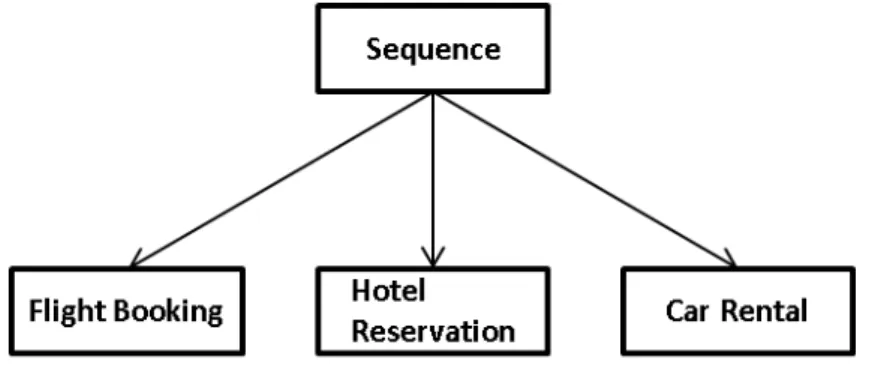
Figure 1.1: An example of a weather information web service However, a web service itself has a limited functionality and when no single web service is able to respond to the user’s request, it is necessary to compose a range of existing services together in order to provide new value-added and complex functionality, which is referred to as web ser-vice composition, and the aggregated web service becomes acomposite web service. A typical scenario of web service composition is an online travel agent shown in Figure 1.2 that is composed of three tasks for flight book-ing, hotel reservation and car rental. In other terms, the user needs to ex-ecute each of these corresponding web services manually and these tasks can be time and effort consuming. For that reason, how to compose a number of web services automatically without user interference or inter-vention attracts a lot of interest. On the other hand, today, a large number of web services on the Internet offer identical or overlapping functionality but present various non-functional characteristics which are calledquality of service (QoS)properties such as response time, execution cost and relia-bility. Therefore, how to select a suitable web service that satisfies user’s requirements still remains an open question, and the non-functional QoS factors become significant criteria that need to be considered in web ser-vice composition. To select web serser-vices among a great number of
candi-date services to meet global end-to-end QoS requirements while fulfilling the functional requirements is called the problem ofQoS-aware web service composition.
Figure 1.2: An example of an online travel agent system
Aside from business processes, the service-oriented approach using web services is also of great interest for the implementation of data inten-sive processes such as data mining and image processing. Such web ser-vices are defined asdata-intensive servicesthat generally have large amounts of data as their inputs and outputs [22]. For example, as depicted in Fig-ure 1.3, a facial recognition solution for video and image content could be published through a web service that, given a set of original images, will provide a set of processed images with identified facial features. Over the recent years, the amount of data generated by humanities, scientific activ-ities, as well as commercial applications from a diverse range of fields has been increasing exponentially. Data volumes used in the fields of sciences and engineering, finance, media, online information resources and so on, are expected to double every two years over the next decade and further [84]. There is no doubt in the industry and research community that the importance of data-intensive computing has been raising and will con-tinue to be the foremost research field. As a result, data-intensive services based applications have become the most challenging type of applications in SOA. Also, data-intensive service composition has become an appealing
research area in academia and industry.
Figure 1.3: An example of a face recognition web service
1.1
Research Problems
1.1.1
Motivations
With the increasing presence and adoption of web services on the World Wide Web, the composition strategy of a variety of services provides max-imal flexibility when designing and implementing data-intensive applica-tions. On the other hand, with the tremendous growth of identical or sim-ilar services, QoS is usually employed to describe the non-functional char-acteristics of web services. For traditional web service compositions, the time and cost of data transmission among component services are negli-gible compared with the execution time of component services. However, as a considerable amount of data needs to be exchanged between the com-ponents in a composite data-intensive service, the movement of mass data has a great influence on the overall performance of the composite web ser-vice. Therefore, it becomes inevitable to take into account non-functional properties (e.g., response time, execution cost, reliability, etc.) during the dynamic process of data-intensive service composition, especially atten-tion should be drawn to the transfer time and transfer cost of mass data transmission between collaborating web services.
A survey on QoS-aware web service composition reveals that most re-search on automated or semi-automated service composition falls in realm
of single-objective optimization. In this approach, different performance objectives are combined into a single objective according to a certain unity function then a particular optimization technique such as genetic algo-rithm is applied to optimize the objective. In the situation where the user’s preference information is completely unknown, the methods in such a cat-egory are difficult to apply because each quality dimension needs to be assigned a weight which is not well known a priori. Also different di-mensional qualities may conflict with one another in the real world. For example, quicker response and lower price are highly demanded, but in practice they are typically in conflict. As more quality dimensions are con-strained by the user, the aforementioned problem becomes more compli-cated. Therefore, it is unlikely to find an optimal solution in one dimen-sion of the objectives without causing unnecessary suffering to another. This is referred to as the problem of many-objective QoS-aware web service compositionin this work. However, limited work has focused on this prob-lem for data-intensive service compositions when more than three quality dimensions are considered simultaneously.
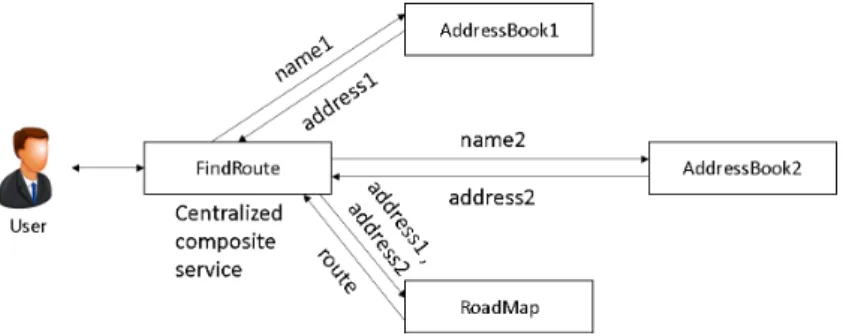
Typically, a composite web service is executed by a single coordinator node which receives service user’s request, makes necessary data trans-formations and invokes each component service. As the name implies, the coordinator node is responsible for the coordination of all the data and control flow between the component services, and hence becomes a po-tential performance bottleneck. This execution mode of composite web services is referred to as centralized orchestration [14]. As depicted in Fig-ure 1.4, all data is transferred between various component services via the coordinator node instead of being transferred directly from the point of generation to the point of consumption, which may cause unnecessary network traffic overloading. In addition, it is possible for a component ser-vice to produce a lot of data that is irrelevant to the desired function of the composite web service. However, the data will be still transferred to the coordinate node, thereby resulting in increased workload on the network
as well as the increase of response time. This is particularly problematic for data-intensive service compositions in which huge collections of data are transferred.
Figure 1.4: An example of centralized orchestration
From a computational point of view, the problems of QoS-aware data-intensive web service composition and execution have proven to be NP-hard. Genetic programming (GP) [48] which is inspired by the process of natural evolution has been successfully applied in a wide range of prob-lem domains [48] such as building electronic circuits or control systems to solve complex, large-scale, constrained and multi-objective optimiza-tion problems. The past successful applicaoptimiza-tions of GP motivate our selec-tion of GP to address the problems presented in this thesis, which are also characterized as complex, large-scale, constrained and multi-objective op-timization problems.
1.1.2
Objectives
Based on the above motivational discussion, the overall objective of this thesis is to develop efficient and scalable GP-based approaches to finding a data-intensive web service composition and realizing decentralized ex-ecution of the composite web service found, with the ability to deal with many and often conflicting quality dimensions. To be specific, this objec-tive is decomposed into three separate objecobjec-tives that are to be addressed
in this thesis, and they are described as follows.
• determining how to efficiently compose a set of data-intensive ser-vices by considering the non-functional attributes of the composite web service, especially paying attention to the time and cost gener-ated by mass data access and transfer,
• solving the problem of QoS-aware data-intensive service composi-tion for the situacomposi-tion where users are not certain about the impor-tance of each quality criterion, and many and often conflicting qual-ity objectives are considered,
• coping with the poor scalability and performance degradation such as unnecessary network traffic overloading and increased response time raised by centralized orchestration.
1.2
Major Contributions
In the field of QoS-aware data-intensive web service composition and ex-ecution, the key contributions of this thesis are three-fold. Firstly, the data transmission among the components in data-intensive service composi-tions is taken into consideration when selecting and composing a number of data-intensive web services. So far, the existing literature has neglected the time and cost spent on mass data transmission between data-intensive web services. As data transmission has a great influence on the overall per-formance of data-intensive service compositions, approaches without con-sidering it cannot satisfy users’ non-functional requirements accurately. Our work overcomes this issue by proposing a mathematical model to measure the communication time and cost between the components in a composite data-intensive service, and a hybrid GP-Tabu approach is pro-posed to address the service composition problem. The simulation experi-ments demonstrate that the hybrid approach outperforms GP, tabu search
and integer linear programming in finding more satisfying data-intensive service compositions. A research paper [93] containing this work has been published in the Tenth International Conference on Simulated Evolution And Learning (SEAL 2014).
Secondly, we propose a many-objective evolutionary approach named F-MOGP to solving the service composition problem when preference in-formation is not well known a priori, which fills the gap in the literature on QoS-aware data-intensive web service composition depending on evolu-tionary many-objective optimization algorithms. The two-phase F-MOGP approach starts with a search space reduction strategy in order to reduce the huge search space of a complex problem. The experimental results show that the search space can be significantly reduced by the proposed search space reduction algorithm, which leads to a dramatic reduction of the computation time required by the optimization phase. By perform-ing a comparative study of the performance of two existperform-ing EMOs (i.e., NSGA-II and SPEA2) based on large datasets, we reach the conclusion that our approach demonstrates better performance when more than three quality objectives are considered in the search process for a data-intensive service composition. A research paper [94] about this contribution has been published in the 2015 IEEE Congress on Evolutionary Computation (CEC2015).
The third contribution of this thesis is a GP-based approach that is pro-posed to split a data-intensive BPEL process into a set of sub-processes for decentralized execution of composite data-intensive web services. The partitioning process takes the data communication overhead occurred in-side a partition and across the partitions into conin-sideration. Compared with two state-of-art methods which are MDU [61] and PGM [61] respec-tively, the proposed approach is scalable with respect to the size of data-intensive service compositions. In other terms, for large-scale partition-ing problems, our approach requires less computation time to generate higher-quality partitioning execution plans compared with the two
exist-ing methods. A research paper has been submitted to the IEEE Interna-tional Conference on Web Services (ICWS).
1.3
Organisations
The remainder of this thesis is organized as follows. The background of our research problems and an overview of recent research efforts are pre-sented in the following chapter. Chapter 3 gives a description of our hy-brid GP-Tabu approach to QoS-aware data-intensive web service compo-sition, meanwhile a series of experiments are conducted to evaluate the ef-fectiveness and efficiency of the proposed approach. In Chapter 4, the ser-vice composition problem is solved using a many-objective evolutionary approach named F-MOGP, and simulation experiments are performed to evaluate and compare the performance of the approach and two popular EMOs. Chapter 5 presents a GP-based approach for distributed execution of composite data-intensive web services and a set of experiments demon-strate that the proposed approach has better scalability than two existing heuristic algorithms. At the end of the thesis, conclusions are made for our research work, and future perspectives are described.
Literature Survey
2.1
Background
In recent years, web services that encapsulate the functions of application components have been rapidly developed and play an increasingly im-portant role in implementing a service-oriented architecture. To make full use of single web services which provide limited functions only, web ser-vice compositionthat aims to integrate multiple services into workflows in order to supply value-added and complex functions, has become a pop-ular research focus. In web service composition, functional requirements are concerned with the functionalities of a composite web service, e.g., given a flight booking task, the functional requirement is to purchase an airline ticket based on the information provided by a user. In addition to functional capabilities of web services, non-functional requirements (e.g., response time, throughout, availability) have to be matched to maximize user satisfaction expressed as many objectives over a variety of QoS at-tributes of services. An example of non-functional requirements for the flight booking task is that the composite web service will respond within a certain time period and charges less than a specific amount of money with a preferred level of accuracy and reliability. Nowadays, due to the explosive increase of web services that provide identical or overlapping
functionality on the Web, quality of service namely QoS becomes a key factor in distinguishing these functionally equivalent services.
2.1.1
Atomic Web Service
vs.
Composite Web Service
A composite web service is made up of a collection of single web services each of which is referred to as atomic web service. The goal of a service composition is to generate the desired outputs given a set of available in-puts that are described by semantic concepts. Assume the task scenario is to search for an appropriate flight as well as the weather forecast for the destination based upon the given departure date, return date, departure city and arrival city. In other terms, a web service is requested to take{departure date, return date, departure city, arrival city} as inputs in order to produce {flight information, weather forecast} as outputs. However, an atomic web service itself has limited functionality which is not sufficient to respond to the user’s request. A composite web service that consists of multiple atomic web services is needed to accomplish the task. A valid service composition must guarantee that the inputs of any atomic web service are available either from the outputs of its ancestors or from the original inputs (i.e., from the user).
2.1.2
Quality of Service
QoS can be characterized according to various non-functional properties of web services calledQoS attributessuch as response time, execution cost, availability and reliability. Based on a selection of relevant characteristics in the field of web services, the QoS attributes considered in this research work are latency, execution cost, availability and accuracy all of which are defined as follows.
• latency L measures the expected delay in seconds between the mo-ment when a request is sent and the momo-ment when the results are received.
• execution cost C is the amount of money that a service requester has to pay for executing the web service.
• availability Ais the probability that a web service is accessible.
• accuracy Ris the measurement of the degree to which the real results produced by the web service match the desired results.
Amongest the above four QoS attributes, latency and execution cost are decreasing measures with respect to QoS. In other terms, the grades of these measures increase as their values decrease. In contrast, availability and accuracy are increasing measures of which the grades decrease as their values decrease.
The four basic control structures shared by web service composition languages such as OWL-S and BPEL4WS are sequence, parallel (f low), choice (switch) and loop. In the figures below, each rectangle denotes a component service that defines either a composite service or an atomic service, and the circles on the left and right represent its functional inputs and outputs, respectively. The workflow structures and the aggregation functions are described in the following subsections. Note that all the ag-gregation functions are recursive.
Sequence Construct
For a sequence workflow of tasks, as shown in Figure 2.1, a number of component services (W S1, ...,W Sn, ...,W Sm) are executed in a sequential
order. The outputs of a component service are part of the inputs of its subsequent service. The aggregation functions of latencyLand execution costC are additive, while the availabilityAand accuracyR functions are multiplicative.
L= m X n=1 ln, C = m X n=1 cn, A= m Y n=1 an, R = m Y n=1 rn
Figure 2.1: Sequence Construct
Parallel Construct
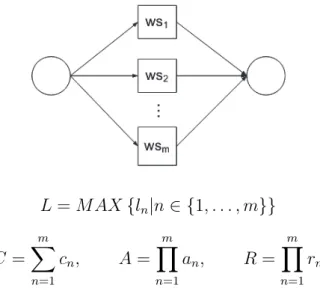
As shown in Figure 2.2, two or more paths are executed in parallel to pro-duce different outputs. Except that for latency L, where the aggregated value is the maximum of the latency of component services, the aggrega-tion funcaggrega-tions for the other QoS attributes (i.e., execuaggrega-tion cost, availability and accuracy) are the same as the ones in the sequence structure.
L=M AX{ln|n ∈ {1, . . . , m}} C = m X n=1 cn, A= m Y n=1 an, R = m Y n=1 rn
Choice Construct
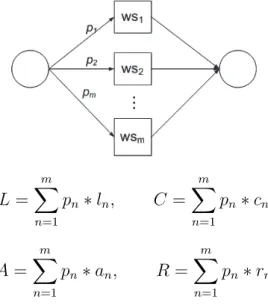
Figure 2.3 shows a choice workflow of tasks, where the same outputs can be obtained through multiple different paths, but only one path will se-lected and executed. Assume the choice structure hasmbranches, and the percentage for each branch to be selected isp1,...,pm, where
m X
n=1
pn = 1.
Therefore, all QoS attributes are evaluated as a sum of the multiplication of the attribute value of each component service and its corresponding percentage. L= m X n=1 pn∗ln, C = m X n=1 pn∗cn A= m X n=1 pn∗an, R= m X n=1 pn∗rn
Figure 2.3: Choice Construct
Loop Construct
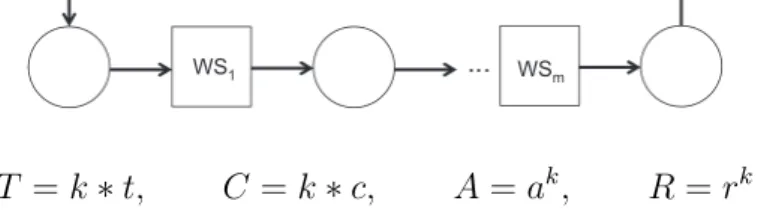
In Figure 2.4 that shows a loop construct, one or more component services are executed repeatedly until a given condition is verified. Assume the number of iterations isk, then the aggregation functions for latencyLand
execution cost C are t · k and c ·k respectively. For availability A and accuracy R, the aggregation functions are the kth power of the value of one iteration, i.e.,akandrk. Here,l, c, aandrdenote the latency, execution
cost, availability and accuracy, respectively, of a composite service of each cycle within the loop.
T =k∗t, C =k∗c, A=ak, R =rk
Figure 2.4: Loop Construct
QoS reflects the non-functional properties of web services which in turn have an influence on user satisfaction, thereby the QoS factors have become significant criteria that cannot be overlooked in web service com-position. The problem ofQoS-aware service compositiondenotes selecting a number of atomic web services while obtaining the highest possible QoS of the service composition and satisfying the global constraints posed by the user. Here, global constraints define an upper or lower bound for the aggregated QoS values of a composite service. To optimize the quality of a service composition, a method must be applied to estimate the QoS of the service composition from its constituent services. This estimation is called QoS aggregation, and the QoS aggregation formulas defined for the above four basic composition patterns and major QoS attributes are summarized in Table 2.1.
2.1.3
Single-Objective, Multi-Objective and Many-Objective
Optimization
Single-objective optimization refers to the optimization problems in which there is a single objective function. In practical problems, more than one
Table 2.1: Aggregation formulae for each pair QoS attribute - workflow structure
QoS attribute Sequence Parallel (Flow) Choice (Switch) Loop
Latency L=Pj
i=1li L=M AX{li|i∈ {1, . . . , j}} L=
Pj
i=1pi∗li L=k∗l Execution cost C=Pj
i=1ci C=Pji=1ci C=Pji=1pi∗ci C=k∗c Availability A=Qj i=1ai A= Qj i=1ai A= Pj i=1pi∗ai A=ak Accuracy R=Qj
i=1ri R=Qji=1ri R=Pji=1pi∗ri R=rk
objective is naturally involved, and there does not exist a single solu-tion that simultaneously optimizes each objective. In that case, multi-objective optimizationis performed to find a number of Pareto-optimal (i.e., non-dominated) solutions. Many evolutionary multi-objective optimiza-tion (EMO) algorithms such as NSGA-II [19] and SPEA2 [103], have been proposed and successfully applied for tackling two-objective and three-objective problems. However, it has been widely accepted that these ex-isting EMO algorithms may lose their effectiveness formany-objective opti-mizationproblems in which more than three objectives arise. A few many-objective optimization algorithms have been introduced to overcome the known disadvantages of EMO algorithms until recently.
Pareto Dominance
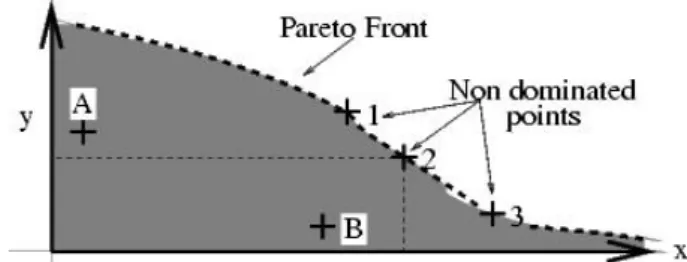
A multi-objective search space is partially ordered in the sense that there is no longer a strict linear ordering of solutions. Instead, two arbitrary solu-tions are related to each other in two possible ways: either one dominates the other or neither dominates. IndividualAPareto dominates individual B if and only ifAis at least as good asB in all objectives, and is superior toB in at least on objective. In Figure 2.5, for example, individualA dom-inates (is better than) individual B along the y axis, but B dominates A along thexaxis. Thus there is no simple ordering between them. The in-dividual marked2, however dominatesBon both axes and would thus be considered strictly better thanB. All individuals that are not dominated by any other individual of a given set are callednondominatedregarding
this set.
Figure 2.5: Two-dimensional example of Pareto optimality and the Pareto front, where the goal is to maximise along both the x and y axes.
Pareto-Optimal Set and Pareto-Optimal Front
The goal of EMOs is to identify a set of solutions which are non-dominated with respect to each other in the search space. Therefore, the set of solu-tions cannot be improved in any objective without causing a degradation in at least one other objective. In other terms, these solutions are optimal in the wider sense that no other solutions in the search space are superior to them when all objectives are considered.
The set of non-dominated solutions within the entire search space con-stitutes the so-called Pareto-optimal setor Pareto-optimal front. Ideally, one would want to find thePareto front, i.e., the set of all non-dominated solu-tions in the search space. However, this is often unrealistic, as the size of the Pareto frontis often limited only by the precision of the problem rep-resentation. If xand yin Figure 2.5 are real-valued, for example, and the
Pareto front is a continuous curve, then it contains an infinite number of points, making a complete enumeration impossible.
Non-dominated Sorting Genetic Algorithm Version II (NSGA-II)
Over the past decade, a number of EMO algorithms that have the abil-ity to find multiple Pareto-optimal solutions in one single run, have been
suggested. NSGA [71] is a popular non-domination based genetic algo-rithm for multi-objective optimization. Despite being a very effective al-gorithm, it has been mainly criticized for its high computational complex-ity, lack of elitism and need for specifying the optimal parameter value for the sharing parameter [21]. In order to address these issues, Deb, et al. [21] developed a fast elitist multi-objective optimization algorithm called Non-dominated Sorting Genetic Algorithm Version II (NSGA-II) which is a much improved version of NSGA. In the following part, NSGA-II is de-scribed in detail.
The evolutionary process shown in Algorithm 1 initially starts from generating a random population P0 of size n which is sorted based on
non-domination level. Each individual in the population is assigned a fit-ness equal to its non-domination rank (1 is the best level). Subsequently a child population Q0 is created by performing binary tournament
selec-tion, simulated binary crossover and polynomial mutation. A combined populationRt is then formed from the parentPt and offspringQt
popu-lations which is ranked according to the non-domination relation, and a set of non-dominated fronts F are obtained. The new population Pt+1 is
generated by adding the individuals from the first front and the follow-ings until it exceeds the population sizen. Finally, a new child population Qt+1is created by applying selection, crossover and mutation to the parent
populationPt+1. The preceding procedure is repeated until the maximum
number of generations are reached.
In the procedure of NSGA-II, a new parameter value called crowding distance is assigned to all the individuals in the population once the non-dominated sort is complete. The crowding distance is a measure of how close an individual is to its neighbours. Large average crowding distance will result in better diversity in the population. As shown in Algorithm 1, individuals are selected from the population by using binary tournament selector based on non-domination rank and crowding distance.
Algorithm 1The NSGA-II procedure
Generate an initial populationP0 of sizen
Rank and sortP0 based on non-domination level
Apply selection, crossover and mutation to create a child populationQ0
of sizen
sett= 0,T = number of generations whilet < T do
Rt=Pt∪Qt
PartitionRtinto frontsF1,F2, ...
SetPt+1=∅,i= 1
while|Pt+1 | ≤ndo
Calculate crowding distance inFi
if|Fi|+|Pt+1 | ≤nthen
Pt+1=Pt+1∪Fi
else
Sort elements ofFi by crowding distance in decreasing order
Pt+1=Pt+1∪the first (n-|Pt+1 |) elements ofFi
end if i=i+ 1 end while
Calculate crowded comparison operator∀i∈Pt+1
Create a new population Qt+1 of size n by applying crossover and
mutation to parents selected via binary tournaments onPt+1
t=t+ 1; end while
Improved Strength Pareto Evolutionary Algorithm (SPEA2)
As one of the most important EMOs that use elitism approach, Zitzler, et al. [106] proposed the modified Strength Pareto Evolutionary Algorithm namely SPEA2 as an improved version of SPEA [105] in 2001. A brief summary of the SEPA2 algorithm is given in Algorithm 2.
The evolutionary process of SPEA2 starts with an initial populationP0
and an empty archive (external set) P00. After fitness values are assigned to both archive and population members, all non-dominated individuals in the population and archive are copied to the updated archive Pt0+1. If the size of the updated archivePt0+1exceeds the predefined sizen0, further archive members are removed by means of the truncation operator. The next step represents the mating selection phase where individuals from the union of population and archive are selected by means of binary tour-naments. Finally, after crossover and mutation the old population Pt is
replaced by the resulting offspring populationPt+1. The preceding steps
are performed per generation until the maximum number of generations is reached.
In contrast with SPEA, SPEA2 uses a fine-grained fitness assignment strategy. Each individual is assigned a raw fitness calculated based on the strength value of solutions who dominate it. Additionally, it incorporates density information to discriminate between individuals having identical fitness value. After fitness evaluation, all non-dominated individuals from current population and external population are passed into the next gener-ation. If the number of these individuals is less than population size then the next population is filled with dominated individuals from current and external populations.
The size of archive that consists largely of the Pareto front of non-dominated individuals discovered so far is fixed. Whenever the number of non-dominated individuals is less than the predefined archive size, the archive is filled up by dominated individuals. For diversity preservation, SPEA2 utilizes a truncation procedure to replace the clustering technique
Algorithm 2The SPEA2 procedure
Generate an initial populationP0of sizen, and create an empty archive
(external set)P00 of sizen0
sett= 0,T = number of generations whilet < T do
Calculate the fitness values of individuals inPtandPt0
Copy all non-dominated individuals inPtandPt0 toPt0+1
if|Pt0+1|> n0 then
ReducePt0+1by means of the truncation operator else
FillPt0+1 with dominated individuals inPtandPt0
end if
Perform binary tournament selection with the replacement onPt0+1in order to fill the mating pool
Apply crossover and mutation to the mating pool and create a new populationPt+1
t=t+ 1; end while
Return a non-dominated set represented by the non-dominated individ-uals inPt0+1
which SPEA uses when the non-dominated front exceeds the archive limit.
2.1.4
Genetic Programming
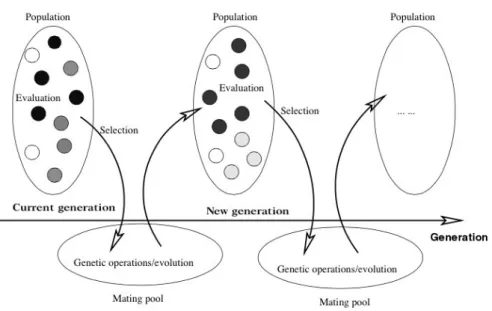
Evolutionary computation (EC) involves a family of approaches called evolutionary algorithms (EAs) which mimic the biological evolutionary process to resolve optimization problems. This kind of evolutionary pro-cess, as illustrated in Figure 2.6, is population-based and involves both competitive and cooperative mechanisms during the evolution of the pop-ulation. Genetic programming (GP) as a commonly used EA was devel-oped and popularized by John Koza [48] over 20 years ago. In GP, a can-didate solution to an optimization problem is represented by a computer program (which normally is a tree structure). GP has been successfully applied to a wide range of problem domains. For example, GP has been used to evolve solutions to problems which has not previously been man-ually solved by humans [48]. Due to its good global search capability, GP is employed to solve the problem in this work.
In GP, the term populationrefers to a collection of candidate solutions calledindividualsto an optimization problem. The termchromosome typ-ically refers to one candidate solution to a problem, which can be repre-sented as a tree that is the most commonly used representation. The major variations of GP include the terminal and function sets. The terminal set consists of the variables and constants of the programs to be constructed. The function set consists of the functions of the programs. In the exam-ple of symbolic regression, the terminal set would contain two variables, xandy, and the function set would be composed of different mathemati-cal functions, such as addition, subtraction and division. In addition, GP requires a fitness function to evaluate each individual in current popula-tion. The fitness function measures the ability of the encoded individual to solve the problem.
Figure 2.6: The generic evolutionary process for an evolutionary algorithm (EA)
three types of genetic operators which are explained as follows.
• Selection. A number of individuals in the population are selected to breed a new generation. Individuals selection is a fitness-based pro-cess, where fitter individuals are typically more likely to be selected for reproduction.
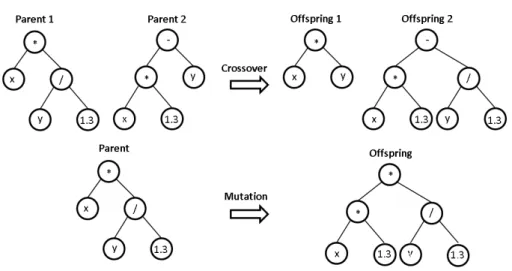
• Crossover. The crossover operator takes two parents and replaces a randomly chosen part of one parent with another randomly chosen part of the other in order to produce two new offsprings (see Figure 2.7).
• M utation. The mutation operator takes one parent and replaces a randomly selected part of that parent with a randomly generated sequence of code (see Figure 2.7).
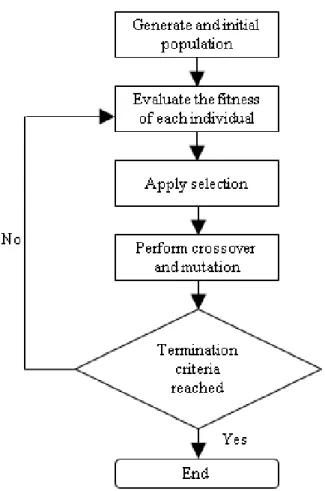
A typical GP framework for solving an optimization problem is de-picted in Figure 2.8. At the start of an evolutionary run, a population is
initialized to be filled with a group of randomly generated candidate so-lutions to the problem. The soso-lutions are then evaluated using a fitness function to determine their relative ability to solve the problem and each candidate solution is assigned a respective fitness value. Following that, a selection mechanism is applied to the population, and genetic operations (i.e., crossover and mutation) are performed on the selected solution to generate new candidate solutions for the new population. Therefore, the new population consists of only relatively fit solutions from the initial pop-ulation and their derivatives. Accordingly, it is expected that the average fitness of the population will have increased. This generational process is repeated over and over again until the number of generations exceeds the specified limit, or any other stopping criteria are satisfied (e.g., an optimal solution is found).
Figure 2.7: An example of crossover and mutation for the symbolic regres-sion problem
Figure 2.8: The typical procedure used by GP to solve an optimization problem
2.2
An Overview of QoS-Aware Web Service
Com-position
The procedure for web service composition basically comprises three phases. As illustrated in Figure 2.9, a critical step of web service composition is to select proper web services for composition in order to satisfy users’ re-quests. However, in the presence of numerous web services with equiva-lent functionality, web services are described and discriminated in terms of both functional capabilities and non-functional (i.e., QoS) properties (e.g., response time, execution cost, availability, etc). Nowadays, web service composition is therefore usually combined with end-to-end QoS require-ments, which isQoS-aware web service composition. The goal of QoS-aware web service composition is to discover the best composition of web ser-vices that meet these end-to-end QoS requirements, while fulfilling the functional requirements. As an example, a user may require to minimize the response time meanwhile satisfying certain constraints in terms of ex-ecution cost and reliability, while another user may give more importance to execution cost than to response time.
A typical scenario of web service composition is a “Travel Planner” system depicted in Figure 2.10 that is composed of three tasks for flight booking, hotel reservation and car rental, and concrete services need to be selected for each abstract task. As a result, web services are combined with some workflow patterns (e.g., sequence, parallel, choice, etc), and the eventual composite service can be constrained by some end-to-end QoS requirements. In most of the existing approaches, solving the QoS-aware service composition problem starts with a predefined workflow for a composite web service which contains a set of abstract tasks, and for each abstract task there are a number of available concrete services which provide identical functionality but present different QoS properties. In general, two different optimization strategies could be applied to solve this service composition problem. One of them is the so-called local
op-timization where an optimal concrete service is selected for each abstract task independently and the performance of each task is assured. The ad-vantage of this approach is its efficiency as the time complexity of the approach is linear with respect to the number of abstract tasks and con-crete services. However, local optimization cannot guarantee the global QoS constraints posed by the user (i.e., minimized total response time and execution cost). Another optimization strategy, called global optimization, considers QoS constraints and user’s preferences globally which aims to obtain the optimal overall QoS of a service composition. However, this strategy introduces a tradeoff between global optimization and increased complexity. Most of the existing research separates the process of gener-ating a service composition from the process of selecting optimal concrete web services for the given service composition. However, this separation restricts the space of finding optimal service composition solutions. In our study, the generation of a service composition is combined together with concrete service selection.
2.3
Related Work
QoS-aware web service composition introduces a global optimization prob-lem with multiple constraints, and it has received much interest in the past few years. Finding an optimal combination of atomic web services among a large number of possible solutions takes significant computation efforts. A variety of approaches have been put forward to solve the QoS-aware service composition problem. These approaches can be grouped into two categories: approaches based on evolutionary algorithms such as genetic programming (GP), particle swarm optimization (PSO) and ant colony op-timization (ACO) and approaches based on non-evolutionary algorithms such as integer programming (IP), graph theory. Each of these approaches is shown in Figure 2.11 and described briefly in the following sections.
Figure 2.9: The prodecure for QoS-aware web service composition
Figure 2.11: Two categories of approches to QoS-aware web service com-position problem
2.3.1
Conventional (Non-Evolutionary) Approaches
Over the past decade, there has been a lot of research efforts addressing the end-to-end QoS constraints in web service composition. In [50, 92], the problem of QoS-aware web service composition is regarded as a multiple-choice knapsack problem (MCKP) in which the service composition rep-resents the knapsack and each candidate service reprep-resents one item that can be put into the knapsack. The goal of the algorithm is to identify the optimal selection of web services which maximises the value while keep-ing the constraint on the limited weight capability of the knapsack that is represented by the QoS constraints. However, the time complexity of the algorithms is exponential which makes the MCKP model not suitable for large scale service composition problems. The service composition prob-lem can also be modeled as a graph based on graph theory. In [53], the node in the graph denotes a web service and the edge denotes the in-teraction between services, whereas in [55], the authors use the node to represent a service orchestration, the edge to represent a web service and each path in the graph to represent a complete service composition. The problem is then transformed into finding the order of nodes in the graph
to generate an executable workflow to satisfy users’ requests. Similarly, the graph model is confronted with the same exponential time complexity problem as the MCKP model.
Since local QoS optimization cannot guarantee the global optimiza-tion of QoS, some researchers have proposed global QoS optimizaoptimiza-tion ap-proaches that use global planning algorithm and integer linear program-ming (ILP) to solve the QoS-aware web service composition problem.The authors of [25] put forward a global planning approach, and quality con-straints and preferences are assigned to a composite service rather than to the individual tasks involved in the composite service. Service selection is then formulated as an optimization problem and a linear programming method is applied to compute the optimal service execution plans for the service composition. ILP is adopted in [25, 26] to optimally select concrete services in which the objective function is defined as a linear composi-tion of multiple QoS constraints. However, the shortcoming of the ILP technique is that the objective functions and constraints are required to be linear which limits the practicality of the approach. Moreover, linear increase in the size of the service composition problem leads to exponen-tial growth of the algorithm’s computational time. If non-linear integer programming is adopted, scalability is still a problem [10]. To overcome these disadvantages, evolutionary approaches have been applied to find the (near)-optimal service composition.
2.3.2
Single-Objective Evolutionary Approaches
Recently evolutionary computation (EC) methods have been more active to overcome the drawbacks of traditional optimization methods. A genetic algorithm (GA) based approach, as a powerful tool to solve combinato-rial optimization problems, is proposed in [99] for QoS-aware web service composition. Compared with ILP, GA is able to scale well with respect to the number of web services. The authors of [99] adopt a one-dimensional
chromosome-encoded method in which each gene of the chromosome rep-resents a candidate service. As a consequence, the length of the chromo-some increases as the number of tasks and candidate services increases. A revised encoding method is put forward in [11], where each gene of the chromosome represents an abstract task of a composite service, and its value represents a candidate service. However, this encoding schema cannot reflect the relationships between component services in a compos-ite service efficiently. Therefore, a tree-based GP approach is developed in [95] which makes it easier to understand and interpret the relationships between component services. In addition, an adaptive strategy is applied to the search parameters of GP in order to prevent the premature con-vergence of GP. Yang, et al. [88] use the combination of ACO and GA to tackle the service composition problem. The problem is solved by ACO, however, there are some important parameters in ACO that have great ef-fect on the algorithm. Therefore, they use GA to set the key parameters of ACO in order to obtain a great efficiency. Chen, et al. [58] solve the service composition problem by using DPSO (Discrete Particle Swarm Optimiza-tion) which is a variant of standard PSO. In this method they regard each particle as a solution and each particle has a position and velocity. The positions of particles are updated based on their last best position and the best position that has been seen so far. These EC-based methods simply assume that multiple quality criteria, no matter whether they are compet-ing or not, can be combined into a scompet-ingle criterion to be handled by the weighted sum approach. In practice, when users are not certain about the importance of each quality dimension, the weighted sum approach is very difficult to apply because weights are not well known a priori. Fur-thermore, the weighted sum approach largely depends on the formulation (i.e., the weighted formula of the objectives), which has to be readjusted and computed again when the scenario changes.
Although various approaches have been presented to solve the QoS-aware web service composition problem, there is limited work in the
lit-erature for data-intensive service composition [10, 83, 84, 101]. The au-thors of [10, 101] consider the data intensity of service compositions, but they overlook the communication cost of mass data transfer and its ef-fects on the performance of business processes with different structures. An ant colony based method is proposed in [83, 84] to find the cost min-imized data-intensive service composition by considering the access cost and communication cost of mass data transfer. However, the approach focuses on minimizing the cost only without reflecting other important quality dimensions (e.g., availability and reliability).
2.3.3
Multi-Objective Evolutionary Approaches
Despite the multi-objective character of the QoS-aware web service com-position problem, EMOs are less used than single-objective algorithms. As discussed before, single-objective optimization approaches have some in-herent limitations in solving QoS-aware web service composition. There-fore, several multi-objective heuristics have been proposed. Taboada et al. [73] employ EMO algorithms to provide a set of optimal solutions with dif-ferent levels of trade-offs for the QoS-aware service composition problem. In [16, 52, 89], the authors resolve the service composition problem using a multi-objective genetic algorithm called NSGA-II [21], without assigning any weight to any quality criterion, and a solution is encoded in the form of an integer vector. The experimental results reveal that NSGA-II is a rea-sonably good fit in solving the QoS-aware service composition problem with satisfied convergence and distribution properties. Similarly, Li, et al. [51] adopt another EMO algorithm called SPEA2 to solve the service com-position problem in which three performance criteria (i.e., response time, execution cost and availability) are considered. The same type of genome encoding, namely integer vector based, is used. Since the experiments are conducted based on different datasets and different number of objec-tives, it is impossible for us to compare the performance of the two EMO
algorithms for solving QoS-aware web service composition. Cremene, et al. [18] apply both EMO algorithms (i.e., NSGA-II and SPEA2) to the ser-vice composition problem, however, mere two quality criteria (i.e., time and cost) are considered in the simulation experiments. As a result, it is not convincing enough to demonstrate the performance differentiation of the two algorithms. The experiments presented in the preceding literature [16, 18, 51, 52, 89] use a small number of abstract tasks and some of them also use a small number of candidate services. Therefore, it is not obvious how scalable these approaches are. Claro et al. [17, 91] also discuss the ad-vantages of two popular EMO algorithms, NSGA-II and SPEA2 in finding optimal service compositions. In contrast to single-objective optimization approaches, these EMO based approaches do not require user to prioritise, scale, or weight objectives in advance, which is more realistic and reliable. Moreover, reformulating the solutions is not required if there is a change (e.g., the change of the user’s preferences). However, existing methods consider two or three quality objectives only due to the limitations of cur-rent EMO algorithms in higher dimensional objective space.
2.3.4
Decentralized Execution of Composite Web Services
In recent years, many researches have been emerging to address the prob-lem of decentralized execution of composite web services. A top down ap-proach for integrated process modelling and distributed process execution is proposed in [68] without considering data dependencies. In the Mentor project [86], a workflow is partitioned for decentralized execution based on rules and state charts into a set of sub-workflows which are then en-acted by a number of distributed workflow engines. Khalaf et al. [44, 45] present a method for partitioning a business process so that each parti-tion can be enacted by a different participant and a corresponding BPEL process along with necessary deployment information is created for each participant. Yildiz et al. [90] propose a method for deriving distributedprocesses of a centralized process with respect to their information flow policies. Nanda et al. [61] review previous approaches and introduced two novel heuristic algorithms which are Merge-by-Define-Use (MDU) and Pooling-and-Greedy-Merge (PGM), respectively. They support auto-matic process partitioning based on an analysis of a program dependence graph generated for the process. However, all of the above approaches do not consider the communication overhead induced by data-flows in the context of data-intensive processes, which in turn has a significant im-pact on the degree of customer satisfaction. In [75], a dynamic workflow model fragmentation algorithm is proposed to partition a centralized pro-cess model into fragments step by step while the propro-cess is executed. Al-though data-intensive tasks are considered in the work, experiments are not conducted to assess the effectiveness and efficiency of the approach.
2.4
Summary
In summary, very few efforts about QoS-aware data-intensive web service composition have been made. The majority of the existing research over-looks the data intensity involved in data-intensive service compositions and the most recent research studies examine the communication cost of mass data transfer only without investigating other important quality di-mensions. Meanwhile, as the number of quality objectives increases, the past single-objective and multi-objective optimization approaches are not able to solve the service composition problem with such a high-dimensional objective space. Therefore, there exists a demand for finding an efficient approach which has the ability to cope with the preceding issues. Further-more, although the decentralized execution of composite web services has been widely studied in the past few years, there is still lack of research on finding an efficient execution plan for data-intensive service compositions in a reasonable time frame.
A Hybrid GP-Tabu Approach to
QoS-Aware Data-Intensive Web
Service Composition
As discussed earlier, few efforts have been made so far to investigate the problem of QoS-aware data-intensive web service composition. To the best of our knowledge, the use of genetic programming in data-intensive ser-vice composition was not examined in the past research. This chapter is devoted to presenting a GP-based solution to our first research problem of the thesis, i.e., the problem of QoS-aware data-intensive service composi-tion.
3.1
The Problem
With the increasing presence and adoption of web services on the World Wide Web, the composition strategy of a variety of services provides max-imal flexibility when designing and implementing data-intensive applica-tions. On the other hand, with the presence of numerous web services with equivalent functionality, web services are described and discriminated in terms of both functional capabilities and non-functional (i.e., QoS)
erties (e.g., response time, execution cost, availability). As a considerable amount of data needs to be exchanged between the components in a com-posite data-intensive service, the movement of mass data influences the performance of the whole composite web service. Therefore, it becomes inevitable to take into account non-functional properties during the dy-namic process of data-intensive service composition, especially attention should be drawn to the access cost and transfer cost of the data between collaborating web services. Therefore, the goal ofdata-intensive service com-positionis to find the best composition of data-intensive services that meet these non-functional requirements, while fulfilling the functional require-ments. As an example, a user may require to minimize the response time meanwhile satisfying certain constraints in terms of execution cost and re-liability, while another user may give more importance to execution cost than to response time.
In this chapter, we present a hybrid GP-Tabu approach to the problem of QoS-aware data-intensive service composition. Tabu search (TS) [30] as a meta-heuristic local search is integrated into the evolutionary process of genetic programming (GP) [48] in order to overcome the downsides of GP such as its prematurity and proneness to trap in local optima. The main contributions of this chapter are two-fold. First, a QoS-aware math-ematical model is developed to take into account the effect of mass data transfer. Second, a hybrid approach that combines the use of GP and TS is proposed to address the QoS-aware data-intensive service composition problem. The experimental results demonstrate the effectiveness and effi-ciency of the approach, especially it offers better performance than tradi-tional optimization techniques.
The rest of this chapter is organized as follows. Section 3.2 discusses the time and cost aware model used in the context of data-intensive ser-vice composition. In Section 3.3, the details of the proposed approach are explained, and Section 3.4 reports on the experimental results. Finally, the conclusions are drawn in Section 3.5.
3.2
A Time and Cost Aware Model for Data
In-tensive Services
Since a data-intensive servicesi is provided by a service provider and
de-ployed on a server, a data-intensive service composition SC that consists of a set ofm service servers and certain composition patterns can be de-noted by SC = {S1, S2, ..., Sm}. Each atomic data-intensive service si is
associated with a QoS vectorQi = [li,ci, ri,ai] whereli,ci,ri,airepresents
the latency, execution cost, accuracy and availability of the service. As-sume that a data-intensive servicesi requires a set of data denoted byDi
to form part of its inputs. The latency li for the servicesi is made up of
three parts: the queue timeqi, the processing timepi and the transfer time
ti, as shown in Equation 3.1.
li =qi+pi(Di) +ti(Di, Sj, Si) (3.1)
where qi is the time spent in waiting in the queue for the data Di to be
processed by the server, pi(Di) is the actual time used to process the set
of data Di, and ti(Di, Sj, Si) is the data transfer time for transferring the
data setDi from the server hosting the servicesj to the server hosting the
servicesi.
To be detailed, the queue timeqi depends on server load, i.e., the
cur-rent request queue length on the server, while the processing timepi and
the transfer timetican be calculated using Equation 3.2 and 3.3.
pi(Di) = size(Di)/pr(Si) (3.2)
ti(Di, Sj, Si) = size(Di)/bw(Sj, Si) +size(Di)/ws(Si) (3.3)
where size(Di) is the size of the data set Di, pr(Si) denotes the
process-ing rate of the serverSi,bw(Sj, Si)is the network bandwidth between the
serverSj and the serverSi, andws(Si)is the disk write speed of the server
depends on the processing capacity of the server, and the data transfer time is determined by the network bandwidth and the amount of data to be transferred between two service servers. As each server has many re-quests at the same time and it serves only one request at a time, the current service request needs to wait until all requests prior to it in the queue have completed.
In addition to time, the costs generated by data-intensive services as well as the movement of mass data have a significant impact on the total cost of a service composition. Consider a data-intensive service si,
simi-larly its execution costciconsists of three parts: the data access costaci, the
data transfer costtci, and the service related costsci. As can be seen from
Equation 3.4, the data access costaci is the price to be paid for writing the
dataDito the server that hosts the servicesiand reading the data in order
to invoke the service. The data transfer cost tci is proportional to the size
of the data setDi, which depends on the available network bandwidth
be-tween two service servers. The service related cost sci expresses the cost
to provision the servicesias well as the cost to process the service request
including data processing.
ci =aci(Di) +tci(Di, Sj, Si) +sci(Di) (3.4)
aci(Di) = size(Di)∗wcost(Si) +size(Di)∗rcost(Si) (3.5)
tci(Di, Sj, Si) =size(Di)∗tcost(Sj, Si) (3.6)
sci(Di) = pcost(Si) +size(Di)∗dcost(Si) (3.7)
where size(Di)denotes the size of the data setDi, wcost(Si)is the cost of
writing per unit of data to the server Si, rcost(Si) is the cost of reading
per unit of data from the disk on the serverSi, tcost(Sj, Si)is the transfer
cost from the service serverSi to the service serverSj for per unit of data,
pcost(Si)is the price charged to use the servicesiwhich is usually specified
by service provider, anddcost(Si)is used to represent the expenditure for processing each unit of data on the serverSi.
For each data-intensive service, the other two QoS attributes (i.e., ac-curacy and availability) are supposed to have fixed values which can be collected from service providers. Therefore, the QoS-aware data-intensive service composition can be regarded as an optimization problem. Clearly the goal of the optimization problem is to minimize the latency and ex-ecution cost that have been defined in Equations 3.1 and 3.4, meanwhile achieving the maximum possible accuracy and availability for a composite web service.
3.3
The Hybrid GP-Tabu Approach
Artificial intelligence techniques have been widely used to solve many op-timization problems. In recent years, GP has become increasingly popular as an alternative to more classical techniques in science and engineering disciplines. As another powerful optimization procedure, TS is capable of escaping local optimum trap by employing a flexible memory system, and it has been successfully applied to a diverse range of combinatorial optimization problems. These methods seem to be promising and are still evolving. Next, the TS method is briefly reviewed before the proposed hybrid approach is presented.
3.3.1
An Overview of Tabu Search
TS [30] is a meta-heuristic that guides a local heuristic search procedure to explore a problem’s solution space with the goal of avoiding local op-timum and ultimately finding the desired solution. The basic principle of TS is to avoid cycling back to previously visited solutions and allow non-improving moves whenever a local optimum is encountered. This is achieved by using a short-term memory that records the recent history of the search to prevent investigating the solution space that has been visited before. However, in some situations, TS permits backtracking to
previ-ous solutions which may ultimately lead to better solutions via a different direction. The two main components of TS are the tabu list and the aspi-ration criteria of the solution associated with the recorded moves.
• Tabu list. Certain forbidden moves (trial solutions) are maintained in the list to prevent cycling when moving away from local opti-mum through non-improving moves. As a result, the search is not allowed to return to a recently visited point in the search space, that is, a recent move is not allowed to be reversed. Usually the tabu list stores a fixed or fairly limited quantity of information. Empirically, the size of the list that provides good results often grows with the size of the problem, and stronger restrictions are generally coupled with smaller list size.
• Aspiration criteria. A key issue for tabu list is that it is sometimes so powerful to prohibit attractive moves, even cycling cannot occur, or they may lead to an overall stagnation of the search process. Hence, aspiration criteria are used to allow for exceptions from the tabu list, if such moves lead to promising solutions. The simplest and most commonly used aspiration criterion, found in almost all TS imple-mentations, allows a tabu move when it results in a solution with an objective value better than that of the current best-known solution (since the new solution has obviously not been previously visited).
3.3.2
The Proposed Hybrid Approach
In order to determine a solution to the QoS-aware data-intensive service composition problem, we propose a new hybrid approach where the evo-lutionary process of GP works along with the local TS search procedure. To be specific, the proposed hybrid approach adopts the neighbour so-lutions found by TS to generate part of a new population in the global search process of GP. The major steps of our approach are described in Algorithm 3. The approach starts from a randomly initialized population
after setting up the necessary variables for GP and Tabu. The individu-als in the current population are then evaluated using the specific fitness function. Crossover and mutation are performed on the selected individ-uals to produce next generation. For every t generations, the m best in-dividuals (i.e., service compositions) in the population are selected as the initial solutions of the TS procedure. As a result, n neighbour solutions are generated by mutating a random node in the tree representation of a candidate service composition solution, and thenworst individuals in the current population are replaced. The above process is repeated until the maximum number of iterations is reached.
Algorithm 3GP-Tabu for QoS-aware data-intensive service composition Require: available inputs, required outputs, QoS constraints and a service
repository
Ensure: a service composition that meets both functional and non-functional requirements
1: Initialize the parameters of GA and TS, and setg=1
2: Generate an initial populationP randomly
3: Evaluate each individualiinP using the fitness function
4: whileg < gmaxdo
5: Select two parents from the population P. Perform crossover with rate Pc, and perform mutation with ratePm to generate a new
pop-ulationP0
6: ifg modk = 0then
7: Choose them best individuals from the current population, and apply the TS algorithm to generatenneighbours to substitute the worstnindividuals in the new populationP0
8: end if
9: Evaluate each individuali0 inP0using the fitness function
10: Setg=g+1
11: end while