Electrical and Computer Engineering Publications
Electrical and Computer Engineering
1-2018
Variance-Optimal Offline and Streaming Stratified
Random Sampling
Trong Duc Nguyen
Iowa State University
, [email protected]
Ming-Hung Shih
Iowa State University
Divesh Srivastava
AT&T Labs–Research
Srikanta Tirthapura
Iowa State University
, [email protected]
Bojian Xu
Eastern Washington University
Follow this and additional works at:
https://lib.dr.iastate.edu/ece_pubs
Part of the
Databases and Information Systems Commons,
Data Storage Systems Commons, and
the
Systems and Communications Commons
The complete bibliographic information for this item can be found at
https://lib.dr.iastate.edu/
ece_pubs/163. For information on how to cite this item, please visit
http://lib.dr.iastate.edu/
howtocite.html.
This Article is brought to you for free and open access by the Electrical and Computer Engineering at Iowa State University Digital Repository. It has been accepted for inclusion in Electrical and Computer Engineering Publications by an authorized administrator of Iowa State University Digital Repository. For more information, please [email protected].
Variance-Optimal Offline and Streaming Stratified Random Sampling
Abstract
Stratified random sampling (SRS) is a fundamental sampling technique that provides accurate estimates for
aggregate queries using a small size sample, and has been used widely for approximate query processing. A key
question in SRS is how to partition a target sample size among different strata. While Neyman's allocation
provides a solution that minimizes the variance of an estimate using this sample, it works under the
assumption that each stratum is abundant, i.e. has a large number of data points to choose from. This
assumption may not hold in general: one or more strata may be bounded, and may not contain a large number
of data points, even though the total data size may be large.
We first present VOILA, an offline method for allocating sample sizes to strata in a variance-optimal manner,
even for the case when one or more strata may be bounded. We next consider SRS on streaming data that are
continuously arriving. We show a lower bound, that any streaming algorithm for SRS must have (in the worst
case) a variance that is Ω(r) away from the optimal, where r is the number of strata. We present S-VOILA, a
practical streaming algorithm for SRS that is locally variance-optimal in its allocation of sample sizes to
different strata. Both the offline and streaming algorithms are built on a method for reducing the size of a
stratified random sample in a variance-optimal manner, which could be of independent interest. Our results
from experiments on real and synthetic data show that that VOILA can have significantly smaller variance
than Neyman's allocation (VOILA's variances are a factor of 1.4x-3000x smaller than that of Neyman
allocation, with the same setting). The streaming algorithm S-VOIlA results in a variance that is typically close
to VOILA, which was given the entire input beforehand.
Disciplines
Databases and Information Systems | Data Storage Systems | Electrical and Computer Engineering | Systems
and Communications
Comments
This is a pre-print of the article Nguyen, Trong Duc, Ming-Hung Shih, Divesh Srivastava, Srikanta Tirthapura,
and Bojian Xu. "Variance-Optimal Offline and Streaming Stratified Random Sampling."
arXiv preprint
arXiv:1801.09039
(2018). Posted with permission.
Variance-Optimal Offline and Streaming
Stratified Random Sampling
Trong Duc Nguyen
Iowa State University
[email protected]
Ming-Hung Shih
Iowa State University
[email protected]
Divesh Srivastava
AT&T Labs–Research
[email protected]
Srikanta Tirthapura
Iowa State University
[email protected]
Bojian Xu
Eastern Washington University
[email protected]
ABSTRACT
Stratified random sampling (SRS) is a fundamental sam-pling technique that provides accurate estimates for aggre-gate queries using a small size sample, and has been used widely for approximate query processing. A key question in SRS is how to partition a target sample size among different strata. While Neyman allocation provides a solution that minimizes the variance of an estimate using this sample, it works under the assumption that each stratum is abundant, i.e. has a large number of data points to choose from. This assumption may not hold in general: one or more strata may be bounded, and may not contain a large number of data points, even though the total data size may be large.
We first present VOILA, an offline method for allocating sample sizes to strata in a variance-optimal manner, even for the case when one or more strata may be bounded. We next consider SRS on streaming data that are continuously arriving. We show a lower bound, that any streaming al-gorithm for SRS must have (in the worst case) a variance that is Ω(r) factor away from the optimal, where r is the number of strata. We presentS-VOILA, a practical stream-ing algorithm for SRS that islocally variance-optimalin its allocation of sample sizes to different strata. Both the offline and streaming algorithms are built on a method for reducing the size of a stratified random sample in a variance-optimal manner, which could be of independent interest. Our re-sults from experiments on real and synthetic data show that thatVOILAcan have significantly smaller variance than Ney-man allocation (VOILA’s variances are a factor of 1.4x-3000x smaller than that of Neyman allocation, with the same set-ting). The streaming algorithmS-VOILAresults in a variance that is typically close toVOILA, which was given the entire input beforehand.
1.
INTRODUCTION
Random sampling is a widely-used method for data anal-ysis, and features prominently in the toolbox of virtually every approximate query processing system. The power of random sampling lies in its generality. For many impor-tant classes of queries, an approximate answer, whose error is small in a statistical sense, can be efficiently obtained through executing the query over an appropriately derived random sample. Sampling operators are part of all major database products, e.g. Oracle, Microsoft SQL Server, and IBM Db2; BlinkDB [3] is a system for approximate query answering that is based extensively on random sampling.
The simplest method for random sampling isuniform ran-dom sampling, where each element from the entire data (the “population”) is chosen with the same probability. But uniform sampling may lead to a high variance in the esti-mate for aggregate queries, when there is a large variation in the contribution of different elements to the aggregate. An alternative method isstratified random sampling(SRS), where the population is partitioned into subgroups called “strata”. Within each stratum, uniform random sampling is used to select a stratum sample. The different per-stratum samples are then combined to derive the “stratified random sample”. In SRS, there is flexibility to emphasize some strata over others, through controlling the allocation of sample sizes to different strata; for instance, strata where there is higher variance can be given a larger allocation.
Suppose that there are r strata, numbered from 1 to r, and that the mean, variance, and number of items in the jth stratum areµj, σj2, andnj respectively. Suppose that the target sample size isk(total across all strata). We mea-sure the quality of a stratified random sample through the variance in the estimate of the population mean, computed using this sample. In “uniform allocation”, each stratumj gets an identical allocation of sample size of kj =k/r. In “proportional allocation”, a stratum is allocated a sample size proportional to the number of elements in it. Propor-tional allocation is more or less equivalent to uniform ran-dom sampling.1 A commonly used allocation method that is believed to yield the smallest variance [25, 11] is “Neyman allocation”, where stratumjgets an allocation proportional to σjnj. Many sampling methods for approximate query processing, such as the ones used in [10, 3], are based on Neyman allocation.
Neyman allocation assumes that each stratum has abun-dant data, and it is possible to sample as many elements from the stratum as we need. However, in practice, some strata can be bounded, and may not contain sufficient ele-ments to satisfy their allocation. To see this, consider that Neyman allocation assigns a sample of sizekj= njσj
Pr
i=1niσi·k to stratumj. A stratumjthat has a large varianceσj2 rel-ative to the other strata, yet a relrel-atively small number of 1There is a minor difference. Both methods allocated a sam-ple size proportional to the size of the stratum, but in case of uniform sampling, the sample size is proportional to the size of the stratum, in expectation, while in proportional al-location, the sample size is proportional to the size of the stratum.
points nj, can receive a relatively large allocation kj. It is possible that kj > nj, and the stratum may not have the required elements to satisfy its assigned allocation. We call such strata, which have a small number of elements, as “bounded” strata. For instance, in our experiments with the one-year-long OpenAQ dataset [27] on air quality measure-ments at different locations in the world, we found that after the first month, 11 out of 60 strata are bounded. This num-ber drops to 3 bounded strata (out of 88) after 6 months and 1 (out of 177) after 12 months. For data with bounded strata, Neyman allocation is clearly no longer the variance-optimal method for allocating sample sizes, since it may assign a sample size greater than the number of points in the stratum.
Current methods for SRS also do not naturally extend to efficiently handle updates to data, since they were designed to only for static data. As a result, they are not effective for use on data streams, where data is continuously arriving. In this work, we consider the general problem of variance-optimal SRS in both the offline and streaming settings, when some of the strata may be bounded.
1.1
Our Contributions
– Variance Optimal Stratified Random Sampling for Bounded Strata: We present the first offline algorithm for variance-optimal SRS for data that may have bounded strata. Our algorithmVOILA(VarianceOptImaL Allocation) computes an allocation that has provably optimal variance among all possible allocations of sample sizes to different strata. While prior work assumes that there are no strata with small volumes of data, which is often violated in real data sets, our analysis makes no such assumptions.VOILA re-duces to Neyman allocation in the case when every stratum is abundant.
– Streaming Lower Bound: We present a lower bound
showing that any streaming algorithm for SRS that uses a memory of k records must have, in the worst case, a vari-ance that is a factor of Ω(r) away from the varivari-ance of the optimal offline algorithm. Here, r denotes the number of strata. This lower bound is tight, since there exist stream-ing algorithms for SRS whose variance matches this bound in the worst case.
– Practical Streaming Algorithm for SRS:We present
S-VOILA, a streaming algorithm for SRS that is locally opti-mal with respect to variance – upon receiving new elements, it (re-)allocates sample sizes among strata in such a way as to minimize the variance among all possible re-allocations. This can be viewed as the online, or dynamic counterpart of the optimization that led toVOILA, which is based on opti-mizing the variance using a static view of data. S-VOILAcan also deal with the case when a minibatch of multiple data items is seen at a time, rather than only a single item at a time – re-allocations made by S-VOILA are locally optimal with respect to the entire minibatch, and are of higher qual-ity for larger size minibatches than when a single element is seen at a time. In our experimental study, the variance of
S-VOILAis very close to that of the offline algorithmVOILA. Since it can deal with minibatches of varying sizes, it is well-suited to real-world streams that may have bursty arrivals. – Variance Optimal Sample Size Reduction:The
algo-rithms for offline SRS (VOILA) and streaming SRS (S-VOILA) are both based on a technique for reducing the size of an ex-isting stratified random sample down to a desired target size in such a way such that the variance of the estimator based on the final sample is as small as possible. This technique for sample size reduction may be of independent interest in other tasks such as sub-sampling from a given stratified ran-dom sample.
– Experimental Evaluation: We present a detailed ex-perimental evaluation using real and synthetic data sets, considering both quality of sample and accuracy of query answers. Our experiments show that (a) VOILA can have significantly smaller variance than Neyman allocation, and (b)S-VOILAclosely tracks the allocation as well as the vari-ance of the optimal offline algorithmVOILA. As the size of the minibatch increases, the variance of the samples produced by S-VOILA decreases. A minibatch of size 100 provides a majority of the benefits, in our experiments on real-world data.
1.2
Related Work
Sampling has been widely used in approximate query pro-cessing on both static and streaming data [11, 22, 29, 28, 18]. The reservoir sampling [23, 30] method for maintain-ing a uniform random sample on a stream has been known for decades, and many variants have been considered, such as weight-based sampling [14, 8], stream sampling under in-sertion and deletion of elements [16], adaptive-size reservoir sampling [4], distinct sampling [17], sampling from a sliding window [7, 15, 9], and time-decayed sampling [13, 12].
SRS in the online setting [28] can be viewed as a type of weight based reservoir sampling where the weight of each stream element is changing dynamically, based on the statis-tics of the stratum the element belongs to. Since the weight of each stream element changes dynamically, even after it has been observed, prior work on weighted reservoir sam-pling [14] does not apply here, since it assumes that the weight of an element is known at the time of observation and does not change henceforth. [24] considered streaming SRS using population-based allocation, and [21] considered streaming SRS using power allocation, based on their prior work on adaptive reservoir sampling [4]. However, prior work does not consider provable guarantees on the result-ing samples, or lower bounds for streamresult-ing SRS, like we do here.
SRS has been used widely in approximate query process-ing in database systems [2, 1, 6, 10, 20]. BlinkDB [3] is a recent system for parallel approximate query processing based on SRS, where a collection of multi-dimensional strat-ified samples are pre-selected from data, assuming a given query workload. All these however works however assume static data. With the emergence of data stream processing systems [5] and data stream warehousing systems [19], it is important to devise methods for streaming SRS with quality guarantees.
2.
PRELIMINARIES AND OVERVIEW OF
SOLUTION
2.1
Preliminaries
We consider the construction and maintenance of a strat-ified random sample of data that is either stored offline, or
arriving as a stream. Stratified sampling can be viewed as being composed of three parts – stratification, sample allo-cation, and sampling.
Stratification is a partitioning of the universe into a num-ber of disjoint strata, such that the union of all strata equals the universe. Equivalently, it is the assignment of each data element to a unique stratum. Stratification is often a pre-defined function of one or more attributes of the data ele-ment. For example, the work of Chaudhuri et al. [10] strat-ifies a tuple within a database table based on the set of selection predicates in the query workload that the tuple satisfies. In the OpenAQ dataset, air quality data measure-ments can be stratified on the basis of geographic location and measurement type, so that tuples relevant to a query can typically be composed of the union of strata. Our work assumes that the universe has already been partitioned into strata, and that each tuple comes with a stratum identifier. This assumption fits the model assumed in [10, 3].
Our work deals with sample allocation, the task of parti-tioning the available memory budget ofM samples among the strata. In the case of offline sampling, allocation needs to be done only once, after knowing the data in its entirety. In the case of streaming sampling, the allocation may need to be continuously re-adjusted as more data arrives, and the characteristics of different strata change.
The final sampling step chooses within each stratum, the assigned number of samples uniformly at random. In the case of offline stratified sampling, the sampling step can be performed in a second pass through the data after sample size allocation, using reservoir sampling on the subset of elements belonging to each stratum. In the case of streaming sampling, the sampling step is not as easy, since it needs to occur simultaneously with sample (re-)allocation, which may change the allocations to different strata over time.
Variance-Optimal Allocation. Given a data set,R= {v1, v2, . . . , vn}of sizen, whose elements are stratified into r strata, numbered 1,2, . . . , r. For each i = 1. . . r, let Si be a a uniform random sample of sizesi drawn without re-placement from stratumi. LetS={S1, S2, . . . , Sn}denote the stratified random sample.
The sample mean of each per-stratum sample Si of size si is: ¯yi =
P v∈Siv
si . Using the sample means of all strata, the population mean of R, µR can be estimated as: ¯y = Pr
i=1niy¯i
n . It can be shown that the expectation of ¯yequals µR.
Given a memory budget of M ≤n elements to store all the samples, so that P
isi =M, we address the question: What is the value of eachsi, the size of sample Si, so as to minimize the variance of ¯y. The variance of ¯y can be computed as follows (e.g. see Theorem 5.3 in [11]):
V = V(¯y) = 1 n2 r X i=1 ni(ni−si)σ 2 i si = 1 n2 r X i=1 n2iσ2i si − 1 n2 r X i=1 niσ2i. (1)
We call the answer to this question as avariance-optimal allocation of sample sizes to different strata.
Neyman Allocation for Strata that are abundant. All previous studies on variance-optimal allocation assume that every stratum has a large volume of data, to fill its sample allocation. Under this assumption, Neyman
allo-cation [25, 11] minimizes the variance V, and allocates a sample size for stratumiasM·(niσi)/Prj=1njσj.
Given a collection of data elementsR, we say a stratum iisabundant, ifni≥M·(niσi)/Prj=1njσj. Otherwise, the stratumiisbounded. Clearly, Neyman allocation works only if each stratum is abundant, and does not work if one or more strata are bounded. We consider the general case of variance-optimal allocation where there may be bounded strata.
2.2
Solution Overview
We note that both offline and streaming SRS can be viewed as a problem of “sample size reduction” in a variance-optimal manner. With offline SRS, we can initially view the entire data as a (trivial) sample of zero variance, where the sample size is very large – this sample needs to be reduced to fit within the memory budget ofM records. If this reduction is done in a manner that increases the variance by the smallest amount, the resulting sample is a variance-optimal sample of sizeM.
In the case of streaming SRS, the streaming algorithm maintains a current stratified random sample of sizeM. It also maintains the characteristics of each stratum, including the number of elements ni and standard deviationσi, in a streaming manner using O(1) space per stratum. When a set of new stream elements arrive, we can let the per-stratum reservoir sampling algorithms continue sampling as before. If the sample size increases due to this step, then we are again faced with a problem of sample size reduction – how can this be reduced to a sample of size M in a variance-optimal manner?
Based on the above observation, we first present a variance-optimal sample size reduction method in Section 3. We start with an algorithm for reducing the size of the sample by one element, followed by a general algorithm for reducing the size byβ≥1 elements, and then present an improved algorithm with a faster runtime. The variance-optimal offline algo-rithmVOILAcan be viewed as an application of sample size reduction – details are presented in Section 4. We present a tight lower bound for any streaming algorithm, followed by
S-VOILA, an algorithm for streaming SRS in Section 5. Note that the streaming algorithmS-VOILA does not necessarily lead to a variance-optimal sample. Though the individual sample-size reduction steps performed during observation of the stream are locally optimal, the overall result may not be optimal. Further details are in Section 5. We present a detailed experimental study of our algorithms in Section 6.
3.
VARIANCE-OPTIMAL SAMPLE SIZE
RE-DUCTION
Suppose it is necessary to reduce an SRS of total sizeM to an SRS of total sizeM0< M. This will need to reduce the size of the samples of one or more strata in the SRS. Since the sample sizes are reduced, the variance of the resulting estimate will increase. We consider the task of variance-optimal sample size reduction (VOR), i.e., how to partition the reduction in sample size among the different strata in such a way that the increase in the variance is minimized.
Consider Equation 1 for the variance of an estimate de-rived from the stratified random sample. Note that, for a given data set, a change in the sample sizes of different strata
sidoes not affect the parametersn,ni, andσi. VOR can be formulated as the following non-linear program.
Minimize r X i=1 n2iσ 2 i s0 i (2) subject to constraints: 0≤s0i≤si for eachi= 1,2, . . . , r (3) r X i=1 s0i=M 0 (4) We observe that, without Constraint 3, and if all strata are unbounded, the answer to the above optimization program is exactly the Neyman allocation under memory budgetM0. However, we have to deal with the additional Constraint 3 and the possibility of a stratum being bounded, in an effi-cient manner. In the rest of this section, we present effieffi-cient approaches for computing theVOR.
3.1
Special Case: Reduction by One Element
We first present an efficient algorithm for the case where the size of a stratified random sample is reduced by one element. An example application of this case is in designing a streaming algorithm for SRS, when stream items arrive one at a time.
We introduce a terminology that we will use frequently in the rest of the paper. Given a memory budgetM, the Ney-man allocation size for stratumiisMi=M·niσi/Prj=1njσj. The task is to choose stratumisuch that after reducing the sample size si by one element, the increase in variance V (Equation 1) is the smallest. Our solution is to choose stra-tumisuch that the partial derivative ofV with respect to siis the largest over all possible choices ofi.
∂V ∂si =− n2 iσ2i n2 1 s2 i . We choose stratum`where:
` = arg max i ∂V ∂si 1≤i≤r = arg min i niσi si 1≤i≤r = arg max i si M0 i 1≤i≤r , (5)
where Mi0 is the Neyman allocation size for stratum i un-der the new memory budgetM0. Equation 5 is due to the fact that each Mi0 is proportional to niσi. This gives the following lemma.
Lemma 1. When required to reduce the size of an stratified random sample by one, the increase in variance of the esti-mated population mean is minimized if we reduce the size of
S`by one, where `= arg mini n niσi si 1≤i≤r o .
In the case where we have multiple choices for ` using Lemma 1, we choose the one where the current sample sizes` is the largest. AlgorithmSingleSSR for reducing the sample size by one is shown in Algorithm 1. It is straightforward to observe that the run time of the algorithm isO(r).
3.2
Reduction by
β
≥
1
Elements
We now consider the general case, where the sample size
needs to be reduced by some number β, 1 ≤ β ≤ M.
A possible solution idea is to repeatedly apply the one-element reduction algorithm (Algorithm 1 from Section 3.1)
Algorithm 1: SingleSSR(): Variance-Optimal Sample Size Reduction by One
Output: The identifier of the stratum whose sample size shall be reduced by one.
1 returnarg mini n niσi si 1≤i≤r o
β times. Each iteration, a single element is chosen from a stratum such that the overall variance increases by the smallest amount. However, this greedy approach may not yield a sample with the smallest resulting variance. On the other hand, an exhaustive search of all possible evictions is not feasible either, since the number of possible ways to partition a reduction of size β among r strata is β+rr−1
, which is exponential inr and a high degree polynomial in β, which can be very large. We now present efficient ap-proaches toVOR. We first present a recursive algorithm, fol-lowed by a faster iterative algorithm. Before presenting the algorithm, we present the following useful characterization of a variance-optimal reduction.
Definition 1. We say that stratum i is oversized under memory budget M, if its allocated sample size si > Mi. Otherwise, we say that stratumiis not oversized.
Lemma 2. Suppose thatEis the set ofβelements that are to be evicted from a stratified random sample such that the varianceV after eviction is the smallest possible. Then, each element inE must be from a stratum whose current sample size is oversized under the new memory budgetM0=M−β. Proof. We use proof by contradiction. Suppose one of the evicted elements, is deleted from a sampleSαsuch that the sample sizesα is not oversized under the new memory bud-get. Because the order of the eviction of the β elements does not impact the final variance, suppose that elemente is evicted after the otherβ−1 evictions have happened. Let sαdenote the size of sampleSαat the momenttright after the firstβ−1 evictions and before evictinge. The increase in variance caused by evicting an element fromSα is
∆ = 1 n2 n2ασ2α sα(sα−1) = Pr i=1niσi nM0 2 M02α sα(sα−1) > Pr i=1niσi nM0 2 whereM0α=M0Prnασα
i=1niσiis the Neyman allocation for stra-tumαunder memory budgetM0. The last inequality is due to the fact thatSαis not oversized under budgetM0at time t, i.e.,sα≤Mα0.
Note that an oversized sample must exist at timet, since there are a total ofM0+ 1 elements in the stratified random sample at timet, and the memory target isM0. Instead of evictinge, if we choose to evict another elemente0 from an oversized sampleSα0, the resulting increase in variance will
be: ∆0 = 1 n2 n2α0σ2α0 sα0(sα0−1) = Pr i=1niσi nM0 2 M02α0 sα0(sα0−1) < Pr i=1niσi nM0 2
Algorithm 2: SSR(A, M,L): Variance-Optimal Sample Size Reduction
Input: Ais the set of strata under consideration. M is the target for the total sample size of all strata inA.
Output: Fori∈ A,L[i] is set to the final size of sample for stratumi, such that the increase of the varianceV is minimized.
1 O ← ∅ // oversized samples
2 forj∈ Ado
3 Mj←M·njσj/Pt∈Antσt// Neyman allocation if memory M divided among A
4 if sj> MjthenO ← O ∪ {j}
5 else L[j]←sj // Keep current allocation
6
7 if O=Athen
/* All samples are oversized. Recursion
stops. */
8 forj∈ Ado L[j]←Mj 9 else
/* Recurse on strata in O, under remaining
memory budget. */ 10 SSR(O, M−P j∈A−Osj,L) whereMα00 =M0 nα0σα0 Pr
i=1niσi is the Neyman allocation for stra-tumα0under memory budgetM0. The last inequality is due to the fact thatSα0 is oversized under budgetM0 at timet,
i.e.,sα0 > Mα00. Because ∆0<∆, at timet, evictinge0from
Sα0 leads to a lower variance than evictingefromSα. This
is a contradiction to the assumption that evictingeleads to the smallest variance, and completes the proof.
Lemma 2 implies that it is only necessary to reduce the size of the samples that are oversized under the target mem-ory budgetM0. Samples that are not oversized can be given their current allocation, even under the new memory target M0. Our algorithm based on this observation first allocates sizes to the samples that are not oversized. The remain-ing memory now needs to be allocated among the oversized samples. Since this can again be viewed as a sample size reduction problem, while focusing on a smaller set of (over-sized) samples, this is accomplished using a recursive call under a reduced memory budget; See Lemma 3 for a formal statement of this idea. The base case for this recursion is when all samples under consideration are oversized. In this case, we simply use the Neyman allocation to each stratum, under the reduced memory budgetM0(Observation 1). Our algorithmSSRis shown in Algorithm 2.
LetS={S1, S2, . . . , Sr}be the current stratified random sample. LetAdenote the set of all strata under consider-ation, initialized to {1,2, . . . , r}. Let O denote the set of oversized samples, under target memory budget forS, and U = S− O denote the collection of samples that are not oversized. When the context is clear, we useO, U, andA to refer to the set of stratum identifiers as well as the set of samples corresponding to these identifiers.
Lemma 3. A variance-optimal eviction ofβelements from
Sunder memory budgetM0requires a variance-optimal
evic-tion ofβelements fromOunder memory budgetM0−P j∈Usj.
Proof. Recall thats0idenotes the final size of sampleSi af-terβelements are evicted. Referring to the varianceV from Equation 1, we know a variance-optimal sample size reduc-tion ofβelements fromSunder memory budgetM0requires to minimize X i∈A n2iσi2 s0 i −X ∈A n2iσi2 si (6)
By Lemma 2, we know si = s0i for all i ∈ U. Hence, minimizing Formula 6 is equivalent to minimizing
X i=O n2iσ2i s0 i −X i∈O n2iσi2 si (7)
The minimization of Formula 7 is exactly the result ob-tained from a variance-optimal sample size reduction ofβ el-ements from oversized samples under the new memory bud-getM0−P
i∈Usi.
Observation 1. In the case every sample in the stratified random sample is oversized under target memory M0, i.e.,
S=O, the variance-optimal reduction is to reduce the size
of each sample Si ∈ S to its Neyman allocation Mi0 under
the new memory budgetM0.
Theorem 1. Algorithm 2 (SSR) finds a variance-optimal re-duction of the stratified random sampleAunder new mem-ory budgetM. The worst-case time of SSR isO(r2), where
r is the number of strata.
Proof. Correctness follows from Lemmas 2–3 and Observa-tion 1. The worst-case time happens when each recursive call sees only one stratum that is not oversized. In such a case, the total time of all recursions ofSSRon a stratified random sample acrossrstrata is: O(r+(r−1)+. . .+1) =O(r2).
AlthoughSSRtakesO(r2) time in the worst case, its time complexity tends to be much better in practice. If the num-ber of samples that are not oversized contributes at least a certain percentage of the total number of samples being considered in every recursion, its overall time cost will be O(r).
We also present an iterative algorithm,FastSSR, for sam-ple size reduction that has a better computational cost, of O(rlogr). FastSSR shares the same algorithmic foundation asSSR, but uses a faster method to find all the samples that are not oversized, leading to an overall faster algorithm for variance-optimal sample size reduction. Due to space con-straints, we only state the properties ofFastSSR and present details of the algorithm and its proof in the full version of the paper [26].
Theorem 2. There is an algorithmFastSSR for variance-optimal sample size reduction onr strata, whose worst-case time complexity isO(rlogr).
4.
VOILA
: VARIANCE-OPTIMAL OFFLINE
SRS FOR BOUNDED STRATA
In this section, we present an algorithm for computing the variance-optimal allocation of sample sizes in the case when one or more strata may be bounded. This allocation gener-alizes and extends the classic Neyman allocation, which is variance-optimal for the case when there is abundant data
within each stratum. The actual sampling step is straight-forward for the offline algorithm – once the allocation of sample sizes is determined, the samples can be chosen in a second pass through the data, using reservoir sampling within each stratum. Hence, in the rest of this section, we focus on determining the allocation.
Consider a static data setRofnelements acrossrstrata, where stratumihasnielements, and has standard deviation σi. Given a memory budget ofM elements, how can this be allocated among the strata such that the variance of an es-timate of the population mean using the stratified sample is minimized? It is possible that some strata may have very few elements in them, but the total number of elements across all strata is at least M. Note that simply using Neyman allocation which allocates samples to stratumiin propor-tion toniσi may not be optimal. The reason is that this may grant a stratum a large allocation due to its high vari-ance, but there may not be enough data in the stratum to fill this allocation. We present VOILA(Variance-OptImaL Allocation), an efficient algorithm for the above question.
VOILA is a generalization of the classic Neyman allocation – in the case when every stratum has abundant data, it re-duces to Neyman allocation.
The idea is as follows. Consider the expression for the varianceV in Equation 1. Since parametersn,r,ni, andσi, are constants that cannot be affected by this decision, mini-mizingV only requires the minimization ofPri=1(n2
iσi2/si). This leads to the following optimization problem.
Minimize r X i=1 n2iσ2i si (8) subject to constraints:
0≤si≤ni, for eachi= 1,2, . . . , r (9) r
X i=1
si=M (10)
The similarity in structure between this optimization prob-lem and VOR, formulated in (2)–(4), leads us to consider the followinghypothetical two-step processthat reduces variance-optimal offline SRS to variance-optimal sample size reduction.
Step 1: Suppose we start with a memory budget ofn. Then, we will just save the whole data set in the stratified random sample, and thus each sample size si = ni. By doing so, the varianceV is minimized, sinceV = 0 (Equation 1).
Step 2: Given the stratified random sample from Step 1, we reduce the memory budget fromntoM such that the resulting variance is the smallest. This can be done us-ing variance-optimal sample size reduction, by callus-ing
SSRorFastSSRwith target sample sizeM.
VOILA(Algorithm 3) simulates this process. The algorithm only records the sample sizes of the strata in arrayL, with-out creating the actual samples. The actual sample from stratumiis created by choosingL[i] random elements from stratumi, using any method for offline uniform random sam-pling without replacement.
Theorem 3. Given a data setRwithrstrata, and a mem-ory budgetM,VOILA(Algorithm 3) returns inLthe sample
Algorithm 3: VOILA (M): Variance-optimal stratified random sampling for bounded data
Input: M is the memory target 1 fori= 1. . . rdo
2 si←ni // assume total available memory of n 3 L ←FastSSR(M)
4 returnL /* L[i]≤ni is the desired size of Si
in a variance-optimal stratified random sample. The actual samples can be constructed by choosing, for each i, a random sample of size
L[i] from Ri. */
size of each stratum in a variance-optimal stratified random sample. The worst-case time cost ofVOILAisO(rlogr). Proof. The correctness follows from the correctness of The-orem 2, since the final sample is the sample of the smallest variance that one could obtain by reducing the initial sam-ple (with zero variance) down to a target memory of sizeM. The run time is dominated by the call to FastSSR, whose time complexity isO(rlogr).
5.
STREAMING SRS
We now consider the maintenance of an SRS from a data stream, whose elements are arriving continuously.
5.1
A Lower Bound for Streaming SRS
Given a data stream R across r strata, let V∗ denote the sample variance of the stratified random sample created byVOILA, using a memory budget of M. BecauseVOILA is variance optimal,V∗is the smallest variance that we can get from any stratified random sample ofRunder the memory budget M. WhileVOILA is not a streaming algorithm,V∗ is a lower bound on the variance that a streaming algorithm can achieve, under memory budgetM.
LetV denote the sample variance of an SRS ofRusing the same memory budgetM. We sayV is an approximation of V∗ with a multiplicative error of α, for some constant α ≥1, if: (1) the sample within each stratum iis chosen uniformly at random without replacement from stratumi. (2)V ≤α·V∗.
Theorem 4. Any streaming algorithm for maintaining an SRS over a stream with r strata using a memory of M
records must, in the worst case, have a multiplicative er-rorΩ(r) when compared with the optimal variance that can be achieved by a stratified random sample using memory of
M records.
We present the proof of this result in the full version [26] of the paper, due to space constraints. The idea in the proof is to construct an input stream withrstrata where the vari-ance of all strata are the same until a certain point, where the variance of a single stratum increases to a high value – a variance-optimal SRS will respond by increasing the allo-cation to this stratum. However, a streaming algorithm is unable to do so quickly, since it is in general unable to col-lect enough samples to satisfy the increased allocation to this stratum. Though a streaming algorithm is able to compute the variance-optimal allocation to different strata in an on-line manner, it cannot actually maintain these samples using limited memory.
We also note that the above lower bound is tight, since the simple uniform allocation, which allocates M/r mem-ory to each of ther strata that have been observed so far, has a variance which is within a multiplicative factor of r of the optimal. However, we see that the policy of uniform allocation performs poorly in practice, since it does not dis-tinguish between different strata, whether based on volume or variance.
5.2
S-VOILA
: A Practical Algorithm for
Stream-ing SRS
We now presentS-VOILA, a streaming algorithm for strat-ified random sampling. Choices made byS-VOILA are “lo-cally optimal“ in the following sense: when new stream ele-ments arrive, the decision of whether or not to select these elements (which will make it necessary to discard sampled elements from other strata) is made in a way that mini-mizes the variance of the estimate from resulting sample.
S-VOILA can be viewed as an online version ofVOILA, which constructs an SRS with minimal variance using a multi-pass algorithm through the entire data.
Let R denote the stream so far, and Ri the substream of elements belonging to stratumi. Within a single stra-tum, any algorithm for SRS needs to maintain a uniform random sample of all data seen so far. In streaming SRS, the memory si allocated to a stratum i may change with time, depending on the data arriving within this stratum, and other strata. One issue for a streaming algorithm is to maintain a uniform random sample within stratumiwhen si is changing. A decrease in the allocationsican be han-dled easily, through discarding randomly chosen elements from the current sampleSi until the desired sample size is reached. What if we need to increase the allocation to stra-tumi? If we simply start sampling new elements according to the higher allocation to stratumi, then recent elements in the stream will be favored over the older ones, and the sample within stratumiis no longer uniformly chosen. In order to ensure thatSi is always chosen uniformly at ran-dom fromRi, newly arriving elements inRineed to be held to the same sampling threshold as older elements, even if the allotted sample sizesiincreases.
S-VOILAmaintains sampleSi as follows. An arriving ele-ment fromRi is assigned a random “key” drawn uniformly from the interval (0,1). The algorithm maintains the fol-lowing invariant: Siis the set ofsielements with the small-est keys among all elements so far in Ri. Note that this means that if we desire to increase the allocation to stratum i, then this may not be accomplished immediately, since a newly arriving element inRimay not be assigned a key that meets this sampling threshold. Instead, the algorithm has to wait until it receives an element in Ri whose assigned key is small enough. In order to ensure the above invariant, the algorithm maintains, for each stratum i, a variabledi that tracks the smallest key of an element inRi that is not currently included inSi. If an arriving element inRi has a key that is smaller than or equal todi, it is included within Si; otherwise, it is not.
Algorithm 4 presents the initialization ofS-VOILA, which simply loads the first M stream elements into the mem-ory budget and divides them intor samplesS1, S2, . . . , Sr, and initializes state. As new elements arrive, they change the frequency and the variance of a stratum and may lead to changes in the desired allocation of samples to strata.
Algorithm 4:S-VOILA: Initialization
Input: Input parameters: M is the total sample size,r is the number of strata.
// Si is the sample for stratum i, and Ri is the
substream of elements from Stratum i 1 Load the firstM stream elements in memory. Assign
each elementein memory a keydchosen uniformly at random from (0,1).
2 Divide theM elements intorgroups,S1, S2, . . . , Sr, such thatSiconsists of (e, d) tuples from stratumi, whereeis the element,dis the key of the element. 3 fori= 1. . . rdo
4 Computeni, the number of elements inRi, andσi, the standard deviation of elements inRi(so far) 5 di←1// di is the smallest key among all
elements in Ri not selected in Si.
While it is possible to recompute the variance-optimal allo-cation, it is not possible to sample additional elements into strata as necessary, since we do not have the ability to look at all the data seen so far. However, our algorithm locally optimizesthe variance through carefully selecting the strata from which samples will be discarded to make way for one or more incoming sampled elements.
S-VOILAsupports the insertion of a minibatch of any size b≥1, where the value ofbis even allowed to be dynamic dur-ing the execution ofS-VOILA. When users fixb= 1,S-VOILA
becomes streaming algorithm that handles one element at a time. As the value b increases, we can expect S-VOILA
to have a better variance, since its optimization decisions are based on greater amount of data. Algorithm 5 presents the algorithm for maintaining the stratified random sample when a new minibatch of multiple elements arrives. Lines 2– 7 make one pass through the minibatch to update the statis-tics of each stratum and store the selected elements into the sample. If β >0 elements from the minibatch get selected into the sample, in order to balance the memory budget at M, we will need to evictβelements from the stratified ran-dom sample– this is accomplished using the variance-optimal sample size reduction technique from Section 3. For the spe-cial case where we only need to evict one element, we can use the faster algorithmSingleSSR(Lines 8–11); otherwise,
FastSSRis used (Lines 12–17).
Theorem 5. For eachi= 1,2, . . . , rsampleSimaintained by S-VOILA (Algorithm 5) is selected uniformly at random without replacement from stratumRi.
Proof. First, note that eachSi is selected fromRi without replacement, because each element ofRiis selected intoSi no more than once. Next, we prove the uniformity of Si. In case |Si| = ni, all elements of Ri are in Si. In case |Si| < ni, Si contains the |Si|elements with the smallest keys from stratum Ri, because: (1) Anytime an element is discarded from Si, it is the element of the largest key in the sample. (2) If another element with keydenters later, it cannot be inserted intoSiunlessdis smaller than or equal to all other keys discarded so far. Because the keys of elements are assigned randomly, each element has a chance of|Si|/ni to be selected into Si. Therefore, Si is a uniform random sample fromRiwithout replacement.
Algorithm 5:S-VOILA: Process a new minibatchBofb elements. Note: the value ofbdoes not have to be fixed and is even allowed to dynamically change over the run of S-VOILA.
1 β←0; // #selected elements in the minibatch
2 foreach elemente∈Bdo 3 Letαdenote the stratum ofe
4 Update nαandσα
5 Assign a random keyd∈(0,1) to elemente;
6 if d≤dαthen // element e is selected
7 Sα← {e}SSα;β←β+ 1;
/* Variance-optimal eviction of β elements
under memory budget M */
8 if β= 1then // faster for evicting 1 element
9 `←SingleSSR();
10 Delete one element of largest key fromS`; 11 d`←smallest key discarded fromS`; 12 else if β >1then
13 L ←FastSSR(M);
14 fori= 1. . . rdo // Actual element evictions
15 if L[i]< sithen
16 Deletesi− L[i] elements of largest keys fromSi;
17 di←smallest key discarded fromSi;
Theorem 6. If the minibatch size b = 1, then the worst-case time cost ofS-VOILAfor processing an element isO(r). Further, the expected time for processing an element belong-ing to stratumα is O(1 +r·sα/nα), which is O(1) when
r·sα=O(nα).
If b > 1, then the worst-case time cost of S-VOILA for processing a minibatch is O(rlogr+b). The per-element amortized time cost isO(1)when b= Ω(rlogr).
Proof. b= 1: The worst case happens when the single new element from belonging to stratumαgets selected intoSα. In that case, we need to reduce the stratified random sample size by one via SingleSSR, which takes O(r) time. The probability that the new element is selected intoSαis equal tosα/nα, so the expected time follows.
b >1: The time cost for Lines 2–7 isO(b). The time cost for Lines 8–17 isO(rlogr+β). So the total time cost is O(b) +O(rlogr+β) =O(rlogr+b).
We can expectS-VOILAto have an amortized per-item pro-cessing time ofO(1) in many circumstances.
For the case whereb= 1: After observing enough stream elements from stratumα, such that r·sα =O(nα), which expects to be the case quickly in massive data stream pro-cessing, the expected processing time of an element becomes O(1). Even if stratumαhas a very low frequency, the ex-pected time cost byS-VOILAfor processsing a minibatch of size one is still expected to beO(1), because elements from an infrequent stratum α will be unlikely to appear in the minibatch.
For the case where b > 1: The per-element amortized time cost of S-VOILAis O(1), when the minibatch sizeb= Ω(rlogr).
6.
EXPERIMENTAL EVALUATION
Streaming Sampler Offline Sample Stream Exact <record> Sampling Offline Sampler Streaming Sample Storage <exact answer> <apr. answer> <apr. answer> <query> compare clientFigure 1: Setup for Evaluating Performance of Samples.
The algorithms developed are evaluated on real-world as well as synthetic data.
The setup used is shown in Figure 1, where input is a stream of records from a data source, and is fed into a stream sampling module. The stream sampler continuously main-tains an SRS of data (stored in memory) from the stream observed so far. The stream sampler can process data in only a single pass, in constructing the sample. If a data el-ement that has already arrived and is not stored within the memory, the stream sampler is not able to access it anymore. There is also an offline sampler module that has access to all data received so far, in computing the stratified random sample. When a sample is desired, the offline sampler can perform a multi-pass computation through all the data re-ceived so far, and compute a stratified random sample.
We evaluate the algorithms in two ways. The first is a di-rect evaluation of the quality of the samples, with respect to the variance of an estimate of the population mean obtained using the samples. The second is through the accuracy of approximate query processing using the samples.
6.1
Sampling Methods
We implemented the following stream sampling methods:
S-VOILA with different minibatch sizes, reservoir sampling algorithm Reservoir, and uniform allocation based SRS
Uniform. Each method is given the same total memory ofM records. The reservoir sampling algorithm maintains a uni-form random sample of sizeM chosen without replacement from all the data seen so far - we expect the number of sam-ples allocated to stratumibyReservoirto be proportional to ni, the number of points in the stratum. Uniform allo-cates the same amount of memory to each stratum that has been observed so far. If a stratum has too few data points to fill its current allocation, then the remaining memory is allocated uniformly among other strata, and this memory leftover redistribution may happen further, recursively.
We implemented offline sampling methods, in which when a sample is desired, they use two passes through the data. One pass is to determine strata characteristics from which the sample size of each stratum is derived, and the other pass is to compute the samples. In the second pass, some strata may have fewer elements than the space allocated. All ele-ments of those strata will be selected. We implemented the following offline sampling methods: VOILA, implemented as described in the paper; Neyman, that allocates the memory as Neyman’s allocation; andNeyman+, an extended version of
0% 20% 40% 60% 80% 100% 2016-01 2016-02 2016-03 2016-04 2016-05 2016-06 2016-07 2016-08 2016-09 2016-10 2016-11 2016-12
(a) Relative Frequencies of Different Strata, during different months. The x-axis is the fraction of points observed so far. At different points in time, the relative (cumulative) frequency of each stratum is shown.
0% 20% 40% 60% 80% 100% 2016-01 2016-02 2016-03 2016-04 2016-05 2016-06 2016-07 2016-08 2016-09 2016-10 2016-11 2016-12
(b) Relative Standard Deviations of Different Strata, demon-strated by normalized cumulative standard deviations observed by the end of each month.
60 61 82 88 88 88 88 89 89 89 134 177 0 50 100 150 200 0.0E+00 5.0E+06 1.0E+07 1.5E+07 2.0E+07 2.5E+07 3.0E+07 3.5E+07 # o f S trat a D ata cou n t
Data count # of strata
(c) The Number of Strata seen so far, and the number of data records, as a function of time.
Figure 2: Characteristics of the OpenAQ dataset.
Neyman, that uses up to the maximum memory budget. As we have explained in previous sections that the original Ney-man’s allocation is non-optimal due to the lack of elements in the bounded strata. SinceNeyman may leave portion of memory unused, for the sake of fairness in comparing differ-ent sampling methods using the same memory budget, we introduceNeyman+that redistributes the remaining memory from bounded strata equally to the rest of stata, which still have elements to be selected. The additional memory al-located may make some strata become bounded. Thus, we repeat the procedure recursively till either we make use of all the leftover memory or the sample database covers all the records we have. We compare VOILA to both Neyman and
Neyman+, to show thatVOILAnot only overcomes the prob-lem of bounded strata but also reuse the remaining unused memory in the optimal way.
6.2
Data
We used two datasets. The first is OpenAQ dataset [27], that contains more than 31 million records of air quality measurements from 7,923 locations in 62 countries around the world in 2016. The measurements includes particulate
0% 20% 40% 60% 80% 100% 5000 10000 15000 20000 25000 30000 35000 40000 45000 50000 Data siz e
(a) Relative Frequencies of Different Strata.
0% 20% 40% 60% 80% 100% 5000 10000 15000 20000 25000 30000 35000 40000 45000 50000 D at a si ze
(b) Relative Standard Deviations of Different Strata
Figure 3: The Change in Data Characteristics over time of Synthetic dataset.
matter (PM10 and PM2.5), sulfur dioxide (SO2), carbon monoxide (CO), nitrogen dioxide (NO2), ozone (O3), and black carbon (BC). The dataset is replayed in time order, to generate the data stream. Data is stratified based on the country of origin and the type of measurement, e.g., all measurements of carbon monoxide in the USA belong to one stratum, all records of sulphur dioxide in India belong to another stratum, and so on. The total number of strata at the end of observation is 177, as shown in Figure 2c.
We note that each stratum begins with zero record, and in the initial stages, each stratum has only a few points within – hence each stratum starts out as a bounded stra-tum. As more data are observed, many of the strata are not bounded anymore, but it is still the case that there are some strata with very few observations, when compared with other strata. Further, new strata are added as more data are observed, and more sensors are incorporated into the data stream. Figure 2c shows the number of strata, that have been observed at the end of each month, is increasing with more data. Figure 2a and 2b respectively show the cu-mulative frequency and standard deviation of the data over time. As seen, the relative frequency and relative standard deviation of different strata change significantly. As a re-sult, the variance-optimal sample-size allocations to strata also change over time, and the streaming algorithms need to adapt to these changes.
In order to evaluate our proposed approaches on data for which we have more control, we created a synthetic data source, that generates streaming data. Each record i is a tuplehsid, valiwheresidis the id of the stratum that record belongs to, and the valueval. The number of strata is set to 20. Frequencies are equal between strata,i.e.,at any time, each stratum has approximately same amount of records. For a stratumj, the value of each record is drawn at ran-dom from Gaussian distribution with two parameters mean µj= 1 and standard deviationσj, which is used to control the relative standard deviation among strata. For the first 10,000 records, we setσj= 1 for all the strata. After that, we change the standard deviation of a single arbitrarily
se-0% 20% 40% 60% 80% 100% 2016-01 2016-02 2016-03 2016-04 2016-05 2016-06 2016-07 2016-08 2016-09 2016-10 2016-11 2016-12
(a) Allocation due toVOILA
0% 20% 40% 60% 80% 100% 2016-01 2016-02 2016-03 2016-04 2016-05 2016-06 2016-07 2016-08 2016-09 2016-10 2016-11 2016-12
(b) Allocation due toS-VOILA with Single Element Processing 0% 20% 40% 60% 80% 100% 2016-01 2016-02 2016-03 2016-04 2016-05 2016-06 2016-07 2016-08 2016-09 2016-10 2016-11 2016-12
(c) Allocation due toS-VOILAwith MiniBatch Processing (batch size = one-day of data)
Figure 4: Allocation due to different algorithms over time, OpenAQ data
0% 20% 40% 60% 80% 100%
Reservoir Uniform S-VOILA VOILA
Figure 5: Allocation of sample sizes among strata after 9 months, OpenAQ data
lected stratum (12) by setting σ12 = 20, while the other strata do not change. Figures 3a and 3b shows the relative frequencies and standard deviations of the synthetic dataset over time. While the frequencies are stable, the accumulated standard deviation shows how the stratum 12 changes.
The synthetic dataset allows us to capture the algorithm’s behavior adapting to the change of data. In the real dataset, the characteristics of strata are changing frequently and con-tinuously, so the allocation is result of the combined adap-tation of multiple dynamic changes. With the synthetic dataset, which have a controllable single change, we can ob-serve how the allocation affected by the change as well as how well the algorithm adapts to it to make the allocation converge to optimal again.
6.3
Allocations to Different Strata
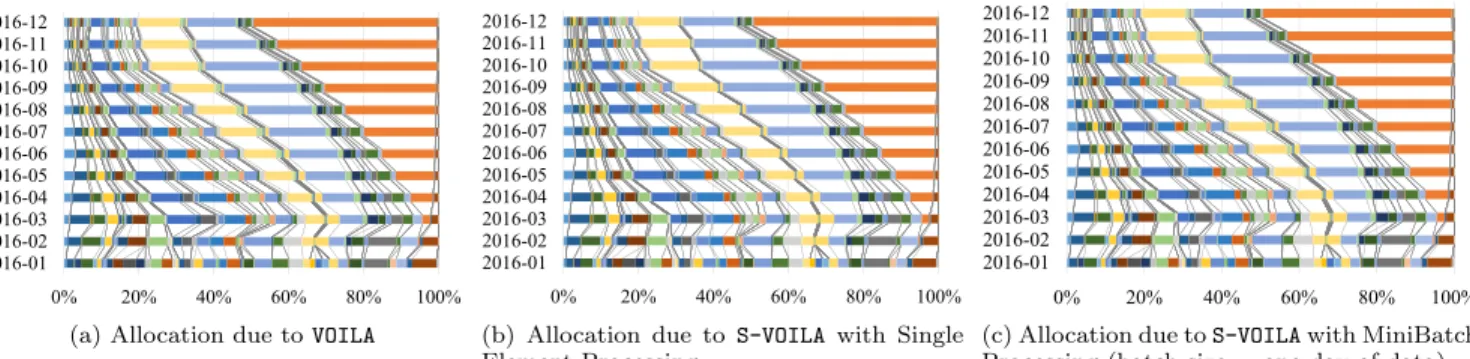
We measured the allocation of samples to different strata. At any point in time (afterM records have been observed), the total space taken by the sample is equal toM. Unless otherwise specified, the sample size M is set to 1 million records. The allocations to different strata can be seen as a vector of numbers that sum up toM (or equivalently, this can be normalized to sum up to 1), and we observe how this vector changes as more data arrive. Figure 5 shows the allocations at a single point in time, at the end of Septem-ber 2016, for the OpenAQ data. From this figure, we see that the allocation of S-VOILA tracks that of the variance-optimal offline algorithmVOILA quite closely. As expected,
Reservoir’s allocation is proportional to the volume of the stratum, whileUniform’s allocation is equal to all strata.
Figures 4a, 4b and 4c show the allocations over time pro-duced by VOILA, S-VOILA with single element processing, andS-VOILAwith minibatch processing where a minibatch contains data collected in each day. Visually, the allocations produced by the three methods track each other over time, showing that the streaming methods follow the allocation of the optimal offline algorithm,VOILA. To understand the
0 0.01 0.02 0.03 0.04 Cos ine di st an ce
S-VOILA, One-day Batch S-VOILA, Single
Figure 6: Cosine distance between the allocations due to
S-VOILA, with Single and Minibatch Processing, andVOILA, OpenAQ data. 0.000 0.001 0.002 0.003 0.004 V ari ance
VOILA S-VOILA, One-day Batch S-VOILA, Single
Figure 7: Variance of streaming S-VOILA, with Single and Minibatch Processing, compared with offlineVOILA. Sample size is set to 1M records, for each method, OpenAQ data.
difference between the allocations due toVOILAandS-VOILA
quantitatively, we measure the cosine distance between the allocation vectors from VOILA and from S-VOILA. Figure 6 shows the average of 5 runs. As seen, the allocation vec-tors due to S-VOILA are highly similar to the vectors due toVOILA, where the cosine distance is close to 0 most of the time and less than 0.04 at all times. S-VOILAwith minibatch processing yields an allocation that is closer toVOILAthan
S-VOILAwith single element processing.
Comparison of Variance: Next we compared the vari-ance of the estimates (Equation 1) from the stratified ran-dom samples produced by different stratified ranran-dom sam-pling algorithms, offline or streaming. The result is shown in Figure 7. Generally, the variance of the sample due to each method increases over time, since the volume of data as well as the number of strata increase, while the sample size is fixed. The variance of S-VOILA using minibatch process-ing is very close to that ofVOILA, showing that it is nearly variance-optimal at all times. The variance due toS-VOILA
0% 20% 40% 60% 80% 100% R elativ e d if fer en ce
S-VOILA, One-day Batch S-VOILA, Single
Figure 8: Relative difference of the variance of S-VOILA, with Single and Minibatch Processing, compared with the optimal variance due toVOILA, OpenAQ data.
0.000 0.001 0.002 0.003 0.004 V ari an ce
VOILA Neyman+ Neyman
Figure 9: Variance ofVOILAcompares toNeyman and Ney-man+with equal sample size of 1M records, OpenAQ data.
with single element processing is higher.
Figure 8 shows the relative difference between the vari-ance produced by a streaming algorithm (ˆx) and the opti-mal variance due toVOILA(x), defined as ˆx−xx. Each point is the average of 5 runs. We note that the variance of both variants of S-VOILA are nearly equal to that of VOILA un-til March, when they start increasing relative toVOILA, and then converge back.
From analyzing the underlying data stream, we see that March is the time when a number of new strata appear in the data (Figure 2c), causing significant changes in the op-timal allocation of samples to strata (this can also be seen in Figure 6 showing the cosine distance between the allo-cations). An offline algorithm such asVOILA can resample more elements from a stratum, if necessary, since it has ac-cess to all data from the stratum. However, a streaming algorithm such asS-VOILAcannot do so and must wait for enough new elements to arrive in these strata before it can “catch up” to the allocation ofVOILA. Hence,S-VOILA with single element as well as with minibatch processing start showing an increase in the variance at such a point. When data become stable again, and more data arrive, the relative performance of S-VOILAimproves. S-VOILAwith minibatch processing approaches the optimal variance faster than S-VOILAwith single element processing, which is as expected, since as the size of the minibatch increases, better optimiza-tion decisions are made with respect to which elements to exclude from the sample. In November and December, new strata appear again, and the relative performance is again affected. Overall, we note thatS-VOILAwith minibatch pro-cessing produces variance that is significantly closer toVOILA
thanS-VOILAwith single element processing.
Among offline algorithms, we observe that Neyman pro-duces variance that is higher thanVOILA. WhileNeyman is known to be variance-optimal for unbounded strata, it is clearly not variance-optimal for bounded strata and its
vari-0.0 0.2 0.4 0.6 0.8 1.0 1.2 5k 10k 50k 100k 500k 1M V ari ance Sample size
VOILA S-VOILA, Batch size: 100k S-VOILA, Single
Figure 10: Impact of Sample Size on Variance, in September, OpenAQ data. 0 0.001 0.002 0.003 0.004 0.005 V ari anc e
VOILA S-VOILA, Single S-VOILA, Batch 10
S-VOILA, Batch 100 S-VOILA, Batch 1K S-VOILA, Batch 10K
Figure 11: Impact of Batch Size on Variance. OpenAQ data.
ance can often be far from that ofVOILA, as seen in Figure 9. To show that VOILA not only addresses the problem of
Neymanthat leaves potion of memory to be unused, but also be optimal in allocating that remaining memory, we com-paredVOILAwithNeyman+, the extended version of Neyman
that reallocate the unused memory equally to the rest of unbounded strata. Neyman+ makes a fair comparison with
VOILAsince it uses up to the memory budget. Figure 9 shows thatNeyman+improves the originalNeyman. Making uses of the remaining memory, Neyman+ provides a lower variance thanNeyman. However, it reallocates the memory in a naive way whileVOILAdoes it delicately, thusVOILAoverperforms bothNeymanandNeyman+.
Impact of Sample Size: To understand the sensitiv-ity to the size of the sample, we conducted an experiment varying the sample size from 5000 up to 1 million records. We fixed the batch size to 100 thousand records. Figure 10 shows the snapshot in September 2016 of variances as a func-tion of the sample size. For bothVOILA andS-VOILA, with single element and minibatch processing, the variance de-creases when the sample size inde-creases. This is as expected, since larger samples produces better estimates of the popu-lation mean.
Impact of Batch Size: It is clear from Figure 7 that the variance of minibatch S-VOILA, where each batch contains data collected in a day, is performing significantly better than single elementS-VOILA. In order to understand the im-pact of the batch size, we conducted an experiment where we tried different batch sizes for minibatch streamingS-VOILA, chosen from{1,10,102,103,104}. The results are shown in Figure 11. A batch size of 10 elements yields significantly better results than single elementS-VOILA. A batch size of 100 or greater makes the variance nearly equal to the opti-mal variance.
6.4
Reaction to a Sudden Change in the Data
Distribution
0% 20% 40% 60% 80% 100% 5000 10000 15000 20000 25000 30000 35000 40000 45000 50000 Data siz e
(a) Allocation due toVOILA across different strata. 0% 20% 40% 60% 80% 100% 5000 10000 15000 20000 25000 30000 35000 40000 45000 50000 D ata size
(b) Allocation due toS-VOILAwith Single El-ement processing. 0% 20% 40% 60% 80% 100% 5000 10000 15000 20000 25000 30000 35000 40000 45000 50000 D ata size
(c) Allocation due toS-VOILAwith Minibatch processing (batch size = 100).
Figure 12: The Change in allocations of different algorithms over time with synthetic dataset.
0 0.001 0.002 0.003 0.004 0.005 0.006 0.007 5000 10000 15000 20000 25000 30000 35000 40000 45000 50000 V ari ance Data size
VOILA S-VOILA, Batch 100 S-VOILA, Batch 10 S-VOILA, Single
Figure 13: The variance changes due to a sole change in synthetic data.
affected by the combination of multiple factors that contin-uously change. To better observe the behavior of our algo-rithms under a single change, we conducted an experiment with our synthetic data. Figure 3b shows a single change in stratum 12, where the standard deviation suddenly increases from 1 to 20 after the first 10,000 records are generated. Meanwhile, the standard deviation of all the other strata are stable and their frequencies are stable as well. After this change, we will expect Stratum 12 to be given a greater sample size than the other strata. The memory budget is set to 1,000 records, which is 2% of the data size in the end of the experiment.
Figures 12a, 12b, and 12c show the allocations produced byVOILA, single elementS-VOILA, and minibatchS-VOILA, respectively. As seen,S-VOILA slowly captures the sudden change in the data by giving Stratum 12 more sample space over time. VOILAis more sensitive to the change, due to the fact thatVOILA works in an offline manner and is able to sample more data into Stratum 12 right after the change. Visually, minibatchS-VOILAis closer to theVOILAthan sin-gle elementS-VOILA.
Figure 13 shows the variance of different methods on syn-thetic data. At first, when the data is stable, all methods have nearly optimal variance. After a single change at 10,000 records, the variance ofVOILAincreases steadily, while those of different versions of S-VOILAincrease at a faster rate. S-VOILAwith a higher minibatch size has a lower variance. In-terestingly, the variance of all versions of S-VOILAconverge to that of the optimal method,VOILA, thoughS-VOILAwith a minibatch of 100 elements converges the fastest.
6.5
Query Performance
We now evaluate the quality of these samples indirectly, through their use in approximate query processing, which is one of the major applications of sampling. The setup
0% 1% 2% 3% 4% 5% 3M 6M 9M 12M 15M 18M 21M 24M 27M 30M Er ro r Ra te Data Size
Reservoir Uniform S-VOILA, Single
S-VOILA, Batch 100 S-VOILA, Batch 10K VOILA
Figure 14: Query Performance as data size varies, with sam-ple size fixed at 100,000. OpenAQ data.
0% 1% 2% 3% 4% 5% 6% 7% 5K 10K 20K 50K 100K Erro r Rat e Sample Size
Reservoir Uniform S-VOILA, Single
S-VOILA, Batch 100 S-VOILA, Batch 10K VOILA
Figure 15: Query Performance as sample size varies, with data size fixed at 21 million. OpenAQ data.
used is shown in Figure 1. The streaming sampler continu-ously maintains a stratified random sample of data (stored in memory), and use this sample to approximately answer ag-gregate queries, which are issued by the client. The offline sampler constructs its sample when needed, using VOILA, which takes two passes through the data. For evaluating the approximation error in query processing, we also implement an exact method for query processing,Exact, that stores ev-ery record in a table (stored in a MySQL database [31]) and answers a query using this table. While the exact method has zero error, its processing time is high, and so is its space overhead. Identical queries are made at the same time points in the stream to the different streaming and offline samplers, as well as to the exact query processor.
We measure the performance of the following samplers:
0.00% 0.01% 0.02% 0.03% 0.04% 5K 10K 15K 20K 25K 30K 35K 40K 45K 50K Error Ra te Data Size
S-VOILA, Single S-VOILA, Batch 10 S-VOILA, Batch 100 VOILA
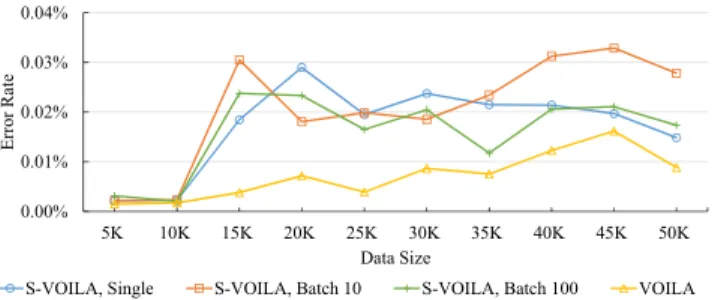
Figure 16: Query Performance on synthetic data as size of streaming data increases, with sample size fixed at 1,000 and one stratum’s distribution changed at 10,000.
the metric of relative error between the approximate answer and the exact answer, where the query asks for the mean of the data received across all strata. The sample size is set to 100,000 for all samplers. ForS-VOILA, we set minibatch size to be 1, 100, and 10,000. Each data point is the mean of nine repetitions of the experiment with the same configuration.
Figure 14 shows the relative error as the size of the stream-ing data increases, while the sample size is held fixed. The query was executed every three million element arrivals, up to thirty million, which covers the entire year of 2016 in the OpenAQ dataset. We note that the relative performance be-tween different methods remains similar for most data sizes.
Reservoirhas a consistent errors since it is mainly affected by sample size rather than data size. Uniformis affected by total number of strata and as expected, we see an increas-ing error when the data size reaches 24 million, where the number of strata increases suddenly as shown in Figure 2c, November 2016. The performance ofVOILAandS-VOILA in-crease slightly with data size, though at much lower rates thanReservoirand Uniform. We note that S-VOILA with any minibatch size is very close toVOILA.
Figure 15 shows the impact of the sample size, as it varies from 5,000 to 100,000, and the queries were executed at a fixed time of stream to see how sample size would af-fect the accuracy of answering queries. As expected, all methods benefit from increased sample size. We observed
S-VOILAandVOILAperform significantly better than Reser-voirandUniformeven with smaller sample sizes. Another observation ofS-VOILA is that a larger minibatch size does not always guarantee better accuracy. When total sample size is small, each stratum is allocated with a smaller space and there are fewer bounded strata. Therefore, the eviction made by single and minibatch processing affected the perfor-mance less. With our configuration,S-VOILAwith minibatch ten thousand elements did not yield a better accuracy until sample size was set to one hundred thousand.
We also test the query performance ofS-VOILAandVOILA
on synthetic data, with the same configuration as in Sec-tion 6.4. Figure 16 shows the performance of a query across all strata. The first observation isVOILAis less affected by the distribution change since it samples from all the received data, whileS-VOILAmethods had to discard data on the fly. Another observation is thatS-VOILAwith a larger minibatch size usually yields better performance.
7.
REFERENCES
[1] S. Acharya, P. Gibbons, and V. Poosala. Congressional samples for approximate answering of group-by queries. InProc. SIGMOD, pages 487–498, 2000.
[2] S. Acharya, P. B. Gibbons, V. Poosala, and S. Ramaswamy. The aqua approximate query answering system. InProc. SIGMOD, pages 574–576, 1999.
[3] S. Agarwal, B. Mozafari, A. Panda, H. Milner, S. Madden, and I. Stoica. BlinkDB: Queries with bounded errors and bounded response times on very large data. InProc. EuroSys, pages 29–42, 2013. [4] M. Al-Kateb, B. S. Lee, and X. S. Wang.
Adaptive-size reservoir sampling over data streams. In
Proc. SSDBM, page 22, 2007.
[5] B. Babcock, S. Babu, M. Datar, R. Motwani, and J. Widom. Models and issues in data stream systems. InProc. PODS, pages 1–16, 2002.
[6] B. Babcock, S. Chaudhuri, and G. Das. Dynamic sample selection for approximate query processing. In
Proc. SIGMOD, pages 539–550, 2003.
[7] B. Babcock, M. Datar, and R. Motwani. Sampling from a moving window over streaming data. InProc. SODA, pages 633–634, 2002.
[8] V. Braverman, R. Ostrovsky, and G. Vorsanger. Weighted sampling without replacement from data streams.Inf. Process. Lett., 115(12):923–926, 2015. [9] V. Braverman, R. Ostrovsky, and C. Zaniolo. Optimal
sampling from sliding windows. InProc. PODS, pages 147–156, 2009.
[10] S. Chaudhuri, G. Das, and V. Narasayya. Optimized stratified sampling for approximate query processing.
ACM Trans. Database Syst., 32(2), 2007.
[11] W. G. Cochran.Sampling Techniques. John Wiley & Sons, New York, third edition, 1977.
[12] G. Cormode, V. Shkapenyuk, D. Srivastava, and B. Xu. Forward decay: A practical time decay model for streaming systems. InProc. ICDE, pages 138–149, 2009.
[13] G. Cormode, S. Tirthapura, and B. Xu.
Time-decaying sketches for robust aggregation of sensor data.SIAM J. Comput., 39(4):1309–1339, 2009. [14] P. S. Efraimidis and P. G. Spirakis. Weighted random
sampling with a reservoir.Inf. Process. Lett., 97(5):181–185, 2006.
[15] R. Gemulla and W. Lehner. Sampling time-based sliding windows in bounded space. InProc. SIGMOD, pages 379–392, 2008.
[16] R. Gemulla, W. Lehner, and P. J. Haas. Maintaining bounded-size sample synopses of evolving datasets.
The VLDB Journal, 17(2):173–201, 2008.
[17] P. B. Gibbons and S. Tirthapura. Estimating simple functions on the union of data streams. InProc. SPAA, pages 281–291, 2001.
[18] P. J. Haas. Data-stream sampling: Basic techniques and results. InData Stream Management, pages 13–44. Springer, 2016.
[19] T. Johnson and V. Shkapenyuk. Data stream warehousing in tidalrace. InProc. CIDR, 2015. [20] S. Joshi and C. Jermaine. Robust stratified sampling
plans for low selectivity queries. InProc. ICDE, pages 199–208, 2008.
[21] P. Kranen, S. G¨unnemann, S. Fries, and T. Seidl. Mc-tree: Improving bayesian anytime classification. In