Bachelor Thesis
A Corpus-Based Approach to the
Classification and Correction of
Disfluencies in Spontaneous Speech
Jana Besser
Matriculation Number: 2507562
November 7, 2006
Supervised by:
Prof. Dr. Wolfgang Wahlster,
Dr. Jan Alexandersson
Saarland University,
Faculty of Humanities,
Department of General Linguistics,
Chair of Computational Linguistics
3
Eidesstattliche Erkl¨
arung
Hiermit erkl¨are ich an Eides Statt, dass ich diese Arbeit selbstst¨andig und nur unter Zuhilfenahme der ausgewiesenen Hilfsmittel angefertigt habe.
Declaration of Academic Honesty
I hereby declare to have written this thesis on my own, having used only the listed resources and tools.
Abstract
This thesis presents a classification scheme for disfluencies occurring in spon-taneous spoken language. Disfluencies are irregular speech phenomena that range from rather simple entities such as sounds of hesitation and slips of the tongue to more complex structures as self-corrections. The presented classi-fication scheme covers phenomena, which affect the structural, non-semantic layer of an utterance.
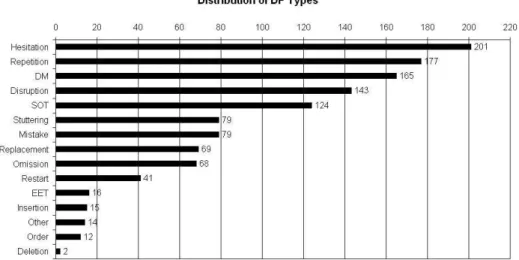
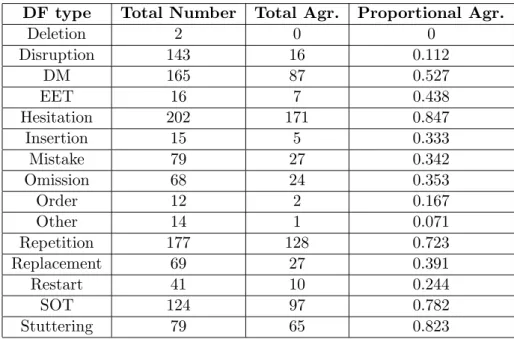
The designed scheme is an extension of previous work on the topic and was conducted in a data-driven approach. It is based on an analysis of data from the AMI Meeting Corpus (McCowan et al., 2005). The corpus contains human-human dialogues on a prescribed topic. The examination of the data led to the identification of 1205 disfluency instances within a total of 792 dialogue acts, showing that disfluencies are prevalent phenomena in spontaneous speech. Therefore their examination is of significant relevance for natural language applications.
The scheme is designed to serve as a basis for the development of a computational tool for automatic disfluency corrections. However, it may be used for other purposes as well, e.g. for speaker-related data collection, such as a person’s characteristic speech behaviour. For this reason, the classification contains several layers, which correspond to different degrees of subdivision of the disfluency types. In this way an adequate layer can be chosen depending on the application, the scheme is used for.
The present work includes also an annotation scheme that was developed according to the classification. Its reliability was tested by comparing an-notations of several annotators, who used the scheme but were not familiar with the topic of disfluencies. The annotations were compared according to a number of different metrics and the inter-annotator agreement was cal-culated using two different statistics: the κ- and the AC1-statistics (Gwet, 2002). The results show that the agreement on the annotations is very high (about 0.95), once the boundaries of a DF were identified similarly.
Contents
1 Introduction 11 1.1 Motivation . . . 12 1.2 Aims . . . 12 1.3 AMI Project . . . 13 1.4 Corpus . . . 13 1.5 Method . . . 14 1.6 Chapter Summary . . . 15 2 Theoretical Background 17 2.1 Shriberg - Regularities in DF Production . . . 172.2 Finkler - Automatic Generation of Self-Repairs . . . 20
2.3 Other Related Work . . . 23
2.4 Comparison of Schemes . . . 24
2.5 Chapter Summary . . . 26
3 Classification Scheme 27 3.1 Disfluency Structure . . . 27
3.2 Disfluency Class Definitions . . . 28
3.2.1 DFs of Type Uncorrected . . . 30 3.2.2 Deletable Phenomena . . . 32 3.2.3 DFs of Type Revision . . . 38 3.2.4 Other . . . 45 3.3 Chapter Summary . . . 46 4 Annotation 47 4.1 Annotation Standard . . . 47 4.2 Complex Disfluencies . . . 48 4.3 Annotation Issues . . . 50 4.4 Evaluation . . . 53 4.4.1 Statistics . . . 53 4.4.2 Metrics . . . 54 4.4.3 Results . . . 56 4.5 Chapter Summary . . . 61 7
5 Summary and Conclusions 63
Acknowledgements
I am sincerely grateful to all the people, who have supported and encouraged me whilst the process of accomplishing this work.
First I want to thank Wolfgang Wahlster, who permitted me to work on the topic at the Intelligent User Interface department of the DFKI GmbH (German Research Center for Artificial Intelligence).
I am especially indebted to my supervisor Jan Alexandersson. He gave me invaluable support throughout the process, always having a critical but encouraging look at the research I was doing. I appreciate the cooperation and correspondence with him and would also like to thank him for advice and discussions that go beyond the scope of this work.
A special note of thanks goes to Thomas Kleinbauer. His advice and constructive contributions were strongly conducive to the progress of my research. His practical tips brought solutions to a number of challenges (both large and small) I encountered during the process.
Thanks to Tilman Becker (and Jan Alexandersson) for providing me with the opportunity to write this thesis within the AMI project, allowing me to use the AMI meeting corpus for my investigations and “lending” me two of the project’s research assistants for disfluency annotations. I also want to express my gratitude to the annotators themselves: Beata Biehl and Alexandria Kimsey. Special thanks to Alexandria for taking her time for language related corrections of the annotation manual.
Sincere thanks also go to the annotators, who did the work in their free time: Lisa Fiedler and Steven B. Poggel.
Other people to whom I am extremely grateful: Stephan Lesch, who contributed with technical support in different areas; Benjamin Lang and Jochen Frey, who made the evaluation of the annotation scheme possible on a technical level; Dan Flickinger for support on the LKB system; Kilem Gwet for support on the generalisation of the AC1-formula for multiple raters; all the people, who gave me valuable recommendations for essential background literature on the topic; all the people that helped with spell-checking and other corrections of the work.
Finally, I would like to thank my mother, my boyfriend, and my friends, who contributed with a lot of encouragement and care.
Chapter 1
Introduction
Speech differs highly from written language. When people talk, they produce a lot of linguistic irregularities, so called disfluencies (henceforth, DFs). Linguistic irregularities in the present work mean syntactic and grammatical errors according to standard syntax and grammar. DFs are often named
self-corrections orself-repairs but the present work avoids these terms as a superordinate concept for all phenomena. Not all DFs include a speaker’s self-correction. They can stay uncorrected or serve to add new information to the context.
The causes for DFs are various. Some cases can be explained by the assumption that speakers sometimes start an utterance before they have formulated it. Then the DF is used as a provisional start, which is revised later if it did not express what the speaker wanted to say. This even holds for mid-sentence DFs, since the process of formulation continues while speaking. The present work examines the regularities of the occurring DF phe-nomena and the possibility to divide them into classes according to their structure. Disfluency phenomena have a quite regular structure. This has been done in other research before, but these approaches did not cover the existent phenomena to a satisfying degree. The present work is more fine-grained than the previous approaches and covers a larger set of DF types, see chapter 2.
In the current approach DFs are divided into three subgroups: uncor-rected phenomena, deletable phenomena, andrevisions, see chapter 3. Only
revisions have the structure that is typically associated with DFs and that is described in almost all work on the topic. It consists of an erroneous part (reparandum), an optional medial region (interregnum) that prepares the correction, and finally the correction (reparans), see chapter 3.1. Un-corrected and deletable DFs do not include a self-correction by the speaker. Therefore they consist only of areparandum.
DFs can be left uncorrected for different reasons: Either the speaker did not notice her error or she noticed it but decided not to correct it since e.g.
a small error could gain too much focus if it gets corrected. Furthermore the communicative intention may not be disturbed by the error. Human listeners are quite good in ignoring errors and interpreting slightly imperfect speech, which makes certain corrections superfluous.
The present work considers only phenomena that actually lead to the interruption of the syntactic or grammatical fluency of an utterance. This excludes meta comments and certain stylistic devices from the classification. The approach is only concerned with the structural correctness of an utter-ance and thus no analysis of the semantic or pragmatic impacts of DFs were considered. The underlying psychological processes were neither examined.
1.1
Motivation
The number of natural language applications that focus on spontaneous speech input rises.Those systems have to be able to handle all the challenges that arise in conjunction with speech, e.g. DFs. Many current computa-tional natural language parsers were though developed to handle written language and thus DFs can mean extensive trouble for them. This makes the topic interesting from a computational linguistic point of view. A tool for the automatic detection and correction of speech disfluencies, that is in-corporated in a natural language application as a pre-processing module for the parser, could make it possible to keep an existent parser and allow for the processing of DFs anyway. This would make the system more robust and user-friendly, since since it would allow for less restricted spontaneous speech input.
The classification scheme developed and reported in this work is meant to contribute to the preparation of automatic detection and correction of speech disfluencies. Since such a correction tool would have to give a cleaned version of the original utterance as output, where all DFs have been cleared, the DF annotation scheme presented here generates an appropriate correction for each DF.
The DF classification scheme can also be used for examinations of other data in various fields. For example, an investigation could be made how disfluencies correspond to a person’s social status, age, education, certainty, or other agent- or context related factors.
1.2
Aims
The aim of this work was to develop a fine-grained broad coverage clas-sification scheme for DFs occurring in spontaneous spoken language. The classification has been made in a data-driven approach based on the analysis of data from the AMI meeting corpus (McCowan et al., 2005). The work is supposed to combine and extend previous research on the topic to produce
1.3. AMI PROJECT 13
a scheme that covers all kinds of DF phenomena and does not only focus on certain types of DF. The disfluency classification scheme can hopefully be used for a large set of approaches, which have to handle disfluencies in one way or another, irrespective of the application’s domain and purpose of the application.
Another goal was to create an annotation scheme from the DF classi-fication. The annotation scheme can be used for marking disfluency types and their erroneous vs. correcting parts or for inserting corrections for un-corrected DFs.
Finally, the classification scheme is meant to be used for enabling the automatic detection and correction of DFs in speech input to natural lan-guage applications. In this scenario the scheme could be used for training a correction tool, in the way described in the previous section.
1.3
AMI Project
The disfluency classification scheme was developed as part of the AMI project (http://www.amiproject.org). The project is operated by a multi-disciplinary 15-member consortium, which consists of both academic part-ners, industrial partpart-ners, and research institutes. The name AMI stands for Augmented Multi-party Interaction. The project’s goal is to develop technology to support and enrich communications between individuals and groups of people. According to (McCowan et al., 2005) some research topics of the project are 1)Definition and analysis of meeting scenarios, 2) Infras-tructure design, data collection and annotation, 3) Processing and analysis of raw multi-modal data, 4)Processing and analysis of derived data, and 5)
Multimedia presentation. For instance, one activity within the project is the work on automated meeting summarisations, which falls into category 4). Disfluency detection and correction is a nearly compulsive matter for reaching this goal.
1.4
Corpus
For the research within the AMI project a corpus was created, which contains records of business meetings that hold about 100 hours of meeting time. The meetings were recorded in instrumented rooms equipped with a variety of instruments, yielding high-quality multi-modal recordings, see (McCowan et al., 2005) for further information. Both real meetings and scenario-driven meetings are contained in the corpus. In the scenario-driven meetings the participants are talking about a prescribed topic.
The speech recordings have been transcribed into text for research pur-poses. A part of the transcriptions was functioning as the basis for the development of the classification scheme presented here.
The corpus contains unrestricted and uncontrolled human-human dis-cussions, which means that a lot of aspects of DFs produced in natural speech should occur in the dialogues. Furthermore, the meetings were held in English, but a large proportion of the participants were non-native En-glish speakers, resulting in a high variability of speech patterns, which is not covered by many other corpora (McCowan et al., 2005). On the other hand the meeting participants were sitting in the same room, having face-to-face conversations. This means that gestural cues and other factors, which can influence DF production could not be excluded. The suggestion is though, that the basic phenomena should not be affected by this.
For empirical approaches it is desirable to examine a large corpus. The larger the corpus, the more robust are the results gained by the investigation. Yet, due to time restrictions, only a limited amount of meetings could be analysed in the presented work. However, as chapters 2 and 3 show, it was still possible to identify an expanded range of DF phenomena. Chapter 4.4 reports that most occurring disfluency types are covered by the scheme.
1.5
Method
The classification is exclusively based on examinations of the meeting tran-scriptions. No acoustic material was used, neither while creating the clas-sification scheme nor for the annotations. Time limitations made this re-striction necessary in spite of the obvious advantages, which result from the inclusion of acoustic information, such as an abbreviation in taking decisions on class assignment in critical cases. However as stated in (Shriberg, 1994) and (Finkler, 1997), even if audio recordings are available, this does not guarantee that all ambiguities can be resolved. Finkler (1997) emphasises that in order to avoid interpretation by the annotator, it is often necessary to ask the speaker herself.
The transcriptions contain only plain text. This means that no non-linguistic material such as laughter, coughing or similar sounds were in-cluded in the investigations. Working on the transcriptions also meant to trust in the transcriber’s analysis of the speech material. For example, a transcribed “I” was always treated as a full-word, a personal pronoun, while “i” was treated as a word fragment, even if it is not sure that the transcriber interpreted the sound correctly. The same counts for “uh” and “a”, which can sound very similar, while the first is a hesitation and the second is an article or a word-fragment.
For the examinations, the corpus had to be segmented into discrete units for analysis. The most convenient way of segmenting the corpus was by dialogue acts (DAs), since it had already been split this way. Every DA was treated as one utterance and annotations were made on one segment a time, not including phenomena, which exceed segment boundaries. The
1.6. CHAPTER SUMMARY 15
annotators were not supposed to include information from the surrounding segments, from the whole discourse or their world knowledge in order to complete their class assignments. This also meant that no semantic analysis of the content and no semantic corrections were to be made.
The segments were processed with the parser of the LKB system (http://www.delph-in.net/lkb) before annotation. Only segments that could not be parsed were annotated with DF classes.
For the comparison of the annotations’ similarity, a number of metrics were created to identify the DF instances that were similarly defined by the annotators. With two different statistics also the inter-annotator agreement was calculated, see chapter 4.4.
1.6
Chapter Summary
The goal of this thesis is to provide a classification scheme for speech dis-fluencies of all types. This is motivated by the fact that DFs in spoken language can cause serious trouble for computational listeners and the abil-ity to handle DFs is therefore of importance for any computer system that deals with spontaneous speech.
The underlying research was carried out within the AMI project. In a data-driven approach, DF phenomena in human-human conversations from the AMI meeting corpus were analysed in order to gain an appropriate classification scheme. The DF class definitions reflect the surface structure of the encountered phenomena and do not consider any underlying processes. The work also involves DF annotations by several annotators. The an-notations were made according to a scheme developed on the basis of the created classification scheme. They were then compared with respect to similarity through measuring the inter-annotator agreement.
Chapter 2
Theoretical Background
Several researchers have investigated the topic of speech disfluencies before, by various motivations. Their work serves as an important basis for this thesis, since the present work extends the list of the previously identified DF phenomena with additional classes.
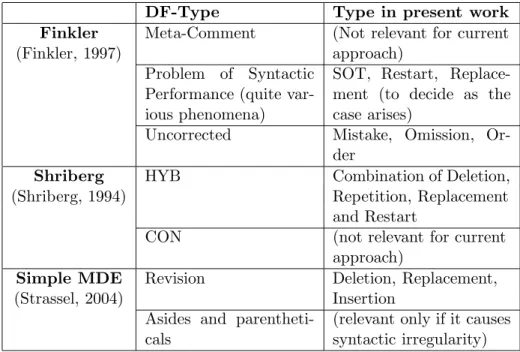
This chapter is supposed to give an overview on the existing research on the topic. The outline is by far not exhaustive but should give a good all-around impression of previous approaches. Two approaches that provide a classification of a great extent of DF phenomena will be presented in de-tail. The first one is (Shriberg, 1994), chapter 2.1. Shriberg’s thesis is an absolute foundation in the research on DFs. She elaborated regularities in the production of DFs and created a detailed classification scheme of DF phenomena. Also Finkler (1997) provides a valuable and elaborate DF clas-sification, which is presented in chapter 2.2. The DF classes identified by Finkler and Shriberg are also presented in tables 2.1 and 2.2 where they are compared to the corresponding classes of the current scheme. Chapter 2.3 presents relevant findings and classifications from miscellaneous other research. It is mainly concerned with differences in the naming of DF phe-nomena.
2.1
Shriberg - Regularities in DF Production
Shriberg (1994) examined disfluencies in spontaneous speech of adult normal speakers of American English. Her aim was to find and illuminate regulari-ties in disfluency (DF) phenomena. According to Shriberg, these regulariregulari-ties have consequences for models of human language production, which she was concerned about as a psycholinguist. Furthermore, the observation of sys-tematic disfluency patterns can help to improve the performance of speech applications.
Shriberg used a strongly data-driven approach in her investigations. Her work was based on the analysis of the three following corpora: 1) ATIS,
which contains task-oriented human-computer dialogues on air travel plan-ning, 2) AMEX, which contains task-oriented human-human dialogues, also on air travel planning, and 3) the SWITCHBOARD corpus, which consists of informal human-human dialogues on a prescribed topic. Shriberg’s work includes an analysis of more than 5000 DF instances, for which she used both transcriptions and audio recordings. The data were analysed with respect to several different features. Shriberg defines features as observable charac-teristics in the data. For further information about the features examined see (Shriberg, 1994).
Shriberg included only same-turn and same-sentence DFs in her inves-tigation. Thus no phenomena, which exceeded turn or sentence boundaries were considered. Moreover, she only regarded cases “in which a contiguous stretch of linguistic material must be deleted to arrive at the sequence the speaker intended[...]” (Shriberg, 1994).
This means that she did not consider any disfluencies where material has to be added or changed in order to gain the sequence the speaker (presum-ably) intended. Thus phenomena, which are classified asOmission orOrder
in the present work are not covered by Shriberg’s classification.
As most other researchers Shriberg defines a three-phase structure of DFs. The terms she uses are adapted from Levelt (1983), with some modifi-cations: Thereparandum (RM) is the whole stretch of speech to be deleted. This goes in accordance with the present work but is against Levelt and Finkler (1997) where only the altered or corrected element(s) are considered asreparandum. The RM is followed by theinterruption point (IP) and then theinterregnum (IM), which is named editing phase in many other works. The third and last part is the repair (RR), which is defined as the stretch of speech that corresponds to and “corrects” the material in the RM. The RM and the IM are the regions which are to be deleted in order to arrive at the intended utterance.
Shriberg’s classification contains the following classes (see also tables 2.1 and 2.2):
ART: This class contains DFs, which arise in connection with speech errors (= SOTs in the present work).
HYB: The Class HYB is used for phenomena, which include the presence of at least two substituted, inserted or deleted words.
SUB: One word from the RM is substituted by another one in the RR.
INS: The RR contains a word, which did not occur in the RM (insertion).
DEL: None of the material from the RM is repeated in the RR.
2.1. SHRIBERG - REGULARITIES IN DF PRODUCTION 19
CON: Denotes coordinating conjunctions, e.g. “and” between two sen-tences, connecting them to one sentence.
FP: Filled pauses (only “um” and “uh” were attended).
Shriberg’s class DEL (deletion) covers the same phenomena as the class
restart in the present work. The only difference is that for DEL only the RM is annotated whereas forrestart both RM andreparans (= RR in Shriberg’s work) are annotated.
Discourse markers andexplicit editing terms(EETs) are accounted for in Shriberg’s work but not considered as DFs. Contrary to the ideas presented in this paper, Shriberg regards them as expressions, which are not only distinct in their position in the utterance (whether or not they are within an IM) but also in the terms they use. However, also here EETs are directly associated with a DF and can only occur within the IM or directly after the repair.
As table 2.2 shows, the classes CON and HYB have no direct counter-part in the present work. HYB is covered by other classes, while a CON phenomenon does not have to lead to disfluency and therefore was not con-sidered as relevant in the current approach. CON denotes cases, where two proper sentences are connected with “and”, which does not cause syntactic irregularity. Shriberg (1994) also states that these phenomena are extremely rare.
As in the present work, serial and complex DFs are treated as consecutive basic DFs or as a hierarchically organized complex of basic DFs in Shriberg’s approach. DFs are denoted as “serial”, where one DF’s repair (RR) is immediately followed by thereparandum(RM) of the next one. In a complex DF, two or more IPs bind both preceding and following material. The correction of a complex DF proceeds outward from the inmost to the outmost DF. Shriberg (1994, chap. 4.3.4.8, p. 68) gives the following example for a complex DF:
(1) he she she went
The disfluent sequence includes the first three words. It contains two disfluencies. The first “she” is the repair region (RR) of the first disfluency. It replaces the “he”. The second “she” is the RR of the second DF. It repeats the first “she”. The sequence is an example for a case, where one word is both repair of one disfluency and reparandum of another one.
One clear difference between Shriberg’s approach and the present work is that the class REP (repetition) also includes cases where the first element of the repetition (= the RM) is a word fragment or a mispronunciation. The present work classifies only real repetitions as repetition, since the risk of false interpretation is otherwise too high. The following example from (Shriberg, 1994, chap. 4.3.4.5.2, p. 65) illustrates the difference:
(2) show me grand trouns- ground transportation
In Shriberg’s approach, “grand” is analysed as a mispronunciation of “ground” and thus “ground” is seen as a repetition of “grand”. Furthermore “transportation” is marked as repeating the word “trouns”, which is both a misarticulation and a word fragment. In the approach presented here, none of these phenomena would be classified asrepetitions:
2.2
Finkler - Automatic Generation of Self-Repairs
With PERFECTION Finkler (1997) created a system for the incremental syntactic generation of natural language. This means that the system starts generating speech output before the complete input information from the (human) conversational partner is given. According to Finkler (1997) this is supported by psycholinguistic models of speech production. Due to non-monotonic input specifications, the incremental processing sometimes makes later modifications of the already produced output necessary, which leads to a self-correction scenario.
Finkler’s aim was to improve the speech production of a natural language system by making it more flexible and adaptable to the situational context and the conversational partner. The system replicates typical performance phenomena of human self-corrections. It is supposed to produce human-like speech even in situations where errors occur. By this, the user’s acceptance of the system is meant to be increased and error situations should be resolved as good as in human-human communication.
In order to produce human-like self-corrections, Finkler analysed a cor-pus, the results of which he took as the empirical basis for his work. The corpus he used contained task-oriented human-human dialogues, recorded within the VERBMOBIL project (http://verbmobil.dfki.de/). The dialogue participants were supposed to arrange a meeting. Finkler had access both to audio recordings and transliterations of the dialogues. This allowed him to consult the acoustic material when the transliterated data did not give sufficient information for the classification of a phenomenon.
Finkler (1997) examined 336 dialogues, which contained a total of 4590 turns and correspond to 8 hours of meeting time. In the material he iden-tified 1251 self-corrections. The corrections were evaluated for 20 criteria, e.g. where theinterruption point typically is located, which of the possible corrections is chosen and how much of the uttered material is usually re-peated at the beginning of the correction. The choice of the criteria shows that Finkler was interested in generating self-corrections, not in identifying them and correcting the errors which they respond to.
In his corpus analysis, Finkler identified ten classes of disfluencies, which he divided into the following four groups: (The original names of the classes are given in parentheses.)
2.2. FINKLER - AUTOMATIC GENERATION OF SELF-REPAIRS 21
1. Replacement, Deletion, Insertion
(Austauschkorrektur, L¨oschung, Sp¨ateingabe)
2. Meta Comment, Syntactic Performance Problem (SPP), Repetition (Metakommentar, syntaktisches Performanzproblem, Wiederholung) 3. Stuttering, Slip Of The Tongue
(Stotterer, Versprecher) 4. Uncorrected Errors, Rest
(Unkorrigierte Fehler, Rest)
Representative for the fundamental structure of DFs, Finkler (1997) de-scribes a DF of the type replacement in the following way: A replacement
consists of the original utterance, an editing phase and thecontinuation:
The Original utterance is the part of the utterance, which reaches from its beginning to the point where the speaker interrupts herself. It contains the disfluency’sreparandum.
The Editing Phase comes directly after the interruption point. It con-tains unfilled pauses, filled pauses, hesitations and/or correction intro-ducers.
The Continuation of the actual utterance takes place after the editing
phase. It contains the self-correction, the disfluency’s reparans. De-pending on the error, this last phase can look quite different.
In (Finkler, 1997) thereparandum (RM) is seen as the part of theoriginal utterance, which is revised in the self-correction later on. There may be several other words between the reparandum and the interruption point. The reparans (RS) is seen in an equivalent way. It denotes the part of the
continuation, which corrects the reparandum. Again there may be several words between the editing phase and the RS. Thus the terms do not say anything about the position of these parts in the complete utterance. This is a clear difference to the present work, where the RM reaches from the beginning of the erroneous part to the IP, which correspond to the start of theinterregnum (= editing phase in Finkler’s work), or thereparans.
Finkler defines the disfluency classes he detected in the following way: (Again, the original names of the classes are given in parentheses.)
Replacement (Austauschkorrektur): The RM is replaced by one or
several substituting elements and may not be contained in the RS, except in an explicit negation.
Deletion (L¨oschung): One element from theoriginal utterance is missing in the continuation and the whole utterance cannot be seen as an ellipsis.
Insertion (Sp¨ateingabe): Some element from the original utterance is repeated in the continuation and also additional information to this element is given in the continuation.
Meta Comment (Metakommentar): Those are sentences or
sentence-like expressions, which are used for adding characterisations, con-straints or an attitude to the uttered material, often in form of an ellipsis. This also includes cases where one of two well-formed sen-tences modifies or negates the other. Often there is no interruption in the original sentence.
SPP (Syntaktisches Performanzproblem): Speech material has been
inserted between the interrupted phrase and theediting phase or there is an agreement error and the utterance does not fulfill the conditions for any of the other classes.
Repetition (Wiederholung): The last part of theoriginal utterance was
repeated in the continuation and a possibly existent abrupted word from the original utterance was fully articulated in the continuation. (A phenomenon is not classified as repetition, if the repetition is ei-ther caused by stuttering, or is a stylistic device or has any syntactic function.)
Stuttering (Stotterer): The utterance was interrupted within a syllable and there are no correction introducers, hesitations or long pauses in theediting phase. The correction has to start with a repetition of the interrupted word fragment.
Slip of the tongue (Versprecher): Those are parts of utterances which
result from interferences in the normal speech production.
Uncorrected (Unkorrigiert): Those are utterances that contain
uncor-rected errors, which do not even fulfill the less stringent rules of speech grammar, or utterances, which contain obvious content errors.
Some differences between Finkler’s work and the classification presented in this work may arise due to the fact that Finkler’s aim was to produce human-like self-corrections, while the present work’s aim is to correct dis-fluencies occurring in spontaneous speech. For example, the present work does not differentiate between grammar for spoken and written language, since the idea is to enable the use of written language parsers for spoken language.
Finkler also distinguishes between 1) different types of insertions, de-pending on the position, on which the new material was placed, relative to the repeated element, and 2) different types ofrepetitions, according to the position of the replacing material in the continuation. These factors might
2.3. OTHER RELATED WORK 23
be interesting for a generation approach of self-corrections but are not as relevant in a correction approach.
The class Meta Comment, as it was defined by Finkler, strongly refer-ences an utterance’s semantic content, which is outside the range of this work. Such phenomena are not considered as long as a sentence is syntac-tically well-formed. Finkler’s class SPP has no direct counterpart in the present work but the examples for this class, given in (Finkler, 1997), are covered by other classes, see chapter 3.
2.3
Other Related Work
Generally, disfluency classification schemes fall into two groups: Schemes using a fine-grained classification and schemes using rather rough classifica-tions. Rough classification schemes usually identify four different groups of disfluencies, which can be described in the following way:
Modifications: The RS is a modification of the RM. It often has a strong correspondence to the RM.
Repetitions: The RS repeats the RM.
Fresh Starts: The current utterance is abandoned and a new one is started, (which often does not correspond to the abandoned utterance).
Fillers: Phenomena which do not contribute to the meaning of the utter-ance, examples arefilled pauses, editing terms etc.
The names used for these phenomena are various. Also the actual num-ber of the defined classes differs. Some research considers less different categories while other studies include additional DF types, e.g. involving word fragments (Bear et al., 1993). This depends mostly on the aim of the work. Some terms used for modifications, are revision (Liu et al., 2003),
repair (Shriberg, 2001) and modification repair (Heeman & Allen, 1999).
Fresh Starts are also called restart (Liu et al., 2003), deletion (Shriberg, 1994, 1996, 2001), and false start (Shriberg, 1999). Other terms for fillers
are filled pause (Shriberg, 1999, 2001), cue words (Bear et al., 1993), and
abridged repairs (Heeman & Allen, 1999).
The filler class can have variable extent. Sometimes it only includes phenomena, which in the present work are referred to ashesitation, e.g. in (Shriberg, 1994, 1999, 2001), sometimes alsodiscourse markers andexplicit editing terms are included, e.g. in (Strassel, 2004; Heeman & Allen, 1999).
Besides the DF classification schemes given in chapters 2.1 and 2.2, an-other example for a more fine-grained classification scheme is the one defined in (Strassel, 2004). In this work, DFs are divided into two subgroups: fillers
andedit disfluencies. Thefillergroup includesfilled pauses,discourse mark-ers,explicit editing terms, andasides and parentheticals. Thus it corresponds
to the range of phenomena that are gathered under the termdeletable in the current work. Phenomena of the categoryasides and parentheticals are not considered in the present work, since they are quite hard to define exactly.
Asides and parentheticals are both defined as short comments in (Strassel, 2004) that do not contribute to the content of the utterance they are en-closed in. The difference between them is that asides concern a new topic (e.g. addressing a new person entering the room), while parentheticals are breaking the flow of the original utterance with a remark on the same topic. Actually, no phenomena of either of the two types were found in the material that was used for DF type identification in the current approach.
Phenomena of the group edit disfluencies are the same as those consid-ered as revisions in the present work. Edit disfluencies includerepetitions,
revisions (denotes the same phenomena as those that above were consid-ered with the term “modification”) andrestarts (the same as therestart in the current work). Strassel (2004) analysed the structure of these DFs in a similar way to the one presented in this work in chapter 3.1.
Finally, it can be stated that all research on the topic accounts for more or less the same phenomena. They are considered from different perspectives though, which leads to differences in the classification schemes.
2.4
Comparison of Schemes
The classification schemes developed by Shriberg (1994) and Finkler (1997) were discussed in detail in chapters 2.1 and 2.2. The DF classes identified by them and the classes of the scheme presented in this work are gathered in tables 2.1 and 2.2 for an easier comparison of the schemes. Also the classification that was made by Strassel (2004) is included there. Table 2.1 lists the classes of the current scheme in the first column and their correspondences in the other schemes in the remaining columns. The table shows that predominantlyuncorrected phenomena miss counterparts in the other approaches.
The first column in table 2.2 gives the classes of the other schemes that did not fit into the first table. This means, they have no direct correspondent in the present work, but are for instance covered by several classes in the current scheme.
There are three phenomena in the other research that are not covered by any class in the current scheme. Those phenomena were mostly excluded for the reason that they do not necessarily cause syntactic irregularity or that they require semantic analysis, which does not fall into the scope of this work. This counts e.g. for the classMeta Comment in Finkler’s scheme.
However, if it turns out that those phenomena are frequent, it could be worth to consider to introduce a new class for them.
2.4. COMPARISON OF SCHEMES 25
Present Work Finkler Shriberg Simple MDE
(Finkler, 1997) (Shriberg, 1994) (Strassel, 2004) Deletion Deletion
Disruption Incomplete SU
DM DM DM
EET EET EET
Hesitation FP Filled Pauses
Insertion Insertion INS Mistake
Omission Order
Other Rest
Repetition Repetition REP Repetition Replacement Replacement SUB
Restart DEL Restart
SOT SOT ART
Stuttering Stuttering
Table 2.1: The DF classes defined in the present work (column 1) and their correspondents in other work discussed in this thesis
DF-Type Type in present work
Finkler Meta-Comment (Not relevant for current
(Finkler, 1997) approach)
Problem of Syntactic Performance (quite var-ious phenomena)
SOT, Restart, Replace-ment (to decide as the case arises)
Uncorrected Mistake, Omission, Or-der
Shriberg HYB Combination of Deletion,
(Shriberg, 1994) Repetition, Replacement and Restart
CON (not relevant for current approach)
Simple MDE Revision Deletion, Replacement,
(Strassel, 2004) Insertion
Asides and parentheti-cals
(relevant only if it causes syntactic irregularity)
Table 2.2: The table shows the DF classes from other work that have no direct correspondent in the present work.
2.5
Chapter Summary
Some basic types of DFs are covered by all examined previous classification schemes. Those are fillers, repetitions, fresh starts and modifications. Only some of the schemes provide a more detailed classification. Differences in the classifications can partially be explained by researchers’ different underlying motivations for their work on DFs. However, none of the presented schemes is exhaustive. Additional DF classes have to be defined in order to gain a satisfactory coverage of the existing DF phenomena, especially for errors that were not corrected by the speaker herself.
Chapter 3
Classification Scheme
This chapter presents the results of my investigations on existing DF phe-nomena. It both reports the general structure of DFs (3.1) and elaborates each of the identified DF classes in detail (3.2). The chapter does not only give the class definitions but discusses also critical cases of class assignment, implications for future research, and planned changes to the current classi-fication scheme.
3.1
Disfluency Structure
Most disfluencies have the same surface structure. They consist of three parts. The first part contains the “erroneous”, disfluent material, that will be replaced by the speaker. It is called reparandum (RM) in the present work. Reparandum is Latin and means “to be repaired”. The RM is followed by the interregnum (IM), a term which is adapted from Shriberg (1994). This part is called “editing phase” in many other researcher’s work. The term interregnum was chosen for two reasons: The first reason is that in this way the DF-parts all have Latin names, the second and more important reason is given in (Shriberg, 1994, chap. 2.3.1, p. 8):
“Interregnum” is a more neutral term than “editing phase” (Lev-elt, 1983); it can be used to specify the temporal region from the end of the reparandum to the onset of the repair even if this re-gion contains no editing term, and it does not imply an editing function for the speaker(...)
This can be the case when the IM contains only hesitations. Hesitations
can be seen to have an editing function in some cases but not in all. The term is also reasonable with regard to the planned inclusion of acoustic information. By means of acoustic information also phenomena such as long unfilled pauses can be scanned.
The third part of a DF is thereparans (RS).Reparans is also Latin and means “repairing”. This indicates this section’s function; it corrects the disfluency of the RM.
Opposed to (Finkler, 1997) and (Levelt, 1983), but similar to (Shriberg, 1994), the reparandum denotes the whole stretch of material from the be-ginning of the DF first part to the bebe-ginning of the IM, not only the words that are replaced or corrected in the reparans. This is due to the fact that replacing the RM with the RS has to result in a meaningful, grammatically correct sentence, which would not always be the case, if only the modified parts were denoted as RM. The following example illustrates this. The italic text in (3) shows a RM according to the present work, while it shows a RM according to Levelt’s and Finkler’s definition in (4). The RS is written in bold face. As can be seen, replacing the RM in sentence (3) by the RS would result in a correct sentence, while it would not in sentence (4).
(3) for two days ago I met — yesterday I metmy mother (4) for two days ago I met — yesterday I met my mother
Between the RS and the IM, theinterruption point (IP) is located. This is the point at which the utterance is interrupted and the correction is ini-tiated. The IP does not say anything about the point at which the speaker has noticed her error, but only about the point at which she is going to do something about it. In this approach, the IP is not marked in the DF anno-tations, since RM, IM, and RS are marked and the IP comes directly after the RM, before the onset of the IM or RS. This means an implicit marking of the IP
Both the IM and the RS can be omitted in a disfluency. The IM can consist of hesitations or explicit editing terms, but a disfluency does not have to include such expressions. The error can be followed directly by the correction, which means that the IM does not apply in these cases. (The present work does not account for unfilled pauses.) The RS is omitted in all uncorrected phenomena, e.g. order, omission and mistake, see 3.2 for details.
3.2
Disfluency Class Definitions
The DF phenomena encountered during the corpus analysis were grouped into a set of classes. The grouping was done based on the disfluencies’ surface similarity. No presumptions concerning the underlying causes for the DF were included in the classification.
Disfluencies can be divided into two subgroups: independent phenomena
andapplication dependent phenomena. Withapplication dependent phenom-ena cases are denoted, which can have the same effect as DFs in computer applications but which are not DFs in actual fact. Therefore they must not
3.2. DISFLUENCY CLASS DEFINITIONS 29
be included in a general classification scheme of DFs. Some examples for application dependent phenomena are named entities (NEs), slang expres-sions and contracted word forms (e.g. you’re, couldn’t etc.). It depends on the application if those things cause DF effects, e.g. on the existence of a reliable NE recognition. Therefore these phenomena would have to be defined and classified according to the approach.
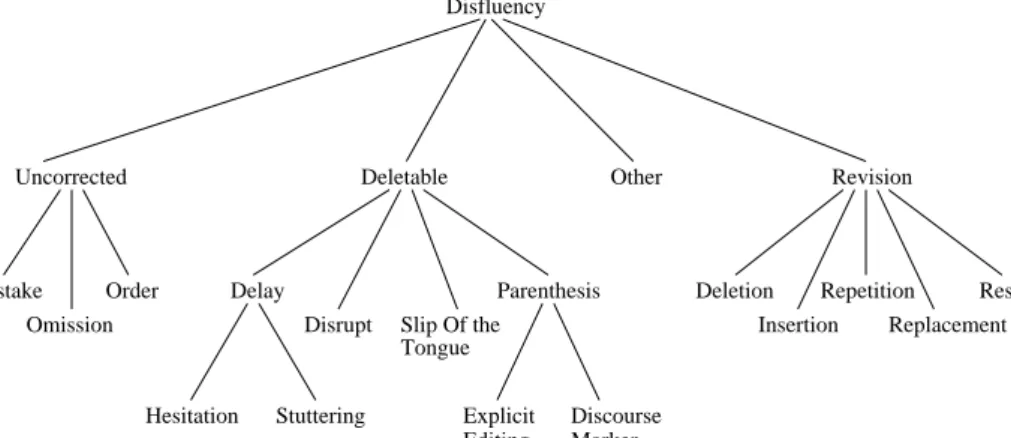
The classification scheme presented here does only specify independent phenomena. Those are entities which objectively can be seen as disrupting the fluency of speech. The classes identified in the current approach are shown in figure 3.1. In the following, detailed descriptions for all classes will be given. The examples given in the descriptions are taken from the corpus.
Slip Of the Tongue Explicit Editing Term Discourse Marker Parenthesis Stuttering Hesitation Delay Mistake Omission Order Uncorrected Disrupt Deletable Other Deletion Insertion Revision Repetition Restart Replacement Disfluency
Figure 3.1: The figure displays the hierarchy of the disfluencies.
Some comments on notation: For clarification purposes thereparandum
is enclosed by <RM> and </RM> and the reparans is enclosed by <RS> and </RS>. This is in the style of the XML-notation, which was used for the an-notations. Furthermore, in most cases DFs are enclosed in tags representing the name of the DF’s class, as they were used in the annotations.
The examples for the uncorrected phenomena are preceded by ’O’ or ’C’. ’O’ stands for “original”, indicating the string of words originally uttered by the speaker. ’C’ stands for “correction”, giving the original string with an appropriate RS added to it. This only applies to the uncorrected DFs, since no RS has to be added in the other cases. There the original utterance contains the repair.
3.2.1 DFs of Type Uncorrected
Two conditions have to be fulfilled by a DF to be classified as uncorrected: 1. The speaker’s original utterance may only contain areparandum(RM). The reparans (RS) must be missing (and thus also the interregnum
(IM)). This means, the speaker herself did not give a correction for the DF. The correction has to be created subsequently (e.g. by an annotator or a correction system).
2. The content of the RM is relevant for the sentence and may not just be left out. Therefore the DF cannot be corrected by only deleting the disfluent material. Instead, the correction must include the insertion of a suitable RS. The RM’s propositional content has to be preserved in this RS.
3.2.1.1 Mistake
A mistake is an uncorrected speech error, which leads to a grammatically incorrect sentence. Examples for this class are agreement errors and other grammatical errors.
Examples for Mistakes:
(5) O: If it <RM>were</RM>flat on the bottom
C: If it<mistake><RM>were</RM> <RS>was</RS></mistake>flat on the bottom
(6) O: You know which way you’re gonna <RM>pointing</RM>it
C: You know which way you’re gonna<mistake><RM>pointing</RM> <RS>point</RS></mistake>it
Distinction from other classes:
Omission: In amistakeall relevant speech material was given by the speaker.
The class is used for the correction of existent speech material by sub-stituting an error with a correct form. In an omission some relevant speech material was not given by the speaker at all (empty RM).
Order: The order class is used for cases, where words occur in the wrong
order. The involved word forms do not necessarily need to be changed in an order DF. A mistake always implies changes of one or several words.
Slip Of the Tongue and Stuttering: Mistakes are meaningful words
that were used in the wrong form by the speaker and have to be corrected. In contrast, SOTs and stutterings are meaningless speech material. In order to gain a meaningful and correct sentence it has to be deleted, not corrected.
3.2. DISFLUENCY CLASS DEFINITIONS 31
3.2.1.2 Omission
The classomission is for cases, in which the speaker omitted a word, which would be necessary for the segment in order to be grammatically correct.
Omissions are quite special cases of (uncorrected) DFs, since they seemingly do not contain a RM. This means, that that part of the DF, which actually makes a phenomenon a DF, seems to be missing. In the presented approach
omissions are treated as containing an empty RM. The RM is existent in the way, that it is the gap, which causes the utterance to be syntactically incorrect.
Typical examples foromissions are left out function words, e.g. articles and prepositions or personal pronouns etc. Omissions do not denote cases, where word stretches have to be added to adjust an utterance’s semantic content or similar purposes. This would include too much interpretation, which should be avoided as far as possible. Of course, even with prepositions and articles it can be hard to decide, which one would be the most appropri-ate or likely addition. For example, in many cases it is almost impossible to judge whether a definite or an indefinite article should be used for example. However, the choice of the article should influence the utterance’s content to an acceptable degree only.
Examples for Omissions:
(7) O: And project manager will design a better meeting
C: And <omiss>the</omiss> project manager will design a better meeting
Distinction from other classes:
Deletion: The difference betweenomission anddeletion is that adeletion
implies a self-correction, where the correcting part (the RS) leaves out some information from the original part (the RM), whereas an omis-sion means that the speaker “forgot” some relevant speech material in the original utterance and did not correct herself. In a deletion both RM and RS are given by the speaker. In an omission the speaker utters neither RM nor RS, which results in an empty RM.
Mistake: Mistakesdo always imply a change of the existing speech material
and their RM may never be empty.
3.2.1.3 Order
Disfluencies of typeorder denote cases, in which a segment’s word order has to be changed in order to make the utterance grammatically correct.
Examples for Order DFs:
(8) O: I don’t know <RM>what’s the idea</RM>for.
C: I don’t know<RM>what’s the idea</RM> <RS>what the idea is</RS> for.
Distinction from other classes:
Mistake: The mistake class implies that changes have to be made to one
or several words of the existent material. This is not the case when a wrong word order was used.
3.2.2 Deletable Phenomena
The following preconditions have to be fulfilled by a DF to be classified as a deletable phenomenon:
1. The DF’s content does not contribute to the meaning of the utterance. It can be discarded without impact on the utterance’s statement. 2. The DF does only contain a RM and no correction, which is quite
nat-urally following from 1, since non-contentional expressions can hardly be corrected.
Since deletable DFs are corrected by deleting them from the utterance, they are the only phenomena, which do not need a RS.
3.2.2.1 Hesitation
Hesitations are rather sounds than words. It can be assumed that they are used by the speaker in order to gain time and thus that they are expressions of the speaker’s cogitation. However, independently from the underlying causes for these sounds, typicalhesitations are: uh, uhm, eh, em, mm etc.
Examples for Hesitations:
(9) <hesit>Um</hesit>one thing I thought of
(10) And then marketing will look and see <hesit>uh</hesit> what people want.
(11) And uh then and then we are going to make <repeat>
<RM>
And<hesit>uh</hesit>then </RM>
<RS> and then</RS> </repeat>
3.2. DISFLUENCY CLASS DEFINITIONS 33
As example (11) shows, hesitations can also occur within the RM or RS of another DF, without influencing that DF’s classification. Note that this only holds for cases in which thehesitation is surrounded by other material of the RM or RS on both sides. Ahesitation may never stand at the begin-ning or end of a RM or RS. Otherwise it is either classified as part of the IM or as a discrete DF.
Distinction from other classes:
Stuttering: Opposed to stutterings, hesitations are not related to the
subsequent word. No phonetic similarity has to be given.
Slip Of the Tongue: SOTs can be seen as an erroneous try by the speaker
to phrase the next word, whereas hesitation sounds rather refer to a phase of cogitation before the speech is continuated. They are not attempts to formulate a real word.
DMs and EETs: The difference betweenDMsandhesitationsis thatDMs
always consist of real words, whereashesitationsare non-lexical speech sounds.
3.2.2.2 Stuttering
Syllables and speech sounds such as single consonants, which are similar to the beginning of the next fully articulated word, are classified asstutterings. The material may not form a whole meaningful word. This means, they are non-lexical word fragments. They may neither be similar to the whole next word. Such cases would be classified asrepetitions.
The deletion of a stuttering may neither make the sentence ungrammat-ical or change its meaning. Thus words, which happen to be phonologungrammat-ically similar to the beginning of the next word are not considered as stutterings.
Examples for Stutterings:
(12) <stutter>D</stutter>do you have
(13) They all work on the same<stutter>prin</stutter>principle. (14) <stutter>N n</stutter>no, I don’t think so.
As (14) shows, sequences of stuttering sounds are seen as one single stutter-ing and are not treated separately.
Distinction from other classes:
Slip Of the Tongue: Stutterings are always related to the subsequent
word and have to be phonetically equal to the beginning of the follow-ing word. These conditions do not count forSOTs.
Hesitation: Neither are hesitations related to the speech material around
them.
Mistake: Mistakes are fully articulated words that have been used by the
speaker in a form that is grammatically incorrect in the current con-text. In contrast, a stuttering is never a complete word. Stutterings
do not contribute to the segment’s content either.
Repetition: Though a sound can be repeated several times in stutterings,
it is not annotated as repetition. Repetitions may only contain whole (meaningful) words.
Discussion of the current definition:
The current annotation manual gives no example for a case, in which a
stuttering stands between the material from RM and RS of another DF. It can be discussed, whether thestuttering should be treated as the end of the RM, as part of the IM or as the beginning of the RS. It could be seen as part of the RM, since it constitutes erroneous material, which is to be deleted. If such astuttering is seen as having an editing function, it could be treated as part of the IM. Last it can also be seen as belonging to the RS, since it is strongly bound to the next fully articulated word and should not be separated from this. For the reason just given, the last interpretation is the preferred one in the current approach, even though it contradicts the idea, that the reparans should only contain correcting material. This is however not given in cases where astuttering occurs in the middle of the RS either. Following is an example for one of the described cases:
(15) remote c rem remote... <replace>
<RM>remote<sot>c</sot></RM>
<RS> <stutter>rem</stutter>remote...</RS> </replace>
...
In the same waystutterings that stand before the onset of an erroneous region would have to be included in the RM:
(16) thi this is this would <replace>
<RM> <stutter>thi</stutter>this is</RM> <RS>this would</RS>
3.2. DISFLUENCY CLASS DEFINITIONS 35
Another case, which the current annotation manual does not account for, is the following: If ahesitationstands between the fragmentary material and the next word, it is still considered as stuttering (see (17)). This does not count for the case that other material, e.g. a slip of the tongue is situated there. This could wrongly be inferred from the declaration that the fragment has to be similar to the onset of the next fully articulated word. (18) 1. is
an example for such a case. Here the “u” is similar to the beginning of the next fully articulated word (“user”) but it is not considered as stuttering
anyway. Thus the definition of stutterings would have to be extended by the addition that no other speech material except forhesitations may stand between thestuttering and the word it belongs to.
(17) the<stutter>u</stutter> <hesit>uh</hesit>user interface (18) the<sot>u</sot> <sot>fin</sot>user interface
3.2.2.3 Disruption
Segments are classified asdisruptions if they do not form a meaningful state-ment and are so fragstate-mentary that no meaning can be established by adding information either. (Such a case would be classified as omission.) Both whole segments and partial segments can be classified as disruptions. The latter applies, when the segment starts with a meaningful clause but its last part does not make sense (see example 20). If the fragmentary material oc-curs at the beginning of a segment, the phenomenon is classified as restart
orreplacement instead. Generally, the removal of material classified as dis-ruption may not cause any loss of relevant information.
Examples for Disruptions:
(19) <disrupt>or like a</disrupt>
(20) Of course we’re not only a electronics company<disrupt>but a </disrupt>
Distinction from other classes:
Omission: Theomission class is only used for cases, where the meaning of
the segment is apparent but some element is missing for the segment to be grammatically correct. With omissions it should also be clear, which word is missing. These things do not hold fordisruptions.
3.2.2.4 Slip Of the Tongue (SOT)
SOTsare single speech sounds, syllable fragments or one or several syllables, which do not form a correct (existing) word and which cannot be classified
1Note that examples (17) and (18) are constructed, not taken from the corpus, since
asstuttering. This means, they may not be similar to the beginning of the next word.
Examples for SOTs:
(21) it may not be<sot>th</sot>as functional
(22) looking at the<sot>tex</sot>technical functions (23) I’ll be<sot>pro</sot>mostly dealing with properties.
Note that cases as example 23 also are classified asSOTs. In some other approaches it would have been treated as aninsertion, since “pro” can be interpreted as the beginning of the later uttered “properties”, which was interrupted for the insertion of additional material before saying “proper-ties”. However, since such considerations are too vague and dependent on interpretation, phenomena of this style are considered asSOTs in this work. Segment (23) is also an example for a case, in which the DF-speech ma-terial could function as an own word. Such cases are classified asSOTs if it is unlikely, that the speaker wanted to use this word at this place. However, a certain vagueness has to be accepted in these cases.
Distinction from other classes:
Stuttering: Stutterings are always related to the subsequent word and
have to be phonetically equal to the beginning of the following word.
SOTs are not related to the following word.
Mistake: Mistakesare meaningful words that were used in the wrong form
by the speaker and which have to be corrected. In contrast,SOTsform meaningless speech material, which is not to be corrected but to be deleted in order to gain a meaningful and correct sentence.
3.2.2.5 Discourse Marker (DM)
All of the following expressions may be classified asdiscourse markers(DMs). DMs do not contribute to the content of an utterance, but have rather a discourse related function. Their usage gives the speaker time to think of what to say next and to hold the turn. The following examples illustrate possible DMs. This list is not exhaustive.
actually okay
anyway see
and yeah so
basically well
I mean yeah
let’s see you know
like you see
3.2. DISFLUENCY CLASS DEFINITIONS 37
It is difficult to decide whether an expression is a DM or not in many cases. This often counts for “kind of” and “sort of”. Those are used not only as DMs but also for weakening the following proposition. If “sort of” and “kind of” modify an adverb, it should be legitimate to classify them as DMs, see (25). However, a phenomenon should only be classified as DM if it is sure that it functions as a DM and does not contribute to the meaning of the utterance. This means, deleting it would not totally change the sentence’s meaning. In case of uncertainty the material should rather be left untouched than classified as a DM.
Examples for DMs:
(24) But,<dm>you know</dm>, they all sort of have the same functions (25) All remotes are<dm>sort of</dm>quite similar
When “yeah” occurs as an own utterance, e.g. as a response to a state-ment made by another person, it is not classified as a DM.
Several consecutive DMs are considered as independent phenomena and classified one by one. As (27) shows, consecutive DMs of the same type are not interpreted asrepetitions.
(26) Just<dm>sort of</dm> <dm>you know</dm>, your buttons (27) I think,<dm>yeah</dm> <dm>yeah</dm>a universal remote
Distinction from other classes:
Explicit Editing Term: The above mentioned expressions are annotated
as EETs only if they stand within a complex disfluency. All other cases are marked as DMs.
Hesitation: DMs consist always of real words, whereashesitationsare
non-lexical speech sounds.
3.2.2.6 Explicit Editing Term (EET)
EETs are filler phrases the speaker uses to mark that she has made an error and is about to correct it. They can also be seen as words that are uttered in order to temporise when the speaker is planning to make a correction. Therefore an EET always stands in the IM of a revision. EETs are roughly the same expressions as DMs but can also consist of other expressions. As stated in (Strassel, 2004), one difference between EET and DM could be that DMs usually should not be terms as “sorry”, “oops” or similar expres-sions.
Examples for EETs:
(28) How would we go about making you know getting rid of our weak points?
How would we go about <restart>
<RM>making</RM> <eet>you know</eet> <RS>getting</RS> </restart>
rid of our weak points?
(29) The design of or the point of putting two sensors on each side <replace>
<RM>The design of</RM> <eet>or</eet>
<RS>the point of</RS> </replace>
putting two sensors on each side
Distinction from other classes:
Discourse Marker: DMs do not occur in IMs of revisions. DM
expres-sions occurring in such a region are always classified as EETs.
Hesitation: EETs always consist of real words (and stand in the IM of
a revision). Hesitations are non-lexical speech sounds and can occur anywhere in an utterance.
3.2.3 DFs of Type Revision
Revisions are phenomena, where both RM and RS are given by the speaker. They could also be named “self-corrections” or “self-repairs”.
Revision phenomena cover the three most general forms of editing: 1. deletion of material
2. insertion of material
3. change of material (which could also be expressed as a combination of deletion and insertion)
The case “change of material” can be divided into two subgroups: partial change of material (replacement in this work) and total change of material (restart in this work).
In all revision classes, except forrestarts, the revised material does not have to consist of a single stretch of words. It may contain several stretches, which are intervened by portions of non-revised, preserved material.
3.2. DISFLUENCY CLASS DEFINITIONS 39
3.2.3.1 Deletion
The RS of a deletion repeats some parts of its RM, while omitting some other material. The deleted material has to be from the central region of the RM. Otherwise the DF is arepetition or areplacement.
Examples for Deletions:
(30) But it’s really not it’s not functional. But
<delete>
<RM>it’s really not</RM> <RS>it’s not</RS> </delete>
functional.
Distinction from other classes:
Omission: A deletion implies a self-correction (RM and RS both uttered
by the speaker). In case of an omission the speaker’s utterance only contains a RM. Here the speaker “forgot” some relevant speech mate-rial.
Replacement: The RS of a deletion simply leaves out information of the
RM, whereas the RS of a replacement replaces some of the original material with new material.
Restart: The RS of arestartconsists of completely new material compared
to the RM. The RS of adeletion does not contain new material at all but leaves out some of the information of the RM.
3.2.3.2 Insertion
The RS of an insertion repeats the RM with supplementary information added at some point. The last element(s) of RM and RS have to be similar. This means, the added information may not be the last material in the RS. Otherwise it would be classified as arepetition.
Examples for Insertions:
(31) What else it what else do we want it to do? <insert>
<RM>What else it</RM>
<RS>what else do we want it<RS> </insert>
A DF is not classified as insertion, if this classification would be based on a word, which seems to occur in both RM and RS but was not fully articulated in the RM. This would require too much interpretation of the speaker’s intention. The following example clarifies the case:
(32) I’ll be pro mostly dealing with properties
a. Correct: I’ll be <sot>pro</sot> mostly dealing with proper-ties.
b. False:
I’ll be
<insert>
<RM>pro</RM>
<RS>mostly dealing with properties</RS> </insert>
Distinction from other classes:
Replacement: The new material in the RS of a replacement is replacing
some of the material of its RM. Thus some information of the RM is missing in areplacement’s RS. The RS of aninsertion preserves all the material of the RM and additionally contains some new information.
Restart: The RS of aninsertionadds information to the utterance without
replacing or deleting any material. The RS of a restart replaces all of the material of the RM with new material.
3.2.3.3 Repetition
Expressions that occur several times consecutively are classified as repe-titions. This denotes both single words and whole phrases, but no word fragments. The class implies that RM and RS contain exactly the same material. Finkler (1997) expresses this in the following way:
“A repetition usually is an unchanged reproduction of a segment of arbitrary length.”
Therefore stretches as “infor information” are not classified as repetitions. Furthermore, nothing except for hesitations and EETs may stand between the repeated material.
Examples for Repetitions:
3.2. DISFLUENCY CLASS DEFINITIONS 41
Maybe we could draw it up <repeat>
<RM>on the</RM> <RS>on the</RS> </repeat>
board.
(34) After a while you have to point it towards the uh towards the equip-ment
After a while you have to point it <repeat> <RM>towards the</RM> <hesit>uh</hesit> <RS>towards the</RS> </repeat> equipment
Cases where an abbreviated form and a fully articulated form of an expression occur after one another are still classified as repetitions:
(35) You’re you are the industrial designer. <repeat>
<RM>You’re<RM> <RS>you are</RS> </repeat>
the industrial designer.
Similar to Finkler (1997), this work does not classify phenomena as rep-etitions, if the repetition is a stylistic device. Consecutive stutterings, DMs, SOTs or EETs are not classified as repetitions either. Repetitions need to consist of proper words.
Discussion of the current definition:
Sometimes the speaker repeats an expression several times. This means, the repetition contains more than two instances of the repeated stretch. (36) is an example for such a case.
(36) We will look at the the the ball later.
In the present approach repetitions have been analysed in the way, that all instances of the repeated expression are included in the RM except for the last one, which is the RS. (37) shows an annotation example for this analysis.
(37) We will look at the the the ball later. We will look at <repeat> <RM>the the</RM> <RS>the</RS> </repeat> ball later.
I decided to change the analysis of such cases in the way that they are analysed as nested two-instance repetitions, see (38). On one hand the for-mer analysis corresponded to the intuitional estimation that the repeated material forms one repetition. On the other hand the new analysis treats such cases as all other complex DFs (see chapter 4.2), which means an im-provement in terms of consistency of the scheme. Furthermore, the proposal that RM and RS have to contain exactly the same material is not fulfilled in the old analysis.
(38) We will look at the the the ball later. We will look at <repeat> <repeat> <RM> <RM>the</RM> <RS>the</RS> </RM> <RS>the</RS> </repeat> </repeat> ball later.
Another thing, which should be reviewed, is the following: The present definition of repetitions says that only hesitations and EETs may stand between the repeated material. This includes also cases, in which the RS is preceded by astuttering. Stutterings appear to be strongly associated with the following word. In this way it would be more natural to classify such cases asrepetitions anyway. (39a) and (39b) are examples for two different possibilities of analysing repetitions in combination withstutterings. (39a) is the preferred analysis for the reason given above: stutterings are strongly associated with the following word. It does not make sense to separate them from the word by treating thestuttering as part of the IM (see also 3.2.2.2), even if this would fit better to the claim that RM and RS of a repetition