arXiv:1811.05517v2 [eess.SP] 10 Jun 2019
Wavelet Based Dictionaries for Dimensionality Reduction of
ECG Signals
Laura Rebollo-Neira
Mathematics Department Aston University
B3 7ET, Birmingham, UK
Dana ˇ
Cern´a
Technical University of Liberec
Liberec, Czech Republic
June 12, 2019
AbstractDimensionality reduction of ECG signals is considered within the framework of sparse rep-resentation. The approach constructs the signal model by selecting elementary components from a redundant dictionary via a greedy strategy. The proposed wavelet dictionaries are built from the multiresolution scheme, but translating the prototypes within a shorter step than that corresponding to the wavelet basis. The reduced representation of the signal is shown to be suitable for compression at low level distortion. In that regard, compression results are superior to previously reported benchmarks on the MIT-BIH Arrhythmia data set.
1
Introduction
Electrocardiography (ECG) is the process of recording the electrical activity of the heart over a period of time. The overall goal of the test is to obtain information about the structure and function of that organ. Dimensionality reduction of ECG signals is relevant to techniques for analysis and classification of this type of data. Such techniques are subject of ongoing research [1–9], which includes methodologies based on the theory of compressive sensing [10–14].
Compressive sensing enhances the concept of sparsity by associating it to a new framework for digitalization [15,16]. Producing sparse representation of ECG signals is the central aim of the present work. This implies to represent an ECG record as superposition of as few elementary components as possible. The same goal was traditionally accomplished by disregarding the least significant terms in the wavelet transform of the signal [17]. However, as shown in this work, much less elementary components are necessary if they are selected from a redundant wavelet dictionary rather than from
a wavelet basis. This allows us to project an ECG record onto a subspace of lower dimensionality, in comparison to the dimension of the signal, and still reconstruct the record at low level distortion.
The main contributions of the paper are listed below:
• A number of wavelets dictionaries, based on existing families of wavelet bases, are developed.
• Each dictionary is shown to render much higher levels of sparsity for representing ECG signals
than the corresponding basis. The tests are performed on the MIT-BIH Arrhythmia data set consisting of 48 records each of which of 30 min length.
• The metric of local sparsity is shown to be relevant to the detection of non-stationary noise or
significant distortion in the patters of an ECG record.
• A strategy for storing the reduced representation of an ECG signal is considered. The resulting
file is shown to render higher compression ratio than previously reported results within the state of the art for the same data set.
• MATLAB software for constructing the dictionaries, as well as for reproducing results, has been
made available on a dedicated website [18].
The paper is organized as follows: Sec. 2 presents all the elements to build the proposed model for piecewise dimensionality reduction of an ECG record. Sec. 3 describes a strategy to encode the reduced representation of the signal. Sec. 4 presents and discusses numerical results. The conclusions are summarized in Sec. 5.
2
Piecewise ECG signal model
Assuming that an ECG record is given as an array f of dimension N, we divide the signal into Q
disjoint segmentsfq ∈RNb, q= 1, . . . , Qand construct an approximationfqkq for each segment as the
kq-term ‘atomic decomposition’
fkq q = kq X n=1 cq(n)dℓqn, (1)
where the elementsdℓq
n, called ‘atoms’, are chosen from a redundant dictionaryD={dn,∈R
Nb,kd
nk=
1}through a greedy pursuit strategy. Here for the selection process we adopt the Optimized
Orthog-onal Matching Pursuit (OOMP) method [19,20] which is stepwise optimal in the sense of minimizing
the residual normkfq−f
kq
q k at each iteration. The algorithm evolves by selecting the atoms one by
2.1
The OOMP Method
Since ECG records are normally superimposed to a smooth background, we initialize the OOMP
algorithm by assuming that the constant atom d1 is always one of the elements in (1). Hence, for
each q we set kq = 0, Γq = ∅, ℓq1 = 1, and w
q
1 = b 1,q
1 = d1. Accordingly fq1 =d1hfq,d1i (where h·,·i
indicates the Euclidean inner product), and r1q =fq−fq1.
From the above initialization the OOMP approach for selecting from D the elements dℓq
n, n =
2, . . . , kqin (1), and calculating the corresponding coefficientscq(n), n = 1, . . . , kq, iterates as follows.
1) Upgrade the set Γq←Γq∪ℓqkq+1, increase kq ←kq+ 1, and select the index of a new atom for
the approximation as ℓqkq+1 = arg max n=1,...,M n /∈Γq |hdn,rkqqi|2 1−Pkq i=1|hdn,w˜qii|2 , (2) with ˜wqi = wqi kwq ik.
2) Orthogonalization step. Compute the corresponding new vector wqkq+1 as
wkq q+1 =dℓ q kq+1 − kq X n=1 wnq kwqnk2 hwq n,dℓqkq+1i (3)
including, for numerical accuracy, the re-orthogonalization step:
wkqq+1 ←wqkq+1− kq X n=1 wq n kwnqk2 hwq n,w q kq+1i. (4)
3) Biorthogonalization step. Forn = 1, . . . , kq upgrade vectors bknq,q as
bkq+1,q n =bknq,q −b kq+1,q kq+1 hdℓ q kq+1,b kq+1,q n i, bkq+1,q kq+1 = wkqq+1 kwqkq+1k2. (5) 4) Calculate rkq+1 q = rkqq− hwqkq+1,fqi wkq q+1 kwqkq+1k2. (6)
5) If for a given ρ the condition krkq+1
q k < ρ has been met compute the coefficients cq(n) =
hbkq+1
n ,fqi, n = 1, . . . , kq+ 1 to write the approximation fqkq of fq as in (1). Otherwise repeat
Once all the segmentsfq have been approximated, the approximation of the whole signal is obtained
by assembling the approximation of the segments as fr = ˆJQq=1fkq
q , where ˆJ is the concatenation
operation.
The complexity of the method, dominated by the selection of atoms, is O(KNbM) with K =
PQ q=1kq.
A suitable model for dimensionality reduction of the signal must involve significantly fewer atoms in their atomic decomposition than the dimension of the signal. The success in achieving such a goal depends on the dictionary being used. Next we discuss wavelet dictionaries which are fit for the purpose.
2.2
Wavelet Based Dictionaries
The proposed wavelet dictionaries are inspired on the construction of dictionaries for Cardinal Spline
Spaces (CSS) as discussed in previous works [21–23]. Let us denote Vj, j ≥0 to the CSS of order m
with simple knots at the equidistant partition of the interval [c, d] having distance 2−j between two
adjacent knots. A basis forVj arises from the restriction of the functions
φj,k(x) := 2j/2φ(2jx−k), k ∈Z (7)
to the interval [c, d], which we expressed as 2j/2φ(2jx−k)|
[c,d]. The function φ(x)≡φ0,0(x) is called
scaling function. For a CSS φ(x) is the cardinal B-spline of order m associated with the uniform
simple knot sequence 0,1, . . . , m [24]
φ(x) = 1 m! m X i=0 (−1)i m i (x−i)m+−1, (8)
where (x−i)m+−1 is equal to (x−i)m−1 if x−i >0 and 0 otherwise.
The complementary wavelet subspace Wj on [c, d] is constructed in order to fulfil
Vj+1 =Vj ⊕Wj, j ∈Z+, (9)
where⊕ indicates the direct sum, i.e. Vj∩Wj ={0}. Hence,
Vj+1 =V0⊕W0⊕W1⊕ · · ·Wj. (10)
For a given value ofj a wavelet basis for Wj arises as
ψj,k(x) = 2j/2ψ(2jx−k)|[c,d], k ∈Z (11)
and the elimination of some redundancy introduced by the cutting process at the borders of the
0 2 4 6 8 −6 −4 −2 0 2 4 0 2 4 6 8 −6 −4 −2 0 2 4
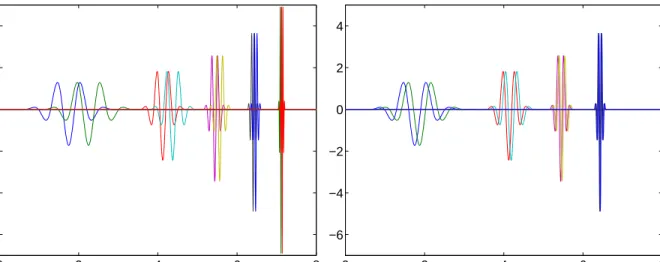
Figure 1: Wavelet functions taken from a basis for a CSS (left graph) and from a dictionary spanning the same CSS (right graph).
Within the multi-resolution framework, dictionaries for a CSS are simply constructed from the
result asserting that if for l∈Z+
Wj,l={2j/2ψ(2jx−
k
2l)|[c,d], k ∈Z}, (12)
then [22]
span{Wj,l}=Vj+l. (13)
This result facilitates a tool for designing dictionaries of wavelets of different support spanning the
same CSS. A multi-resolution-like dictionaryDj,l spanning Vj is constructed as
Dj,ℓ=V0,l∪ W0,l∪ W1,l ∪ · · · ∪ Wj−l,l, (14)
with
V0,l ={φ(x−
k
2l)|[c,d], k∈Z}. (15)
The top graph of Fig. 1 shows consecutive wavelets in a cubic Chui-Wang4 [25] wavelet basis and consecutive wavelets in a dictionary for the same CSS. Notice that the wavelet functions at the finest scale in the dictionary are broader than those at the finest scale in the basis.
For the sake of comparison we have built dictionaries for the following wavelet families.
Semi-orthogonal spline waveletswere mentioned above. Their construction was proposed by C. Chui and J. Wang in [25]. Semi-orthogonal wavelets, also called prewavelets, are not orthogonal if the wavelets are at the same scale level, but orthogonality of wavelets at the different levels is
0 100 200 300 400 500 −0.2 −0.1 0 0.1 0.2 0 100 200 300 400 500 −0.2 −0.1 0 0.1 0.2 0 100 200 300 400 500 −0.2 −0.1 0 0.1 0.2 0 100 200 300 400 500 −0.2 −0.1 0 0.1 0.2 0 100 200 300 400 500 −0.2 −0.1 0 0.1 0.2 0 100 200 300 400 500 −0.2 −0.1 0 0.1 0.2 0 100 200 300 400 500 −0.2 −0.1 0 0.1 0.2 0 100 200 300 400 500 −0.2 −0.1 0 0.1 0.2
Figure 2: Wavelet prototypes. From left top to right bottom the graphs correspond to the families
CW4, CW2, CDF97, CDF53,Db4, Coif, Sym,and Short3.
respectively. The wavelet prototypes corresponding to this family are given the 1st and 2nd graphs in the 1st row Fig. 2.
Cohen-Daubechies-Feauveau biorthogonal wavelets were built in [26]. In this case both primal and dual wavelets have compact support. Wavelets from this family with 9 and 7 taps filters (CDF97) and with 5 and 3 taps filters (CDF53) are used in the JPEG2000 compression standard. The corresponding prototypes are given in the 3rd and 4th graphs in the 1st row of Fig. 2.
Daubechies wavelets were built by I. Daubechies as first orthonormal compactly supported continuous wavelets in [27]. They have the shortest possible support for the given number of vanishing moments and they have extremal phase. Here we consider the four vanishing moments and indicate
it as Db4. This wavelet prototype is displayed in the 1st graph of the 2nd row of Fig. 2.
Coiflets were suggested by R. Coifman as orthonormal wavelet systems with vanishing moments for both scaling functions and wavelets. They were first constructed by I. Daubechies in [28]. We consider two vanishing moments used exact values of scaling and wavelet parameters from [29] and
indicate the family as Coif. The mother wavelet is displayed in the 2nd graph in the 2nd row of
Fig. 2.
Symlets are modified version of Daubechies wavelets. They have also the shortest possible support for the given number of vanishing moments, see [28]. We consider four vanishing moments.
The prototype wavelet for the familySym is given in the 3rd graph in the 2nd row of Fig. 2.
Spline wavelets with short support are obtained if the local support of dual wavelets is not required. They were designed in [30, 31]. Here we consider quadratic splines and indicate them as
Short3. The prototype for this family is plotted in last graph of the 2nd row of Fig. 2.
In the discrete case dictionaries can be constructed in a very simple manner: A redundant
such that N of them are linearly independent and M > N. Inspired by the results for CSS we
construct a dictionary for RN simply by discretization of the functions in the wavelet dictionary.
As already mentioned, ECG signals are commonly superimposed to a smooth background, hence we enrich a wavelet dictionary adding a few low frequency components from a discrete cosine basis.
Thus the whole dictionary we consider is built asD = DC∪ DW, with DW a discrete wavelet basis
(or dictionary) for RNb and
DC = {w c(n) cos π(2i−1)(n−1) 2M , i= 1, . . . , Nb} M n=1,
where each wc(n) is a normalization constant. For the numerical tests we fix M = 10 for DC and
for DW we consider different wavelet dictionaries, all obtained from the aboved mentioned wavelet
bases.
3
Encoding the signal model
For the reduced representation of the signal (1) to be suitable for storage and transmission purposes it is necessary to encode it within a small file in relation to the size of the original record. For
this end, firstly the absolute value coefficients |cq(n)|, n= 1. . . , kq, q = 1, . . . , Q, are converted into
integers as follows:
c∆q(n) =⌊|cq(n)|
∆ +
1
2⌋, (16)
where ⌊x⌋ indicates the largest integer number smaller or equal to x and ∆ is the quantization
parameter. The signs of the coefficients, represented as sq, q = 1, . . . , Q, are encoded separately
using a binary alphabet. For creating the strings of numbers to encode the the signal model we proceed as in [32, 33].
The indices of the atoms in the atomic decompositions of each blockfqare first sorted in ascending
orderℓqi →ℓ˜qi, i= 1, . . . , kq, which guarantees that, for eachqvalue, ˜ℓqi <ℓ˜
q
i+1, i= 1, . . . , kq−1. The
order of the indices induces order in the unsigned coefficients, c∆
q → ˜c∆q and in the corresponding
signs sq → ˜sq. The ordered indices are stored as smaller positive numbers by taking differences
between two consecutive values. By definingδiq= ˜ℓqi −ℓ˜qi−1, i= 2, . . . , kq the follow string stores the
indices for blockq with unique recovery ˜ℓq1, δ2q, . . . , δkqq. The number ‘0’ is then used to separate the
string corresponding to different blocks and entropy code a long string,stind, which is built as
stind = [˜ℓ11, . . . , δ1k1,0,ℓ˜ 2 1, . . . , δk22,0,· · ·,ℓ˜ kQ 1 , . . . , δ Q kQ]. (17)
follows:
stcf = [˜c∆1(1), . . . ,c˜∆1(k1),· · · ,˜c∆kQ(1), . . . ,˜c∆kQ(kQ)]. (18)
Using ‘0’ to store a positive sign and ‘1’ to store negative one, the signs are placed in the string,stsg
as
stsg = [˜s1(1), . . . ,s1˜(k1),· · · ,s˜kQ(1), . . . ,s˜kQ(kQ)]. (19)
4
Results
The numerical tests we present here use the full MIT-BIH Arrhythmia database [35] which contains
48 ECG records. Each of these records is of 30 min length, consisting ofN = 650000 11-bit samples
at a frequency of 360 Hz.
All our results have been obtained in the MATLAB environment using a notebook 2.9GHz dual core i7 3520M CPU and 4GB of memory.
4.1
Assessment Metrics
The quality of the signal approximation is assessed with respect to the PRD calculated as follows,
PRD = kf −f
rk
kfk ×100% (20)
where, f is the original signal and fr is the signal reconstructed from the approximated segments.
Since the PRD strongly depends on the background of the signal, the PRDN as defined below is also a relevant metric.
PRDN = kf −f
rk
kf −fk ×100%, (21)
where, f indicates the mean value of f.
For a fixed value of PRD the sparsity of a representation is assessed by the sparsity ratio (SR)
SR = N
K, (22)
where N is the total length of the signal and K = PQq=1kq, with kq the number of atoms in the
atomic decomposition (1) of each segment of length Nb. For detection of nonstationary noise in
patterns it is useful to define the measure of local sparsity sr(q) as follows:
sr(q) = Nb
kq
, q= 1, . . . Q. (23)
The compression performance depends of the size of the file storing the signal representation and is assessed by the Compression Ratio (CR) as given by
CR = Size of the uncompressed file
In the numerical tests below we use the notation CR to denote the compression ratio obtained when
the string stind, stcf and stsg are stored in hierarchical data format [34], simply using the MATLAB
instructionsave. If a Huffman coding step is included the corresponding compression ratio is denoted
as CRHf
.
The quality score (QS), reflecting the tradeoff between compression performance and reconstruc-tion quality, is the ratio:
QS = CR
PRD. (25)
Since the PRD is a global quantity, in order to detect possible local changes in the visual quality of
the recovered signal, we consider the local PRD as follows. Each signal is partitioned in Qsegments
fq, q = 1. . . , Q of Nb samples. The local PRD with respect to every segment in the partition is
indicate as prd(q), q= 1, . . . Q and calculated as
prd(q) = kfq−f
r
qk
kfqk
×100%, (26)
where fqr is the recovered portion of the signal corresponding to the segment q. In all the numerical
test of the next section the OOMP approximation is stopped through a fixed valueρso as to achieve
the same value of prd for all the segments in the records. Assuming that the target prd before
quantization is prd0 we set ρ= prd0kfqk/100.
4.2
Test I
The purpose of the first numerical tests is to demonstrate the significant gain in dimensionality
reduction (high values of SR) achieved if the component DW of the dictionary D is a wavelet
dic-tionary instead of a wavelet basis. The wavelet basis arises using as translation parameter b = 1
and the wavelet dictionary using a translation parameter b = 1/4. A wavelet basis contains scales
corresponding to the values j = 3, . . . ,8 while the corresponding dictionary contains one less scale
i.e. j = 3, . . . ,7. The exact redundancy of the dictionary depends of the wavelet family but in all
the cases is close to two. The records are approximated by partitioning the signal into Q = 1300
segments ofNb = 500 data points each.
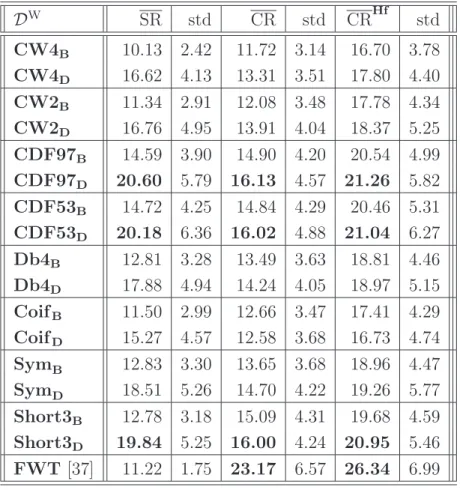
The second column in Table 1 gives the mean value SR, after quantization, with respect to the 48 records in the data set. The standard deviation is given in the 3rd column. The approximation with all the families is accomplished to obtain the same mean value of PRD (PRD = 53). For this test the quantization parameter is fixed. For all the records and all the dictionaries ∆ = 35. The 4th column gives the mean value CR and the fifth column the corresponding standard deviation. For further improvement in CR we have added an entropy coding step to represent the strings described
Table 1: Mean values of SR and CR with respect to the 48 records in the MIT-BIH Arrhythmia database. In all the cases the reconstructed signals produce PRD = 53.
DW SR std CR std CRHf std CW4B 10.13 2.42 11.72 3.14 16.70 3.78 CW4D 16.62 4.13 13.31 3.51 17.80 4.40 CW2B 11.34 2.91 12.08 3.48 17.78 4.34 CW2D 16.76 4.95 13.91 4.04 18.37 5.25 CDF97B 14.59 3.90 14.90 4.20 20.54 4.99 CDF97D 20.60 5.79 16.13 4.57 21.26 5.82 CDF53B 14.72 4.25 14.84 4.29 20.46 5.31 CDF53D 20.18 6.36 16.02 4.88 21.04 6.27 Db4B 12.81 3.28 13.49 3.63 18.81 4.46 Db4D 17.88 4.94 14.24 4.05 18.97 5.15 CoifB 11.50 2.99 12.66 3.47 17.41 4.29 CoifD 15.27 4.57 12.58 3.68 16.73 4.74 SymB 12.83 3.30 13.65 3.68 18.96 4.47 SymD 18.51 5.26 14.70 4.22 19.26 5.77 Short3B 12.78 3.18 15.09 4.31 19.68 4.59 Short3D 19.84 5.25 16.00 4.24 20.95 5.46 FWT[37] 11.22 1.75 23.17 6.57 26.34 6.99
in Sec. 3 at a fixed bit depth using Huffman coding. The implementation of the step is realized using the off-the-shelf MATLAB function Huff06 available on [36]. The corresponding outcomes, indicated
as CRHf, are given in the sixth column of Table 1. The 1st column lists the different wavelet families
which are considered to build the dictionary DW. The subscript B is used to indicate the wavelet
basis and the subscript D to indicate the corresponding dictionary, i.e. CDF97B indicates the 9/7
Cohen-Daubechies-Feauveau biorthogonal wavelet basis and CDF97D the corresponding wavelet
dictionary. For further of comparison the last row of the table gives the results produced when a
Fast Wavelet Transform (FWT) is applied on the whole record, as proposed in [37].
As seen in Table 1 the best results in relation to dimensionality reduction (largest values of SR)
are for CDF97D,CDF53D and Short3D and all the wavelet bases perform poorly in comparison
to the dictionaries. The difference in CR is not so pronounced though. This is because, in spite of the fact that the approximation using a dictionary involves much less elementary components in the signal decomposition, the dispersion of indices corresponding to the atoms in the decomposition is larger if using a dictionary. Notice that, as far as compression is concerned using a FWT to transform
the whole signal is more effective than a piecewise transformation. This is true not only in terms of the achieved CR but also in regard to computational time (the approach advanced in [37] is very fast). Contrarily, as indicated by the values of SR in Table 1 the method in [37] is not as effective for dimensionality reduction as it is for compression. However, dimensionality reduction is relevant in its own right to methodologies for classification and recognition tasks [38, 39].
Table 2: Performance metrics for each of the 48 records in the MIT-BIH Arrhythmia database listed in the first column.
Rec PRD SR CRHf QS PRDN 100 0.51 27.19 28.27 55.75 12.64 101 0.51 25.39 25.89 50.82 9.45 102 0.51 24.43 24.74 48.27 13.13 103 0.52 21.93 22.06 42.73 7.86 104 0.53 19.00 19.52 37.21 10.27 105 0.53 17.37 18.15 34.22 6.43 106 0.53 18.63 18.87 35.97 7.07 107 0.55 12.64 12.66 23.01 3.18 108 0.52 21.13 22.74 43.52 8.51 109 0.52 19.32 19.42 37.05 5.16 111 0.51 23.22 24.32 47.45 9.90 112 0.53 22.72 24.47 46.18 10.20 113 0.52 20.21 19.80 38.18 6.26 114 0.50 32.21 33.13 66.17 14.52 115 0.53 20.18 20.52 38.98 6.73 116 0.58 12.33 12.90 22.10 3.72 117 0.52 27.31 28.82 55.27 9.33 118 0.59 11.06 12.51 21.22 5.90 119 0.56 16.15 16.50 29.78 4.44 121 0.51 33.27 33.61 66.10 7.29 122 0.56 16.42 17.62 31.80 6.50 123 0.53 21.94 22.93 43.11 7.94 124 0.53 23.28 23.09 43.92 4.94 200 0.53 15.56 16.69 31.33 7.05 201 0.49 34.72 35.05 71.66 12.52 Rec PRD SR CRHf QS PRDN 202 0.51 26.24 26.28 51.87 8.44 203 0.55 12.75 13.86 25.14 5.54 205 0.51 25.25 26.83 52.54 12.50 207 0.51 25.93 25.66 50.80 7.08 208 0.54 15.09 15.69 29.16 5.55 209 0.54 15.65 16.83 31.40 9.92 210 0.51 23.84 24.62 48.18 9.72 212 0.56 12.12 13.56 24.40 8.35 213 0.56 11.71 12.06 21.71 4.09 214 0.52 19.22 19.15 36.59 5.54 215 0.55 14.07 15.34 28.20 9.60 217 0.53 16.86 16.47 31.06 4.30 219 0.54 18.06 18.00 33.69 4.43 220 0.53 19.18 19.65 37.07 7.65 221 0.52 22.73 23.00 44.69 8.50 222 0.51 26.52 27.53 54.42 13.53 223 0.53 18.56 18.70 35.09 6.06 228 0.52 18.97 20.31 38.91 7.53 230 0.52 19.12 19.47 37.29 7.30 231 0.51 25.67 26.20 51.84 9.23 232 0.50 29.72 31.59 63.83 14.91 233 0.54 14.26 14.81 27.43 4.96 234 0.52 19.81 20.50 39.28 7.68 mean 0.53 20.60 21.26 40.76 7.99 std 0.02 5.79 5.82 12.47 2.92
For further information in Table 2 we provide the figures of the evaluation metrics for each of the 48 records in the dataset. The 2nd column of Table 2 shows the values of PRD for the records listed
in the 1st column. The 3rd column shows the values of SR after quantization. The CRHf
is given in the 4th column and the corresponding QS in the 5th column. The last column corresponds to the
values of PRDN. All the results are obtained using the dictionary CDF97D. The average time for
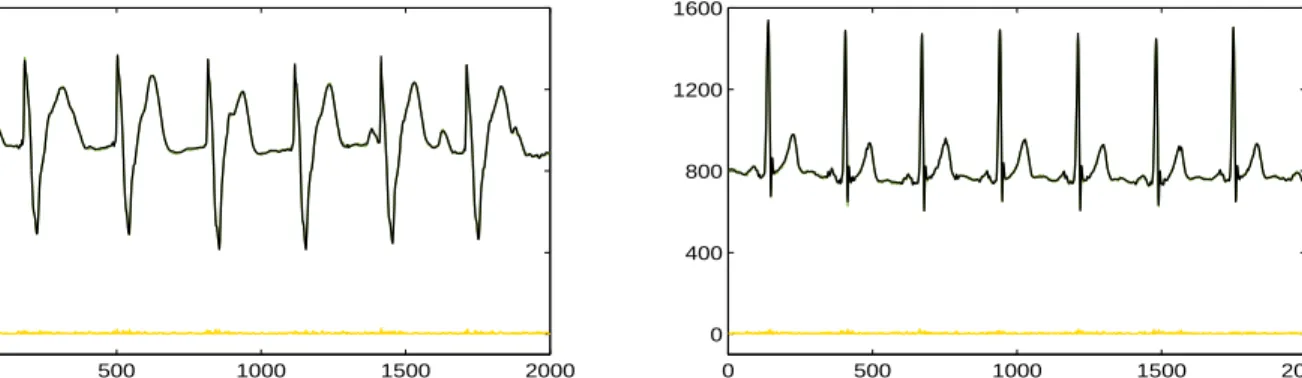
Fig. 3 depicts the approximation and raw data (indistinguishable in the scale of the graphs) of 2000 points in the records 107 and 116.
0 500 1000 1500 2000 0 400 800 1200 1600 0 500 1000 1500 2000 0 400 800 1200 1600
Figure 3: The waveforms in the graphs are the raw data and the approximations corresponding to 2000 points in the records 107 (left) and 116 (right). The bottom lines represent the absolute value of the difference between the data and the approximation.
4.3
Test II
In this test we compare compression results with previously reported benchmarks on the MIT-BIH Arrhythmia database. Since the PRD strongly depends on the baseline in the ECG record, when using the relation CR vs PRD for comparison one needs to be able to confirm that the values of PRD reported in previous work either, do not include any subtraction of baseline, or the subtracted value is also reported. From the information given in the papers we are comparing with (the relation between the values of PRD and PRDN) we can guarantee that the results correspond to the same
database [35] and without any subtraction of baseline. In the range [0.31 0.67] the comparison is
realized with the classical benchmark [40]. This method is based on peak detection to perform the Discrete Cosine Transform (DCT) between consecutive peaks and Huffman encoding for lossless
compression. In the range [0.80 1.71] the comparison is with the methods in [41] and [42]. Both
these methods are based on Adaptive Fourier Decomposition (AFD) and overperform those in [40] and [43] for values of PRD in the range being considered. In [42] the lossless compression is realized using Huffman coding while [41] applies symbol substitution. Comparisons are also produced with the results arising when a FWT is applied on the full record [37].
Table 3 compares CRs obtain with CDF97D and CDF53D for values of PRD in the range
[0.31 0.81], Table 4 for values in the range [0.91 1.06], and Table 5 in the range [0.14 1.71]. The last
two rows in all the tables give the values of the quantization parameter, ∆, and the approximation
publications we are comparing with.
Table 3: Comparison between the average compression performance of the proposed method and the methods in [40], [41], [42] and [37], for values of PRD in the range [0.31 0,81].
PRD 0.81 0.80 0.67 0.48 0.31 CR [40] 11.30 9.28 6.22 CR [41] 18.00 CR [42] 16.85 CR [37] 33.32 33.05 27.79 19.84 10.59 CRHf [37] 36.54 36.26 31.01 23.09 15.00 CR CDF97D 24.03 23.81 20.52 14.79 9.37 CRHfCDF97D 31.64 31.07 26.71 19.59 12.50 CR CDF53D 24.76 24.50 20.67 14.67 8.89 CRHfCDF53D 32.59 31.93 26.01 19.25 11.93 prd0 0.750 0.740 0.645 0.435 0.275 ∆ 60 60 40 30 16
Table 4: Comparison between the average compression performance of the proposed method and the
methods in [41], [42], [43] and [37], for values of PRD in the range [0.91 1.06].
PRD 1.06 1.05 1.03 0.94 0.91 CR [41] 25.667 22.27 CR [42] 22.80 20.38 CR [43] 18.59 CR [37] 41.31 41.24 41.00 38.52 37.68 CRHf [37] 44.42 44.23 44.04 41.93 41.08 CR CDF97D 30.36 30.12 29.44 27.29 26.27 CRHfCDF97D 40.25 39.96 39.11 35.94 34.42 CR CDF53D 31.93 31.66 30.84 28.46 27.28 CRHfCDF53D 42.73 42.39 41.40 37.81 35.70 ∆ 100 100 100 80 80 prd0 0.940 0.930 0.900 0.850 0.805
Table 5: Comparison between the average compression performance of the proposed method and the
methods in [41], [42], and [37] for values of PRD in the range [1.14 1.71].
PRD 1.71 1.47 1.29 1.18 1.14 CR [41] 38.46 33.85 28.21 CR [42] 42.27 3.53 30.21 25.99 CR [37] 62.48 56.78 49.60 47.04 45.75 CRHf [37] 63.92 58.59 52.19 49.59 48.47 CR CDF97D 52.01 43.83 37.63 33.88 32.69 CRHfCDF97D 66.99 56.44 48.77 44.45 42.98 CR CDF53D 57.19 47.43 40.66 36.27 34.62 CRHfCDF53D 73.27 61.00 52.56 47.19 45.51 ∆ 150 120 110 110 110 prd0 1.660 1.430 1.220 1.070 1.020
4.4
Discussion
From the results shown in Tables 4 - 5 we can assert that the dictionary-based approach presented in this paper, which is powerful for dimensionality reduction at low level distortion, is also relevant to compression. In that sense the adopted strategy produces results which significantly improve upon the state of the art for the full MIT-BIH Arrhythmia data set [40–43]. In regard to CR the results are close to those recently reported in [37]. In that publication the compression results are obtained with an equivalent strategy as that described in Sec. 3, but applying a FWT on the full signal instead of using a piecewise model as proposed here. With respect to processing time the approach in [37] is far more efficient though. Indeed, with the same equipment the construction of Table 2 in this paper takes 30 s per record. The equivalent table with the approach of [37] takes 0.14 s per record. However, the central aim of the present work is to accomplish dimensionality reduction. In that sense the dictionary approach is much more effective. As shown in the second column of Table 1, to
achieve PRD = 53 theCDF97D method uses 84% less components than theFWT one. Moreover,
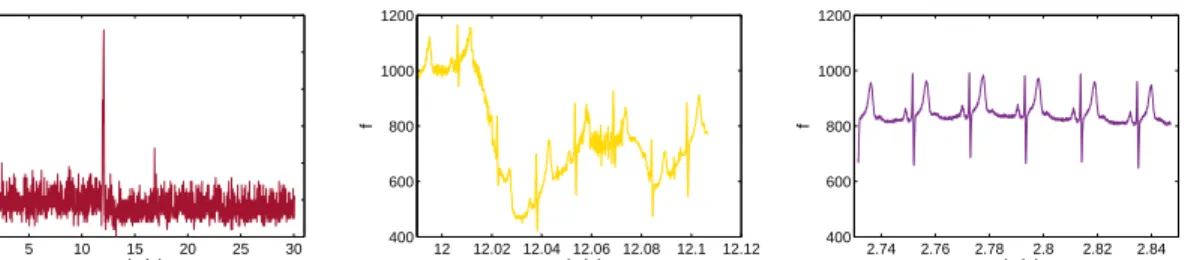
the dictionary approach yields a piecewise model which can be useful for analysis. It is interesting to note, for instance, that abrupt variations of the local sparsity ratio (c.f. (23)) gives information about the presence of nonstationary noise or significant distortions in patters. The left graph in
Fig. 4 plots the values 1/sr(q), q= 1, . . . ,1300 for record 117. The middle top graph shows the piece
0 5 10 15 20 25 30 0.02 0.04 0.06 0.08 0.1 0.12 0.14 t (min) 1/sr 12 12.02 12.04 12.06 12.08 12.1 12.12 400 600 800 1000 1200 t (min) f 2.74 2.76 2.78 2.8 2.82 2.84 400 600 800 1000 1200 t (min) f
Figure 4: The left graph shows the inverse local sparsity values for each segment in the signal partition
of record 117. The middle graph is the piece of signal where the peak of 1/sr takes place. The right
graph is a piece of signal of the same length but at different time interval.
length, outside that time interval.
5
Conclusions
A method for dimensionality reduction of ECG signals has been proposed. The approach was de-signed within the framework of sparse representation. A number of wavelet based dictionaries have been introduced to undertake the signal model via the OOMP greedy strategy. The resulting repre-sentation was shown to require significantly less elementary component than those needed when using a wavelet basis. The method was proven to be useful for ECG compression at low level distortion. The compression results largely surpass benchmarks within the state of the art for the MIT-BIH Arrhythmia database.
The MATLAB software for constructing the dictionaries and reproducing the results in the paper has been made available on a dedicated website. Although the numerical construction of the signal model is computationally intensive it can be effectively realized, even in the MATLAB environment, where it typically takes 30 s to compress a 30 min record and 1 s to recover the signal from the compressed file. Moreover, since the approximation is carried out independently in every segment of the signal partition, there is room for straightforward parallelization using multiprocessors. The sensitivity of local sparsity to nonstationary noise or significant distortion of patterns leads to con-clude that the model might be useful to support the development of techniques for analysis of ECG records.
Acknowledgments
We are indebted to Karl Skretting for making available the MATLAB functions Huff06 which has
References
[1] S. Banerjee, M. Mitra, “Application of Cross Wavelet Transform for ECG pattern analysis and
classification”, IEEE Transactions on Instrumentation and Measurement, 63 326–333 (2014).
[2] R.G. Afkhami, G. Azarnia, M.A. Tinati, “Cardiac arrhythmia classification using statistical and
mixture modeling features of ECG signals, Pattern Recognition Letters, 70, 45– 51 (2016).
[3] S. Shadmand, B. Mashoufi, “A new personalized ECG signal classification algorithm using
block-based neural network and particle swarm optimization, Biomedical Signal Processing and
Control, 25, 12–23 (2016).
[4] E.J.D. Luz, W.R. Schwartz, G. Camara-Chavez, D. Menotti, ECG-based heartbeat classification
for arrhythmia detection: a survey, Computer Methods and Programs in Biomedicine,127 144–
164 (2016).
[5] D. P. Tob´on V., T. H. Falk, M. Maier, “MS-QI: A Modulation Spectrum-Based ECG Quality
Index for Telehealth Applications”, IEEE Transactions on Biomedical Engineering, 63, 1613–
1622 (2016).
[6] S. Gutta, Q. Cheng, “Joint feature extraction and classifier design for ECG-based biometric
recognition”, Journal of Biomedical and Health Informatics,20, 460–468 (2016).
[7] H. Li, D. Yuan, Y. Wang, D. Cui, and L. Cao, “Arrhythmia Classification Based
on Multi-Domain Feature Extraction for an ECG Recognition System”, Sensors, 16,
doi:10.3390/s16101744 (2015).
[8] M. Abdelazez, P. X. Quesnel, A. D. C. Chan, H. Yang, “Signal Quality Analysis of
Ambula-tory Electrocardiograms to Gate False Myocardial Ischemia Alarms”, IEEE Transactions on
Biomedical Engineering, 64, 1318 – 1325 (2018).
[9] S. K. Berkaya, A. K. Uysal, E. S. Gunal, S. Ergin., S. Gunal, M. B. Gulmezoglu, “A survey on
ECG analysis”, Biomedical Signal Processing and Control, 43, 216 – 235 (2018).
[10] H. Mamaghanian, N. Khaled, D. Atienza and P. Vandergheynst, “Compressed Sensing for
Real-Time Energy-Efficient ECG Compression on Wireless Body Sensor Nodes”, IEEE Transactions
[11] Z. Zhang, T-P Jung, S. Makeig and B. D. Rao, “Compressed Sensing for Energy-Efficient
Wire-less Telemonitoring of Noninvasive Fetal ECG via Block Sparse Bayesian Learning”, IEEE
Transactions on Biomedical Engineering, 60, 300–309 (2013).
[12] L. F. Polan´ıa, R. E. Carrillo, Manuel Blanco-Velasco and K. E. Barner, “Exploiting Prior
Knowl-edge in Compressed Sensing Wireless ECG Systems”, IEEE Journal of Biomedical and Health
Informatics, 19,508–519 (2015).
[13] G. Da Poian, R. Bernardini, R. Rinaldo, ‘RSeparation and Analysis of Fetal-ECG Signals From
Compressed Sensed Abdominal ECG Recordings”, IEEE Transactions on Biomedical
Engi-neering,63, 1269 – 1279 (2016).
[14] L. F. Polan´ıa and R. I. Plaza, “Compressed Sensing ECG using Restricted Boltzmann Machines”,
Biomedical Signal Processing and Control, 45, 237–45 (2018).
[15] R. Baraniuk, “Compressive sensing”,IEEE Signal Processing Magazine, 24, 118–121, (2007).
[16] E. Cand`es and M. Wakin, “An introduction to compressive sampling”,IEEE Signal Processing
Magazine, 25, 21 – 30 (2008).
[17] M. S Manikandan and S. Dandapat, “Wavelet-based electrocardiogram signal compression
meth-ods and their performances: A prospective review”, Biomedical Signal Processing and Control,
14,73–107 (2014).
[18] http://www.nonlinear-approx.info/examples/node011.html (Last access May 2018).
[19] L. Rebollo-Neira and D. Lowe, “Optimized orthogonal matching pursuit approach”,IEEE Signal
Process. Letters, 9, 137–140 (2002).
[20] L. Rebollo-Neira, “Cooperative greedy pursuit strategies for sparse signal representation by
partitioning”, Signal Processing,125, 365–375 (2016).
[21] M. Andrle and L. Rebollo-Neira, “Cardinal B-spline dictionaries on a compact interval”, Appl.
Comput. Harmon. Anal. , 18, 336-346 (2005).
[22] M. Andrle and L. Rebollo-Neira, “From cardinal spline wavelet bases to highly coherent
dictio-naries”, Journal of Physics A 41 (2008) 172001.
[23] L. Rebollo-Neira and Z. Xu, “Adaptive non-uniform B-spline dictionaries on a compact interval”,
[24] L. L. Schumaker, Spline Functions: Basic Theory, Wiley, New-York, 1981.
[25] C. Chui and J. Wang, “On compactly supported spline wavelets and a duality principle”,Trans.
Amer. Math. Soc., 330, 903–915 (1992).
[26] A. Cohen, I. Daubechies, and J.C. Feauveau, “Biorthogonal bases of compactly supported
wavelets”, Comm. Pure and Appl. Math., 45, 485–560 (1992).
[27] I. Daubechies, “Orthonormal bases of compactly supported wavelets”, Commun. Pure Appl.
Math.,41, 909–996 (1988).
[28] I. Daubechies, “Orthonormal bases of compactly supported wavelets II, variations on a theme”,
SIAM J. Math. Anal.,24, 499–519 (1993).
[29] D. ˇCern´a, V. Finˇek, and K. Najzar, “On the exact values of coefficients of coiflets”, Cent.
European J. Math.6, 159–169 (2008).
[30] D. Chen, “Spline wavelets of small support”,SIAM J. Math. Anal., 26, 500–517 (1995).
[31] B. Han and Z. Shen, “Wavelets with short support”,SIAM J. Math. Anal.,38, 530–556 (2006).
[32] L. Rebollo-Neira and I. Sanches, , “Simple scheme for compressing sparse representation of
melodic music”, Electronics Letters (2017) DOI:10.1049/el.2017.3908
[33] L. Rebollo-Neira, “A competitive scheme for storing sparse representation of X-Ray medical
images” (2018) PLOS ONE. https://doi.org/10.1371/journal.pone.0201455.
[34] L. A. Wasser, “Hierarchical Data Formats - What is HDF5?”,
https://www.neonscience.org/about-hdf5 (2015)
[35] https://physionet.org/physiobank/database/mitdb/ (Last access May 2018).
[36] K. Skretting,http://www.ux.uis.no/∼karlsk/proj99 (Last access May 2018).
[37] L. Rebollo-Neira, “Effective high compression of ECG signals at low level distortion”, Scientific
Reports 9, Article number: 4564 (2019).
[38] J. Wang, M. She, S. Nahavandi, A. Kouzani, “Human Identification From ECG Signals Via
[39] S. Raj, K. C. Ray, “Sparse representation of ECG signals for automated recognition of cardiac
arrhythmias”, Expert Systems with Applications, 105, 49–64 (2018).
[40] S.J. Lee, J. Kim and M. Lee,“A Real-Time ECG Data Compression and Transmission Algorithm
for an e-Health Device”,IEEE Transactions on Biomedical Engineering,58, 2448–2455 (2011).
[41] J.L. Ma, T.T. Zhang and M. C. Dong, “A Novel ECG Data Compression Method Using Adaptive
Fourier Decomposition With Security Guarantee in e-Health Applications”, IEEE Journal of
Biomedical and Health Informatics,19, 986–994 (2015).
[42] C. Tan, L. Zhang and H. Wu,“A Novel Blaschke Unwinding Adaptive Fourier
Decomposi-tion based Signal Compression Algorithm with ApplicaDecomposi-tion on ECG Signals”, IEEE Journal
of Biomedical and Health Informatics 10.1109/JBHI.2018.2817192, 22 March 2018.
[43] A. Pandey, B. Singh, S Sain, and N. Sood, “A joint application of optimal threshold based discrete cosine transform and ASCII encoding for ECG data compression with its inherent


![Table 4: Comparison between the average compression performance of the proposed method and the methods in [41], [42], [43] and [37], for values of PRD in the range [0.91 1.06].](https://thumb-us.123doks.com/thumbv2/123dok_us/9227883.2807311/13.918.237.684.685.1044/table-comparison-average-compression-performance-proposed-method-methods.webp)
![Table 5: Comparison between the average compression performance of the proposed method and the methods in [41], [42], and [37] for values of PRD in the range [1.14 1.71].](https://thumb-us.123doks.com/thumbv2/123dok_us/9227883.2807311/14.918.236.680.153.484/table-comparison-average-compression-performance-proposed-method-methods.webp)