http://eprints.whiterose.ac.uk/114352/ Version: Accepted Version
Article:
Pattnayak, KC orcid.org/0000-0001-9589-8789, Kar, SC, Dalal, M et al. (1 more author) (2017) Projections of annual rainfall and surface temperature from CMIP5 models over the BIMSTEC countries. Global and Planetary Change, 152. pp. 152-166. ISSN 0921-8181 https://doi.org/10.1016/j.gloplacha.2017.03.005
© 2017 Elsevier B.V. This manuscript version is made available under the CC-BY-NC-ND 4.0 license http://creativecommons.org/licenses/by-nc-nd/4.0/
Reuse
Unless indicated otherwise, fulltext items are protected by copyright with all rights reserved. The copyright exception in section 29 of the Copyright, Designs and Patents Act 1988 allows the making of a single copy solely for the purpose of non-commercial research or private study within the limits of fair dealing. The publisher or other rights-holder may allow further reproduction and re-use of this version - refer to the White Rose Research Online record for this item. Where records identify the publisher as the copyright holder, users can verify any specific terms of use on the publisher’s website.
Takedown
If you consider content in White Rose Research Online to be in breach of UK law, please notify us by
Projections of annual rainfall and surface temperature from CMIP5 models over the BIMSTEC countries
K.C. Pattnayak, S.C. Kar, Mamta Dalal, R.K. Pattnayak
PII: S0921-8181(16)30488-X
DOI: doi:10.1016/j.gloplacha.2017.03.005 Reference: GLOBAL 2570
To appear in: Global and Planetary Change Received date: 7 November 2016
Revised date: 23 March 2017 Accepted date: 24 March 2017
Please cite this article as: K.C. Pattnayak, S.C. Kar, Mamta Dalal, R.K. Pattnayak , Projections of annual rainfall and surface temperature from CMIP5 models over the BIMSTEC countries. The address for the corresponding author was captured as affiliation for all authors. Please check if appropriate. Global(2016), doi: 10.1016/ j.gloplacha.2017.03.005
This is a PDF file of an unedited manuscript that has been accepted for publication. As a service to our customers we are providing this early version of the manuscript. The manuscript will undergo copyediting, typesetting, and review of the resulting proof before it is published in its final form. Please note that during the production process errors may be discovered which could affect the content, and all legal disclaimers that apply to the journal pertain.
ACCEPTED MANUSCRIPT
Projections of Annual Rainfall and Surface Temperature from CMIP5 Models over the BIMSTEC Countries
1,2*
K. C. Pattnayak, 1S. C. Kar, 3Mamta Dalal and 4R. K. Pattnayak
1
National Centre for Medium Range Weather Forecasting, Noida, India
2
School of Geography, University of Leeds, Leeds, UK
3
CAS, IIT Delhi, Hauz Khas, New Delhi, India
4
Dhansuli SS School, Dhansuli, Nabarangpur, Orissa, India
*
ACCEPTED MANUSCRIPT
AbstractBay of Bengal Initiative for Multi-Sectoral Technical and Economic Cooperation (BIMSTEC) comprising Bangladesh, Bhutan, India, Myanmar, Nepal, Sri Lanka and Thailand brings together 21% of the world population. Thus the impact of climate change in this region is a major concern for all. To study the climate change, fifth phase of Climate Model Inter-comparison Project models have been used to project the climate for the 21st century under the Representative Concentration Pathways (RCPs) 4.5 and 8.5 over the BIMSTEC countries for the period 1901 to 2100 (initial 105 years are historical period and the later 95 years are projected period). Climate change in the projected period has been examined with respect to the historical period. In order to validate the models, the mean annual rainfall has been compared with observations from multiple sources and temperature has been compared with the data from Climatic Research Unit (CRU) during the historical period. Comparison reveals that ensemble mean of the models is able to represent the observed spatial distribution of rainfall and temperature over the BIMSTEC countries. Therefore, data from these models may be used to study the future changes in the 21st century. Four out of six models show that the rainfall over India, Thailand and Myanmar has decreasing trend and Bangladesh, Bhutan, Nepal and Sri Lanka show an increasing trend in both the RCP scenarios. In case of temperature, all the models show an increasing trend over all the BIMSTEC countries in both the scenarios, however, the rate of increase is relatively less over Sri Lanka than the other countries. The rate of increase/decrease in rainfall and temperature are relatively more in RCP8.5 than RCP4.5 over all these countries. Inter-model comparison show that there are uncertainties within the CMIP5 model projections. More similar studies are required to be done for better understanding the model uncertainties in climate projections over this region.
Key Words: BIMSTEC, CMIP5, Climate Change, Representative Concentration Pathways,
ACCEPTED MANUSCRIPT
1. IntroductionSouth and South East Asia is one of the most climate vulnerable parts of the world. In recent years, climate change studies over the countries within this region have been getting more attention by the researchers and policy makers at the national and international levels. Bay of Bengal Initiative for Multi-Sectoral Technical and Economic Cooperation (BIMSTEC) is a regional organization comprising of seven Member States adjacent to the Bay of Bengal (BIMSTEC report). Out of the seven Member States, five are from South Asia (Bangladesh, Bhutan, India, Nepal, Sri Lanka) and two are from South East Asia (Myanmar and Thailand). The member countries are shown in Figure 1a. The regional group constitutes a bridge between South and South East Asia and represents a reinforcement of relations among these countries. BIMSTEC brings together 1.5 billion people – 21% of the world population, and a combined gross domestic product (GDP) of over US$ 2.5 trillion (http://www.bimstec.org/). The GDP of the BIMSTEC countries is 3.2 % of the total world economy. The major source of anthropogenic emission from all the BISMTEC countries is the energy production sector. Trends in global CO2 emissions for various regions have been examined by Olivier et al (2016). For the study area, time series of greenhouse gas emissions (kton(Gg) CO2eq/yr) for the period 1970-2012 has been plotted (Fig 1b). It is seen that there
is a steady increase of greenhouse gas emissions over India in last 40 years. Over Bhutan and Sri Lanka, the emission amount is too less. While other countries, rate of increase is not much, Myanmar has reduced its emission amount after 1998. The impulses of climate and weather in this region are a major concern for all. Therefore, the scientific findings and understanding reported in this paper is expected to contribute further advancement in the planning process over this region.
ACCEPTED MANUSCRIPT
Rainfall and temperature are the most important climatic variables in the context of climate change and these two variables have been studied both globally and regionally with various different aspects. Such studies have been made in Intergovernmental Panel on
Climate Change (IPCC) Fifth Assessment Report (AR5) using the coupled models of the 5th
version of coupled model intercomparison project (CMIP5, IPCC report 2013). An analysis of CMIP3 and CMIP5 models is thus studied to understand the capability of climate models in simulating the present-day climate. As compared with CMIP3, CMIP5 models showed some significant improvements in the simulation of surface temperatures, but there was a lack of apparent improvement for simulation of rainfall. Bangladesh is particularly vulnerable because of ongoing climate change as shown by Nowreen et al. 2014 who simulated the regional climate of Bangladesh by a high-resolution regional climate model (Providing Regional Climate for Impact Studies, PRECIS). According to Climate Change Cell (CCC, 2006) of Bangladesh, projected temperature rise in Bangladesh is 1.3°C by 2030 (over mid-20th century levels) and 2.6°C by 2070. In case of projected rainfall, it may increase by 3.8% during 2030 and 9.7 % during 2100. Using CMIP3 and CMIP5 multi-model data Hasan et al. (2013) provided the projections of surface temperature and rainfall over the Bangladesh for the period 1971 to 2100. They found that the spread of CMIP5 precipitation projections are smaller than CMIP3 climate projections. Thus the CMIP5 projections are more helpful for decision makers as they have comparatively better representation of earth’s physical processes. Based on studies carried out by Hasan et al. (2015) using CMIP5 projections, the annual precipitation over Bangladesh may rise by 4.4%, 4.9%, and 11.9% for RCP2.6, RCP4.5 and RCP8.5 respectively, by 2100 compared to the 1971 to 2000 baseline in
European Centre (EC) Earth system model. The annual mean temperature increases by 1.4 –
4.1°C by 2050s under different RCP scenarios and by about 2.3 – 6.4 °C by 2080s, relative to the base period. For Nepal, various available studies (Shrestha et al. 1999; Rangwala et al.
ACCEPTED MANUSCRIPT
2009; Ohmura 2012; Rangwala and Miller 2012) show that the mean annual temperatures have increased during the recent years. Results from the CMIP5 models suggest that temperatures will increase between 1.3 – 2.4 °C over the period 1961–1990 to 2021–2050 (Lutz et al. 2013). Not much work have been done over Bhutan due to lack of data and information to tell about historical changes in temperature and rainfall pattern and also future changes. According to Alam and Tshering (Capacity Strengthening in the Least Developed Countries for Adaptation Climate Change (CLACC) working report, 2004), temperature may increase by 2°C and as a consequence the glaciers or snow cover may be retreated by 49cm, with the rainfall may increase of about 4.1% by the end of 21st century over Bhutan. Supharatid (2015) has studied the precipitation change projection, in the rainy season in Bangkok through multi-model mean and multi-model median of 9 GCMs. The uncertainty in precipitation projections as a result of the range in the climate change projections have been quantified and show how this uncertainty differs between the CMIP3 and CMIP5 ensembles. In India, several studies have been carried out considering temperature and precipitation projections (Chaturvedi et al. 2012, Dash et al. 2014, Pattnayak et al. 2013 and 2016). The CMIP5-based model ensemble mean (Chaturvedi et al. 2012) indicate that temperatures will increase from of 2°C (RCP2.6) to 4.8°C (RCP8.5) over India (from 1880s to 2080s). All India precipitation is projected to increase by 6%, 10%, 9% and 14% under the scenarios
RCP2.6, RCP4.5, RCP6.0 and RCP8.5 respectively, by 2080s relative to the 1961–1990 base,
while much larger variability is seen in the spatial distribution of precipitation. Dash et al. (2014) projected the Indian summer monsoon using regional climate model driven with GFDL-ESM2M for RCP 4.5 and 8.5. They have shown that the rainfall may decrease over the central India and the signal strengthens with time. Although Sri Lanka does not contribute to global warming (Yamane, 2009), still the mean air temperature of the country has
ACCEPTED MANUSCRIPT
projected mean temperature may increase by approximately 0.9 – 4 ˚C by the year 2100 (De Zoysa and Inoue 2014; Basnayake et al., 2007). The annual average rainfall in Sri Lanka has decreased by 144 mm from 1961 to 1990; this is a decrease of approximately 7% compared with the period of 1931 to 1960 (Baba, 2010).
A handful amount of climate change studies over this region have used climate models to estimate future projections and uncertainties. In this study, an attempt has been made to project the spatial and temporal variations of precipitation and temperature over BIMSTEC countries using CMIP5 simulations under a high emissions scenario (RCP8.5, Moss et al. 2010) and a medium mitigation scenario (RCP4.5) for the twenty first century. RCP 8.5 is a high emissions scenario with maximum emissions in 2100 of nearly 30 PgC yr-1 and
atmospheric CO2 levels nearly 1000 ppm in 2100. The RCP2.5 scenario is very modest and
detailed analysis of climate simulations in RCP4.5 and RCP8.5 scenarios capture all the aspects of RCP2.5 scenarios. As the foregoing literature survey indicates, present climate trend and future projections are different over each of the BIMSTEC member countries. The climate projections from various CMIP5 models also show a range of solutions. Previous studies also bundle all the model results in a single study in order to rank the models or to highlight the future projections and therefore, individual strength and weakness of these models over a particular country/region do not get enough attention. We address here the following questions using observations and some of the CMIP5 model simulations: (i) how the climate conditions in the historical records over the BIMSTEC countries have been simulated by the models? (ii) since Bhutan, Nepal and Sri Lanka don’t contribute towards global warming, still whether these countries are affected by global warming? (iii) how the rainfall in these countries is going to behave in the high emissions scenario (RCP8.5) and medium mitigation scenario (RCP4.5) and (iv) do the selected CMIP5 models behave in a similar manner or there are uncertainties. A brief discussion of the data and methodology
ACCEPTED MANUSCRIPT
used for this study are described in Section 2. Section 3 discusses the verification of CMIP5 simulations for the historical period. Section 4 provides the rainfall and surface temperature projections in RCP 4.5 and 8.5 scenarios. The last Section 5 summarizes the conclusions.
2. Data and methodology
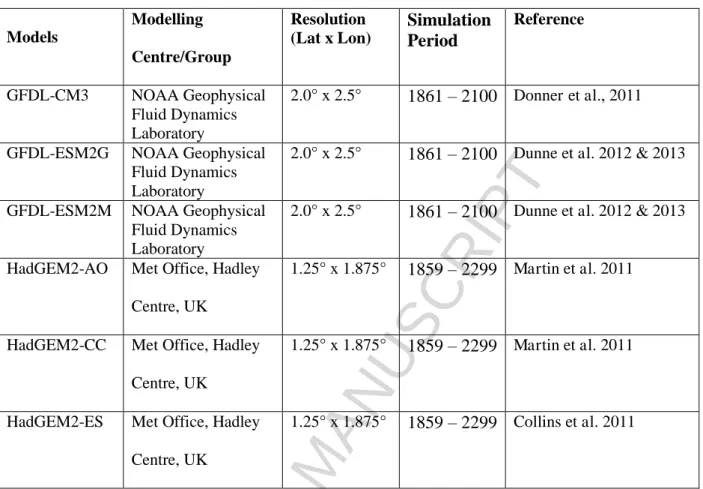
The long-term historical simulations and future projections from the Fifth Coupled Model Inter-comparison Project (CMIP5, Taylor et al. 2012) over the BIMSTEC region (Figure 1a) have been used for this study. Among the available CMIP5 model simulations, six models have been chosen to analyze the present-day (historical) and projected climate in RCP 4.5 and 8.5 (Moss et al. 2008). Moss et al. (2010) have assigned priority to the RCPs. The highest emission scenario RCP8.5 is the first priority and the scenario with stabilization without overshoot i.e. RCP4.5 is the second priority. Thus these two scenarios have been selected for this study. Sengupta and Rajeevan (2013) have examined the CMIP5 simulated results over the Indian region in detail and have ranked these model in terms of skill of precipitation and temperature simulations. However, each model has its own characteristic skill on some or other aspect of temperature and precipitation simulation. The six models used in this study are listed in Table 1, together with their host institutions, and their abbreviations as used in this study. Availability of the model projections for dynamic downscaling has been one of the criteria for selecting the models for the present study. The model simulations are available for the period of 1901 to 2100. This period of simulation has been divided in to two periods, historical or present day climate (1901 to 2005) and projected climate (2006 to 2100). The historical simulations have been forced by observed atmospheric composition changes (including greenhouse gases, natural and anthropogenic aerosols and volcanic forcing), solar variations and time-evolving land cover in a bid to simulate the observed climate of the recent historical period. The projected climate simulations have been forced by radiative forcing of 4.5 and 8.5 W/m2 in RCP 4.5 and 8.5 respectively, and while
ACCEPTED MANUSCRIPT
greenhouse gases, solar constant, ozone and aerosol are kept changing with time. For evaluating the model simulations, the simulated rainfall has been compared with multiple datasets of observed gridded rainfall such as Climatic Research Unit (CRU, TS3.21; Harris at al. 2014), Global Precipitation Climatology Center (GPCC, Schneider et al., 2014) and Global Precipitation Climatology Project (GPCP; Adler et al., 2003) and the surface temperature has been compared with CRU. The CRU and GPCC data are available for the period 1901 to 2012, while GPCP data is available from 1979 till present Thus, the model evaluation has been done for common period between the model simulations and observations i.e. 1901 to 2005 in case of CRU and GPCC and 1979 to 2005 for GPCP. Most of the analyses of the model simulations are carried out at the model resolution (without applying any interpolation). Area average quantities have been computed for each country and from each simulation. In order to compute model bias against observations, the model data at coarse resolution have been interpolated uniformly to the CRU data at finer resolution onto 0.5x0.5 degree grid or respective observations. The same step has been carried out for making the multi-model ensemble. Model anomalies have been have been computed at each grid point with respect to observations for the present climate. These anomalies are then averaged over the grid box representing the respective countries. The trends in precipitation and temperature have been computed for each country and each member of the model simulations.
3. Verification of CMIP5 models
The simulated rainfall and temperature have been validated against the corresponding observations through climatological spatial maps, time series and box-whisker diagrams for the period 1901 to 2005 over each of the BIMSTEC countries. The spatial results presented on the maps provide a perspective on the reliability of the models over each grid points. While the time series and box-whisker diagrams, show the statistical distribution of the
ACCEPTED MANUSCRIPT
results across climate scenarios, provide a complementary perspective on the variability of the observed changes in last 105 years.
The annual mean rainfall and temperature from ensemble mean of six CMIP5 models for each of the BIMSTEC countries have been verified against the corresponding CRU observations are shown in Figure 2 to 5. Figure 2(a-r) shows the climatological annual rainfall from the ensemble means of six CMIP5 Models, CRU and their differences for the period 1901 to 2005. The ensemble mean is able to reproduce the rainfall over most of the regions in Bangladesh, Bhutan, India, southern part of Nepal, northeast Myanmar and Thailand. Over these countries, the model ensemble shows similar spatial pattern as that in
the CRU observed. South-western part of Myanmar is highly underestimated by about 4 – 8
mm/day in the ensemble mean (Figure 2-l). Over Sri Lanka, the models also underestimated the annual rainfall by 2 – 4 mm/day (Figure 2-o). An overestimation of rainfall can be seen over north Bhutan, India and major parts of Nepal (Figure 2- f, i and l). Over most of the parts of Thailand, the models and observation have shown similar rainfall amount of about 2 – 4 mm/day (Figure 2-r). The spatial correlation between the ensemble mean and the CRU observed rainfall is having minimum value of 0.53 over Myanmar and maximum value of 0.88 over Bhutan. For the sake of completeness, the model simulated annual mean rainfall has been compared with GPCC (Figure S1) and with GPCP (Figures S2) for the period 1979 to 2005. Comparison shows that the rainfall from the model ensemble have similar agreement with CRU (Figure 2) with both the observed datasets (Figures S1 and S2). From the above discussions, it may be concluded that large-scale rainfall climatology over the study region are well simulated by even the coarse resolution global models. Therefore, the underlying sea surface temperatures (SSTs) and other natural as well as greenhouse gas (GHG) forcing used in the models adequately explain the rainfall climate.
ACCEPTED MANUSCRIPT
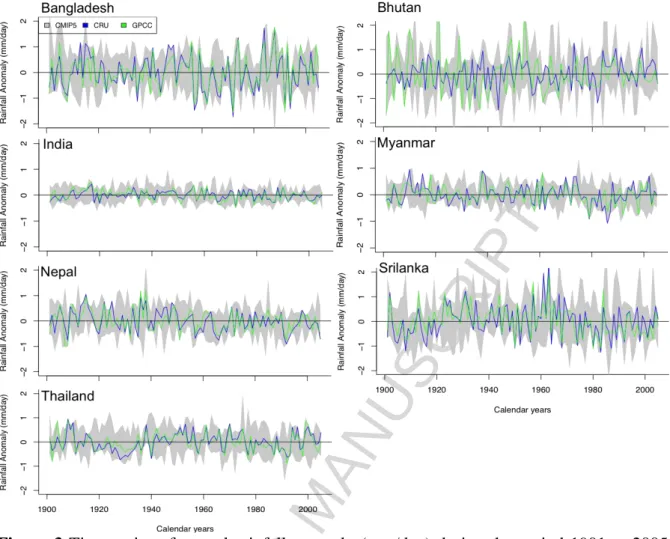
Further, the model evaluation has been carried out by examining the capability in simulating the internannual variation of annual rainfall. Area average of rainfall over each of the BIMSTEC countries have been calculated to compute the inter-annual variation of annual rainfall anomaly for all the six CMIP5 models as well as the CRU and GPCC observations (Figure 3). The grey shaded region in the figure shows the spread of annual rainfall anomaly of the six CMIP5 models. It can be seen that both the observations (CRU as blue line and GPCC as green line) lie within the spread of the CMIP5 models over all the countries. It may be noted here that the historical CMIP5 experiments were only constrained by observed GHG concentrations; therefore, they could not represent inter-annual variability. However, in the study region, most of rainfall variability occurs in the monsoon season. The interannual variability of the monsoons largely depend on the SST variability. Jha et al (2014) have examined the diversity of CMIP5 models in simulating various aspects of SST variability and found that majority of the CMIP5 models reasonably capture the relative large SST anomaly variance in the tropical central and eastern Pacific, in north Pacific and north Atlantic. However, frequency of ENSO is not well captured by almost all models. The remote response of SSTs on the monsoon variability in the study region has not been examined in detail. In the present study, it is seen that the ensemble members of the selected CMIP5 models and the observations lie within the model spread (Figure 3). It means that the ensemble members are statistically identical to the observed values in the sense that both the observation and an ensemble member can be considered to be drawn from the same composite of underlying distributions (Johnson and Bowler, 2009).
Figure 4(a-r) shows the climatological annual mean temperature from the ensemble mean, CRU and their difference for the period 1901 to 2005. Most parts of the BIMSTEC region have cold bias except over north-west Myanmar (Figure 4-l) and southern part of Sri Lanka (figure 4-o). Over Bangladesh, the ensemble mean has cold bias by about 2 – 4 ºC
ACCEPTED MANUSCRIPT
(Figure 4-c) and over Thailand, the cold bias is about 1 – 2 ºC (Figure 4-r). Although, the models show cold bias, the spatial pattern is fairly well captured over all the BIMSTEC countries. Interannual variation of annual mean temperature anomaly for each of the BIMSTEC countries for the period 1901 to 2005 in six CMIP5 models (grey shaded) and CRU observations (blue line) have been shown in Figure 5. The grey shaded region shows the spread of six CMIP5 model simulated temperature anomaly. The temperature from the CMIP5 model agrees well with the CRU temperature and the CMIP5 model spread lies in between the observed interannual spread over all the countries. Over Nepal and Bhutan, the annual temperature has shown a significant increase during 1980 to 2005 which is consistent with study carried out by Shresta et al. 1999. In all the countries, the annual mean temperature shows an increasing from 1990 in both simulations and observation. The spatial correlation between the ensemble mean and the CRU observed surface temperature is minimum over Sri Lanka with a value of 0.48 and maximum value of 0.95 over India. It may be noted that the large-scale distribution of mean surface temperature is largely determined by the distribution of incoming solar radiation moderated by clouds, other surface heat fluxes and transport of energy by the atmosphere (IPCC, 2007). The biases in global models are largely associated with the global energy balance among the various physical processes including radiative processes (e.g., cloud, albedo feedbacks) and non-radiative processes (e.g., surface turbulent fluxes and large-scale circulation) within the model climate system (Randall et al., 2007; Yang and Ren, 2011). Many climate models have cold bias in the study region including the models selected for the present study. The present study does not attempt to examine the sources of biases in the present set of models.
Further, the models have been validated in simulating the annual rainfall and temperature with the help of box-whiskers as shown in Figure 6 and 7 (a-g) respectively over the each of the BIMSTEC Countries. The x-axis represents the six CMIP5 Models, their
ACCEPTED MANUSCRIPT
ensemble and CRU, while the y-axis represents the rainfall (mm/day) and temperature (ºC). In both the figures, the boxes indicate the 1st quartile, median and 3rd quartiles of the distribution and the whiskers represent the range from the minimum to the maximum during the 105 years period. In each of the box and whisker plot, the middle line represents the median of rainfall or temperature, and the top and bottom of the rectangle box represent the 25th and 75th percentiles respectively. The dashed lines extending above and below the boxes (the whiskers) show the range of extreme values of the projected results, and the open circles show the model outliers. The outliers are retained in the plots because they provide some indication of the worst case scenarios during the period of study. In Figures 6 and 7, each of the members of GFDL and HadGEM2 family behaves alike over most of the BIMSTEC countries. The simulated annual rainfall has been underestimated over Bangladesh when compared with CRU rainfall (Figure 6a). Although the annual rainfall has been underestimated in both the families, the HadGEM2 simulations are relatively closer to the observations as compared to those in GFDL family. Similar inferences can be seen over Bhutan, India, Myanmar and Thailand. Over Sri Lanka, the annual rainfall from GFDL family is closer to the CRU observation than that of HadGEM2 family. In Figure 7, the annual temperature has been underestimated by most of the models over Bangladesh, Bhutan and Nepal. Over Sri Lanka and Thailand, the GFDL family have cold bias whereas the HadGEM2 family has warm bias. In both the figures 6 and 7, it can be seen that the ensemble mean of these models have relatively less error than the each member of the ensemble. By and large, the CMIP5 models simulate satisfactorily some of the salient features of annual mean rainfall and temperature. Eventhough, these models have large biases over the BIMSTEC countries, they may be suitable to be used for studying the future projected climate over the region.
ACCEPTED MANUSCRIPT
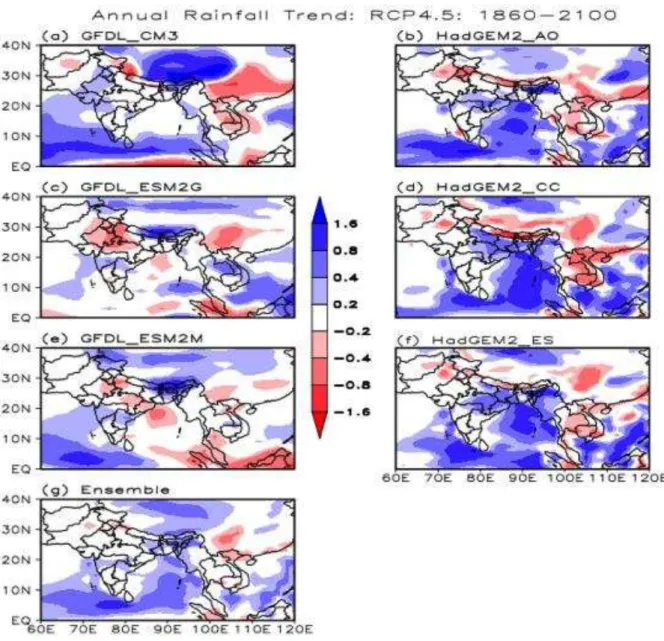
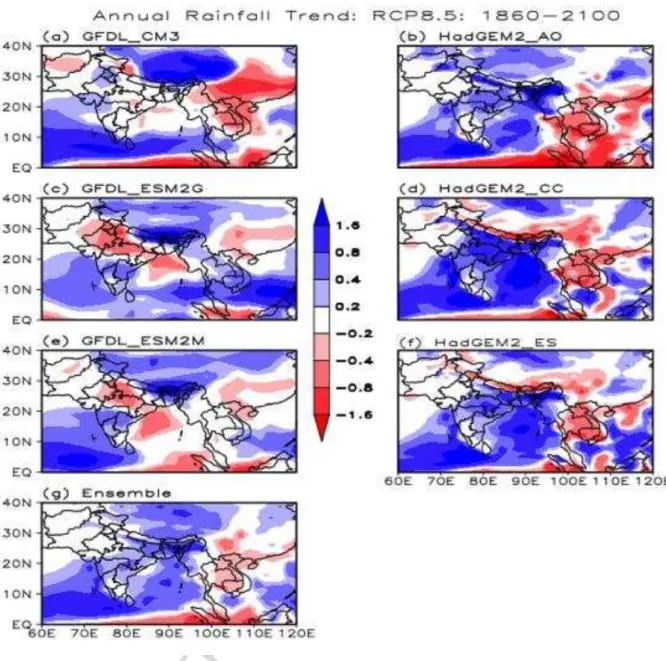
4. Projection of rainfall and temperatureThis section deals with the annual trends in rainfall and temperature by 2100 with respect to 1901 in each of the models in RCP4.5 and RCP8.5. The rainfall trends in RCP4.5 and RCP8.5 are depicted in Figures 8 and 9 respectively. It can be noticed from the figures that the rainfall trends are similar in both the RCPs, but only difference is the magnitude. The magnitude is more in RCP8.5 than that in the RCP4.5. All the models show an increasing trend of about 0.2 mm/yr in RCP4.5 and 0.4 mm/yr in RCP8.5 over Bangladesh. The GFDL and HadGEM families show different trends over Bhutan and Nepal. There is an increasing trend in GFDL family whereas the HadGEM family shows a decreasing trend over these countries. Except GFDL_CM3 model, all the other models show that there is an increasing trend in annual rainfall over Myanmar in both the RCPs. Out of the six models, fives models show that there is a decreasing trend in annual rainfall over Thailand in both the RCPs. The decreasing trend is more in HadGEM members than in the GFDL members. There is no significant trend over Sri Lanka in any of the models.
Further, the time series of annual mean rainfall from all the models and ensemble mean have been plotted for the period 1901 to 2100 over each of the BIMSTEC countries in Figure 10(a-g). Since the historical simulations were available up to 2005, thus the CRU observations were also plotted up to 2005 only. The model spread is quite less over India and Thailand while it is maximum over Bangladesh and Sri Lanka, which indicates that the model uncertainty is more (less) over the countries where spread is more (less). It can be noticed from the ensemble mean that no country shows any significant trend (increasing/decreasing) during the historical period (1901 to 2005). In all the BIMSTEC countries, the rainfall may increase in either of the RCP scenarios. The rainfall intensity is more in RCP8.5 than RCP4.5 towards the end of the twenty first century in all the countries except Thailand. Thailand is the only country where the rainfall in RCP4.5 shows more than that in the RCP8.5. The
ACCEPTED MANUSCRIPT
strengthening of rainfall after 2080 seen in the present study over Thailand agrees with the study made by Supharatid 2015 and over India the results are consistent with the study carried out by Chaturvedi et al. 2012. Over Bangladesh, India and Nepal, the rainfall is likely to increase in both the RCPs. There may be no change in the rainfall in either scenarios over Bhutan, Myanmar and Sri Lanka.
The surface temperature trends in RCP4.5 and RCP8.5 are shown in Figures 11 and 12 respectively. It may be noticed from both the figures that, the surface temperature has more or less an increasing trend over all of the BIMSTEC countries. But the rate of increase in surface temperature is more in RCP8.5 (Figure 12) than that of the RCP4.5 (Figure 11). In RCP4.5, the rate of increasing trend over Bangladesh, Bhutan, Myanmar, Nepal and most part of India and Thailand is about 3 – 4 ºC/200years during the 1901 to 2100 in most of the models. Over Sri Lanka, the trend is about 2 – 3 ºC/200years. Similarly, the trend in RCP8.5 over Bangladesh, Bhutan, Myanmar, Nepal, Thailand and most part of India is about 4 – 5 ºC/200years during the 1901 to 2100 in most of the models. Over Sri Lanka, the trend is about 3 – 4 ºC/200years. It can be seen that the trend is maximum over north-west part of India and minimum over Sri Lanka in both the RCPs and in all of the models. Among all the models, the GFDL-CM3 shows maximum warming in both the RCPs.
Figure 13 shows the time series of annual mean surface temperature from the six CMIP5 models for the period 1901 to 2100 over each of the BIMSTEC countries. In this figure the colour conventions are the same as in the Figure 10. Over India, the spread is minimum while it is maximum over Nepal, which indicates the model uncertainty is more over Nepal and less over India. The model ensemble shows a slight increasing trend of surface temperature over all the countries during the historical period. The rate of increase in annual mean surface temperature is quite large towards the end of 21st century in RCP8.5
ACCEPTED MANUSCRIPT
mean temperature seems like to be same till 2040 in both RCP4.5 and RCP8.5. After 2040, the surface temperature might stabilise in RCP4.5 but intensify in the RCP8.5 over all the countries. Thus the temperature difference between RCP 4.5 and RCP 8.5 towards 2100 over all the BIMSTEC countries is about 3 – 4ºC. It may be noted here that the basic structure of the models used in this study is comparable. But the differences arise when these models try to represent the physical interactions between the atmosphere, the oceans, land surfaces, and sea ice with respect to a multitude of processes operating on many different space and time scales. They all differ in their details make different choices about which elements of the physics to emphasize. These models also differ in their treatment of clouds and aerosols. Climate change projections are associated with a range of limitations and uncertainties which are driven mainly by the model and scenario uncertainties. Climate projections are generally more reliable at the global scale than at smaller regional scales (Taylor et al. 2012). The differences in the projected temperature or precipitation among the models arise when the changes made by the model is due to its internal processes over a small region are more than that caused by prescribed radiative heating representing climate change (e.g. RCP4.5 or RCP8.5). The uncertainties are more where the region has sharp orography gradient and the coarse-resolution global models are not able to represent this heterogeneity in the orography. Nepal is a small country on the foothills of Himalayas and has sharp topographic gradient. Therefore, each model produces a different future projection for this region. In contrast, India is a large country and the area-mean uncertainty in temperature projection is less than that of a small country (Nepal). Multi-model ensemble mean approaches try to represent the uncertainties in regional climate projections in a reasonable manner which have been used in this study.
ACCEPTED MANUSCRIPT
ConclusionsIn this study, future changes in annual rainfall and surface temperature projected by the six state-of-the-art IPCC AR5 CMIP5 models have been analyzed to derive robust signals of projected changes and its variability over the BIMSTEC countries. During the historical period, the comparison analysis reveals that the performance of the models are sufficient enough in simulating the annual rainfall and surface temperature pattern over the most of the BIMSTEC countries. Hence it has been used to project the future changes in climate over the BIMSTEC countries.
Four out six models show that the rainfall over central and north India, Thailand and eastern part of Myanmar have decreasing trend and Bangladesh, Bhutan, Nepal and Sri Lanka show an increasing trend in both RCP 4.5 and RCP 8.5 scenarios. In case of temperature, all of the models show an increasing trend over all the BIMSTEC countries in both scenarios, however, the rate of increase is relatively less over Sri Lanka than the other countries. The rate of increase or decrease in rainfall and temperature over the BIMSTEC countries reveals that the signals are stronger in RCP8.5 than that in RCP4.5. Inter-model comparison show that there are large uncertainties within the CMIP5 model projections. However, the results found in this study, which is consistent with other earlier studies give us the confidence in the projected changes in the annual rainfall and temperature over most of the BIMSTEC countries. Many more such kind of studies are required to help scientists and policy makers to develop suitable strategies to cope with and take advantage of possible future climate changes. Moreover, there is a need to downscale the coarse resolution climate model projections using dynamic downscaling method (by using high-resolution regional climate models). This work is now underway.
ACCEPTED MANUSCRIPT
AcknowledgmentsWe are thankful to the CRU, GPCC and GPCP for making their data records available for this study. Thanks are due to IPCC for providing the CMIP5 data freely for research purpose. The authors are thankful to the anonymous reviewers whose suggestions helped to improve the quality of the paper. The corresponding author would also like to thank Mr Bruno Ladvocat for his help in preparing the time series plots.
ACCEPTED MANUSCRIPT
ReferencesAdler, RF, Huffman GJ, Chang A, Ferraro R, Xie P, Janowiak J, et al. (2003) The Version 2 Global Precipitation Climatology Project (GPCP) Monthly Precipitation Analysis (1979-Present). J Hydrometeor, 4, 1147–1167.
Alam M, Tshering D. 2004. Capacity strengthening in the least developed countries (LDCs) for adaptation to climate change, working report, Bangladesh Centre for Advanced Studies (BCAS) publishers.12-13.
Basnayake BRSB, Abjhyasinghe, KR, Sumathipala WL, Punyawardene BVRP, Perera N, Joseph PG. 2007. Climate Change in Sri Lanka: Impacts, Adaptation & Mitigation. Proceedings of the National Conference on Climate Change, Centre for Climate Change Studies, and Kobe-Asia-Pacific Network for Global Change Research, Department of Meteorology, Colombo, Sri Lanka.
Baba N. 2010. Sinking the Pearl of the Indian Ocean: Climate Change in Sri Lanka. Global Majority E-Journal. 1. 4-16.
BIMSTEC brief report february 2014. Ministry of External Affairs,
http://www.mea.gov.in/Uploads/PublicationDocs/23022_BIMSTEC_Brief_February_2014. pdf
Chandrapala L. 1996. Long Term Trends of Rainfall and Temperature in Sri Lanka. In Y. P. Abrol, S. Gadgil, G. B. Pant (Eds.).Climate Variability and Agriculture (pp. 150-152). New Delhi: Narosa Publishing House.
Chaturvedi RK, Jayaraman M, Ravindranath NH, Joshi J, Bala G. 2012. Multi-model Climate change projections for India under representative concentration pathways. Current Science. Vol 103.No 7. Doi:10/10/2012.
CCC (2006) Bangladesh Climate Change Impacts and Vulnerability, Climate Change Cell, Department Of Environment; Comprehensive Disaster Management Programme, MoFDM.
Government of the People’s Republic of Bangladesh, Dhaka.
Collins, W. J., Bellouin, N., Doutriaux-Boucher, M., Gedney, N., Halloran, P., Hinton, T., Hughes, J., Jones, C. D., Joshi, M., Liddicoat, S., Martin, G., O’Connor, F., Rae, J., Senior, C., Sitch, S., Totterdell, I., Wiltshire, A., and Woodward, S. 2011, Development and evaluation of an Earth-system model – HadGEM2, Geosci. Model Dev. Discuss., 4, 997– 1062, doi:10.5194/gmdd-4-997-2011.
Dash SK, Mishra SK, Pattnayak KC, Mamgain A, Mariotti L, Coppola E, Giorgi F, Giuliani G. 2015. Projected seasonal mean summer monsoon over India and adjoining regions for the twenty-first century. Theor. Appl. Climatol. Volume 122. Issue 3. pp 581-593.
ACCEPTED MANUSCRIPT
De Zoysa M, Inoue M. 2014. Climate Change Impacts, Agroforestry Adaptation and Policy
Environment in Sri Lanka. Open Journal of Forestry.4.439-456. doi:
10.4236/ojf.2014.45049.
Donner, L. J., and Coauthors, 2011: The dynamical core, physical parameterizations, and basic simulation characteristics of the atmospheric component of the GFDL global coupled model CM3. J. Climate, 24, 3484–3519.
Duncan JMA, Biggs EM. 2012. Assessing the accuracy and applied use of satellite derived precipitation estimates over Nepal. Appl. Geogr. Doi: 10.1016/j.apgeog.2012.04.001.
Dunne JP, John JG, Adcroft AJ, Griffies SM, Hallberg RW, Shevliakova E, et al. (2012). GFDL's ESM2 global coupled climate–carbon earth system models. Part I: physical formulation and baseline simulation characteristics. J. Clim. 25, 6646–6665. doi: 10.1175/JCLI-D-11-00560.1
Dunne JP, John JG, Shevliakova E, Stouffer RJ, Krasting JP, Malyshev SL, et al. (2013).
GFDL's ESM2 global coupled climate–carbon earth system models. Part II: carbon system
formulation and baseline simulation characteristics. J. Clim. 26, 2247–2267. doi: 10.1175/JCLI-D-12-00150.1
Harris I, Jones PD, Osborn TJ, Lister DH. 2013. Updated high-resolution grids of monthly climatic observations. In press. Int. J. Climatol. Doi: 10.1002/joc.3711.
Hasan MA, Islam AKM, Bhaskaran B. 2013. Predicting future precipitation and temperature over Bangladesh using high resolution regional scenarios by multi- member ensemble climate simulation, Institute of water and flood management (IWFM). 2013/09.583-590. Hasan MA, Islam Saiful AKM, Islam Tarekul GM, Bala SK, Paul S, Billah M, Rahman M
M, Fahad MGR. 2015. A comparative analysis of CMIP3 and CMIP5 climate projections over Bangladesh. 5th International Conference on Water & Flood Management (ICWFM-2015).
IPCC, 2007. Climate Change 2007: Working Group I: The Physical Science Basis, IPCC Fourth Assessment Report, Solomon, S., D. Qin, M. Manning, Z. Chen, M. Marquis, K.B. Averyt, M. Tignor and H.L. Miller (eds.) Cambridge University Press, Cambridge, United Kingdom and New York, NY, USA.
IPCC 2013. Climate Change 2013: The Physical Science Basis. Contribution of Working Group I to the Fifth Assessment Report of the Intergovernmental Panel on Climate Change. Stocker TF, Qin D, Plattner GK, Tignor M, Allen SK, Boschung J, Nauels A, Xia Y, Bex V, Midgley PM E. Cambridge University Press. Cambridge and New York. 1535 p.
Jha, B., Hu, ZZ. & Kumar, A. 2014. SST and ENSO variability and change simulated in historical experiments of CMIP5 models. Clim Dyn. 42: 2113.
doi:10.1007/s00382-013-ACCEPTED MANUSCRIPT
Johnson C. and N. Bowler, 2009. On the Reliability and Calibration of Ensemble Forecasts, Mon. Wea. Rev. 137, 1117-1720.
Khandu JA, Foortan E. 2015. An evaluation of high resolution gridded precipitation products over Bhutan (1998-2012). International Journal of Climatology. Doi:10.1002/joc.4402. Lutz AF, Immerzeel WW, Bierkens MFP, Gobiet A, Pellicciotti F. 2013. Comparison of
climate change signals in CMIP3 and CMIP5 multi-model ensembles and implications for Central Asian glaciers. Hydrol. Earth Syst.Sci.Doi:10.5194/hess-17-3661-2013.
Martin GM, Bellouin N, Collins WJ, Culverwell ID, Halloran PR, Hardiman SC, Hinton TJ, Jones CD, McDonald RE, McLaren AJ, O’Connor FM, Roberts MJ, Rodriguez JM, Woodward S, Best MJ, Brooks ME, Brown AR, Butchart N, Dearden C, Derbyshire SH, Dharssi I, Doutriaux-Boucher M, Edwards JM, Falloon PD, Gedney N, Gray LJ, Hewitt HT, Hobson M, Huddleston MR, Hughes J, Ineson S, Ingram WJ, James PM, Johns TC, Johnson CE, Jones A, Jones CP, Joshi MM, Keen AB, Liddicoat S, Lock AP, Maidens AV, Manners JC, Milton SF, Rae JGL, Ridley JK, Sellar A, Senior CA, Totterdell IJ, Verhoef A, Vidale PL, Wiltshire A, 2011 The HadGEM2 family of met office unified model climate
configurations. Geosci Model Dev 4(3):723–757. doi:10.5194/gmd-4-723-2011
Moss RH, Babiker M et al. 2008 Towards New Scenarios for Analysis of Emissions, Climate Change, Impacts, and Response Strategies (PDF). Geneva: Intergovernmental Panel on Climate Change. p. 132.
Moss RH, Edmonds JA et al. 2010 The next generation of scenarios for climate change research and assessment. Nature 463: 747–756
Nowreen S, Murshed BS, Islam SMKA, Bhasakaran B, Hasan AM. 2014. Change of rainfall extremes around the haor basin areas of Bangladesh using multi-member ensemble RCM. Theoretical and applied climatology. Doi:10.1007/s00704-014-1101-7.
Ohmura A. 2012. Enhanced temperature variability in high-altitude climate change. Theor.
Appl. Climatol. 110. 499–508. doi:10.1007/s00704-012-0687-x.
Olivier, J.G.J., Janssens-Maenhout, G., Muntean, M. and Peters, J.A.H.W. (2016) Trends in global CO2 emissions: 2016 Report. European Commission, Joint Research Centre (JRC), Directorate C - Energy, Transport and Climate; PBL Netherlands Environmental
Assessment Agency, The Hague. JRC103425, PBL2315, Internet:
http://edgar.jrc.ec.europa.eu/news_docs/jrc-2016-trends-in-global-co2-emissions-2016-report-103425.pdf, November 2016
Pattnayak KC, Panda SK, Dash SK (2013) Comparative study of regional rainfall
characteristics simulated by RegCM3 and recorded by IMD. Glob Planet Change 106:111–
ACCEPTED MANUSCRIPT
Pattnayak KC, Panda SK, Vaishali Saraswat and Dash SK (2013) Relationship between tropospheric temperature and Indian summer monsoon rainfall as simulated by RegCM3.
Clim Dyn (2016) 46:3149–3162
Rangwala I, Miller JR, Russell GL, Xu M. 2009. Using a global climate model to evaluate the influences of water vapor, snow cover and atmospheric aerosol on warming in the Tibetan Plateau during the twenty-first century. Clim.Dynam. 34. doi:10.1007/s00382-009-0564-1. 2009.
Rangwala I, Miller J. 2012. Climate change in mountains – a review of elevation dependent warming and its possible causes. Climate Change.114.527-547. Doi:10.1007/s10584-012-0419-3.2012.
Randall D. A. , R. A. Wood, S. Bony, et al. , 2007: Climate models and their evaluation, in: Climate Change 2007: The Physical Science Basis. Contribution of Working Group I to the Fourth Assessment Report of the Intergovernmental Panel on Climate Change, S. Solomon et al. (Eds.), Cambridge University Press, Cambridge and New York, 996pp.
Schneider U, Becker A, Finger P, Meyer-Christoffer A, Ziese M, Rudolf B. 2014. GPCC’s new land surface precipitation climatology based on quality-controlled in situ data and its role in quantifying the global water cycle. Theor. Appl. Climatol. 115: 15–40, doi: 10.1007/s00704-013-0860-x.
Sengupta A, Rajeevan M. 2013. Uncertainty quantification and reliability analysis of CMIP5 projections for the Indian summer monsoon. Current Science. Vol. 105, No12, 1694-1703 Shrestha BA, Wake PC, Mayewski A, Paul, Dibb JE. 1999. Maximum Temperature Trends
in the Himalaya and its Vicinity: An analysis based on Temperature Records from Nepal for the period 1971-94. Journal of Climate. Vol 12.2775-2786.
Supratid S, Thongthaeng N, Aribarg T, Supratid S. 2014. Bias Correction with dynamical downscaling of rainfall over Bangkok under Climate Change. Proceeding of the 19th IAHRAPD Congress 2014.Hanoi, Vietnam. Doi:10.13140/2.1.2670.1128.Taylor KE, Stouffer RJ, Meehl GA. 2011. A Summary of the CMIP5 Experiment Design. Program for Climate Model Diagnosis and Intercomparison (PCMDI).
Taylor KE, Stouffer RJ, Meehl GA. 2012. An overview of CMIP5 and the experiment
design. Bull. Am. Meteorol. Soc. 93, 485–498, Doi:10.1175/BAMS-D-11-00094.1.
Yamane A. 2009. Climate Change and Hazardscape of Sri Lanka. Environment and Planning. 41. 2396-2416. http://dx.doi.org/10.1068/a41213
Yang Yang, Ren Rong-Cai 2011. Understanding the Global Surface-Atmosphere Energy Balance in FGOALS-s2 through an Attribution Analysis of the Global Temperature Biases. Atmospheric and Oceanic Science Letters, 8(2): 107-112
ACCEPTED MANUSCRIPT
Table – 1 List of CMIP5 climate models and ensemble outputs used in this study, their resolution, and research groups responsible for their development
Models Modelling Centre/Group Resolution (Lat x Lon) Simulation Period Reference GFDL-CM3 NOAA Geophysical Fluid Dynamics Laboratory 2.0° x 2.5° 1861 – 2100 Donner et al., 2011
GFDL-ESM2G NOAA Geophysical Fluid Dynamics Laboratory
2.0° x 2.5° 1861 – 2100 Dunne et al. 2012 & 2013
GFDL-ESM2M NOAA Geophysical Fluid Dynamics Laboratory
2.0° x 2.5° 1861 – 2100 Dunne et al. 2012 & 2013
HadGEM2-AO Met Office, Hadley
Centre, UK
1.25° x 1.875° 1859 – 2299 Martin et al. 2011
HadGEM2-CC Met Office, Hadley
Centre, UK
1.25° x 1.875° 1859 – 2299 Martin et al. 2011
HadGEM2-ES Met Office, Hadley
Centre, UK
ACCEPTED MANUSCRIPT
Figures1. Figure 1 (a) BIMSTEC region is the area of interest over which the study has been
carried out; (b) Time series of Green House Gases emissions (kton(Gg) CO2eq/yr) for
the period 1970-2012 (Olivier et al. 2016) for each of the countries of BIMSTEC. 2. Figure 2 Climatology of the annual rainfall (mm/day) for the period 1901-2005 (a)
CRU, (b) Ensemble Mean of GFDL and HadGEM2 (ENSEMBLE) and (c)
ENSEMBLE – CRU.
3. Figure 3 Time series of annual rainfall anomaly (mm/day) during the period 1901 to
2005. Grey shaded area represents the range of rainfall anomaly in six CMIP5 models for each year. Blue and green curve represents CRU and GPCC rainfall for the historical period (1901 to 2005) respectively.
4. Figure 4 Climatology of the annual surface temperature (ºC) for the period 1901-2005
(a) CRU, (b) ENSEMBLE and (c) ENSEMBLE – CRU.
5. Figure 5 Time series of annual temperature anomaly (°C) during the period 1901 to
2005. Grey shaded area represents the range of temperature anomaly in six CMIP5 models for each year. Blue curve shows the CRU observed temperature anomaly.
6. Figure 6 Box plot of climatological annual rainfall as observed by CRU and
simulated by CMIP5 Models over (a) Bangladesh, (b) Bhutan, (c) India, (d) Myanmar (e) Nepal, (f) Sri Lanka and (g) Thailand for 1901 – 2005.
7. Figure 7 Box plot of climatological annual surface temperature as observed by CRU
and simulated by CMIP5 Models over (a) Bangladesh, (b) Bhutan, (c) India, (d) Myanmar (e) Nepal, (f) Sri Lanka and (g) Thailand for 1901 – 2005.
8. Figure 8 Annual rainfall trend (mm/200years) during the period 1901 to 2100 in
RCP4.5 as simulated by (a) GFDL_CM3, (b) HadGEM2_AO, (c) GFDL_ESM2G, (d) HadGEM2_CC (e) GFDL_ESM2M, (f) HadGEM2_ES and (g) ENSEMBLE Mean. 9. Figure 9 Annual rainfall trend (mm/200years) during the period 1901 to 2100 in
RCP8.5 as simulated by (a) GFDL_CM3, (b) HadGEM2_AO, (c) GFDL_ESM2G, (d) HadGEM2_CC (e) GFDL_ESM2M, (f) HadGEM2_ES and (g) ENSEMBLE Mean. 10.Figure 10 Time series of annual mean rainfall during the period 1901 to 2100.
Shaded area represents the range of annual mean rainfall by the six models for each year. The model ensemble averages for each RCP are shown with thick lines. Grey shade and blue thick line represents RCP4.5 while the pink shade and red thick line represents RCP8.5.
11.Figure 11 Annual surface temperature trend (ºC/200years) during the period 1901 to
2100 in RCP4.5 as simulated by (a) GFDL_CM3, (b) HadGEM2_AO, (c) GFDL_ESM2G, (d) HadGEM2_CC (e) GFDL_ESM2M, (f) HadGEM2_ES and (g) ENSEMBLE Mean.
12.Figure 12 Annual surface temperature trend (ºC/200years) during the period 1901 to
2100 in RCP8.5 as simulated by (a) GFDL_CM3, (b) HadGEM2_AO, (c) GFDL_ESM2G, (d) HadGEM2_CC (e) GFDL_ESM2M, (f) HadGEM2_ES and (g)
ACCEPTED MANUSCRIPT
13.Figure 13 Time series of annual mean temperature(°C) during the period 1901 to
2100. Shaded area represents the range of annual mean temperature by the six models for each year. The model ensemble averages for each RCP are shown with thick lines. Grey shade and blue thick line represents RCP4.5 while the pink shade and red thick line represents RCP8.5.
ACCEPTED MANUSCRIPT
Figure 1 (a) BIMSTEC region is the area of interest over which the study has been carried
out; (b) Time series of Green House Gases emissions (kton(Gg) CO2eq/yr) for the period
1970-2012 (Olivier et al. 2016) for each of the countries of BIMSTEC.
(a)
ACCEPTED MANUSCRIPT
Figure 2 Climatology of annual mean rainfall (mm/day) for the period 1979-2005 for each of
the countries of BIMSTEC. The left and middle column represents the observation as evident in CRU data set and ensemble mean of six CMIP5 models respectively. The right column shows the difference between the Ensemble mean and the CRU observed.
ACCEPTED MANUSCRIPT
Figure 3 Time series of annual rainfall anomaly (mm/day) during the period 1901 to 2005.
Grey shaded area represents the range of rainfall anomaly in six CMIP5 models for each year. Blue and green curve represents CRU and GPCC rainfall for the historical period (1901 to 2005) respectively.
ACCEPTED MANUSCRIPT
Figure 4 Same as figure 2 but for annual mean surface temperature (°C).ACCEPTED MANUSCRIPT
Figure 5 Time series of annual temperature anomaly (°C) during the period 1901 to 2005.
Grey shaded area represents the range of temperature anomaly in six CMIP5 models for each year.
ACCEPTED MANUSCRIPT
Figure 6 Box plot of climatological annual rainfall as observed by CRU and simulated by CMIP5 Models over (a) Bangladesh, (b) Bhutan, (c) India, (d) Myanmar (e) Nepal, (f) Sri Lanka and (g) Thailand for 1901 – 2005.
ACCEPTED MANUSCRIPT
Figure 7 Box plot of climatological annual surface temperature as observed by CRU and
simulated by CMIP5 Models over (a) Bangl.5adesh, (b) Bhutan, (c) India, (d) Myanmar (e) –
ACCEPTED MANUSCRIPT
Figure 8 Annual rainfall trend (mm/200years) during the period 1901 to 2100 in RCP4.5 as
simulated by (a) GFDL_CM3, (b) HadGEM2_AO, (c) GFDL_ESM2G, (d) HadGEM2_CC (e) GFDL_ESM2M, (f) HadGEM2_ES and (g) ENSEMBLE Mean.
ACCEPTED MANUSCRIPT
Figure 9 Annual rainfall trend (mm/200years) during the period 1901 to 2100 in RCP8.5 as
simulated by (a) GFDL_CM3, (b) HadGEM2_AO, (c) GFDL_ESM2G, (d) HadGEM2_CC (e) GFDL_ESM2M, (f) HadGEM2_ES and (g) ENSEMBLE Mean
ACCEPTED MANUSCRIPT
Figure 10 Time series of annual mean rainfall during the period 1901 to 2100. Shaded area represents the range of annual mean rainfall by the six models for each year. The model ensemble averages for each RCP are shown with thick lines. Grey shade and blue thick line represents RCP4.5 while the pink shade and red thick line represents RCP8.5.
ACCEPTED MANUSCRIPT
Figure 11 Annual surface temperature trend (ºC/200years) during the period 1901 to 2100 in
RCP4.5 as simulated by (a) GFDL_CM3, (b) HadGEM2_AO, (c) GFDL_ESM2G, (d) HadGEM2_CC (e) GFDL_ESM2M, (f) HadGEM2_ES and (g) ENSEMBLE Mean.
ACCEPTED MANUSCRIPT
Figure 12 Annual surface temperature trend (ºC/200years) during the period 1901 to 2100 in
RCP8.5 as simulated by (a) GFDL_CM3, (b) HadGEM2_AO, (c) GFDL_ESM2G, (d) HadGEM2_CC (e) GFDL_ESM2M, (f) HadGEM2_ES and (g) ENSEMBLE Mean.
ACCEPTED MANUSCRIPT
Figure 13 Time series of annual mean temperature(°C) during the period 1901 to 2100.
Shaded area represents the range of annual mean temperature by the six models for each year. The model ensemble averages for each RCP are shown with thick lines. Grey shade and blue thick line represents RCP4.5 while the pink shade and red thick line represents RCP8.5.
ACCEPTED MANUSCRIPT
Highlights Impact of climate change over BIMSTEC countries is a major concern for all as it brings together 21% of the world population.
Six state-of-the-art IPCC AR5 CMIP5 models have been analyzed to derive robust signals of projected changes and its variability over the BIMSTEC countries.
During the historical period, the comparison analysis reveals that the performance of the cmip5 model used in this study are sufficient enough in simulating the annual rainfall and temperature pattern over the most of the BIMSTEC region.
The rate of increase or decrease in rainfall and temperature over the BIMSTEC countries reveals that the signals are stronger in RCP8.5 than that in RCP4.5.
Inter-model comparison show that there are large uncertainties within the CMIP5 model projections.