Best Practice
Recommendations
for Canadian Harm reduCtion Programs tHat Provide serviCe to PeoPle
WHo use drugs and are at risk for Hiv, HCv, and otHer Harms: Part 1
Working grouP on Best PraCtiCe for Harm reduCtion Programs in Canada
SuggeSted reference: Strike c, Hopkins S, Watson tM, gohil H, Leece P, Young S, Buxton J, challacombe L, demel g, Heywood d, Lampkin H, Leonard L, Lebounga Vouma J, Lockie L, Millson P, Morissette c, nielsen d, Petersen d, tzemis d, Zurba n. Best Practice recommendations for canadian Harm reduction Programs that Provide Service to People Who use drugs and are at risk for HIV, HcV, and Other Harms: Part 1. toronto, On: Health and Long term care to complete the narrative syntheses for chapters related to needles and syring-es, other injecting equipment, safer crack smoking equipment and disposal and handling. throughout this project, our team has benefited from the wisdom and advice from the following people: Horst Backe (Win-nipeg regional Health Authority), darlene Palmer (cactus Montreal), francine Keough (Safe Works Access Program, AIdS committee of newfoundland and Labrador) and Patricia Bacon (Blood ties four directions centre). throughout our project, Sheila Lacroix (centre for Addiction and Mental Health) provided help to search for scientific articles. We also owe thanks to carol danis (Sistering) for her feedback on the draft chap-ter for safer crack cocaine smoking equipment We also thank Alex Lee (university of toronto) for his help sorting hundreds of scientific references into a manageable set of categories. We thank ryan nunn r.g.d. for his graphic design of the document and the accompanying chapter summaries.
Disclaimer
the opinions and recommendations in this document reflect those of the authors and do not necessarily reflect those of their employers, the canadian Institutes for Health research nor the AIdS Bureau, Ontario Ministry of Health and Long term care.
Table of contents
Overview of the Best Practice recommendations: Part 1 ... 4
1. needle and syringe distribution... 8
2. cooker distribution...28
3. filter distribution ...35
4. Ascorbic acid distribution ...43
5. Sterile water distribution ...48
6. Alcohol swab distribution ...55
7. tourniquet distribution ...61
8. Safer crack cocaine smoking equipment distribution ...65
9. disposal and handling of used drug use equipment ...86
10. Safer drug use education ...98
11. Opioid overdose prevention: education and naloxone distribution ...109
Appendix A – Methods: Overview of research evidence review and Synthesis ...120
the goal of the Best Practice recommendations is to im-prove the effectiveness of harm reduction programs that deliver prevention services to people who use drugs and are at risk for human immunodeficiency virus (HIV), hepatitis c (HcV), hepatitis B (HBV), and other harms. these recommen-dations aim to assist programs and communities to:
• Improve effectiveness of harm reduction programs • reduce transmission of HIV, HcV, HBV, and other harms • Improve the quality and consistency of harm
reduction services
• Inform decisions about the use of resources for effective and efficient practice
• Advocate for better resources in harm reduction services • Provide benchmarks to evaluate their services
• Identify targets for improvement at the individual program and systems levels
the Best Practice recommendations are divided into two parts. In Part 1, we reviewed and synthesised into user-friend-ly, evidence-based, national best practice recommendations the most up-to-date scientific evidence available about the distribution of injection and smoking equipment, safer drug use education, and overdose prevention (see Appendix A for a full description of our methods). Part 2 will focus on program models, testing and vaccination, first aid, referrals and counseling, and relationships with police and other or-ganizations and is scheduled be completed in the latter part of 2014 – stay tuned!
these recommendations are intended to replace those pre-viously disseminated by British columbia (Bccdc, 2008; Bux-ton et al., 2008) and Ontario (Strike et al., 2006). evaluations of these two documents demonstrate impressive implemen-tation of the recommendations (Buxton et al., 2008; Strike et al., 2011); we hope to achieve more widespread uptake of our current comprehensive recommendations.
What are ‘best practice recommendations’ and how
to use them?
Best practices are a series of recommendations for service design and delivery, based on the best available scientific evidence. the recommendations represent a tool to transfer knowledge developed through research to the delivery of service and development of policy. each section of the rec-ommendations begins with a set of definitive best practice statements. Our goal is to enable programs to use evidence to move towards best practices, if these are not already in place. It is also our goal to help programs advocate for bet-ter resources and services by providing a document that con-tains empirical evidence that they can reference.
Harm reduction programs develop over time and best prac-tice recommendations can be used to guide development from new to experienced, multi-faceted programs. Many harm reduction programs face financial and other con-straints. As such, some programs may have more resourc-es or resourc-established partnerships to help implement particular best practice components compared to other programs. While the ideal harm reduction program would include all components, an inability to provide all components should not be used to discourage development and implementa-tion to the best of a program’s ability.
Why are best practice recommendations necessary?
drug use practices that can lead to transmission of HIV and other harms (i.e., reuse and sharing of injection and smok-ing equipment) are a critical public health issue affectsmok-ing communities across canada (Public Health Agency of can-ada, 2006, 2009). International evidence demonstrates that effective communicable disease prevention programming for people who use drugs can reduce transmission of HIV, HcV, HBV, and other harms related to drug use. Injection drug use is associated with many negative health and so-cial outcomes. Harm reduction programs, like needle and syringe programs (nSPs), lead to reduced HIV incidence and prevalence, reduced needle and equipment reuse, and are cost-effective (Holtgrave et al., 1998; Laufer, 2001; Wodak & cooney, 2006). nSPs distribute new and dispose of used injection equipment, distribute safer sex materials, and pro-vide prevention education related to HIV, HcV, other
gens, skin and vein problems, and overdose. Many programs provide a wide array of formal and informal services using varied service models and link clients to health and social services in their communities (McKnight et al., 2007; Paone et al., 1999; Strike et al., 2002).
Harms related to unsafe crack cocaine smoking are exten-sive and increasingly documented in the scientific literature (gyarmathy et al., 2002; Haydon & fischer, 2005; Leonard et al. 2008; Porter & Bonilla, 1993; tortu et al., 2001, 2004). research points to the elevated risk of HcV and HIV trans-mission among people who smoke crack cocaine (deBeck et al., 2009). Safer crack cocaine smoking kits are distributed to help reduce the risks of HIV, HcV, and other harms (ca-nadian HIV/AIdS Legal network, 2008). Safer crack cocaine equipment distribution programs also aim to reach margin-alised people who use drugs and provide support and edu-cation to reduce equipment sharing (Leonard et al., 2008; Malchy et al. 2011).
there is an urgent, community-identified need to better inform and implement safer practice recommendations for people who smoke crack cocaine. In canada, safer crack co-caine equipment distribution programs are not as well or consistently implemented as programs that distribute safer injection equipment and are completely lacking in many jurisdictions (canadian AIdS Society & canadian Harm re-duction network, 2008; canadian HIV/AIdS Legal network, 2007). these programs are often poorly funded and have been subject to political opposition and controversy as well (canadian HIV/AIdS Legal network, 2008; Ivsins et al., 2011; Strike et al., 2011). Where possible, harm reduction programs across canada have expanded their mandates to distribute safer crack cocaine smoking supplies. Our synthesis of evidence on safer crack cocaine smoking equip-ment represents a substantially expanded section of best practice recommendations.
Intended audience
We developed this set of recommendations for service pro-viders, managers and policy makers who deliver harm re-duction programs for people who use drugs and are at risk for HIV, HcV, HBV, and other harms. We hope that these rec-ommendations will be useful to develop, review, redesign, and evaluate your programs.
Our team - Working Group on Best Practice for
Harm Reduction Programs in Canada
Based on the principles of community-based research, our project arose from a community-identified need. from in-ception to dissemination, this project has involved commu-nity members and service providers. Members of the team joined based on their interest, expertise (i.e., people with lived experience, service providers, policy makers, and re-searchers) and their roles as representatives within their communities, stakeholder groups and/or regions. We used a consensus-based process whereby all team members con-tribute to the design and implementation of the project.
References
Bccdc. Best practices for British columbia’s harm reduction supply distribution program. Bc Harm reduction Strategies and Services committee; 2008. Accessed May 2013 from: http://www.bccdc.ca/nr/rdonlyres/17e7A2c8-5070-4A29-9971-55210f781B58/0/BestPractices.pdf
Buxton JA, Preston ec, Mak S, Harvard S, Barley J, Bc Harm reduction Strategies and Services committee. More than just needles: an evidence-informed approach to enhanc-ing harm reduction supply distribution in British columbia. Harm reduction Journal, 2008 dec 24;5:37.
canadian AIdS Society and canadian Harm reduction network. Learning from each other: enhancing communi-ty-based harm reduction programs and practices in canada; 2008. Accessed May 2013 from: http://canadianharmreduc-tion.com/sites/default/files/final_report_en.pdf
canadian HIV/AIdS Legal network. distributing safer crack use kits in canada. canadian HIV/AIdS Legal network; 2008. Accessed May 2013 from: http://www.aidslaw.ca/publica-tions/interfaces/downloadfile.php?ref=1390
canadian HIV/AIdS Legal network. Sticking points: barriers to access to needle and syringe programs in canada; 2007. Accessed May 2013 from: http://www.aidslaw.ca/publica-tions/interfaces/downloadfile.php?ref=1182
deBeck K, Kerr t, Li K, fischer B, Buxton J, Montaner J, Wood e. Smoking of crack cocaine as a risk factor for HIV infection among people who use injection drugs. canadian Medical Association Journal, 2009 Oct;181(9):585-589.
gyarmathy VA, neaigus A, Miller M, friedman Sr, des Jar-lais dc. risk correlates of prevalent HIV, hepatitis B virus, and hepatitis c virus infections among noninjecting heroin users. Journal of Acquired Immune deficiency Syndromes, 2002;30:448-456.
Haydon e, fischer B. crack use as a public health problem in canada. canadian Journal of Public Health, 2005;9(3):185-188.
Holtgrave dr, Pinkerton Sd, Jones tS, Lurie P, Vlahov d. cost and cost-effectiveness of increasing access to sterile syringes and needles as an HIV prevention intervention in the united States. Journal of Acquired Immune deficiency Syndromes and Human retrovirology, 1998;18(Suppl 1):S133-138.
Ivsins A, roth e, nakamura n, Krajden M, fischer B. uptake, benefits of and barriers to safer crack use kit (ScuK) distribu-tion programmes in Victoria, canada--A qualitative explo-ration. International Journal of drug Policy, 2011;22(4):292-300.
Laufer fn. cost-effectiveness of syringe exchange as an HIV prevention strategy. Journal of Acquired Immune deficiency Syndromes, 2001 nov;28(3):273-278.
Leonard L, derubeis e, Pelude L, Medd e, Birkett n, Seto J. ‘’I inject less as I have easier access to pipes’’. International Journal of drug Policy, 2008;19(3):255-264.
Malchy LA, Bungay V, Johnson JL, Buxton J. do crack smoking practices change with the introduction of safer crack kits? canadian Journal of Public Health. 2011 May-Jun;102(3):188-192.
McKnight I, Maas B, Wood e, tyndall M, Small W, Lai c, et al. factors associated with public injecting among users of Vancouver’s supervised injection facility. American Journal of drug and Alcohol Abuse, 2007;33(2):319-325.
Paone d, clark J, Shi Q, Purchase d, des Jarlais dc. Syringe exchange in the united States, 1996: a national profile. American Journal of Public Health, 1999 Jan;89(1):43-46. Porter J, Bonilla L. crack users’ cracked lips: an addition-al HIV risk factor. American Journaddition-al of Public Headdition-alth, 1993;83(10):1490-1491.
Public Health Agency of canada. HIV and AIdS in canada. Surveillance report to december 31, 2008. Ottawa: Surveil-lance and risk Assessment division, centre for communi-cable diseases and Infection control, Public Health Agen-cy of canada; 2009. Accessed May 2013 from: http://www. phac-aspc.gc.ca/aids-sida/publication/survreport/2008/dec/ index-eng.php
Public Health Agency of canada. I-track: enhanced surveil-lance of risk behaviours among injecting drug users in can-ada. Phase 1 report. Ottawa: Surveillance and risk Assess-ment division, centre for Infectious disease Prevention and control, Public Health Agency of canada; 2006. Accessed May 2013 from: http://www.phac-aspc.gc.ca/i-track/sr-re-1/ index-eng.php
Strike c, Leonard L, Millson M, Anstice S, Berkeley n, Medd e. Ontario needle exchange programs: Best practice recom-mendations. toronto: Ontario needle exchange coordinat-ing committee; 2006. Accessed May 2013 from: http://www. health.gov.on.ca/english/providers/pub/aids/reports/ontar-io_needle_exchange_programs_best_practices_report.pdf Strike c, Watson tM, Lavigne P, Hopkins S, Shore r, Young d, Leonard L, Millson P. guidelines for better harm reduction: evaluating implementation of best practice recommenda-tions for needle and syringe programs (nSPs). International Journal of drug Policy, 2011;22(1):34-40.
Strike cJ, challacombe L, Myers t, Millson M. needle ex-change programs. delivery and access issues. canadian Jour-nal of Public Health, 2002 Sep-Oct;93(5):339-343.
tortu S, McMahon JM, Pouget er, Hamid r. Sharing of non-injection drug-use implements as a risk factor for hepatitis c. Substance use and Misuse, 2004;39(2):211-224.
tortu S, neaigus A, McMahon J, Hagen d. Hepatitis c among noninjecting drug users: a report. Substance use and Mis-use, 2001;36(4):523-534.
Wodak A, cooney A. do needle syringe programs reduce HIV infection among injecting drug users: A comprehensive review of the international evidence. Substance use and Misuse, 2006;41(6-7):777-813.
1
Needle and syringe distribution
Description of how needles and syringes are used
needles are used to inject drugs into veins (i.e., intravenous), muscles (i.e., intramuscular), and under the skin (i.e., subcu-taneous). to inject drugs with a needle, the drugs are first mixed with water to form a solution in a container (‘cook-er’/spoon). Often the solution is heated and then drawn through a filter through the needle and into the syringe. Some drugs are mixed directly in the syringe. When mul-tiple people are sharing a drug solution, the solution may be drawn from a common container into multiple needles/ syringes or the solution may be squirted from one needle/ syringe through the front or back of another needle /syringe (also known as frontloading or backloading, respectively). there is a risk of disease transmission when any of the piec-es of equipment used to prepare, share, or inject the drug solution are contaminated with HIV, HcV, HBV, or other pathogens.
to reduce the risk of transmission from contaminated nee-dles, clients need to use a new needle each time they inject. Many needle and syringe programs (nSPs) distribute sterile needles; that is, needles that are free from microorganisms, including pathogens, and come in commercially sealed packages that have never been opened. If a package has been opened or damaged and its seal broken, the needle may no longer be sterile. If a needle has been used and has been cleaned (which can be done with a variety of clean-ing agents), the needle is not sterile. Only a process of
ster-ilization that effectively kills all microorganisms results in a sterile needle. needle cleaning practices performed by peo-ple who inject drugs may reduce the number of pathogens found in and on used needles, but the majority of these practices cannot effectively remove all pathogens.
Evidence of needles and syringes as vectors of HIV,
HCV, and HBV transmission
Injection with a previously used needle puts people who in-ject drugs at high risk for infection with pathogens such as HIV, HcV, and HBV. Studies have found evidence of these viruses in used needles.
Abdala and colleagues found that under laboratory condi-tions HIV can survive in blood in needles for up to 30 days or longer. their studies show that recovery of viable HIV is affected by factors including: volume of blood, storage tem-perature, and duration of storage (Abdala et al., 1999; 2000; Heimer & Abdala, 2000). At temperatures between 4oc and 22oc, HIV was recovered following storage for up to 42 days (Abdala et al., 2000; Heimer & Abdala 2000). Among needles collected from shooting galleries in florida, 20% to 94% of visibly contaminated needles showed evidence of HIV (i.e., HIV-1 antibodies, proteins, rnA, dnA; chitwood et al., 1990; Shah et al., 1996; Shapshak et al., 2000). In new Haven, connecticut, samples of needles were tested and showed varying prevalence of HIV proviral dnA depending
Recommended best pRactice policies to facilitate use of a sterile needle and syringe for each injection and reduce transmission of human immunodeficiency virus (HIV), hepatitis C (HCV), hepatitis B (HBV), and other pathogens:
• Provide sterile needles in the quantities requested by clients without requiring clients to return used needles • Place no limit on the number of needles provided per client, per visit (one-for-one exchange is not recommended) • Encourage clients to return and/or properly dispose of used needles and syringes
• Offer a variety of needle and syringe types by gauge, size, and brand that meet the needs of clients and educate cli-ents about the proper use of different syringes
• Educate clients about the risks of using non-sterile needles
• Provide pre-packaged safer injection kits (needles/syringes, cookers, filters, ascorbic acid when required, sterile water for injection, alcohol swabs, tourniquets, condoms and lubricant) and also individual safer injection supplies concurrently
on the source: among the “street” needles tested, preva-lence of HIV was 67.5% (n=160), for “illegal exchange” needles it was 62.8% (n=180), and for “shooting gallery” needles it was 91.7% (n=48; Heimer et al., 1993). Among re-turned nSP needles, the prevalence of HIV was 63.9% when the program opened in november 1990 (Heimer et al., 1993) and declined to 41.1% by May 1992 (Kaplan & Heimer, 1994; 1995). the presence of HIV antibodies suggests that a previous user was HIV-positive. It should be noted that the presence of HIV rnA, dnA, and proviral dnA indicate that virus particles are present in the needles, but the virus may or may not be infectious.
HcV is more resilient than HIV and more infectious through blood contact. Like HIV, HcV can be transmitted via blood-to-blood contact; however, it is ten times more easily trans-mitted through a contaminated needle than HIV (Kiyosawa et al., 1991; Mitsui et al., 1992). HcV has also been detected in used needles. In an Australian study, crofts et al. (2000) detected the presence of HcV rnA in rinses from 70% (14 of 20) of needles collected from 10 injecting sites. As well, HcV may remain viable in syringes for prolonged periods of time and has been observed to survive up to 63 days in tuberculin syringes; HcV survival appears to vary depending on syringe type, time, and temperature (Paintsil et al., 2010). Pouget et al. (2011) conducted a systematic review of studies report-ing HcV seroincidence as part of the HcV Synthesis Project. results of their meta-analysis found an association between HcV seroconversion and syringe sharing (Prr = 1.94, 95% cI) 1.53, 2.46). In their meta-regression analysis, studies report-ing a higher HcV seroprevalance in the sample population found larger effects of syringe sharing on HcV seroconver-sion (Pouget et al., 2011).
HBV is also a resilient and virulent virus. HBV can survive in dried blood at room temperature for at least a week and is easily transmitted through needle sharing (thompson et al., 2003). According to the Public Health Agency of canada (PHAc), HBV can survive in dried blood for weeks and re-main stable on environmental surfaces for at least a week (http://www.phac-aspc.gc.ca/lab-bio/res/psds-ftss/hepati-tis-b-eng.php). However, HBV can be prevented by an ef-fective vaccine (http://www.phac-aspc.gc.ca/publicat/cig-gci/ p04-hepb-eng.php#sched).
the risk of transmission is greater in the context of needle sharing among people who inject drugs than it is for acci-dental needlesticks that occur in the community. for exam-ple, a Montreal study found that there were no HIV, HcV, or HBV seroconversions among 274 community pediatric needlestick injuries (Papenburg et al., 2008).
Evidence of risk behaviours
reductions in needle sharing have been documented in some jurisdictions in canada. However, needle sharing does continue and varies across the country.
data from canadian studies have shown that the percent-ages of people who inject drugs with a used needle have varied from just under 9% to 27% (fischer et al., 2005; 2006; PHAc, 2006). Studies from different parts of the country have reported declines in needle sharing. In Ontario, trend data show that needle sharing has declined since the early 1990s. In toronto, the percentage of people who inject drugs who reported sharing needles declined from 42% in 1991 to 24% in 2003 (Millson et al., 2005). Among youth who in-ject drugs in Montreal, needle sharing and sharing of other drug use equipment decreased significantly between 1995 and 2004 (roy et al., 2007). Between 1996 and 2007, rates of used syringe sharing also decreased in Vancouver (roy et al., 2007; urban Health research Initiative, 2009). More recent, unpublished data (2011) from Vancouver found that among people who inject drugs 1.5% reported difficulty accessing syringes, 1.3% reported syringe lending, and 1.7% reported syringe borrowing. In comparison, needle sharing in nearby Victoria reportedly increased from below 10% in early 2008 to 20% in late 2010, though during this timeframe the city’s only fixed-site nSP was shut down (Ivsins et al., 2012). un-published data from Ontario, collected between 2010 and 2012 as part of the I-track Study, found that 14.6% of 953 people who inject drugs had borrowed needles (average of data from toronto, Kingston, Sudbury, thunder Bay, and London, Ontario).
epidemiologic data provide evidence of HIV, HcV, and HBV transmission risk associated with needle sharing. toronto data from the WHO study (1991-1994) show that sharing injection equipment in the previous 6 months was associ-ated with higher HIV prevalence (Or=2.0 p<0.01; Millson et al., 2005). In Ottawa, data from two studies show that in-jecting with a used needle was a predictor of HIV infection at baseline. In the Ottawa POInt Project, participants with a history of injecting with a used needle had a three-fold elevated risk for HIV infection (AOr=2.8; 95%cI: 1.3-6.1; Leonard et al., 2005). the SurvIdu Study (1996-2003) found a three-fold elevated risk among women (AOr=3.0; 95%cI: 1.3-7.1) and a slightly lower risk for men (AOr=2.5; 95%cI: 1.6-3.7; Millson et al., 2005). HIV seroprevalence was also as-sociated with backloading in a study with 660 people who inject drugs in new York city (Or=2.2; 95%cI: 1.5-3.1; Jose et al., 1993).
data from a cross-sectional study with 437 “street youth” (14-25 years; 200 people who inject drugs) in Montreal (1995-1996) show that injecting drugs was an independent risk factor for HcV infection (Adjusted Or=28.4; 95%cI: 6.6-121.4; roy et al., 2001). In Seattle, needle sharing among a cohort of 317 people who inject drugs was associated with a three-fold increased risk of HcV seroconversion at one-year follow-up (rr 2.94; 95%cI: 1.6-5.3; Hagan et al., 2001). Simi-larly, a cross-sectional study of 308 young people who inject drugs in San francisco found that risk factors for HcV anti-bodies included ever borrowing a needle (Or=2.56; 95%cI: 1.18-5.53) and daily injecting (Or=3.85; 95%cI: 2.07-7.17; Hahn et al., 2001).
If the needle or syringe used for the preparation and trans-fer has been previously used, blood or other residues can be transferred along with the shared drugs. Backloading (as well as frontloading) refers to a method of transferring a drug solution (see above for description). for instance, among participants in the Seattle study (Hagan et al., 2001) who reported injecting with a used needle during the one-year follow-up period, backloading was associated with a two-fold non-significant risk of HcV seroconversion (rr 2.1, 95%cI: 0.9-4.5;). furthermore, among a cohort of 353 young people who inject drugs in chicago who tested HcV nega-tive at baseline, recepnega-tive needle sharing and backloading were associated with elevated non-significant risks of sero-conversion (thorpe et al., 2002).
HBV transmission is a concern for people who inject drugs who have not been immunized or are not immune as a re-sult of previous exposure to the virus. In the cross-sectional study of Montreal “street youth” mentioned above, after controlling for immunization status participants who had a history of injection drug use (n=200) had 3.5 times the rate of HBV infection of those who reported no drug use (AOr=3.5, 95%cI: 1.5-8.3; roy et al., 1999).
According to PHAc, “universal immunization against HBV is now part of the publicly funded vaccine programs offered in all provinces and territories. the age at which children and adolescents are offered HBV vaccine varies from juris-diction to jurisjuris-diction.” (http://www.phac-aspc.gc.ca/pub-licat/cig-gci/p04-hepb-eng.php#sched) However, it should be noted that people whose schooling was interrupted or who attended school irregularly and newcomers to canada may not have been immunized. In a study of street-recruit-ed people who inject drugs under age 30 in San francisco, it was found that more than half of the participants had not been effectively immunized against HBV (Lum et al., 2008).
Although HBV immunization programs extend coverage, rates of immunization may not be as high as public health predictions for the general population, especially among people who inject drugs (day et al., 2010). for information on immunization programs across the provinces and territo-ries, see http://www.phac-aspc.gc.ca/im/ptimprog-progimpt/ table-1-eng.php.
Correlates of risk behaviours
Knowing the correlates of risk behaviours enhances our understanding of why needle sharing may continue. dis-tributive sharing (i.e., passing on a used needle to someone else) and receptive sharing (using a used needle to inject) are associated with some similar factors including perceived risks and type of injecting partners (Bailey et al., 2007; golub et al., 2007).
data from British columbia suggest that unstable housing is associated with risk behaviours like needle sharing (corneil et al., 2006; gibson et al., 2011). those without stable hous-ing may engage in risk behaviours includhous-ing ushous-ing used sy-ringes in order to avoid encounters with others or the police on the street (Wagner et al., 2010).
Age appears to be an important correlate as well. Young people from marginalized populations (including Aborig-inal, LgBtQ, and street involved) are especially vulnerable to risk factors that increase the likelihood of acquiring HIV and HcV (unpublished data/personal communication, chal-lacombe). Young, travelling people who inject drugs may engage in more risk behaviours, including more sexual and injecting partners and backloading syringes (Hahn et al., 2008). data from Vancouver suggests that people who in-ject crystal methamphetamine may be younger and show more risk behaviours like syringe borrowing and lending (fairbairn et al., 2007). Other data also suggest that young people who inject methamphetamine may be more likely to share syringes (Marshall et al., 2011).
Increased risk of HIV and HcV transmission are also associ-ated with backloading (Hagan et al., 2001), longer injecting careers (Hahn et al., 2001), crack or cocaine use (Millson et al., 2005; Monterroso et al., 2000; roy et al., 2001) and fre-quent or ‘binge’ injecting (Millson et al., 2005; thorpe et al., 2002; Hahn et al., 2001).
Personal risk behaviours happen in social contexts; social network characteristics, such as network size and peer norms regarding injecting, contribute to risk behaviours and also
need to be considered by prevention programs (de et al., 2007; golub et al., 2007; Latkin et al., 2010; Shaw et al., 2007; Wylie et al., 2006). reports from Saskatchewan document the risk of sharing behaviours in social contexts. A summa-ry about injection drug use in Saskatchewan explains that, “Most inject with their regular sex partners, close friends, or family. they inject mostly in their own homes, or at friends’ or relatives’ places. Injection drug users know not to share needles but may interpret this to mean only not with people close to them” (Laurence thompson Strategic consulting, 2008, p. 26).
Incidence and prevalence of HIV, HCV and HBV
among people who inject drugs in Canada
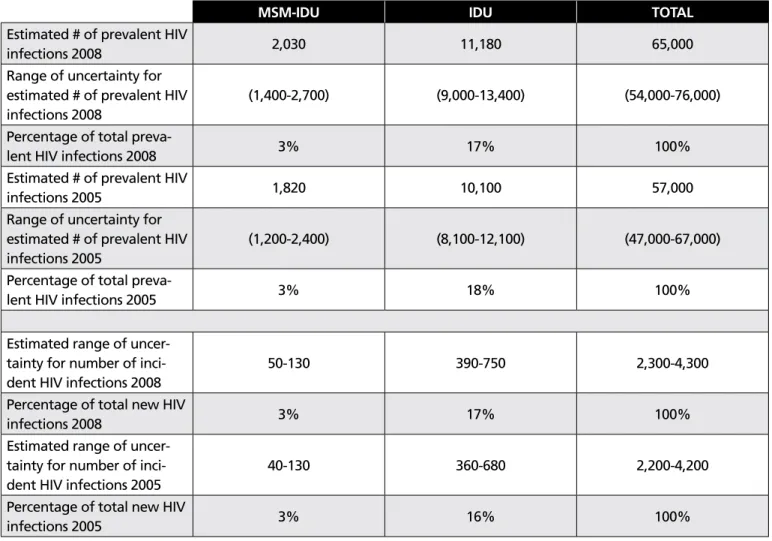
tracking and estimating numbers of HIV, HcV, and HBV infections in the general population and in specific expo-sure categories is challenging, especially on a national scale. there are national estimates for HIV (see table 1.1) and HcV (see table 1.2) and below we provide the numbers for peo-ple who inject drugs.
Table 1.1 HIV prevalence and incidence in Canada overall and among groups of people who inject drugs
MSM-IDU IDU TOTAL
estimated # of prevalent HIV
infections 2008 2,030 11,180 65,000
range of uncertainty for estimated # of prevalent HIV infections 2008
(1,400-2,700) (9,000-13,400) (54,000-76,000) Percentage of total
preva-lent HIV infections 2008 3% 17% 100%
estimated # of prevalent HIV
infections 2005 1,820 10,100 57,000
range of uncertainty for estimated # of prevalent HIV infections 2005
(1,200-2,400) (8,100-12,100) (47,000-67,000) Percentage of total
preva-lent HIV infections 2005 3% 18% 100%
estimated range of uncer-tainty for number of inci-dent HIV infections 2008
50-130 390-750 2,300-4,300
Percentage of total new HIV
infections 2008 3% 17% 100%
estimated range of uncer-tainty for number of inci-dent HIV infections 2005
40-130 360-680 2,200-4,200
Percentage of total new HIV
infections 2005 3% 16% 100%
Source: Public Health Agency of canada, 2010. MSM: men who have sex with men. Idu: people who inject drugs. Point estimates, ranges, and percentages are rounded. (*table modified from original source)
HIV incidence is not uniform across the country and has declined in some jurisdictions. Surveillance data in-dicates that HIV incidence among people who inject drugs has declined in eastern central canada (roy et al., 2011). Similarly, a study of a large cohort of people who inject drugs in Montreal found declining HIV incidence between 1992 and 2008 (Bruneau et al., 2011). In terms of prevalence among I-track (PHAc, 2006) participants, 13.2% were HIV positive, ranging from 2.9% in regina to 23.8% in edmonton. In British columbia, observed decreases in new positive HIV tests among people who inject drugs has been interpreted as representing actual declines in HIV incidence (gilbert et al., 2011).HIV inci-dence is also not uniform across groups. Aboriginal peo-ple who use drugs have higher HIV incidence compared to non-Aboriginal people who use drugs (duncan et al., 2011). HIV incidence has increased more rapidly among Aboriginal people over the last decade than any other
group in canada and in 2008 66% of new HIV infections among Aboriginal people were attributed to injection drug use (PHAc, 2010). In addition, there are concerns about women who inject drugs. In 2008, there were an estimated 600 to 1,120 new HIV infections among wom-en in canada and 29% may be attributed to injection drug use, slightly up from 27% in 2005 (PHAc, 2010). It is worth noting that in some areas globally there are notable differences in HIV prevalence between women and men who inject drugs. des Jarlais et al. (2012) con-ducted a systematic review and meta-analysis of studies from 14 countries with high (>20%) seroprevalence HIV epidemics among people who inject drugs and found higher HIV prevalence among women than men. canada was not one of the countries examined. these authors also reported wide variation across the studies and noted that further research would be needed to compare the findings to low or moderate HIV seroprevalence settings.
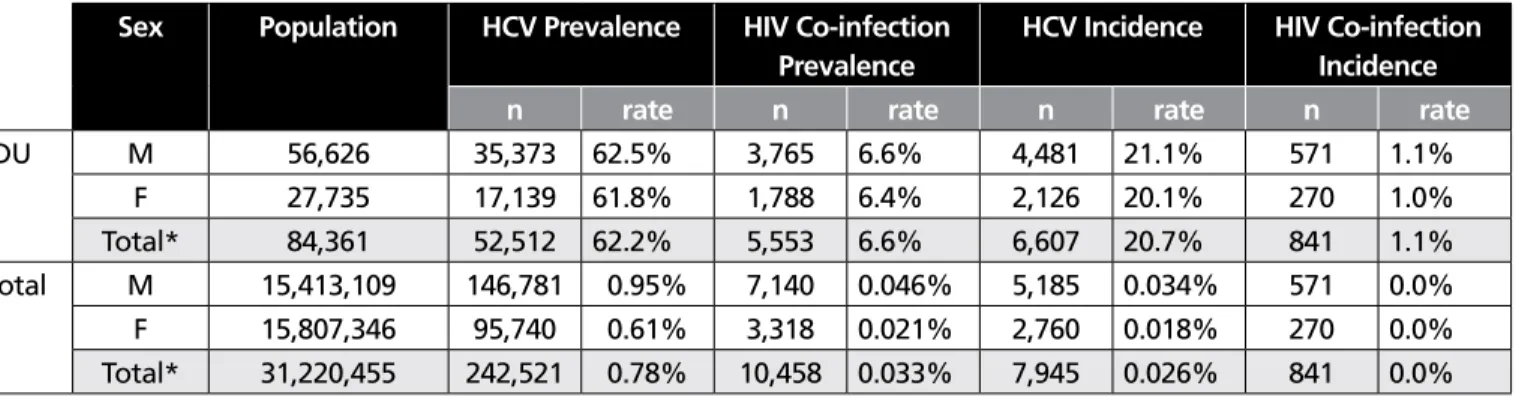
Table 1.2 Modelled prevalence and incidence of HCV infection and HCV/HIV co-infection in the general
pop-ulation and among people who inject drugs in Canada, 2007
Sex Population HCV Prevalence HIV Co-infection
Prevalence
HCV Incidence HIV Co-infection Incidence
n rate n rate n rate n rate
Idu M 56,626 35,373 62.5% 3,765 6.6% 4,481 21.1% 571 1.1% f 27,735 17,139 61.8% 1,788 6.4% 2,126 20.1% 270 1.0% total* 84,361 52,512 62.2% 5,553 6.6% 6,607 20.7% 841 1.1% total M 15,413,109 146,781 0.95% 7,140 0.046% 5,185 0.034% 571 0.0% f 15,807,346 95,740 0.61% 3,318 0.021% 2,760 0.018% 270 0.0% total* 31,220,455 242,521 0.78% 10,458 0.033% 7,945 0.026% 841 0.0%
Source: remis, 2007. Idu: people who inject drugs. *numbers may not add up exactly due to modelling uncertainties and use of rounded whole numbers in the calculations. (*table modified from original source)
In canada, most new HcV infections are attributed to in-jection drug use (PHAc, 2011; remis, 2007). In a cross-sec-tional canadian study on men who have sex with men it was found that the largest contribution to HcV and HcV-HIV co-infection was injection drug use (Myers et al., 2009). Among I-track (PHAc, 2006) participants, 65.7% were HcV-positive, ranging from 61.8% in Winnipeg to 68.5% in Sudbury and Victoria. for people who inject drugs, HcV inci-dence in canada has not declined to the same extent as HIV which could be due to several factors, including the scenario where people who inject drugs become infected with HcV before they access prevention services like nSPs (fischer et al., 2006). Studies have reported high risk of acquiring HcV shortly after beginning to inject drugs (Hagan et al., 2007), thus early intervention for new users is important. evidence from Amsterdam has shown that participation in both nSPs and methadone programs is associated with decreased risk of acquiring HIV and HcV among people who have ever in-jected drugs (Van den Berg et al., 2007).
Aboriginal people in canada are also disproportionately af-fected by HcV (PHAc, 2011). Aboriginal groups in canada show higher HcV seroconversion rates compared to other groups (Lelutiu-Weinberger et al., 2009). Young people who have started injecting drugs are at increased risk for HcV (Maher et al., 2007).
data on HBV infection from the provinces and territories are sent to the Public Health Agency of canada regularly; however, reporting practices across the country are incon-sistent and risk factor information has not always been collected (PHAc, 2011). data collected between 2005 and 2010 from the enhanced Hepatitis Strain Surveillance Sys-tem (eHSSS) across national sites indicates that the incidence rate of reported acute HBV infection has declined (PHAc, 2011). Of 262 cases of acute HBV infection, injection drug use accounted for 12.2% while high-risk sexual behaviours accounted for 30.1% (PHAc, 2011).
reported incidence rates of HBV were higher for Aboriginal people compared to non-Aboriginal people (PHAc, 2011). given that HIV, HcV, and HBV disproportionately affect Aboriginal people in canada, nSPs should consider how to best tailor needle distribution to meet the needs of this diverse population.
Other health-related harms
HIV, HcV, and HBV transmission are not the only concerns associated with reusing needles. Injecting with a used
nee-dle, including one’s own neenee-dle, puts people who inject drugs at risk for other infections as well as skin and vein damage (Kaushik et al., 2011; Khalil et al., 2008; Lloyd-Smith et al., 2010). People who already have depressed immune systems are at an elevated risk of infection. Injecting with a needle contaminated with bacteria and debris can lead to various infections like endocarditis, septicemia, and potentially syphilis.
A study by Morrison et al. (1997) showed that injection-re-lated harms were common among people who inject drugs recruited from nSPs in glasgow. Among the 147 partici-pants in the study, 21% had abscesses (i.e., injection site infections), 49% had thrombosis (i.e., vein clots), 84% had bruising at an injection site(s), and 87% had other injec-tion-related problems such as fasciitis (i.e., deeper injection site infection), arterial damage and/or limited venous access. In the four weeks prior to the survey, 52% of participants had no contact with a health service other than an nSP and 30% had not attended a health service in the past 6 months. despite the frequency of injection-related harms, only 27% had recently sought assistance stating that these issues were normal (62%) or they were reluctant to seek assistance be-cause of unpleasant past experiences (28%). When the nSP referred people who inject drugs, 34% did not attend the service to which they were referred. Morrison et al. (1997) concluded that people who inject drugs will avoid seek-ing treatment until faced with a crisis and that nSPs need to be more proactive and encourage clients to seek medical assistance.
Among a sample of 200 people who inject drugs in Sydney, participants reported using a mean of 3.1 injection sites in the past 6 months (darke et al., 2001). fully 97% report-ed a history of injection-relatreport-ed problems with a mean of 2.3 injection-related issues in the past 6 months including scarring/bruising (84%), lumps/swelling (64%), difficulty in-jecting (49%), and hitting an artery (10%). More recently, Salmon et al. (2009) examined self-reported data from 9552 people who inject drugs who registered to use the super-vised injection facility in Sydney and found that 26% (2469) of the sample had experienced injection-related problems and 10% (972) had experienced injecting-related injury and disease. the most common injection-related problems were trouble finding a vein (18%), prominent scarring or bruis-ing (14%), and swellbruis-ing of the hands or feet (7%). the most common injecting-related injury and disease were abscesses or skin infection (6%), thrombosis (4%), septicemia (2%), and endocarditis (1%; Salmon et al., 2009). Other injec-tion-related harms such as wound botulism (Passaro et al.,
1998), vascular complications (Woodburn & Murie, 1996), and eye infections (Shankland & richardson, 1998) have been reported in the literature as well.
convenience, ease of access, skill, and other factors influence the choice of injection sites. As well, vein damage and infec-tions can reduce the accessibility of some veins and lead peo-ple to inject into other sites on the body. the places where people inject into their bodies can increase or decrease the chances of damage, injury, and infection. commonly used sites for injection include: the arms, legs, neck, groin, fin-gers, toes, and abdomen. However, some sites are safer and less likely than others to lead to injury and/or infection. to help clients select safer injection sites, some agencies have developed resources that contain information about risk levels associated with injecting into different parts of the body. for example, cAtIe has a numbered diagram that indicates that one should never inject into the head and neck, and groin and genital areas (http://www.hepcinfo.ca/ sites/default/files/pdf/1362_cAtIe_revised_sharpshooters_ eng_0.pdf).
Injection into the jugular vein in the neck is especially risky given the potential for serious health-related harms, includ-ing venous trauma and infection. Hoda et al. (2008) sought to examine the prevalence and risk factors associated with jugular injection among a sample of people who inject drugs in Vancouver. Among the 780 participants included in the analysis, 198 (25%) reported jugular injection in the last 6 months. factors independently associated with this prac-tice included being female, daily heroin use, daily cocaine use, needing help with injecting, and sex-trade involvement (Hoda et al., 2008).
groin injection is also considered risky practice as the po-tential for venous damage and other complications is high. using ultrasound scanners, Senbanjo et al. (2012) performed 160 groin scans in 84 people who inject in the groin from community drug treatment centres in South east england. the scanning revealed significant femoral vein damage in 72.5% of the groins scanned; “severe” or “very severe”’ damage in 41.8% of the veins. estimated time to develop-ing femoral vein damage varied widely, includdevelop-ing ranges of 1 to 116 months for minimal damage and 12 to 240 months for very severe damage (Senbanjo et al., 2012). Another study that compared 67 people who inject in the groin with severe femoral vein damage and 86 people with minimal/ moderate damage reported that severe femoral vein dam-age was associated with longer duration of groin injection, using thick needles, benzodiazepine injection, history of and
recurrent deep vein thrombosis (dVt), having a depressed groin scar, and chronic venous disease (Senbanjo & Strang, 2011). needle size and dVt were found to be the main pre-dictors of severe damage.
using data from 92 people who inject drugs who attend-ed an nSP in Bristol, unitattend-ed Kingdom, Maliphant and Scott (2005) reported on the prevalence of groin injection. Of those interviewed, 51% injected into the femoral vein. the mean length of time from first injection to groin injection was 7 years; however, a small number started this practice early in their injection career. ease of access and perceived lack of other usable or convenient sites encouraged groin injection. fear of losing a hit or difficulty injecting with the non-dominant hand deterred rotation of injection sites. Other studies have also found that people who inject drugs may turn to groin injecting once venous access becomes difficult (Harris & rhodes, 2012). In a qualitative study of 44 people in the united Kingdom who inject crack-heroin speedballs, rhodes et al. (2007) reported that older and longer-term injectors viewed groin injecting differently than younger injectors; the former saw it as a “last resort” whereas the latter tended to give reasons for injecting in the groin. Some participants explained that groin injection results in a ‘better rush’ and can be discreet and convenient. While most seemed aware of health risks and complications, participants explained some strategies they use to reduce risk when using the groin as an injection site (e.g., seeking help from others).
In a comprehensive review of bacterial infections in people who use drugs, a number of important findings were high-lighted by gordon and Lowy (2005). Most of the bacterial infections in people who inject drugs were a result of germs that are on the surface of their own skin, use of dirty nee-dles, failing to clean skin before injecting, as well as “boot-ing” (flushing and pulling back during injecting), which may increase risk of abscess formation (gordon & Lowy, 2005). A number of other factors have been linked to soft tissue infection and infection in other parts of the body including lack of injecting experience, skin popping (subcutaneous or intramuscular injection), repeated injection into soft tissue, use of tap water and saliva for mixing drugs, injection of speedballs, higher frequency of injecting, and needle licking which may double the risk of cellulitis or abscess formation (gordon & Lowy, 2005).
needle licking before injection may be a relatively common practice. One study of 40 people who inject drugs reported that 13 had said that they lick their needles before injecting
(deutscher & Perlman, 2008). reasons behind this practice were varied and included ritualistic practices, “cleaning” the needle, enjoying the taste of the drug, and checking the state of the needle. HcV has been found in saliva (ferreiro et al., 2005; Hermida et al., 2002; Lins et al., 2005; Wang et al., 2006) and HBV has also been detected in saliva (Hui et al., 2005; van der eijk et al., 2004). therefore, it might be possible that licking needles prior to injection can contam-inate the needles with these pathogens that then could be transmitted if the needles were shared. Licking may also contaminate needles with bacteria and oral flora. People who lick their needles prior to injection may be at increased risk for abscesses or cellulitis (Binswanger et al., 2000). Khalil et al. (2008) reviewed cases of skin and soft tissue ab-scesses treated in an emergency department between 2005 and 2007 and conducted a literature search of skin and soft tissue abscesses in people who inject drugs. they presented a treatment algorithm for skin and soft tissue abscesses in people who inject drugs and reported that the type of drugs injected (such as heroin-cocaine mixtures), injection tech-nique, attendant circumstances, and immunological status were important factors for the development of abscesses. there have been reports of abscesses infected with MrSA (Methicillin resistant Staphylococcus Aureus) related to in-jecting drugs. MrSA is a bacterium that is resistant to many antibiotics and requires careful medical management. Sten-strom et al. (2009) reported that 54% of the soft tissue in-fections in a Vancouver-area emergency department tested positive for the pathogen and a risk factor for an MrSA-re-lated-soft tissue infection was injection drug use (Or=4.6, 95% cI 1.4-16.1). Huang et al. (2008) reported a similar asso-ciation between MrSA and injecting drugs. Lloyd-Smith et al. (2010) reported that 29% of community-recruited people who inject drugs had wounds and that more than a quarter (27%) tested positive for MrSA. further, wound botulism outbreaks have been reported among people who inject black tar heroin (Kaushik et al., 2011).
Injection drug use can lead to infective endocarditis (inflam-mation of the heart tissues due to an infection). the risk of developing this condition may be increased by the presence of abscesses and a previous diagnosis of the condition (gor-don & Lowy, 2005). Infections within the circulatory system such as in the heart, veins, or in the general bloodstream (sepsis or bacteremia) are very serious and require immedi-ate hospitalization.
An international report of syphilis transmission associated with sharing of needles has highlighted the potential for transmission through this route (Loza et al., 2010). Infection with syphilis places an individual at an elevated risk for con-tracting HIV or HcV because of the ulcers associated with this disease.
finally, each time a needle is used the point becomes more dull (or “barbed”) and injecting with a dull needle can cause skin, tissue, and vein injury, as well as infection including ab-scesses, cellulitis, and vein collapse.
Needle distribution policies
Policies that limit the number of needles distributed limit the effectiveness of nSPs to prevent HIV and HcV transmis-sion (Bluthenthal et al., 2007a; Heimer et al., 2002; Shaw et al., 2007; Small et al., 2010). nSP one-for-one exchange poli-cies, whereby programs give clients one new needle for each used needle returned, reflect restrictive and unsatisfactory practice. Ideally, nSPs should distribute sufficient needles to provide a new sterile needle for each injection (i.e., 100% coverage; Brahmbhatt et al., 2000; tempalski et al., 2008). Bluthenthal et al. (2007b) examined data from 24 nSPs in california and observed five types of exchange, ranging from least to most restrictive:
• unlimited needs-based distribution
• unlimited one-for-one plus some additional syringes • per-visit limited one-for-one plus some
additional syringes • unlimited one-for-one • per-visit limited one-for-one
they found that lower percentages of syringe coverage (<50%) were associated with increased odds of both recep-tive and distriburecep-tive syringe sharing. they also found that nSP clients with percentage of syringe coverage of 150% or more were significantly less likely to share syringes than those with coverage between 100% and 149%, suggesting that achieving greater than 100% coverage may maximize benefits. these authors found that nSPs with less restrictive policies provided more syringe coverage to clients. Accord-ing to turner et al. (2011), high nSP coverage (defined in their study as greater than or equal to 100% needles per in-jection) coupled with receiving opioid substitution therapy (OSt) can substantially reduce the odds of new HcV infec-tion among people who inject drugs.
While 100% coverage may not always be feasible, the move away from exchange policies towards distribution policies that allow clients access to more needles is an important goal. canadian evidence includes a study of syringe shar-ing and lendshar-ing and HIV incidence among a cohort of 1228 people who inject drugs in Vancouver (Kerr et al., 2010). further evidence comes from a survey of 435 people who inject drugs in Winnipeg which found that people who had difficulty accessing new syringes were 3.6 times more likely to share used ones (Shaw et al., 2007).
In Ontario, the vast majority of nSPs (including all core nSP programs) no longer follow one-for-one exchange policies, in accordance with best practice recommendations (Strike et al., 2011). Providing clients with the number of needles they request is more likely to meet the recommendation for a new sterile needle for each injection, thereby reducing the risk of disease transmission. this may involve bulk dis-tribution, as some clients may prefer to stockpile needles to ensure they have sufficient sterile needles on hand (Strike et al., 2005). Some people may also collect needles for peer dis-tribution – an important secondary disdis-tribution strategy to reach people who inject drugs who may not use nSPs (Bry-ant & Hopwood, 2009).
those potentially affected by nSP exchange policies include homeless people who may not have needles to exchange and/or are unable to properly store needles until they at-tend an nSP. In a study of three uS cities, green et al. (2010) found that factors associated with transitions to direct nSP use included homelessness and police contact involving drug use equipment possession. Homelessness was asso-ciated with moving away from direct nSP use. Police con-tact was associated with beginning and maintaining direct nSP use, although there were transitions away from direct nSP use for some types of clients in cities that had a syringe distribution policy change. Other research has found that people may be unwilling to carry needles due to fear of po-lice contact (e.g., cooper et al., 2005; Maher & dixon, 1999), so police contact in the context of nSP policy changes may have different impacts on nSP use.
Meeting client preferences for needle type
People who inject drugs have individual preferences for needle gauge, syringe volume, and brand, and may not use nSP services if they cannot obtain their preferred types. In the empirical literature, little attention has been paid to needle and syringe preferences among people who inject drugs. existing research and insights from harm reduction
workers and program managers raise important consider-ations regarding these preferences.
needles with a higher gauge are thinner (i.e., have a smaller diameter) than needles with a lower gauge. Many people who inject drugs prefer higher-gauge needles because they are often less painful and less likely to result in vein damage (Zule et al., 2002). People who are experienced with inject-ing drugs may prefer lower-gauge needles because these needles are less likely to clog and are better able to pierce through thick scar tissue (Zule et al., 2002). Some nSPs in canada are offering a range of needle sizes (e.g., in Mon-treal, they offer gauges of 18, 21, 23, 25, 26, 27, and 30) and brands and volumes (also in Montreal, terumo and Bd™ syringes in ½, 1 or 3cc; Lebounga Vouma, personal commu-nication, 2012).
A small sample of interviews with harm reduction service providers in British columbia revealed that, “Most clients use 0.5 or 1 cc syringes with needles attached” (Buxton et al., 2008). According to anecdotal reports, people who mix their drugs within their syringes tend to prefer larger syring-es. In terms of brand, there is a variety of needle brands on the market, though Bd™ appears to be among the most popular brand used by nSPs in certain provinces (Keough; Heywood; Lockie; Zurba - all personal communications, 2012). Some people may find certain brands to be more comfortable to inject with and easier to manipulate than others (Harm reduction coalition, 2010). Because people who inject drugs may have their own preferences for nee-dle type and brand that they develop out of experience, it is important that nSPs distribute a variety of needles and syringes to meet client needs. If nSPs enter contracts that allow for only one brand of needles to be purchased, pro-grams could potentially see less service uptake. Supply short-ages of particular needle brands and types may raise similar concerns and programs will potentially need to assist clients through supply transitions.
People who inject drugs may like syringes with detachable needles for several reasons, including the ability to remove the needle during the preparation of the drug solution and to replace if the needle becomes clogged (Zule et al., 2002). However, others may prefer permanently attached needles because the lower dead-space may result in less wasted drugs (Zule et al., 2002). Importantly, high dead-space sy-ringes (HdSS) present greater risk of blood-borne infection transmission while low dead-space syringes (LdSS) may be associated with reduced risk. (see section on dead-space
Coverage
According to the World Health Organization (WHO et al., 2009), coverage refers to the “number of syringes distrib-uted per Idu [person who injects drugs] per year” (p. 13). calculating the quantity of needles required for 100% cov-erage is challenging as it is affected by a number of vari-ables including estimates of the number of people who in-ject drugs in the community (non-nSP clients as well as nSP clients), type(s) of drug used, and frequency of injection. However, u.S. researchers estimate that approximately 1000 needles are required per person who injects drugs, per year (Lurie et al., 1998; Holtgrave et al., 1998).
further, coverage can be calculated on an individual lev-el or population levlev-el as Bryant et al. (2012) have noted. these authors examined individual-level coverage based on cross-sectional data from 417 people who inject drugs and who receive syringes from community pharmacies in new South Wales, Australia. About half of participants (51%) had 150% or greater coverage and, overall, about two-thirds (63%) had adequate coverage (Bryant et al., 2012). Bivari-ate analysis showed some people were significantly more likely to have inadequate coverage including men, younger participants, daily or frequent injectors, those who recep-tively share syringes, and those who had not used an nSP to obtain syringes in the last month. Multivariate analysis
re-vealed that people who had not accessed an nSP in the last month were twice as likely to report inadequate coverage. Bryant et al. (2012) also mentioned something important about high coverage: calculations of 100% or greater may be inaccurate for people who require more than one nee-dle per injection (e.g., those who have lost neenee-dles or had needles confiscated; older, long-term injectors who require more than one syringe to successfully inject). In another re-cent Australian study that examined national cross-sectional data on nSP clients where coverage was defined as “propor-tion of monthly injec“propor-tions covered by a new syringe”, Ivers-en et al. (2012) found that syringe reuse (including personal syringe reuse) was associated with less than 100% coverage; the median number of syringes per person per year was 720 (2 per day).
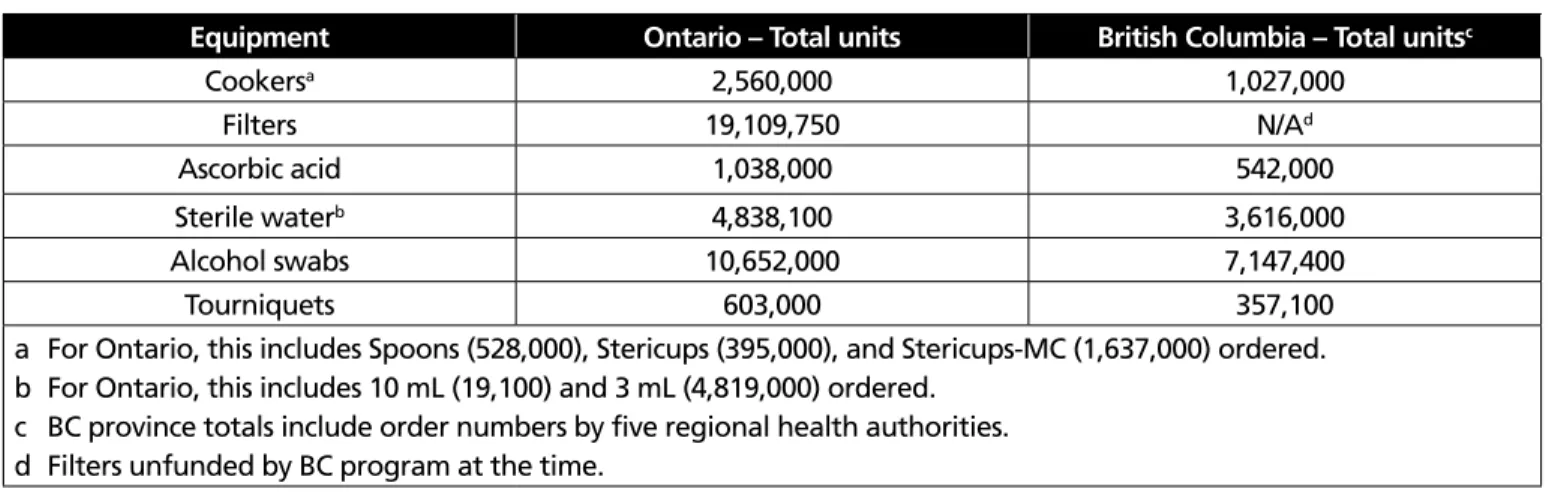
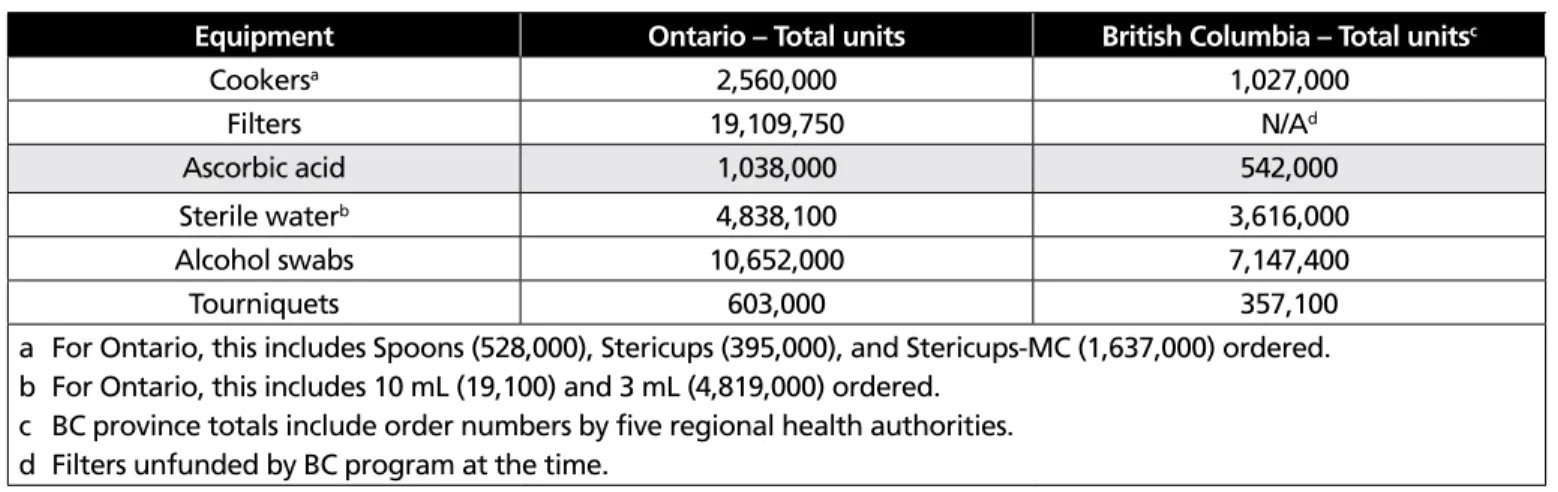
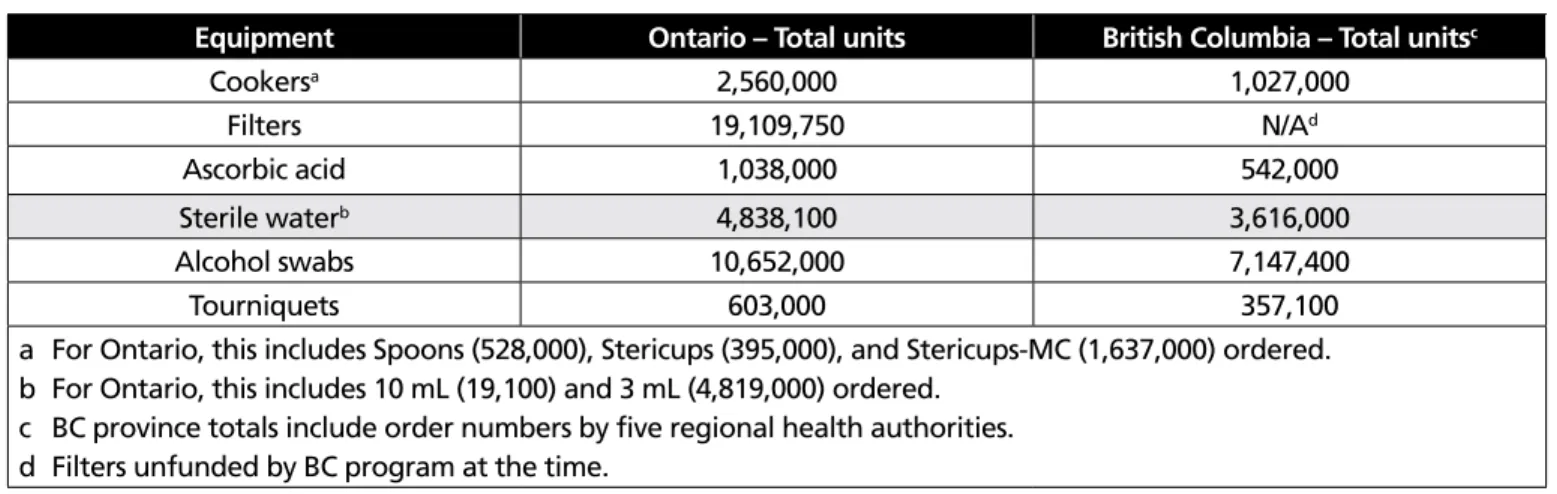
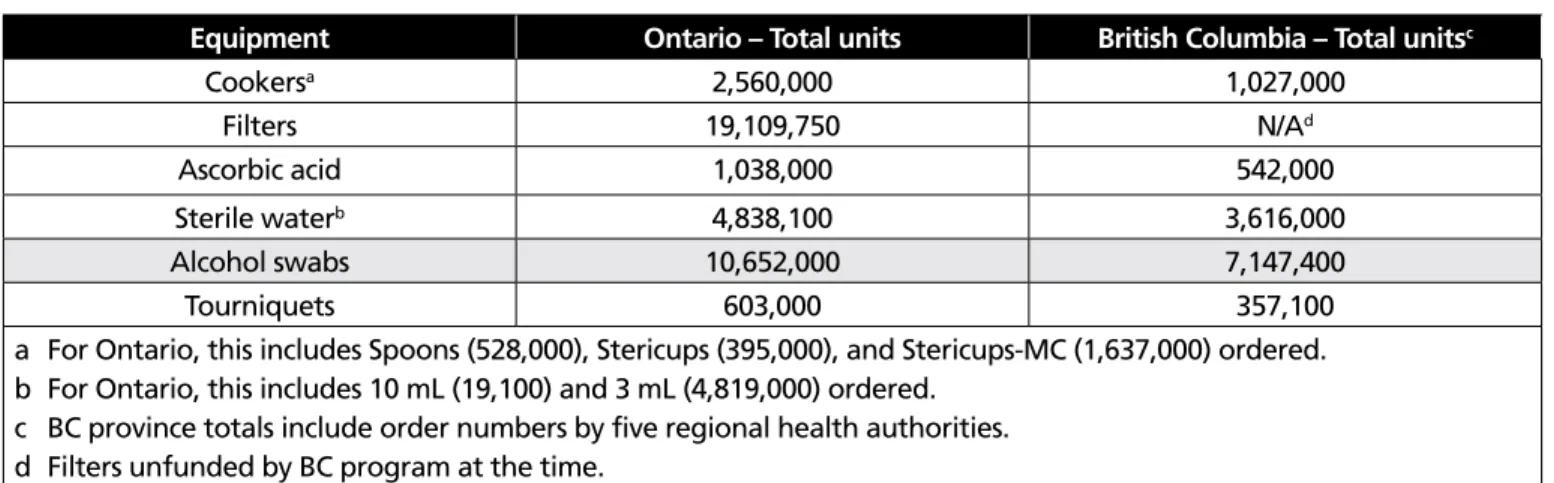
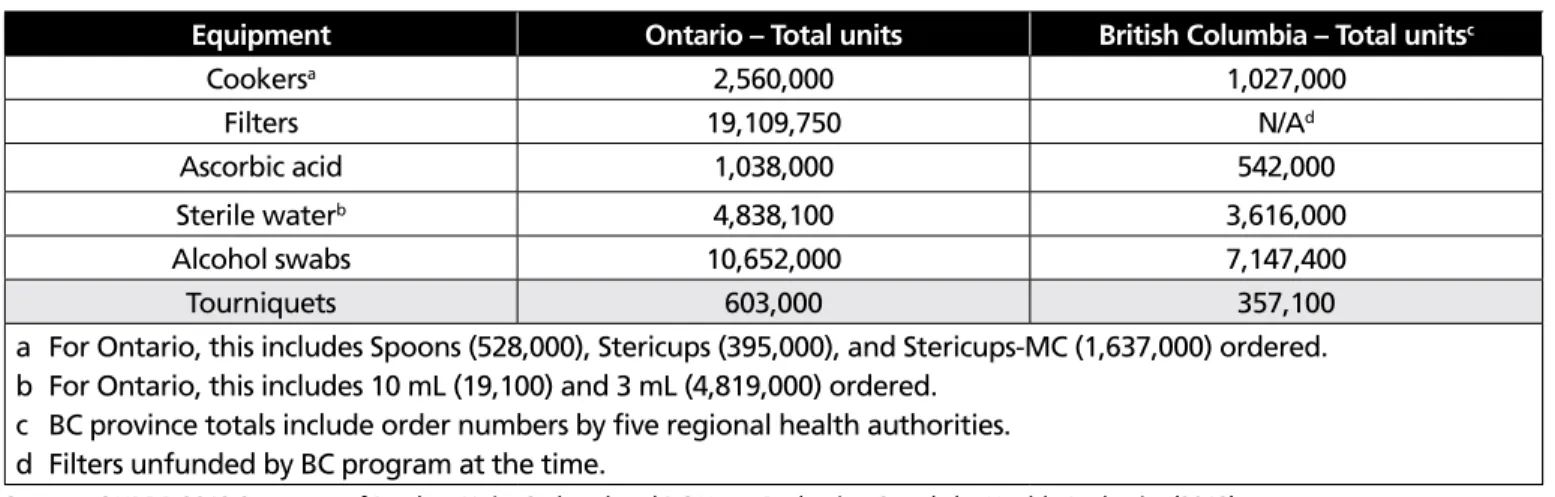
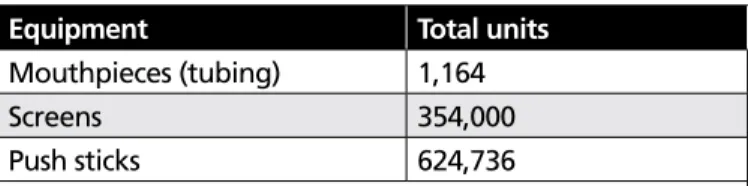
Available coverage estimates not only point to wide vari-ation across world regions and countries, but also suggest that coverage is very low (Mathers et al., 2010). national data about nSPs in canada is lacking. We can employ num-bers from British columbia (table 1.3) as an example of needle distribution volume and numbers from Ontario and British columbia (table 1.4) as examples of other injection equipment distribution volume. this type of information is made possible by having central distribution programs and tracking systems.
Table 1.1 HIV prevalence and incidence in Canada overall and among groups of people who inject drugs
2006 2007 2008 2009 2010 2011 2012
4,182,900 5,066,400 4,526,200 6,030,600 5,295,300 5,940,500 6,953,600 Bc province totals include order numbers by five regional health authorities. counts include syringes with needles attached and syringes without needles.
In Ontario, nSPs report a wide variation in levels of needle distribution. for instance in 2002, coverage ranged between 1 and 474 needles per person who injects drugs per year (Millson et al., 2005). On average in Ontario, it was estimat-ed that 53 neestimat-edles were distributestimat-ed per person who injects drugs per year (Millson et al., 2005). In Montreal, remis et al. (1998) estimated that nSPs distribute approximately 5% of the sterile needles required by people who inject drugs. Sim-ilarly, in Ottawa, Leonard et al. (2004) calculated that nSPs distribute 5% of the sterile needles required by people who inject drugs in that community.
contextual differences between canada and the united States (e.g., drug of choice, availability of needles from oth-er sources and legislative diffoth-erences) make needle covoth-er- cover-age comparisons problematic. nevertheless, u.S. nSPs also distribute a small proportion of the sterile needles required. A total of approximately 154 nSPs were in existence in the u.S. in 2000 (des Jarlais et al., in riehman et al., 2004). In a survey of 84 nSPs, Paone et al. (1999) found that only 10 exchanged 500,000 or more needles per year, and the most needles exchanged was approximately 1.5 million per year. A new sterile needle for each injection would require be-tween 1.25 and 1.6 billion needles per year (drucker et al., in Brahmbatt et al., 2000; Heimer 1998).
Being available when and where people need needles
evidence from a toronto study (Strike et al., 2005) showed that clients engage in different needle acquisition patterns. Some stockpile large numbers, others make sure they have enough for a week or two while others acquire needles on
a daily basis. Of these, day-to-day access is the most prob-lematic because this group is more likely to reuse, share or borrow needles. nSPs can facilitate access to sterile needles with varied modes of program delivery including fixed sites with extended open hours, mobile needle distribution, pharmacy distribution, peer distributors, home delivery, and vending machines. Vending machines, in particular, can offer increased access to sterile syringes during times when nSPs and other harm reduction services are closed (Islam et al., 2007, 2008; Mcdonald, 2009). Implementing nSPs where they are needed matters too. In a study of 456 people who inject drugs in Montreal, it was found that distance from nSP services was associated with high-risk injecting behaviour and the authors suggested that this finding confirms that nSPs were established where they are needed (Bruneau et al., 2008).
Other issues specific to needles
Dead-space syringesAll syringes contain some fluid or “dead-space” when the plunger is depressed (Strauss et al., 2006), but the amount of fluid depends on whether the needle is permanently at-tached or detachable. Syringes that have detachable nee-dles are usually high dead-space syringes (HdSS) as they re-tain fluid in the needle, needle hub, and syringe tip (Zule et al., 2009). Syringes with permanently attached needles are typically low dead-space syringes (LdSS) as fluid is only con-tained in the needle when the plunger is depressed (Zule et al., 2009). needle gauge and length also affect the amount of dead space.
Table 1.4 Total other injection equipment ordered in 2012
Equipment Ontario – Total units British Columbia – Total unitsc
cookersa 2,560,000 1,027,000 filters 19,109,750 n/Ad Ascorbic acid 1,038,000 542,000 Sterile waterb 4,838,100 3,616,000 Alcohol swabs 10,652,000 7,147,400 tourniquets 603,000 357,100
a for Ontario, this includes Spoons (528,000), Stericups (395,000), and Stericups-Mc (1,637,000) ordered. b for Ontario, this includes 10 mL (19,100) and 3 mL (4,819,000) ordered.
c Bc province totals include order numbers by five regional health authorities. d filters unfunded by Bc program at the time.
Sources: OHrdP 2012 Summary of Product units Ordered and Bc Harm reduction Supply by Health Authority (2012).
the dead-space in a syringe has important implications for risk of HIV and HcV transmission if the syringe is shared. there is a risk of transmission if fluid remaining in the dead space is contaminated with HIV, HcV and/or HBV and the syringe is reused by someone who is not already infected. After rinsing, HdSS can retain 1000 times more blood com-pared to LdSS (Zule et al., 2009). Studies have shown links between sharing HdSS and HIV and HcV prevalence (Zule et al., 2002, 2009). A mathematical modelling study suggests that even a small percentage of syringe-sharing involving HdSS can substantially increase the spread of HIV, especially in high-risk populations (Bobashev & Zule, 2010). HcV has been observed to survive in HdSS for up to 63 days (Paintsil et al., 2010), thus these types of syringes may be much more likely to transmit the virus. Zule et al. (2013) suggest that switching from HdSS to LdSS would be a simple and low-cost intervention that may help reduce HIV transmission “in countries with injection-driven epidemics” (p. 6) and recom-mend additional research.
Safety-engineered syringes
Safety-engineered syringes – also known as difficult to re-use syringes, single-re-use syringes, and one-re-use syringes – are designed to be used only once (e.g., the plunger cannot be retracted once it has been depressed or the needle retracts into the syringe). these devices can be “passive” whereby the user does not need to perform extra steps to engage the safety feature, or “active” whereby the user actively en-gages the safety feature. Potential benefits of safety-engi-neered syringes may include the prevention of needle reuse and sharing (and thereby less transmission of pathogens) and prevention of needlestick injury, including potential in-jury from publicly discarded needles. existing empirical liter-ature does not contain much information regarding the use of safety-engineered syringes among people who use drugs attending harm reduction programs; most of the literature focuses on their use to prevent needlestick injuries among healthcare workers in other health settings (e.g., tosini et al., 2010; Whitby et al., 2008). In British columbia, Work-SafeBc’s Occupational Health and Safety regulations now require that safety-engineered needles be used for medi-cal procedures to reduce needlestick injuries to healthcare workers; an exception to this is where “either the medical practitioner or patient would be at increased risk of injury” (http://www2.worksafebc.com/Pdfs/healthcare/faq_safety_ engineered_needles.pdf).
research on the use of safety-engineered syringes among people who inject drugs has highlighted a number of
con-cerns. des Jarlais (1998, 2000) reviewed the existing litera-ture on difficult to reuse syringe use among people who inject drugs and raised the following points:
• Any needle, regardless of design, can be reused. • difficult to reuse syringes are difficult to disinfect. • A faulty mechanism may misfire, resulting in
the loss of drugs.
• the mechanism prevents people who inject drugs from aspirating or “registering”, i.e., drawing blood into the syringe to check whether they have found a usable vein and then continuing with injection. • difficult to reuse syringes prevent “booting” or
“flag-ging” – a process of injecting part of the drug solution, then retracting the plunger to draw blood into the drug mixture and injecting again. It has been anecdotally reported that booting, flagging, and registering may be associated with risk for embolism. However, booting and flagging serve to extend the pleasurable effects of drug injection and people who inject drugs may want to repeat this process several times.
• A person cannot recover the drug if something goes wrong with an injection, e.g., if a vein collapses.
In Ottawa, a study looked at first impressions and reactions towards a safety-engineered product (the new Medical technology Safety Syringe) among 50 nSP clients (Oickle, 2008). Many participants made comments about plunger stiffness and difficulty with retracting the needle. As well, a concern arose around vein safety. At the time, it was recom-mended that the program not distribute safety-engineered syringes on the basis of safety, feasibility, liability, and cost concerns. Oickle (2008) also states that, “According to com-munication with other nSPs in canada, the uS and Australia and a preliminary review of worldwide studies, there are currently no programs distributing single-use safety syringes to the injection drug using (Idu) population” (p. 5). Overall, the report suggests that introduction of safety-engineered syringes would require further investigation and offers several other products as potential options for evaluation. A market scan subsequent to the report did not find any new products on the market (Oickle, personal communication, 2012).
Other organizations have published cautions regard-ing safety-engineered syrregard-inges as part of harm reduction among people who inject drugs (e.g., http://www.exchang- esupplies.org/article_retractable_and_safety_syringe_de-bate.php). given that nSP clients may not like or be able
to effectively use safety-engineered syringes, offering these syringes in place of regular syringes could potentially lead to regular syringes being reused and shared. Safety-engi-neered needles are also more costly than standard syring-es (Harm reduction coalition, 2010), so they may not be cost-effective for nSPs.
Use of bleach to disinfect injection equipment
In 2004, the WHO reviewed the scientific evidence concern-ing the effectiveness of bleach to disinfect used injection equipment and stated that bleach and other methods of disinfection are not supported with good evidence for re-ducing HIV transmission. As well, the WHO (2004) states that studies in the field cast doubt that disinfection procedures could ever be effective:
At best, these strategies can only be regarded as acceptable in community or correctional settings where the introduction of NSPs is considered im-possible because of fear or hostility on the part of community members or authorities. Public health practitioners in these settings should continue to advocate for the introduction of NSPs as the most reliable and evidence-based way of maintaining control of HIV among IDUs. (WHO, 2004, p. 28)
PHAc (2004) reviewed the evidence regarding the use of bleach to prevent the transmission of HcV, HBV, and HIV. PHAc (2004) concluded that although there is partial effec-tiveness, bleach disinfection offers little benefit to prevent HcV transmission among people who inject drugs. this re-port states, “Bleach distribution and education programs for people who use injection drugs must be careful not to impart a false sense of security regarding bleach’s protective efficacy” (p. 16). Since the publication of these two reports, there have been no new studies evaluating the impact of bleach to disinfect equipment.
A study of 2,302 people who use drugs in six urban sites in the united States (Monterroso et al., 2000) found that those who reported ever cleaning a needle with bleach were 3.70 times more likely (95%cI: 1.34-10.0) to become HIV infect-ed than other people who inject drugs. Monterroso et al. (2000) suggest that people who inject drugs who had tried to protect themselves from HIV transmission may not have done so consistently or correctly, or both.
Needle and syringe distribution evidence summary
the evidence that informs this chapter and its recommen-dations came from a variety of studies. Laboratory studies involving virologic testing have contributed much knowl-edge regarding the transmissibility of HIV, HcV, and other blood-borne pathogens via needles. cross-sectional stud-ies and prospective cohort studstud-ies were the main types of studies to contribute evidence on injection risk behaviours, while some qualitative interview studies have deepened our understanding of such risky practices. A few articles relied on randomized controlled trial (rct) designs to provide data on injection risk behaviours. While rcts are generally considered to provide the highest quality evidence for inter-ventions, it is not always feasible or ethical to conduct this type of research within populations or with harm reduction programs. this is recognised by a number of public health experts and authorities, for example:
[T]he difficulty of conducting a strictly randomized con-trolled trial to evaluate a public health intervention such as a NSP should not be underestimated. Potential sources of bias and confounding are impossible to control because of insurmountable ethical and logistical impediments. (WHO, 2004, p. 5)
[I]n some cases it is impossible for researchers to conduct RCTs since to do so would be unethical. Further, given the complexity of causal chains in public health, the external va-lidity of RCT findings often has to be enhanced by observa-tional studies. (NICE, 2009, p. 17)
review papers – including a few systematic and meta-an-alytic reviews – have covered a variety of topics including HIV and HcV seroconversion, infections and other health-re-lated harms among people who inject drugs, and program coverage. Other study designs (e.g., case-control, cost-ef-fectiveness, modelling) and other materials (e.g., manuals) provided information, but less frequently. Much of the evi-dence we reviewed for this chapter came from observation-al and other studies.