Excellence in Engineering Education:
Views of Undergraduate Engineering Students
C
RISTINAP
OMALES-G
ARCÍADepartment of Industrial and Operations Engineering University of Michigan, Ann Arbor
Y
ILIL
IUDepartment of Industrial and Operations Engineering University of Michigan, Ann Arbor
ABSTRACT
The purpose of this study was to understand the views and per-ceptions of engineering undergraduate students on engineering education. The method of content analysis was used to analyze the language used by engineering undergraduate students, and to extract the underlying common factors or perceived characteris-tics of “Excellence in Engineering Education.” These common factors were then used to identify and compare the similarities and differences in views between engineering students and per-spectives from three types of stakeholders in the field. Forty-seven undergraduate engineering students (17 females and 30 males) participated voluntarily in this study to answer four individual questions and ten group questions. The results showed that stu-dents strongly emphasized the importance of their own roles in the educational system and the value of instructional technology and real work examples in enhancing the quality of engineering education. The implications of the research results on excellence in engineering education are discussed.
Keywords:content analysis, excellence in engineering education, focus group
I. INTRODUCTION
During the 1990’s and continuing today, there has been a signif-icant movement towards understanding the issues that may affect the quality of engineering education. According to the National Academy of Engineering and other organizations, such as ABET, Inc. [1], many universities around the world have been making major efforts to: (1) recognize the challenges faced by engineering education programs, and (2) make changes to achieve what many are calling “Excellence in Engineering Education.” As one example of the programs developed recently, in 2002 the National Academy of Engineering launched the Center for the Advancement of Scholarship on Engineering Education (CASEE) [2]. Its purpose is to understand at a deeper level what should be taught in engi-neering and how to teach students by recognizing how they learn.
Through its research and activities, CASEE defines specific and measurable outcomes to challenge itself and the engineering com-munity to achieve its goal of excellence in engineering education. CASEE defines excellence in engineering education in terms of its effectiveness, engagement, and efficiency.
Along with institutional goals as standards of excellence, research in engineering education shows that an integral part of the process is providing undergraduates with opportunities to develop individual characteristics and skills that will positively impact the students’ fu-ture career. Rugarcia et al. [3] and Felder, et al. [19] both state that an integral part of an engineer’s profile is the development of knowl-edge, skills, and attitudes that dictate the goals toward which stu-dents’ skills and knowledge will be directed. From the perspective of faculty, Fromm [4] defines a detailed list of characteristics which fu-ture engineering graduates should possess to become leaders of the profession, including a strong foundation in basic sciences, mathe-matics and engineering fundamentals, and the capacity to apply these fundamentals to a variety of problems, among others.
Another example is the Millennium Project [5] at the Universi-ty of Michigan, which is a research laboratory designed for the study of the future of the American universities. The mission of this project is to “provide an environment in which creative students and faculty can join with colleagues from beyond the campus to de-velop and test new paradigms of the university.” The Millennium Project proposes some key characteristics of education in a society of learning, including being learner-centered, affordable, support-ive for lifelong learning, a seamless web, interactsupport-ive and collabora-tive, asynchronous and ubiquitous, diverse, intelligent, and adap-tive. They state that in the process of transforming the university, a balance should be achieved: among missions (teaching, research, service), among disciplines (liberal education, academic disciplines, and professions), among undergraduate vs. graduate vs. profession-al education (e.g., education vs. training), among sciences vs. humanities, and among life sciences vs. everything else. Ehrmann [6] summarizes the goal of engineering education as follows: “what un-dergraduate students need to learn or develop in the future is a combination of certain knowledge, skills, and wisdom.”
In the design of engineering systems and processes, the concept of user-centered design is widely used. This approach involves the user early in the design and evaluation of the system and its process-es. If we analyze our educational system and its goals from a human factors perspective then we would understand the importance of involving our students, which are the “users” of the system in the development and evaluation of our educational environments. Ac-cording to the National Survey of Student Engagement (NSSE) 2000 report [13], students learn more when they are intensely involved in their education; this is also seen in our classrooms where student-centered instruction [12] is playing a significant role.
Students are playing a significant role in shaping our learning envi-ronments, but this seems not to be the case when it comes to policy making. This is why it is important to ask whether the views, per-ceptions, and definitions of our undergraduate engineering students are aligned with the views proposed by different stakeholders in the field [2-6, 10, 12] on what is considered to be excellence in engi-neering education.
Few studies have looked into how undergraduate students define excellence in engineering education. Our study presents a thorough list of characteristics that define excellence in engineering education from the student’s perspective with the objective of developing a bet-ter understanding of these views and perceptions. In this paper we present the responses of our sample to four individual questions fo-cusing on excellence in engineering education, followed by the re-sponses to a focus group discussion. Student views are presented on topics including: student and professor roles, educational technolo-gy, goals and challenges of teaching engineering, and effective teach-ing methods, among others. The method of content analysis and keyword frequency count will be used to analyze the language used by engineering undergraduate students and extract the underlying common factors from the individual and focus group questions. Fur-thermore, we identify the similarities and differences in views on teaching engineering between engineering students and a random sample of three types of stakeholders in the field.
II. RESEARCH
METHODS
A. Focus of Study QuestionsThe questions addressed in this study were inspired by the litera-ture on engineering education from sources like ABET [1], the Na-tional Academy of Engineering [2], and work by Felder and col-leagues [3, 12, 19–21, 23]. We analyzed the literature and identified common threads, then developed a series of questions to gain in-sights into the perceptions and views of our undergraduate neering students. For example, the literature on excellence in engi-neering education stresses the importance of knowledge and skills [2, 3, 5, 6, 10]. Based on these examples from the literature we wanted to understand if the students perceived as part of their goal to learn knowledge and skills. With this goal in mind, we asked our students individually to describe their role in the college of engi-neering and to discuss as a group the goals of teaching engiengi-neering, and the types of skills and attitudes they need to learn.
B. Participants
Forty-seven University of Michigan undergraduate engineering students (17 females and 30 males) participated voluntarily in this study. The participants replied to ads and e-mails sent to all stu-dents in the college of engineering. To participate in this study, un-dergraduate students had to be 18 or older and enrolled in at least one engineering course. Each participant attended one of 12 focus groups, which lasted one hour. Each focus group had between three and eight participants of both genders. Each participant received a monetary compensation of $10.00 for their time.
C. Procedure
The participants were greeted individually and asked to read and sign a consent form to participate. The participants were first asked to answer four individual “brainstorming” questions, one question
at a time. They were asked to write on blank sheets of paper 10 words or phrases that came to their mind when they think about or hear a specific phrase. The phrases were: (1) excellence in engineer-ing education, (2) educational technology, (3) student’s role in the engineering college, and (4) professor’s role in the engineering col-lege. The participants had three minutes to write down their re-sponses for each phrase individually, and then return the sheets. Only for question one (phrase of “excellence in engineering educa-tion”) were the participants asked to rank all the words and phrases they wrote according to what they felt was more important for them. After answering the individual questions, the participants were asked to participate in a focus group discussion on ten ques-tions, which were asked by the experimenter and the responses were audio taped for transcription purposes.
Content analysis was the method used to analyze the data. This method is a research technique for analyzing text data and making replicable and valid inferences from data to their context [7]. Liu [8, 9] applies content analysis within the context of engineering aes-thetics, as a procedure to analyze selected texts with the aim of ob-taining useful insights into a research question and make inferences about their substantive problems. In this study, keyword frequency count was the content analysis index used to summarize the data. Keywords are words extracted from each participant’s responses and used to summarize the answers. The data are summarized by show-ing the number of occurrences of keywords for the individual ques-tions, and how these keywords were grouped into categories. As part of the analysis of the results, responses to the individual ques-tions and group discussion quesques-tions were analyzed by a group of five trained assistants. Each assistant individually assigned a key-word to each response for the individual or group discussion ques-tion. The keywords assigned by each trained assistant were then compared among the five assistants to choose the keyword that best described each answer. In the event there was a disagreement be-tween the assigned responses, a consensus was reached bebe-tween the five assistants after a discussion on the best keyword that would rep-resent the participant answer.
III. RESULTS
A. Individual Brainstorming QuestionsKeyword frequency values are shown below, for each of the four individual questions. The number shown next to a keyword repre-sents the number of times the specific keyword was recorded. If a keyword is not accompanied by a numerical value, then that key-word was not repeated among the different participants more than once. Ideally for each question there should be 470 responses, if each participant could write 10 responses for each of the questions during the allowed time.
1) What is Excellence in Engineering Education?This question generated a total of 410 words or phrases among the 47 partici-pants, which were grouped into the following 14 categories: char-acteristics or definitions of excellence (n 122), individual or per-sonal characteristics (n 58), general examples of excellence (n 47), personal and professional skills (n 39), resources (n 39), professor characteristics (n 21), knowledge (n 18), need for examples or real life application (n 16), community (n 15), hard work (n 13), hands-on (n 11), cost (n 5), grades (n 4), and degree (n 2). Each participant ranked their own
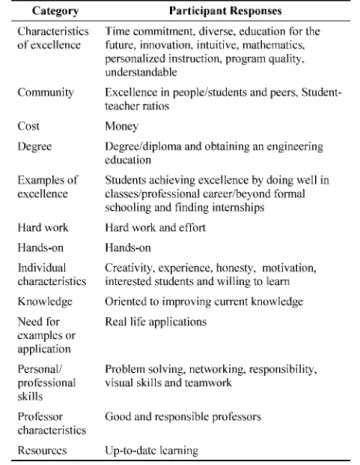
responses for this individual question from what they considered to be most important to the least important word or phrase. Table 1 presents a summary of the responses ranked as number 1 by the par-ticipants, when describing what is more important in excellence in engineering education. The participants of this study defined or characterized excellence in engineering education with the follow-ing keywords:
Accredited, accurate, analytical, applied and hands-on, challenging, changing, clear, commitment, communication, competitive, complex, comprehensive, constructive, cost-effective, current, demanding, detailed, different, diverse, efficient, ethical, hard work, hybrid, important, informative, innovative, integrative, interactive, international, intuitive, involved, leadership, mathematics, meaningful, modern, multidimensional, multidisciplinary, new, personalized, practical, precise, preparing for the future and long lasting, pressure, working towards prevention and safety, quality, reliable, reputable, involved in research, rewarding, robust, satisfaction, science, selective, simple, specialized,
stimulating, technical, understandable, unique, useful, varied, and well rounded.
From the total number of responses we can infer that this was an easy question for the students, since they were able to generate meaningful and insightful responses quickly.
2) What is Educational Technology?When the participants thought about educational technology they generated a total of 413
words or phrases that were grouped into eight categories, including: tools (n 126), general characteristics of educational technology (n 115), software (n 56), specific examples of educational tech-nology (n 55), Internet (n 42), application of educational tech-nology (n 11), research (n 6), and internships (n 2). The general characteristics category includes all the words and phrases that students used to define technology. The participants described educational technology as:
Advanced, different from lecture, engaging, hands-on, providing independence, interactive, could be used as help, increasing and facilitating knowledge, enhancing level of understanding, being up-to-date, and varied.
Interestingly enough, students perceived internships and re-search as tools or vehicles of educational technology. For the most part, the participants’ answers suggested either physical examples of technology or ways in which it is used. The answers given by the participants reflect a general misconception of educational technol-ogy, which is not only multimedia and audiovisuals, but it is a process of teaching and learning in itself.
3) What is the Student’s role?Thinking about themselves and their role in school, the participants generated 199 words or phras-es, which were grouped in 19 categories. On average, each student was able to write about four words or phrases. The number of re-sponses is important as it suggests that this was a difficult question or the allowed time was not enough for the participants to generate a list of 10 phrases or words. According to the participants, their role in the school was to be or to do certain things which are re-ferred to as self characteristics (n 38), to learn (n 34), be a stu-dent (n 24), contribute (n 23), prepare for the future (n 16), to mentor others (n 11), participate in extracurricular activities (n 9), develop skills (n 7), represent their race or college (n 7), pay tuition (n 5), earn a degree (n 4), make friends (n 4), do research (n = 4), have no impact at all (n 3), compete (n 2), network (n 2), experience college (n 2), make good use of resources (n 2), and maintain good grades. “Self-charac-teristics” was the keyword used to group all the words or phrases that the participants used to describe themselves within their role, for example:
Client, collaborator, colleague, consumer and customer, critic, a dependable teammate, designer, employer, engineer, and members of the engineering community.
Students also thought that their role was to evaluate staff and professors, feel significant/insignificant depending on size of class and attitude of professor, go through the process as “being on a con-veyor belt going through some education factory,” play sports, grow and be a better person, gain independence, interact with professors and graduate student instructors, “become better rounded,” repre-sent a minority, observe, participate, “live up to the high standards of the school to keep its reputation,” “make parents/family proud,” “prove I can make it,” be a speaker or teacher, ask questions, use resources, volunteer, work, and write.
From the study we observed the participant’s eagerness to an-swer, so the small quantity of responses for the question of student’s role and professor’s role (next question) should not be interpreted as an indifference to the questions or lack of importance.
Table 1. Summary of the responses ranked as number one for the “excellence in engineering education” question by category.
4) What is the Professor’s role?We gathered 216 words or phrases and 23 categories were generated to group the responses and key-words. These categories are related to characteristics of the profes-sors and their role in the college, including: to teach (n 29), to help (n 22), personal characteristics (n 20), to work in research (n 16), receive comments from students’ opinions (n 16), mentor (n 15), prepare (n 13), motivate (n 9), understand (n 8), be a model/inspiration (n 8), encourage (n 7), facili-tate (n6), explain (n6), be available (n 6), share informa-tion/knowledge (n 7), learn (n 5), educate (n 5), enforce (n
4), grade (n 4), develop personal relationships (n 3), create tests/homework (n 3), contribute (n 2), and be up-to-date with real world and technology (n 2).
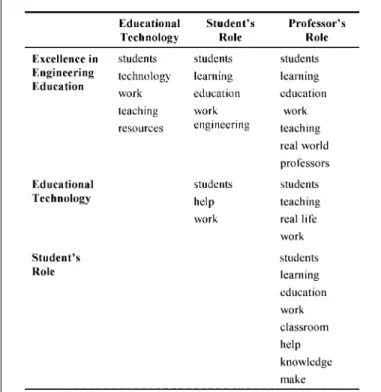
A comparison of the four individual questions is shown in Table 2. The words “students,” “learning,” “work” and “education” were the most commonly used keywords among the individual questions. “Teaching” and real life or “real world” were common words that appeared in the questions about excellence, technology, and profes-sor’s role. “Resources” was the only word shared between excellence in engineering education and educational technology. Possibly in the context of educational technology as a resource, and resources playing an important role in determining what is considered excel-lence in engineering education. “Help” and “knowledge” were two words that appeared in the responses of participants to the ques-tions of student’s and professor’s role in the college. The keyword “help” for the question concerning the student’s role was used in the context of helping others (n 9), helping school, just help (n 5), and helping themselves (n 3). For the question concern-ing the professor’s role the word “help” was used in the context of helping students to learn and acquire knowledge (n 6), facilitate growth, help with questions outside classroom (n 3), provide of-fice hours (n 4), help develop skills (n 2), help through e-mail and research, and help with career and when needed (n 3). In
Table 2, the uses of the keyword “make” suggest actions, which is not surprising because as participants are asked about roles, they will certainly need to talk about what it is that they need to do, which in-volves an action. Participants referred to the word “make” in terms of making human connections happen (friends and contacts), com-pleting a degree, and contributing. From the participants’ views of the professor’s role, the word “make” was used in the context of un-derstanding (make understandable), make adjustments, be aware, and make tests. Many of the usages were related to the act of “making things happen for students” (unidirectional), which is different from the participants’ perspective which took the viewpoint of mak-ing thmak-ings happen for themselves and others, as a bidirectional link.
B. Focus Group Discussion
During the focus group activity, the participants answered ten questions that were based on topics found in the literature [3, 6, 20–24]. The focus group questions were: (1) What are the types of interactions between students and professors? (2) What are the methods used to present information, and how would students like information to be presented? (3) What is the task of students in the classroom and what would students like to do in the classroom? (4) What are the current challenges in the teaching environment? (5) What are the goals of teaching engineering and what types of skills and attitudes do students need to learn? (6) What are the student experiences with alternative teaching methods? (7) What teaching methods do students feel work in the classroom? (8) How can a professor make students feel comfortable in the classroom? (9) How do professors learn? (10) What are students’ opinions on course evaluations? The results for each of the questions are shown below.
1) What are the types of interactions between students and pro-fessors?The focus group participants mentioned that interactions between students and professors were an individual choice. Stu-dents suggested that interactions occur through electronic mail, of-fice hours, and feedback obtained through graded homework. They perceived interactions were more likely to occur when the class is “not formal,” when the students feel comfortable, when the profes-sors are more approachable and encourage participation, when pro-fessors are “connected to the students making sure that students un-derstand each step” of the lecture and class material, and when students get the opportunity to have a more personal relationship with the professor. Another type of interaction occurs when stu-dents work in research projects with professors. A few participants mentioned that “PowerPoint use in the classroom is a method that decreases interaction between students and professors,” and “some times addressing questions in class delays the class and some ques-tions should be dealt with after class.”
These comments suggest that students are concerned with the types of interactions and the barriers that exist between students and professors. These barriers could be technological, environmen-tal, as well as personal.
2) What are the methods used to present information and how would students like information to be presented?The board, PowerPoint, handouts, overhead and transparencies, examples/ applications, lectures, Web sites, projects and presentations, inter-active activities, stories, anecdotes, general questions asked in class-room, and videos, were mentioned as common methods used to present information in the classroom. Occasional e-mails are used to communicate corrections and announcements to students out-side the classroom.
Table 2. Summary of the shared words used in answering the individual questions, comparing two questions simultaneously.
Students emphasized that they would like information to be pre-sented through examples, demonstrations, stories, Web sites, notes, any form of visual display, handouts, use of group work to write pa-pers, competitions, and oral presentations. Even though some of these methods are currently used in the classroom, they were men-tioned again by the students thus emphasizing their importance. Stu-dents like the traditional method of using the board and overhead transparencies and having an interactive teaching style. They said:
● Using the board or overhead transparencies, “help students to
see what the professor is writing, making it easy to see the pro-gression of ideas,” because “when using the board, professors tend to explain more than just going over the material.” Fur-ther, when students write down the information themselves, “it’s easier to remember, instead of just looking at it on a slide.”
● Having professors ask questions in class “makes you think
and process the information they are actually telling you.” Students also expressed interest in new technologies, including:
● Using instructional technology like the personal response
systems to “ask students questions in class, collect responses, and then provide immediate feedback.”
● Provide videos of the class lectures to review at home and
movie clips to explain and demonstrate concepts.
The use of PowerPoint in the classroom received negative re-sponses in general. For example, participants said that PowerPoint “appeals to only one type of learner, is hard to read and makes pro-fessors skip steps when explaining,” having “dimmed lights in class-room makes students feel tired,” and having “laundry lists of items” in a slide makes professors “stay too long at one slide and it gets bor-ing.” Outside the classroom, however, Power Point presentations may have great value when the presentations are made available on-line to assist student learning. This point is relevant as many univer-sities are trying to develop distance learning courses as well as digital libraries of all the courses offered on campus. These materials could be used by students to complement class material and allow stu-dents to go deeper into the content.
3) What is the task of students in the classroom and what would they like to do?Participants agreed that their primary task in the class-room was to take notes, participate and ask questions, pay attention, follow the professor, highlight concepts, learn, and “try to stay awake” when they “feel bored because there is nothing new.”
When students were asked what they would like to do in the classroom, their overwhelming responses were:
● see more application and examples and less lecturing ● participate in smaller classes, and increase interaction ● discuss homework problems in class as well as work more
problems in class
● have a balance between notes and lectures, and show visual
aids and examples of the real world application of what stu-dents learn in the classroom
These responses suggest the idea of active learning in the class-room and a shift from lecture-based courses to student-centered, application-based courses.
4) What are the challenges in the teaching environment?The com-mon challenges reported by the participants of this study were: keeping students focused, motivated and interested, having a proper class pace, making the material as understandable to the student as possible, trying to make science available in common layman terms so that the society and children could understand, professors having better time management skill to balance research and teaching, and
making both classes and the university environment more multidis-ciplinary. Other challenges mentioned by some of the participants include making education more affordable, dealing with limited re-sources, the professor’s teaching attitude and accessibility, a more flexible curriculum with more opportunities for internship and practice, language issues and requirements, retention of students, and the understanding of student learning styles.
5) What are the goals of teaching engineering and the types of skills and attitudes that need to be learned?The participants reported that one of the main goals of teaching engineering was to develop a basic knowledge and developing skills. The skills mentioned more often were problem solving, critical thinking, teamwork, communication, interpersonal relations and people skills, creativity, discipline, re-sponsibility, prioritizing, time management skills, writing skills, and applying technical knowledge, ethics, and theory in the learning process.
As part of the goals of teaching engineering, the literature sug-gests [3] that there is an attitude that is taught along with skills. Students in ten of the 12 focus groups suggested that indeed there was an engineering attitude being taught. This attitude includes ac-cepting mistakes, having common sense, ethics, high standards, un-derstanding that there is not always a right answer, being flexible, and having an open mind. From the student standpoint, patience, confidence, self trust, discipline, and persistence are other attitudes that students learn as engineers. Only two of the groups had differ-ent perspectives. One of the groups interviewed suggested that they did not believe teaching a certain attitude was part of the goals of teaching engineering. The other group suggested that attitudes are not learned from engineering education but students are helped to create their own attitudes. Certainly this is a topic that needs to be studied in more detail.
6) What are alternative teaching methods?The common experi-ence reported by the study participants was group work, followed by laboratory experiences, hands-on activities, and distance learning. However, many students also mentioned that “seating arrangement in big classrooms makes it difficult to work in groups,” and working in groups is time consuming. Also group work is seen from the per-spective that “it takes time away from class, and sometimes is done too soon after the material is introduced.” These concerns are simi-lar to concerns of faculty on the issues related to alternative teaching methods, specifically with active learning exercises. Students sug-gested including alternative teaching methods in the course sched-ule or syllabus. This is important as students believe that if they know about the activity and understand the purpose behind it, they would feel more motivated and engaged. Other methods suggested as alternative teaching methods were games, having in class presen-tations, using individual response systems (example of instructional technology), undergraduate research opportunity programs, use of movies and demonstrations, teaching Web sites, learning in mini-sessions, and explanation diagrams of lecture structure and organi-zation before giving all the details to students.
Students interviewed repeated and emphasized the use of exam-ples and real life applications as examexam-ples of alternative teaching methods, along with upper level courses like senior design, and teaching different view points of approaching a situation without imposing one way.
7) What are teaching methods that work in the classroom? Provid-ing examples/applications is an effective teachProvid-ing method, followed by presenting information in both concrete and abstract ways, clear
objectives, and recaps of information taught at the beginning or end of class are also methods that work. Students value when professors use interactive methods that break the monotony, when professors ask for questions at beginning of the lecture, when they teach using application versus theory, and when they are organized and provide space for students to mentor and help each other. Also when profes-sors are excited about the class, acknowledge things that are difficult and simplify the material, “feel the audience” to see if students are fol-lowing the lecture, and provide students with “time to soak” or time to let the newly presented material “be absorbed.” Also participants liked when breaks are given in classes that are more than two hours long, when students are engaged, when professors move around in the classroom, and when a comfortable environment is created.
8) How can a professor make you feel comfortable in the classroom?
The answer that participants mentioned most often was “know my name.” They also agreed that a professor being approachable, avail-able, and willing to meet made a great difference. Not only explaining simple assumptions made students feel more comfortable, but an-swering questions constructively and anticipating questions made a great difference. Participants also mentioned that they liked when professors approached students as equals and when they have a sense of humor. Participants agreed that professors should try to:
● be supportive to undergraduates ● “feel the audience”
● be excited about what they are teaching, along with keeping
students engaged
● get in the students’ position
● make mistakes and show how to fix them, allowing
them-selves to be more human
● be genuine about wanting to interact more with students ● greet students in the hall
● smile more often
● have graduate student instructors or teaching assistants come
to class and interact with students
In general, the participants agreed that most of the comfort issues had to do with the professor’s personality and demeanor in the class.
9) How do professors learn to teach?Common ideas expressed by participants on how professors learn to teach were the following:
● from student feedback and evaluations ● from their peers
● seminars, workshops and conferences ● trial and error
● sitting at other professors’ lectures ● experience and graduate school ● experimenting
● learning from research
● videotaping lectures to get feedback
Most participants do not feel learning was a concern, as “profes-sors learn because they have to and it is a requirement for teaching,” although some participants feel some professors may not have a strong motivation to learn to teach. These insights provided by the students are important and relevant as we can see that students know that most faculty members have no formal training in teach-ing. It is shameful to see that students believe that faculty learn to teach by “trial and error” and experimenting in the classroom.
10) What is your opinion on course evaluations?Although course evaluations were frequently mentioned by the participants as a way for professors to learn to teach, it is also one issue with mixed feelings. While many participants believed course evaluations are important,
they also agreed that course evaluations were done too late in the process and suggested mid-semester as a better time. One of the common remarks of the participants was that they did not know what the professors and the universities do with the evaluations after they were completed, particularly when there is a “high turnover of profes-sors.” Some of them also mentioned that they themselves lack moti-vation to participate in evaluations, since they would not benefit from the evaluations directly after having completed the course.
C. VIEWS OF
STAKEHOLDERS ANDUNDERGRADUATE
STUDENTS ONENGINEERING
EDUCATION
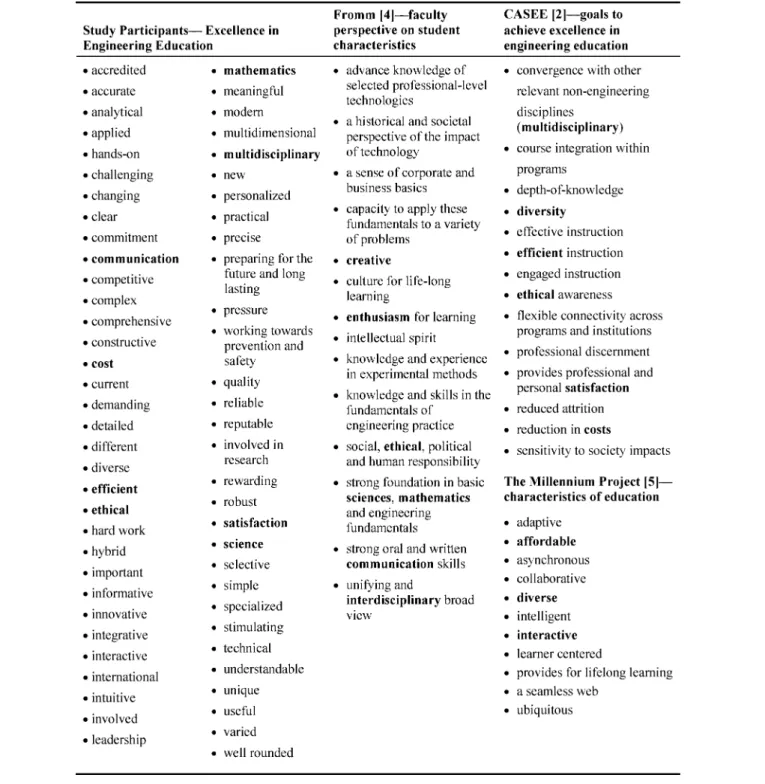
Table 3 shows a comparison of the results obtained from this study and three highly regarded perspectives taken from three types of stakeholders in the field. These stakeholders are represented by one educational researcher [4], a university-based project [5], and a national program [2]. Words in boldhighlight the similarities be-tween study results and researcher views. Only those common words were highlighted in the text. A detailed study of the different perspectives shows that there are many similarities between them but the language used varies, thus allowing the findings to be inter-preted in many ways. For example, the participants in the study de-scribed excellence in engineering education as multidisciplinary; while other perspectives describe excellence as being interdiscipli-nary [4], collaborative [5], and converging with other relevant non-engineering disciplines [2]. The differences in interpretation and terminology present a barrier that may hinder the communication in the field between researchers, programs, and university-wide projects. Few studies have looked into how students define excel-lence in engineering education. Our study presents a thorough list of characteristics that define excellence in engineering education from the student’s perspective.
IV. DISCUSSION
A. Individual Brainstorming QuestionsAs discussed earlier, research literature on excellence in engi-neering education stresses the importance of knowledge and skills [2, 3, 5, 6, 10]. It also includes institutional outcomes such as engagement in instruction and learning, increase of diversity with respect to underrepresented groups, ethical awareness and sensitivi-ty to sociesensitivi-ty impacts, professional and personal satisfaction with the value of having studied engineering, increasing retention rates, flex-ible programs that foster connectivity across programs and institu-tions, and reduction in costs [2].
Undergraduate student participants in this study reflected in their answers all of the ideas proposed in the literature, as they too mentioned knowledge and skills as integral parts of what is considered to be excellence in engineering education. However, the participants pointed out some ideas not reflected in the literature, including for example, the quality of the people/educational community, and the desire for more personalized instruction by de-creasing student teacher ratios.
In 1990 the Engineering Coalition of Schools for Excellence in Education and Leadership (ECSEL) was established with the pur-pose of renewing undergraduate engineering education and its infrastructure [11]. This coalition was interested in diversity, the
curriculum, and informal education, but did not consider the learn-ing community, materials, and technology which are some of the aspects that the participants of this study mentioned as relevant. The ABET criteria for accrediting engineering programs is one of the documents that most of the universities around the country use as their standard. This criteria includes a measure to assure quality of engineering education; stating that that the quality and performance of studentsis an important consideration in the evaluation of an engi-neering program. The criteria also state that the institutional support and financial resources needs to be adequate to assure the quality and continuity in the engineering program [1]. Overall, the criteria do not explicitly list the technology, the community, and the “quality”
of instructors as important factors in engineering education. Many requirements and descriptors are used to define the desired charac-teristics of instructors, but the word quality is not mentioned in the criteria to refer to instructors or professors.
Among three of the four individual questions, the word that had the most occurrence was “students;” and in the educational technol-ogy question it was the seventh most repeated word. From the human factors standpoint of honoring the user, it is a loud and clear message from the user population, or the participants in this study, that they are very important by constantly repeating the word “stu-dents.” This point is evident in student centered teaching/learning approaches [12].
In the National Survey of Student Engagement (NSSE) 2000 report [13], it was mentioned that students learned more when they are intensely involved in their education and have the opportunity to think about and apply what they are learning. The participants in the focus group considered that part of the their roles as students was to be to be a critic, to ask questions in class or contribute to class discussions, give class presentations; teamwork, work with class-mates in and outside of class; mentor, tutor or teach other students, extracurricular activities, participating in community-based pro-jects, participating in research propro-jects, and be exposed to diversity. In general, the more contact students have with their teachers the better; however, the NSSE report mentions that this does not occur very often, which is supported by our results. When students collab-orate with other students to solve problems or master difficult mate-rial, they acquire valuable skills that prepare them to deal with the problems they might encounter after college.
With the changing nature of the need for higher education, Duderstadt [10] proposes that “both young, digital-media savvy students and adult learners will likely demand a major shift in edu-cational methods, away from passive classroom courses packaged into well-defined programs and toward interactive, collaborative learning experiences, provided when and where the student needs the knowledge and skills…as the student is evolving into an active learner and eventually a demanding consumer of educational ser-vices.” The data collected in this study echo both the message on the role of new teaching techniques and approaches, and at the same time it shows that many traditional methods such as using a board to present a dynamic and interactive teaching session are most effective. Research has shown that interface design is an important issue in effective instructional technology and methods [14, 15].
B. Focus Group Discussion
1) Interaction between students and professors:When describing interactions between students and professors, many participants mentioned graduate student instructors first rather than professors. Many participants expressed that they had limited interactions with professors, and they hesitated to ask questions and had interactions only if professors were approachable. Figure 1 shows a visual repre-sentation of the interactions derived from this research study be-tween the reported roles of professors and students. These interac-tions shown in the figure (represented by arrows) are based on the results from the individual brainstorming questions about student roles and professor roles, and the results from the group discussion on the interactions between students and professors. Solid arrows represent reported interactions that work between students and pro-fessors; connections that are direct and solid. However, the connec-tion between the students and professors, represented by dashed lines, is severed and fragmented by many factors. These factors were
implicitly described by the participants in this study by describing the environment (e.g. class size and class dynamics), professors’ person-ality, and technology (e.g. e-mails).
In a report by the NSSE [13], five benchmarks were created to indicate the state of student engagement at different types of insti-tutions and by different types of students during the spring of 2000. These benchmarks were created for different questions on 100-point scales by summing all student responses to the question and multiplying the summed responses so that 0 is the lowest score and 100 the highest. One of the questions included in the survey mea-sured student interactions with faculty members and the differences between first-year students and senior students. The school where the seniors have the most contact with their teachers scored 59.4 and the lowest scoring school scored 23.1. For the first-year stu-dents, the lowest scoring school was 21.4 and the highest was 45.1, with 50 percent of the scores falling between 30 and 40 respectively. In this same research they found that at public doctorate-granting universities, 53 percent of first-year students and 35 percent of se-niors “never” discussed ideas from their readings or classes with a faculty member outside the classroom, and 79 percent of first-year students and 63 percent of seniors never worked with a faculty member in a venue other than classes (e.g., committees). This re-search shows quantitative data on the issue of interactions between students and professors supporting the results found in our study (see connections in Figure 1), which suggest that interactions be-tween students and professors are very limited. In the future, more data should be collected to understand the reasons behind the limit-ed interaction between students and professors.
There is a substantial body of research on effective teaching which documents the importance of student-faculty contact. Most of this research has focused on student ratings of classroom teaching [16]. They describe good teachers as approachable and interested in students, easy to talk to, and inviting of student views and discus-sion. Teacher-student contact characterizes good teaching and helps students attain a number of educational goals. In a recent study by Bjorklund, et al. [17] on the effects of faculty interaction and feedback and gains in students’ skills, the results show that fac-ulty interacting with and providing constructive feedback to stu-dents were significantly and positively correlated to stustu-dents’ self-reported gains in several design and professional skills. This study is relevant because, as mentioned before, one of the main goals of en-gineering education is to make students develop skills and knowl-edge. This study suggests the interaction between students and fac-ulty is one of the important factors that affect learning. Chickering and Ehrman [18] also stress the importance of interaction between student and professors suggesting “frequent student-faculty contact in and out of class is a most important factor in student motivation and involvement…knowing a few faculty members well enhances students’ intellectual commitment and encourages them to think about their own values and plans.”
2) Methods used to present information in the classroom: One clear message from the study participants was that the use of the board or writing on overhead transparencies in the classroom was preferred over PowerPoint presentations, since using the board showed the progression of ideas and gave the professor an opportunity to write down all the steps in the classroom, showing the process. Partici-pants agreed that effective instructors show clear objectives, a bal-ance between concrete and abstract information, and recapitulation or summary of the information presented either during the current
lecture class or the material from the previous lecture. This is con-sistent with Felder et al.’s [19] statement that instructors need to es-tablish relevance of course material and teach inductively by relating the material introduced in class to things students already know.
3) Goals of teaching engineering, and the types of skills and attitudes that need to be learned: The participants mentioned that one of the goals of teaching engineering is developing several skills. The skills they considered most important were critical thinking, problem solving, creativity, organization, and teamwork. They also men-tioned communication, discipline, responsibility, interpersonal rela-tions, time management, and writing skills.
A content analysis of Felder et al. [19] shows that the authors mentioned that acquiring a basic knowledge, skills, and attitudes are part of the goals that should be achieved in engineering educa-tion. The main skills mentioned by the authors were engineering problem-solving skills (n6); creative thinking (n5); team-work (n10); written and oral communication skills (n7); so-cial awareness (n3); and critical thinking (n6) which are all in accordance with the skills mentioned by the participants in our study. Whitmire [22] considers that the development of critical thinking skills plays a significant part of undergraduate education. In Whitmire’s study, students’ perception of gains in critical think-ing were mainly dependant of their perceived college environment, the student background characteristics, and the frequency of li-brary activities.
In order to attain the skills needed, students should be given practice and not just passively listen to what they are supposed to do, because people acquire skills most effectively through practice and feedback. Instructors should serve as coaches, providing con-structive feedback and encouraging reflection (recaps) to help stu-dents achieve the target attitudes and skills [23]. According to Woods et al. [23], the target skills are: communication skills, team-work (n2); management skills (n5); self-assessment (n5); problem-solving; and writing skills.
Fromm [4] also mentions in his article that students must pos-sess: a basic knowledge, capacity to apply, communication skills (n2), management skills, social and ethical responsibilities, in-terdisciplinary view, critical judgment skills and enthusiasm for learning, teamwork, and interpersonal relations.
The study presented by Bjorklund, et al. [17] examines the fac-ulty teaching practices that are positively related to gains in several design and professional skills, such as problem solving skills (n 4); teamwork (n 3); application in the real-world; communica-tion skills (n 4); and management skills. The study mentions the following as effective methods: working in small groups, hands-on projects, student-student and student-faculty collaborations, presentations, writing reports, providing feedback and academic advice.
4) Teaching methods that work in the classroom: The teaching methods that participants considered to be most effective were the presentation of: examples/applications in the classroom, clear objec-tives, information in both concrete and abstract ways, and recapping information. Students also valued when the professors were orga-nized and ask for questions at the beginning of a lecture. The study participants mentioned the following as interactive methods: work-ing in groups, in-class demonstrations, experiments, uswork-ing internet, and any type of activity that is hands-on. They also appreciated when the instructor acknowledged that things were difficult and helped the students simplify the material by providing handouts
and giving “time to soak.” These comments are consistent with what were proposed in Felder, et al. [19–21] who suggested doing recaps, using real world applications, giving clear objectives, work-ing in teams, providwork-ing handouts or a course pack, and uswork-ing the In-ternet, as teaching methods that work in the classroom.
5) Perspectives on course evaluations:Course evaluations are con-sidered to be one of the important measures of teacher success and course satisfaction. Participants suggested that the evaluations need to not only be a general course evaluation, but to approach teaching and methods used. In general, participants perceived evaluations to be standard and not asking questions that are relevant to the course they were taking. There was consensus among the participants about the personalized questions in the course evaluations. Students shared that asking open-ended questions in the evaluations was valuable for them as well as directly approaching students for feed-back.
V. CONCLUSIONS
When it comes to excellence in engineering education, the gen-eral feeling is that students would like to see more opportunities to give input to the system. Much can be learned from involving stu-dents in the process of educational/instructional development. It is very important to recall that students repeatedly emphasized that they are an important part of the system.
The word “example” was the one word that seemed to be most important to the participants of this study other than the word “stu-dents.” In the question about educational technology, the word “ex-ample” came up in the context of creating technology that is inter-active and provides real-life examples, and technology that allows teachers to illustrate examples. In the question on “excellence in en-gineering education” participants mentioned that excellence is asso-ciated with real life examples and providing more examples. For this question, the word “example or real life examples” was written by 32 percent of participants, and was also ranked by 71 percent of them as one of the top five priorities in comparison to the other ideas mentioned about excellence. During the focus group discussion, the word “examples” was mentioned by participants in four of the ten questions that were discussed. The results from this study show that it is important for students to see and work with examples in their engineering courses.
Research literature on excellence in engineering education stresses the importance of skills and knowledge, but leaves out the technology component and the building of relationships that seem to be important to the participants of this study. “Technology” was written by 16 of 47 participants in this study (34 percent) as one of the things that came to mind when they thought about excellence in engineering education.
This study provides concrete evidence that we need to attract not only policy makers, educational researchers, teachers, and industry, but that we need to get the students involved in the creative process so they can participate more in shaping their learning environment and creating a community of excellence. The study shows that the views of the students often overlap with, but are not always identical to, those of the educators. Further study of this issue with a larger sample of students with diverse backgrounds and characteristics would give us more insights into the definition, perception, and achievement of excellence in engineering education.
ACKNOWLEDGMENTS
We would like to thank undergraduate students Virginia Soto, Carolyn Bertelsen, and Kristin King for their assistance in this research.
REFERENCES
[1] Engineering Accreditation Commission (ABET), “Criteria for Accrediting Engineering Programs: Effective for Evaluations During the 2004–2005 Accreditation Cycle,” Baltimore, MD, accessible at www.abet.org, 2003.
[2] National Academy of Engineering, Center for the Advancement of Scholarship on Engineering Education, http://www.nae.edu/NAE, 1999.
[3] Rugarcia, A., R.M. Felder, D.R. Woods, and J.E Stice, “The Fu-ture of Engineering Education: I. A Vision for a New Century,” Chemical Engineering Education, Vol. 34, No. 1, 2000, pp. 16–25.
[4] Fromm, E., “The Changing Engineering Educational Paradigm,” Inaugural Bernard M. Gordon Lecture, Journal of Engineering Education, Vol. 92, No. 2, 2003, pp. 113–121.
[5] The Millennium Project, Media Union, University of Michigan, Ann Arbor, “Higher Education in the New Century: Themes, Challenges, and Opportunities,” Nagoya, Japan, July 22, 2002.
[6] Ehrmann, S.C., “Asking the Right Questions,” Change, Vol. 27, 1995, pp. 20–27.
[7] Krippendorff, K., Content Analysis: An Introduction to its Methodology, Beverly Hills, CA, Sage Publications v.5, 1980.
[8] Liu, Y., “Engineering Aesthetics and Aesthetic Ergonomics: Theo-retical Foundations and a Dual-Process Methodology,” Ergonomics, Vol. 46, No. 13/14, 2003, pp. 1273–1292.
[9] Liu, Y., “The Aesthetic and the Ethic Dimensions of Human Factors and Design,” Ergonomics, Vol. 46, No. 13/14, 2003, pp. 1293–1305.
[10] Duderstadt, J.J., “Higher Education in the New Century: Themes, Challenges and Options,” University of Southern California, Los Angeles, CA. (Speech), February 6, 2004.
[11] Engineering Coalition of Schools for Excellence in Education and Leadership (ECSEL), University of Washington, http://depts.washington. edu/mscience.
[12] Felder, R.M., and R. Brent, “Navigating the Bumpy Road to Student-Centered Instruction,” College Teaching, Vol. 44, No. 43–47, 1996.
[13] National Survey of Student Engagement, The College Student Report. “The NSSE 2000 Report: National Benchmarks of Effective Educational Practice”, 2000.
[14] Pomales-García, C., and Y. Liu, Web-Based Distance Learning Technology: The Impacts of Web Module Length and Format, The American Journal of Distance Education, Vol. 20, No. 3, 2006, 163–179.
[15] Pomales-García, C., and Y. Liu, “Web-Based Distance Technol-ogy: The Effects of Instructor Video on Information Recall and Aesthetic
Ratings,” International Journal of Instructional Technology and Distance Learning, Vol. 3, No. 3, 2006, pp. 55–70.
[16] Chickering, A.W., and Z.F. Gamson, “Applying the Seven Principles for Good Practice in Undergraduate Education,” New Directions for Teaching and Learning, Vol. 47, 1991, pp. 13–25.
[17] Bjorklund, S.A., J.M. Parente, and D. Sathianathan, “Effects of Faculty Interaction and Feedback on Gains in Student Skills,” Journal of Engineering Education, 2004, pp. 53–160.
[18] Chickering, A.W., and S.C. Ehrmann, “Implementing the Seven Principles: Technology as a Lever,” American Association for Higher Educa-tion (AAHE) Bulletin, 1996, pp. 3–6.
[19] Felder, R.M., A. Rugarcia, and J.E. Stice, “The Future of Engi-neering Education V. Assessing Teaching Effectiveness and Educational Scholarship,” Chemical Engineering Education, Vol. 34, No. 3, 2000, pp. 98–207.
[20] Felder, R.M., J.E. Stice, and A. Rugarcia, “The Future of Engi-neering Education VI. Making Reform Happen,” Chemical Engineering Education, Vol. 34, No. 3, 2000, pp. 208–215.
[21] Felder, R.M., D.R. Woods, J.E. Stice, and A. Rugarcia, “The Future of Engineering Education: II Teaching methods that work,” Chem-ical Engineering Education, Vol. 34, No. 1, 2000, pp. 26–39.
[22] Whitmire, E., “Undergraduate Students’ Development of Critical Thinking Skills: An Institutional and Disciplinary Analysis and Compari-son with Academic Library Use and Other Measures,” Association for the Study of Higher Education, Memphis, TN, 1996.
[23] Woods, D.R., R.M. Felder, A. Rugarcia, and J.E. Stice, “The Future of Engineering Education: III Developing Critical Skills,” Chemical Engineering Education, Vol. 34, No. 2, 2000, pp. 108–117.
[24] Wulf, W.M.A., and G.M.C. Fisher, “A Makeover for Engineering Education,” Issues in Science and Technology: Perspectives Online, 2002.
AUTHORS’ BIOGRAPHIES
Cristina Pomales-García, Ph.D. is an assistant professor at the Department of Industrial Engineering at the University of Puerto Rico, Mayagüez Campus. Her current research interests relate to studying human-computer interaction and the design of Web-based distance learning environments to understand how students learn. Dr. Pomales-García, received her B.A. degree in Psychology from the University of Puerto Rico at Mayagüez, and an M.S. and Ph.D. degrees in Industrial Engineering from the University of Michigan, Ann Arbor.
Address: Department of Industrial Engineering, University of Puerto Rico at Mayagüez, PO Box 9043, Mayagüez, PR 00681; telephone: (1) 787.265.3819; e-mail: [email protected].
Yili Liu, Ph.D. is the Arthur F. Thurnau Professor and associate professor of Industrial and Operations Engineering at the University of Michigan; e-mail: [email protected].