RDA Metadata Standards Directory Working
Group: Final Report
Alex Ball
Jane Greenberg
Keith Jeffery
Rebecca Koskela
Contents
Executive summary 3
1 Summary of working group activity 4
1.1 Problem addressed . . . 4
1.2 Goals . . . 5
1.3 Developing the directory . . . 5
1.4 Collecting use cases . . . 6
1.5 Achieving sustainability . . . 7
2 The Metadata Standards Directory 8 2.1 Using the directory to look up standards . . . 8
2.2 Developing the source code . . . 10
3 Use cases 12 3.1 Data Providers and Custodians . . . 12
3.2 Librarians . . . 12
3.3 Journal editors and funders . . . 13
3.4 Tool developers . . . 13
3.5 PURLs for standards . . . 13
4 Adoption 15
5 Maintenance and retirement plan 16
Executive summary
The Metadata Standards Directory Working Group set out to develop a directory that would enable researchers, and those who support them, to discover metadata standards that would be appropriate for documenting their research data, regardless of their academic discipline. It happened that a directory with similar aims had recently been developed independently by the UK Digital Curation Centre (DCC), so the group collaborated with the DCC on developing the directory further to achieve additional goals regarding coverage, ease of maintenance, and sustainability. The group provided updates and additions to the entries in the DCC directory, and developed a second instance of the directory that could be maintained by the community. Additions and updates to the second instance were and are fed back to the DCC version. The second instance was designed in such a way as to simplify any future development effort, and indeed such development is being taken forward by the Metadata Standards Catalog Working Group.As well as developing the directory itself, the group also collected use cases that will inform the work of the Metadata Standards Catalog Working Group, the Data in Context Interest Group, and the Metadata Interest Group.
1
Summary of working group activity
1.1 Problem addressed
The value inherent in shared research datasets can only be realized if peer re-searchers are able to identify, discover, contextualize, interpret and reuse them. They can only do this if the datasets are accompanied by metadata that describes, explains, and associates them with various other entities. When this metadata is missing or deficient, the dataset cannot be used to its full potential, and the schol-arly endeavor is poorer as a result.
There are several ways in which the metadata might be problematic. It might not exist at all. It might have to be deduced from unstructured text, a process which is prone to incompleteness and misinterpretation, and requires a level of human attention that is simply not scalable. It might conform to an ad hoc or unsuitable standard, making it inconsistent with the metadata for peer datasets. There may be a proliferation of standards for the given purpose, leading to incompatible silos of data and a dilution of community effort, such that no one standard gets a satisfac-tory level of support from training materials and tools (Tenopir et al.2011; Willis, Greenberg, and White2012).
Such problems can be avoided if researchers endeavor to use existing standards wherever possible, to create local profiles instead of new specifications if the ex-isting standards do not quite meet local needs, and to develop new standards only where there is a definite gap in provision. In order to be able to do this, researchers need access to comprehensive knowledge of the metadata standards that are in use, both within their own field and generally across all fields.
Directories of standards, often broader than metadata standards, have been compiled for a limited number of disciplines. The aim of this Working Group was to set up a directory that is comprehensive across all disciplines, so that it might serve
• researchers not already served by a directory; • researchers working across disciplines;
1.2 Goals
The Metadata Standards Directory Working Group had three goals:
1. Develop a Metadata Standards Directory that lists standards relevant for research data and is
• comprehensive, covering all disciplines and most generic applications; • easy for anyone to contribute to or update.
2. Define and develop use cases for research metadata, in order to optimize how standards within the directory are arranged and described.
3. Develop a plan for the long-term growth and maintenance of the directory.
1.3 Developing the directory
The original intention was for the working group to develop a new directory from scratch, using previous surveys and subject-specific directories as inspiration. It transpired, however, that in parallel with the establishment of the working group, the UK Digital Curation Centre (DCC) had independently developed its own Disci-plinary Metadata Catalogue1; this was launched in January 2013. On evaluating the resource and finding that it aligned closely with its own ideals, the working group entered into a collaboration with the DCC to adopt this resource and develop it further (Ball et al.2014).
In common with the goals of the working group, the DCC directory had compre-hensive disciplinary coverage while also catering for general applications, and was being actively maintained and updated. The areas in which the working group hoped to develop the directory were as follows:
1. Deepen the coverage of the directory within the disciplines already covered, extend the coverage to more disciplines, and broaden the utility of the direc-tory globally by including standards and profiles local to areas outside the UK.
2. Find ways in which the directory could be maintained by a wider group of volunteers, and to make the process of contributing entries more transparent. 3. Migrate the service and content to a platform more amenable to future
devel-opment.
The work of updating the directory was performed by two students, Sean Chen and Cristina Perez, within the School of Information and Library Science at the University of North Carolina, Chapel Hill, under the supervision of the chairs of the working group and with technical assistance from the DCC (Perez2013). The students conducted a survey in the latter part of 2013 to collect information on disciplinary metadata standards and associated resources. The survey instrument was a web form, a link to which was circulated via the mailing lists of various
stakeholder groups. A total of 41 responses were received, leading to the addition of 14 new standards, 4 new profiles, 13 metadata tools and 19 use cases to the directory, plus updates to a further 18 entries. The survey form2 remains available for inspection though it is no longer monitored.
The second and third areas were addressed by a reimplementation of the directory using the static site building tool Jekyll3 and hosted on GitHub Pages. A prototype was developed by Sean Chen and Kate Anne Alderete during the first half of 2014. Further work was conducted to make the directory production-ready in the first quarter of 2015, with editorial work from Adrian Ogletree and a new site theme contributed by Dustin Allen. There are several advantages to this implementation over the original DCC instance:
• New entries and updates can be logged visibly through the GitHub issue and pull request trackers.
• The entries themselves are encoded as plain text YAML4 files, meaning they are at once easily human readable and machine-interpretable. It also means they can easily be imported into alternative systems.
Further details of this implementation are given under ‘The Metadata Standards Directory’ below.
1.4 Collecting use cases
The working group developed use cases at its meetings held at Plenary 3 in Dublin and Plenary 4 in Amsterdam.
The use cases at Plenary 3 were focused on how various stakeholders – data cus-todians, librarians, journal editors, funders – might want to use the directory. The group also developed use cases concerning how the directory might be integrated into various relevant tools (e.g., for data management planning), and whether new services might be possible if the directory could be used as a register of persistent identifiers for metadata standards. Summaries of these use cases are provided under ‘Use cases’ below.
The use cases at Plenary 4 looked in detail at metadata standards in particular disci-plines. The intention was both to understand how researchers might want to search and browse for standards, and to understand how the elements within standards were related to particular applications or tasks. Four use cases were produced by the group, drawn from geospatial engineering, materials science (synchrotron data), hu-manities and the social sciences, and cultural heritage. These use cases are available from the Metadata Interest Group.
While the use cases did not provide the group with a strong steer about the imme-diate development of the directory, they helped to shape the thinking of the chairs about how to develop it into a machine-actionable catalog in a future phase.
2 http://bit.ly/1fToaqd 3 http://jekyllrb.com/ 4 http://www.yaml.org/
1.5 Achieving sustainability
The DCC directory forms part of the organization’s website, which raises some concerns about its sustainability:
• In order to protect the integrity of the main site, administrators must be cautious about granting the requisite rights to edit the directory.
• It is somewhat tricky to export the entries from the system while maintaining referential integrity.
• It would not be possible to redeploy the directory in short order should the DCC site become unavailable.
The development of the GitHub instance of the directory has opened up more possi-bilities for sustaining the directory into the future:
• Managing the pool of volunteer administrators is considerably easier since granting the requisite rights has no implications beyond the GitHub repository. There are inherent safeguards in the version control system to allow recovery from most problems.
• As mentioned above, exporting the entries from the system is as simple as copying a set of text files.
• Since the site is static, and generated by an open source tool from a set of text files, it would be simple to migrate it rapidly to another host should GitHub Pages cease to be hospitable.
2
The Metadata Standards Directory
2.1 Using the directory to look up standards
The Metadata Standards Directory1 is hosted on GitHub Pages. It supports four types of entries:
• standardsare the ‘top level’, independent metadata standards themselves; • extensions are profiles, variations or extensions of the metadata standards; • tools are pieces of software (e.g., libraries, applications, web services) that
automate some aspect of using a metadata standard or extension, such as creating an XML serialization from a form interface, or running a validation check;
• use casesare examples of organizations and services that use the metadata standards as a regular part of their operation.
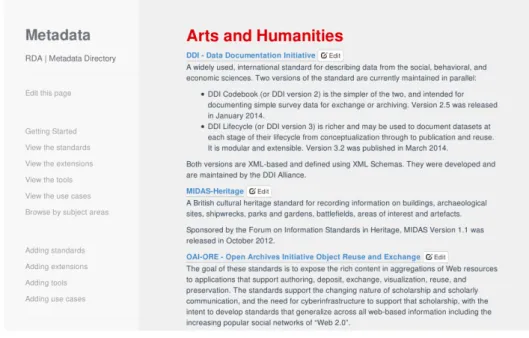
The directory provides a separate ‘view’ interface for each type of entry, wherein all the entries of that type are listed. The list is divided into broad subject areas – namely Arts and Humanities, Engineering, Life Sciences, Physical Sciences and
Mathematics, Social and Behavioral Sciences, and General Research Data – under which the corresponding entries are listed alphabetically. An entry may be listed under more than one area.
In each case, the entry is represented by a hyperlinked name, an edit button, and a description. In the case of standards, the hyperlink points to a display of the record for the standard; for all other entries, the hyperlink points to the home page for the extension, tool or organization. The edit button is provided so that if users find the description to be erroneous, outdated or incomplete, they can immediately bring up the underlying YAML file for editing. In order to be able to use this facility, users need a (free) GitHub account. Maintainers can make changes directly, while other users need to submit their changes using the pull request mechanism, for which GitHub provides a friendly interface.
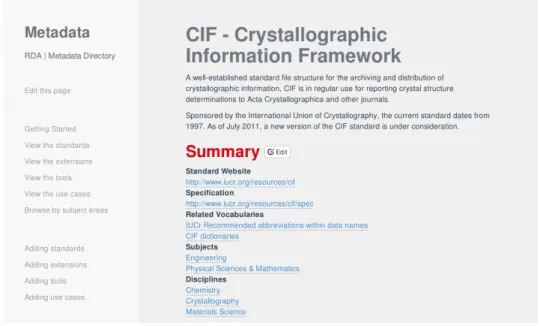
Each standard has its own record page. It begins with a recapitulation of the descrip-tion, followed by a set of summary information:
Figure 2.1: List view of the standards included in the directory.
• Links to the full specification for the standard, and to an official website or webpage where more information may be found
• A link to the organization that maintains the standards, if this is distinct from the above
• The current version number and date of last update • Vocabularies commonly used with the standard • Mappings to or from other standards
• A contact email address for queries concerning the standard
• Broad subject areas and specific disciplines in which the standard is commonly used
Again, an edit button is provided for quick access to the underlying YAML file. Lastly, the extensions, tools and use cases related to the standard are listed, again in the form of name, edit button, and description.
In truth, the other entries also have record pages, but since they only provide a name, description and link – and thus do not add value beyond what is provided in the listing – they are not promoted. There is no reason in principle why these other entries may not be expanded and the record pages used, should the user community wish it.
One other browsing pattern is supported: browsing by subject area. An index is provided of the subject areas and disciplines used to classify entries. For each of them, a further index page is provided that lists all the standards, extensions, tools and use cases associated with that subject area or discipline.
Figure 2.2: Beginning of the record page for a metadata standard.
2.2 Developing the source code
The source code for the directory2 is hosted on GitHub, and versioning is controlled using Git3.
2.2.1 Branching policy
The source code repository has two branches: master andgh-pages. The latter is checked periodically by GitHub Pages and is used to regenerate the site. The sug-gested workflow for developing the directory is as follows (please consult the Git documentation for an explanation of terms):
1. Checkout themaster branch and pull in any upstream changes.
2. Merge in any changes from the origin/gh-pagesbranch. Note that users who have added or edited files using the links on the directory pages will have made those changes directly to the gh-pagesbranch.
3. Make changes in themasterbranch. It is possible to test the changes by in-stalling a local copy of Jekyll4 and running it on your local files. Commit and push your changes as and when you are ready.
4. When you are ready to deploy the changes, checkout thegh-pagesbranch, pull in any upstream changes, then merge in the changes from yourmaster branch. Finally, push your changes upstream.
2 http://www.github.com/rd-alliance/metadata-directory 3 http://git-scm.com/
2.2.2 Arrangement of source code
In the top-level directory, the important files are these:
• README.md contains the high-level documentation for the directory, and is displayed by GitHub when visiting the source code repository in a browser. • _config.yml contains settings that tell GitHub Pages how to generate the site,
and the social media links displayed in the sidebar navigation. • LICENSE contains the license terms for the code.
Static files related to the site theme are stored in thecss,fonts,images,js, andswf directories.
The_layouts directory contains templates for different types of pages, written using the Liquid template language5:
• The front page uses thedefault.html layout.
• The ‘Getting started’ page uses theabout.html layout.
• The layouts for the lists of subjects, standards, extensions, and so on are con-trolled partly bylinks.html and partly by theindex.md files in thesubjects,
standards,extensions,tools, anduse_cases directories respectively. • The entry records themselves use thestandard.html,extension.html,
tool.html, anduse_case.html layouts respectively.
• The subject- and discipline-specific lists of entries use thesubject.html lay-out.
• The pages that explain how to add entries use theadd.html layout.
The_includes directory contains snippets of content that are injected into the various layouts. The following are of particular interest:
• header.html andfooter.html contain the HTML that wraps around the con-tent of all pages. In particular, header.html includes the sidebar navigation and footer.html contains the list of maintainers.
• greeting.html contains the content of the front page.
• standard.yml,extension.yml,tool.yml, anduse_case.yml contain, respec-tively, the YAML templates for the four entry types.
The entries themselves are stored in thesubjects,standards,extensions,tools, anduse_cases directories. The entries are saved as Markdown files (with extension
.md) to ensure they are recognized by Jekyll as pages, but in fact they are empty apart from a block of YAML data. The subject areas and disciplines used to catalog entries are also registered using Markdown files that contain only YAML data; these are kept in thesubjects directory.
These last five directories also contain some additional files, namely the aforemen-tionedindex.md pages andadd.md pages that explain how to add entries.
3
Use cases
The following are summaries of the use cases discussed at Plenary 3. Note that the majority of them were not within the scope of the Metadata Standards Directory, but suggested how the development of the directory might be taken forward in a future phase.3.1 Data Providers and Custodians
As a data provider or custodian, I would like to use the Directory…
• …to compile guidelines on the standards that the repositories/archives within my federation should use. I would particularly like to know where mappings exist between standards.
• …to analyze which standards are commonly used by other communities, institutions or archives.
• …to search or browse for metadata standards by what they describe – physical artifacts, video, etc.
• …to compare standards side-by-side, especially to identify commonalities between the standards of different communities.
• …to obtain recommendations of standards to use based on criteria I provide. • …to search or browse standards by fine-grained tags relating to specialisms
within disciplines.
• …to discover the persistent ID for a standard, so I can directly link to it. • …to discover tools to create metadata based on a standard such as DataCite.
3.2 Librarians
As a librarian, I would like to use the Directory…
• …to discover ways of adapting a standard to a local need, perhaps by inspect-ing other profiles of the standard in which I am interested to see how they did it.
3.3 Journal editors and funders
• As a journal editor, I would like to use the Directory to identify what stan-dards exist, and check their maturity and level of support, so I can implement them in my journal’s (or publisher’s) tools and databases, and include them in the journal’s author guidelines.
• As a funder, I would like to use the Directory to find out of which standards we have funded the development, whether they are widely used, whether they have been kept up to date, and whether they be merged into other standards. • As a journal editor or funder, I would like the Directory to provide me with a
clustering of standards that are relevant to my domain.
3.4 Tool developers
As a tool developer, I would like to be able…
• …to submit sample content to the Directory (such as a whole or partial data set) and retrieve a list of metadata standards which could appropriately be used to document that content.
• …to submit a set of field names to the Directory (stripped, perhaps, from an existing metadata record) and retrieve the metadata standard from which they originate.
• …to use tools and services provided by the Directory to map between and align similar ontologies. (This use case may now be better addressed by the Vocabulary Services Interest Group.)
• …to use the Directory to convert between schemas automatically. • …to identify implementors of specific standards using the Directory.
• …to request from the Directory a sample of metadata records adhering to a specific standard.
• …to submit to the Directory the properties (or perhaps certain content) of a data management plan being composed in a tool such as DMPonline or DMPTool, and retrieve a list of appropriate metadata standards to suggest to the user.
3.5 PURLs for standards
As a tool developer, I would like…• to use the Directory to look up identifiers for metadata standards so I could use them to identify the source and destination of metadata crosswalks. These identifiers should be implemented as persistent URLs such that anyone fol-lowing the URL would be able to retrieve machine-readable data about the standard.
• to submit a PURL identifier for a metadata standard to the Directory and retrieve the specification for the standard.
• to submit a pair of PURL identifiers for metadata standards to the Directory and retrieve a suggested migration pathway (i.e., a chain of one or more tools or mappings) between them, with some indication of possible loss of information.
4
Adoption
The Metadata Standards Directory is closely tied to the DCC Disciplinary Metadata Catalogue; while the information they contain is not identical, their coverage is the same and they are kept synchronized. The important point is that information that is contributed to the GitHub directory is also pulled into the DCC directory, and in this sense the DCC can be said to have adopted the outputs of the working group. Similarly, the records in the Metadata Standards Directory have also been imported into the Community Inventory of EarthCube Resources for Geosciences Interoperabil-ity1.Usage figures are not available for users browsing the GitHub directory, but we can offer some idea of the impact of the information therein by indirect means. The Disciplinary Metadata Catalog is the third most popular part of the DCC website with 27 355 visits in 2015. This accounts for 6% of the traffic to the DCC website and makes it the third most popular section after the events section (14%) and the How-to Guides section (9%).
The DCC directory is recommended as a resource under the heading ‘Identify and use relevant metadata standards’ in the DataONE Best Practices Database. This database attracts 16 500 users and 20 250 sessions per quarter.
The DCC directory has helped some groups in Europe reach decisions to adopt certain metadata standards:
• various groups have adopted DCAT;
• various projects using European Space Agency data have adopted INSPIRE, the European profile of ISO 19115;
• some university biology departments now use Darwin Core; • some social science departments have moved to using SDMX;
• some universities linked to the UK Data Archive provide support for using DDI. The GitHub directory has attracted a modest amount of attention from contributors; to date there have been 25 updates or additions suggested through the issue tracker and 21 contributed through the pull request mechanism.
5
Maintenance and retirement plan
The GitHub directory continues to be maintained by a team of volunteers including Kate Anne Alderete, Alex Ball, Sean Chen, and Adrian Ogletree. Further devel-opment of the directory will take place within the Metadata Standards Catalog Working Group, which among other things aims to make the content easier for auto-mated tools to query and act on. Once this has been achieved the resource will be renamed accordingly.It is possible, even likely, that the Metadata Standards Catalog will not be hosted in the same way as the current Metadata Standards Directory. In which case, the home page of the current directory will be maintained for as long as possible with links directing visitors to use the catalog instead.
The DCC will continue to maintain its Disciplinary Metadata Catalogue in paral-lel with the GitHub version for the time being. Notifications have been arranged between the DCC and GitHub editors so that each are informed of changes made by the other. It is understood that if and when the forthcoming Metadata Stan-dards Catalog achieves a sufficient level of maturity, the DCC Disciplinary Metadata Catalogue will be retired in favor of it.
References
Ball, Alexander, Sean Chen, Jane Greenberg, Cristina Perez, Keith Jeffery, andRebecca Koskela. 2014. “Building a Disciplinary Metadata Standards Directory.”
International Journal of Digital Curation 9 (1): 142–151. doi:10.2218/ijdc.v9i1 .3081.
Perez, Cristina I. 2013. “The RDA’s Metadata Standards Directory: Information gathering.” Unpublished master’s paper, University of North Carolina, Chapel Hill.
Tenopir, Carol, Suzie Allard, Kimberly Douglass, Arsev Umur Aydinoglu, Lei Wu, Eleanor Read, Maribeth Manoff, and Mike Frame. 2011. “Data Sharing by Scientists: Practices and Perceptions.”PLoS ONE 6 (6): e21101. doi:10.1371/ journal.pone.00211012.
Willis, Craig, Jane Greenberg, and Hollie White. 2012. “Analysis and Synthesis of Metadata Goals for Scientific Data.”Journal of the American Society for Informa-tion Science and Technology63 (8): 1505–1520. doi:10.1002/asi.226833.
1 http://dx.doi.org/10.2218/ijdc.v9i1.308
2 http://dx.doi.org/10.1371/journal.pone.0021101 3 http://dx.doi.org/10.1002/asi.22683