Master’s Programme in Computer Science
Reasoning over Assumption-Based
Argumentation Frameworks via Answer Set
Programming
Tuomo Lehtonen
December 10, 2019
Faculty of Science
University of Helsinki
Prof. Matti J¨arvisalo, Dr. Johannes P. Wallner Examiners
Prof. Matti J¨arvisalo, Dr. Johannes P. Wallner
Contact information
P. O. Box 68 (Pietari Kalmin katu 5) 00014 University of Helsinki,Finland Email address: [email protected]
Faculty of Science Master’s Programme in Computer Science
Tuomo Lehtonen
Reasoning over Assumption-Based Argumentation Frameworks via Answer Set Programming
Prof. Matti J¨arvisalo, Dr. Johannes P. Wallner
MSc thesis December 10, 2019 50 pages
Argumentation, Assumption-Based Argumentation, Answer Set Programming
Helsinki University Library
Algorithms study track
Formal argumentation is a vibrant research area within artificial intelligence, in particular in knowledge representation and reasoning. Computational models of argumentation are divided into abstract and structured formalisms. Since its introduction in 1995, abstract argumentation, where the structure of arguments is abstracted away, has been much studied and applied. Structured argumentation formalisms, on the other hand, contain the explicit derivation of arguments. This is motivated by the importance of the construction of arguments in the application of argumentation formalisms, but also makes structured formalisms conceptually and often computationally more complex than abstract argumentation.
The focus of this work is on assumption-based argumentation (ABA), a major structured for-malism. Specifically we address the relative lack of efficient computational tools for reasoning in ABA compared to abstract argumentation. The computational efficiency of ABA reasoning systems has been markedly lower than the systems for abstract argumentation. In this thesis we introduce a declarative approach to reasoning in ABA via answer set programming (ASP), drawing inspiration from existing tools for abstract argumentation. In addition, we consider ABA+, a generalization of ABA that incorporates preferences into the formalism. The com-plexity of reasoning in ABA+is higher than in ABA for most problems. We are able to extend our declarative approach to some ABA+ reasoning problems. We show empirically that our approach vastly outperforms previous reasoning systems for ABA and ABA+.
ACM Computing Classification System (CCS)
Computing methodologies→Artificial intelligence→Knowledge representation and reasoning Theory of computation→Logic→Constraint and logic programming
Tekij¨a — F¨orfattare — Author
Ty¨on nimi — Arbetets titel — Title
Ohjaajat — Handledare — Supervisors
Ty¨on laji — Arbetets art — Level Aika — Datum — Month and year Sivum¨a¨ar¨a — Sidoantal — Number of pages
Tiivistelm¨a — Referat — Abstract
Avainsanat — Nyckelord — Keywords
S¨ailytyspaikka — F¨orvaringsst¨alle — Where deposited
1 Introduction 1
2 Assumption-based Argumentation 5
2.1 ABA . . . 5
2.2 ABA Reasoning Problems . . . 9
2.3 Relating Forward-derivability and Tree-derivability . . . 11
2.4 ABA+: ABA with Preferences . . . . 12
3 Systems for Reasoning in ABA and ABA+ 16 4 Properties of ABA and ABA+ 19 5 Answer Set Programming 23 5.1 Answer Set Programs . . . 23
5.2 ASP Solvers and Additional Features . . . 24
6 ASP for Reasoning in ABA 26 6.1 Stable, Admissible, Complete, and Preferred Semantics . . . 28
6.2 Ideal Semantics . . . 29
7 ASP for Reasoning in ABA+ 32 7.1 <-Stable Semantics . . . 32
7.2 <-Grounded Semantics . . . 33
8 Experiments 36 8.1 Benchmarks . . . 37
8.2 Comparison with Existing Systems . . . 39
8.3 Scalability of the ASP Approach . . . 40
Formal argumentation is a vibrant research area in artificial intelligence, in particular within knowledge representation and reasoning [3, 4]. The aim is to draw conclusions from inter-nally inconsistent or incomplete knowledge bases using formalisms in which reasoning can be done algorithmically. Thus in contrast to for example classical logic, formal argumenta-tion represents defeasible reasoning, where new informaargumenta-tion may revoke previously reached conclusions. Various formalisms of non-monotonic reasoning have in fact been shown to be captured by an argumentative approach [22]. In addition to providing a different approach to other formalisms, formal argumentation has applications in various domains [1], such as legal, medical [16, 18], and e-government, as well as multi-agent systems [31].
Argumentation formalisms divide into abstract and structured approaches. The main model to abstract argumentation is provided by abstract argumentation frameworks (AFs), where the components are atomic arguments and attacks between arguments [22]. That is, the structure of arguments is not visible. Attacks signify conflicts between arguments: an argu-ment that attacks another can be seen as a counterarguargu-ment to the arguargu-ment it attacks. The power of abstract argumentation is in its simplicity: an AF is a graph where the nodes are the arguments and the edges are the attacks. The basic reasoning mode for AFs is to determine sets of arguments that are jointly acceptable. Which sets of arguments are acceptable de-pend only on the attack relation and the chosen criteria for accepting arguments, the latter of which is called semantics. There are multiple central semantics, and the choice of semantics depends on the application. For example, a set of arguments is acceptable according to the admissible semantics if the set attacks every argument that attacks it, and does not attack itself.
In contrast to AFs, in structured argumentation formalisms the structure of arguments is explicit in the formalism and depends on other elements, usually a form of premises and a deductive system [7]. Attacks are also typically constructed from other elements of the formalism, such as a notion of what contradicts a specific premise. Making the structure of arguments and attacks explicit is a more realistic way of representing an argumentative scenario. Intuitively arguments most often have multiple components, such as premises, sup-porting facts, and rules for deriving new facts. What makes an argument conflict with another one also depends on the components of each argument. Due to the conceptual richness of structured formalisms, a knowledge base may be easier to represent using a structured ar-gumentation formalism instead of first applying other methods to construct arguments and attacks and then representing them as an AF. In other words, structured argumentation formalisms allow for representing the knowledge base in a format more closely resembling the data. The explicitness of the structure of arguments and attacks makes the complex-ity of reasoning in structured argumentation formalism in many cases higher than it is in abstract argumentation [28]. There is a multitude of proposed structured argumentation formalisms, including assumption-based argumentation (ABA) [9, 20, 23, 61], ASPIC+ [50,
51, 54], Defeasible Logic Programming (DeLP) [36, 35], deductive argumentation [6, 5], and Carneades [43].
We focus on ABA in this thesis. An ABA framework consists of assumptions, rules, sen-tences and contraries. Deductions of sensen-tences are made from assumptions via the rules, and assumptions can be attacked by the contrary of the assumptions, contraries being sentences. Whereas in abstract argumentation sets of arguments are jointly accepted according to
se-mantics, in ABA the semantics sanction acceptable sets of assumptions. Attacks are defined
between sets of assumptions: if a set of assumptions derives the contrary of some assump-tion, the set of assumptions attacks this assumption and all assumption sets containing the attacked assumption. Similarly to abstract argumentation, ABA has various semantics. An acceptable set of assumptions is such that the assumptions together do not derive a contrary of any of the assumptions in the set, and in addition fulfil some further criteria enforced by the chosen semantics. Some applications of ABA include medical decision making [16, 18], decision making in a multi-agent context [31], and game theory [30].
The development of reasoning systems for argumentation formalisms has focused more on abstract argumentation than on ABA or other structured formalisms [13]. There are mul-tiple efficient implementations of reasoning with AFs, including specialized algorithms and declarative methods. A competition for AF reasoning systems (International Competition on Computational Models of Argumentation, ICCMA) has been held every two years since 2015 [59, 34, 44]. Notably, the most efficient solvers are usually based on a declarative ap-proach [13]. In declarative programming, a problem is modelled as another formalism, solved with a solver designed for that other formalism, and the answer to the original problem is interpreted from the solution. For example, approaches based on propositional satisfiability (SAT) [8] solving and answer set programming (ASP) [42, 52, 10, 39] have been widely used for reasoning in abstract argumentation [13]. This is motivated by a number of central rea-soning problems in abstract argumentation being NP-hard [28] and by SAT and ASP being successful tools for solving NP-hard problems (NP-complete problems directly and problems beyond NP via iterative calls to solvers). These approaches consist of encoding the problem as propositional logic or as a logic program and using a SAT or an ASP solver, respectively, to solve the encoded instance. The answer to the original problem instance can be inter-preted from the answer to the encoded instance. The solver technology for both of these is similar. Clingo, a state-of-the-art system, incorporates most of the techniques of modern conflict-driven clause learning SAT solvers [37].
In contrast to abstract argumentation, there are relatively few reasoning systems for ABA [13] and no solver competitions. The state-of-the-art systems for ABA are abagraph [14] and aba2af [46]. Abagraph implements a specialized algorithm for certain semantics and problems of ABA while aba2af translates ABA frameworks to AFs in order to make use of AF solvers. However, neither of the systems are purely declarative; in translation-based systems the AF part can be solved declaratively, but the translation is a non-trivial algorithm in itself. The resulting AF can also be much larger than the input ABA framework. Since many central ABA reasoning problems are NP-hard (see Section 2.2), similar declarative approaches as the ones developed for AF reasoning can conceivably be developed for ABA. The main
contribution of this work is introducing a direct and efficient declarative approach to reasoning in ABA, drawing inspiration from the success of reasoning systems for AFs. In particular, we develop ASP-based algorithms for the central ABA semantics admissible, complete, preferred, stable and ideal. This allows for the use of efficient ASP solvers to answer central NP-hard ABA reasoning problems. We show via extensive empirical experimentation that our approach is vastly more efficient than previous state-of-the-art ABA reasoning systems. Beyond plain ABA, we also address the challenge of reasoning in a formalism extending ABA with preferences over assumptions, namely ABA+ [17, 2, 19]. Preferences can be considered
an important part of argumentative reasoning as they make it possible to include additional qualifying information about the situation that is being modelled, such as the plausibility of a fact or the wishes of an agent. An example of the latter is a study where (a modification of) ABA+was used to determine a set of recommendations to follow from clinical guidelines [18].
Preferences were used to represent the wishes of patients about their treatment: a patient might wish, for example, to avoid intense exercise. Then a treatment without intense exercise is chosen over ones involving it, if possible.
There are several approaches to augmenting ABA with preferences. They can be classified into meta-level and object-level approaches [20]. Object-level approaches describe a way to embed preferences into ABA frameworks by using the existing components (assumptions, rules, contraries). Thus these approaches are captured by any computational tool capable of reasoning over ABA frameworks, such as the one we introduce in this work. Meta-level approaches, on the other hand, add preferences into ABA as a new component of the for-malism and alter the semantics in some way to respect the preferences. Two such forfor-malisms are ABA+, which adds preferences over assumptions and alters the attack relation, and a
p ABA [62], which adds preferences over sentences and ranks the accepted assumption sets accordingly. We consider the computation of reasoning problems of ABA+ in this thesis.
The complexity of reasoning in ABA+ is shown to be higher than in ABA for certain
seman-tics [47]. However, for stable semanseman-tics, the complexity is the same. We are able to show a similar ASP encoding for reasoning over stable semantics of ABA+ as for the ABA
counter-part. We also introduce an ASP-based algorithm for reasoning in ABA+under grounded
se-mantics. There is one previous system implementing reasoning for ABA+, called ABAplus [2].
This system supports most central semantics by translating the given ABA+ framework into
an AF in a way that respects the preferences. We show that the ASP approach we introduce for the two ABA+ semantics significantly outperforms ABAplus.
This thesis is structured as follows. Section 2 introduces and formally defines ABA and ABA+, as well as their semantics and reasoning problems. Section 3 reviews the current
state-of-the-art systems for reasoning in ABA and ABA+. Section 4 shows some properties of
ABA and ABA+ that form the basis of our encodings. Section 5 gives an overview on answer
set programming. Sections 6 and 7 present our algorithms for reasoning in ABA and ABA+,
respectively, by encoding their reasoning problems as ASP. In Section 8, our declarative algorithms are evaluated empirically against the previous state-of-the-art systems. Finally, Section 9 concludes the thesis.
The original contributions of this work are showing properties that form the theoretical basis for our ASP encodings (Section 4), introducing ASP-based algorithms for all central ABA semantics (Section 6), introducing ASP-based algorithms for two central ABA+
se-mantics (Section 7), and evaluating the algorithms empirically (Section 8). Some of these contributions have been published at AAAI 2019 [48] with an extended version currently at manuscript stage.
We give an overview of the central structured argumentation formalism assumption-based argumentation (ABA) [9, 61, 20] and its extension ABA+[17, 19, 2], which equips ABA with
preferences over assumptions.
The basic elements of ABA are sentences, rules, assumptions and contraries. Rules dictate how to derive sentences from other sentences. Assumptions are sentences that are prima facie true. The acceptance of an assumption can be revoked by an attack to the assumption.
Attacks are constructed on the basis of contraries, each assumption having one. Contraries are sentences. Intuitively, an assumption and its contrary can not hold at the same time. There are multiple semantics for ABA, defining sets of assumptions that are jointly acceptable in a given ABA framework. The semantics are defined on the basis of attacks, and generally the semantics are requirements on the kinds of incoming and outgoing attacks of the accepted assumption set. Specifically, sufficient outgoing attacks and sufficiently restricted incoming attacks are required. Many semantics are defined in terms of other semantics, for example by further adding a subset-maximality constraint.
2.1
ABA
We recall the basic definitions for ABA, including a deductive system, an ABA framework, the notion of attack and defence, and the major semantics that we consider in this work. A deductive system consists of a set of sentences and a set of rules. The rules specify how sentences can derive other sentences.
Definition 1 (Deductive system). A deductive system is a pair (L,R), where L is a formal
language, that is, a set of sentences, and R a set of inference rules over L. A ruler∈ R has
the form a0 ←a1, . . . , an with ai ∈ L. We denote the head of rule r by head(r) ={a0} and the (possibly empty) body of r with body(r) = {a1, . . . , an}.
An ABA framework contains a deductive system, a set of assumptions, and contraries to assumptions.
Definition 2 (ABA framework). An ABA framework is a tuple F = (L,R,A, ) with (L,R) a deductive system, a set of assumptionsA ⊆ L, and a contrary function mapping
assumptions A to sentences L.
The contrary of an assumption a∈ A is denoted by a.
We assume that each set of an ABA framework is finite. ABA frameworks in which assump-tions do not occur at the head of rules areflat. We restrict ourselves to flat frameworks in this
flat frameworks [46, 14]. The complexity of reasoning in general ABA frameworks is higher than in flat frameworks under many semantics [28], and thus it is not trivial to generalize algorithms developed for flat frameworks.
There are different definitions for the precise manner in which sentences are derived from a set of assumptions and a set of rules. Two notable formulations, which are equivalent for defining ABA attacks and semantics, are tree-derivability (here denoted by|=) and
forward-derivability (here denoted by `) [24, 25]. In both of them the derivation of a sentence is done
by chaining rules so that the derived sentence is at the end the chain. Forward-derivability forms the basis of our ASP encodings (in Section 6), and we will mainly use it in our treatment of ABA. In contrast, ABA+ handles preferences explicitly via tree-derived arguments, and
in general, forward-derivability can not be used as an alternative notion in ABA+. However,
we will show in Section 2.3 that under particular semantics tree-derivability and forward-derivability are equivalent for ABA+. This allows for similar ASP encodings for ABA+ to
those we develop for ABA under specific semantics. We will define forward-derivations now and leave tree-derivations for Section 2.3.
Definition 3 (Forward-derivation). A sentencea ∈ Lisforward-derivable from a setA⊆ A
via rules R, denoted by A`R a, if and only if there is a sequence of rules (r1, . . . , rn) where head(rn) = a and for each rule ri, ri ∈ R, and each sentence in the body of ri is either the head of a rule earlier in the sequence, or is in A. Formally expressed, it is required that body(ri)⊆A∪Sj<ihead(rj) holds.
In other words, a sentence is forward-derivable from a set of assumptions via a set of rules if it can be derived by iteratively applying the rules such that every body element of a given rule is either among the given assumptions or derived earlier. The assumption setAis said to support the derivation. The deductive closure ofA⊆ Awith respect to rulesRis denoted by ThR(A) = {a|A`R a}. When the set of rules available for the derivation is not relevant, we
will write`and assume all of the rules of the framework are available (though not necessarily
all needed for the derivation).
Example 1. Consider the deductive system
L= {a, b, c, x, y, z},
R= {(x←a, b),(y←c),(z ←a, c)}.
The following forward derivations, for example, are possible in the system:
{a, b} `x,
{a, c} `z,
{a, c} `y.
4
ABA semantics, that is, criteria for a set of assumptions being acceptable, are defined in terms of sets of assumptions, the sentences they derive, and the assumptions that they
attack. More precisely, if a set of assumptions derives the contrary of another assumption, the set is said to attack the assumption. The notion of attack is lifted to targeting sets of assumptions by defining that the attacking set attacks all assumption sets that contain the attacked assumption. Finally, if a set of assumptions attacks all attackers of a set of assumptions, the former set defends the latter.
Definition 4 (Attack and defence). Let (L,R,A, ) be an ABA framework,A, B ⊆ A, and
c∈ A.
• A attacks cif and only if A`c,
• A attacks B if and only if A attacks some assumption in B, and • A defends B if and only if A attacks each C ⊆ A that attacks B.
For an assumption set being acceptable, not attacking itself is a minimum requirement. Definition 5 (Conflict-free assumption set). Let F = (L,R,A, ) be an ABA framework. An assumption set A⊆ A isconflict-free if and only if A does not attack itself.
Example 2. Let us complete the deductive system of Example 1 into an ABA framework: sentences L= {a, b, c, x, y, z}
assumptions A= {a, b, c}
contraries a=y, b=z, c=x
rules R= {(x←a, b),(y ←c),(z ←a, c)}
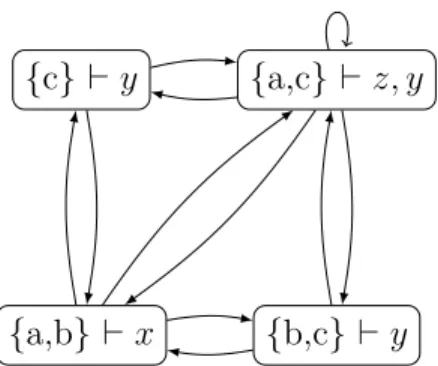
See Figure 2.1 for an illustration of this framework. In this framework, the set {a, b}attacks
cby deriving x, {c} attacksa via y, and{a, c}attacks b viaz, as well as a viay. Therefore, for example {a, c}is not conflict-free, while {a, b}is. 4
There are multiple different ABA semantics, each placing different constraints on the accept-ability of assumption sets [20]. Here we define the more commonly studied ones.
Definition 6 (Semantics). Let F = (L,R,A, ) be an ABA framework. A conflict-free set A⊆ A is
• admissible if and only if A defends itself,
• complete if and only ifA is admissible and contains every assumption defended by A, • grounded if and only if A is the intersection of all complete assumption sets,
• preferred if and only if A is a subset-maximal admissible assumption set, • stable if and only if each x∈ A \A is attacked by A, and
{a,b} `x
{c} `y {a,c} `z, y
{b,c} `y
Figure 2.1: The ABA framework of Example 2 illustrated. The assumption sets of the framework as well as the sentences they can derive are shown inside the rectangles. Attacks between assumption sets are represented by the edges. For simplicity, the self-attacking assumption set {a, b, c} is not drawn, and neither are the sets {a} and {b}, both of which
attack nothing but are attacked. The empty set, not attacking anything or being attacked, is also omitted.
• ideal if and only ifAis the maximal admissible assumption set that is a subset of every preferred assumption set.
The term σ-assumption set is used for an assumption set under a semantics σ ∈ {adm,com, grd, stb, prf, ideal}, that is, admissible, complete, grounded, stable, preferred, and ideal
semantics, respectively.
Example 3. In the ABA framework of Example 2, the different semantics accept the fol-lowing assumption sets.
admissible: ∅,{a, b},{b, c},{c} complete: ∅,{a, b},{b, c} preferred: {a, b},{b, c} stable: {a, b},{b, c} ideal: ∅ grounded: ∅
The rationale for theσ-assumption sets are as follows. From {b, c} and{c}one can derive y, and from {a, c}both z and y. The empty set is trivially admissible, and since the empty set alone defends nothing, it is also complete. Set{c}is complete because it is only attacked by {a, b} which it defends itself against by attackinga. The admissibility of {a, b} and {b, c} is
evident: they attack everything that attacks them. Moreover, one cannot add the remaining assumption (c and a, respectively) to the sets without making them self-conflicting, and thus they are complete and preferred. They are also stable, since they attack the remaining assumption. The ideal assumption set is empty, because the subsets of every preferred
assumption sets are∅ and {b}, of which {b} is not admissible. The grounded assumption set
is also empty, as the intersection of all complete assumption sets is empty. 4
Flat ABA frameworks satisfy a property called Fundamental Lemma, stating that given an admissible assumption set A and an assumption b that is defended by A, A ∪ {b} is
admissible [9]. A consequence of this is that the grounded assumption set can be computed as the least fixed point of a defence operator. Computing the grounded assumption set this way is more direct than computing all complete assumption sets and taking their intersection. The defence operator is defined as defF(A) ={a∈ A | A defends a}.
Proposition 1 ([9, Theorem 6.2]). LetF = (L,R,A, ) be an ABA framework. The least fixed point of defF is the grounded assumption set of F.
2.2
ABA Reasoning Problems
A basic reasoning task of ABA is the enumeration all assumption sets accepted under a given semantics.
Definition 7 (σ-assumption set enumeration). LetF = (L,R,A, ) be an ABA framework and σ a semantics. Report all σ-assumption sets.
Instead of reporting all accepted assumption sets under a semantics, often a relevant question is to find out whether a given sentence is acceptable under a semantics. To answer this question, there are two prominent reasoning modes. One can either accept sentences derivable in any σ-assumption set, or only sentences that are derivable in allσ-assumption sets. Definition 8 (Acceptability of sentences). LetF = (L,R,A, ) be an ABA framework and a semantics σ. A sentence s∈ L is
• credulously accepted under semanticsσ if and only if there is a σ-assumption set A so that A`s, and
• sceptically accepted under semantics σ if and only if A`s for all σ-assumption sets A. Example 4. One can check the acceptability status of sentences of our running example from the σ-assumption sets listed in Example 3. All of the assumptions are credulously accepted under admissible, complete, preferred, and stable semantics. On the other hand, nothing is credulously or sceptically accepted under ideal or grounded semantics. Under preferred and stable semantics, b is sceptically accepted. Nothing is sceptically accepted under admissible and complete semantics, as ∅ is admissible and complete. 4
Credulous reasoning coincides under admissible, complete, and preferred semantics [9, 20]. Intuitively, this follows from the facts that any admissible assumption set is a subset of some complete and some preferred assumption set, any complete assumption set is admissible and a subset of some preferred assumption set, and finally any preferred assumption set is admissible
and complete. For ideal and grounded semantics, credulous and sceptical reasoning both amount to finding the unique σ-assumption set of the given semantics (and checking if the queried assumption is contained in it).
The computational complexity of credulous and sceptical acceptance under different seman-tics is well-established. These are decision problems: their answer is either YES or NO. We will recall the characterisations of the complexity classes relevant here before discussing the complexity of reasoning in ABA. For more details on computational complexity, see [53]. The class P contains problems that can be solved in polynomial time with a deterministic Turing machine. The class NP contains problems that can be solved in polynomial time with a nondeterministic Turing machine. Equivalently, for any problem in NP, a (polynomial-sized) witness of a YES-instance can be verified in polynomial time. Witness here means essentially a guessed solution; in the context of credulous reasoning in ABA, a witness is a set of assumptions. The class coNP contains problems whose complement is in NP.
For a given complexity class C, a C-hard problem is at least as hard as any problem in C. More precisely, if every problem in C can be reduced in polynomial time to a problem P, then P is C-hard. A problem is said to be C-complete if it is C-hard and also contained in C.
A C-oracle is a procedure that solves a C-complete problem in constant time. With this, complexity classes higher in the polynomial hierarchy can be defined. The classes NP and coNP are on the first level of the hierarchy. On the second level are problems that belong to the first level when assuming access to an NP-oracle. Relevant to us are the second-level classes ΣP
2, ΠP2, and ΘP2. A problem is contained in ΣP2 (also written as NPNP) if it can be
solved in polynomial time with a non-deterministic Turing machine that has access to an NP-oracle. ΠP
2 (also written as coNPNP), is the class of problems whose complements can
be solved in polynomial time with a non-deterministic Turing machine that has access to an NP-oracle. ΘP
2 contains the problems that can be computed in polynomial time by an
algorithm making a logarithmic number of calls to an NP-oracle.
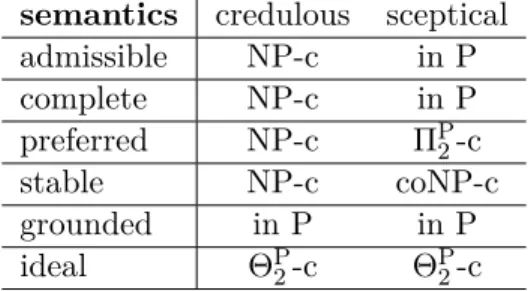
The complexity of the core ABA reasoning problems is summarised in Table 2.1. The results for admissible, stable and preferred were shown in [21], for ideal in [26], and for complete and grounded in [48]. For more complexity results for ABA, see [28]. As enumerating σ -assumption sets is a function problem rather than decision problem, its complexity is not as easily analysed [28].∗ However, the complexity of credulous and sceptical acceptance give
a good indication of the complexity of enumerating σ-assumption sets. For the semantics with a unique σ-assumption set (grounded and ideal), credulous and sceptical reasoning and enumerating σ-assumption sets coincide. For the others, enumerating σ-assumption sets is at least as hard as the harder of the two decision problems.
∗There is recent research into the complexity of enumeratingσ-assumption sets in a special case of ABA, called bipolar ABA [45]. Another recent study investigated the complexity of enumerating AF extensions (an extension being a set of arguments accepted under a semantics) [32].
Table 2.1: The complexity of deciding the acceptability of a sentence in ABA. For a com-plexity class C, C-c is an abbreviation for C-complete.
semantics credulous sceptical
admissible NP-c in P complete NP-c in P preferred NP-c ΠP2-c stable NP-c coNP-c grounded in P in P ideal ΘP2-c ΘP2-c
2.3
Relating Forward-derivability and Tree-derivability
The ABA+formalism is defined in terms of tree-derivability, and in general one can not
substi-tute it with forward-derivability in ABA+. In this subsection we discuss tree-derivability [23].
We recall a result on the correspondence between forward-derivability and tree-derivability: a sentence is forward-derivable from a set of assumptions if and only if the sentence is tree-derivable from a subset of the set of assumptions in question.
Unlike forward derivability, tree-derivability does not allow redundant assumptions in the underlying assumption set. The derivation sequence is viewed as a tree, so that each given assumption must be connected via the given rules to the sentence that is finally being derived. In the tree, the derived sentence is the root; the leaves are either > (signifying that the
sentence is derivable from the empty set) or the assumptions from which the sentence is derived; the inner nodes are heads of rules used in the derivation; and the edges correspond to rules. A derivation tree is often called an argument.
Definition 9 (Tree-derivation). A sentences ∈ Listree-derivable from a set of assumptions
A⊆ A and rules R ⊆ R, denoted by A|=Rs, if and only if there is a finite tree T such that 1. the root is labelled s,
2. the set of labels of the leaves is eitherA or A∪ {>},
3. internal nodes are labelled by some a ∈ L, and as its children are the elements of the
body of some rule in R such thata is the head of the rule, and 4. each rule of R is used in the tree (as described in Item 3).
When the set of rules R used in the derivation is not relevant, we will write |= and leave R implicit.
Example 5. In the deductive system of Example 1, the first two forward-derivations shown in the example also serve as tree-derivations: {a, b} |= x and {a, c} |= z. However, while
{a, c} `y, there is no corresponding tree-derivation, because there is no way to make use of a in deriving y fromc. Instead,{c} |=y is a tree-derivation. 4
There is a close correspondence between tree-derivability and forward-derivability.
Proposition 2 ([24, Theorem 4.1]). Let F = (L,R,A, ) be an ABA framework. It holds that
• ifA|=Rs then A`Rs, and
• ifA`R s there is an A0 ⊆A and R ⊆ R so that A0 |=R s.
In words, if there is a tree-derivation for a sentence, there is a forward-derivation for the sentence from the same set of assumptions. Moreover, if there is a forward-derivation for some sentence, there is also a tree-derivation for the sentence from some subset of assumptions and rules of the forward-derivation. To realize the latter, note that simply disregarding the assumptions and rules not actually needed in the derivation yields a tree-derivation. Thus tree-derivation is stricter and more minimal. Due to the correspondence between the derivation types, we may refer to just derivations if the type of derivation is not relevant. As noted before, the semantics of ABA can be defined equivalently via tree-derivations. It suffices to modify the definition of attack so that an assumption setAattacks an assumption b if any subset of A tree-derivesb from any subset of the rules of the framework.
2.4
ABA
+: ABA with Preferences
Preferences can be used to resolve conflicts in favour of a more preferred conclusion. The in-terpretation of the preference ordering depends on the application; one example is the wishes of a patient concerning their treatment [18]. We specifically focus on ABA+, which extends
ABA by including preferences over assumptions. Intuitively, this helps resolve conflicts by preventing less preferred assumption sets from attacking more preferred ones by reversing attacks.
Definition 10 (ABA+framework). AnABA+ framework is a tupleF = (L,R,A, ,≤) with
(L,R,A, ) an ABA framework and a preorder ≤ overA.
A preorder is a binary relation that is transitive and reflexive∗. It is useful to distinguish the
case when an assumption is strictly less preferred than another one. For this, we writea < b if and only if a≤b and b6≤a, for a, b∈ A. We focus only on flat ABA+ frameworks.
In ABA+, the preferences modify the attack relation. As we will see, the semantics and
reasoning tasks remain analogous to ABA. The attack relation after preferences are taken into account is named <-attacks.
Definition 11 (<-attack). Let (L,R,A, ,≤) be an ABA+ framework. Assumption set
A⊆ A <-attacks B ⊆ A if and only if
∗A binary relation R is transitive iff R(a, b) and R(b, c) implyR(a, c) for all a, b, c in the domain of R, and it is reflexive iff R(a, a) holds for allain the domain ofR.
• there is a tree-derivation A0 |= b, for some A0 ⊆ A and b ∈ B, so that @a0 ∈ A0 with a0 < b, or
• there is a tree-derivation B0 |= a, for some a ∈ A and B0 ⊆ B so that ∃b0 ∈ B0 with b0 < a.
Notice that, as noted before, attacks in ABA+ are defined in terms of tree-derivability and
can not in general be equivalently defined via forward-derivability. The first case in the definition yields a normal <-attack. There is a normal <-attack from A to B if a subset of A deriving a contrary of some assumption inB contains only assumptions that are not less preferred than the assumption in B. Attacks according to the second case are calledreverse
<-attacks. As the name suggests, an attack can be reversed when preferences are taken into account. Namely, if a subset B0 of B tree-derives a contrary of some assumption ain A, but some assumption in B0 is strictly less preferred than a, then A reverse<-attacksB.
Example 6. Let us add a preference relation to the ABA framework of Example 2. sentences L= {a, b, c, x, y, z}
assumptions A= {a, b, c}
contraries a=y, b=z, c=x
rules R= {(x←a, b),(y ←c),(z ←a, c)}
preferences a < c
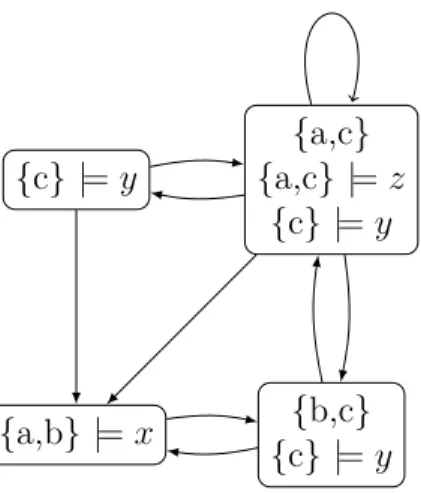
Now the attacks from {a, b} to {c} and {a, c} are reversed (in this case collapsed into the
attack already existing in the other direction). This is due to the fact that an assump-tion supporting the attack, namely a, is strictly less preferred than the assumption c being
attacked. 4
ABA+semantics are direct generalisations of ABA semantics. First note that for determining
freeness, one does not need to account for preferences: a set of assumptions is conflict-free in an ABA+ framework if and only if the same set is conflict-free in the corresponding
ABA framework with the preference relation emptied [17, Theorem 3.5]. This is because if a non-preference attack is present between sets A ⊆ A and B ⊆ A, then either there is a
normal<-attack in the same direction, or a reverse<-attack in the reverse direction. That is, a non-preference attack always translates to either kind of <-attack. The notion of defence in ABA+is also analogous to the one in ABA: a setA⊆ A <-defends assumption setB ⊆ A
if for all C⊆ A that <-attack B it holds thatA <-attacks C.
Definition 12 (ABA+ semantics). Let F = (L,R,A, ,≤) be an ABA+ framework. A
conflict-free assumption set A is
• <-admissible if and only if A defends itself,
{a,b} |=x {c} |=y {a,c} {a,c} |=z {c} |=y {b,c} {c} |=y
Figure 2.2: The ABA+ framework of Example 6 after preferences have modified the attack
relation. When needed, the assumption set is given at the top of a box and the tree-derivations from this set after it. Again for simplicity, the self-attacking assumption set {a, b, c} is not
drawn, and neither are the sets {a} nor {b}, both of which attack nothing but are attacked.
• <-grounded if and only if A is the intersection of all<-complete assumption sets, • <-preferred if and only if A is a subset-maximal <-admissible assumption set, • <-stable if and only if each{x} ⊆ A \A is <-attacked by A, and
• <-ideal is A is the maximal admissible assumption set that is a subset of every < -preferred assumption set.
The reasoning tasks (credulous and sceptical reasoning) for ABA+ are the same as for ABA,
after replacing σ with <-σ.
Example 7. In the ABA+ framework of Example 6, the<-σ-assumption sets are as follows. <-admissible: ∅,{b, c},{c} <-complete: {b, c} <-preferred: {b, c} <-stable: {b, c} <-ideal: {b, c} <-grounded: {b, c}
The preferences settled the dilemma of choosing between mutually conflicting sets {a, b}
and {b, c} under many semantics. Since c is more preferred than a, the set {b, c} is solely
credulously accepted under most semantics.
The rationale for the<-σ-assumption sets are as follows. One can deriveyfrom both{c}and {b, c}. The empty set is trivially <-admissible. Further, {c} is <-admissible since it defends
itself against attacks, namely from {a, c}; and {c} is not <-complete because it defends b. Instead, {b, c} is plainly <-admissible and moreover the only <-complete and <-preferred assumption set because one cannot add the last assumption, a, to the set without making it self-conflicting. {b, c} is also <-stable because it attacks a. Finally, {b, c} is <-ideal as the <-admissible intersection of preferred assumption sets, and <-grounded as the intersection
of the <-complete assumption sets. 4
Not all properties of ABA semantics carry over to ABA+ [17]. Notably, the Fundamental
Lemma does not in general hold for ABA+ frameworks, not even when restricted to flat
frameworks. Recall that the Fundamental Lemma states that if a set of assumptions A is admissible and defends an assumptionb, thenA∪{b}is also admissible. Recall further that a
consequence of the Fundamental Lemma not holding is that the grounded assumption set can not be found by computing the least fixed point of the defF operation. However, for ABA+
frameworks satisfying a property called Axiom of Weak Contraposition, the Fundamental Lemma does hold, and the <-grounded assumption set can be computed similarly to ABA grounded assumption set, as shown in [17].
Definition 13 (Axiom of Weak Contraposition). An ABA+ (L,R,A, ,≤) satisfies the
Ax-iom of Weak Contraposition (WCP) if for each A⊆ A and b ∈ A it holds that
if A |=b and ∃a0 ∈A so that a0 < b,
then A0 |=a for some ≤-minimal a∈A and A0 ⊆(A\ {a})∪ {b}.
In words, WCP insists that when a set of assumptionsAderives the contrary of an assumption b that is more preferred than some assumption in A, then b together with some subset of A must have a way to attack some ≤-minimal assumption of A. This ensures that more preferred assumptions have a way to attack less preferred ones even before attack reversals. Example 8. The framework of Example 6 satisfies WCP. The two attacks to a more preferred assumption are from {a, b} toc and {a, c}via z. One can indeed tree-derive y, the contrary of the less preferred assumption, a, from a subset of ({a, b} \ {a})∪ {c}={b, c} (the subset
being just c), and thus the requirement is satisfied. 4
The computational complexity of ABA+ has been studied in [48]. Notably, it was shown
that under <-stable semantics, credulous reasoning is NP-complete and sceptical reasoning is coNP-complete. This means that for stable semantics, adding preferences does not in-crease the complexity of deciding the acceptability of sentences. However, it was shown that verifying whether a given set of assumptions is <-admissible is coNP-complete, a jump in complexity compared to verifying admissibility in ABA, which is in P. Based on this it is shown that credulous reasoning under<-admissible semantics is ΣP2-hard, a higher complexity than the NP-complete credulous reasoning under admissible semantics.
This latter result is refined to show completeness in addition to hardness in [47]. We show in this thesis (in Section 4) that finding the <-grounded assumption set in a framework that satisfies WCP can be done with a polynomial-time algorithm with access to an NP-oracle.
This section gives an overview of the reasoning systems previously developed for ABA and ABA+. In particular, we discuss the state-of-the-art systems abagraph, aba2af and ABAplus,
against which we evaluate our ASP-based approach in Section 8. A summary of which reasoning problems the considered systems support is shown in Table 3.1 for ABA and in Table 3.2 for ABA+. For a more thorough survey of argumentation systems, see [13].
ABA reasoning systems can be classified into three categories: translation-based systems, specialized algorithms, and direct declarative approaches. The most notable specialized sys-tems implement algorithms for so-called dispute derivations, which are procedures for deter-mining the credulous acceptability of a given sentence under certain semantics [60, 15, 14]. The most recent dispute derivation system is abagraph [14], improving on the earlier systems grapharg [15], proxdd [60] and CaSAPI [33], all implemented in Prolog. Abagraph can reason credulously under admissible and grounded semantics, and also enumerate solutions.
Another specialized approach is implemented in TweetyProject, a Java library of various approaches to logical aspects of artificial intelligence and knowledge representation [58, 57]. Tweety implements σ-assumption set enumeration under admissible, complete, stable, pre-ferred, ideal and grounded semantics.
The translation-based approaches translate the input ABA frameworks to abstract argumen-tation frameworks and allow for the use of fast AF reasoning systems, mainly ones based on SAT or ASP solvers. A problem of translation-based systems is that the translation be-tween ABA and AF takes time and the resulting AF instance may be much larger than the input ABA framework. For regular ABA, the system aba2af translates ABA frameworks to AFs and uses ASP encodings on the AF-level [46]. Aba2af supports credulous and sceptical reasoning under admissible, stable and preferred semantics. Abagraph and aba2af can both reason credulously under complete and preferred semantics via admissible semantics, as these tasks coincide.
A direct declarative approach encodes an ABA framework as another formalism (such as SAT or ASP) and uses a solver for that formalism to solve the problem. There is a lack of direct declarative approaches to ABA reasoning. Our work rectifies the situation by introducing ASP-based algorithms for admissible, complete, stable, preferred, and ideal semantics, al-lowing for credulous and sceptical reasoning as well as σ-assumption set enumeration (see Section 6). We note that recently a single logic programming translation for ABA was put forth, such that reasoning under different ABA semantics is accomplished by using different logic programming semantics [12]. The translation consists of representing the input frame-work in a new way. Namely, any assumption in the rule body is replaced with its contrary. The answer set semantics (called 2-valued stable semantics in [12]) corresponds to ABA sta-ble semantics given the translation. In other words, one obtains the stasta-ble assumption sets of a given ABA framework by representing the framework in the specified way and solving the answer sets of this representation with an ASP solver. Thus restricting to stable
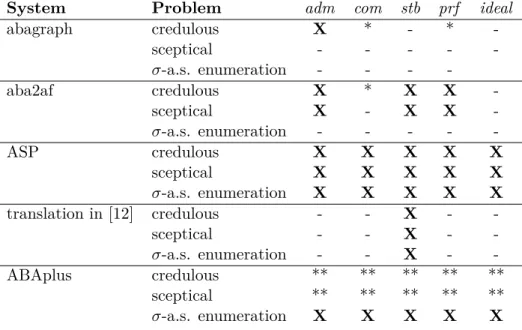
seman-Table 3.1: The ABA reasoning problems that the different reasoning systems support. The problems are credulous/sceptical reasoning and σ-assumption set enumeration under a given semantics. Xmarks a problem that the given system supports directly, * a problem supported via admissible semantics, and ** a problem supported via σ-assumption set enumeration.
System Problem adm com stb prf ideal
abagraph credulous X * - * -sceptical - - - - -σ-a.s. enumeration - - - -aba2af credulous X * X X -sceptical X - X X -σ-a.s. enumeration - - - - -ASP credulous X X X X X sceptical X X X X X σ-a.s. enumeration X X X X X translation in [12] credulous - - X - -sceptical - - X - -σ-a.s. enumeration - - X - -ABAplus credulous ** ** ** ** ** sceptical ** ** ** ** ** σ-a.s. enumeration X X X X X
tics of ABA, the encoding presented in [12] can be compared to the one introduced in this thesis using an ASP solver for both. Our stable encoding is stylistically uniform with our encodings for the other semantics, while the one presented in [12] can be considered simpler. The encoding of [12] has not been implemented before to the best of our knowledge.
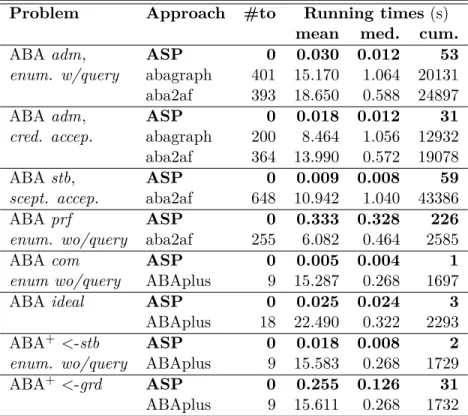
For ABA, at present the state-of-the-art systems are abagraph [14] and aba2af [46]. We compare the performance of the encodings introduced in this work to them, as well as the stable encoding of [12]. Due to some missing semantics from what abagraph and aba2af support, we will also take ABAplus (see next paragraph) into the comparison for some ABA semantics.
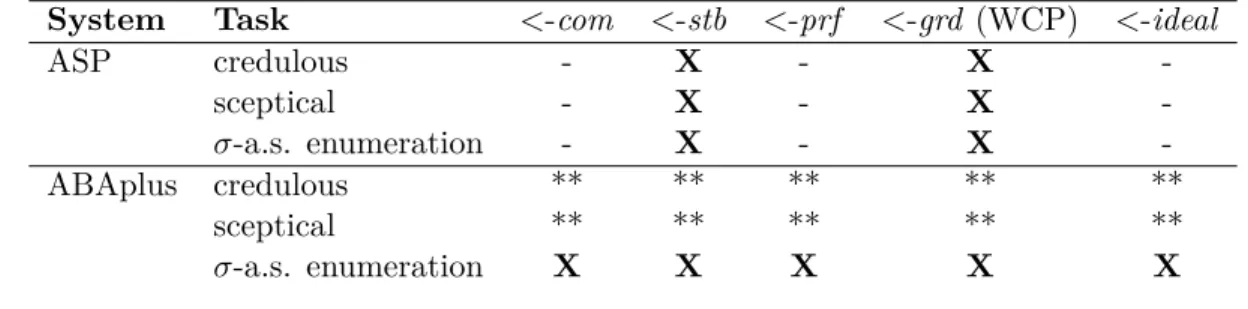
The only system currently supporting ABA+ reasoning is ABAplus [2]. ABAplus is a
translation-based system, translating from ABA+ to AF while accounting for preferences,
and using Aspartix ASP encodings [29] on the AFs. ABAplus only supports σ-assumption set enumeration instead of credulous or sceptical reasoning. Credulous and sceptical queries can be answered by enumerating all σ-assumption sets, of course, but this most likely re-sults in worse computational performance than a more direct approach. ABAplus can be used to reason over regular ABA frameworks too, because ABA+ is a generalisation of ABA.
ABAplus supports σ-assumption set enumeration under <-stable,<-grounded, <-complete, <-preferred and <-ideal semantics. ABAplus requires that WCP (recall Definition 13) is satisfied by the ABA+ framework. It can modify a framework to satisfy WCP. ABAplus also
places additional restrictions on the input framework: assumptions cannot be contraries and each assumption must have a unique contrary.
Table 3.2: The ABA+ reasoning problems that the different reasoning systems support. For
<-grounded, both systems require that WCP is satisfied in the ABA+ framework. The problems are credulous/sceptical reasoning and σ-assumption set enumeration under a given semantics. x marks a problem that the given system supports directly and ** a problem supported via σ-assumption set enumeration.
System Task <-com <-stb <-prf <-grd (WCP) <-ideal
ASP credulous - X - X -sceptical - X - X -σ-a.s. enumeration - X - X -ABAplus credulous ** ** ** ** ** sceptical ** ** ** ** ** σ-a.s. enumeration X X X X X
We provide ASP-based algorithms for the ABA+ semantics <-stable and <-grounded in this
thesis. Our algorithm for <-grounded requires that WCP is satisfied in the given ABA+ framework.
We show properties of ABA and ABA+ that will form the formal basis of our ASP encodings
presented in Sections 6 and 7. To this end, we restate some semantics to better match the language of ASP. In addition we show complexity results for ABA+, which suggest how one
can, in spite of the complexity jump in many semantics of ABA+, implement ABA+reasoning
in ASP for <-grounded and <-stable semantics.
First, we explicate that a set of assumptions defends another set of assumptions if and only if the former set defends all assumptions in the latter set.
Lemma 1. LetF = (L,R,A, ) be an ABA framework, andA, B ⊆ A. A defends B if and only if A defends each{b} ⊆B.
Proof. Assume that A ⊆ A defends B ⊆ A. Let C ⊆ A attack some b ∈ B. Thus by definition C attacksB. SinceAdefends B,A must attackC, and thus Adefends {b}. Since
b is arbitrary,A defends each {b} ⊆B.
Assume that A defends each {b} ⊆ B. Let C ⊆ A be such that C attacks B. Then, by definition of attacks in ABA, there is ab0 ∈B such thatC `Rb0. This implies thatC attacks
{b}0 ⊆B. Since A defends each assumption inB,A attacks C. Therefore A defends B.
With the help of Lemma 1 we can restate the defence of assumption set as well as admissible and complete semantics in terms of the set of assumptions attacked by a given assumption set. This helps us formulate our ASP encodings for admissible, complete and preferred semantics in Section 6.
Let (L,R,A, ) be an ABA framework and E ⊆ A be a set of assumptions. Define DE =
{a ∈ A | E attacks{a}}. Recall that in ABA an assumption set E attacks {a} if and only
if E `R a.
Proposition 3. Let (L,R,A, ) be an ABA framework and E ⊆ A be a conflict-free set of
assumptions. Then
1. E defends an assumption a ∈ A if and only if A \DE does not attacka, 2. E is admissible if and only if A \DE does not attack E, and
3. E is complete if and only if E is admissible and for each b ∈ A \E, b is attacked by
A \DE.
Proof. Item 1: By definition E defends an assumption a ∈ A if and only if A attacks C for all C ⊆ A that attack a. By construction of DE, E attacks any set X ⊆ A for which X∩DE 6=∅. Thus E defends a if and only if A \DE does not attacka.
Item 2: By definition E is admissible if and only if it defends itself. By the previous item and Lemma 1, E defends itself if and only ifA \DE does not attack E.
Item 3: By definition E is complete if and only if it is admissible and every assumption that is outside of it is not defended by it. By the first item and Lemma 1, this is the case exactly when each b∈ A \E is attacked by A \DE.
Extending our treatment to ABA+, we show a different characterisation of<-stable semantics
that uses forward-derivability instead of tree-derivability, and later provide an algorithm for finding the <-grounded assumption set in a framework that satisfies WCP. These help us devising ASP-based algorithms for reasoning under these semantics.
First we show that normal<-attacks can be defined via forward-derivability, as well as reverse <-attacks from a conflict-free assumption set to a singleton assumption set.
Lemma 2. Let (L,R,A, ,≤) be an ABA+framework,A, B ⊆ Abe two sets of assumptions,
and b ∈ A.
1. Set A normally <-attacks B if and only if A0 `R b, for some A0 ⊆ A, b ∈ B, and
@a0 ∈A0 with a0 < b.
2. If A is conflict-free, then A reversely <-attacks {b} if and only if {b} `R a for some
a∈A and b < a.
Proof. Item 1: by Proposition 2 it holds that if X |=Rs, then X `R s, and if X `R s, then
there is an X0 ⊆ X and R ⊆ R such that X0 |=R s. Assume assumption set A normally <-attacksB. By definition of <-attack, there is aA0 |=R b, for some A0 ⊆Asuch that b ∈B and @a0 ∈A0 with a0 < b. This implies that A0 `R b.
For the other direction, assume that A0 `R b for some A0 ⊆ A, b ∈ B, and @a0 ∈ A0 with a0 < b. Again by Proposition 2 there is an A00 ⊆ A0 such that A00 |=R b for some R ⊆ R. Since@a0 ∈A0 such thata0 < bandA00⊆A0, it follows that@a00 ∈A00such that a00 < b. Thus
item 1 holds.
Item 2: Assume A is conflict-free. Then ∅ 6|=R a for all a ∈ A. Assume that A reversely <-attacks {b} and thus a subset of {b} containing an assumption less preferred than some
a ∈ A attacks a. The only possibility is that {b} |=R a for some a ∈ A such that b < a. It follows by Proposition 2 that {b} `Ra.
For the other direction, assume that A is conflict-free and {b} `R a for some a such that
b < a. By Proposition 2, there is a B ⊆ {b} such that B |=R a. Since the only subsets of
{b} are {b} and ∅, and A is conflict-free, it holds that {b} |=R a. Thus by definition, {b} reversely <-attacksA, and moreover item 2 holds.
Next we show that to decide <-stable assumption sets, one needs to only consider normal <-attacks and reverse <-attacks to singleton assumption sets. From this and Lemma 2 it
follows that one can define <-stable semantics with forward-derivability. We will make use of this fact in our encoding for <-stable semantics in Section 7.
Proposition 4. LetD= (L,R,A, ,≤) be an ABA+ framework. A conflict-free setE ⊆ A
is <-stable if and only if for all b ∈ A that are not normally <-attacked by E, either b ∈ E or {b} is reversely<-attacked by E.
Proof. Let E ⊆ A be a conflict-free assumption set. First, assume that E is <-stable. Suppose for contradiction that there is an assumption {b} that is not normally <-attacked by E such that {b} * E, and {b} is not reversely <-attacked by E. Then {b} is neither
<-attacked by E nor a subset of E, contradictingE being <-stable.
Now assume that for all {b} that are not normally <-attacked by E, either {b} ⊆ E or {b}
is reversely <-attacked by E. It immediately follows by definition that E is <-stable. We will show that that the presence of <-attacks between two sets of assumptions can be decided in polynomial time in Proposition 5, using Lemma 3. Then Proposition 5 will be used to show an algorithm for finding the <-grounded assumption set in an ABA+ frame-work that satisfies WCP, also giving an upper bound to the complexity of this problem (in Proposition 6).
Lemma 3 ([47]). LetF = (L,R,A, ,≤) be an ABA+ framework, x∈ L, andA, A0 be two sets of assumptions such that A0 ⊆ A and A `R x. Further, let G = (V, E) be a directed
graph with
• V =ThR(A), and
• E ={(a, b)| ∃r∈ R:body(r)⊆ThR(A), a∈head(r), b∈body(r)}.
It holds that X |=R x with X ⊆ A and X∩A0 6= ∅ if and only if there is a directed path from x to a node in A0 inG.
Proposition 5. Let (L,R,A, ,≤) be an ABA+ framework and A, B ⊆ A. One can decide
in polynomial time whether A 1. normally <-attacksB, or 2. reversely <-attacksB.
Proof. Item 1: Consider for eachb ∈B the set of assumptions inAthat are not less preferred than b, that is Ab = {a ∈ A | a 6< b}. It directly follows from the definition of <-attack that Ab normally <-attacks {b} if and only if Ab `R b. Both constructing Ab for each b and checking ifAb `Rb for anyAb can be done in polynomial time. Checking if Aattacks B can be done based on Ab in polynomial time: if Ab normally<-attacks{b}, then A normally< -attacks B, and if Anormally <-attacksB, there is ab ∈B such that Ab normally<-attacks
Item 2: consider the deductive closure of B, that is ThR(B). Check for each a ∈ A such
that a ∈ ThR(B) whether B0 |=R a for some B0 ⊆ B such that ∃b0 ∈ B with b0 < a. Due to Lemma 3, this can be reduced to checking reachability in a directed graph, which can be computed in polynomial time. To see how Lemma 3 applies, notice that we are interested in checking if B0 |= a with B0 ⊆ B and B0 ∩B<a 6=∅, where B<a is the set of assumptions of B that are less preferred than a.
Finally, we show that in an ABA+framework that satisfies WCP, the<-grounded assumption
set can be computed with an algorithm that makes polynomially many calls to an NP-oracle. The algorithm uses the defF operator of ABA+, similarly to how one can compute the
grounded assumption set of an ABA framework with thedefF operator (recall Proposition 1).
We describe an implementation of this algorithm in Section 7. In particular, we implement the defF operator with iterative ASP calls and use this to find the <-grounded assumption set.
Proposition 6. In an ABA+ framework that satisfies WCP, the<-grounded assumption set can be computed via a deterministic polynomial time algorithm that can access an NP-oracle.
Proof. LetF = (L,R,A, ,≤) be an ABA+framework that satisfies WCP. Due to [17, proof
of Theorem 4.7 (iv)], it holds that the least fixed point of defF is equal to the <-grounded assumption set. Consider the subproblem of checking whether a given set of assumptions X defends a singleton assumption set {a}. We claim that this problem is in coNP. To see
this, consider the complementary problem, namely, checking whether X does not defend
{a}. This can be solved by the following procedure. First non-deterministically construct
an assumption set Y ⊆ A. Check whether Y <-attacks{a} (this is decidable in polynomial
time due to Proposition 5). If Y does <-attack {a}, check whether X <-attacks Y (which is again decidable in polynomial time). If not, then by definition X does not defend {a}. In
other cases X (Y does not <-attack {a} or X <-attacksY), X does defend {a}. There are
polynomially many assumptions, and thus defF(X) can be computed with polynomial many calls (at most |A|) to an NP-oracle following the preceding procedure. The <-grounded assumption set is found after a polynomial number of applications (at most |A|) of defF
We briefly recall answer set programming (ASP) [42, 52, 10, 39], the approach to logic programming implementing the stable model semantics (also called answer set semantics). ASP is a prominent declarative approach to solving NP-complete search and optimization problems. Declarative programming refers to an approach in which a problem is encoded in a specified language, the encoded instance is solved with a solver for that language, and finally the result is interpreted in terms of the original problem. In this case, we represent our ABA reasoning problems as ASP problems and use an ASP solver to solve them.
5.1
Answer Set Programs
An ASP program is a collection of rules of the form
h←b1, . . . , bk, not bk+1, . . . , not bm.
where h and each bi is an atom. An atom bi is a predicatep(t1, . . . , tn) with each tj either a constant or a variable. An answer set program, a rule, and an atom, respectively, is ground if it is free of variables. The process of making a non-ground program ground is called grounding or variable replacement.
A rule is positive if k =m (no negated atoms), a fact if m = 0 (no body), and a constraint if there is no head h. A fact can be shortened to “h.” by omitting the arrow. A constraint
←b1, . . . , bk, not bk+1, . . . , not bm. is a shorthand for
x←b1, . . . , bk, not bk+1, . . . , not bm, not x.,
where x is a ground atom not occurring anywhere else. Intuitively, the head of a fact must hold and at least one body element of a constraint must not hold in a solution to the program. The answer sets to a program are defined in terms of a grounded program. Let π be an answer set program that contains variables. Let GP be the set of rules obtained by applying all possible substitutions from the variables to the set of constants appearing in the program. GP is ground. An interpretation I consists of a subset of the ground atoms. I satisfies a positive rule r = h ← b1, . . . , bk if and only if the presence of all positive body elements b1, . . . , bk in I implies that the head atom is in I. That is, I satisfiesr if and only if
{b1, . . . , bk} ⊆I implies h∈I.
For a program π consisting only of positive rules, let Cl(π) be the subset-minimal inter-pretation I that satisfies all rules in π. That is, Cl(π) = I if and only if I, but not any
proper subset of I, satisfies all rules in π. The reduct of a program π with respect to an interpretation I is
πI ={(h←b1, . . . , bk)|(h←b1, . . . , bk,notbk+1, . . . ,notbm)∈π,{bk+1, . . . , bm} ∩I =∅}. In other words, the reduct contains the positive part of all rules ofπ, except the rules whose negative part contains the negation of an atom that is contained in I. An interpretationI is an answer set of a ground programπ if I =Cl(πI) whereπI is the reduct. An interpretation I is an answer set of a non-ground program π if I is an answer set of GP of π. A program is satisfiable if the program has at least one answer set and unsatisfiable otherwise.
5.2
ASP Solvers and Additional Features
Variables are highly useful for modelling problems, but the answer sets are defined in terms of ground programs. Thus solving problems with ASP typically consists of modelling the problem with variables, grounding the program, and finally solving the ground program. We will now discuss the last two steps, as well as some additional language features we make use of later.
Grounders use various techniques to make the grounding more efficient than the naive method of simply creating all substitutions of variables by constants. These techniques involve partial evaluation, rewriting and database technology. The most popular grounders are DLV [49], Lparse [56], and gringo [40, 41]. DLV also incorporates a solver, and Lparse was originally paired with the solver Smodels.
Arguably the state-of-the-art ASP solver today is clasp [37]. Algorithmically clasp is similar to modern conflict-driven clause learning (CDCL) SAT solvers [55], notably implementing conflict-driven learning and backjumping. In addition clasp incorporates various optimiza-tions used by modern SAT solvers. Unlike SAT solvers, clasp also ensures that the given output solutions are answer sets.
In this work, we will use the state-of-the-art ASP system clingo [40, 41], incorporating gringo as the grounder and clasp as the ASP solver. Using a system that incorporates both grounding and solving in the same system streamlines ASP solving. Clingo grounds and computes answer sets to a given program without the need for any further pre- or post-processing. One can specify how many answer sets are computed. In particular, clingo can compute one answer set and terminate (useful for credulous reasoning), or compute every answer set (useful for sceptical reasoning and σ-assumption set enumeration).
Clingo and systems built on top of it support a host of additional features, some of which are very useful for implementing reasoning in ABA. Firstly, we will use the cautious enumeration mode of clingo in our algorithm for finding the ideal assumption set. The cautious mode returns the intersection of all answer sets to a given program [40]. We also use asprin [11], a framework for optimization in ASP that relies on iterative calls to an ASP solver (by default clingo). Specifically we use the capabilities of asprin to get subset-maximal answer sets of a program with respect to a predicate of arity one. Formally, I is an optimal answer set if
there is no answer set J such that {p(t) | p(t) ∈ I} ⊂ {p(t) | p(t) ∈ J}). This is useful for