user web automation. PhD thesis, University of
Nottingham.
Access from the University of Nottingham repository:
http://eprints.nottingham.ac.uk/13529/1/EssamEliwa-Web2Sh_2013.pdf
Copyright and reuse:
The Nottingham ePrints service makes this work by researchers of the University of Nottingham available open access under the following conditions.
· Copyright and all moral rights to the version of the paper presented here belong to
the individual author(s) and/or other copyright owners.
· To the extent reasonable and practicable the material made available in Nottingham
ePrints has been checked for eligibility before being made available.
· Copies of full items can be used for personal research or study, educational, or
not-for-profit purposes without prior permission or charge provided that the authors, title and full bibliographic details are credited, a hyperlink and/or URL is given for the original metadata page and the content is not changed in any way.
· Quotations or similar reproductions must be sufficiently acknowledged.
Please see our full end user licence at:
http://eprints.nottingham.ac.uk/end_user_agreement.pdf A note on versions:
The version presented here may differ from the published version or from the version of record. If you wish to cite this item you are advised to consult the publisher’s version. Please see the repository url above for details on accessing the published version and note that access may require a subscription.
The University of Nottingham School of Computer Science
A Framework for Interactive End-user Web Automation
Essam Eliwa
Thesis submitted to the University of Nottingham for the degree of Doctor of Philosophy
Abstract
This research investigates the feasibility and usefulness of a Web-based model for end-user Web automation. The aim is to empower end users to automate their Web interactions. Web automation is defined here as the study of theoretical and practical techniques for applying an end-user programming model to enable the automation of Web tasks, activities, or interactions. To date, few tools address the issue of Web automation; moreover, their functionality and usage are limited.
A novel model is presented, which combines end-user programming techniques and the software tools philosophy with the vision of the “Web as a platform.” The model provided a Web-based environment that enables the rapid creation of efficient and useful Web-oriented automation tools. It consists of a command line for the Web, a shell scripting language, and a repository of Web commands.
A framework called Web2Sh (Web 2.0 Shell) has been implemented, which includes the design and implementation of scripting language (WSh) enabling end users to create and customise Web commands. A number of Web2Sh-core Web commands were implemented. There are two techniques for extending the system: developers can implement new core Web commands, and the use of WSh by end users to connect, customise, and parameterise Web commands to create new commands. The feasibility and the usefulness of the proposed model have been demonstrated by implementing several automation scripts using Web2Sh, and by a case study based experiment that was carried out by volunteered participants. The implemented Web2Sh framework provided a novel and realistic environment for creating, customising, and running Web-oriented automation tools.
All praise be to Allah, the most gracious, the most merciful
Acknowledgements
It is hard to acknowledge everybody that helped me to start, continue, and finish this work. I attempt my best and apologise dearly to those I did not mention.
I would like to extend particular thanks to my supervisors, Dr. Colin Higgins and Dr. Peter Blanchfield, for their support, guidance, and comments on this thesis, and for their moral support over the time of my study.
Foremost, I express my deep gratitude to my dear friends Ashraf AbdelRaouf, Mohamed Sabri, Rami Ghorab, P. Christofi, A. Soaifan, I. Balčait , and M. Al-Momani for all their support in many aspects during my study years.
The help of a number of computer science researchers has been essential at the early years of my studies, so special thanks to A.Tsintsifas, S.Bagley, I.Celik, M.Meccawy, M.Begum, S. Myo Htwe, and C.Schoreels.
The Phd for an international student is a lonely journey without great friends. I was lucky to meet so many of them in Nottingham; they have been like a second family away from home, so special thanks to A.Sabra, A.Khalifa, M.Mansour, A.Freewan, A.Basiouni, N.Wahba, Y.Saber, M.Sobhi, S.Abdulkadir, M.Ali, A.Soghier, K.Saleh, G.Frisso, L.McCormack, J.Durkin, A.Galati, E.Bachis, and A.Mangood.
Special gratitude to all the Egyptians who have participated in the 25th January revolution, mostly the ones who lost their lives in all of Egypt’s Tahrir squares. There are no adequate words to express my gratitude to my parents for supporting me emotionally, spiritually, and financially. I am also forever thankful to Ayman and Ola Eliwa for being great and supportive siblings in my most difficult moments. I am indebted to my whole family, especially to Dr. Hesham Khalil, my cousin who encouraged and inspired me since I was a very young. Finally, sincere love and gratitude to my wife Halah Yasser, whom I was blessed to marry, and who supported me to complete such a long life-changing journey.
Table of Contents
Abstract ... ii
Acknowledgements ... iii
Table of Contents ... iv
List of Tables ... viii
List of Figures and Illustrations ... ix
List of Symbols, Abbreviations, and Nomenclature ... xi
CHAPTER ONE: INTRODUCTION ... 1
1.1 Motivation ... 3
1.2 Background ... 5
1.3 End-user Web Automation ... 12
1.4 Research Issues ... 14
1.4.1 Scope ... 14
1.4.2 General Aims and Objectives ... 15
1.4.3 Specific Objectives ... 17
1.4.4 Potential Users ... 17
1.4.5 Approach ... 19
1.5 Contributions ... 20
1.5.1 Web2Sh Framework Overview ... 20
1.6 Organisation of the Thesis ... 22
CHAPTER TWO: RELATED WORK ... 24
2.1 Introduction ... 24
2.2 World Wide Web ... 24
2.2.1 A Brief History of the Web ... 26
2.2.2 Web Architecture ... 28
2.2.2.1 Identification ... 29
2.2.2.2 Interaction ... 29
2.2.2.3 Representation ... 29
2.2.3 Web Scripting Languages ... 31
2.2.4 Web Mining ... 33
2.2.5 Semantic Web ... 33
2.2.6 Syndication Feeds ... 35
2.2.7 Web 2.0 ... 36
2.2.8 Rich Internet Applications (RIA) ... 38
2.2.9 User-Generated Content (UGC) ... 39
2.3 Web Automation Tools ... 40
2.3.1 Web SPHINX ... 45 2.3.2 YubNub ... 46 2.3.3 Mashups ... 47 2.3.4 Yahoo Pipes ... 49 2.3.5 Microsoft Popfly ... 51 2.3.6 Firefox plugins ... 52
2.4 UNIX Shell Scripting ... 54
2.5 A Programmable Web ... 56
CHAPTER THREE: WEB2SH FRAMEWORK DESIGN ... 58
3.1 Introduction ... 58
3.2 Design Objectives and Requirements ... 58
3.3 The Web2Sh Architecture ... 60
3.3.1 UNIX Tools Web Wrapper ... 61
3.4 Web2Sh Framework Design ... 63
3.4.1 Web2Sh Implementation of the Visitor Pattern ... 65
3.4.2 Web2Sh Implementation of the Command Pattern ... 67
3.4.3 Web2Sh Implementation of Abstract Factory Pattern ... 68
3.5 Framework Scalability ... 70
3.6 Summary ... 71
CHAPTER FOUR: WEB2SH USER INTERFACE ... 72
4.1 Introduction ... 72
4.2 Web Command Line ... 72
4.3 User Support ... 74
4.3.1 Login ... 74
4.3.2 Web Commands Help ... 75
4.4 Error Handling ... 75
4.5 Output Options ... 76
4.6 Client Side Web Commands ... 76
4.7 Implementation Decisions ... 77
4.8 Summary ... 77
CHAPTER FIVE: THE WSH SCRIPTING LANGUAGE... 78
5.1 Introduction ... 78
5.2 Scripting Language for Web Automation ... 81
5.3 Software Tools Philosophy ... 84
5.4 WSh Language Deign ... 85
5.4.1 Top-Down Parsing: ... 86
5.4.2 WSh Parser: ... 86
5.4.2.1 Command Execution: ... 87
5.4.2.2 Input /Output: ... 87
5.5 WSh Scripting Language Design ... 88
5.5.1 Language Informal Specifications ... 89
5.5.1.1 Programming Concepts ... 89
5.5.1.2 WSh item ... 89
5.5.1.3 Web Command ... 91
5.5.1.4 WSh Pipeline ... 91
5.5.1.5 The tee Web Command ... 91
5.5.1.6 Syntax ... 94
5.5.1.7 Start Symbols: ... 94
5.5.1.8 Terminals (list of keywords): ... 94
5.5.1.9 Operators: ... 94
5.5.1.10 Production Rules ... 95
5.5.1.11 Nonterminals: ... 95
5.5.2 Contextual Constraints: ... 96
5.5.2.1 Global Built-in Shell Variables: ... 96
5.5.2.3 Naming Web Commands ... 97
5.5.2.4 Variable Types ... 97
5.5.2.5 Variables Scope: ... 98
5.5.3 Semantics ... 99
5.5.3.1 Basic Web Commands ... 99
5.5.3.2 New Web command example: ... 99
5.5.3.3 Artwork Importer, iTunes Example: ... 101
5.6 Language Formal Syntax: ... 103
5.7 WSh Language ... 103
5.7.1 WSh Parser and Interpreter ... 104
5.7.1.1 WSh AST ... 105
5.7.1.2 WSh AST Parsing ... 105
5.7.1.3 Parsing Variables ... 106
5.8 Summary ... 108
CHAPTER SIX: WEB COMMANDS ... 109
6.1 Introduction ... 109
6.2 Internet Media Types ... 111
6.3 Polymorphic Mime Types ... 112
6.4 Web Command General Syntax ... 112
6.5 Web Commands Input and Output ... 114
6.6 Building a Pipeline ... 114
6.7 Internet Browsing Commands ... 115
6.7.1 Fetch ... 115 6.7.2 Submit ... 119 6.8 HTML Parsing ... 120 6.8.1 GetLinks ... 120 6.8.2 GetTags ... 120 6.8.3 GetTagByID ... 121 6.9 Text-Processing ... 122 6.9.1 Extract ... 122 6.9.2 Sort ... 123 6.9.3 Replace ... 123 6.9.4 Count ... 124 6.10 Mathematical ... 124 6.10.1 Calculate ... 124
6.11 Running External Programs and scripts ... 125
6.12 Error Handling ... 125
6.13 Summary ... 126
CHAPTER SEVEN: WEB2SH APPLICATIONS ... 127
7.1 Introduction ... 127
7.2 Automation Tools for the Research Community ... 127
7.2.1 Building Arabic Corpus ... 127
7.2.2 Organizing PDF files... 129
7.3 Automating Repetitive Web Tasks ... 129
7.3.1 Finding the Top 10 UK Movies on the BBC Web Site ... 130
7.3.2 Filtering and Retrieving Links ... 130
7.5 Building Web Mashups ... 131
7.5.1 Aggregate Search Results with Semantic Tags ... 132
7.6 Extracting Data from Web Pages ... 133
7.7 Composite Search Tasks ... 134
7.8 Vendor-Specific Web Commands ... 135
7.9 Retrieving Financial and Stock Market Indicators ... 135
7.10 Summary ... 136
CHAPTER EIGHT: EVALUATION ... 137
8.1 Introduction ... 137
8.2 Specific Hypotheses ... 138
8.3 Experiment Design ... 138
8.3.1 Task One Summary ... 140
8.3.2 Task Two Description ... 141
8.3.3 Task Three Description ... 142
8.3.4 Task Four Description ... 143
8.3.5 Task Five Description ... 146
8.4 Participants’ Background ... 147 8.5 Data Analysis ... 150 8.5.1 Qualitative Findings ... 150 8.5.2 Quantitative Findings ... 154 8.6 Summary of Findings ... 158 8.7 Summary ... 161
CHAPTER NINE: CONCLUSION AND FUTURE WORK ... 162
9.1 Introduction ... 162
9.2 The Need for a New Scripting Language ... 164
9.3 Is Yahoo Pipes Enough? ... 165
9.4 End-user Web Automation ... 167
9.5 Meeting the Objectives ... 168
9.5.1 New Model for End-user Web Automation ... 168
9.5.2 WSh, a Scripting Language for Web Automation ... 169
9.5.3 Web2Sh, a Web Automation Framework ... 171
9.5.4 Repository of Web Commands ... 172
9.6 Future Work ... 172
9.7 Closing Remarks ... 175
BIBLIOGRAPHY... 176
APPENDIX A: RESEARCH ETHICS APPLICATION ... 187
APPENDIX B: WSH FORMAL SPECIFICATION DEFINITION FILES ... 198
APPENDIXC: WEB2SH EXECUTE SERVLET ... 216
List of Tables
Table 6-1: Fetch Web command summary ... 117
Table 6-2: Submit Web command summary ... 119
Table 6-3: GetLinks Web command summary ... 120
Table 6-4: GetTags Web command summary ... 121
Table 6-5: GetTagByID Web command summary ... 121
Table 6-6: Extract Web command summary ... 122
Table 6-7: Sort Web command summary ... 123
Table 6-8: Replace Web command summary ... 123
Table 6-9: Count Web command summary ... 124
List of Figures and Illustrations
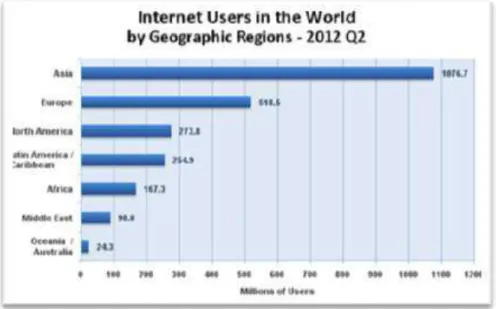
Figure 2-1: Internet users estimate for June 30, 2012. Source (Group 2011) ... 28
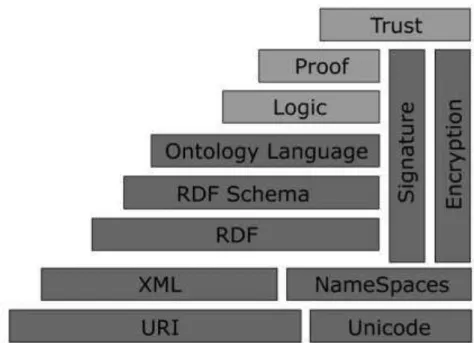
Figure 2-2: The Semantic Web layers, reproduced from (Berners-Lee 2002a) ... 35
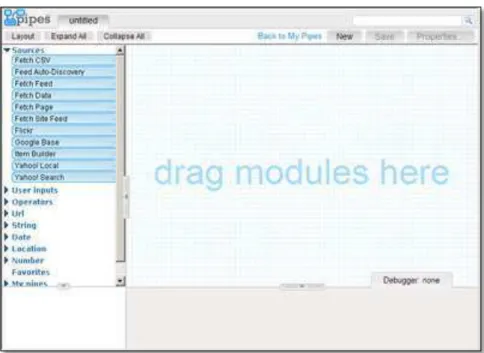
Figure 2-3: Yahoo Pipes Editor ... 50
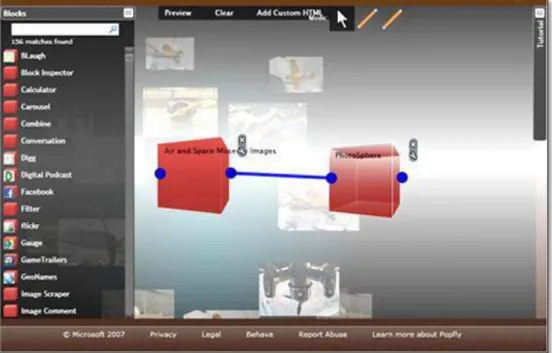
Figure 2-4: Microsoft Popfly ... 51
Figure 3-1: Web2Sh Architecture ... 60
Figure 3-2: Web2Sh Interactions ... 63
Figure 3-3: Web2Sh implementation of the Visitor design pattern ... 66
Figure 3-4 Web2Sh implementation of the Command design pattern ... 68
Figure 3-5: Web2Sh implementation of the Abstract Factory pattern ... 69
Figure 4-1: Web2Sh Command Line Interface ... 73
Figure 5-1: Using tee Web command ... 92
Figure 5-2: WSh Language processor using a tombstone diagram ... 104
Figure 6-1: Web2Sh pipeline ... 114
Figure 7-1 excerpt from cnn.com Web page source ... 136
Figure 8-1 Sample solution for task one in Yahoo pipes... 141
Figure 8-2 Sample solution for task two in Yahoo pipes ... 142
Figure 8-3 Sample solution for task three in Yahoo pipes ... 143
Figure 8-4 Sample solution for task four in Yahoo pipes ... 145
Figure 8-5 Sample solution for task five in Yahoo pipes ... 146
Figure 8-6 Participants’ programming experience ... 147
Figure 8-7 Participants’ self-evaluation of their programming skills ... 147
Figure 8-8 Participants’ preferred languages ... 148
Figure 8-9 Average number of hours using a Web browser weekly ... 149
Figure 8-10 Frequency of executing repetitive composite Web tasks ... 149
Figure 8-12 Number of tasks completed by all participants ... 155
Figure 8-13 Final participants overall rating ... 156
Figure 8-14 Preferred system by each language users ... 157
Figure 8-15 Preferred approach by group ... 157
List of Symbols, Abbreviations, and Nomenclature
Symbol Definition
AJAX Asynchronous JavaScript and XML
AST Abstract Syntax Tree
CUI Character User Interface
CSV Comma-separated values
EBNF Extended Backus–Naur Form
GUI Graphical User Interface
HTML HyperText Markup Language
HTTP Hypertext Transfer Protocol
JSF Java Server Faces
MIME Multipurpose Internet Mail Extensions
OOP Object-Oriented Programming
Web World Wide Web
Web2Sh Web 2.0 Shell (Framework)
WSh Web Shell (Scripting language)
XUL XML User Interface Language
Chapter One:
INTRODUCTION
This thesis presents an investigation that builds upon advanced and modern techniques for enabling customised automation of the Web interactions. It introduces a novel and innovative approach, which enables more useful and effective implementation of end-user programming to automate simple and sophisticated Web activities such as communicating, querying, and aggregating information.
This enabling approach was put into practice by designing and implementing a Web-based framework, which was named Web2Sh (Web 2.0 Shell). This framework empowers end users to write, customise, and run Web automation scripts that reflect their own needs and experiences. In addition, users can share these tools. With time, the aggregation of the users’ generated scripts will extend the framework leading to constant growth of Web automation tools.
Web2Sh presents an enabling technology for the shift towards the Web as a platform. It interconnects with various research fields. Yet, the focus of this research is the study and investigation of applying an end-user programming model for the automation of Web tasks, activities, and interactions. This thesis refers to this research topic as end-user Web automation as a focused area that combines end-user programming with Web standards and enabling technologies.
One of the premises of this research is that the Web is now the most important source of general information and one of the most important technological developments of our generation (Brin and Page 1998, Jeffrey I. Cole, Suman et al. 2003). It is also the most widely used platform for querying, accessing, and researching information, among other usages (Jeffrey I. Cole, Suman et al. 2003, William, Ellen et al. 2009). Hence, there is a need for improved and innovative approaches for searching, retrieving, and manipulating information over the Web and namely for approaches enabling casual and experienced programmers to achieve more expeditious, efficient and customised Web automation.
Most people experience the Web as an end-user of packaged services/resources. Unfortunately, creators of these services cannot know the details of each job an end-user is attempting. It is simpler and more efficient to the end end-users when they can
directly build and customise tools that they need. An end-user (casual programmer) is a user who has limited or no programming experience. However, this type of user may need to write or modify programs in order to accomplish some repetitive Web-related tasks.
End-user programming is a recognised approach to allow end users to create novel programs in a simple manner. Spreadsheet programs are often considered to be a very good example of success in end-user programming (Margaret, Curtis et al. 2003), allowing them to write, edit, and use formulas and automation programs such as Microsoft Excel.
End-user programming environments are also useful for expert users and even programmers. This is due to the use of scripting languages, which are fast and easy to learn compared to high-level programming languages. In platforms such as UNIX shell, considerable amounts of time and effort can be saved by writing task automation programs.
The hypothesis of this work is that the development of an interactive end-user programming UNIX-like model for the Web, as a platform in its own terms, is feasible and useful. Such a model would facilitate the process of automating both simple and sophisticated Web users’ tasks. Interactive in this context refers to the ability to accept and respond to commands from the end-user.
Web browsers are the most commonly used client for accessing, navigating, and interacting with the Web. Various Web browsers are currently in use, and even different versions of the same browser are common. This leads to the co-existence of a wide variety of browsers. Hence, for a Web end-user (hereinafter, end-user) programming environment to be widely used, it must operate on all, or at least the majority of, Web browsers and on any type of computer or smart device that can be used to access the web.
This thesis presents research on a new model of end-user Web automation. The model is evaluated through the design, implementation, and testing of a Web-based framework (Web2Sh) for writing, customizing, and running Web automation tools.
This chapter presents the motivation, objectives, and approach used in this work and its scope. At the end of the chapter, an overview of the implemented framework and the structure of the thesis are provided.
1.1
Motivation
This is an innovative research endeavour targeting a novel area of research. A main objective of this research has been to investigate and experiment with the design, development, and usage of an extensible Web-based framework for end-user Web task automation.
The presented framework explores a new approach, which allows data on the Web to be more effectively utilised through better discovery, integration, and automation. This would enable the end-user’s Web interactions to achieve new and greater possibilities.
The approach implements a successful model that has been available and tested on various platforms, most notably UNIX, for automating end users’ repetitive and tedious tasks. This model is useful for achieving automation through the effective use of scripting languages for end-user programming, which runs over a platform-specific shell via a command line interface.
This research shares the vision of the Web as a platform (O'Reilly 2007a). Hence, this work integrates the development of Web2Sh framework, which targets the Web as a platform and uses the thin client model to provide a Web command line for the Web. It also presents a specific Web shell scripting language (WSh) in addition to a variety of Web automation tools in the form of Web commands that can be linked together using WSh to cater for sophisticated interactions.
The thesis emphasises that the development of effective end-user Web automation tools is important, useful, and feasible; the current available environments for building such tools are both limited and hardly practical for the majority of users.
It provides a solid foundation for future research into end-user Web automation, and has potential wide uses for diverse Web research topics. Web2Sh offers a new development framework that can be used by researchers to facilitate the implementation and testing of new innovative ideas in various domains. This was demonstrated in this research by the implementation of some useful Web commands inspired by research from the data-mining domain.
In addition, available academic research focusing on the automation of Web tasks is limited. Although major Web companies, most notably Yahoo, have implemented systems related to the automation of end-user Web activities, they have hardly produced a lot of pertinent academic literature. This indicates the importance of and the need for greater research effort that focuses on this novel research topic. The potential of this field has inspired this research to investigate, building on the current literature and systems, in order to expand it so to provide the academic research community with a more solid foundation for future research.
This research and the implemented framework takes a step forward towards fulfilling the Web as a platform concept (O'Reilly 2007a), which is a major scientific challenge to the Web research community. The design and development of Web2Sh framework enables this concept by providing an environment for building useful and flexible automation tools (Web commands). Another challenge that this thesis addresses is the investigation and development of a robust and powerful repository of useful, customisable, connectable, and extendable Web commands, which can handle a wide range of users’ activities.
The main motivation for this research was therefore to investigate such a novel research topic of end-user Web automation, which can be of great use in the current shift towards fulfilling the vision of the Web as a platform. This research topic could offer many potential benefits for various other Web research domains. In addition, the work provides a significant benefit for end users with the development of an extendable Web commands repository that facilitates the automation of a wide spectrum of Web tasks.
1.2
Background
There has been a clear shift towards utilising the Web as a platform (O'Reilly 2006a, O'Reilly 2007a) in order to provide many services and applications previously only available on desktop computers. There is an obvious need to provide mechanisms and tools on the Web that support the move towards the full vision of the Web as a platform.
Whois Internet Statistics1 estimated 28.7% of the world population in 2010 were active Web users, with a 444.8% usage growth in the prior 10 years. It also states that the Web serves a total number of approximately 131 million domain names in 2011. Researchers have identified a variety of motives for Web usage, although the specific number and content of the categories of those motives differ. According to (Jackson 1999), the five main motives for using the Web are: interpersonal communication, personally valued information, self-expression, entertainment, and consumptive motives. A more recent study by (Kennon, Rodgers et al. 2002), involving journalism college students via an open-ended questionnaire, identified four primary types of motives for using the Web: communicating, researching, shopping, and surfing.
In 2002 the ten most popular Internet activities according to (Jeffrey I. Cole, Suman et al. 2003) were:
1. E-mail and instant messaging; 2. Web surfing or browsing; 3. Reading news;
4. Accessing entertainment information; 5. Shopping and buying online;
6. Hobbies;
7. Travel information; 1 http://www.whois.sc/internet-statistics/
8. Medical information; 9. Playing games; 10.Credit card tracking.
Recent research in the United Kingdom (William, Ellen et al. 2009) reported that Internet users were more likely to use search engines compared to previous years. It also stated that the Internet has become their primary source of information. A significant increase of the use in social networking sites in 2009 is also obvious in the report. It stated five main categories of reasons for using the Web: seeking information, communication and social networking, entertainment, finance and government services, and production.
Most Web applications offer their services through a GUI based interface, usually a Web browser, although programmers can write their own programs to automate any customised task they require. The majority of end users cannot easily achieve such automation due to the major lack of customisable automation tools.
Numerous Web crawlers and bots roam today’s Web. These are programs that browse the Web, and follow links and process the Web in order to perform a variety of services such as: full text indexing (Brin and Page 1998), product comparison (Yun, Satya et al. 2007), Web data mining (Raymond and Hendrik 2000), downloading, and visualisation. However, this list of services is by no means sufficient for users growing needs. Users often require custom services that no existing robot provides.
With the rapid growth of the Web, a parallel growth in demand for personalised Web automation is expected. This will allow a user to delegate repetitive tasks to a robot or a script that can generate alternative views or summaries of Web content that meet the user’s needs (Miller and Bharat 1998).
Both Semantic Web and Web 2.0 communities aim to achieve a superior Web, by investigating novel approaches that allows data to be used for more effective discovery, integration, collaboration, and automation (Berners-Lee and Miller 2002b, O'Reilly 2007a).
The research (Bolin, Webber et al. 2005b, Berners-Lee, Hall et al. 2006, O'Reilly 2007a, Ankolekar, Krötzsch et al. 2008) indicates that for the “Web as a platform” vision to be realised, end users still need more efficient, accessible approaches for automating the Web. However, the semi-structured nature of the Web, its vast size, variety of formats, languages, and standards, and above all the GUI-HTML based interface of the Web all present challenges for automating Web access, querying, and manipulation.
According to (Bolin 2005a), end users still need an efficient, unified and simplified way to accomplish Web-based tasks, particularly tedious tasks of repetitive nature. There is still no universally applicable and flexible system envisaged that fulfils such needs. Thus a system, with built-in extensibility to allow users to add and adapt new tools, is highly desirable.
There have been recent and current efforts on the Web (Miller and Bharat 1998, Pilgrim 2005, Bolin, Webber et al. 2005b, O'Reilly 2007b, Beard 2008) to provide users with the required environments and tools to enable them to achieve a higher level of personalised Web automation. However, it should be noted that this research approach is different and novel in the sense that it investigates the use of simple command line operation from within any modern Web browser, which is by far easier, faster and more convenient to use. Furthermore, it utilises the use of data streams, filters, and pipes similar to the UNIX shell approach that has already been tested and widely used by various computer communities (Delaglio 1995).
One of the aims of this research is to offer broad tools that can access data in its various formats on the Web. Few known tools offer end users with environments for building tools to aggregate and manipulate Web content. The most recognized web-based tool is Yahoo Pipes2 (Fagan 2007), yet it can only access specific formats, mainly RSS feeds, with limited support for raw HTML pages - by far, the most commonly used format for Web pages. The development of advanced automation tools is a major scientific challenge to the research community. Such tools need to cope with the ever-increasing complexity of the Web and be flexible enough to adapt to its frequent and rapid changes.
2 http://pipes.yahoo.com/pipes/
The introduced scripting language for Web2Sh framework, named WSh, enables end users to aggregate Web commands in innovative approaches to accomplish tasks that the original commands designers may have not even foreseen. This could later support the development and extension of robust, flexible, adaptable, and powerful automation tools.
This provides significant benefits for end users. Indeed, such tools would help to alleviate the tedious effort and save time currently needed to process Web retrieved data. It also presents new opportunities to exploit the Web for both scientific and business purposes. Improvements in this field will lead to significantly more efficient use of resources, both of the users’ time and the advanced utilisation of the resources themselves.
Developers of desktop applications have relatively full control over their user experience. However, on the Web, there is virtually no control over how clients access, view, and use Web pages. Having this control on the desktop made it easier for developers to build tools that end users can use to write and customise scripts to automate a variety of tasks on platforms and applications. A good example of such a platform is UNIX, where users could use any available shell scripting language to automate a certain task. End users also have automation tools in various applications, such as Microsoft Office, which offers the Visual Basic scripting language.
Most end users search for information using Web browsers with search engines as a starting point; however, this retrieval mechanism does not necessarily address all of the users’ needs. The end users main concern is to find all the information they seek swiftly and accurately. However, with the vast size of the Web, achieving this is usually a challenge (Madria, Bhowmick et al. 1999).
The huge growth of the data accessible on the Web presented two fundamental issues regarding the effectiveness of accuracy of information search: mismatch and overload. Mismatch means some useful and related data has been disregarded, while overload means some assembled data is not actually related to what users need (Yuefeng 2006).
In many cases, end users may require information that they need to filter and aggregate from various search engines or specific Web pages, e.g. users may need to retrieve a set of articles from various news sites related to a certain topic. Current browsers and search engines give users very limited options or tools to program or customise their own automation programs that may fulfil their own information needs.
Recently there has been an increased research interest by major commercial Web players such as Yahoo, Google, and Microsoft. They have started to provide Web-based tools that facilitate Web activities automation for end users. These systems include, Yahoo Pipes3, Microsoft Popfly (Foley 2009), and Google Mashup Editor4. Although both Popfly and Google Mashup Editor were shutdown in their beta stage, they showed potential and provided new ideas that did meet a recognizable success. The only available statement by Microsoft about the closing of the Popfly project stated that they made great progress and learned many lessons yet had to close it due to the economic situation (Bishop 2009). As for Google, they announced that they used the gained experience from the Mashup Editor project in their App Engine5 project (Tholomé 2009).
Even in its beta version, PC World magazine picked Popfly as one of the most innovative computing and consumer electronics products of 2007 (PC-World-Staff 2008).Yet, it was clear from the type of tools created by Popfly users, that it was more suited as a fun gadget rather than serious Web automation. The situation was different with Google Mashup Editor; it was more suitable for expert users and actual programmers. This made it more powerful compared to other systems, but at the same time would have been harder to utilise by the wider end users community. The system was not even published to the public and was only available to be tested through requesting invitations.
3 http://pipes.yahoo.com/pipes/ 4 http://code.google.com/gme/ 5 http://code.google.com/appengine/
Other research teams also developed other tools. For Example:
• Chickenfoot (Bolin 2005a), which was developed as a plugin for the Firefox Web browser.
• cURL6, is a desktop-based command line utility for executing a variety of functions with URL-oriented protocols.
• Fiddler HTTP Debugging Proxy (Lawrence 2008), which logs all HTTP traffic between a computer and the Internet.
Such approaches offer significant promise for solving specific problems, however, the investigation of such approaches and building more robust general system should not be underestimated. These systems have been targeting special areas, rather than as a universal solution to a wider range of problems, and as such, they provide only limited functionality, although they demonstrate the feasibility of work in this topic. One of the first general tools targeting this domain was Yahoo Pipes, which introduced a service to aggregate Web content (O'Reilly 2007b). Similar to UNIX pipes, Modules can be combined together to create the desired output. Yahoo launched this service in early 2007. Since then many users have been creating pipes with various functionality. (O'Reilly 2007b) considers Yahoo Pipes as a milestone in the history of the Internet, and describes it as “still a bit rough around the edges, it has enormous promise in turning the Web into a programmable environment for everyone.”
At this time, Yahoo Pipes is perhaps the most useful Web automation tool that has been publicly available to end users (Fagan 2007, O'Reilly 2007b). However, it is particularly limited in intent and functionality; it mainly works for RSS feeds, with minor exceptions. In addition, it depends on a graphical interface for building users’ pipes, which affects the pipe creation process in terms of performance and speed. It also makes it suitable only for powerful computers and close to impossible to utilise over smart devices. While Yahoo Pipes users can combine multiple searches into a
6 http://curl.haxx.se/
single feed, there is limited functionality for exploiting extracted data in other, more flexible and powerful ways.
The Yahoo Pipes graphical user interface (GUI) makes it easy for novice users to create modules. However, for more advanced users and programmers it would be faster and more efficient to have a text-based editor where users can write code rather than using the drag and drop GUI interface. Hence, it is preferable and desirable to offer a faster text-based command line especially when creating scripts that are more complicated.
The author of this thesis shares the view of (O'Reilly 2007b) that “Most of the non -graphical utility programs that have run under UNIX since the beginning, some 30 years ago, share the same user interface. It is a minimal interface, but one that allows programs to be strung together in pipelines to do a task that no single program could do alone. Most operating systems including modern UNIX and Linux systems have graphical interfaces that are powerful and a pleasure to use. But none of them are so powerful or exciting to use as classic UNIX pipes and filters, and the programming power of the shell.” This indicates a preferable non-graphical interface that can provide similar and more advanced functionality.
This research provides an interface suited for both regular and advanced users. Many Web2Sh Web commands have the option to produce an RSS feed (by piping to an RSS filter at the end of any command) so that the resulting feed may then be used from within Yahoo Pipes or any other similar tool.
Calls for combining Web services as the Web analogue to UNIX pipes have occurred (Jeffrey 2007) but have largely gone unheeded. Expanding this concept to a general system where the Web can be seen as a library of callable components has also been partially envisaged by Jon Udell who had a vision of Web sites as “Data sources that could be re-used, and of a new programming paradigm that took the whole Internet as its platform” (O'Reilly 2007b). This research not only investigates, improves, and implementsthese ideas, but also tries to take the concept further.
To meet its objectives, this research investigates and utilises major current Web trends, such as Web 2.0 that work towards enabling the Web as a platform mainly by providing usable desktop-like applications and enabling further the move towards more interoperable applications that reside on the Internet space rather than on users own computers.
In the Semantic Web approach, end users are mainly consumers. Semantic Web applications mostly depend on developers and experts rather than end users to participate in supporting the conversion or to add semantics themselves. On the other hand, one of Web 2.0 objectives is to empower end users to be more effective. Web 2.0 facilitates the adding of users’ content and customises their own views of the Web. This could be one of the main reasons for the popularity of Web 2.0 jargon; however, functionalities offered to end users by Web 2.0 applications usually limit their capabilities. They usually cannot extend or modify beyond what the developers of those applications offer.
This research also aims to investigate how to empower end users further in order to play a more effective role in the transition to the Web as a platform. Web2Sh provides a set of simple and advanced tools that end users can extend in unlimited ways using the piping system. This enables end users to create their own tools or simply to use tools created by others. A text-based scripting editor provides a command line approach similar to what is available on any other platform and that the Web still lacks. Although many may consider the Web address bar as a command line in itself, but it has very limited functionality.
1.3
End-user Web Automation
This research uses the term Web Automation to refer to the enabling systems and technologies, which support end users to write and run automation tools that express their own personalised Web experiences.
An end-user programmer (casual programmer) is defined as a user who is not concerned with programming, yet who needs some of the power of programming to accomplish tasks effectively (Nardi 1993). On the Web, end users normally use GUI-based applications, mostly Web browsers, for various objectives like information
retrieval, shopping, communication, and entertainment. Any task on the Web usually involves a set of link clicks and forms submission to reach a required goal. For similar goals, users would usually follow a sequence of similar steps. Usually the users’ own experiences are the main factor affecting the speed and efficiency of reaching a goal.
The research topic of end-user Web Automation in the context of this thesis is defined as the study of theoretical and practical techniques for applying an end-user programming model to enable the automation of Web tasks, activities, and interactions.
The end-user Web automation is a novel research topic, which connects together various computer sciences fields. This work involved the study of following topics:
• Web Enabling Technologies;
• End-user Programming;
• Programming Language Processors;
• Software Engineering;
• Concurrency;
1.4
Research Issues
The current state of the Web leads to the conclusion that there is still plenty to be done to fulfil the move towards achieving the “Web as a platform” vision (O'Reilly 2005, O'Reilly 2006a). The current embracing of the Web has fundamentally changed software development approaches. In the past few years, the Web has become the most used deployment environment for software systems and applications.
At present, end users utilise a Web browser more widely to run desktop-like applications. In the near future, developers will write the vast majority of software applications as a Web application or at least with considerable Web integration (Taivalsaari, Tommi Mikkonen et al. 2008). However, there is still a significant need for environments and tools to enable end users to achieve the same level of task automation they find using desktop-based platforms such as Operating Systems, Spreadsheets environments, and many other applications that offer the use of scripting languages and basic command line tools.
1.4.1Scope
The main scope of this research is to investigate the feasibility and importance of enabling end users to automate and share their Web experiences. This research shows the main aspects of the proposed Web2Sh programming platform. Web2Sh is a framework for writing and running Web commands. It offers a Web-based shell scripting language, Web commands repository, and a Web-based command line interface.
To accomplish such a platform, this research must explore many computer science domains to reach the best technical approach and design for achieving the thesis target. However, the focus of the research is Web automation for end users.
In addition, the research investigates a set of Web commands to execute browsing, data mining and filtering tasks. These commands provide a multiplicity of functions such as retrieving Web pages, string manipulation, data mining, and Web page segmentation.
1.4.2General Aims and Objectives
The main aim of this research is to investigate a new approach for Web task automation. Such an approach will provide Web users with flexible and fundamentally more powerful ways for automating their Web interaction and in particular for information retrieval, data mining processes, and constructing Mashups. This approach enables Web end users to create, test, and run script-based tools that can execute a sequence of steps required to achieve a given goal.
The overriding aim is to offer a more flexible approach in order to create and share automation scripts in the form of “Web commands” that offer an innovative way for users to interact with the Web, automate their activities, and share their Web experience with other Web users.
In this context, this research investigates the development of a framework named Web2Sh (Web 2.0 Shell, based on the term Web 2.0), which offers a command line interface for the Web, a simple scripting language and a user friendly environment for building Web commands in a similar approach to UNIX platform shell scripts. To achieve such Web automation, Web2Sh offers further flexibility that allows end users to interact with the Web and a great level of generality that facilitates the development of tools that end users can employ in a wide range of situations and environments. Furthermore, Web2Sh offers end users a new model to retrieve information, create customised pages from multiple resources, and automate various Web tasks.
Web2Sh also offers a new model for sharing users’ Web interaction experiences in the form of customisable Web commands. It also offers new approach for Web information retrieval and automating Web activities through a command based interface rather than the common GUI link click common model.
For achieving those goals, Web2Sh emphasises two major paradigm shifts in the Web:
1. User-generated content: This relates to enabling individuals to become an effective part of the Web and to produce their own information, i.e. blogs, wikis, social bookmarking, and social networking sites.
2. Thin client computing: this indicates the model where data and applications are stored on Web servers, and users can access them from any computer via a Web browser. Cloud Computing is a clear and exact application of this model.
In the light of these paradigm shifts, this research investigates how far the proposed model can enable end users to achieve Web automation. In addition, an ambitious objective is to offer end users new, easy, and fast methods to interact with the Web especially with the use of small devices like smart phones. Web2Sh is able to operate fundamentally faster and in fewer steps to retrieve information from the Web; once a user creates or learns to use a Web command he/she can then immediately and easily put it into use (e.g. to retrieve information) by typing this command in the Web2Sh command line. In addition, the user can easily manipulate or customise the retrieved information by extending the Web command.
Another ambitious aim of the research is to investigate other domains of Web technologies in order to support the development of a useful Web commands repository, such as a set of commands specific for Web data mining.
Data quality is an important issue that represents a problem when applying data mining techniques to the semi-structured data of the Web, as the unstructured Web data requires the development of powerful and more efficient tools. Such tools should support the discovery and analysis of interesting, unforeseen or valuable structures in the Web data as defined in (Madria, Bhowmick et al. 1999).
The work presented in this thesis offers useful and extensible tools that implement some data mining techniques. This offers the end-user community with direct access to utilising such techniques themselves.
1.4.3Specific Objectives
The key objectives of this research are:
3. Investigate a new model for end-user Web automation. This model should offer an easy to use approach to automating Web tasks.
4. Design and implement a new simple and effective scripting language focused on the development of Web automation tools.
5. Design and implement a Web-based framework to enable end users to create, run and share Web automation tools.
6. Design and implement a repository of Web commands, as a reusable, efficient and customisable Web automation tools.
1.4.4Potential Users
End users are a diversity of unique individuals each with their own experiences, goals, skills, and interests. The development of a command-line-based interface for the Web, a Web scripting language, and a framework for developing Web commands, would provide the community of Web end users with powerful tools that would enable them to both save time and share their Web experience. The ability to extend the system by collaboratively developing and sharing Web commands would allow Web users extra flexibility by giving them the tools they require to search, interact and customise the Web according to their own needs.
In defining the end-user (Nardi 1993) does not classify them as novices and experts, but by the way which they represent various domains, such as academics, librarians, doctors, students and researchers. He also defines end-user programming systems as software that end users can use to develop and run applications; a good system should allow end users to build their tools with the minimum amount of work.
One of the general aims of Web2Sh is to serve the wider possible set of users. Hence, the framework offers a set of general use commands that meets the most common activities shared among end users. However, more specific Web commands that target specific end-user communities were developed, in order to demonstrate further the feasibility and usefulness of the approach implemented by Web2Sh framework.
An important advantage of Web2Sh is that end users can create and share Web commands in a simple way. The success of social bookmarking, blogging, wikis, and other sites, where users are encouraged to participate actively, implies that giving end users the chance to contribute to creating Web shell tools would be very promising.
One community of prospected users of Web2Sh is the wide researchers’ community. Almost all researchers in various fields use the Web to research, access and publish information. In many cases they may need to collect data from variety of Web sites for certain analysis reasons, for example, collecting a huge number of images, then extract their img tags’ alt attribute value for further accessibility analysis. For researchers with a computing background it would be easy for them to write or customise an existing program for the task they require, however, for the majority of researchers they could waste time doing such jobs manually and repeatedly.
Another type of prospective user is Web administrators, who work with diverse tools to manage, monitor, configure, troubleshoot, and continually update their Web sites, which can be distributed across multiple networks and servers, in a rapidly paced growing and changing Web of information and services.
They may in some cases build and share custom tools for automating specific tasks that are not supported by out of the box tools. The recent movement towards dealing with the Web as a platform, in addition to using desktop-like Web-based management consoles, offers many advantages. Yet, this puts an extra burden on Web administrators, as achieving customisation and automation requires a decent level of Web programming experience, which in many cases will be beyond their skills, hence making it difficult to write tools with the level of customisation they might need.
Field studies in (Eser, Eben et al. 2005) indicate the importance of collaboration among system administrators and end users in the development and use of custom automation tools in organisations.
The methodologies this research employs aim to provide an accessible, usable and productive framework, which empowers end users to automate their Web experiences. This framework should serve end users with little or no formal
programming training as well as users with more expertise. Hence, the design of Web2Sh caters for the general need of regular Web users, particularly for casual programmers. For these, programming is not their main trade; they only use it to achieve certain tasks they may need. This type of user is not willing to spend a long time learning a sophisticated programming language, but can invest a few hours in learning a language that might help them to save time and increase their efficiency by automating repetitive systematic tasks they need to do.
1.4.5Approach
This research took the following approach in order to achieve the objectives specified in section 1.4.3:
First, to acquire theoretical and practical understanding, the research investigates the best known tools and Web applications that offer various approaches to full or partial support for end users to create and share customisable automation tools (Miller and Bharat 1998, Aquino 2005, Pilgrim 2005, Bolin, Webber et al. 2005b, Fagan 2007). Secondly, an investigation is made of the end users’ most common activities and possibly useful basic Web commands that can empower them to automate their most repetitive tasks in a fast and effective manner.
Thirdly, the research investigates state of the art Web development technologies and design techniques, which may serve the design and implementation of Web2Sh framework.
Fourthly, Web2Sh framework implementation was accomplished through multiple iterations of design and development, in order to realise the highest possible level of performance, extensibility, effectiveness, and usability.
Fifthly, the framework was initially evaluated by writing, testing, and running a set of Web commands that target possible common scenarios, which various domains of end users could require.
Finally, a mixed method approach was used to examine the hypothesis of this thesis. An experiment encompassed fulfilling five tasks that complemented each other. The overall objective of the five tasks was to integrate data from Google product search
and Amazon Web services in order to create a mashup of a set of dynamic links that contain an associate id of an amazon affiliate. In addition to completing their tasks, each participant was asked to provide feedback through online questionnaires, in which both quantitative and qualitative data was collected.
1.5
Contributions
The primary contribution of this research lies in the novel area of Web Automation. The combination of end-user programming technique, and the power of the Web as a platform, facilitates the creation and running of user-oriented automation scripts in the form of Web commands. A flexible and powerful framework (Web2Sh) for creating, customising, and running Web Automation scripts has been provided. In addition, a repository of useful Web commands is provided for end users.
A second contribution is in the field of end-user programming. A Web scripting language (WSh) has been developed for the generic use of creating and customising Web commands. WSh is a task-oriented language that applies the concepts of the software tools philosophy.
1.5.1Web2Sh Framework Overview
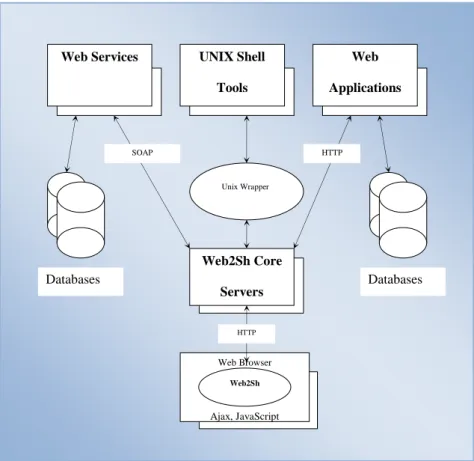
This thesis presents a new Web-based programming platform “Web2Sh” for creating, sharing, and evaluating Web commands. Web2Sh framework, in the context of this thesis, refers to components including a command line Web interface, Web WSh shell script, interoperability and sharing model and a repository of core Web commands that handles many basic and composite Web activities.
The proposed system aims to serve and support the move toward the concept of “Web as a platform.” The research investigates this concept and the limitations regarding Web automation in terms of ease of use, reusability, flexibility, and limited tools, which prevents utilising this concept to its full potential.
A main component of Web2Sh is a UNIX-like shell scripting language for creating Web scripts. Extended Backus–Naur Form (EBNF) is used to create the formal grammar for the WSh scripting language; the language itself is initially generated
using the JavaCC tool (Kodaganallur 2004), and then extended using the Java language.
Web2Sh introduces a repository of Web commands, which is the main programming unit of the shell; a Web command is a tool that executes a certain task over the Web platform. Combining multiple Web commands is easy using the pipeline concept. The pipe idea is to pass a command’s output into another command for extra processing.
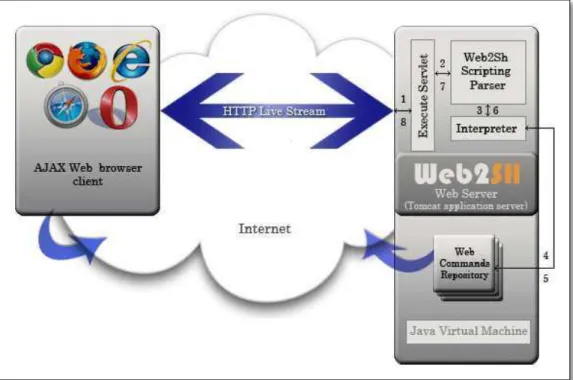
In addition, Web2Sh supports the thin client-computing model, hence, allowing Web commands to utilise many server-side resources that have been usually only accessible by developers. This model also makes Web2Sh more usable as all end users need is a Web browser to write and run their Web commands.
End users can further utilise and customise Web commands to construct new reusable Web commands. A primary advantage is that much of the functionality needed by Web users can be accessible in one place. Furthermore, The WSh scripting language provides the ability to extend Web commands repository offered by the framework to cover new domains and functionalities.
Web2Sh utilises the power of the Java language and offers end users a usable, extensible, and powerful set of Web commands enabling them to increase the efficiency of how they accomplish various tasks on the Web, giving them the possibility to customise a set of their own commands to serve individual needs. Web commands are, from the deployment and execution point of view, server-side programs and services. Running on the server side, allows Web commands to access superior resources and make them easily accessible for the wider end-user community.
Many Web sites make their services accessible to developers through different interfaces, most commonly Web services. However, developers need to locate the right service URL and documentation, before being able to use it. Web2Sh empowers end users to access and utilise data across the Internet through one simple language, eliminating the need to learn advanced programming languages and how to locate and call different APIs.
While some systems exist to help search, retrieve, and process this information, there is a dearth of advanced, powerful, and flexible applications for both novice and expert users. Hence, this research investigates the ability of introducing a new approach for information retrieval, creating Web Mashups, sharing users’ Web experience, creating Web-mining tools, and automating various Web tasks.
This research proposes a novel Web-based environment for end-user programming to enable end users to create their own specific automation programs targeted for the World Wide Web as Web command to achieve an improved utilisation of Web resources. This environment consists of a command line for the Web, a series of Web commands that targets a variety of Web activities, and a simple scripting language.
1.6
Organisation of the Thesis
This chapter presented the motivation, background, scope, and objectives for this research. It introduced the definition of the end-user Web automation, explained the approach, and highlighted the contributions. It also provided an overview of the developed framework (Web2Sh) and its potential users.
Chapter 2 introduces the concept of the Web as a platform, and provides an overview of Web history, architecture, and other enabling technologies with the focus on Web automation-related technologies and systems. It also provides an investigation of available systems and tools that provide partial support for end-user Web automation. It highlights and considers the advantages and disadvantages of each tool’s approach. Finally, it provides an overview of the concept of end-user programming, scripting languages, and command line interfaces. It also provides an overview of the UNIX shell environment as a recognised example that implements end-user programming and shell scripting.
Chapter 3 present the Web2Sh framework. It presents the main design challenges, and describes solving the problem of developing a concrete useful framework for end users Web task automation. It presents in more detail the framework architecture and design. The implementation details of the pipeline concept are provided.
Chapter 4 provides a detailed description of the Web2Sh command line user interface. This is the client side component of the framework.
Chapter 5 describes the building process of Web2Sh dedicated scripting language (WSh). It explains the need for a scripting language to enable Web automation. It presents the software tools philosophy, and the background needed for defining a new scripting language and implementing its Parser; the design of WSh language is explained, and the language informal and formal specifications are introduced. Finally, it explains the parsing, translation, and interpretation of the code.
Chapter 6 presents Web command as the basic building block to writing Web automation scripts. A detailed description of the syntax, structure, and general characteristics of Web command is provided with detailed descriptions of some of the commands provided by Web2Sh. The Web2Sh implementation of the pipeline concept is discussed. Finally, the integration of external tools and services in Web2Sh is discussed.
Chapter 7 reports on the use of the framework, it demonstrates the usefulness of the framework through the implementation of various possible Web related activities. This shows that the framework facilitates the creation and running of Web commands in a wide range of domains.
Chapter 8 presents the evaluation of the experiment that was performed to examine the hypothesis of this thesis. The evaluation was carried out as a user trial, involving twenty-four participants. The user trial included the use of both Yahoo pipes and Web2sh to produce a set of modules/Web commands, with the objective of automating information integration between Google products and Amazon Web services.
Chapter 9 describes the foundations and arguments for the design and implementation decision throughout the development of Web2Sh framework, lays out the conclusions of this research, and suggests future work.
This thesis supports the hypothesis that the development of an interactive end-user programming UNIX-like model for the Web, as a platform in its own terms, is feasible and useful. Chapters 8 and 9 highlight these claims by reviewing the thesis main points and linking the model with the design and implementation of Web2Sh framework and meeting the objectives. It also discusses the contributions while indicating areas for future work.
Chapter Two:
RELATED WORK
2.1
Introduction
This chapter provides the research background related to the novel area of end-user Web automation. It starts with a general overview of the Web, Web architecture, and its main enabling technologies, followed by a survey of related Web automation systems and tools, and finally examines the end-user programming model and UNIX shell scripting. A section is presented for each item.
Section 2.2 introduces an overview of the Web and the shift towards the vision of the Web as a platform. The advantages and limitations of the Web are considered, with a focus on the enabling technologies leading to Web task automation. A brief historical overview of the Web is provided, followed by research background in the fields of scripting languages, Web mining, Semantic Web, Syndication Feeds, Web 2.0, Rich Internet Applications, and user-generated content .A sub-section is presented for each field.
Section 2.3 defines the term Web automation, and then provides an overview of related systems and enabling techniques. A sub-section is presented for each of the best-known systems and tools. The advantages and disadvantages of each system’s approach are considered.
Section 2.4 examines in more detail the concept of end-user programming. The role and characteristics of scripting languages are presented. The usefulness of command line interfaces is demonstrated. Finally, an overview of the UNIX shell environment is presented as a recognised example that demonstrates the utilisation of end-user programming and shell scripting.
2.2
World Wide Web
The World Wide Web (WWW, or simply the Web) is a vast information space in which the items of interest, referred to as resources, grow further every day encompassing more services and information in different languages and formats. At present there is a clear shift towards utilising the Web as a platform (Anderson 2006,
O'Reilly 2006a) to provide many services and application that used to be available only as desktop applications.
Successful utilisation of the Web as a platform unlocks many new possibilities and challenges given the number of simultaneous users, the numerous services, and the ever-growing information repositories. Web developers and demonstrators are usually the main information producers on the Web. They add new content, servers, and applications quite often, providing an endless supply of knowledge accessible by millions of users.
Since 2005, a new approach that encourages end users to produce information themselves proved very successful. This approach is known as User Generated Content (UGC). It covers a wide range of Web publishing and media content Web sites available in a range of modern technologies. It was successful in many domains including blogging, podcasting, forums, products reviews, social networking, and wikis (Marianna, David et al. 2008).
In desktop applications, developers expect to have control over the end-user experience. However, on the Web, there is much less control over how the user might view a Web page and on which browser. Hence, Web developers face many challenges taking into account all the variables, such as the Web browser type and version, which may have an effect on the end-user experience.
The use of well-known standard formats and protocols helps to solve these problems. However, many developers, vendors, and even users might not always adhere to these standards. This leads to another major challenge for creating general tools that automate Web-based tasks. Committing to tools that utilise Web standard protocols and formats is perhaps the best approach to cater for the majority of Web resources. Yet, it is also important to provide end users with some tools that can also handle the sites that may not adhere fully to the Web standards.
The Web will be more powerful when it becomes an environment which allows data to be used for more effective discovery, integration and automation (Berners-Lee and Miller 2002b). Both Semantic Web and Web 2.0 communities aim to achieve almost the same goals using different approaches. They appear to be competing rather than collaborating. However, future Web applications may make use of both of them, to
retain the Web 2.0 focus on community and usability, while utilising Semantic Web infrastructure to facilitate information sharing, integration and processing via automated tools (Ankolekar, Krötzsch et al. 2008).
Research by (Bolin, Webber et al. 2005b, Berners-Lee, Hall et al. 2006, O'Reilly 2007a, Ankolekar, Krötzsch et al. 2008) indicates that end users require automated tools that are efficient, accessible, customisable, and useful to accomplish various Web tasks. The semi-structured nature of the Web, the diversity of formats and languages, and above all the GUI-HTML based interface of the Web, raise many challenges for achieving such Web automation.
The Web is likely to be the logical choice as a platform for building and running a Web automation framework. Hence, the next section will investigate several aspects of the Web. First, it will offer a summary of the Web history, architecture, and models. Secondly, it investigates enabling Web technologies that should be considered for the architecture of such a framework.
2.2.1A Brief History of the Web
The Web is a worldwide-shared medium for information, communication, broadcasting, and many other services. Web pages are usually arranged into Web sites, which are identified with domains, and connected using hypertext links. Information on a Web page can be hard coded directly as HTML content in static pages or retrieved dynamically from a database or XML-based documents allowing for a higher level of interactivity with its users.
Users are a major facet of the Web, the more users the Web has the more powerful it grows. Users participate in various Web activities through different devices, most commonly computers, mobile phones and smart devices. According to the World Wide Web Consortium and (Berners-Lee 2004), the Web history goes back to 1945 when (Bush 1945) published an article in Atlantic Monthly about a photo-electrical mechanical device called “Memex”. It had the advantage that it could make and follow links between documents on microfiche. later on, (Nelson 1965) coined the term "Hypertext".