Estimating Implied Recovery Rates from the Term Structure
of CDS Spreads
Marcin Jaskowski
1and Michael McAleer
∗1,2,3,41
Econometric Institute, Erasmus School of Economics, Erasmus University Rotterdam
2Tinbergen Institute, The Netherlands
3
Institute of Economic Research, Kyoto University, Japan
4
Department of Quantitative Economics, Complutense University of Madrid, Spain
December 2012
Abstract
Credit risk models should reect the observation that the relevant value of collateral is generally not the average value of the asset over all possible states of nature. In most cases, the relevant value of collateral for the lender is its secondary market value in bad states of nature, where marginal utilities are high. Although the negative correlation between recovery rates and default probabilities is well documented, the majority of pricing models does not allow for correlation between the two. In this paper, we propose a relatively parsimonious reduced-form continuous time model that estimates expected recovery rates and default probabilities from the term structure of CDS spreads. The parameters of the model and latent factors driving recovery risk and default risk are estimated using a Bayesian MCMC algorithm. We nd that the Bayesian deviance information criterion (DIC) favors the model with stochastic recovery over constant recovery. We also observe that for companies with a good rating, implied constant recovery rates do not dier much from stochastic recovery. However, if a company is very risky, then forward stochastic recovery rates are signicantly lower at longer maturities. Keywords: Constant recovery, stochastic recovery, implied recovery rate, term structure, CDS spreads. JEL: G13, G17, G33, E43
∗For nancial support, the second author wishes to acknowledge the Australian Research Council, National Science Council, Taiwan,
1 Introduction
In recent years, a number of papers have concentrated on the role of recovery risk in credit risk models. Part of this literature attempts to extract implied recovery rates from observed prices of bonds or CDS spreads. Most of these studies are based on the assumption that recovery rates are constant and are independent of the default probabilities. The assumption of independence is made for tractability. However, this turns out to be a very strong assumption because we have sucient empirical evidence to believe that recovery rates are stochastic and negatively correlated with default rates (Altman, Brady, Resti, and Sironi (2005), Altman (2006), Acharya, Bharath, and Srinivasan (2007), Bruche and González-Aguado (2010)). In this paper, we address the question of how far this”independence
assumption” may be justied.
The basic intuition behind this paper is based on the corporate nance theory of asset re sales, as described in the seminal paper by Shleifer and Vishny (2012). Their model was the rst to make the resale price of collateral endogenous. First, they make the very plausible assumption that assets are specialized, and their rst-best use is only within a particular industry. Obviously, when an asset has many alternative uses, it should always have high liquidation value. For instance, commercial real estate can be used in many dierent ways. However, hardly any asset is so easily redeployable. Most of the assets have no sensible use for rms outside the industry.
The second important assumption is that shocks aecting rms within the same industry are correlated. That means that when one rm has problems meeting its debt obligations, then most probably other rms in the industry will face similar problems. Consequently, rms in times of distress may be forced to sell their assets at signicantly depressed prices to outsiders from other industries. Therefore, defaulting rms can impose a negative externality on other rms in the industry, or even on the economy at large.
The insights of Shleifer and Vishny (2012) have been conrmed in many empirical studies. Altman et al. (2005), Altman (2006) shows that the aggregated recovery rates on corporate bonds can be volatile and negatively correlated with aggregate default rates. That is, recovery rates tend to fall at a time when the number of defaults rises. For instance, using yearly data between 1982 and 2009, Altman (2006) shows that a simple linear regression of realized weighted average recovery rates on weighted average default rates gives anR2= 0.5361with a signicantly negative
coecient.
In a related study, Acharya et al. (2007) show that recovery rates depend more on industry specic conditions than on macroeconomic indicators. They claim that results from Altman et al. (2005), appear to be just a mani-festation of omitted variables. Other studies like Campbell, Giglio, and Pathak (2009) provide evidence of spillover eects, in which home foreclosures reduce the prices of other houses in the neighborhood. Benmelech and Bergman (2011) identify another channel for spillover eects of rm bankruptcies. They demonstrate that bankrupt rms in a particular industry impose a negative externality on their non-bankrupt competitors. That happens because liquidations depress the value of collateral, and thereby increase the cost of external debt nancing for the rest of the industry. This, in turn, increases the default probabilities of all rms using the same type of asset as collateral.
easy to sell, no matter what the state of the world.
In this paper, we are concerned with the problem of extracting implied recovery rates from observable prices. The literature on the estimation of implied recovery rates is relatively small and new, especially when compared with the large literature on default probabilities. One of the rst attempts to extract implied recovery rates was in Madan, Bakshi, and Zhang (2006). Their model assumed that both default intensity and the recovery rate are driven by the same factor that governs the risk-free rate term structure. In this paper, we also assume that default intensity and recovery rates are driven by a single factor. However, in contrast to Madan et al. (2006), we assume that CDS spreads are driven by a latent factor that is specic to the credit risk of the company rather than to a risk-free rate.
Pan and Singleton (2008) demonstrate that one can exploit the term structure of CDS spreads to identify the parameters of the default intensity and the recovery rate. They nd that long-maturity premia are essential for identication as the impact of changes in the recovery rate on short-maturity premia is relatively low. In their model, expected recovery rates are constant. They argue that recovery rates on sovereign bonds are not correlated with the business cycle in the same way as recovery rates for corporate CDS. Therefore, a constant recovery assumption is not so unreasonable for a sovereign debt market.
Schneider, Sögner, and Veºa (2011), in a framework similar to Pan and Singleton (2008), simultaneously estimate jumps in default intensities and rm-specic constant recovery rates from a large cross section of US corporate CDS spreads. We augment their approach and extract the parameters of the default intensity process and recovery rate from the term structure of CDS spreads, but also allow the recovery rate to depend on the default intensity.
Das and Hanouna (2009) use data on both CDS spreads and stock price data to infer recovery rates by boot-strapping over the term structure of CDS using a parametric function to link default probabilities with stochastic recoveries. Similarly, we assume a parametric relation between the stochastic recovery rate and default probability. However, we do not calibrate our model to a single time point but perform time series estimation.
Two other papers related to Das and Hanouna (2009) are Le (2007) and Song (2007). Le (2007) infers implied recovery rates in a two-step procedure. Using option prices, he nds the risk-neutral default intensity, and then deduces what should be the corresponding recovery rate from CDS spreads. Song (2007) developed a framework based on cross-sectional no-arbitrage restrictions between dierent credit derivatives in order to identify constant recovery rates.
Finally, two papers that are most closely related to this paper are Christensen (2007) and Doshi (2011). Both models estimate a stochastic recovery model using CDS data. Christensen (2007) estimates the model for the Ford Motor Corporation using senior CDS contracts, while Doshi (2011) estimates a discrete time model using CDS spreads of dierent seniorities and for 46 rms.
This paper complements these papers in two ways. First, we estimate a more parsimonious model than either Christensen (2007) or Doshi (2011), which allows us to model default intensity and recovery rate as being driven by the same credit risk specic latent factor. That is, in our case the correlation between recovery and the default intensity does not come from the common dependence on interest rate factors. In terms of the asset re sales framework, it would be rather dicult to nd an economically reasonable mechanism that would link risk-free interest rates with lower or higher recovery rates on bonds. Therefore, we think that it is economically more plausible to model the recovery rate as a function of the same latent process that drives default intensity rather than as a function of the latent process driving the term structure of risk-free interest rates.
Second, we compare the relative performance of the model with stochastic recovery and constant recovery. Specically, using MCMC methods and a Bayesian model selection criterion, we compare two parsimonious reduced form models in continuous time. The rst model is estimated under the assumption that the recovery rates are constant and are independent of default intensities. The second model is estimated with a stochastic recovery rate that is negatively correlated with default intensity of the rm. We assume that both the default probability and the expected recovery rate are driven by the same latent process. In other words, they are in a sense entangled, at least from the perspective of investors choosing defaultable credit instruments. The estimated model uses just one (Cox, Ingersoll, and Ross, 1985, hereafter: CIR) process as a latent factor. Additionally there are two more parameters that drive the recovery rate process. In general, this is a very parsimonious model. We nd that the parameter estimates are signicant and imply sensible recovery rates.
This paper is organized as follows. Section 2, with a simple example, provides the intuition for the relation of recovery rates under the risk neutral and real world measure. Section 3 presents how the stochastic recovery rate can be accommodated by an ane term structure model. In Section 4 we describe the estimation methodology. Section 5 presents the estimates and Section 6 concludes the paper.
2 Relation Between Stochastic Recovery and Risk Premia
The following simple example should provide some intuition for the relation between the expected recovery rates under the empiricalPand under the pricingQmeasure. From the empirical papers mentioned above, we know that
under the Pmeasure, the higher the number of rms that are liquidated, the lower is the recovery from defaulted
bonds. Ane models always assume some sort of market price of risk. In this example, we show that when investors are risk averse and recoveries decrease under thePmeasure, then recoveries will decrease underQ.
Assume that there is an investor, two periods and two identical rms. The rms nance themselves by issuing bonds. At time2, the bond will pay1with probabilitypand will default with probability1−p. If the rm defaults,
the investor recovers an amount equal toφ1. However, if both rms are liquidated, then the supply of the collateral from defaulted rms on the market is so high that it depresses the price. Then the investor can recover onlyφ2, which is less thanφ1. Assume for simplicity that the investor buys only one bond andu0(c0) = 1, so that the state prices have the following form:
ψω=
pωu0(c1,ω) u0(c
0)
=pωu0(c1,ω).
probabilities underP payos state prices probabilities underQ
default are negatively correlated with realized recovery rates. The following proposition shows that, in such a case, investors will demand an additional risk premium in order to be compensated for the recovery risk.
Proposition 2.1. If 1> φ1> φ2 and the investor is risk averse, then
EQ(φ|default)< EP(φ|default).
Proof. See the Appendix.
3 Recovery Rate in an Ane Term Structure Model
The class of ane processes is one of the most popular and widely studied time series models in the empirical nance literature. Its popularity can be largely attributed to analytical tractability, which accommodates stochastic volatility, jumps and correlations among risk factors. As we will show, ane processes can also be used to model recovery rates that are negatively correlated with the probability of default. In this paper, we will make use of the methods described in Due, Pan, and Singleton (2003), and summarized and extended in Filipovic (2009).
Specically, in order to price CDS spreads at dierent maturities, we will use the transform method derived in Due et al. (2003), which gives a closed-form solution for the following expectation:
Ethe−´tTr(Xs)dseuYT(v0+v1XT) 1{βX T<y}
i
whereXtis a state variable that follows an ane process,R(X)is a discount rate and an ane function ofX, and euXT(v
0+v1XT) 1{βXT<y} is the terminal payo at timeT.
3.1 CDS Pricing
3.2 Constant recovery
The CDS price (we adapt here formulae from Due (2005), sections 5, 6 and 8) is a ratio of the so-called default leg,Ldef aultt (T), to the xed leg,L
f ixed t (T): cdst(T) =L def ault t (T) Lf ixedt (T) , (1)
whereLdef aultt (T)is equal to the expected payment from the CDS issuer to the protection buyer in case of default:
Ldef aultt (T) = ˆ T t EQ t h e− ´v t rsds1 {τ <T}(1−φv) i dv, (2)
τ denotes the doubly-stochastic default time, and φ is a recovery rate. Lf ixedt (T) represents the sum of the
discounted CDS premium payments accounting for the probability that the rm survives until the payments are due, plus an accrued premium payment made at default timeτ. LetTI(τ) denote the last time when the premium was paid before the default happened. If default occurs at timeτbetween premium payments at timesTjandTj+1,
andj=I(τ),then the protection buyer has to pay an accrued premium over the periodτ−TI(τ), which yields: Lf ixedt (T) = 1 4 4T X j=1 EQ t e−´ 1 4j t rsds1 {τ >T} dv+ ˆ T t EQ t h e−´tvrsds1{τ <T} i v−TI(v) dv. (3)
Following Due (2005) (sections 5 and 6), we can express the above conditional expectations using a default intensity process,λt, to obtain:
EQ t h e−´tvrsds1{τ <T}(1−φv) i dt=EQ t h e−´tv(ru+λu)duλv(1−φv) i dv (4) and EQ t h e−´tτrsds1 {τ >T} i =EQ t h e−´tT(ru+λu)du i . (5)
Equations (4) and (5) allow us to expressLdef aultt (T)andLf ixedt (T) as
Ldef aultt (T) = ˆ T t EQ t h e−´tv(rs+λs)dsλv(1−φv) i dv, (6) Lf ixedt (T) = 1 4 4T X j=1 EQ t e−´ 1 4j t (rs+λs)ds + ˆ T t EQ t h e−´tv(rs+λs)dsλv i v−TI(t) dv. (7)
In order to obtain these expressions in closed form, we assume that λt follows a CIR process under the pricing
measureQ:
dλt=κQ θQ−λt
+σpλtdWtQ. (8)
3.3 Stochastic recovery
Assume that the recovery rate is stochastic and depends on the default intensityλt. Additionally, assume that there
exists a functionφ(λt)that links the default intensity with the expected recovery rate. The functionφ(λt)should
fulll three necessary properties. First, it should have the domain on R+, because CIR is dened on R+. Second, in order to ensure a negative correlation of default probabilities with recovery rates, we need to use a function that has a negative or nonpositive rst derivative. This is a crucial condition. We know that realized recovery rates are negatively related with aggregate default rates. Therefore, we impose the same condition on implied recovery rates. Finally, the values of the functionφshould be between 0and1.
A convenient possibility is an exponential function:
Any other functional relation of default intensity with expected recovery rate can be implemented using Fourier transform methods (see Filipovic (2009)). However, it would be less precise, and given that we have a panel of
1146×5 data points, it would also be much more computationally time consuming.
3.3.1 Constant risk-free interest rate
We follow Pan and Singleton (2008) and Schneider et al. (2011) and assume that the risk free rate has no impact on credit risk. Therefore, we assume that
r=const.
The recovery rate is assumed to be a function of the stochastic processφ(λt). Here,Ldef aultt (T)is equal to Ldef aultt (T) = ˆ T t EQ t h e−´tvλsdsλ v(1−φ(λv)) i dv (10) andLf ixedt (T)is Lf ixedt (T) =1 4 4T X j=1 EQ t e−´ 1 4j t λsds + ˆ T t EQ t h e−´tvλsdsλv i v−TI(v) dv. (11)
Forφ(λt) =β2+β0eβ1λt,the numerator of the CDS spread can expressed as follows:
Ldef aultt (T) = (1−β2) ˆ T t EQ t h e−´tvλsdsλ v i dv−β0 ˆ T t EQ t h e−´tvλsdsλ veβ1λt i dv
and the two integrands can be expressed in terms of the moment generating functions (as shown in Due and Garleanu (2001)): EQ t h e−´tvλsdsλv i = eΦ(v−t,0)+Ψ(v−t,0)λ(t)[Φu(v−t,0) + Ψu(v−t,0)λ(t)], (12) EQ t h e−´tvλsdsλveβ1λt i = eΦ(v−t,β1)+Ψ(v−t,β1)λ(t)[Φ u(v−t, β1) + Ψu(v−t, β1)λ(t)]. (13) The functions Φ (v−t, u), Ψ (v−t, u), Φu(v−t, u) and Ψu(v−t, u) are solutions of certain Riccati equations.
These functions for a CIR process are dened in the Appendix. Finally, the CDS price with stochastic recovery rate is equal to cdst(T) = ´T t E Q t h e−´tvλsdsλv 1−β2+β0eβ1λ(v) i dv 1 4 4T P j=1 EQ t e−´ 1 4j t λsds +´tTEQ t h e−´tvλsdsλv i v−TI(v) dv . (14)
4 Estimation Methodology
The model described in this paper assumes that CDS spreads are driven by unobserved state variables. Here we will use Bayesian simulation methods to estimate the parameters and the latent process λt. This method is
processes. MCMC allows us to estimate simultaneously both the parameters of the model and the latent variables, given the observed data.
Let the vector Θdenote the parameters underQand P, as well as the parameters in the covariance matrix of
the errors,Σe, dened by:
Θ = κP, κQ, θP, θQ, σ, β
0, β1, β2, a0, a1, a2 0
. (15)
The generated CDS premia from the model arey={yt}1146t=1, where
yt= (yt(T = 1), yt(T = 3), yt(T = 5), yt(T = 7), yt(T = 10))
are expressed in terms of the latent process,λt, and the vector of parameters,Θ. We assume that the panel of CDS
premia, computed from equation (14), is observed with an additive iid observation error, et ∼N(0,Σe(t)), such
that at each point in timet, we have:
yt=cds(λt,Θ) +et. (16)
The covariance matrix of the error term is a5×5diagonal matrix, with entries given by (Σe)ii =e
a0+a1Ti+a2Ti2, (17)
where i = 1, ...,5 and Ti is the i-th component of the vector of CDS maturities, T = (1,3,5,7,10). Finally, let
λ = {λt}
1146
t=1 denote the whole latent process. For time series inference, we discretize equation (6) under the objective measureP:
λt=λt−1+κP θP−λt−1∆ +σ
p
λt−1∆ελ(t) (18)
where ∆ is a time step between observations equal to 1/252. The innovations ελ(t) are iid distributed random
variables. The joint posterior density of the parameters and latent state variables are given by the following equation:
p(λ, λ0,Θ|y)∝p(y|λ, λ0,Θ)p(λ|Θ)p(Θ)p(λ0). (19) The densityp(y|λ, λ0,Θ)represents a multivariate normal distribution arising from equation (16) and the transition density p(λ|Θ) is determined by the latent process from equation (18). Here we use uninformative priors p(Θ)
andp(λ0), with normal priors for parameters with support on the real line and gamma priors for parameters with support on the positive real line, both with high variances. Specically, for κP, κQ, θP, θQ, σ
, we use gamma priors, for β1 we use gamma prior but multiplied by(−1), for (a0, a1, a2)we use normal priors, and for (β0, β2)we also use normal priors but truncated to the interval (0,1). Further details about sampling the parameters and latent
5 Empirical Results
5.1 Data
The models are estimated for three dierent rms: ConocoPhillips, General Motors and Campbell Soup. The data on CDS come from the Markit Group, and these are daily data that span approximately 4.5 years from 1 January 2004 until 30 May 2008. ConocoPhillips is the fth largest private sector energy corporation in the world (A1 rating from Moody's). General Motors is an American multinational automotive corporation. General Motors defaulted in 2009, which is already outside of the time interval covered by the dataset. In an auction on 12 June 2009, the recovery rate for the CDS was settled at a level of 12.5 percent. Campbell Soup is a well-known American producer of canned soups and related products (A2 rating from Moody's).
5.2 ConocoPhillips Case Study
5.2.1 Posterior Parameter Estimates
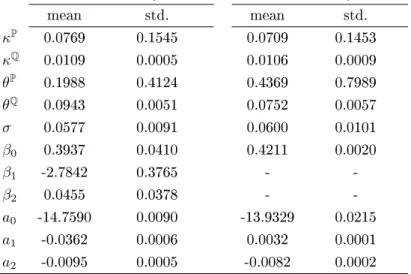
Table 1 presents the posterior estimates of the parameters both for the model with stochastic and constant recovery rate. What stands out is a very high standard deviation of the parameters measured under thePmeasure, that is
κP andθP. The parameters that are estimated under the
Qmeasure are apparently much more precise.
stochastic recovery model constant recovery model
mean std. mean std. κP 0.0769 0.1545 0.0709 0.1453 κQ 0.0109 0.0005 0.0106 0.0009 θP 0.1988 0.4124 0.4369 0.7989 θQ 0.0943 0.0051 0.0752 0.0057 σ 0.0577 0.0091 0.0600 0.0101 β0 0.3937 0.0410 0.4211 0.0020 β1 -2.7842 0.3765 - -β2 0.0455 0.0378 - -a0 -14.7590 0.0090 -13.9329 0.0215 a1 -0.0362 0.0006 0.0032 0.0001 a2 -0.0095 0.0005 -0.0082 0.0002 Table 1
Results of estimation for ConocoPhillips
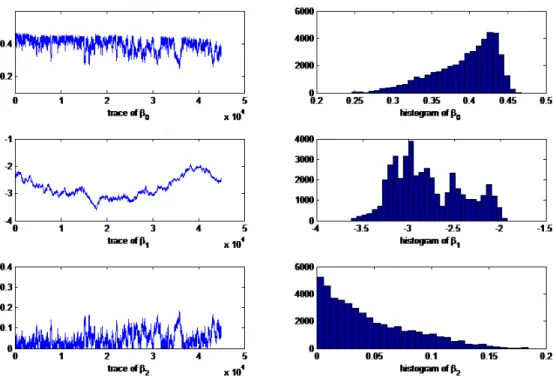
We are particularly interested in the estimates of the parameters that govern the implied recovery rate. For the model with stochastic recovery, these are β0, β1 and β2, while for the model with constant recovery, it is just β0. Figure 1 shows the trace plots and histograms for the beta parameters estimated for ConocoPhillips for the model with stochastic recovery, while Figure 2 presents the estimates for the model with constant recovery.
Using the MCMC output, we nd that the β parameters for both models with a 95% condence will fall into
the intervals presented in Table 2.
stochastic recovery model constant recovery model
β0∈(0.2974,0.4469) β0∈(0.4170,0.4251)
β1∈(−3.3665,−2.0520)
-β2∈(0.0013,0.1348) -Table 2
95% condence interval forβ derived from the MCMC output
For the model where the recovery is assumed to be constant, we have just one parameter β0 to estimate. It turns out that, in this case,β0can be estimated with very high precision. The posterior constant recovery estimate is
φconstant=β0= 0.4210
and with a 95% condence it falls into a very narrow interval, as can be seen in Table 2 and Figure 2. On the other hand, theβ parameters in the stochastic model are much less precise. However, one important observation is that
the β1 estimate is signicantly less than zero. In fact, the posterior distribution ofβ1 is everywhere below zero. This implies that the stochastic recovery model is strongly supported by the data, even if it turns out that it is dicult to pinpointβ1exactly. Moreover, the estimate ofβ0 for the stochastic model is signicantly dierent from zero.
5.2.2 Forward Recovery Rates and Default Probabilities
Table 3 presents the mean recovery rates and mean default probabilities at dierent maturities for both models. Forward default probabilities are obtained from the following formula:
P DTt = EQ
t
h
e−´tTλsdsi (20)
= eΦ(T−t,0)+Ψ(T−t,0)λt (21)
and forward recovery rates in the stochastic model are equal to:
φTt = β2+β0EtQ
eβ1λT (22)
= β2+β0eΦ(eT−t,β1)+Ψ(eT−t,β1)λt, (23) whereΦ (e T−t, β1)andΨ (e T −t, β1)are solutions to the Riccati equation dened in the Appendix.
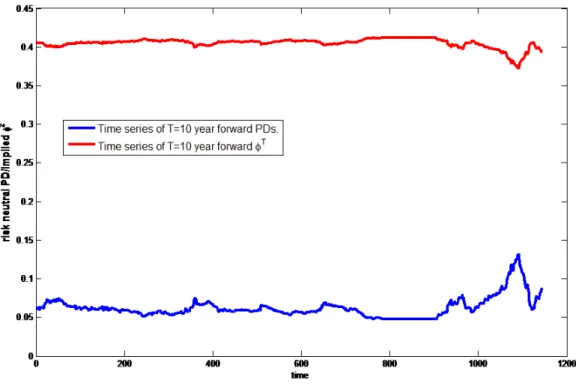
Figure 3: Risk neutral default probabilities and implied forward recovery rates at maturityT = 10
ConocoPhillips
stochastic recovery constant recovery
T forwardP DT forwardφT forwardP DT φ
1 0.0022 0.4361 0.0025 0.4207 3 0.0099 0.4312 0.0101 0.4207 5 0.0211 0.4250 0.0221 0.4207 7 0.0355 0.4177 0.0348 0.4207 10 0.0624 0.4051 0.0603 0.4207 Table 3
Mean ofP DTandφTacross all time points
In Table 3 we can see that forward stochastic and constant recovery rates for ConocoPhillips are, in fact, very similar for longer maturities. We have the same impression from Figure 3, where we can see the time series of forward recovery rates at a xed maturity of T = 10. It seems that for ConocoPhillips the implied stochastic
recovery rates do not change much over time, so that qualitatively the two models are indistinguishable.
Figure 4: Term structure of forward recovery rates and their 95% condence interval for the stochastic recovery rate model - ConocoPhillips
In our case, we would be particularly interested in estimation risk of the recovery rate. Therefore, we use the MCMC output to calculate the 95% condence intervals for the recovery rate. For the model with constant recovery, it is straightforward because it depends on only one parameter, β0. As can be seen in Table 2, β0 ∈ (0.4170,0.4251) with 95% condence.
For the model with stochastic recovery,φT depends on all the parameters and on the realizations of the latent
process λ. Altogether, our output of the MCMC algorithm consists of 50000 iterations, but the rst 5000 are
discarded, so we use information contained in the other 45000 iterations of MCMC to evaluate estimation risk. Specically, for each iteration stepgin the output of MCMC for givenΘ(g)andλ(g),we compute the corresponding
φT from equation (21) at dierent maturitiesT. That gives us1146dierent forward recovery rates for each each T and eachg. We summarize these data by taking an average over all time points from1to1146,and then nding
the mean and the0.025thand0.975thquantiles ofφT. In this way, we obtain an averaged term structure of recovery
5.2.3 Pricing errors
The fact that we use only one factor to explain the term structure of CDS spreads should not be controversial, given that the rst principal component accounts for94%of the variation in all spreads. However, the model does
not price all maturities equally well. In Table 4, we can see the pricing errors for dierent maturities.
1 year 3 year 5 year 7 year 10 year stochastic recovery 3.87 2.38 1.45 1.73 2.49
constant recovery 5.74 3.26 0.97 1.34 2.61
mean value of spread 9.17 17.04 25.11 30.64 37.62 Table 4
RMSE at dierent maturities
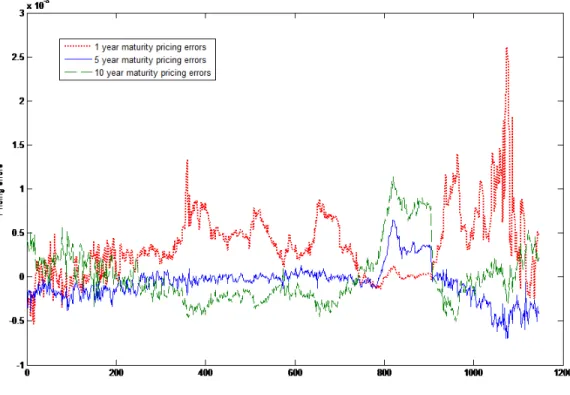
The highest root mean square error is for the shortest 1-year maturity and the lowest is for the 5-year maturity, which is also the most liquid one. We observe in Figure 5 that the pricing errors on the 1-year contract are negatively correlated with the 5- and 10-year maturity contract spreads. This may suggest that there is some diculty in tting the 1-year spread. The same problem with matching the 1-year spread has also been reported in Pan and Singleton (2008) and Schneider et al. (2011). Schneider et al. (2011) solve this problem by adding a second latent factor and allowing for jumps. We choose the same approach as in Pan and Singleton (2008), and assume only one latent factor. This assumption is made for two reasons. First, in order to identify additional parameters of the recovery rate function, it is necessary to keep the model parsimonious in other dimensions. Second, following the asset re sales theory, we believe that recovery rates and default probabilities are manifestations of the same economic mechanism. That is, when industry conditions deteriorate and the default probability is increasing, the risk of asset re sales also increases signicantly. The reduced form method to capture the simultaneous worsening of default probability and expected recovery rate is the assumption of one latent factor behind both phenomena.
With alternative models proposed, it is important to compare their relative performance. One can use informa-tion criteria. As we have two nested models, it might be possible to use standard informainforma-tion criteria like AIC or BIC. However, these two criteria do not use additional information that the MCMC algorithm provides.
Spiegelhalter, Best, Carlin, and Van Der Linde (2002) have developed a Bayesian alternative to both AIC and BIC. In the Bayesian context, this criterion is more satisfactory than the two former alternatives because it takes into account the prior information, and also provides a natural penalty factor to the log-likelihood function. In a model with latent factors, the parameter space is somewhat arbitrary. Let (Θ, λ)denote the vector of augmented
parameters andpbe a likelihood function, a multivariate normal distribution arising from the observation equation
(16). Then the deviance information criterion (DIC) consists of two parts:
where D=E(Θ,λ)|y[−2 lnp(y|λ,Θ)] and pD = D−D Θ = E(Θ,λ)|y[−2 lnp(y|λ,Θ)] + 2 lnp y|λ,Θ .
Here D is a Bayesian equivalent of a model t, and is dened as the posterior expectation of the deviance. More
precisely, it is −2 times the log-likelihood value, and it attains smaller values for models with a better t. In the
above, pD is a measure of complexity, also called the eective number of parameters.
For ConocoPhillips, we nd thatDICstochastic=−84713 andDICconstant=−84249, so that
DICstochastic < DICconstant.
Hence, the stochastic recovery model, despite its higher number of parameters and larger uncertainty of the beta parameters, fares better. Therefore, we conclude that a stochastic recovery model is supported by the data for the Bayesian estimates.
5.3 Campbell Soup and General Motors
Table 5 presents the posterior estimates of the parameters for Campbell Soup and General Motors. For these two rms we see that the parametersκP andθPare much more dicult to estimate precisely than the other parameters
Campbell Soup General Motors
stochastic constant stochastic constant
mean std. mean std. mean std. mean std.
κP 0.1408 0.2289 0.1544 0.2263 0.1580 0.1157 0.1515 0.1129 κQ 0.0117 0.0009 0.0098 0.0020 0.0176 0.0002 0.0135 0.0003 θP 0.0699 0.1410 0.0731 0.1181 0.5960 0.3958 0.5277 0.3979 θQ 0.0901 0.0065 0.0962 0.0173 0.4858 0.0144 0.6338 0.0092 σ 0.0504 0.0029 0.0652 0.0058 0.1231 0.0027 0.1209 0.0029 β0 0.4094 0.0132 0.4408 0.0040 0.4191 0.0470 0.5151 0.0005 β1 -4.7822 0.3586 - - -1.0881 0.1468 - -β2 0.0143 0.0122 - - 0.1896 0.0464 - -a0 -14.9779 0.0048 -14.5412 0.0741 -8.3262 0.0003 -8.1397 0.0011 a1 -0.0070 0.0002 -0.0077 0.0008 -0.0496 0.0001 -0.3865 0.0001 a2 -0.0091 0.0009 -0.0098 0.0005 -0.0503 0.0001 -0.0009 0.0001 DIC -81608 -8.0806 -55713 -53824 Table 5
Estimates for Campbell Soup and General Motors
Once again, we see that it is more dicult to estimate precisely theβ parameters for the model with stochastic
recovery. Table 6 presents the 95% condence intervals for the estimated β parameters for both models. The
Deviance Information Criterion in each case favors the model with the stochastic recovery rate.
Campbell Soup General Motors
stochastic φ constantφ stochasticφ constantφ
β0∈(0.37,0.42) β0∈(0.43,0.44) β0∈(0.34,0.52) β0∈(0.51,0.52)
β1∈(−5.60,−4.24) - β1∈(−1.37,−0.85)
-β2∈(0.00,0.04) - β2∈(0.09,0.26)
-Table 6
Campbell Soup General Motors
stochastic constant stochastic constant
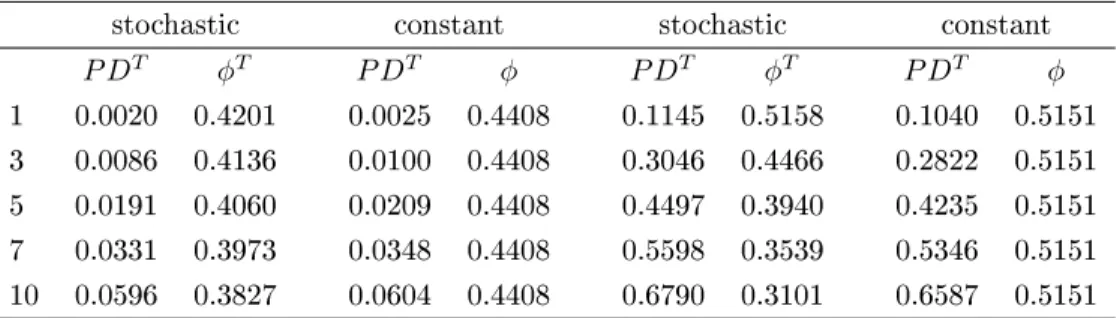
P DT φT P DT φ P DT φT P DT φ 1 0.0020 0.4201 0.0025 0.4408 0.1145 0.5158 0.1040 0.5151 3 0.0086 0.4136 0.0100 0.4408 0.3046 0.4466 0.2822 0.5151 5 0.0191 0.4060 0.0209 0.4408 0.4497 0.3940 0.4235 0.5151 7 0.0331 0.3973 0.0348 0.4408 0.5598 0.3539 0.5346 0.5151 10 0.0596 0.3827 0.0604 0.4408 0.6790 0.3101 0.6587 0.5151 Table 7
Mean of P DT andφT across all time points
In Table 7, we can see for Campbell Soup that forward recovery rates for the stochastic model are very close to the estimates of constant recovery. The same is not the case for General Motors. In the right panel of Table 7, we can see that the implied recovery rates for General Motors are very close to each other only for a 1-year maturity. However, the forward recovery rates decline much faster for General Motors than for either Campbell Soup or ConocoPhillips.
We observe in Figure 6 that the 95% condence interval for General Motors is much broader at longer maturities. The dierence between the0.975thand0.025thquantiles of the forward recovery rateφT is only0.0203at maturity T = 1, but increases to 0.1173forT = 10, while the lower 0.025thquantile is equal to φ10
0.025quantile = 0.2465and the higher isφ10
0.975quantile= 0.3638.
Figure 7 presents the time series of forward recovery rates and forward default probabilities at maturityT = 10.
We see that risk-neutral default probabilities have a larger variance than the implied recovery rates. Contrasting the time series of implied recovery ratesφT=10 for General Motors with the same plot ofφT=10for ConocoPhillips in Figure 3, we see the qualitative dierence between the two. While the time series ofφT for ConocoPhillips seems
to be almost at and is always very close to0.4, for General Motors it varies between0.2and0.45. This observation
strengthens our assertion that a stochastic recovery model is more important for companies that are very risky. 5.3.1 Model implied φT and realized recovery rate for General Motors
Our dataset covers daily CDS spreads between 1 January 2004 and 30 May 2008, and the estimates of implied recoveries in Table 7 and in the right panel of Figure 5 present averages over this period. We know that after General Motors led for Chapter 11 reorganization, in an auction on 12 June 2009 the recovery rate for the CDSs was settled at12.5 percent. The forward recovery rates for General Motors implied by the models are above12.5
percent, but at longer maturities the lower bound of the implied stochastic recovery is very close to the realized recovery rate for General Motors.
Summarizing, the model that allows for stochastic recovery turns out to be more realistic. In the model with constant recovery, we found that φ= 0.5151, and additionally this parameter has been estimated with very high
Figure 6: Term structure of forward recovery rates and their 95% condence interval for the stochastic recovery rate model. Left panel - Campbell Soup (CPB), and right panel - General Motors (GM).
precision. On the contrary, the model with stochastic recovery indicates lower forward recovery rates, especially for longer horizons, as can be seen in Figure 6.
6 Conclusion
We augmented the work of Pan and Singleton (2008) and showed how one could extract implied recovery rates under the assumption that they are negatively correlated with risk-neutral default probabilities. We used the framework developed in ? to derive closed-form solutions for CDS prices with stochastic recovery. The parameters of the model and latent factors driving recovery risk and default risk were estimated using a Bayesian MCMC algorithm.
In summary, a model with stochastic recovery received stronger empirical support. First, the parameter driving stochastic recovery, which describes the strength of the negative relation between default intensities and expected recovery rates, is strongly negative. Second, a Bayesian model comparison criterion, namely DIC, which penalizes a larger number of parameters, also supports the model with stochastic recovery rate. Moreover, there is a qualitative reason that favors the stochastic recovery model as it predicted much more realistic recovery rates for General Motors than did the constant recovery model.
In future research we will estimate both models for a larger number of rms and compare these estimates against other determinants of recovery rates in cross-sectional regressions. More specically, it will be necessary to see whether the variables that the literature has identied as explaining realized recovery rates, can also explain implied recovery rates extracted from CDS spreads. Most importantly, we need to check the rms for which the assumption of stochastic recovery is more important. On the one hand, we expect that the implied stochastic recovery will not dier too much from the implied constant recovery for rms with very good credit ratings. On the other hand, we expect that for risky rms, the implied stochastic recovery will diverge from the implied constant recovery rate.
If this is true, then we may claim that the constant recovery assumption for companies with good credit rating is fairly innocuous. However, for risky companies, the constant recovery assumption may result in serious mispricing.
References
Acharya, V.V., S.T. Bharath, and A. Srinivasan, 2007, Does industry-wide distress aect defaulted rms? evidence from creditor recoveries, Journal of Financial Economics 85, 787821.
Altman, E., 2006, Default recovery rates and lgd in credit risk modeling and practice: an updated review of the literature and empirical evidence, New York University, Stern School of Business .
Altman, E.I., B. Brady, A. Resti, and A. Sironi, 2005, The link between default and recovery rates: Theory, empirical evidence, and implications, The Journal of Business 78, 22032228.
Benmelech, E., and N.K. Bergman, 2011, Bankruptcy and the collateral channel, The Journal of Finance 66, 337378.
Bruche, M., and C. González-Aguado, 2010, Recovery rates, default probabilities, and the credit cycle, Journal of Banking & Finance 34, 754764.
Campbell, J.Y., S. Giglio, and P. Pathak, 2009, Forced sales and house prices, NBER Working Paper .
Chen, R.R., and L. Scott, 1995, Interest rate options in multifactor cox-ingersoll-ross models of the term structure, The Journal of Derivatives 3, 5372.
Christensen, J.H.E., 2007, Joint default and recovery risk estimation: an application to cds data, Working Paper. Available at: http://www.defaultrisk.com/ppcrdrv37.htm .
Cox, John C, Jr Ingersoll, J. E, and S. A. Ross, 1985, A theory of the term structure of interest rates, Econometrica 53, 385407.
Das, S.R., and P. Hanouna, 2009, Implied recovery, Journal of Economic Dynamics and Control 33, 18371857. Doshi, H., 2011, The term structure of recovery rates, Available at SSRN 1904021 .
Due, D., 2005, Credit risk modeling with ane processes, Journal of Banking & Finance 29, 27512802.
Due, D., and N. Garleanu, 2001, Risk and valuation of collateralized debt obligations, Financial Analysts Journal 4159.
Due, D., J. Pan, and K. Singleton, 2003, Transform analysis and asset pricing for ane jump-diusions, Econo-metrica 68, 13431376.
Filipovic, D., 2009, Term-structure models: A graduate course, (Springer) .
Geyer, A.L.J., 1996, Bayesian estimation of econometric multi factor cox ingersoll ross models of the term structure of interest rates via mcmc methods, Unpublished Working Paper .
Johannes, M., and N. Polson, 2003, Mcmc methods for continuous-time nancial econometrics, Available at SSRN 480461 .
Le, A., 2007, Separating the components of default risk: A derivative-based approach, NYU Working Paper No. FIN-06-008 .
Madan, D., G. Bakshi, and F.X. Zhang, 2006, Understanding the role of recovery in default risk models: Empirical comparisons and implied recovery rates .
Pan, J., and K.J. Singleton, 2008, Default and recovery implicit in the term structure of sovereign cds spreads, The Journal of Finance 63, 23452384.
Schneider, P., L. Sögner, and T. Veºa, 2011, The economic role of jumps and recovery rates in the market for corporate default risk, Journal of Financial and Quantitative Analysis 45, 15171547.
Shleifer, A., and R.W. Vishny, 2012, Liquidation values and debt capacity: A market equilibrium approach, The Journal of Finance 47, 13431366.
Song, J., 2007, Loss given default implied by cross-sectional no arbitrage, Unpublished Working Paper .
Spiegelhalter, D.J., N.G. Best, B.P. Carlin, and A. Van Der Linde, 2002, Bayesian measures of model complexity and t, Journal of the Royal Statistical Society: Series B (Statistical Methodology) 64, 583639.
A Appendix
A.1 Proof of Proposition 1
Expected payos conditional on default are equal to:
EP(φ|default) = pφ 1+ (1−p)φ2 EQ t (φ|default) = πQ 2φ1+π4Qφ2 πQ 2 +π4Q so what we want to show is that:
EQ(φ|default)−EP(φ|default)<0 and EQ(φ|default) = pu 0(φ 1)φ1+ (1−p)u0(φ2)φ2 pu0(φ 1) + (1−p)u0(φ2) = pu 0(φ 1)φ1+ (1−p)u0(φ2)φ2+ (1−p)u0(φ1)φ2−(1−p)u0(φ1)φ2 pu0(φ 1) + (1−p)u0(φ2) = pu 0(φ 1)φ1−pu0(φ1)φ2 pu0(φ 1) + (1−p)u0(φ2) +u 0(φ 1)φ2+ (1−p)u0(φ2)φ2−(1−p)u0(φ1)φ2 pu0(φ 1) + (1−p)u0(φ2) = pu 0(φ 1)φ1−pu0(φ1)φ2 pu0(φ 1) + (1−p)u0(φ2) +(1−p)u 0(φ 2)φ2+pu0(φ1)φ2 pu0(φ 1) + (1−p)u0(φ2) = pφ1−pφ2 p+ (1−p)u0(φ2) u0(φ 1) +φ2. It follows that: EQ(φ|default)−EP(φ|default) = 1 p+ (1−p)u0(φ2) u0(φ1) −1 | {z } <0 (pφ1−pφ2)
and for the risk averse investor, we haveu0(φ2)> u0(φ1)and
1 p+ (1−p)u0(φ2) u0(φ1) <1. It follows that: EQ(φ|default)< EP(φ|default).
A.2 Solution to the Riccati Equation for CIR
A.2.1 Functions Φ (t, u),Ψ (t, u), Φu(t, u) and Ψu(t, u)
The following expectation can be solved by means of the so-called extended ane transform, which follows from Due and Garleanu (2001):
Ehe
´t
0qλ(s)dsλteuλti=eΦ(t,u)+Ψ(t,u)λt[Φ
u(t, u) + Ψu(t, u)λt]
and the solutions for the functionsΦ (t, u),Ψ (t, u),Φu(t, u)andΨu(t, u)are:
Φ (t, u) = m(a1c1−d1) b1c1d1 log c 1+d1eb1t c1+d1 +m c1 t (24) Ψ (t, u) = 1 +a1e b1t c1+d1eb1t (25) Φu(t, u) = ∂ ∂uΦ (t, u) (26) Ψu(t, u) = ∂ ∂uΨ (t, u) (27) where c1 = −n+pn2−2pq 2q d1 = (1−c1u) n+pu+ q (n+pu)2−p(pu2+ 2nu+ 2q) 2nu+pu2+ 2q a1 = (d1+c1)u−1 b1 = d1(n+ 2qc1) +a1(nc1+p) a1c1−d1 .
We nd closed-form solutions forΦu(t, u)andΨu(t, u)with the symbolic toolbox from Matlab.
A.2.2 Functions Φ (e t, u),Ψ (e t, u)
The following solutions are based on Lemma 2 from Filipovic (2009), for CIR processλt: dλt= (b+βλt)dt+σpλtdWt
whereθ=pβ2+ 2σ2 and L1(t) = 2 eθt−1 L2(t) = θ eθt+ 1+β eθt−1 L3(t) = θ eθt+ 1 −β eθt−1 L4(t) = σ2 eθt−1 .
A.3 Description of the MCMC Estimation Method
We sample a path of λt and the model parameters with 50000 MCMC steps, where the rst 5000 samples are
discarded as burn-in steps. The major blocks are given by:
Step A: sampleΘfromp(Θ|y, λ, λ0) Step B: sampleλfrom p(λ|y,Θ, λ0) A.3.1 Step A: Drawing the Parameter Vector Θ
The Bayesian MCMC solution of the estimation problem is based on the joint posterior distributionp(λ, λ0,Θ,|y).
The joint posterior is given by equation (19), and we may derive from it the marginal distributionp(Θ|y)to infer the
model parameter vectorΘ. The parametersβ0andβ2 can be obtained by means of a Gibbs sampler. All the other parameters from the vectorΘare sampled by means of the Metropolis-Hastings algorithm. DenoteΘA={β0, β2},
ΘB=
κP, κQ, θP, θQ, σ, β
1, a0, a1, a2 andΘ ={ΘA,ΘB}.
A1. Gibbs sampler for ΘA We observe that equation (16) can be expressed as a linear function ofβ0and β1 and yt = (1−β2)× ´T t E Q t h e−´tvλsdsλv i dv 1 4 4T P j=1 EQ t e−´ 1 4j t λsds +´tTEQ t h e−´tvλsdsλv i v−TI(v) dv | {z } =A(t,T ,ΘB,λt) +β0× ´T t E Q t h e−´tvλsdsλvβ0eβ1λ(v) i dv 1 4 4T P j=1 EQ t e−´ 1 4j t λsds +´tTEQ t h e−´tvλsdsλv i v−TI(v) dv | {z } =B(t,T ,ΘB,λt) +et = (1−β2)×A(t, T,ΘB, λt) +β0×B(t, T,ΘB, λt) +et.
Hence,(1−β2)andβ0are coecients in a panel regression conditional on the other parameters, state variables and the data. We assume a truncated normal prior with1{ΘA∈(0,1)} as a truncation function. Specically, we regress
A(t, T,ΘB, λt)andB(t, T,ΘB, λt)on the observed CDS spreadsy at each point in timetand for all maturitiesT.
We construct the standard Gibbs sampler as follows. yis a panel of1146×5CDS data-points, andA(t, T,ΘB, λt)
y. Therefore, in order to sample(1−β2)andβ0, we perform a Bayesian panel regression. We weightA(·, T,ΘB, λ) and B(·, T,ΘB, λ) separately for each maturity T corresponding to the particular maturity error term from the
matrix(Σe)ii dened in equation (17). Then we stack dierent maturities on to each other to obtain:
yT=1 yT=3 yT=5 yT=7 yT=10 | {z } =Y = (1−β2)× A(·, T = 1,ΘB, λ)/(Σe)11 A(·, T = 3,ΘB, λ)/(Σe)22 A(·, T = 5,ΘB, λ)/(Σe)33 A(·, T = 7,ΘB, λ)/(Σe)44 A(·, T = 10,ΘB, λ)/(Σe)55 | {z } =Ae +β0× B(·, T = 1,ΘB, λ)/(Σe)11 B(·, T = 3,ΘB, λ)/(Σe)22 B(·, T = 5,ΘB, λ)/(Σe)33 B(·, T = 7,ΘB, λ)/(Σe)44 B(·, T = 10,ΘB, λ)/(Σe)55 | {z } =Be + eT=1 eT=3 eT=5 eT=7 eT=10 . | {z } =e (30)
For brevity, denote b = [(1−β2), β0]0 andX =
h e
A,Be i
. Then the panel regression (28) can be rewritten as Y =
b×X+e. With conjugate priors,b∼Nbd(0),Σ
bb(0)
,bcan sampled from a normal distribution,b|Σe, λ,ΘB, y∼ Nbb,Σ bb , where bb = Σ bb Σ bb(0) −1 d b(0) +X0Y Σ bb = Σ bb(0) −1 +X0X −1 .
The conjugate truncated normal prior has the following parameters: bd(0) = (0.5,0.5)0 andΣ
bb(0) = 1000×I2where
I2 is a 2×2 identity matrix. By drawing samples from N
bb,Σ
b
b
that fulll the parametric restrictions of the truncated normal priors, we obtain samples from the desired conditional distribution.
A2. Metropolis algorithm We use random walk proposals and for everyi∈ΘB we accept with probability: α( ΘB) (g+1) i ,( ΘB) (g) i = min 1, py|λ, λ0,( ΘB) (g+1) i pλ|λ0,( ΘB) (g+1) i p( ΘB) (g+1) i py|λ,( ΘB) (g) i pλ|( ΘB) (g) i p( ΘB) (g) i
The proposal densities cancel out due to the symmetry of the random walk proposals. The variance of random walk proposals was scaled to obtain aacceptance rate in the range of(0,25,0.75). The Metropolis algorithm consists of
the following steps, for everyi∈ΘB:
Step A2.1: Draw( ΘB)
(g+1)
i from the proposal densityq
( ΘB) (g+1) i |( ΘB) (g) i
Step A2.2: Accept ( ΘB)
(g+1) i with probabilityα ( ΘB) (g+1) i ,( ΘB) (g) i .
The MCMC algorithm in iteration(g+ 1)samples a new starting value λ(0g+1) , which is used by the extended
Kalman lter to nd the whole processλ(g+1).This new proposal for the latent factor is either accepted or rejected with probability: αλ(g+1),λ(g)= min 1, py|λ(g+1), λ(0g+1),Θp λ(g+1)|Θpλ(0g+1) py|λ(g), λ(g) 0 ,Θ p λ(g)|Θ pλ(0g) × q λ (g)|λ(g+1) q λ(g+1) |λ(g)
Thus, it can be summarized as a three-step procedure: Step B.1: Drawλ(0g+1)from the proposal density
Step B.2: Usingλ(0g+1)as a starting value lterλ(g+1)with an Extended Kalman Filter Step B.3: Acceptλ(g+1)with probabilityα λ(g+1),λ(g)
As a proposal density, we use the normal distribution of the following form:
qλ(g)|λ(g+1)∝ 1146 Y t=1 e− (λ(tg)−λ(0g+1))2 2c2λ (31)
where cλ is a variance from the random walk proposal for parameter λ(0g+1) = λ0(g)+cλελ, ελ ∼ N(0,1). The
discretized diusion process for the latent factorλt under the objectiveP measure, dened in equation (16), has a
non-central χ2 transition density (Cox et al. (1985)). In our implementation of the EKF, the exact non-centralχ2 transition density for the latent factor is substituted with a normal density:
λt|t−1∼N(Ftλt−1+ut, Qt) (32)
where, from Chen and Scott (1995), we know thatFt,utandQtare chosen in such a way that the rst two moments
of the approximate normal and the exact transition density are equal:
Ft = e−κP∆t (33) ut = 1−e−κP∆tθP (34) Qt = σ2 1−e−κP∆t κP 1−e−κP∆tθ P 2 +e −κP∆t λt−1 (35) In order to cope with the nonlinearity of the CDS function, we will apply an extended Kalman lter. It relies on the rst-order Taylor expansion of equation (16) around the predicted stateλt|t−1:
yt=cds λt|t−1|Θ +Jt λt−λt|t−1 | {z } =cds(λt,Θ) +et (36) where Jt= ∂cds ∂λ λ=λ t|t−1 (37) denotes the Jacobian matrix of the non-linear function cds λt|t−1,Θ
and
derivation of the Jacobian Jtcan be found in section 7.4. For a detailed description of latent factor sampling, see
Geyer (1996).
A.4 First-Order Taylor Approximation of CDS Price Function for the Extended
Kalman Filter
In order to implement the extended Kalman lter, we solve the Jacobian of the CDS function with respect toλ: Jt= ∂cds ∂λ λ=λ t|t−1
at the predicted pointλt|t−1. In our case, the JacobianJtwill be a5×1 vector, becauseλis one-dimensional and the CDS equation (14) has to be computed at ve dierent maturities, that is:
Jt= ∂ ∂λ cdsTt=1 λ=λt|t−1 cdsT=3 t λ=λt|t−1 cdsTt=5 λ=λt|t−1 cdsT=7 t λ=λt|t−1 cdsT=10 t λ=λt|t−1
We show how to computeJtby decomposing equation (14) into a numerator and denominator.
A.4.1 Numerator:
For the numerator of the CDS function, we need to nd:
∂ ∂λL def ault t (T) = ˆ T t ∂ ∂λE Q t h e−´tvλsdsλv(1−φ(λv)) i dv. We know that ∂ ∂λL def ault t (T) = ˆ T 0 (1−β2) ∂ ∂λE Q t h e−´0tλsdsλ t i +β0 ∂ ∂λE Q t h e−´0tλsdsλ teβ1λt i dt,
so it is enough to nd the following derivatives:
∂ ∂λE Q t h e− ´v t λsdsλv i = ∂ ∂λ n eΦλ(v−t,0)+Ψλ(v−t,0)λ(t)Φλu(v−t,0) + Ψλu(v−t,0)λt o (38) = Ψλ(v−t,0)EQ t h e−´tvλsdsλv i + Ψλu(v−t,0)eΦλ(v−t,0)+Ψλ(v−t,0)λt (39)
= Ψλ(v−t, β1)EtQ h e−´tvλsdsλveβ1λ(v) i + Ψλu(v−t, β1)EtQ h e−´tvλsdseβ1λ(v) i . (41)
These formulae give us the numerator of the rst derivative of the CDS price formula. A.4.2 Denominator:
For the denominator of the CDS function, we need to ndLf ixedt (T):
∂ ∂λL f ixed t (T) = 1 4 4T X j=1 ∂ ∂λE Q t e−´ 1 4j t λsds + ˆ T t ∂ ∂λE Q t h e−´tvλsdsλ v i v−TI(v) dv
and, with the following derivative, we obtain all the necessary functions:
∂ ∂λE Q t h e−´tvλsds i = ∂ ∂λ n eΦλ(v−t,0)+Ψλ(v−t,0)λ(t)o (42) = Ψλ(v−t,0)EQ t h e− ´v t λsdsi. (43)
A.4.3 Numerator and denominator:
Once we have all the necessary components of the numerator and denominator of equation (14), we can obtain
∂
∂λcds(λ,Θ). Rewrite the CDS pricing function in terms of functionsf,gand h:
cds(λ,Θ) = ˆ T t EQ t h e−´tvλsdsλ v 1−β2+β0eβ1λ(v) i dv | {z } =f(λ) 1 4 4T X j=1 EQ t e−´ 1 4j t λsds | {z } =g(λ) + ˆ T t EQ t h e−´tvλsdsλv i v−TI(v) dv | {z } h(λ) (44) = f(λ) g(λ) +h(λ). (45) Then, by using ∂ ∂λcds(λ) = ∂ ∂λf(λ)×[g(λ) +h(λ)] +f(λ)× ∂ ∂λg(λ) + ∂ ∂λh(λ) [g(λ) +h(λ)]2 (46)