1 Page 1-7 © MAT Journals 2019. All Rights Reserved
A Detection of Amblyopia using Image Processing and Machine
Learning Techniques
K. Praveen1*, S.Lalitha2, S.Gopinath2 1
M.E. Student, 2Assistant Professor 1,2
Department of Computer Science & Engineering, Gnanamani College of Technology, Namakkal, Tamil Nadu, India
Email: [email protected]
DOI:http://doi.org/10.5281/zenodo.3066525
Abstract
Amblyopia is an eye disease occurred due to the failure of interconnection between the brain and the eye. It typically affects the vision of children and kids. Using image processing and machine learning techniques validate the user name and password then proceed to capture image and if it is valid then use the canny edge detection techniques to detect the amblyopia. If validation is success means test the training data using KNN Algorithm, Logistic Regression and Random Forest Classifier(RFC). Comparing to other algorithm RFC is more accurate to detect the amblyopia. It is nothing but lack of coordination between eye and brain. It could be a new visual process disorder which ends within the patient perceiving a blurred image from one in all their eyes that isn't rectifiable with glasses or contact lenses. We used SPYDER IDE, Open CV, and python programming language for image processing and machine learning algorithm.It can result from any condition that prevents from the eye from focusing clearly. The Input parameters taken as for the sample dataset are namely gender, age, cataract, myopia, hyperopia, strabismus, and class.
Keywords: Amblyopia, KNN, Logistic Regression, RFC INTRODUCTION
Amblyopia is the exact cause of visual impairment among children, specifically 2-3% of children being affected. If it is not cleared by childhood mostly it will replicate in adulthood. It also affects the other normal eye. The brain and the eyes are coordinated to produce vision.
It is also called as lazy eye [1]. EXISTING SYSTEM
Usually the treatment of amblyopia is provided to the child to use the eye with weaker vision. The two most common solution to treat amblyopia are patching and atropine and the other methods are vision exercises, contact lenses, and by regular eye drops to the weaker vision.In olden days, amblyopia was assumed to be a retinal defect. It has now been well established through animal studies that amblyopia represents functional and
morphological effects of visual deprivation on the visual cortex (advanced methods). Based on the retina studies, we should identify the eye issues earlier [2]. A best method to analyze amblyopia in childhood by experiment the visual test initially and it should be rectified with small visual activities. When amblyopia occurred, it can be cured if adequately treated in children less than 6–7 years of age. Even in existing patients, visual improvement can be achieved with therapy. Present research is focused at developing substances and delivery modes that will allow the sensitive period of visual development to be manipulated, increasing the period during which it can develop and enhancing preventative and therapeutic measures. Research is contributing to current understanding of causes, prevention and treatment of amblyopia is discussed. At most many new
2 Page 1-7 © MAT Journals 2019. All Rights Reserved treatmentmethods have been tried; it still
seems to be the most successful therapy [3,4].
Disadvantages of Existing System
It takes more time to predict amblyopia.
It requires new systematic approaches or methods to treat the disease.
PROPOSED SYSTEM
Implementation of Knn Algorithm using pythonfor Detecting Amblyopia Eye Disease
Handling the data Calculate the distance Find k nearest point Predict the class Check the accuracy
Implementation of Logistic Regression Algorithm using pythonfor Detecting Amblyopia Eye Disease
Logistic Regression
It produces results in a binary format which is used to classify the result of a dependent input variable. It is used when the dependent variable is binary i.e., the number of dependent variable is two such as, the result of logistic regression are Yes and No
True and False High and Low Pass and Fail
Implementation ofRandom Forests Classifier Algorithmusing python for Detecting Amblyopia Eye Disease Random Forests Classifier
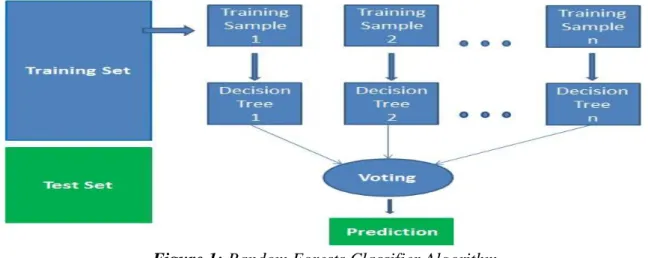
It is a supervised learning algorithm. It is mainly used for classification and regression. It is more flexible and eases to use algorithm. A forest is classified into trees. It refers to more trees it has, the more robust a forest is. It creates a decision trees on randomly selected data set, gets prediction from each tree and opt the optimal solution by means of voting. It also provides accurate results (Figure 1). It has a plenty of applications, such as recommendation engines, image classification and feature selection. It can be used to classify genuine loan applicants, identify fraudulent activities and predict diseases. It works based on the Boruta algorithm, which optsimportant features in a sample dataset.
How does the algorithm work? It works in four steps:
Step1: Select random samples from a given dataset.
Step2: Construct a decision tree for each sample and get a prediction result from each decision tree.
Step 3: Perform a vote for each predicted result.
Step 4: Select the prediction result with the most votes as the final prediction.
3 Page 1-7 © MAT Journals 2019. All Rights Reserved SYSTEM SPECIFICATIONS
Hardware Requirements
System : Pentium IV 2.4 GHz. Hard Disk : 40 GB.
Monitor : 15 VGA Colour. Mouse : Logitech.
Ram : 512 Mb.
High resolution image capture device Software Requirements
Operating system :Windows / MAC /LINUX
Navigator : Anaconda Image processing tool:
Open CV
IDE : Spyder
Programming language : Python METHODOLOGY
Methodology Method used in this project can be classified in two steps
• Image Processing and Feature Extraction • Supervised learning
Methodology Method used in this project can be classified in two steps
• Image Processing and Feature Extraction • Supervised learning
Image Processing and Feature Extraction
This is the most important step of the project as textures obtained will be taken as input material for neural nets which will classify the images in their respective classes.
Image compression
We may take eye images in various perspectives and it size may vary according to quality of images. Our motto is to split them in different classes. Based on the heterogeneous dataset, image size also varies.
Feature extraction
It is the most important step in image processing. It is classified into canny edge detection and thresholding.
Canny edge detection
In this step we proceed towards finding perimeters of all 3 layers. This is done by canny edge detection. In canny edge detection Gaussian filters are applied then using double threshold edge of intensity variation part is detected.
Thresholding
It classifies the original image into various layers. It can be done by adaptive thresholding.
Implementation of KNN Algorithm using Python
Handling the data Calculate the distance Find k nearest point Predict the class Check the accuracy Logistic Regression
It produces output in a binary format which is used to predict the result of anexpected variable. It is mostly used when the required variable is binary i.e., the number of available input categories is two such as, the usual outputs of logistic regression are as follows
Yes and No True and False High and Low Pass and Fail
Random Forests Classifier
It is a type of supervised learning algorithm. It is mainly used for classification and regression. It is more flexible and eases to use algorithm. A forest is classified into trees. It refers to more trees it has, the more robust a forest is. It creates a decision trees on randomly selected data set, gets prediction from each tree and opt the optimal solution by means of voting. It also provides accurate results. It has a plenty of applications, such as recommendation engines, image classification and feature selection. It can be used to classify genuine loan applicants,
4 Page 1-7 © MAT Journals 2019. All Rights Reserved identify fraudulent activities and predict
diseases. It works based on the Boruta algorithm, which opts important features in a sample dataset.
How does the algorithm work? It works in four steps:
Step1: Select random samples from a given dataset.
Step2: Construct a decision tree for each sample and get a prediction result from each decision tree.
Step 3: Computes a vote for each predicted result.
Step 4: Opt the prediction result with the most votes as the final prediction.
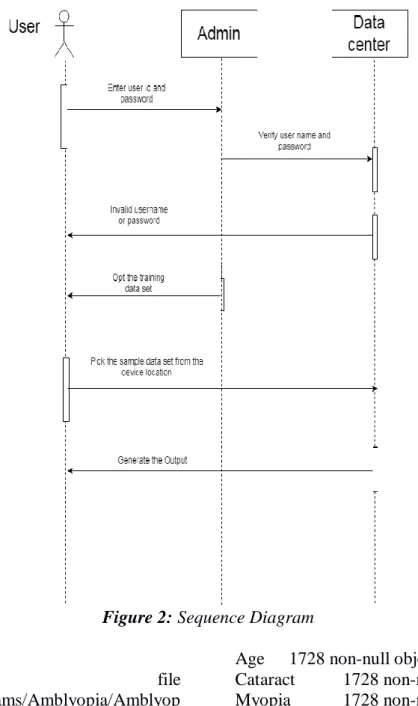
Figure 2: Sequence Diagram RESULT run file ('D:/PythonPrograms/Amblyopia/Amblyop ia.py', wdir='D:/PythonPrograms/Amblyopia') <class 'pandas.core.frame.DataFrame'> Int64Index: 1728 entries, 0 to 1727 Data columns (total 7 columns): Gender 1728 non-null object
Age 1728 non-null object
Cataract 1728 non-null object Myopia 1728 non-null object Hyperopia 1728 non-null object Strabismus 1728 non-null object Class 1728 non-null object dtypes : object (7)
memory usage: 60.8+ KB ['Boy' 'Girl'] 2
5 Page 1-7 © MAT Journals 2019. All Rights Reserved ['five' 'eight' 'three' 'four' 'six' 'two' 'one'
'five ' 'seven'] 9 ['yes' 'no'] 2 ['yes' 'no' '4'] 3 ['yes' 'no'] 2
['no' 'yes'] 2
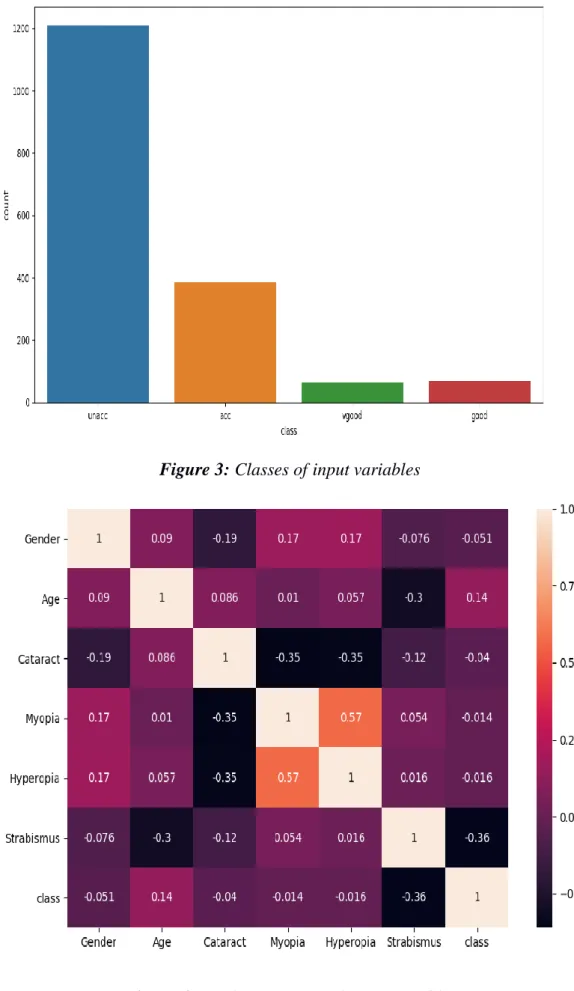
['unacc' 'acc' 'vgood' 'good'] 4 Boy 1329
Girl 399
Name: Gender, dtype: int64 six440 eight415 seven412 three124 four121 two 95 one48 five48 five25
Name: Age, dtype: int64 yes929
no799
Name: Cataract, dtype: int64 yes943
no779 4 6
Name: Myopia, dtype: int64 yes 1134
no594
Name: Hyperopia, dtype: int64 yes1152
no576
Name: Strabismus, dtype: int64 unacc1210
acc384 good69 vgood65
Name: class, dtype: int64
{'C': 1, 'multi_class': 'multinomial', 'solver': 'newton-cg'} 70.96774193548387 C:\ProgramData\Anaconda3\lib\site-packages\sklearn\metrics\classification.py: 1143: UndefinedMetricWarning: Precision and F-score are ill-defined and being set to 0.0 in labels with no predicted samples. 'precision', 'predicted', average, warn_for) C:\ProgramData\Anaconda3\lib\site-packages\sklearn\metrics\classification.py: 1143: UndefinedMetricWarning: Precision and F-score are ill-defined and being set to 0.0 in labels with no predicted samples. 'precision', 'predicted', average, warn_for) C:\ProgramData\Anaconda3\lib\site-packages\sklearn\metrics\classification.py: 1143: UndefinedMetricWarning: Precision and F-score are ill-defined and being set to 0.0 in labels with no predicted samples. 'precision', 'predicted', average, warn_for) precision recall f1-score support
0 0.28 0.28 0.28 118 1 0.08 0.16 0.11 19 2 0.77 0.78 0.78 358 3 0.00 0.00 0.00 24 microavg 0.61 0.61 0.61 519 macroavg 0.28 0.31 0.29 519 weightedavg 0.60 0.61 0.60 519 C:\ProgramData\Anaconda3\lib\site-packages\sklearn\ensemble\forest.py:246: FutureWarning: The default value of n_estimators will change from 10 in version 0.20 to 100 in 0.22. "10 in version 0.20 to 100 in 0.22.", FutureWarning) 66.66666666666666 30.844463062441474 C:\ProgramData\Anaconda3\lib\site-packages\sklearn\metrics\classification.py: 1143: UndefinedMetricWarning: F-score is ill-defined and being set to 0.0 in labels with no predicted samples.
'precision', 'predicted', average, warn_for) {'criterion': 'gini', 'max_depth': 5, 'max_features': 2, 'max_leaf_nodes': None} 71.05045492142267
Index(['Gender', 'Age', 'Cataract', 'Myopia', 'Hyperopia', 'Strabismus'], dtype='object') [0.05331111 0.37306533 0.0817321 0.07007619 0.04430057 0.3775147 ] 67.4373795761079
6 Page 1-7 © MAT Journals 2019. All Rights Reserved SCREEN SHOTS
Figure 3: Classes of input variables
7 Page 1-7 © MAT Journals 2019. All Rights Reserved Figure 5: Knn accuracy
CONCLUSION
In future, amblyopia is easily identified by using various systematic approaches. Using efficient algorithms we can able to detect the amblyopia earlier and achieve the best accuracy rate. In the forthcoming days there would be chance for getting the inputs dynamically from the patients. Surely this project could be remedy for the amblyopia affected persons.
REFERENCES
1. Allen HF. A new picture series for preschoolvisiontesting. AmJOphthalm ol. 1957;44:38–41.[PubMed].
2. American Academy of
Ophthalmology. San Francisco, Calif:
American Academy of
Ophthalmology;2002. Preferred
Practice Pattern: Amblyopia.
3. Atilla H, Oral D, Coskun S, et al. Poor correlation between “fix-follow-maintain” monocular/binocular fixation pattern evaluation and presence of functional amblyopia.
Binocul Vis Strabismus Q. 2001;16:85–90. [PubMed]Atkinson J, Braddick O. Assesment of visual acuity in infancy and early childhood. ActaOphthalmolScand Suppl. 1983:18–26. [PubMed].
4. Beck RW, Moke PS, Turpin AH, et al. A computerized method of visual acuity testing: adaptation of the early treatment of diabetic retinopathy study testing protocol. Am J Ophthalmol. 2003;135:194–
205. [PubMed].
Cite this article as: K. Praveen, S.Lalitha, & S.Gopinath. (2019). A Detection of Amblyopia using Image Processing and Machine Learning Techniques. Journal of Computer Science Engineering and Software
Testing, 5(2), 1–7.
http://doi.org/10.5281/zenodo.306652 5