Interactive Visualisation Tools
for Supporting Taxonomists’
Working Practice
Alan J. Cannon
A thesis submitted in partial fulfilment of the requirements of
Napier University for the degree of Doctor of Philosophy
Abstract
The necessity for scientists and others to use consistent terminology has recently been regarded as fundamental to advancing scientific research, particularly where data from disparate sources must be shared, compared or integrated. One area where there are significant difficulties with the quality of collected data is the field of taxonomic description. Taxonomic description lies at the heart of the classification of organisms and communication of ideas of biodiversity. As part of their working practice, taxonomists need to gather descriptive data about a number of specimens on a consistent basis for individual projects. Collecting semantically well-defined structured data could improve the clarity and comparability of such data. No tools however currently exist to allow taxonomists to do so within their working practice.
Ontologies are increasingly used to describe and define complex domain data. As a part of related research an ontology of descriptive terminology for controlling the storage and use of flowering plant description data was developed.
This work has applied and extended model-based user interface development environments to utilise such an ontology for the automatic generation of appropriate data entry interfaces that support semantically well defined and structured descriptive data. The approach taken maps the ontology to a system domain model, which a taxonomist can then specialise using their domain expertise, for their data entry needs as required for individual projects. Based on this specialised domain knowledge, the system automatically generates appropriate data entry interfaces that capture data consistent with the original ontology. Compared with traditional model-based user automatic interface development environments, this approach also has the potential to reduce the labour requirements for the expert developer.
The approach has also been successfully tested to generate data entry interfaces based on an XML schema for the exchange of biodiversity datasets.
Contents
Chapter 1 Introduction ________________________________________________1
1.1Taxonomic working practice ___________________________________________ 1 1.2 Aim of Research______________________________________________________ 2 1.3 Organisation of Thesis_________________________________________________ 3 Chapter 2 Taxonomy __________________________________________________5 2.1 Introduction _________________________________________________________ 5 2.2 Introduction to Taxonomy _____________________________________________ 5 2.2.1 Classification ___________________________________________________________ 6 2.2.2 Character Concepts _______________________________________________________ 7 2.2.3 Linnaean taxonomy _______________________________________________________ 8
2.3 Analysis Of The Taxonomic Process _____________________________________ 9
2.3.1 Introduction _____________________________________________________________ 9 2.3.2 Initial Preparations for a Taxonomic Project ___________________________________ 13 2.3.3 The Crude Similarity Sort _________________________________________________ 13 2.3.4 The Detailed Sort________________________________________________________ 13 2.3.5 Completing the Project for Publication _______________________________________ 17 2.3.6 Differentiation in the process due to the nature of the intended publication ___________ 18 2.3.7 Collaborative Working ___________________________________________________ 19
2.4 Taxonomic Description Issues _________________________________________ 19
2.4.1. Definition of Character ___________________________________________________ 20 2.4.2 Character selection and definition ___________________________________________ 21 2.4.3 Unavailable data elements _________________________________________________ 23 2.4.4 Consequences __________________________________________________________ 24 2.4.5 Summary ______________________________________________________________ 25
2.5 Existing Computerised Tools for Taxonomy _____________________________ 25 2.6 Opportunities For Computerised Tools To Support Taxonomists’ Working Practice__ 29
2.6.1 General Requirements ____________________________________________________ 29 2.6.2 Supported Tasks ________________________________________________________ 31
2.7 Conclusion _________________________________________________________ 37
Chapter 3 Supporting Information Systems Literature Research ______________39
3.1 Introduction ________________________________________________________ 39 3.2 Tailored Data Entry Interface Generation Tools __________________________ 40
3.2.1 Presentation Aids & Toolkits_______________________________________________ 41 3.2.2 Automatic Interface Generation_____________________________________________ 42 3.2.3 Ontologies _____________________________________________________________ 48
3.3 Browsing databases __________________________________________________ 54 3.4 Visualising Structured Data ___________________________________________ 56
3.4.1 General State of Visualisation Research ______________________________________ 56 3.4.2 Interaction Techniques____________________________________________________ 58 3.4.3 Display Methods ________________________________________________________ 59 3.4.4 Visualisation Summary ___________________________________________________ 69
3.5 Conclusion _________________________________________________________ 70
Chapter 4 Capturing Description Data for Taxonomic Projects _______________71
4.2 System Concept _____________________________________________________ 73
4.2.1 Introducing the System ___________________________________________________ 73 4.2.2 Description Data ________________________________________________________ 75 4.2.3 Presenting the interfaces __________________________________________________ 76
4.3 Proforma Building___________________________________________________ 77
4.3.1 Process of usage_________________________________________________________ 78 4.3.2 Refinements to the process of usage during storyboard development ________________ 81
4.4 Entering Instance Description Data_____________________________________ 82 4.5 Evaluation _________________________________________________________ 83
4.5.1 Presenting choices for scoring ______________________________________________ 83 4.5.2 Overview Visualisation ___________________________________________________ 84 4.5.3 Presenting Definitions with Multimedia Aspects _______________________________ 87 4.5.4 Level of Guidance _______________________________________________________ 87 4.5.5 Glossary Based Problems _________________________________________________ 88
4.6 Conclusions ________________________________________________________ 91
Chapter 5 Ontology-Based Generation of Data Entry Interfaces ______________92
5.1 Introduction ________________________________________________________ 92 5.2 Approach and Tasks _________________________________________________ 94 5.3 Ontology Based Domain Model ________________________________________ 96
5.3.1 Abstract Domain Model __________________________________________________ 97 5.3.2 Domain Ontology. _______________________________________________________ 98 5.3.3 Mapping to the Concrete Domain Model ____________________________________ 100 5.3.4 Specialised Domain Model _______________________________________________ 103
5.4 Presentation Models ________________________________________________ 107 5.5 Development Methodology ___________________________________________ 108
5.5.1 Methodology Principles__________________________________________________ 108 5.5.2 Evaluation of Interactive Tools ____________________________________________ 108 5.5.3 Interactive tool development phases ________________________________________ 110
5.6 Conclusion ________________________________________________________ 111
Chapter 6 Specialisation Process_______________________________________112
6.1 Introduction _______________________________________________________ 112 6.2 Domain Model _____________________________________________________ 113
6.2.1 Names _______________________________________________________________ 113 6.2.2 Fixed score____________________________________________________________ 114
6.3 Task Model________________________________________________________ 115
6.3.1 Primary specialisation task _______________________________________________ 116 6.3.2 Other supporting tasks ___________________________________________________ 116 6.3.3 Specialisation Task Restrictions ___________________________________________ 118
6.4 Ontology presentation model _________________________________________ 118
6.4.1 Interface Designs _______________________________________________________ 119 6.4.2 Presenting the specialised domain model ____________________________________ 120 6.4.3 Mapping the domain and task model to the interface ___________________________ 121 6.4.4 Mapping tasks to the interface _____________________________________________ 121 6.4.5 Domain terms for domain model terms ______________________________________ 139
6.5 Specialisation Issues ________________________________________________ 139
6.5.1 Results consistent with ontology ___________________________________________ 140 6.5.2 Users able to specify their concepts_________________________________________ 143 6.5.3 Informed choices _______________________________________________________ 144 6.5.4 Other Effectiveness and Usability issues_____________________________________ 151 6.5.5 Time_________________________________________________________________ 158
Chapter 7 Data Entry Process _________________________________________166
7.1 Introduction _______________________________________________________ 166 7.2 Domain Models ____________________________________________________ 166
7.2.1 Specimens ____________________________________________________________ 166 7.2.2 Multiple values ________________________________________________________ 167 7.2.3 Concrete description objects ______________________________________________ 169 7.2.4 Modifiers _____________________________________________________________ 169 7.2.4 Not scored statement ____________________________________________________ 170 7.2.5 Description object presence attribute________________________________________ 170
7.3 Data Entry Task Model______________________________________________ 171
7.3.1 Task Order ____________________________________________________________ 171 7.3.2 Attribute instantiation ___________________________________________________ 172
7.4 Presentation Models ________________________________________________ 172
7.4.1 Two presentation models_________________________________________________ 172 7.4.2 High-level concept______________________________________________________ 173 7.4.3 Description object hierarchy ______________________________________________ 174 7.4.4 Description object ______________________________________________________ 175 7.4.5 Navigation task ________________________________________________________ 176 7.4.6 Attribute______________________________________________________________ 177 7.4.7 Supporting task: review instantiation________________________________________ 184 7.4.8 Specimen details _______________________________________________________ 184 7.4.9 Changing the data entry presentation model __________________________________ 185 7.4.10 Domain terminology ___________________________________________________ 185
7.5 Evaluation ________________________________________________________ 185
7.5.1 Expressing data entry concepts ____________________________________________ 186 7.5.2 Informed Decisions _____________________________________________________ 191 7.5.3 Efficient and effective usage ______________________________________________ 193
7.6 Conclusion ________________________________________________________ 200
Chapter 8 Application in other domains _________________________________203
8.1 Introduction _______________________________________________________ 203 8.2 Importing domain ontologies _________________________________________ 204 8.3 Other domain ontologies _____________________________________________ 205 8.4 TDWG Taxonomic Transfer Concept Schema ___________________________ 206
8.4.1 Mapping the ontology ___________________________________________________ 207 8.4.2 Effectiveness of presentation ______________________________________________ 216 8.5 Conclusion ________________________________________________________ 219 Chapter 9 Conclusion _______________________________________________220 9.1 Introduction _______________________________________________________ 220 9.2 Discussion _________________________________________________________ 221 9.3 Main Contributions _________________________________________________ 225 9.4 Future Work ______________________________________________________ 227 References ________________________________________________________230 Appendix A: Use Cases ______________________________________________244 Appendix B: Storyboard Examples _____________________________________267 Appendix C: Prometheus 2 Data Model _________________________________271 Appendix D: Third Phase Development _________________________________277 Appendix E: Wide User Tests _________________________________________288
Figures
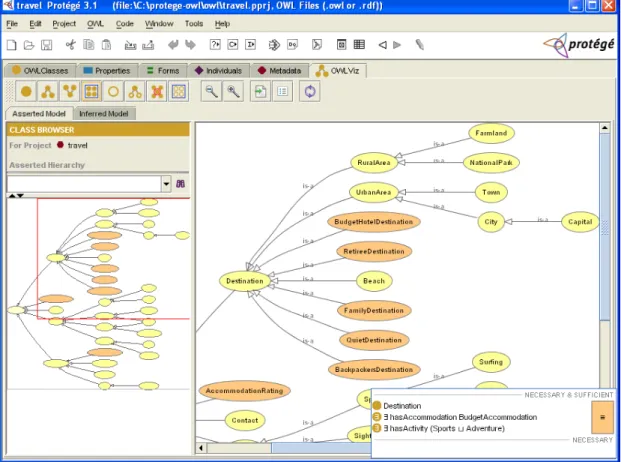
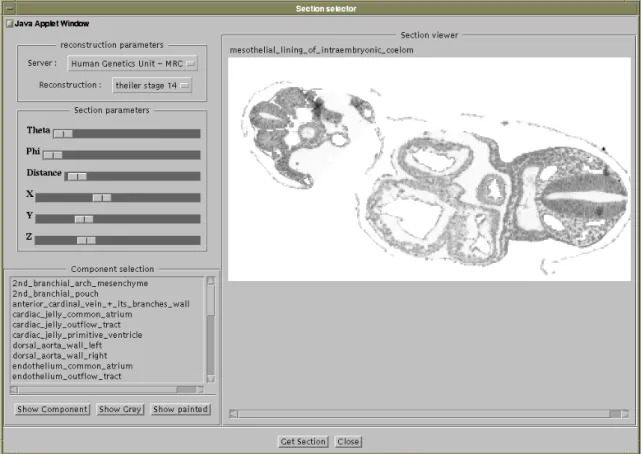
Figure 2.1: Simplified Taxonomic Hierarchy Example of Western Cutlery________________________ 6 Figure 2.2: The Taxonomic Process ____________________________________________________ 11 Figure 2.3: Data Flow Diagram – Top Level ____________________________________________ 12 Figure 2.4: Data Flow Diagram – Detailed Sort __________________________________________ 15 Figure 2.5: Identify New Character Process ______________________________________________ 16 Figure 2.6: Selection of computerised tools to illustrate support for taxonomists’ working practice__________ 26 Figure 2.7: Potential areas for Computerised Tools ________________________________________ 31 Figure 3.1: Protégé Frames instances tab for knowledge acquisition___________________________ 50 Figure 3.2: Protégé Frames forms tab for tailoring instance editing forms ______________________ 51 Figure 3.3: OWLviz visualisation of an ontology, showing the subsumption class relationships_____________ 52 Figure 3.4: Gene Expression Information Resource Project - MOUSE ATLAS ___________________ 53 Figure 3.5: Gene Expression Information Resource Project - MOUSE ATLAS (with overview navigation pane)_________ 54 Figure 3.6: Treemap of stock holdings __________________________________________________ 64 Figure 3.7: Information Pyramid of file directory __________________________________________ 64 Figure 3.8: Basic cone tree model ______________________________________________________ 66 Figure 3.9: Hyperbolic Disc __________________________________________________________ 68 Figure 4.1: System to capture specimen description data in taxonomy. _________________________ 74 Figure 4.2. Example of Proforma Builder interface storyboard. _______________________________ 76 Figure 4.3 Example of data entry interface storyboard. _____________________________________ 77 Figure 4.4: Creation of Electronic Proforma _____________________________________________ 79 Figure 4.5: Creating an Electronic Proforma Prototype. Example from initial storyboarding. _______ 80 Figure 4.6: Specifying a character to add to a proforma. Example from storyboarding. ____________ 82 Figure 4.7: File tree overview. The Leaflet of the Leaf is focussed on in this example. _____________ 86 Figure 4.8: Storyboard proforma builder interface with pop-up definition box ___________________ 87 Figure 4.9: Alternative orientation structure editor ________________________________________ 90 Figure 5.1. Ontology Driven Automated Generation of Data Entry Interfaces utilising a Model-Based Approach. _______ 95 Figure 5.2: Abstract Domain Model ____________________________________________________ 98 Figure 5.3 Major terms and relationships represented in the angiosperm domain ontology conceptual model __________ 99 Figure 5.4: Mapping from Angiosperm Ontology Conceptual Model to Abstract Domain Model___________ 101 Figure 5.5: Mapping structure terms to description objects._________________________________ 102 Figure 5.6 Cloning description objects._________________________________________________ 106 Figure 6.1: Specialisation Interface Screenshot __________________________________________ 119 Figure 6.2: Specialisation Interface: definitions Explorer Tab Screenshot: _____________________ 120 Figure 6.3: Description Object Hierarchy Tree___________________________________________ 122 Figure 6.4: Including a universally applicable description object in the specialised domain model _________ 126 Figure 6.5: Result of including ‘lobe’ __________________________________________________ 127 Figure 6.6: Attribute and value object hierarchy__________________________________________ 128 Figure. 6.7: Attribute-value tree example for selected ‘Lobe’ description object _________________ 129
Figure 6.8: Attribute Details Panel for leaf length:width ratio attribute________________________ 131 Figure 6.9. Sub-attribute nodes on attribute-value tree_____________________________________ 132 Figure 6.10: Mouse-over definition example _____________________________________________ 133 Figure 6.11: Attribute Specialisation Pop-up Window _____________________________________ 137 Figure 7.1: Data entry Interface example _______________________________________________ 173 Figure 7.2: Data Entry Interface components ____________________________________________ 174 Figure 7.3: Description object informative data display for a description object with clones _______ 176 Figure 7.4: Attribute Instantiation Complex Interaction Object ______________________________ 178 Figure 7.5: Alternate instance-scores example ___________________________________________ 179 Figure 7.6: Attribute instantiation IO example for an abstract numerical attribute _______________ 180 Figure7.7: Attribute instantiation IO example for a concrete numerical entry attribute____________ 180 Figure 7.8: Attribute instantiation IO example with value objects represented by checkboxes_______ 181 Figure 7.9: Attribute instantiation IO example with value objects represented by pictorial selection________ 181 Figure 7.10: AIO selection strategy____________________________________________________ 183 Figure 8.1: Transfer XML format (.xsd file). Top level elements______________________________ 204 Figure 8.2: Transfer XML format (.xsd file). Terminology elements ___________________________ 205 Figure 8.3: Excerpt from TCS schema (version 0.88), showing top-level xml elements ____________ 207 Figure 8.4: TCS alternative types of names. (XML Spy view)________________________________ 209 Figure 8.5: Excerpt from TCS xsd containing PublicationDetailed data _______________________ 211 Figure 8.6: Description object ‘PublicationDetailed’ ______________________________________ 212 Figure 8.7: Specialisation interface example for TCS ontology ______________________________ 216 Figure 8.8: Data entry interface example for TCS ontology_________________________________ 217 Figure 8.9: XML spy representation of TCS schema ______________________________________ 218
Acknowledgements
I would like to thank Professor Jessie Kennedy, for her supervision, guidance and support throughout the project. Thanks also go to other colleagues at Napier University, particularly Trevor Paterson and David Benyon. I would also like to thank Mark Watson, Kate Armstrong, Sarah MacDonald, Martin Pullan and the other taxonomists at RBGE who gave so generously of their time to test the approach and answer my questions. Finally I would like to thank my family, especially my wife, Nicky and daughter Amelia for their patience, love and support throughout.
Contributing Papers
Cannon, A., Kennedy, J., Paterson, T., Watson, M. (2004) Ontology-Driven Automated Generation of Data Entry Interfaces. In Williams, H., Mackinnon, L. (Eds.), Key Technologies for Data Management (Proc. BNCOD21): Lecture Notes in Computer Science 3112 pp.150-164. : Springer Verlag.
Paterson, T., Kennedy, J., Pullan, M. R., Cannon A. J., Armstrong, K., Watson M. F., Raguenaud C., McDonald S. M., Russell G. (2004) A Universal Character Model and Ontology of Defined Terms for Taxonomic Description, DILS 2004, LNBI 2994, pp. 63-78
Pullan, M., Armstrong, K., Paterson, T., Cannon, A., Kennedy, J. (2005). The Prometheus Description Model: An examination of the taxonomic description building process and its representation. Taxon, 543, pp. 751-765. ISSN 0040-0262
Chapter 1
Introduction
1.1 Taxonomic working practice
Taxonomic description lies at the heart of the classification of organisms and communication of ideas of biodiversity. Taxonomists are under pressure to complete work to accurately classify organisms before they become extinct. They are however proceeding with their work with only limited support from the computing advances of the last decades. That support is generally limited to areas of major research such as genome sequencing and to general desktop utilities such as word processing and spreadsheets. Whilst bioinformatics research has also focussed on the sharing of data repositories between experts in related disciplines in the biological sciences, comparatively little research has been done in supporting the capturing of the complex descriptive data that lies at the heart of biological classification.
There are a number of perceived problems with taxonomic description data where a lack of standards and the complex nature of the data give rise to issues of clarity, re-use and comparability. With communication of important concepts thus compromised, there have been proposals to improve the situation by using a structured data model, based on the use of defined terms, to capture descriptive data in a rigorous database [Diedrich 1997, Prometheus 2001]. There is however no support for taxonomists to use such a model to consistently capture their descriptive data.
Traditional methods of generating data entry interfaces to databases tend to involve simplistic forms-based interfaces generated by DBMSs to conform to the table structure (or views thereof). These however fail to capture domain semantics, constraining entry to basic data types at best. Other general automatic user interface generation tools have so far failed to gain widespread acceptance or address the needs of high-quality complex data entry. Higher quality user interfaces are made possible by the intervention of expert developers who develop interfaces for specific domain needs. In taxonomy however the domain of descriptive terminology is very large and a data entry interface based on all descriptive possibilities would be impractical. In addition each taxonomic project needs to collect data on a consistent set of features for all specimens described in
it; this set however varies depending on the project. It is equally infeasible to involve an IT expert for each individual project.
The necessity for scientists and others to use consistent terminology has recently been regarded as fundamental to advancing scientific research, particularly where data from disparate sources must be shared, compared or integrated. As a result, ontologies are increasingly used to describe and define complex domain data. Using an ontology to control the data entry for a database has the potential to ensure that better quality data is captured and that data from differing data providers will be compatible. It may also allow a data entry interface to be created that allows domain users to enter data using terms with which they are familiar but which are clearly defined semantically.Existing ontology based approaches for data entry are, however, still limited to using automatically generated forms-based data entry interfaces, unless manual editing is used. These systems are designed to populate a knowledge base describing relationships between described instance items of interest, rather than regulating the capture of the description of a complex concept.
1.2 Aim of Research
The primary aim of this research is to support taxonomists in capturing descriptive data capture which is unambiguous, in particular by supporting the use of a structured data model that captures the semantics of the domain data in a clear and unambiguous manner. This involves supporting their working practice of collecting specimen description data using a proforma template with a theoretically consistent basis. This proforma and the descriptive data concepts that are of interest, change for different taxonomic projects.
This research tackles this problem through the use of domain ontologies to generate and control data entry interfaces that support high quality data capture. Investigating the use of ontologies in this context became a secondary aim of this research.
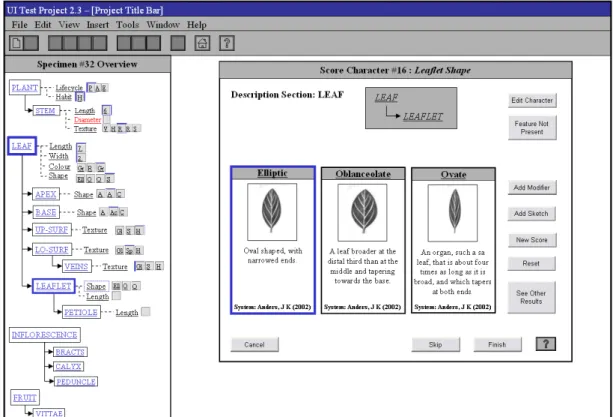
The approach developed to meet the primary aim adopts that of model-based user interface development environments. We hypothesise that using the ontology as the basis for a domain model will improve the user interfaces that can be generated for the task of data entry. By editing an ontology that captures the range of descriptive
possibilities for a domain (taxonomic description), taxonomists can generate data entry interfaces specific to the needs of their projects Use of such an automatically generated project specific interface will support high-quality data entry.
1.3 Organisation of Thesis
The main contribution of this thesis is in the use of domain ontologies to support the capture of high-quality descriptive data in the instance field of taxonomy. This involved the ontology-based automatic generation of suitable interfaces, the effective presentation of ontologies to domain users for constrained editing and the use of ontologies to support high-quality data entry. The generalised application of the approach is also discussed. The thesis is organised as follows.
Chapter 2 examines the field of taxonomy; investigating and modelling the working practice. Qualitative research was conducted at the Royal Botanical Garden, Edinburgh (RBGE) in order to gain insight into the taxonomic process. Together with existing literature, the tasks and issues concerned with the taxonomic working process were analysed in order to identify areas where computerised support could be of value; in particular the issues of taxonomic descriptive data collection are noted.
Chapter 3 examines the literature in information visualisation, data entry interface generation and ontology fields relevant to addressing the identified descriptive data collection problems identified in chapter 2. Potentially useful techniques are identified. Chapter 4 investigates an initial solution to the difficulties of capturing high quality descriptive data for taxonomy. Storyboard and use case walkthroughs are evaluated to identify the parameters of a system that can address the problem.
Chapter 5 describes a model-based user interface development environment (MB-UIDE) approach to providing data entry interfaces to databases for taxonomists. The tool is based on the storyboards and evaluation reported in chapter 4 and uses a domain ontology to provide domain knowledge to the system. The main models that effect the approach are introduced, including the system models and the conceptual model of the utilised ontology. The development and evaluation methodology for a designed interactive software tool is described.
Chapter 6 describes the specialisation process by which domain experts can specify their descriptive data concepts on the basis of the domain ontology. The system models and developed specialisation interface are described. The evaluation of the process, models and interface based on user testing and expert evaluation is discussed. Changes in the system resulting from the evaluation are highlighted.
Chapter 7 covers the other main user process, the data entry process itself. The models and automatically generated interface are described. Again the evaluation and resulting changes are discussed in a similar manner to chapter 6.
Although the primary focus for user tests and development is taxonomic description, the needs of a generalised approach that can use different domain ontologies were considered. Accordingly chapter 8 discusses the application of the approach to another instance domain, that of TCS, in full.
Finally chapter 9 discusses where this work fits into related research, what the main perceived contributions to research are and what future work might be done to take the approach further.
Chapter 2
Taxonomy
2.1 Introduction
This chapter discusses the problem area within taxonomic working practice addressed in this research.
As part of this research, qualitative research was conducted at the Royal Botanical Garden, Edinburgh (RBGE) in order to gain insight into the taxonomic process. Together with existing literature, the tasks and issues concerned with the taxonomic working process were analysed in order to identify areas where computerised support could be of value. A model of taxonomic working practice is developed from the undertaken qualitative research and within that framework those problems of taxonomic description that this research addresses are identified.
The rest of this chapter is organised as follows. The general subject of taxonomy and relevant concepts important to taxonomic description are first briefly introduced to give appropriate context to the following work. Next, undertaken qualitative research into taxonomic working practice is described and the working practice is modelled. Problems with the central practice of taxonomic description within this working practice are identified and discussed in greater depth. Other computerised tools are examined to see where aid and support is already available to taxonomists in their working practice. Areas where extra computerised support to taxonomists could be provided are identified and the specific area where this research will focus is determined.
2.2 Introduction to Taxonomy
Biological taxonomy is the branch of biology concerned with the classification of organisms into an ordered hierarchical system of groups reflecting their natural relationships and similarities. In botanical science, this involves naming, describing, identifying and classifying groups of plants. The purpose of taxonomy is to
communicate classification concepts, providing biologists and others the ability to identify, categorise and refer to organisms in a meaningful way. Taxonomic output is fundamental to all fields of biology that refer to organisms, and taxonomists in turn use the data derived from these sources when refining past classifications [Jacobs 1969].
2.2.1 Classification
In general terms, taxonomy involves the process of classifying objects based on a series of descriptive concepts they have in common. In botanical science, classification of plants is determined by concepts such as morphological characteristics (e.g. petiole length, number of petals), genetic make-up, and ecological characteristics. The classification process produces a hierarchical data set, in which each grouping is called a taxon (pl. taxa). In classical Linnaean plant taxonomy the lowest possible level of the data set is the plant specimen. Taxonomic classifications (taxonomies) do not all represent the same number of hierarchy levels, and some do not go down to the specimen level. The classification data set purely represents the taxonomic groupings, and not the concepts used to make classification decisions.
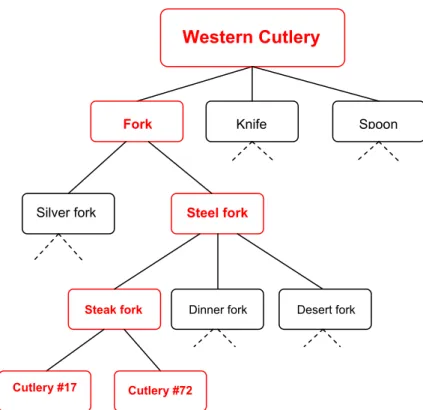
Figure 2.1: Simplified Taxonomic Hierarchy Example of Western Cutlery Figure 2.1 gives a simplistic example of a taxonomic classification of cutlery. Western cutlery is classified into basic shapes {knife, fork, spoon}, forks are then classified by
Steel fork
Spoon
Western Cutlery
Fork Knife
Silver fork
Steak fork Dinner fork Desert fork
material {silver and steel forks}, steel forks are then classified again {steak fork, dinner fork, desert fork}, the steak fork grouping can be seen to include specific cutlery specimens {#17, #72}.
The same organism may be classified according to different taxonomic opinions, resulting in different classifications with different names, groups and underlying concepts. Using the above example, cutlery could alternately be split by materials first and then by design style and price. This would produce a different classification using the same pieces of cutlery. In taxonomy all previous published classifications are considered valid, leading to the problem of using conflicting hierarchies, where the same basic building blocks of the classification are grouped in different ways.
2.2.2 Character Concepts
The cutlery example above shows the results of the classification, but, as can be seen, the concepts upon which the classification is made can only be guessed at from this data. Concepts (such as basic function, material, number of prongs) are being used to delimit the groups in the classification process. Objects are grouped with other objects that share similar concepts (for example all the 2-pronged, steel forks could be grouped by similarity into the steak fork group).
Descriptions of taxa (and possibly specimens) found in taxonomic publications contain these concepts, although they do not necessarily explicitly declare which concepts have been used to delimit the taxonomic groups (taxa) at any particular level. A taxonomic description is a record of what an organism (an actual specimen or a taxon of any rank) looks like, consisting of statements on features of the organism. These statements are usually referred to as characters. It is these characters that form the essential concepts underlying taxonomic classifications, describing and differentiating taxa.
The following is an example of a typical plant taxon description:
Torilis genus description (Taken from the Chinese Umbels descriptions) [Sheh 2004]
Annual or perennial, herbaceous, bristly, hispid or pubescent throughout. Stem erect and branching. Leaf blade 1-2-pinnate or pinnately decompound. Loose compound or capitate umbels, lateral or terminal and lateral; involucral brats few or wanting; rays 2-12, spreading-ascending, or obsolete; bractlets 2-8, linear or subulate. Flowers white or purplish-red. Calyx-teeth deltoid, acute. Petals obovate, with a narrower inflexed apex, abaxially appressed-strigose. Stylopodium thick, conic; styles short. Fruit round-ovoid or oblong, flattened laterally, tuberculate or prickly; primary ribs filiform, setulose, the lateral ribs displaced onto the commissural surface, the secondary hidden by the numerous glochidiate prickles or tubercles which occupy the entire interval; vittae 1 under the secondary ribs, 2 on commissure. Carpophore bifid at the apex or cleft one-third or one-half of its length.
The characters used in a taxon description can be any of a number of different types. In plant taxonomy, organisms are grouped by similarity (phenetic relationships) of their chemical, morphological, anatomical, physiological, and ecological characters (particularly the anatomical-morphological characters). Evolutionary characters are used in the related field of systematics (a term often loosely used as synonymous with taxonomy). Whilst encompassing the areas covered by taxonomy, systematics, also covers evolutionary studies (the processes of evolution and evolutionary relationships between groups) to attempt by classification to convey the evolutionary history of plant groups (phylogenetic relationships).
2.2.3 Linnaean taxonomy
This research refers primarily to classical Linnaean taxonomy using phenetic relationships of anatomical-morphological characters to create a specimen-based taxonomic revision or new classification, although it is generally applicable to other types of taxonomy.
2.3 Analysis Of The Taxonomic Process
2.3.1 Introduction
Taxonomists work on projects concerning a group of plants based upon a geographical area (floristic works called floras) or subject group (either revisions based upon previous taxonomists’ taxonomic classification concepts or monographs representing a new subject group). These projects aim to produce a publication which contains the results of their work, including relevant classifications and supporting descriptions. There is no agreed consensus upon a formalised methodology for creating the various published works that are the end-product of taxonomic projects. The taxonomic process generally involves sorting specimens into groups that reflect their natural variation to create a hierarchical classification. During this process, the character concepts that underlie the classification are developed. The results of the classification process are published to communicate the taxon concepts to interested parties.
As a first step in supporting taxonomists’ working practice, it is necessary to understand their working process in order to identify where and how computerised tools can be of help. Accordingly, as there is no agreed methodology, the taxonomic working process was identified and modelled based on the results of qualitative research undertaken at the RBGE.
2.3.1.1 Qualitative Research Study Methodology
The qualitative research took the form of an ethnographic study using three main methods: interviews of taxonomists; collected documentation; and observations of taxonomists during their work. The stated aim of the study was to investigate the current taxonomic process within RBGE, to understand taxonomists' views on the term ‘character’ and explore user opinions on possible future roles of information technology to aid the taxonomic process.
Interviews
Semi-structured interviews were conducted with eight taxonomists from the RBGE in June-July 2001 Interviews were taped, and later transcribed. Complementary notes were taken during and immediately following interviews. All interviewees were asked to
outline what they do and how. They were all asked what their understanding of character was and how they chose the characters they described. They were also asked to outline any difficulties they had with reading past descriptions and with their work in general.
Further preliminary unstructured and follow-up semi-structured interviews with three RBGE taxonomists were also conducted to clarify various related issues.
Documentation
Limited documentation was collected from interview participants of documents relating to their work. This was limited due to the nature of the taxonomic process, particularly the lack of collaborative working during the actual process, which consequently meant there were no inter-personal communication records as well as poor filing and destruction of paper working notes. Finished published documents (monographs, floras, etc) were available and consulted.
Observation
Direct observation of an initial sort of a group of specimens, using dried pressed material, into approximate taxa by taxonomists at RBGE was conducted. Observation of a detailed sorting was also conducted, in which the repeated task elements were observed. Other informal demonstrations of parts of working practice by RBGE taxonomists were requested and observed.
Whilst a full ethnographic study was not conducted as it was felt the results would not justify the time required, some cultural impressions were drawn and recorded based upon informal contact with RBGE taxonomists.
2.3.1.2 Identified Process
The qualitative research project at the RBGE found that there was a general taxonomic process, which could be identified, even if it was not formalised. This process holds true in general terms for the various types of publication. The emphasis and level of detail however, depend upon the type of publication and its intended audience. The process identifies the taxonomic groups and the observed plant characteristics that make up a description. Figure 2.2 models this process. The constituents of this process are detailed
below. Data flows within the system were problematic to capture, as due to the generally single person nature of the taxonomic process, many of the data follows passed between the same individual in an informal manner. Identified data flows are detailed in figures 2.3 and 2.4.
Create Keys Create Initial Proforma Collect Initial Subject Area Knowledge Gather Specimens Crude Similarity Sort Grouping Identify and Record Characters Collect Further Related Knowledge Review and Modify Groups Write Taxa Descriptions Check on Missing Data &
DataIntegrity Name Taxa / Handle Synonymy Decide Diagnostic Characteristics Interpret Written Descriptions (Check Specimens) Detailed Sort
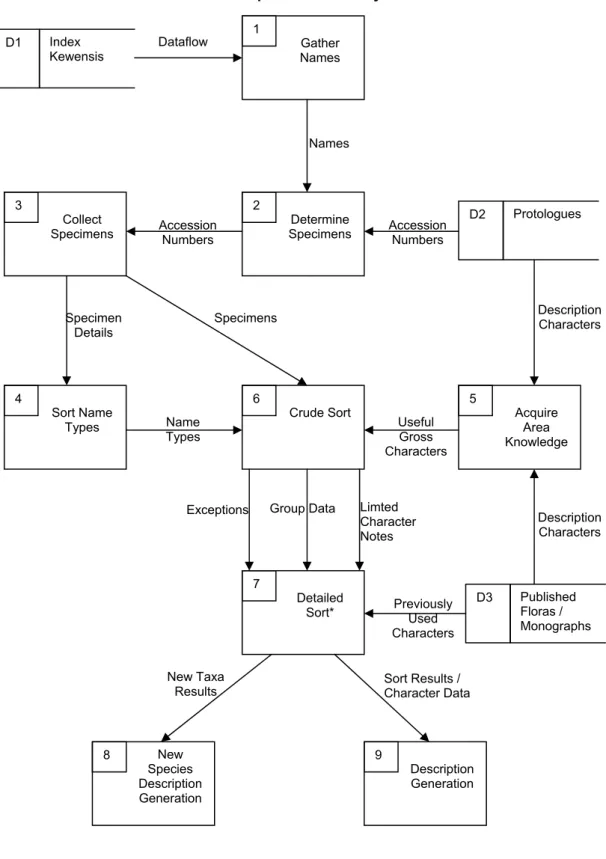
Gather Names 1 Determine Specimens 2 Collect Specimens 3 D1 Index Kewensis Crude Sort 6 Sort Name Types 4 Detailed Sort* 7 Acquire Area Knowledge 5 D2 Protologues D3 Published Floras / Monographs Description Generation 9 New Species Description Generation 8 Dataflow Names Accession Numbers Accession Numbers Specimen Details
Specimens Description Characters
Useful Gross Characters Name Types Exceptions Limted Character Notes Group Data Description Characters Previously Used Characters New Taxa
Results Sort Results / Character Data
Figure 2.3: Data Flow Diagram – Top Level (*The Detailed Sort process is expanded in figure 2.4)
2.3.2 Initial Preparations for a Taxonomic Project
The first task in the taxonomic process is to establish a list of names used within the study group or geographical area, usually using a taxonomic index such as Index Kewensis [2004] (an on-line database of seed plants) or Index Fillicum [2004] (a database of ferns). Using this as a base, the protologues (the first publication of each name) are gathered in order to verify the validity of the name, check priority, and possibly to read the first description. If the work being undertaken is a flora, floras from the surrounding area may be consulted. Based on this data, sufficient physical specimens from the subject group or geographical area are gathered to support the study.
2.3.3 The Crude Similarity Sort
Using the collected physical specimens, an initial crude similarity sort into groups is done. This process tends to be done physically, by making piles of the physical specimens. Often multiple taxonomists may work together at this stage, with colleagues helping the primary investigator. This process can be quite quick, especially for revision work. For floristic works, this stage tends to be more important. Often the work is done in the collecting room where access to computers is more limited.
Firstly in the crude sort, the specimens which are ‘types’ of previously used taxa names (each taxa in a classification has a type specimen from which its name is partly derived) are sorted out, as the basis for the sort. The remaining specimens are then rapidly divided up into crude taxa, without looking at past classifications, using gross macroscopic characters (such as leaf shape) and general overall appearance. Some taxonomists may use past descriptions to give an idea of what characters to look for. Few actual notes are usually made at this stage, other than the specimen composition of the crude taxa themselves.
2.3.4 The Detailed Sort
The detailed sort is an iterative process utilising detailed characters to refine the crude taxa groups. The specimens are examined in more detail to determine how much variation between specimens can be considered simply within-taxon variation and how much is sufficient to warrant separating the specimens into different groups. It is during
this stage that recognisable character concepts are developed and articulated. Taxonomists look for useful comparable characters and the variation between those characters to develop and support their classification concept. The end result of this detailed sort is a set of taxa and a record of the characteristics of the taxa or the specimens that make up the taxa. Some of the specimen material may be too poor to assign it to any taxa, in which case it remains a taxonomic problem.
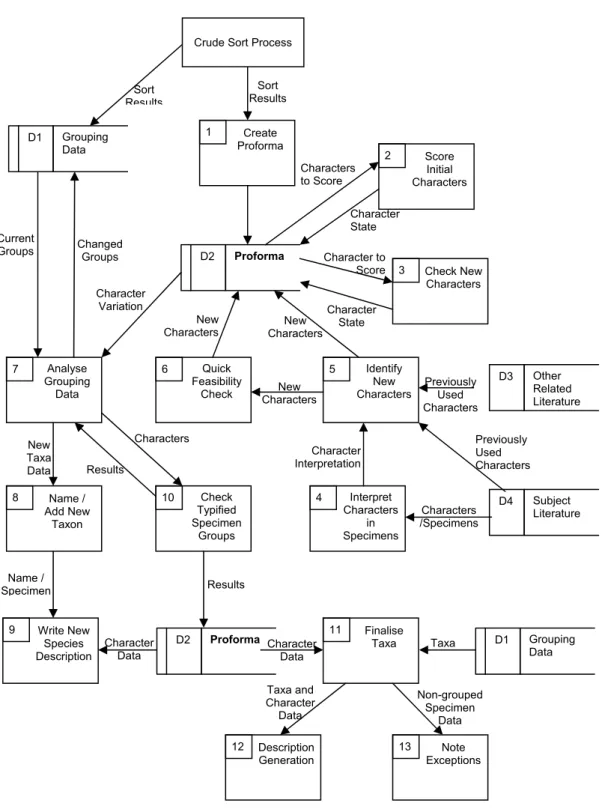
Notes are more commonly kept during the detailed sort than in earlier stages. Usually records are kept in the form of a proforma, which records the characters for each specimen. Initially the proforma is empty, the taxonomist populates it with characters and then records the specific scores for individual specimens. The same proforma is generally used for all the specimens in a particular study. The central importance of the role of the proforma can be seen in the data flow diagram (Figure 2.4). Generally, at present, the proforma tends to be in the form of a basic spreadsheet or a paper table. Additional unformatted notes are also made concerning ideas, concept drawings, etc. Occasionally some taxonomists will record the taxa and their descriptions directly without a proforma during quick floristic work.
Create Proforma 1 Score Initial Characters 2 Check New Characters 3 Identify New Characters 5 Quick Feasibility Check 6 Interpret Characters in Specimens 4 D4 Subject Literature D3 Other Related Literature Crude Sort Process
Analyse Grouping Data 7 Name / Add New Taxon 8 Write New Species Description 9 Check Typified Specimen Groups 10 Finalise Taxa 11 Note Exceptions 13 Description Generation 12 D2 Proforma D1 Grouping Data Sort Results Sort Results Character State Character to Score Character State New Characters New Characters New Characters Previously Used Characters Character Interpretation Previously Used Characters Characters /Specimens Current
Groups Changed Groups
New Taxa Data Characters Results Name / Specimen Character
Data Character Data Taxa
Taxa and Character Data Non-grouped Specimen Data Results D2 Proforma D1 Grouping Data Character Variation Characters to Score
Figure 2.4: Data Flow Diagram – Detailed Sort
2.3.4.1 Proforma Creation
The character proforma is first created with characters based upon the taxonomist’s knowledge gained from their general work, from ideas developed in the crude sort and from reading other related descriptions after the crude sort is completed. In addition, by
looking at the specimens the taxonomist identifies the various major structures and features of the plant that might be used as characters. Some taxonomists determine the domain of possible values (states) for each character at this point (taxonomists creating data to be compatible with electronic description formats (see 2.5) definitely do this). No definite overt decision about definitions of terms is generally determined at this stage, although the taxonomist may have implicit assumptions regarding the definitions of the terms used.
2.3.4.2 Identify New Characters
Observable characters are also added to the proforma after it has been initially created and specimens are recorded. Identifying new characters (see Figure 2.5) is based on research and ideas found during the detailed sort process after the initial proforma has been set-up. Identify Character Idea Collect Further Related Knowledge Analyse Significance Interpret Descriptions (Check Specimens) Record Sample Characters
Record for All Specimens
Add to proforma
Record and Discard Idea
Figure 2.5: Identify New Character Process
A taxonomist gains ideas about possible characters of interest during the process as they study the specimens in question and become more familiar with the subject area. By having an overall understanding of the subject area and the characters already recorded, the taxonomist may be able to identify areas where few characters are currently
recorded. Taxonomists also read around the subject area, and may gain ideas of characters from this related literature. Often due to a lack of definition for terms, taxonomists referencing literature must return to referenced samples to check the exact meaning of terms used to describe characters. The taxonomist's personal working experience and wider biological knowledge also suggests new characters, which may be utilised. In general, the process of developing character concepts is imprecise and relies heavily on intuition based upon the taxonomists’ professional expertise.
Once a new character is identified, its significance is reviewed, to determine if it is a useful character for describing and splitting taxonomic groups. To do so, the taxonomist may record a representative sample from the existing taxonomic groupings. If these representative samples show the character is likely to be useful (in terms of ability to be effectively recorded and to potentially differentiate groups), the taxonomist will then record all the specimens using the character, if not, then they will record what has been done and discard the idea.
2.3.4.3 Review Groups
A repeated task during the detailed sort, is the constant updating both mentally and on paper, of the grouping data, based on the recorded characters. Initially the grouping information is held in physical piles of specimens. This grouping data is then later recorded. With small data sets (both of specimens and number of recorded characters), the taxonomist is able to do much of this reviewing of groups mentally. With larger data sets, the amount of data and number of variables becomes too great for the taxonomists to maintain a mental picture of their entire data set, forcing them to rely on ad-hoc notes and manipulated spreadsheets.
2.3.5 Completing the Project for Publication
After the detailed sort is completed, the work is finalised for publication. Taxa are named according to the normal taxonomic rules and any naming issues (synonymy) are resolved. Reviewing individual recorded proformas, final groupings and the spread of characters makes the final determination of which characters are included in the published descriptions to identify and delimit taxonomic groups. The creation of keys and actual writing up of the descriptions then occurs as required before the work is
published. Writing descriptions is generally completed at the end of the process by compiling notes. The proforma, other records and notes made during the sort process are not usually published and are often discarded.
2.3.6 Differentiation in the process due to the nature of the intended publication There is some difference in the emphasis and level of character detail between the taxonomic process for creating monographic works (monographs, revisions, etc.) and floristic works (floras, field guides, etc.) due to the nature of the publication and intended audience.
In the case of more detailed monographic works in which more time is likely to be available, the detailed sort can be a long process, with more detailed records, particularly of specimens, being made. Monographic work is more likely to look for new characters to base classification decisions upon and is more rigorous in determining what constitutes a recorded character. New classifications are generally put forward in monographs and revisions. Consequently the final published descriptions tend to be more comprehensive, and they often possess introductory chapters which justify and explain the character concepts, sometimes relating these to others in the literature. In the case of floristic works, the detailed sort tends to be shorter, more based on accepting previously published taxa and descriptions, where available. Taxonomists working on floristic projects are less likely to record detailed characters of each specimen, often preferring to construct the characteristics of the taxa as they go along rather than recording every specimen individually. In contrast with monographic works, floristic works tend to be more concise. They may use and comment on existing taxonomic publications, but generally do not develop new classifications (although they may aggregate and merge pre-existing works to form a single integrated taxonomy for plants of a region). Descriptions in floristic works may still convey taxon concepts, however this role is secondary to the primary purpose of differentiating between taxa found in a geographical area. Thus the descriptions are often short and only give the diagnostic characters essential for identification. For example, the description of the Sanicula genusin the Umbelliferae of India [Mukherjee 1993] flora is less than half the length of the description from Shan & Constance’s monograph [Shan 1951]. Completed floristic works do not usually have detailed information on the characters used. Some
works may have glossaries explaining the meaning of terms, however these are essentially general guides, and may not accurately convey the character concepts used in a particular taxa.
2.3.7 Collaborative Working
Collaborative working practice in the taxonomic process is very limited. One taxonomist usually undertakes the identified process (figure 2.2), alone. On occasion there are collaborative projects, for example with a large flora, however in these, the individual taxonomist is assigned a sub-set of the subject area on which they will work, producing descriptions in an agreed format, but not actually collaborating on the details of the taxonomy. This solo working method combined with the lack of accepted formalised procedures, gives rise to individualistic working practices.
2.4 Taxonomic Description Issues
A number of issues with working practice in the taxonomic description process were identified in the course of the qualitative research undertaken and related literature search.
A taxonomic description is the main way in which a taxon concept is communicated. Character data are used within a description to delimit taxon concepts, however, there are problems with the way in which these character data are handled and used for communication. There are many instances where this communication is ineffective. For example it may not be possible to see from published descriptions whether two species are closely related because the same criteria are not used in the construction of the different descriptions [Sivarajan 1991]. In another example, taxonomists in a study were asked to identify images of diatoms. The ability to correctly identify each specimen ranged from 33.8% to 86.5% with a mean of 63.3%. One cause of such low accuracy could be deficiencies in the descriptions of species in floras [Kelly 2002]. As the purpose of taxonomy is to communicate taxon concepts in order to provide frameworks within which other disciplines can work, it is important to improve the communication of these concepts. Doing so involves improving the communication of the underlying character data.
2.4.1. Definition of Character
A principal difficulty with the use of characters as the focus for the communication of taxon concepts is that the term ‘character’ itself can be misleading as there is little consensus amongst taxonomists on what exactly constitutes a character. The term is used in several different ways and has several definitions. One study [Colless 1985] for example found 19 different explicitly stated, or clearly implied, definitions of ‘character’ from a survey of 50 publications. Most commonly a character is seen either as some kind of feature, aspect or attribute of a plant or as a statement on a feature of the organism [e.g. Blackwelder 1967, Wiley 1981, Stuessy 1990, Fristrup 1992, Bailey 1999].
Most of the ways in which ‘character’ is utilised in descriptions can actually be identified as really belonging to one of two main conceptual entities [Diederich 1997]. One is where the character is a general concept (e.g. leaf shape) which is separated from the value (e.g. ovate). In this situation the character is a combination of a structure (e.g. leaf) and an abstract concept or property describing that structure (e.g.shape). The score is often referred to as the character state. The other use is where the structure and the score are combined (e.g. leaves ovate) in which case the property (e.g. shape) is implicit. In the qualitative research study, taxonomists generally supported one of these two general approaches to character in theory, although some respondents believed that additionally a character concept only truly existed where it also existed to support variation between taxa. A small minority of respondents preferred character concepts to refer to a more complex entity, comprising multiple individual concepts. Further investigation also showed that approximately 75% of respondents experienced at least some degree of difficulty in manually breaking down complex descriptive statements from existing natural language taxonomic descriptions (e.g. ‘mericarps with slender, almost glabrous ridges’) into atomic characters of the structure, property, state format.
Due to the loose use of character, the amount of data placed in one character by some taxonomists is quite variable, and may include more than one feature, depending on how important the feature is in delimiting taxa. For example, the ‘mericarps with slender, almost glabrous ridges’ example from above could be seen as one character or as multiple characters such as: ‘mericap ridges, present’; ‘mericap ridges, absent’;
‘mericarp ridges, slender’; and ‘mericarp ridges, almost glabrous’, depending on whether there were other taxa with thick, almost glabrous ridges or slender, hairy ridges. In order to promote clarity and comparability of character data, a common approach to the conceptualisation of character data would need to be developed and adapted.
2.4.2 Character selection and definition
A more significant problem with the use of character data in descriptions is that character selection and definition is inconsistently applied.
2.4.2.1 Character Selection
Character selection has been recognised as a “weak link” [Davis 1963] for some time. One problem is that taxonomists use a mental picture of the similarities of their specimen groups and often do not consciously use defined characters to delimit those groups. They only break down their group descriptive concept into its component parts to communicate their ideas. Even when characters are selected at early stages, the selection is done on an ad hoc basis, based largely on experience and favoured publications. Poorly selected characters can mean that taxonomists’ cannot effectively communicate their taxon concepts. For example, a monograph on the Biscutella genus [Machatschke-Laurich 1926], provides descriptions and key characters which are not sufficiently different for related taxa to be distinguished. An examination of the cited specimen material however, showed that the taxa are recognisable on the basis of characters not mentioned by the author [Davis 1963].
Another selection problem arises with a lack of consistency in the characters selected for inclusion in published works. Within one publication, one taxon may be described using characters that are not recorded for the next. Additionally the order characters are placed in a description may vary. Usually, descriptions are generally ordered acropetally (from the bottom of the plant up and from the outside in), but there is no formalised order. The lack of consistency in format between descriptions, particularly the failure to use the same characters in the same order for multiple taxa in the same publication, may cause misinterpretation and general difficulty in parsing descriptions, as well as making effective comparisons impossible.
2.4.2.2 Character Definition
The other major problem with character data in descriptions is that there is no accepted universal defined terminology and glossaries of terms used are not often provided, giving rise to uncertainty, as well as rendering meaningful comparisons impossible. Taxonomic description terms can have a number of definitions. For example, Lawrence [Lawrence 1951] defines the term ‘tomentose’ as ‘densely woolly or pubescent; with matted soft wool-like hairiness’ whereas Stearne’s definition is ‘thickly and evenly covered with short more or less appressed curled or curved matted hairs’ [Stearne 1983]. A term used without a definition will mean that a reader’s interpretation of the term will depend on which definitions they have previously encountered and if they have their own personal preferences for the term. Individual taxonomists tend to have a set of terms that they always use and have fixed ideas about their meaning, which may be different from other taxonomists’ understanding. One taxonomist’s understanding of a term may consequently be significantly different from another’s understanding of that same term and this difference in opinion may not be apparent.
The use of simple ambiguous natural language terms as part of a description also make interpretation difficult. For example, a key to the species of Sanicula differentiates S. lamelligera from S. petagnioides on the basis of the number of spines found on the fruit. The states for this character are ‘densely spined’ and ‘sparsely spined’ [Huang 1993]. The author had a sound taxon concept for each species but any user of this key may find it difficult to distinguish between ‘densely’ and ‘sparsely’ as it is undefined what constitutes ‘densely’ as opposed to ‘sparsely’ in this instance [McDonald 2002].
Due to the age of some descriptions there can also be difficulties with language as the meanings of terms over time changes. Taxonomy is a discipline with a long history and many older works are still heavily utilised. This is particularly a problem in reference to descriptions written in Old French or German where the meaning of words has changed over time (Botanical Latin by contrast is more stable). In addition old descriptions are often incomplete, leaving obvious difficulties in interpretation.
In these all these situations where definitions are lacking, taxonomists can only resolve exactly what is meant by a term, by the time consuming method of returning to the original specimens upon which the author based their description.
The lack of explicit definitions of terms can also have an effect within a project, due to definition creep. In this situation, a taxonomist’s internal conceptualisation of a character or term, may gradually change during the life of a project without the change being apparent to the taxonomist or later interpreters. This situation most commonly arises in the case of terms to sub-divide a range of concepts into a set of atomic alternatives. (e.g. a particular leaf shape term may be used for an increasingly wider range of actual leaves during the life of a project.)
2.4.2.3 Inconsistent similar terminology
Related to the problem of different possible definitions of the same term, there is a general lack of consistency in terminology used. Different people do not describe things in the same way and it is often not clear whether they mean the same thing as no definitions are available. (e.g. one author might describe inflorescences as diachasial cymes and another simply as cymes. They may actually mean the same thing, but without definitions it is impossible to be sure.) Once again the taxonomist must return to the original specimens to resolve the question.
2.4.3 Unavailable data elements
Lack of definition data is only one element of the thought processes underlying the summarisation of the data, which is not available for evaluation. A considerable amount of time and effort is spent gathering actual specimen data, much of which is not included in the summary account. Once the work has been published, this data is often discarded and not made available for re-use or verification [Diederich 2000], [Cannon 2001]. Participants generally regard this as an unfortunate side effect of the current process, where paper proformas holding descriptive observations made during the course of the project are discarded. A lack of rigor in note keeping and required speed of some of the undertaken work were also causes of this loss.
Equally, when features (e.g. fruit) are not included in the descriptions without the author explaining why, it is impossible to distinguish between the feature not being present on the described specimen, the author accidentally missing the feature or the author considering the feature to be of insufficient interest to warrant describing it [Watson 1971]. Again the interpreter must return to the original specimens.
2.4.4 Consequences
All of these difficulties in using character data from descriptions not only make effective communication of concepts between taxonomists difficult, but they also have had subsequent consequences for the type of work that can be effectively undertaken. For example, the description difficulties mean that to complete a taxonomic revision involves returning to the specimens, using the descriptions as a guide rather than a source of data. This is possible for situations where there are only a few specimens or species, but working on large families (500+ species) is very time consuming [Jacobs 1969]. Engler’s Das Pflanzenreich [Engler 1900-1953] was the latest world monograph on many plant families [Stace 1989]. However, many smaller families have been revised several times since then. Revision of large families is not attempted because the revision of one large family is likely to take one taxonomist their entire working career [Jacobs 1969]. If descriptions were recorded in a way that enabled interpretation with less need for re-examining thousands of specimens, the taxonomic process would be much quicker and tackling larger taxonomic works with a team approach would be more feasible.
Specimen descriptions represent a huge potential data resource, not just for future taxonomic revisions, analyses and the creation of identification keys, but for other biological disciplines such as biodiversity and ecological studies. However, these uses require the meaningful integration of data from different description sets, which, in the absence of both an agreed character model and particularly a shared descriptive terminology, is currently not possible.
These problems have led a number of taxonomists to suggest that there should be a standard approach to taxonomic descriptions [e.g. Diederich 1997, TDWG 2000]with terminology used consistently throughout all descriptions and the criteria used to describe one organism used in all other descriptions [Allkin 1984]. However, so far it
has not been possible to agree a standard descriptive terminology or structure for taxonomic descriptions.
2.4.5 Summary
As a consequence of the way in which character description data have historically been collected, recorded and made available, the interpretation, integration and re-use of character data is problematic. Typically neither the character concepts, nor the terms used to describe these characters have been rigorously or consistently selected and defined. The original thought processes and description data underlying the summary description are not available for evaluation as common practice has been to record only the 'characters' of interest for a given study. More detailed original descriptions, typically recorded onto paper proformas are not composed in a format suitable for reuse, and are often discarded, causing a significant loss of potentially useful information. Subsequent interpretation of descriptions may therefore be ambiguous and descriptions from disparate sources cannot be compared or reused with any confidence of accuracy. Published descriptions are therefore of limited value to a modern taxonomist, who must often re-examine a specimen in order to interpret the original description or re-describe the specimen themselves.
In the following sections of this chapter, this research identifies possible opportunities for using computerised tools to address some of these description issues, in order to improve the collection, recording, communication and use of character data within the taxonomic process.
2.5 Existing Computerised Tools for Taxonomy
Currently, varying degrees of computerised techniques are utilised in the creation of plant descriptions and in the wider taxonomic descriptive process. Newly qualified taxonomists tend to utilise computerised techniques to a fuller extent than other, more experienced taxonomists, although there is also significant variation by individual [Cannon 2001]. There is, however, no consensus among taxonomists on which of the available computerised techniques to utilise. The provision of more advanced electronic
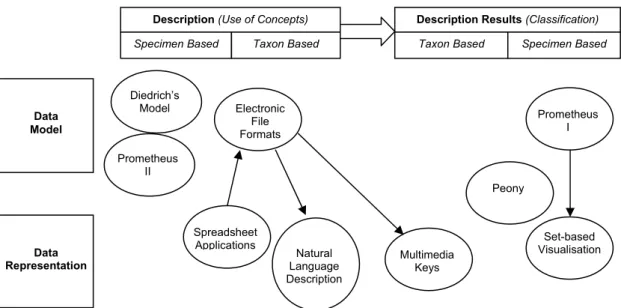
support for taxonomists’ working practice is limited to certain areas, as can be seen in Figure 2.6 Prometheus II Data Model Data Representation Electronic File Formats Spreadsheet Applications Peony Natural Language Description Multimedia Keys Prometheus I Set-based Visualisation Description (Use of Concepts) Description Results (Classification)
Specimen Based Taxon Based Taxon Based Specimen Based
Diedrich’s Model
Figure 2.6: Selection of computerised tools to illustrate support for taxonomists’ working practice
There is support available for taxonomists in utilising the single and multiple classifications they develop (e.g. Peony [Hyam 2002], Prometheus I [Pullan 2000], Graham's set-based visualisation [Graham 2001]) but more limited support is available for the description process utilising the character concepts underlying the eventual classifications.
Some plant specimens also exist in electronic form but these are generally at a very basic level of detail and are not all in the same format. Mainly photographs and accession data are likely to be available. Some character notes may be included but this is unusual.
Spreadsheets of varying degrees of sophistication are utilised to record character observations during the detailed sort process, however, taxonomists must construct these spreadsheet proformas themselves on an ad hoc basis. A majority of record keeping is however still done in paper format, including drawings.
Supporting the use of characters in the description process are various electronic systems that attempt to capture the description data. Electronic descriptions have been
![Figure 3.2: Protégé Frames forms tab for tailoring instance editing forms [Stanford Medical Informatics 2005b]](https://thumb-us.123doks.com/thumbv2/123dok_us/11087333.2995759/60.892.170.807.88.408/figure-protégé-frames-tailoring-instance-stanford-medical-informatics.webp)
![Figure 3.8: Basic cone tree model [Robertson 1991]](https://thumb-us.123doks.com/thumbv2/123dok_us/11087333.2995759/75.892.249.753.262.637/figure-basic-cone-tree-model-robertson.webp)
![Figure 3.9: Hyperbolic Disc [Lamping 1995]](https://thumb-us.123doks.com/thumbv2/123dok_us/11087333.2995759/77.892.170.797.79.710/figure-hyperbolic-disc-lamping.webp)