seasonally varying environments
.
White Rose Research Online URL for this paper:
http://eprints.whiterose.ac.uk/133818/
Version: Published Version
Article:
Reid, Jane M, Travis, Justin M. J., Daunt, Francis et al. (3 more authors) (2018) Population
and evolutionary dynamics in spatially structured seasonally varying environments.
Biological reviews of the cambridge philosophical society. pp. 1578-1603. ISSN 0006-3231
https://doi.org/10.1111/brv.12409
[email protected] https://eprints.whiterose.ac.uk/ Reuse
This article is distributed under the terms of the Creative Commons Attribution (CC BY) licence. This licence allows you to distribute, remix, tweak, and build upon the work, even commercially, as long as you credit the authors for the original work. More information and the full terms of the licence here:
https://creativecommons.org/licenses/
Takedown
If you consider content in White Rose Research Online to be in breach of UK law, please notify us by
Population and evolutionary dynamics in
spatially structured seasonally varying
environments
Jane M. Reid
1∗, Justin M. J. Travis
1, Francis Daunt
2, Sarah J. Burthe
2, Sarah
Wanless
2and Calvin Dytham
31School of Biological Sciences, University of Aberdeen, Zoology Building, Tillydrone Avenue, Aberdeen AB24 2TZ, U.K.
2Centre for Ecology & Hydrology, Bush Estate, Penicuik, Midlothian, EH26 0QB, U.K.
3Department of Biology, University of York, Heslington, York YO10 5DD, U.K.
ABSTRACT
Increasingly imperative objectives in ecology are to understand and forecast population dynamic and evolutionary responses to seasonal environmental variation and change. Such population and evolutionary dynamics result from immediate and lagged responses of all key life-history traits, and resulting demographic rates that affect population growth rate, to seasonal environmental conditions and population density. However, existing population dynamic and eco-evolutionary theory and models have not yet fully encompassed within-individual and among-individual variation, covariation, structure and heterogeneity, and ongoing evolution, in a critical life-history trait that allows individuals to respond to seasonal environmental conditions: seasonal migration. Meanwhile, empirical studies aided by new animal-tracking technologies are increasingly demonstrating substantial within-population variation in the occurrence and form of migration versus year-round residence, generating diverse forms of ‘partial migration’ spanning diverse species, habitats and spatial scales. Such partially migratory systems form a continuum between the extreme scenarios of full migration and full year-round residence, and are commonplace in nature.
Here, we first review basic scenarios of partial migration and associated models designed to identify conditions that facilitate the maintenance of migratory polymorphism. We highlight that such models have been fundamental to the development of partial migration theory, but are spatially and demographically simplistic compared to the rich bodies of population dynamic theory and models that consider spatially structured populations with dispersal but no migration, or consider populations experiencing strong seasonality and full obligate migration. Second, to provide an overarching conceptual framework for spatio-temporal population dynamics, we define a ‘partially migratory meta-population’ system as a spatially structured set of locations that can be occupied by different sets of resident and migrant individuals in different seasons, and where locations that can support reproduction can also be linked by dispersal. We outline key forms of within-individual and among-individual variation and structure in migration that could arise within such systems and interact with variation in individual survival, reproduction and dispersal to create complex population dynamics and evolutionary responses across locations, seasons, years and generations. Third, we review approaches by which population dynamic and eco-evolutionary models could be developed to test hypotheses regarding the dynamics and persistence of partially migratory meta-populations given diverse forms of seasonal environmental variation and change, and to forecast system-specific dynamics. To demonstrate one such approach, we use an evolutionary individual-based model to illustrate that multiple forms of partial migration can readily co-exist in a simple spatially structured landscape. Finally, we summarise recent empirical studies that demonstrate key components of demographic structure in partial migration, and demonstrate diverse associations with reproduction and survival. We thereby identify key theoretical and empirical knowledge gaps that remain, and consider multiple complementary approaches by which these gaps can be filled in order to elucidate population dynamic and eco-evolutionary responses to spatio-temporal seasonal environmental variation and change.
* Author for correspondence at address 1 (Tel.:+44 1224 274224; E-mail: [email protected]).
Biological Reviews93(2018) 1578–16032018 The Authors. Biological Reviews published by John Wiley & Sons Ltd on behalf of Cambridge Philosophical Society.
Key words: demographic structure, density-dependence, eco-evolutionary dynamics, life-history variation, meta-population, movement ecology, partial migration, plasticity, population viability, seasonal migrant, vital rate. CONTENTS
I. Introduction . . . .1579
(1) Spatio-temporal population dynamics in seasonally varying environments . . . .1580
(2) Population dynamic theory and models that do not consider seasonal migration . . . .1581
(3) Population dynamic models that consider obligate seasonal migration . . . .1582
(4) Objectives . . . .1582
II. Seasonal migration as a variable life-history trait and demographic rate . . . .1583
III. Basic scenarios and models of partial migration . . . .1584
IV. Concept and properties of a ‘partially migratory meta-population’ . . . .1586
(1) A partially migratory meta-population . . . .1586
(2) ‘Partially migratory meta-population’ as an overarching conceptual framework . . . .1587
(a) Partial migration, reproduction and survival . . . .1588
(b) Partial migration and dispersal . . . .1588
(c) Partial migration and density . . . .1589
(d) Structure, heterogeneity and individual variation in migration versus residence . . . .1591
(e) Eco-evolutionary dynamics involving partial migration . . . .1592
V. Requirements and opportunities for modelling dynamics . . . .1593
(1) Progression of modelling approaches . . . .1593
(2) An illustrative individual-based model . . . .1594
VI. Requirements and opportunities for empirical data . . . .1596
(1) Current knowledge and requirements . . . .1596
(2) Approaches to addressing empirical objectives . . . .1598
VII. Conclusions . . . .1599
VIII. Acknowledgments . . . .1599
IX. References . . . .1599
X. Supporting Information . . . .1603
I. INTRODUCTION
Almost all wild populations utilise geographical ranges where environmental capabilities to support key life-history stages, and hence to maintain demographic rates that underlie population growth rate, vary both spatially and temporally. The ubiquitous spatial variation in habitat and environmental suitability is overlain by stochastic among-year variation within some typical range, plus occasional atypical extreme environmental events that can substantially impact key demographic rates (Thomas & Kunin, 1999; Jentsch, Kreyling, & Beierkuhnlein, 2007; Van de Polet al.,2010; Lawsonet al.,2015; Selwood, Mcgeoch, & Macnally, 2015; Bailey & Van de Pol, 2016; Sætheret al.,
2016). Most populations also experience some degree of predictable within-year variation in environmental condi-tions stemming from seasonality, creating cyclic temporal variation in the capacity of different locations to support different life-history activities (Caswell, 2001; Faaborget al.,
2010; Morrison & Bolger, 2012; Small-Lorenzet al.,2013; Dingle, 2014). Spatial and within-year temporal dynamics of environmental conditions, and associated demography, are then intrinsically linked. Critical objectives in ecology are consequently to identify general principles that underlie the short-term and longer-term spatio-temporal dynamics of
populations utilising spatially structured seasonally varying environments, and hence to understand and forecast popu-lation responses to spatio-temporal seasonal environmental change (Runge & Marra, 2005; Fryxell & Holt, 2013; Small-Lorenzet al.,2013; Selwoodet al.,2015; Rushinget al.,
2017; Van de Polet al.,2017). These objectives are increas-ingly imperative because climate models predict widespread changes in means and variances in seasonal conditions and hence in the degree of seasonality, and predict increasing frequencies, magnitudes and durations of extreme seasonal climatic events (e.g. storms, heatwaves, intense rainfall; Easterlinget al.,2000; Ummenhofer & Meehl, 2017). Such changes could substantially impact location-specific and season-specific demography, and thereby ameliorate or exacerbate current seasonal constraints on population demography, dynamics, range and persistence (e.g. Jentsch
et al.,2007; Welbergenet al.,2008; Van de Polet al.,2010;
Selwoodet al.,2015; Bailey & Van de Pol, 2016).
Against this backdrop, some overarching principles of population-dynamic responses to environmental variation are well established. In general, spatio-temporal population dynamics depend on immediate and lagged (delayed) effects of typical ranges of environmental variation, and of atypical extreme events, on all key demographic rates that affect population growth rate (i.e. ‘vital rates’; ˚Adahl,
Lundberg, & Jonz´en, 2006; Benton, Plaistow, & Coulson, 2006; Van de Polet al.,2010; Lawsonet al.,2015; Selwood
et al., 2015; Gamelon et al., 2017). Such effects result
from individuals’ life-history responses to environmental conditions and population density (i.e. density-dependence), including the forms and magnitudes of carry-over effects and developmental and environmental canalisation versus
plasticity (Pfister, 1998; Beckermanet al.,2002; Ratikainen
et al., 2008; Harrison et al., 2011; Sæther et al., 2016).
Further, key life-history traits are rarely uniformly expressed by all population members and rarely vary independently, generating distinct means, variances and covariances within and across different subsets of individuals structured by sex, age, stage, state and/or cohort (e.g. Van Tienderen, 2000; Caswell, 2001; Lindstr¨om & Kokko, 2002; Benton et al.,
2006; Sæther et al., 2013; Lawson et al., 2015). Resulting complex forms of life-history and demographic variation, covariation, structure and heterogeneity have been shown to substantively affect population dynamics (Beckermanet al.,
2002; Clutton-Brock & Coulson, 2002; Lindstr¨om & Kokko, 2002; Coulson, Gaillard & Festa-Bianchet, 2005; Doaket al.,
2005; Bentonet al.,2006; Vindenes, Engen, & Sæther, 2008; Sætheret al.,2013; Lawsonet al.,2015).
In addition, long-term population dynamics manifested across multiple generations will also depend on the degrees to which key life-history trait means, variances, covariances and plasticities evolve in response to changing means, variances and extremes in environmental conditions (Benton et al.,
2006; Bailey & Van de Pol, 2016; Chevin & Hoffmann, 2017). Such evolution might be rapid, and hence non-trivial on ecological timescales (Pelletier, Garant, & Hendry, 2009; Bonteet al.,2012; Gonzalezet al.,2013; Legrandet al.,2017). Overall, therefore, theoretical and empirical studies aiming to understand observed spatio-temporal population dynamics, and forecast future dynamics, must encompass sufficient complexity in the forms of current and evolving life-history variation and covariation in relation to spatio-temporal seasonal variation in environmental conditions and population density (Clutton-Brock & Coulson, 2002; Runge & Marra, 2005; Bentonet al.,2006; Ratikainenet al.,2008; Van de Polet al.,2010; Traviset al.,2012; Sætheret al.,2013; Lawsonet al.,2015; Gamelonet al.,2017).
However, despite such well-established overarching ambitions and principles, major bodies of population dynamic theory, and empirical studies, have not yet fully encompassed major components of within-individual and among-individual variation, covariation, structure, heterogeneity and evolution in a critical life-history trait that allows individuals to respond to spatio-temporal seasonal environmental change: seasonal migration.
(1) Spatio-temporal population dynamics in seasonally varying environments
In general, spatio-temporal population dynamics can be quantified as time series of the number and composition of individuals inhabiting each focal location across sequences of consecutive seasons, or in the same season across
consecutive years. Given seasonal variation in environ-mental conditions and population density and resulting demography, among-year dynamics will ultimately depend on among-season (i.e. within-year) dynamics (Sutherland & Dolman, 1994; Caswell, 2001; Runge & Marra, 2005; Ratikainen et al., 2008; Holt & Fryxell, 2011; Hostetler, Sillett & Marra, 2015; Rushinget al.,2017). Such dynamics will in turn depend on immediate and lagged variation and covariation in four key life-history traits expressed by individuals and resulting demographic rates emerging across sets of individuals: reproduction, survival, dispersal and sea-sonal migration. Here, dispersal is defined as movements of individuals among natal and subsequent breeding locations between breeding seasons (and hence often between years), resulting in local emigration and immigration between reproductive events (Websteret al.,2002; Bonteet al.,2012;
Coteet al.,2017; Legrandet al.,2017). Meanwhile, seasonal
migration is, for current purposes, most simply defined as reversible movements of individuals between distinct breeding and non-breeding locations and seasons, meaning that reproduction does not typically occur between outward and return migrations (Websteret al.,2002; Newton, 2008; Faaborg et al., 2010; Shaw & Couzin, 2013; Peters et al.,
2017, but see Dingle & Drake, 2007; Morita et al., 2014;
Coteet al.,2017; Harrisonet al.,2017 and Section V.2).
Accordingly, annual reproduction, survival and dispersal together describe the local productivity and persistence of individuals within locations across years and are consequently the primary determinants of among-year spatio-temporal population dynamics (Thomas & Kunin, 1999; Neubert & Caswell, 2000; Selwood et al.,2015; Gamelon et al., 2017). However, seasonal migration can also play major roles, both as a primary demographic rate and as a mechanistic structur-ing process that can affect reproduction, survival and disper-sal. These roles stem from the fact that migration is a critical life-history trait that evolves to allow individuals to anticipate or respond to spatio-temporal seasonal environmental vari-ation. Migration allows individuals to increase their survival and/or reproduction by exploiting spatially restricted sea-sonal peaks in resource availability while avoiding seasea-sonally inhospitable local environments or mitigating disease or pre-dation risk, and can thereby increase overall population size and density (e.g. Pulido, 2007; Faaborget al.,2010; Griswold, Taylor, & Norris, 2011; Skovet al.,2013; Avgar, Street, & Fryxell, 2014; Dingle, 2014; Liedvogel & Lundberg, 2014; Eggemanet al.,2016; Shaw & Binning, 2016).
First, by definition, migration redistributes individuals in space among seasons and consequently directly and profoundly affects among-season (i.e. commonly within-year) spatio-temporal population dynamics. Second, because migration can require physiological transitions and affects individuals’ environmental experiences and location-specific population densities, it can directly affect survival and create carry-over effects that influence subsequent reproduction and exacerbate pre-existing heterogeneities in individual life histories (e.g. Gunnarssonet al.,2005; Harrisonet al.,2011). It can thereby substantively affect among-year population
dynamics (e.g. Runge & Marra, 2005; Norris & Taylor, 2006; Ratikainen et al.,2008; Faaborg et al., 2010). Third, the occurrence or form of migration can vary within and among individuals and rapidly evolve in response to covariances with survival and reproduction (i.e. selection), potentially creating complex evolutionary dynamics on ecological timescales (Pulido et al., 2001; Van Noordwijk
et al.,2006; Pulido, 2007; Pulido & Berthold, 2010). Overall,
therefore, migration constitutes a major, flexible (i.e. plastic) and evolving life-history trait and structuring process that could have multiple immediate, lagged and long-term effects on the demography and dynamics of populations inhabiting seasonally varying environments (Sutherland & Dolman, 1994; Gunnarssonet al.,2005; Runge & Marra, 2005; Norris & Taylor, 2006; Hostetleret al.,2015).
The need to explicitly incorporate seasonality and asso-ciated seasonal migration and demography into population dynamic theory and forecasts has been emphasised as an urgent goal in the face of projected seasonal environmental changes (Sutherland & Dolman, 1994; Websteret al.,2002; Runge & Marra, 2005; Norris & Taylor, 2006; Faaborget al.,
2010; Small-Lorenzet al.,2013; Marraet al.,2015). However, despite recent advances, we still lack comprehensive popu-lation dynamic models and empirical studies that consider the full spectrum of within-individual and among-individual variation, covariation, structure and heterogeneity in migration alongside survival, reproduction and dispersal.
(2) Population dynamic theory and models that do not consider seasonal migration
Long-standing bodies of general theory that consider pop-ulation and evolutionary dynamics stemming from complex forms of life-history and demographic variation and structure often do not explicitly consider seasonality, or associated seasonal migration, at all. Rather, models that consider effects of environmental variation and population density on demographic rates and structures, and hence on determin-istic or stochastic population growth rates, initially focused on reproduction and survival (and sometimes on underlying growth, development or phenology) as the sole demographic processes (e.g. Grant & Benton, 2000; Van Tienderen, 2000; Caswell, 2001; Lindstr¨om & Kokko, 2002; Hodgson & Townley, 2004; ˚Adahlet al.,2006; Ezardet al.,2010; Sæther
et al.,2013, 2016; Lawsonet al.,2015; McDonaldet al.,2016;
Salguero-G´omezet al.,2016). Such work quantifies effects of small perturbations in demographic rates (e.g. sensitivities, elasticities), and larger perturbations and resulting transient dynamics (e.g. reactivities), given different life histories span-ning the fecundity–survival spectrum. Results apply directly to single resident populations, and can be applied indirectly to spatially structured or seasonally mobile populations if effects of dispersal and migration are implicitly subsumed into variation in local annual survival and reproduction (and underlying density). However, such theory and models cannot explicitly consider spatial population dynamics, or hence directly forecast range dynamics or identify
key seasonal locations that underpin overall population dynamics and persistence.
Consequently, further substantial bodies of work have explicitly considered population dynamics in patchy or spatially heterogeneous habitats, stemming from variation in dispersal alongside (implicit or explicit) variation in reproduction and survival. For example, classical meta-population theory and stochastic patch occupancy models quantify the consequences of patch sizes and separations and associated dispersal rates for probabilities of patch-population extinction and recolonisation and resulting meta-population dynamics and persistence; this approach transformed the conceptualisation of spatio-temporal population dynamics (e.g. Hanski, 1999; Sutherland, Elston, & Lambin, 2014). Matrix models can explicitly consider dispersal rates among patches that support different rates of reproduction and survival, and thereby evaluate scenarios of local habitat destruction or creation (e.g. Caswell, Lensink, & Neubert, 2003; Strasser et al., 2012). Joint matrix and integro-difference equation models allow sensitivity analyses pertaining to population invasion speeds and range shifts (Neubert & Caswell, 2000; Bullocket al.,2012), including in heterogeneous landscapes (Gilbertet al.,2014). Meanwhile, spatially explicit individual-based models (IBMs) can include mechanistic representations of dispersal, encompassing context-, sex- and stage-dependent individual decisions and costs concerning the sequential phases of departure, transfer and settlement (Traviset al.,2012; Bocediet al.,2014; Aben
et al., 2016). Dispersal rates, distances and directions, and
resulting spatial population dynamics, then emerge from underlying ecologically informed individual decisions rather than being constrained to imposed values or distributions (Bocedi et al., 2014). Such IBMs can also readily track evolutionary dynamics and postulated drivers of dispersal, including kin competition, inbreeding and bet-hedging, and thereby test eco-evolutionary hypotheses (Travis
et al.,2012).
Such matrix models and IBMs that link structured variation in survival, reproduction and dispersal to spatial population dynamics have greatly facilitated general theory development and system-specific forecasting of population viability and range expansion in relation to spatially explicit scenarios of environmental change (e.g. Bullock et al.,
2012; Lurgi et al., 2015; Aben et al., 2016; Legrand et al.,
2017). However, leading general modelling frameworks that explicitly consider multi-patch or complex landscapes with structured or context-dependent dispersal, and associated individual variation in survival and reproduction, have not yet also considered variation and structure in seasonal migration or associated seasonal demography and dynamics. Such models consequently still ignore a major dimension of life-history variation that arises within and among individuals, and resulting demographic variation, covaria-tion, structure and heterogeneity, that could substantially shape short-term and longer-term population dynamic responses to spatio-temporal seasonal environmental change.
(3) Population dynamic models that consider obligate seasonal migration
The recognition that models that ignore seasonal environmental variation and demography might forecast erroneous population dynamics, or incorrectly identify key locations for population persistence, has prompted repeated calls to build, parameterise and analyse ‘full annual cycle’ models that explicitly consider seasonality (Sutherland & Dolman, 1994; Webster et al., 2002; Runge & Marra, 2005; Norris & Taylor, 2006; Small-Lorenz et al., 2013; Hostetler et al., 2015; Marra et al., 2015). Consequently, diverse mathematical, meta-population, matrix, network and individual-based models have been constructed that explicitly include seasonal migration as a structural process that links demography across seasonal environments, with internally consistent seasonal density-dependence and carry-over effects on reproduction and/or survival (e.g. Sutherland & Dolman, 1994; Runge & Marra, 2005; Norris & Taylor, 2006; Taylor & Norris, 2010; Taylor & Hall, 2012; Gilroy et al., 2016; reviewed by Hostetler
et al.,2015).
However, such models and associated analyses have not yet fully considered sex-, age-, stage-, state-, cohort- and/or location effects on the form or occurrence of migration, and hence on other associated demographic rates (Runge & Marra, 2005; Small-Lorenz et al., 2013; Hostetler et al.,
2015). Indeed, most ‘full annual cycle’ models designed to explore population dynamics treat migration as an obligate transition and fixed structural process: all individuals migrate (or die). They thereby typically assume complete strong seasonality such that breeding locations cannot support non-breeding-season survival and non-breeding-season locations cannot support reproduction, fostering obligate directional migration (Websteret al.,2002; Taylor & Norris, 2010; Hostetleret al.,2015). Consequently, such models have not yet fully considered population dynamics stemming from spatial, temporal and individual variation in the occurrence of migration versus residence (i.e. partial migration), and associated covariances with reproduction, survival or dispersal. Further, such models have not generally considered plasticity or short-term evolutionary dynamics of migration
versusresidence, or resulting eco-evolutionary feedbacks that
could fundamentally affect population dynamic responses to environmental change.
In an evolutionary context, Shaw & Couzin (2013) used a spatially explicit IBM to identify forms of information use and selection under which directional migration (as opposed to residence) evolved in complex patchy landscapes. Migration typically evolved when habitats were more seasonal than patchy, to degrees that also depended on the forms of available information and the fitness benefits of migration (Shaw & Couzin, 2013). Guttall & Couzin (2010) also used a spatially explicit IBM to consider evolution of migration as a collective, socially informed behaviour (reviewed by Cote
et al.,2017). Here, migration evolved readily in the presence
of a constant global gradient that could be detected with little error, generating co-existing ‘leaders’ and ‘followers’ that
migrated using direct and social information, respectively. However, Shaw & Couzin (2013) considered outward migratory movements only, and Guttall & Couzin (2010) did not explicitly consider spatial habitat heterogeneity. Neither model considered any form of demographic structure in relation to seasonal environmental variation and associated fitness costs or benefits of migration, or explicitly examined any emerging partial migration or population dynamics or persistence (Guttall & Couzin, 2010).
Overall, therefore, population dynamic models for (potentially) migratory populations have not yet fully embraced major forms of demographic structure and variation that are known to substantially affect the dynamics of non-migratory populations, and hence are unlikely to be ignorable. Nor have they embraced key forms of context-dependent (i.e. plastic) and evolving individual variation in migration (and underlying departure, transfer and settlement) analogous to those that are increasingly central to mechanistic modelling and forecasting for spatial population dynamics involving dispersal (e.g. Bocedi et al.,
2014; Lurgiet al.,2015; Coteet al.,2017; Legrandet al.,2017).
(4) Objectives
Progress in understanding and forecasting the dynamics of populations inhabiting spatially structured seasonally varying environments now requires new models and empirical studies that coalesce attributes of the major existing bodies of work that consider complex structure, variation and micro-evolution in key demographic rates in non-migratory systems (Section I.2), or consider seasonal demography given obligate seasonal migration (Section I.3). By fully encompassing demographic complexity involving seasonality and among-individual and within-individual variation in seasonal migration, such work could provide a holistic framework for population dynamic theory and forecasting.
To facilitate this goal, we first review fundamental scenarios where the occurrence and form of seasonal migration varies among individuals within populations, creating different forms of spatio-temporal population structure (Sections II and III). Second, to provide an overarching general framework that encompasses all these scenarios, we outline the concept of a ‘partially migratory meta-population’ (PMMP). We draw on this framework to hypothesise numerous ways in which complex forms of spatio-temporal structure and variation in migration within and among individuals could arise and interact with variation in reproduction, survival and dispersal to shape population dynamics across locations, seasons, years and generations (Section IV). Finally, we provide agendas for new population dynamic and demographic theory, models and empirical studies that are required to address emerging hypotheses and questions and, ultimately, to fulfil the urgent requirement to understand and forecast population dynamics in spatially structured seasonally varying environments (Sections V and VI).
II. SEASONAL MIGRATION AS A VARIABLE LIFE-HISTORY TRAIT AND DEMOGRAPHIC RATE
Some populations are well known to be fully (i.e. obligately) seasonally migratory, where all individuals undertake directional outward and return movements between distinct geographical locations between distinct breeding and non-breeding seasons (Newton, 2008; Faaborg et al.,2010; Dingle, 2014). Within such systems, different individuals can migrate between different initial and destination locations in ‘leapfrog’, ‘chain’ or ‘telescopic’ structures with different degrees of migratory dispersion and connectivity (Webster
et al.,2002; Taylor & Norris, 2010; Gilroyet al.,2016). The
form of migration, and the life-history and demographic consequences, can consequently vary substantially among individuals and sub-populations that experience different seasonal environmental conditions and transitions (e.g. Norriset al.,2004; Gunnarssonet al.,2005; Runge & Marra, 2005; Flacket al.,2016; Loket al.,2017).
However, it is increasingly evident that ‘partial migration’, where single populations contain mixtures of seasonally migrant individuals and year-round residents, occurs very widely and may even predominate in nature (Fig. 1; Lund-berg, 1988; Chapmanet al.,2011). Facilitated by technolog-ical advances that allow individual animals to be tracked across seasons, diverse forms of seasonal partial migration have been documented in numerous fish, birds, mammals, amphibians and reptiles, in temperate and tropical regions, and spanning terrestrial, freshwater and marine environ-ments (e.g. Fig. 1; Berthold, 1999; Newton, 2008; Chapman
et al.,2011, 2012; Shaw & Levin, 2011; Avgar et al.,2014;
Dingle, 2014; Boyle, 2017; Peterset al.,2017). Such partial migration encompasses cases where migratory individuals undertake long-distance geographical migrations to single or multiple destinations, while other individuals remain resi-dent. It also encompasses cases where migratory individuals undertake medium- or short-distance seasonal migrations across altitudinal gradients or between adjacent habitat types, meaning that migration is not necessarily uniformly geographically directional. Partial migration therefore spans hugely diverse species, ecologies, life histories and spatial scales, and spans the continuum between the extreme scenar-ios of full obligate migration and full residence, both of which may in fact be relatively unusual (Fig. 1; Berthold, 1999; Din-gle & Drake, 2007; Pulido, 2007; Chapmanet al.,2011, 2012; Shaw & Levin, 2011; Boyle, 2017; Peterset al.,2017).
Partial migration can be viewed as the population-level outcome of an underlying axis of individual variation that translates into a qualitative state difference between residence and migration that each individual expresses at any point in time (Pulido, 2007, 2011). Such partial migration can act alongside differences among migratory individuals that move to different destinations to generate population-wide demographic structure and variation (e.g. Gurarie et al.,
2017; Peters et al., 2017). By definition, partial migration means that current residents remain in single locations
while current migrants experience different physiological and ecological processes linked to movement and the fact that they inhabit different locations across seasons. Migrants versus residents might consequently experience substantial differences and discontinuities in physiology, in environmental conditions and information, in territory occupancy, social interactions and competition, and in energy, predation risk or parasitism costs or benefits stemming directly from departure and/or subsequent movement and/or settlement into new locations (e.g. Kokko & Lundberg, 2001; Olssonet al.,2006; Grayson & Wilbur, 2009; Griswoldet al.,2011; Kokko, 2011; Avgaret al.,2014; Shaw & Binning, 2016; Yackulic, Blake & Bastille-Rousseau, 2017). These differences mirror those experienced by dispersers versus non-dispersers (Bonte et al., 2012; Travis
et al., 2012; Cote et al., 2017), and could substantially
affect current or future reproduction, survival and/or dispersal. Partial migration could thereby create degrees of life history and demographic variation, covariation, structure and heterogeneity that exceed those arising in fully resident populations, or in fully migratory populations where all individuals experience relatively similar seasonal discontinuities in physiology, environment, information and territoriality and direct costs or benefits of departure, even if migrants move to diverse locations (Lundberg, 1988).
Further, expression of migrationversusresidence can vary with individual state and local environmental conditions, generating phenotypic plasticity such that individuals switch between residence and migration at different points in time (e.g. Brodersenet al.,2008; Grayson & Wilbur, 2009; Fudickaret al.,2013; Eggemanet al.,2016; Peterset al.,2017). Such plasticity can potentially generate density-dependence in the occurrence or form of migration (Brodersen et al.,
2008; Grayson & Wilbur, 2009; Eggeman et al., 2016). It can also generate ‘irruptive’ migration that occurs as a facultative response to extreme seasonal environmental conditions rather than as a pre-emptive (anticipatory) action preceding predictable seasonal environmental change (Newton, 2008; Boyle, Norris, & Guglielmo, 2010; Lind´en
et al.,2011). Conversely, an individual’s strategy of migration
or residence could be strongly genetically determined or developmentally or environmentally canalised, and hence consistently and inflexibly expressed across different environmental conditions experienced in different years. The degree of plasticity or canalisation could in turn have a genetic basis. Both baseline migration propensity and the form of plasticity or canalisation could then evolve in response to selection on the expression of migration stemming from spatio-temporal environmental change. Such evolution could be rapid given substantial additive genetic variation, and given strong selection stemming from extreme environmental events that cause high mortality or prevent reproduction in some seasons and locations and thereby impact specific spatially segregated sets of migrants or residents (e.g. Berthold, 1999; Pulido et al., 2001; Pulido & Berthold, 2010; Liedvogel, ˚Akesson, & Bensch, 2011; P´aezet al.,2011). Such dynamic, heterogeneous and evolving partial migration
Fig. 1. (A) Illustration that seasonal partial migration forms a continuum between the extreme scenarios of full obligate migration and full year-round residence. (B–J) Examples of diverse partially migratory taxa. Migratory individuals can make long- or medium-distance geographical migrations (B–E), or medium-distance altitudinal migrations (F–H), or short-distance migrations between adjacent but distinct habitat types (I, J). Geographical migrations occur in (B) wandering albatross (Diomedea exulans; Weimerskirchet al.,2015); (C) tiger shark (Galeocerdo cuvier; Papastamatiouet al.,2013); (D) European shag (Phalacrocorax aristotelis; Gristet al.,2014, 2017); (E) Skylark (Alauda arvensis; Hegemannet al.,2015), and numerous other birds [including blackbirds,Turdus
merula(Fudickaret al.,2013; Z ´u ˜nigaet al.,2017), and American kestrels,Falco sparverius(Andersonet al.,2015)]. Altitudinal migrations
occur in (F) elk (Cervus elaphus; Hebblewhite & Merrill, 2011; Eggemanet al.,2016) and other ungulates (e.g.caribou Rangifer tarandus; McDevittet al.,2009), and in (G) white-ruffed manakin (Corapipo altera; Boyleet al.,2010, 2011) and (H) American dipper (Cinclus
mexicanus; Gilliset al., 2008; Greenet al., 2015) and numerous other birds (Boyle, 2017). Habitat-related migrations occur in (I)
red-spotted newt (Notophthalmus viridescens, Grayson & Wilbur, 2009; Graysonet al.,2011) and (J) roach (Rutilus rutilus; Brodersenet al.,
2008; Skovet al.,2013) and many other fish (e.g. Chapmanet al.,2012; V´elez-Espinoet al.,2013), and also ungulates such as roe deer (Capreolus capreolus; Peterset al.,2017). Seasonal partial migration across diverse spatial scales also occurs in reptiles (e.g. Shaw & Levin, 2011; Yackulicet al.,2017). Partial migration can also occur on shorter timeframes, including diel migrations observed in fish and invertebrates (e.g. Chapmanet al.,2011; Harrisonet al.,2017). Photograph credits: (B) Henri Weimerskirch; (C) Yannis Papastamatiou; (D) Mark Newell; (E) Rob Voesten; (F) Celie Intering; (G) Alice Boyle; (H) Roberta Olenick; (I) Kristine Grayson; (J) Jakob Brodersen.
could profoundly affect population structure, demography and dynamics, including short-term and longer-term eco-evolutionary responses to changing means, variances and extremes in seasonal environmental conditions.
However, despite the ubiquity of complex spatial variation in seasonal environmental conditions, increas-ingly widespread evidence of diverse forms of partial migration (Fig. 1), and increasing general interest in rapid eco-evolutionary responses to environmental change and resulting ‘evolutionary rescue’ (e.g. Pelletier et al., 2009; Bonteet al.,2012; Gonzalezet al.,2013; Chevin & Hoffmann, 2017), we still lack any general understanding of key forms
of spatio-temporal demographic variation, covariation, structure and heterogeneity that can arise in partially migratory systems, and of the short-term and longer-term population dynamic and evolutionary consequences.
III. BASIC SCENARIOS AND MODELS OF PARTIAL MIGRATION
To date, models aiming to elucidate dynamics arising in partially migratory systems have typically envisaged highly
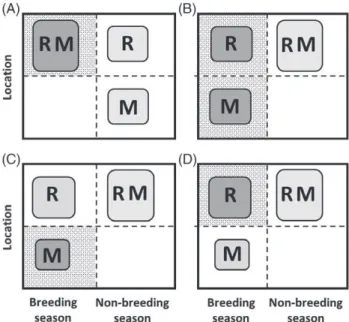
stylised two-location systems where focal sets of resident and migrant individuals co-exist either in the breeding season, or in the non-breeding season, but not both. Two primary scenarios of partial migration can then be conceptualised: ‘non-breeding partial migration’ occurs when residents and migrants co-exist in the breeding season and are spatially separated in the non-breeding season, and ‘breeding partial migration’ occurs when residents and migrants co-exist in the non-breeding season and are spatially separated in the breeding season (Fig. 2A, B; e.g. Kaitala, Kaitala, & Lundberg, 1993; Kokko & Lundberg, 2001; Taylor & Norris, 2007; Griswold, Taylor, & Norris, 2010; Griswold et al.,
2011; Chapman et al., 2011). Elements of both scenarios are widely observed in nature. For example, instances of breeding-season sympatry between residents and migrants occur in blackbirds (Turdus merula) (Fudickar et al., 2013; Z ´u ˜niga et al., 2017) and red-spotted newts (Notophthalmus
viridescens) (Grayson, Bailey, & Wilbur, 2011), while instances
of non-breeding-season sympatry occur in American dippers
(Cinclus mexicanus) (Gillis et al., 2008) and ungulates that
express partial altitudinal migration (e.g. Hebblewhite & Merrill, 2011).
A third partial migration scenario has been envisaged, where all individuals typically inhabit a non-breeding loca-tion and some individuals sporadically migrate to a different location to breed but remain in the non-breeding location, and hence skip reproduction, in other years (‘intermittent breeding partial migration’, Fig. 2C; Shaw & Levin, 2011). We additionally highlight a fourth scenario, where all individuals typically inhabit a breeding location but some non-breeding individuals (e.g. sub-adults or adults that skip reproduction) migrate to a non-breeding location for one or multiple breeding seasons (‘intermittent non-breeding partial migration’, Fig. 2D). This scenario could arise when breed-ing areas become unfavourable for non-breeders durbreed-ing the breeding season, for example due to high combined densities of breeders and new offspring and associated competition for resources or risk of disease or predator attraction, but breed-ers cannot leave due to their reproductive requirements (e.g. breeding sites or immobile offspring). Such partial migration away from breeding locations (i.e. ‘temporary emigration’) occurs in diverse species, causing heterogeneity in local seasonal presence and associated encounter probability (for example, as highlighted in diverse marine mammals, reptiles and birds; Fujiwara & Caswell, 2002; Stauffer, Rotella, & Garrott, 2013; Weimerskirchet al.,2015).
Mathematical models have been derived and analysed to examine the relative and overall population dynamics of residents and migrants within simple two-location ‘breeding’, ‘non-breeding’ and ‘intermittent-breeding’ partial-migration scenarios considered as discrete mutually exclusive alterna-tives [Fig. 2A–C; e.g. Kaitalaet al.,1993; Taylor & Norris, 2007; Griswold et al., 2010, 2011; Kokko, 2011; Shaw & Levin, 2011; De Leenheer et al., 2017; the ‘intermittent non-breeding’ scenario (Fig. 2D) has not received analogous treatment]. The primary aim of such models has been to identify conditions where partial migration (i.e. migratory
Fig. 2. Illustration of four basic scenarios of partial migration considered as mutually exclusive alternatives. Resident (R) and migrant (M) individuals can (A) co-exist in the same location in the breeding season but be spatially separated in the non-breeding season (‘non-breeding partial migration’, also known as ‘shared breeding partial migration’); or (B) co-exist in the non-breeding season but be spatially separated in the breeding season (‘breeding partial migration’, also known as ‘shared non-breeding partial migration’); or (C) all individuals typically inhabit a non-breeding location but some individuals sporadically migrate to breed at a different location during the breeding season while other individuals remain resident and hence do not breed (‘intermittent breeding partial migration’, also known as ‘skipped breeding partial migration’); or (D) all individuals typically inhabit a breeding location but some individuals sporadically migrate to a non-breeding location during the breeding season and hence do not breed (‘intermittent non-breeding partial migration’). Box sizes indicate local seasonal population densities, implying that density is highest when residents and migrants coexist. Background stippling indicates location–seasons where breeding can occur. Dark-grey and light-grey shading respectively indicate sets of individuals that do and do not breed in each season. These scenarios implicitly assume local strong seasonality such that: the migrants’ non-breeding-season location cannot support breeding (A); the migrants’ breeding location cannot support non-breeding-season survival (B, C); and the migrants’ breeding-season location cannot support breeding (D). Scenario C also requires an initial movement of offspring from the breeding location to the non-breeding location.
polymorphism) is maintained given different forms of differential reproduction and/or survival between migrants and residents and of season-specific density-dependence (Lundberg, 2013). Underlying variation in location-specific seasonal density emerges as a simple function of total pop-ulation size and migration rate, creating intrinsic negative frequency-dependence in the benefit of migration and thereby maintaining migratory polymorphism. Such models predict that the evolutionary stability and degree of partial
migration (as opposed to full obligate migration or residence) can depend on the relative reproductive success of migrants and residents (e.g. Kaitalaet al.,1993; Kokko & Lundberg, 2001), on the magnitudes of seasonal density-dependence in survival (e.g. Taylor & Norris, 2007; Griswoldet al.,2010) and fertility (De Leenheer et al., 2017), and on the form of asymmetry in territory acquisition (e.g. Kokko, 2011). Collectively, they highlight that the conditions that maintain partial migration differ between scenarios where migrants and residents co-exist in the breeding versus non-breeding seasonsversusintermittent breeding, and depend on the forms of season-specific demographic variation and associated density-dependence and frequency-dependence (Griswold
et al., 2010; Chapman et al., 2011; Kokko, 2011; Shaw &
Levin, 2011). They also illustrate that the overall size and composition of partially migratory populations can change, sometimes in counter-intuitive ways, in response to environ-mental changes that affect breeding and/or non-breeding locations and associated demographic rates (Griswoldet al.,
2011; Kokko, 2011). They thereby further illustrate the role of seasonal demography in shaping population dynamics.
Such models, analyses and conclusions have been central to developing and testing theory regarding the maintenance of partial migration. However, they necessarily consider simple abstract scenarios of partial migration and invoke a key assumption that migrants and residents co-exist in one biological season but are completely spatially separated in the other season (Fig. 2). Locations that are seasonally occupied only by focal migrants are assumed not to contain any other resident (or migrant) conspecifics, meaning that local density and consequent density-dependent reductions in reproduction or survival arise solely from the number of migrants originating from the focal shared location (generating direct negative frequency-dependence). Since residents and migrants do not co-exist in both the breeding and non-breeding seasons within any individual scenario, any demographic effects of season-specific environments and/or density will differentially impact migrants versus
residents, causing strategy-specific dynamics. Further, some models assume no density-dependent constraints on demography in a non-shared season or location (e.g. Kaitala
et al.,1993; Griswold et al.,2010), and emphasise seasonal
release from density-dependence as a key process that can cause partially migratory population sizes to exceed those of otherwise analogous fully resident or fully migratory populations (Griswoldet al.,2011).
By contrast, in real-world partially migratory systems, single focal sets of migrants and residents are unlikely to exist in complete seasonal isolation from other sets of individuals, as envisaged in the four basic abstract scenarios (Fig. 2). Rather, given weaker environmental seasonality, migrants might often move between locations that hold different sets of residents and/or migrants originating from elsewhere. Different sets of migrants and residents can then co-exist at different locations across breeding and non-breeding seasons, and hence experience common environments and population densities. The conclusions of simple two-location
partial-migration models that assume local strong seasonality, and hence complete seasonal segregation of residents and migrants, seem unlikely to hold given such generalised conditions (Holt & Fryxell, 2011).
Further, existing partial-migration models are (deliber-ately) demographically and ecologically simplistic. They typically do not consider sex-, age-, stage- or state-specific migrationversusresidence (but see Kaitalaet al.,1993; Kokko, 2011), or hence consider resulting spatio-temporal varia-tion in local sex ratios or age or stage structures. They do not consider environmentally induced plasticity, canal-isation, carry-over effects or cohort effects in migration
versus residence itself (as opposed to specific short-term
carry-over effects of migration on reproduction or sur-vival). Consequently, such models have not yet encompassed forms of spatial, temporal and individual variation in life history and resulting demography that have proved neces-sary to adequately understand and forecast the dynamics of non-migratory populations (e.g. Coulson et al., 2001; Clutton-Brock & Coulson, 2002; Lindstr¨om & Kokko, 2002; Benton et al., 2006; Harrison et al., 2011; Legrand et al.,
2017), and been strongly advocated for fully migratory populations (Runge & Marra, 2005; Hostetleret al., 2015). Consequently, as yet, we have no overarching conceptual frameworks with which to explore, rationalise or forecast the dynamics of partially migratory populations inhabiting complex seasonally varying environments where the poten-tial for spatio-temporal demographic structuring, and hence for complex eco-evolutionary responses to spatio-temporal environmental change, is likely to be substantial.
IV. CONCEPT AND PROPERTIES OF A
‘PARTIALLY MIGRATORY META-POPULATION’ (1) A partially migratory meta-population
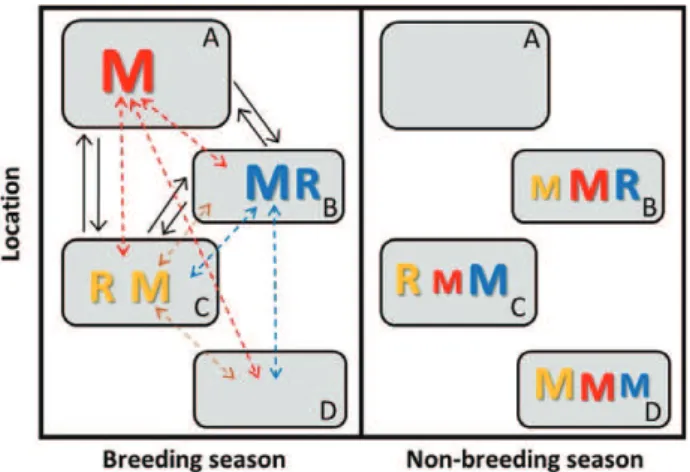
To provide an overarching conceptual framework for explor-ing the spatio-temporal dynamics of populations inhabitexplor-ing spatially structured seasonally varying environments we define a ‘partially migratory meta-population’ (PMMP) sys-tem as a set of locations (e.g. habitat patches) that can hold sub-populations of individuals comprising different sets of co-existing residents and/or migrants of different sexes, ages, stages or states in different seasons (Fig. 3).
Such locations could comprise patches of similar or rad-ically different habitats that could be immediately adjacent, forming a local habitat mosaic, or could be separated by substantial geographical or altitudinal distances. Seasonality could be strong, such that single locations cannot support both breeding-season activity (i.e. reproduction and survival) and non-breeding-season activity (i.e. survival), or could be weaker such that some or all locations can support all year-round activities to different degrees. Consequently, at the extremes, some locations could be repeatedly vacated and re-colonised across consecutive seasons, representing spa-tially restricted occurrences of ‘non-breeding’ and ‘breeding’
Fig. 3. Illustration of a simple partially migratory meta-population (PMMP) system comprising four patches, where three patches (A–C) can support breeding-season sur-vival and reproduction and three patches (B–D) can support non-breeding-season survival. Here, individuals that breed in patch B (blue font) can remain resident (R) throughout both breeding and non-breeding seasons or migrate (M, dashed arrows) to patches C or D for the non-breeding season. Like-wise, individuals that breed in patch C (yellow font) can remain resident or migrate to patches B or D for the non-breeding sea-son. Individuals that breed in patch A (red font) must migrate to patches B–D for the non-breeding season. Migration could be bidirectional (e.g. patch C to patches B and D), or recip-rocal (e.g. in both directions between patches B and C), but asymmetric (font sizes denote relative numbers of individuals). Patches B and C can consequently hold different combinations of resident and migrant individuals in both seasons (leftversus
right panels). Meanwhile, patches A and D are unoccupied in the non-breeding and breeding seasons, respectively (i.e. local populations go seasonally extinct), yet support migrants in the opposite seasons. Patches A–C that can support breeding can also be linked by dispersal (solid black arrows). This general PMMP system thereby comprises a set of locations experiencing spatio-temporal seasonal environmental variation that can be occupied by different sets of resident, migrant and dispersed individuals in different seasons.
partial migration (Fig. 2A, B) nested within a more complex overall system (Fig. 3). However, given multiple locations and weaker seasonality, focal sets of seasonal migrants originating from any particular location could coexist with different sets of residents, and with incoming migrants originating from other locations, in both seasons (Fig. 3). Meanwhile, focal sets of residents could co-exist with different sets of incoming migrants in both seasons (Fig. 3). The resulting year-round local co-existence of different sets of residents and migrants is not possible given the basic two-location partial-migration scenarios that have previously been conceptualised and analysed as discrete alternatives (Fig. 2).
Within a PMMP, migration could be bidirectional from individual locations, or even reciprocal among locations that can support both breeding-season and non-breeding-season activity, rather than uniformly directional (Fig. 3). However, relative migration rates could be asymmetric, reflecting underlying seasonal source–sink dynamics (Fig. 3). Further,
there might be spatial variation in the demographic structure of migration, for example because the sex, age, stage or state structure of migration or residence [including ‘intermittent breeding’ and ‘intermittent non-breeding’ partial migration expressed by breeders versus non-breeders (Fig. 2C, D)] varies among locations. Finally, locations that can support reproduction might also be linked by dispersal (Fig. 3), creating further demographic and genetic connectivity.
Such PMMP structures could encompass any number of locations with different relative and absolute abilities to sup-port reproductionversusbreeding-season and non-breeding-season survival, meaning that not all conceivable non-breeding-seasonal transitions among locations will necessarily arise in all systems. The PMMP framework could be further extended to consider more complex forms of seasonality, encom-passing systems where mating and offspring rearing are spatially separated, and incorporating additional locations used solely as migratory stop-overs or as ‘stepping stones’ in extended spatially structured migrations (e.g. Faaborg
et al., 2010; Hostetler et al., 2015; Thorup et al., 2017).
PMMP structures could therefore apply to diverse systems spanning diverse spatial scales, for example including fish inhabiting lake–stream or stream–ocean systems or patchy oceanic or estuarine environments (e.g. Kerr & Secor, 2012; Papastamatiouet al.,2013; V´elez-Espino, McLaughlin & Robillard, 2013; Hodge, Wilzbach, & Duffy, 2014), newts inhabiting pond–forest mosaics (e.g. Grayson et al.,
2011), and birds, mammals and reptiles inhabiting locations spanning altitudinal, latitudinal or environmental gradients (e.g. McDevittet al., 2009; Mysterud et al., 2011; Fudickar
et al.,2013; Avgaret al.,2014; Andersonet al.,2015; Boyle,
2017; Gristet al.,2017; Peterset al.,2017; Yackulic, Blake, & Bastille-Rousseau, 2017; Z ´u ˜nigaet al.,2017).
(2) ‘Partially migratory meta-population’ as an overarching conceptual framework
Overall, the PMMP concept provides an overarching general framework that encompasses multiple established paradigms in population ecology as special cases. First, the case where all patches can support year-round activity and all individuals are non-migratory represents a classical meta-population of patches linked by dispersal, as considered by existing stochastic patch-occupancy models and spatially explicit matrix and individual-based models (Section I.2). Second, the case where all locations exhibit strong seasonality and all individuals migrate (or die) represents full obligate directional migration to single or multiple destinations, as considered by existing meta-population, network and full annual cycle models of fully migratory populations (Section I.3). Third, cases where some locations can support breeding-season but not non-breeding-season activity, orvice versa(i.e. local strong seasonality), can reduce to the basic discrete two-location scenarios considered by existing partial-migration models (Section III).
In comparison, the full general PMMP concept (Fig. 3) allows greater spatio-temporal variation in the degree of environmental seasonality, and such landscapes
could consequently support spatially, temporally and demographically diverse sets of interacting residents and seasonal migrants. PMMPs could thereby create diverse and complex forms of spatio-temporal variation, covariation, structure and heterogeneity in and among individual reproduction, survival, dispersal and migration, including complex forms of migratory plasticity, carry-over effects and density-dependence and hence migratory frequency-dependence. Such PMMP structures might con-sequently create substantially different population dynamic and evolutionary responses to seasonal environmental variation, including extreme seasonal environmental events, from those arising in non-migratory or fully migratory populations or given basic partial-migration scenarios, affecting the locations, seasons and sub-populations that underpin population persistence. Numerous effects that encompass structured demographic variation and potentially rapid evolution can be hypothesised, as outlined in the following sections and summarised in Tables 1 and 2. (a) Partial migration, reproduction and survival
Most obviously, variation in the occurrence of individual migration versus residence within and/or across locations could directly cause substantial within- and among-location variation in individuals’ survival and/or current or subsequent reproduction. Migrants inhabiting different locations in different seasons could be more or less likely to survive and/or reproduce than residents in the same sex, age or stage classes inhabiting the same initial or destination locations, creating major demographic structure among different sets of individuals that co-exist in one season or the other (Fig. 4A). Such effects could stem from major physiological changes associated with the migratory movement itself, and/or from different environmental, information or social conditions experienced as a consequence of migration. Indeed, individuals migrating within PMMPs might experience competition with established local residents in both seasons (e.g. Fig. 4A), rather than in only one season as assumed in models that consider basic two-location partial-migration scenarios (e.g. Taylor & Norris, 2007; Kokko, 2011, Fig. 2), or in neither season as assumed in models of fully migratory populations (e.g. Runge & Marra, 2005; see also Kokkoet al.,2006). Such effects could exacerbate socially induced costs and constraints on migration or residence (e.g. P´erez-Tris & Tellería, 2002; Mysterudet al.,2011; Coteet al.,2017).
More complex carry-over effects could arise when migration substantially affects multiple future life-history traits expressed by individuals, including future migration itself. For example, migrationversusresidence might facilitate or impede subsequent reproduction, which might alter future expression of migration or residence, thereby affecting subsequent survival or reproduction (Fig. 4B). Indeed, in partially migratory Cory’s shearwaters (Calonectris borealis), experimentally induced breeding failure caused reduced migration in males, followed by earlier return to the breeding colony and higher breeding probability the following
year (Catry et al.,2013). Cross-season associations between individual breeding failure and non-breeding-season location have also been observed in fully migratory black-legged kittiwakes (Rissa tridactyla; Bogdanovaet al.,2011).
Further, within a PMMP, direct and lagged effects of the expression of migration or residence on survival and reproduction are themselves likely to be spatially heterogeneous (Fig. 4C). This is because seasonal environmental conditions, and hence the magnitude of local environmental seasonality, will likely vary spatially. Consequently, migration might increase survival and reproductive success in some sub-populations if migrants experience better seasonal conditions, but decrease survival and reproductive success in other sub-populations if any survival benefit of migration is outweighed by associated costs, and/or migrants lose breeding opportunities to local residents (Fig. 4C). Such reversed effects of migrationversus
residence on survival and reproduction across locations would generate system-wide disruptive selection, potentially leading to local migratory adaptation.
(b) Partial migration and dispersal
The existence of multiple locations with relatively weak seasonality means that covariances between occurrences of migration and dispersal might also arise. Individuals that disperse to a non-natal breeding location might be more (or less) likely to undertake subsequent seasonal migrations than non-dispersers inhabiting the same breeding and/or natal locations (Fig. 4D). Similarly, individuals that migrate might be more (or less) likely to subsequently disperse (Fig. 4D). Positive covariances could arise if the same underlying physiology or ecological drivers facilitate both forms of movement (e.g. Coteet al.,2017), or because dispersers gain wider spatial environmental experience than non-dispersers, thereby facilitating future informed migration (or vice
versa). Conversely, negative covariances could arise if, by
dispersing, individuals can move to a good year-round location and thereby eliminate the need for subsequent migration. Indeed, an initial migratory movement with failure to return (whether reflecting adaptive decision or constraint) equates to dispersal (as currently defined; Berthold, 1999; Coteet al.,2017, see also Section V.2).
Direct effects of migration on survival and reproduction could then occur non-independently of direct negative or positive effects of dispersal. Such effects are themselves widely considered to be multifaceted and substantial, representing multiple costs of dispersal alongside benefits stemming from release from high local density and kin competition (Bonte
et al.,2012). Migration and dispersal could then have further
indirect effects on survival and reproduction because they affect each other (Fig. 4E). Additional carry-over effects of reproduction on migration could then arise if reproductive failure prompts dispersal (e.g. Hoover, 2003) and dispersal affects an individual’s subsequent migration (Fig. 4E).
Overall, PMMP structures could therefore magnify or mitigate the independent consequences of seasonal migration and dispersal for reproduction and survival, and
Table 1. Three sets of key conceptual and theoretical questions that need to be addressed in order to understand and forecast population and evolutionary dynamics in partially migratory meta-populations (PMMPs) in seasonally varying environments. (1) Prospective analyses of population growth rate
(i) What are the sensitivities (or elasticities) of sub-population and overall PMMP growth rates to sex-, age- and sub-population-specific migration rates, and to covariances among migrationversusresidence and survival, dispersal and reproduction?
(ii) What are the sensitivities (or elasticities) of sub-population and overall PMMP growth rates to the degree of individual migratory plasticity and associated carry-over effects?
(iii) How do such sensitivities (or elasticities) vary with life history (i.e. with mean demographic rates), and with the spatial structures of seasonal environmental variation and density-dependence and resulting migratory frequency-dependence?
(2) Complex population dynamics and persistence given environmental change
(i) What are the responses of sub-population and overall PMMP growth rates and extinction probabilities to postulated regimes of seasonal environmental change, including extreme environmental events and resulting major demographic perturbations? What are the resulting rates of seasonal range-shifting, and the time courses and spatial scales of internal and overall transient and cyclic population dynamics?
(ii) How do such spatio-temporal dynamics vary with life history, with the form of individual migratory plasticity, with the spatial structure of seasonal environmental variation and change, and with the spatio-temporal pattern of major perturbations?
(iii) To what degree are PMMP dynamics and local and global extinction probabilities more or less resilient or responsive to seasonal environmental change and perturbations than classical meta-populations (i.e. spatially structured populations with dispersal but no seasonal migration), or than populations with full obligate migration?
(3) Genetic variation and eco-evolutionary dynamics
(i) To what degree can PMMP structures maintain additive genetic variation in individual liability (i.e. propensity) for migrationversus residence, including through periods of environmental change and range-shifting? How does such maintenance vary with life history, and with the spatial structures of seasonal environmental variation and of major perturbations?
(ii) How does the evolved strategy of migrationversusresidence, and the magnitude of additive genetic variation, vary among PMMP sub-populations, thereby generating local adaptation and evolvability in migration? How do such properties vary with the spatial structure of seasonal environmental variation and perturbations?
(iii) To what degree can PMMP structures facilitate or impede evolution of phenotypic plasticity in the form of migrationversusresidence, fostering condition-dependence and responsive ‘irruptive’ migratory responses to extreme environmental events?
(iv) To what degree can evolution of migration facilitate or impede evolution of dispersal (andvice versa)? What are the directions and magnitudes of emerging genetic covariances?
(v) To what degree do such evolutionary dynamics feed back to affect PMMP dynamics and persistence, and over what time scales? Consequently, to what degree can changing partial migration generate rapid ‘evolutionary rescue’ in the face of seasonal environmental change, including major perturbations?
hence further affect population and evolutionary dynamics. Introgressive gene-flow stemming from dispersal and subsequent reproduction might then be non-independent of transient (non-introgressive) gene flow stemming from seasonal migration, further shaping the overall evolutionary and population consequences of spatio-temporal variation in seasonal selection.
(c) Partial migration and density
Patterns of spatio-temporal variation in population density arising in PMMPs, and hence expression of density-dependence in reproduction, survival, dispersal and migration (and resulting frequency-dependent consequences of migration and dispersal), are likely to differ substantially
from those arising in non-migratory or fully migratory populations, or given basic two-location partial-migration scenarios (Section III). In a PMMP, local seasonal density is no longer a simple function of total population size in the preceding season and local migration rate. Rather, local seasonal densities will result from variation in residence, migration and dispersal of individuals originating from, and potentially moving to, numerous initial and destination locations, experiencing different seasonalities and hence forms of selection on migration and dispersal (Fig. 3). Indirect forms of lagged density- and frequency-dependence could also arise if the presence of residents or other migrants in a location in the season when a focal set of migrants is absent alters the conditions the focal migrants experience
Table 2. Three sets of key empirical questions that need to be addressed in diverse partially migratory populations and meta-populations (PMMPs) in order to inform, parameterise, test and/or validate population and evolutionary dynamic theory and models.
1. Spatial and demographic structures of partial migration, including individual canalisation and plasticity
(i) To what degree does the form of migration or residence differ between females and males of different ages, stages or states originating from the same and different locations within PMMPs? Consequently, what is the form of structured partial migration, and resulting seasonal co-existence of different types of residents and migrants, across different locations?
(ii) How does the form of migration or residence expressed by individuals develop across ages and life-history stages? Consequently, is the form of migration or residence canalised or plastic within or across ontogenic stages?
(iii) To what degree is the form of migration or residence expressed by individuals canalised or plastic across different environmental conditions? Specifically, what are the forms of environment-dependence and/or density-dependence in migration or residence? (iv) To what degree do initial environment-dependent and/or density-dependent migration and developmental canalisation combine to
generate persistent cohort effects in the form of migration or residence?
(v) To what degree do atypical extreme environmental events increase or decrease switching between residence and migration (for example causing responsive irruptive migration)? Does such responsive migration have carry-over effects on subsequent expression of pre-emptive migration?
(vi) To what degree does the magnitude or form of plasticity in migration expressed in relation to typical or atypical ranges of seasonal environmental variation or density vary among sexes, age or stage classes, cohorts or locations?
(2) Key life-history and demographic covariances involving partial migration
(i) To what degree do survival, reproduction and dispersal vary with different forms of migration or residence, including direct effects and carry-over (lagged) effects? Conversely, to what degree does the form of migration or residence vary in response to reproduction and dispersal?
(ii) To what degree do such direct and lagged demographic covariances vary with sex, age, stage or state, thereby defining the overall structure of demographic covariation?
(iii) To what degree do such direct and lagged demographic covariances vary among individuals that inhabit different locations and hence experience different seasonal environments and degrees of environmental seasonality, thereby defining the spatial structure of
demographic covariation?
(iv) To what degree does such spatial variation in demographic covariance vary temporally, in relation to typical or atypical seasonal environmental variation, thereby defining the spatio-temporal structure of demographic covariation?
(v) To what degree are effects of migrationversusresidence on survival, reproduction and dispersal manifested among breeding pairs or groups rather than solely among individuals?
(3) Key genetic variances and covariances involving partial migration
(i) What is the magnitude of additive genetic variance in individual liability (i.e. propensity) for migrationversusresidence? What are the magnitudes of other components of phenotypic variance, for example individual, year, cohort and parental environmental variances? Hence what is the narrow-sense heritability of migration manifested in the context of natural environmental variation and hence total phenotypic variance?
(ii) What is the magnitude of additive genetic variance in migratory plasticity?
(iii) What are the additive genetic covariances between liability for migration and survival, reproduction and dispersal, and hence what are the forms of evolutionary drivers and constraints?
(iv) To what degree do these additive genetic variances and covariances differ between females and males, and vary among sub-populations originating from or inhabiting different locations?
(v) What is the degree of assortative mating between different sets of migrants and residents? How does the degree of assortative mating vary among stages, years and locations?