Case DNA Finland Ltd: How to Gain More Russian Prepaid
Subscription Customers?
LAHTI UNIVERSITY OF APPLIED SCIENCES
Degree Programme in International Business Thesis
Spring 2009
JENNI-MARI LAITINEN: Marketing Communication Plan Case DNA Finland Ltd: How to Gain More Russian Prepaid Subscription Customers?
Thesis for International Business 61 pages, 5 appendixes Spring 2009
ABSTRACT
This thesis is about marketing communications. The objective is to define the parts, which especially need to be considered in the functional and cost-effective promotion planning process, and then apply these features to the case company’s plan. The research question tries to solve the problem on what the case company must observe in their promotion process when trying to gain more Russian prepaid subscription customers.
The study is divided into theoretical and empirical parts. The theory part
introduces marketing on a general level; marketing planning, the marketing mix, the 4P model and the basics of the marketing communication. Promotion planning is handled stage-by-stage by using the MCPF theory. The empirical part applies theory to practice by developing a marketing communication plan for the case company.
The research offers feasible ideas to accomplish promotion towards the target segment. Therefore it is not to be a precise and detailed plan. Only prepaid subscriptions and consumers are handled.
The qualitative study consists of multiple methods. The information is gathered widely from different marketing and marketing communication textbooks, magazine articles, web pages and by interviewing representatives of the case company.
Marketing communication planning process is a versatile process, which requires many resources from the company in order to be executed successfully. This study offers the theoretical framework and an empirical paradigm for the person who operates with marketing communication process. The result of the study is the marketing communication plan for the case company. It helps the implementation of the planning process and offers comprehensive information about the subject. Key words: marketing communication, marketing communication planning, intercultural promotion, DNA Finland Ltd
JENNI-MARI LAITINEN: Markkinointiviestintäsuunnitelma Case DNA Finland Oy: Kuinka hankkia enemmän venäläisiä
prepaid-matkapuhelinasiakkaita? Kansainvälisen liiketoiminnan opinnäytetyö 61 sivua, 5 liitesivua Kevät 2009
TIIVISTELMÄ
Tämä opinnäytetyö käsittelee markkinointiviestintäsuunnittelua. Tavoitteena on selvittää, mitä osa-alueita suunnittelussa tulee huomioida ja mihin seikkoihin käytännönläheinen suunnitelma keskittyy. Tutkimuskysymys pyrkii selvittämään osa-alueet, joihin kohdeyrityksen tulee markkinointiviestinnässään panostaa hankkiakseen lisää venäläisiä prepaid-matkapuhelinasiakkaita.
Työ jakaantuu teoreettiseen ja empiiriseen jaksoon. Teoriaosa lähestyy aihetta laaja-alaisesti, alkaen markkinoinnin käsitteestä hyvin yleisellä tasolla, esitellen markkinoinnin suunnitteluprosessin sekä markkinoinnin kilpailukeinot (ns. 4P-mallin) ja lopulta keskittyen markkinointiviestintään. Suunnitteluprosessin vaiheet ja usein käytetty MCPF-suunnittelurunkomalli on esitelty omassa kappaleessaan. Empiirisessä osassa teoriaa sovelletaan käytäntöön niin, että
markkinointiviestinnän teorian pohjalta luodaan kohdeyritykselle
markkinointiviestintäsuunnitelma. Tutkimuksen ei ole tarkoitus olla tarkka ja yksityiskohtainen viestintäsuunnitelma, vaan tarjota käyttäjäystävällinen markkinointiviestintäkehys lukijalle.
Kyseessä on kvalitatiivinen tutkimus, jonka menetelminä on käytetty erilaisten markkinointiin ja markkinointiviestintään keskittyvien kirjojen, lehtiartikkeleiden ja Internet-sivujen lisäksi kohdeyrityksen edustajien haastattelua. Tietoa on hankittu laaja-alaisesti aihetta eri näkökulmista käsittelevistä teoksista.
Markkinointisuunnitelma on laaja ja monipuolinen prosessi, jonka toteutus vaatii yritykseltä paljon resursseja. Tämä tutkimus tarjoaa teoreettisen pohjan ja
empiirisen esimerkin markkinointiviestintäsuunnitelman parissa toimivalle. Tutkimuksen tuloksena syntynyt markkinointiviestintäsuunnitelma tarjoaa tietoa aiheesta laaja-alaisesti ja helpottaa lukijan omaa suunnitteluprosessia.
Avainsanat: markkinointiviestintä, markkinointiviestinnän suunnittelu, monikulttuurinen markkinointi, DNA Finland Oy
1 INTRODUCTION 1
1.1 Background for the Research 1
1.2 Objectives of the Thesis and the Research Question 1 1.3 Limitations of the Study and the Research Methods 2
1.4 The Structure of the Thesis 3
2 MARKETING IN GENERAL 4
2.1 Strategic Marketing Planning 5
2.2 Marketing Mix 6 2.2.1 4Ps: Product 7 2.2.2 4Ps: Price 9 2.2.3 4Ps: Place 11 2.2.4 4Ps: Promotion 12 3 MARKETING COMMUNICATIONS 13
3.1 The Aim of Marketing Communication 14
3.2 The Promotion Tools 15
3.2.1 Advertising 15 3.2.2 Sales Promotion 18 3.2.3 Public Relations 19 3.2.4 Personal Selling 20 3.2.5 Direct Marketing 21 3.3 The Message 22
3.4 Intercultural Marketing Communication 22
3.5 Developing an Effective Promotion 23
4 PLANNING MARKETING COMMUNICATIONS 24
4.1 Context Analysis 25
4.2 Promotional Objectives 26
4.3 Promotional Strategies 27
4.4 Budget and Other Resources 28
4.5 Schedule 29
5.1 Context Analysis 31 5.1.1 Company Analysis 31 5.1.2 Competitor Analysis 36 5.1.3 Segment Analysis 43 5.1.4 Environmental Analysis 44 5.2 Promotional Objectives 47 5.3 Promotional Strategies 47
5.3.1 Print, Outdoor and Radio Advertising 48
5.3.2 New Media 51
5.3.3 Sales Promotion 52
5.3.4 Customer Care in Russian 53
5.4 Budget and Other Resources 53
5.5 Schedule 54
5.6 Control and Evaluation 54
6 CONCLUSIONS 55
7 SUMMARY 57
REFERENCES 58
1 INTRODUCTION
1.1 Background for the Research
This thesis is a marketing communication plan for a case company, DNA Finland Ltd. The aim of the plan is to gain more Russian prepaid subscription customers. The idea for the subject originated after the author of the study had worked for DNA customer care and noticed that there is a possibility to increase the number of the Russian customers. Furthermore, the case company had confirmed that they do not have a functional marketing communication plan for the particular
segment.
At first, the idea was to concentrate on inbound roaming customers in general. Roaming itself can be defined as “the ability for a cellular customer to
automatically make and receive voice calls, send and receive data, or access other services, including home data services, when travelling outside the geographical coverage area of the home network by means of using a visited network” (GSM Association 2009).
Later, however, it was noticed that focusing on a Russian prepaid customers instead of roaming customers in general could be more profitable to DNA. The nationality is the biggest foreign customer segment using DNA’s network and the amount of Russian tourists has been increasing yearly. Therefore, this study is targeted to Russian customers, paying attention to their cultural aspects and concerning their needs.
1.2 Objectives of the Thesis and the Research Question
The aim is to make Russian visitors to choose DNA prepaid subscription instead of domestic competitors’ services by emphasizing DNA’s marketing effectiveness and reasonable prices. The challenge is to gain customers’ attraction within other
networks. The plan offers ideas for the case company, which they can apply in their marketing communication towards the target market. The aim is not to create a detailed marketing communication plan, but instead to offer applicable and cost-effective ideas.
In order to gain more Russian customers, the plan must emphasize the target market’s cultural features. The attention of the segment must be captured and therefore the promotional methods and implementation locations are selected carefully.
The research question defines what kind of marketing communication plan the case company needs in order to gain more Russian prepaid customers. Since the plan is directed to foreign customers, the cultural features must be considered.
1.3 Limitations of the Study and the Research Methods
This thesis offers an idea for the case company on how they could promote the product in the target market. Overall, the marketing communication plan for the company is created on a general level and the final campaign design is left to the company to plan.
This study focuses only on prepaid subscriptions and not to postpaid subscriptions and international roaming. It is very hard to affect on consumers' behavior when they use postpaid subscriptions due to partnerships with networks. By
co-operation, networks can provide lower prices to their customers. Prepaid subscriptions can be obtained from many places and they are secure choices, as their pricing is always clear and all the costs are known and paid beforehand. Furthermore, only consumers are handled.
The characteristic feature of prepaid subscriptions is that the call time is paid in advance. This thesis refers prepaid subscriptions generally as “prepaids”. When a certain product is emphasized, e.g. DNA Prepaid, the exact name is mentioned.
This study is done by using different marketing textbooks, Internet pages and other materials. In addition, DNA’s representatives have been interviewed. During January 2009, DNA Finland Ltd’s Head of Roaming Kimmo Martikka and
Marketing Planner Pia Lindroos were interviewed in the company’s headquarters in Vantaa. They provided some very valuable ideas and information on the subject.
1.4 The Structure of the Thesis
The first chapter of the study is an introduction. Second part concentrates on marketing in general, marketing planning, the marketing mix and the 4P’s theory. Marketing mix model is introduced fairly largely as it is widely taught and used. The third section is about marketing communication theory and some special features of promotion are introduced.
The fourth chapter concentrates on marketing communication planning. This part explains the marketing communication planning framework (MCPF), which is also applied in case company’s plan.
The empirical marketing communication plan can be found in the fifth chapter. The sixth part introduces the author’s conclusions about the study and the seventh chapter is a summary of the research.
2 MARKETING IN GENERAL
Marketing can be found everywhere; people are bombarded with television commercials, direct-mail offers and sales calls. Simplified, marketing is only a two-way process, even though four stages can be recognized. These are designing, developing, delivering and determining value. (Baines, Fill, Page 2008, 17.) Baines et al. (2008, 17) stresses that a two-way process includes a customer and a marketing organization. The four stages are there to ensure that the whole process will be successful. The customer is the one, who has the power to make the final decision and has a strong input. Additionally, the marketer must specify how to satisfy customer’s needs. Generally thought marketing is just a process of an exchange; both parties supply and receive something. (Baines et al. 2008, 17.) Marketing could be defined as managing profitable customer relationships in order to satisfy their needs. Kotler (2006, 5) characterises marketing as a process by which a company creates value for customers and build strong and long-lasting customer relationships in order to receive value from customers in return (Kotler & Armstrong 2006, 5).
American Marketing Association defines marketing as “the activity, set of institutions, and processes for creating, communicating, delivering, and
exchanging offerings that have value for customers, clients, partners, and society at large” (American Marketing Association 2009).A French perspective to marketing is very different. They emphasize the importance of market
segmentation and positioning instead of other features. (Baines et al. 2008, 5.)
As can be seen, marketing is a wide and versatile term, which includes many dimensions of business activities. Whatever determination is used, the terms value, customer needs and information are often mentioned. Therefore, when thinking of promotion, which is a vital part of the marketing process, it is good to bear in mind that many features affect on the result.
2.1 Strategic Marketing Planning
There must always be a strategic plan to accomplish marketing. Often used framework first defines mission, vision, values, organizational goals and organizational strategy (Baines et al.2008, 176). When these factors are understood and defined, the functional marketing plan can be developed. The vision refers to the organization’s future and it is a statement of what the company wants to become. The mission is the company’s long-term achievement. It usually defines the organization’s purpose and direction. Values define the behavior culture inside the company and goals represent the outcomes of the company’s various activities. Organizational strategy brings together human resources, logistics, production, marketing, IT and financial parts of the company that support accomplishing organizational goals. (Baines et al. 2008, 176-178.) Overall marketing should support and contribute to the company’s strategy. Strategic marketing planning is a formal written document that specifies the accomplishment of the company’s strategy. It is also a basis for the marketing mix and marketing communication planning. The process is demonstrated on the following Figure 1. (Baines et al. 2008, 180.)
Figure 1. The Relationship Between Corporate and Marketing Strategies
(Baines et al. 2008, 180; Simplified version, completed by the author of the thesis)
2.2 Marketing Mix
Neil Borden developed the term marketing mix in late 1940s and in 1964 it was published in his article “The Concept of the Marketing Mix”. He begun to use the term in his teachings after James Culliton had described the marketing manager as a “mixer of ingredients”. These ingredients in Borden’s marketing mix were product planning, pricing, branding, distribution channels, personal selling, advertising, promotions, packaging, display, servicing, physical handling, fact-finding and analysis. (NetMBA.com 2002-2007.)
Later, in the 1960s Jerome McCarthy developed the 4Ps theory. It was simplified marketing theory, when compared to the marketing mix. The 4Ps theory includes product, price, place and promotion. Despite of the simplicity of the 4Ps theory,
Mission, values and goals Decided activities Allocated resources
Corporate Strategy
Marketing Strategy
Selection of target markets and segments Selection of marketing mix Implementation and evaluation
the framework has remained strong and many marketing books refer to it. (NetMBA.com 2002-2007.)
In this study, the 4P theory is emphasized because promotion is a part of the marketing mix and therefore it is important to introduce the whole theory before concentrating on marketing communication more thoroughly.
2.2.1 4Ps: Product
A product is a key for the marketing mix and a main element of the market
offering. Kotler & Armstrong (2006, 233) define a product as anything that can be offered to a market for attention, use or consumption and that satisfies a need. Products include physical objects, services, events, persons, places, ideas or mixes of these entities. In this thesis, a product can mean any of those above. (Kotler & Armstrong 2006, 233.)
A human has 15 basic needs, which are partly satisfied by consuming. Regarding Lahtinen & Isoviita (1999, 22) these needs are hunger, honour, appreciation, sexual interaction, straightness, revenge, citizenship, avoiding emergency, social interaction, independency, curiosity, family and social appreciation. (Lahtinen & Isoviita 1999, 22.)
Product and service designers need to plan their outputs in order to satisfy some of those basic needs. In order to fulfil the need, there must be a product.
Furthermore, the new product must be named. Only an individual name can separate the output from the similar ones. (Lahtinen & Isoviita 1999, 136.) Not only brand naming, but also packing and advertising create a brand over the product. One exaemple is Coca Cola, one of the world’s best-known brands. More than 90 per cent of the people recognize it and as a word, it is the most well-known after “Hello”. (Lahtinen & Isoviita 1999, 136.)
Brand naming is a strategic issue for the company. The brand name can not be launched without thinking of the long-term influences effects the name. Once launched, the name can not easily be changed afterwards.
Brand naming serves not only the buyer, but the seller, too. Without a brand name or trademark, the customer has difficulties to separate similar products. Further, it can be hard to remember which product had previously best fulfilled their need without a sharp and effective brand name.
There are few terms, which should not be mixed: brand, brand name, brand mark and trademark. In the spoken language, these are commonly used as synonyms. However, there are significant differences between the terms.
Lahtinen et al. (1999, 135) explain that a brand can be any name, term, symbol, format or design, or the combination of the previous ones. The main point to remember is that a brand separates and identifies the producer or the seller of the product from similar ones. (Lahtinen et al. 1999, 135.)
A brand name, however, is the brand’s spoken or written part. A good name can add a product’s popularity. The brand name must also be protected in order to prevent others to use the name in the future.
Furthermore, a brand mark is a unique symbol. Some products are known by their symbol or picture; e.g., Mercedes Benz is known by the star and Coca Cola by the white font on the red background. A logo is a unique way to write the company’s or the product’s name. A trademark is a legally protected brand name or brand mark. It can be formed by a word or words, letters, numbers or it can be a combination of all the previous ones. (Lahtinen et al. 1999, 136.)
Brands are more than names and designs. They are highly powerful assets, which must be maintained, developed and managed carefully. Brands represent
Not only brand name, but also quality, is an important measurement of the
product. First, the quality must be excellent, and furthermore, the customers must confirm the quality. The level of a quality is very subjective and therefore formed by the customers’ vision. A low quality is a huge expense for the companies. It is calculated that sales deductions due to low quality products, fixing and adjusting errors, rejecting erroneous products and handling claims are approximately 35 per cent of the turnover. (Lahtinen et al. 1999, 146.)
Market segmentation is dividing large and heterogeneous markets into smaller groups that can be reached more efficiently by their unique needs (Kotler et al. 2006, 195). Segmentation must be accomplished carefully in order to find the potential customer groups and to focus marketing especially towards them. After segmentation, the product must be positioned. Positioning is visualizing the product within the target audience. The goal is to clarify which reasons assign audience’s choices. (Opetushallitus Etälukio 2009.)The aim is to make audience to choose the product from the mass of competitors’ similar products.
There are some excellent examples of successful positioning. For instance, Volvo is recognized worldwide as a safety family car. This derives from executive positioning. BMW, on the other hand, has been positioned for the target audience, which requires sexy and sporty car.
2.2.2 4Ps: Price
Price was some decades ago the major factor affecting on the product choice. Later other factors gained more important roles in the buyer’s behaviour. It is good to bear in mind that price is the only element which produces revenue in the marketing mix. Therefore pricing must be controlled and considered carefully. Price can also change quickly due to economic fluctuations. Pricing must also cooperate with product design, distribution and promotion decisions. (Kotler et al. 2004, 309.)
There are internal and external factors, which have an effect on pricing
considerations. According to Kotler et al. (2004, 309), internal factors include e.g. marketing mix strategy, costs and organizational considerations. In addition, external factors include market and demand nature, competition and other environmental elements (Kotler et al. 2004, 315).
Kotler et al. introduces target costing as a strategic weapon. It means that first the ideal selling price is set based on customer considerations and then objective costs are calculated in order to meet the price. (Kotler et al. 2006, 310.)However, there is a problem when deciding the price before the final product. The impact to product’s quality could be significant if the target costing was not been made carefully.
A management consulting and education firm DRM Associates’ President Kenneth A. Crow explains that target costing is based on three factors. Firstly, a company must focus on orienting their products to customer’s affordability, secondly, the products must be considered as an independent variable when designing its requirements, and lastly, the company must consider target cost during development. (Kenneth A. Crow, 2002.)
Lahtinen et al. (1999, 165-166) reminds that pricing decisions concern a product’s price level, price changing, price discounts and terms of payments. In addition, psychological factors need to be taken in consideration when pricing products. Furthermore, pricing principals and pricing methods must be decided early enough in order to gain an ideal price level. (Lahtinen et al. 1999, 165-166.) Overall, pricing methods are those actions that the company does in order to define product’s price level. According to Lahtinen et al. (1999, 168), the company must first decide which pricing politics it uses and then set the ideal price level with the help of pricing methods.
2.2.3 4Ps: Place
The products, which have been produced, must also be made available for the customers. This path is called a supply chain or a distribution channel. Kotler et al. (2004, 360) explains that a supply chain consist of upstream and downstream partners. Upstream partners include raw material, component and information suppliers, in other words all of the suppliers, which are needed to produce or manufacture something. Downstream partners look towards the customer;
including wholesalers and retailers. Downstream partners are the link between the seller and the buyer. (Kotler et al.2004, 360-361.)
Companies often pay too little attention to their distribution channels. However very few producers sell their goods direct to customers and this emphasizes the importance of the supply chain. In addition, company’s distribution channel decisions have a direct effect on other marketing decisions. Distribution channel decisions usually involve with long-term partnerships with other firms. (Kotler et al.2004, 361.)
The right channel needs to be selected carefully and purposefully in order to gain maximum effectiveness. According to Kotler et al. (2004, 372), channel designing include customer need analyzing, setting channel objectives as well as channel alternatives identifying and evaluating. The company must analyze what the target consumer is willing to do in order to obtain the product. It is also important to define what the customer requires from the channel. Usually, for example, if the product can be obtained nearby, the price is higher and vice versa. Therefore, there must be a balance between consumer needs and price preferences.
Consumers often accept lower service level in exchange for lower prices. (Kotler et al.2004, 372.)
Channel objectives are to be set due to a company’s and product’s nature. They are set in order to gain certain level of customer service. Regarding Kotler et al. (2004, 372), the company can identify several segments wanting different levels
of service. Then the decision, which segments are to be served and which
channels are to be used in each case, are done. Channel objectives are influenced by the nature of the company and its products, its marketing intermediaries, competitors and the environment. (Kotler et al. 2004, 372.)
The next step in the company’s supply chain designing is to identify the best suitable channel alternatives. Then the types of intermediaries and number of intermediaries and each channel members’ responsibilities are set (Kotler et al. 2004, 372-373).
2.2.4 4Ps: Promotion
Marketing is not just developing an innovative product, pricing it attractively and making it available for customers. The product must also be made known for the potential customers. Marketing communication is therefore a vital part of the marketing mix.
Marketing communication, or promotion how it is also called, is one of the competitive advantages of marketing mix. Furthermore, the marketing
communications methods include advertising, sales promotion, public relations, personal selling and direct marketing. However, when thinking of promotion, customer service and web marketing must also be taken under consideration. (Lahtinen et al. 1999, 211.)
According to Lahtinen et al. (1999, 210-211), marketing communication is divided into informative and suggestive parts. Informative communication describes the product and the price in order to decrease potential customers’ suspense. Suggestive communication attempts to affect on customers’ attitudes by emotional methods. Marketing communication will be stressed in more detail in the following chapter. (Lahtinen et al. 1999, 210-211.)
3 MARKETING COMMUNICATIONS
As the marketing mix and the 4Ps model have already been introduced in this study, it is time to focus on the fourth “P”; promotion more in more detail. In addition, it is important to bear in mind that other parts of the marketing mix are also communication. Very often price is related to quality and a certain
distribution channel can have a significant surplus to a product. However, this chapter focuses on promotion, as it usually is the most visible and concrete way to tell about the product or the company to potential customers and to interest
groups.
Marketing communication actually consists only of three elements; a set of tools, the media and messages. The tools to accomplish promotion are advertising, sales promotion, personal selling, direct marketing and public relations, which are introduced later in this thesis. (Baines et al. 2008, 443.) Usually several promotional tools are used simultaneously.
It is good to bear in mind that there are also other promotional methods, which can be mixed with promotional tools. Some examples of these methods are sponsorship, product placement, branded entertainment, field marketing, exhibitions and viral marketing. These methods can be used along with the promotional tools or by their own. (Baines et al. 2008, 500.)
The message is the visual and informative part of the complete marketing
communication process. Messages can be either product-orientated and rational or customer-orientated and based upon feelings and emotions (Fill 1999, 282). The main thing is to deliver the core message effectively.
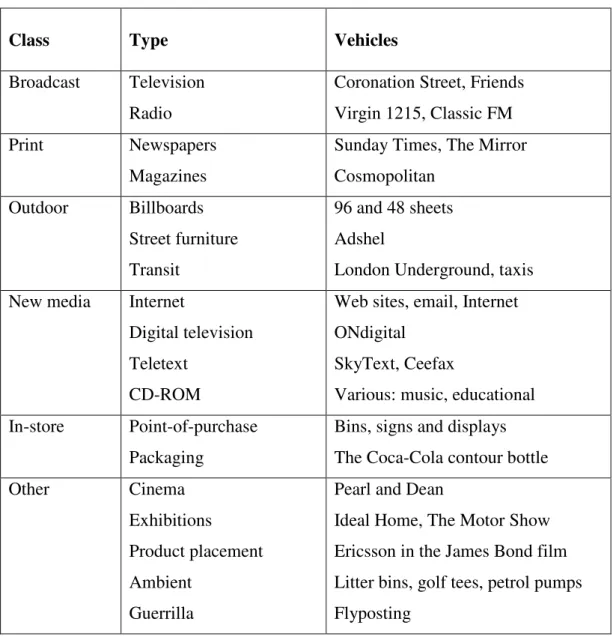
The media can be divided into six main classes. These are broadcast, print, outdoor, new, in-store and other media classes. Within each of the class, there are particular media types. For example, broadcast includes television and radio, and
within print class there are magazine and newspapers. (Fill 1999, 302.) Common feature is that the media conveys the message to target audience.
When these three elements, the tools, the media and messages are combined, the result is called integrated marketing communications (IMC). It has become a popular approach within organizations and their communication agencies, as it is very media-orientated. In the future IMC is probably to become an established marketing theory. (Baines et al. 2008, 450.)
In order to execute marketing communication effectively, it is good to notice the main features of communication. According to Kunelius (2003, 13) the term communication is formed by the words confirmation and to inform. Confirmation refers to an occasion when someone is taken a part of the community. Informing refers to the delivery of messages. That is why communication always require the audience and the message. (Kunelius 2003, 13.)
Overall, communication is a process by which individuals share meaning (Fill 1999, 23). Although it may sound simple, that is not the whole truth.
Communication is a complex transmission process.
Communication requires always a sender and a receiver. Additionally it is
dependent on the social context in which it takes place. There must also be a clear and unobstructed route to deliver the message. There might be distractions in the channel, which may disturb the understanding of the message. Lastly, feedback is to be given immediately. (Smith, Berry, Pulford 1999, 21.)
3.1 The Aim of Marketing Communication
Marketing communication has two principal aims. First is to develop brand values by using advertising to set up feelings, to create visions and to improve beliefs. The second is to make customers behave particular ways. Target audience is made to behave in a beneficial way in order to make then buy the product use the
Successful marketing communication has three obstacles to overcome. Firstly, the message must be delivered in a way that the audience is able to notice it. Next, full attention of the audience must be achieved and message must easily be processed and understood. (Idman, Kämppi, Latostenmaa, Vahvaselkä 1993, 25.) The goal is to deliver consequences, feelings and certain atmospheres in order to awake wanted visions or patterns of behave.
3.2 The Promotion Tools
This chapter introduces the promotion tools. Each tool has unique characteristics and costs. These characteristics must be considered carefully when selecting the compatible tool. Even within a same field of industry, applicable tools vary a lot. For example in a cosmetic field, Yves Rocher concentrates on direct marketing while L’Oreal spends heavily on consumer advertising.
3.2.1 Advertising
Advertising is paid, impersonal communication focused simultaneously on a big audience conveyed by mass medium or other channels (Vuokko 2003, 193). International advertising rules defines that an advertisement must be recognized as an advertisement. In print media, for instance, an audience must be able to
understand when something is about marketing and when about a factual article. As described, advertising is impersonal communication and there is no personal contact between information receiver and sender. Therefore, there must be a channel, or media, which conveys the message to the receiver. This channel can be a television, a radio, an Internet, a magazine or any kind of billboard for instance. The message can also be conveyed directly via text message or e-mail. (Vuokko 2003, 193-194.)
Overall, the main purpose of advertising is to affect on audience’s opinion and increase awareness of the product. The channel used depends on the desired effect of the message and the selected audience. The most common channel in Finland in 2001 was, according to Vuokko (2003, 194) print advertising in magazines. Many customers get to know about the products through advertisements. They are seen everywhere; at the morning in newspaper, in the evening in television. At noon, they are heard from the radio and red from the Internet. Advertising is also the most visual and designed method of communication compared to other parts of marketing communications. (Vuokko 2003, 194.)
Although marketing is usually carried out by businesses or by financial purposes, it is widely used by non-profit organizations and social agencies in order to make people aware of their causes. Advertising is an effective way to inform and persuade target groups.
Advertising is a very popular way of pursue marketing. For instance, in Finland more than 1 230 million EUR was spent on media advertising in 2006. The amount increased 3.7 per cent from the previous year. (TNS Media Intelligence 2007a.)
The advert must be conveyed to the target audience by a suitable medium. When selecting the media, one of the most important characteristic is the cost. There are two types of costs, absolute and relative costs. Absolute costs are the time and space expenses. Relative costs are the costs of contacting each member of the target audience. Therefore television, for example, has high absolute cost but because the message is delivered for a large number of people, is relative cost very low. (Fill 1999, 303.)
It is good to notice that often many forms of medium are used simultaneously and some forms may be only complementary parts of the complete promotion.
Table 1. Main Forms of Media Classes(Fill 1999, 302)
Class Type Vehicles
Broadcast Television Radio
Coronation Street, Friends Virgin 1215, Classic FM Print Newspapers
Magazines
Sunday Times, The Mirror Cosmopolitan Outdoor Billboards Street furniture Transit 96 and 48 sheets Adshel
London Underground, taxis New media Internet
Digital television Teletext
CD-ROM
Web sites, email, Internet ONdigital
SkyText, Ceefax
Various: music, educational In-store Point-of-purchase
Packaging
Bins, signs and displays The Coca-Cola contour bottle
Other Cinema
Exhibitions
Product placement Ambient
Guerrilla
Pearl and Dean
Ideal Home, The Motor Show Ericsson in the James Bond film Litter bins, golf tees, petrol pumps Flyposting
3.2.2 Sales Promotion
Sales promotion is the part of the marketing communication that supports other parts by encouraging selling and buying processes. It usually works closely with advertising. American Marketing Association includes into sales promotion all of the below-the-line advertising (direct advertising, exhibitions, store advertising and sponsorship).
However, the sales promotion definition varies regarding authorization (Idman et al. 1993, 265).The differ between advertising and sales promotion is that whereas advertising offers reason to buy, sales promotion offers reason to buy it now (Kotler et al. 2006, 469).
The target group for sales promotion usually includes dealers, company’s own sales force and customers. The aim is to increase their desire and ability to promote sales. Sales promotion aspires to fasten selling process in order to encourage customers to instant purchases. (Idman et al. 1993, 267.)
The consumer sales promotions can be put into force e.g. by samples, coupons, price packs and advertising specialties. Furthermore, manufacturers direct their sales promotion towards retailers and wholesalers instead of consumers, and it is accomplished by discounts and allowances. Giving free or sample goods for resellers is also an effective sales promotion tool. When directing the sales promotion towards industrial customers in order to stimulate purchases and to motivate salespeople, the focus must be on conventions, trade shows and sales contests. (Kotler et al. 2006, 470-473.)
3.2.3 Public Relations
Public relations as a method of marketing communication, is commonly known as “PR”. In the 90s, it was fashionable to use PR in every potential context, as it was somehow new and exciting to emphasize on developing public relations in a company’s marketing. These days PR is a vital part of upholding the corporate image.
Public relations can be divided into internal and external parts. Internal actions stress the employees of the company, while external operations emphasize to develop company’s public image. Internal actions include marketing inside the company by encouraging employees to follow the organization’s operational culture. (Lahtinen et al. 1999, 92.) External operations aspire to remove negative attitudes toward the company (Lahtinen et al. 1999, 250).
This tool may have a major impact on public awareness at a lower cost than advertising. Instead of using financial resources for media, the company focuses more on paying to the staff to circulate information and to develop events. (Kotler et al. 2006, 476.)
The aim is to create strong and long-lasting relation between organization and its interest groups. Further, Idman et al. (1993, 276)emphasizes that the aim of the public relations is to develop company image, remove negative attitudes toward the company and investigate the reasons behind negative attitudes. Nevertheless, the objective is to change company’s unfavourable and negative image into positive one.
However, public relations can sometimes be limited and scattered. In order to avoid negative influences, public relations must work hand in hand with advertising. (Kotler et al. 2006, 477.)
Public relations can be managed with the help of many tools. One of the major ones is news, which can be created by organizing different events. Sometimes news stories occur naturally, too. In addition, speeches can create product and company publicity. Written material is a common way of reach target markets, and annual reports, brochures and company newsletters are the most important ones. (Kotler et al. 2006, 478.) Further, company’s own web site delivers information very effectively to target audiences.
3.2.4 Personal Selling
Kotler et al. (2006, 487) explains that personal selling is the interpersonal tool of the promotion mix. He continues, that advertising consist of non-personal
communication between company and target audience, in contrast personal selling involves personal interaction. This personal level can be achieved by face-to-face selling process, by telephone, through web conferences or by video. (Kotler et al. 2006, 487.)
The result of personal selling depends highly on the salesperson’s personality and overall control of the selling process. The selling process can be defined as product-centered or customer centered. In a product centered selling process the salesperson emphasizes the product and its qualities. Further, effective and customer centered salesperson additionally concentrates on the customer’s needs and comprehensive customer analysis. (Idman et al. 1993, 113.)
Personal selling is the most effective tool of the buying process, particularly in building up the customer’s preferences and developing the understanding of the product. In personal selling process, the customer usually feels greater need to listen and respond. (Idman et al. 1993, 113.)
3.2.5 Direct Marketing
Direct marketing is often tailored for the customer based on his or her previous consumer behaviour. Direct marketing can be e.g. telephone marketing, online marketing or home advertising. Probably the most known form of direct marketing is the telephone sellers who sell different magazines.
This tool is non-public because the message is directed to a specific person. Kotler et al. (2006, 443) explains, that the message can be prepared quickly in order to be specified for the customer. Furthermore, direct marketing is interactive as it allows a dialogue between marketer and the consumer. Often this tool is used to build up one-to-one customer relationship. (Kotler et al. 2006, 443.)
Direct marketing is usually a complementary part of promotion and it is rarely used as the only method. Idman (1995, 205) emphasizes that direct marketing is often used as a bridge from an advertising to a personal selling process.
This method can have informative, reminiscent or authoritative features.
Informative direct marketing means company’s image upholding and it includes price lists and product catalogues. Reminiscent direct marketing pays attention to interest groups by e.g. sending Christmas and birthday cards or presents.
Additionally persuading and steering for a buying process by slogans “pay now!” or by other commands, is called authoritative direct marketing. (Lahtinen et al. 1999, 234.)
Direct marketing reaches customers effectively. Lahtinen et al. (1999, 234) confirms, that consumers use approximately three minutes daily for exploring these non-public advertisements. Target Group Index has further researched that a direct mail (sent to the customer with his/her address) reaches 90 per cent of the target market. Direct mail sent without an address reaches 81 per cent of the target consumers. (Lahtinen et al. 1999, 234.) The problem here is that these kinds of advertisements are often regarded as a junk mail.
3.3 The Message
The company’s or the product’s overall marketing communication must be formed by a specific design. Further, the message should concern the balance, the structure, the perceived source and the presentation for the target audience (Fill 1999, 282).
The balance means that the style must be constant, in order that the context of the message does not require the audience to readjust their perceptions. The structure of the message must emphasize the core message, which is pursued to be
delivered. The source must be trustworthy, and the presentation must appeal to the target audience. (Fill 1999, 282-289.)
The most important feature of the message is its continuity. The company must follow their marketing communication direction systematically, in order to fulfill their customers’ expectations. Naturally there can be changes e.g. in brand outlook, marketing campaigns or overall advertising, but the changes must nevertheless be formed by a certain pattern.
3.4 Intercultural Marketing Communication
Marketing communication across cultures does not have huge differences when compared to domestic practices. However, always when implementing marketing communication across borders, some special features must be recognized. There are differences within economic, cultural, legal, technological and competitive framework (Fill 1999, 582).
Culture is acquired through learning and therefore people across the world do not behave uniformly. Multiple cultural aspects affect on marketing communication. The main ones are the values and beliefs associated with symbols, such as language. Furthermore, aesthetics features which deals with institutions and groups, such as embracing family and work. The third class is values that represent the core of the culture. (Fill 1999, 582.)
Culture affects on the selected language, the useful colours and even the form of the message. Overall, when designing a promotion campaign abroad, the target market’s cultural aspects must be taken into consideration. It is important in any ways not to defame the target audience.
3.5 Developing an Effective Promotion
An effective communication demands many steps. According to Kotler et al. (2006, 432-440) the company must first identify the target audience, then determine communication objectives and design the form of the message. After the message has been developed, must the right media to be chosen. Last step is to collect feedback from the target market. (Kotler et al. 2006, 432-440.)
There are many frameworks which can be utilized when planning marketing communication. One example is to use a SOSTAC® model. The model can be applied to any kind of plan.
S = Situation analysis (Where are we now?) O = Objectives (Where do we want to go?) S = Strategy (How do we get there?) T = Tactics (The details of strategy)
A = Action (Or implementation, putting the plans to work)
C = Control (Measurement, monitoring, reviewing and modifying)
The benefit for using SOSTAC® is the simple structure which is applicable at different levels and situations. (Smith, Taylor 2004, 32.)
Another valid framework is MCPF, which is utilized in the empirical part of the study. Overall marketing communication planning is introduced more accurately in the following chapter.
4 PLANNING MARKETING COMMUNICATIONS
The aim of marketing communications is to produce successful results (Vuokko 2003, 131).In this meaning marketing communication is a wide term, which can be understood in many ways. Main thing is, however, to make a product known by various methods. Like every project, marketing communication must be planned carefully, too. This chapter focuses on the main issues on marketing communication planning.
When planning marketing communication, one important thing to be concerned is about ethical norms. This only not refers to truth-telling, but also legal and other regulatory deterrents of promotional tools. Ethical issues stand out especially while designing the message that is to be delivered to target audience. These issues lead directly to the special requirements for the treatment of vulnerable groups in promotion campaigns. Overall, special attention must be given in order to behave in a generally acceptable way in marketing communication. (Fill 1999, 54-57.)
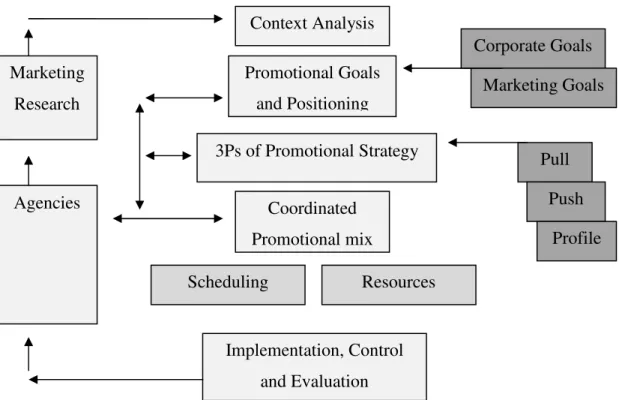
Promotion planning is an essential management activity, and it should be developed around a suitable framework. Baines et al. (2008, 519) introduces marketing communication planning framework (MCPF), which provides a visual guide within elements. The process starts from the external agencies which make a marketing research for the company. The marketing communication plan can be based on the gathered information.
Furthermore, Baines reminds that MCPF is a suitable checklist of activities that need to be considered. The framework can be seen in the following Figure 2. (Baines et al. 2008, 519)
Figure 2. The Marketing Communication Planning Framework (MCPF) (Baines et al. 2008, 519)
There are a few important factors, which must be included into the marketing communication plan. The following subchapters introduce these elements.
4.1 Context Analysis
The base of the plan is to define problems and opportunities (Vuokko 2003, 133). Usually there are some points what need to be improved or some opportunities what can be utilized. The purpose of the context analysis is to determine and understand communication drivers, which are likely to affect on the brand or company.
In context analysis, market research data about target audience is highly appreciated. Their needs, motivation, attitudes and decision-making
characteristics are important information for the successful plan (Chris Fill 1999, Context Analysis Promotional Goals and Positioning 3Ps of Promotional Strategy Coordinated Promotional mix Implementation, Control and Evaluation Scheduling Resources Marketing Research Agencies Corporate Goals Marketing Goals Pull Push Profile
620). This information can be gathered from the marketing plan, which is normally already prepared at this point.
Context analysis contains information on several related contexts, which enriches the marketing communications plan. It may emphasize on the business context, the customer context, the stakeholder context, the organizational context and the environmental context. (Fill 1999, 621.)
Context analysis can also be done in a simplified way by dividing it roughly to internal and external factors. Company and product analyses are included into internal factors, and segments, competitors and environmental context are external factors. (Vuokko 2003, 136.)
However, in spite of the content and the extent of the context analysis, the main purpose is to understand the current situation of the product, brand or the company. Only after the current situation has been clarified, the marketing communications plan can be developed. (Vuokko 2003, 136.)
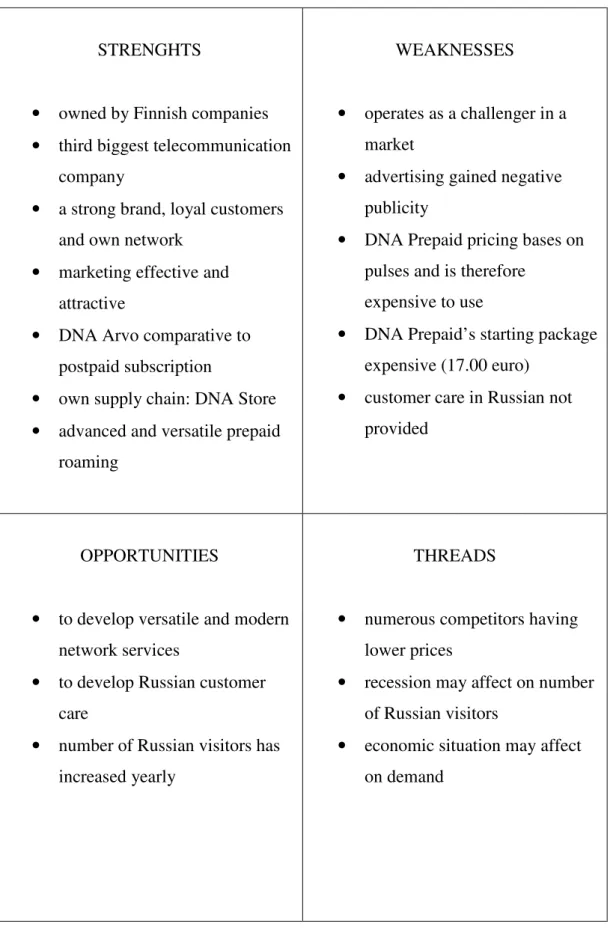
The information of the context analysis can be gathered into the SWOT analysis, where all the factors are seen at a glance. At the SWOT analysis strengths, weaknesses, opportunities and threads of the current situation are summarized. Strengths and weaknesses are internal factors while opportunities and threads are external factors.
4.2 Promotional Objectives
It is important to set up promotional objectives in order to measure achievement. It is also important to monitor and evaluate used resources. (Isohookana 2007, 98.)The most important criteria, though, is that objectives are realistic and
challenging (Vuokko 2003, 138). Often the final objective is to make the customer to purchase the good. However, the purchase decision is made after a long
Promotional objectives can be divided into three sub-groups, which are corporate, marketing and marketing communications objectives.
Corporate objectives refer to the business area that the company believes it should be in. These details are derived from the key communications factors facing the company at the moment. Marketing objectives are output-orientated and derived from the marketing plan. Furthermore, marketing communications objectives are derived from the current position of the brand. (Fill 1999, 622.)
Fill (1999, 510)explains, that objectives can be described to a SMART guideline. This acronym stands for Specific, Measureable, Achievable, Realistic and
Targeted & Timed. When making objectives with the help of SMART technique, all of the required facts must be to be considered.
S = Specific M = Measurable A = Achievable R = Realistic
T = Targeted & Timed
SMART guideline does not have to be long; even one sentence may contain all the necessary information. (Fill 1999, 510.) Information can also be gathered into a table.
4.3 Promotional Strategies
At this point usable marketing communications methods (advertising, sales promotion, public relations, personal selling and direct marketing) are selected. The strategy is decided based on promotional objectives and context analysis. Even in the same field of industry, different tools are used. Therefore the selection must always be done particularly by the company’s own interests and by the campaign. When the usable marketing communication method has been selected,
must the selection for the right media to be done. Additionally now the usable financial resources must be known. (Fill 1999, 510.)
Fill advises the utilization of three promotional strategies (1999, 511). He defines it as 3Ps of Marketing Communications Strategy. This means that there can be identified three core marketing communications strategies, and each bases on broad target audiences. The 3Ps strategies are pull, push and profile strategy. (Fill 1999, 511.)
A pull strategy is focused on consumers and end users of B2B customers, and the communication goal is to get them to purchase goods. A push strategy’s target audience is the channel intermediaries in order to develop sustainable
relationships and distribution networks. Further, profile strategy focuses on brand developing and reputation building and it is aimed to all relevant stakeholders. (Baines et al. 2008, 511.)
These strategies are required in order to achieve audiences’ awareness and to reposition the brand. Important factor is also to increase market’s interest and understanding of the product and brand. (Baines et al. 2008, 511.)
4.4 Budget and Other Resources
Budget is the opportunity and the limitation of the successful marketing communications plan and therefore the amount of financial resources defines many boundaries. Vuokko (2003, 145) points out that the marketing
communications expenses should be regarded as investments. Additionally the impact of the expense can be noticed not until a long time.
Financially, promotion should always bring more back than what is demanded, otherwise the whole campaign has been worth nothing. Marketing ROI (return on investment) is about creating positive value for a brand through demonstrating cost against payback. In order to archive profitable promotion, there must be clear
line of sight between message and business result. (Young, Aitken 2007, 16.) Return on investment differs according to a company or a brand and its objectives. ROI can be explained as a profit when it is easier to understand. There are two types of profits; improved cash-flow and value of an asset. Positive cash-flow means the increase of sales within short time period. The value of an asset, for ones part, is a long-term sales effect that is a result of an effective marketing. (Young et al. 2007, 17.)
The suitable budget always depends on the case. The usable amount of financial resources must be calculated based on the company’s financial statements and plans.
Promotion campaign requires not only financial, but also human resources. Baines et al. (2008, 524) reminds, that resource planning is often forgotten or avoided. It is advisable to think marketing ROI as a profit because it includes not only financial resources, but people and time too. (Baines et al. 2008, 524.)
There are, however, a number of problems associated with establishment of a marketing communications budget. According to Fill (1999, 244) the main problems are the following; difficult to quantify the precise amount needed, problem to fit budget to a standard accounting practices and lastly difficulty to proceed budgeting process neatly.
4.5 Schedule
The schedule determines the time, which can be used, or need to be used for obtaining objectives. It is impossible to give any general examples of the schedule as it depends totally on the case. Usually marketing professionals divide year into quarters and the actions of each quarter is determined individually. (Fill 1999, 631.)
Sometimes the project may need a year to be accomplished and sometimes a campaign may need only a month. However, setting up a schedule and following it strictly is important part of a successful promotion.
4.6 Control and Evaluation
After the communication project has been launched, it should be monitored. The most important measurement is to find out how the objectives were achieved. (Baines et al. 2008, 524.)It is advocated to track continuous objectives so the current situation is constantly known.
Information gathered is vital for future projects and naturally, information argues whether the campaign was profitable or not. Evaluation should therefore not to be forgotten but it is often avoided because it is seen as an unnecessary workload. In addition, accomplishing evaluation research is expensive (Rossiter, Percy 1997, 585).
Kotler et al. (2006, 439) explains that evaluation may suggest changes to the promotion program or in the product itself. Controlling can be accomplished by market surveys, coupon inquiries or sales and market share measurements and comparisons (Rossiter et al. 1997, 590).
5 CASE DNA FINLAND LTD: MARKETING COMMUNICATIONS PLAN This plan offers only ideas to accomplish a promotion campaign towards Russian customers. It has not meant to be too precise or detailed. The plan is formed by the marketing communications planning framework (MCPF) which has
introduced previously.
5.1 Context Analysis
In this study context analysis is divided into two parts; internal and external factors. Internal factors include company and product analyses. External factors concentrate on target segment, on analyzing competitors and introducing environmental facts.
5.1.1 Company Analysis
DNA Group consists of DNA Finland Ltd, which offers mobile communications and mobile communications network services and DNA Services Ltd, which offers fixed-line broadband and TV services. Additionally DNA Store Ltd is the distribution channel of the company’s products.
CEO of the DNA Group is Riitta Tiuraniemi and turnover on 2008 was EUR 647 Million. The turnover of telecommunication operations was EUR 424 Million. There were 982 people working for DNA Group at the end of 2008, which includes 227 people working only the for telecommunications services. (DNA Finland Ltd 2009.)
The company was originally called Finnet Ltd which was owned by 40 local Finnish telephone companies. On 1.7.2007, the existing DNA Group was
established after joint venture with six other Finnish fixed-line phone companies. Currently DNA Group is mostly owned by Finnish companies; additionally 12.84
per cent of the shares are owned by the private equity company 3i and 8.67 per cent by other owners.
DNA Finland Ltd is a young and growing challenger in a telecommunication business. At the moment DNA has approximately 1.6 million mobile
communication customers. Therefore the company is the third biggest player within Finnish telecommunication field after TeliaSonera and Elisa. The coverage of DNA’s 3G-network in 2008 was 80 per cent of the surface area of Finland. The core elements of DNA’s strategy are a strong brand, loyal customers and its own network. The aim is to grow faster than its competitors do. Additionally the essential goal is to be cost effective and to develop versatile and modern services for the customers. For 2009, DNA's goal is to create a uniform operation culture inside the DNA Group. (DNA Finland Ltd 2009.)
Company’s Marketing
DNA’s marketing has been effective and very distinctive. Last winter DNA’s television advertisement campaign “Partiotytöt” was withdrawn from television due to its controversial message. The campaign introduced three girl scouts in the forest with their older male supervisor. The campaign was meant to be humoristic and stirring, however, not all the people liked it.
The Central Chamber of Commerce got numerous claims about the campaign. The audience thought it was sexually pejorative and distractive. In the end, DNA was released from every accusation. The Central Chamber of Commercestated that the ad was not offensive or otherwise contemptuous. The lawyer of
Keskuskauppakamari Paula Paloranta assured later on the article that the ad was not against good marketing behaviour (Keskuskauppakamari 17.12.2008). DNA uses garish magenta colour in their logos, which capture attention very effectively and therefore is very useful style. The logo is also very simple.
which is close to the colour which their subsidiary T-Mobile uses. Previously in 2000 had Deutsche Telekom registered magenta colour as the European
community trademark.
The company sued DNA in January 2008 in Helsinki Municipal Court. The German company demanded that DNA must terminate to use pink colour in their telecommunication services marketing. Additionally Deutsche Telekom wanted DNA to pay compensation for using the colour they had registered earlier. In October 2008 DNA sued Deutsche Telekom for the same issue. DNA demanded that Helsinki Municipal Court would dismiss the registration of the trademark. The dispute is about the colour, which is placed between pink and magenta shade. However, the judicial writ has not yet been processed. If DNA was stated to terminate the usage the colour, would company's outward
appearance be remarkable changed. (Taloussanomat, Digitoday 2008.)
New Marketing Communication Partner and the Campaign
DNA changed their marketing communication partner in March by selecting SEK & GREY as their new co-operator. The former marketing partner was the
advertising agency PHS. The partner was changed as DNA tries to seek new direction for the company's marketing implementation.
The new partner will co-operate in strategic marketing, advertising, distribution channel and digital marketing. According to DNA's Sales and Marketing Director Erik Sylvestersson, the new partner was selected due to intent to respond the changing market situation with new ideas. He stated that “In the operator
business, images and the rapid, intuitive utilization of various marketing methods are of crucial importance. As Finland's fastest-growing operator, we aim to lead the way even in marketing”.
DNA has previously also co-operated with the company. For example, SEK & GREY's Marketing Director Marco Mäkinen contributed the campaign "Life is..". (Press release 18.3.2009, DNA Ltd)
DNA launched a new marketing campaign on March offering new subscribers the chance to get rich with a lotto coupon. The campaign is based on the survey the company carried out recently. The survey was about the Finnish people's behaviour if they won a jackpot from a lottery. The result was that the majority would spend their money on donations to family members, or save it. Additionally only few people would abandon their jobs or change their home country.
The survey was commissioned by DNA from Taloustutkimus in February and March 2009. A total of 577 Finns over the age of 18 responded to it in the form of an Internet panel.
The campaign aims to inspire consumers to compare their mobile phone
subscriptions and replace them with a DNA subscription. The campaign is loyal for well-known humoristic pattern that DNA has tend to have. The campaign also affected on the company's public appearance by changing visual image to more detailed and more colourful style.
Product Analysis
The characteristic feature of prepaid packages is that a customer pays call time in advance. In reloading a prepaid card, he/she purchases a credit of call minutes, which can be used for calls up to the value of the credit purchased. In contrast, postpaid subscriptions are characterized by the fact that the usage fees in a particular period are invoiced to the customer. Generally there is a fixed price which may also include a credit in respect of call minutes.
DNA provides two types of prepaid subscriptions; DNA Prepaid and DNA Arvo. The difference between these subscriptions is that DNA Arvo can be compared to a postpaid subscription. For example, its pricing model is compatible to postpaid minute-priced-subscription. Furthermore, DNA Arvo requires registration although customer's credit history or creditworthiness is not checked.
DNA Arvo is developed for a customer, who requires a low-costing starting package and additionally pays usage fees as little as possible. DNA Prepaid subscription does not need to be registered and is therefore completely
anonymous. Both prepaid types can be obtained from DNA Dealers, R-Kiosks, DNA Web Store and DNA Store.
DNA Prepaid and DNA Arvo Pricing
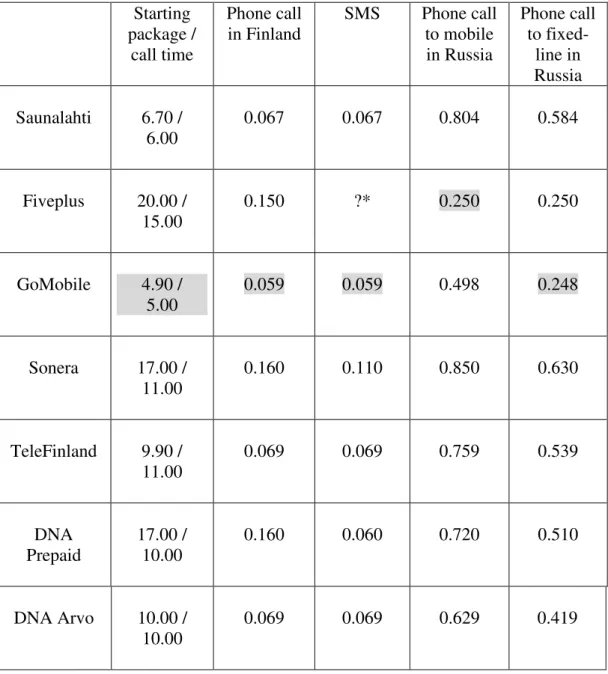
DNA Prepaid pricing is based on pulses. The frequency of pulses defines the average minute price. One pulse costs 0.08241 euro. The first pulse is charged at the beginning of the call, the next ones every 30 seconds. Therefore one minute phone call cost two pulses, in other words 0.16482 euro. Phone calls with DNA Arvo, unlike prepaids generally, are charged by a second basis. Prices are combined in the table in Appendix 1.
DNA Prepaid starting package costs 17.00 euro including 10.00 euro worth of call time. DNA Arvo can be obtained by 10.00 euro and starting package includes call time worth 10.00 euro.
With DNA Prepaid voice calls cost 0.16 euro per minute and SMS' 0.06 euro each within Finland. With DNA Arvo voice calls and SMS’ are charged 0.069 euro per minute or each.
With DNA Prepaid phone calls to Russian mobile subscriptions cost 0.35 euro + 0.21 euro + 0.16, being 0.72 euro. Fixed-line calls cost 0.35 euro + 0.16 euro, being 0.51 euro per minute.
With DNA Arvo phone calls to Russian mobile subscriptions cost 0.35 euro + 0.21 euro + 0.069, being 0.629 euro. Fixed-line calls cost 0.35 euro + 0.069 euro, being 0.419 euro per minute. (DNA Finland 2009.)
Prepaid Roaming
Since 8.10.2007 DNA Prepaid and DNA Arvo have operated in more than 80 countries. Commercial launch of the roaming feature concerning prepaid
subscriptions took place on 22.10.2007. As previously described, roaming means subscription usage abroad. Prepaid roaming enables only voice calls and SMS', therefore other services e.g. data transfer or multimedia messages can not currently be used abroad. (DNA's Intranet Ilona.)
Depending on network’s features, there are two methods which enable prepaid roaming; USSD Call Back or Camel technique. USSD phone call requires a certain code, which must be added to the receiver’s phone number. In the front of the receiver number must prefix *140* be added and in the end #. Inside Finland USSD code can not be used.
The camel technique does not require any special codes or signs added to the number. With the Camel technique phone calls to service numbers are banned. At the moment this technique is used when using subscription in Belgium (Base and Mobistar networks), Italy (H3G), Sweden (Telenor), Estonia (Elisa and EMT) or Russia (Megafon).
Since 1.9.2007, within the European Union, voice calls to Finland have costs of 0.59 euro per minute. Receiving a voice call is charged 0.2928 euro per minute.
5.1.2 Competitor Analysis
In Finland, there are a few competitors for DNA Prepaid subscriptions. These networks are Saunalahti, Fiveplus, GoMobile Sonera and TeleFinland. Kolumbus Prepaid subscriptions have not been available after 28.11.2008 since Saunalahti Prepaid replaced it.
There are three actual competitors for prepaid subscriptions, which are directed to foreign visitors. These are Saunalahti, Fiveplus and GoMobile. Saunalahti has
pushed prices down by aggressive marketing tactics and pricing their services very low. Fiveplus, however, is directed only for Russian tourists. The problem with the GoMobile is that very few people know about it due to lack of marketing. The subscription could have a huge potential if the marketing was accomplished effectively. The price analysis can be found at the end of the competitor analysis while the main features of competitor analysis are gathered to Appendix 2. Saunalahti
Saunalahti is owned by Elisa and therefore it operates in Elisa's network. Elisa bought Saunalahti in 2005. Previously Saunalahti was known as Saunalahti Serveri (1998) and Jippii Group (2000-2003). Saunalahti Prepaid subscription can be obtained from Elisa Shops, R-Kiosks, from grocery stores Prisma and Alepa, and from their web page www.saunalahti.fi.
The starting package normally costs 6.70 euro (currently from promotion offer 2.90 euro) and it includes call time worth 6.00 euro. Phone calls within Finnish mobile subscriptions cost 0.067 euro, in addition short messages are priced 0.067 euro each. Currently there is a promotion offer and therefore prices are 0.049 euro / minute and each message. The promotion will end on 31.5.2009. Therefore at the moment Saunalahti Prepaid is the cheapest service provider regarding prepaid phone calls within Finland.
However, phone calls abroad are relatively expensive compared to the company's competitors. The pricing follows Elisa's foreign phone calls price list. One minute phone call to a Russian mobile subscription cost 0.737 + 0.067 euro. Therefore a minute price is 0.804 euro. Furthermore, one minute fixed-line phone call cost 0.517 + 0.067, being 0.584 euro. (Saunalahti 2009, Elisa 2009.)
Saunalahti provides own discussion board in the Internet
(http://palsta.saunalahti.fi). This is most definitely a strength of Saunalahti as their customers can share their thoughts in a private web page instead of public one. Therefore negative thoughts and opinions are not to be spread as easily to
potential customers. However, the discussion board is not directed only for Saunalahti's customers although it requires registration.
Saunalahti has gained popularity rapidly as it operates as a subsidiary in one of the biggest Finnish operator’s network. Therefore there have been huge financial resources to be used to promote the brand. Saunalahti can be obtained by a very low-costing starting package when customer must pay less than he/she receives call time. These promotion offers are well known among the target market. Fiveplus
5+ Fiveplus prepaid subscription was launched together with AinaCom Oy in January 2009. A special feature of the subscription is that all the services are available in Russian. Therefore the subscription is mainly directed to Russian tourists and other Russian customers (Kauppalehti 2009).
The subscription and call time can be obtained from every R-Kiosk. The starting package cost 20.00 euro including 15.00 euro call time. Under planning are separate sales place establishments and co-operations with Russian travel agencies. 5+ Fiveplus Oy's Chairman of the Board Timo Louhenkilpi has explained that the amount of Russian visitors in Finland is increasing yearly and therefore the country is an important market area for the company.
Phone calls within Fiveplus subscriptions cost 0.15 euro per minute. Furthermore phone calls to other mobile phone subscriptions and to fixed-line subscriptions cost 0.25 euro per minute. However, phone calls to Russia are priced equally and there are not any extra foreign phone call charges. Therefore Fiveplus’ Russian phone calls are remarkably cheap compared to their competitors. Fiveplus operates in Finland, Sweden, Estonia, Italy and Belgium.
Fiveplus has not been marketed much enough and it is definitely a disadvantage for the product. It is possible, however, that the marketing has been focused to Russian publications and web pages in order to catch the target segment before
they have arrived Finland. This is very hard to investigate as Russian web pages are written in Cyrillic alphabets.
GoMobile
GoMobile is a virtual operator and its prepaid subscriptions can be obtained from their web page, R-Kiosks and other stocked kiosks. GoMobile is a subsidiary of Ainacom Oy. An interesting fact is that Ainacom cooperates also with Fiveplus that was introduces previously. However, although Fiveplus is directed towards Russian customers, GoMobile is a cheaper option for the target group.
The starting package costs 4.90 euro including 5.00 euro call time. Furthermore by registering to GoMobile’s web service customer, a customer receives
additional 10.00 euro call time. After registration, SMS’ can be sent of free of charge via the Internet.
Phone calls and SMS' within Finland cost 0.059 euro per minute and each. Foreign phone calls to Russian mobile phone subscriptions cost 0.439 euro + 0.059 euro being 0.498 euro. Phone calls to fixed-line cost 0.189 euro + 0.059 euro being 0.248 euro per minute. Therefore GoMobile is the cheapest option among competitors when calling to Russia. Additionally phone calls within Finland are permanently cheapest compared to other subscriptions. (GoMobile 2009.)
GoMobile has concentrated its marketing only on their web pages. They market themselves as a “dirty cheap” prepaid subscription. Their target group is young customers who either can not obtain nor want not obtain a postpaid subscription. GoMobile could have a huge potential to grow one of the biggest players in the prepaid field, but due to the lack of an effective marketing, this dream has been ruined. Situation could, however, be changed with the right actions.