0095-1137/08/$08.00⫹0 doi:10.1128/JCM.01903-07
Copyright © 2008, American Society for Microbiology. All Rights Reserved.
Effect of Swab Composition and Use of Swabs versus Swab-Containing Skim
Milk-Tryptone-Glucose-Glycerol (STGG) on Culture- or PCR-Based
Detection of
Streptococcus pneumoniae
in Simulated and Clinical
Respiratory Specimens in STGG Transport Medium
䌤
Lorry G. Rubin,* Atqia Rizvi, and Aryeh Baer†
Feinstein Institute for Medical Research and Schneider Children’s Hospital of the North Shore-Long Island Jewish Health System, Division of Pediatric Infectious Diseases, New Hyde Park, New York
Received 24 September 2007/Returned for modification 18 March 2008/Accepted 9 June 2008
To detectStreptococcus pneumoniaecolonization, the nasopharynx is sampled using a swab placed in skim milk-tryptone-glucose-glycerol (STGG) transport medium, and then the swab specimen or STGG medium is cultured or subjected to PCR. We evaluated the effect of swab composition and compared the sensitivities of detection of culture and PCR using swabs and swab-containing medium. Calcium alginate, Dacron polyester, or rayon-tipped swabs were inoculated with pneumococci or were immersed in nasal wash specimens from children and then placed in STGG medium. Swabs and medium inoculated with pneumococci were cultured. Swabs grew significantly more colonies than medium. The number of colonies cultured from rayon swabs or medium was significantly higher than the number cultured from the calcium alginate swab or medium. The number of colonies from both the Dacron polyester swabs and medium were significantly lower than with either calcium alginate or rayon swabs. When DNA was separately extracted from the calcium alginate swab and medium and subjected to PCR for pneumococcal detection from eitherS. pneumoniae-inoculated swabs or clinical specimens that grewS. pneumoniae, the sensitivity was at least 10 times higher using the swab. With Dacron polyester or rayon-tipped swabs, there was no consistent difference between the sensitivity of PCR using swabs and that of PCR using medium. Thus, calcium alginate swabs may be superior to STGG medium for the culture and PCR-based detection ofS. pneumoniae. For culture, rayon swabs are superior and Dacron polyester swabs are inferior. The sensitivity of the swab and swab-containing medium for culture or PCR detection ofS.
pneumoniaevaries with swab composition.
Streptococcus pneumoniae (pneumococcus) is an important pathogen of children and adults (15). Pneumococci frequently and asymptomatically colonize the nasopharynges of infants and young children. Colonizing bacteria are the source of res-piratory tract infections such as pneumonia and acute otitis media as well as invasive pneumococcal infections and serve as the reservoir for person-to-person transmission. In 2000, a heptavalent pneumococcal conjugate vaccine (PCV7) was li-censed in the United States and recommended for routine administration to all infants (4). Use of this vaccine has re-sulted in a large decrease in the incidence of invasive pneu-mococcal infections in young children and a decrease in the prevalence of colonization with vaccine serotypes. The latter fact has resulted in a decrease in invasive disease in adults (21) and in infants too young to have been directly protected by vaccination (13) via herd type immunity. This has been accom-panied by an apparent increase in the prevalence of coloniza-tion with nonvaccine serotypes (7, 10, 12). Some of these non-vaccine serotypes may have been present prior to the use of
PCV7 but were unrecognized due to limitations in the sensi-tivity of culture and the difficulty in detecting more than one serotype in a nasopharyngeal specimen. Thus, there is a need for sensitive tests for the detection of colonization with S. pneumoniae, including the detection of simultaneous coloniza-tion with more than one serotype (2, 6).
A World Health Organization (WHO) working group rec-ommended a standard method for detecting carriage of S. pneumoniae, including the use of nasopharyngeal swabs with a calcium alginate or Dacron polyester tip (11) placed in STGG (2% skimmed milk powder, 3% Oxoid tryptone soy broth, 0.5% glucose, 10% glycerol) transport medium (9). To detect pneumococcal colonization, an aliquot of STGG medium or the swab is cultured on agar medium. However, it is unclear if culture of the swab or an aliquot of STGG medium containing the swab is optimal for the culture of pneumococci and if swab composition affects the culture of pneumococci.
Nucleic acid amplification techniques such as PCR hold promise as sensitive tests for the detection of pneumococci in nasopharyngeal (5, 18, 19) and other (14, 20, 22) respiratory specimens, as well as for the detection of specific pneumococ-cal serotypes (2, 8, 16). In a study using pneumococ-calcium alginate na-sopharyngeal swabs in STGG medium,S. pneumoniae DNA was detected by real-time quantitative PCR amplification of DNA extracted from STGG medium in 93% of 158 samples that grew S. pneumoniae as well as 41% of S. pneumoniae
culture-negative specimens. There was a direct correlation be-* Corresponding author. Mailing address: Schneider Children’s
Hospital, Room 365, Division of Pediatric Infectious Diseases, 269-01 76th Avenue, New Hyde Park, NY 11040. Phone: (718) 470-3415. Fax: (718) 470-0887. E-mail: [email protected].
† Present address: The Joseph M. Sanzari Children’s Hospital, Hackensack University Medical Center, 30 Prospect Avenue, Hacken-sack, NJ 07601.
䌤Published ahead of print on 18 June 2008.
2635
on May 16, 2020 by guest
http://jcm.asm.org/
tween genome equivalents and the number of colonies on culture; specimens that did not growS. pneumoniaebut were positive by PCR had a low level of genome equivalents (18). Although we acknowledge that some of the positive PCR re-sults for specimens without culturable pneumococci could be false-positive results possibly due to the detection of other alpha-hemolytic streptococci, these results suggest that PCR was more sensitive than culture (2, 16, 18, 19). Whether the swab or STGG medium is the optimal specimen for PCR-based detection and whether swab composition affects the sen-sitivity of PCR-based detection methods are not known.
In the present study, we evaluated which swab composition was optimal and whether the use of a swab or STGG medium containing a swab is optimal for the recovery ofS. pneumoniae
by culture and the detection of S. pneumoniae DNA by a PCR-based method.
MATERIALS AND METHODS
Bacterial strains, growth, and storage.Clinical isolates of serotype 1 and 19F pneumococci were obtained from Michael Jacobs, Case Western Reserve Uni-versity. The isolates were subcultured on 5% sheep blood agar plates incubated at 37°C. Colonies were inoculated in 10 ml Todd-Hewitt (TH) broth and incu-bated at 37°C for⬃2 h to an optical density at 492 nm of 0.4 to 0.5 (exponential phase). A quantitative culture was performed by counting colonies grown after 0.1 and 0.01 ml of a 10⫺5
dilution were spread on blood agar plates. Clinical specimens were cultured (i) by plating 0.1 ml of nasal wash specimen on a blood agar plate containing gentamicin, streaking the plate for isolation, and incubating it in 5 to 10% CO2(BBL GasPak CO2system; Becton Dickinson Microbiology
Systems, Sparks, MD) and (ii) by inoculating 1 ml of a modification of Avery’s broth (TH broth with 5% rabbit plasma and 0.8% dextrose [1]) with 0.1 ml nasal wash specimen. Inoculated Avery’s broth was subcultured onto blood agar plates after incubation at 37°C for 4 to 6 h and overnight. Colonies morphologically consistent with pneumococci were identified by standard methods (17) and serotyped as previously described (16).
Comparison of the sensitivities of methods using a pneumococcus-inoculated swab and STGG medium containing an inoculated swab for the optimal detec-tion ofS. pneumoniaeby culture.Ten microliters of TH broth containing ap-proximately 2⫻103CFU of exponential-phase pneumococci or 10l of a 1:10
dilution in TH broth were absorbed onto individual calcium alginate (Fisher Healthcare, Pittsburgh, PA)-, Dacron polyester (COPAN Innovation, Brescia, Italy)-, or rayon (COPAN Innovation, Brescia, Italy)-tipped aluminum swabs
that were then placed in tubes containing 1 ml of STGG medium. Control tubes that simulated STGG medium with a 100% release of pneumococci from an inoculated swab were prepared by adding 10l of pneumococci directly into STGG medium. After incubation for 30 min at ambient temperature (or at 4°C for 18 h), the tubes were vortexed for 20 to 30 seconds, and then 0.1 ml and 0.01 ml of the inoculated STGG medium were quantitatively cultured by plating and spreading the medium on blood agar plates and incubating the plates overnight. In addition, swabs were cultured by removing the swab from STGG medium, and after excess moisture was removed by pressing and rotating the swab against the inside of the tube above the liquid, the swab was rolled repeatedly across the surface of a blood agar plate, with care taken to spread the inoculum evenly, and the plate was incubated overnight. There was day-to-day variation in the numbers of CFU present in the exponential-phase culture and in the inoculum. In order to compare the results of multiple trials performed on different days, the number of CFU in the inoculum was normalized to 2.1⫻103
CFU (the median inoculum size) by calculating with a conversion factor (2.1⫻103divided by the number of
CFU in the inoculum) and by multiplying the results for each culture of pneu-mococci from the swab or STGG medium by the conversion factor. The values for the median and interquartile numbers of CFU reported in Table 1 reflect the normalized values.
[image:2.585.41.542.89.232.2]DNA extraction from specimens.Swabs were inoculated with 10l of serial 10-fold dilutions of exponential-phase pneumococci, and four methods listed here were tested for the extraction of DNA from 0.2 ml STGG medium or calcium alginate swabs. (i) A High Pure PCR template preparation kit (Roche Applied Science, Mannheim, Germany) was used according to instructions pro-vided by the manufacturer for the isolation of nucleic acids from bacteria or yeasts, with the following modification. The bacterial-lysis step was modified by the addition of 10l lysis buffer (0.1% sodium deoxycholate, 0.01% sodium dodecyl sulfate, 0.15 M sodium citrate) to the lysozyme-containing solution. Extracted DNA was suspended in a final volume of 200l. (ii) A NucliSens isolation kit (bioMe´rieux, Durham, NC), which uses an isolation method based on the binding of DNA to silica particles, was used according to the instructions provided by the manufacturer. We also used a silica particle-based DNA extrac-tion and purificaextrac-tion method identical to that of the NucliSens isolaextrac-tion kit using reagents prepared in the laboratory as described by Boom et al. (3). With either set of reagents, the final extraction volume was 50l. The performance of the NucliSens isolation kit varied between lots, resulting in inconsistent DNA ex-traction and purification. Therefore, reagents for this silica particle-based DNA extraction and purification method were prepared in the laboratory. For consis-tent performance of this method, we noted that the sodium thiocyanate solution must be prepared freshly or used within 48 h of preparation. (iii) The STGG medium (after centrifugation at 10,000⫻gfor 1 min, removal of supernatant, and resuspension in water) or swab in water was boiled in water for 5 min and centrifuged at 10,000⫻gfor 1 minute, and the supernatant fluid was used. (iv) The specimen was treated with proteinase K (20g/ml) and 1% Tween 20,
TABLE 1. Comparison of the results of cultures ofS. pneumoniaefrom STGG medium and fromS. pneumoniae-inoculated swabs removed from STGG mediuma
Swab composition Strain serotype nb
Median no. of CFU cultured on solid medium (25th, 75th quartiles)c
Pvalued
Median % of CFU released from
swabe
Swab STGG medium
Ca alginate 1 6 83 (64, 87) 22 (19, 25) 0.031 10
19F 9 87 (58, 107) 26 (8, 35) 0.0039 13
Combined 15 85 (59, 98) 23 (12, 32) ⬍0.0001 11
Dacron polyester 1 9 8 (0, 24) 73 (3, 88) 0.0039 23
19F 9 0 (0, 24) 3 (3, 3) 0.74 1.1
Combined 18 3.5 (0, 24) 3 (3, 3) 0.027 1.4
Rayon 1 6 740 (590, 870) 220 (200, 300) 0.031 44
19F 5 120 (91, 120) 120 (80, 120) 0.92 54
Combined 11 320 (120, 740) 150 (120, 220) 0.019 47
a
Swabs were inoculated with approximately 2⫻103
CFU of exponential-phase bacteria.
b
Number of experiments performed.
c
Per 0.1 ml STGG medium or per rolled swab.
d
Significance was tested using the Wilcoxon matched-pair sign rank test, except with studies of the rayon swab inoculated with serotype 19F, for which the Mann-Whitney test was used because pairing was not effective.
e
Number of CFU cultured from STGG medium containing an inoculated swab divided by the number of CFU cultured from an STGG medium tube inoculated directly times 100.
on May 16, 2020 by guest
http://jcm.asm.org/
incubated at 55°C for 60 min and then at 95°C for 10 min, and centrifuged at 10,000⫻gfor 1 min; the supernatant fluid was used.
PCR assays for the amplification of DNA specific for allS. pneumoniaeorS. pneumoniaeserotype 1 or 19F isolates.PCR for the amplification and detection of serotype 19F DNA was performed as previously described (16) using 10l of a sample (extracted DNA) in a 50-l reaction mixture, except that a nested PCR was not performed and only the inner primers were present in the PCR sample reaction mixture. PCR for serotype 1 was performed as described previously (N. E. Dayan, A. Rizvi, and L. G. Rubin, unpublished data). PCR for the amplification and detection of pneumococci from clinical specimens targeted a region of the autolysin gene,lytA. Left and right primers were GGA AAG ACC CAG AAT TAG GT and GTC TGA GTG GTT GTT TGG TT, respectively. PCR products were detected via agarose gel electrophoresis, and photographs of gels were inspected for the presence of bands with molecular sizes of 178 bp, 208 bp, and 308 bp for serotype 1, serotype 19F, andlytA, respectively.
Comparison of the sensitivities of methods using a pneumococcus-inoculated swab and STGG medium containing an inoculated swab for PCR amplification and detection ofS. pneumoniaeDNA in simulated clinical specimens.Calcium alginate-, Dacron polyester-, or rayon-tipped aluminum swabs were inoculated with (i) 10l of STGG medium containing approximately 2⫻103CFU of
exponential-phase cultures of a type 1 or 19F isolate or (ii) 10l of serial 10-fold dilutions of these isolates and placed in tubes containing 1 ml of STGG medium. After the tubes were incubated at ambient temperature for 30 min and vortexed for 20 to 30 seconds, DNA was separately extracted from the removed swab (after excess moisture was removed by pressing and rotating the swab against the inside of the tube) and from 0.2 ml STGG medium containing the swab by the silica particle-based method. Extracted DNA was subjected to PCR-based am-plification and detection as described above.
Comparison of the sensitivities of methods using a swab and STGG medium containing an inoculated swab for the PCR-based detection ofS. pneumoniae
DNA in clinical specimens.Nasal wash specimens that were submitted to the clinical microbiology laboratory for testing for respiratory syncytial virus and influenza virus antigens in saline were obtained from children suspected of having respiratory tract infections. Only specimens from children who had not received an antimicrobial prior to our obtaining the nasal wash specimen were used in these studies. Specimens were cultured forS. pneumoniaeas described above and stored at⫺70°C. Specimens were thawed, and swabs of each compo-sition were simultaneously immersed in the specimen, removed, and placed in individual tubes containing 1 ml of STGG medium. After being vortexed for 30 seconds, swabs and 0.2 ml of STGG medium were separately processed for DNA extraction and PCR-based amplification and detection. The use of these clinical specimens was approved by the Institutional Review Board of the Long Island Jewish Medical Center.
RESULTS
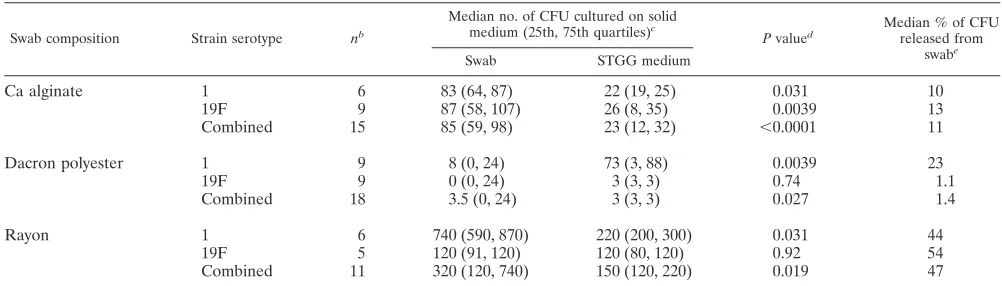
Comparison of swab and swab-containing STGG medium as specimens for the culture ofS. pneumoniae.Culture of calcium alginate swabs (after removal from STGG medium) grew a 3.7-fold-greater number of colonies than 0.1 ml of STGG me-dium containing the inoculated swab (P⬍0.0001) (Table 1). When cultures were repeated after the incubation of STGG medium for 18 h at 4°C, similar results were obtained (data not shown). Compared to the number of colonies grown by the culture of control STGG medium that had been directly inoc-ulated, the culture of STGG medium preincubated with cal-cium alginate swabs grew only 11% of the number of colonies (Table 1), indicating that a small proportion of viable pneu-mococci were released from the calcium alginate swab into the STGG medium. Thus, the number of colonies grown on solid medium is significantly higher from the swab than from STGG medium.
Parallel experiments of similar design were performed using Dacron polyester or rayon nasopharyngeal swabs (Table 1). Using Dacron polyester swabs, more colonies were grown from the swab than from the STGG medium, but few colonies were grown from either source and only 1.4% of viable colonies were released from the swab. Results were similar after the
culture of swabs and STGG media that had been incubated at 4°C for 18 h (data not shown). Thus, following the inoculation of a Dacron polyester swab, few viable pneumococci were recovered from either the swab or the swab-containing STGG medium. In contrast, using a rayon swab, significantly more colonies were cultured from the swab than from STGG me-dium, but more colonies were recovered from either the rayon swab or medium than from either the calcium alginate or the Dacron polyester swab. In addition, the median proportion of viable colonies released from the rayon swab was 47%, which was higher than from the calcium alginate or Dacron polyester swab. In limited experiments of similar design using culturing of rayon swabs and STGG media, which were incubated at 4°C for 18 h, similar results were obtained. Unlike the calcium alginate or Dacron polyester swabs, the rayon swabs unraveled in STGG medium and absorbed more liquid; this may have increased the number of colonies grown from rayon swabs on culture but is unlikely to explain the larger number of colonies grown from the STGG medium. Thus, independently of swab composition, more colonies were grown from the swab than from the STGG medium containing the swab. With culturing of either the swab or STGG medium, more colonies were grown using rayon swabs than calcium alginate swabs and more colonies were grown using calcium alginate swabs than Dacron polyester swabs.
DNA extraction from calcium alginate swabs. The four methods for extracting DNA from calcium alginate swabs de-scribed in Materials and Methods were compared. When DNA was prepared either by boiling the inoculated swabs in water or by incubating the swab with proteinase K and 1% Tween 20, no amplified DNA was detected after PCR. When DNA was ex-tracted from swabs using a High Pure PCR template prepara-tion kit or silica-based isolaprepara-tion method and subjected to PCR-based amplification and detection, DNA was detected, but detection was at least 100-fold more sensitive using the silica-based method. Therefore, the silica-silica-based method was chosen.
DNA extraction from STGG medium. To determine the optimal method for DNA extraction for PCR-based detection from STGG medium, the inoculation of STGG medium with serial 10-fold dilutions of exponential-phase S. pneumoniae
serotype 1 and DNA extraction using the silica-based method and the boiling method, in either water or STGG medium (see Materials and Methods), were compared. In each of two trials, the detection of the PCR product was 100-fold more sensitive using the silica-based method than the method using boiled water (the highest dilution detected was 10⫺7and 10⫺6for the silica-based method and 10⫺5and 10⫺4for the boiling-water method in trials 1 and 2, respectively). No PCR product was detected using DNA prepared by boiling STGG medium (low-est dilution t(low-ested, 10⫺2). Therefore, the silica-based method was chosen.
Comparison of swab and swab-containing STGG medium as the source of DNA for the amplification and detection of pneu-mococcal DNA from simulated clinical specimens.Detection of amplified type 1 or type 19F DNA from the inoculated calcium alginate swab was approximately 100-fold more sensi-tive than from the STGG medium containing the swab (Table 2). Experiments of identical designs were performed using Dacron polyester and rayon swabs. With Dacron polyester swabs, the sensitivity of detection of pneumococcal DNA from
on May 16, 2020 by guest
http://jcm.asm.org/
the swab was equal to that of the swab-containing STGG me-dium (Table 2). With rayon swabs, the sensitivity of DNA amplification and detection was approximately 10-fold higher using DNA from the swab-containing STGG medium than using the swab but the differences were not significant (Table 2). However, the sensitivities of DNA detection methods using swabs of any of the three compositions were similar.
Effect of swab composition on the sensitivity of PCR-based detection ofS. pneumoniaeDNA from clinical specimens and comparison of the methods using swabs and swab-containing STGG medium. Thirteen clinical specimens were tested, of which four did not growS. pneumoniaeon culture and nine grewS. pneumoniae. Each of the four clinical specimens that did not grow pneumococci was negative for pneumococcal DNA by PCR using primers withinlytA. Amplified pneumo-coccal DNA was detected from all of nine culture-positive specimens, although one was positive using DNA extracted from the original undiluted specimen but not from any of the swabs or STGG media. PCR was performed on serial 10-fold dilutions of extracted DNA from eight culture-positive speci-mens to compare the sensitivities of the methods using swabs and STGG medium containing the swab as sources of DNA for PCR. Using calcium alginate swabs, the swab was at least 10-fold more sensitive than swab-containing STGG medium for six specimens, equally sensitive and less sensitive for one specimen each (median titers [ranges], 4 [1 to 6] and 3 [1 to 5] for the swab and the medium, respectively). With Dacron poly-ester swabs, PCRs using the swab and STGG medium exhib-ited similar sensitivities. The PCR using the swab was more sensitive than the PCR using medium with four specimens, sensitivities were equal with one specimen, and the PCR using medium was more sensitive than the PCR using a swab with three specimens. The median titers (ranges) were 3 (0 to 5) and 2 (1 to 7) for the swab and the medium, respectively. Using rayon swabs, PCR with the swab was at least 10-fold more sensitive than PCR with STGG medium and four specimens and equally sensitive with four specimens. The median titers (ranges) were 3 (1 to 6) and 2.5 (1 to 5) for the swab and the medium, respectively. Thus, with clinical specimens and cal-cium alginate or Dacron polyester swabs, the sensitivities of
PCRs using swabs and swab-containing medium were similar to those observed using simulated clinical specimens. Using rayon swabs with actual clinical specimens, detection was somewhat more sensitive with swabs than with STGG medium, while using simulated clinical specimens, detection from STGG medium was more sensitive than from a swab.
DISCUSSION
An important finding of this study is that the numbers of colonies of pneumococci cultured from simulated nasopharyn-geal swab specimens in STGG transport medium varied mark-edly with swab composition. Using calcium alginate swabs, the culture of the swabs yielded a statistically significant 3.7-fold-greater mean number of colonies than the culture of STGG medium. This difference in colony number was observed de-spite the culture of 0.1 ml of STGG medium, a larger volume than is typically streaked on solid agar media for culture (11) These results suggest that viable pneumococci adhere to cal-cium alginate swabs in STGG medium despite vigorous vor-texing or overnight incubation, yet the transfer of viable bac-teria occurs when the swab is placed in direct contact with solid agar medium. Using clinical nasopharyngeal specimens, O’Brien et al. grew comparable numbers of CFU from cultures of calcium alginate swabs that were plated directly (prior to placement in STGG medium) and from cultures of 0.1 ml STGG medium containing the swab (9). However, they did not compare the numbers of CFU recovered from the cultures of the swab removed from STGG medium and of the STGG medium containing the swab. Our findings support the use of calcium alginate nasopharyngeal swabs for obtaining speci-mens for the culture of pneumococci as recommended by the WHO working group but suggest that the sensitivity of culture may be higher with the swab than with STGG transport me-dium containing the swab, the source of material for culture recommended by the working group (11). In some studies of pneumococcal carriage, the swab rather than the STGG me-dium was used for culture (12, 19).
[image:4.585.43.543.90.212.2]Dacron polyester swabs were also recommended by the WHO working group, but after inoculation and placement in TABLE 2. Sensitivities of PCR detection ofS. pneumoniaefrom STGG medium andS. pneumoniae-inoculated nasopharyngeal swabs
removed from STGG mediuma
Swab type Source of DNA
Highest dilution of extracted DNA detected after PCR amplification
Serotype 19F Serotype 1
Median Trial 1 Trial 2 Trial 3 Trial 1 Trial 2 Trial 3
Calcium alginate Swab 10⫺5 10⫺5 10⫺5 10⫺5 10⫺5.0b
STGG medium 10⫺3 10⫺3 10⫺3 10⫺4 10⫺3.0b
Dacron polyester Swab 10⫺5 10⫺5 10⫺5 10⫺6 10⫺6 10⫺6 10⫺5.5c
STGG medium 10⫺6 10⫺5 10⫺5 10⫺6 10⫺6 10⫺7 10⫺6.0c
Rayon Swab 10⫺5 10⫺4 10⫺5 10⫺5 10⫺6 10⫺6 10⫺5.0c
STGG medium 10⫺6 10⫺6 10⫺5 10⫺6 10⫺7 10⫺6 10⫺6.0c
a
Swabs were inoculated with 10l of serially diluted (10-fold), exponential-phase bacteria in TH broth, starting with a 10⫺3
dilution (containing approximately 2⫻103
CFU), placed into tubes containing 1 ml STGG medium, and vortexed. DNA was separately extracted and purified from the removed swabs and from 0.2 ml of STGG medium using a silica particle binding-based method.
b
Differences between results with the swab and results with STGG medium could not be analyzed using the Mann-Whitney test or Wilcoxon signed-rank test because the standard deviation in one column is 0.
c
Differences between results with the swab and results with STGG medium were not significant by the Mann-Whitney test.
on May 16, 2020 by guest
http://jcm.asm.org/
STGG medium, less than 2% of viable CFU were released into the medium and few CFU were recovered when either the swab or medium was cultured. These findings suggest that Dacron polyester swabs are inferior to calcium alginate swabs for the culture ofS. pneumoniae, although this finding needs to be confirmed using clinical specimens. We have previously shown that the culture of pneumococci is not inhibited by the presence of a Dacron polyester nasopharyngeal swab (N. E. Dayan, A. Rizvi, and L. G. Rubin, unpublished data). There-fore, it appears unlikely that inhibition of pneumococcal growth by Dacron polyester explains the comparatively poor recovery of pneumococci in culture. The most likely explana-tion is that viable bacteria are not readily transferred from Dacron polyester swabs to solid agar medium when the swab is rolled across medium and that a limited number of bacteria are released into liquid medium despite vortexing.
Based on these data, rayon swabs and the rayon swab-con-taining STGG medium facilitate the growth of pneumococci and appear to be superior to either calcium alginate or Dacron polyester swabs. Although the median number of colonies grown from the rayon swab was higher than that from STGG medium, the use of the medium resulted in more colonies than the use of either the calcium alginate or Dacron polyester swab. Rayon swabs readily release pneumococci into STGG medium and upon contact with agar growth medium. There-fore, either the rayon swab or medium with the rayon swab appears to be an excellent source of pneumococci for culture. Due to the limitations of culture, nucleic acid amplification techniques such as PCR are being evaluated as diagnostic tests for the detection of pneumococci in nasopharyngeal swabs and other respiratory specimens (2, 5, 8, 14, 19, 20, 22). We sought to maximize the sensitivity of PCR detection by analyzing the effect of the DNA extraction method, namely, the use of a swab or medium containing the swab, and the effect of swab composition on the sensitivity of PCR. We compared several methods of DNA extraction and purification from calcium alginate swabs and found the silica-based method to result in the most sensitive detection by PCR. Using the silica-based method, the sensitivities of PCR using inoculated swabs com-posed of any of the three materials were similar using either simulated specimens or clinical specimens. Whether either the swab or swab-containing STGG medium was superior as a source of DNA for PCR amplification and detection varied with swab composition. Using a calcium alginate swab with either simulated specimens or the nasal wash specimens, the titer of pneumococcal DNA was higher with the swab than with the STGG medium, but the differences were not significant, perhaps because of the small sample sizes (which precluded statistical analyses of the results with simulated specimens). Using Dacron polyester swabs, PCR-based amplification and detection of DNA from the swab and STGG media had similar sensitivities whether simulated or actual clinical specimens were used. Thus, Dacron polyester swabs and swab-containing media were good specimens for PCR-based detection but poor specimens for the culture ofS. pneumoniae. PCR-based detec-tion from rayon swab-containing STGG medium was more sensitive than the use of an inoculated rayon swab as a DNA source when simulated clinical specimens were used but less sensitive than PCR using actual clinical specimens. In neither case were the differences statistically significant, but the small
sample size of simulated clinical specimens precluded statisti-cal analyses. Overall, in a comparison of the three swab types and the three swab-containing STGG media, the sensitivity of PCR-based DNA amplification and detection varied by no more than 10-fold, with the exception of PCR with calcium alginate swabs, with which detection using the swab was ap-proximately 100-fold more sensitive than with the use of STGG medium. These differences in sensitivity may not be clinically important for most specimens because they contain adequate pneumococcal DNA for PCR-based detection. For seven of the nine culture-positive clinical specimens, the titer for detec-tion by PCR was at least 2, with median titers that ranged from 2.5 to 4 (varying with the source of material), indicating an excess of pneumococcal DNA in most specimens. However, for certain specimens, such as from patients who received antimi-crobial therapy, or for detection of DNA from a second pneu-mococcal serotype that may be present in small numbers, com-paratively small differences in sensitivity may be important (2, 16). Saukkoriipi et al. (18) successfully amplified and detected pneumococcal DNA from STGG medium containing calcium alginate nasopharyngeal swabs from children, a sample choice with which PCR-based detection exhibited a lower sensitivity in the current study than PCR using the swab itself.
There are limitations to these data. The experiments com-paring the results of the culture of swabs differing in compo-sition or comparing results with swabs and with STGG medium used pneumococci grown in vitro. The results might have been different if clinical nasopharyngeal specimens from swabs dif-fering in composition had been studied. The sensitivities of DNA detection were compared using a silica-based method for DNA extraction and purification, a method chosen because it was found to be optimal for use with calcium alginate swabs. The results might have been different if a different method for DNA extraction and purification had been used. We tested only a single brand of swab of each composition. It is possible that the results with swabs of the same composition manufac-tured by different processes may vary. Finally, we used quali-tative PCR and were able to detect only differences in sensi-tivities of detection that were at least 10-fold in magnitude. It is possible that detection sensitivity from different swabs or swab-containing media differed by smaller magnitudes that were not detected in these studies. Ideally, comparative studies should be performed using clinical nasopharyngeal specimens obtained directly with swabs differing in composition, and swabs and swab-containing STGG medium should be evalu-ated for culturing and as a source of DNA for PCR-based detection.
ACKNOWLEDGMENT
This work was supported by Public Health Service grant R01AI58200 from the National Institute of Allergy and Infectious Diseases.
REFERENCES
1.Avery, O. T.1918. Determination of types of pneumococci. JAMA70:17–19. 2.Billal, D. S., M. Hotomi, M. Suzumoto, K. Yamauchi, J. Arai, T. Katsura-hara, S. Moriyama, K. FujiKatsura-hara, and N. Yamanaka.2008. Determination of pneumococcal serotypes/genotypes in nasopharyngeal secretions of otitis media children by multiplex PCR. Eur. J. Pediatr.167:401–407. 3.Boom, R., C. J. A. Sol, M. M. M. Salimans, C. L. Jansen, P. M. E.
Wertheim-van Dillen, and J. Wertheim-van der Noordaa.1990. Rapid and simple method for purification of nucleic acids. J. Clin. Microbiol.28:495–503.
on May 16, 2020 by guest
http://jcm.asm.org/
4.Centers for Disease Control and Prevention.2000. Preventing pneumococcal disease among infants and young children: recommendations of the Advisory Committee on Immunization Practices (ACIP). MMWR Recommend. Rep.
49(RR-9):1–35.
5.Greiner, O., P. J. R. Day, P. P. Bosshard, F. Imeri, M. Altwegg, and D. Nadal.
2001. Quantitative detection ofStreptococcus pneumoniaein nasopharyngeal secretions by real-time PCR. J. Clin. Microbiol.39:3129–3134.
6.Huebner, R. E., R. Dagan, N. Porath, A. D. Wasas, and K. P. Klugman.2000. Lack of utility of serotyping multiple colonies for detection of simultaneous nasopharyngeal carriage of different pneumococcal serotypes. Pediatr. In-fect. Dis. J.19:1017–1020.
7.Millar, E. V., K. L. O’Brien, J. P. Watt, M. A. Bronsdon, J. Dallas, C. G. Whitney, R. Reid, and M. Santosham.2006. Effect of community-wide con-jugate pneumococcal vaccine use in infancy on nasopharyngeal carriage through 3 years of age: a cross sectional study in a high-risk population. Clin. Infect. Dis.43:8–15.
8.Moreno, J., E. Herna´ndez, O. Sanabria, and E. Castan˜ada.2005. Detection and serotyping ofStreptococcus pneumoniaefrom nasopharyngeal samples by PCR-based multiplex assay. J. Clin. Microbiol.43:6152–6154.
9.O’Brien, K. L., M. A. Bronsdon, R. Dagan, P. Yagupsky, J. Janco, J. Elliott, C. G. Whitney, Y. H. Yang, L. G. Robinson, B. Schwartz, and G. M. Carlone.
2001. Evaluation of a medium (STGG) for transport and recovery of Strep-tococcus pneumoniaefrom nasopharyngeal secretions collected during field studies. J. Clin. Microbiol.39:1021–1024.
10.O’Brien, K. L., and R. Dagan.2003. The potential indirect effect of conjugate pneumococcal vaccines. Vaccine21:1815–1825.
11.O’Brien, K. L., H. Nohynek, and the World Health Organization Pneumo-coccal Vaccine Trials Carriage Working Group.2003. Report from a WHO working group: standard method for detecting upper respiratory carriage of
Streptococcus pneumoniae. Pediatr. Infect. Dis. J.22:e1–e11.
12.Pelton, S. I., A. M. Loughlin, and C. D. Marchant. 2004. Seven valent pneumococcal conjugate vaccine immunization in two Boston communities. Pediatr. Infect. Dis. J.23:1015–1022.
13.Poehling, K. A., T. R. Talbot, M. R. Griffin, A. S. Craig, C. G. Whitney, E. Zell, C. A. Lexau, A. R. Thomas, L. H. Harrison, A. L. Reingold, J. L. Hadler, M. M. Farley, B. Anderson, and W. Schaffner.2006. Invasive pneumococcal
disease among infants before and after introduction of pneumococcal con-jugate vaccine. JAMA295:1668–1674.
14.Rintama¨ki, S., A. Saukkoriipi, P. Salo, A. Takala, and M. Leinonen.2002. Detection ofStreptococcus pneumoniaeDNA using polymerase chain reac-tion and microwell hybridizareac-tion with Europium-labelled probes. J. Micro-biol. Methods50:313–318.
15.Rubin, L. G.2000. Pneumococcal vaccine. Pediatr. Clin. N. Am.47:269–285. 16.Rubin, L. G., and A. Rizvi.2004. PCR-based assays for detection of Strep-tococcus pneumoniaeserotypes 3, 14, 19F and 23F in respiratory specimens. J. Med. Microbiol.53:595–602.
17.Ruoff, K. L., R. A. Whiley, and D. Beighton.2003.Streptococcus, p. 407–412.
InP. R. Murray, E. J. Baron, J. H. Jorgensen, M. A. Pfaller, and R. H. Yolken (ed.), Manual of clinical microbiology, 8th ed. ASM Press, Wash-ington, DC.
18.Saukkoriipi, A., T. Kaijalainen, L. Kuisma, A. Ojala, and M. Leinonen.2003. Isolation of pneumococcal DNA from nasopharyngeal samples for real-time quantitative PCR. Comparison of three methods. Mol. Diagn.7:9–15. 19.Saukkoriipi, A., K. Leskela, E. E. Herva, and M. Leinonen.2004.
Strepto-coccus pneumoniae in nasopharyngeal secretions of healthy children: com-parison of real-time PCR and culture from STGG-transport medium. Mol. Cell. Probes18:147–153.
20.Virolainen, A., P. Salo, J. Jero, P. Karma, J. Eskola, and M. Leiononen.
1994. Comparison of PCR assay with bacterial culture for detecting Strepto-coccus pneumoniaein middle ear fluid of children with acute otitis media. J. Clin. Microbiol.32:2667–2670.
21.Whitney, C. G., M. M. Farley, J. Hadler, L. H. Harrison, N. M. Bennett, R. Lynfield, A. Reingold, P. R. Cieslak, T. Pilishvile, D. Jackson, R. R. Facklam, J. H. Jorgensen, and A. Schuchat for the Active Bacterial Core Surveillance of the Emerging Infections Program Network. 2003. Decline in invasive pneumococcal disease after the introduction of protein-polysaccharide con-jugate vaccine. N. Engl. J. Med.348:1737–1746.
22.Yang, S., S. Lin, A. Khalil, C. Gaydos, E. Nuemberger, G. Juan, J. Hardick, J. G. Bartlett, P. G Auwaerter, and R. E. Rothman.2005. Quantitative PCR assay using sputum samples for rapid diagnosis of pneumococcal pneumonia in adult emergency department patients. J. Clin. Microbiol.43:3221–3226.