Parametrial Anisakidosis
Poornima Ramanan,aAndrea K. Blumberg,bBlaine Mathison,cBobbi S. Prittd
Divisions of Infectious Diseasesa
and Clinical Microbiology,d
Mayo Clinic, Rochester, Minnesota, USA; Pathology Consultants of South Broward, Memorial Hospital West, Pembroke Pines, Florida, USAb
; Division of Parasitic Diseases and Malaria, Center for Global Health, Centers for Disease Control and Prevention, Atlanta, Georgia, USAc
Anisakidosis is a parasitic infection caused by anisakid nematodes in the generaAnisakisandPseudoterranova. Infection is not uncommon in the United States due to increased raw seafood consumption. We report the first known case of parametrial ani-sakidosis in a 42-year-old woman and review existing literature.
CASE REPORT
T
he patient was a 42-year-old German American female who presented with a 1-year history of intermittent, clear, odorless vaginal discharge and intermittent abdominal bloating. She de-nied fever, abdominal pain, nausea, vomiting, diarrhea, or weight loss and had regular menstrual cycles. Her past medical history was significant for childhood bronchitis, but she was otherwise in good health with no chronic medical conditions. She had quit smoking tobacco recently, reported drinking wine socially, and denied illicit substance abuse. She also denied any allergic symp-toms or rash.Physical examination revealed an endocervical polyp which was removed and diagnosed as adenocarcinomain situby histo-pathologic examination. A LEEP (loop electrosurgical excision procedure) subsequently revealed invasive, moderately differen-tiated adenocarcinoma and squamous cell carcinoma of the cer-vix. She therefore underwent a robotic-assisted radical hysterec-tomy with bilateral pelvic and periaortic lymphadenechysterec-tomy. Intraoperatively, a 1-centimeter friable area was observed on the anterior cervix, consistent with her previously diagnosed carci-noma. There were no ectocervical or vaginal lesions, and the bi-lateral ovaries, fallopian tubes, appendix, and peritoneal cavity appeared normal. However, a firm mass was noted on the external aspect of the posterior cervix in the parametrium when the recto-vaginal space was dissected. A hematoxylin-and-eosin-stained section of the mass demonstrated two cross-sections of a pre-sumed single roundworm surrounded by granulomatous inflam-mation and numerous eosinophils (Fig. 1A). On higher magnifi-cation, narrow Y-shaped lateral cords arising from the internal aspect of the muscular coat were observed in the cross sections of the worm (Fig. 1B), most consistentAnisakis larvae, allowing a diagnosis of anisakidosis to be made. The patient was informed about this incidental finding. No serological or molecular tests were done, due to the unavailability of such testing in the United States.
During a subsequent interview, the patient stated that she en-joys eating raw seafood and eats sushi from Japanese restaurants and ceviche from Peruvian restaurants in Miami approximately once a month. She does not buy fish from local markets and de-nied making these dishes at home. She had lived in the United States for the past 24 years, with most of this time spent in Florida and a few years spent in Arizona and New York. She visited her family in Germany frequently and had also traveled to Thailand the year before, but did not recall eating raw seafood during these
trips. She was educated about the risks of acquiring future anisaki-dosis and the methods of prevention.
Anisakidosis is acquired by the consumption of raw or under-cooked marine fish or squid. Human infection occurs due to the accidental ingestion of the third-stage larvae of marine mammal nematodes belonging to the familyAnisakidae. The two organisms that are commonly associated with human cases areAnisakisspp.
andPseudoterranova decipiens(1,2).
Anisakidosis denotes disease caused by any member of the familyAnisakidae, whereas anisakiasis is used for disease caused by members of the genus Anisakisand pseudoterranovosis for disease caused by members of genusPseudoterranova(3). The first description of this infection was in 1845 by Dujardin, who de-scribed a worm in dolphins and called itAnisakis. The term
Ani-sakisis derived from the Greek words “anisos,” meaning unequal,
and “akis,” meaning point (4). However, it was not until 1960 that the first human infection was reported in a patient from the Neth-erlands who had reported eating raw herring (5).
Anisakid-infected marine life exists in all the oceans and seas, and the disease is distributed worldwide (6). The prevalence of disease is related to the practice of raw seafood consumption in communities. Currently, around 20,000 new cases are reported worldwide annually; the majority of them (over 90%) are from Japan (7). Most of the other cases occur in parts of coastal Europe (Netherlands, Spain, Germany, and France) and South America where raw fish is consumed. In the United States, the frequency of anisakidosis is unknown, since it is not a reportable disease and may be underdiagnosed (8). The frequency was approximately 10 reported cases per year in the 1970s and may be higher now (8). The incidence is expected to rise in coming years due to increased awareness of infection, advances in endoscopic techniques, in-creasing popularity of raw seafood consumption, and inin-creasing marine mammal (definitive host) populations since the enact-ment of the Marine Mammal protection act of 1972 (1,9). Fish
Received31 May 2013Returned for modification24 June 2013 Accepted11 July 2013
Published ahead of print17 July 2013
Address correspondence to Bobbi Pritt, [email protected].
Copyright © 2013, American Society for Microbiology. All Rights Reserved.
doi:10.1128/JCM.01398-13
on May 16, 2020 by guest
http://jcm.asm.org/
dishes that are commonly implicated in anisakidosis are Japanese sushi and sashimi, South American ceviche, Dutch salted or smoked herring, Filipino bagoong, and Spanish pickled anchovies (9,10). The risk of infection is lower in Japanese restaurants and sushi bars that serve sushi and sashimi prepared by professional sushi chefs (2,6). Cheap marine fish and shellfish, such as cod, herring, mackerel, and squid, which are mainly consumed at other ethnic restaurants or at home, tend to be heavily infected with
anisakid larvae (Fig. 2) (2). In the United States, salmon and rock-fish are commonly implicated in transmitting anisakidosis (11). Wild-caught salmon in the Pacific northwest are commonly in-fected with anisakid larvae (12) and may cause anisakidosis if con-sumed raw (11).
Adult worms live and reproduce in the stomach of marine mammals, such as dolphins, whales, seals, and sea lions, who serve as the definitive hosts for this parasite. The eggs are excreted with FIG 1Low-power magnification of the mass (left) from the external aspect of the posterior cervix, demonstrating two cross-sections of the anisakid roundworm (arrows) surrounded by fibrous tissue and inflammatory cells (hematoxylin-and-eosin [H&E] staining,⫻20 magnification). On higher magnification, narrow Y-shaped lateral cords are seen within the worm cross sections (arrow), characteristic ofAnisakissp. Numerous eosinophils are seen in the granulomatous inflammation to the right of the worm (H&E staining,⫻400 magnification).
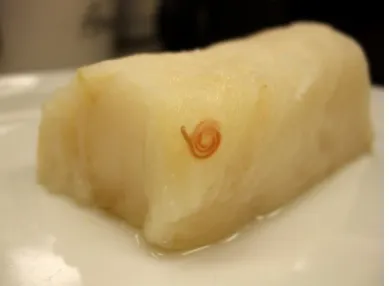
FIG 2Coiled anisakid larva in a frozen cod fillet from a local grocery store. The coiled worm measures approximately 5 mm in diameter. This is a common finding in cod fillets.
on May 16, 2020 by guest
http://jcm.asm.org/
[image:2.585.101.486.67.239.2] [image:2.585.100.489.414.700.2]the feces into seawater, where they molt into free-living larvae. The second-stage larvae are ingested by small crustaceans (first intermediary hosts), which are then consumed by marine fish and squid (second intermediary hosts), where the larvae undergo fur-ther development. The third-stage larvae present in fish and squid can penetrate the gut wall and migrate to tissues in the peritoneal cavity and muscles. Ultimately, marine mammals ingest the larvae in infected marine fish or squid. Upon reaching the stomach of the definitive host, the third-stage larvae will transform into adult worms and complete their life cycle. The adult worms superficially invade the stomach lining of the marine mammals as part of their attachment process and are embedded in the gastric mucosa. This may explain their tendency to accidentally perforate the human stomach and intestine. Humans are considered accidental dead-end hosts since the larvae cannot reach maturity and usually die within a span of 3 weeks after infection (13).
There are four main clinical forms of human anisakidosis: gas-tric, intestinal, extragastrointestinal/ectopic, and allergic disease (9). Symptoms associated with gastric or intestinal forms in hu-mans are usually the result of the third-stage anisakid larvae at-tempting to penetrate the gastric or intestinal mucosa. Gastric invasion is most commonly associated withPseudoterranova spe-cies, while intestinal invasion is most commonly associated with
Anisakisspecies (1).
Acute gastric anisakidosis manifests with sudden onset of epi-gastric pain accompanied by nausea or vomiting within a few min-utes to hours of ingesting raw seafood. Live larvae are often ex-pelled via the nose or mouth. Symptoms of acute disease may also mimic angina-like chest pain (14,15). Chronic gastric anisakido-sis, which usually occurs due to the host inflammatory response to dying larvae, may mimic symptoms of peptic ulcer disease and chronic gastritis (6). Occasionally, patients may present with gas-tric perforation and pneumoperitoneum (16).
Intestinal anisakidosis occurs more frequently in Europe and is less common in Japan, where more than 97% of cases involve the stomach (17,18). The terminal ileum is involved in the majority of cases (19,20), although the ileocecal valve may also be involved (21). Symptoms include intermittent or constant abdominal pain, fever, vomiting, or diarrhea, all of which usually start 5 to 7 days after ingestion of the seafood (6). Because of the nonspecific na-ture of these symptoms, intestinal anisakidosis has frequently been misdiagnosed as acute appendicitis, Crohn’s disease, or co-lon cancer, occasionally resulting in unnecessary laparotomy and bowel resection. In chronic intestinal anisakiasis, the formation of eosinophilic granulomas around the larvae may present as in-testinal obstruction or tumor (18,22), with resultant segmental colitis, small bowel obstruction, intussusception, or intestinal perforation presenting as acute abdomen (23–27). Intestinal anisakidosis may also present as eosinophilic gastroenteritis (28). Ectopic disease is much less common than the gastric and in-testinal forms (2) and occurs when the anisakid larvae traverse the intestinal wall and reach the peritoneal cavity. Peritoneal involve-ment may result in hemorrhagic ascites (29). Rarely, the larvae have been detected in peritoneal dialysis effluent (30,31). From the peritoneal cavity, the larvae may then enter surrounding or-gans and induce an eosinophilic granulomatous response. Presen-tations of ectopic disease include mesenteric mass (32), omental nodules (33,34), and involvement of mesocolic lymph nodes (35) and spleen (36). Anisakid larvae may also enter the pleural cavity from the peritoneal cavity by penetrating the diaphragm and
caus-ing an eosinophilic pleural effusion (37,38). Finally, cases of ton-sillar and laryngeal anisakidosis have been described, where the larvae migrated back up the esophagus and into the tonsils or larynx (39,40).
The fourth form of human disease is acute allergic anisakidosis. Manifestations may range from urticaria and angioedema to ana-phylactic shock; concurrent gastrointestinal symptoms may also be present (gastroallergic anisakiasis) (41). Most cases of allergic anisakidosis have high levels of IgE specific toA. simplex, but sen-sitization to the actual fish products is uncommon (42). There-fore, it may be prudent to evaluate patients with presumed fish allergy forA. simplexsensitization. Rarely, allergic reactions can manifest as allergic gingivostomatitis, intractable chronic pruri-tus, nephrotic syndrome, autoimmune pancreatitis, or rheumatic manifestations (43–47). Anisakid sensitization in fish-processing workers has been associated with bronchial hyperreactivity and dermatitis (48).
Diagnosis of gastric, intestinal, and ectopic anisakidosis is most reliably achieved through direct visualization and examination of the larvae by endoscopy, resected surgical specimen, or gross mor-phological examination of expelled, intact worms. Gastric anisaki-dosis is often easily diagnosed by endoscopy, although the worm may be hidden among gastric folds or can be confused with gastric mucus (49). In chronic cases, diagnosis is often difficult due to the nonspecific nature of symptoms and infrequent visualization of larvae on endoscopy due to deep tissue penetration of larvae (10). Other adjuncts to diagnosis are history (onset of abdominal symp-toms following raw seafood consumption), histopathology, imag-ing studies, and serology. Imagimag-ing studies may show mucosal edema, irregular bowel wall thickening, lymphadenopathy, focal mass, or ascites (6).
The criteria for diagnosing allergy toA. simplexare a compat-ible history and measurement of antibodies to anisakids using commercially available enzyme-linked immunosorbent assay (ELISA) (50) or Western blotting (51). Cross-reactivity with other nematodes, insects (cockroaches), or crustaceans (shrimp) (6) has been reported and may cause false-positive serology results. Mo-lecular methods of identifying anisakids in fish (52) and in hu-mans (53) have also been developed but are not widely available. When the intact worm is submitted (from vomitus or stool or retrieved via endoscopy), the third-stage larvae may be identified by morphological features, including the striated outer cuticle, one dorsal and two ventral lips, a boring tooth and excretory pore at the anterior end, and a mucron at the posterior end (54). These features allow anisakid larvae to be differentiated from third- or fourth-stageAscarislarvae, which may also be retrieved from the throat or vomitus.Anisakis larvae may be differentiated from
Pseudoterranovalarvae in that they are generally smaller and have
a simple digestive tube, whereasPseudoterranovalarvae are larger and have an anteriorly directed cecum (54). In histologic sections, anisakid larvae can be distinguished from related nematodes, such
asAscaris, by the absence of lateral alae.Anisakislarvae have tall,
prominent muscle cells and Y-shaped lateral chords (Fig. 1B), whereasPseudoterranovalarvae have the characteristic intestinal cecum and butterfly-shaped lateral chords (54). Determination of the genus of an anisakid nematode is often not performed due to limited availability of the expertise needed for pathological diag-nosis and the lack of molecular tests. While the CDC currently does not offer serological or molecular testing, it may still be a good resource for the identification of these nematodes.
on May 16, 2020 by guest
http://jcm.asm.org/
Removal of larvae by endoscopy is curative for acute gastric anisakidosis. Suspected intestinal anisakidosis, on the other hand, may be managed conservatively, given that the larvae die after a few days. Occasionally, surgery is required for management of intestinal or extraintestinal infections, especially if there are com-plications like appendicitis, intestinal obstruction, perforation, or peritonitis. Isolated cases of presumed intestinal anisakiasis have been treated with albendazole (55), although the benefits of al-bendazole are unknown.
Prevention of anisakidosis is best achieved by following the guidelines put forth by the Food and Drug Administration (FDA). The FDA recommends cooking seafood to temperatures of 63°C (145°F), while fish intended for raw consumption should be fro-zen at⫺4°F (⫺20°C) or below for 7 days or flash-frozen to⫺31°F (⫺35°C) or below for at least 15 h. In addition, consumers, pa-tients, and individuals preparing fish for consumption should be educated about the risks of ingesting raw seafood. Fishermen should eviscerate fish immediately after catching them to prevent postmortem migration of larvae from intestines to fish muscula-ture but are discouraged from throwing the eviscerated products back into the sea since this can increase the infection rate in local marine life (1).
We report the first case of parametrial anisakidosis. We believe that the larva gained access to the parametrium by burrowing through the stomach or intestinal wall, entering the peritoneal cavity, and eventually reaching the retrouterine pouch (Pouch of Douglas) (Fig. 3) through the known pathways of peritoneal fluid circulation. Given that the retrouterine pouch is a watershed area in the peritoneal fluid circulation pathway, it is a common loca-tion for tumor (56) and endometriosis implants (57). The host response subsequently encased the larva within eosinophilic gran-ulomas and fibrous tissue, thus causing it to adhere to the poste-rior aspect of the uterine cervix. The parametrial location in this patient with cervical cancer led to an initial impression of either malignant tumor spread or a benign cervical lesion. However, recognition of key anatomic anisakid structures allowed for
defin-itive identification, while an understanding of the parasite life cy-cle and circulation route of the peritoneal fluid allowed for recon-struction of the presumed pathway of infection.
REFERENCES
1.Chai JY, Murrell KD, Lymbery AJ.2005. Fish-borne parasitic zoonoses: status and issues. Int. J. Parasitol.35:1233–1254.
2.Nawa Y, Hatz C, Blum J.2005. Sushi delights and parasites: the risk of fishborne and foodborne parasitic zoonoses in Asia. Clin. Infect. Dis.41:
1297–1303.
3.Kassai T, Cordero del Campillo M, Euzeby J, Gaafar S, Hiepe T, Himonas CA.1988. Standardized nomenclature of animal parasitic dis-eases (SNOAPAD). Vet. Parasitol.29:299 –326.
4.Bouree P, Paugam A, Petithory JC.1995. Anisakidosis: report of 25 cases and review of the literature. Comp. Immunol. Microbiol. Infect. Dis.18:
75– 84.
5.van Thiel P, Kuipers FC, Roskam RT.1960. A nematode parasitic to herring, causing acute abdominal syndromes in man. Trop. Geogr Med.
12:97–113.
6.Hochberg NS, Hamer DH.2010. Anisakidosis: perils of the deep. Clin. Infect. Dis.51:806 – 812.
7.Pravettoni V, Primavesi L, Piantanida M.2012. Anisakis simplex: cur-rent knowledge. Eur. Ann. Allergy Clin. Immunol.44:150 –156. 8.Beaudry C.2012. Bad bug book. Foodborne pathogenic microorganisms
and natural toxins handbook, 2nd ed. Center for Food Safety and Applied Nutrition, U.S. Food and Drug Administration, Washington, DC. 9.Audicana MT, Kennedy MW. 2008. Anisakis simplex: from obscure
infectious worm to inducer of immune hypersensitivity. Clin. Microbiol. Rev.21:360 –379.
10. Hernandez-Prera JC, Polydorides AD.2012. Anisakidosis of the sigmoid colon disguising as metastatic carcinoma: a case report and review of the literature. Pathol. Res. Pract.208:433– 435.
11. Couture C, Measures L, Gagnon J, Desbiens C.2003. Human intestinal anisakiosis due to consumption of raw salmon. Am. J. Surg. Pathol.27:
1167–1172.
12. Deardorff TL, Kent ML.1989. Prevalence of larval Anisakis simplex in pen-reared and wild-caught salmon (Salmonidae) from Puget Sound, Washington. J. Wildl. Dis.25:416 – 419.
13. Anadón AM, Romarís F, Escalante M, Rodríguez E, Gárate T, Cuéllar C, Ubeira FM.2009. The Anisakis simplex Ani s 7 major allergen as an indicator of true Anisakis infections. Clin. Exp. Immunol.156:471– 478. 14. Garcia Garcia JM, Romero Arauzo MJ.2004. Angina-like chest pain due
to gastric anisakiasis. An. Med. Interna21:185–186. (Article in Spanish.) 15. Machi T, Okino S, Saito Y, Horita Y, Taguchi T, Nakazawa T,
Naka-mura Y, Hirai H, Miyamori H, Kitagawa S.1997. Severe chest pain due to gastric anisakiasis. Intern. Med.36:28 –30.
16. Ito Y, Ikematsu Y, Yuzawa H, Nishiwaki Y, Kida H, Waki S, Uchimura M, Ozawa T, Iwaoka T, Kanematsu T.2007. Chronic gastric anisakiasis presenting as pneumoperitoneum. Asian J. Surg.30:67–71.
17. Takabe K, Ohki S, Kunihiro O, Sakashita T, Endo I, Ichikawa Y, Sekido H, Amano T, Nakatani Y, Suzuki K, Shimada H.1998. Anisakidosis: a cause of intestinal obstruction from eating sushi. Am. J. Gastroenterol.
93:1172–1173.
18. Montalto M, Miele L, Marcheggiano A, Santoro L, Curigliano V, Vastola M, Gasbarrini G. 2005. Anisakis infestation: a case of acute abdomen mimicking Crohn’s disease and eosinophilic gastroenteritis. Dig. Liver Dis.37:62– 64.
19. Shirahama M, Koga T, Ishibashi H, Uchida S, Ohta Y, Shimoda Y.1992. Intestinal anisakiasis: US in diagnosis. Radiology185:789 –793. 20. Repiso Ortega A, Alcantara Torres M, Gonzalez de Frutos C, de Artaza
Varasa T, Rodriguez Merlo R, Valle Munoz J, Martinez Potenciano JL.
2003. Gastrointestinal anisakiasis. Study of a series of 25 patients. Gastro-enterol. Hepatol.26:341–346. (Article in Spanish.)
21. Lee JI, Choi MG, Kim SW, Lim CH, Kim JS, Cho YK, Lee IS, Choi KY, Chung IS.2011. A case report of anisakiasis developed on ileocecal valve area. J. Gastroenterol. Hepatol.26:124 –125.
22. Ishii N, Matsuda M, Setoyama T, Suzuki S, Uchida S, Uemura M, Iizuka Y, Fukuda K, Horiki N, Fujita Y.2009. Anisakiasis and vanishing tumor of the cecum. Endoscopy41(Suppl 2):E226 –E227.
23. Lock G, Ehresmann J, Jontvedt E.2008. Severe segmental colitis due to anisakiasis. Unusual manifestation of a rare infection in Germany. Dtsch. Med. Wochenschr.133:1779 –1782. (Article in German.)
FIG 3Schematic demonstrating the retrouterine pouch that contained the
Anisakislarva. Note the close proximity of this space to the posterior cervix, demonstrating how the larva and surrounding inflammatory tissue could be mistaken for a mass arising from the cervix. (Courtesy of Mayo Foundation for Medical Education and Research. Reproduced with permission.)
on May 16, 2020 by guest
http://jcm.asm.org/
[image:4.585.82.248.66.253.2]24. Pellegrini M, Occhini R, Tordini G, Vindigni C, Russo S, Marzocca G.
2005. Acute abdomen due to small bowel anisakiasis. Dig. Liver Dis.37:
65– 67.
25. Kang DB, Oh JT, Park WC, Lee JK.2010. Small bowel obstruction caused by acute invasive enteric anisakiasis. Korean J. Gastroenterol.56:
192–195.
26. Miura T, Iwaya A, Shimizu T, Tsuchiya J, Nakamura J, Yamada S, Yanagi M, Usuda H, Emura I, Takahashi T.2010. Intestinal anisakiasis can cause intussusception in adults: an extremely rare condition. World J. Gastroenterol.16:1804 –1807.
27. De Nicola P, Napolitano L, Di Bartolomeo N, Waku M, Innocenti P.
2005. Anisakiasis presenting as perforated ulcer of the cecum. G. Chir.
26:375–377. (Article in Italian.)
28. Gomez B, Tabar AI, Tunon T, Larrinaga B, Alvarez MJ, Garcia BE, Olaguibel JM.1998. Eosinophilic gastroenteritis and Anisakis. Allergy
53:1148 –1154.
29. Akbar A, Ghosh S.2005. Anisakiasis—a neglected diagnosis in the West. Dig. Liver Dis.37:7–9.
30. Yeum CH, Ma SK, Kim SW, Kim NH, Kim J, Choi KC.2002. Incidental detection of an Anisakis larva in continuous ambulatory peritoneal dialy-sis effluent. Nephrol. Dial. Transplant.17:1522–1523.
31. Ohta M, Ikeda K, Miyakoshi H, Nishide K, Horigami T, Akao T, Yamagishi S, Hirano S.1995. A very rare case of continuous ambulatory peritoneal dialysis peritonitis caused by Anisakis larva. Am. J. Gastroen-terol.90:1902–1903.
32. Cespedes M, Saez A, Rodriguez I, Pinto JM, Rodriguez R.2000. Chronic anisakiasis presenting as a mesenteric mass. Abdom. Imaging25:548 –550. 33. Cancrini G, Magro G, Giannone G. 1997. 1st case of extra-gastrointestinal anisakiasis in a human diagnosed in Italy. Parassitologia
39:13–17. (Article in Italian.)
34. Takekawa Y, Kimura M, Sakakibara M, Yoshii R, Yamashita Y, Kubo A, Koide H, Kameda K. 2004. Two cases of parasitic granuloma found incidentally in surgical specimens. Rinsho Byori52:28 –31. (Article in Jap-anese.)
35. Kim HJ, Park C, Cho SY.1997. A case of extragastrointestinal anisakiasis involving a mesocolic lymph node. Korean J. Parasitol.35:63– 66. 36. Testini M, Gentile A, Lissidini G, Di Venere B, Pampiglione S.2003.
Splenic anisakiasis resulting from a gastric perforation: an unusual occur-rence. Int. Surg.88:126 –128.
37. Saito W, Kawakami K, Kuroki R, Matsuo H, Oishi K, Nagatake T.2005. Pulmonary anisakiasis presenting as eosinophilic pleural effusion. Respi-rology10:261–262.
38. Matsuoka H, Nakama T, Kisanuki H, Uno H, Tachibana N, Tsubouchi H, Horii Y, Nawa Y. 1994. A case report of serologically diagnosed pulmonary anisakiasis with pleural effusion and multiple lesions. Am. J. Trop. Med. Hyg.51:819 – 822.
39. Bhargava D, Raman R, El Azzouni MZ, Bhargava K, Bhusnurmath B.
1996. Anisakiasis of the tonsils. J. Laryngol. Otol.110:387–388. 40. Kwak SY, Yoon YH.2012. Laryngeal anisakiasis: an unusual cause of
foreign-body sensation in the throat. Otolaryngol. Head Neck Surg.147:
588 –589.
41. Choi SJ, Lee JC, Kim MJ, Hur GY, Shin SY, Park HS.2009. The clinical
characteristics of Anisakis allergy in Korea. Kor. J. Intern. Med.24:160 – 163.
42. Caballero ML, Moneo I.2002. Specific IgE determination to Ani s 1, a major allergen from Anisakis simplex, is a useful tool for diagnosis. Ann. Allergy Asthma Immunol.89:74 –77.
43. Eguia A, Aguirre JM, Echevarria MA, Martinez-Conde R, Pontón J.
2003. Gingivostomatitis after eating fish parasitized by Anisakis simplex: a case report. Oral Surg. Oral Med. Oral Pathol. Oral Radiol. Endod.96:
437– 440.
44. Gallo R, Cecchi F, Parodi A.2012. Intractable chronic pruritus as the only manifestation of IgE hypersensitivity to Anisakis. J. Am. Acad. Der-matol.67:e261. doi:10.1016/j.jaad.2012.03.026.
45. Meseguer J, Navarro V, Sanchez-Guerrero I, Bartolome B, Negro Al-varez JM.2007. Anisakis simplex allergy and nephrotic syndrome. Aller-gol. Immunopathol. (Madr.)35:216 –220.
46. Pezzilli R, Casadei R, Santini D.2007. Autoimmune pancreatitis asso-ciated with anisakis infection. Dig. Liver Dis.39:273.
47. Cuende E, Audicana MT, Garcia M, Anda M, Fernandez Corres L, Jimenez C, Vesga JC.1998. Rheumatic manifestations in the course of anaphylaxis caused by Anisakis simplex. Clin. Exp. Rheumatol.16:303– 304.
48. Nieuwenhuizen N, Lopata AL, Jeebhay MF, Herbert DBR, Robins TG, Brombacher F.2006. Exposure to the fish parasite Anisakis causes allergic airway hyperreactivity and dermatitis. J. Allergy Clin. Immunol.117:
1098 –1105.
49. Zullo A, Hassan C, Scaccianoce G, Lorenzetti R, Campo SM, Morini S.
2010. Gastric anisakiasis: do not forget the clinical history! J. Gastrointes-tin. Liver Dis.19:359.
50. Arilla MC, Ibarrola I, Martínez A, Monteseirín J, Conde J, Asturias JA.
2008. An antibody-based ELISA for quantification of Ani s 1, a major allergen from Anisakis simplex. Parasitology135:735–740.
51. Rodero M, Cuellar C, Chivato T, Mateos JM, Laguna R.2007. Western blot antibody determination in sera from patients diagnosed with Anisakis sensitization with different antigenic fractions of Anisakis simplex puri-fied by affinity chromatography. J. Helminthol.81:307–310.
52. Cavallero S, Ligas A, Bruschi F, D’Amelio S.2012. Molecular identifi-cation of Anisakis spp. from fishes collected in the Tyrrhenian Sea (NW Mediterranean). Vet. Parasitol.187:563–566.
53. Mattiucci S, Paoletti M, Borrini F, Palumbo M, Palmieri RM, Gomes V, Casati A, Nascetti G.2011. First molecular identification of the zoonotic parasite Anisakis pegreffii (Nematoda: Anisakidae) in a paraffin-embedded granuloma taken from a case of human intestinal anisakiasis in Italy. BMC Infect. Dis.11:82. doi:10.1186/1471-2334-11-82.
54. Connor DH.1997. Pathology of infectious diseases. Appleton & Lange, Stamford, CT.
55. Pacios E, Arias-Diaz J, Zuloaga J, Gonzalez-Armengol J, Villarroel P, Balibrea JL.2005. Albendazole for the treatment of anisakiasis ileus. Clin. Infect. Dis.41:1825–1826.
56. Meyers MA.1973. Distribution of intra-abdominal malignant seeding: dependency on dynamics of flow of ascitic fluid. Am. J. Roentgenol. Ra-dium Ther. Nucl. Med.119:198 –206.
57. Farquhar CM.2000. Extracts from the “clinical evidence.” Endometrio-sis. BMJ320:1449 –1452.