GSM Based Automation System Using
Microcontroller
Aakansha Singh1, Ankita Sinha2,Dilraj Kour3, Pratiksha Gupta4,Swapnil Sinha5
1.2,3,4,5 Electronics & Telecommunication Department, CSVTU University
Abstract: Object tracking and detection is first step in applications such as video surveillance. The main aim of object tracking has been developed to estimate location, velocity and distance parameters of moving objects with the help of static camera. Object tracking system require accurate segmentation of objects from the background for effective tracking. Motion segmentation or optical flow can be used to segment incoming images. Optical flow allows multiple moving targets to be separated based on their individual velocities ,optical flow techniques are prone to errors caused by changing lightning and occlusions, both common in surveillance environment. In this paper we propose a combined motion segmentation/optical flow algorithm for used in object tracking. Optical flow is calculated at pixel resolution and tracking of flow vectors is employed to improve performance and detect discontinuities, which can indicate the location of overlaps between objects.
I. INTRODUCTION
During the present days technology is all about the automation and wireless control of all the equipment used in industries, factories and households. Any equipment that can be controlled wirelessly is more easily maintained and it responds very fast comparing to the manual operation of the equipment. It increases safety as well as speed of operation in times of failure or damage. So here we present a design which uses wireless technology for Switching of electrical appliances. This project uses the application of wireless communication i.e. GSM network for the wireless control of the electrical appliances. In this project the applications of GSM network for the design of a circuit to control the house hold appliances is shown, and also the design of the circuit and method to construct the system using GSM modem and 8051 microcontroller is explained. Various uses and limitations of the system are being briefed.
The main aim of the design provided in this project is to develop a device to have wireless control of home electrical appliances. The device can be made sure to be available at a low cost so that everyone can afford it. This is basically a device built for appliances control system that can provide remote access to electrical appliances at low cost and in efficient way. The electrical devices connected in the home, office or any place, consume electrical power, and there is an absolute necessity of saving of power as per present day situations. So it is necessary to control electrical devices more effectively and efficiently at anytime from anywhere. So this project is built for the sole purpose of efficient control of electrical appliances.
This project is basically built on the process of wireless communication through the GSM network. GSM plays a very important role in the present day life of a person. Each and every person now-a-days has a cell phone with him, and GSM network makes the people across the world to communicate with each other. So as technology is increasing so vastly now-a-days, everything in the world is being automated and wireless for the comfort of man. So here we are building a device based on the GSM network to control the electrical appliances through a cellular phone. Here we are going to design a cell phone based remote control of electrical appliances. This system is designed for controlling arbitrary devices according to the necessity. It includes a cell phone which is connected to the designed system. Basically for the system to work a phone call is made to the designated number or a message is being sent containing a password. As the caller press the specific password, it results in turning ON/OFF of the particular device. The switching of devices is achieved by relays.
As a reason of drastic developments in the field of wireless communications these days, the applications of this technology can be used in various sectors for making daily tasks comfortable and easy. One such application can be used for control of electrical appliances which results in effective and efficient use of electrical power reducing the loss. This area has yet tobe explored in major parts of the world. So we would like to take this opportunity to put forward a cost effective method for the wireless switching of the electrical appliances.
II. DESIGNANDIMPLEMENTATION
enables the user to control the operations of the machine. Just by pressing keypad and the user can perform ON/OFF operations on the system. In this machine, we have included Gsm sim900, Microcontroller, Keypad, LCD
[image:3.612.185.424.107.271.2].
Figure 1: Image of development board
The Atmel AT89S52 is a low power, high performance CMOs 8-bit microcontroller having 8K bytes of in-system programmable flash memory. The on flash memory permits the program memory to be further reprogrammed in-system or by a conventional non-volatile memory programmer. By adding versatile 8-bit CPU with insystem programmable flash on a monolithic chip, the Atmel is a powerful microcontroller, which gives an exceedingly flexible and cost effective solution for a lot of people, embedded control application. . The on flash memory permits the program memory to be further reprogrammed in-system or by a conventional non-volatile memory programmer
III. METHODOLOGY
The hardware part is driven by a set of program instructions, or software. User once familiar with hardware and software can easily apply the microcontroller to the problems. We program the microcontroller to take the digital output from the DTMF decoder through the pins of port P1, and then process to give the appropriate output through the pin of port P0 to the relays connected to switch ON/OFF of the particular appliances.
A. GSM Module
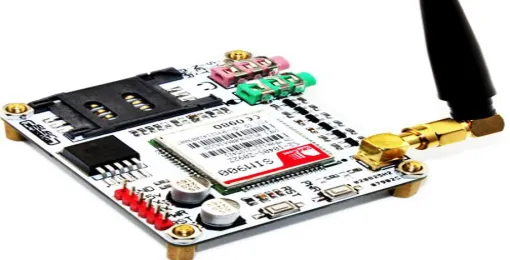
GSM module SIM900 is being used in the project here. It is just like a cell phone with all the facilities of sending and receiving a message, sending and receiving calls. It has a communication that can be programmed using AT commands. The signal names for the GSM modem communication port include the following; audio input and output pins (for connecting external hands free audio devices), mute control pin, flash programming signal pins, external power pins, and receiver and transmitter pins. Here the RX and TX pins are used for the serial communication with the microcontroller. There are various AT commands to check the signal strength and connection and SIM status etc. Here the Hyper Terminal is used to initially interface with the computer to check the module. It also has an antenna to receive the GSM signal from the user’s phone. The basic AT commands are loaded into the program of microcontroller for it to interface with the GSM module. The figure given below shows a GSM module it (e.g. 5v DC) to switch the power in a high voltage circuit
[image:3.612.179.434.585.715.2]
B. Interfacing of GSM with Microcontroller
These phases are created by the physical offset of the original power generator. In contrast to AC there is DC or direct current. DC doesn't alternate the current, it outputs a steady current to be applied to circuits. DC is useful in circuit design because many of the components do not function well if an AC is applied. AC is the current that is brought to a normal house wall socket. Through the wall socket many different devices are plugged in and used everyday but most of these devices need DC to operate correctly.
Figure3 : Interfacing of sim 900 with 8051 microcontroller
IV. RESULT
The project GSM SIM900 based automation with security using a microcontroller designed a complete remote handling. From owner GSM mobile sending a message to the GSM modem located in office or home is considered to be as an input and the respective action performed by the microcontroller by switching ON or OFF the relays is considered to be the output. In this project we have reduced the man power and have well maintaine d new technology of automation by using cellphones and GSM. So the need to physically present has been eliminated. It can be used at times when people want to operate and check the status of their home devices when they are outside the home or even outside the station. The only need for this system is that the network should be available during that particular time.
V. CONCLUSION
The project is aimed to design and implement a GSM based wireless control of house hold electrical appliances.. After doing different tests and programming different codes, eventually the obliged outcome is put forward. It is a fast and efficient approach to control the devices. This equipment works anywhere with a great gathering Of sign. At last the obliged result is attained with GSM module Sim900 based outline for effective and compelling result.
The project GSM SIM900 based automation with security using a microcontroller designed a complete remote handling. From owner GSM mobile sending a message to the GSM modem located in office or home is considered to be as an input and the respective action performed by the microcontroller by switching ON or OFF the relays is considered to be the output. In this project we have reduced the man power and have well maintained new technology of automation by using cellphones and GSM.
REFERENCES
[1] Baris Yuksekkaya, A. Alper Kayalar, M. Bilgehan Tosun, M. Kaan Ozcan, and Ali Ziya Alkar “A GSM, Internet and Speech Controlled Wireless Interactive Home Automation System”, 2006, IEEE Transactions on Consumer Electronics, Vol. 52(3) , pp. 837 - 843.
[2] Rozita Teymourzadeh,Salah Addin Ahmed,Kok Wai Chan and Mok Vee Hoong , “Smart GSM Based Home Automation System”, 2013, IEEE Conference on Systems, Process & Control, Kuala Lumpur, Malaysia.
[3] A. Alheraish, “Design and Implementation of Home Automation System”, 2004, IEEE Transactions on Consumer Electronics ,Vol. 50(4) , pp. 1087-1092. [4] M.Van Der Werff, X. Gui and W.L. Xu, “A Mobile based Home Automation System, Applications and Systems”, 2005, 2nd International Conference on
Mobile Technology, Guangzhou, pp.5
[6] Faisal Baig, Saira Baig, Muhammad Fahad Khan, “Controlling Home Appliance Remotely through Voice Command”, 2012, International Journal of Computer Applications , Vol. 48(17), pp.1 - 5.
[7] S.R.Bharanialankar, C.S.Manikanda Babu, “Intelligent HomeApliance Status Intimation Control and System Using GSM”, 2014, International Journal of Advanced Research in Computer Science and Software Engineering, Vol. 4(4), pp.554 - 556.