Reporting on Analysis of NSEP Physics MCQ Test
Madhav R. Rajwade11
Sathaye College, Dixit Road, Vile Parle (East), Mumbai 400057, India
Abstract: IAPT (Indian Association of Physics Teachers) conducts NSEP (National Standard Examination) in physics every year as a first step of prestigious Physics Olympiad Programme of the country. The Question paper for the examination has MCQ, Multiple Choice Question section in it. I present here analysis of this MCQ test {conducted in the academic year 2013-14}, based on Classical Test Theory1. Each item in the test is judged on the basis of indices prescribed in the Classical Test Theory. Based on these indices modification some of the items are suggested wherever necessary.
Keywords: MCQ Test, Classical Test Theory, Olympiad Programme.
I. INTRODUCTION
Indian Association of Physics Teachers conducts National Standard Examination as a part of Physics Olympiad Programme of the country. This study refers to an examination held in 2013-14, which had three sub- parts A1, A2 and B. Sub-part A1 ( 40 Questions) was Multiple Choice type with only one correct answer, sub-part A2 was also of multiple choice type with more than one correct answer. Part B however had questions which were essentially challenging Physics numerical problems. Based on classical test theory, only sub-part A1, has been analysed. Analysis of sub-part A1, means analysis of responses given by students to items in the MCQ test of sub-part A1. There are a total of 40 items which were attempted by each of 742 students who took this NSEP examination at 30 centres in Maharashtra. These centres were located in rural, semi-urban and urban areas of the state of Maharashtra. Methodology- Classical Test Theory [1, 2] defines following five indices for any item in an MCQ test.
A. Item Difficulty Level : P
N N
P 1
N1 = Number of correct responses. N = Total number of students taking the test. Range: 0.3 to 0.9
B. Item Discrimination Index : D
4
N N N
D H L
NH, NL are the number of correct responses in the top and bottom quartile respectively. ‘Quartile’, here means top 27% and bottom 27% students. The total scores obtained by students on this test was the criterion based on which top-down list of students was prepared.
Range : D ≥ 0.3
C. Point Biserial Coefficient: rpbi
pbi
r
x x P
P
x
1 0 1
1
x
= Average total score for those who have correctly answered an item.0
x
= Average total score for those who have incorrectly answered an item.x
= Standard deviation of total scores.D. Kuder – Richardson Index : rtest
Kuder Richardson Index
r
test
2 1 1 1 x i i P P K K K = number of test items.
Range : rtest ≥ 0.7
E. Ferguson’s Delta
1
2 2 2 2
K
N
N
f
N
i
if
= number of students whose total score is i.Range :
≥ 0.9Original MCQ test had 40 items but one of them (No.26 in the original test) is wrong. That has been omitted. Students’ (742) performance on all the remaining 39 items was tabulated in the form of a matrix with configuration of 742x 39. A correct response is indicated by 1 and an incorrect one by 0.
II. DATA
[image:3.612.162.455.405.731.2]An easy way to comply with IJRASET paper formatting requirements is to use this document as a template and simply type your text into it.
TABLE I : ITEM INDICES
Q. No. P D rpbi rtest δ
Q1 0.24 0.43 0.35 0.63 0.948
Q2 0.15 0.26 0.26
Q3 0.20 0.24 0.21
Q4 0.13 0.16 0.16
Q5 0.17 0.29 0.26
Q6 0.14 0.16 0.17
Q7 0.14 0.22 0.21
Q8 0.14 0.18 0.21
Q9 0.17 0.26 0.25
Q10 0.17 0.23 0.25
Q11 0.14 0.20 0.21
Q12 0.14 0.21 0.22
Q13 0.09 0.29 0.32
Q14 0.18 0.28 0.31
Q15 0.20 0.38 0.39
Q16 0.11 0.18 0.21
Q17 0.14 0.26 0.26
Q18 0.10 0.18 0.20
Q20 0.13 0.17 0.24
Q21 0.07 0.15 0.24
Q22 0.13 0.24 0.27
Q23 0.23 0.28 0.26
Q24 0.13 0.22 0.24
Q25 0.16 0.32 0.33
Q26 0.20 0.23 0.23
Q27 0.15 0.30 0.28
Q28 0.20 0.33 0.31
Q29 0.19 0.14 0.15
Q30 0.16 0.31 0.29
Q31 0.13 0.28 0.34
Q32 0.06 0.14 0.23
Q33 0.21 0.18 0.16
Q34 0.11 0.26 0.29
Q35 0.17 0.31 0.31
Q36 0.33 0.38 0.32
Q37 0.24 0.32 0.30
Q38 0.12 0.30 0.34
Q39 0.20 0.27 0.21
Computation of P,D, rpbi and rtest , δ for the test items and test as a whole have been listed in TABLE I above for each item in the MCQ test. Item no 26 in the original sub-part A01 is wrong which has been omitted. Items have been renumbered giving a total of 39 items, to this MCQ test. Indices within range have been left uncoloured whereas those outside the range have been coloured.
III.RESULTSANDDISCUSSION
It is seen that total scores of students is low indicated by low P of all items except no. 33. This indicates that this test is a tough one for all the students of this study. As stated this test is a part of Olympiad programme, meant to identify students proficient in Physics. That requires the items in the MCQ test to be challenging items. Further, it is seen that D is low for all items except item numbers 1, 15, 19,25,28,30,35,36,37. Even for these items the value of D is beyond 0.3 as required but barely just above it. That indicates that the items are not of such nature which can separate students over wide range of scores. This is evident from the fact that top scorer is with 17 out of 39 and the lowest being 0 among a total of 742 students giving us a SD of students’ scores as 3.66. This low value of SD indicates that the scores are not too spread out.
In fact there is only one student with top 17 marks, 5 students with 16 marks, 7 students with 15 marks and 23 students with 0 marks and so on. A test of this kind is expected to identify talented students who would be high scorers. That has not happened here. rpbi for all item numbers, except No 4, No 6, No 18, No 29 and No 33 have rpbi is within range i.e. > 0.2, which is a measure of individual item reliability. A reliable item should be consistent with the rest of the test, so fairly high correlations between the item score and total score is expected. This is indicated by rpbi being within range.
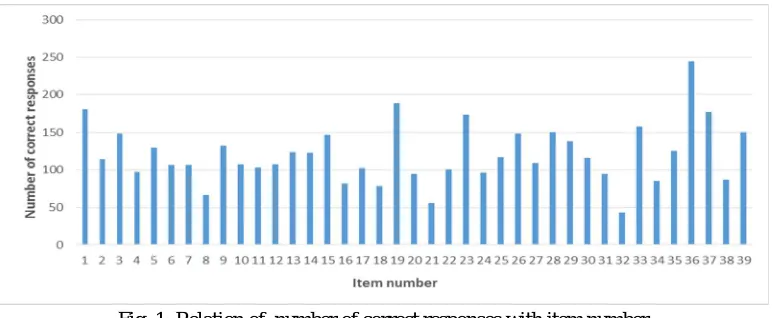
0.948 above prescribed value is 0.9 indicating good discriminating power of test as a whole. It must be noted that the test as a whole is good discriminator power but discriminating index of each item is low for most of the items. This is because total scores are low due to lack of preparation or motivation among students. In order to further investigate students’ performance on individual items we consider 3 items each from following two categories, Category I:- a large number of students correctly answer an item and Category II:- relatively small number of students answer the item correctly. This is identified easily from Graph I.
Fig. 1: Relation of number of correct responses with item number
Item numbers 1, 19 and 36 are identified in the Category I whereas item numbers 8, 21 and 36 are identified in the Category II.
A. Category I Items
The impedance of the RL circuit given in the adjacent figure is expressed by the relation Z2 = A2 + B2 . Then the dimensions of AB are
(a) [M1L2I-2T-3] (b) [M2L4I-4T-6] (c) [M1L-1I-2T-3] (d) [M-1L-2I2T4]
1) Discussion: This item requires that students know dimensions of resistance. Further they are expected to know that the product AB would have same dimensions as that of A2. This item was correctly answered by 181 students. In this sample it is a fairly high number comparatively but considering the nature of examination much larger number is expected. A certain quantity of oxygen ( = 7/5) is compressed isothermally until its pressure is doubled (P2). The gas is then allowed to expand adiabatically until its original volume is restored. Then the final pressure (P3) in terms of initial pressure (P1) is
P3 = 0.55 P1 (b) P3 = 0.76 P1 (c) P3 = 0.68 P1 (d) P3 = 2.55 P1
2) Discussion: This item is correctly answered by 188 students. It only requires that students have concepts of isothermal,
adiabatic compressions and expansions. A very easy problem of numerical kind which should have been attempted successfully by larger number of students.
A body A revolves along a circular orbit close to the earth’s surface. Body B oscillates along an imaginary straight tunnel drilled through the earth, whereas another body C through a similar longest tunnel. Let TA, TB and TC be the corresponding periods of revolution or oscillation, then
(a) TA > TB = TC (b) TA > TC > TB (c) TA = TB = TC (d) TA < TB = TC
This is a highly conceptual problem. A total of 125 students got it right. It requires conceptual clarity about equivalence of UCM and SHM The vibrations of a string of length 100 cm and fixed at both ends are represented by the equation: y = 2 sin ( x / 10) cos (50 t). then the equations of the component waves whose superposition gives the above vibrations are
(a)
t x t
x 50 10 sin 2 50 10 sin
2 (b)
t x t
(c)
t x t
x 50 10 sin 50 10
sin (d)
t x t
x 50 10 sin 2 50 10 sin 2
3) Discussion: this is a straight forward numerical problem, correctly attempted by 245 students. This relatively large number has appeared due to students visual
B. Category II Items
A bead of mass 5.0 g can move without friction on a piece of wire bent in the form of a semicircular ring of radius 0.10 m, as shown in the adjacent figure. This ring can freely rotate about the vertical axis OY. At what height will the bead stay above the ground level OX, if this semicircular are revolves with angular velocity 10.63 rad / s?
(a) 0.013 m (b) 0.087 m (c) 0.027 m (d) 0.073 m
1) Discussion: This problem which requires visualization power was correctly solved by only 66 students. This low score for this item means very few students have correct conception of centrifugal forces.
21. 43 m long rope of mass 5.0 kg joins two rock climbers. One climber strikes the rope and the second one feels the effect 1.4 s later. What is the tension in the rope?
(a) 110N (b) 301N (c) 215N (d) 154N
2) Discussion: This is another numerical type of problem. Only 55 students got it right. Low score has to be attributed to a fact that the problem does not say that the string is taut, hinting wave propagation.
A ray of white light falls on an isosceles prism at such an angle that the red light leaves the prism perpendicular to the other face of the prism. Find angle of deviation if the refractive index of the prism for red light is 1.37 and refracting angle of prism is 45o.
(a) 20o37’ (b) 28o37’ (c) 35o37’ (d) 30o37’
3) Discussion: Another straight forward numerical item attempted only by 43 students. This low score only points towards poor preparation.
IV.CONCLUSIONS
Five indices described reveal the character of the test under consideration. It follows from the results and discussion section that students may have been ill prepared for the test. That is the reason for all indices are just above the qualifying range. This analysis shows that the items are well designed and are capable of identifying students’ talent in Physics. Specially = 0.948 indicates high discriminating power of the entire test for the selected sample. However, the top scorer should have been higher than the reported value.
REFERENCES
[1] Lin Ding, Robert Beichner, Approaches to data analysis of multiple choice questions, Phys. Rev. ST Phys. Educ. Res. . 2009, Vol. 5(2), p. 2010301.