Technology (IJRASET)
Enhancing VM Migration Performance in Cloud
Environment
Navnit Kumar1, Sachin Majithia2, Gagandeep Singh3 1
Student, 2,3Assistant Professor
Department of IT, Chandigarh Engineering College, Landran, 140307
Abstract— Cloud computing is a technology that used for distributed computing, on a network. It is meant network-based services that these services are provided by virtual ISPs. Virtual machine migration has been tout as one of the crucial technologies that improving data center efficiency, such as maintaining load balance and reducing energy cost. However, traditional approaches of could not avoid the service interruption completely. These techniques are deficient, when the entire cluster needs to be migrated. In these methods, Moreover, they often result in longer delay and are liable to failures. In this paper, we discussed the migration techniques existing today, and proposes a new approach of VM migration. In new approach we uses the monitoring technique for take decision of destination host and a additional hardware is use for pre-copy of process data and sent to destination host during the VM migration process. which reduces the total migration time of virtual machine in datacenter. Migration refers to a transparent transfer of an active guest or virtual machine from a source server to a chosen destination server.
Keywords — Cloud Computing, datacenters, Virtualization, Virtual Machines (VMs), VM migration.
I. INTRODUCTION A. Cloud Computing
Cloud computing is a technology that allows you to access information or application that inhabit on computer other than your
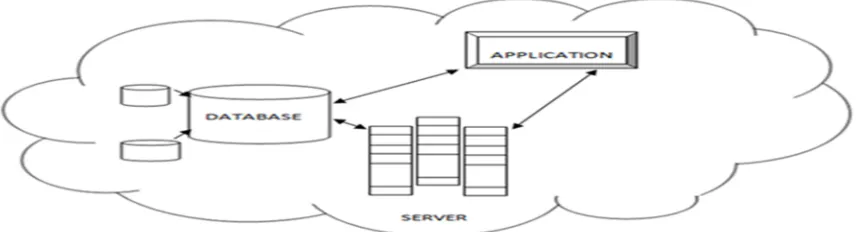
computer and other internet connected device[1] . The best part of cloud computing is that other company hosts your application. This means that they manage the costs of servers, they manage the software updates, and—depending on how you make up your contract, you pay less for the service[2]. It’s also tractable for telecommuters and traveling remote workers, who can merely log in and use their applications wherever they are. The cloud also consists of Server & a Database[3]. Server is also known as Cloud-Provider; while Database is a hoard of user-details and applications to be worked upon by users. Computing is the term terminology used for services of cloud. Cloud computing generally provides three types of service models. Infrastructure as a Service (IaaS), Platform as a Service (PaaS), Software as A Service (SaaS). Cloud can be installed as public cloud, private Cloud and hybrid cloud and community cloud[4][5].
[image:2.612.95.525.509.625.2]
Figure 1. Overview of Cloud Computing
B. Virtualization
Technology (IJRASET)
timesharing techniques were developed [6].
Multiprogramming, multitasking and timesharing formed the fundamental of virtualization. Virtualization is the technique which
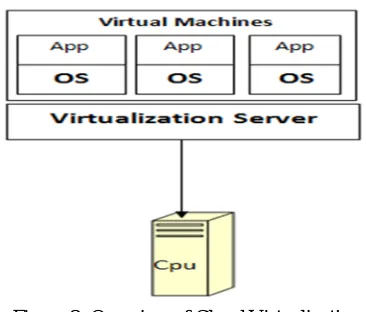
divides physical machine into severalwholly isolated machines known as virtual machines [5]. Virtualization is the notion of
hardware resources to have better resource sharing. We have different kind of virtualization such as server virtualization, operating System virtualization, network virtualization, Hardware emulation, storage virtualization, Full virtualization etc. Thus virtualization
[image:3.612.213.396.175.331.2]reduces expenditure , installation and operational cost price for organization[6].
Figure 2. Overview of Cloud Virtualization
In computing the cloud platform increases the resources availableness and the flexibility of their management (allocation, migration, etc.). It also minify the cost through hardware multiplexing and helps energy saving[7].
C. Virtual Machine(VMs) Migration
Virtual Machine(VMs) migration is crucial feature of virtualization defined as a process of dynamically transferring running VMs from one physical server to another with little downtime and without interrupting services running in VM. Downtime is the total time for which VM abolish running. Migration aid System administration in cases like fault tolerance, system maintenance, workload balancing and consolidation of VMs. Also in case of natural disasters Migration flirt very important role in recovery process. Limited resources on same physical machine running multiple VMs causes resource duel due to which physical machine may fail to serve continuously .Hence, to avoid failure of VMs migration is the solution to have continued and unmitigated service. At present migration is performed manually. Most of open source hypervisors like Xen, VMware‘s, Oracle‘s, KVM Virtual box etc supports migration[8].
[image:3.612.175.436.511.700.2]Technology (IJRASET)
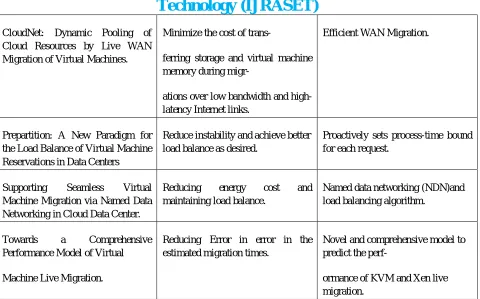
II. LITERATURESURVEYJiaqiang Liu, Li Su et al. investigate the problem of virtual machine migration planning to minimize the total migration time. They formulate VM migration planning as an optimization problem considering both computation and bandwidth constraints. His formulation is based on a step-by-step migration scheme, where multiple VMs can be migrated simultaneously as long as the resource constraints are satisfied. They find solution of the optimization problem outputs the migration plan which achieves the minimum time to finish the migration task. Moreover, They verify the effectiveness of the optimal migration plan through extensive simulations and comparison with the best algorithm in existing works[9].
Timothy Wood, K. K. Ramakrishnan at el. introduced and present the CloudNet architecture consisting of cloud computing platforms linked with a virtual private network (VPN)-based network infrastructure to provide seamless and secure connectivity between organization and cloud data center sites. They realize a vision of efficiently pooling geographically distributed data center resources, CloudNet procured optimized support for live WAN migration of virtual machines. Specifically, they present a set of optimizations that minimize the cost of transferring storage and virtual machine memory during migrations over low bandwidth and high-latency Internet links. They evaluate system on an operational cloud platform distributed across the continental US. During simultaneous migrations of four VMs between data centers in Texas and Illinois, CloudNet’s optimizations reduce memory migration time by 65% and lower bandwidth consumption for the storage and memory transfer by 19 GB, a 50% reduction[10]. Wenhong Tian at el. propose a new paradigm-Prepartition: it predefined sets process-time bound for each request on each PM and equip in advance to migrate VMs to achieve the predefined balance goal. Prepartition can purse process time by preparing VM migration in advance and therefore purse instability and achieve better load balance as desired. Trace-driven and synthetic simulation results show that Prepartition has 10%-20% better performance than the well known load balancing algorithms with invigilate to average CPU utilization, makespan as well as capacity make span[11].
Ruitao Xie, at el. In this paper, They leverage the emerging named data networking (NDN) to adumbrate an efficient and definitive protocol to support seamless virtual machine migration in cloud data center. Specifically, virtual machines (VMs) are named with the services they provide. Request routing is rooted on service names substitute of IP addresses that are bounded simply with physical machines. As such, services would not be barred when migrating supported VMs to different physical machines. They further analyze the performance of our projected NDN-based VM migration protocol, and edify its performance by dint of load balancing algorithm. Our extensive appreciation verify the effectiveness and the efficiency of our approach and demonstrate that it is interruption-free[12].
Senthil Nathan at el. propose a novel model that takes all these parameters into account. Author present a thorough validation with 53 workloads and show that the 90 percentile error in the estimated migration times is only 12% (8 sec) and 19% (14 sec) for KVM and Xen live migration, respectively[13].
Wes Felter, at el. explore the performance of traditional virtual machine deployments, and contrast them with the use of Linux containers. They use a suite of workloads that stress CPU, memory, storage, and networking resources and use KVM as a representative hypervisor and Docker as a container manager. Results show that containers result in equal or better performance than VMs in almost all cases. Both VMs and containers require tuning to support I/O-intensive applications. Writer also discusses the implications of our performance results for future cloud architectures[14].
Title of Paper
Advantages
Techniques
Optimal VM Migration Planning for Data Centers.
The solution of the optimizati-
On problem output the migrat-
Ion plan which achieves the
minimum time to finish the
migration task.
Technology (IJRASET)
CloudNet: Dynamic Pooling of Cloud Resources by Live WAN Migration of Virtual Machines.
Minimize the cost of trans-
ferring storage and virtual machine memory during migr-
ations over low bandwidth and high-latency Internet links.
Efficient WAN Migration.
Prepartition: A New Paradigm for the Load Balance of Virtual Machine Reservations in Data Centers
Reduce instability and achieve better load balance as desired.
Proactively sets process-time bound for each request.
Supporting Seamless Virtual
Machine Migration via Named Data Networking in Cloud Data Center.
Reducing energy cost and
maintaining load balance.
Named data networking (NDN)and load balancing algorithm.
Towards a Comprehensive
Performance Model of Virtual
Machine Live Migration.
Reducing Error in error in the estimated migration times.
Novel and comprehensive model to predict the perf-
[image:5.612.69.549.62.361.2]ormance of KVM and Xen live migration.
Table 1.1 Comparison of some research papers.
III.PROPOSEDTECHNOLOGY
The above comparison discursion defined in the previous section shows, All data center consume more time to virtual machine
migration when physical machine is breakdown or overload. During the live migration, we waste more time to copy and send data
from source to destination host Survey and documents shows, As a result VM migration waste eighty percent time to copy the process data, decision of destination host in VM migration and the another factor is we loose more process data when migration is performed and migration downtime is increased.
In this research proposal, we deploy a new data center model to achieve above problem, That reduce the migration time of VM and
increased the migration performance also. The new data center model reduce the data lose probability using pre copy method .A new hardware is add with the physical resources that will make the data backup of current process and send the data to destination where the migration process will performed. A indexing method is show which physical resources is under lord, The index is update automatic when the physical resources is change the load state.
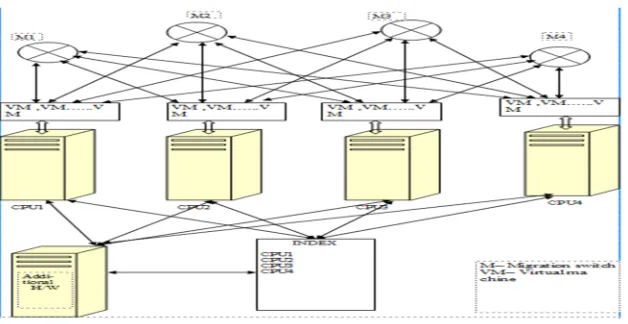
we will create a data center, that have four CPUs. VMs are run on CPUs. Migration switch is connected to all physical resources and additional host is store the copy of current process data for future uses.
The index is show the state of physical machine (which is under flow or which machine is overflow) and it also show the physical machine utilization percentage.
If any physical machine is over load or physical machine is failure then migration is start Virtual machine is migrate from one physical machine to other.
Index will show that which physical machine is under load. Under lord machine will top in the list of index.
Technology (IJRASET)
Additional H/W send the process data of VM to migration host. [image:6.612.150.464.123.285.2]After completing task, save data of current process will delete.
Figure 4. The detailed new approach migration process
IV.CONCLUSION
In this paper, we investigate the problem of VM migrations in the cloud data center. We have proposed a VM migration process Model that based on pre-copy approaches. The proposed migration process is fast as there is no waiting for the complete VM
image to be transferred before the destination VM can be started. By making use of the attached a hardware, A new hardware is add
with the physical resources that will make the data backup of current process and send the data to destination where the migration process will performed. Instead of copying the entire memory image of the VM, we are transferring the execution log and copy data by further reducing the volume of data to be migrated. Lastly, taking advantage of the similar images of VMs of the same application, we have formed clusters of VMs so as to restrict the migration distance within the cluster itself.
REFERENCES
[1] Sachin Majithia, Suman Kumar Mishra, “Scheduler for Minimum Energy Consumption and Better Job Management in Data Center”, 2015(June) Volume 3 Issue VI.
[2] Sachin Majithia, Suman Kumar Mishra, “Hybrid Scheduler Hybrid Scheduler for Minimum Energy Consumption and Optimised Job Management in Data Centre”, 2015(August) Volume 3 Issue VIII.
[3] Hassan, Qusay (2011). "Demystifying Cloud Computing". The Journal of Defense SoftwareEngineering (CrossTalk) 2011 (Jan/Feb): 16–21. [4] Xu, X. (2012) From Cloud Computing to Cloud Manufacturing. Robotics and Computer- Integrated Manufacturing, 28, 75-86.
[5] Svantesson, D. and Clarke, R. (2010) Privacy and Consumer Risks in Cloud Computing. Computer Law & Security Review, 26, 391-397. [6] Graziano, Charles. "A performance analysis of Xen and KVM hypervisors for hosting the Xen Worlds Project".
[7] Turban, E; King, D; Lee, J; Viehland, D (2008). "Chapter 19: Building E-Commerce Applications and Infrastructure". Electronic Commerce A Managerial Perspective. Prentice- Hall.
[8] Haikun Liu and Bingsheng He; ; APRIL-2015 “VMbuddies: Coordinating Live Migration of Multi-Tier Applications in Cloud Environments” Division of
Networks and Distributed Systems, School of Computer Engineering of Nanyang Technological University, Singapore.
[9] Jiaqiang Liu, Li Su, Yuchen Jin, Yong Li, Depeng Jin and Lieguang Zeng ; AUGUST- 2014 “Optimal VM Migration Planning for Data Centers” Department of Electronic Engineering, Tsinghua University, Beijing 10084, China.
[10] Timothy Wood, K. K. Ramakrishnan “CloudNet: Dynamic Pooling of Cloud Resources by Live WAN Migration of Virtual Machines” Computer Science Department, The George Washington University, Washington, DC, USA.
[11] Wenhong Tian, Minxian Xu, Yu Chen, Yong Zhao “Prepartition: A New Paradigm for the Load Balance of Virtual Machine Reservations in Data Centers” School of Computer Science and Engineering University of Electronic Science and Technology of China, Chengdu, China.
[12] Ruitao Xie, Yonggang Wen, Xiaohua Jia, Fellow, IEEE and Haiyong Xie ; MARCH- 2014 “Supporting Seamless Virtual Machine Migration via Named Data Networking in Cloud Data Center” Department of Computer Science at City University of Hong Kong.
[13] Senthil Nathan, Umesh Bellur, and Purushottam Kulkarn “Towards a Comprehensive Performance Model of Virtual Machine Live Migration” Department of Computer Science and Engineering, IIT Bombay.