www.ijraset.com Volume 4 Issue IV, April 2016 IC Value: 13.98 ISSN: 2321-9653
International Journal for Research in Applied Science & Engineering
Technology (IJRASET)
©IJRASET: All Rights are Reserved
30
Automated Malaria Detection from Blood Samples
Using Image Processing
R.Yogapriya1, S.Supriya2, S.Sushmitha3, L. Raji4
1
UG, 2Asst.Professor , Department of IT, R.M.K Engineering College, Chennai.
Abstract--Malaria is a life-threatening parasitic disease, caused by the protozoan parasites of the genus Plasmodium and is transmitted through the bite of a female Anopheles mosquito. During this process, the red blood cells (RBCs) are used as hosts and are destroyed afterwards. It is an important determinant in selecting the appropriate treatment and drug dose. Here we are going to propose a method to detect the presence of malaria causing parasites in human blood by applying various image processing techniques on the microscopic images of the blood samples.
Keywords: Malaria Detection, Image acquisition, RBC count, Stained object detection.
I. INTRODUCTION
Malaria is a curable disease if the patients have access to early diagnosis and prompt treatment. Antigen-based rapid diagnostic tests (RDTs) have an important role at the periphery of health services capability because none of the rural clinics has the ability to diagnose malaria on-site due to a lack of microscopes and trained technicians to evaluate blood films. Furthermore, in regions where the disease is not endemic laboratory technologists have very limited experience in detecting and identifying malaria parasites. An ever increasing numbers of travelers from temperate areas each year visit tropical countries and many of them return with a malaria infection. The RDT tests are still regarded as complements to conventional microscopy but with some improvements it may well replace the microscope. The tests are simple and the procedure can be performed on the spot in field conditions. These tests use finger-stick or venous blood, the completed test takes a total of 15–20 minutes, and a laboratory is not needed. The threshold of detection by these rapid diagnostic tests is in the range of 100 parasites/µl of blood compared to 5 by thick film microscopy. To detect infection of malaria in human blood sample using various image processing techniques.
II. MALARIA ANTIGEN DETECTION
Malaria antigen detection tests are a group of commercially available rapid diagnostic test that allow quick diagnosis of malaria by people who are not otherwise skilled in traditional laboratory techniques for diagnosing malaria or in situations where such equipment is not available. There are currently over 20 such tests commercially available (WHO product testing 2008). The first malaria antigen suitable as target for Rapid Diagnostic Tests (RDTs) was a soluble. None of the rapid tests are currently as sensitive as a thick blood film, nor as cheap. A major drawback in the use of all current dipstick methods is that the result is essentially qualitative. In many endemic areas of tropical Africa, however, the quantitative assessment of parasitaemia is important, as a large percentage of the population will test positive in any qualitative assay.
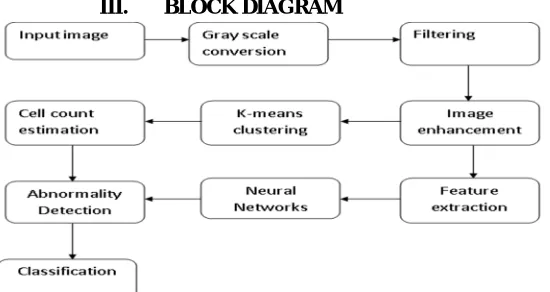
[image:2.612.189.464.554.700.2]III. BLOCK DIAGRAM
©IJRASET: All Rights are Reserved
31
image processing techniques on the microscopic images of the blood samples.
IV. PRE-PROCESSING
A. Gray Scale Conversion
It converts the true color image RGB to the gray-scale intensity image I. The rgb2gray function converts RGB images to gray-scale by eliminating the hue and saturation information while retaining the luminance.
Figure 2: Microscopic images of malaria blood samples
B. Median Filter
The median filter is a nonlinear digital filtering technique, often used to remove noise. Such noise reduction is a typical pre-processing step to improve the results of later pre-processing.
C. Enhancement
Image enhancement is the process of adjusting digital images so that the results are more suitable for display or further image analysis. For example, you can remove noise, sharpen, or brighten an image, making it easier to identify key features.
V. K-MEANS CLUSTERING
Place K points into the space represented by the objects that are being clustered. These points represent initial group centroids. Assign each object to the group that has the closest centroid. When all objects have been assigned, recalculate the positions of the K centroids. Repeat Steps 2 and 3 until the centroids no longer move. This produces a separation of the objects into groups from which the metric to be minimized can be calculated.
VI. DISCRETE WAVELET TRANSFORMATION
In numerical analysis and functional analysis, a discrete wavelet transform (DWT) is any wavelet transform for which the wavelets are discretely sampled. DWT show a better performance in spatial and spectral quality of an image compared to other transformation methods.
VII. NEURAL NETWORKS
Artificial neural network (ANN) is a machine learning approach that models human brain and consists of a number of artificial neurons. Neuron in ANNs tend to have fewer connections than biological neurons. Each neuron in ANN receives a number of inputs. An activation function is applied to these inputs which results in activation level of neuron (output value of the neuron).
www.ijraset.com Volume 4 Issue IV, April 2016 IC Value: 13.98 ISSN: 2321-9653
International Journal for Research in Applied Science & Engineering
Technology (IJRASET)
[image:4.612.182.468.73.245.2]©IJRASET: All Rights are Reserved
32
Figure 3: Malarial detection
The above diagram gives the details about malarial detection. Malaria must be recognized promptly in order to treat the patient in time and to prevent further spread of infection in the community via local mosquitoes. Malaria should be considered a potential medical emergency and should be treated accordingly. Delay in diagnosis and treatment is a leading cause of death in malaria patients in the United States
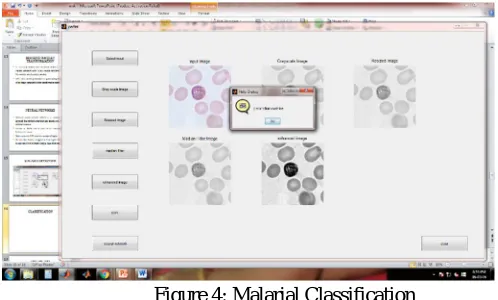
Figure 4: Malarial Classification
Malaria can be suspected based on the patient's travel history, symptoms, and the physical findings at examination. However, for a definitive diagnosis to be made, laboratory tests must demonstrate the malaria parasites or their components.
IX. ADVANTAGES
Edge detection optimizes RBC count detection.
Labelling algorithm has been introduced which reduces the error rate of detection in state of art method.
Bio medical application in Detection of Malaria.
REFERENCES
[1] D. W. T. Crompton, D. Daumerie, P. Peters, and L. Savioli, Working to overcome the global impact of neglected tropical diseases first WHO report on neglected tropical diseases. Geneva, Switzerland: World Health Org., 2010.
[2] C. R. Caffrey, “Chemotherapy of schistosomiasis: Present and future,” Curr. Opin. Chem. Biol., vol. 11, no. 4, pp. 433–439, Aug. 2007.
[3] S. Nwaka and A. Hudson, “Innovative lead discovery strategies for tropical diseases,” Nature Rev. Drug Discov., vol. 5, no. 11, pp. 941–955, Nov. 2006. [4] D. C. Swinney and J. Anthony, “How were new medicines discovered?,” Nature Rev. Drug Discov., vol. 10, no. 7, pp. 507–519, Jun. 2011.
[image:4.612.182.431.324.474.2]