Wireless Machine to Machine (M2M) based
e-Healthcare System
Dr.Prakash.H.Patil1, Seema.V.Kamkhedkar2
1
Professor, 2Student , 1,2Department of Electronics & Telecommunication,
Abstract - Nowadays, machine-to-machine (M2M) communication is being considered as the most promising solution for the future intelligent pervasive applications. It provides a framework to develop services in different fields such as smart metering, remote monitoring, security, health care etc .This article presents the design of an M2M based platform architecture and prototype implementation of e-healthcare system based on android mobile and IPv6 techniques in a wireless sensor network to monitor the health condition of patient .The proposed system can be used over low power wireless personal area network (6LoWPAN) with mobile technique ,whether sensors located inside or outside of wireless sensor networks. For wireless transmission these sensors are connected to M2M node through internet or IPv6 network. This system provides a wide range of effective and convenient healthcare services by using global network. This helps to set up the communication between sensor device and doctor. In this, visualization module of the server program can graphically displays the recorded biomedical signals on Android mobile devices which used by patients and doctors in real-time at the end of network.
Keywords - Android Mobile, e-Healthcare, IPv6, Machine to Machine Network, , Wireless personal area network.
I. INTRODUCTION
As the Information and Communications technologies are transforming our social interactions, our lifestyles and our workplaces. One of the most promising applications of information technology is healthcare and wellness management. Healthcare is moving from reactive responses to acute conditions to a proactive approach characterized by early detection, prevention and long-term healthcare management. The health condition monitoring is particularly important in chronic conditions that is in treatment of cardiovascular diseases . so continuous monitoring & recording of biomedical signals such as Electrocardiogram (ECG) & Photoplethysmogram (PPG) gives realistic view of patients heart condition. so that we can track high blood pressure, anxiety, stress, depression and diabetes etc in normal daily routines of patients' life. Hence the recorded biomedical signal helps the doctors to analyze the patients' state and allows development of warning system [1].
With the medical science, we can use Machine-to-Machine (M2M) technology to help the doctors by collecting patients’ information (such as pulse rates, temperature, HRR etc. ). The sensors kept in the patients’ body automatically send the information to the application server via M2M network [2]. Here a low-power embedded wearable sensor measures the health parameters dynamically and is connected according to the concept of IPv6 over low-power wireless personal area network to the M2M node for wireless transmission through the internet or external IP-enabled networks via the M2M gateway [5]. Health care could be used as a life-saver by monitoring the patient’s condition in real-time. When the condition of patient becomes acute, the messages from sensor must arrive to the hospital immediately. Follow the warning messages; the doctor does some emergency measures for patient. So provides the Quality of life. This would bring several benefits, such as decreased healthcare costs, by increasing health and, doctor-to-patient efficiency and collaboration among doctors etc. As Compared to wired solutions, the wireless transmission for monitoring provides several advantages. The patient mobility will be improved, and that it will provide the opportunity for monitoring patients outside the health institutions. Patients' well-being and retention of health care has also influenced the recovery time. A transition to wireless systems will therefore help to improve patients' wellbeing and reduce recovery time [7].
In this paper the Section I describes about overview of healthcare system. Section II deal with related work. Section III descries about system architecture and design. Section IV shows result. Finally we conclude the paper in section V.
II. LITERATURE SURVEY
A. Recently, the European Telecommunications Standards Institute (ETSI) has launched the M2M Technical Committee with
the purpose of developing an end-to-end architecture for M2M communications [11].
C. Recent technological advances in M2M systems together with the rise of M2M communications over wired and wireless links allow the design of lightweight, low-power sensors at low cost for wearable sensor networks, integrated circuits, and wireless communication[7].
D. The evolution of M2M systems began with the development of a wireless sensor network with the help of an IPv6 technique [13]. Advances in M2M networks allow the establishment of wireless sensor networks by the efficient addressing mechanism of IPv6 over the IEEE 802.15.4 standard to every node to enhance the quality of data transmission and extend healthcare service coverage .
E. With advances in mobile communication, new opportunities have opened up for the development of healthcare systems that remotely monitor biomedical signals from patients by using global networks.
F. The availability of a new generation of mobile phones has had an important impact on the development of such healthcare systems, as they seamlessly integrated with a wide variety of networks (such as 3G, Bluetooth, wireless LAN, WCDMA and GSM) [11].
G. Hence enable the transmission of recorded biomedical signals to doctors or patients from a central server located in a hospital, home, or office [16].
H. A smart phone presents a programmable monitoring platform for healthcare as people go about their daily lives [17].
III. SYSTEM ARCHITRCTURE & DESIGN
[image:3.612.150.498.339.448.2]In this section, we describe the system that uses modern wireless communication and information technologies to provide clinical care to remote located individuals. The system is mainly divided into two sections Hardware design & software design. The Hardware section includes M2M device (i.e sensors), M2M node, M2M gateway & android mobile device shown in Fig 1.The overall architecture of the proposed personal M2M e-healthcare system used to monitor patient health states.
Fig. 1. System architecture of a personal M2M healthcare solution A. Hardware design
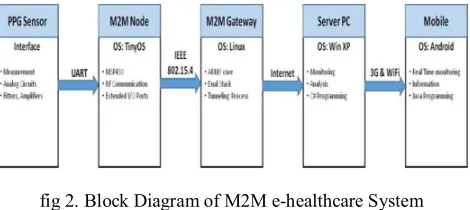
1) M2M Device: In proposed system M2M device is capable of replying to request for data contained within those devices are capable of transmitting data autonomously. The M2M devices are mainly consist of sensors designed to measure and transmit the PPG signals wirelessly [6]. Here we used spo2 sensor to detect pulse rate. It is generally placed on a thin part of the patient's body, usually a fingertip or earlobe. Light of two wavelengths is passed through the patient to a photo detector to detect the pulse rate [8]. The PPG sensor is designed to design to measure PPG waveform and oxygen saturation level by calculating red and infrared on device surface. The PPG sensor consist of analog circuits, filters & amplifiers as signals are too weak and distorted so signal processing is required. As shown in fig 2.
fig 2. Block Diagram of M2M e-healthcare System
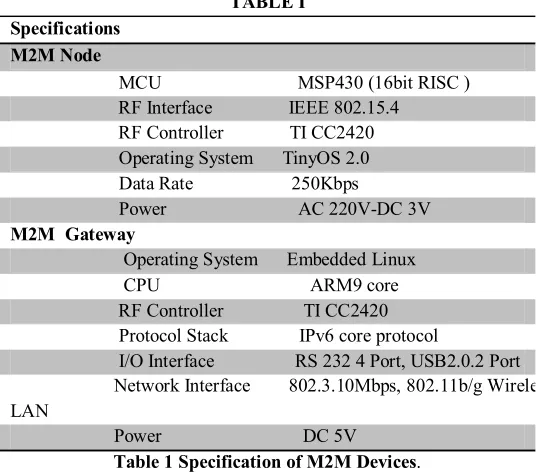
[image:3.612.190.425.584.689.2]transmitting & receiving the sampled signals at 75 Hz for the PPG signals to the M2M gateway. This M2M node consists of a Microcontroller unit (MCU), Radio frequency (RF) transceiver chip and battery and transfers the measured biomedical signals to an M2M gateway connected to the internet [11]. For global network communication, 6LoWPAN is connected to external IP-enabled networks by M2M gateways. A Low power personal area network (6LoWPAN) and mobile communication, the system offers excellent flexibility and scalability. For practical measurements, an M2M node, with integrated health sensors, collects and sends biomedical signals. At the server, a server program monitors and analyzes the transmitted biomedical signals and network topologies. Then, the program verifies the recorded sensing values and analysis results, combining them with personal data before sending this information to an Android mobile for user access within any internet supported area. A Tiny OS-based M2M node is allocated its own IP address by the M2M gateway over IPv6 packets [14]. Table I. shows specification of M2M devices.
TABLE I Specifications
M2M Node
MCU MSP430 (16bit RISC ) RF Interface IEEE 802.15.4
RF Controller TI CC2420 Operating System TinyOS 2.0 Data Rate 250Kbps
Power AC 220V-DC 3V
M2M Gateway
Operating System Embedded Linux CPU ARM9 core RF Controller TI CC2420 Protocol Stack IPv6 core protocol
I/O Interface RS 232 4 Port, USB2.0.2 Port Network Interface 802.3.10Mbps, 802.11b/g Wireless LAN
Power DC 5V
Table 1 Specification of M2M Devices.
2) Android Mobile Device: When the server program sends received data wirelessly to the patient’s Android mobile device. Various algorithms are combined into mobile application software created with the Java Android language to handle all server processes. Query processes handle communication between the server and the Android mobile device for a graphic real-time display of biomedical signals on the screen [9]. The mobile monitoring program can be implemented on an Android mobile phone running a 1 GHz ARM processor and Android operating system (OS) version 2.3.6. Through wired or wireless internet connections, the server connected to different types of mobile devices and performed a range of development tests on them [15]. The presented system is flexible in operation, functionality and in cost provides high interoperability, integration, and interface. Table II. Summarizes a comparison of conventional system and M2M based system indicates advantages offered by M2M [11].
TABLE II
Features Conventional System M2M based System
Operation Fixed type of operation Variable Operation
Capacity Difficult to vary and rearrange
facility
Easy to vary & rearrange facility
Cost High cost Low cost
Flexibility Fixed capacity for pollution
facilities
Flexible capacity for pollution facilities
Efficiency Manual capture system hence Low
Efficiency
B. Software design
In terms of architecture, software for the personal M2M healthcare system falls into three parts: TinyOS programming in the M2M nodes, tunneling processes in the M2M gateway for network access and server application program. These parts will be discussed in the following sections.
1) TinyOS programming: The proposed M2M nodes run on TinyOS, an open source operating system mainly for wireless embedded sensors, which was developed by the University of California, Berkeley, in co-operation with Intel Research. [15] For TinyOS programming, TinyOS 2.x version is used to enable device identification (ID) based on unique IPv6 addresses (IPv4/IPv6 dual) using Kubuntu. It is an operating system built by a worldwide team of expert developers, and it is used for Tiny OS programming. [15].
2) Gateway tunneling: By using of the IPv6 technique, 6LoWPAN provides an extension to IP-based sensor networks to enhance the coverage area of such applications as the personal healthcare application presented here. The application’s M2M gateway provides reliable IPv6 communication for transmitting biomedical signals to a doctor or server via the internet and Utilizing IPv6 over the IEEE 802.15.4. [13]. As each M2M node is assigned a unique IPv6 address, they can directly communicate with each other, offering higher accessibility In IPv6 communication, each IPv6 address must be defined at the M2M gateway and server PC. As IP networks can usually be accessed by IPv4 addresses, the IPv6 to IPv4 tunneling process, which changes IPv4 addresses to IPv6 addresses at the M2M gateway, is required to access the server PC through the internet through tunneling process.[12]
[image:5.612.177.437.382.547.2]
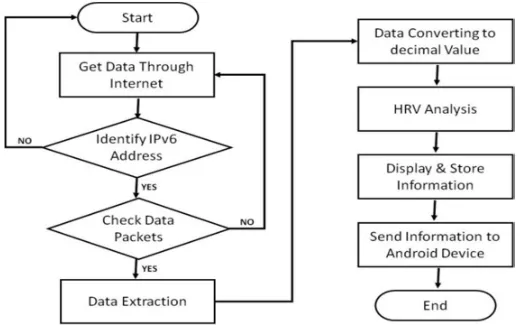
3) Server program: Measured biomedical signals are sent through the internet by the M2M gateway to the server PC for processing [16]. A monitoring and analysis graphical user interface (GUI) was designed with the C# language to monitor, store and process the received data. On receiving a data packet through the M2M devices, the monitoring programme processes it, extract the useful data, as illustrated in Fig. 3
Fig. 3. Flowchart of the data process on the server
On reception, the sender’s IPv6 address is identified to ensure that the aggregated data is from the correct M2M device source. Then, the received data are scanned to ensure that the data packet is complete. This monitoring program monitors biomedical signals as well as information about the M2M devices, including current communication settings and IPv6 addresses in real-time [11]. All packets transmitted through the internet are verified by the server monitoring program.
Having received all transmitted packets via UDP communication, the monitoring program stores the values of the measured biomedical signals in a database and plots them dynamically. This monitoring program also displays the recorded values along with other relevant information, such as ECG and PPG waveforms, heart rate and the IPv6 addresses of the M2M node, M2M gateway and server IP. [17].
IV. RESULTS
The below figure shows the Android emulator tests were conducted on the monitoring application using the measured PPG signals, as shown in Fig. 4
fig 4. Android emulator test works on the application on the server.
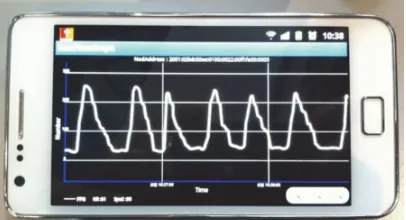
For practical tests, a Samsung Galaxy S cell phone, based on the Android OS, used to monitor biomedical signals, heart rate and blood oxygen saturation as well as the IPv6 address of the transmitting M2M node. Figure 5 shows the display of sensor level. By using this we can measure the health condition of patients through Android mobile Health monitoring Activity of Android application working an Android emulator.
fig 5 . Monitoring of PPG signal on Android Mobile.
V. CONCLUSION
A wireless M2M based e-healthcare system using the Android mobile device can be implemented in a global network with the help of the IPv6 technique The M2M devices are designed and used for the measurement of PPG signals and their transmission to a server PC through the IP-enabled internet, while the Android mobile device is used to provide a mobile healthcare service by means of an Android application running on a smart phone device with wireless internet access by combining the 6LoWPAN and mobile communication.
VI. ACKNOWLEDGEMENT
The Author would like to thank our guide for their valuable guidance and to motivate us for doing research work in upcoming field.
REFERENCES
[1] S. J. Jung and W. Y. Chung, “Flexible and scalable patient’s health monitoring system in 6LoWPAN,” Sensor Lett., vol. 9, no. 2, pp. 778–785, Apr. 2011. [2] Sang-Joong Jung ,Wang Chung Chang "Wireless Machine to Machine (M2M) Healthcare System with Mobile Device In Global Networks." IEEE
Sensor Journal, Vol 13 ,May 2013.
[3] W. Shen, Y. Xu, D. Xie, T. Zhang, and A. Johansson, “Smart border routers for e-healthcare wireless sensor networks,” in Proc. 7th Int. Conf. Wireless Commun., Netw. Mobile Comput., Wuhan, China, 2012, pp. 1–4.
[image:6.612.206.409.354.464.2][5] Y. T. Chen, I. C. Hung, M. W. Huang, C. J. Hou, and K. S. Cheng, “Physiological signal analysis for patients with depression,” in Proc. 4th Int. Conf. Biomed. Eng. Informat., Shanghai, China, 2011, pp. 805–808.
[6] G. Z. Yang, Body Sensor Networks, 1st ed. London: Springer-Verlag, 2006, pp. 1–275.
[7] Yan Zhang, Rong Yu and Shengli Xie,"Home M2M Networks: Architectures, Standards, and QoS Improvement", IEEE Communications Magazine , April 2011,pp 0163-6804.
[8] J. G. Ko, C. Y. Lu, M. B. Srivastava, J. A. Stankovic, A. Terzis, and M.Welsh, “Wireless sensor networks for health-care,” Proc. IEEE, vol. 98,no 1, pp. 1947–1960, Nov. 2010.
[9] G. Lawton, “Machine-to-machine technology gears up for growth,” Computer, vol. 37, no. 9, pp. 12–15, Sep. 2004.C. Kim, A. Soong, M. Tseng, and X. Zhixian, “Global wireless machine to-machine standardization,” IEEE Internet Comput., vol. 15, no. 2,pp. 64–69, Mar.–Apr. 2011.
[10] S. Whitehead, “Adopting wireless machine-to-machine technology,” Comput. Control Eng., vol. 15, no. 5, pp. 40–46, Oct. 2004.
[11] C. Inhyok, Y. Shah, A. U. Schmidt, A. Leicher, and M. V. Meyerstein, “Trust in M2M communication,” IEEE Veh. Technol. Mag., vol. 4, no. 3,pp. 69– 75, Sep. 2009.
[12] Z. Shelby and C. Bormann, 6LoWPAN: The Wireless Embedded Internet. New York: Wiley, 2009, pp. 1–244.
[13] J. Jara, M. A. Zamora, and A. F. G. Skarmeta, “An architecture based on internet of things to support mobility and security in medical environments,” in Proc. 7th IEEE Consumer Commun. Netw. Conf., Las Vegas, NV, 2010, pp. 1–5.
[14] S. H. Toh, S. C. Lee, and W. Y. Chung, “WSN based personal mobile physiological monitoring and management system for chronic disease,” in Proc. 3rd Int. Conf. Convergence Hybrid Inf. Technol., 2008, pp.467–472.
[15] N. D. Lane, E. Miluzzo, H. Lu, D. Peebles, T. Choudhury, and A. T.Campbell, “A survey of mobile phone sensing,” IEEE Commun. Mag., vol. 48, no. 9, pp. 140–150, Sep. 2010.
[16] W. Y. Chung, Y. D. Lee, and S. J. Jung, “A wireless sensor network compatible wearable u-health-care monitoring system using integrated ECG, accelerometer and SpO2,” in Proc. 30th Annu. Int. Conf. Eng. Med. Biol. Soc., Vancouver, BC, Canada, 2008, pp. 1529–1532.