Performance Evaluation of Routing Protocol for
Mobile Ad Hoc Network
Devesh Kumar Pal1, Dr. Pallavi Murghai Goel2 School of Computing Science
Galgotias University ,Greater Noida, India
Abstract- Congestion in mobile ad hoc network is the most important problem. That leads to communication delays, packet loss, reason wastage of time and energy on recovery. Routing protocols which are customize to the congestion position of a mobile ad hoc network can improve the network performance .In this paper, we compare the performance of an on-demand reactive routing protocol for mobile ad hoc networks and a mobile agent related congestion conscious routing protocol. Performance is evaluated with respect to packet loss and network throughput.
Keyword: AODV, MACAR, Mobile Agents
1. INTRODUCTION
A wireless ad hoc network is usually defined as a set of wireless mobile nodes dynamically self-organizing a temporary network without any central administration or existing network infrastructure. Since the nodes in wireless ad hoc networks can serve as routers and hosts, they can forward packets for other nodes if they are on the route from source to the destination. Wireless ad hoc networks make it easily to achieve ubiquitous communication. Routing is an important problem in wireless ad hoc networks. The traditional routing protocols cannot work well in wireless ad hoc networks, because of the characteristic of wireless ad hoc networks. In the recent decade, many routing protocols specially designed for wireless ad hoc networks were proposed. They are usually classified by the approach they use for maintaining and updating their routing tables. The two main kinds of them are: reactive protocols and proactive protocols. In reactive protocols, a route is not searched for unless it is needed, and it can be acquired in an on-demand fashion. The advantage of these protocols is that unnecessary exchange of route information is avoided, leaving more network resources available for other network traffic. The disadvantage is that the delay resulted from the route discovery is a little larger. In
between hosts. In general, a mobile agent executes on a machine that hopefully provides the resources or services that it needs to do its work. Lange and Oshima [6] enumerate several benefits of using mobile agents of particular interest to MANET routing are:
•Mobile agents are adept to improved protocols in use by
moving to a destination and setting up communications operating under revised policies.
•After being dispatched, mobile agents become independent of
the process that created them and can operate asynchronously and react dynamically and autonomously to environmental changes.
•Mobile agents can reduce network load and latency by running
remotely.
Detailed comparison of MACAR and AODV is done in [2] taking network throughput, end to end delay and routing overhead in account by varying parameters such as mobility, load and transmission range. In this paper we study the performance of these protocols using quantitative metrics: packet loss and network throughput. The remainder of this paper is organized as follows. Section II gives a brief overview of AODV and MACAR. Section III provides the results of the simulation and their analysis. Section IV gives concludes the paper and finally, section V gives future scope of the study.
II. DESCRIPTION OF THE PROTOCOLS
A. AODV
AODV is the reactive routing Protocol which creates and maintains routes only if these are needed, on demand [7]. If a node desires to send a message to a destination node for which it does not have a valid route to, it initiates a route discovery to locate the termination node. The origin node broadcast a route request (RREQ) packet to its entire adjoining node, which then onward dispatch the request to their adjoining node and so on until either the destination or an intermediate node with a fresh enough routes to the Destination listed in the RREQ is located. AODV makes use of sequence numbers to ensure that routes are loop free. Every node maintains its serial number, and a broadcast ID. The serial number is incremented whenever there
is a change in the adjoining of the node and the broadcast ID is incremented for every route discovery the node initiates. Along with its sequence number and the broadcast ID, the origin node also includes the most recent sequence number it has for the destination node. Intermediate nodes may reply to the RREQ if they have a route to the destination with a destination sequence number equal to or more than the one listed in the RREQ. If additional copies of the same RREQ are later received, these packets are simply discarded. When the RREQ reaches the destination or an intermediate node (having fresh enough route to the destination), it responds by sending a route reply (RREP) packet back to the source. Periodic HELLO broadcasts are used in AODV by the nodes in the network to inform each mobile node of the other nodes in its neighborhood. These broadcasts are used to maintain the local connectivity. If a node along the routes moves, its upstream neighbors notices the move and propagates a link failure notification/route error message (RRER) to each of its active upstream neighbors to inform of the removal of that part of the route.
B. MACAR
MACAR is a composite protocol where intelligent mobile agents can be used with any on-demand routing protocol proposed in MANETs [2]. Ad Hoc On Demand Distance Vector Routing (AODV) is used as an essentially protocol over which mobile agent is used. The mobile agents in MACAR collect congestion based network connectivity information. This
information provides “ready routes” when there is a need for
III. SIMULATION AND RESULTS
A. Simulation Model
The protocols MACAR and AODV have been simulated in NS2 (ns2.31) a discrete event simulator that can model and simulate multi hop wireless ad hoc networks. The implementation environment used is Windows operating system with cygwin. Cygwin is a large collection of GNU and Open Source tools which provide functionality similar to a Linux distribution on Windows. The distributed coordination function (DCF) of the IEEE standard 802.11 for wireless LANs is used as MAC layer. Radio model used with a nominal bit-rate of 2Mbps. Simulation is carried out with Constant Bit Rate (CBR) traffic. Packets sent by routing layer are queued at the interface queue till MAC layer can transmit them. The size of Interface Queue used is 50 packets long. The other considerations made for the simulation environment and protocol settings are shown in Table I.
Table I. Simulation Environment
Routing Protocol AODV
Network Space 800x600 meters
Simulation Time 100 seconds
Number Of Nodes 10
Physical/MAC layer IEEE 802.11 at 2 Mbps
Transmission Range 250 meters
Interface Queue Queue/Drop Tail/PriQueue
IFQ length 50 packets
Agent Type TCP/UDP
Mobility Model Random
Node Speed Random
Traffic Type CBR (1024 bytes/sec)
B. Simulation Result
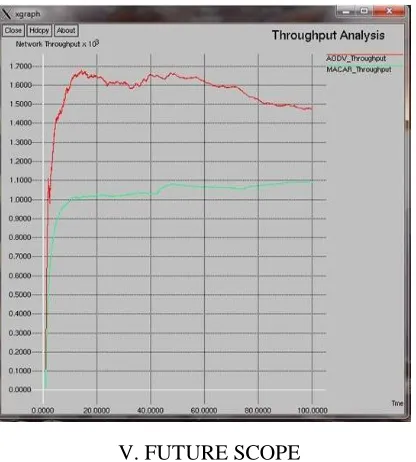
The performance analysis of MACAR and AODV is done using following performance metrics: Packet loss and Network Throughput.
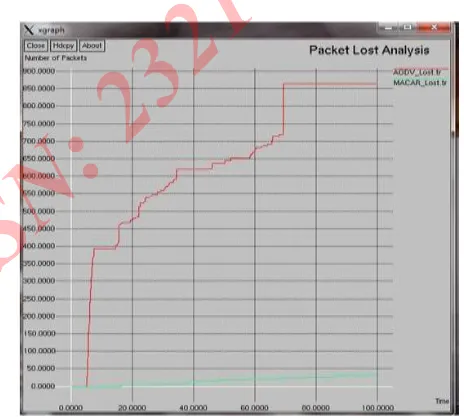
[image:4.612.307.539.282.491.2]Packet Loss: It is the measure of packet lost due to congestion. Fig.1 shows the packet loss, where AODV_lost.tr represents the packet lost in AODV and MACAR_lost.tr represents the packet lost in MACAR. It is clearly shown that the packet lost in AODV is much higher than the packet lost in MACAR which shows that MACAR outperforms in the congestion affected scenario.
Fig 1: Packet Loss Analysis
Fig 2: Network Throughput Analysis
IV.CONCLUSION
The field of ad hoc networking has been receiving increasing attention among researchers in current years. However, congestion is the most important prohibition of wireless ad hoc networks. It deteriorates the performance of wireless ad hoc networks [9]. Using mobile agent solves this problem and helps network become congestion free. We have compared and evaluated the advantages of using mobile agents in an on demand routing protocol with considering Packet Loss shown in Fig.1 and Network Throughput shown in Fig.2 in account. The results clearly show that the performance of MACAR is far much better than using AODV as MACAR routes the packets on the basis of congestion information provided by mobile agents and these agents worked very frequently.
V. FUTURE SCOPE
As a future work we can incorporate the concept of mobile agent into multicast protocols such as Multicast Ad-hoc on demand Distance Vector (MAODV) and make them congestion aware and make it suitable for multimedia communication. It is increase accessibility of network in the multimedia communication.
REFERENCES
[1] Baboo, S.S., Narasimhan, B.: A Hop-by-Hop Congestion-Aware Routing Protocol for Heterogeneous Mobile Ad-hoc Networks. International Journal of Computer Science and Information Security. (2009)
[2] Shekhar H M P, and K S Ramanatha, “Mobile Agent Based
Congestion Aware Routing in Mobile Ad Hoc Networks,” 3G
and Beyond, 2005 6thIEE Conference on Publication Year : 2005, Pages 1-7
[3] Shekhar H M P, Arun Kumar M A, and K S Ramanatha, “
Mobile Agents Aided Multicast Routing for Mobile Ad Hoc
Networks”, Proc. Of 7thIEEE Intl. Conference on „Advanced
Communication Technology”, February 21-23, 2005, Phoenix
Park, Republic of Korea.
[4] N. Minar, K. H. Kramer and P. Maes, “Cooperating Mobile
Agents for Dynamic Network Routing”, Software Agents for
Future Communication Systems, Chapter 12, Springer Verlag, 1999.
[5] R. R. Choudhary, S. Bandhopadhyay and K. Paul, “A
Distributed Mechanism for topology discovery in Ad hoc
Wireless Networks Using Mobile Agents,” Proc. Of
Mobicom, Aug. 2000, pp. 145-146
[6] D. Lange and M. Oshima: “Seven Good Reasons for Mobile
Agents”. Communication of the ACM 42(3) (1999) 88–89.
[7] Elizabeth M Royer and Chai-Keong Toh, "A Review of Current Routing Protocols for Ad Hoc Mobile Wireless Networks", IEEE Personal Communications, Apr. 2003, pp. 46-55.
[9] Wu Wei, Zhang Zhongzhao, Sha Xuejun, Qin Danyang, “A Study of Congestion-aware Routing Protocols for Wireless Ad
hoc Networks”, Wireless Communications, Networking and