using sgRNAs with matched 5
’
nucleotides
Sojung Kim
1, Taegeun Bae
1,2, Jaewoong Hwang
3and Jin-Soo Kim
1,2,3*Abstract
We report that engineered Cas9 variants with improved specificity—eCas9-1.1 and Cas9-HF1—are often poorly active in human cells, when complexed with single guide RNAs (sgRNAs) with a mismatch at the 5’terminus, relative to target DNA sequences. Because the nucleotide at the 5’end of sgRNAs, expressed under the control of the commonly-used U6 promoter, is fixed to a guanine, these attenuated Cas9 variants are not useful at many target sites. By using sgRNAs with matched 5’nucleotides, produced by linking them to a self-cleaving ribozyme, the editing activity of Cas9 variants can be rescued without sacrificing high specificity.
Keywords:CRISPR-Cas, Off-target effect, Engineered Cas9 variants, Hammerhead ribozyme-linked sgRNA
Background
Clustered, regularly interspaced, short palindromic repeats (CRISPR) – CRISPR-associated (Cas) RNA-guided endo-nucleases, derived from adaptive immune systems in bacteria and archaea, have been repurposed for targeted genome editing in various cells and organisms [1–4]. These nucleases cleave chromosomal DNA in a targeted manner, producing site-specific DNA double-strand breaks (DSBs), the repair of which via non-homologous end-joining (NHEJ) induces small insertions or deletions (indels) at target sites. Unfortunately, off-target DNA cleavage at sites that are highly homologous to on-target sites can lead to mutations at undesired genomic loci [5, 6] and to chromosomal rearrangements such as transloca-tions and inversions [6–8]. Both S. pyogenesCas9 [9, 10] and single guide RNAS (sgRNAs) [6, 11, 12] have been modified to minimize or eliminate these off-target effects. In particular, two groups have independently presented engineered Cas9 variants, termed enhanced Cas9-1.1 (eCas9-1.1) [9] and Cas9 high-fidelity variant 1 (Cas9-HF1) [10], with minimal or no detectable off-target effects in human cells. These high-specificity Cas9 variants contain alanine substitutions to weaken non-specific ionic interactions between the Cas9 protein and the non-target or target DNA strand.
Here, we show that these attenuated Cas9 variants are poorly active at sites with a mismatched 5’nucleotide rela-tive to their sgRNA sequences in human cells. By using sgRNAs with matched 5’nucleotides relative to their target DNA sequences, generated by self-cleaving ribozyme fusion, the cleavage activity of the Cas9 variants was rescued in human cells without sacrificing their high specificities.
Results
We hypothesized that the attenuated Cas9 variants might be poorly active at sites with a mismatch at the 5’terminus. Because the U6 promoter, which is commonly used to ex-press sgRNAs in eukaryotic cells, requires a guanosine (G) nucleotide to initiate transcription, sgRNAs typically con-tain a G nucleotide at the 5’ terminus. Three out of four DNA target sites will contain a mismatch at this position and thus might be poorly edited in cells by attenuated Cas9 variants in complex with gX19sgRNAs (Fig. 1a), where“g”
or“G”is a mismatched or matched guanosine, respectively. Note that high-specificity Cas9 variants have been previ-ously tested at target sites with a G nucleotide at the 5’end of the target DNA strand using GX19sgRNAs [9, 10].
Before testing this hypothesis, we compared expres-sion levels of Cas9 variants in human cells and found that the two variants, especially Cas9-HF1, were poorly expressed in HeLa cells (Fig. 1b). We noted that our plasmid encoding wild-type Cas9 (termed Cas9-WT hereinafter) and the two plasmids encoding Cas9 vari-ants [9, 10] contained different promoters, tags, and
* Correspondence:[email protected]
1Center for Genome Engineering, Institute for Basic Science, Seoul, South
Korea
2IBS School, Korea University of Science and Technology, Seoul, South Korea
Full list of author information is available at the end of the article
codon sequences [4, 6]. We performed site-directed mu-tagenesis in our Cas9-WT plasmid to obtain constructs encoding the two high-specificity Cas9 variants. Western blot analysis showed that all three proteins were highly expressed in HeLa cells (Fig. 1b). Consistent with this result, eCas9-1.1 and Cas9-HF1 expressed using the new constructs induced indels at theEMX1site with efficien-cies comparable to Cas9-WT (Fig. 1c). Based on these results, we used the newly cloned constructs to express eCas9-1.1 and Cas9-HF1 throughout this study.
Reduced editing activity of high-fidelity Cas9 variants at target sites with a mismatched 5’nucleotide
To test whether the attenuated Cas9 variants are poorly active at sites with a mismatch at the 5’ terminus, we compared editing activities of eCas9-1.1 and Cas9-HF1
with those of Cas9-WT at 26 sites whose 5’terminal nu-cleotides are not guanosine in HeLa cells using gX19
sgRNAs: the sites with a 5’cytosine (C) were termed CX19
(seven sites); those with a 5’thymine (T), TX19(ten sites);
and those with a 5’adenosine (A), AX19(nine sites) (Fig. 2a
and b, Additional file 1: Table S1 and Table S2). As expected, Cas9-WT was not sensitive to the mismatch at the 5’end, inducing indels at high frequencies (64 ± 5% at CX19sites; 65 ± 5% at TX19sites; 80 ± 2% at AX19sites, on
average). eCas9-1.1 showed much lower indel frequencies at CX19sites (36 ± 10%) and TX19sites (24 ± 10%), a
1.8-fold or 2.7-1.8-fold reduction in average indel frequencies at CX19or TX19sites, respectively. Cas9-HF1 was least active
among the three Cas9 nucleases, with average indel fre-quencies of 9.0 ± 3% at CX19sites and 20 ± 10% at TX19
sites, which corresponds to 7.1-fold and 3.2-fold reductions,
a
c
b
[image:2.595.61.538.87.454.2]respectively. At AX19target sites, however, both eCas9-1.1
and Cas9-HF1 showed indel efficiencies (81 ± 3% and 79 ± 3%) comparable to that of Cas9-WT (80 ± 2%), suggesting that a G:T mismatch at the 5’ terminus may still form a wobble base pair. These results are in line with a previous report showing Cas9-HF1 activities with three and one gX19sgRNAs at CX19and AX19sites, respectively [10].
We chose six CX19 or TX19 target sites at which the
two Cas9 variants were poorly active and tested gX20
sgRNAs with an extra guanosine at the 5’ terminus rather than gX19 sgRNAs (Fig. 2c). Note that gX20
sgRNAs, unlike gX19sgRNAs, have matched nucleotides
at the 5’end. Use of gX20sgRNAs enhanced the activity
of Cas9 variants at AAVS1-01 and HBB-02 sites but re-duced the activity at the other four sites, compared to gX19 sgRNAs. We also noted that Cas9-WT was more
efficient with gX19sgRNAs than with gX20sgRNAs at all
six sites. These results show that gX20 sgRNAs cannot
rescue the genome editing activities of high-specificity Cas9 variants. These Cas9 variants in combination with gX19 and gX20 sgRNAs also showed lower indel
frequencies than Cas9-WT in HEK293T, another human cell line (Additional file 1: Figure S1).
Rescue of high-specificity Cas9 variants using Hammerhead ribozyme-linked sgRNAs
To expand the utility of high-fidelity Cas9 variants, we produced sgRNAs with matched 5’ nucleotides by using a self-cleaving ribozyme. Thus, each sgRNA was fused to a Hammerhead (HH) ribozyme at its 5’-end [13], which generates mature 20-nucleotide (X20) sgRNAs after
self-cleavage (Fig. 3a). HH ribozyme-fused sgRNAs with matched 5’ nucleotides (termed HH-X20) or the
mis-matched 5’ guanosine nucleotide (termed HH-gX19)
were tested in combination with Cas9-WT and high-fidelity Cas9 variants in HeLa cells (Fig. 3b). Use of HH-X20sgRNAs rescued the activity of the two Cas9 variants
at all six target sites. Thus, indel frequencies obtained with eCas9-1.1 (64 ± 6%) and Cas9-HF1 (55 ± 7%) using HH-X20 sgRNAs were comparable to those obtained
with Cas9-WT (69 ± 5% or 70 ± 3%) using HH-X20
sgRNAs or HH-gX19 sgRNAs, respectively (Fig. 3c and c
[image:3.595.58.539.88.390.2]Additional file 1: Table S3a). The ratios of indel frequen-cies of Cas9 variants in complex with HH-X20 sgRNAs
relative to that of Cas9-WT had medians of 0.9 for eCas9-1.1 and 0.8 for Cas9-HF1 (Additional file 1: Figure S2, Table S3b). The two Cas9 variants were poorly active when combined with HH-gX19 sgRNAs, demonstrating
that the rescue of high-fidelity variants was due to matched nucleotides at the 5’ end rather than the ribozyme fusion itself. As expected, Cas9-WT was equally efficient with HH-X20, HH-X19, and gX19
sgRNAs (P= 0.36, HH-X20 vs HH-X19; P= 0.28,
HH-X20 vs gX19; P= 0.31, HH-X19 vs gX19) (Fig. 3c and
Additional file 1: Table S3a). Editing efficiencies of eCas9-1.1 and Cas9-HF1 were also increased with HH-X20 sgRNAs in HEK293T cells (Additional file 1:
Figure S3 and Table S4).
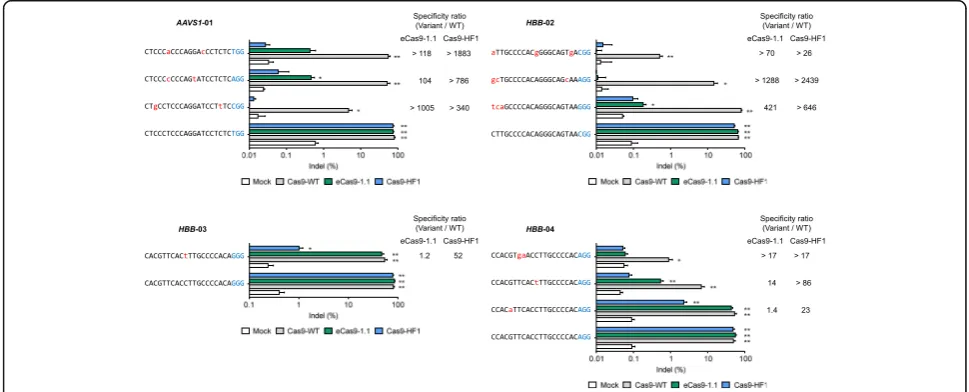
Specificities of Cas9-WT and high-fidelity Cas9 variants in combination with HH-X20sgRNAs
Next, we compared the specificities of the two Cas9 variants in complex with HH-X20 sgRNAs by
meas-uring mutation frequencies at known off-target sites in HeLa cells. The CCR5-01- and EMX1-05-specific sgRNAs have no known off-target sites and were a
b
c
[image:4.595.58.540.87.493.2]03 off-target site and two HBB-04 off-target sites), each with a single nucleotide mismatch. These re-sults show that attenuated Cas9 variants retain their high specificities when combined with HH-X20
sgRNAs. eCas9-1.1 and Cas9-HF1 also showed high specificities with HH-X20 sgRNAs in HEK293T cells
(Additional file 1: Figure S4).
Discussion and conclusions
In summary, we showed here that newly developed, high-specificity Cas9 variants, unlike the wild-type (WT) protein, are often inefficient at target sites with a mismatch at the 5’ terminus, unequivocally demon-strating the contribution of the 5’ nucleotide to the high specificity of CRISPR-Cas9 in human cells for the first time. Of note, a single 5’-end mismatch be-tween the sgRNA and target DNA is largely tolerated by Cas9-WT. The two attenuated Cas9 variants, how-ever, contain several alanine substitutions to weaken ionic interactions between the protein and target DNA, which can make them sensitive to a single mismatch even at the 5’ terminus. By matching the first nucleotide of sgRNAs to target DNA via the self-cleaving activity of a HH-ribozyme fusion, highly
pre-assembled Cas9 variant ribonucleoproteins [16] rather than Cas9- and sgRNA-encoding plasmids may further improve genome-wide target specificities of CRISPR genome editing. Our method expands target-able sites for high-specificity Cas9 variants, allowing broad applications in research and medicine.
Methods
Construction of high-fidelity Cas9 variant-encoding plasmids and the HH-ribozyme-fused sgRNA-encoding plasmid
eCas9-1.1- and Cas9-HF1-encoding plasmids (p3s-eCas9-1.1, Addgene #104172; p3s-Cas9-HF1, Addgene #104173) were created via site-directed mutagenesis of a WT Cas9 construct (p3s-Cas9-HN, Addgene
#104171). HH-ribozyme sgRNA constructs were
cloned via ligation of annealed oligonucleotides that included a HH-ribozyme sequence and a protospacer sequence into a plasmid (pRG2, Addgene #104174) in which sgRNA expression is under the control of the U6 promoter.
Cell culture and transfection
HeLa cells (ATCC, CCL-2) and HEK 293 T/17 cells (ATCC, CRL-11268) were maintained in Dulbecco’s
[image:5.595.55.540.469.665.2]modified Eagle’s medium (DMEM) supplemented with 100 units/mL penicillin, 100 μg/mL streptomycin, 0.1 mM non-essential amino acids, and 10% fetal bovine serum (FBS). 0.8 × 10⁵HeLa cells and 2 × 10⁵HEK293T/ 17 cells were transfected with the Cas9-encoding plas-mid (0.5 μg) and sgRNA expression plasmid (0.5 μg) using Lipofectamine 2000 (Invitrogen) according to the manufacturer’s protocol.
Western blotting
The Cas9-WT and Cas9 variant proteins expressed in HeLa cells after transfection were detected using western blotting. Cas9 and GAPDH were detected using anti-Cas9 (Abcam, ab191468) and anti-GAPDH (Santa Cruz Biotechnology, sc-32233) primary anti-bodies. Goat anti-mouse IgG-HRP antibody (Santa Cruz Biotechnology, sc-2005) was used for signal de-tection. ImageQuant LAS4000 (GE healthcare) was used for digital imaging.
Targeted deep sequencing
The on-target and off-target regions were polymerase chain reaction (PCR) amplified for NGS library con-struction. Pooled PCR amplicons were sequenced using MiniSeq with a TruSeq HT Dual Index system (Illumina). Indel frequencies were obtained using Cas-Analyzer [17].
Additional file
Additional file 1: Figure S1.Comparison of editing efficiencies of Cas9-WT and high-fidelity Cas9 variants using gX19 and gX20 sgRNAs in HEK293T cells.Figure S2.Comparison of relative indel frequencies of Cas9 variants normalized to that of Cas9-WT in HeLa cells.Figure S3.Comparison of indel frequencies of HH-X20, HH-gX19, and gX19sgRNAs in combination with Cas9-WT and Cas9 variants in HEK293T cells.Figure S4.Specificities of high-fi-delity Cas9 variants in combination with HH-X20sgRNA in HEK293T cells.Table
S1.Indel frequencies of Cas9-WT, eCas9-1.1, and Cas9-HF1 combined with gX19sgRNAs at 26 target sites with an HX19sequence.Table S2.Comparison of Cas9-WT and Cas9 variants using gX19sgRNAs at 26 target sites with an HX19sequence.Table S3.Comparison of indel frequencies of HH-X20, HH-gX19, and gX19sgRNAs in combination with Cas9-WT and Cas9 variants in HeLa cells.Table S4.Comparison of indel frequencies of HH-X20, HH-gX19, and gX19sgRNAs in combination with Cas9-WT and Cas9 variants in HEK293T cells. (PDF 497 kb)
Abbreviations
Cas9-HF1:Cas9 high-fidelity variant 1; Cas9-WT: Wild-type Cas9; DSBs: DNA double strand breaks; eCas9-1.1: Enhanced Cas9-1.1; HH: Hammerhead; Indels: Insertions or deletions; NHEJ: Non-homologous end-joining; sgRNAs: Single guide RNAs
Funding
This work was supported by the Institute for Basic Science (IBS-R021-D1).
Availability of data and materials
The deep sequencing data are available at the NCBI Sequence Read Archive (SRA) under accession number SRP118952 [18].
Authors’contributions
SK, TB, and JH performed the experiments. SK and J-SK wrote the manuscript. All authors read and approved the final manuscript.
Ethics approval and consent to participate
No ethics approval was required for this study.
Competing interests
J-SK is a co-founder of and holds stocks in ToolGen, Inc.
Publisher’s Note
Springer Nature remains neutral with regard to jurisdictional claims in published maps and institutional affiliations.
Author details
1
Center for Genome Engineering, Institute for Basic Science, Seoul, South Korea.2IBS School, Korea University of Science and Technology, Seoul, South
Korea.3Department of Chemistry, Seoul National University, Seoul, South
Korea.
Received: 27 June 2017 Accepted: 2 November 2017
References
1. Jinek M, Chylinski K, Fonfara I, Hauer M, Doudna JA, Charpentier E. A programmable dual-RNA-guided DNA endonuclease in adaptive bacterial immunity. Science. 2012;337:816–21.
2. Mali P, Yang L, Esvelt KM, Aach J, Guell M, DiCarlo JE, et al. RNA-guided human genome engineering via Cas9. Science. 2013;339:823–6. 3. Cong L, Ran FA, Cox D, Lin S, Barretto R, Habib N, et al. Multiplex genome
engineering using CRISPR/Cas systems. Science. 2013;339:819–23. 4. Cho SW, Kim S, Kim JM, Kim JS. Targeted genome engineering in human cells
with the Cas9 RNA-guided endonuclease. Nat Biotechnol. 2013;31:230–2. 5. Hsu PD, Scott DA, Weinstein JA, Ran FA, Konermann S, Agarwala V, et al.
DNA targeting specificity of RNA-guided Cas9 nucleases. Nat Biotechnol. 2013;31:827–32.
6. Cho SW, Kim S, Kim Y, Kweon J, Kim HS, Bae S, et al. Analysis of off-target effects of CRISPR/Cas-derived RNA-guided endonucleases and nickases. Genome Res. 2014;24:132–41.
7. Lee HJ, Kim E, Kim JS. Targeted chromosomal deletions in human cells using zinc finger nucleases. Genome Res. 2010;20:81–9.
8. Lee HJ, Kweon J, Kim E, Kim S, Kim JS. Targeted chromosomal duplications and inversions in the human genome using zinc finger nucleases. Genome Res. 2012;22:539–48.
9. Slaymaker IM, Gao L, Zetsche B, Scott DA, Yan WX, Zhang F. Rationally engineered Cas9 nucleases with improved specificity. Science. 2016;351:84–8. 10. Kleinstiver BP, Pattanayak V, Prew MS, Tsai SQ, Nguyen NT, Zheng Z, et al.
High-fidelity CRISPR-Cas9 nucleases with no detectable genome-wide off-target effects. Nature. 2016;529:490–5.
11. Fu Y, Sander JD, Reyon D, Cascio VM, Joung JK. Improving CRISPR-Cas nuclease specificity using truncated guide RNAs. Nat Biotechnol. 2014;32:279–84. 12. Kim D, Bae S, Park J, Kim E, Kim S, Yu HR, et al. Diseq:
genome-wide profiling of CRISPR-Cas9 off-target effects in human cells. Nat Methods. 2015;12:237–43. 231 p following 243.
13. Gao Y, Zhao Y. Self-processing of ribozyme-flanked RNAs into guide RNAs in vitro and in vivo for CRISPR-mediated genome editing. J Integr Plant Biol. 2014;56:343–9. 14. Port F, Bullock SL. Augmenting CRISPR applications in Drosophila with
tRNA-flanked sgRNAs. Nat Methods. 2016;13:852–4.
15. Hendel A, Bak RO, Clark JT, Kennedy AB, Ryan DE, Roy S, et al. Chemically modified guide RNAs enhance CRISPR-Cas genome editing in human primary cells. Nat Biotechnol. 2015;33:985–9.
16. Kim S, Kim D, Cho SW, Kim J, Kim JS. Highly efficient RNA-guided genome editing in human cells via delivery of purified Cas9 ribonucleoproteins. Genome Res. 2014;24:1012–9.
17. Park J, Lim K, Kim JS, Bae S. Cas-analyzer: an online tool for assessing genome editing results using NGS data. Bioinformatics. 2017;33:286–8. 18. Kim S, Bae T, Hwang J, Kim JS. Rescue of high-specificity Cas9 variants using