Mohd Noor ABDULLAH
1,2, Nasrudin Abd RAHIM
1, Abd Halim Abu BAKAR
1,3, Hazlie MOKHLIS
1,3,
Hazlee Azil ILLIAS
1,3, Jasrul Jamani JAMIAN
4 UMPEDAC, University of Malaya(1), Universiti Tun Hussein Onn Malaysia(2), Department of Electrical Engineering, University ofMalaya(3), Universiti Teknologi Malaysia(4)
Efficient Evolutionary Particle Swarm Optimization Approach for
Nonconvex Economic Load Dispatch Problem
Abstract. The main objective of economic load dispatch (ELD) is to allocate the output power generator at minimum cost while satisfying all the operation constraints. This paper presents a new hybrid method by integrating particle swarm optimization with time varying acceleration coefficients and evolutionary programming (TVAC-EPSO) for solving nonconvex ELD problem. The competition, sorting and selection in EP method are used to determine the best particle in PSO for finding the optimum solution efficiently. The proposed TVAC-EPSO has been tested on three different power system benchmarks. The simulation results have demonstrated the effectiveness of the proposed method in solving nonconvex ELD problem.
Streszczenie. W artykule przedstawiono hybrydową metodę ekonomicznie uzasadnionego określenia założeń dotyczących generowanej energii elektrycznej (ang. Economic Load Dispatch - ELD). Algorytm oparty jest na wykorzystaniu metody optymalizacji roju cząstek ze współczynnikami zmiennymi w czasie i programowaniu ewolucyjnym. (ang. TVAC-EPSO). Proponowana metoda została poddana weryfikacji na trzech różnych systemach energetycznych. Wyniki symulacyjne potwierdzają jej efektywność w analizie problemu ELD. (Zagadnienie ekonomicznie uzasadnionego określenia wytwarzanej energii elektrycznej o charakterystyce niewypukłej – wykorzystanie metody optymalizacji roju cząstek).
Keywords: Economic load dispatch, particle swarm optimization, evolutionary programming, time varying acceleration coefficients.
Słowa kluczowe: zapotrzebowanie energetyczne, optymalizacja roju cząstek, programowanie ewolucyjne, zmienne w czasie współczynniki przyspieszenia.
Introduction
The economic load dispatch (ELD) is about minimizing the total generation cost of generating units in order to meet the power demand while satisfying equality and inequality constraints. Traditionally, the cost function of the generator is assumed to be piecewise linear and represented by a quadratic function. However, in practical, this assumption is no longer valid due to the valve point effect and prohibited operating zones (POZ) of generating units. This makes the ELD problem highly non linear and nonconvex optimization problem, which is difficult to be solved by mathematical approach. Moreover, the ELD problem becomes more complicated when ramp-rate limits and transmission losses are taken into account.
Many optimization methods have been used for solving classical ELD problem, such as lambda iteration, gradient method, linear programming and quadratic programming [1]. Most of these methods might be unable to solve nonconvex and discontinuous ELD problem efficiently. This is because these methods required monotonically increasing of incremental cost function, where the derivative information of the cost function exists.
In order to solve nonconvex ELD problem, heuristic methods such as evolutionary programming (EP), genetic algorithm, artificial immune system, tabu search, ant colony optimization and particle swarm optimization (PSO) have been implemented to solve nonconvex and discontinuous ELD problems [2]. These methods do not require the derivative information of the cost function. Thus, it can be used to solve nonconvex ELD problem due to valve point effects, prohibited operating zones, multi fuels options and nonlinear power flow constraints that cannot be solve by classical methods. However, these methods are not guaranteed in finding the optimum solution due to premature convergence.
Among these methods, the PSO method is widely used for solving ELD problem due to its simple implementation, less memory storage and able to find global solution. Many modifications and hybrid of PSO methods were proposed for solving the nonconvex ELD problem such as IPSO [3], SOH-PSO [4], PSO-MSAF [5], GA-PSO [6] and hybrid CPSO-SQP [7]. Nevertheless, the classical PSO can be further improved to obtain a good solution.
In this paper, a new hybrid approach is proposed by integrating particle swarm optimization with time varying acceleration coefficients and evolutionary programming named TVAC-EPSO for solving nonconvex ELD problem. The concepts of EP method based on competition, sorting and selection are applied for finding the best individual and group particle in PSO method. In addition, the time varying acceleration coefficients for both cognitive and social components are used to find the global optimum solution. The performance of the proposed TVAC-EPSO is tested on different power system which consists of 3, 6 and 15 generating units. The results obtained by TVAC-EPSO were compared with the existing results from the literature in terms of optimum cost and execution times.
Problem formulation
The objective of the ELD problem is to determine the optimal output power of a scheduled generator that minimizes the total generation cost (Fc) while equality and inequality constraints are satisfied as follows:
(1) Minimize
Ni i i
C
F
P
F
1
)
(
(2)
F
i(
P
i)
a
iP
i2
b
iP
i
c
iWhen the valve point effect is considered, the generation cost function in (2) is added with rectified sinusoidal function to obtain an accurate ED modelling,
(3)
F
i(
P
i)
a
iP
i2
b
iP
i
c
i
e
isin(
f
i(
P
imin
P
i))
where Fi(Pi) is the total generation cost for generator i, Pi is the real power output of generator i,ai, bi and ci are the cost coefficients for unit i and ei and fi are the cost coefficients for unit i with presence valve point effects.
Power balance constraints
(4)
N i L D iP
P
P
1
where PD and PL are the total real power demand and total transmission loss respectively.
The transmission loss can be calculated by using B-coefficient approach as
(5)
N i N j N i i i j ij iL
P
B
P
B
P
B
P
1 1 1 0 00
where, Bij, B0i and B00 are network loss coefficients.
Generator constraints
Each unit has a generation range which is represented as (6)
P
imin
P
P
imaxwhere Pimin and Pimax are the minimum and maximum limits of real power output for unit i.
Ramp rate limits
The effective generator limit with the presence ramp rate limits can be written as
(7)
max(
min,
0)
min(
max,
0)
i i i i i i
i
P
DR
P
P
P
UR
P
where P0 is the previous real power output of unit i (MW),
DRi and URi are the upper and lower ramp rate limits of unit
i (MW/time period) respectively.
Prohibited operating zones
The generating unit with prohibited operating zones have discontinuous and nonlinear cost characteristics. This characteristic can be formulated in ELD problem as follows:
(8)
max , , 1 , 1 , min i i UB Nz i LB z i i UB z i LB i i i iP
P
P
P
P
P
P
P
P
P
z=2,3…,Nz
where Pi,zLB and Pi,zUB are the lower and upper limits of POZ of generator i in (MW) respectively and Nz is the number of POZ of i-th generator.
Review PSO method
The particle swarm optimization is developed by Kennedy and Eberhart in 1995 based on of bird flocking and fish schooling [8]. This method is a population based optimization approach, where each particle represents the possible solution in d dimensional search space. Each particle will fly around the possible search space according to their own previous experience and the group experience. The position of each particle (X) is updated using the following formulas: (9)
)
(
)
(
2 2 1 1 1 j id j d j id j id j id j idX
gbest
r
c
X
pbest
r
c
wV
V
(10)
X
idj1
X
idj
V
idjwhere Vidj+1 is the updated velocity of i-th particle in dimension d, w is the inertia weight factor, c1 and c2 are acceleration coefficient for cognitive and social components respectively, r1 an r2 are uniform random number between 0 and 1 respectively, XidJ+1 is the update position of i-th particle in dimension, Xidj is the position of i-th particle in
current iteration j, pbest is the best position reached by i-th particle and gbest is the best position found in a population.
The linearly decreasing of w with increasing iteration j is computed using (11) [9].
(11)
j
j
w
w
w
w
(
)
max min max
max j=1,2,...,itermax
wmin and wmax are the initial and final value of inertia weights respectively and jmax is the maximum number of iteration.
Proposed TVAC-EPSO
In order to improve the performance of PSO, the hybrid particle swarm optimization and evolutionary optimization (EPSO) was proposed by P.J. Angeline [10]. This method was successfully applied in power system application [11]. The performance of heuristic method like PSO algorithm depends on the parameters selection. Therefore, it should be tuned properly to obtain the best solution. However, in EPSO method, the value of acceleration coefficients (c1 and
c2) for cognitive and social component is fixed to a constant value during iteration process.
The proper selection of acceleration coefficients (c1 and
c2) can help the algorithm to produce the global or near to the global solution. The time varying acceleration coefficients (TVAC) is used to control the exploration and exploitation of the algorithm in search space. If the coefficients value of c1 is higher than c2, the particles will guide the particles to explore the entire search space. However, a higher value of c2 than c1 will force the particles to obtain the better solution [12]. In the proposed TVAC-EPSO, the initial value of c1 is set relatively higher than c2 in order to increase the exploration capability throughout the possible solution. As number of iteration increases, the values of c1 and c2 will decrease and increase respectively. Thus, it can attract the particles to find the optimal solution. The TVAC are varies as the iteration increases and is computed as follows:
(12)
j
j
c
c
c
c
i
(
f
i)
max 1 1 1 1
(13)
j
j
c
c
c
c
i
(
f
i)
max 2 2 2 2
The PSO algorithm is used as the main optimization method in the proposed TVAC-EPSO method. In order to determine the pbest and gbest value, the concept of combination, tournament competition and sorting in EP are integrated in PSO. After combined the particles in previous and current iteration, the particle will compete with other particle based on the competition rate. Then, the winner position in N number of a population will be chosen as the survival positions. These results will used to determine the current pbest and gbest value for updating the new position. The procedures of the TVAC-EPSO method are summarized as follows:
Step 1: Initialization of PSO parameter.
Step 2: Evaluate the fitness function of every particle Step 3: Initialize the pbest and gbest on fitness function. Step 4: Implement the combination, tournament selection and sorting process using the EP concept.
Step 5: Determine the pbest and gbest value. The update of the particle position is based on (9) to (10).
Simulation results and analysis
In order to validate the feasibility of the proposed TVAC-EPSO method, it has been applied to solve ELD problems on three different test systems. To obtain the optimum solution using TVAC-EPSO method, the following parameters have been used for all test systems; population size = 30, c1i=c2f=0.2, c2i=c1f=1.0 and competition rate = 25%. The maximum number of iterations was used as the stopping criteria. The simulation was written in MATLAB 7.6 and was executed on Core 2 Quad processor, 4 GB RAM.
Test system 1: 3-unit system
The test system 1 consists of 3-generating units with valve point effects. The cost characteristic of the generators are modelled as in (3) with equality and inequality constraints in (4) to (6). All input data (fuel cost coefficients and generator limits) are given in [13]. For comparison with other methods, the transmission losses are not considered. The total real power demand is 850 MW.
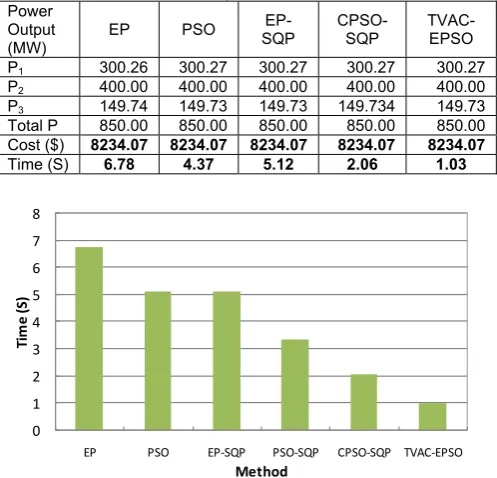
The results obtained by the proposed TVAC-EPSO method have been compared with EP, PSO, EP-SQP and CPSO-SQP [7, 14]. Table 1 shows the comparison of the best results produced by various methods in term of generation cost and execution time. It can be seen that all methods can reach a global optimum solution (8234.07 $) due to the simple system. However, the execution time for the proposed method is less than other methods, as shown in Fig. 1. The execution time is measured based on the maximum number of iteration run by TVAC-EPSO. The convergence characteristic of TVAC-PSO is shown in Fig. 2. It is obvious that the proposed method can reach a global solution after 30 iterations. Therefore, this method can increase the capability of the algorithm to reach the optimum solution within shorter execution time.
Test system 2: 6-unit system
The second test system consists of 6-generating units. All input data for this system are given in [15] and the total real power demand is 1260 MW. In this test system, the POZ and ramp rate limit of the generator in (7) and (8) are considered as inequality constraints. The transmission losses are calculated using (5). This system has non-continuous fuel cost characteristic with multiple local minima due to POZ and transmission loss.
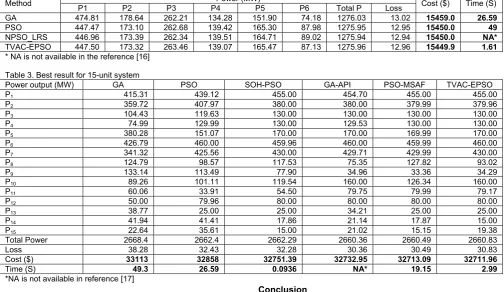
Table 2 shows the best results achieved by the proposed TVAC-EPSO method. It can be seen that the proposed method can produce lower generation cost than GA [15], PSO [15] and NPSO_LRS [16]. Moreover, the execution time of the proposed method is less than other methods, as shown in Table 2. The convergence characteristic of the proposed method is shown in Fig. 3. For this case, the TVAC-EPSO method is better than other techniques in obtaining the best generation cost. In addition, it can provide significant reduction in simulation time execution.
Test system 3: 15-unit system
The input data of 15-generating units are given in [15]. The total real power demand is 2630 MW. For this test system, large number of generators is used to validate the effectiveness of the proposed method. The POZ and ramp rate limits are considered as the generator constraints. The transmission losses are calculated using (5).
The best results produced by TVAC-EPSO are presented in Table 3. They were compared with the results reported in literatures, such as GA [15], PSO [15], SOH-PSO [4], GA-API [17] and SOH-PSO-MSAF [5]. From Table 3, it clearly shows that the proposed method yields lower generation cost and less execution time than other methods
[image:3.595.301.550.122.361.2](except for SOH-PSO). Fig. 4 shows the potential cost saving of TVAC-EPSO and other methods (compared to GA). Therefore, this method can provide a significant cost saving compared to other methods. The convergence characteristic of the proposed method is shown in Fig. 5.
Table 1. Best result for 3-unit system Power
Output (MW)
EP PSO SQP EP- CPSO-SQP TVAC-EPSO
P1 300.26 300.27 300.27 300.27 300.27 P2 400.00 400.00 400.00 400.00 400.00 P3 149.74 149.73 149.73 149.734 149.73 Total P 850.00 850.00 850.00 850.00 850.00
Cost ($) 8234.07 8234.07 8234.07 8234.07 8234.07 Time (S) 6.78 4.37 5.12 2.06 1.03
0 1 2 3 4 5 6 7 8
EP PSO EP‐SQP PSO‐SQP CPSO‐SQP TVAC‐EPSO
Ti
m
e
(S
)
Method
Fig.1. Comparison of execution times for different method for 3-unit system
8100 8300 8500 8700 8900 9100
0 10 20 30 40 50 60 70 80 90 100
Cos
t
(
$
)
[image:3.595.309.541.408.560.2]Iteration
Fig.2. Convergence characteristic for 3-unit system
15400 15500 15600 15700 15800 15900 16000
0 10 20 30 40 50 60 70 80 90 100
Co
st
(
$
)
[image:3.595.309.542.588.743.2]Iteration
Table 2. Best result for 6-unit system
[image:4.595.46.551.67.359.2]Method P1 P2 P3 P4 P5 P6 Power (MW) Total P Loss Cost ($) Time (S) GA 474.81 178.64 262.21 134.28 151.90 74.18 1276.03 13.02 15459.0 26.59 PSO 447.47 173.10 262.68 139.42 165.30 87.98 1275.95 12.95 15450.0 49 NPSO_LRS 446.96 173.39 262.34 139.51 164.71 89.02 1275.94 12.94 15450.0 NA* TVAC-EPSO 447.50 173.32 263.46 139.07 165.47 87.13 1275.96 12.96 15449.9 1.61 * NA is not available in the reference [16]
Table 3. Best result for 15-unit system
Power output (MW) GA PSO SOH-PSO GA-API PSO-MSAF TVAC-EPSO
P1 415.31 439.12 455.00 454.70 455.00 455.00 P2 359.72 407.97 380.00 380.00 379.99 379.96 P3 104.43 119.63 130.00 130.00 130.00 130.00 P4 74.99 129.99 130.00 129.53 130.00 130.00 P5 380.28 151.07 170.00 170.00 169.99 170.00 P6 426.79 460.00 459.96 460.00 459.99 460.00 P7 341.32 425.56 430.00 429.71 429.99 430.00 P8 124.79 98.57 117.53 75.35 127.82 93.02
P9 133.14 113.49 77.90 34.96 33.36 34.29
P10 89.26 101.11 119.54 160.00 126.34 160.00
P11 60.06 33.91 54.50 79.75 79.99 79.17
P12 50.00 79.96 80.00 80.00 80.00 80.00
P13 38.77 25.00 25.00 34.21 25.00 25.00
P14 41.94 41.41 17.86 21.14 17.87 15.00
P15 22.64 35.61 15.00 21.02 15.15 19.38
Total Power 2668.4 2662.4 2662.29 2660.36 2660.49 2660.83
Loss 38.28 32.43 32.28 30.36 30.49 30.83
Cost ($) 33113 32858 32751.39 32732.95 32713.09 32711.96 Time (S) 49.3 26.59 0.0936 NA* 19.15 2.99 *NA is not available in reference [17]
0 50 100 150 200 250 300 350 400 450
PSO SOH‐PSO GA‐API PSO‐MSAF TVAC‐EPSO
Co
st
sa
vin
g
(
$
)
[image:4.595.55.290.378.514.2]Method
Fig.4. Potential cost saving compared to GA method (15-unit system)
32000 34000 36000 38000 40000 42000 44000
0 10 20 30 40 50 60 70 80 90 100
Co
st
(
$
)
[image:4.595.54.289.560.715.2]Iteration
Fig. 5. Convergence characteristic for 15-unit system
Conclusion
In this paper, a hybrid method incorporating PSO with TVAC and EP, called TVAC-EPSO has been proposed to solve nonconvex ED problems. The performance of the proposed method has been tested on three different test systems which consider the practical generator constraints such as valve point effects, POZ and ramp rate limits. The results obtained by TVAC-EPSO method were compared with other methods reported in literatures. The comparison study was done based on the optimum generation cost and execution time for every test system. The proposed method is able to reduce the generation cost significantly especially for a large system (15-unit system). Also, this method is able to reach an optimum solution within less computation time. From this study, it can be concluded that the proposed TVAC-EPSO method can be an alternative approach in finding a better optimum solution for nonconvex ELD problems.
REFERENCES
[1] B. H. Chowdhury and S. Rahman, "A review of recent advances in economic dispatch," IEEE Transactions on Power Systems, vol. 5, pp. 1248-1259, 1990.
[2] A. Mahor, V. Prasad, and S. Rangnekar, "Economic dispatch using particle swarm optimization: A review," Renewable and Sustainable Energy Reviews, vol. 13, pp. 2134-2141, 2009. [3] A. Safari and H. Shayeghi, "Iteration particle swarm
optimization procedure for economic load dispatch with generator constraints," Expert Systems with Applications, vol. 38, pp. 6043-6048, 2011.
[4] K. T. Chaturvedi, M. Pandit, and L. Srivastava, "Self-Organizing Hierarchical Particle Swarm Optimization for Nonconvex Economic Dispatch," IEEE Transactions on Power Systems,
vol. 23, pp. 1079-1087, 2008.
[5] P. Subbaraj, R. Rengaraj, S. Salivahanan, and T. R. Senthilkumar, "Parallel particle swarm optimization with modified stochastic acceleration factors for solving large scale economic dispatch problem," International Journal of Electrical Power and Energy Systems, vol. 32, pp. 1014-1023, 2010. [6] M. Younes and F. Benhamida, "Genetic Algorithm-Particle
Srawrm Optimization (GA-PSO) for Economic Load Dispatch,"
[7] J. Cai, Q. Li, L. Li, H. Peng, and Y. Yang, "A hybrid CPSO– SQP method for economic dispatch considering the valve-point effects," Energy Conversion and Management, vol. 53, pp. 175-181, 2012.
[8] J. Kennedy and R. Eberhart, "Particle swarm optimization,"
IEEE International Conference on in Neural Networks, 1995,
pp. 1942-1948 vol.4.
[9] P. Jong-Bae, L. Ki-Song, S. Joong-Rin, and K. Y. Lee, "A particle swarm optimization for economic dispatch with nonsmooth cost functions," IEEE Transactions on Power Systems, vol. 20, pp. 34-42, 2005.
[10] P. J. Angeline, "Using selection to improve particle swarm optimization," IEEE International Conference on Evolutionary Computation, 1998, pp. 84-89.
[11] J. J. Jamian, M. W. Mustafa, H. Mokhlis, and M. N. Abdullah, "Comparative Study on Distributed Generator Sizing Using Three Types of Particle Swarm Optimization," 2012 Third International Conference on Intelligent Systems, Modelling and Simulation (ISMS), 2012, pp. 131-136.
[12] A. Ratnaweera, S. K. Halgamuge, and H. C. Watson, "Self-organizing hierarchical particle swarm optimizer with time-varying acceleration coefficients," IEEE Transactions on Evolutionary Computation, vol. 8, pp. 240-255, 2004.
[13] N. Sinha, R. Chakrabarti, and P. K. Chattopadhyay, "Evolutionary programming techniques for economic load dispatch," IEEE Transactions on Evolutionary Computation, vol. 7, pp. 83-94, 2003.
[14] T. A. A. Victoire and A. E. Jeyakumar, "Hybrid PSO–SQP for economic dispatch with valve-point effect," Electric Power Systems Research, vol. 71, pp. 51-59, 2004.
[15] G. Zwe-Lee, "Particle swarm optimization to solving the economic dispatch considering the generator constraints,"
IEEE Transactions on Power Systems, vol. 18, pp. 1187-1195, 2003.
[16] A. I. Selvakumar and K. Thanushkodi, "A New Particle Swarm Optimization Solution to Nonconvex Economic Dispatch Problems," IEEE Transactions on Power Systems, vol. 22, pp. 42-51, 2007.
[17] I. Ciornei and E. Kyriakides, "A GA-API Solution for the Economic Dispatch of Generation in Power System Operation,"
IEEE Transactions on Power Systems, vol. 27, pp. 233-242, 2012.
Authors:
Mohd Noor Abdullah, Faculty of Electrical and Electronic Engineering, Universiti Tunn Hussien Onn Malaysia, 86400 Batu Pahat, Johor, Malaysia. E-mail: [email protected].
Prof. Dr. Nasrudin Abd Rahim and Dr. Abd Halim Abu Bakar, University of Malaya Power Energy Dedicated Advanced Centre (UMPEDAC), University of Malaya, 50603 Kuala Lumpur, Malaysia. E-mail: [email protected], [email protected].
Dr. Hazlie Mokhlis and Dr. Hazlee Azil Illias, Department of Electrical Engineering,University of Malaya, 50603 Kuala Lumpur, Malaysia, E-mail: [email protected], [email protected].