Developing Asian language corpora: standards and practice
Zhonghua Xiao, Tony McEnery, Paul Baker, Andrew Hardie
Department of Linguistics
Lancaster University
Lancaster
{z.xiao, a.mcenery, j.p.baker, a.hardie}
@lancaster.ac.uk
Abstract
This paper first discusses standards for developing Asian language corpora so as to facilitate international data exchange. Following this, we present two corpora of Asian languages developed at Lancaster University – the EMILLE Corpus, which contains 14 South Asian languages, and the Lancaster Corpus of Mandarin Chi-nese. Finally, we will demonstrate how to explore these corpora using Xara and other corpus tools.
1 Introduction
In the recent past, the focus of corpus linguistics was on the creation and exploitation of English language corpora. While many European language corpora have also been created and made available recently,1 less progress has been made in the
crea-tion of Asian language resources. In contrast to the wide variety of languages in Asia, the number of publicly available Asian language corpora is very limited. This situation needs to be improved.
There are some Asian language corpora scat-tered around the world. Of these, Chinese is proba-bly the language for which most corpus data is available. The Institute of Computational Linguis-tics of Peking University released a corpus con-taining one million words using one month’s news texts from People’s Daily (January 1998).2 The PH
1 See http://www.eida.fr/cata/tabtxt1.html, the website of Evaluations and Language Resource Distribution Agency. 2 See http://icl.pku.edu.cn/Introduction/corpustagging.htm.
corpus, compiled by Guo Jin, contains around two million words of newswire texts from the Xinhua News Agency (1990 – 1991).3 Academia Sinica
also released a five million word balanced corpus of Mandarin Chinese as used in Taiwan.4 The
LIVAC synchronous corpus of Chinese, created by City University of Hong Kong, is near comple-tion.5 A spoken Chinese corpus of situated
dis-course is under construction under the auspices of the Chinese Academy of Social Science (see Gu 2002). The LDC has also released some corpora of news texts and telephone conversations in Chinese. Corpora for other Asian languages are rela-tively few, though there are some resources, nota-bly for East Asia and Thailand, e.g. Korean (cf. Rim 2001), Japanese (cf. Shirai 2001; Goto et al 2001) and Thai (cf. Sornlertlamcanich 2001; Thongprasirt et al 2001). With a few exceptions, e.g. the Sinica Corpus for Chinese (see Huang 2001) and the Sejong Corpus for Korean, most Asian language corpora are specialized corpora (e.g. newspaper corpora).
The problems facing Asian corpus linguistics are self-evident, as are their causes. First of all, there appears to be a lack of coordination in the development of Asian language resources. There is no true parallel to the European Language Re-sources Association (ELRA) in Asia, which could coordinate worldwide Asian language resource development efforts. There is also a need to estab-lish standards and guidelines for corpus encoding
3 A brief description of the corpus can be accessed online at
ftp://ftp.cogsci.ed.ac.uk/pub/chinese/.
and exchange in the region.6 These standards, while taking into account the unique features of Asian languages, must also conform to other major standards (e.g. the ELRA standards for corpus validation) so as to facilitate the exchange of cor-pus resources in the region.
This paper first seeks to propose standards re-garding corpus structure, markup and character encoding for Asian languages. Following this, two corpora are presented, namely, the EMILLE Cor-pus, which contains 14 South Asian languages, and a balanced corpus of written Chinese, the Lancas-ter Corpus of Mandarin Chinese. We will then demonstrate how to explore these corpora using
Xara (XML-aware SARA) and other corpus tools.
2
Standards of corpus development
This section discusses standards of corpus devel-opment. As noted in section 1, while there are some corpora available for Asian languages, stan-dards for corpus constituents, data formats, file structure, markup, annotation and character encod-ing are clearly needed for efficient data exchange internationally. These are currently lacking, or not applied if they exist.Corpus constituents and data formats. A corpus can consist of written text, transcribed speech or multimedia like audio/video clips; it can also be distributed using various media (e.g. disks, CD, DVD, tape) or online. Whatever form or medium it takes, it is only considered complete when all of the necessary constituents are available. They in-clude primary (corpus files) and ancillary (documentation) components. The following data formats are commonly used, and are recommended for most corpus interchange tasks: XML/SGML for text files, MP3/WAV for audio files, MPEG/Quicktime for video files and PNG/JPG for image files. For documentation, open formats such as PDF, HTML, or XML are recommended because non-standard or proprietary formats which may require the use of specific software should be avoided as far as possible.7
6 The ALR committee is working in the right direction by setting up a language resource repository and related stan-dards.
7 The discussion in this paragraph is based on ELRA docu-ment D1: Validation Manual for Written Language Resources
(http://www.oucs.ox.ac.uk/rts/elra/D1.xml).
File structure, markup and annotation. Each corpus file should consist of two parts: header and body. The header part provides metadata about the corpus file while the body part contains the corpus data proper. As an international standard, XML has proved to be a sound basis for standardizing corpus and annotation formats to facilitate easy data link-age and transformation (cf. Ide 2000: 2).
As for the header part, a number of metadata sets have been proposed in Europe and the US by, for example, the Dublin Core Metadata Initiative (DC), the Open Language Archives Community (OLAC), the ISLE Metadata Initiative (IMDI), MPEG7 and EAGLES (Corpus Encoding Standard or CES). DC provides 15 elements used primarily to describe authored web resources. OLAC is an extension of DC, which introduces refinements to narrow down the semantic scope of the DC ele-ments and adds an extra element to describe the language(s) covered by the resource (cf. Witten-burg et al 2002: 1321). MPEG7 is principally ori-ented towards multimedia rather than textual data. Hence, many of its elements are not relevant to text corpora. While IMDI applies to (multimedia) cor-pora and lexica as well, it nevertheless needs spe-cial software (e.g. the IMDI BCEditor) to work efficiently. The standard we have used in our Asian corpus building work is the Corpus Encod-ing Standard (CES) developed by EAGLES.
the same metalanguage specifications, standardiza-tion at the syntactic level specifies precise tag names and syntactic rules for using the tags as well as constraints on content. However, even the same tag names can be interpreted differently by the data sender and receiver. This is why standardization at the semantic level is useful. The CES seeks to standardize at the semantic level for those elements most relevant to language engineering applications, in particular, linguistic elements. The three levels of standardization are designed to achieve the goal of universal document interchange. In addition, the CES also provides encoding specifications for lin-guistic annotation (e.g. paragraph and sentence boundaries and morphological information for to-kens) together with a data architecture for linguis-tic corpora. 8
Character encoding. Character encoding is an-other area that needs to be standardized for corpus construction. In many cases, multiple and often competing encoding systems complicate Asian corpus building, providing a real problem as McEnery and Xiao (2004) observe. The main diffi-culty in building a multilingual corpus of Asian languages is the need to standardize the language data into a single character set (see McEnery et al 2001). We recommend Unicode as a solution to this problem. Unicode is truly multilingual in that it can display characters from a very large number of writing systems. From the Unicode Standard version 1.1 onwards, Unicode is fully compatible with ISO 10646-1 (UCS). The combination of Unicode and XML is a general trend in corpus de-velopment. As such it is to be welcomed.
The EMILLE and LCMC corpora were devel-oped at Lancaster University following these guidelines. These corpora will be presented in the following two sections as an example of what can be achieved by adherence to these standards.
3
The EMILLE Corpus
The EMILLE Corpus is the primary resource de-veloped by the EMILLE (Enabling Minority Lan-guage Engineering) project.9 The corpus consists
8 The discussion in this paragraph is based on Corpus Encod-ing Standard (http://www.cs.vassar.edu/CES).
9 The project was funded by the UK EPSRC (Grant references GR/N19106, GR/M70735, GR/N28542 and GR/R42429/01). The corpus can be accessed at the following site:
http://www.ling.lancs.ac.uk/corplang/emille.
[image:3.612.312.545.273.468.2]of three components: monolingual, parallel and annotated corpora. There are 14 monolingual cor-pora, including both written and (for some lan-guages) spoken data for 14 South Asian languages. The parallel corpus consists of 200,000 words of text in English and its accompanying translations in Hindi, Bengali, Punjabi, Gujarati and Urdu. The annotated component includes the Urdu monolin-gual and parallel corpora annotated for parts-of-speech, together with 20 written Hindi corpus files annotated to show the nature of demonstrative use. The rationale for the corpus design was explained and justified in McEnery et al (2001) and Baker et al (2002, 2003).
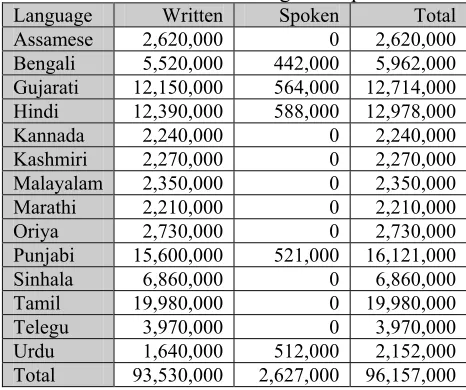
Table 1: The EMILLE monolingual corpora Language Written Spoken Total
Assamese 2,620,000 0 2,620,000 Bengali 5,520,000 442,000 5,962,000 Gujarati 12,150,000 564,000 12,714,000 Hindi 12,390,000 588,000 12,978,000 Kannada 2,240,000 0 2,240,000 Kashmiri 2,270,000 0 2,270,000 Malayalam 2,350,000 0 2,350,000 Marathi 2,210,000 0 2,210,000 Oriya 2,730,000 0 2,730,000 Punjabi 15,600,000 521,000 16,121,000 Sinhala 6,860,000 0 6,860,000 Tamil 19,980,000 0 19,980,000 Telegu 3,970,000 0 3,970,000 Urdu 1,640,000 512,000 2,152,000 Total 93,530,000 2,627,000 96,157,000
de-mographically sampled speech. Table 1 gives the sizes of each monolingual corpus.
In the EMILLE Corpus, files are classified by their provenance or genre. All of them have a file-name in a standard format, which consists of a se-ries of codes chained together with hyphen characters. These codes specify the main language of the file, the source of the text, its subcategory in terms of subject matter if such information is available, and an identifying number. The name is generally of the format: [Language]-[text type]-[Source]-[subcategory]-[identifyingNumber].txt. In the case of sources from which text was gath-ered on a periodical basis (i.e. the news websites in the written corpus, the radio programs for the spo-ken corpus) the identifying number is a date. For other files it is simply an arbitrary unique number. The major exception to this scheme is the Sinhala written corpus, which, unlike the other languages, is organized primarily by the category into which the text falls, and secondarily by the source it was gathered from.
The EMILLE monolingual corpora are bal-anced, covering a number of genres and domains. Whilst these corpora vary in size, each of them contains at least two million words, typically large enough for natural language processing tasks.
On the EMILLE project we wished to develop a POS tagger for at least one of the languages cov-ered by the project. The language we chose to fo-cus on was Urdu. We selected Urdu for a number of reasons. Firstly, it is widely spoken in the UK, both as a first and second language, and native speakers were available to be consulted at Lancas-ter where this part of the project took place. Sec-ondly, as the lingua franca of a multilingual community (that of South Asian Muslims) and the official language of Pakistan, Urdu has consider-able political and cultural importance. Thirdly, there are a number of factors that we anticipated would make tagging Urdu more complicated than tagging any other EMILLE language. For example, the right-to-left directionality of the Perso-Arabic script in which Urdu is written and the presence of grammatical forms borrowed from Arabic and Per-sian, which are structurally quite distinct from Indo-Aryan forms, mean that Urdu represents a unique challenge in our data. It seemed the best course of action was to confront these problems by choosing Urdu as the language for which to de-velop POS tagging. The Urdu tagset was created,
using the Urdu grammar of Schmidt (1999) as a basis, in accordance with the EAGLES guidelines on morphosyntactic annotation (Leech and Wilson 1999). The data in Urdu (both monolingual and parallel) was annotated with morphosyntactic analysis using the Urdu tagger developed on the EMILLE project (see Hardie 2003).
The corpus annotation research of EMILLE has also expanded to cover another form of annotation – the annotation of demonstratives – in Hindi. The annotation scheme was designed on the basis of the blueprint provided by Botley and McEnery’s (2001) scheme devised for English demonstrative anaphors (see Sinha 2003 for details). The ana-phorically annotated Hindi corpus contains roughly 100,000 words of news material (20 excerpts from the Ranchi Express data).
The parallel corpus was compiled using 75 ad-vice leaflets published by the UK government, tak-ing the form of approximately 200,000 words of English originals with accompanying translations in five South Asian languages (Hindi, Bengali, Punjabi, Gujarati and Urdu). The research value of these British government data is very high in our view. Whilst the corpus is composed of only one genre, it covers a range of domains, including con-sumer issues, education, housing, health, law and social security, all of which are term-rich areas.
The EMILLE Corpus is a product of collabora-tion between the Lancaster team and Central Insti-tute of Indian Languages (CIIL), Mysore, India. We learnt from our experience that collaboration is better than competition. The construction of large-scale language resources needs to accept this truth if it is to be effective (see Baker et al 2003).
4
The LCMC Corpus
The Lancaster Corpus of Mandarin Chinese (LCMC) is a one million word balanced corpus of written Mandarin Chinese. The corpus was created as part of the research project Contrasting tense and aspect in English and Chinese.10 We built the
LCMC Corpus in response to the general lack of publicly available balanced corpora of Chinese (see section 1). The only balanced corpus of Man-darin Chinese is the Sinica Corpus, which was produced by Academia Sinica, Taiwan. As a result
of Taiwan being separated politically from Mainland China for decades, the language used in Taiwan has diverged from that used in Mainland China.11 As such, the Sinica corpus does not
[image:5.612.67.304.215.511.2]repre-sent modern Mandarin Chinese as written in Mainland China. Given the available corpus re-sources for Chinese corpus linguistics and our de-sire to use a balanced corpus of modern Mandarin Chinese from Mainland China to contrast English and Chinese, we decided to build LCMC.
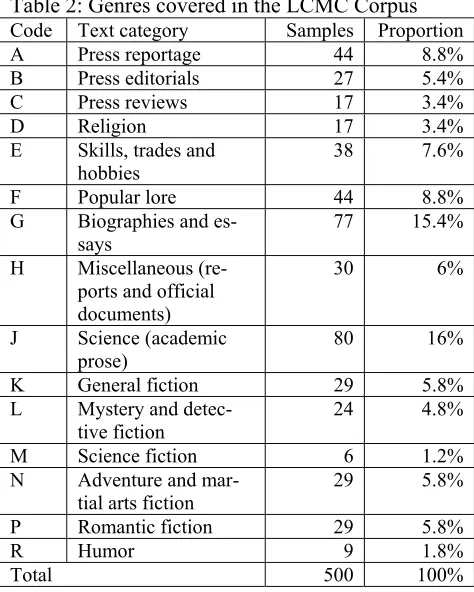
Table 2: Genres covered in the LCMC Corpus Code Text category Samples Proportion A Press reportage 44 8.8% B Press editorials 27 5.4%
C Press reviews 17 3.4%
D Religion 17 3.4%
E Skills, trades and
hobbies 38 7.6%
F Popular lore 44 8.8%
G Biographies and
es-says 77 15.4%
H Miscellaneous (re-ports and official documents)
30 6%
J Science (academic prose)
80 16%
K General fiction 29 5.8% L Mystery and
detec-tive fiction 24 4.8%
M Science fiction 6 1.2% N Adventure and
mar-tial arts fiction 29 5.8% P Romantic fiction 29 5.8%
R Humor 9 1.8%
Total 500 100%
As the LCMC Corpus was created principally with contrastive research in mind, it was designed as a Chinese match for the FLOB (British English, see Hundt, Sand and Siemund 1998) and Frown (American English, see Hunt, Sand and Skandera 1999) corpora. All three corpora sampled written text produced in 1991 – 1992, covering 15 genres as shown in Table 2.
LCMC has been constructed using written Mandarin Chinese texts published in Mainland
11 In Taiwanese Mandarin, for example, you can function as a perfective marker indicating the actualization of a situation, especially in conversations. Speakers of Mainland Mandarin find this usage odd and even ungrammatical (cf. Christensen 1994).
China to ensure some degree of textual homogene-ity. It should be noted that the corpus is composed of written textual data only, with items such as graphics and tables in the original texts replaced by <gap> elements in the corpus texts. Long citations from translated texts or texts produced outside the sampling period were also replaced by <gap> ele-ments so that the effect of translationese could be excluded and L1 quality guaranteed.
While a small number of samples, if they were conformant with our sampling frame, were col-lected from the Internet, most samples were pro-vided by the SSReader Digital Library in China. As each page of the electronic books in the library came in PDG format, these pages were trans-formed into text files using an OCR module pro-vided by the digital library. This scanning process resulted in a 1-3% error rate, depending on the quality of the picture files. Each electronic text file was proofread and corrected independently by two native speakers of Mandarin Chinese so as to keep the electronic texts as faithful to the original as possible.
As we needed to the follow the structure of the FLOB/Frown corpora, all of the samples for each genre were combined into one file. As such, in building the LCMC Corpus, we had to modify the CES header (see section 2) slightly by moving the bibliographic information for each sample into a separate ancillary document accompanying the corpus.
While the original data was encoded with GB2312, we decided to convert the corpus into Unicode, following the standards established in section 2. In addition to the standard version con-taining Chinese characters, we also produced a Pinyin version to enable users who can read Ro-manized Chinese but not Chinese characters to use our corpus.
The LCMC Corpus is a valuable resource for research into Mandarin Chinese and, in combina-tion with FLOB and/or Frown, for the contrastive study of Chinese and English. It is our hope that the release of LCMC will stimulate corpus-based research both into modern Chinese itself, and into modern Chinese in contrast with English.12
5
Exploration
tools
As EMILLE and LCMC are marked up respec-tively in SGML and XML, non-markup-aware concordancers will not allow users to easily exploit these corpora fully. Two Unicode-compliant markup-aware corpus tools that are available, Xara
(Burnard and Todd 2003) and WordSmith version 4 (Scott 2003), are at the final stage of beta testing at the moment and will be released soon.
Using WordSmith 4 to explore the two corpora is quite straightforward, though the LCMC Corpus needs to be converted from utf-8 to utf-16 first us-ing a built-in utility of WordSmith.
Xara is more powerful in that it allows users to build very complex queries, yet it is accordingly more difficult to use. The program is an XML-compliant extension of SARA (SGML-aware Re-trieval Application) originally developed for the British National Corpus (cf. Aston and Burnard 1998). It can be used for both the local and remote access of a corpus. With Xara, a corpus needs to be indexed using the Indexer tool before it can be ex-plored using the client program. This section dem-onstrates how to explore EMILLE and LCMC using Xara. We will also introduce a web-based concordancer developed for LCMC.
When we indexed the EMILLE Corpus, we followed the corpus architecture established in sec-tion 3. The 14 monolingual corpora (including speech data where appropriate) were indexed sepa-rately. The two annotated corpora for Urdu and Hindi were also kept separate, as they consist of data contained within the monolingual corpora. Similarly, the six parallel corpora were indexed individually by language. As a result, there are al-together 22 subcorpora in EMILLE. Note, how-ever, that using Xara to explore these parallel corpora is an interim solution. We are aligning
12 See McEnery, Xiao and Mo (2003) for a discussion of the design criteria and technical details of the corpus. The corpus is can be accessed at the following website:
http://www.ling.lancs.ac.uk/corplang/lcmc.
these corpora at the sentence level, using an align-ment algorithm developed at Lancaster (see Piao 2000). Once the alignment is complete, users will be able to explore these parallel corpora with the new Unicode-compliant version of ParaConc de-veloped by Michael Barlow, which is now being beta tested.
As the EMILLE Corpus is richly annotated with various kinds of information, there are many dif-ferent markup elements in the corpus. The most important parameters which are directly relevant to most users include channel, domain (for monolin-gual written corpora), as well as occupation and
person (indicating a speaker’s occupation, sex and age for speech data). POS tags and anaphoric tags are also important, respectively, for annotated Urdu and Hindi data. These two types of token-level tags were indexed following a different pol-icy from other elements to allow for POS queries. In the remainder of this section, we will use LCMC to demonstrate how to explore these corpora with
Xara. While the languages discussed are different, the method of using Xara on each should remain the same.
In the LCMC Corpus, the most important XML elements are text (text category), file (sample file),
s (sentence) and w (word token).13 The text element
can be used to compare different genres while the
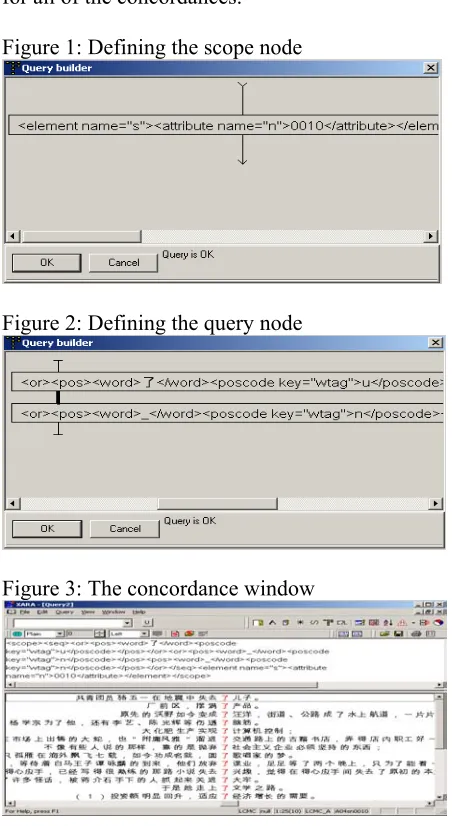
file and s elements indicate the location of a con-cordance to provide a reference back in the corpus. Now suppose we want to extract all instances of the verbal-final 了 -le (tagged as u) immediately followed (the link type defined as Next) by a noun (tagged as n) in sentence number 0010 in all of the 500 sample files in the 15 text categories. This complicated query can be made using “Query builder” of Xara. First, define the scope node (the left node in Query builder that indicates the context to search in) as “0010” using the s element (Fig. 1). In the query node (the right node in Query builder), select AddKey (POS) to define the first part of the query as 了 and select the POS tag u, and the sec-ond part as Any and select the POS tag n. Then define the link type as Next (Fig. 2). The search result is shown in Fig. 3. The upper part of the concordance window gives the query text (Select
Query – Query text from the main menu to display
13 Following the BNC style, punctuations and symbols in LCMC are tagged separately from word tokens using the c
the query text) while the lower window displays the concordances. The status bar of the concor-dance window shows the name of the corpus, the current position of the pointer/mouse (i.e. concor-dance number 1), the total number of concorconcor-dances (i.e. 25), the number of files in which the query is matched (10), the file name where the current con-cordance occurs (i.e. LCMC_A), and the file/sentence number for the current concordance (i.e. File A04 and sentence number sn0010). As we have searched in sentence number 0010 (in 500 sample files), this should be the sentence number for all of the concordances.
Figure 1: Defining the scope node
Figure 2: Defining the query node
Figure 3: The concordance window
By comparison to many other corpus tools, one advantage of Xara is that it displays complete sen-tences while also centering the search query. Users are also given options to display concordances in the page (giving more context) or line mode (i.e.
KWIC, as shown in Fig. 3), in XML or plain text. Additionally, users can define their own style sheet to display selected XML elements. Xara can also compute significant collocates automatically using a statistic selected from those available by the user.
While the EMILLE and LCMC corpora can be explored most efficiently with Xara, we have also developed a web-based concordancer (WebConc) for use with LCMC, which is more user-friendly than Xara.
WebConc allows users to search in the standard character version or the Romanized Pinyin version of the LCMC corpus using a token, POS tag or their combination. Users can also select text cate-gories for inclusion in their search. The search re-sult can be displayed the sentence or KWIC mode (both displaying complete sentences), in XML or plain text. The concordancer also gives a summary of the query, including the query text, the date the corpus is accessed, raw and normalized (per mil-lion words) frequencies in each text category, and the total frequency in the text categories users have selected. Together with the instructions for order-ing LCMC, WebConc can be accessed at the cor-pus website given in section 4.
6 Conclusion
This paper has discussed standards for developing Asian language corpora and presented two corpora developed at Lancaster University, together with exploration tools for use with these corpora. The standards we propose here work well with Asian language corpora, as demonstrated by our practice in corpus development; they also conform to the current trends in the international NLP community. The two corpora we developed also constitute an improvement to the previous state of Asian lan-guage resources.
collabora-tion is better than competicollabora-tion. Our experience in collaborating with the Xara team also tells us that the cooperation between corpus creators and soft-ware developers can produce better corpora and better corpus tools. It is our belief that the coopera-tion and collaboracoopera-tion between centres and insti-tutes worldwide will undoubtedly give rise to the further development of Asian language corpora.
References
Aston, G. and Burnard, L. 1998. The BNC Handbook. Edinburgh: Edinburgh University Press.
Baker, P., Hardie, A., McEnery, A., Cunningham, H., and Gaizauskas, R. 2002. “EMILLE, a 67-million word corpus of Indic languages: data collection, mark-up and harmonization”. In LREC 2002 Pro-ceedings, pp. 819-827.
Baker, P., Hardie, A., McEnery, A. and Jayaram B. 2003. “Corpus data for South Asian language proc-essing”. In P. Hall and D. Rao (eds) Proceedings of the Workshop on Computational Linguistics for the Languages of South Asia, pp. 1-8.
Botley, S. and McEnery, A. 2001. “Demonstratives in English: a corpus-based study”. Journal of English Linguistics. 29: 7-33.
Burnard, L. and Todd, T. (2003). “Xara: an XML aware tool for corpus searching”. In Proceedings of Corpus Linguistics 2003, pp. 142-4.
Christensen, M. 1994. Variation in Spoken and Written Mandarin Narrative Discourse. Ph.D. thesis, Ohio State University, Columbus.
Goto, I., Kato, N. and Ehara T. 2001. “A multilingual news database and its application to a translation memory system”. In Proceedings of ALR-2 Work-shop, pp. 1-6.
Gu, Y. 2002. “Towards an understanding of workplace discourse”. In C. Candlin (ed) Research and Practice in Professional Discourse, pp. 137-86. Hong Kong: City University of Hong Kong Press.
Hardie, A. 2003. “Developing a model for automated part-of-speech tagging in Urdu”. In Proceedings of Corpus Linguistics 2003, pp. 298-307.
Huang, C. 2001. “Current Status and Future of Lan-guage Resources in Taiwan”. In Proceedings of ALR-1 Workshop.
Hundt, M., Sand, A. and Siemund, R. 1998. Manual of information to accompany the Freiburg - LOB Cor-pus of British English (“FLOB”).
Hunt, M., Sand, A. and Skandera, P. 1999. Manual of information to accompany the Freiburg - Brown Corpus of American English (“Frown”).
Ide, N. 2002. “Requirements, tools, and architectures for annotated corpora”. In LREC 2000 Proceedings of Data Architectures and Software Support for Large Corpora Workshop, pp. 1-5.
Leech, G. and Wilson, A. 1999. “Standards for tagsets”. In H. van Halteren (ed) Syntactic wordclass tagging. Dordrecht: Kluwer Academic Publishers.
McEnery, A., Baker, P., Gaizauskas, R. and Cunning-ham, H. 2001. “EMILLE: building a corpus of South Asian languages”. In D. Lewis and R. Mitkov (eds) Proceedings of Machine Translation and Multilin-gual Applications in the New Millennium.
McEnery, A., Xiao, Z. and Mo, L. 2003. “Aspect mark-ing in English and Chinese: usmark-ing the Lancaster Cor-pus of Mandarin Chinese for contrastive language study”. Literary and Linguistic Computing 18(4): 361-78.
McEnery, A. and Xiao, Z. 2004. “Character encoding in corpus construction”. In M. Wynne (ed) Guide to Good Practice. Oxford: Oxford University Press. Piao, S. 2000. Sentence and Word Alignment between
Chinese and English. Ph.D. thesis, Lancaster Univer-sity, Lancaster.
Rim, H. 2001. “Language Resources in Korea”. In Pro-ceedings of ALR-1 Workshop.
Schmidt, R. 1999. Urdu: an essential grammar. Lon-don: Routledge.
Scott, M. 2003. WordSmith Tools Manual.
Shirai, K. 2001. “Language resources in Japan”. In Pro-ceedings of ALR-1 Workshop.
Sinha, S. 2003. Demonstrative Anaphors in Hindi Newspaper Reportage: A Corpus-based Study. MA dissertation, Lancaster University, Lancaster.
Sornlertlamvanich, V. 2001. “Thai linguistic resources”. In Proceedings of ALR-1 Workshop.
Thongprasirt, R., Charoenporn, T., Sinthupinyo, W. and Sortlertlamvanich, V. 2001. “Development of very large corpora in Thailand”. In Proceedings of ALR-2 Workshop.