A Comprehensive Experimental Comparison of
Event Driven and Multi-Threaded Sensor Node
Operating Systems
Cormac Duffy
1, Utz Roedig
2, John Herbert
1, Cormac Sreenan
1 1Computer Science Department, University College Cork, IrelandEmail: {c.duffy,j.herbert,c.sreenan}@cs.ucc.ie 2InfoLab21, Lancaster University, UK
Email: [email protected]
Abstract— The capabilities of a sensor network are strongly influenced by the operating system used on the sensor nodes. In general, two different sensor network
oper-ating system types are currently considered:event drivenand
multi-threaded. It is commonly assumed that event driven operating systems are more suited to sensor networks as they use less memory and processing resources. However, if factors other than resource usage are considered important, a multi-threaded system might be preferred. This paper compares the resource needs of multi-threaded and event driven sensor network operating systems. The resources considered are memory usage and power consumption. Additionally, the event handling capabilities of event driven and multi-threaded operating systems are analyzed and compared. The results presented in this paper show that for a number of application areas a thread-based sensor network operating system is feasible and preferable.
Index Terms— Sensor Networks, Sensor Network Oper-ating Systems, Performance Evaluation, TinyOS, MANTIS.
I. INTRODUCTION
Wireless sensor networks consist of battery powered sensor nodes used to gather information about a moni-tored physical phenomenon. To ensure long periods of unattended network operation, the energy consumption of the sensor nodes must be very low. The operating system used for the sensor nodes influences energy consumption on two levels. First, the design of the operating system defines the minimum resource requirements such as CPU speed and memory capacity that the sensor hardware must provide. Second, the operating system design influences the usage pattern of the CPU and thus defines how often energy-efficient sleep periods can be activated. As the sensor node must provide a service, the operating system design can not be focused solely on energy efficiency. Sensor readings and incoming messages must be handled promptly by the sensor node. The responsiveness of the node must be sufficient to handle events and requests according to their deadlines.
Application responsiveness is influenced by the oper-ating system design in two ways. First, the responsive-ness depends on the task scheduling capabilities of the operating system. Second, the design of the operating
system influences the degree to which task scheduling is performed by the system or by the systems programmer. Obviously, the last point is subjective as it depends on the quality and knowledge of the programmers. Nevertheless, the issue has strong impact in real world application designs.
Currently, operating systems for sensor nodes follow either one of two different design concepts. Operating systems following the first design approach are called
event driven. Each operating system process is triggered in response to an event (e.g. a timer, an interrupt indicat-ing new sensor readindicat-ings or an incomindicat-ing radio packet). The tasks associated with the event are executed and thereafter the node is sent to an energy-efficient sleep state or the next event is processed. As events are processed sequentially, expensive context switching between tasks is not necessary. An example of such an operating system is TinyOS [1]. The second approach follows the classic
multi-threaded operating system design. The operating system multiplexes execution time between the different tasks, implemented as threads. While switching from one thread to another, the current context has to be saved and the new context must be restored. This consumes costly resources in the constrained sensor node. An example of such an operating system for sensor nodes is MANTIS [2].
Currently it is assumed that an event driven operating system is more suitable for sensor networks because less resources are needed resulting in a more energy-efficient system. However, the exact figures are unknown and therefore determined and presented in this paper. On the other hand it is claimed that a multi-threaded operating system has superior event processing capabilities. Again, an in depth analysis is currently missing and is there-fore shown in the paper. For comparison purposes, the event-based systemTinyOSand the multi-threaded system
MANTISexecuting the same sensor network applications on theDSYS25[3] sensor platform are used. The contri-butions of the paper can be summarized as follows:
2) Comparison of the event processing capabilities of the event-based TinyOS and multi-threaded MAN-TIS operating system.
3) Comparison of the energy consumption of the event-based TinyOS and multi-threaded MANTIS operating system.
The results presented in the paper can be used to decide which type of operating system should be used for a specific sensor network application. The results also show that for a number of application areas a thread-based sensor network operating system is actually feasible and even preferable.
The rest of the paper is organized as follows. The next section describes related work in the research area of operating systems for sensor networks. Section III gives an overview of the operating systems TinyOS and MANTIS. Section IV describes the sensor platform, appli-cation scenarios and their implementation as used for the comparative experiments. Sections V,VII and VI present the experimental comparison of the operating systems. Section VIII concludes the paper.
II. RELATEDWORK
Historically, there has been much debate on whether an event-based or multi-threaded architecture is more efficient. To decide which operating system architecture should be used, the specific application environment of interest has to be considered as each application envi-ronment dictates very specific constraints. Unfortunately, results obtained for one application environment are nor-mally not directly applicable to another environment. Thus, a comprehensive study covering a multitude of application scenarios is required.
Preliminary results of our research presented in this paper were published in [4]. This paper describes the performed experiments in much greater detail. In addi-tion, the results and their implications are analyzed and discussed.
Besides our preliminary work, no published research exists that presents a comprehensive comparison of event-based and multi-thread sensor network operating systems taking event processing, energy consumption and memory usage into account. The lack of such a study is the main motivation for the work presented in this paper. Existing work targets only a subset of aspects investigated in this paper. For example papers analyzing or describing one specific operating system (e.g. [5], [6], [7], [8], [9]), or publications comparing only one aspect (e.g. memory usage in [6]). As each single existing analysis is based on different assumptions and experimental setups, it is not possible to extract an objective comparison.
As previously mentioned, the choice of operating sys-tem design has an impact on the way an application is programmed. In [10] the event-based system CONTIKI[7] uses a programming concept called “proto-threads” which allows the programmer to develop a program using a multi-threaded programming syntax. It is argued that an event-based system is more power efficient but that
programming concurrent (sensor network) applications with threads as opposed to event handlers is easier for the programmer. The proto-threads in CONTIKI allow a combination of both benefits. However, an objective performance comparison of an event-based and multi-threaded system is not provided.
In [11] it is argued that TinyOS, in contrast to MAN-TIS, has a problem with multiplexing long running tasks and short running tasks. However, an in-depth analysis - an analytical evaluation or by measurement - of the task handling problem is not given. It is argued that both operating systems should be combined to overcome the existing problems. As a solution, the complete TinyOS operating system is executed as a thread in MANTIS. If tasks in TinyOS need to be able to preempt other tasks, they can be executed in a separate MANTIS thread. Very similar earlier work [12] uses the AvrX [13] as a multi-threaded extension of the TinyOS scheduler. In this work, the event processing capabilities of the basic TinyOS and the modified AvrX extended TinyOS are investigated (a very similar experimental setup to the setup described in Section IV is used for evaluation). However, an analysis of other parameters such as power consumption and memory usage is omitted. The differences of a generic thread-based system are also not investigated. In summary, the research focus of [11] and [12], is to integrate multi-threaded features in TinyOS.
In [14] TinyOS is compared with eCos, an embedded multi-threaded operating system. eCos is not specifi-cally a sensor network operating system as many of the core operating features are designed for more com-plex embedded processors. The paper does evaluate both memory, processing performance and power efficiency. For processing performance the number of clock cycles required to process kernel functions are summed up, but actual application performance is not investigated. The power performance is compared theoretically based on the memory requirements of each operating system, but no investigation into operating system power-management is analyzed in this paper.
To our knowledge, this is the first work that provides specific data to determine the effectiveness of both an event-based and a multi-threaded operating system in a range of application scenarios.
III. SENSORNODEOPERATINGSYSTEMS
• Event: An environmental occurrence. • Interrupt:An interrupt triggered by an event. • Event-Handler: A system function, invoked in
re-sponse to an interrupt.
• TinyOS Task:A deferred procedure, usually triggered by an event-handler.
• MANTIS Thread: A portion of the MANTIS OS that can run independently of, and concurrently with, other portions of the OS, typically invoked in response to an interrupt.
A. TinyOS
The TinyOS [1] operating system was one of the first operating systems specifically designed for wireless sensor networks. The inventors felt that an event driven light-weight kernel was the best solution to handling a “large number of concurrent flows and juggle numerous out-standing events”.
The operating system and specialized applications are written in the programming language nesC and are orga-nized in self-contained components. A simplified view of this component structure is shown in Fig. 1. Components consist of interfaces in the form of command and event
functions. Components are assembled together, connect-ing interfaces used by components to interfaces provided by others, forming a customized sensor application. The resulting component architecture facilitates event-based processing by implementing event-handlers and TinyOS tasks. TinyOS tasks are deferred function calls and are placed in a simple FIFO task-queue for execution (see Fig. 1, line 8). TinyOS tasks are taken sequentially from the queue and are run to completion. Once running, the TinyOS task can not be interrupted (preempted) by another TinyOS task. Event-handlers are triggered in response to a hardware interrupt and are able to preempt the execution of a currently running TinyOS task (see Fig. 1, line 5). Event-handlers perform the minimum amount of processing to service the event. Further non time-critical processing is performed within a TinyOS task that is created by the event handler. After all TinyOS tasks in the task queue are executed, the TinyOS system enters a sleep state to conserve energy (see Fig. 1, line 10). The sleep state is terminated if an interrupt occurs.
Functionality in TinyOS is distributed among many components. Each function (e.g. sensing or packet for-warding) is normally segmented into a series of sub-steps, (task, command and event hander functions). Thus, functionality can execute concurrently by multiplexing these atomic sub-steps. When used correctly, this ap-proach leads to an efficient system structure. On the other hand it is difficult for the programmer to achieve a proper division of functionality. The programmer must be familiar with the internal affairs of all low level components in the system. Additionally, it can be difficult for some programmers to handle functionality in such sub-steps.
1:component_A 2: task do(){...} 3: command X(){...} 4: event Y(){...}
5:int_A 6: ...
7: post_task(A)
8:TOSH_run_task()
9: while(TOSH_run_next_task()) 10: TOSH_sleep()
Fig. 1. TinyOS structure
B. MANTIS
The MANTIS operating system [2] is a light-weight multi-threaded operating system capable of multi-tasking processes on energy constrained distributed sensor net-works. The system provides a classical multi threaded system in the context of wireless sensor networks.
Each task the operating system must support can be implemented - using standard C - as a separate MANTIS thread. A simplified view of this thread structure is shown in Fig. 2. A new thread is initialized and thread processing is started (line 1). Processing might be halted using the functionmos_semaphore_waitwhen a thread has to wait for a resource to become available (line 3). An interrupt handler (line 4) using the functionmos_semaphore_post
(line 5) is used to signal the waiting thread that the resource is now available and thread processing is re-sumed. While a thread is waiting on a resource to become available, other threads might be activated or, if no other processing is required, a power saving mode is entered. Power saving is handled by a thread called idle-task which is scheduled when no other threads are active. Thread scheduling is performed within the kernel function
dispatch_thread shown in Fig. 2, line 6. This function searches a data structure calledreadyQfor the highest pri-oritized thread and activates it. When thedispatch_thread
function is called, the current active thread is suspended calling PUSH_THREAD_STACK (line 7) which saves CPU register information. The highest priority thread is then selected from the readyQ (line 8) and its reg-ister values are restored by the POP_THREAD_STACK
function (line 10). Before the dispatch_thread function is called, the readyQ structure is updated. Threads that are currently sleeping or that are waiting on a semaphore (resource) are excluded from thereadyQ. The scheduling through thedispatch_thread function can be initiated by two different means. Dispatch_thread is called when a semaphore operation is called (e.g. to let the current thread wait on a resource).Dispatch_threadis also called periodically by a time slice timer to ensure processing of all threads according to their priority.
1:thread_A 2: while(running)
3: ...;mos_semaphore_wait(A1);...
4:int_A
5: ...;mos_semaphore_post(A1);...
6:dispatch_thread() 7: PUSH_THREAD_STACK()
8: CURRENT_THREAD = readyQ.getThread() 9: CURRENT_THREAD.state=RUNNING 10: POP_THREAD_STACK()
Fig. 2. MANTIS structure
information for each MANTIS thread and a pointer to the thread stack. Typically only 12 MANTIS threads can be either queued or active at any one time and will consume 120 bytes of SRAM [2]. The heap space of each thread is managed by the kernel memory manager. The memory manager assigns thread space according to a best-fit policy. Thread heaps will, by default, be assigned in the lowest possible memory address spaces, ensuring that a thread heap space doesn’t collide with the processor heap.
By defining processes as threads, algorithms can be represented in a more intuitive sequential fashion as processes don’t need to be segmented into specific states when waiting for a system event to occur. Compared to TinyOS, functionality is multiplexed by the OS, not by the programmer. Thus, MANTIS has the potential of being easier for programmers to use.
IV. EVALUATIONSETUP
For the evaluation of event processing capabilities, power consumption patterns and memory usage of TinyOS and MANTIS, both operating systems were ported to the same sensor platform, the DSYS25 [3]. Additionally, measurement facilities are integrated in both operating systems which allow us to observe the required parameters without altering the system behavior. To ac-tually perform the comparative evaluation, an abstract application scenario is defined and implemented on the sensor nodes. This abstract application scenario corre-sponds to a broad spectrum of real-world sensor network deployments.
In the following paragraphs, the selected abstract ap-plication scenario is motivated and described. Thereafter, the DSYS25 sensor-node platform, the ported operating systems and the measurement hooks are explained. This evaluation setup is used for the experiments described in the remaining sections of the paper.
A. Application Scenarios
To evaluate operating system performance, an applica-tion context must be defined. Subsequently, the operating system performance of a sensor node supporting the given scenario can be investigated. Obviously, to obtain useful results, it is important that the investigated application scenario corresponds to real-world deployment and usage scenarios of wireless sensor networks.
In many cases, a sensor network is used to collect periodically obtained measurement data at a central point (sink or base-station) for further analysis. The sensor nodes in such a network perform two major tasks. Sensor nodes perform the sensing task and they are used to forward the gathered data to the sink. If the sink is not in direct radio range of a node, other nodes closer to the sink are used to forward data. The execution time of the sensing task will depend on the nature of the physical phenomenon monitored and the complexity of the algorithm used to analyze it. Therefore, the position of the node in such a network and the complexity of the sensing task define the operating system load of the sensor node. The complexity of the sensing task is varied in the experiments and hence the application scenario is considered abstract, as it can be compared with many different real-world deployment scenarios.
The complexity of the sensing operation depends on the phenomenon monitored, the sensor device used and the data pre-processing required. As a result, the operating system can be stressed very differently. If, for example, an ATMEGA128 CPU with a processing speed of4M hzis considered (a currently popular choice for sensor nodes), a simple temperature sensing task (processed through the Analogue to Digital Converter) can be performed in less than 1ms [15]1. In this case only a 16bit value has to
be transferred from the sensing device to the CPU. If the same device is used in conjunction with a camera, image processing might take some time before a decision is made. Depending on camera resolution and image processing performed, a sensing task can easily take more than100ms[16]. Other application examples documented in the literature are situated in between these values. For example if a sensor value needs to be cryptographically secured before transmission, the sensing task is prolonged by 5ms [17]. Thus, combined with a simple sensor, a sensing task can be around10ms. Note that a long sensing task can be split-up into several sub-tasks. However, in practice this is often not possible due to two factors. First, many data-processing algorithms are difficult or impossible to be split into separate tasks. For example some image processing algorithms cannot be divided, as explained in [16]. Second, it is difficult from a program-ming (or programmers) perspective to handle and manage such divided entities. The experimental evaluation spans the task sizes described (1ms...100ms). Thus, the abstract application scenario corresponds to a wide range of real world application scenarios.
The following paragraphs give an exact specification of the abstract application scenario used, which is defined by its topology, traffic pattern and sensing pattern. The application scenario is then implemented on the DSYS25 sensor platform for evaluation.
1This calculation is based on the amount of processing time necessary
n=3
[image:5.595.68.278.79.120.2]n=1 n=2
Fig. 3. Binary Tree
Topology: The sensor network is used to forward sensor data towards a single base-station in the network. It is assumed that a tree topology is formed in the network. To simplify the evaluation process, a binary tree shown in Fig. 3 is assumed. Depending on the positionnin the tree, a sensor node si might process varying amounts of packets. Leaf nodes put less demand on the processor. Nodes closer to the root are more involved in packet forwarding and these nodes have to multiplex packet forwarding operations with their sensing operations. The position in the tree has therefore - besides other param-eters - a significant impact on the event processing and energy consumption properties of the node.
Sensing Pattern: A homogeneous activity in the sensor field is assumed for the abstract application scenario. Each sensor gathers data with a fixed frequencyfs. Thus, everyts= 1/fs a sensing task of the durationls has to be processed. As mentioned, the duration ls is variable between ls = 4000 and ls = 400000 clock cycles depending on the type of sensing task under consideration (Which corresponds to 1ms/100mson a4M HzCPU).
Traffic Pattern: Depending on the positionnof a node siin the tree, varying amounts of forwarding tasks have to be performed. It is assumed that no time synchronization among the sensors in the network exist. Thus, even if each sensor produces data with a fixed frequency, data forwarding tasks are not created at fixed points in time. The arrival rateλn of packets at a node at tree-levelnis modeled as a Poisson process. As the packet forwarding activity is related to the sensing activity in the field, λn is given by:
λn = (2n−1)·fs (1)
This equation is a simplification; queuing effects and losses are neglected, but nevertheless provides an accurate method to scale the processing performance requirements of a sensor network application. It is assumed that the duration (complexity)lpof the packet forwarding task, is lp = 4000 clock cycles. This is the effort necessary to read a packet from the transceiver, perform routing and re-send the packet over the transceiver. This is a common processing time and was obtained analyzing the DSYS25 sensor nodes using the Nordic radio [18].
Summary: The abstract scenario described above is used in Section V, Section VI and Section VII to compare event processing capabilities, energy consumption and memory usage of the two operating systems. For the evaluation, a single DSYS25 sensor node is fitted with the operating systems under investigation and the packet forwarding tasks and sensing tasks are generated such that the nodes activity corresponds to a place in the tree topology. The parameters defining the abstract application
TABLE I EVALUATIONSETUP
Task Duration Clock cycles Frequency Forwarding Fixed:
1ms
Fixed:
lp= 4000
Variable, Poisson:
λn= (2 n−
1)·f n∈1, ...,8
Sensing Variable:
100ms,
75ms,
50ms,
10ms,
5ms,
1ms
Variable:
ls= 400000,
ls= 300000, ls= 200000,
ls= 40000 ls= 20000,
ls= 4000
Fixed, Periodic:
fs= 11s
Fig. 4. DSYS25 Sensor Hardware
are set for all following experiments according to the values or ranges listed in Table I (Set for the 4M Hz CPU used in the DSYS25 platform).
B. Evaluation Platform
The DSYS25 [3] is a sensor platform developed as part of the D-Systems project at University College Cork and the Tyndall Institute. The hardware platform is an ATMega128L micro-controller based Lego-like 25mm x 25mm stackable system. Its modular nature lends itself to the development of numerous layers for use in different application scenarios. Layers can be combined in an inno-vative plug and play fashion and include communication, processing, sensing and power. The sensor hardware is depicted in Fig. 4.
The chosen Nordic nRF2401 transceiver performs com-munication tasks such as address and CRC computation, freeing the micro-controller from these activities. Thus the micro-controller can be either used for processing other tasks or can be sent to an energy saving sleep mode.
C. OS Ports and Measurement Facilities
The goal of the study is a comparison of operating system concepts. To provide a fair comparison our exper-iment hinges on a number of important setup/experexper-imental parameters.
this problem, the operating systems are reduced to their bare minimum and simple components emulating the behavior of the aforementioned abstract application are implemented.
Secondly, in measuring the performance of each appli-cation it is imperative that the performance of the abstract application is not hindered. The experiment revolves around a setup in which tasks are dispatched up until the end time of the experiment. Performance is evaluated as to how timely each task is completed with respect to this clock. However in measuring clock cycles we take away processing resources from the tasks and would therefore provide imprecise measurements. This overhead is carefully calculated with an additional hardware timer and subtracted from the results.
TinyOS: In case of TinyOS, the abstract application is implemented using nesC, the programming language used in TinyOS. The packet processing task and the sensing tasks are initiated by an interrupt. For the experiment, the interrupt is not generated by the transceiver or sensor hardware, instead, the interrupt is generated by a timer. The timer intervals are configured by the parameters given for the abstract application (λn,fs, see Table I) . Within the interrupt routine for the transceiver, a TinyOS task for packet forwarding is created and queued in the task list. The size of the packet forwarding task lp is set to 4000 clock cycles (implemented as assembler NOOP operations, to ensure cycle accurate timings). In the interrupt routine of the sensor, the sensing task is created. The sensing task has the size (complexity) ls defined by the application scenario.
The TinyOS is modified such that essential parameters can be measured during the experiment. The task creation time in the interrupt routine is recorded. When a task finishes, the task duration from creation to completion is known. Additionally, idle times of the CPU are recorded. The time from the completion of the last task to the occurrence of a new event is measured. The records of these two parameters - task execution time and system idle time - enables us to analyze event processing and power consumption capabilities of the operating system.
MANTIS: The thread-based architecture of the MAN-TIS operating system requires a syntactically different implementation of the abstract application. The sensing task and the packet forwarding task are implemented as MANTIS threads. Again, the interrupts initiating packet processing and sensing are generated by a timer, not the hardware. The timer intervals are configured by the parameters given for the abstract application (λn,fs, see Table I). Following an interrupt, the appropriate interrupt routine is called. Within the interrupt routine, the neces-sary thread for processing is activated. MANTIS allows for a prioritization of threads. The packet processing thread is configured to have a higher priority than the sensing thread. The size of the packet forwarding thread lp is set to 4000 clock cycles The sensing thread has the size (complexity)ls defined by the application scenario. When a thread completes execution, it is set to sleep and
TABLE II MEMORYUSAGE
Operating System Programmable Flash
Memory (kB)
Required RAM (B)
TinyOS 9 283
MANTIS 13.1 287
waits to be woken again by the appropriate interrupt. The time from waking a thread until its completion is measured during the experiments. Thus, an analysis of the event-processing capabilities of MANTIS is possible. If no thread is active, MANTIS activates an idle thread. The idle thread is used to implement the power management capabilities of the operating system. The idle thread de-cides which power saving mode has to be activated. Power saving is terminated when an interrupt occurs. The time from activating the idle thread until an interrupt occurs is measured. Thus, the power management capabilities of MANTIS can be investigated.
The following Sections V, VI, VII detail how each performance result was measured and the findings and relevance of these results.
V. MEMORYUSAGE
The memory footprint of the operating system has to be as small as possible. Additional memory increases the cost of the sensor nodes and the more memory is integrated in the hardware, the more energy is consumed by the system. In practice, not each reduction of memory requirements leads to a cheaper and more energy-efficient system. A sensor built out of standard components normally uses a chip combining CPU and memory. Whether the system uses the available memory or not has little impact on the power consumption of the chip. Thus, improvement can only be expected if memory (and CPU) requirements can be reduced to a point where a simpler CPU/memory chip is available.
A. Measuring memory
In order to determine operating system memory usage, we use the GNU project binary utility avr-size [19]. Avr-size is a flash image reader that outputs the program Avr-size, and the initialized and uninitialized memory size.
B. TinyOS
Operating system and application code are compiled into a single binary file which is executed on the sensor node. Depending on the application used, the executable requires an extremely small memory space. The abstract application scenario presented in Section IV is used for the evaluation.
Memory requirements of the OS/Application are fur-ther reduced by a specialized custom compiler (nesC) provided with the TinyOS framework. The nesC compiler exploits the component-based architecture to include only components required by the application’s wiring schema in the compiled program image. The nesC compiler can further deduce and remove any unused component functions within the application configuration [20]. A TinyOS program image therefore contains no program code unrelated to the target application.
The necessary memory space for TinyOS providing the abstract application functionality is shown in Table II. The programmable flash memory, represents the amount of space to store the application code. The RAM field repre-sents the amount of statically compiled memory/variables required by the application at runtime. Both applications will require more RAM to assign memory space for local variables which are dynamically allocated at run-time2.
C. MANTIS
MANTIS OS provides more core functionality. The op-erating system core must provide functionality to handle multiple threads. Furthermore, preemption and context switching must be implemented within the operating system core. This includes semaphores, timer structures and memory management. Semaphores must be imple-mented to ensure that critical sections of code cannot be used by multiple threads at the same time. A memory manager must be set up to dynamically assign S-RAM address space during thread initialization. Three different hardware timers are required to implement time-slicing, general purpose timers and a sleep timer. As such the complexity of the MANTIS kernel requires considerable overhead in code size, memory requirements and proces-sor complexity. An application is implemented as a set of MANTIS threads. Kernel and application are compiled into one binary file executed on the CPU. To be able to compare the memory footprint of MANTIS with TinyOS, the abstract application scenario is used for evaluation.
The MANTIS OS framework does not provide any tools to optimize memory size at compile time. Thus, it is left to the programmer to decide which operating system elements should be included in the binary. In practice, it is very difficult to determine which elements are necessary and a tool - comparable to nesC in TinyOS - would be very useful.
The necessary memory space for MANTIS to provide the abstract application functionality is shown in Table II.
2By dynamic memory, we refer to memory assigned by a stack, not
the more common term of heap memory allocation.
D. Discussion and Findings
The initial build of each operating system highlights the huge memory savings gained by using TinyOS in combination with the nesC compiler. By compiling only the necessary functionality the nesC compiler can build extremely optimized binary images. A direct memory comparison between the operating systems is not fair if no optimization is performed for MANTIS. Thus, the MAN-TIS operating system was optimized manually for the experiment by removing all non-essential functionality. The results are shown in Table II. With this optimiza-tion, the MANTIS operating system takes nearly a third extra programmable memory space the TinyOS operating system. Both operating systems statically allocate almost equal amounts of RAM, however both applications will require more memory to cater for the stack (local/non static memory). Furthermore the MANTIS scheduler dy-namically allocates a memory pool to store the stack and processor registers for each thread. If there is insufficient memory to store both the threads and stack, then during the course of execution, memory will be corrupted and the application will fail.
The experimental results show that an optimization method, comparable to the nesC features in TinyOS, would be desirable for the MANTIS operating system. If a standard Atmel 128 processor is used to realize such a system, the applications realized with either operating system can be accommodated easily in the memory3. If a more constrained platform is selected, such as the PIC 16 micro processor [21], a TinyOS implementation might be the only option to realize such a system.
VI. EVENTPROCESSING
Many monitoring tasks in sensor networks require a responsive network reaction as sensing data has to be reported in a timely fashion. If the operating system of a sensor node is not capable of quickly responding to events, such time-critical applications are difficult to build. Furthermore, it is desirable to have sensor nodes that react to events in a deterministic and constant way. Sensor nodes with a predictable and constant performance can be used as building blocks for sensor network appli-cations that require more deterministic network behavior. This section investigates the event processing capabili-ties of the TinyOS and MANTIS operating system while supporting the abstract application scenario (see Section IV-A). The average processing time required to handle the packet forwarding task in the abstract application scenario is investigated. Additionally, the standard deviation of this processing time is investigated to determine the stability of processing times.
A. TinyOS
The simple TinyOS scheduler schedules tasks to run atomically with a FIFO queuing algorithm. Tasks will
3The Atmega 128 is capable of supporting 128kB of programmable
execute atomically with respect to one another, and can only be preempted by an asynchronous event (an event spawned from a hardware interrupt). The scheduling al-gorithm is very simple, and it can therefore schedule tasks with a minimum processing overhead. By scheduling tasks to run atomically, TinyOS precludes any potential deadlock errors or any potential inter-task race conditions, greatly simplifying the task of programming the appli-cation. However, atomic/non-preemptive task schedules can result in non-ideal situations. A long TinyOS task (e.g. a sensing task) is occupying the CPU. Periodic interrupts occur that signal the arrival of packets. The packets are read from the radio in the interrupt routine (interrupting the long TinyOS task) and a TinyOS task for the packet processing is created to be processed after the long TinyOS task. Packet processing is deferred in a non-predictable way and deadlines regarding packet processing can be missed. Thus, if an application requires more precise control of the task execution schedule, the existing TinyOS scheduler is not suitable.
The task-blocking problem can be tackled with a num-ber of different solutions. The functionality of the high-priority tasks can always be programmed into an interrupt handler. However code executed in an interrupt handler will block all other activity and should therefore be used sparingly. A more viable solution would be to segment the long sensing task into a series of sub-tasks, such that higher priority TinyOS tasks will not be blocked for the full duration of the long task execution time. However, as described in Section IV-A the segmentation of processing functions is often not possible or simply not done by the programmer.
B. MANTIS
In the multi-threaded MANTIS operating system, all processes are defined as individual MANTIS threads which can be preempted at any time during the course of execution. MANTIS thread preemption provides a significant scheduling advantage, as all higher priority tasks can be executed on demand. Thus, it is easier to ensure that deadlines of high priority tasks are met. However, MANTIS thread preemption facilitates extra processing cost, as the MANTIS scheduler must swap active/idle threads in addition to managing a memory pool to store the state of inactive threads. These extra costs add to the overall processing time needed to realize the task functionality. In the MANTIS operating system the processor will consume approximately 1200 clock cycles from the time the interrupt occurs until the time the tasks starts executing. The significance of this overhead depends on the length of each process and the number of context switches.
A long sensing task, implemented as low priority MANTIS thread can be interrupted for packet process-ing. Packets arrive at the radio triggering interrupts. An interrupt causes a high priority MANTIS thread to be activated for packet forwarding. As context switch time
and packet forwarding have deterministic time bounds, deadlines regarding packet processing can be met.
C. Measuring Event Processing Capabilities
To ascertain the operating system responsiveness, ex-periments with the network model and experiment setup shown in Section IV-A are carried out. Two tasks, a sensing task and a packet processing task are executed concurrently on the same processor. In this model, the (lengthily) sensing task and the packet-processing task compete for CPU resources on the sensor node. It is assumed that the packet-processing task within the nodes has priority so that deadlines regarding packet forwarding can be met. Thus, in the MANTIS implementation, the packet processing task has a higher priority than the sens-ing task. In the TinyOS implementation, no prioritization is implemented as this feature is not provided by the operating system.
Task Execution Time: To characterize processing per-formance of the operating system, the average task execu-tion timeEt of the packet forwarding task, is measured. During the experiment, J number of packet processing timesej are recorded. To do so, the task start timeestart and the task completion timeestop are measured and the packet processing time is recorded ase=estop−estart. In case TinyOS is used,estopis the time when the packet processing task is completed and is removed from the task queue. When MANTIS is used,estopis the time when the packet processing thread finishes and is sent into the wait state. In both cases, the start timeestartis recorded in the interrupt routine when the packet processing is initiated. The average task execution time Et is calculated at the end of the experiment as:
Et=
!e j
J (2)
In order to investigate how deterministic the packet processing time is, the standard deviation of the average execution time is also calculated.
D. Evaluation
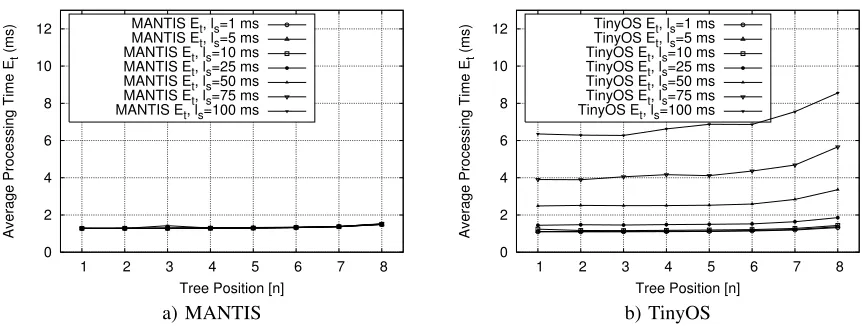
In the experiment, the average task execution time Et is determined for TinyOS and MANTIS supporting the abstract application scenario. The average task execution timeEt is shown in Fig. 5.
Where MANTIS is used, it can be observed that the average packet processing time is independent of the sensing task execution time. Furthermore, Et is also very independent from the position n of the node in the tree. Only under heavy load, the average processing time slightly increases. This is due to the fact that under heavy load packet forwarding tasks have to be queued (see Fig. 5 a)).
0 2 4 6 8 10 12
1 2 3 4 5 6 7 8
Average Processing Time E
t
(ms)
Tree Position [n] MANTIS Et, ls=1 ms MANTIS Et, ls=5 ms MANTIS Et, ls=10 ms MANTIS Et, ls=25 ms
MANTIS Et, ls=50 ms MANTIS Et, ls=75 ms MANTIS Et, ls=100 ms
0 2 4 6 8 10 12
1 2 3 4 5 6 7 8
Average Processing Time E
t
(ms)
Tree Position [n] TinyOS Et, ls=1 ms TinyOS Et, ls=5 ms TinyOS Et, ls=10 ms TinyOS Et, ls=25 ms
TinyOS Et, ls=50 ms TinyOS Et, ls=75 ms TinyOS Et, ls=100 ms
[image:9.595.78.509.84.247.2]a) MANTIS b) TinyOS
Fig. 5. Average packet processing timeEt, scheduled with a sensing task of execution timels.
tasks also contribute somewhat to the average processing time (see Fig. 5 b)).
The thread prioritization capability of MANTIS is clearly visible in the experiment results. Packet processing times are independent of the concurrently executed and lower priority sensing task. In TinyOS, sensing and packet forwarding task delays are coupled, and the influence of the sensing activity on the packet forwarding activity is clearly visible.
In the case of small sensing tasks with ls ≤ 5ms, TinyOS outperforms MANTIS. MANTIS has to perform a context switch (either from the idle task or a running sensing task) and this overhead adds to the average execution timeEt.
Fig. 6 shows the standard deviation of the packet forwarding task execution time Et for a sensing task of lengthls= 75ms. In the case where MANTIS is used, the standard deviation in the task processing time is very low. The standard deviation is noticed only for a high system load. This is caused by packets queuing and waiting to be processed. If TinyOS is used, a huge variation in the processing times is observed. This variation increases considerably with the size of the sensing task. This is due to the fact that a packet processing task in TinyOS has to wait for a sensing task to finish. However, for small sensing tasks, as shown in Fig. 6, the standard deviation ofEt is very small.
E. Discussion and Findings
It is evident that MANTIS provides better stability and predictability of packet processing time than TinyOS. Additionally, MANTIS decouples the packet processing time from the sensing time delay.
However, if small sensing tasks are used, TinyOS is able to provide a similar stability in the packet processing times. In fact, in the case of small processing times, TinyOS is capable of processing incoming traffic faster as there is no operating system overhead in the form of context switches.
If a sensor network with a controlled and predictable network performance has to be implemented, a deter-ministic packet forwarding behavior of sensor nodes is
required. For such an application, the MANTIS operating system would generally be more suitable, especially if processing intensive sensing tasks have to be supported concurrently. However, in the particular case of small sensing tasks, TinyOS is the better choice. The same stability in packet processing time can be achieved while packet processing requires less time. Thus, a higher throughput can be achieved.
Our findings regarding event processing of event-based and multi-threaded sensor network operating systems can be summarized as follows:
• A multi-threaded system is preferred if long (sens-ing) tasks have to be supported concurrently with the packet forwarding tasks.
• An event-based system is preferred if short (sensing) tasks have to be supported concurrently with the packet forwarding tasks.
While these conclusions are not surprising, they neverthe-less provide quantitative results on which to support the choice of operating system.
VII. ENERGYCONSUMPTION
The lifetime of a sensor network is related to the energy consumption of the sensor nodes. Therefore, the task of reducing a sensor node’s power consumption is of paramount importance. Operating systems for sensor net-works achieve low power consumption rates by exploiting processor idle times. Available idle time can be used to put the CPU in an energy-efficient power saving mode. Depending on the processor used, different power saving modes might be available. The different power saving modes vary in the time and energy necessary to enter and leave the mode and the power spent in the particular mode. Thus, to determine the energy efficiency of sensor network operating systems, it is necessary to investigate the available idle times during system operation.
1 1.5 2 2.5 3 3.5 4
1 2 3 4 5 6 7 8
Average Processing Time E
t
(ms)
Tree Position [n] MANTIS Et, ls=1 ms
1 1.5 2 2.5 3 3.5 4
1 2 3 4 5 6 7 8
Average Processing Time E
t
(ms)
Tree Position [n] TinyOS Et, ls=1 ms
0 2 4 6 8 10 12 14
1 2 3 4 5 6 7 8
Average Processing Time E
t
(ms)
Tree Position [n] MANTIS Et, ls=75 ms
0 2 4 6 8 10 12 14
1 2 3 4 5 6 7 8
Average Processing Time E
t
(ms)
[image:10.595.55.531.82.157.2]Tree Position [n] TinyOS Et, ls=75 ms
Fig. 6. Standard deviation of packet processing timeEt, scheduled with a sensing task of execution timels= 1msandls= 75ms.
distribution of idle time periods is analyzed as the length and variation of available idle periods determines which power saving mode can be used by the processor.
A. TinyOS
TinyOS executes all pending tasks sequentially (See Section III). A processing task is only interrupted by hardware interrupts which in turn process interrupt ser-vice routines. Thus, the TinyOS operating system spends almost all processing activity in the execution of the application functionality. Little processing effort is spent on operating system related functionality.
As soon as the task queue is emptied and no events have to be processed, the TOSH_sleep() routine is called. In this routine it can be decided how the CPU should spend the available idle time. More specifically, it can be decided which power saving mode will be used. Here it is theoretically possible to use an algorithm to predict how long the idle period will be and to select the power saving mode accordingly. Such an algorithm might take application layer knowledge into consideration. However, the current implementation of TinyOS only considers the simplest available power saving mode and optimization options are not exploited.
B. MANTIS
The drawback of a multi-threaded operating system, is that a considerable part of the CPU processing time is needed for the organization of the system itself. A context switch between different threads requires the operating system to save the context information. This operating system overhead can not be spent for power efficient sleep times. The question is how much overhead has to be allocated for the operating system itself.
If no MANTIS threads are scheduled for execution and no events have to be processed, the system ex-ecutes a so-called task. The function of the idle-task is to determine which power saving mode should be activated. For this decision, the idle-task uses thread state information. If all threads are waiting for a service to respond, i.e the radio to return an acknowledgment message, then it is in a THREAD_STATE_IDLE and the idle-task will activate a CPU idle mode as soon as all threads finish processing. If however, all threads are in a THREAD_STATE_SLEEP then there are no threads waiting on a service to complete, and the CPU will enter a sleep mode once all threads finish processing. This simple policy is used as it is assumed that a thread in
THREAD_STATE_IDLE will become active very soon and no long idle period can be expected. The idle mode can be activated without a transition phase but is not very energy-efficient. The sleep mode has a transition phase before the actual power saving starts. This simple policy helps to optimize power consumption and depends very much on the type and specification of the CPU used. However, a better policy might be available if, for example, application layer knowledge is used to predict idle times.
C. Measuring Power Efficiency
To measure the power efficiency of each operating system, we use the abstract application scenario in Section IV-A, to evaluate each operating system under varying degrees of duress. Both operating system applications must process a sensing task and a number of packet forwarding tasks. The frequency of packet forwarding tasks increases progressively as the position of the sensor node reaches the root of the network topology, i.e. the number of child nodes increase.
In evaluating power efficiency, the aforementioned op-erating system specific power management policies are ignored (In fact, only MANTIS currently implements such a policy). This study investigates the available idle times for power management purposes, not the different power management policies available. An efficient power management policy must be tailored to the particular CPU used and can take application layer information into account. However, the results presented can be used to design appropriate power management strategies.
It= !
ik
T ·100 (3)
The percentage idle time is compared with the the-oretical maximal percentage idle time, Imax
k . I
max
k is
calculated by taking only application processing of the abstract application scenario into account. Thus, Imax
k represents the percent of running time the processor would be idle for an ideal operating system which would have no operating system processing overhead.Imax
k depends on the task sizes lsandlp of sensing and packet forwarding task, the frequency of the sensing taskfs, the CPU speed scpu and the positionnof the node in the abstract appli-cation scenario.Imax
k is calculated using Equation (1):
Imax
k =
" 1− fs
scpu
·(ls+lp·(2n−1)) #
·100 (4)
The operating system overheadIo
k is calculated using Equation (3) and Equation (4):
Io
k =I
max
k −It (5)
Idle Periods: The second parameter of interest is the average length of the idle periods Ip. This parameter shows which sleep modes a CPU could use. Long contin-uous idle periods allow for deep sleep modes. Again, it is necessary to record the durationik of allK idle time periods during the experiment. The average length of the idle periodIp is calculated as:
Ip=
!i k
k (6)
The standard deviation of the idle period length is also calculated to determine the stability of the idle period lengths.
D. Evaluation
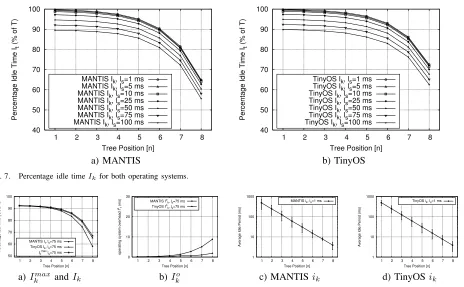
In the first experiment, the percentage idle time It is determined for TinyOS and MANTIS supporting the abstract application scenario. The idle time It is shown in Fig. 7.
The time spent in idle mode drops for both operating systems exponentially with the increasing node position in the tree described by the parameter n. This behavior is expected as the number of packet tasks increases accordingly (See Equation (1)). Less obvious is the fact that the available idle time drops faster in MANTIS than in TinyOS. The fast drop in idle time is caused by the context switches in the MANTIS operating system. The more packet forwarding tasks are created, the more likely it is that a sensing task is currently running when a packet interrupt occurs. Subsequently, a context switch to the higher prioritized forwarding task is needed.
When MANTIS is used, the length of the sensing task has a significant impact on the idle time. If TinyOS is used, the length of the sensing task does not influence idle time that strongly. Again, the difference is down to the necessary context switches in MANTIS. The longer
the sensing task, the more likely it is that a sensing task is running when a packet arrives.
As expected, MANTIS proves to be less energy-efficient than TinyOS. However, in the case of low system activity both systems have roughly the same energy efficiency. For example for a leaf node withn = 1 and a sensing task with the size ofls= 1msTinyOS is only 0.09% more energy-efficient than MANTIS. In the worst case, for a node at position n = 8 and a sensing task with the size ofls= 1msTinyOS is 7.6% more energy-efficient.
If TinyOS is used, the length of the sensing task has little impact on the idle time measured. This is due to the low operating system overhead introduced by TinyOS. As previously mentioned, TinyOS spends nearly all available CPU time for application processing, not for operating system related tasks.
The theoretical maximum available idle timeImax
k and
the measured idle time for TinyOS and MANTIS with a long sensing task of ls = 75ms is shown in Fig. 8 a). In Fig. 8 b), the resulting operating system overheadIo k is shown. As we can see, MANTIS has an increasing overhead with the increasing activity of the system. The TinyOS operating system overhead on the other hand is not very dependent on the load of the system.
Fig. 8 shows the average length of the idle periods Ip and the standard deviation ofIp for a short sensing task with the lengthls= 1ms. MANTIS has slightly shorter idle periods as it has a higher operating system overhead. Despite this difference, both operating systems achieve very similar sleeping periods. Also, the standard deviation in the idle period length is not very different. Thus, both operating systems can make use of available power modes in the same way. As shown, the thread-based MANTIS operating system does not fragment unnecessarily the available idle times. This effect however might be present in other thread-based operating system where a periodic context switch to a kernel-thread is performed.
E. Discussion and Findings
It can be confirmed that the multi-threaded MANTIS is not as power efficient as the event-based TinyOS operating system. However, the difference between both operating systems under specific conditions is not very big. If the system is not loaded (leaf node with n = 1 and a sensing task with the size ofls= 1ms) a difference of only0.09%in idle time is measured. Still, even if the system is in a heavy load situation (leaf node withn= 8 and a sensing task with the size of ls = 75ms) only a 7.05%difference in the idle time is encountered. Thus, if an application is implemented where sensors are inactive for long periods and suddenly an event is detected that leads to an activity increase in the sensor field MANTIS is comparable to TinyOS in power efficiency. Additionally, as detailed in Section VI, MANTIS would be able to handle such bursty activity in a more deterministic way.
40 50 60 70 80 90 100
1 2 3 4 5 6 7 8
Percentage Idle Time I
t
(% of T)
Tree Position [n] MANTIS Ik, ls=1 ms MANTIS Ik, ls=5 ms MANTIS Ik, ls=10 ms
MANTIS Ik, ls=25 ms MANTIS Ik, ls=50 ms MANTIS Ik, ls=75 ms MANTIS Ik, ls=100 ms
40 50 60 70 80 90 100
1 2 3 4 5 6 7 8
Percentage Idle Time I
t
(% of T)
Tree Position [n] TinyOS Ik, ls=1 ms TinyOS Ik, ls=5 ms TinyOS Ik, ls=10 ms
TinyOS Ik, ls=25 ms TinyOS Ik, ls=50 ms TinyOS Ik, ls=75 ms TinyOS Ik, ls=100 ms
[image:12.595.68.532.80.367.2]a) MANTIS b) TinyOS
Fig. 7. Percentage idle timeIkfor both operating systems.
50 60 70 80 90 100
1 2 3 4 5 6 7 8
Percentage Idle Time I
t
(% of T)
Tree Position [n] MANTIS It, ls=75 ms TinyOS Ik, ls=75 ms Ikmax ls=75 ms
0 10 20 30
1 2 3 4 5 6 7 8
operating system overhead I
o (ms)t
Tree Position [n] MANTIS Io
k, ls=75 ms
TinyOS Io k, ls=75 ms
1 10 100 1000
1 2 3 4 5 6 7 8
Average Idle Period (ms)
Tree Position [n] MANTIS ik, ls=1 ms
1 10 100 1000
1 2 3 4 5 6 7 8
Average Idle Period (ms)
Tree Position [n] TinyOS ik, ls=1 ms
a)Imax
[image:12.595.77.288.84.247.2]k andIk b)Iko c) MANTISik d) TinyOSik
Fig. 8. a) Percentage idle timeIkand the theoretical maximum idle timeImaxk , b) Operating system overhead, for both TinyOS and MANTIS
withls= 75ms, c+d) Variation of Idle periods,ik.
common argument that a multi-threaded operating system leads to high fragmentation of sleep times is proven wrong in the case of the MANTIS operating system. Both operating system types are able to exploit the same energy saving modes provided by the hardware.
Our findings regarding power efficiency of event-based and multi-threaded sensor network operating systems can be summarized as follows:
• The processing overhead resulting from a more com-plex threaded scheduler reduces the amount of time that a sensor node can sleep. The reduction depends heavily on the system activity.
• A multi-threaded scheduler has little impact on how fragmented a sleep schedule is. All energy saving modes provided by hardware can be accessed.
VIII. CONCLUSION
Most sensor network application scenarios used today are built using event-driven operating systems. The vast majority of these deployments use the event driven (and well established) operating system TinyOS. However, alternative operating system concepts such as the clas-sical thread-based system exist. A well known example of a multi-threaded operating system is MANTIS. We believe a study, as presented in this paper, is needed to decide objectively which operating system type should be used for a particular application scenario. This de-cision is currently made on mainly subjective grounds for event driven systems and TinyOS. We believe this paper presents the first objective comparison between both main operating system concepts, taking the important
performance parameters memory usage, event processing and energy usage into account. Based on the presented study we conclude that an event driven operating system is often, but certainly not always the best choice. Classic thread-based operating systems are of use for many sensor network application scenarios.
A. Results
Memory Usage: If memory efficiency is a primary goal of the target application then TinyOS would be the better operating system. In the experiment, the application sce-nario was compiled to a binary image 4kB less in TinyOS than MANTIS. While these memory requirements will have no impact on processors such as the Atmega 128, if the application is to be compiled for a more cost effective but less capable processor such as the PIC16 [22] then only TinyOS could be used. While both operating systems run a very light-weight scheduler, the TinyOS scheduler is smaller in code size as it does not provide a thread switching capability.
• If the sensing task is large (e.g.ls= 75ms,n= 1) TinyOS has an204%longer average packet forward-ing task execution time than MANTIS. TinyOS has a much higher variation in the task execution time than TinyOS (Variation MANTIS34µs, Variation TinyOS 58ms).
As a consequence, TinyOS is the preferred operating system in the case where no long sensing task has to be supported (Or in case the sensing task can be divided in small sub-tasks). In case long sensing tasks are executed, MANTIS would be the preferred system to achieve a deterministic and fast packet processing. Ultimately, the application requirements for the message forwarding per-formance of the network dictate which operating system can be used.
TinyOS has a high variation in the packet forwarding times as a pending packet task has to wait for a sensing task to finish. Especially when long sensing tasks are present, this delay is visible in the variation of the forwarding times.
Energy Usage: The energy usage of nodes in the ab-stract application scenario depends mainly on the network activity, not on the complexity of the sensing task. This dependency can be summarized as:
• If there is low network activity (n = 1, lS = 1ms), TinyOS has an 0.09%longer idle time than MANTIS. Thus, TinyOS is more power efficient. The fragment size of idle periods is of the same order for both operating systems (Idle Time Length for TinyOS is 499msand Idle time for MANTIS is 490ms).
• If there is low network activity (n= 8, ls= 1ms), TinyOS has an 7%longer idle time than MANTIS. Thus, TinyOS is more power efficient. The fragment size of idle periods is in the same order for both operating systems (Idle Time Length for TinyOS is
3.8msand Idle Time for MANTIS is3.9ms).
As a consequence, TinyOS is the preferred in all operating conditions as it is more power efficient. The MANTIS operating system is not far behind in terms of power efficiency, especially if a low network activity is present. The more responsive MANTIS is not as power efficient as the necessary context switches reduce the available idle time. Especially when a large amount of network traffic is present, the context-switch overhead is prominent.
Summary: The difference in memory usage of the two operating systems is a (nearly) static parameter and does not depend on the particular application scenario supported. In most cases, this small difference would not be the deciding factor in choosing one of the op-erating systems. If a deterministic behavior regarding packet forwarding times is required, AND a complicated sensing task is carried out at the same time, MANTIS would be the better choice. This has to be paid with an additional energy consumption, but in some cases a deterministic network behavior would be preferred over a low energy consumption. If a TinyOS application requires a long sensing task, the poor packet processing times
resulting from the non-preemptive scheduler, could lead to a congested network. This in turn would consume probably more energy retransmitting lost packets.
B. Application Scenarios
It was shown in Sections V, VI, VII that neither operat-ing system would be optimal for all application scenarios as both operating systems target different performance objectives. In TinyOS for example, a key design metric is focused on compiling small application images, however the light-weight multi-threaded kernel in MANTIS is designed to provide predictable performance for more processing intensive applications.
To measure the operating system performance for a range of applications scenarios, the experiment evaluation used a range of sensing tasks sizes. These tasks times were chosen to model a spectrum of sensor network applications. Examples of such task times can be found in literature, for example encryption algorithms such as TinySec can take up to 1ms to encrypt a byte of data [17]. A structural monitoring application presented in [23] uses a wavelet decomposition algorithm that takes12ms to compress vibration data readings, before transmitting data over the network. It can be concluded from our experiment that TinyOS would provide a more efficient scheduler for processing these applications. Such small task times achieve a better average response time and also more predictable response time in TinyOS due to the low processing overhead of the scheduler.
C. Further Study
Both operating systems leave room for further study. Our work described in [24] shows how preemptive scheduling capabilities can be added to TinyOS in order to tackle the performance problems described in Section VI. The established event driven processing concepts can be retained while adding preemption through context switching. Established TinyOS programming conventions can be used which ensures that existing application code can be re-used. Preemption features can be integrated seamlessly in existing TinyOS infrastructures.
Our work described in [25] shows how overheads due to context switching can be significantly reduced within the MANTIS operating system. Thus, the problems described Section VII can be diminished. The overhead can be reduced to such an extent that in usual sensor network application scenarios the modified MANTIS has a similar overall performance to TinyOS.
REFERENCES
[1] J. Hill, R. Szewczyk, A. Woo, S. Hollar, D. Culler, and K. Pister,
“System architecture directions for networked sensors,” inACM
SIGOPS Operating Systems Review, vol. 34, pp. 93–104, Decem-ber 2000.
[2] H. Abrach, S. Bhatti, J. Carlson, H. Dai, J. Rose, A. Sheth, B. Shucker, and R. Han, “MANTIS: System support for
mul-timodal networks of in-situ sensors,” in2nd
ACM International Workshop on Wireless Sensor Networks and Applications, pp. 50– 59, September 2003.
[3] A. Barroso, J. Benson, T. Murphy, U. Roedig, C. Sreenan, J. Bar-ton, S. Bellis, B. O’Flynn, and K. Delaney, “Demo abstract:
The DSYS25 sensor platform,” in2nd
international conference on Embedded networked sensor systems, pp. 314–314, November 2004.
[4] C. Duffy, U. Roedig, J. Herbert, and C. J. Sreenan, “An Exper-imental Comparison of Event Driven and Multi-Threaded
Sen-sor Node Operating Systems,” in3rd
IEEE International Work-shop on Sensor Networks and Systems for Pervasive Computing (PERSENS2007), White Plains, USA, Mar. 2007.
[5] S. Bhatti, J. Carlson, H. Dai, J. Deng, J. Rose, A. Sheth, B. Shucker, C. Gruenwald, A. Torgenson, and R. Han., “MANTIS OS: An embedded multithreaded operating system for wireless
micro sensor platforms,”ACM kluwer Mobile Networks &
Applica-tions Journal, special Issue on Wireless Sensor Networks, August 2005.
[6] C. Han, R. Kumar, R. Shea, E. Kohler, and M. Srivastava, “A
dynamic operating system for sensor nodes,” in 3rd
Interna-tional Conference on Mobile Systems, Applications, and Services, pp. 117–124, June 2005.
[7] A. Dunkels, B. Gronvall, and T. Voigt, “Contiki - a lightweight and flexible operating system for tiny networked sensors,” in
29th
Annual IEEE International Conference on Local Computer Networks, pp. 455–462, November 2004.
[8] A. Eswaran, A. Rowe, and R. Rajkumar, “nano-RK: An energy-aware resource-centric operating system for sensor networks,” in
26th
IEEE Real-Time Systems Symposium, pp. 265–265, Decem-ber 2005.
[9] S. Dulman, T. Hofmeijer, and P. Havinga., “AmbientRT - real time,
data centric system software for wireless sensor networks,” in1st
international Conference on Intelligent Sensors, Sensor Networks and Information Processing, pp. 61–66, December 2004. [10] A. Dunkels, O. Schmidt, and T. Voigt, “Using protothreads for
sensor node programming,” inWorkshop on Real-World Wireless
Sensor Networks, June 2005.
[11] E. Trumpler and R. Han., “A systematic framework for evolving
TinyOS,” inIEEE Workshop on Embedded Networked Sensors,
pp. 61–65, May 2006.
[12] J. Regehr, A. Reid, K. Webb, M. Parker, and J. Lepreau, “Evolving real-time systems using hierarchical scheduling and concurrency
analysis,” in24th
IEEE Internation Real-Time Systems
Sympo-sium, pp. 25–36, December 2003.
[13] L. Barello, “Avrx real time kernel.” http://barello.net/avrx/, 2006. [14] S. Li, R. Sutton, and J. Rabaey, “Low power operating systems
for heterogeneous wireless communication systems,” inWorkshop
on Compilers and Operating Systems for Low Power, pp. 1–16, September 2001.
[15] Atmel Corporation,Atmega128 Datasheet, rev n ed., March 2006.
[16] M. Rahimi, R. Baer, O. I. Iroezi, J. C. Garcia, J. Warrior, D. Estrin, and M. Srivastava., “Cyclops: In situ image sensing and
interpre-tation in wireless sensor networks,” inIn proc. 3rd
international conference on Embedded Networked Sensor Systems,, pp. 192– 204, November 2005.
[17] C. Karlof, N. Sastry, and D. Wagner, “TinySec: A link layer
security architecture for wireless sensor networks,” in2nd
ACM Conference on Embedded Networked Sensor Systems, pp. 262–175, November 2004.
[18] Nordic Semiconductor, Datasheet NRF2401, rev 1.1 ed., June
2004.
[19] “The gnu project, http://www.gnu.org/,” 2006.
[20] D. Gay, P. Levis, R. von Behren, M. Welsh, E. Brewer, and D. Culler, “The nesC language: A holistic approach to networked
embedded systems,” inACM SIGPLAN Conference on
Program-ming Language Design and Implementation, pp. 1–11, June 2003.
[21] Microchip,PIC16F877 Datasheet. Microchip, f ed., October 2003.
[22] C. Lynch and F. O’Reilly, “PIC-based TinyOS implementation,” in
2nd
European Workshop on Wireless Sensor Networks, pp. 378–
385, 31st
Jan.-2nd
Feb. 2005.
[23] N. Xu, S. Rangwala, K. Chintalapudi, D. Ganesan, A. Broad, R. Govindan, and D. Estrin, “A wireless sensor network for
struc-tural monitoring,” inACM Conference on Embedded Networked
Sensor Systems, pp. 13–24, November 2004.
[24] C. Duffy, U. Roedig, J. Herbert, and C. J. Sreenan, “Adding
Pre-emption to TinyOS,” inProceedings of the The Fourth Workshop
on Embedded Networked Sensors (EmNets2007), Cork, Ireland, June 2007.
[25] C. Duffy, U. Roedig, J. Herbert, and C. J. Sreenan, “Improving
the energy efficiency of the MANTIS kernel,” inProceedings of
the 4th
IEEE European Workshop on Wireless Sensor Networks (EWSN2007), Delft, Netherlands, Jan. 2007.
Cormac Duffyreceived his B.Sc degree in Computer Science from the Dublin Institute of Technology, Ireland and M.Sc Degree from University College Cork. He had completed his Ph.D. at University College Cork on the topic of Lightweight Scheduling for Wireless Sensor Networks at the time of his sudden tragic death in August 2007.
Utz Roedigis a Lecturer in the Department of Communication Systems and the Department of Computing at Lancaster University. He pursues research in the area of wireless sensor networks. A specific aspect of this research is the data transport performance of wireless sensor networks. Utz received his Ph.D. in Computer Science at Darmstadt University of Technology in 2002.
John Herbert received a B.Sc. (Physics, Mathematics) and M.Sc. (Physics) from University College Cork, Ireland and a Ph.D. (Computer Science) from Cambridge University, England. He has held positions as Research Associate at Cambridge University, International Fellow at DEC Systems Research Centre, California and Computer Scientist at SRI International, Cambridge. At present he is a Senior Lecturer in Computer Science at University College Cork.