Munich Personal RePEc Archive
Territorial development reconsidered
Sucháček, Jan
VŠB - TU Ostrava, Faculty of Economics
December 2008
Online at https://mpra.ub.uni-muenchen.de/15009/
TERRITORIAL
DEVELOPMENT
RECONSIDERED
Jan Suchá
č
ek
2
Jan Sucháček
Territorial development reconsidered
All rights reserved. No part of this publication may be reproduced in any form, by print or photoprint, microfilm or any other means, without written permission of the publishers. The publication of this monograph has been financially supported by the Grant Agency of the Czech Republic, grant No. 402/08/0987 ‘Chronological-Spatial Development of Large Enterprise and Banking Headquarters and their Influence on Regional Development in the Czech Republic’.
© VŠB–TU Ostrava, 2008
3
Contents:
INTRODUCTION…………..……….…………...6
1 BEFORE THE BIRTH OF THE NATION STATE: UNLEARNED AND NATURAL SELF – GOVERNANCE... 8
1.1 FROM HUMAN NATURE TO THE SELF – GOVERNANCE.. 8
1.2 MEDIEVAL WORLD:STATIC BUT DIFFERENTIATED SPACE... 13
1.3 FROM SPIRITUAL TOWARDS MATERIAL COMPONENTS OF THE EXISTENCE... 18
2 RISE OF THE NATION STATE ... 21
2.1 THE BIRTH OF THE GREAT PROTECTOR ... 21
2.2 INDUSTRIAL REVOLUTION... 24
2.3 NATION STATE:OUTER HOMOGENEITY AND INNER HETEROGENEITY ... 26
2.4 THE GROWTH OF NATIONALISM ... 29
2.5 DISASTROUS IMPACTS OF NATIONALISM... 32
3 TOWARDS A CONTEMPORARY FORM OF THE NATION STATE ... 38
3.1 FORDIST PERIOD... 38
3.2 PUBLIC ADMINISTRATION IN THE NATION STATES... 41
3.3 STATE ADMINISTRATION AND SELF –GOVERNMENT IN THE NATION STATES... 45
3.4 SUBSIDIARITY:A PURIFICATION OF TRADITIONAL PRINCIPLE FROM THE DUST ... 48
3.5 TERRITORIAL DEVELOPMENT: ON THE ROAD TO THE DUALITY OF EUROPEAN SPACE ... 51
4
4 GLOBALIZATION... 67 4.1 POST – FORDISM... 67
4.2 WHAT IS GLOBALISATION?... 70
4.3 SOCIAL AND ECONOMIC IMPACTS OF
GLOBALISATION………...72
4.4 GLOBALISATION AND DISSOLUTION OF THE NATION
STATE... 76
4.5 ON THE RELATION BETWEEN MULTINATIONALS AND
REGIONS... 78
4.6 NETWORKS INSTEAD OF ORGANIZATIONS AND
PROJECTS INSTEAD OF STRATEGIES... 81
4.7 POST – FORDIST INDIVIDUALS AND TERRITORIES... 86
4.8 ATOMIZATION AND UNCERTAINTISATION OF THE
SOCIETY... 89
4.9 FROM THE STABLE CONCEPTION OF IDENTITY TO THE
FLUID ONE... 93
5 MEDIA: A ONE-WAY MEDIATOR ... 97 5.1 MEDIA:MORE THAN A FOURTH POWER... 97
5.2 TV REPORTING AS A POWERFUL INSTRUMENT OF THE
FORMATION OF VIRTUAL REALITY... 101
5.3 MEDIA AND CONSUMERISM... 104
5.4 HOMO CONSUMENSIS:THE AIM OF ECONOMIC AND
POLITICAL ELITES... 106
6 THE RESURRECTION OF SELF – GOVERNANCE AND SELF - GOVERNMENT ... 111
6.1 SPONTANEOUS FULFILLMENT OF SELF – GOVERNING
GAPS... 111
6.2 ON THE NATURALNESS OF THE RETURN OF SELF
-GOVERNMENT AND SELF-GOVERNANCE ... 113
6.3 PERSONNEL ISSUES RELATED TO SELF
5
6.4 VANISHING BORDERS:THE DISAPPEARANCE OF THE
ARTIFACT... 121
6.5 TOWARDS THE HIGHER RANK OF SPATIAL ORDER
SUPPORTED BY CONSCIOUS SELF -GOVERNANCE... 128
7 INSTEAD OF CONCLUSION ... 139 7.1 GENERAL EVOLUTIONARY TENDENCIES... 139
7.2 TOWARDS A TRANSFORMED RANK DIFFERENTIATION OF
SPACE... 144
7.3 ON THE GLOCAL NATURE OF CURRENT SOCIETAL
PROBLEMS AND THE HERITAGE OF THE NATION STATE.... 149
7.4 SOME PROPOSALS RELATED TO CONTEMPORARY
SOCIETAL PROBLEMS OR THE WAY TO CONSCIOUS SELF
-GOVERNANCE VIA ABCDE AGENDA ... 152
6
Introduction
Lamentations on societal and environmental developments and voices for the return to humanity become increasingly audible in our times. And since the environment provides the mankind with existence, society should behave accordingly. However, numerous frictions are currently symptomatic for the relation between society and environment.
From chronological perspective, the relation between society and environment has undergone a very important historical transformation. At the beginning, the society in relation to its environment was relatively static and externally directed by natural conditions. But together with the emergence of industrial revolution the relation of the society towards the environment has altered and nowadays is relatively dynamic and internally actively conditioned. Society thus influences and forms the environment and orients itself primarily towards material and technical components of the expansion of civilization.
Talking about societal activities within the environment, we cannot omit their territoriality nor time dimension for the sake of the fact that virtually all societal activities are expressible through time – spatial context. Chronological and namely territorial perspectives and categories thus form the principal axis of the book. However, taking into consideration the multidimensionality of real life, there is the effort to avoid time – spatial fetishism.
7
bottom – up and top – down. Bottom – up approach, which is
literally penetrated by self – governing processes, represents one of inherent principles of the initial stages of the society formation. This principle was typical for pre-industrial era when societal development was shaped mainly by natural setting.
On the contrary, top – down approach is typical for later phases of societal development, when elite groups dose the uncertainty to the non – elite ones in order to keep the control over territories. Top – down approach enabled the centralization of power, which stands behind the creation of the modern nation state. Top – down type of territorial management to a certain extent embodies contemporary intensive influence of the society on our environment.
8
1
Before the Birth of the Nation State:
Unlearned and Natural Self - Governance
1.1
From Human Nature to the Self –
Governance
No individual exists as an isolated island. In case that individual would live in isolation and out of the environment that reflects his or her existence and influences the human being concerned, he or she could exist without identity. But an individual as a part of the whole is able to realize his or her own peculiarity, individuality. By acting we are realizing the consciousness of identity. Human being with his or her own identity is the basic building stone of the society.
Identity represents the search for the meaning of the individual in relation to the self and to the society. This is about looking for inborn characteristics. In other words, this is gradual process of uncovering the nature. The same nature, which provides us with the urge to live.
During human growth and maturation, people meet with vast numbers of other individuals and experiences. Children encounter first their immediate family, then extended family, and then local community, which is typically school and work. In that way they enlarge the knowledge and develop their identities. And nowadays as we will see later, one identity is not exciting enough to satisfy our needs and that is why we adopt multiple identities.
9
the ladder of their values, world view as well as attitudes toward the larger society. Gaining an understanding of group settings and dynamics and their relations to the individuals constitutes one of essential parts of socialization. Individuals develop interpersonal relationships and in case they are lucky enough they also begin to make choices about whom to associate with and under what circumstances.
In the course of adolescence and namely adulthood, the individual tends to build up a more sophisticated identity since he or she finds itself submerged in an increasing quantity of relations and opinions. To become integral part of the community, one has to have or to develop the sense of belonging. Communities possess their own identities as well and consequently we can differentiate the communities on the basis of their specific identities too.
Community should be generally grasped as a set of organisms sharing a certain environment, normally with shared interests. In human communities, a large number of social characteristics may be present. Altogether, they affect the identity of the participants and their degree of cohesiveness. Not surprisingly, the word community is derived from the Latin communitas, meaning ‘the same’, which is in turn derived from communis, which means ‘common, public, shared by all or many.’
10
influences and helps to fulfill their needs as well as share emotions.
Put succinctly, the concept of the individual is not and cannot ever be separated from the concept of community.
Without the primary community of our family, or the secondary communities of professional, friendly, hobby or other characters, we could not develop stable personalities as individual human beings. Although people and animals share the common urge to live and often also the need of safe territory, the distinctiveness of human communities is apparent.
First communities were formed on the basis of territorial principle because of limited mobility of the population in ancient times. Later on, concurrently with progressing civilization, infrastructure building and augmented transportation possibilities, there emerged the communities that were organized on the basis of shared professional, cultural or other interests. These communities are currently not limited by state borders and function in global arena. Some communities, such as disabled or elderly persons are formed as a consequence of the need.
However, territoriality is the principle, which is inseparably
connected with communities from the very beginning. In
11
Together with slowly nonetheless still progressing civilization and subsequent growth of the complexity and institutionalization of the world the conception of self – governance came into existence. Contemporary world incorrectly contemplates the self – governance as pretty wide and at the same time abstract concept that refers to several different spheres of human activity. The notion may refer to personal conduct or family units but more commonly it concerns larger scale activities, i.e. professions, religions, non-profit organizations and territorial units, including aboriginal people or ethnic minorities. Last but not least, the concept is connected also with self-governing regions or autonomous territories within contemporary nation states. Self – governance delimitates the behavior of the members of given entity on the basis of the management stemming from internal structures and relations, i.e. bottom – up approach is typical for this form of governance.
Self-governing entities also embody the culture in the widest sense which includes local/regional songs, dances, handicraft as well as general way of life. From this point of view, the myriads of activities of self-governing territories can be grasped as outer cultural manifestations of inner integrity of particular localities or regions.
12
there still exist common denominators of individuals participating on self – governmental structures, such as common interests, identification with the matter and usually also common will. Rather than communitarian ‘sameness’ sense of belonging is characteristic for self –governance.
The principal feature of self – governance is that its rules are created and management accomplished in a democratic way. If it is not the case, we cannot speak about self – governance any more. And it differentiates this concept from that of nation state, for instance.
The concept of self – governance contains mainly informal institutions as well as some formal ones. A little presence of formal institutions or bureaucratic elements and mechanisms facilitates advocating self – governmental interests. The concept of self – government, which is derived from self – governance and which is symptomatic rather for modern times, is much more formal than original self – governance. Self – government can be to a certain extent grasped as ‘bureaucratic distillate’ of original self – governance that has been modified for the purposes of modern society.
However, the situation is not so obscure as territoriality is still valid and spatial characteristics of the population, such as regional or local patriotism, belonging or identity still fulfill (at least partly) contemporary self – government with lively stuff. Self – governance is simply inherent to humans which helps to surpass formal and bureaucratized self – government.
13
Ancient and namely medieval times witnessed a truly motley mosaic created by communities and self – governing structures. They were largely in compliance with locally or regionally unique social, economic and cultural conditions. Since spatial interactions were practically negligible at that time, localities and regions across the whole planet were rather dissimilar. Pre – modern states by far did not occupy the whole territory of the earth and were not strong enough to make any larger unification on their territories.
1.2
Medieval World: Static but Differentiated
Space
Afore mentioned local or regional ‘civilization circuits’ constitute a certain opposition to the modern world, for which the notion, such as bureaucratization, centralization or ‘top – down’ governments became the rule. Naturally, the bureaucratization of the administration is very old phenomenon. There are innumerable ‘best practices’ of bureaucracy influencing everyday life of ancient Greece, Rome, Egypt or China. And it has to be mentioned that they were very sophisticated even in comparison with modern bureaucratic practices. That is why the excursion into ancient world would be very demanding and we have to take with last one thousand years and European civilization room.
14
embodied the state finance, marriages among the members of these families served as international political acts.
Taking into account pretty humble and limited means of transportation as well as the whole infrastructure, these households concentrated namely upon their own maintenance. Noblemen had men-at-arms that helped them to keep the control over the closest territories, however, more distant individuals and households have not been controlled almost at all just for the sake of above mentioned transportation constraints.
The economy was primarily of agricultural character, for which relatively limited production was typical. The division of labor was pretty weak because the production processes were not so demanding and did not require any larger specialized knowledge and capabilities. Households constituted fundamental social and economic units within the space. Incidentally, medieval households were on average many times bigger than contemporary ones.
Put succinctly, in the whole pre-industrial period, life of people was firmly bound to the family. This concerned not only noblemen, but also vassals and serfs. As already indicated, life in the family facilitated the survival. In rural areas, livelihood of the individual was bound to the family almost absolutely, and in cities substantially. Few had a chance to see or hear beyond their own village or city. Only two institutions – army and church – were administered in a different level than that of the household.
15
education. That is why the clergy acted as clerks at that time. At the same time, there existed only a little division of labor among these teams governed by noblemen. On the contrary, rudeness, aggressiveness and fierceness were the characteristics that raised the probability of the success of these groups whose main mission consisted in keeping the noblemen households. Similarly to contemporary world, stronger or better arguments did not ensure any victory.
Although it may seem that afore-mentioned administrative system is quite efficient, contrary is often the case. If the nobleman wanted to be respected, he was always compelled to be in the proximity of controlled people. Taking into consideration smaller geographical mobility, it was everything but easy. And this was often misused by his clerks, which transformed the property they administered into their own. And they had plenty of opportunities for doing that. Essentially, this situation resembled nowadays rather popular ‘principal – agent’ problem.
In remote parts of managed territories, the agents very often established their own households and since they could be only hardly controlled, they frequently omitted whose interests they are representing. The formation of their own domain acted as a truly big bait. And after the creation of their own domain they rented their own clerks and copied the original principal.
16
privileges, towns, localities and territories enjoyed a rather wide autonomy. Plurality of self – governmental forms has been symptomatic for these times.
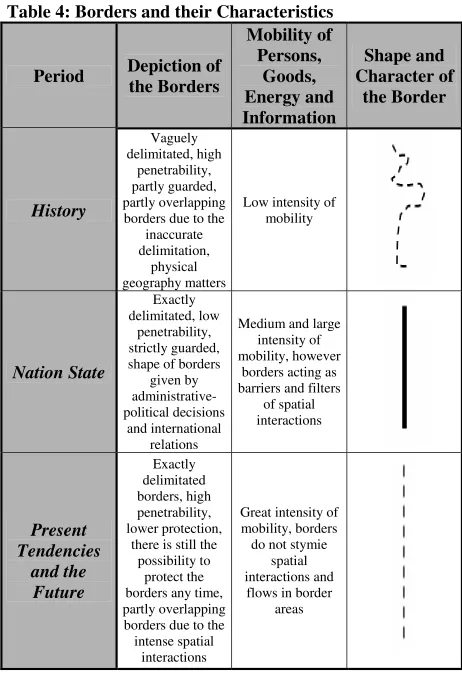
It has to be mentioned that generally low geographical mobility of individuals as well as whole groups has been accompanied by a great permeability of borders. Borders served rather as symbolical lines than hindrances for spatial socioeconomic – although minimal - interactions. Generally speaking, empires as a form of pre-modern states were very diverse and at the same time able easily to absorb newly emerging entities and identities. This could be attributed to the fact that absence of the central power formed something that might be called a pre-modern chaotic or non-coordinated development. In other words, for pre-modern society, exceptions rather than rules were typical.
The typical example was the dynamic development of cities from twelfth century onwards. These cities enjoyed rather wide autonomous powers. For instance, the system of Magdeburg law can be in a wider sense comprehended as a predecessor of self – government. In contrast to feudalists that did not distinguish between private and public spheres and namely private and public finance, in cities, private and public spheres were clearly divided. Naturally, this lowered the probability of the misuse of power by city aldermen.
17
that noblemen got a monopoly on the coinage as well as military power. In that way, they reinforced the control over managed territories.
Medieval Europe could be paradoxically depicted as ‘Europe of regions’, a concept so popular nowadays. However, from
spatial point of view, Europe of that time formed much more fragmented and motley entity enriched by quite a wide scope of autonomous structures that were formally covered by empires.
15th and 16th century brought the top epoch of aristocratic yards. At the same time, this meant also the signal of their obituary because their aspirations were much higher than their real possibilities. Their functioning became increasingly costly. Diplomacy and marriage policies lay behind their very gradual integration into the bigger units.
18
Sources gathered from households inconspicuously shaped the skeleton of the modern states. At the same time they enabled to establish and later also to foster the formal organizations, almost inseparable parts of modern states. Formal state organizations proved to be noticeably viable and later on, they were quite easily capable to overgrow the church that was originally more profoundly institutionalized.
The process of the decay of the pre – modern empires was launched. Later, they gradually lost their legitimacy either because of the industrial revolution, secularization or military defeats. Old certainties were replaced by a new reality which represented one of substantial turning – points in the development of mankind.
1.3
From Spiritual towards Material
Components of the Existence
Generally, in pre-industrial world, existing ideologies, poor technological level as well as generally static character of the society caused that people could not influence so many processes, they were less initiative as natural conditions determined the framework of the life of human society. The traditional world functioned cyclically just in accordance with the changes of the seasons.
19
This situation was in compliance with the role of the church in medieval world. Church represented relevant institution of these times. Basically every aspect and process of life in a medieval world was interpreted in spiritual terms. Church acted as an interpreter and intermediary between spiritual world and the society.
Such kind of evolutionary, traditional cock – time with the prevalence of spiritual, immaterial issues over the economy could be lasting a very long time. However, numerous territorial conflicts depicted above started to decay existing societal order.
At the same time, growing institutionalization of the church and its isolation from the society stimulated the transformation of spiritual components of societal life. Specific ‘churchism’ in combination with non-adequate behavior of the church administration lay behind the disenchantment of the population with the inbuilt spiritual interpretation of the world.
Priests that worked as intermediaries between the Lord and the society in many cases did not behave accordingly. New churches that wanted to avoid these intermediaries emerged. Spiritual fabric of the society was weakened and an uncertainty concerning the position of the mankind in the world as well as the sense of life embraced not negligible part of population.
20
replaced (at least in the West) the spiritual view of the world by an economic, material one. Economy in fact fulfilled the space of uncertainty that could be perceived as a product of fading of traditional medieval world. Economy as ‘a new certainty’ helped the transformation of the cock – time to the clock – time that abandons cyclical development and aims at progress and move from one point to another one.
The new ideology in European space relied on the values based on ideas of rational cognition, liberty and humanism. The sense of cognition was namely a practical one and should serve as a basis for the perfection of human beings as well as the whole society. Morality was perceived as a practical principle of cognition. From methodological perspective, the principle of critical thinking should ensure the right developmental trajectories.
But in practice, Europeans gradually abandoned and deformed this ideal pattern. In connection with the industrial revolution and an intensive drive of science European space re-oriented itself merely to the objective reality and commenced to strive for its active conversion. People and their development as an original aims were shifted aside of main stream. And this created ideal preconditions for an economization of the world.
21
2
Rise of the Nation State
2.1
The Birth of the Great Protector
Not surprisingly, the birth of the modern state is frequently connected with the Peace of Westphalia that ended the Thirty Years’ War in 1648. The Thirty Years’ War was a series of wars beginning in 1618 because of conflicts between Protestants and Catholics and political struggles involving the Holy Roman Empire. The Peace of Westphalia, which formed the space for the system of the balance of power, helped to lay the foundations of the modern nation states. In fact, the basis of the modern state was formed after endless, exhausting religious wars.
It was stipulated that citizens of the respective countries should be subjected to the laws and to their own governments. The premises for the bureaucratization of the administration were formed since concrete rulers (such as king or emperor) were replaced by general, abstract and anonymous mechanisms made of laws, rules and regulations. In contrast to previous rulers, such as kings or emperors that were proud of their origin and underlined their stock in practically every moment, new state bureaucracy became much more anonymous. Modern clerks and officials actually do not have an origin and can easily form abstract and anonymous administrative structures.
22
administrative apparatus became vital for the centralization of the state.
Central power also started to eliminate formerly autonomous cities and transformed them into mere administrative units subjected to state. And the same applied also to other previously self – governing entities. Diverse and ample territorial medieval mosaic has thus been gradually dissolved under the unifying administrative roof of the modern state.
Modern states fortified their power namely via centralization of the administration, which found its spatial manifestation in the concentration and further growth of central authorities in the capital cities. Tax system became increasingly effective which served as the best fuel for further expansion of state bureaucracy.
The power not so long ago freely dispersed through wide territories was increasingly gathered by modern states. This power was subsequently compressed into territories delineated by the state borders. Guarded state borders together with related phenomena, such as customs formed a very effective instrument for the augmentation of the state power. On the other hand, the borders virtually erased previous naturally formed spatial interactions among individual territories, which had formidable impacts on numerous local and regional communities.
23
education, health and many others became the domain of the state administration.
System of state taxes ruined numerous households, which facilitated the transfer of traditional functions of households to the state administration. Production of the goods, formerly one of main activities of households removed elsewhere and families were gradually degraded to mere consuming units. Naturally, family businesses meant also bigger communication and subsequent cohesion among family members. In case household serves as a consumer, the communication among family members is not necessary any more.
This was one of steps on the road of growing individualization of the population. Currently, monomial households represent no exception. Social stratification is thus measured rather by professional position than by family status. Formal organizations simply replaced the households and became widely recognized instrument for the solution of the problems connected with survival.
Incidentally, the governments in the 17th and 18th centuries were usually composed of only a couple of ministries, such as the ministry of justice, the ministry of foreign affairs, the ministry of war or the ministry of treasury. Currently, in many countries, we can find several dozens of various ministries. The existence of the state means the presence of well – paid jobs and power for rather massive administration. Thus, the existence of the state is the main objective of central state elites.
24
feature of the modern states. Contrary to self – governing structures that crystallized out naturally, bureaucratic state administration represents artificially created fabric that overlay original entities. Even more importantly, modern state swallowed many entirely specific entities, regions and localities that had almost nothing in common.
2.2
Industrial Revolution
Almost concurrently with the rise of the modern state the industrial revolution emerged. Industrial revolution is a process that led to the transformation from the old type of capitalist economy to the modern one. The transformations it brought were so intense that they substantially affected the whole societal development. From historical standpoint, industrial revolution is comparable to the transition towards agrarian economy a long time ago.
The process of industrial revolution is closely linked to a small number of innovations accomplished in the second half of the 18th century. They concerned steam power, textile sector and iron founding. Iron and coal were fundamental pillars of industrialization. Industrial revolution started in Britain and subsequently spread throughout Europe and North America and finally basically the whole world.
25
concurrence and specific constellation of the factors mentioned constituted a decisive motor for the birth and further advancement of industrial revolution. While GDP per capita was essentially stable before the occurrence of industrial revolution, after its start the indicator grew sharply.
The societal impacts of industrialization became palpable soon. In terms of social stratification, during industrial revolution one could contemplate the triumph of a middle class of industrialists and businessmen over suddenly constrained group of nobility and gentry. Commons found augmented opportunities for employment in new factories, but these were largely under severe working conditions with long hours of labor and the pace of labor adjusted to new machines.
Old world that was embodies by rural life is increasingly replaced by intense industrialization and urbanization. But even more importantly, the realm of politics that traditionally dominated in power relations is complemented by economy more and more. Economy – and more precisely industry – became the criterion as well as an instrument for exercising the power.
26
2.3
Nation State: Outer Homogeneity and Inner
Heterogeneity
Industrialization brought not only immense socioeconomic changes but also a great portion of uncertainty for wide masses of people. Ties of their households as essential socioeconomic units of the medieval times were weakened by the advent of the nation state. The traditional world became to crumble. Thus, the whole masses became disorientated in the view of quick societal changes.
However, at the beginning of 18th century the nationalism is
coming and offers a safe room for the masses of uprooted people. The whole loyalty of the people is directed to the
nation and the territory inhabited by this nation. State power is very well aware of the danger of original local/regional identities or local/regional patriotism as they could weaken the loyalty just to the central authorities.
That is why traditional, genuine and natural local or regional identities have been artificially suppressed and the national identity has been offered as a substitution by official propaganda. Later, the efficacy of this mental massage was multiplied as a consequence of the intense development of media.
27
their nation. In that way, nationalistic figments could materialize.
Naturally, apart from manufacturing, industrialization affected also infrastructure development. Thus, railways, roads, canals, navigable rivers and telegraphs stimulated much higher and intense flows of people, goods, energy and information on the territories delimitated by individual states. At the same time, these networks enabled to bring the population in the nation states under control.
Such kind of ‘material ties’ was accompanied also by ‘immaterial national clues’. The role of the print, which developed namely in the era of industrial revolution was from the perspective of the state establishment an indispensable one. The creation of national systems of compulsory primary education and comparatively uniform curriculum in secondary schools were very efficient tools for spreading the national languages. The schools also taught the national history, frequently in a propagandistic and mythologized version. Compulsory readings of carefully chosen books through the system of national education helped to build the edifice of national identity.
28
State power intensely utilized guarded and practically impenetrable national borders for the delimitation of the nation. Thus, the conviction that only the state is reliable guarantee of economic prosperity as well as cultural unity of people living in the given state territory, finally prevailed. State came to be known as a new home of people uprooted from their original communities.
And if traditional rural people did not manage to transform themselves into modern entrepreneurs, they still belonged to the nation state. Middle and lower classes of disintegrated population thus gained a new artificially created national identity, which lowered their degree of uncertainty. At the same time, state bureaucracy directed these groups of people in a desirable way via utilization of the technique of nationalism.
Nation state is thus generally perceived as a form of state, which exists in order to provide a sovereign territory for a concrete nation, and which derives its legitimacy from that nation. However, in reality, political boundaries often do not coincide with ethnic ones or cultural ones and nation states are composed of rather heterogeneous and peculiar entities. And it can be seen that state policies are hitherto mostly spatially blind.
29
Local or regional patriotism, belonging to the community and other traditional forms of living are perceived as something obsolete as they create the hindrances to the smooth functioning of the economy. This is so simply for the sake of the fact that these ways of living limit the mobility of people and subsequently also the mobility of the work as one of fundamental factors of production.
National economies are composed of individuals that are less submerged in their families and are willing and capable to work for the national economy and to move in its framework just in compliance with quickly advancing needs of industry (in the era of industrialization basically from the countryside to the progressive towns and cities). Standardized state education also produces standardized individuals and workers that can be easily utilized in industry.
It is thus only hardly surprising that newly built infrastructural networks follow the territories of the nation states: they enabled the central power to control every part of the society in the area covered by the nation state on the one hand and formed the important premises for the economic growth on the other.
2.4
The Growth of Nationalism
30
authorities to control all subjects within the state territory. Local patriotism or regionalism turned out to be very strong namely in countries, such as Spain, Italy or Germany.
However, if something is repeated persistently, after a certain time it becomes accepted by the majority of population. And nationalism had an opportunity to influence several generations of people and that is why the self-governing nature of the population was generally covered and supressed by the state administration.
Paradoxically, despite the fact that nationalism is directed by central state bureaucracy located typically in the capital cities, it finds its sources of inspiration namely in folk and rural motives. And when many rural people moved to the cities where they were forced to face unnatural and alienated milieu, they found an ally in omnipresent and at the same time chimerical nationalism that provided them with new identity and facilitated their orientation in quickly changing reality.
31
The birth of the institution of national holidays and national ceremonies were also fully in compliance with the preferences of the governing central bureaucracy. The individuals were frequently told that their common denominator consists in nation and all aspects around. In the nation states, history is always an interpreted past.
Nationalism was always accepted by the widest population. These uprooted masses got to know that as members of the given nation they are privileged people. This collective intoxication connected with fabled privileged position can be reached only if we find an entity, which is of lower quality than we are. And these entities are represented just by other nations, from which all members of our privileged nation differ substantially. Since we are better than the members of the other nations, we, members of our nation, are privileged ones. This trick substantially contributed to keeping the obedience of the population constrained by state boundaries and allegedly bound by intense cultural ties, traditions and other specific qualities. Nation state created a safe roof over the nation.
The most ridiculous thing is that nationalism created a common room for many people in the form of their homeland. The homeland allegedly represents one great and genuine community, which in reality has practically no communitarian features. On the contrary, the society is created by anonymous and alienated structures governed by omnipresent bureaucracy. Nation states are actually created by atomized and mutually replaceable individuals.
32
historical roots and continuity. Nationalism actually shattered traditional communities and traditional homes. That is probably why this concept offers the people a kind of dummy home.
In the nation state, it is always required that citizens see the others living in the common territory as themselves. And what is behind our borders or what came from the other country is perceived with suspicion as strange and different. ‘We – others’ identity is one of symptoms of the nation state.
National identity is the product of intended governmental policy that should contribute to the unification of already existing state. In contrast to pre-modern empires, the national modern state is largely hostile to the pluralism of identities. Last but not least, it has to be added that in spite of some common features of nationalism, its specific cases are extremely diverse in individual countries and just this diversity in combination with ‘we – others’ dichotomy became one of underlying causes of formidable conflicts that harshly hit the whole world.
2.5
Disastrous Impacts of Nationalism
The nation state is closely interconnected with practically all modern institutions. In the course of time, the nation states insured and fortified their legitimacy also through the creation of formal attributes, such as national flag, national anthem or national currency, which were resolutely closed by national borders.
33
Subsequently, human activities are evaluated as national in their nature. Nations thus possess national symbols, cultivate national culture, sing and compose national music and songs and write national literature while using and sharing national language. According to nationalists, a plenty of these national elements are rooted in national folklore and narrations are full of national mythology. Citizens eat national dish and play the national sports, while they can admire national heroes, which have many statues dispersed within the territory of nation states.
Nationalists also frequently talk about national values and mainly national identity embodying the spirit and the best traditions of the nation. Membership in the nation is of involuntary nature and is determined by the place of birth. All of these national narrations cover the simple fact that nation states are in reality composed of large impersonal and often bureaucratic structures that have only a little in common.
The paradoxical thing is that in current times practically all elements concerning the nations became the object of economic calculations. Economy, which for a long time survived under the protection of the nation state, finally got sufficient powers to disaffiliate itself from the boundaries of the nation state. And the same economy gladly utilizes the opportunities created by the nation state story.
34
nation state. But from economic standpoint the most important feature of national celebrations after the success of national teams is increased consumption and buying, no matter, whether in the form of alcoholic beverages or national flags and scarves. So although it is currently commonly claimed that global economy to a certain extent invaded the nation state on the one hand, the very same sector still needs the
existence of the nation state on the other (and not only for the
sake of national sport successes as it will be shown later).
There are only a little doubts that territoriality represents one of pivotal components of nationalism. Members of the nation share a certain territory officially called the homeland. Homeland is considered to be their genuine home and that is why there are implicit territorial claims in order to secure the safe home for all citizens. As already stated, the inventiveness of the nationalists is not especially high since they merely inflated the original notions of home, household and community. At the same time, it is worth to notice that
original concepts of self – governing nature, such as localities, regions or communities were silently swept under great national state administrative carpet.
Nation states always claim that they guarantee the existence of a nation and preserve specific national identities. The population is thus provoked to hide under seemingly safe shelter of national unity. In reality, nation states are composed of isolated individuals that compete in the same or even higher degree than people in traditional communities.
35
of conflict should surpass the local or regional ones as well as all other loyalties to family, friends, profession, religion or class. Via afore mentioned ‘we – others’ philosophy,
nationalists often create the external danger – and no matter
whether a real one or a fictional one. This forms the ground
for the misuse of the concepts penetrated by ‘national’ principles.
Indeed, if it is impossible to stimulate genuine national feeling, the danger of hostile surroundings is utilized rather frequently. Individuals thus exist in order to contribute to the maintenance and strength of their homeland. Although nationalism theoretically does not imply the belief in the superiority of one nation over others, in practical life the nationalists do think in that way. Nationalism cannot be separated from the desire for power. Not surprisingly, in the course of time, imperialism, chauvinism, xenophobia and racism became accompanying phenomena of many nation states.
Racism was one of characteristics of colonialist ideologies, which reached their summit at the end of 19th century. African or Asian colonies were in dissonance with the principles of the nation state as they were not part of the homeland of colonists and their inhabitants belonged to other ethnic, language and cultural groups. Remarkably, these ‘impurities’ (as claimed by nationalists) did not prevent the leading industrial countries from the ruthless exploitation of overseas colonies.
36
to the others. Expansionist nationalism asserts the state’s right to expand its territorial base or economic influence by means of military aggression at the expense of other states. Expansionism satisfied one of the most expressive desires of modern national states for winning overseas territories in order to gain in wealth and power.
Unfortunately, the philosophy of nationalism materialized itself in numerous bloody conflicts that only adumbrated two formidable disasters known as the first and the second world wars. The first war catastrophe, which actually meant fighting between the nation states formed the conflict by that time unprecedented in its cruelty, scope as well as methods of the warfare.
The relation between racism and nationalism reached its top in the fascist and Nazi movements. The specific combination of the nation or people and state with minorities having no authentic or legitimate role in such a state became the typical features of Nazi Germany. In Germany, neither Jews nor the Roma were considered part of the nation and became the target of prosecution. German nationality law defined ‘German’ on the basis of German ancestry excluding all non – Germans from the nation.
37
fact that activities that are beneficial for state should not be subjected to legal or moral limits.
The state was viewed as an organic entity superior to the individuals. State demanded loyalty to the single leader, which led to a cult of personality and the unquestioned obedience to orders. Naturally, the whole system was penetrated by the fear of foreign contamination as only one race was a desirable one.
That is why the motives, which led to the World War II with all its atrocities had also much to do with the conception of the nation state. Holocaust was based on the principles copied from fordist economy and production. Fordist principles were misused for the mass and efficient killing. While in economy these principles meant the progress, in the war they brought a great human decay and shame.
38
3
Towards a Contemporary Form of the
Nation State
3.1
Fordist Period
Naturally, societal trajectories find their sources as well as reflections also in economy. Industrial revolution, i.e. primarily economic phenomenon, stimulated many developments that finally brought great societal transformations. Pre-modern economic conditions were not sustainable any more and were relatively quickly replaced by new economic milieu that influenced the whole societies framed by the borders of the nation states. Vigorous and chaotic growth of urban structures with smoking chimneys smoothed away previously calm and unchanging rural settlement. Indeed, industrialization is connected with the dominance of towns and cities over old-world, traditional villages.
At the same time, traditional world that was composed of big families started to be gradually expelled by artificially created formal organizations and bureaucracy. One of pivotal features of the modern society is the division of public and private sectors. While public affairs are managed just by formal organizations, traditional households moved or were driven into the private sector. Moreover, needs of expanding industry and intense urbanization led to increasing mobility of the population and further weakening of households.
39
from an agricultural to an industrial, mass consumption economy and society. Put succinctly, craft production gave place to mass production.
Big department stores became a symbol, sui generis, of previously depicted transformations. Traditional little shops could only hardly face the surge of increasingly standardized department stores that utilized the economies of scale widely. However, formal organizations also penetrated practically all other spheres of life and covered different areas ranging from mass education to mass imprisonments, for instance. Large block of flats or mass railway transportation are further representatives of the economization of life.
Fordism was a mode of capital accumulation that originated at about 1910 when Henry Ford introduced a five-dollar, eight-hour workday for the assembly line production of cars. Fords’s practices broke down complicated tasks in many smaller and simpler ones, which was in compliance with the capabilities of unskilled labor. These operations spared a lot of time on the one hand and made the production more efficient on the other. This formed the preconditions for mass production of homogeneous products. Average production costs were lowered so much that many products became accessible to the wider public. Regime of intensive accumulation lay behind the intense growth of investments as well as the growth of employees’ purchasing power.
40
material requirements via logistical planning, merit principle and functional administrative designs to the decomposition of tasks to their simplest components. Not surprisingly, German military bureaucracy during World War I as well as system of central planning in the Soviet Union called Gosplan were very ‘fordist’ in their character.
The division of labour was based on the rigorous separation of management functions from individual standardised manual performances of workers, which resulted in a greater productivity. However, this division of labour required a higher degree of labour-discipline and subservience to a central directing authority. Moreover, assembly line production is everything but a pleasant one. Mass production is very monotonous, dehumanising and at the same time physically demanding and requires high degrees of concentration.
The level of depletion of human beings is high indeed as automatisation and mechanisation supersede everything irrational or emotional, simply human. Ironically, Henry Ford confessed that fordist milieu is far from attractive and he personally would not work under such severe conditions.
41
The regime of intensive accumulation was formed already in 1930-ies, but mainly after World War II, when it constituted true bait mainly for Western Europe both physically and mentally destroyed by the war. Societal mood was determined mainly by collective bargaining and trade – unionism as well as by intense redistribution processes in the framework of welfare state. The state interventions into the economy were typical phenomenon of the time for the sake of prevailing Keynesian doctrine. Keynesian approach, in a certain sense, represented the application of Fordism at the level of the state.
Welfare state that was created in the fordist era handled very extensive social nets. Strong redistribution processes in the framework of social but also many other policies formed adequate social and economic conditions facilitating the stability of fordist society based mainly on mass production and mass consumption.
Welfare state could be formed also for the sake of the fact that although workers were not so skilled they could form trade unions. These trade unions were rather influential since capital was much more immobile than nowadays. Societal – economic paradigm called fordism was prevailing in basically all advanced countries until 1970 – ies when oil crisis suffocated practically the whole planet.
3.2
Public Administration in the Nation States
42
international agreements, is often important to the establishment of its statehood. It has to be added, that nation state represents an institution that successfully claims the monopoly of the legitimate use of force within its territory.
There are various ways in which the governments form the activities of population in individual countries. Central government and its activities can be perceived as one of the most important determinants of institutional structures within the country. State constitutes a centralized organization of the whole country.
Since the complexity is immanent to the process of governing, state delegates political power from ‘rulers’ to ‘agents’. The situation essentially resembles principal-agent problem well known also from many other spheres of life. Opportunism more or less conspicuously present in the behavior of state officials or ‘hired agents’ increases total transaction costs. State succinctly regulates and administers numerous areas of human activity via its bureaucratic hierarchy.
43
agents. Basically, the whole structure of public administration is the question of political consent.
From the formal standpoint, public administration should be comprehended as the system of organizations with given competences, financial resources at disposal as well as duties to be performed. Although public administration is often depicted as abstract system, in reality, it finds itself in particular time-space context and has ample time-space impacts. The importance of public administration stems from the fact that it defines, to certain extent, the constraints and possibilities for other aspects of life in the whole country, as well as in regions and municipalities.
For the purposes of our monograph, it is of crucial importance that all systems of public administration have a territorial dimension just for the sake of the fact that public administration deals with societies that live in particular territories. Structure of administrative functions and organizations is actually always bound to concrete territorial context.
Territorial dimension of public administration should follow several principles, such as desired harmony between administrative and natural territories, co-existential character of territorial systems, sustainability principle or intergovernmental relations principle. These principles contribute to the smooth functioning of territorial administration from both internal and external perspectives.
44
society. In other words, administrative territories delimitated by the government should be in compliance with natural ones. Administrative units should take into account the hierarchy of settlement system, existing socioeconomic spatial relations as well as the socioeconomic potential and cultural characteristics of individual territories.
Administrative areas should also be designed so as to make administrative services reasonably accessible for the majority of citizens. Geographical distances to administrative centers and frequency of citizens' contacts with different administrative services are the most important elements in this context. It is also rightful to emphasize the importance of transportation networks as no areas should be isolated from administrative centers.
Various territories are shared by a plurality of economic, political, social or cultural actors whose activities must be horizontally coordinated in order to draw on desirable co-existence and to prevent the conflicts. In case that majority of actors present in the given area is able to identify itself with the given territory, we are entitled to speak about territorial identity. Identity – or non-material territorial clue – should be also respected by public administration.
45
as the logical supplement to the whole system of public administration.
3.3
State Administration and Self –
Government in the Nation States
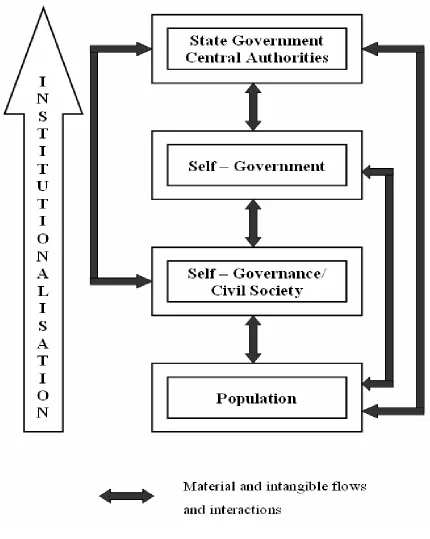
Central governments decentralize some of their functions to subnational territories, i.e. to self-governing structures. Decentralization means the devolution of state's functions to autonomous territorial governments, which can act, within the scope of decentralized functions, on their own behalf. In this case, we are dealing with territorial self-administration.
As indicated above, there should exist the balance in terms of competences and financial resources between both fundamental components of public administration, i.e. state administration and self-administration. While state administration can be characterized as public administration performed by the state bodies, self-administration is generally performed by other subjects than state.
Self-governing structures of public administration are
autonomous entities having a legal status.
For state administration, hierarchical ‘top-down’ system is typical. State policies and preferences are accomplished just via state administration and individual incumbents. State administration acts on behalf of the state. While the subject of the state administration is the state itself, the objects of state administration are represented by independent elements, such as firms, households or individuals.
46
and entities present in these territories. Self-administration is based primarily on the accomplishment of its own governing power. Obviously, the activities of self-administration are delimitated by the legislation. governing bodies act on behalf of the given territory. Self-governing institutions are the subjects of self-administration, and units that belong to the field of their legally delimitated competences constitute the objects of self-administration.
The power of self-administration essentially expresses the rate of democracy in given country. Not surprisingly, territorial differentiation plays a crucial role in the evaluation of relations between self-administration and state administration. We are dealing with the reflection of the distribution of political power alongside the hierarchical axis state-region-locality. In case that self-governing structures are not strong enough to act as the partner or balancing power of state administration, the threat of the emergence of power centralization becomes rather pressing.
Obviously, territorial distribution of political power turned out to be rather delicate issue many times in the history. Leading political actors may design the spatial dimension of public administration in order to prevent or facilitate regional separatism, or formation of a strong regional government that would challenge central authority or weaken or strengthen the position of regional power elites etc.
47
the augmentation of the self-governments’ manoeuvring space.
It has to be stated that there exists a great differences in the power of self-administration in various countries. While western countries promoted self-administrative structures as a consequence of many sharp regional declines in 1960-ies and 1970-ies and strived for the fulfillment of the principle of subsidiarity, transitional countries mostly did not settle with unfavorable centralistic institutional heritage of socialistic era so far.
Table 1: Self-governing Regions in European Countries according to the Date of Origin
State Number of Regions
Date of Origin
Belgium 3 1970
Denmark 15 1970
Germany 16 1949/90
Finland 12 1919/86
France 26 1982
Great Britain 78 1972/73
Greece 13 1986
Ireland 31 1889
Italy 20 1948/70
Luxembourg 3 1868
Netherlands 12 1850
Portugal 7 1978
Austria 9 1918/45
Spain 17 1979/83
Sweden 25 1634/1862
48
Territorial administrative structures play one of the decisive roles in the process of socioeconomic development of the whole countries as well as their particular territories, i.e. regions. Adequate system of territorial administration may help in designing the desirable territorial policies, which should bear in mind that it is better to prevent socioeconomic problems than to cure their consequences. It concerns both
state and regional levels.
Last but not least, it has to be mentioned that there is a big mess concerning the notions that have something to do with territorial administration. The institutions at the local or regional levels vary greatly between countries and even when similar arrangements exist, the terminology often varies. Common names for local or regional governments include state, province, regions, department, county, prefecture, district, city, township, borough, parish, municipality, shire or village. A lot of attention subsequently concentrates rather upon discourses on the proper names of particular parts of the nation states than on truly important solving the relations between state administration and self administration. Obviously, this situation is beneficial for central authorities in nation states as it prolongs their hitherto relatively trouble – free life.
3.4
Subsidiarity: A Purification of Traditional
Principle from the Dust
49
that problems should be solved at the level at which they arise and that powers transferred to higher levels of government should only be those which lower level bodies cannot apply.
The whole principle is based on the autonomy and dignity of human beings. At the same time, it stresses the importance of small and medium – sized communities or institutions. The principle was developed in the encyclical Rerum Novarum of 1891 by Pope Leo XIII, as an attempt to articulate a middle course between the excesses of laissez – faire capitalism and the emerging forms of communism that subordinate the individual to the state. In other words, the principle of subsidiarity attempts to search for a golden middle way in the realm of the interactions between bottom – up and top – down principles.
50
The principle should act as one of essential guidelines for defining the powers in the framework of democratically arranged territorial administration. Subsidiarity is applicable at both national and international levels, which means that this principle can cover various territorial ranks of spatial order from municipalities via regions to the individual states or even supranational groupings, such as European Union, for instance.
In European space, the subsidiarity principle plays rather important role. At the local level, it was already a key element of the European Charter of Local Self-Government, an instrument of the Council of Europe promulgated in 1985. In 1992, the subsidiarity principle was introduced in the Treaty of Maastricht. From practical point of view it means that in the sphere of the EU policies, this instrument is taken into consideration, when the EU acts in the areas not coming under its exclusive competence. While at the level of the European Union, the principle of subsidiarity is basically fulfilled, at the level of the nation states, as already indicated, subsidiarity still often belongs to the sphere of theory.
51
As already indicated, one of the basic goals of each country should be the prevention of deep regional socioeconomic inequalities. Such discrepancies are usually named (if at all) after their rise. It is much more efficient to precede the creation and further expansion of such discrepancies. In case that the principle of subsidiarity is duly applied, the probability of the occurrence of dramatic spatial differences is reduced. More precisely, provided that local and regional entities possess sufficient self-governing powers and finance, subsidiarity provides them with a truly useful instrument for the mitigation of numerous threats coming from external environment.
Last but not least, it has to be added that subsidiarity leads to the true liberty of human beings as well as other subjects. It is a principle that has much to do with spiritual dimension of our life. The principle by chance did not emerge just in the period of an economization of the world. Economy is only one of societal superstructures, while spirituality is transcendent component of living, from which the other developments and structures are derived.
3.5
Territorial Development: on the Road to the
Duality of European Space
52
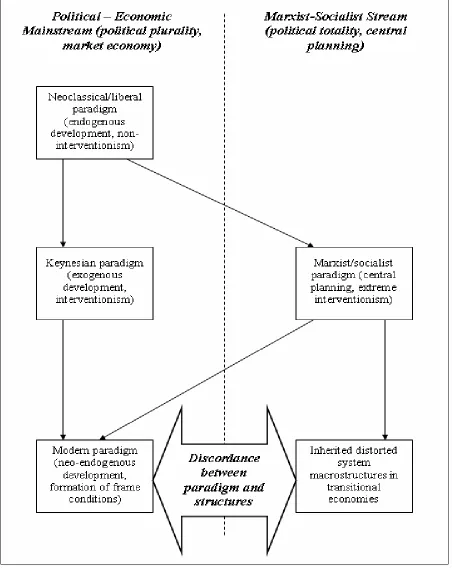
in the sphere of politics and central planning in the realm of economy. These differences are reflected also in the evolution of economic – political approaches towards regional and local development in individual countries.
In the course of last two or three decades the move from exogenous approaches towards regional development that rely on inner potential became tangible. However, rather than by remade endogenous doctrine, exogenous Keynesian paradigm was replaced by new neo-endogenous doctrine, which accentuates the creation of general conditions for the stimulation of inner endogenous developmental possibilities in individual regions. Neo-endogenous stream of regional development was formed as an intersection of new conceptions, such as learning regions, flexible specialization or industrial districts that underline the importance of profound spatial differentiation in institutional characteristics. Contemporary neo-endogenous and to a certain extent eclectic stage of regional development is path-dependent upon the history of regional development paradigms.
53
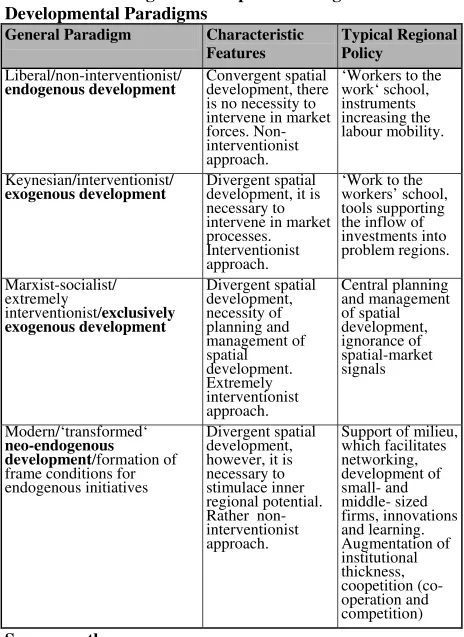
As it is visible in table 2, regional development approaches are distinguishable as follows:
• Interventionist, i.e. Keynesian and extremely
interventionist Marxian-Socialist,
• Non-interventionist, i.e. strongly non-interventionist
liberal paradigm and rather non-interventionist modern neo-endogenous conceptions of regional development.
In other words it is possible to talk about ‘top-down’ conceptions that rely upon the outer interventions and are inherent to Keynesian and Marxian-Socialist paradigms on the one hand and ‘bottom-up’ approaches, which emphasize the stimulation of inner regional developmental potential and are typical for liberal and modern paradigms of regional development on the other hand.
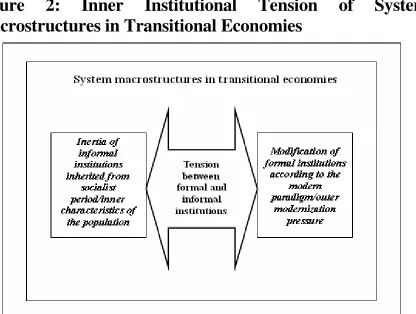
Modern, neo-endogenous approaches towards regional development stress the importance of the stimulation of endogenous potential in the region. At the same time, these conceptions implicitly consider that system macrostructures are distributed in the way, which enables approximately even conditions for the development of individual regions and localities in the framework of the country. In this context, one has to take into account that system macrostructures bear distinct spatial dimension, which principally influences the quality of these macrostructures.
System macrostructures are embodied by public administration (namely the power and manoeuvring space of state administration and self-government from financial perspective as well as the organisation of their competences) or by both physical and social infrastructure.