Unequally spaced knot techniques for the numerical
solution of partial differential equations.
WISHER, Stephen J.
Available from Sheffield Hallam University Research Archive (SHURA) at:
http://shura.shu.ac.uk/20555/
This document is the author deposited version. You are advised to consult the
publisher's version if you wish to cite from it.
Published version
WISHER, Stephen J. (1983). Unequally spaced knot techniques for the numerical
solution of partial differential equations. Doctoral, Sheffield Hallam University (United
Kingdom)..
Copyright and re-use policy
See http://shura.shu.ac.uk/information.html
Sheffield Hallam University Research Archive
Z Q 4 - 5 B 3 2 0 J»Z
Sheffield City Polytechnic Library
REFERENCE ONLY
ProQuest Number: 10701202
All rights reserved
INFORMATION TO ALL USERS
The quality of this reproduction is dependent upon the quality of the copy submitted.
In the unlikely event that the author did not send a com plete manuscript and there are missing pages, these will be noted. Also, if material had to be removed,
a note will indicate the deletion.
uest
ProQuest 10701202
Published by ProQuest LLC(2017). Copyright of the Dissertation is held by the Author.
All rights reserved.
This work is protected against unauthorized copying under Title 17, United States C ode Microform Edition © ProQuest LLC.
ProQuest LLC.
789 East Eisenhower Parkway P.O. Box 1346
UNEQUALLY SPACED KNOT TECHNIQUES FOR THE
NUMERICAL SOLUTION OF PARTIAL DIFFERENTIAL EQUATIONS
Being a thesis submitted
in partial fulfilment of the degree of
Doctor of Philosophy
at
Sheffield City Polytechnic
by
STEPHEN JOHN Y/ISHER
ACKNOWLEDGEMENTS
I wish to express my sincere thanks to my Director of
Studies, Dr G F Raggett, for his general support,
constructive criticism and continual encouragement during
my work on this thesis.
I would also like to thank numerous members of the Department
of Mathematics, Statistics and Operational Research at
Sheffield City Polytechnic for many helpful discussions;
particular thanks are due to Dr A C Allen, Dr R McLaughlin,
Mr R Ward and, my second supervisor, Dr J A R Stone.
I wish to acknowledge a very helpful discussion which took
place between myself, Dr Raggett and certain members of
the Division of Numerical Analysis and Computer Science at
the National Physical Laboratory. Particularly, I wish to
thank Dr M G Cox for bringing to my attention the variable
knot point results for approximation on which two of the
methods of this thesis are based.
My thanks are also due to Mrs Renee Hayes for her expert
typing of this thesis.
ABSTRACT OF THE THESIS
"Unequally Spaced Knot Techniques for the Numerical
Solution of Partial Differential Equations"
S J WISHER
Cubic spline approximations to time dependent
partial differential equations, having both constant and variable coefficients, are developed in which the knot points may be chosen to be unequally spaced. Four methods are presented for obtaining 'optimal* knot positions, these being chosen so at to produce
an increase in accuracy compared with methods based on equally spaced knots. Three of the procedures described produce knot partitions which are fixed throughout time. The fourth procedure yields
differently placed 'optimal' knots on each time line, thus enabling us to better approximate the varying time nature characteristic of many partial
differential equations. Truncation errors and stability criteria are derived and full numerical implementation procedures are given. Five case studies are presented to enable comparisons to be drawn between the knot placement methods and results found using equally spaced knots. Possible extensions of the work of this thesis are given.
CONTENTS
Page No,
Acknowledgements
Abstract of the thesis
Chapter 1 Introduction
1.1 Finite Difference Solution of Partial Differential Equations
1.2 Development of Spline Techniques
1.3 Motivation for Present Work
i
ii
Chapter 2 Review of Cubic Spline Theory
2.1 Definition of a Cubic Spline
2.2 Cubic Spline Functions
10 10
Chapter 3 Initial Value Partial Differential Equations with Equally Spaced Knots
(i) Hyperbolic Partial Differential Equations
3.1 Constant Coefficients
3.2 Variable Coefficients
(ii) Parabolic Partial Differential Equations
3.3 Constant Coefficients
3.4 Variable Coefficients
14
19
21
29
Chapter 4 Initial Value Partial Differential Equations with Unequally Spaced Knots
Page No.
4.2
4.3
Chapter 5
Hyperbolic Partial Differential Equations with Constant Coefficients
Parabolic Partial Differential Equations with Constant Coefficients
Methods for Obtaining Knot Partitions
35
43
5.1 Preamble 47
5.2 A Local Method 48
5.3 A Global Method 52
5.4 A Transformation Method 58
Chapter 6 Case Studies 1
6 . 1 Case Study Philosophy 62
6 . 2 Case Study 1.1 62
6.3 Case Study 1.2 69
6.4 Case Study 1.3 72
6.5 Case Study 1.4 74
6 . 6 Case Study 1.5 77
Chapter 7 Varying the Knots on Each Time Line
7.1 Preamble 82
7.2 Procedure for Determining Optimal
Knot Partition 83
7.3 Implementation of the Splines Scheme 87
Chapter 8 Case Studies 2
8 . 1 Case Study Philosophy 89
8 . 2 Case Study 2.1 90
Page No.
8.4 Case Study 2.3 94
8.5 Case STudy 2.4 96
8 . 6 Case Study 2.5 97
Chapter 9 Conclusions and Extensions
9.1 Conclusions 1 0 1
9.2 Possible Extensions 108
Tables 111
Figures 142
Appendices 165
CHAPTER 1
. Introduction
1.1 Finite Difference Solution of Partial Differential Equations
The most well-known early work on the use of finite
differences was that of Richardson (1910), although the
paper by Courant, Friedrichs and Lewy (1928) is usually
considered as the birthplace of modern numerical methods
for solving partial differential equations. In that work
Courant, Friedrichs and Lewy also showed that the
convergence of simple difference approximations depends
on the mesh ratio satisfying certain conditions. Such
conditions were also derived using Fourier techniques for
a wide variety of problems by von Neumann during the
Second World War. A detailed discussion of von Neumann's
work is given in O'Brien, Hyman and Kaplan (1951).
Since the work of von Neumann many finite difference schemes
have been proposed, perhaps the most well-known being that of
Crank and Nicolson (1947). A thorough description of methods
available is given in Richtmyer and Morton (1967). The
computational aspects and the application of finite
difference methods to partial differential equations with
variable coefficients and generalised boundary conditions
is discussed in, for example, Ames (1977), Mitchell (1969)
and Mitchell and Griffiths (1980).
The majority of finite difference schemes derived for
the solution of time dependent partial differential
equations use rectangular grids which have constant
step lengths in both the space and time directions.
There are} however, certain instances in which unequally
spaced mesh points in the space direction are beneficial.
For example, situations frequently arise in which the
solution of a partial differential equation varies very
rapidly over a small part of the domain but changes slowly
over the rest of the domain. The problem in using non-
uniform grids in such situations is that, in general, an
order of accuracy is lost by employing unequally spaced
mesh point schemes. It is therefore important to position
the mesh points so that optimal numerical performance is
achieved. Pearson (1968) proposed an iterative scheme for
the solution of boundary layer problems in which additional
mesh points are added where the variation in solution values
exceeds some predetermined level. Woodford (1975) extended
this idea and produced a scheme which used graded meshes
in which the mesh points are systematically chosen according
to the natural structure of the problem. The use of such
transformation techniques has also been considered by
various authors (see, for example, Jones and Thompson (1980)
and references therein) in determining the position of mesh
points for the solution of fluid flow problems.
An additional area where non-uniform grids have been
used is in the numerical solution of moving boundary
problems in heat flow* Murray and Landis (1959) solved
such so-called Stefan problems by employing a uniform grid
on the solid side of the boundary and a different uniform
grid on the liquid side. A change in the size of the step
lengths therefore occurs from one side of the boundary to
the other. These moving boundary problems were also
considered by Douglas and Gallie (1955). They used a
scheme with a variable time step length which is chosen so
that the boundary always moves from one line of the space
grid to the neighbouring line in a single time step. More
recently, Crank and Gupta (1972b),proposed a method for
solving Stefan problems which employed cubic splines to
interpolate solution values.
Development of Spline Techniques
The term ’spline function’ was first used by Schoenberg
(1946) in a paper describing the use of generalised splines
and other piecewise polynomials to approximate smooth
functions of one variable. Although Schoenberg’s early
paper was an important contribution to the use of spline
techniques, it was not until the 1960's that further work
in the field was published.
Since that time, spline functions have been used
extensively as methods of interpolation and approximation,
see for example, Birkhoff and de Boor (1967), Greville (1969),
Schumaker (1969), Curtis (1970), Hayes and Halliday (1974)
and Cox (1975). An excellent summary of spline techniques
is given in Ahlberg, Nilson and Walsh (1967).
Due to the benefit gained by employing splines in approximation
problems, numerous authors have adapted spline techniques to
obtain solutions to various problems in numerical analysis.
For example, Loscalzo and Talbot (1967), Loscalzo (1969),
Micula (1973) and Patricio (1978) considered the solution
of initial value problems, whilst methods for solving
two-point boundary value problems were presented by Bickley
(1968), Albasiny and Hoskins (1969) , Fyfe (1969) and
Khalifa and Eilbeck (1982).
in addition, El Tom (1974 and 1976) has used spline techniques
in the solution of Volterra integral equations.
The development of spline techniques for obtaining numerical
solutions to partial differential equations began with
Papamichael and Whiteman (1973) . In that work the authors
presented a method for solving the simple one-dimensional
spline approximation in the space direction together with
a finite difference approximation in the time direction.
A similar technique was used by Raggett and Wilson (1974)
in obtaining numerical solutions to the one-dimensional
wave equation.
Spline function approximations have since been applied
to more general partial differential equations. For example,
Raggett, Stone and Wisher (1976) considered the solution
of practical problems modelled by hyperbolic partial
differential equations of the form
a(x,t) jhi + b(x,t) jhi + c(x,t)u. (1 .2 .1)
8x _ 8x
In addition, Rubin and Graves (1975) and Rubin and Khosla
(1976) presented spline techniques for solving problems in
fluid mechanics. In particular, their work developed the
use of spline techniques in the solution of non-linear
equations. The application of spline function approximations
to partial differential equations in two space dimensions
was considered by Jain and Holla (1978) . They proposed a
high accuracy formula, using a technique similar to that
of McKee (1973) , for the spline solution of wave equations of
a
u = d_8t^ 3x
the form
92u = a(x,y,t) 32u + b(x,y,t) 32u . (1 .2 .2 )
8t2 9x2 3y2
Jain and Aziz (1981) have also recently applied parametric
spline techniques to a variety of differential equations and
have found that they compare favourably with the more usual
cubic spline approximations. In addition, papers by Sastry
(1976) and Pala and Spano (1978) have also proposed methods
for obtaining spline solutions to parabolic partial
differential equations.
1.3 Motivation for Present Work
As mentioned earlier, the use of cubic splines for the
numerical solution of the one-dimensional wave equation
has been considered by Raggett and Wilson (1974). An
indication of how that work could be generalised to the
solution of more general one-dimensional, constant coefficient,
hyperbolic partial differential equations was shown by
Raggett (1974). The completion of that work was carried
out by Wisher (1977) , who indicated that the use of spline
techniques gave increased accuracy over comparative
hyperbolic equations by Wisher (1977) are illustrated in
Chapter 3 of this thesis. The extension of that work to
include parabolic partial differential equations is also
given in Chapter 3.
Most of the previously mentioned works on the application
of spline techniques to the solution of partial differential
equations have produced methods in which the knots were
chosen to be equally spaced. An exception here is that of
Wisher (1977) who used unequally spaced knots in solving
the simple wave equation. In that work, the knots were
positioned in an ad-hoc manner and no improvement in
accuracy was observed over the use of uniform knot partitions.
Further, some experimentation on choosing the knot points
to be the zeros or extrema of the shifted Chebyshev polynomial
T*(x) = Cos (nCos-1 (2x-l)) (1.2.3)
n
was undertaken in Wisher (1977). Again no improvement in
accuracy over constant knot spacing was observed.
In this thesis we employ spline techniques with unequally
spaced knots for the numerical solution of both hyperbolic
and parabolic partial differential equations. Further, we
present methods for the optimal positioning of these knots.
The derivation of schemes allowing the non-uniform partitioning
of knot points is given in Chapter 4.
The problem of determining optimal positions of knots
has been shown to be a difficult one and has only to-date
been applied to approximation problems.
In the earlier works on approximating functions (see for
example, Curtis and Powell (1967)) equally spaced knots
were employed with additional knots being inserted when -
the error in the approximation was larger than some
prescribed magnitude. Since that time various authors
have attempted to choose the positions of the knots, in
some optimal sense, given knowledge about the function f
being approximated. De Boor and Rice (1968) described an
algorithm for solving the least-squares cubic spline
approximation problem. Their idea was to vary one knot
at a time so as to reduce the error of best approximation.
Similarly, Esch and Eastman (1969) proposed a method for
a best discrete Chebyshev approximation by splines. Both
these algorithms are computationally expensive and de Boor
(1973) has since proposed an alternative method which chooses
the knot partition from the given function f. This method
in Chapter 5 by taking the function f to be the given
initial condition. Two additional methods for optimally
positioning the knots are also derived in Chapter 5.
In Chapter 6 of this thesis, a number of case studies
are considered and solutions derived using knot partitions
resulting from each of the methods given in Chapter 5.
Comparisons are also made with results produced using equally
spaced knots.
The results of Chapter 6 suggest that improvement on the
methods for locating the knot points given in Chapter 5 would
be desirable. An improved algorithm is thus presented in
Chapter 7, which chooses optimal partitions of knots on each
time line. The suitability of this method is examined in
Chapter 8 , where the earlier case studies are again considered.
Throughout this thesis, no particular reference to the
associated characteristics has been made for hyperbolic
problems. However, it should be realised that due
account has been taken in the satisfaction of the
Courant Friedrichs Lewy condition (see Mitchell and
Griffiths (1980)) for all the problems cited.
CHAPTER 2
Review of Cubic Spline Theory
Definition of a Cubic Spline
Let f(x) be a function with continuous derivatives in
the range a $ x $ b. To approximate f(x) using cubic
spline techniques we may subdivide the interval a $ x $ b
into N sub-intervals by inserting knots x^ such that
a = Xq < x^ < ....< xN = b. (2.1.1)
S(x) is a cubic spline interpolating to the function f(x) at
the knots x^, x if
(i) in each sub-interval x^^ $ x $ x^^ (1=1,2, ... ,N) f
S(x) is a cubic polynomial,
(ii) s ’(x) and s"(x) are continuous everywhere in [a ,bJ ,
(iii) S(x±) = fCxJ (i=0,l,...,N).
A cubic spline thus consists of a set of cubic polynomial
arcs which are joined smoothly end to end with continuous
first and second derivatives. In general, the third derivative
will have a discontinuity at each of the knots x ,x ,....,x^ - ^
Cubic Spline Functions
where hi = Xi Xi l Ci = 1,2,...,N) (2.2.2)
ft
and = S (x_^) . Integrating twice gives the cubic spline function S(x) on I x, , x I as
S(x) = (x± - x)3 + M± (x - Xj.j)3 +/ “ h)2 ) (*,“*)
6h± 6h± \ 6 ' hi
+ | f(Xi) - h± 2 M± | (x - xi ]L) (i=l,2,----,N)
(2.2.3)
the constants of integration being evaluated from S(x^) = f(x^)
and S(x^, ^) = f(x^ ^) . From (2.2^3) the following one-sided
limits of the derivatives of s'(x) are derived
s'(Xi-) = h± U ±mml + h ± Mi + f(x±) - f(xi-_1) (i=l,2,...,N)
6 3 hi (2.2.4)
S ’(x±+) = -hi + 1 M± - hi + 1 Mi + 1 + f(x±+1) - f(x±) (i=0,l,...(N-l))
3 6 hi+l (2.2.5)
The unknowns M (i=0,2,...,N) are obtained by equating these
one-sided limits, thus giving
h. M , + h.+h. l i M. + h. M. = h.f(x. .J-Oi.+h, ,)f(x.)+h, \ f(x. .
- 1 l l+l i i+ 1 i+ 1 i i+ 1 i i+ 1 l i+ 1 i-l
6 3 6 h.h. ,
l l+l
(i=l,2,...,(N-l))
(
2.
2.
6)
Equation (2.2.6) is a tri-diagonal system of (N-l)
equations in (N+l) unknowns. To solve this system various
choices of conditions are available at the end points,
Xq and x^, of the interval to produce a consistent set
of (N+l) equations
(i) s"(x^) = 0 (i=0,N) (2.2.7)
(ii) S * (x^) ■= f*(xi) (i=0,N) (2.2.8)
(III) s " ^ ) = f’* (x±) (i=0,N) (2.2.9)
As suggested by Behforooz and Papamichael (1979), the
choice of these extra conditions plays an important role
on the quality of the spline approximation. It is well-known
that the best order of approximation which can be achieved
by an interpolatory cubic spline is
I[ S - f 11 = 0(h4)
where | | . | | denotes the uniform norm on [a>bJ aad
h = max(h^). This order of accuracy is obtained if either
(ii) or (iii) are used as the extra conditions. As stated 4
by Kershaw (1973) an 0(h ) accuracy is not obtained if
condition (i) is applied. However, the conditions (ii)
and (iii) require knowledge of the derivatives of the
function f(x). This knowledge is not generally available
from any imposed boundary conditions of partial differential
this thesis, S(x) and (i) being known as a ’natural’
cubic spline. Papamichael and Worsey (1981) have
recently derived improved extra conditions for spline
approximation which could result in increased accuracy
to the results of case studies considered later.
Having decided on the choice of 'end conditions', substitution
of these into (2.2.6) gives a system of (N-l) equations which
are linearly independent, tri-diagonal and diagonally
dominant. They can therefore easily be solved for M.i
(1=1,2,...,(N-l)), the satisfaction of the end conditions
then giving MQ and The spline function S(x) can then
be obtained from (2.2.3).
CHAPTER 3
Initial Value Partial Differential Equations with Equally Spaced Knots.
(i) Hyperbolic Partial Differential Equations
3.1 Constants Coefficients
Suppose that u(x,t) satisfies the second order linear
hyperbolic partial differential equation
2 2
8 u = a 8 u + b jhi + cu (0 £ x $ 1, t >0) (3.1.1)
2 2
8t 8x dx
where the coefficients a, b, c are constants (a > 0 ).
Assume further that (3.1.1) is subject to the function
value boundary conditions
u(0,t) = f1 (t) , u(l,t) = f2 (t) (3.1.2)
and the initial conditions
u(x,0) = g (x) , 8u(x,0) - g (x) (3.1.3)
8t
where f^(t), fg(t), g^x) and g2 Cx) are known functions.
To obtain solutions to (3.1.1) using spline techniques
we here consider the knots
0 . = x < x < .... < xXT = 1 0 1 N (3.1.4)
to be.equally spaced where the distance between successive
knots is h, so that xi = ih (i=0,l.... ,N) . We now replace
the time derivative in (3.1.1) by a finite difference
approximation and the space derivatives by a cubic spline,
thus obtaining at the point (ih,jk) the implicit relationship
u. . ,-2u. ,+u. . _ = afsM. . _+(l-20)M. J+0MJ .i,d i,j+l I i,j-l i,j i , j+lj
+ M 0l, .. _ +(1-2 0)L +0L L
\ i,j-l i , d i,d+lj
+ c(0u. +(1-2 0)u +0u \
I (3.1.5)
(i=0,l,....,N; d=l»2 ,»**»; ; 6 ^ 0)
where L = S*(x ), M = s"(x ); S (x) denoting the
1 13 J * J J ^ J
th cubic spline interpolating the values u on the d
1 »J
time line, this being given by
Y x ) " (v x ) 3 + Mi.,i(x-xi-i) 3 + f ui-i..r^Mi-i..i) (xr x)
6h 6h \ / h
* y * t j_-2"i j
j
(i=l,2 N) (3.1.6)As shown in section 2.2, the continuity of the first
derivatives of the spline function yields
i J + 2 M J . = u. , . - 2uJ , + u, , .
k i-1,3 o' i»d fi- i+1,3 i-1,3 i.d i+1.3
2 (3.1.7)
h
(i=l,2,....,(N-l))
th th
This relationship also holds on the (d-1) and (d+1)
time lines, giving respectively
i Mi-l,j-l+ |Mi,j-l+ = Ul-1 . j-l~2Ui ..1-l'l'Ul+l. j- 1
h2
(1=1,2...,(N-1)) (3.1.8) and
iMl-l, j+l + |M1 , j+ 1 + £“i+l, j+l = Ul-1 . ,1+l~2Ui . ,1+1+U1+1 . j+ 1
h2
(1=1,2...(N-l)) (3.1.9)
We now require an expression similar to (3.1.7) which th
incorporates the L 1 , J values. On the j time line (2.2.4)and (2.2.5) respectively become
L_, a = S J(xJ-) = hM , u + hM + u_, - u^
h--- <3
J - o v * - n m - . T U ffl - r u - u
i,j
j i
g i-1.J 3ij
i
,j
i-l>
J(3
(3 (i=l,2.... ,N)
and
L. = S*(x. +) = -hM. -hM. + u ' • u. .
i j j i 3 g 1 +1,J i+l,J - i.d
(1=0,1,--- ,(N-1)) From (3.1.10) we have
It, , . = hMJ . + hM. , . + ^ , . — u. .
i+l,j J i+l.J i+l.j i,j
h
<i=0> 1,--- - (N-l))
and from (3.1.11)
L = -hM - hM + u - u
i-l,d 3 i-lj gi,j i,J i-ltj (3
h
(i=l,2,....,N)
A relationship is now obtained by adding (3.1.10) and (3.1
the result being added to half the sum of (3.1.12) and (3.
Thus on the jth time line
jLi-l, } + fLi J + = V l . J ' "i-l.J (3
2h
(i=l, 2,. .. .,(N-l))
4-1-Again (3.1.14) holds on the (j-1) and(j+l) time lines
giving
1L + 2L + 1L = u - u „ „
-i-l,j- 1 - i , H - i +1 ,d- 1 i+1,d-1 i-l,d-l (3 2h
(i=l ,2 --- ,(N-1))
.
1.
10)
.
1.
11)
.
1.
12)
.1.13)
.
11),
1.13).
.1.14)
and
1L + 2L + 1L = u — u
-i-l,j+l - i j + l -i+l,j+l i+l,j+l i-1,j+1 (3.1.16) Zh
(1*1 , 2 (N-l)>
As shown in Wisher (1977) the required scheme incorporating
splines is obtained by performing the following operations:
(i) multiply (3.1.7) by a(l-20);
(ii) add (3.1.8) and (3.1.9), multiply the result by a0;
(iii) multiply (3.1.14) by b(l-20);
(iv) add (3.1.15) and (3.1.16), multiply the result by b0;
(v) add the expressions produced in (i) - (iv) together;
(vi) use (3.1.5) to eliminate the and L. . values,
thus giving the following three time level scheme
and the mesh ratio r=k/h.
The truncation error for (3.1.17) is obtained by expanding
each term of the scheme about the mesh point (ih,jk) using
(see Wisher (1977)) the following expression, to fourth order,
is obtained
+ 4(l+3o0)u
4(l+3o0)u (3.1.17)
(i=l,2,----,(N-1))» • • • • >
Taylor series approximations. After appropriate rearrangements
(3, k2h2 c2 r2 f(0)u + 2bcr2 f(0) jhi
[ 9x
f 2 2 2 2 ^ 2
+J r (2ac + b )f(0) - 1^ c k 0> 9 u
I 6 J 3 z 2
+ J 2abr3f(9) - 1_ bck30^ 33u
L 6 J 3x3
( 2 2 a r f(0) + 1 a - 1 ch - 2 1 ack o 1 40i 9_u
12
72
6 J 3x4
where f(0) = 1_(1 - ck20) - 6. (3, 12
This truncation error may be considerably simplified by
choosing f(0) = 0 , in which case the parameter 0 is
chosen such that
0 = 1 (3,
12 + ck2
Thus, in the special case where fourth and higher order
derivatives are small, the truncation error is reduced
2 2 4 2
in magnitude from 0(k h ) to 0(k h ). The technique of
optimally choosing the parameter 0 has been considered
in detail by Wisher (1977). For example, when obtaining
solutions to the wave equation ((3.1.1) with a=l, b=c=0) 2 4 6
the truncation error (3.1.18):can be reduced to 0(k h +k ) bt) choosing
0 = _JL_ (1+r2) (3,
1 2 r2
1.18)
1.19)
1
.
20)
2 6 8
and, in fact, to 0 (k h +k ) by suitable choice of both
6 and r.
To examine the stability of the scheme (3.1.17) we use
the well known von Neumann method (see Mitchell (1969)) in
which a harmonic decomposition is made of the error at
mesh points (see Wisher (1977) for full details). The
following stability conditions are obtained
(a) if 6 £ it is unconditionally stable
(b) if 0 < it is stable when
-1/2
r $ {3a(l-40)} . (3.1.22)
3.2 Variable Coefficients.
Here we require solutions to the hyperbolic partial
differential equation
-+ b(x,t) 9ii -+ c(x,t)u (3.2.1)
9x
where a(x,t), b(x,t) and c(x,t) are variable coefficients
and a(x,t) > 0 at all points in the solution domain.
Again we consider the knots to be equally spaced and
perform an analysis identical to that of the previous
section. Though complicated by the variable coefficients
the following scheme, similar to (3.1.17), is derived
at (ih,jk) if 9t
9 u = _9
2 9x a(x,t) jhi9x
^i-l.j+l “8*i,j+l>ui-l,j+l + ^ i . j + l + 3Yi,j+l)Ui,j+ 1
+('f’i+l,j+l “6xi,j+l)ui+l,J+l
={2*i-i,j+ A - i . j v u + 4 {2^ , j + A . j
-3(1-26,Yi(J} Ulj + {2*i+ltJ + k2c1+1tj ♦<l-ae>x1<j> u1+1>j
' + 3Yi,j-i)ui,j-i
"^i+l.j-l “ 0Xi,3-l)Ul+l,j-1 (t=1>2.... »(N-1), (3.2.2)
where
2 2
*i,j 1 k 9°i,j ’ Yi,l ” r ai,J ’ 6Yi,j 6l.j ’
Xi,J = 6 Y i,J + ei,d • 6i.j = 3rk(ai j + b ilJ> >
the prime denoting differentiation with respect to x.
The truncation error for (3.2.2) is again obtained using
Taylor series expansions. It is found that the error is 2 2
0 (k h ), although in this case the expression is much more
complex, involving derivatives of the variable coefficients
and odd order derivatives of u with respect to t. The full
expression for this truncation error is given in Wisher (1977)
The stability condition for (3.2.2) is obtained by applying
the von Neumann method locally, since the method is only
As suggested by Widlund (1966) and Mitchell (1969)
we therefore perforin the analysis by considering the
coefficients to be constant and assume that the scheme
with variable coefficients will be stable provided the
condition obtained is satisfied at every point of the
solution domain. The scheme (3.2.2) then has the following
stability condition
(a) if 0 £ ~ , it is unconditionally stable;
(b) if 0 < ■- , it is stable whenever
- 1/2
r $ {3a(x,t)(1-40)} (3.2.3)
is satisfied independently at each point of the solution
domain.
Equations of the form (3.2.1) have been considered in detail
by Raggett, Stone and Wisher (1975) and (1976).
(ii) Parabolic Partial Differential Equations
3.3 Constant Coefficients
The cubic spline solution of the simple heat conduction
equation has been considered by Papamichael and Whiteman(1973)
and by Sastry (1976). In this section we extend the technique
to the more general parabolic partial differential equation
2
3u = a 3 u + b 3u. + cu (0 $ x $ 1, t > 0) (3.3.1)
3t 3x^ 3x
where a, b, c are constants (a > 0) . We here assume that
(3.3.1) is subject to the initial condition
where f^(t), g(x) are known functions. If the
knot partition (3.1.4) is again chosen to be equally spaced,
then by similarly replacing the time derivative in (3.3.1)
by a finite difference approximation and the space derivatives
by a cubic spline we have at (ih,jk)
similar in nature to (3.1.17) is obtained by performing the
following operations:
u(x,0 ) = g(x) (3.3.2)
and the function value boundary conditions
u(0 , t) = f1 (t) U( 1 y t) = ^(t) (3.3.3)
k
(3.3.4)
where L
(i) multiply (3.1.7) by a(l-0);
(ii) multiply (3.1.9) by a0;
(iii) multiply (3.1.14) by b(l-0);
(iv) multiply (3.1.16) by b0;
(v) add the expressions produced in (i)-(iv) above
together;
(vi) use (3.3.4) to eliminate the M and L values i i J * i J
The following scheme incorporating splines thus results
(l-310)ui_1 j+1 + 4(1-*-320)u± ^ +<1“330)ui+1 J+1
= {l+31(l-0)}i^ _ 1 4{l-32 (l-0) }u± ^ + {l+33 (l-0)}ui + 1 (3.3.5)
(i=l,2,....,(N-l))
where 3, = 6 ar - 3brh + kc ; 3„ = 3ar - ck ; 3„ = 6 ar + 3brti + kc
1 A
2 and the mesh ratio r = k/h .
The scheme (3.3.5) reduces to that of Papamichael and
Whiteman (1973) for a=l, b=c=0 and is analogous to (3.1.17)
for hyperbolic equations. In fact, if a=l, b=c=0, suitable
choices of the parameter 0 lead to other well-known finite
difference schemes. For example, by choosing 0 = 1_ the
6 r
scheme (3.3.5) reduces to the simple explicit representation;
1 1
. 0 = — + — gives rise to the Crank-Nicolson formula and
2 or
® ~ \ + ^2r yields the accuracy formula of Douglas
(1956).
+ 4(1-1
+(1“33l
The truncation error associated with the scheme (3.3.5) Is
again obtained using Taylor series expansions. Fuller
details are given here (compared to the hyperbolic.case)
since this truncation error has not been derived elsewhere.
Thus, expanding (3.3.5) about the mesh point (ih,jk) we have
(l-3je> u + k / 3u\ + k^
I
82u \ + kf^1
83u \ + k^ / 34u \-h + k 5 \ u \ + k
i,d 3x3tl .
33u + k 34u
2 ! \3x3t /
j i $ j 3! \ 3x3t*
+ h_ 2.'
2 ’
3 u 3x2 ,
+ k / 3 u + k 34u "I
/ \ 2 1 2 2 /
r 1»J \3x 31/ i »J 2! \ 3x 3t / i» J
- h_ 3*
33u 3x3,
J20)
))
u. ■ + k / 3u i j
i j k
\ 3x 3t
2 2
3t
+ h_ 4:
34u 3x4
33u + k
i,d 4 34u
3! \. 3t /. . 4! \ 3t i. J
u., . + k/ 3u , 2 / . 2
+ k / 3 u + k 33u + k
+h 3u \.\3x.
3t / . 2 ! \ 3t" .
2 / 3 + k / 3 u
3 ! \ 3t
i,d , / ^ 2
+ k( 3 u + k3 / .4 3 u
v \ O X / . 1 , J
7 1
>3x3t/. . 2! \3x3t/ . 3.’ \ 3x313 , .i , j i , j i ,
3
+ k/ 3 u 3x2 3t,
i.j + k
2*.
34u 3x2 3t2
i,d-+h_ 3.*
rus \
+ k 34u3x33t
N + h x.4
4 1
34u 3x4
i.j.
34u
ui . j " h i— ) + -W i .3 2I
3 u * h a3 u3 ' + h / 9 u4 / 4 \
3x2-'i,j 3: ' 3x34 ,j 4:
Ui , j + h - + - a3 u2 ' + h3 I 33u\ + h4 a3 u4
2 ! \ 3x 3 ! \ 3x'
i,d 4! V 3x i.j (3.3.6)
Using the expressions for 3., 3 , 3 given earlier and
1 A U
rearranging we obtain the following truncation error to
fourth order
(-ck3 0) 3u + 1 (k^ - ck3 0) 3^u + 1 (k3 - ck4 0 ) 33u
3t 3t 3t‘
+ 1 (k4 - ck^0) 34u + (-bk3 0 ) 3^u + (- lbk3 0 ) 33u
24 3t 3x31 3x3t
2 . . 2 2. 2
.
+ (- lbk 0) 3 u + (- lckh ) 3 u + 1 (kh - 6 ak 0-ck h 0) 3 u
3x3t' 3x 6
+ 1 (k^h3 -3ak30~ ck3h30) 34u + (- lbkh3) 33u
6 12 2 , 3x 3t2 a + 2 3x*
2 2 4 I 2 4 \ 4
+ (- lbk h 0) 3 u + 1 j-akh - ckh j 3 u
3x33t 12 3x'
2 2 3x 3t
(3.3.7)
The time and mixed derivatives in (3.3.7) can now be
replaced by space derivatives by employing (3.3.1).
For example
2 2 4 3 2 2 2
9 u = a 9 u + 2 ab 9 u + (2 ac + b ) 9 u + 2bc 9u + c u,
9t 9x‘ 9x 9x 9x
2 3 2
9 u = a 9 u + b 9 u + c 9 u
9x9t 9x 9x 9x
The following expression for the truncation error
k2.
involving space derivatives only, is thus obtained
u c2 1(1-20) + ck(l-36) + c2k2(l - 40 - ck0)
\ 2 6 24
be I 1-20 + ck(l-30) + c2k2(l - 40 - ck0)
I 2 6 3udx
ac ( 1-20 + ck(l-30) + c2k2(l - 30 - ck0)
\
2 6+ b2 / 1(1-20)+ ck(l-30) + c2k4(l - 40 - ck0)
+ c2h2 ( 1 - 1 2 0 - ck0)
72 afu3x2
ab [ 1-20 + ck(l-30) + c2k2(l - 30 - ck0)
+ b2 / ck2(l - 40 - ck0) + k (1 -30)
+ bch ( 1 - 1 2 0 - 6 ck0)
36 afu3x3
a2 / 1(1-20) + ck(l-30) + c2k2 (l-20 - ck0)
+ ab2 / k (1-30) + ck2(l - 30 - ck0 )
+ ach2 ( 1 - 60 - 6 ck0) + b2h2 ( 1 - 1 2 0 - 6 ck0)
36 72
4 2 2
+ b k ( 1 - 4 0 - ck0) + a - ch
24 12r 72r 33x4u
4
For the simple heat conduction equation this error
reduces to
k2 1 (1-2 0) + 1 3ju + ,... (3.3.9)
3x4
2 1 2 r
and thus by choosing
0 = 0 . + _ ± _ (3.3.10)
2 1 2 r
the truncation error is simplified to include only terms
higher than fourth order derivatives. As previously mentioned,
the use of (3.3.10) gives rise to the high accuracy formula
derived by Douglas (1956).
The stability of (3.3.5) is examined by first replacing imY n
u ji , j j by u m,n and then letting u m,n = e £ , where Y is an
arbitrary real number and £ = X being a complex parameter.
Equation (3.3.5) thus becomes
(l-e_0)el(m”1)YSn + 1 + 4(l+390)ei m Y £ n + 1 + (l-3«e)ei ( m + 1 ) Y £ n + 1
X 6 o
:{l+6l(l-e)}ei(m-1)Y5n + 4{l-B2 <l-6) }eimYCn + U +B3 (l-0) }ei(,,1+1> V
imy n
Dividing by e £ ^0 and rearranging gives
K = {1 +B1 (l-6)}e"iY+ 4{l-B2 (l-0)} + {l+B3(l-6)}eiY
Cl-6 1 8 )e_iY + 4(1+B20) + <l-B30)eiY
If we now replace 3., 30, 3, by their full expressions and let1 A 3
h and k tend to zero in such a way that r remains fixed we
obtain
K = {1 + 6ar(l-0)}(e“iY+eiY) + 4{l - 3ar(l-0)}
( 1 - 6 ar6)(e“iY+eiY) + 4(l+3ar0) (3.3.11)
—iv iy
Since 2cosy = e +e ,
2
and cosy = 1 - 2Sin y_
2
it follows that, in view of the fact that £ is purely real, the
stability condition on £ is
-1 £ 3 - 2(1 + 6ar(l-0))Sin2y $ 1 (3.3.12)
3 - 2(1 - 6ar0)Sin2y
Denoting the denominator in this expression by D, we see
that since r > 0, a > 0 and 0 £ 0 then D > 0. Thus (3.3.12)
becomes
- 3 + 2(l-6ar0)Sin2y $ 3 - 2(l+6ar(l-0))Sin2y $ 3 - 2(l-6ar0)Sin2
2 2
(3.3.13)
From the right-hand inequality in (3.3.13) we have
-12arSin2y^ $ 0 (3.3.14)
2
which is satisfied for all r > 0 ; thus the left-hand
inequality will yield the required stability criteria.
From the left-hand inequality we obtain the expression
Thus, if 1-20 > 0, we can rearrange (3.3.15) to give
2 r $ 3 - 2Sin y
6a(l-20)Sin2y (3.3.16)
Since Sin y_ e [o,l], then by choosing Sin y_ to give the most
2 2
restricted condition on stability, we obtain
T* < “ ---1
±--- . (3.3.17)
6 a(l-2 0)
Alternatively, if 1-20 $ 0, rearrangement Of (3.3.15) gives
r £ 3 - 2Sin2y
6a(l-20)Sin2y
(3.3.18)
2
and thus r £ a, where a < 0. This implies that the scheme
(3.3.5) is unconditionally stable for 1-20 ^ 0.
The scheme (3.3.5) therefore has the following condition
governing its stability
(a) if 0 it is unconditionally stable.
A
(b) if 0 < -■, it is stable provided that
- 1
r S (6a(l-20)} (3.3.19)
3.4 Variable Coefficients
As shown in section 3.2 spline techniques can be applied
to hyperbolic partial differential equations with variable
coefficients. In this section we require solutions to the
parabolic equation with variable coefficients
3u =. _3_
3t 9x
a(x,t) 3u 3x
+ b(x,t) 3ii + c(x,t)u (3.4.1) 3x
where again a(x,t) > 0 at all points in the solution domain.
As in previous sections, if we replace the time derivative
in (3.4.1) by a finite difference approximation and the
space derivatives by a cubic spline we obtain at (ih,jk)
ul,j+l ~ ul.j = 0ai,j+l + (1_6)ai,j “i,j
+ e<ai(j+l + + bi,J>Li.j
+ 6ci,j+l ui,j+l + (1-e)ci,j ui,} (3-4 ‘2)
(i=0,l ,N ; J=l,2,„. ; Nh=l ; 6 5 0).
To obtain the required scheme incorporating cubic splines
we perform the following operations: (i) multiply (3.1.7) by a. (1-0);
^ » J
(ii) multiply (3.1.9) by 0a t ;
J"*"-*-(iii) multiply (3.1.14) by (a! .+b .)(1—0); i > 0 * » 3
(iv) multiply (3.1.16) by 0(a^ j+1^’
(v) add the expressions obtained in (i)-(iv) together;
this gives the following expression
a. .(1-0)/ 1M . .+2M .+1M. _ . \ + a. i,j - i-l,j j i , . . d l1M. _ .^+2M. _ \
J j i+1,J J 1, j+1 Ig- i-1,0+1 J i,J+l q i+1,j+lj
+(a' ,+b4 ) (1-0)7 1L. _ +2L +1L. .\+(a.' 4j,+b, . . ) Q l l L . ...
v i,j i, j I - l-l, j 3 i, j g- l+l, J i,j+l i,j+l hr i-1 , j+1 .
+ 2L. _+lL . 3 i,j+ 1 6 i+1 ,J+ 1
= ai..i(1~9)/ v i . . r2ui..i+V i , j V ai..i+i9/ui-i..i+r 2ui.j+x+ui+i.3+i
A
h2 I \ h2+(ai , j+bi, (1_9)/ ul+l.j~ul-l.j \ * (ai , j+l+bi , j+l)9/ui+l.j+l~Ui-l,J+l
(vi) use (3.4.2) directly and with i replaced by
both (i-1) and (i+1) to eliminate the M and
i i j
L values in (3.4.3). In the case of constant i » J
coefficients the required scheme results immediately.
In this case however, use must also be made of Taylor
Series expansions before the M's and L*s can be
eliminated. For example, (3.4.2) with i replaced
by (i-1) can be written as
Ui-l,j+l ~ Ui-ltj ^ 9|ai,j+l ~ hai,j+l + — ai,j+l
J
“i-1 ,j+ 1k
+(1“0)|ai,j “ hai,j+ — ai,r*--jMi-ij
+0 fai,j+l “ hai,j+l+ +bi,j+l “ hbi,j+l + — bi,j+l**
2 1
L
i-1 ,j+ 1
« / * *’ ■ » 2 **
+(1-0 )fa. - ha. .+....+b. - hb. + h b. .
i,j i,j i,j i,j — i,J
\ 2 1
h
i-1 , j
+ 0O1-I,j+1 V i , M + ■(1-8)0i-i,d V i . d
(3-4-4)
A similar expression can also be obtained for (3.4.2)
with i replaced by (i+1). These expressions are then used
to carry out the elimination of the M and L values as 1 I J * J J
required. The following scheme thus results
K-l jl-1
(V l , j + l ‘ + 4 (*i,j+l + 3 0Yi,j+l)Ui,j+l
+ ^ i + l j + l “ 0Xi,j+l)ui+l,j+ 1
i-1,j + kCl-l,j + (1-6)*l,jlui-l,J + 4 {*i,d + kci,J - 3 <1-0)Yi,J} ui.J
+{V l , j + k°i+l,j + (1-0)Xi,j} ui+l,J
(i=l,2.... . (N-l) (3.4.5)
where
*i,d = 1 - k0oi j ’ Yu = rai,d • ’"1 , 4 = 6yi.j " ei,j ’
Xi,d ” 6Yi,j + ei.J ’ Si.3 " 3 I (ai.3 + bi.i> '
As in section 3.2, the stability condition for the scheme
(3.4.5) is derived by applying the von Neumann Method locally.
It can thus be shown that
(i) if 0 £ — , it is unconditionally stable
2
(ii) if 0 < ^ , it is stable provided
a
- 1
r $ { 6 a(x, t)(1-20)} (3.4.6)
is satisfied independently at each point of the solution
domain.
The truncation error associated with (3.4.5) may again be
series. As in section 3.2, the expression is complicated
by derivatives of the variable coefficients. For conciseness
the details are not given here, but it can be shown that the
error of (3.4.5) is 0(k2).
CHAPTER 4
Initial Value Partial Differential Equations with Unequally Spaced Knots
4.1 The Use of Unequal Step Lengths
The numerical solution of partial differential equations using
finite difference schemes in which the mesh points are non-
uniformly distributed has been considered by various authors.
For example, Saul’yev (1964) suggested the use of non-rectangular
grids for solving the heat conduction equation in which the
initial condition g(x) has the form illustrated in Figure 1.
Saul'yev recommends that, due to the changing nature of the function g(x) in such a situation the step lengths should be
and larger in the reamining two-thirds.
More complicated problems in which the solution varies rapidly
over a small part of the domain but very slowly over the rest
are found in boundary layer problems in fluid dynamics. Crowder
and Dalton (1971) and Kalnay de Rivas (1972) have considered
the use of non-uniform grids which can be used to place sufficient
mesh points in the region of the boundary layer and fewer
points in the remaining solution domain.
Finite difference approximations with unequally spaced mesh
points have also been shown to be advantageous in moving
Landis (1959), Douglas and Gallie (1955), Lotkin (1960)
and Crank and Gupta (1972a).
4.2 Hyperbolic Partial Differential Equations with Constant Coefficients
In this section we obtain solutions u(x,t) to (3.1.1)
using spline techniques in which the knot partition (3.1.4)
is considered to be unequally spaced and where the distance
between successive knots is given in (2 .2 .2).
til
From equation (2.2.3) the spline function on the j time
line has the form
V X) = “i-1,3 (X1 ~ X)3 + Mi,j (X - Xi-1)3
+ (V i . j '
' (X' ' X)
6hi 6hi \ 6 / hi
+ f ui j - ^ \ (x - x.^) . (i=l,2, ... ,N) (4.2.1)
6* * I h"
Similarly the expression (2.2.6) for the second derivative th'
of the spline function becomes on the j time level
h.M. i l-l,j + h. + h. _ M, . + h. ,M. , .l i
+ 1 i,j l+l l+l,j
= hiUi+l>J ~ (hi + hi+l>Ui.j + hi+lUi-l,j (4.2.2) hihi+l
(1=1,2,...,(N-l))
A relationship similar to (3.1.14) is now required for unequally
spaced knots. From (3.1.10) to (3.1.13) the following expressions
are obtained
2 2
h L i i,j _i i-= h M + h M + u - u (4.2.3)
1 ,j _i i,j i,j i-l,j V 9
6 3
. “ -h? ,M . - hf _M. + u. - u . . (4.2.4) i+1 i,j J + 1 i j _ J + 1 i+lj i+l,j i , j
3 6
2 2
h L i = h M + h M + u — u (4.2.5)
+ 1 i+1 , j i+ 1 i, j i+ 1 i+1 , j i+1 , j i,j
2 2
h L i i-1,j = —h M T i - l , j T i , J — h M + u i ,j — u i-1,j (4.2.6)v '
3 6
Adding (4.2.3) and (4.2.4) to half the sum of (4.2.5) and
(4.2.6) gives the expression
h L + h + h L + h L
_i^i-l,j i i+ 1 i, j i+ 1 i+l,j
6 3 6
(hi ~ hi+l)Mi,j * Uj+1,j ~ Ui-l,j (4.2.7)
12 2
(i=l,2.... ,(N-1))
Approximations similar to (4.2.2) and (4.2.7) also hold on the
th th
(j-1) and (j+1) time lines. As explained in section 3.1
we now take combinations of the above mentioned relationships
and use (3.1.5) to eliminate the M. and L. terms where ^ i j i »J
={2*± + t1(1-26)}u1_1 3 + 2 { 2 - xi(l-26)}ui {2^ + ^ (1-2 0) }u1 + 1 ^
— (d) — v 0)u — 2(1 +
v± *i
Y 0)u 'i,j-l VPi
— ( 8 — ibv± 0)9i+1,j-1
i i (4.2.8)v
'
(i=l,2,....,(N-l))
where
Y = 6 ar — 3bh 9 + ch h s
i i i+ 1 i i i+ 1 i
Xi = 6 avi - ck2
iii = V± ouai 6 as + 3bh r + ch h ruuiii i+lxi
6 = h 3 = h
*i ui i pi “i+i
h^ + h. _ i i hJ + h. _
+ 1 i l+l
If the coefficient b in (3.1.1) is non-zero the solution
of the scheme (4.2.8) is complicated by the presence of
i» M . Assuming that the scheme is fully
i,j-l i,j i»J+l
th developed in that values for u and M are known on the j
th
and (j-1) time lines, then we must determine M values 1 I
before further solutions u . . , can be found.i, j+i
This problem is overcome using the following numerical
procedure:
(i) Using the initial condition (3.1.3) the expression
(4.2.2) becomes
hiMi-l, 0 + hj + hj+i Mi > 0 + hj+l Mi+1 , 0
6 3 6
= hi «l(aW ~ (hi + + hi+lgl(*i-l} *
hihi+l (4.2
(i=l,2,--- - (N-l)
Given that MQ = ^ = 0 (j=0,l,2,....), the tri-diagonal
system is easily solved for ^ (i=l,2,....,(N-l)).
(ii) By setting 0=0 and using the derivative initial
condition in (3.1.3), the scheme (4.2.8) becomes,
with j= 0
2d> u vi i- + 4u + 28 u + bk2(h - h )M
1 , 1 i, 1 i i+1 , 1 v i+ 1 i' i, 0
= + Yi)g1<xi l )+2(2-xi)g1(xi)+(28i + ^i)&1<xi+1>
+ 2k(j)j,g2 (xi_1) + 4kg2 (xi) + 2k3ig2 (xi+1) . (4.2
(i=l,2,--- - (N-l))
The solutions u (i=l,2,...,(N-l)) are thus obtained fromX , X
tri-diagonal system (4.2.10).
9)
(iii) Putting j=l in the expression (4.2.2) gives an easily
solvable tri-diagonal system of equations producing
the values M (i=l,2,....,(N-l)).
(iv) Since we have now determined M. _, II , , u i ,u i,i i ,o and
u. „ we can develop a general scheme for obtaining i.l
M, , , and hence u, , ,. This is done using a simple
i,j+l i,j+l
iterative process, beginning with an initial approximation
to Mi j+1>given by the extrapolated relationship
M.(°* = 2M. . - M.--- (i=0,1,--- ,N). i,j+l i,j i,j-l (4.2.11)
We substitute (4.2.11) into the scheme (4.2.8) thus
(
0)
obtaining initial approximations u^ to ui j+1 *
(v) Assuming now that the iterative process is fully
developed and that we wish to obtain improved
approximations BI i ,j . to M, J then from (4.2.2)
+ 1 * i ,j+ 1
we have the expression
(n+1) (n+1) (n+1)
h.M, _ i i- + h. + h. , M. + h. , M. _
1 ,j+ 1 i i+ 1 i,j+ 1 i+ 1 i+1 ,j+ 1
= h u ^ - (h + h )u ^ + h u ^i i+
1 ,j+ 1 vni ai+l'ui.j+l ni+l i-1 .j+ 1 . ( 4 2 12)
hihi+l
Given that M 0,3 + 1 N , j+l = 0, the system (4.2.12)
is easily solved for the required improved approximations
MiCj+l> ( i = 1 > 2 .... .(N-l)).
(vi) The M. values obtained in (v) are now used in
1 ,
J+-*-the scheme (4.2.8), which in iterative notation is
(d> - Y 0)u ^n+1^ + 2(1+y 0)u *n+1* + ($ -if, 0)U ^n+1^
vvi ri ' i-1,j+1 v i i ,j+1 KPi V1 ' i+1,j+1
+ bk2 (h. - h ) (0M +(1-2 0 )M + O m / ^ )
2 ~ i+l 1 i,j-l i,j i,j+l
*{2 «1+yi(1-2.0)}u1 _ 1 j+2 {2-xi(l-2 0 )}ui ^ { 2 6 ^ ( 1 - 2 0 ) }ui + 1 ^^
- < W )Ui-l,j-l - 2 (1+Xi8>Ui,j-l - < W >Ui+l,j-l
(i=l,2,___,(N-1)) (4.2.13)
By solving (4.2.13) we obtain improved approximations (n+1)
u. . , , to u, . ,.i
tj+ 1 i,j+l
(vii) A test is now performed on these u. values by
1 , j+ 1
examining numerical values of the inequality
* e (i=l,2,...,(N-l)) (4.2.14) (n+1) _ (n)
1,3+1 1,3+1
for some fixed tolerance e. If (4.2.14) is satisfied for
all i then the u,, are taken as the required solutions i,j+l
However, if (4.2.14) is not satisfied, then the ufn**^ i > J+i must be re-employed in (4.2.12) and the process repeated
until the required accuracy is achieved.
The obtaining of solutions to (3.1.1) using this iterative
process is obviously more computationally expensive than the
the M values obtained in this process are of further
benefit in the following instances:
(a) As explained in Wisher (1977), a major advantage
of splines schemes is that by making use of the k
spline function (4.1.1), we can easily obtain
solutions to (3.1.1) at points intermediate to
the knot points.
(b) In a later section of this thesis an algorithm is
derived for obtaining 'optimal' knot positions for
the spline solution of partial differential equations.
This algorithm requires the evaluation of the M
values on each time line.
The truncation error for the scheme (4.2.8) may again be
derived using Taylor Series expansions. For example,
expanding u. , . and u. , . about (x.,t.) we havev
6 i+l,j i-l,j i* j7
u. , . • = u. ■ + h ld u \ + hf _ I 92u \ +.... (4.2.15)
'i,j 2 .' 'i,j
and
The following expression for the truncation error is
thus obtained
*{
s2k2f(8)u +-^2bck2 f(0) + c2k2 0 (hi”lli+1)J
k"(2 ac+b“)f(0) + £ b ( h4-h4j_,)(l+<*“0) - |c2k2 0 /h2+h2+1V
Li+hi+l/-6 ' i i+ 1 3 u
3x2
+^2abk2 f(0) + |k29(hi-hi+1)(2ac+3b2) - ~ c ( h * - h *
i+ 1
hi+hi+l;
-
ibck2e
(
\
\h. +hi i+l>
+ { a2k2 f(0)+ ■^abk2 0 (h_L - bi+1> + J g hi 3 + h3+1\ (l-2ck2 0 )
hi + hi+l
+ - 5 724 { _i____i+1 b I
hi + hi+l
1 / u 5 u5
7 2 ° I i + i+1
hi + hi+l
34u 3x
(4.2
where f(0) is given by (3.1.19)
Due to the unequally spaced knot points employed in the
scheme (4.2.8) it is not possible to examine the stability
of this scheme using the usual von Neumann method. This is
because the method requires that the step lengths h and k
tend to zero in such a way that the mesh ratio r remains
which we would have to let tend to zero at the same rate.
However, the scheme (4.2.8) reduces to (3.1.17) when
h = h i + 1 we would thus expect the stability
conditions for the two schemes to be very similar.
This problem has been considered by Saul'yev (1964) in the
use of non-uniform finite difference approximations. Using
his notation the reasoning of the above paragraph suggests
that the scheme (4.2.8) has the following stability condition
(a) if 0 ^ j , it is unconditionally stable
(b) if 0 < - , it is stable provided that
k2 1
--- *--- -------- (4.2.18)
min{h±hi+1} 3a(l-40)
Numerical evidence confirming this stability condition is
given in the later chapters on case studies where values
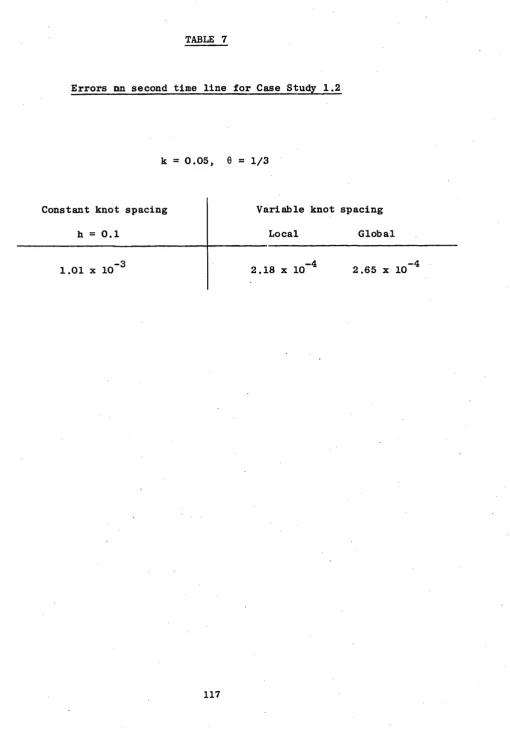
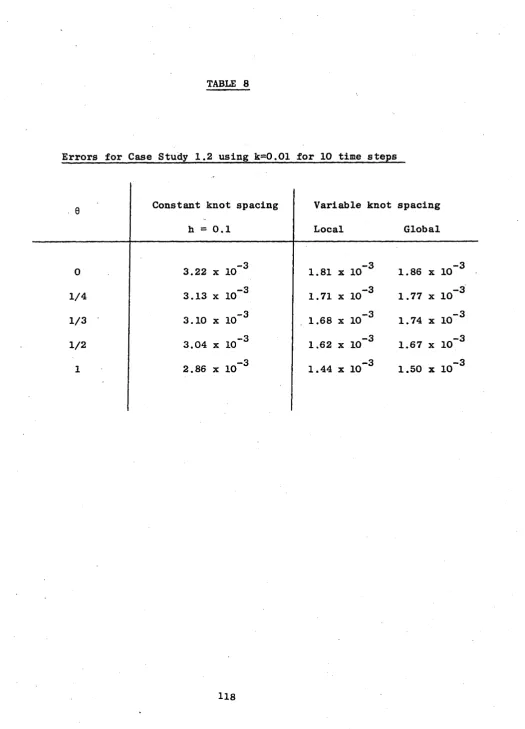
of 0 , k. h. and h. , are used which either satisfy or
' i i+ 1
violate the condition.
Parabolic Partial Differential Equations with Constant Coefficients
Here we consider spline solutions to the parabolic equation
(3.3.1). As in the previous section the knot partition (3.1.4)
is chosen to be unequally spaced where h^,, the distance
between successive knots, is given by (2 .2 .2).
Using the technique explained in section 3.3, we take
combinations of the relationships (4.2.2) and (4.2.7) and use
(3.3.4) to eliminate the M and L terms where possible. i > J i »J
The two time level scheme thus obtained is as follows
/<f> _ v Q)u + 2(1 + y 0)u + (8 — iIj 0)u , . ,
VHi i ' i-l,j+l v i ' i,j+l v i * i 9 i+l,j+l
+ |k(hi+i - h ^ O H i ^ + a - ^ i >;j)
(1=1,2.... . (N—1) (4.3.1)
where ^i and are as defined in section 4.2 and
X± = 6 avi - ck,
r"
hi(hik+ hi+i> ’
hi+i < V hi+i) ’ Vl a i V i
As described in section 4.2, when the coefficient b in (3.3.1)
is non-zero the scheme (4.3.1) requires the calculation of
M. . _ and M. . before solutions can be produced. A numerical i,j+l . . i,j
procedure similar to that of the previous section is employed,
although in this case the process is considerably simplified
since (4.3.1) is only a two time level scheme. The numerical
(i) Using the expression (4.2.2) determine ^(1=1,2,...., (.
(ii) Set 9 = 0 in (4.3.1) and hence evaluate the solutions
u (i=l,2,....,(N-l)).
(iii) Using (4.2.2) determine M (i=l,2,...,(N-l)).1,1
(iv) Evaluate u (i=l,2,...,(N-l)) from the scheme J- > 2
(4.3.1).
The procedure is now fully developed and further solutions
are obtained using (4.2.2) and (4.3.1) alternately.
In a similar manner to previous sections, we again derive the
truncation error associated with the scheme (4.3.1) using
Taylor series expansions. It can thus be shown that (4.3.1)
becomes
[-Yi+2 xi-*iJ u + £k(3-Yie+2Xj8-i|’i0>
]Jf
2~(3-Yie+2xie-fie) 3u
at5
~(3-Yi0+2xi0 ^ i0) 33uJ at
h
i i
y— h
i+1 i
ib
+ T k
| ^ ( 3 - Y i e + 2 x i e - ^ i e) a u
43t
+ [-k(h. - hi+1>+ k(hiYie - h1 + 1
*•>]*
i0)]
J axat^—au ax
+L-
' * W + |-(V i 6 - V l V ' L
-JdXdt2 2
‘^i Yi-hi+l ^
2 2
ax 2
afaThis expression again contains time and mixed
derivative terms. As in section 3.3, these can be replaced
using (3.3.1), although the resulting expression is
extremely complicated due to the variable step lengths. cose
In the simple^of the heat conduction equation ((3.3.1) with
a=l, b=c=0 ) the truncation error to fourth order derivative
terms has the form
k + 1_ [ i i+1 - k\ 0
1 2 1 hi + hi+l
3ju + ___ (4.3.3)
ax4
In addition, the scheme (4.3.1) has the following conditions
governing its stability
(a) if 0 £ ■— , it is unconditionally stable A
(b) if 0 < -j- , it is stable provided that A
CHAPTER 5
Methods for Obtaining Knot Partitions
5.1 Preamble
In this chapter three techniques are presented for
obtaining 'optimal* knot partitions. These techniques
will be called the 'local', 'global' and 'transformation' methods
for reasons which will become apparent. The knot partitions
obtained are chosen to best suit (in some sense) the initial
condition of the partial differential equation, but which
are then fixed throughout time.
As explained in the work of de Boor (1978), we cannot hope
to place each knot optimally. This is because in approximating
a function f(x) by a spline function S(x) we must have
sufficient information about f(x) to evaluate ||f—S||^
before each knot can be optimally located. In the solution
of differential equations f(x) is only known implicitly
and hence in this thesis we endeavour to obtain an optimum
knot distribution which we believe to be a general improvement
on existing equally spaced knot methods. More exactly one could
consider the knots as sub-optimal. Here-after the word optimal
will have this meaning.
5.2 A Local Method
The technique described in this section for obtaining
optimal knot positions is an adaptation of the well-known
work of Curtis and Powell (1967). In that work, the authors
developed an algorithm for use in approximating simple
functions using cubic splines. They stated than an estimate
of the error e (x)=f (x)-S(x) at each knot xi is given by
ei = I lf " S l L “ -L- <xi “ xi-l) 3 di (5.2.1)
1 384 1 1 1 1
where d^, the discontinuity in the third derivative of the
spline function, is defined as
m t i t
di = S (x +) - S (x -). (5.2.2)
A full derivation of (5.2.1) is given in Schultz (1973).
We now require an expression for this discontinuity in
terms of function values f(x).
Rewriting (3.1.7) we have
s"(xi-i) + 4s"(xi)+ s”(xi+i>= — rf(xi-i)_2f(xi)+f(xi+i)i <5-2-3>
h2 l j
which in operator notation can be written as
(E-1+ 4 + E)h2S”(x )= 6 (E-1-2 + E)f(x±) (5.2.4)
and after rearrangement
h2S”( V =
S g ~ l
*<*i> • (5.2.5)Using a simple forward difference approximation, in
S (xi+) can be expressed as
in u H
S (xi+) = S (*i+1) - S (xi)
-and thus by substituting for the second derivatives
using (5.2.5), we have the expression
h V " (x.+) = SCE^^+E) f (x _) - 6 (E"1~2+E)f(xt) .
-1 -1
E + 4 + E E + 4 + E
Employing the shift operator again, (5.2.7) becomes
h V * (x +) '= 6 (1-2E+E2) f(x.) - 6 (E~1-2+E) f(x ) .
-1 1 -1
E + 4 + E E + 4 + E
and thus after suitable rearrangement the following
hi
expression for S (x^) is derived
3 m 2 —1
h S (x±+) = 6(3-3E+E -E ) f (x±) . E'"14 4 + E
Similarly, using the approximation
i n it it
S (x±-) = S (x±) - S (xi ;L)
h ”
t i l
an expression for S (x^) becomes
-3 m —1 —2
hS. (x —) = 6(3E - 3 + E - E ) f(x ) .
- 1 i
E + 4 + E
Subtracting the relationships (5.2.11) from (5.2.9)
results in the expression
m ' m o —1 — 2
S (Xj+) - S (x -) = 6 ( 6 - 4E + E - 4E + E ) f(x ) (5.2.12) - 1
E + 4 + E
and thus
s'" (3^+) - s'" (x±-) £ 6hfiv(x ). (5.2.13)
E + 4 + E
By expanding the denominator terms in (5.2.13) we obtain
approximately
in in
S (.K± + ) - S (x±-)
4
and hence, by ignoring 0(h) terms, (5.2.14) results in the
required expression for d^
d± = s’" (xj,+) - s’" (x±-) = hfiV(x±) + 0(h3). (5.2.15)
Employing Taylor's theorem to remove the higher order
terms in (5.2.15), the error estimate (5.2.1) thus becomes
e. = _ 1 _ h4f1V (S) (5.2.16)
1 384
where £ is some value lying between x^, ^ and x^.
In the Curtis and Powell algorithm a cubic spline is
fitted to the function f(x) using a small number of
equally spaced knots and if exceeds some pre-assigned
error bound, extra knots are inserted half-way between
■*[
1 + h D + 2 2 h4 4 D6 72
- 1
] ■ _i v
existing knots. The process is repeated until the
error estimates |e^| are all less than the error bound.
To obtain unequal knot positions for use in the spline
solution of partial differential equations we rewrite
the error estimate (5.2.16) in the form
= lsi - \ \ =
384 h- |u (O (5.2.17)
where and u^ are, respectively, the spline and exact
solutions at the knot x^. Rearrangement of (5.2.17) yields
the expression
hi =
1/4 384 e ±
(5.2.18)
Substitution of (5.2.18) into (2.2.2) gives the approximation
Xi- 1 +
384 1/4 (i=l,2,...,N) (5.2.19)
which may be used as a basis for generating suitable knot iv
partitions, in which the function u (£) is evaluated as the
fourth derivative of the initial condition at the knot x.l-l As will be later shown, equation (5.2.19) is implemented
with e = e = e = .... = e , the aim being to choose a 1 A N
suitable e value which gives a desired number of knots
over [o,l] . This is only to enable us to compare the various
methods and in practice a bound would initially be
fixed on e^. The number and position of knots would
then be determined by this bound.
5.3 A Global Method
Here the technique described for obtaining knot partitions
for use in the spline solution of partial differential
equations is largely based on the work of de Boor (1973 and
1974). Using results obtained by Rice (1969), Phillips .(1970),
McClure (1970), Dobson (1972), de Boor and Swartz (1973) and
Burchard (1974), de Boor considered the approximation of a
given function f on [a,b] by , a spline of order k
(degree k-1) with a knot partition A, where
A: a = t < t < ___ < t„ < t 1 & N N+l= b. (5.3.1
For convenience only, (5.3.1) is here used rather than
(2 .1 .1); note that the notations are made compatible at the
end of this section.
To obtain suitable knot distributions, de Boor suggests
that the following condition should be satisfied
(5.3.2)
where
sup | h(t) | (5.3.3)
maxAt = max(t. , - t ) . i . i
+ 1 i