• No results found

Considerations concerning the analysis of the wage costs efficiency

N/A
N/A
Protected

Academic year: 2020

Share "Considerations concerning the analysis of the wage costs efficiency"

Copied!
11
0
0

Loading.... (view fulltext now)

Full text

(1)

Munich Personal RePEc Archive

Considerations concerning the analysis of

the wage costs efficiency

Bondoc, Maria-Daniela and Radu, Florea

University of Pitesti, Romania

April 2008

(2)

CONSIDERATIONS CONCERNING THE ANALYSIS OF

THE WAGE COSTS EFFICIENCY

Maria-Daniela BONDOC*, Ph.D. Lecturer

*University of Piteşti

Florea RADU*, Ph.D. Professor

*University of Piteşti

Key words:staff costs, efficiency, labour efficiency, average wage

Abstract:In this article, the authors sought to study the efficiency of the staff costs and its reflection upon the main economic and financial indicators of a company. In the performed study, the application of the factor analysis models was made at the level of an industrial trading company the social object of which is manufacturing automotive subassemblies. The efficiency of the wage costs was monitored by the correlation between the average wage and the labour efficiency as well as by means of the indicators used for the general expression of their efficiency, such as: staff costs at an operating income, turnover or added value of 1,000 Lei. Moreover, highlighting the economic and financial consequences of their modification on the main key performance indicators of the company was considered. The conclusions that were drawn are useful for the management company for the substantiation of the decisions related to the improvement of the usage of the human resources, with direct positive consequences upon the reduction of the wage costs to 1,000 Lei and of the wage costs per product unit, as well as upon the profit increase.

A. General Aspects Concerning the Efficiency of the Wage Costs

The staff costs represent a significant percentage in the total costs of any entity. In the vast majority of cases, the staff costs sum up to more than half of the operating expenses and for this reason, the correct substantiation of the wage costs and the monitoring of their efficiency constitutes an important concern of the management of any trading company.

The dynamics of the staff costs (Chp) must be compared to the dynamics of the volume of the activity performed by the company (expressed either by the turnover -CA, or by the operating incomes - Ve, or by the added value - VA). A normal activity is characterized by a dynamicity of the activity volume that exceeds or is at least equal to the one registered by the staff costs: ICA

IChp, ICA

IVe, ICA

IVA.

The aforementioned correlation allows for the assessment of the admissible level of the staff costs:

100

0ICA

Chp a

Chp

 or Chp1000IVe

a

Chp

 or Chp1000IVA

a

Chp

 (1)

The amount of the admissible staff costs (Chpa) can be compared to the amount of

the staff costs that were actually registered (Chp1), and the evolution of the efficiency of

the staff costs can be characterized as follows: [David Sobolevschi, 2004]:

- If Chp1 < Chpa, an increase in the efficiency of the staff costs takes place, as

compared to the previous exercise;

- If Chp1= Chpa, the same level of the efficiency of the staff costs is maintained;

- If Chp1 > Chpa, a decrease in the efficiency of the staff costs takes place, as compared

(3)

Similarly to the staff costs, the evolution of the wage costs represented by the wages fund (Fs) is assessed, as correlated with the one of the volume of activity. The result of the comparison between the actual wages fund and the one that is recalculated on the basis of the activity volume index (the admissible wages fund) is called relative modification of the wages fund (Fs’) and can by materialized in economy or relative overrun: ∆Fs’= Fs1 – Fsa.

I have analysed this correlation at the level of an industrial company having as an object the manufacturing of automotive subassemblies, hypothetically called S.C. „X”, by taking into account the operating incomes (Ve) as an indicator expressing the volume of activity.

By estimating first the operating income index, the admissible wages fund in 2006, respectively in 2007 was:

% 44 . 104 100 100 2482494925927850

2005 2006 2005 /

2006 Ve     Ve

Ve

I

% 57 . 163 100 100 2592785042409812

2006 2007 2006 /

2007 Ve     Ve

Ve

I

83

.

4418701

100 44 . 104 4230852 100

2006

2004 / 2006

2005

FsIVe

Fsa

Lei

86

.

7533752

100 57 . 163 4605828 100

2007

2006 / 2007

2006

FsIVe

Fsa

Lei

The relative modification of the wages fund (Fs’), calculated for the years 2006 and 2007 had the following values:

17 . 187126 83

. 4418701 4605828

2006

'

Fs Lei

86 . 2183384 86

. 7533752 5350368

2007

'

Fs Lei

[image:3.516.75.460.445.570.2]

The results prove that in 2006 the company registered a relative wages fund overrun (correlated with the dynamics of the operating income). On the other hand, in 2007, the situation was positive from the economic point of view, with a relative saving of over two million Lei, which will be reflected in a positive manner into the wage cost efficiency indicators, respectively on the reduction of the wages fund to operating incomes of 1000 Lei, as well as on the company profit.

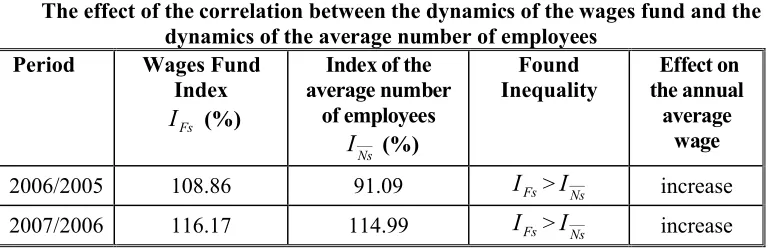
Table 1 The effect of the correlation between the dynamics of the wages fund and the

dynamics of the average number of employees

Period Wages Fund

Index

Fs

I

(%)

Index of the average number

of employees

Ns

I (%)

Found Inequality

Effect on the annual

average wage

2006/2005 108.86 91.09

I

Fs>INs increase

2007/2006 116.17 114.99

I

Fs>INs increase

Moreover, estimations concerning the evolution of the annual average wage can be made by comparing the dynamics of the wage costs (the wages fund - Fs) with the one of the average number of employees as follows: :

- If IFs> INs, an increase in the annual average wage is registered;

- If IFs = INs, the annual average wage remains unchanged;

(4)

The situation of this comparison between the dynamics of the wages fund and the dynamics of the average number of employers at the company that is being studied is presented in Table 1.

From the data in the table we can notice that the annual average wage increased in 2006 as compared to the one in 2005 by 19.51%, respectively with 1,531.06 Lei, while in 2007 as compared with 2006, it increased by 14.99%, respectively with 1,406.52 Lei.

B. The correlation between the dynamics of labour efficiency and that of the average wage and its effects

In the conditions of the market economy, the evolution of the average wage must be monitored by its comparison with the evolution of labour efficiency, since, as we know, other production factors also contribute to the increase in labour efficiency, besides the work factor represented by the company personnel. In this way, a faster increase in the labour efficiency as compared to the increase in the average wage constitutes a critical condition of the provision of the efficiency of the performed activity.

In the analysis of the general situation of this correlation, the correlation index (Ic) is used as a ratio between:

- The dynamics of the average wage and of the labour efficiency:

W S

I I

Ic

, in this case, the correlation is observed when the correlation index is mathematically proper (Ic <1);

- The dynamics of the labour efficiency and of the average wage:

S W I I

Ic  , the correlation is observed when the correlation index is mathematically improper (Ic >1),

Where: IS– the average wage index; IW– the average labour efficiency index.

The correlation index can also be estimated as a ratio between the relative increases in the two indices:  11

W S

I I

Ic or  11

S W

I I

Ic .

The usage of any of the above-mentioned relations should reflect the same tendency in the comparative evolution of average wage index and of the labour efficiency: IS<IW.

By calculating the correlation index as a ratio between the annual average wage index and the one of the annual labour efficiency (

W S

I I

Ic

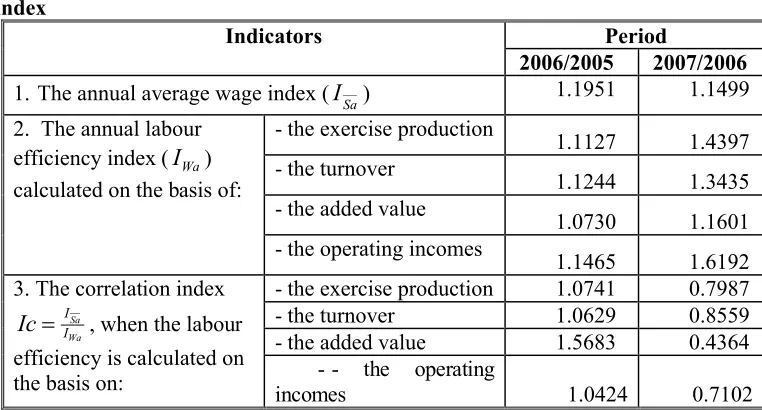
), at the studied trading company, the values presented in Table 2 were obtained, which allow for a positive appreciation only in 2007 as compared to 2006 because in 2006 as compared to 2005 this correlation was not observed since, irrespective of the indicator used for the estimation of the labour efficiency, the correlation index was improper.

When this correlation is observed, the labour efficiency grows with a higher rate than the one of the average wage, which confirms the efficiency of the wage costs and their direction towards the reduction to 1,000 Lei of the operating income, turnover, added value or exercise production.

(5)
[image:5.516.74.455.101.306.2]

Table 2 The correlation between the average wage index and the labour productivity index

Indicators Period

2006/2005 2007/2006 1. The annual average wage index (

Sa

I ) 1.1951 1.1499

2. The annual labour efficiency index (

I

Wa) calculated on the basis of:

- the exercise production

1.1127 1.4397 - the turnover

1.1244 1.3435 - the added value

1.0730 1.1601 - the operating incomes

1.1465 1.6192 3. The correlation index

Wa Sa

I I

Ic , when the labour efficiency is calculated on the basis on:

- the exercise production 1.0741 0.7987 - the turnover 1.0629 0.8559 - the added value 1.5683 0.4364

- - the operating

incomes 1.0424 0.7102

The economic consequences of the observance of the correlation analysed in the period 2007/2006 manifest themselves on the level of providing a balance between production, costs and wages, with positive effects on other economic and financial indicators of the studied company.

We used the correlation index in the version of calculating the labour efficiency on the basis of the turnover (Ic2007/2006=0.8559).

The influence of the annual labour efficiency modification (Wa) and that of annual average wage (

Sa

)

on the wage costs for a turnover of 1,000 Lei (Cs/1000) is found by starting from the model:

1000

1000

/

Wa

Sa

Cs

(2)

The amount of the wage costs for a turnover of 1,000 Lei in the years 2006 and 2007 is as follows:

53

.

209

1000

83

.

44768

51

.

9380

1000

1000

/

2006 2006

2006

Wa

Sa

Cs

Lei

35

.

179

1000

75

.

60145

03

.

10787

1000

1000

/

2007 2007

2007

Wa

Sa

Cs

Lei

The modification of the wage costs for a turnover of 1,000 Lei in 2007 as compared to 2006 was:

∆Cs/1000 = 179.35-209.53 = -30.18 Lei

The result is a reduction in the wage costs for a turnover of 1,000 Lei with 30.18 Lei in 2007 as compared to 2006 because the dynamics of the labour efficiency (

I

Wa= 1.3435) outran the dynamics of average wage (

Sa

(6)

The influences of the two factors on the modification of the wage costs for a turnover of 1,000 Lei were calculated by using the method of the chain substitutions or that of successive iterations as follows:

1. The influence of the annual labour efficiency:

Lei Cs I Cs Wa Sa Wa Sa Wa Wa Cs 57 . 53 53 . 209 96 . 155 53 . 209 3435 . 1 53 . 209 1000 / 1000 / 1000

1000 2006 2006

2006 2006 2007 2006 1000 / 2006 / 2007              

This influence can be broken down function of the modification of the average time worked by a person over one year (

t

) expressed in man-hours and of the

modification of the hourly labour efficiency (

Wh

), as follows:

Lei Wh t Sa Wh t Sa t Cs 75 . 24 53 . 209 78 . 184 1000 1000 1000 1000 . 1 . 1 61 . 27 50 . 1621 51 . 9380 61 . 27 72 . 1838 51 . 9380 2006 2006 2006 2006 2007 2006 1000 /                  Lei Wh t Sa Wh t Sa Wh Cs 82 . 28 78 . 184 96 . 155 1000 1000 1000 1000 . 2 . 1 61 . 27 72 . 1838 51 , 9380 71 . 32 72 . 1838 51 , 9380 2006 2007 2006 2007 2007 2006 1000 /                 

2. The influence of annual average wage:

Lei

I

Cs

Cs

Wa

Sa

Wa

Sa

Wa Sa Cs

39

.

23

96

.

155

35

.

179

1000

/

1000

/

1000

1000

2006 / 2007 2006 2007 2007 2006 2007 2007 1000 /

We find that the modification of the annual labour efficiency led to a reduction of the wage costs for a turnover of 1,000 Lei with 53.57 Lei, while the modification of the annual average wage led to their increase with 23.37 Lei.

The fact that the annual labour efficiency index outran the average wage index (

Sa Wa I

I  ) means that through the more rapid increase of the labour efficiency the negative influence produced by the increase in the annual average wage was compensated, and eventually, a reduction of the wage costs with 30.18 Lei for a turnover of 1,000 Lei was registered.

In what the influence of the average time per employee is concerned, it was positive from the economic point of view, leading to the reduction of the wage costs at 1,000 Lei with 24.75 Lei, while the increase in the hourly labour efficiency caused their reduction with 28.82 Lei.

In the analysis process, it is necessary for us to study the effect of the modification of the wage costs for a turnover of 1,000 Lei on the gross profit (Pb) afferent to the turnover, calculated as follows:

lei Cs Cs CA cs Pb 57 . 900338 1000 29832292 ) 53 . 209 35 . 179 ( ) 1000 / 1000 /

( 2007 2006 1000

1000 / 2007          

(7)

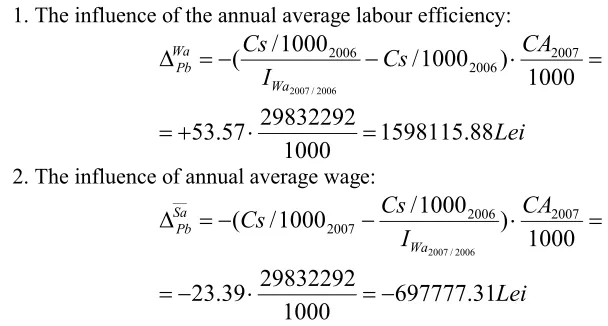
1. The influence of the annual average labour efficiency:

Lei CA Cs

I Cs

Wa Wa

Pb

88 . 1598115 1000

29832292 57

. 53

1000 ) 1000 / 1000

/

( 2007

2006 2006

2006 / 2007

 

 

 

 

 

2. The influence of annual average wage:

Lei CA I

Cs Cs

Wa Sa

Pb

31 . 697777 1000

29832292 39

. 23

1000 ) 1000 / 1000

/

( 2006 2007

2007

2006 / 2007

  

 

 

 

 

We can see that the observance of the correlation between the dynamics of the labour efficiency and that of average wage, by increasing the labour efficiency at a superior rate as compared to that of the average wage in 2007 as compared to 2006, led to the increase in the gross profit of the company with 900,338.57 Lei, and the increase in the labour efficiency compensated the negative effects of the increase in the average wage, leading to the reduction of the wage costs for a turnover of 1,000 Lei and at the increase in the profit afferent to the turnover.

C. The component/factor analysis of the wage expenses for operating expenses, turnover or added value of 1,000 Lei

For the component/factor analysis of the efficiency of the of the wage costs at operating income, turnover, or added value of 1,000 Lei both the correlation models as well as the multiplicative models can be used.

A first type of correlation model is constituted by the level of the wages fund (Fs) afferent to operating incomes (Ve), turnover (CA) or added value (VA) of 1,000 Lei, calculated as follows:

1000

1000

/

Ve,CAFs,VA

Cs

(3)

[image:7.516.85.389.59.222.2]

The values of these indicators in the period 2005-2007 at the studied company are calculated in Table 3.

Table 3 The wage costs at a Ve, CA and VA of 1,000 Lei

(Lei)

Indicators 2005 2006 2007

1. Wages fund – Fs 4230852 4605828 5350368

2. Operating income – Ve 24824949 25927850 42409812

3. Turnover – CA 21460610 21981496 29852292

4. Added value – VA 7578850 7407762 8681420

5. Cs/1000Ve 170.43 177.64 126.16

6. Cs/1000CA 197.15 209.53 179.35

(8)
[image:8.516.73.459.426.673.2]

The dynamics of the wage costs for an operating income, turnover and added value of 1,000 Lei in the period 2005-2007 is presented in Table 4.

Table 4 The dynamics of the wage costs at a Ve, CA and VA of 1,000 Lei

(Lei)

Indicators 2006/2005 2007/2006

(Lei)

Index (%)

(Lei)

Index (%) 1. Cs/1000Ve 7.21 104.23 -51.48 71.02

2. Cs/1000CA 12.38 106.28 -30.18 85.60

3. Cs/1000VA 63.52 111.38 -5.46 99.12

We can see that in 2006 the level of the three indicators expressing the efficiency of the wage costs increased, while in 2007 a reduction of the wage costs at an operating income, turnover or added value of 1,000 Lei with 51.48 Lei, with 30.18 Lei, and respectively with 5.46 Lei was achieved. This reduction reflects an increase in the efficiency of the staff costs, as a result of a more accentuated increase in the operating income, in the turnover or in the added value as compared to the increase in the wages fund (Fs) or to the staff costs, which shows that in 2007 as compared to 2006 the correlation: IVe, VA, CA > IFswas observed.

In the case of the expression of the efficiency of the staff costs through the wage costs at an operating income of 1,000 Lei (Cs/1000Ve), the correlation model is:

1000

1000

/

VeFs

Ve

Cs

(4)

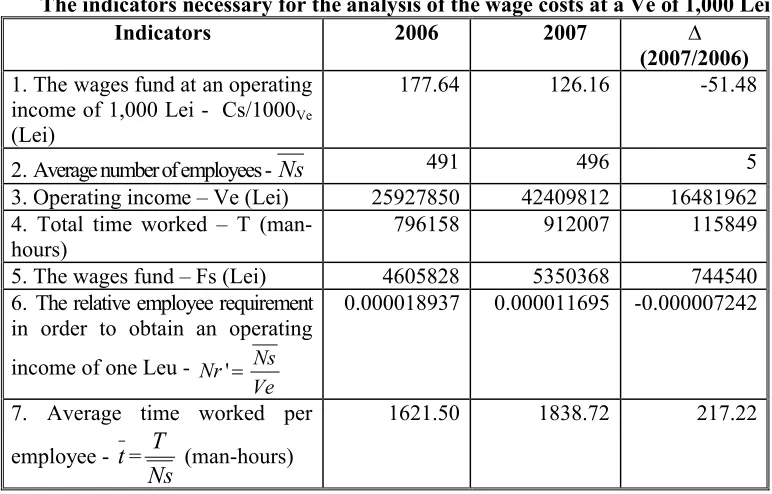
The data necessary for the application of this model are presented in Table 5. Table 5 The indicators necessary for the analysis of the wage costs at a Ve of 1,000 Lei

Indicators 2006 2007

(2007/2006) 1. The wages fund at an operating

income of 1,000 Lei - Cs/1000Ve

(Lei)

177.64 126.16 -51.48

2. Average number of employees -

Ns

491 496 5 3. Operating income – Ve (Lei) 25927850 42409812 16481962 4. Total time worked – T

(man-hours)

796158 912007 115849

5. The wages fund – Fs (Lei) 4605828 5350368 744540 6. The relative employee requirement

in order to obtain an operating

income of one Leu

-Ve Ns Nr'

0.000018937 0.000011695 -0.000007242

7. Average time worked per

employee -

t

=

Ns T

(man-hours)

(9)

According to the presented model, a reduction the wage costs at an operating income of 1000 Lei was registered in 2007 as compared to 2006 with 51.48 Lei, which is explained as follows:

1. The influence of the operating income:

Lei Ve Fs Ve Fs Ve Cs Ve

04 . 69 64 . 177 60 . 108 64 . 177 1000 42409812 4605828 1000 1000 2006 2006 2007 2006 1000 /             

2. The influence of the wages fund:

Lei Ve Fs Ve Fs Fs Ve

Cs 1000 1000 126.16 108.60 17.56

2007 2006 2007 2007 1000 /        

These results prove that the efficiency of the wage costs increased in 2007 as compared to 2006, due to a more accentuated increase in the operating income as compared to the increase in the wages fund, which lead to the reduction with 51.48 Lei of the wage costs at operating incomes of 1,000 Lei.

The multiplicative-type model that we applied at the component/factor analysis of the wage costs at an operating income of 1,000 Lei is as follows:

1000

1000

1000

1000

/

T

Fs

Ns

T

Ve

Ns

Ns

Fs

Ve

Ns

Ve

Fs

Cs

Ve

(5)

where:

Ve

Ns

represents the relative employee requirement (Nr') necessary in order to

obtain operating incomes of one leu, i.e. a reversed form of expressing the labour efficiency;

Ns Fs

- annual average gross wage per employee (

Sa

);

Ns T

- annual average work time per employee, expressed in man-hours (

t

);

T Fs

- hourly average wage (

Sh

).

In this case, the modification of the wages fund for an operating income of 1,000 Lei is explained by:

1. The influence of the relative employee requirement:

Lei Ns Fs Ve Ns Ve Ns Nr Ve Cs 92 . 67 1000 51 . 9380 000007242 . 0 1000 ) ( 2006 2006 2006 2006 2007 2007 ' 1000 /            

2. The influence of the annual average gross wage per person:

(10)

2.1. The influence of the work time per employee: Lei T Fs Ns T Ns T Ve Ns t Ve Cs 72 . 14 1000 79 . 5 22 . 217 000011695 . 0 1000 ) ( 2006 2006 2006 2006 2007 2007 2007 2007 1000 /            

2.2. The influence of average hourly wage:

Lei T Fs T Fs Ns T Ve Ns Sh Ve Cs 72 . 1 1000 08 . 0 72 . 1838 000011695 . 0 1000 ) ( 2006 2006 2007 2007 2007 2007 2007 2007 1000 /            

The only factor with a positive influence from the economic point of view was the relative staff requirement, which confirms the positive effect of the increase in the labour efficiency that compensated the negative economic effects of the other factors.

The modification of the wage costs at a Ve, CA or VA of 1,000 Lei is directly reflected on the main economic and financial indicators of the company. [Radu Florea, 2006].

In the case of the studied trading company, the modification of the wage costs at a turnover of 1,000 Lei had effectson the following indicators:

1. On the gross profit afferent to the turnover (Pb):

Lei

Cs

Cs

CA Cs Pb

57

.

900338

1000

29832292

)

53

.

209

35

.

179

(

)

1000

/

1000

/

(

2007 2006 1000

1000 / 2007

2. On the efficiency of the usage of the fixed assets (EAf):

lei

Af

Af

CA

Cs

Cs

cs E Cs E Pb Af

6

.

103

1000

8688053

57

.

900338

1000

1000

1000

)

1000

/

1000

/

(

2007 1000 / 2007 2007 2006 2007 1000 /

3. On the efficiency of the usage of the circulating assets (EAc):

Lei

Ac

Ac

CA

Cs

Cs

cs Pb Cs EAc

4

.

88

1000

10188553

57

.

900338

1000

1000

1000

)

1000

/

1000

/

(

2007 1000 / 2007 2007 2006 2007 1000 /

4. On the gross profit per employee (Ps):

20 . 1815 496 57 . 900338 2007 10000 / 1000 /    

Cs NsCsPb

Ps Lei

5. On the rate of return on equity (RKpr):

%

46

.

6

100

13936340

57

,

900338

100

2007 1000 / 1000 /

(11)

6. On the rate of the return on permanent funds (RKper):

%

16

.

5

100

17449077

57

.

900338

100

2007 1000 / 1000

/

Cs

Kper

CsPb RKper

The conclusion is that the reduction of the wage costs at turnover of 1,000 Lei with 30.18 Lei in 2007 as compared to 2006 was positively reflected on these indicators because it lead to the increase in the profit, in the efficiency of the usage of the fixed and circulating assets, of the average profit per employee, as well as of the rates of return of equity and permanent funds.

Conclusion

The labour efficiency, as a synthetic indicator of estimation of the efficiency of usage of human resources, can actually be calculated in any activity field, which makes the object of specific analyses, on the basis of which the decisions of the management concerning the appropriate remuneration of the performed work must be substantiated. The estimation of the staff costs efficiency can be made by means of the correlation between the average wage index and the average labour efficiency index, as well as by means of the indicators used to generally express their efficiency, such as: the staff costs at an operating income, turnover or added value of 1,000 Lei.

As it can be noticed from the analysis of these indicators at the level of a company, the study of the correlations between the dynamics of these indicators, as well as of their reflection on the economic and financial performance of each trading company have special importance.

BIBLIOGRAPHIC REFERENCES

1. David Sobolevschi Iulia (2006) - “Analiza dinamică şi structurală a cheltuielilor cu personalul” (“Dynamic and Structural Analysis of the Staff Costs”) –

Economic Tribune,No.6, Bucharest;

2. Radu Florea, Cîrciumaru Daniel, Bondoc Daniela (2006) – “Analiza economico-financiară a societăţilor comerciale”(“Economic and Financial Analysis of Trading Companies”), Scrisul Românesc Publishing House, Craiova;

3. Samier Nathalie (1999) - De la productivité du capital humain à la performance des ressources humaines : vers une pertinence des modèles d'évaluation, (From the Human Capital Efficiency the Human Resources Performance: towards a Relevance of Evaluation Models,)Presses de l’Université d'Angers, Angers;

4. Troie Liviu, Zaharia Octavian, Roman Monica, Hurduzeu Miruna (2001) –

Analiza statistică a activităţii economice şi a gestiunii financiare a întreprinderii

Figure

Table 1The effect of the correlation between the dynamics of the wages fund and the
Table 2The correlation between the average wage index and the labour productivity
Table 3The wage costs at a Ve, CA and VA of 1,000 Lei
Table 4 The dynamics of the wage costs at a Ve, CA and VA of 1,000 Lei

References

Related documents

issued by the Comptroller General of the United States, the financial statements of the business-type activities and the discretely presented component unit (Francis Marion

Background and Objectives: Serratia marcescens , a potentially pathogenic bacterium, benefits from its swarming motility and resistance to antibiotic as two important

class I integrons and antibiotic resistance profile of Salmonella enterica serovars isolated from clinical specimens.. MATeRIAlS AND

During this portion of the study, we examine the effect that lowering the threshold number of flow contributing cells required to distinguish between channel and overland flows has

The uniaxial compressive strengths and tensile strengths of individual shale samples after four hours exposure to water, 2.85x10 -3 M cationic surfactant

ephemera joins the discussion on critical organization studies in a field of engagement already drawn out by AOM, APROS, BAM, CMS, EGOS, SCOS, Organization, Organization Studies,

National Conference on Technical Vocational Education, Training and Skills Development: A Roadmap for Empowerment (Dec. 2008): Ministry of Human Resource Development, Department