http://dx.doi.org/10.4236/ajcm.2016.61004
An Integer Coding Based Optimization
Model for Queen Problems
Nengfa Hu
Department of Computer Science and Engineering, Hanshan Normal University, Chaozhou, China
Received 4 March 2016; accepted 27 March 2016; published 30 March 2016
Copyright © 2016 by author and Scientific Research Publishing Inc.
This work is licensed under the Creative Commons Attribution International License (CC BY).
http://creativecommons.org/licenses/by/4.0/
Abstract
Queen problems are unstructured problems, whose solution scheme can be applied in the actual job scheduling. As for the n-queen problem, backtracking algorithm is considered as an effective approach when the value of n is small. However, in case the value of n is large, the phenomenon of combination explosion is expected to occur. In order to solve the aforementioned problem, queen problems are firstly converted into the problem of function optimization with constraints, and then the corresponding mathematical model is established. Afterwards, the n-queen problem is solved by constructing the genetic operators and adaption functions using the integer coding based on the population search technology of the evolutionary computation. The experimental results demonstrate that the proposed algorithm is endowed with rapid calculation speed and high efficiency, and the model presents simple structure and is readily implemented.
Keywords
Queen Problem, Function Optimization, Mathematical Model, Evolutionary Computation, Integer Coding
1. Introduction
As to the definition of the n-queen problem: n queens are placed on the international checkerboard with the dimension of the grid being n × n, and the precondition is that no queen suffers from the attack from another queen. That is to say, among the n queens, any two of them are not on the same row, column, or oblique line. There are many algorithms to solve this problem, such as the exhaustive method, backtracking algorithm, learn-ing algorithm of the neural network, and so on. However, when the value of n is great, these algorithms take a long time for computation and therefore become infeasible.
Evolutionary computation is a global optimization based random search algorithm that simulates the natural selection and natural genetic mechanism of the biological evolution. Evolutionary computation has been applied in various fields including neural network, function optimization, image processing, system identification, ex-pert system and so on due to its high efficiency and practicality through years of study. As for the application in solving the n-queen problems, evolutionary computation is an efficient nondeterministic algorithm [6]-[10].
2. Modeling and Evolutionary Algorithm for n-Queen Problems
The general steps for solving a problem using the evolutionary computation are demonstrated as follows: 1) Analyzing the problem to determine a coding scheme;
2) Determining the objective function of the problem, to design a fitness function;
3) Generating an initial population that contains several individuals, each of which is a feasible solution of the problem;
4) Calculating the fitness values of each individual in the population; 5) If the optimal solution of the problem is found, quitting the cycle;
6) Performing the genetic operations including selection, hybridization and variation according to the fitness values of each individual;
7) Returning to step (4).
It is regulated in the n-queen problems that all queens are not in the same row, column, and oblique line. As-sume that a layout of the n-queen problems is P=
{
a[ ] [ ]
0 ,a1 ,,a n[
−1]
}
, where, a i[ ]
∈{
0,1,,n−1}
repre- sents that a queen is placed on the ith row and a i[ ]
th column. Then, the n-adic queen problems are supposed to satisfy the following constraints:1) Any two queens are not in the same column, that is a i
[ ] [ ]
≠a j , (when i≠ j).2) Any two queens are not located in the same oblique line, namely, a i
[ ] [ ]
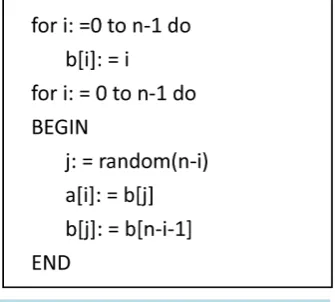
−a j ≠ −i j, (when i≠ j). A random function can be utilized to process the constraint 1, and the specific processing procedure is dem-onstrated as follows (Figure 1):Constraint 2 can be converted into the objective function f: Suppose that a
[ ] [ ]
0 ,a1 ,,a n[
−1]
is an individual.Let
2 1
0 1
n n
ij
i j i
f f
− −
= = +
=
∑ ∑
, where 1 when[ ] [ ]
0 otherwise
ij
a i a j i j
f = − ≠ −
[image:2.595.230.398.559.710.2]According to the definition of f, when f =
(
n− +1) (
n−2)
++ =1 n n(
−1 2)
, we obtaina i[ ] [ ]
−a j ≠ −i j . Thereby, it is obtained that the individuals under such circumstance satisfy the requirements of the constraint 2.Obviously, the greater the function value is, the smaller the possibility of the mutual attacks between queens. When the function value f reaches the maximum n n
(
−1 2)
, the individual corresponding to the maximum value is the solution of the problem. Therefore, the function value f can be defined as the fitness function of the individuals.3. Algorithm
1) The aforementioned program segments are utilized to generate the initial population
[ ] [ ]
[
]
(
)
(
[ ] [ ]
[
]
)
(
[
] [
]
[
]
)
{
p 0, 0 , 0,1 ,p , 0,p n−1 , p1, 0 , 1,1 ,p , 1,p n−1 ,, p NN−1, 0 , p NN−1,1 , , … p NN−1,n−1}
, where,NN and n represent the population size and the number of the queens respectively. The first and second sub-scripts in array p indicate the serial numbers of the individuals and genes separately, and are called the individu-al and gene respectively for the sake of convenience;
2) The fitness values f i
[ ]
,(
i=0,1,,NN−1)
of all the individuals in the initial population are calculated, and the individual kmax with the maximum value being fmax and kmin with the minimum value being fmin are foundout;
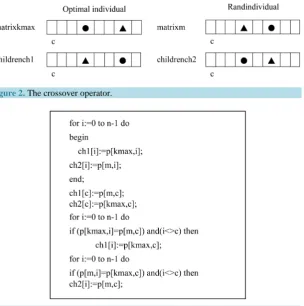
3) Hybridization: the location based crossover operator is adopted, and the specific process is demonstrated as follows: to begin with, a random integer c with the value varying from 0 to n is randomly generated to be re-garded as the crossover point. Afterwards, the optimal individual kmax is selected from the population, followed by the generation of a random integer m (m ≠ kmax and m ≠ kmin) with the value in the range of 0~NN. Then, the
location based hybridization process is performed between the individual corresponding to the integer m and the optimal individual kmax at the point c. If the preferable individual in the hybrid progenies is superior to the op-timal individual kmax, the worst individual kmin is replaced by the individual; otherwise, the worst individual kmin is reserved. The crossover operator is demonstrated in Figure 2, and its implementation algorithm is illu-strated in Figure 3.
[image:3.595.166.471.402.709.2]As demonstrated in Figure 3, the array element p[*,i] represents the value of the ith gene of the individual *, while ch1[i] and ch2[i] indicate the values of the ith gene in two generations respectively.
Figure 2. The crossover operator.
4) Variation: the locations of any two genes in the original optimal individual kmax in step 3 are exchanged, to
generate a new individual. If the new individual is superior to the previous optimal individual kmax, the latter is
replaced by the former; otherwise, the latter is reserved.
5) Recalculating the values of fitness, maximum and minimum of the individuals changed by the hybridiza-tion and variahybridiza-tion processes;
6) The results are output if the termination condition is satisfied, that is, output all the individuals i that satisfy the condition; otherwise, step 3 is repeated.
4. Operation Results
By using the proposed algorithm nearly all the solutions of the 4 queens problem (n = 4) are obtained in the test. Limited by the length of the paper, merely parts of the operation results are demonstrated, as illustrated in Table 1.
The value of the population size in the algorithm is generally taken as 10 - 20 times of the number of the queens. The evolution generation can be adjusted in the range of 50 - 100 times of the number of the queens, and the termination condition of the evolution is fmax =n n
(
−1 2)
.5. Conclusion and Improvement
The construction of the fitness functions using integers shortens the evaluation time of the computers, and thus greatly improves the calculation efficiency. Meanwhile, integer coding is performed on the individuals, which applies the knowledge of the n-queen problems and makes the algorithm concise and visual. The experimental results demonstrate that this algorithm is endowed with rapid calculation and high efficiency. Of course, in order to further improve the operating speed, several crossover points can be added according to the variation of the
Table 1. Experimental results.
Queens Partial results
8 61528374 73025164 48157263 35714286 52617483 25703641 47302516 36824175
100
78 63 53 96 89 20 22 93 73 83 62 8 55 74 43 79 64 37 42 26 21 2 52 29 7 88 76 100 69 97 33 4 17 58 6 30 46 95 57 47 77 12 81 23 61 24 38 91 10 54 86 50 66 9 87 18 56 59 70 80 11 35 48 98 90 99 19 85 72 1 13 36 5 60 41 14 67 34 44 40 49 65 27 94 82 75 45 3 32 15 68 51 16 31 71 84 25 28 39 92
200
151 49 5 162 112 48 28 69 75 130 34 199 143 196 50 72 165 152 86 180 105 115 121 82 167 198 114 147 139 175 56 100 67 183 138 122 200 190 52 36 106 104 155 45 119 46 185 102 76 64 29 174 110 117 84 22 79 17 154 4 40 93 96 163 77 27 181 113 146 26 172 55 92 191 177 131 39 65 42 30 150 51 187 88 13 186 192 35 133 19 37 10 182 24 83 188 137 168 20 57 144 95 9 31 78 189 156 68 194 21 43 1 184 15 7 142 145 85 169 118 157 12 126 170 63 107 91 136 38 8 73 108 18 116 124 153 32 179 70 53 61 193 47 16 161 123 54 178 160 44 109 158 89 87 80 176 148 3 98 2 58 74 195 25 149 111 120 6 159 141 90 171 66 128 140 11 94 129 103 71 166 197 33 99 101 127 60 41 132 164 125 62 173 97 135 59 134 14 81 23
500
fitness functions while designing the evolutionary operators. That is to say, the smaller the fitness value of the optimal individual is, the more the crossover points. With the gradual increase of the fitness value of the optimal individuals in the evolution process, the number of the crossover points is gradually reduced. When the differ-ence between the fitness value and the integer n(n − 1)/2 is smaller than certain a given positive number, the number of the crossover points is changed to 1. In this way, the evolution speed of the population is accelerated, which gives rise to the improved efficiency of the algorithm. In addition, in order to avoid the local optimum of the programs, the stability of the system requires to be further improved.
References
[1] Dahl, O.J., Dijkstra, E.W. and Hoare, C.A.R. (1972) Structured Programming. Academic Press, London.
[2] Kryszkiewicz, M. (1998) Rough Set Approach to Incomplete Information Systems. Information Sciences, 112, 39-49.
http://dx.doi.org/10.1016/S0020-0255(98)10019-1
[3] Kryszkiewicz, M. (1999) Rules in Incomplete Information Systems. Information Sciences, 113, 271-292.
http://dx.doi.org/10.1016/S0020-0255(98)10065-8
[4] Stefanowski, J. and Tsoukias, A. (1999) On the Extension of Rough Sets under Incomplete Information. Proceedings of 7th International Workshop on New Directions in Rough Sets, Data Mining, and Granular Soft Computing, Physica- Verlag, Yamaguchi, 73-81. http://dx.doi.org/10.1007/978-3-540-48061-7_11
[5] Slowinski, R. and Vanderpooten, D. (2000) A Generalized Definition of Rough Approximation Based on Similarity. IEEE Transactions on Knowledge and Data Engineering, 12, 331-336. http://dx.doi.org/10.1109/69.842271
[6] Holland, J.H. (1992) Adaptation in Natural and Artificial Systems. MIT Press, Cambridge.
[7] Darwin, C. and Burrow, J.W. (2009) The Origin of Species by Means of Natural Selection: The Preservation of Fa-voured Races in the Struggle for Life. Penguin Classics, USA, 2-3. http://dx.doi.org/10.1017/CBO9780511694295
[8] Darwin, C. (1994) The Descent of Man, and Selection in Relation to Sex. John Murray, London.
[9] Moore, A.J. (1990) The Evolution of Sexual Dimorphism by Sexual Selection: The Separate Effects of Intrasexual Se-lection and Intersexual SeSe-lection. Evolution, 34, 315-331. http://dx.doi.org/10.2307/2409410