Munich Personal RePEc Archive
Which way to cooperate
Kaplan, Todd and Ruffle, Bradley
Ben-Gurion University
1 June 2007
Online at
https://mpra.ub.uni-muenchen.de/3381/
Which way to cooperate
Todd R. Kaplan
University of Exeter
Bradley J. Ruffle
Ben-Gurion University
June 2007
Abstract: Cooperation in real-world dilemmas takes many forms. We introduce a class of two-player games that permits two distinct ways to cooperate in the repeated game. One way to cooperate is to play cutoff strategies, which rely solely on a player’s private value to defection. The second cooperative strategy is to take turns, which relies on publicly available information. Our initial experiments reveal that almost all cooperators adopt cutoff strategies. However, follow-up experiments in which the distribution of values to defection are made more similar show that all cooperators now take turns. Our results offer insight into what form a cooperative norm will take: for mundane tasks or where individuals otherwise have similar payoffs, taking turns is likely; for difficult tasks that differentiate individuals by skill or by preferences, cutoff cooperation will emerge.
Keywords: experimental economics, cooperation, incomplete information, alternating, cutoff strategies, random payoffs.
JEL classification nos.: C90, Z13.
Contact Information: Ruffle: Department of Economics, Ben-Gurion University, Beer Sheva 84105, Israel, e-mail: [email protected], tel.: +972-8-6472308, fax: (917) 591-8151; Kaplan: Department of Economics, University of Exeter, Exeter, UK, e-mail: [email protected], tel.: +44-1392-263237, fax: (530) 871-6103.
1
Introduction
Many real-world cooperation dilemmas permit multiple modes of cooperation. Cab drivers at a
taxi stand are assigned to passengers according to an agreed upon order, whereas roaming cabbies
divvy up the dispatcher’s calls on a case-by-base basis, mostly by proximity to the passenger’s
location. Siblings can divide household chores in a given week on a volunteer basis or by taking
turns. Firms that face one another in multiple markets can collude by alternately competing
and acquiescing in markets or by staying out of less profitable markets.
Why are some cooperative dilemmas resolved by taking turns or alternating, while others
are best dealt with by conditioning one’s cooperative behavior on the value to defection, that is,
cutoff cooperation? In this paper, we aim to understand the features of cooperation dilemmas
that are conducive to alternating versus cutoff cooperation. For the purpose of studying the
way in which players cooperate, we introduce a class of two-player games that permits these
two distinct modes of cooperation in the repeated game. To illustrate, consider the following
game parameterization: each player privately receives a randomly drawn integer between 1 and 5
inclusive, each with equal probability. Each player then decides between one of two actions: enter
or exit. By exiting a player receives zero. By entering, he receives his number if his opponent
exits and one-third of his number if his opponent also enters.
The first-best outcome of this game entails the high-value player entering and the other player
staying out. This can be achieved only when players know or learn each others’ values for the
action before making a decision. Two strangers who reach the airport check-in counter at the
same time with tickets in hand can achieve the highest social surplus by having the person whose
flight does not leave for another four hours allow the hurried passenger to go ahead. Pregnant
women with children in arms are invited to bypass lengthy lineups.
In our game in which values are private and cannot be communicated or signaled, the
first-best outcome is no longer feasible. Instead, when the same pair of players interacts repeatedly,
stage-game dominant strategy of always entering. Cutoff cooperation entails entering when the value
to doing so exceeds some threshold and not entering otherwise. Cutoff strategies thus condition
on players’ private information. Firms might implicitly collude by staying out of relatively
high-cost or low-demand markets with the expectation that rival firms will reciprocate. Auction
participants might bid only when the object is sufficiently valuable so as not to inflate the winning
bid unnecessarily or receive the object when another bidder values it more.
Unlike cutoff cooperation, alternating ignores private values; rather, it makes use of publicly
available information, like the time of day, the round or object number. Cooperation dilemmas
in families are often resolved by alternating. Spouses take turns making important decisions;
parents avoid favoring one child over another by rotating favors between them; and siblings
settle scores by recalling who enjoyed the same privilege (like riding in the front seat) last time.
Firms that compete with one another in multiple markets or in the same markets repeatedly, or
bidders who compete for similar objects auctioned off sequentially can cooperate by taking turns
capturing the market, instead of pricing or bidding aggressively in each market. Zillante (2005)
presents evidence that the four baseball-card manufacturers alternate the timing with which they
introduce new product lines in order to reduce intra-period competition.1
To address the questions of whether cooperation will emerge and what form it will take, we
begin with the above game parameterization, which yields very similar joint expected payoffs for
the socially optimal cutoff strategy and the alternating strategy. We conduct this game for 80
rounds under two private-information treatments that differ according to the point in time at
which a player learns his opponent’s number (at the end of the round or not at all). We find that
the socially optimal symmetric cutoff strategy whereby a player enters on the numbers 3, 4 and 5,
and exits otherwise is subjects’ modal choice in both treatments. Revealing opponents’ numbers
at the end of the round is particularly conducive to cutoff strategies since entry on low values is
observable and punishable. But even when the opponents’ numbers are not revealed, cooperative
1
cutoff strategies continue to be employed by over 70% of subjects even though play according to
these strategies cannot be observed. Few subjects adopt alternation in either treatment.
In an effort to understand why so few subjects alternate, despite the strategy’s prevalence
in real-world cooperation dilemmas, we designed an additional pair of treatments in which we
added a constant of 100 to all of the entry values. This change makes the entry values relatively
similar, thereby reducing the importance of players’ private information, while leaving unchanged
the inherent difficulty coordinating on alternation. The results from these follow-up experiments
are discussed in section 7.
In the next section, we develop the theoretical framework for this class of two-player games
and through numerical optimization arrive at the above parameterization for our experiments.
We contrast our game with familiar cooperation and coordination games in section 3. In section
4, we detail our experimental design and procedures. Section 5 presents theoretical results
on cooperation for the infinitely repeated game, which yield testable experimental hypotheses.
Section 6 presents the results and analysis. We attempt to understand differences in cooperative
behavior between treatments and especially the paucity of alternating in these experiments.
Section 7 reports the results of additional treatments designed to determine whether the inherent
coordination problem with alternating may be overcome. Section 8 concludes with insights into
when to expect alternation versus cutoff strategies in real-world cooperation dilemmas.
2
Theoretical Framework
In this section, we introduce a class of two-player games. We derive the theoretical properties of
these games, which may be of some independent interest since these games are new. Moreover, the
theoretical and comparative-statics results will help guide our choice of game parameterization
for the subsequent experiments. While our experimental test involves a repeated game, we begin
with an analysis of the one-shot game to highlight some of the differences between this and
further analysis of the repeated game (in section 5).
2.1
Environment
We propose a two-player game with the following general structure. Each player receives a
randomly drawn number between v and v inclusive where the probability of receiving a number
x is πx (whereπx >0 and Px∈{v,...,v}πx = 1) and faces a binary decision A ={enter,exit}. By
exiting a player receives zero. By entering he receives his number if the other player exits or some
function f(x, y) increasing in his number, x, and possibly also a function of the other player’s
number, y, if both enter. We assume that f(x, y) is strictly less than his number x; hence entry
imposes a negative externality on the other player. We also assume that if it is profitable for a
player to enter alone (x >0), then it is also profitable for him to enter when his opponent enters
(f >0 for x >0). For the purposes of this paper, we consider games in which a player’s number
is his private information.
2.2
Solutions
There are noncooperative and cooperative solutions to this game. If each player is concerned
about maximizing only his own payoff, then we can solve for the Bayes-Nash equilibrium. This
yields the dominant strategy of entry for numbers greater than zero.
The cooperative solution is given by the pair of strategies that maximizes the sum of the
players’ expected payoffs. Suppose the other player enters with probabilityp(y) when his number
is y. The joint expected payoff to entering with number xis,
X
y∈{v...v}
πy{x(1−p(y)) +p(y)[f(x, y) +f(y, x)]}.
The joint expected payoff to staying out is Py∈{v,...,v}πyyp(y).
Lemma 1: If f is increasing in both arguments, then the cooperative solution entails cutoff
strategies (that is, for v ≤y < v if p(y)>0, then for all y′
> y, p(y′
Monotonicity explains Lemma 1: if it is profitable to enter with number x, then it is also
profitable to enter with any number greater thanx. A pure-strategy cutoff is when there exists
a c∗ such that for all x ≤ c∗, p(x) = 0 and for all x > c∗, p(x) = 1. A mixed-strategy cutoff is
when there exists an x such that 0 < p(x) < 1. The lemma implies that it is never optimal to
mix on more than one number in the range.
These cutoff values may be non-interior and even asymmetric. Iff(x, y)+f(y, x)>max{x, y},
then the social optimum is non-interior – both enter. An extreme form of asymmetric
pure-strategy cutoffs involves one player entering for all numbers greater than or equal to v (i.e.,
always enter) and the other entering for numbers greater thanv (i.e., always exit). In a repeated
game, this cooperative solution can admit the form of players taking turns entering and exiting.
This solution may only reasonably be expected in games in which the same pair of players
interacts repeatedly. All of our experiments are such.
2.3
Choosing a Particular Game
From this general framework, we selected a game to test experimentally with the goal of
determin-ing the form of cooperation. To choose a particular game, we performed numerical optimization
on the space of games in which players’ numbers are drawn from a uniform distribution of
in-tegers between v and v inclusive. We restricted f(x, y) to be of the form x/k (where k is an
integer) to aid subjects’ understanding of the game.
Our objectives were twofold: 1) to design a game for which the joint expected payoffs from
alternation and the socially optimal pure-strategy symmetric cutoff strategy are very similar; 2)
to maximize the difference between the joint expected payoffs from playing the optimal symmetric
pure-strategy cutoff,c∗, and the second-best symmetric pure-strategy cutoff. Put another way, we
want to maximize the steepness of the joint expected payoff function around the socially optimal
pure-strategy cutoff. Achieving this second goal maximizes the incentive for those players wishing
from this strategy can thus be interpreted as an intention not to cooperate optimally.
Before computing the game that maximizes these objectives, we first derive several theoretical
propositions and comparative-statics results for this class of games. These results will help narrow
the range of parameters from which we determine the optimal game.
Proposition 2: The socially optimal pure-strategy symmetric cutoff for integers drawn
inde-pendently from the uniform distribution of integers from v to v and congestion parameter k is
given by,
c∗ = −1−2v+ (2v−1)k+ q
12v (1 +v) (k−1)2+ (1 + 2v+k−2v k)2
6 (k−1) .
Although the expression for c∗ seems unintuitive, it demonstrates the uniqueness of the
so-cially optimal cutoff and leads to some sensible comparative-statics results. First, as the
conges-tion parameter,k, increases, so does the optimal symmetric cutoff for a givenvandv. Intuitively,
as k increases, it becomes increasingly costly for both players to enter; as a result, the socially
optimal threshold for entry increases. Taking the limit of c∗ ask tends to infinity yields,
limk→∞c∗ =
−1+2v+√(1−2v)2+12v(1+v)
6 .
Moreover, taking k and v as fixed, the expression for c∗ also reveals that as v increases, so does
the socially optimal cutoff.
Corollary 3: For integer numbers uniformly distributed on [v, v], v < v, and k ≥ 3, the
socially optimal cutoff always involves each player exiting on at least the integer v.
The surprising aspect of Corollary 3 is that no matter how small the percentage difference
between the highest and lowest integers in the range of numbers, the socially optimal cutoff
always involves some measure of cooperation by exiting on at least the lowest integer, v, in the
Proposition 4: For k ≤ 2, the socially optimal strategy is a cutoff strategy. In the uniform
case, as k→ ∞, the socially optimal strategy is alternating.2
In our search for a parameterization that yields similar joint expected payoffs for the optimal
cutoff and alternating strategies, Proposition 4 suggests values of k greater than 2, but not too
large: we allowed k to vary from 2 to 5. Over the range of numbers, {v, . . . , v}, we allowed v
to be any integer greater than or equal to 3, and fixed v = 1.3 This latter decision was made
because if v is an integer less than 1, then the strategy “always enter” is no longer a unique
dominant strategy in the stage game.
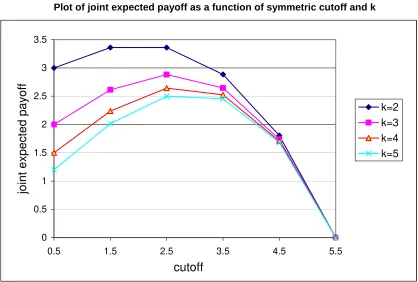
For our experiments, we chose (v = 5, k = 3). Figure 1 displays the results of our search
for the range of numbers {1, . . . ,5} and k ∈ {2,3,4,5}. The figure reveals that the optimal
pure-strategy cutoff value, c*, equals 1.5 for k = 2, equals 2.5 for k = 3,4, and equals 3.5 for
k ≥ 5. We express all cutoffs as halves to denote unambiguously that the player enters on all
integers greater than the cutoff and exits otherwise. The figure also shows that the steepness
around c∗ is maximized for k = 3. For k = 3, the pair’s expected payoff if each player employs
the optimal cutoff,c∗ = 2.5, is 2.88. Forc= 3.5, the pair’s expected payoff decreases to 2.64 and
to 2.61 forc= 1.5. Table 1 indicates the pair’s joint expected payoff for all pure-strategy cutoffs
and alternating.
[insert Figure 1 and Table 1 here]
2
When the distribution of values is not uniform, Proposition 4 does not generally hold. Take for example the values of 100 with probability 1/3 and 1 with probability 2/3. For large k, alternating yields a joint expected payoff of 34. Entering only when one has 100 yields 100 with probability 4/9 andǫotherwise. Hence, this optimal cutoff strategy yields a higher joint expected payoff.
3
For our chosen parameterization, the alternating strategy earns the pair 3 units of profit in
expectation, a mere 0.12 units more than than the optimal symmetric cutoff, c∗ = 2.5. That
these two strategies perform almost equally well despite their qualitatively very different natures
raises the empirical question of which one, if any, will be adopted by players. Not only is the
pair’s expected payoff from playing the alternating strategy (3) higher compared to the optimal
cutoff strategy (2.88), the variance of the expected payoff is also lower: 2 compared to 2.42.
3
Related Games
The best known and most frequently tested cooperation game, the prisoners’ dilemma (PD),
has a unique dominant-strategy equilibrium in the one-shot game in which both players defect;
however, if both players could commit to cooperation, both would be better off. Likewise, in
the public-goods game (PG) (an n-player extension of the PD), the socially optimal outcome
involves all players contributing their endowments to a public good, which conflicts with the
unique dominant-strategy equilibrium in which each player to a private good. Noncooperation
(enter) is also the unique dominant-strategy equilibrium of our class of games. Unlike the PD and
PG games, the socially optimal outcome in our game involves one person playing his dominant
strategy and the other playing his dominated strategy. A second distinction of our game is
that if both players choose their dominant strategies they are better off than if both play their
dominated strategies.
Van de Kragt, Dawes and Orbell (1983) introduce a variation on the standard public goods
game in which a minimum aggregate contribution to the public good is required for its provision.
In these threshold or step-level public goods games, there is no dominant strategy since each
player would prefer to contribute if and only if his contribution is pivotal in ensuring the public
good’s provision.
Amnon Rapoport and his coauthors have conducted various versions of a market-entry game
independently decide whether to enter a market with capacity c≤n. Staying out yields a fixed
payoff, whereas entering yields a payoff that decreases in the number of entrants and yields less
than the fixed payoff from staying out in the case of excess entry.4 In subsequent versions of the
market-entry game, Rapoport and coauthors have explored the effect of deciding whether to enter
in one of two markets where each market’s capacity changes in each period (Rapoport, Seale and
Winter, 2000) and asymmetric entry costs that are held constant throughout the experiment
(Rapoport, Seale and Winter, 2002). These games have large numbers of pure-strategy and
mixed-strategy equilibria, all efficient and all characterized by some subset of players entering
with positive probability. By contrast, our games have a unique Nash equilibrium, which is
inefficient and at odds with the full-information, social optimum whereby one player enters and
the other exits. Moreover, exit is a strictly dominated strategy in our game forv >0 and f >0.
Put another way, if both players enter (“excess entry”), unlike the market entry game, each
entrant still earns more than if he had exited.
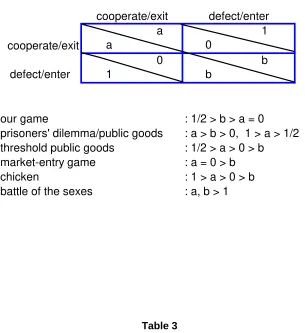
For a particular realization of players’ numbers, the 2×2 payoff matrix in Table 2 makes
precise the outcome differences between our game and others. The top row and left column are
the cooperate/exit/swerve action (depending on the game in question). The bottom row and
right column are the defect/enter/not swerve action. Normalizing the off-diagonal payoffs to
(1,0) and (0,1), we denote the payoffs from the cooperative outcome as (a, a) and from the defect
outcome as (b, b).
[insert Table 2 here]
The PD and PG games restricta > b >0 and a <1, but 2a >1 in order for the cooperative
outcome to be efficient. The market-entry game requiresa = 0 andb < 0. The game of chicken
can be characterized by 1 > a > 0 > b. It has the same asymmetric equilibria as the
market-entry game and can be seen as a limiting case of it as a decreases to 0. For both games, the
4
Nash equilibria are also the socially optimal outcomes. For the battle-of-the-sexes game the Nash
equilibria also correspond to the social optima, although they are the diagonal outcomes. Finally,
our game requires b > a = 0, and 2b < 1 to ensure that the off-diagonal outcomes are efficient.
Our game is the only one for which coordination is needed to reach a social optimum that is
not an equilibrium. Private information further complicates this task by making it difficult to
coordinate on any social optimum at all.
4
Experimental Design and Procedures
All experiments were conducted in fixed pairs. Each player in the pair received an independently
and randomly drawn integer between 1 and 5 in each round. Subsequently, each player decided
independently whether to enter or exit. The decision to exit yields 0, whereas entry yields the
value of the number if the opponent exits and 1/3 of the value of the number if the opponent
also enters. All experiments were conducted for 80 rounds.
At the end of each round, a player observes his opponent’s decision to enter or exit. We
conducted two experimental treatments that differ by the point in time at which a player learns
his opponent’s value (after the round or never). In “After”, at the end of each round, each player
learns his opponent’s decision and value. In “Never”, a player does not observe his opponent’s
number at the end of the round, only his decision to enter or exit.
The After treatment provides relatively favorable conditions for cooperation since the pair
may coordinate on and enforce both alternation and cutoff strategies. If a player enters when it
is not his turn to enter or on a low number, say 1, he recognizes that his opponent will observe
this defection and can retaliate by entering out of turn or the next time he receives a 1.
In Never, deviations from alternating strategies are easily detected and punishable; whereas,
defection from cooperative cutoff strategies is more difficult to detect. A player does not know if
his opponent entered because he is playing uncooperatively or because he drew a high number.
more than 7 entries in the past 10 rounds constitutes a deviation; yet, efficiency would be lost
if more than 7 of the last 10 draws exceeded the cutoff of 2.5. Furthermore, how does the pair
coordinate upon the rule of 7 out of 10, or any other? This lack of information inNever renders
cooperative cutoff strategies unlikely.
Upon arrival, each subject was seated in front of a computer terminal and handed the sheet
of instructions (see Appendix B). After all subjects in the session had read the instructions, the
experimenter read them aloud. To ensure full comprehension of the game, subjects were given
a series of knowledge-testing questions about the game (Appendix B contains the questions).
Participation in the experiment was contingent upon answering correctly all of the questions.5
Five practice rounds were then conducted with identical rules to the actual experiment. To
minimize the influence of the practice rounds, subjects were rematched with a different opponent
for the 80-round experiment.
An important feature of our experimental design that allows us to compare subjects’ behavior
across pairs and across treatments is our use of one pair of randomly drawn sequences of 80
numbers (85 numbers including the five practice rounds) from 1 to 5. Before beginning the
experiments, we drew two 80-round sequences, one for each pair member. We applied these
sequences to all subject pairs in all sessions and treatments.6
We recruited subjects from a broad range of faculties and departments at Ben-Gurion
Univer-sity. Sixty-two subjects participated in one of the threeAftersessions and a different 62 subjects
participated in one of the three Never sessions. In both treatments, one unit of experimental
currency was exchanged for 0.6 shekels at the end of the session. A session lasted about 100
min-utes on average, including the instructions phase and post-experiment questionnaire. Including
a 10-shekel showup fee, the average subject profit was 76 shekels.7
5
No one was excluded from participating. All subjects who showed up answered correctly all of the questions in the allotted time.
6
Thus, for instance, in round 56 regardless of pair, session or treatment, one pair member received a value of 2, while the other received a value of 4.
7
5
Cooperation in the Repeated Game
Our theoretical results thus far all refer to the one-shot game where entry is the dominant
strategy. However, the repetition of our experiments for 80 rounds with the same partner raises
the possibility of some measure of cooperation. Indeed, in finitely repeated prisoners’ dilemma
and public goods games, cooperation is frequently observed before breaking down in the terminal
rounds of play (see, e.g., Davis and Holt 1993).8
We can show that if subjects play the repeated game as if it is infinitely repeated, for a
sufficiently high discount factor they will not deviate from the alternating strategy in After or
Nevernor from symmetric cooperative cutoff strategies in After.
Proposition 5: In an infinitely repeated game, for sufficiently patient players (high δ):
(i) Alternation is a sequential-equilibrium (SE) strategy for the paired players in both the After
and Never treatments;
(ii) The symmetric cooperative cutoffs c= 1.5, c∗ = 2.5 and c= 3.5 are additional SE strategies
in the infinitely repeated game in the After treatment only;
(iii) It is possible to support cutoff cooperation as a SE in Never, but only when strategies consist
of history-dependent actions.
From the proof of Proposition 5(iii), we observe that if cutoff cooperation is played, then the
cutoff value responds dynamically to the player’s history of values and entry decisions. Thus,
to the extent that subjects in our experiments adopt these dynamic strategies, any attempt to
categorize their play in Never as pure-strategy cutoffs will lead to higher error rates compared
toAfter in which pure-strategy cutoffs may be supported in equilibrium.
8
The next proposition compares cooperation in After and Never.
Proposition 6: For any SE in Never, there is a SE in After with the same value-contingent
payoffs; the reverse, however, is not true.9
The implication of Proposition 6 for our experiments is that, compared toNever, the subjects
in After have a strictly larger set of SE upon which to coordinate. As a result, we anticipate
higher cooperation in Afterthan in Never.
Unconditional cooperation in humans is rare, in large part because it is easily exploited.
Rather, individuals typically condition their cooperative behavior on their opponents’
cooperat-ing to a similar degree. Both the reward of cooperative behavior (positive reciprocity) and the
punishment of uncooperative behavior (negative reciprocity) have been widely documented in
the experimental literature (see, e.g., Andreoni et al. 2003, Fehr and Gachter 2000). In After, if
a player’s opponent is visibly playing, say, a higher cutoff than him, he may switch to the same
cutoff and exit more frequently (positive reciprocity). Alternatively, he may respond to his
oppo-nent’s deviations from a cutoff strategy by entering more frequently (negative reciprocity). The
absence of information in Never inhibits subjects from directly rewarding or punishing
number-contingent actions. Instead, subjects may set a threshold of entry frequency for their opponent
(e.g., 7 of the past 10 rounds, as mentioned in section 4); if the opponent exceeds this threshold,
they respond by entering in one or more subsequent rounds regardless of their number.
With the promise of positive reciprocity or threat of negative reciprocity, a subject may
will-ingly adopt this sort of entry budgeting. Jackson and Sonnenschein (2007) demonstrate that
individuals may achieve higher social efficiency by budgeting (i.e., rationing) their
representa-tions in a voting game in accordance with their empirical distriburepresenta-tions. However, Engelmann
9
and Grimm (2006) show experimentally that only an exogenously imposed budget significantly
improves the truthful representation of preferences and overall efficiency in this game.
Budgeting is not needed in After because play according to cutoffs is observable. Once
equilibrium is reached, we would not anticipate negative reciprocity in After since it is off the
equilibrium path. InNever, by contrast, optimal punishment may be set to deter deviation from
a subject’s budget when he receives low values. Notwithstanding, punishment may be insufficient
to deter exceeding budget when the subject faces a 5.10
6
Results
We begin this section by comparing cooperation across treatments. In 6.2, we estimate whether
a cutoff or the alternating strategy most closely characterizes each individual subject’s observed
decisions. Section 6.3 explores the dynamics in arriving at these strategies. We attempt to
understand our results in 6.4.
6.1
Cooperation across Treatments
Table 3 is a simple presentation of aggregate decisions: the entry percentage for a given number
and treatment. For instance, in the After treatment when subjects drew the number 1, they
entered only 16.3% of the time. These summary statistics reveal a number of findings. First, not
all subjects are playing the static Nash equilibrium: exit is the modal decision for the number
1 in both treatments and also for the number 2 in After. Second, the sharp spike in entry
percentages in going from the number 2 to 3 in both treatments suggests that many subjects
may be employing the socially optimal cutoff of 2.5. Third, that not all subjects are entering all of
the time on numbers 4 and 5, particularly in Never, suggests the use of alternating strategies for
which entry and exit decisions are independent of the numbers received. Finally, as anticipated
10
by Proposition 6, cooperation increases with increasing information, as seen by the overall lower
entry frequency in After.
[insert Table 3 here]
To determine whether the difference in cooperation across treatments is significant we
esti-mate a random effects Probit model on the pooled data from both treatments to explain the
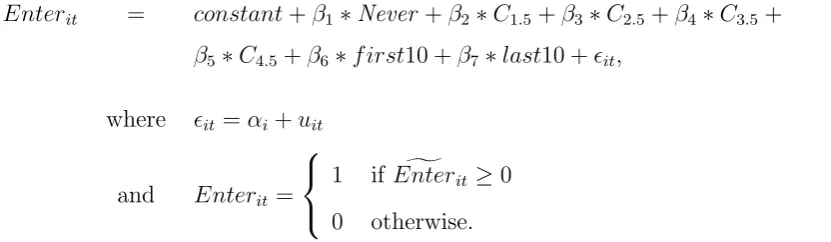
variation in subject i’s decision to enter in period t. The specification for our random effects
Probit model is as follows,
g
Enterit = constant+β1∗Never+β2∗C1.5+β3∗C2.5+β4∗C3.5+ (1)
β5∗C4.5+β6∗f irst10 +β7∗last10 +ǫit,
where ǫit =αi+uit
and Enterit=
1 if Enterg it≥0
0 otherwise.
The treatment dummyNevertests for differences in the level of cooperation across treatments.
The dummy variableC1.5 equals one if playeri’s periodtnumber is 2, 3, 4 or 5 and equals zero if
it is 1; similarly, C2.5 equals one for numbers 3, 4 and 5, and zero otherwise, and so forth forC3.5
and C4.5. The marginal effects of the estimated coefficients on these variables are interpreted as
the marginal propensity to enter for numbers 2, 3, 4 and 5, respectively. Also in the regression
equation are dummy variables for the first 10 and last 10 periods, which control for initial learning
and end-game effects, respectively. The error term, ǫit, is composed of a random error,uit, and
[image:17.595.101.517.288.409.2]a subject-specific random effect, αi.
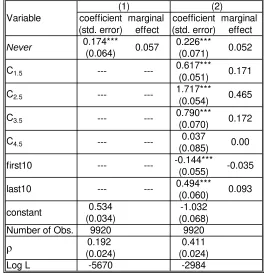
Table 4 displays the regression coefficients and marginal effects. The highly significant and
positive coefficient on Never and the marginal estimate in regressions (1) and (2) indicate that
a subject is about 5% more likely to enter in Never than in After, controlling for the subject’s
“last10” supports these latter effects in the anticipated directions: subjects are less likely to enter
early on and more likely to enter toward the end of the game.
[insert Table 4 here]
The estimates of ρin Table 4 measure the fraction of the error term’s variance accounted for
by subject-specific variance. The highly significant estimates of 0.192 and 0.411 indicate that
about 19% and 40% of the variance in the error term is explained by subject heterogeneity in
the two specifications, respectively.
6.2
Individual Strategies
To understand better the heterogeneity in subject behavior, we infer the strategy that best fits
each subject’s observed decisions, that is, the strategy that minimizes the number of errors in
classifying the subject’s decisions. We search over each of the possible pure-strategy cutoffs,
c∈ {0.5,1.5,2.5,3.5,4.5,5.5}, and the alternating strategy, generously modeled as the choice of
an action opposite to the one made in the previous round.11
[insert Table 5 here]
Despite the slight payoff advantage and lower payoff variance of the alternating strategy,
our main finding is the overwhelming adoption of cooperative cutoff strategies and the paucity
of alternators. Table 5 reports the distribution of individuals’ best-fit strategies by treatment
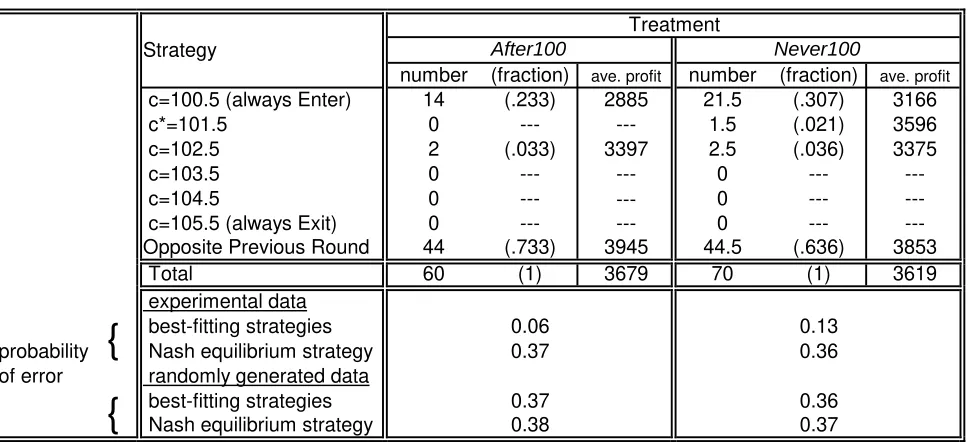
for rounds 11–70.12 The optimal symmetric cutoff strategy of c∗ = 2.5 best characterizes the
decisions of 39/62 subjects in the After treatment.13 Nine subjects in After appear to be
11
Although there are other ways to model the alternating strategy, such as enter in odd or even rounds only, our chosen specification based on comparing decisions in roundstandt−1 is robust to mistakes: for instance, it detects subjects who began alternating, stopped for one or more rounds and resumed alternating by coordinating differently on who enters on the odd and even rounds.
12
Excluding the first 10 and last 10 rounds reduces the error rates by minimizing the initial learning and end-game effects documented in the regression analysis. The inferred best-fit strategies are highly robust to the different time horizons tested, like all 80 rounds, the last 60 rounds, the last 40 rounds and rounds 16–65.
13
employing the cutoff of 1.5; for one of these subjects, the static Nash strategy of always enter
fits his decisions equally well. Eight additional subjects also play according to the Nash strategy
of c= 0.5, while four other subjects (two of whom form a pair) use the hyper-cooperative cutoff
of 3.5. Only one pair of subjects alternates, beginning in period 33 and continuing without
deviation through period 80.
The Never treatment is a more likely candidate for alternating because the play of cutoff
strategies cannot be observed or enforced. Still, a meager two out of 31 pairs alternate.14 An
additional subject whose best-fit strategy is alternating eventually abandons it after his opponent
fails to reciprocate.
Table 5 also reveals a marked shift from higher to lower entry cutoff values in going fromAfter
to Never. For example, the percentage of subjects playing the optimal symmetric pure-strategy
cutoff declines from 62.1% in After to 38.7% in Never, while those who always enter increases
from 13.7% to 20.2%. Like the overall entry percentages in Table 3 and the regression results
in Table 4, these individual inferred strategies also point to a decline in cooperation when less
information is provided.
Overall, this inference technique fits the data well as seen in the error rates of 6% and 8%
for the two treatments, respectively.15 Thus, of the 3720 decisions made by the 62 subjects
in After between rounds 11 and 70, 3479 of them correspond to the best-fit strategy inferred
for each subject. By comparison, if we assume that all subjects are playing the static Nash
strategy, then the third-to-last row of data in Table 5 indicates that the error rates jump to 15%
and 32% depending on the treatment. In addition, we generated random decisions for subjects
calibrating the probability of entry to match the observed overall rate of entry in each treatment
(.677 and .744 respectively for the treatments). We then calculated the error rate from these
random decisions for each subject’s best-fitting strategy and for each subject assuming static
Nash play. The results in the bottom two rows of Table 5 again demonstrate that our inferred
14
For these pairs, alternation begins in rounds 2 and 8, respectively, and continues flawlessly for the duration.
15
strategies on the actual data fit the data much better than the best-fitting and Nash strategies
on the randomly generated data. In sum, subjects are indeed playing in a non-random, methodic
fashion that can be captured mostly by cutoff strategies.16
Our strategy analysis also reveals that pair members typically coordinate on the same
co-operative strategy. In After, of the 30 pairs that employ cutoff strategies, members in 22 pairs
coordinate on the same cutoff values. If subjects independently chose their strategies according
to the observed distribution of best-fit strategies, the probability of at least 22 pairs coordinating
on the same cutoff is 1/60. Sixteen out of 28 pairs do so in Never. In addition, for all 12 pairs
in which partners do not coordinate on the same cutoffs, their inferred cutoffs differ by only one
integer value. Again, if subjects drew their strategies independently from the observed
distribu-tion, the likelihood of obtaining this degree of coordination or better is 1/600. The implication is
that it is extremely unlikely in both Afterand Neverthat paired subjects achieved the observed
degree of coordination on the same or similar cutoff values by mere chance. Paired subjects’
coordination is particularly surprising inNever, since opponents’ values are unobservable.
Successful coordination on the same strategy shows up in the form of higher profits for paired
subjects playing the optimal cooperative cutoff strategy than those who always enter. The
right-hand columns of each treatment in Table 5 reveal that the average subject profits for c∗=2.5 are
111.6 and 106.8 in After and Never, respectively, compared to 109.5 and 93.2 for always enter.
These profits reveal that non-cooperators earned substantially more inAfterthan inNever. The
explanation is that 5/9 Nash players in After were paired against more cooperative subjects
compared to only 3/13 in Never. How did such a relatively high fraction of subjects in After
allow their partners to always enter, when entry on values of 1 and 2 is perfectly observable in
this treatment? A likely explanation is that these unconditional cooperators encourage defection.
A subject who enters on a 1 and observes that his opponent does not retaliate is emboldened to
16
do so again, while in Neverthe defector as such is not observable.
6.3
Dynamics
The strategy analysis in the preceding section does not help us understand how pair members
succeed in coordinating on the same cutoff values. In this section, we explore two forms of
dynamic behavior that may have aided coordination, budgeting and reciprocity (both discussed
in section 5).
The idea underlying budgeting is that a player bases his current-period entry decision on his
entry frequency in previous periods. The player has a target frequency of entry from which he
attempts not to deviate. Having entered frequently in recent periods, he may choose to exit
in the current period (regardless of his value) to avoid exceeding this target. We refer to this
as “gentlemanly budgeting”. The maintenance of goodwill with one’s partner may motivate
gentlemanly budgeting. On the other hand, if the player has exited frequently in recent periods,
he may choose to enter in the current period (regardless of his value) to maintain his target entry
frequency. We refer to this as “opportunistic budgeting”.
Consider, for example, a subject with a target entry frequency of 60%. In an effort not to
deviate excessively from this target, the subject may decide to enter if he has exited in six or
more of the past 10 periods and to exit if he has entered in eight or more of the last 10 periods.
Alternatively, the subject may base his current-period entry decision on his entry frequency from
the past five or past three periods only. These examples begin to illustrate the large number of
possible time horizons and rules for entry and exit on which subjects may condition their entry
decisions.
We do not aspire to understand individual subjects’ time horizons or target entry frequencies.
Instead, to determine empirically whether the gentlemanly or opportunistic budgeting motives
may guide subjects’ entry decisions, we include two dummy variables in estimating subject i’s
previous two rounds and zero otherwise; similarly, “iprevious2exit” takes on a value of 1 if the
subject exited in the previous two rounds and zero otherwise. Looking at occurrences where
the subject makes the same decision in the previous two rounds both eliminates alternators and
captures budgeting over two or more rounds.17
We also explore empirically the reciprocity motive. A subject may reward his opponent’s
re-cent under-entry by exiting in the current period (positive reciprocity). Similarly, he may punish
his opponent’s recent over-entry by entering (negative reciprocity). Again to avoid confounding
alternating with reciprocity, we investigate whether the subject is responsive to his opponent’s
decisions made in the past two periods. The variable “uprevious2enter” takes on a value of 1
if the opponent entered in periods t−1 and t−2, and zero otherwise. The variable “
uprevi-ous2exit” is analogously defined. As with budgeting, these variables capture reciprocity based
on the opponent’s decisions from the past two or more rounds.
Table 6 reports the results of these random-effects regressions designed to test for the
bud-geting and reciprocity motives in the After and Never treatments. From regression (1), two
significant tendencies can be seen in After: subjects are less likely to enter in the current round
if either in the previous two rounds they entered or their opponent exited (iprevious2enter and
uprevious2exitare both negative and significant). The first of these trends points to gentlemanly
budgeting, while the latter suggests positive reciprocity. Interestingly, from regression (3) we
see that neither of these two variables is significant in Never, whereas precisely the other two
variables (iprevious2exit and uprevious2enter) are both highly significant and positive. That is,
subjects are more likely to enter in the current round if either in the previous two rounds they
exited or their opponent entered. The first of these trends is opportunistic budgeting, while the
latter reflects negative reciprocity.
[insert Table 6 here]
17
Both of these budgeting and reciprocity trends inNever are less cooperative and imply more
entry than the corresponding findings in After.18 By taking advantage of the unobservability
of values inNeverto enter when they have exited “too often”, subjects exhibit limited
trustwor-thiness. By entering when their opponent has entered “too often”, subjects exhibit limited trust
that their opponent is abiding by their implicitly agreed upon cutoff strategies.
To determine whether these budgeting and reciprocity tendencies take place simultaneously
or at different stages during the course of play, in regressions (2) and (4) we interact each of the
four variables from (1) and (3), respectively, with a dummy for the first 40 rounds (“half1”) and
the last 40 rounds (“half2”). InAfter, gentlemanly budgeting plays a significant role only in the
first half as subjects push for cooperation while they learn to play a cutoff strategy. The weakly
significant negative coefficient on “uprevious2exit*half2” is evidence of positive reciprocity in the
latter half of the game and reflects the subject’s willingness to be pulled to more cooperative
play.19 In Never, opportunistic budgeting is a significant motive throughout, whereas negative
reciprocity is significant in the latter half only as subjects attempt to maintain cooperation.
6.4
Why so few alternators?
Although the pair’s expected profit from alternating is slightly higher (by 0.12 units per period)
and the variance lower than those from the optimal cutoff strategy ofc∗ = 2.5, the overwhelming
majority of subjects employ cutoffs. There are two possible explanations.
First, successful alternation requires coordination on the part of both pair members, as
wit-nessed by several subjects who began the game alternating, but eventually abandoned it after
their partner failed to reciprocate. By contrast, cutoff cooperation can be implemented
unilat-erally and its usefulness does not require coordination on the same cutoff.
18
If we replace these four variables based on the same previous two-round decisions with analogous variables from the previous three rounds, all of our findings above as well as those reported below remain qualitatively similar.
19
Second, cutoff cooperation is cheap, since it involves exiting on the lowest values, when it
is least costly to do so; whereas, alternation ignores the value to entry. Thus, for a player who
decides to cooperate regardless of whether his opponent reciprocates, his foregone profit from
exiting only on low values is less than if he exits just as often without regard for values (as with
alternating).
To determine which of these reasons accounts for subjects’ unwillingness to alternate, we
designed an additional pair of treatments that maintains the difficulty of coordinating jointly on
the alternating strategy, but makes cutoff cooperation less cheap.
7
In Search of Alternating
7.1
Experimental Game and Procedures
By shrinking the percentage difference between v and v, the values to entering become more
alike making cutoff cooperation less cheap. In the extreme case where v =v, one would expect
all players to alternate. If siblings derive identical utility from riding in the front seat, they will
take turns enjoying this privilege.
To determine if a game parameterization with more similar values can increase alternation,
we conducted two additional treatments. We added a constant of 100 to the randomly drawn
numbers 1-5. Thus, the After100 and Never100treatments are identical to the similarly named
original treatments (i.e., five integers in the range, k=3), except that players’ iid integers come
from the uniform distribution 101 to 105. The dominant stage-game strategy remains entry.20
By corollary 3, we know that the socially optimal cutoff involves exiting on at least the lowest
integer in the range. Indeed, c∗ = 101.5 is the socially optimal pure-strategy cutoff and yields
the pair an expected payoff of 77.28 units per round. By comparison, alternating earns 103 in
expectation, a 33% premium over c∗ = 101.5. The research question can then be phrased as,
20
is the joint payoff premium to alternation sufficient to overcome its inherent dual coordination
problem?
Sixty and 70 subjects participated in After100andNever100, respectively. Participation was
again restricted to one experiment per subject and no subject had participated in eitherAfteror
Never. In selecting the experimental-currency-to-shekel ratio, we held constant across both sets
of treatments the joint monetary payoff from the optimal cooperative strategy of alternating.
Also, keeping fixed his opponent’s decisions, a player always entering earns the same expected
monetary payoff in all treatments. This implies a new exchange rate of 1:0.0175. Table 7
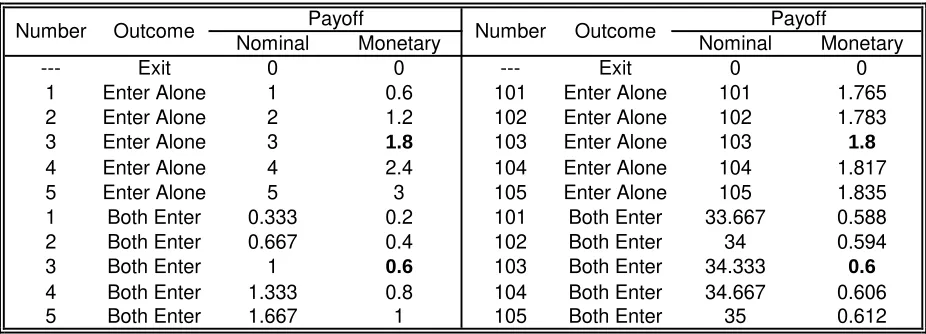
compares the nominal and real payoffs in the original and follow-up treatments.
[insert Table 7 here]
7.2
Results from Follow-Up Treatments
The last two columns of Table 8 reveal little variation in the entry decisions as a function
of the number received in both After100 and Never100. Overall, about 61% of the decisions
are enter on 101, increasing to 67% on the number 105. This stability of entry percentages
attests to alternation. The strategy inference analysis in Table 9 confirms the preponderance of
alternators: alternating is the best-fit strategy for 64% of subjects in Never100and a still higher
73% of subjects in After100, even though After100 affords the opportunity to observe and thus
coordinate on cooperative cutoff strategies. Alternating and Nash play account for about 95%
of subjects in both treatments. No subject plays according to the optimal cutoff c∗ = 101.5 in
After100 and only 1.5/70 adopt this cutoff in Never100. Put starkly, those who cooperate in
these experiments alternate; the remaining quarter of the subjects are best described by entering
in every round.
[insert Tables 8 and 9 here]
How can we explain the shift from almost all cutoff cooperators in the original treatments
nominal and real payoffs to entry are made very similar for all values 101-105, as shown in Table 7.
It no longer matters substantively whether a player enters alone on the highest or lowest integer
in the range: the difference in both monetary and nominal terms between the two outcomes is a
paltry 4% compared to 400% in the original treatments. In addition, Table 7 shows that exiting
on the lowest integer is about three times costlier in these treatments than the original ones, no
matter if only one player exits (foregone profit of 0.588 vs. 0.2) or both do (foregone profit of
1.765 vs. 0.6). Alternation ensures that exactly one player enters each round, thereby at once
avoiding congestion and the now costlier outcome whereby both players receive low draws and
exit.
The prevalence of alternators in these treatments implies that the two-person coordination
problem inherent in alternating is not insurmountable. By increasing the joint-expected-payoff
advantage to alternating (i.e., by making cutoff cooperation less cheap), all cooperators switch
from cutoffs to taking turns.
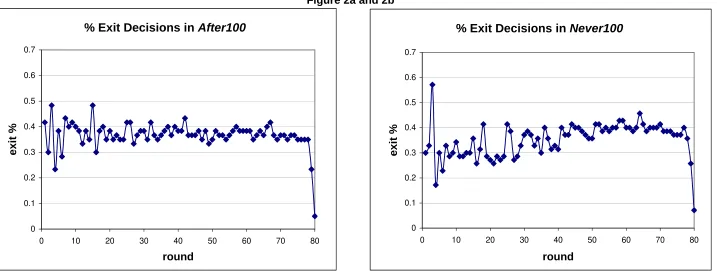
Figures 2a and 2b also attest to the pervasiveness and stability over time of the
alternat-ing strategy in both After100 and Never100. If all subjects employed the alternating strategy
throughout the game, 50% of the decisions would be exit in every round; whereas exit
percent-ages varying from 0 to 100 depending on the numbers drawn would reflect cooperative cutoff
strategies. In round 3, for example, paired subjects drew numbers 101 and 102 followed by 104
and 105 in round 4. Accordingly, the exit percentage swung from 57% to 17% in Never100and
from 48% to 23% in After100, suggesting that some subjects are using cooperative cutoffs in
these early rounds. In After100, from round 17 through round 78, the percentage of exit
deci-sions stabilizes at about 40%, despite the randomly drawn numbers each round. In Never100,
the percentage of exit decisions starts below 30% and it is not until round 40 that it reaches 40%
where it stabilizes, again until the second-to-last round.21
[insert Figures 2a and 2b here]
21
The relatively high error rate of the best-fit strategies of 0.13 inNever100compared to only 0.06 inAfter100
It is surprising that After100reveals a higher percentage of alternating pairs and their faster
formation thanNever100 where alternating is the only verifiable cooperative strategy.
How can we understand this opposite finding? It turns out that learning the opponent’s
num-ber at the end of the round facilitates the formation of alternating pairs even though alternating
in no way depends on the subject’s number. A subject in After100 who exits on a 104 or 105
while entering on a 101 or 102 in other rounds sends a strong signal that he is not playing a cutoff
strategy. Never100 offers no such conspicuous opportunity to communicate one’s intentions due
to the unobservability of the opponent’s number.
The other striking observation from these time series of exit decisions is the sudden drop off
in exiting in the final two rounds. InAfter100, from around 40% of all decisions in rounds 17-78,
exit decisions plummet to 23% and 5% in rounds 79 and 80, respectively. Similarly, inNever100,
exit decisions fall to 26% and 7% in the last two rounds after having stabilized at around 40%
during the last half of the game. Like the endgame effects observed in the original treatments,
these sharp declines in cooperative behavior in the final two rounds suggest that cooperation
throughout the game is at least in some measure strategic.
8
Lessons for Cooperation in the Real World
Cooperation assumes many forms in the real world. We design a class of games that permits two
distinct forms of cooperation in the repeated game. These games are characterized by a tension
between the unique static Nash equilibrium in which both players enter and the socially optimal
outcome in which one player enters and the other exits. We derive the theoretical properties of
these games and optimally select a parameterization to study experimentally. The asymmetric
social optimum permits alternating as one cooperative repeated-game strategy. Privately known,
randomly drawn values for entering admit cutoff strategies as another form of cooperation.
We find that when the range of values to cooperation is similar, players alternate; whereas,
adoption of cutoff strategies. In real-world cooperation dilemmas, participants’ values tend to
be alike and thus, according to our results, alternation adopted, when the cooperative task is
mundane or requires little skill. By contrast, individuals’ values are varied for tasks that require
a particular, unequally distributed skill or tasks that elicit a strong heterogeneity in preferences.
In these situations, our results reveal that cooperative participants will adopt cutoff strategies,
even if alternation yields similar expected payoffs. For participants to overcome the costly
two-person coordination required of alternation, it must provide a substantially higher payoff than
cutoff strategies.
Several examples illustrate these distinctions. Cabdrivers are assigned to passengers in two
distinct ways. Similar to alternating, cabdrivers at a taxistand serve passengers in a
predeter-mined order based on the observable time at which the drivers returned to the stand. This
solution distributes passengers evenly and prevents conflict between cabbies, all of whom are
available with identical locations. However, for passengers who call the cab company, such an
as-signment would be inefficient and likely to elicit complaints from passengers and from the cabbies
dispersed throughout the city. Instead, the dispatcher broadcasts the location of the passenger
and allows cabdrivers to take advantage of their private information (e.g., availability, distance
to the customer) to divide up customers according to their values, similar to cutoff strategies.
Likewise, an army sergeant, shift manager, head of a team of programmers or committee
of commune members may assign mundane tasks (e.g., cleaning the latrine, unpopular shifts,
routine programming) using a duty roster or other system that disregards input from group
members (alternating); or, in the case of diverse values (e.g., combat duty, revenue-generating
activities for the commune, choice shifts, challenging programming), the members may self-select
their tasks based on privately known ability and preferences (cutoffs).
Allowing group members to choose their tasks exploits their private information. By the same
token, conflict may ensue if more than one member opts for the same task, while other unwanted
avoiding conflict and ensuring that no opportunity is missed, while at the same time conveying
an impression of an equitable distribution of assignments.
References
Andreoni, James, William Harbaugh and Lise Vesterlund (2003) “The Carrot or the Stick: Rewards, Punishments, and Cooperation,”American Economic Review, 93:3, 893-902.
Arthur, W. Brian (1994) “Inductive Reasoning and Bounded Rationality,”American Economic Review Papers and Proceedings, 84:2, 406-411.
Dal Bo, Pedro (2005) “Cooperation under the Shadow of the Future: Experimental Evidence from infinitely Repeated Games,” American Economic Review, 95:5, 1591-1604.
Davis, Douglas and Charles Holt (1993) Experimental Economics, Princeton University Press, Princeton, NJ.
Engelmann, Dirk and Veronika Grimm (2006) “Overcoming Incentive Constraints? The (In-) Effectiveness of Social Interaction,” unpublished manuscript.
Fehr, Ernst and Simon Gachter (2000) “Cooperation and Punishment in Public Goods Exper-iments,” American Economic Review, 90:4, 980-994.
Jackson, Matthew and Hugo Sonnenschein (2007) “Overcoming Incentive Constraints,” Econo-metrica, 75:1, 241-57.
Kahneman, Daniel (1988) “Experimental Economics: A Psychological Perspective,” R. Tietz, W. Albers and R. Selten (eds.), Bounded Rational Behavior in Experimental Games and Markets, Berlin: Springer-Verlag, 11-18.
Kandori, Michihiro (1992) “The Use of Information in Repeated Games with Imperfect Moni-toring,”Review of Economic Studies, 59:3, 581-593.
Normann, Hans-Theo and Brian Wallace (2004) “The Impact of the Termination Rule in Co-operation Experiments,” unpublished manuscript.
Rapoport, Amnon (1995) “Individual strategies in a market entry game,”Group Decision and Negotiation, 4, 117-133.
Rapoport, Amnon, Darryl A. Seale and Eyal Winter (2000) “An Experimental Study of Co-ordination and Learning in Iterated Two-Market Entry Games,” Economic Theory, 16, 661-687.
Van de Kragt, A., R. Dawes and J. Orbell (1983) “The Minimal Contributing Set as a Solution to Public Goods Problems,” American Political Science Review, 77, 112-122.
Zillante, Artie (2005) “Spaced-Out Monopolies: Theory and Empirics of Alternating Product Release,” unpublished manuscript.
Appendix A - Proofs of Propositions
Proof of Proposition 2: Let us examine the costs and benefits of extending the symmetric
cutoff by one from c−1/2 to c+ 1/2. We can represent the problem on a grid that is v−v+ 1
units by v−v+ 1 units. Each point on the grid refers to the net gains if the numbers drawn are
from that point. The uniform independent distribution implies that each grid point has equal
weight. Let us refer to each point as (x, y). The points affected are (·, c) and (c,·). Divide this
set of points into three groups. Group one is (c, z) and (z, c) where z > c. Group two is (c, z)
and (z, c) where z < c. Group three is (c, c).
For each grid point in group one, there is a net gain of z−(z +c)/k. For group two, there
is a net loss of c for each grid point. For group three, there is a net loss of 2c/k. For all of the
points together, there is a net gain of,
2
v
X
z=c+1
(z−z+c k )
| {z }
Group 1
−c·2(c−v)
| {z }
Group 2
− 2c k |{z}
Group 3
= v (1 +v) (k−1)−(1 + 2v+k−2v k) c−3 (k−1)c
2
k .
This is simply a quadratic with both a positive and a negative root. The expression represents
the net benefit of increasing the pure-strategy cutoff c starting at v. It will eventually become
negative as csurpasses the positive rootc∗. Thus, for pure strategies, the positive root provides
the optimal cutoff where exiting occurs if and only if one’s number is below c∗. From Lemma 1,
the optimal cutoff strategy may entail the use of mixed strategies. While we don’t do so here,
Proof of Corollary 3: The two comparative-statics results preceding the corollary indicate
that the most difficult test for the corollary is k = 3 and the range of integers [v, v+ 1]. If we
can show that the socially optimal strategy is exit onv for this case, then the corollary holds for
all v > v and k ≥ 3. Each player earns in expectation (v2 +v+12 )· 1 3 =
2v+1
6 if he enters on both
v and v + 1. But by staying out on v, each player does better with expected earnings equal to
v+1 2 ·(
1 2 +
1 2 ·
1 3) =
2v+2
6 . QED
Proof of Proposition 4: Independent of k, alternating yields a joint expected payoff equal
to the expected value of the range of numbers, while the joint expected payoff of any symmetric
cutoff strategy (strictly less than v) is strictly decreasing in k. Consider the case of k = 2. The
strategy of always enter (the lowest possible cutoff) yields half the expected value for each player.
Thus, for k = 2, the joint expected payoffs are the same for alternating and always entering.
Hence, for k < 2, the joint expected payoff from the not necessarily optimal cutoff strategy of
always enter will be strictly higher than that of alternating, implying that the optimal cutoff will
yield expected payoffs that are strictly higher as well.
For the uniform distribution and k → ∞, using the grid method of the previous proof,
alternating yields (v−v+ 1)Pvz=vz = (1 +v−v)2(v+v)/2. As k→ ∞, both players entering
yields a payoff of 0 (as does both exiting). This simplifies the joint-payoff calculation of the cutoff
strategyc∗ to 2(c∗−v)Pv
z=c∗z = (1 +v−c∗)(c∗−v)(v+c∗). The expression (1 +v−c∗)(c∗−v)
reaches its maximum atc∗ = (1 +v+v)/2, yielding (1 +v−v)2/4. Since (v+c∗) is maximized
forc∗ =v, we know the joint cutoff payoff must be strictly less than (1 +v−v)2· v/2. Forv >0,
this is less than the joint alternating payoff. QED
Proof of Proposition 5: (i) Assume that a deviation from the intended strategy prompts
the opponent to enter forever after (grim trigger strategy). Such a deviation from alternation is
done by entering out of turn and always detected in either the After or Never treatments. The
payoff to deviating from alternation is highest on a 5 and yields an expected payoff of, 5 3+ 1·
δ
whereas continued alternation yields an expected payoff of 3δ+ 3δ3+. . .= 3δ
1−δ2. Thus, a player
will never deviate from alternation if and only if 3δ
1−δ2 ≥
5 3 +
δ
1−δ, or δ≥0.679.
(ii) Again assuming a trigger-strategy punishment, we now verify that each of the cooperative
cutoffs c = 1.5, c∗ = 2.5 and c = 3.5 constitutes a symmetric SE for a sufficiently high δ. For
each of these cutoff strategies, the most profitable deviation involves entering on the highest value
below the cutoff, namely, entering onc−0.5. The expected present discounted deviation payoff
is thus, (c−0.5)(1−p) +c−0.5 3 p+
δ
1−δ, wherep is the probability that the opponent also enters
in the deviation round, equal to 0.8, 0.6 and 0.4 whenc= 1.5,c∗ = 2.5 andc= 3.5, respectively.
The expected present discounted payoff from c = 1.5, c∗ = 2.5 and c = 3.5 for the infinitely
repeated game are 1.305·δ
1−δ ,
1.44·δ
1−δ and
1.32·δ
1−δ , respectively. Comparing each of these expressions with
the corresponding deviation payoff implies that a player never deviates as long as δ ≥0.605 for
c= 1.5,δ≥0.732 forc∗ = 2.5, andδ≥0.873 forc= 3.5. In addition, the cooperative cutoffs 4.5
and 5.5 cannot be supported as symmetric SE since they yield lower stage-game joint expected
payoffs than always enter (see Table 1).
In Never, these symmetric cooperative cutoffs cannot form an equilibrium strategy. Consider
the following two sets of realizations of infinite sequences of random values, {x, y} and {x′
, y′
}.
For both sequences, player 1 has the exact same realizations,x=x′
. Player 2’s realizations differ
in round t only: in one sequence he draws a 5, yt = 5, while in the other he draws a 1, y
′
t = 1.
In all other rounds s 6= t, we have ys = y
′
s. When y
′
t = 1, we have shown that the equilibrium
strategy inAfter involves exiting, since entry triggers player 1’s punishment strategy. In Never,
the two sequences {x, y} and {x′
, y′
} are indistinguishable to player 1 so that play by a cutoff
strategy dictates the same actions for player 1. Hence, if player 2 plays as if he drew sequence
y when in fact he faces sequencey′
, player 2 profits from this deviation simply because player 1
behaves exactly as if player 1 drew sequence y.
(iii) In part (ii) we already established that non-history dependent cutoff cooperation is not
the cooperative strategy of exiting one out of every two rounds. Let us assume that as opposed
to alternating, this is done solely by cutoffs. For example, on a 1 or 2 in the first round, a
player stays out in the first round and enters in the second. On a 3, 4 or 5, a player enters
in the first round and stays out in the second. This gives a two-round expected payoff of
0.6·(4·0.4 + 4/3·0.6) + 0.4δ·(3·0.6 + 1·0.4) = 1.44 + 0.88δ. Let us again assume
trigger-strategy punishment. The highest incentive to deviate occurs when one player draws a 5 in the
second round, but knows that both players are supposed to stay out in that round. The payoff
to deviating is 5 + δ
1−δ. The payoff for staying the course is
δ(1.44+0.88δ)
1−δ2 . Cooperation can be
established if δ >0.968. QED
Proof of Proposition 6: Any SE inNeverfor which the equilibrium strategies are contingent
on observables can be exactly duplicated in After. What if the equilibrium strategies in Never
condition on player i’s own value, which is unobservable to the opponent? We will show that
for these equilibria, there are comparable, isomorphic equilibria in After in which the player’s
value-contingent strategy can be replaced with a value-independent strategy that attains the
same expected action profile and the other player chooses the same strategy as in Never; as a
result, both players earn the same expected payoffs as inNever.
Consider player i’s strategy in period t denoted bysit(vt−1, vit, at−1), where vt and at are the
histories of all values and actions, respectively, up to period t. In Never, since the opponent’s
values are never revealed, a player’s strategy can condition on his own values only, sit(vit, at−1).
InNever, playeri’s present and future payoffs depend on his previous values only insofar as they
affect his individual strategy. This is because his period payoff is ui(vit, ait, ajt),j 6=i, and only
his actions can depend upon previous values. InAfter, the opponent’s j’s action can also depend
on player i’s values,i6=j.
For anyNeverequilibrium in which playeri’s strategy depends upon his previous values, there
exists another equilibrium that yields the same expected payoffs for both players where player