http://dx.doi.org/10.4236/cmb.2014.41001
How to cite this paper: Santos, C.B.R., et al. (2014) Application of Hartree-Fock Method for Modeling of Bioactive Mole-cules Using Sar and Qspr. Computational Molecular Bioscience, 4, 1-24. http://dx.doi.org/10.4236/cmb.2014.41001
Application of Hartree-Fock Method for
Modeling of Bioactive Molecules Using SAR
and QSPR
Cleydson B. R. Santos1,2,3*, Cleison C. Lobato1, Francinaldo S. Braga1, Sílvia S. S. Morais4, Cesar F. Santos1, Caio P. Fernandes1,3, Davi S. B. Brasil1,5, Lorane I. S. Hage-Melim1, Williams J. C. Macêdo1,2, José C. T. Carvalho1,2,3
1Laboratory of Modeling and Computational Chemistry, Federal University of Amapá, Macapá, Brazil 2Postgraduate Program in Biotechnology and Biodiversity-Network BIONORTE, Campus Universitário Marco
Zero, Macapá, Brazil
3Laboratory of Drug Research, School of Pharmaceutical Sciences, Federal University of Amapá, Macapá, Brazil 4Laboratory of Statistical and Computational Modeling, University of the State of Amapá, Macapá, Brazil 5Institute of Technology, Federal University of Pará, Belém, Brazil
Email: *[email protected]
Received 12 January 2014; revised 12 February 2014; accepted 20 February 2014
Copyright © 2014 by authors and Scientific Research Publishing Inc.
This work is licensed under the Creative Commons Attribution International License (CC BY).
http://creativecommons.org/licenses/by/4.0/
Abstract
The central importance of quantum chemistry is to obtain solutions of the Schrödinger equation for the accurate determination of the properties of atomic and molecular systems that occurred from the calculation of wave functions accurate for many diatomic and polyatomic molecules, us-ing Self Consistent Field method (SCF). The application of quantum chemical methods in the study and planning of bioactive compounds has become a common practice nowadays. From the point of view of planning it is important to note, when it comes to the use of molecular modeling, a collec-tive term that refers to methods and theoretical modeling and computational techniques to mimic the behavior of molecules, not intend to reach a bioactive molecule simply through the use of computer programs. The choice of method for energy minimization depends on factors related to the size of the molecule, parameters of availability, stored data and computational resources. Mo-lecular models generated by the computer are the result of mathematical equations that estimate the positions and properties of the electrons and nuclei, the calculations exploit experimentally, the characteristics of a structure, providing a new perspective on the molecule. In this work we show that studies of Highest Occupied Molecular Orbital Energy (HOMO), Low Unoccupied Mole-cular Orbital Energy (LUMO) and Map of moleMole-cular electrostatic potential (MEP) using Hatree- Fock method with different basis sets (HF/3-21G*, HF/3-21G**, HF/6-31G, HF/6-31G*, HF/
6-31G** and HF/6-311G), that are of great importance in modern chemistry, biochemistry, mole-cular biology, and other fields of knowledge of health sciences. In order to obtain a significant correlation, it is essential that the descriptors are used appropriately. Thus, the quantum chemical calculations are an attractive source of new molecular descriptors that can, in principle, express all the geometrical and electronic properties of molecules and their interactions with biological receptor.
Keywords
Molecular Modeling; Meps Maps; Orbital Frontier; Quantum Chemical Methods
1. Introduction
Brazil has the largest genetic diversity in plant species in the world, however it is estimated that less than 10% were evaluated as their biological characteristics and less than 5% were submitted the detailed phytochemical studies. Despite a recent increase in research in this area, plants still constitute a source relatively underused and potentially very valuable for discovery of new biologically active substances [1] [2]. The bioactive compounds present in the vegetable kingdom have important functions and biological actions and may be considered as promoters of human health. We have already recognized the association between intake of fruits and vegetables and decreased risk of development various disorder chronic degenerative, such as cancer, inflammation, cardi-ovascular disease, cataracts, macular degeneration and other being carotenoids and phenolic compounds, some of the groups of bioactive compounds to which are attributed such actions. The seeds and extracts of annatto (Bixa orellana L.) are used as colorants in food, pharmaceutical and cosmetic industries due to the predominant presence of the carotenoid bixin [3]. The efficiency of biological activity of bioactive compounds of vegetable origin depends on their structure and concentration. In turn, the amount of these substances in vegetables is largely influenced by genetic factors and environmental conditions, in addition of the degree of maturation and plant variety, among other things. It is known also that the biological capacity is influenced by the substrate used in the assay, by the solvent and by extraction technique used, as well as the binomial time-temperature. Regard-ing the organic solvents, methanol, by managRegard-ing to extract high amount of bioactive compounds, it has been touted as the most effective [4]-[7].
The Montrichardia linifera (Arruda) Schott, Araceae family, popularly known as “aninga”, is an aquatic ma-crophyte that forms large clonal populations along the rivers and streams of the Amazon. Those bordering con-sider this poisonous plant because its sap causes skin burns and eye contact can cause blindness [8]. However, paradoxically, it is widely used in traditional Amazonian medicine, mainly due to the healing properties of sap and of the juice of this plant, which has already been mentioned in the literature since the nineteenth century for the treatment of wounds and ulcers [9]-[12], leading to the hypothesis that this species may contain biologically active substances. However, very little is known about their chemical composition and biological activities that eventually may be useful also against human infections caused by parasites, which are serious problems in trop-ical and subtroptrop-ical in developing countries, despite the discovery of new anti-protozoal drugs [13]. Between antimalarial compounds isolated from plants, artemisinin is one of the most important discoveries nowadays
[14]-[16]. Artemisinin (or Qinghaosu, QHS, Figure1) represents the most relevant advance in the treatment of malarial disease for the last 20 years [17]. Artemisinin is a sesquiterpene lactone with an endoperoxide group, which has been used in traditional Chinese medicine for many centuries as a natural product for fever and ma-larial treatment. This drug was isolated by Chinese chemists in the early 1970s from the ancient Artemisia annua
L. Nowadays, artemisinin and derivatives are widely used around the world because of their potent antimalarial activity, fast action, and low toxicity. As a result, artemisinin and its derivatives have become recognized as a new generation of antimalarial drugs [18].
Figure 1. (a) The artemisinin structure and the region essential for expression of the bi-ological activity (pharmacophore) was visualized using ChemSketch 12.00 program [23]. (b) Map of molecular electrostatic potential (MEP). ((c) and (d)) Orbital’s energy Homo and Lumo. The MEP, Homo and Lumo were visualized and calculated using Hartree- Fock (HF) method and HF/6-31G** basis set by the Molekel program [24].
two (2) compounds of a set of twelve (12) test predicted as of high activity were proposed [19]. Artemisinin de-rivatives with antimalarial activity against Plasmodium falciparum, which is resistant to mefloquine, were stu-died using quantum chemical methods (HF/6-31G*) and the partial least-squares (PLS) method. Three main components explained 89.55% of the total variance, with Q2 = 0.83 and R2 = 0.92. From a set of 10 proposed arte-misinin derivatives (artearte-misinin derivatives with unknown antimalarial activity against Plasmodium falciparum), a novel compound was produced with superior antimalarial activity compared with the compounds previously de-scribed in the literature [20]. Cardoso et al. (2008) studied artemisinin and some of its derivatives with activity against D-6 strains of Plasmodium falciparum using the HF/3-21G method. To verify the reliability of the geome-try obtained, Cardoso et al. compared the structural parameters of the artemisinin trioxane ring with theoretical and experimental values from the literature. MEP was used in an attempt to identify key features of the com-pounds that are necessary for their activities, and they use those to propose new artemisinin derivatives [21]. There is however, the need for discovery of new antimalarial drugs using techniques of quantum chemistry which has been extensively used in the pharmaceutical industry, where predicting the probable activity of a drug from mole-cular orbital calculations is much less expensive than manufacturing it in order to perform expensive tests [22].
2. The Importance and Application of the Methods of Quantum Chemistry to
Molecular Modeling
The central importance of quantum chemistry is to obtain solutions of the Schrödinger equation for the accurate determination of the properties of atomic and molecular systems. Within the area of physical chemistry, quan-tum chemistry is used to calculate various thermodynamic properties such as entropy, heat capacity of gases, for the interpretation of molecular spectra, calculations of bond length, bond angles, dipole moment and the under-standing of intermolecular forces. In organic quantum chemistry can estimate the stability of molecules, calcu-late the properties of intermediate reactions, reproduce the aromaticity of organic compound and simucalcu-late
tra of nuclear magnetic resonance (NMR). In analytical chemistry is used for the interpretation of intensities of the spectral lines. In the area of inorganic chemistry is used for the ligand field theory, where predictions are made, and properties justify complex ions of transition metals. In Biochemistry of quantum chemistry calcula-tions are used to study the conformation of biological molecules such as enzyme-substrate binding and solvation of organic molecules [25]-[28].
The application of quantum chemical methods in the study and planning of bioactive compounds has become a common practice nowadays. From the point of view of planning, it is important to note that, when speaking of the use of molecular modeling (a collective term that refers to theoretical methods and computational techniques to model or mimic the behavior of molecules), it is not intended to reach a bioactive molecule simply through the use of computer programs. The development process of these molecules due to their complexity, necessarily involves multidisciplinary approach, which employs a large set of computational methods of systematic way form facilitate and optimize the development process of bioactive compounds, on a constant exchange of infor-mation with groups of chemical synthesis and evaluation of the activity of these compounds. These computa-tional methods can be used as tools of racomputa-tional design of bioactive compounds, so called because it is guided by a rational hypothesis about the mechanism of action of these compounds. The action of bioactive molecules is a very complex phenomenon, but one of the paradigms of medicinal chemistry is that these molecules are related to their effects or interactions to chemical reactions with macromolecular structures present in living systems, proteins, in its large majority. Cases these proteins are cell receptors, bioactive molecules are classified as re-ceptor agonists or antagonists, in the case of enzymes, these molecules act as enzyme inhibitors [29] [30].
The Origin of Quantum Chemistry Methods
The history and debates related to the so called “semiempirical method” of London-Eyring-Polanyi are reported on a fascinating work of Nye [31]. The approach of Eyring and Polanyi, aiming to merge theory with experi-mental results to construct potential energy surfaces, showed that it is possible to gain insights into the mechan-isms of adiabatic reactions, leading to important concepts related to the dynamics of chemical reactions, such as transition state and activated complex. Already at that time, there were debates comparing the approaches based on first principles with the semiempirical. In 1933 James and Coolidge [32] published an ab initio calculation when obtained the binding energy of H2 molecule with an accuracy of 98%. This calculation took a year to be done, but its success increased confidence of authors that then criticized the semiempirical method as a “happy cancellation of errors” that occurs for not taking into account “terms of considerable importance” [32]. This ex-pression “cancellation of errors” remains to this day in the imagination of researchers, although it is not possible to identify precisely that are these errors, and mainly, how and why they if would cancel. Polanyi in 1937 coun-ter-argued: “Personally, I do not attach importance to an exact agreement between theory and experiment at this stage, but I believe that the theory [referring to the semiempirical method] can claim to provide a reasonable de-scription of the mechanism of reactions chemical that would otherwise remain obscured” [33].
In 1941 Hirschfelder presented the calculation of at least one hundred activation energies for several reactions using the method of London-Eyring-Polanyi, showing that only in some cases the values did not agree with the experimental, with an error of 10 kcal/mol [34]. Hirschfelder defended the semiempirical method as “a method sufficiently flexible so that it could be made consistent with any set of chemical facts, maintaining consistent with the basic principles of quantum mechanics”. According to Nye [31], in this statement Hirschfelder has cor-rectly identified that an ad hoc character is inherent to semi-empirical approaches. This ad hoc character in-volves risk, since it may well be possible to force an agreement between the semi-empirical and experimental model, even if the model is based on an erroneous theory. Such risk is even greater if the model is used for extrapolation. The final triumph of the first principles approach to the reaction H + H2→ H2 + H, occur only came in 2003 when Mielke and colleagues [35] presented a new constants of experimental and theoretical speeds. The theoretical calculations were obtained using quantum dynamics in an exact adiabatic potential sur-face including Born-Oppenheimer corrections. The experiment and theory now agree in the range of 167 K to 2112 K, within experimental error, causing the problem can be solved now.
how the physical and chemical processes occur, and to motivate the development of new techniques and expe-riments to study the temporary combination of atoms called transition state as in the works of Ahmed Zewail. The novelty of the visual maps of potential energy surfaces and the language of potential wells and barriers of activation has also become an important pedagogical tool for chemistry. In contrast, first-principles calculations of quantum dynamics, with equivalent accuracy to that of Mielke and colleagues [35], remain prohibitive, al-most impossible to be performed for the vast majority of chemical reactions of practical interest. Undoubtedly: the ab initio methods, based entirely on first principles eventually prevail. However, if the reaction of the hy-drogen atom with a hyhy-drogen molecule could be regarded as definitely settled 10 years ago, what about all the other chemical and biochemical reactions? [38]
3. Hartree-Fock Equations
A development of great importance in quantum chemistry occurred from calculation functions accurate wave diatomic and for many polyatomic molecules, by the method of self-consistent field developed by Douglas Hartree [39]. In his theory Hartree considered the wave function as being formed by an antisymmetric linear combination of products of spin-orbitals. Then the wave function Hartree-Fock for atoms or molecules obeying the Pauli exclusion principle, should be written as a product antisimetrizado spin-orbitals, called Slater determi-nant, that in the formula restricted and normalized to a system of closed layers containing 2m electrons, is given by:
(
)
( )
( )
( )
( )
( )
( )
( )
( )
( )
1 1 1 1 1 11 1 1
2 2 2
1 1, 2, 2
2 !
2 2 2
m
m
m m
m
n m m
Φ Φ Φ
Φ Φ Φ
Ψ =
Φ Φ Φ
(1)
in which each spin-orbital Φi
( )
x,α is a product of a spatial function ϕi( )
x and a spin function α or β(
,)
( ) ( )
, i(
,)
( ) ( )
i xα ϕi x α i x β ϕi x β i
Φ = Φ = (2)
The functions of an electron ϕi
( )
x are known as “orbitals”, a term proposed by Mulliken [40], which is the quantum mechanical analogue of the classical orbit [41]. It is considered that the orbitals are orthonormal( ) ( )
1 1 , 0 se 1 sei j ij ij
i j
i j
ϕ ϕ =δ δ = ≠
=
(3)
All elements forming a given column of Slater determinant involve the same spin-orbital already all elements in the same row involve the same electrons. When the configuration of an atom or molecule layer is closed this is represented by a single determinant, unlike a configuration layer to open, since in this case it is used a sum of Slater determinant. The analysis made the following refers the systems configurations closed layer. Open layer settings will not be discussed here, viewed the complexity of the formulas. Aiming to show a simple format for the expressions, it is used the system of atomic units in the equations.
The expression refers to the total electronic energy Hartree-Fock E for a system of electrons n nuclei in fun-damental state is given by the theorem of the variational method.
ˆ
H E
Ψ Ψ
=
Ψ Ψ (4)
where Ψ comes to be wave function in the form of Slater determinant and Hˆ is the Hamiltonian operator without considering the coordinates spin system and non-relativistic. In the case of molecules that in our case the operator Hˆ is the Hamiltonian purely electronic which is obtained after the separation of Born-Oppern- heimer [42] that written in atomic units has the form:
2 1 1 ˆ 2 A i
i i i i j ij
Z H
r r
α α <
The first term in Equation (5) is the operator for the kinetic energy of the electrons, the second term comes to be potential energy of attraction between electrons and nuclei, and the last term refers to the potential energy of repulsion between the electrons, ZA is the charge of the nucleus A, rαi is the distance of the electron i the
nucleusα and rij is the distance of the electron i to the electron j. The operator Hˆ can be separated into two other operators
1 2
ˆ ˆ ˆ
H =H +H (6)
The operator Hˆ1 is relative to the kinetic energy of the electrons and the potential energy of interaction of the electrons with the nuclei:
( )
2
1 ˆ
ˆ m
i
H =
∑
h i (7)The operator h iˆ
( )
is the corresponding Hamiltonian to the motion of an electron in the field generated by the nuclei only( )
1 2ˆ 2 A i j Z h i r α α
= − ∇ −
∑
(8)The operator Hˆ2 is associated with the interelectronic repulsion
2
1 ˆ
i j ij H
r
<
=
∑ ∑
(9)Utilizing the wave function (1) and the Hamiltonian (5) in the expression for the energy functional (4), has been as a result the expression for the total electronic energy of a system represented by a wave function in the form of Slater determinant.
(
)
1
2 ii 2 ij ij
i i j
E h J K
=
=
∑
+∑∑
− (10)This relationship has reduced the integration of many electrons the set of three dimensional integrals (hij) and six (Jij) and (Kij), written of following form:
( ) ( ) ( )
1 ˆ 1 1ii i i
h = ϕ h ϕ (11)
( ) ( )
( ) ( )
12
1
1 2 1 2
ij i j i j
J
r
ϕ ϕ ϕ ϕ
= (12)
( ) ( )
( ) ( )
12
1
1 2 1 2
ij i j j i
K
r
ϕ ϕ ϕ ϕ
= (13)
The integral of an electron hii represents the sum of the kinetic energy of an electron in the orbital ϕi
( )
1 and its potential integral due to the action of the nuclei. The Coulomb integrals Jij and of exchange Kij are associated to interaction between an electron in the orbital ϕi( )
x and another in the orbital ϕj( )
x . In classic-al mechanics the integrclassic-al Coulomb is the interaction energy between two distributions of charges, classic-already integral exchange does not have analogue in classical mechanics, their presence arises due to anti-symmetry of the wave function [41]. Varying E in Equation (4) for each orbital and making δ =E 0 while keeping ortho-normality of the wave function arrives at the 1-electron equations that define the Hartree-Fock method( ) ( )
( )
ˆ 1 i 1 i i 1 , 1, 2, ,
F ϕ =ε ϕ i= m (14)
where Fock operator Fˆ 1
( )
is given by( )
ˆ( )
( )
( )
ˆ 1 1 m 2ˆ 1 ˆ 1
i j
j
F =h +
∑
J −K (15)( ) ( )
*( )
( )
( )
2 12
1
ˆ 1i i 1 j 2 j 2 d i 1
J
r
ϕ = ϕ ϕ τ ϕ
∫
(16)( ) ( )
*( )
( )
( )
2 12
1
ˆ 1 1 2 2 d 1
j i j i j
K
r
ϕ = ϕ ϕ τ ϕ
∫
(17)The Hartree-Fock equations are solved in general by an interactive procedure (SCF). At the end of the proce-dure, εi are the eigenvalues monoeletrônicos HF system. Each εi is often called orbital energy and is
inter-preted as being the energy of an electron in the orbital ϕi, resulting from its kinetic energy, energy of attraction
with the nuclei and their energy exchange and repulsion due to all other electrons in their charge density ϕi 2.
The Equation (14) provides
( ) ( ) ( )
1 1 1i i F i
ε = ϕ ϕ (18)
Substituting Equation (15) in (18) we can relate the orbital energies with the integrals (11), (12) and (13).
(
)
1 2 m
i ii ij ij
j
h J K
ε
=
= +
∑
− (19)It may be also find the total electron energy E from the orbital energies. But this total energy is not simply equal the sum of the energies of an electron. This fact is due to the sum of the energies of an electron including twice each electron-electron interaction, i.e., repulsion between electrons 1 and 2 contributes to the energy of an electron associated with both electrons. Thus it follows that the second term in the equation below corrects this problem
(
)
2 2
m m m
i ij ij
i i j
E=
∑
ε +∑∑
J −J (20)Thus substituting (19) in (20) have
(
)
1 1
2 2
m m
ii ij ij
i j
E h J K
= =
= + −
∑
∑
(21)which equals
(
)
1 m i ii iE ε h
=
=
∑
− (22)with hii being the same Equation (11).
3.1. Hartree-Fock-Roothaan Method
The problem of solving the Hartree-Fock equations for atoms and molecules is due to the fact of absence of cen-tral symmetry. Therefore it is necessary to use approximations for the best orbital. Thus for systems containing many electrons, an approximated way of revolver the Hartree-Fock equations consists of expand the orbital Hartree-Fock ϕi
( )
x on a linear combination of K basis functions χµ, in accordance proposed by Roothaan[43], and this method denominated of Hartree-Fock-Roothaan (HFR) or also Molecular-Orbital Linear Combi-nation Atomic Orbitals (LCAO-MO). Thus the orbital can be expanded in a linear combiCombi-nation as follows.
K
i cµi µ
µ
ϕ =
∑
χ (23)where the cµi are the coefficient of expansion, which will be treated as variational parameters and basis func-tions χµ are Slater type atomic orbitals or Gaussian type. To accurately represent the orbitals, functions should
*
i j v ij v
c c Sµ µ µ
µ =δ
∑
(24)where Sµv is the overlap integral
( ) ( )
v v
Sµ = χµ i χ i (25)
For the molecules ϕi
( )
x are molecular orbitals and χµ are the atomic orbitals. Thus there is a significant improvement in computational calculations when the orbital functions are expanded in terms of a finite set of basis functions. The integro-differential equations are then transformed into algebraic equations for the expan-sion coefficients [41]. The total electronic energy is obtained when Equation (23) is replaced in (21).* * *
2 2
ocup ocup
i vi v i j vi j
i v ij v
E c c hµ µ c c c cµ λ σ v v
µ µ λσ
µλ σ µ λσ
=
∑ ∑
+∑ ∑
− (26)where
( ) ( ) ( )
1 ˆ 1 1v v
hµ = χµ h χ (27)
with hˆ 1
( )
given by Equation (8) by replacing i by 1.The integrals µλ σv and µ λσv are integral interaction two electrons are represented by
( ) ( )
( ) ( )
* *
1 2 12
1
1 2 v 1 2 d d
v
r
µ λ σ
µλ σ =
∫ ∫
χ χ χ χ τ τ (28)( ) ( )
( ) ( )
* *
1 2 12
1
1 v 2 1 2 d d
v
r
µ λ σ
µ λσ =
∫∫
χ χ χ χ τ τ (29)The best coefficients cµi are determined by varying the electron energy given by Equation (26) with respect to them, obeying the condition of orthonormality. Thus we arrive at the equations of Hartree-Fock-Roothaan
* 2
ocup
vi v vj j ij vj v
v j v j v
c hµ c cσ v c Sµ
σ
µλ σ µσ λσ ε
+ − =
∑
∑ ∑
∑∑
(30)where the operator Fock defined as
2
ocup
v v vj j
j v
Fµ hµ c cσ v v
σ
µλ σ µ λσ
= +
∑ ∑
− (31)We can replace the Equation (31) in (30) and thus obtain the equations of Hartree-Fock-Roothaan the follow-ing notation
0, 1, 2, ,
vi v ij vj v
v j v
c Fµ − ε c Sµ = µ= k
∑
∑∑
(32)Applying a unitary transform on Equation (32) to diagonalize the matrix ε, has been
(
v i v)
vi 0, 1, 2, , vFµ −εSµ c = µ= k
∑
(33)Equation (33) can be written in matrix form in this way has been
FC=SCE (34) The equations of Hartree-Fock-Roothaan are resolved in the same way that the equations of Hartree-Fock, i.e., by an interactive process (SCF-MO-LCAO). Those obtained at the end of the procedure are the eigenvalues of HFR system.
3.2. Hartree-Fock Limit
Slater determinant. The exact solution of the Schrödinger equation would not be obtained in case the spatial or-bitals ϕi
( )
x be expanded into a linear combination of basis functions χµ, although the larger and more com-plete is the set of those functions greater the degree of flexibility in expansion for spin-orbital and lowest ex-pected value for energy. Larger bases sets decrease the HF energy up to a certain limit. This limit is the lowest that can be obtained from a wave function of a determinant and it is called of Hartree-Fock limit. Even so, as a variational method, this limit energy EHF will still be above the exact nonrelativistic energy Eex( )
NR due to the energy of electron correlation Ecorr( )
ex HF corr
E NR =E +E (35)
The SCF method is a valid approach, but generates errors in energy because it describes of approximate mode the interactions between the electrons. Should be also consider the instantaneous interactions between the elec-trons. The moves of the electrons are correlated with each other, i.e., there is a correlation in the different posi-tions of the electron and must be taken into account.
The exact value of the energy E including electron correlation and relativistic effects Erel is given by:
HF corr rel
E=E +E +E (36)
4. Application of Basis Sets Separate Valence Used in the Molecular Modeling
To perform atomic and molecular calculations, determines a basis set formed by mathematical functions. These bases consist of a linear combination of the wave functions of an electron in terms of a finite number of base functions, which contains a set of parameters to be optimized. The denomination of the base sets depends on various types of basis functions, of the number of those employed functions in the expansion of monoeletrônicas functions (orbital) and of characteristics of the parameters to be optimized. Thus it is of fundamental importance the careful choice these functions when you want to get accurate results. The main basis sets separate valence avail-able in computational chemistry programs for performing calculations of molecular properties are presented below:4.1. Slater Type Functions
The atomic systems containing only one electron, hydrogenic atoms, have as a solution of the Schrödinger non-relativistic equation, a function of type
(
)
( )
( , ), ,
nlm r Rnl r Ylm
θ ϕ
θ ϕ
Ψ = (37)
where n, l and m are the principal quantum numbers, orbital angular momentum and magnetic, Rnl
( )
r is the radial part and Ylm( , )θ ϕ
is the angular part denominated spherical harmonics. The radial part has the form
( )
2 11
2 2
exp
l
l
nl nl n
Zr Zr Zr
R r N L
na na na
+ +
= −
(38)
where Nnl comes to be a normalization factor, Z is nuclear charge, r is radius, a is a constant and
2 1 1 2 l n Zr L na + + represents in a generic form a polynomial called associated Laguerre polynomial. The angular part is equal to
( , ) ( )
(
)
cos
m im
lm lm l
Yθ ϕ =N P θ e φ (39)
being Nlm a normalization factor and ( ) m l
P the associated Legendre polynomial.
For more that hydrogenic orbitals are orthogonal they do not form a complete set of continuous functions. They have limited application because many of the required integrals in molecular orbital calculations are somewhat hard to calculated, especially when you have high values of the principal quantum number because of the complexity of the polynomial in r. Then Slater (1930) proposed a form analytical simpler for the radial func-tion, then introducing functions such as Slater (Slater Type Functions-STFs) [42].
( )
[
]
( )
(
)
1 2 0 1 0 1 2 2 exp 2 ! n n nl aR r r r a
n ζ ζ + − = − (40)
*
Z s n
ζ = − (41)
where s is a constant related to the shielding effect of the electrons of the internal layers of atoms and n* is an effective principal quantum number. Therefore the general shape of Slater type functions can be written as fol-lows, which is similar to the equation.
(
) ( )
1 2( )
1 2 1 ( , ), , , 2 ! 2 n n P
nlm r n r e Ylm
θ ϕ ζ
ζ θ ϕ ζ + − −
Ψ = (42)
Slater evaluated through empirical rules to select of parameters s and n*, thereby aiming at a good approxima-tion for the atomic orbitals best of this type. The values of ζ were determined by the variational method by Clementi (1963 and 1967) for neutral atoms to the ruthenium in their fundamental states, using for this the SCF method [44] [45]. The exponents ζ are positive numbers and adjustable in the methods of calculation. These exponents determine the size of the orbital, thereby large exponents characterize dense orbital and small expo-nents characterize diffuse orbitals.
The so-called Slater type orbitals (STOs) are formed by the product of the angular part of Equation (39), by the product of the radial part of Equation (40). The STOs generate reasonable representations of atomic orbitals. However, as they replace the polynomial in r in the hydrogenic orbitals by a simple power r, do not have the proper number of radial nodes, just not well represent the internal part of an orbital.
One of the limitations is that they are not of mode some orthogonal, as much as it can be corrected using a set of STOs orthogonalized. In addition the use of these orbitals in molecular SCF calculations makes the integrals multicenter, that involve interactions between electrons, becomes somewhat difficult to be solved numerically, thereby increasing the computational time.
4.2. Minimum Base Sets
Minimum base sets or base “single-zeta” is set containing a single function to represent each occupied atomic orbital of different quantum numbers n and l of electron configuration. Thus, this set presents a reduced compu-tational time to make these calculations, so can be used in calculations involving large molecules which are our case. In the calculations where a minimum base set is used are used in general Slater type orbitals. Due to the small size of the base, minimum base sets generate results only form qualitative of the properties. Nevertheless the calculations of the electronic structure were until around 1960 all performed in terms of minimum base. The first semiempirical methods more used were based in a set of minimum base STOs [46] [47].
4.3. Gaussian Type Functions
4.3.1. Contracted Gaussian Functions
The use of STOs in electronic structure calculations generates computational problems due to the emergence of multicenter integrals, although these orbitals well describe the functional behavior of molecular orbitals. In order to simplify the calculation of multicenter integrals, Boys (1950) proposed for calculations involving molecules using Gaussian type functions (GTFs) [48]
( )
(
)
(
)
1 2 2 3 2
2 1 4 1 2
2
exp 2 1 ! π
n
n n
nl
R r r r
n α α
+
+ −
= −
−
(43)
where n and l are the main quantum numbers and orbital angular momentum and α is the orbital exponent which is a variational parameter. The use of GTFs in calculations of electronic interaction integrals presents an enormous advantage, because the product two of these functions entries in different centers is equivalent to a single function centered on a new center [49], thereby there is a reduction of multicenter integrals to integrals calculated in terms of functions centered on the same point.
integrals in terms of GTFs compensates the large number of integrals to be calculated when comparing using STFs.
The solution of the equations of SCF method in the calculation HFR is also a process using an enormous computational time, it is also proportional to the fourth power of the number of base functions. However, the number of cycles of the interactive process SCF method increases with the number of coefficients to be opti-mized. Thus the use of GTFs contracted originated from linear combinations of Gaussian primitive is generally more adequate [47] [50] [51].
The contracted basis functions can be chosen in order to resemble STOs, atomic orbitals HF or any other set of functions. A type of GTFs contracted is set STO-NG. This nomenclature comes being a set of GTFs con-tracted that describes a STF through N GTFs primitives used in contraction. Each STO is then approximated as a linear combination of N GTFs, in which the coefficients and exponents contracted are chosen so that the basis function approach is an STF. Thus the computational time decreases, but the results generated by the set of con-tracted GTFs are not good.
The STOs ns and np are approximated by their respective functions
( )
, 1(
,)
1
, 1, 2, 3
m
ns ns k s nk
k
r d g r n
ϕ α
=
=
∑
= (44)( )
, 2(
,)
1
, 1, 2, 3
m
np np k p nk
k
r d g r n
ϕ α
=
=
∑
= (45)where g1s and g2p are GTFs, αnk are gaussian exponents and dns k, and dnp k, are coefficients of the ex-pansion, where the last three parameters are determined by the least squares method [51].
4.3.2. Basis Sets Separate Valence
In order to obtain better results, many studies have been made aimed at finding basis sets with this capability. In recent years, besides the basis sets previously described, other sets are being used in electronic structure calcula-tions. Among these, there are basis sets separate valence [42].
Basis sets separate valence are extended sets GTFs contracted, where the most usual are listed below: 4-31G, 3-21G, 6-31G e 6-311G. In such sets are used two functions for the valence orbitals and only one for the orbitals of the internal layer, may each of these functions is a linear combination or not primitive gaussian. The occur-rence of this is due the internal layer contribute little to the chemical properties of interest. As the functions of the internal layers not duplicate it generates effects on total energy, however represents little it comes of dipole moments, ionization potentials of the valence, charge density, dissociation energy and other chemical properties. For example, the base 4-31G each atomic orbital of the internal layers is described by only one GTF contracted which is formed by the combination of four linear (4) GTFs primitive. For each atomic orbital of the valence shell there are two basic functions, being that of them is a GTF contracted from the linear combination of three (3) GTFs primitive, describing the internal part of valence orbital, since the other is a single GTF primitive, which describes the outer part of the valence orbital. Considering the first row atoms (Li to F) we have:
( )
4(
)
1 ,1 1 ,1
1
,
s k s s k s
k
r d g r
ϕ α
=
=
∑
(46)( )
3(
)
2 ,2 1 ,2
1
,
s k s s k sp
k
r d g r
ϕ α
=
′ =
∑
′ ′ (47)( )
(
)
2s r g1s 2sp,r
ϕ′′ = α′′ (48)
( )
3(
)
2 ,2 2 ,2
1
,
p k p p k sp
k
r d g r
ϕ α
=
′ =
∑
′ ′ (49)( )
(
)
2p r g2sp 2sp,p
ϕ′′ = α′′ (50)
( )
3(
)
1 ,1 1 ,1
1
,
s k s s k s
k
r d g r
ϕ α
=
′ =
∑
′ ′ (51)where the functions which appear with (') are internal functions while appearing with (“) are external functions. Similarly to the base structure previously described is the basis 6-31G. Only now each orbital of internal layers is represented by a GTF contracted originated from linear combination of six (6) GTFs primitive. In the case of the base 6-311G, includes a GTF primitive the set 6-31G to represent a new layer of the outer valence.
4.4. Polarization Function
All basis sets discussed so far have a peculiar characteristic, i.e., they comprise functions restricted to be cen-tered in the nuclei. However, there is evidence showing that the atomic orbitals distort or polarize when they form a molecule. For this reason one should take into consideration the possibility of non-uniform displacement of electric charges outside the atomic nucleus, i.e. the polarization. Thus it is possible to obtain a better descrip-tion of the changes as well as also deformadescrip-tions in the atomic orbitals within the molecule.
One way to consider such a polarization is introduced on the basis in question functions wherein the values of
l (quantum number of the orbital angular momentum) larger than those of fundamental state of a given atom. In this type of functions gives the name of polarization functions. For the hydrogen atom of the description funda-mental state uses only functions s. The functions p, d, ... centered on H, for molecular calculate, are considered as functions of polarization. Generally, with the inclusion of polarization functions in the molecular basis there is a higher possibility of obtaining better results for many of the properties of chemical interest, such as dissoci-ation energy and dipole moments. In real terms, it is noted that it is not satisfactory to include polarizdissoci-ation func-tions of symmetry d and f together with the basis sets s and p small, that is, the polarization functions should only be added when working with basis sets said saturated [52].
Of the bases valence separate with polarization functions most commonly used in molecular calculations are the STO-3G*, 3-1G*, 6-31G*, 6-31G**, 6-311G* and 6-311G**[53]. The base 6-31G* and 6-31G** are formed by the inclusion of polarization functions to the base 6-31G, being that the base 6-31G* is constructed by adding a set of five (5) polarization functions of type GTFs of symmetry d to the base 6-31G, for each different atom of hydrogen and helium, already the basis 6-31G** is constructed by adding a set of three (3) polarization functions of type GTFs of symmetry p to the set 6-31G*, for each hydrogen atom.
4.5. Diffuse Functions
The use of valence basis set with polarization function in calculations involving anions does not generate good results, because the electron cloud of the anionic systems possess a tendency to expansion. Thus it is necessary to also add appropriate diffuse functions because they allow a greater occupation of space by the orbital region. The importance of diffuse functions in calculations of transition metals is due to the metal atoms present orbital type d and these have diffuse characteristics. So it becomes necessary adding diffuse functions to basis function associated to configuration of the neutral metal atom in order to obtain a better description of the metal complex. The great importance of diffuse functions is due to the fact that they better describe the farthest molecular orbital of the nuclei [54].
5. Computational Chemistry Software for Calculating Molecular Properties
Several computational chemistry softwares make available calculations of molecular properties through semi- empirical and Hatree-Fock methods. We can cite: MOPAC2002 [55], VAMP [56], MNDO97 [57], Gaussian98
[58], Spartan [59], GAMESS [60], Chem3D [61], CAche [55], HyperChem [62], ZINDO [63], GEOMOS [64]. Most of the great advances obtained in the research of semi-empirical methods were essentially incorporated on a series of programs entitled MOPAC [62]. MOPAC should be understood as an abbreviation of Molecular Or-bital PACkage. Initiated in 1983, on group of Prof. M. Dewar, with the participation of Prof. J. J., P. Stewart, the MOPAC project currently has 30 years, and the main landmarks of this story are:
1) 1983: MOPAC → Geometry optimization, vibrational analysis and transition states. 2) 1984: MOPAC 2 → Solution of errors.
4) 1987: MOPAC 4 → Solution of errors.
5) 1988: MOPAC 5 → PM3 method and way of reaction.
6) 1989: MOPAC 6 → Repair errors, calculation of electrostatic potential and extent of PM3 for 28 elements. 7) 1993: MOPAC 7/93 → Model solvent, nonlinear optical properties and analysis of symmetry.
8) 1997: MOPAC 97 → MNDO-d method
9) 1999: MOPAC2000 → Dynamic memory allocation, large molecules, solids, transition metals, improving the search algorithm of the transition state.
10) 2001: MOPAC2002 → Improvement of the package solvate, all atoms of the main group, PM5 method and parameterization for more transition metals.
11) 2004: MOPAC2005 → Calculation of complex Eu(III) [65] and Th(IV) [66] by Sparkle Model.
12) 2006: MOPAC 7.1 → A translation of MOPAC 6 for Fortran 90 is available on the Internet, having in-corporated the Sparkle/AM1 model for calculating all trivalent lanthanide ions [67];
13) 2007: MOPAC2007 → An application of MOPAC7.1 incorporating new methods of RM1, PM6, Sparkle/ AM1 and Sparkle/PM3. This program is available free of charge to the academy and for applications nonprofit
[67].
Several programs two-dimensional of design of molecules are available and easy to use, as ChemWindow, Isis Draw, ChemDraw [68] and Chem3D [69]. They allow the preparation of figures and diagrams with desired quality and accuracy and facilitate the documentation and scientific communication. The software ChemSketch 12.00 [23] is an advanced design that provides chemical molecular properties, optimization and 3D visualization, ability to name the molecules, as IUPAC, and still has a large database of chemical structures and laboratory materials. The software automatically calculates the valence of each atom and restricts the construction of the molecule based on the octet rule, unless instructed to do this restriction. Then is possible to request the construc-tion of 3D spatial form of the species studied, which triggers another window where the academic can rotate tri-dimensionally the species studied, in addition to observing these species in different visualizations with possibil-ity to visualize bonds and spatial arrangement of species prominently in each of these representations. The de-sign and visualization of 3D drugs, with steric factors relevant to biological activity, are important for analysis of the size, volume and shape of the molecules [70]. The Molekel is a free software multiplatform molecular vi-sualization. It was originally developed at the University of Geneva by Flükiger in the 1990s for Silicon Graph-ics computers. In 1998, Stefan Portmann took responsibility and released version 3.0. The version 4.0 was al-most one version of the platform independent. Other developments lead version 4.3, before Stefan Portman moved and stopped developing the codes. In 2006, the Swiss National Supercomputing Centre (CSCS) restarted the project and version 5.0 was released on December 21 of the same year [24].
To obtain the conformational analysis and energy minimization, we can cite: the program Chem3D [69]
widely used in studies with this objective [70]. However, other programs like Molecular Modeling Pro [71], ChemSite (ChemSW) [72], Alchemy, Sybyl, ChemX, cache and WebLab Viewer are also available.
In the area of molecular modeling, graphics construction and projects of drugs, the program Hyperchem [73]
for being a tool specializing in 3D structures of interest to the medical, pharmaceutical and organic chemistry. The program lets you design complicated molecules. This software is also an alternative in the field of spec-troscopy, which besides the ability to simulate a priori by the NMR spectra quantum methods, contains a data-base of approximately 104 molecules applicable to macromolecules as well as small molecules. The software also includes animations, and quantum chemical calculations and molecular mechanics.
The choice of method for energy minimization depends on factors related to the size of the molecule, para-meters of availability and stored data and computational resources. Molecular models generated by the computer are the result of mathematical equations that estimate the positions and properties of the electrons and nuclei, the calculations exploit experimentally, the characteristics of a structure, providing a new perspective on the mole-cule [74].
In quantum chemistry the softwares more used are Gaussian and GaussView that uses the laws of quantum mechanics to predict the energies, structures and properties and vibrational frequency of molecular systems [75]. The GaussView 5.0 is a program that can work on Windows and responsible for building the structures under study, by viewing these as well as for generating the input of the species under study for the program calcula-tions–Gaussian 03W. This includes an advanced molecular modeler, which can be used for construction and molecular dimensions of the three test [75].
study of reaction mechanisms, equilibrium geometries of neutral molecules, radicals and ions, and the determi-nation of physicochemical parameters. Appreciates structure, reactivity, thermodynamic properties, energy bar-riers (transition states), conformational analysis, employing the optimization of molecules and theoretical calcu-lations of vibrational spectra. From the optimization is obtained the most appropriate structure to the molecule, whereas the lengths and bond angles and power stabilization calculated by E RB
(
=HF−LYP)
ua [75].6. Application of Hartree-Fock Method Using Computational Tools
Obtaining molecular properties depends of method and basis sets, and represents a means of chemical informa-tion contained in the molecular structure of the compound studied. The structure-activity relainforma-tionships (SAR) represent a core aspect of medicinal chemistry. The fact that a small change in structure leads to a small change in biological activity and allows chemists to rationalize substitutions at specifics positions, giving them the freedom to modify a molecule to improve various properties such as lipophilicity, bioavailability, and so on without sacrificing potency (to a large extent). From the modelers’ perspective, the principle of similar struc-tures having similar activities [76] is a cornerstone of quantitative structure-activity relationship (QSAR) mod-eling [77] [78]. This information is transformed and encoded for lots of problems chemical, pharmacological and toxicological studies on the relationship between structure-activity, quantitative structure-activity and struc-ture-property (SAR, QSAR and QSPR) [79]-[81].
Ferreira et al.[82] studied artemisinin and 18 derivatives with antimalarial activity against W-2 strains of
Plasmodium falciparum through quantum chemistry and multivariate analysis. The geometry optimization of structures was realized using the Hartree-Fock method and the 3-21G** basis set. Maps of molecular electros-tatic potencial and docking molecular were used to investigate the interaction between the ligands and the re-ceptor (Heme).
Santos et al. [83] performed studies using Hartree-Fock method and the 6-31G** basis set were employed to calculate the molecular properties of artemisinin and 20 derivatives with antimalarial activity. Maps of molecu-lar electrostatic potential (MEPs) and molecumolecu-lar docking were used to investigate the interaction between li-gands and the receptor (heme). Principal component analysis and hierarchical cluster analysis were employed to select the most important descriptors related to activity. The correlation between biological activity and molecu-lar properties was obtained using the partial least squares and principal component regression methods. The re-gression PLS and PCR models built in this study were also used to predict the antimalarial activity of 30 new artemisinin compounds with unknown activity. The models obtained showed not only statistical significance but also predictive ability. The significant molecular descriptors related to the compounds with antimalarial activity were the hydration energy (HE), the charge on the O11 oxygen atom (QO11), the torsion angle O1-O2-Fe-N2 (D2) and the maximum rate of R/Sanderson Electronegativity (RTe+). These variables led to a physical and structural explanation of the molecular properties that should be selected for when designing new ligands to be used as antimalarial agents.
Case Study on Aspirin
Aspirin introduced in 1899 was one of the first drugs developed and is still one of the most widely used. Esti-mated 20 billion aspirin tablets are consumed each year in the United States. Originally planned to ease the pain and relieve sore muscles, proved to be a highly complex drug with the power and unexpected limitations. It turned out that it reduces the incidence of heart attacks and is effective in reducing the incidence of Alzheimer's disease and cancer of the digestive tract. At the same time, however, aspirin attacking the stomach lining, caus-ing bleedcaus-ing or even ulcers, and usually cause intestinal problems [84]. One of the forms of action of aspirin is blocking an enzyme (a type of protein) called COX-2, which promotes inflammation, pain and fever. Unfortu-nately, it also interferes with COX-1 a correlate enzyme that produces essential hormones to the health of sto-mach and kidney. An analgesic and anti-inflammatory agent is efficient in COX-1. Figure2 is shown the struc-ture of aspirin which acts transferring part of its molecule known as acetyl group, for COX-2, disabling it. This drug-receptor interaction is irreversible nature due to the formation of a covalent bond resulting from the nuc-leophilic attack of the hydroxyl group of the amino acid serina530 to the electrophilic acetyl grouping present in aspirin [85].
Figure 2.Aspirin (structure) and region essential for the expression of bi-ological (pharmacophore) was visualized using ChemSketch 12.00 pro-gram [23] and HyperChem Release 6.02 [73].
that aspirin.
The use of maps of electrostatic potential (MEP) is a computational tool that aids in the process of recognition of one molecule by another, as interactions of types receptor drugs and enzyme substrates, because being by their potential that chemical species interact with other in biological recognition process. The electronic para-meters are one of the main factors governing drug-receptor interaction, in this sense; the MEP can be considered an alternative approach in order to understand the electrostatic contribution of this drug and its new derivatives for biological activity [86]. In the construction of the MEP are necessary three steps: construction of the surface density of the molecule, construction of the electrostatic surface potential and applying colors the surface ob-tained to designate potential values. One of the frequent topics of theoretical chemistry is research to improve methods to elucidate the behavior of molecules and other reactive chemical species. Among the numerous ex-isting reactivity indices the molecular electrostatic potential V r
( )
that is generated around a molecule by its nuclei and electrons, is known for being a real physical property can be determined experimentally by diffrac-tion methods, as well as computadiffrac-tionally [87].In Figure3 are shown the MEPs of aspirin with Hatree-Fock method in different basis sets (HF/3-21G*, HF/ 3-21G**, HF/6-31G, HF/6-31G*, HF/6-31G** and HF/6-311G). In this figure we can observe that in the HF/6-31G** method, showed the lowest positive electrostatic potential (region blue color) of 0.06715 au (atom-ic unit). However, HF/6-311G method, showed higher positive electrostat(atom-ic potential 0.07607 au. The variation between them was ±0.00892au (HF/6-311G and HF/6-31G**); Also in this figure we observed that the HF/6-311G method, showed the lowest negative electrostatic potential (region red color) equal to −0.10235 au. However, HF/3-21G** method showed higher negative electrostatic potential of −0.09071 au. The variation between them was ±0.01164 au (HF/6-311G and HF/3-21G**). Thus, the presence of a negative potential sur-face in carbonyl oxygen atom of the acetyl group is nucleophilic (affinity for positive nuclei), while the carbonyl carbon is electrophilic (electron affinity) in accordance with the literature [85]. Thus, we have shown that the use of different basis sets present values of different electrostatic potentials for the same case study. Therefore, obtaining molecular properties will depend on the method and basis set to reproduce experimental data with greater accuracy. In this case, the MEP of aspirin in different basis set was used to evaluate the key features of aspirin from qualitative comparisons in the region of the acetyl group, which according to Bernardinelli et al.
[88] the geometric form of the electrostatic potential is similar for all active compounds. However, new deriva-tives of aspirin must have some structural similarity in terms of their electrostatic potentials that allow one to be recognized by the other, with similar biological activities [87] [89] [90].
Structure-activity relationship (SAR) indicates molecular structure modifications that increase the drug effec-tiveness. In general, reports show that these modifications are made throughout small changes in the leading compound structure, followed by trials in laboratory to quantify the variations in the biological activity due to changes in the molecular structure [91].
The quantum-chemical descriptors widely used in SAR, QSAR and QSPR studies are related to the energy of the frontier orbitals (HOMO and LUMO). The reason for this is related to the fact that these properties provide information about the character electron donor and/or electron-acceptor and a compound thus forming a charge transfer complex (CTC) [92]. The energy of Highest Occupied Molecular Orbital Energy (HOMO) and Lowest Unoccupied Molecular Orbital Energy (LUMO) are quantum-chemical descriptors, which play an important role in chemical reactions and the formation of many complex charge transfer [93]. In Figure 4 is shown the fron-
1
6 2
5 3
4
10
O
13
O
H
11
O
7 8
CH
312
O
Figure 3. Molecular Electrostatic Potential Map of aspirin in different basis sets (A – HF/3-21 G*, B – HF/3- 21G**, C – HF/6-31G, D – HF 6-31G*, E – HF 6-31G**, F – HF 6-311G). The MEPs were visualized and calculated by the Molekel program [24].
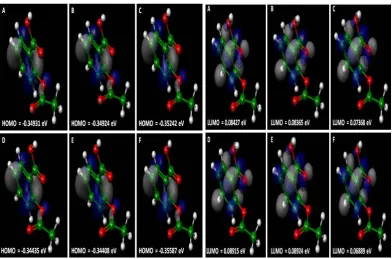
Figure 4. Orbital’s energy Homo and Lumo of aspirin in different basis sets (A – HF/3-21 G*, B – HF/ 3-21G**, C – HF/6-31G, D – HF 6-31G*, E – HF 6-31G**, F – HF 6-311G). The Homo and Lumo were visualized and calculated by the Molekel program [24].
[image:16.595.118.511.386.645.2]and this figure we note the delimited region for the HOMO orbital which measures the electron-donor character of aspirin, and the LUMO which measures the electron-acceptor character. From these definitions, two impor-tant features can be observed: the higher the energy of the HOMO greater electron-donating ability, which can be observed in HF/6-31G** with a value of HOMO = −0.34408 eV, and the lower the energy of the LUMO will be lowest resistance to accept electrons that can be noticed in HF/6-311G with a value of LUMO = 0.06889 eV. In this figure the HOMO is located in the region around the benzene ring and the acetyl group, when the substi-tuents are made in the aromatic ring or acetyl group, depending on the substituent will have a high electron den-sity, such as the carbonyls, amines or amides, the more pronounced HOMO region is strongly influenced to perform electronic stereo secondary effects, which may compromise the pharmacological activity of the com-pound. The energy of HOMO is directly related to the ionization potential of the compound and characterizes the ability of the molecule to perform nucleophilic attacks. Also in Figure4, the LUMO is located in close re-gion to the benzene ring and of the carboxylic group, so the energy of LUMO is directly related to the electron affinity, characterized by the susceptibility of the compound in relation to attacks by nucleophiles [94].
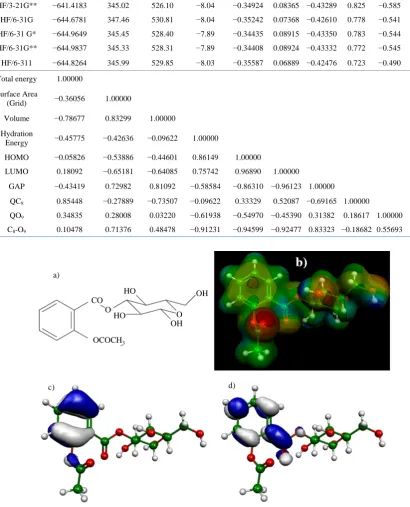
The energies of HOMO and LUMO have been used for decades as indices of chemical reactivity and are commonly correlated with other indices, such as electron affinity and ionization potential [95]-[99]. The differ-ence between the energies of the HOMO-LUMO orbitals (gap) is an important indicator of molecular stability. Molecules with low gap value are generally reactive, while molecules with higher gap value indicate high sta-bility of the molecule, in the sense of low reactivity in chemical reactions [100]. In Table1 are shown some molecular properties obtained with Hartree-Fock method in different basis sets (HF/3-21G*, HF/3-21G**, HF/6-31G, HF/6-31G*, HF/6-31G** e HF/6-311G) and the correlation matrix of Pearson [101]-[103], consi-dering how an independent variant the total energy (Etotal) of aspirin, and other properties as the dependent va-riable, this treatment was performed using Stastica 6.2 program [104]. In this table it is observed that the corre-lation between the molecular properties of aspirin is less than or equal to 0.96890 (LUMO), while the correcorre-lation between the molecular properties and the total energy is less than or equal to 0.85448 (QC8), which represents the charge on the carbon atom 8, see Figure2. Among these properties obtained those that had greater relevance to building a model QSPR in function of the total energy were the volume (−0.78677), hydration energy (−0.45775), GAP (−0.43419) and QC8 (0.85448). Therefore, we can represent the QSPR model according to the values of the statistical parameters in Equation (52) below. The statistical quality [105] of the regression equa-tions was gauged by parameters like correlation coefficient (r) or squared correlation coefficient (r2), explained variance (RA2, i.e., adjusted R
2
), standard error of estimate (SEE), and variance ratio (F) [106]-[108]. The better regression models were selected on the basis of the higher r, F value (a statistic of assessing the overall signific-ance) and the lower SEE.
( )
( )
(
)
(
)
total 286.1621 1.1850 8.7851 615.3683 39.8875 8
E = − V + HE + GAP + QC (52)
This type of treatment shows that QSPR studies are important to obtain of molecular properties that take into account different aspects of chemical information, this information can be through experiments or theoretical calculations simple counting, consider the entire molecule, fragments or functional groups, knowledge of the 3D structure of the molecule or molecular graphics his or her simply formula, information defined by scalar values, vectors or scalar fields [109].
In the discovery of a superaspirin Jacob et al. (2012) [110] synthesized by conjugation aspirin-glucose (Figure5) in order to study the solubility in water and anticancer activity as compared to aspirin and evaluated that aspirin-glucose was seven times more soluble in water than aspirin, and about 8 to 9 times more active in inhibiting cell growth than aspirin in its anticancer activity in cell culture breast, pancreatic, and cell lines pros-tate, while the activity was similar in a line benign non-cancer cells. According to the computer calculations performed to aspirin and aspirin-glucose in HF/6-31G** verified that the anticancer activity of aspirin-glucose was increased by the fact of presenting high value GAP = −0.43232 eV, having greater molecular stability and low chemical reactivity, being that the value of GAP to aspirin in HF/6-31G** was −0.43332 eV, having a vari-ation of GAP = ±10−3 eV (between aspirin and aspirin-glucose).
Table 1.Molecular properties obtained at different basis sets of aspirin and Pearson correlation matrix.
Method and basis set
Total energy (u.a)
Surface Area (Grid) (Å2)
Volume (Å3)
Hydration Energy (kcal/mol)
HOMO (eV)
LUMO (eV)
GAP
(eV) QC8 (C) QO9 (C)
C8-O9 (Å)
HF/3-21G* −641.3663 345.70 527.07 −8.00 −0.34931 0.08427 −0.43358 0.856 −0.584 1.19329 HF/3-21G** −641.4183 345.02 526.10 −8.04 −0.34924 0.08365 −0.43289 0.825 −0.585 1.19312 HF/6-31G −644.6781 347.46 530.81 −8.04 −0.35242 0.07368 −0.42610 0.778 −0.541 1.20473 HF/6-31 G* −644.9649 345.45 528.40 −7.89 −0.34435 0.08915 −0.43350 0.783 −0.544 1.18114 HF/6-31G** −644.9837 345.33 528.31 −7.89 −0.34408 0.08924 −0.43332 0.772 −0.545 1.18127 HF/6-311 −644.8264 345.99 529.85 −8.03 −0.35587 0.06889 −0.42476 0.723 −0.490 1.20201 Total energy 1.00000
Surface Area
(Grid) −0.36056 1.00000
Volume −0.78677 0.83299 1.00000 Hydration
Energy −0.45775 −0.42636 −0.09622 1.00000
HOMO −0.05826 −0.53886 −0.44601 0.86149 1.00000
LUMO 0.18092 −0.65181 −0.64085 0.75742 0.96890 1.00000
GAP −0.43419 0.72982 0.81092 −0.58584 −0.86310 −0.96123 1.00000
QC8 0.85448 −0.27889 −0.73507 −0.09622 0.33329 0.52087 −0.69165 1.00000
QO9 0.34835 0.28008 0.03220 −0.61938 −0.54970 −0.45390 0.31382 0.18617 1.00000
[image:18.595.137.490.380.671.2]C8-O9 0.10478 0.71376 0.48478 −0.91231 −0.94599 −0.92477 0.83323 −0.18682 0.55693 1.00000
Figure 5.(a) The glucose-aspirin structure was visualized using ChemSketch 12.00 program [23]. (b) Map of molecular electrostatic potential (MEP). ((c) and (d)) Orbital’s energy Homo and Lu-mo. The MEP, Homo and Lumo were visualized and calculated using Hartree-Fock (HF) method and HF/6-31G** basis set by the Molekel program [24].
a)
CO
c)
LUMO = 0.07773 eV OH
O OH
OCOCH3
HO O
HO
d)
![Figure 1. (a) The artemisinin structure and the region essential for expression of the bi-ological activity (pharmacophore) was visualized using ChemSketch 12.00 program [23]](https://thumb-us.123doks.com/thumbv2/123dok_us/8009671.763882/3.595.160.472.87.369/artemisinin-structure-essential-expression-ological-pharmacophore-visualized-chemsketch.webp)
![Figure 2. Aspirin (structure) and region essential for the expression of bi-ological (pharmacophore) was visualized using ChemSketch 12.00 pro-gram [23] and HyperChem Release 6.02 [73]](https://thumb-us.123doks.com/thumbv2/123dok_us/8009671.763882/15.595.181.450.89.195/structure-essential-expression-pharmacophore-visualized-chemsketch-hyperchem-release.webp)