COMPLEX FORMATION IN MOLTEN SALTS
STUDIED BY DISTRIBUTION METHODS
II. Ca
CHLORO COMPLEXES IN KL1NO3
H. WIRRIES and R. LINDNER
¡Jßlnijp
jUHtt i rifai] ηώ ï îL· i:; Xfc
1964
(rSfrWP? ·κ{*ιιί{
liBtje.i.li.n!·,·1!!)!'!
Joint Nuclear Research Center
Ispra Establishment - Italy
Materials Department
Reprinted from
ZEITSCHRIFT FÜR NATURFORSCHUNG
Reprinted from
Vol. 18 a, No. 7 - 1963
Ä * « j
m
m
LEGAL NOTICE
This document was prepared under the sponsorship of the Commission of the European
Atomic Energy Community (EURATOM).
lO^J
m
Neither the EURATOM Commission, its contractors nor any person acting on their behalf :
1° — Make any warranty or representation, express or implied, with respect to the accuracy,
completeness, or usefulness of the information contained in this document, or that the use
of any information, apparatus, method, or process disclosed in this document may not
infringe privately owned rights; or
2° — Assume any liability with respect to the use of, or for damages resulting from the use of
any information, apparatus, method or process disclosed in this document.
This reprint is intended for restricted distribution only. It reproduces,
by kind permission of the publisher, an article from
"ZEITSCHRIFT
FÜR NATURFORSCHUNG",
Vol. 18a, No. 7 1963, 840842. For
further copies please apply to Verlag der Zeitschrift für
Naturforschung
—
Tubingen. Uhlandsrtasse 11 (Deutschland).
Dieser Sonderdruck ist für eine beschränkte Verteilung bestimmt. Die
Wiedergabe des vorliegenden in „ZEITSCHRIFT
FÜR
NATUR
FORSCHUNG,
Vol. 18a, Nr. 7 1963, 840842 erschienenen Auf
satzes erfolgt mit freundlicher Genehmigung des Herausgebers. Bestel
lungen weiterer Exemplare sind an Verlag der Zeitschrift für
Natur
forschung
—
Tubingen. Uhlandstrasse 11 (Deutschland), zu richten.
Ce tiréàpart est exclusivement destiné à une diffusion restreinte. Il
reprend, avec l'aimable autorisation de l'éditeur, un article publié dans
«ZEITSCHRIFT
FÜR NATURFORSCHUNG»,
Vol. 18a, N° 7
1963, 840842. Tout autre exemplaire de cet article doit être demandé à
Verlag der Zeitschrift für Naturforschung
—
Tubingen. Uhlandstrasse 11
(Deutschland).
Questo estratto è destinato esclusivamente ad una diffusione
limitata.
Esso è stato riprodotto, per gentile concessione dell'Editore, da
«ZEITSCHRIFT
FÜR NATURFORSCHUNG»,
Vol. 18a, N" 7
1963, 840842. Ulteriori copie dell'articolo debbono essere richieste a
Verlag der Zeitschrift für Naturforschung
—■
Tubingen.
Uhland
strasse 11 (Deutschland).
Deze overdruk is slechts voor beperkte verspreiding bestemd. Het artikel
is met welwillende toestemming van de uitgever overgenomen uit
„ZEITSCHRIFT
FÜR NATURFORSCHUNG",
Vol. 18α,
Νο.7~
1963, 840842. Meer exemplaren kunnen besteld worden bij Verlag
der Zeitschrift für Naturforschung
—
Tubingen, Uhlandstrasse 11
(Deutschland).
M
'■¿Κ
lÉiáliililii
EUR 395-e
Part II REPRINTCOMPLEX FORMATION IN MOLTEN SALTS STUDIED BY DISTRIBU TION METHODS II. Ca CHLORO COMPLEXES IN KLiN03 by
J.O. LILJENZIN, H. REINHARDT, H. WIRRIES and R. LINDNER.
European Atomic Energy Community EURATOM. Joint Nuclear Research Center Ispra Establishment (Italy). Materials Department.
Reprinted from "Zeitschrift für Naturforschung" Vol. 18α, No. 7 1903 pages 840842.
With a distribution technique described earlier the stability constants of cadmili mchloro complexes were evaluated. The values obtained are practically identical with those obtained by other authors with Polarographie methods with the exception of the first complex constant which was found to be conside rably higher (832) than that described in the literature (200).
EUR 395.e
Part II REPRINTCOMPLEX FORMATION IN MOLTEN SALTS STUDIED BY DISTRIBU TION METHODS II. Ca CHLORO COMPLEXES IN KLiN03 by
J.O. LILJENZIN, H. REINHARDT, Η. WIRRIES and R. LINDNER.
European Atomic Energy Community EURATOM. Joint Nuclear Research Center Ispra Establishment (Italy). Materials Department.
Reprinted from "Zeitschrift für Naturforschung" Vol. 18«, No. 7 19G3 pages 840842.
Sonderabdruck aus der Z E I T S C H R I F T F Ü R N A T U R F O R S C H U N G Band 18 a, Heft 7, 1963 V e r l a g d e r Z e i t s c h r i f t f ü r N a t u r f o r s c h u n g , T ü b i n g e n
Complex Formation in Molten Salts Studied by Distribution Methods
I L Cd — Chloro C o m p l e x e s in K - L i - N 03
840
J. O. LILJENZIN, H. REINHARDT, H. WIRRIES AND R. LINDNERComplex Formation in Molten Salts Studied by Distribution Methods
I I . C d — C h l o r o C o m p l e x e s i n K L i N 03
B y J . 0 . L I L J E N Z I N , H . R E I N H A R D T , H . W I R R I E S * a n d R . L I N D N E R
Materials Department, CCR Euratom Ispra (Italy)
(Z. Naturforschg. 18 a, 840—842 [1963] ; eingegangen am 22. April 1963)
With a distribution technique described earlier the stability constants of cadmiumchloro com plexes were evaluated. The values obtained are practically identical with those obtained by other authors with Polarographie methods with the exception of the first complex constant which was found to be considerably higher (832) than that described in the literature (200).
I n an earlier paper 1 we have studied the distribu
tion between g r a i n s of alumina and nitrate melts of cations m o r e or less complexed by the addition of chloride ion. F r o m the dependence of the distri bution coefficient on chloride concentration various complex constants can be evaluated in a similar way as has been shown for aqueous solutions in m a n y cases.
Compared with our first paper we introduce a change of the treatment of the information gained by the experiments inasmuch as the values for the complex constants are obtained purely analytically by a least square method.
T h e o r y
We start from the equation
ΚΛ
¿o+ Σβηλη[Α]ΐ
«=_1 _
(D
ΚΛ= V [ M A „ ]S/ _^ [ΜΑ„]ι is the distribution
co-n~0 « = 0
efficient, λ0 is the value of K¿ in the absence of complex forming anions, λ„ = [ M A „ ]s/ [ M A „ ] i is
the distribution coefficient for the rcth complex,
βη= [ M A „ ] i / [ M ] i [ A ] " is the complexity product
for formation of the complex MA„ , and [ A ] I = CAI is the concentration of the free complex forming anions in the liquid phase. Introducing the follow ing simplifications and substitutions, y = K¿,
X = [ A ] , and αη = βηλη, eq. (1) is consequently
transformed to
y=
Σ*
ηχ
ηΐΣβ»χ
ηΜ=ϋ « = 0
(2)
The deviation U/ is defined as
(
CO so \Vi Σ βηΧ"- Σ αη*ί" ■ (3)
η=0 κ = 0 Ι
A certain weight, ιυ,, can be assigned to each meas ured point, thus compensating for the different pre cisions. According to the wellknown Ä^method
1
ΔΙ.
(4)
where Ay¡ stands for the s t a n d a r d deviation.
The sum, U, of the squared and weighted devia tions is
U-( = 1
(5)
When U is minimized the following system of equa tions is obtained for the a's and y?'s
1 = 1
Ν
Σ ^ ϊ ί ^ '
y¡ Σ βηχ.
Ν
.η V
α„ χ
0;
η = 0
λ1 = 1 , 2 , . . . , ^ , ( 6 a )
Σ
™>Φ
ί
Vi Σ
ßη Χ?
Σ «« *|" ) 0;
«=η /
k
2=l,2,....K
2(6 b)
f l n = {)
where Kt = Ν and K2 has the same value as the
highest index of a. The solution to this equation system gives the best values for the a's and ß7s.
Considering the variation of the measured distri bution coefficient for a certain anion concentration
I n p a r t i a l f u l f i l m e n t of a p l a n n e d t h e s i s to b e p r e s e n t e d to t h e F a c u l t y of S c i e n c e of t h e T e c h n i c a l U n i v e r s i t y of B r u n s w i c k ( G e r m a n y ) .
COMPLEX FORMATION IN MOLTEN SALTS. II. Cd-Cl-COMPLEXES 8 4 1
with the cadmium concentration on the alumina it was necessary to recalculate K¿ to a new constant
K<\* corresponding to a low and constant loading on the alumina '2· 3. For comparison reference is made
to similar methods which can be found in the litera-ture 4~7.
To carry out the numerical calculations a FOR-TRAN-program was written and run on the com-puter IBM-7090.
E x p e r i m e n t s
As described in our earlier paper ' equilibrium of the distribution of the more or less complexed ions between 7-Al20;) and an eutectic melt of K — Li — N 03
was obtained in pyrex test tubes at 160 °C. By filtration the phases were separated and the radioactivity of the melt, containing Cd-115m, was measured from which
the distribution coefficient could be calculated.
The chloride concentration was determined by Po-tentiometrie titration with silver nitrate. The amount of alumina powder used in each experiment was de-termined after washing with water and drying.
Results
First of all the distribution isotherm of pure cad-mium and complexed cadcad-mium between the solid and liquid phase had to be checked. The results are represented in Fig. 1.
It is evident from this figure that the slope of the curves is not one, but 0.7. This means that K¿ is a function of the cadmium concentration on the alu-mina which could partly be explained by the format-ion of dimer molecules8. Nevertheless the slope
seems to be independent of the chloride concentra-tion.
The recalculated values, K{*, which were used
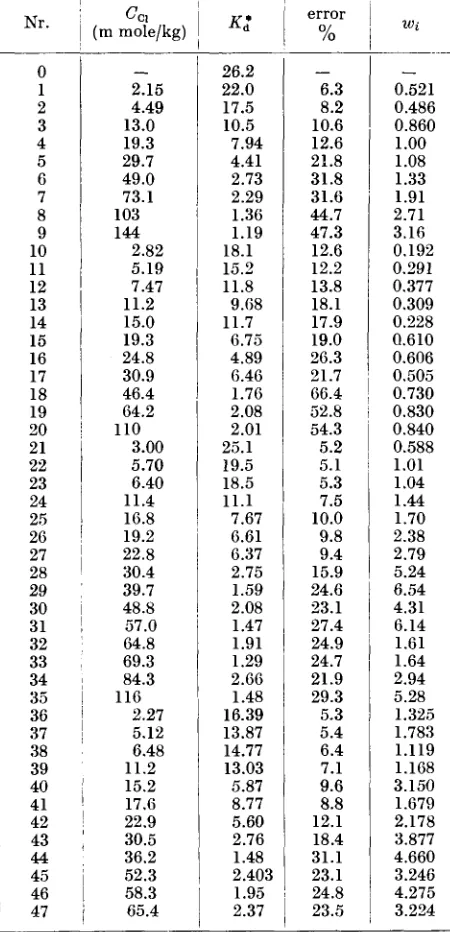
for the calculation of the complex constants are as-sembled in Fig. 2. The experimental errors as dis-cussed above are contained in Table 1.
Fig. 1. Distribution of Cd between K —Li —N03 melt and
alumina at 160 CC as function of Cd concentration at various
chloride concentrations.
Fig. 2. Distribution of Cd between K — Li — ¡\Ό3 melt and
A1203 as function of chloride concentration.
Finally according to equations (6 a) and (6 b) the constants for stepwise complex formation are calculated and the values are given in Table 2, first line. The same table contains the respective values obtained by CHRISTIE and OSTERYOUNG 9 and INMAN8.
S. FRONAEUS, Acta Chem. Scand. 5, 859 [1951].
S. FRONAEUS, The Use of Ion Exchangers for the Investiga tion of Complex Equilibria; Proc. Sympos. on Coordination Chemistry, Copenhagen 1953, p. 61.
J. A. CHOPOORIAN, G. R. CHOI-PIN, H. G. GRIFFITH and R. CHANDLER, J. Inorg.Nucl. Chem. 21, 21 [1961].
J. C. SULLIVAN, J. RYDBERG and W. F. MILLER, Acta Chem.
Scand. 13, 2023 [1959].
J. RYDBERG, Acta Chem. Scand. 15, 1723 [1961].
7 R. H. MOORE and R. K. ZEIGLF.R, The Solution of the General
Least Squares Problem with Special Reference to High-Speed Computer; LA-2367, Los Alamos Scientific Labora tory, New Mexico, 1960.
8 D. INMAN, The Potentiometrie Study of Complex Ions in the
Molten Solvent Ν Stockholm 1962.
0 J. H. CHRISTIE and R. A. OSTERYOUNG, J. Amer. Chem. Soc.
842 COMPLEX FORMATION IN MOLTEN SALTS. II. CdClCOMPLEXES Nr. 0 1 2 3 4 5 6 7 8 9 10 11 12 13 14 15 16 17 18 19 20 21 22 23 24 25 26 27 28 29 30 31 32 33 34 35 36 37 38 39 40 41 42 43 44 45 46 47 Cci (m mole/kg)
2.15 4.49 13.0 19.3 29.7 49.0 73.1 103 144 2.82 5.19 7.47 11.2 15.0 19.3 24.8 30.9 46.4 64.2 110 3.00 5.70 6.40 11.4 16.8 19.2 22.8 30.4 39.7 48.8 57.0 64.8 69.3 84.3 116 2.27 5.12 6.48 11.2 15.2 17.6 22.9 30.5 36.2 52.3 58.3 65.4
κ;
26.2 22.0 17.5 10.5 7.94 4.41 2.73 2.29 1.36 1.19 18.1 15.2 11.8 9.68 11.7 6.75 4.89 6.46 1.76 2.08 2.01 25.1 19.5 18.5 11.1 7.67 6.61 6.37 2.75 1.59 2.08 1.47 1.91 1.29 2.66 1.48 16.39 13.87 14.77 13.03 5.87 8.77 5.60 2.76 1.48 2.403 1.95 2.37 error /o 6.3 8.2 10.6 12.6 21.8 31.8 31.6 44.7 47.3 12.6 12.2 13.8 18.1 17.9 19.0 26.3 21.7 66.4 52.8 54.3 5.2 5.1 5.3 7.5 10.0 9.8 9.4 15.9 24.6 23.1 27.4 24.9 24.7 21.9 29.3 5.3 5.4 6.4 7.1 9.6 8.8 12.1 18.4 31.1 23.1 24.8 23.5 IVi 0.521 0.486 0.860 1.00 1.08 1.33 1.91 2.71 3.16 0.192 0.291 0.377 0.309 0.228 0.610 0.606 0.505 0.730 0.830 0.840 0.588 1.01 1.04 1.44 1.70 2.38 2.79 5.24 6.54 4.31 6.14 1.61 1.64 2.94 5.28 1.325 1.783 1.119 1.168 3.150 1.679 2.178 3.877 4.660 3.246 4.275 3.224Two things can be seen clearly :
As observed in a n u m b e r of cases the substitu tion of sodium by lithium in nitrate melts does not
lower the complex formation constants of metal halogen complexes. On the contrary, these constants are increased.
Secondly, cadmium shows a very high constant of the formation of the first chloro complex which is already evident from F i g . 2 . The value stated by us
Our values Values according
to CRISTIE and OSTERYOUNG9
(LiKAOa Eut.) Values according
to INMAN8
(NaKNOs Eut.)
n = l
832
200
40
n = 2
2.300
3.000
200
n = 3
120.000
120.000
n = 4
600.000
600.000
11.800!
Table 1. Experimental Error of Determination.
Table 2. CdCln Complex Formation Constants (ßn).
is even higher than that found by CHRISTIE and OSTEROUNG, but our method should give better re sults in the low chloride concentration range than
the Polarographie method used by those a u t h o r s .
The mathematical method used in this p a p e r seems to us of a more universal use than that in our previous paper *. We intend to investigate simi lar systems, especially those of u r a n i u m and fission products in nitrate melts or other molten salts.
A c k n o w l e d g e m e n t
[image:8.576.70.295.65.531.2]